11th Information Technology Practicals Skill Set 4 Exercise Accounting Package (GNUKhata) Practical Problems Solutions Maharashtra Board

Accounting Package (GNUKhata) 11th Information Technology Practicals Skill Set 4 Solutions Maharashtra Board

Balbharati Maharashtra State Board Class 11 Information Technology Solutions Practicals Skill Set 4 Accounting Package (GNUKhata) Textbook Exercise Questions and Answers.

Class 11 Information Technology Practicals Skill Set 4 Exercise Solutions

SOP 1: Use of Accounting Package to create a company.
Create a company with the following particulars.
Company Name: B.B Enterprises
Case: Upper Case
Company Type: Profit Making
Financial Year: 01-04-2019 to 31-03-2020
Use GNUKhata for: Accounting Only
Create a profile with relevant data for any company. Create an Admin account for the company.
Answer:
Step 1: Open GNUKhata Application. Click on ‘company Setup Wizard’ or (press shift + control + C)

Step 2: While creating a company the following details are to be given.
Company Name: B.B Enterprises
Case: Upper Case
Company Type: Profit Making
Financial Year: 01/04/2019 to 31/03/2020
Use GNUKhata for: Accounting Only
Fill in all the required details and click on proceed button on the right button corner.

Step 3: Enter Appropriate Company Information in the Given Field.
Company Profile window appears, in that window fill in the details and click on proceed button on the right bottom corner.

Step 4: Create Admin Next step is the ‘create Admin’ which is mandatory with proper user name and password. Fill in the fields and click on ‘Create & Login button, the company will be created.
Now your Company is ready.

Step 5: Admin Dashboard After login, the following admin dashboard, appears.

Maharashtra Board Class 11 Information Technology Practicals Skill Set 4 Accounting Package (GNUKhata)
SOP 2: Create ledger accounts using the accounting Package.
Create ledger accounts for the following and allocate proper groups.

  1. Import duty
  2. Insurance
  3. Machinery
  4. Audit Fee
  5. Purchase
  6. Sales
  7. Telephone charges
  8. Interest Received
  9. Salary
  10. Professional fees

Answer:
Step 1: You Can select an already created company using the ‘Select Existing Company ’ Option on Opening Screen.

Step 2: Log in with User Name and Password

Step 3: To create an account (ledger account) click on the Hamburger Menu available at the left top corner of the dashboard.
Click on the Master Account → It allows you to create an account.
The following table shows the group name, sub-group name, and account name which are to be created.

Group NameSub Group NameAccount / Ledger Name
Direct ExpensesNoneImport Duty
Indirect ExpensesNoneInsurance
Fixed AssetsPlant & MachineryMachinery
Indirect ExpensesNoneAudit fee
Direct ExpenseNonePurchase
Direct IncomeNoneSales
Indirect ExpenseNoneTelephone charges
Indirect IncomeNoneInterest received
Indirect ExpenseNoneSalary
Direct IncomeNoneProfessional Fees

Class 11 Information Technology Textbook Solutions
11th Information Technology Practicals Skill Set 3 Exercise Client Side Scripting (JavaScript) Practical Problems Solutions Maharashtra Board

Client Side Scripting (JavaScript) 11th Information Technology Practicals Skill Set 3 Solutions Maharashtra Board

Balbharati Maharashtra State Board Class 11 Information Technology Solutions Practicals Skill Set 3 Client Side Scripting (JavaScript) Textbook Exercise Questions and Answers.
Class 11 Information Technology Practicals Skill Set 3 Exercise Solutions
SOP 1: Create a JavaScript program for the following using appropriate variables, JavaScript inbuilt functions, and control structures.

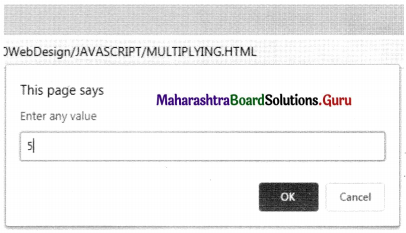
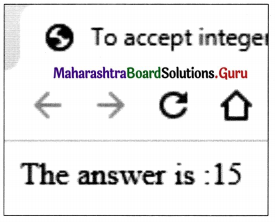
  • To accept an integer and display the result by multiplying it with 3.
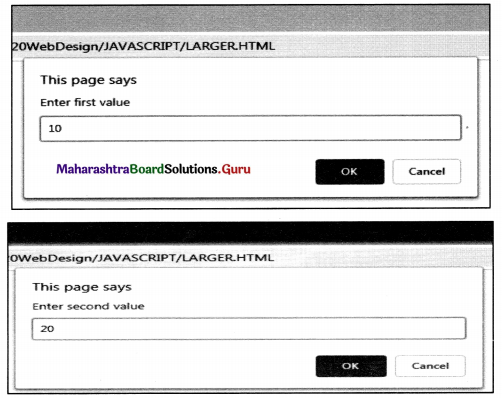
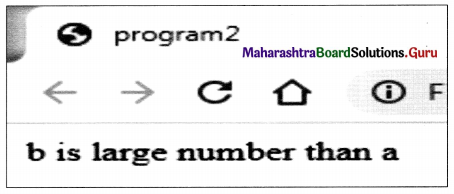
  • To accept two integers and display a larger number of them.
  • To check whether the user entered number is positive or negative.

Answer:
To accept integer and display the result by multiplying it with 3.
<!DOCTYPE html>
<head>
<title>To accept integer and display the result by multiplying it with 3.</title>
</head>
<body>
<script language=”javascript”> var a,no,ans;
a=prompt(Enter any value’);
no=parseInt(a);
ans=no*3;
document.
write(“The answer is :”+ans);
</script>
</body>
</html>

Maharashtra Board Class 11 Information Technology Practicals Skill Set 3 Client Side Scripting (JavaScript) SOP 1
Maharashtra Board Class 11 Information Technology Practicals Skill Set 3 Client Side Scripting (JavaScript) SOP 1.1
Maharashtra Board Class 11 Information Technology Practicals Skill Set 3 Client Side Scripting (JavaScript)
To accept two integers and display larger number of them.
<!DOCTYPE html>
<head>
<title>To accept two integers and display larger number of them.</title>
</head>
<body>
<script language=”javascript”>
var a,b;
a=prompt(‘Enter first value’);
b=prompt(‘Enter second value’);
if(a>b)
document.write(“a is large number than b “);
else
document. write(“b is large number than a”);
</script>
</body>
</html>

Maharashtra Board Class 11 Information Technology Practicals Skill Set 3 Client Side Scripting (JavaScript) SOP 1.2
Maharashtra Board Class 11 Information Technology Practicals Skill Set 3 Client Side Scripting (JavaScript) SOP 1.3
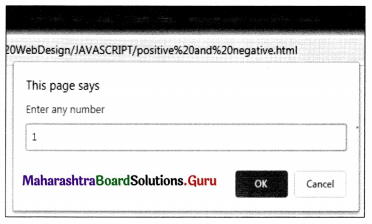
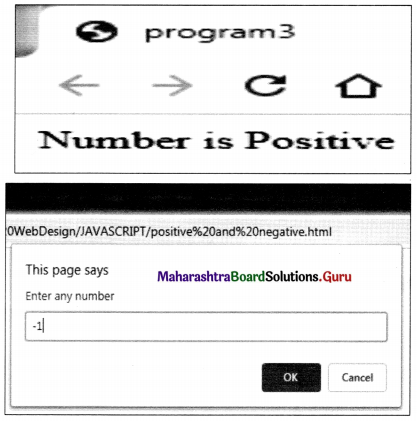
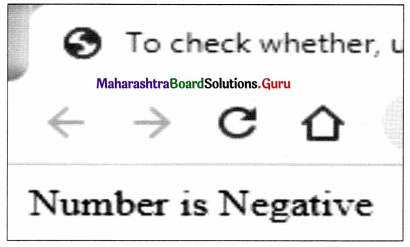
To check whether, user entered number is positive or negative.
<!DOCTYPE html>
<head>
<title>To check whether, user entered number is positive or negative</title>
</head>
<body>
<script language=”javascript”>
var a,no;
a=prompt(‘Enter any number’);
no=parseInt(a);
if(no>0)
document.write(“Number is Positive”);
else
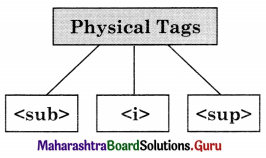
document.write(“Number is Negative”);
</script>
</body>
</html>

Maharashtra Board Class 11 Information Technology Practicals Skill Set 3 Client Side Scripting (JavaScript) SOP 1.4
Maharashtra Board Class 11 Information Technology Practicals Skill Set 3 Client Side Scripting (JavaScript) SOP 1.5
Maharashtra Board Class 11 Information Technology Practicals Skill Set 3 Client Side Scripting (JavaScript) SOP 1.6
SOP 2: Create a JavaScript program for the following using appropriate variables, JavaScript inbuilt functions, and control structures.

  • To accept two positive or negative numbers and check whether they are equal or not.
  • To accept a number and display the square of it.
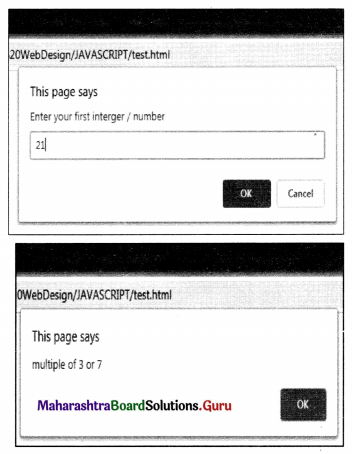
  • To check whether the accepted integer is multiple of 3 or multiple of 7.

Answer:
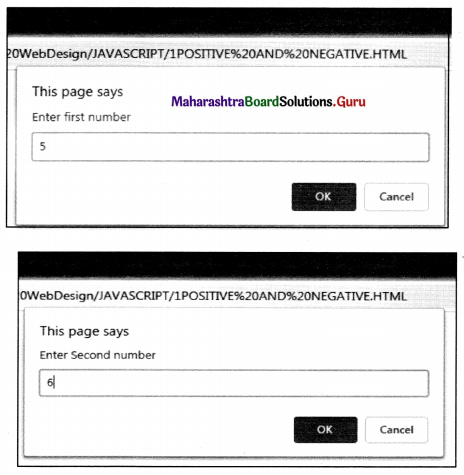
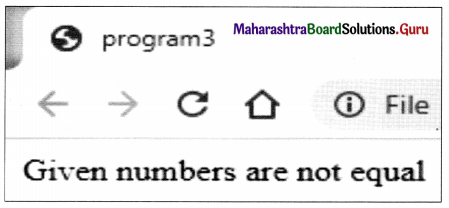
To accept two positive or negative numbers and check whether they are equal or not.
<!DOCTYPE html>
<head>
<title>program3</title>
</head>
<body>
<script language=”javascript”> var no1,no2;
no1=prompt(‘Enter first number’);
no2=prompt(‘Enter Second number’);
if(no1==no2)
document.write(“Both are equal”);
else
document.write(“Given numbers are not equal”);
</script>
</body>
</html>

Maharashtra Board Class 11 Information Technology Practicals Skill Set 3 Client Side Scripting (JavaScript)
Maharashtra Board Class 11 Information Technology Practicals Skill Set 3 Client Side Scripting (JavaScript) SOP 2
Maharashtra Board Class 11 Information Technology Practicals Skill Set 3 Client Side Scripting (JavaScript) SOP 2.1
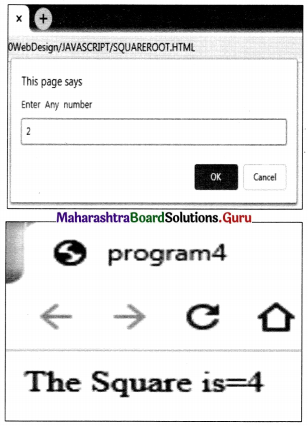
To accept number and display square of it.
<!DOCTYPE html>
<head>
<title>To accept number and display square of it</title>
</head>
<body>
<script language-’j avascript”>
var no,sqr;
no=prompt(‘Enter Any number’);
sqr=no*no;
document, write (“The Square is=”+sqr);
</script>
</body>
</html>

Maharashtra Board Class 11 Information Technology Practicals Skill Set 3 Client Side Scripting (JavaScript) SOP 2.2
To check whether the accepted integer is multiple of 3 or multiple of 7.
<!DOCTYPE html>
<html>
<head>
<title>To check whether the accepted integer is multiple of 3 or multiple of 7.</title>
</head>
<body>
<script language=JavaScript>
var a;
a=prompt(“Enter your first interger / number”);
if(a%3==0 | | a%7==0)
alert(“multiple of 3 or 7”);
else
alert(“not a multiple of 3 or 7”);
</script>
</body>
</html>

Maharashtra Board Class 11 Information Technology Practicals Skill Set 3 Client Side Scripting (JavaScript) SOP 2.3
SOP 3: Create a JavaScript program for the following using appropriate variables, JavaScript inbuilt string functions, and control structures.

  • To accept a string and calculate its length.
  • To accept a string and display it in lowercase and uppercase.
  • To check whether the length of the string is 4 or greater.

Answer:
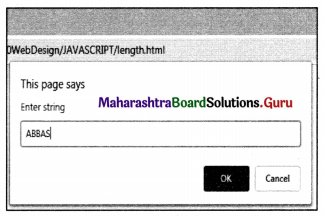
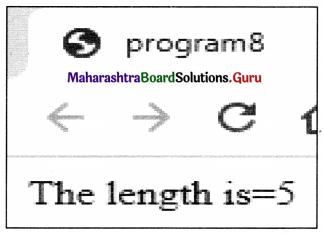
To accept a string and calculate its length.
<!DOCTYPE html>
<head>
<title>program8</title>
</head>
<body>
<script language=”javascript”>
var a;
a=prompt(‘Enter string’);
document.write(“The length is=”+a.length);
</script>
</body>
</html>

Maharashtra Board Class 11 Information Technology Practicals Skill Set 3 Client Side Scripting (JavaScript)
Maharashtra Board Class 11 Information Technology Practicals Skill Set 3 Client Side Scripting (JavaScript) SOP 3

Maharashtra Board Class 11 Information Technology Practicals Skill Set 3 Client Side Scripting (JavaScript) SOP 3.1
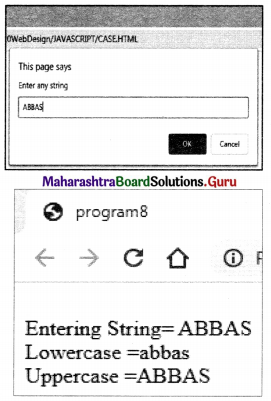
To accept string and display it into lowercase and uppercase.
<!DOCTYPE html>
<head>
<title> To accept string and display it into lowercase and uppercase</title>
</head>
<body>
<script language=”javascript”>
var a;
a=prompt(‘Enter any string’);
document.write(“<br>Entering Strings “+a);
document.write(“<br>Lowercase=”+a.toLowerCase());
document.writeln(“<br>Uppercase=”+a.toUpperCase());
</script>
</body>
</html>

Maharashtra Board Class 11 Information Technology Practicals Skill Set 3 Client Side Scripting (JavaScript) SOP 3.2
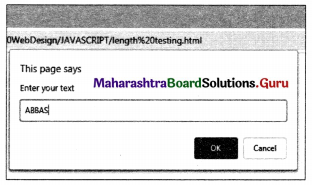
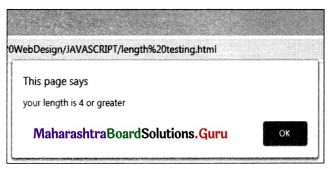
To check whether the length of string is 4 or greater.
<!DOCTYPE html>
<html>
<head>
<title> JavaScript</title>
</head>
<body>
<script language=JavaScript>
var a,b;
a=prompt(“Enter your text”);
b=a.length;
if(b=4 || b>=4)
alert(‘‘your length is 4 or greater”);
else
alert(“your text length is below 4”);
</script>
</body>
</html>

Maharashtra Board Class 11 Information Technology Practicals Skill Set 3 Client Side Scripting (JavaScript) SOP 3.3
Maharashtra Board Class 11 Information Technology Practicals Skill Set 3 Client Side Scripting (JavaScript) SOP 3.4
Maharashtra Board Class 11 Information Technology Practicals Skill Set 3 Client Side Scripting (JavaScript)
SOP 4: Create event-driven JavaScript programs for the following using appropriate variables, JavaScript inbuilt functions, and control structures.
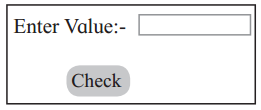
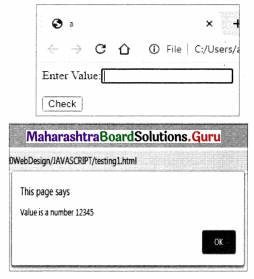
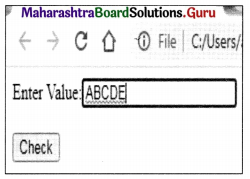
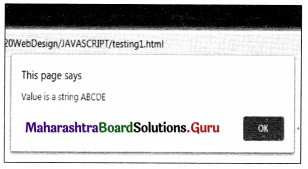
To accept numbers and validate if the given value is a number or not by clicking on the button.
Maharashtra Board Class 11 Information Technology Practicals Skill Set 3 Client Side Scripting (JavaScript) SOP 4.4
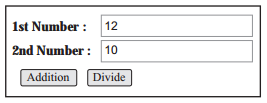
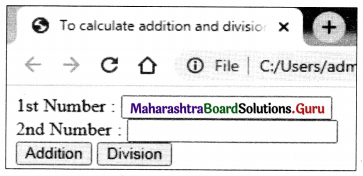
To calculate the addition and division of two numbers.
Maharashtra Board Class 11 Information Technology Practicals Skill Set 3 Client Side Scripting (JavaScript) SOP 4.5

Answer:
To accept number and validate if the given value is a number or not by click
<!DOCTYPE html>
<html>
<head>
<title> To accept number and validate if the given value is a number or not by clicking on the button.
</title>
</head>
<script language-’JavaScript”>
function display()
{
var a,b;
a=form1.t1;value;
if(a>=0)
alert(“Value is a number”+” “+a);
else
alert(“Value is a string”+” “+a);
}
</script>
</head>
</body>
<form name=form1>
Enter Value: <Input type=text name=t1><br><br>
<Input type=button value=Check onClick=”display()”>
</form>
</body>
</html>

Maharashtra Board Class 11 Information Technology Practicals Skill Set 3 Client Side Scripting (JavaScript) SOP 4

Maharashtra Board Class 11 Information Technology Practicals Skill Set 3 Client Side Scripting (JavaScript) SOP 4.1

Maharashtra Board Class 11 Information Technology Practicals Skill Set 3 Client Side Scripting (JavaScript) SOP 4.2
Maharashtra Board Class 11 Information Technology Practicals Skill Set 3 Client Side Scripting (JavaScript)
To calculate addition and division of two numbers.
<!DOCTYPE html>
<head>
<title>To calculate addition and division of two numbers.</title>
<script langauge=”javascript”>
function add()
{
var a,b,result;
a=f1.t1.value;
b=f1.t2.value;
result=parselnt(a)+parselnt(b);
document.write(“The Addition is =”+result);
}
function div()
{
var a,b,d;
a=f1.t1.value;
b=f1.t2.value;
d=parselnt(a)/parselnt(b);
document.write(“The Divide is =”+d);
}
</script>
</head>
<body>
<form name=”f1”>
1st Number : <input type=”text” name=”t1”><br>
2nd Number : <input type=”text” name=”t2”><br>
<input type=”button” value=”Addition” name=”b1” onClick=”add()”>
<input type=”button” value=”Division” name=”b2” onClick=”div()”>
</form>
</body>
</html>

Maharashtra Board Class 11 Information Technology Practicals Skill Set 3 Client Side Scripting (JavaScript) SOP 4.3
Class 11 Information Technology Textbook Solutions
11th Information Technology Practicals Skill Set 2 Exercise Web Designing (HTML – 5) Practical Problems Solutions Maharashtra Board

Web Designing (HTML – 5) 11th Information Technology Practicals Skill Set 2 Solutions Maharashtra Board

Balbharati Maharashtra State Board Class 11 Information Technology Solutions Practicals Skill Set 2 Web Designing (HTML – 5) Textbook Exercise Questions and Answers.
Class 11 Information Technology Practicals Skill Set 2 Exercise Solutions
SOP 1: Write a program using HTML with the following specifications.

  • The background colour should be green.
  • The text colour should be red.
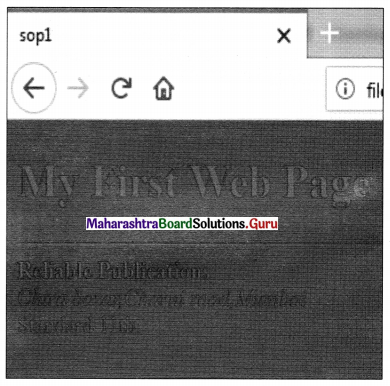
  • The heading should be as large in size as ‘My First Web Page’.
  • Display a horizontal line after the heading.
  • Display your name in Bold, address in Italics, and standard as 11th.

Answer:
<!DOCTYPE html>
<html>
<head>
<title>sop1</title>
</head>
<body bgcolor=green text= red>
<h1> My First Web Page </h1>
<hr>
<b> Reliable Publications</b>
<br>
<i> Chira bazar,Charni road,Mumbai</i>
<br>
Standard 11th.
</body>
</html>

Maharashtra Board Class 11 Information Technology Practicals Skill Set 2 Web Designing (HTML - 5) SOP 1
Maharashtra Board Class 11 Information Technology Practicals Skill Set 2 Web Designing (HTML - 5)
SOP 2: Create a web page with, following specifications.

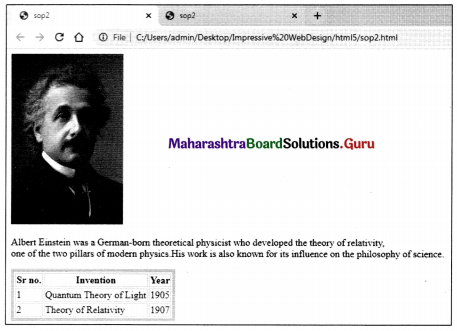
  • Image of any scientist with an alternate text as his name.
  • Create a paragraph related to the information of that scientist.
  • Create a table of his/her inventions.

Answer:
<!DOCTYPE html>
<html>
<head>
<title>sop2</title>
</head>
<body>
<img src=”Albert Einstein.jpg” alt=”Albert Einstein”>
<br>
<p>
Albert Einstein was a German-born theoretical physicist who developed the theory of relativity,<br> one of the two pillars of modern physics.His work is also known for its influence on the philosophy of science.
</p>
<table border=5 bordercolor=pink>
<tr>
<th> Sr no.</th>
<th> Invention </th>
<th> Year</th>
</tr>
<tr>
<td>1</td>
<td>Quantum Theory of Light </td>
<td>1905</td>
</tr>
<tr>
<td>2</td>
<td>Theory of Relativity</td>
<td>1907</td>
</tr>
</table>
</body>
</html>

Maharashtra Board Class 11 Information Technology Practicals Skill Set 2 Web Designing (HTML - 5) SOP 2
SOP 3: Create a webpage with the following specifications.

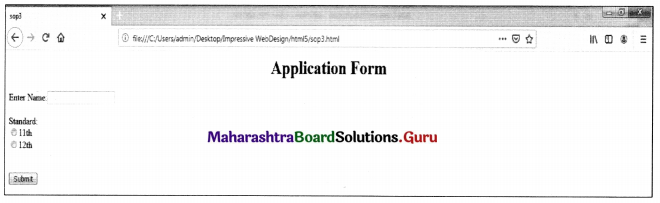
  • Display heading ‘Application Form’ in the highest heading with center alignment.
  • Accept name, standard 11th or 12th with only one selection choice.
  • Submit the form.

Answer:
<! DOCTYPE html>
<html>
<head> <title> sop3</title>
</head>
<body>
<h1 align=center> Application Form </h1>
<form>
Enter Name:<input type=text name=t1>
<br><br>
Standard:<br>
<input type=”radio” name=r1>11th<br>
<input type=”radio” name=r1>12th<br>
<br><br>
<input type=”submit” value=”Submit”>
</form>
</body>
</html>

Maharashtra Board Class 11 Information Technology Practicals Skill Set 2 Web Designing (HTML - 5) SOP 3
Maharashtra Board Class 11 Information Technology Practicals Skill Set 2 Web Designing (HTML - 5)

SOP 4: Write a program using HTML with the following specification.
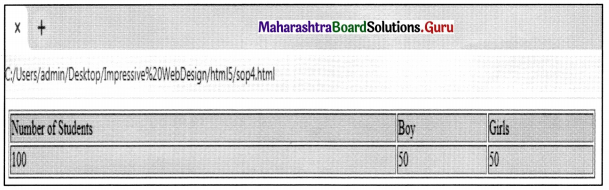
A webpage with details about a class with a total number of students-100, (Boys – 50), Girls – 50 in tabular form.
e.g.
Maharashtra Board Class 11 Information Technology Practicals Skill Set 2 Web Designing (HTML - 5) SOP 4
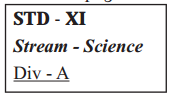
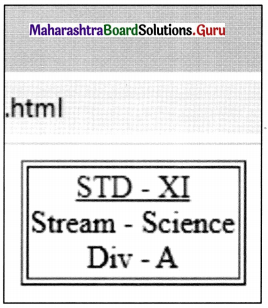
Link this page to another page as follows.
Maharashtra Board Class 11 Information Technology Practicals Skill Set 2 Web Designing (HTML - 5) SOP 4.1
Demo.html
Answer:
<!DOCTYPE html>
<html>
<head>
<title>New Page 1</title>
</head>
<body>
<center>
<table border=”1” width=”69%” >
<tr bgcolor=pink>
<td>Number of Students</td>
<td>Boy</td>
<td>Girls</td>
</tr>
<tr bgcolor=”lightgreen”>
<td>100</td>
<td>50</td>
<td>50</td>
</tr>
</table>
</body>
</html>

Maharashtra Board Class 11 Information Technology Practicals Skill Set 2 Web Designing (HTML - 5) SOP 4.2
Demo
<!DOCTYPE html>
<html>
<head>
<title>the heading</title>
</head>
<BODY>
<header>
<center>
<table border=”1” align=center>
<tr align=center>
<td><a href=”sop4.html”>STD – XI</a>
<br>Stream – Science<br>
Div – A<br></td>
</tr>
</table>
</body>
</html>

Maharashtra Board Class 11 Information Technology Practicals Skill Set 2 Web Designing (HTML - 5) SOP 4.3
Class 11 Information Technology Textbook Solutions
11th Information Technology Practicals Skill Set 1 Exercise Daily Computing (Libre Office) Practical Problems Solutions Maharashtra Board
Daily Computing (Libre Office) 11th Information Technology Practicals Skill Set 1 Solutions Maharashtra Board
Balbharati Maharashtra State Board Class 11 Information Technology Solutions Practicals Skill Set 1 Daily Computing (Libre Office) Textbook Exercise Questions and Answers.
Class 11 Information Technology Practicals Skill Set 1 Exercise Solutions
SOP 1: Create a Resume

  • The resume should contain the following :
  • Title at the center with applicable font and size.
  • It should contain points such as Name, Address, Mobile Number, Date of Birth, Nationality, Caste, Category, Hobbies, etc. Add some extra points.
  • For educational qualifications, a student should insert a table.
  • In the end, students should write a few lines about their aim.

Answer:
Step 1: Click on the LibreOffice Writer icon.

Step 2: Create a New File.
File Menu → New → Text Document

Step 3: Write Title at the center with applicable font size. (Resume).

Step 4: Type Name, Address, Mobile Number, Date of Birth, Nationality, Caste, Category, Hobbies, etc.

Step 5: Write Student educational qualifications (Insert Table).
Choose Table Menu → Insert Table → Select number of rows and columns → Insert.

Step 6: Write some lines about the aim, select the text and make it bold by clicking on the bold option from the formatting toolbar.

After Completing this practical students will learn how to create resumes using LibreOffice, also tab setting and table creation.

Maharashtra Board Class 11 Information Technology Practicals Skill Set 1 Daily Computing (Libre Office)
SOP 2: By using Mail Merge send an invitation for your birthday party.

  • Use the mail merge feature.
  • Send an invitation to at least 5 friends.

Answer:
Choose Tools – Mail Merge Wizard.
Step 1: Select Start from a template, and click the Browse button. You see the New dialog.

Step 2: Select five friends Details in the left list, and then the Invitation letter in the right list.
Click OK to close the Templates dialog, and click Next in the wizard.

Step 3: Select Letter and click Next.

Step 4: On the next step of the wizard, click the Select Address List button to check that you are using the correct address list. If you want to use an address block, select an address block type, match the data fields if necessary, and click Next.

Step 5: Next follows the Create a salutation step. Deselect the Insert personalized salutation box. Under General salutation, select the salutation that you want on top of all letters.

Step 6: If you want to place mail merge fields anywhere else in the Invitation document select the corresponding column in your address data source and then drag and drop the column header into the invitation document where you would like the field to be. Be sure to select the entire column.

Step 7: Click Next and finally Finish creating the mail merge.

SOP 3: Create a mark list. The mark list should display:

  • Fields as Name, Math, Physics, Chemistry, Biology, Total, Percentage.
  • Below each subject find out the lowest marks and highest marks.
  • Enter a minimum of 10 records.
  • Declare the first three ranker students.
  • Create a chart based on the above data.

Answer:
Step 1: Open LibreOffice Calc and add fields like Name, Math, Physics, Chemistry, Biology, Total, Percentage.

Step 2: Enter 10 records in it.

Step 3: To Calculate Total
Click inside the cell where the total has to be calculated.
(Use =SUM(A2:D2) formula) – Type the range of cell.

Step 4: Now click inside the cell where the percentage has to be calculated.
Calculate Percentage using formula = E2* 100/400, drag the formula for remaining cells.

Step 5: Enter a minimum of 10 records. And calculate the result.

Step 6: Find out the Lowest Marks
Calculate Lowest marks using formula = min(A2:A11), drag formula for remaining cells.

Step 7: Find out the Highest Marks
Calculate Highest marks using formula =max(A2:A11), drag formula for remaining cells.

Step 8: Now Show the first three ranker students. Use Sort Option for sorting and auto filter.

Step 9: To find the first ranker use formula =large(F2:F11,1)

Step 10: To find the second ranker use formula =large(F2:F11,2)

Step 11: To find the third ranker use formula =large(F2:F11,3)

Step 12: To create a chart Select Complete Table → Click on Insert Menu → Click on Chart Option.
A window will appear, which starts with the chart wizard → Select Chart type.

Maharashtra Board Class 11 Information Technology Practicals Skill Set 1 Daily Computing (Libre Office)
SOP 4: Create an Informative presentation on your college.

  • The presentation should contain a minimum of 8 slides.
  • One slide should contain a chart.
  • One slide with an image.
  • Each slide should contain custom animation & slide transition effect.

Answer:
Step 1: Preparing an Eight slide for an Informative presentation of your college.
Press the Ctrl + N Keys. OR choose Slide → New Slide from Menu bar.
OR
Click on the New Slide icon on the Standard Toolbar.

Step 2: Specify the background image. OR background colour.
Now First Choose Slide Menu → Click on Insert Menu → Click on Image Submenu (inserting college Image with information )

Step 3: Click on Insert Menu → Click on Chart Option.

Step 4: Click on object presentation → from slide bar select Custom Animation each object → Choose category, effect, duration, direction, etc.

Step 5: Click on Press F5 function key for slide show
OR
Select slide menu → Start from the first Slide from the menu bar.
OR
Click on the start from the first slide Icon on the standard Conclusion: After Completing this practical students will be known how to create an informative presentation, custom animation & slide transition effect using Libre Office Impress.

Class 11 Information Technology Textbook Solutions
11th Information Technology Chapter 4 Exercise Cyber Law Practical Problems Solutions Maharashtra Board
Cyber Law 11th Information Technology Chapter 4 Solutions Maharashtra Board
Balbharati Maharashtra State Board Class 11 Information Technology Solutions Chapter 4 Cyber Law Textbook Exercise Questions and Answers.
Class 11 Information Technology Chapter 4 Exercise Solutions

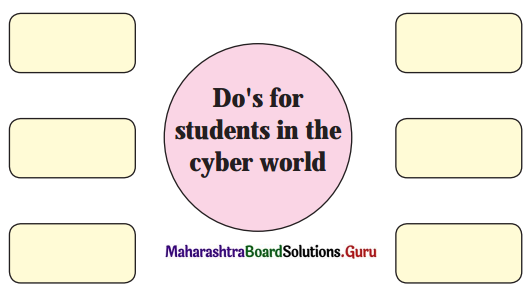
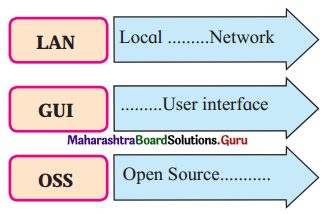
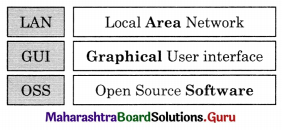
1. Complete the following web.

Question 1.
Maharashtra Board Class 11 Information Technology Solutions Chapter 4 Cyber Law 1 Q1

Answer:

  1. Use the Internet for the knowledge base.
  2. Use the Internet to communicate messages.
  3. Respect the privacy of other users on the Internet.
  4. Download legitimate and authentic programs from the Internet.
  5. Use licensed software on your computer.
  6. Check to see if the web address begins with https:// whenever you sign in.
  7. Report and flag content that is abusive or illegal.

Maharashtra Board Class 11 Information Technology Solutions Chapter 4 Cyber Law

2. Complete the following chart.

Question 1.
Maharashtra Board Class 11 Information Technology Solutions Chapter 4 Cyber Law 2 Q1

Answer:
Maharashtra Board Class 11 Information Technology Solutions Chapter 4 Cyber Law 2 Q1.1

3. Fill the following boxes with the appropriate cybercrime name.

Question 1.
Copyright violation of software created originally by an individual.
Maharashtra Board Class 11 Information Technology Solutions Chapter 4 Cyber Law 3 Q1

Answer:
Software Piracy

Question 2.
Gaining access without the user’s permission.
Maharashtra Board Class 11 Information Technology Solutions Chapter 4 Cyber Law 3 Q2
Answer:
Unauthorized Access

Maharashtra Board Class 11 Information Technology Solutions Chapter 4 Cyber Law
Question 3.
Extracting confidential information by email.
Maharashtra Board Class 11 Information Technology Solutions Chapter 4 Cyber Law 3 Q3
Answer:
Phishing

4. Read the following and answer the question.

Rahul lost his pen drive in his college computer lab. His classmate Madhav finds it. He carries it home to return it to him the next day. When Madhav opens it he finds his favourite game. He thinks of making a duplicate copy of the game software.
Question I.
Does Madhav think ethically?
Answer:
No

Question II.
What do you think should Madhav do?
Answer:
Madhav should return back the pen drive. He has done unauthorized access.

Question III.
If he makes a duplicate copy then which cybercrime will he commit?
Answer:
Software Piracy

5. Answer in brief.

Question 1.
What care should be taken by the user while doing online activities?
Answer:

  1. Stick to copyright restrictions when downloading anything from the internet.
  2. Use strong passwords with combinations of numbers. Uppercase and lowercase letters and special characters.
  3. Always scan files before opening them.
  4. Don’t talk to strangers.
  5. Think before posting something on social media related to any sensitive topic like politics, religion, etc.
  6. Report to the service provider if the account is hacked; if possible deactivate your account.
  7. Whenever you sign in online check if the web address begins with https: //

Question 2.
Define the terms (1) Ethics (2) Moral
Answer:
Ethics:
Ethics also called moral philosophy is the discipline concerned with what is morally good and bad, right or wrong.

Moral:
The standards of behaviour; principles of right and wrong behaviour. Thus morals are dictated by society, culture, or religion while ethics are chosen by the person himself which governs his life.

Maharashtra Board Class 11 Information Technology Solutions Chapter 4 Cyber Law

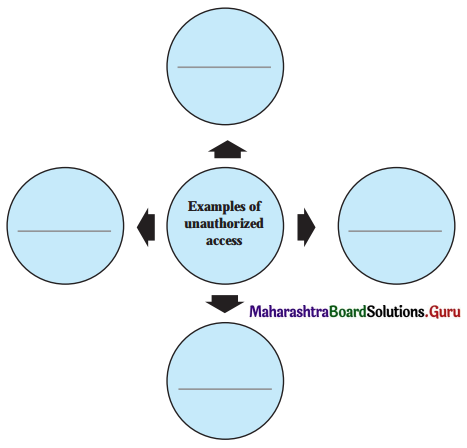
Question 3.
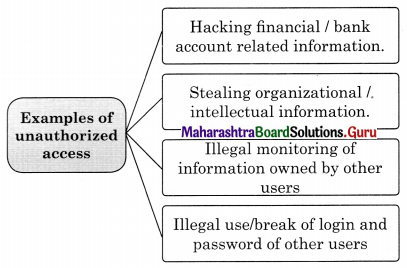
Explain three examples related to unauthorized access?
Answer:

  1. Hacking financial/bank account-related information.
  2. Stealing organizational/intellectual information.
  3. Illegal monitoring of information owned by other users.
  4. Illegal use/break of login and password of other users.
  5. Causing intentional irritation to other users by means of damaging software and important information.

Question 4.
Explain software piracy and Hacking.
Answer:
Software piracy:
Software piracy is the illegal copying, distribution, or use of the software. It 15 such a profitable “business” that it has caught the attention of organized crime groups in a number of countries. According to the Business Software Alliance (BSA), about 36% of all software in current use is stolen.

Hacking:
Hacking refers to unauthorized intrusion into a computer or a network. Hacker is a person intensely interested in the deep and hidden or concealed working of any computer operating system and programming language. They might discover loopholes within systems and reasons for such loopholes.

6. State true or false.

Question 1.
A firewall is used to encrypt the transmission of data.
Answer:
True

Question 2.
The standards of behaviour; the principle of right or wrong are referred to as moral.
Answer:
True

Maharashtra Board Class 11 Information Technology Solutions Chapter 4 Cyber Law

Question 3.
Hacking bank account-related information is an example of software piracy.
Answer:
False

Question 4.
Phishing is representing someone else’s work as own without permission.
Answer:
True

7. Match the following.

Question 1.

(A)(B)
(1) Copying a game file(a) Firewall
(2) Law related to internet(b) Cyberthreat
(3) Network security(c) Software piracy
(4) System crashes suddenly(d) Cyber Law

Answer:

(A)(B)
(1) Copying a game file(c) Software piracy
(2) Law related to internet(d) Cyber Law
(3) Network security(a) Firewall
(4) System crashes suddenly(b) Cyberthreat

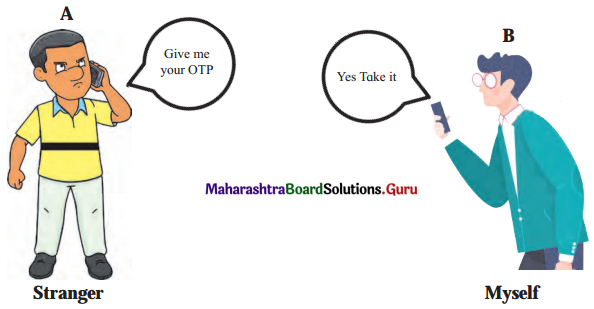
8. Observe the following picture and give your opinion about it by responding to the following questions.

Maharashtra Board Class 11 Information Technology Solutions Chapter 4 Cyber Law 8 Q1

Question 1.
Is ‘B’s response correct or not?
Answer:
No B’s response is not correct.

Maharashtra Board Class 11 Information Technology Solutions Chapter 4 Cyber Law

Question 2.
What will be the consequences of ‘B’s reply?
Answer:
With all such crucial information like OTP in hand, the fraudster can easily carry out illegal financial transactions using B’s identity.

Question 3.
Which type of cybercrime does the picture depict?
Answer:
Fake Call Frauds

Class 11 Information Technology Textbook Solutions

11th Information Technology Chapter 3 Exercise Impressive Web Designing Practical Problems Solutions Maharashtra Board

Impressive Web Designing 11th Information Technology Chapter 3 Solutions Maharashtra Board

Balbharati Maharashtra State Board Class 11 Information Technology Solutions Chapter 3 Impressive Web Designing Textbook Exercise Questions and Answers.

Class 11 Information Technology Chapter 3 Exercise Solutions

1. Answer the Following:

Question 1.
The data entry operator wants to insert.
1. Photograph
2. Write remarks about the photograph
3. Underline the heading.
He will use:
1. <Image>
2. <Text>
3. <TextArea>
4. <Img>
5. <UL>
6. <U>
Select the correct tags from the above and arrange them in the sequence.
Answer:
1. Photograph – <Img>
2. Write remarks about the photograph – <TextArea>
3. Underline the heading – <U>

Question 2.
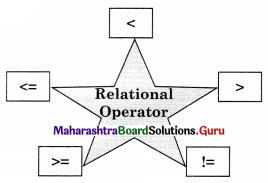
Identify the logical operators in JavaScript.
1. OR
2. AND
3. ||
4. &
5. &&
6. ++
Answer:
| |, &&

Maharashtra Board Class 11 Information Technology Solutions Chapter 3 Impressive Web Designing

2. Complete the following Activity:

Question 1.
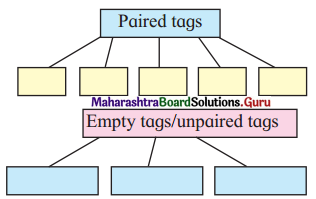
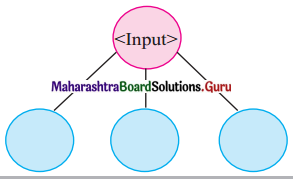
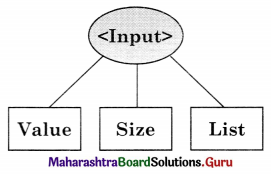
State at least three attributes of <Input>
Maharashtra Board Class 11 Information Technology Solutions Chapter 3 Impressive Web Designing 2 Q1
Answer:
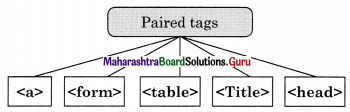
Maharashtra Board Class 11 Information Technology Solutions Chapter 3 Impressive Web Designing 2 Q1.1

Question 2.
Maharashtra Board Class 11 Information Technology Solutions Chapter 3 Impressive Web Designing 2 Q2
Answer:
Maharashtra Board Class 11 Information Technology Solutions Chapter 3 Impressive Web Designing 2 Q2.1

Question 3.
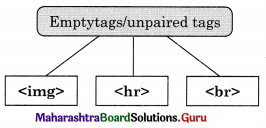
Group the Following.
Maharashtra Board Class 11 Information Technology Solutions Chapter 3 Impressive Web Designing 2 Q3
Answer:
Maharashtra Board Class 11 Information Technology Solutions Chapter 3 Impressive Web Designing 2 Q3.1
Maharashtra Board Class 11 Information Technology Solutions Chapter 3 Impressive Web Designing 2 Q3.2

Maharashtra Board Class 11 Information Technology Solutions Chapter 3 Impressive Web Designing

Question 4.
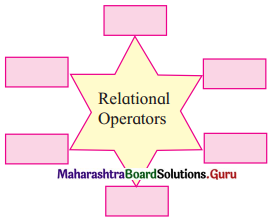
Write operator names with symbols in boxes.
Maharashtra Board Class 11 Information Technology Solutions Chapter 3 Impressive Web Designing 2 Q4
Answer:
Maharashtra Board Class 11 Information Technology Solutions Chapter 3 Impressive Web Designing 2 Q4.1

Question 5.
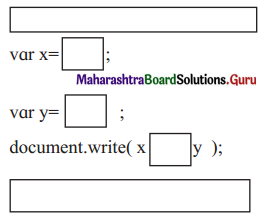
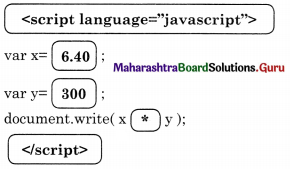
Complete following program to display multiplication of 6.40 and 300.
<!DOCTYPE html>
<html>
<head><title> Series </title></head>
<body>
Maharashtra Board Class 11 Information Technology Solutions Chapter 3 Impressive Web Designing 2 Q5
</html>
Answer:
<!DOCTYPE html>
<html>
<head><title> Series </title></head>
<body>
Maharashtra Board Class 11 Information Technology Solutions Chapter 3 Impressive Web Designing 2 Q5.1
</html>

3. Find out errors if any in the following javascript code.

Question 1.
var length, breadth;
length=4.5;
breadth=6;
area=1/2*length*breadth;
document.write(“Area of triangle is”area);
Answer:
Concatenate Operator ‘+’ is missing
document. write(“Area of triangle is” [+] area);

Maharashtra Board Class 11 Information Technology Solutions Chapter 3 Impressive Web Designing

4. Solve the following puzzles.

Question A.
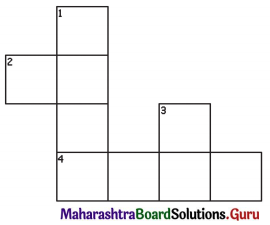
Fill the blocks
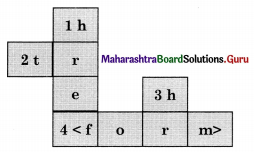
Maharashtra Board Class 11 Information Technology Solutions Chapter 3 Impressive Web Designing 4 Q1
1) Across
2. The tag is used to create a table row.
4. Tag to create a form

2) Down
1. The attribute is used to specify the path of a linked document.
3. The tag used to display horizontal ruled line
Answer:
Maharashtra Board Class 11 Information Technology Solutions Chapter 3 Impressive Web Designing 4 Q1.1
Across
2. <tr>
4. <form>
Down
1. href
3. <hr>

Question B.
Solve the puzzle by finding words with the help of the hint given below.
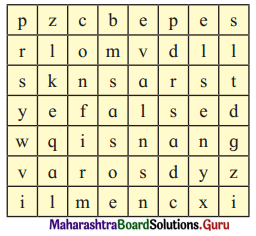
Maharashtra Board Class 11 Information Technology Solutions Chapter 3 Impressive Web Designing 4 Q2
1. Boolean value.
2. Keyword used in conditional if statement.
3. Built-In function in JavaScript
4. Function to check given value is number or not
5. Keyword used to declare a variable
6. Function used to evaluate given expression
Answer:
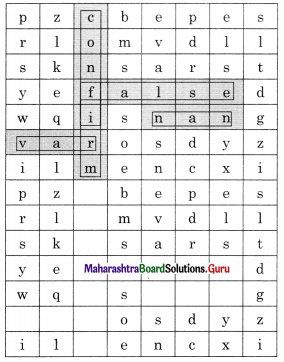
Maharashtra Board Class 11 Information Technology Solutions Chapter 3 Impressive Web Designing 4 Q2.1
1. False
2. if
3. confirm
4. nan
5. var
6. False

Maharashtra Board Class 11 Information Technology Solutions Chapter 3 Impressive Web Designing

5. Trace the output of the following Html code.

Question 1.
<!DOCTYPE html>
<html>
<head>
<title>Heading tags</title></head>
<body>
<h1 align=left>Information Technology</h1>
<hr>
<h2 align=center>XI Standard</h2>
<h3 align=right>Division</h3>
</body>
</html>
Answer:
Maharashtra Board Class 11 Information Technology Solutions Chapter 3 Impressive Web Designing 5 Q1

6. Discuss the following and answer the questions.

Question 1.
A Jr. web designer wants to design a webpage to enter the employee’s name, address. He needs a button to clear the form content and submit the data.
Write the different controls he will use to create the web page.
State the tags to be used for the controls.
Answer:
A Junior Web designer will use the following controls to design web as follows:
1. Text – to create a single-line textbox for employee name
2. Text or Textarea – If he wants to create a single-line address the text control is used otherwise to create a multiline address textarea is used.
3. Submit – It is used to submit form data to the server.
4. Reset – It is used to clear form data.

Tags used for the controls are-
1. Employee Name :<Input type-”text”>
2. Address :<Input type=”text”> or
Address: <textarea rows=”4” cols-”30”><textarea>
3. <Input type=”submit” value=”submit”>
4. <Input type-”reset” value=”reset”>

Maharashtra Board Class 11 Information Technology Solutions Chapter 3 Impressive Web Designing

Question 2.
A teacher has asked a student to create a web page to accept numbers and check whether it is between 50 to 100.
List the variable, operators to be used.
Specify the built-in function used and structure used.
Answer:
Program:
<!DOCTYPE html>
<head>
</head>
<body>
<script language =”Javascript”>
//To check whether the given no is between 50 to 100
var n;
n=prompt(“Enter any number”);
if(n<50 | | n>100)
{
alert(“it is less than 50, Please Re-Enter”);
}
else
{
alert(“it is greater than 50. Please Re-Enter”);
}
</script>
</body>
</html>

Variables used ‘n’
Operators used Not is equals | | less then < grater then > etc
Function is Prompt(), Alert() if then Else

7. Create web pages for the following.

Question 1.
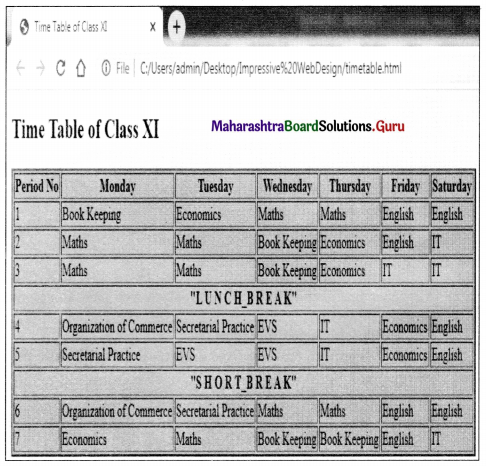
Write a program using HTML to design your class Time Table.
Answer:
Program <!Doctype Html>
<html>
<head><title> Time Table of Class XI</title>
</head>
<body bgcolor=yellow>
<h2>Time Table of Class XI</h2>
<table border=”2” bgcolor=skyblue>
<tr>
<th>Period No</th>
<th>Monday</th>
<th>Tuesday</th>
<th>Wednesday</th>
<th>Thursday</th>
<th>Friday</th>
<th>Saturday</th>
</tr>
<tr>
<td>1</td>
<td>Book Keeping</td>
<td>Economics</td>
<td>Maths</td>
<td>Maths</td>
<td>English</td>
<td>English</td>
</tr>
<tr>
<td>2</td>
<td>Maths</td>
<td>Maths</td>
<td>Book Keeping</td>
<td>Economics</td>
<td>English</td>
<td>IT</td>
</tr>
<tr>
<td>3</td>
<td>Maths</td>
<td>Maths</td>
<td>Book Keeping</td>
<td>Economics</td>
<td>IT</td>
<td>IT</td>
</tr>
<tr>
<th colspan=”7”>”L U N C H_B R E A K”</th>
</tr>
<tr>
<td>4</td>
<td>Organization of Commerce</td>
<td>Secretarial Practice</td>
<td>EVS</td>
<td>IT</td>
<td>Economics</td>
<td>English</td>
</tr>
<tr>
<td>5</td>
<td>Secretarial Practice</td>
<td>EVS</td>
<td>EVS</td>
<td>IT</td>
<td>Economics</td>
<td>English</td>
<tr>
<th colspan=”7”>”S H O R T_B R E A K”</th>
</tr>
<tr>
<td>6</td>
<td>Organization of Commerce</td>
<td>Secretarial Practice</td>
<td>Maths</td>
<td>Maths</td>
<td>English</td>
<td>English</td>
</tr>
<tr>
<td>7</td>
<td>Economics</td>
<td>Maths</td>
<td>Book Keeping</td>
<td>English</td>
<td>IT</td>
</tr>
</table>
</body>
</html>

Maharashtra Board Class 11 Information Technology Solutions Chapter 3 Impressive Web Designing 7 Q1

Maharashtra Board Class 11 Information Technology Solutions Chapter 3 Impressive Web Designing

Question 2.
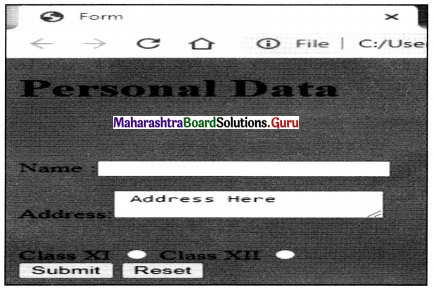
Write a program using HTML to create a form and submit it with personal data like name, address, and standard.
Answer:
Program:
<!DOCTYPE html>
<head>
<title> Form</title>
</head>
<body bgcolor=”#FF0100”>
<h1>Personal Data</h1><br><br><br>
Name :<input type=text name=t1><br><br>
Address:<Textarea> Address Here </textarea><p><br>
Class XI <input type=radio name=c1 value=xi>
Class XII <input type=radio name=c1 value=xii><br>
<input type=Submit name=b1 value=Submit>
<input type=reset name=b2 value=Reset>
</body>
</html>

Output:
Maharashtra Board Class 11 Information Technology Solutions Chapter 3 Impressive Web Designing 7 Q2

Question 3.
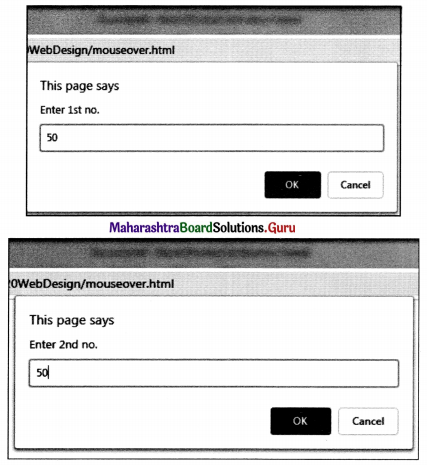
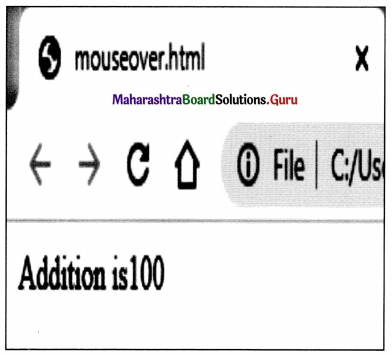
Write a javascript program to accept two numbers and perform the addition of two numbers by using the mouseover event.
Answer:
<html>
<head>
<title> JavaScript Program </title>
<script language = “JavaScript”>
function iload()
{
var c=0
a=parseInt(prompt(“Enter 1st no.”));
b=parseInt(prompt(“Enter 2nd no.”));
c=a+b
document.write(“Addition is”+c);
}
</script>
</head>
<body><center><br><br><br><br><br>
<a onMouseover=”iload();”>Addition</a></center>
</body>
</html>

Maharashtra Board Class 11 Information Technology Solutions Chapter 3 Impressive Web Designing 7 Q3
Maharashtra Board Class 11 Information Technology Solutions Chapter 3 Impressive Web Designing 7 Q3.1

8. Complete the following.

Question 1.
Maharashtra Board Class 11 Information Technology Solutions Chapter 3 Impressive Web Designing 8 Q1
Answer:
Maharashtra Board Class 11 Information Technology Solutions Chapter 3 Impressive Web Designing 8 Q1.1

Maharashtra Board Class 11 Information Technology Solutions Chapter 3 Impressive Web Designing

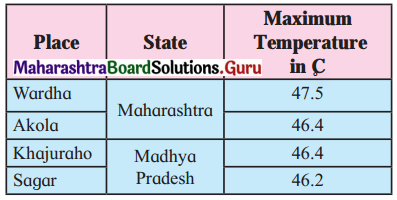
9. Write HTML Code for the following table.

Question 1.
Maharashtra Board Class 11 Information Technology Solutions Chapter 3 Impressive Web Designing 9 Q1
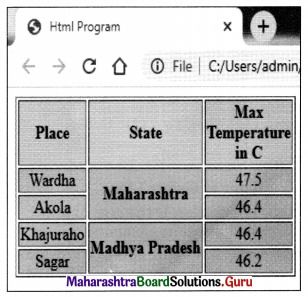
Answer:
<!DOCTYPE html>
<head>
<title>Html Program </title>
</head>
<BODY>
<table border=”1”>
<tr bgcolor=pink>
<th>Place</th>
<th>State</td>
<th>Max <br>Temperature <br>in C</th>
</tr>
<tr align=center bgcolor=skyblue>
<td>Wardha</td>
<th rowspan=”2”>Maharashtra</th>
<td>47.5</td>
</tr>
<tr align=center bgcolor=skyblue>
<td>Akola</td><td>46.4</td>
</tr>
<tr align=center bgcolor=skyblue>
<td>Khajuraho</td>
<th rowspan=”2”>Madhya Pradesh</th>
<td>46.4</td>
</tr>
<tr align=center bgcolor=skyblue>
<td>Sagar</td><td>46.2</td>
</tr>
</table>
</body>
</html>

Maharashtra Board Class 11 Information Technology Solutions Chapter 3 Impressive Web Designing 9 Q1.1

10. Multiple choice one correct answer.

Question 1.
The default method of submitting form data is __________
(a) Post
(b) Get
(c) Submit
(d) Reset
Answer:
(b) Get

Maharashtra Board Class 11 Information Technology Solutions Chapter 3 Impressive Web Designing

Question 2.
In JavaScript the post increment operator is __________
(a) x++
(b) x–
(c) –x
(d) ++x
Answer:
(a) x++

Class 11 Information Technology Textbook Solutions

11th Information Technology Chapter 2 Exercise Introduction to DBMS Practical Problems Solutions Maharashtra Board

Introduction to DBMS 11th Information Technology Chapter 2 Solutions Maharashtra Board

Balbharati Maharashtra State Board Class 11 Information Technology Solutions Chapter 2 Introduction to DBMS Textbook Exercise Questions and Answers.

Class 11 Information Technology Chapter 2 Exercise Solutions

1. Complete the following activity.

Question 1.
Tick whichever box is not valid.
Maharashtra Board Class 11 Information Technology Solutions Chapter 2 Introduction to DBMS 1 Q1
Answer:
Maharashtra Board Class 11 Information Technology Solutions Chapter 2 Introduction to DBMS 1 Q1.1

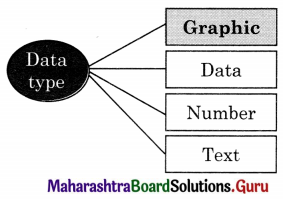
Question 2.
The student wants to create a field Pincode in a table, which data type he will choose?
Maharashtra Board Class 11 Information Technology Solutions Chapter 2 Introduction to DBMS 1 Q2
Answer:
Int

Maharashtra Board Class 11 Information Technology Solutions Chapter 2 Introduction to DBMS

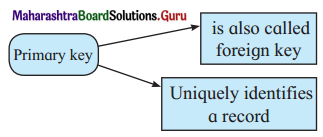
Question 3.
Tick the appropriate box.
Maharashtra Board Class 11 Information Technology Solutions Chapter 2 Introduction to DBMS 1 Q3
Answer:
Uniquely identifies a record

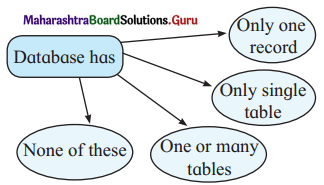
Question 4.
Tick the appropriate circle.
Maharashtra Board Class 11 Information Technology Solutions Chapter 2 Introduction to DBMS 1 Q4
Answer:
One or Many Tables

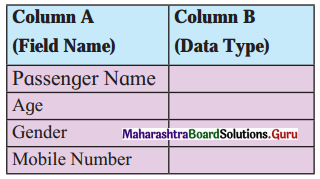
2. Observe the field names of a database given below in ‘Column A’ related to Bus reservation. Write suitable data types for each field in front of the respective field in ‘Column B’.

Question 1.
Maharashtra Board Class 11 Information Technology Solutions Chapter 2 Introduction to DBMS 2 Q1
Answer:

Column A (Field Name)Column B (DataType)
Passenger NameVarchar
AgeInt
GenderChar
Mobile NumberInt

Maharashtra Board Class 11 Information Technology Solutions Chapter 2 Introduction to DBMS

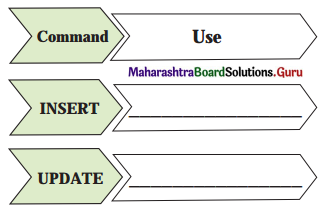
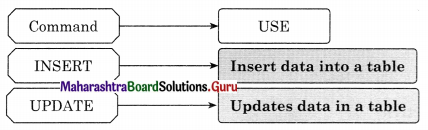
3. Write the use of the following SQL command.

Question 1.
Maharashtra Board Class 11 Information Technology Solutions Chapter 2 Introduction to DBMS 3 Q1
Answer:
Maharashtra Board Class 11 Information Technology Solutions Chapter 2 Introduction to DBMS 3 Q1.1

4. Create a table for the information given below by choosing appropriate data types. Specify proper primary key for the table (1) Movie (2) Actor

Question 1.
Movie (Registeration_no, movie_name, Realease_Date)
Answer:
CREATE TABLE Movie (Registeration_no int(20) PRIMARY KEY, movie_name VARCHAR(20), Realease_Date DATE);

Question 2.
Actor (actor_id, Actor_name, birth_date )
Answer:
CREATE TABLE Actor (actor_id int(20) PRIMARY KEY, Actor_name VARCHAR(20), Birth_Date DATE);

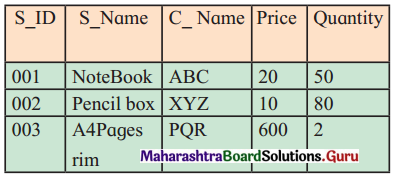
5. Consider the following table Stationary. Write SQL commands for the following statements.

Table: Stationary
Maharashtra Board Class 11 Information Technology Solutions Chapter 2 Introduction to DBMS 5 Q1

Question 1.
Write SQL command to create above Table.
Answer:
CREATE TABLE Stationary (S_ID int(20) PRIMARY KEY, S_Name VARCHAR(20), C_Name VARCHAR(20), Price int(20), Quantity int(20));

Question 2.
Write SQL command to insert the above-mentioned record in the table.
Answer:
INSERT INTO Stationary Values (001, ‘Note Book’, ‘ABC’, 20,50);
INSERT INTO Stationary Values (002, ‘Note Book’, ‘XYZ’, 10,80);
INSERT INTO Stationary Values (003, ‘Note Book’, ‘PQR’, 600,02);

Maharashtra Board Class 11 Information Technology Solutions Chapter 2 Introduction to DBMS

Question 3.
To delete the above table.
Answer:
DROP TABLE Stationery;

6. Answer the following questions.

Question 1.
What is a database?
Answer:
A DBMS is a collection of programs (computer-based system) that enables the user to create and maintain a database it is used to define, construct and manipulate the data in the database for various applications. It provides information storage, organization, and retrieval capabilities. The DBMS also enforces necessary access restrictions and security measures in order to protect the database.

Various types of control systems within the DBMS make sure that the database continues to function properly. They Include Integrity system Security system Concurrency control system Recovery control system Some DBMS enables us to define “views” of the database. A view is how the database appears to the user. This enables us to show only the relevant information to different types of users and it increases security, as certain users will not be able to see data which they are not meant to see.

Question 2.
What are the advantages of a DBMS?
Answer:
Advantages of a DBMS:
1. Redundancy is controlled: In File Processing System, duplicate data is created in many places because all the programs have their own files. This creates data redundancy which in turn wastes labor and space. ‘In Database Management System, all the files are integrated into a single database. The whole data is stored only once in a single place so there is no chance of duplicate data.

2. Sharing of Data: In a database, the users of the database can share the data among themselves. There are various levels of authorization to access the data. And consequently, the data can only be shared based on the correct authorization protocols being followed.

3. Data Security: Data Security is a vital concept in a database. Only authorized users should be allowed to access the database and their identity should be authenticated using a username and password. Unauthorized users should not be allowed to access the database under any circumstances as it violates the integrity constraints.

4. Enforces integrity constraints: Constraints are used to store accurate data because there are many users who feed data in the database. Data stored in the database should always be correct and accurate. DBMS provides the capability to enforce these constraints on the database.

5. Provides backup and recovery of data: Data loss is a very big problem for all organizations. In a traditional tile processing system, a user needs to back up the database after a regular interval of time that wastes lots of time and resources. If the volume of data is large then this process may take a very long time.

Question 3.
What do you understand by Data Model?
Answer:
A Database model defines the logical design and structure of a database and defines how data will be stored, accessed, and updated in a database management system. While the Relational Model is the most widely used database model.

Relational Model:
It is the most popular data model in DBMS. The relational model is the primary data model. Which is widely used for data processing. This model has all properties required to Process data with storage efficiency.

Maharashtra Board Class 11 Information Technology Solutions Chapter 2 Introduction to DBMS

Question 4.
What is a primary key?
Answer:
Primary Key: A column in the table that uniquely identifies each row in that table is called a primary key.

Question 5.
What is DDL (Data Definition Language)
Answer:
DDL statements or commands are used to define and modify the database structure of your tables or schema. When you execute a DDL statement, it takes effect immediately.
Some examples of DDL commands are CREATE, ALTER, and DROP.

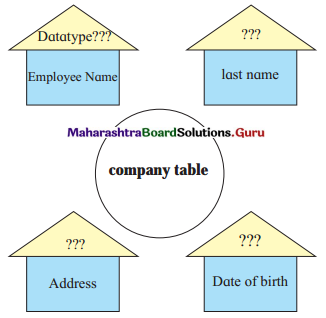
7. In a company the data is stored in a table under the following fields Employee number, Last name, Date of birth, Address. Which data type will you use for the above field?

Question 1.
Maharashtra Board Class 11 Information Technology Solutions Chapter 2 Introduction to DBMS 7 Q1
Answer:

Field NameData Type
Employee NameChar
Last NameChar
AddressVarchar
Date of BirthDate

8. Multiple choice select three correct answers.

Question 1.
Valid relationships in RDBMS are
(a) one to one
(b) one to two
(c) one to many
(d) many to two
(e) many to many
(f) one to three
Answer:
(a) one to one, (c) one to many, (e) many to many

Maharashtra Board Class 11 Information Technology Solutions Chapter 2 Introduction to DBMS

9. Complete the following.

Question 1.
Maharashtra Board Class 11 Information Technology Solutions Chapter 2 Introduction to DBMS 9 Q1
Answer:

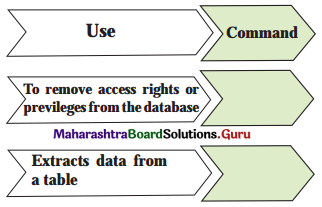
UseCommand
To remove access rights or privileges from the databaseRevoke
Extracts data from a tableInsert into Select

Class 11 Information Technology Textbook Solutions

11th Information Technology Chapter 1 Exercise Basics of Information Technology Practical Problems Solutions Maharashtra Board

Basics of Information Technology 11th Information Technology Chapter 1 Solutions Maharashtra Board

Balbharati Maharashtra State Board Class 11 Information Technology Solutions Chapter 1 Basics of Information Technology Textbook Exercise Questions and Answers.

Class 11 Information Technology Chapter 1 Exercise Solutions

1. Complete the following activity.

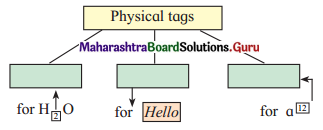
Question 1.
Maharashtra Board Class 11 Information Technology Solutions Chapter 1 Basics of Information Technology 1 Q1
Answer:
Maharashtra Board Class 11 Information Technology Solutions Chapter 1 Basics of Information Technology 1 Q1.1

Question 2.
Tick the appropriate box.
Internet is a ____________ network connecting millions of computer.
Maharashtra Board Class 11 Information Technology Solutions Chapter 1 Basics of Information Technology 1 Q2
Answer:
Global

Maharashtra Board Class 11 Information Technology Solutions Chapter 1 Basics of Information Technology

Question 3.
Maharashtra Board Class 11 Information Technology Solutions Chapter 1 Basics of Information Technology 1 Q3
Answer:
Maharashtra Board Class 11 Information Technology Solutions Chapter 1 Basics of Information Technology 1 Q3.1

Question 4.
Tick the appropriate box.
Maharashtra Board Class 11 Information Technology Solutions Chapter 1 Basics of Information Technology 1 Q4
Answer:
Maharashtra Board Class 11 Information Technology Solutions Chapter 1 Basics of Information Technology 1 Q4.1

Question 5.
Maharashtra Board Class 11 Information Technology Solutions Chapter 1 Basics of Information Technology 1 Q5
Answer:
Maharashtra Board Class 11 Information Technology Solutions Chapter 1 Basics of Information Technology 1 Q5.1

Maharashtra Board Class 11 Information Technology Solutions Chapter 1 Basics of Information Technology

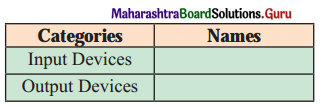
2. Divide the following list of devices into appropriate categories.

Question 1.
Monitor, Barcode reader, Printer, Keyboard. Optical character reader, Speaker
Maharashtra Board Class 11 Information Technology Solutions Chapter 1 Basics of Information Technology 2 Q1
Answer:

CategoriesNames
Input DevicesBarcode reader, Keyboard, Optical Character reader
Output DevicesMonitor, Printer, Speaker

3. Multiple choice two correct answers.

Question 1.
The primary memory consists of ____________ and ____________
(a) Pendrive
(b) Hard Disk
(c) RAM
(d) Scanner
(e) ROM
Answer:
(c) RAM, (e) ROM

Question 2.
The network architectures which are widely used are ____________
(a) Server
(b) Client
(c) Peer to peer
(d) Client-server
(e) Internet
Answer:
(c) Peer to peer, (d) Client-server

4. Match the following.

Question 1.

1. IS(a) change directory
2. FTP(b) Translates Network Address
3. CD(c) List of Directory
4. DNS(d) To transfer file on interent

Answer:

1. IS(c) List of Directory
2. FTP(d) To transfer file on interent
3. CD(a) change directory
4. DNS(b) Translates Network Address

5. Name the following and complete the diagram.

Question 1.
Maharashtra Board Class 11 Information Technology Solutions Chapter 1 Basics of Information Technology 5 Q1
Answer:
Maharashtra Board Class 11 Information Technology Solutions Chapter 1 Basics of Information Technology 5 Q1.1

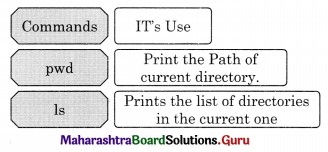
6. Complete the following with Linux commands with their use.

Question 1.
Maharashtra Board Class 11 Information Technology Solutions Chapter 1 Basics of Information Technology 6 Q1
Answer:
Maharashtra Board Class 11 Information Technology Solutions Chapter 1 Basics of Information Technology 6 Q1.1

Maharashtra Board Class 11 Information Technology Solutions Chapter 1 Basics of Information Technology

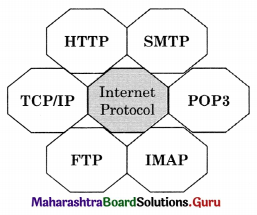
7. Complete the list of the following protocols.

Question 1.
Maharashtra Board Class 11 Information Technology Solutions Chapter 1 Basics of Information Technology 7 Q1
Answer:
Maharashtra Board Class 11 Information Technology Solutions Chapter 1 Basics of Information Technology 7 Q1.1

8. Complete the following Long form.

Question 1.
Maharashtra Board Class 11 Information Technology Solutions Chapter 1 Basics of Information Technology 8 Q1
Answer:
Maharashtra Board Class 11 Information Technology Solutions Chapter 1 Basics of Information Technology 8 Q1.1

9. Identify the following activity.

Question 1.
You are typing a letter using a computer and suddenly there is a power failure.
Which type of Memory does this activity deal with?
Answer:
Random Access Memory

10. Answer the following.

Question 1.
What are Data and Information? Give examples of data and information.
Answer:
Data can be any character, text, word, number, or raw facts.
Example of Data:
Mumbai, 1234, Aditya, MG Road, Maharashtra, 9444444441, 411004

Information is data formatted in a manner that allows it to be utilized by human beings in some significant way.
Example of Information:
Aditya, 1234, MG Road, Mumbai 400004, Maharashtra, 944444444114.

Maharashtra Board Class 11 Information Technology Solutions Chapter 1 Basics of Information Technology

Question 2.
Explain functional units of a computer system.
Answer:
The computer system has the following three basic components:
Input Unit:
An input device is any hardware device that sends data to a computer, allowing you to interacts with and controls it. Data can be in the form of words, symbols, numbers, etc. The function of the input device is to direct commands and data into the computer.
For example keyboard, mouse, scanners, digital cameras, joysticks, and microphones.

Central Processing Unit:
After receiving data and commands from the user, a computer system has to process the instructions provided using Central Processing Unit (CPU). It has three elements:

(a) Arithmetic and Logic Unit: An arithmetic logic unit (ALU) is a major component of the central processing unit of a computer system. It does all processes related to arithmetic and logic operations like add, subtract, multiply, etc.

(b) Control Unit: The control unit (CU) is a component of a computer’s central processing unit (CPU) that directs the operation of the processor. It tells the computer’s memory, arithmetic, and logic unit, and input and output devices how to respond to the instructions that have been sent to the processor.

(c) Memory Unit: A memory unit is the amount of data that can be stored in the storage unit. Once the data has been entered using input devices, the system stores the data in the memory unit.

Types of Memory: Primary Memory & Secondary Memory.

  • Primary Memory: It has 18 internal memory of the computer also known as main memory. It is of two types RAM and ROM.
  • RAM (Random Access Memory): RAM stands for Random Access Memory also known as reading/write memory. Information stored in this memory is lost as the power supply to the computer is switched off; it is also called “Volatile Memory”.
  • ROM(Read Only Memory): ROM stands for Read-Only Memory. ROM is a permanent type of memory. The contents are not lost as the power supply to the computer is switched off. ROM cannot be overwritten by the computer. It is also called “Non Volatile Memory”.
  • Secondary Memory: It is the external memory of the computer which is used to store a large amount of data. The secondary storage devices are a Hard disk, Pen drive, CD, DVD, etc.

Output Unit:
An output device is any device used to send data from a computer to another device or user. Most computer data output that is ‘meant for humans is in the form of audio or video. Thus, most output devices used by humans are in these categories. Examples include monitors, projectors, speakers.

Question 3.
What is a storage unit? Explain types of primary memory storage.
Answer:
When a user enters data using input devices, the computer system stores this data in a memory unit i.e. storage unit. The storage unit uses a set of pre-programmed instructions to further transmit this data to other parts of the CPU. There are two types of memory

  • Primary Memory
  • Secondary Memory

RAM: It stands for Random Access Memory. RAM is known as reading/write memory. It is the main memory of the computer system. The information stored in this memory is lost as the power supply to the computer is switched off, so it is also called as “Volatile Memory”.

ROM: It stands for Read-Only Memory. ROM is permanent memory. The content is not lost when the power supply is switched off. ROM cannot be overwritten by the computer, so it is also called “Non-Volatile Memory”.

Maharashtra Board Class 11 Information Technology Solutions Chapter 1 Basics of Information Technology

Question 4.
Explain how Linux is different from Windows.
Answer:

  • Linux is open sources system whereas the window operating system is commercial.
  • Linux has access to source code and alters the code as per user need whereas a window does not have access to source code.
  • Linux distribution doesn’t collect user data” whereas Windows collects all the user details which leads to privacy concerns.
  • As the software is open to the public, it constantly updates, improves, and expands as more people can work on its improvement.

Question 5.
Write down the difference between LAN, MAN, and WAN.
Answer:

LAN (Local Area Network)MAN (Metropolitan Area Network)WAN (Wide Area Network)
LAN Stands for Local Area Network.MAN stands for Metropolitan Area Network.WAN stands for Wide Area Network.
A LAN is a network of connected devices that exist within a specific location.A public or private network is used to connect various locations including suburbs in metropolitan cities.A WAN is any network that crosses metropolitan, regional, or national boundaries.
LANs may be found in homes, offices, educational institutions, or other areas.A MAN is a network, which covers an entire city, but uses LAN topology.Most networking professionals define a WAN as any network that uses routers and public network links (e.g. Telephone lines).
LAN is easy to set up.MANs are formed by connecting multiple LANs.Due to long-distance transmission, the noise and errors are more in WAN.
Data transmits at a very fast rate.Examples of a MAN are the cable TV network in a city.The best example of WAN is the Internet.

Class 11 Information Technology Textbook Solutions

11th Commerce BK Chapter 10 Exercise Single Entry System Practical Problems Solutions Maharashtra Board

Single Entry System 11th BK Commerce Chapter 10 Solutions Maharashtra Board

Balbharti Maharashtra State Board Bookkeeping and Accountancy 11th Solutions Chapter 10 Single Entry System Textbook Exercise Questions and Answers.

Class 11 Commerce BK Chapter 10 Exercise Solutions

1. Answer in One sentence only.

Question 1.
What do you mean by a Single Entry System?
Answer:
A system of bookkeeping in which an accountant or businessman records only one aspect of business transaction (either debit or credit and ignores the other aspect is called ‘Single Entry System’.

Question 2.
What is a Statement of Affairs?
Answer:
A list of all assets and liabilities prepared under a single entry system to find out capital balance is called a statement of affairs.

Maharashtra Board 11th BK Textbook Solutions Chapter 10 Single Entry System

Question 3.
Which type of accounts are normally not kept under the Single Entry System?
Answer:
Under a single entry system, records of impersonal accounts i.e. real accounts and nominal accounts are not maintained.

Question 4.
Which statement is prepared under the Single Entry system to ascertain the capital balances?
Answer:
A statement of Affairs is prepared under a single entry system to ascertain capital balances.

Question 5.
How Opening Capital is calculated under the Single Entry System?
Answer:
Under a single entry system, opening capital is ascertained by preparing the opening statement of affairs.

Question 6.
Which types of accounts are maintained under the Single Entry System?
Answer:
Under a single entry system, all personal accounts and cash accounts are maintained.

Question 7.
Can a Trial Balance be prepared under a Single Entry System?
Answer:
A trial balance cannot be prepared under a single entry system.

Maharashtra Board 11th BK Textbook Solutions Chapter 10 Single Entry System

Question 8.
Which type of organizations generally follow the Single Entry System?
Answer:
Organizations having small sizes of business such as sole trading concerns and partnership firms follow a single entry system.

2. Write a word, term, or phrase which can substitute each of the following statements.

Question 1.
A statement that is similar to the Balance Sheet.
Answer:
Statement of Affairs

Question 2.
The system of Accounting is normally suitable for small business organizations.
Answer:
Single Entry System

Question 3.
A statement similar to the Balance Sheet is prepared to find out the amount of opening capital.
Answer:
Opening Statement of Affairs

Question 4.
An excess of assets over liabilities.
Answer:
Capital

Maharashtra Board 11th BK Textbook Solutions Chapter 10 Single Entry System

Question 5.
Excess of closing capital over opening capital of proprietor under Single Entry System.
Answer:
Profit

Question 6.
Name of the method of accounting suitable to firms having limited transactions.
Answer:
Single Entry System

Question 7.
A System of accounting that is unscientific.
Answer:
Single Entry System

Question 8.
Further capital introduced by the proprietor in the business concern over and above his existing capital.
Answer:
Additional Capital

3. Select the most appropriate answer from the alternatives given below and rewrite the sentence.

Question 1.
The capital balances are ascertained by preparing _______________
(a) Statement of Affairs
(b) Cash Account
(c) Drawings Accounts
(d) Debtors Accounts
Answer:
(a) Statement of Affairs

Maharashtra Board 11th BK Textbook Solutions Chapter 10 Single Entry System

Question 2.
Under Single Entry System, Opening Capital = Opening Assets less _______________
(a) Opening Liabilities
(b) Closing Liabilities
(c) Debtors Account
(d) Creditors Account
Answer:
(a) Opening Liabilities

Question 3.
Additional Capital introduced during the year is _______________ from closing capital in order to find out the correct profit.
(a) Added
(b) Deducted
(c) Divided
(d) Ignored
Answer:
(b) Deducted

Question 4.
Single Entry System may be useful for _______________
(a) Sole traders
(b) Company
(c) Government
(d) None of these
Answer:
(a) Sole traders

Question 5.
In order to find out the correct profit, drawings is _______________ from closing capital.
(a) Multiplies
(b) Divided
(c) Deducted
(d) Added
Answer:
(d) Added

Maharashtra Board 11th BK Textbook Solutions Chapter 10 Single Entry System

Question 6.
The difference between assets and liabilities is called _______________
(a) Capital
(b) Drawings
(c) Income
(d) Expenses
Answer:
(a) Capital

Question 7.
When Closing Capital is greater than the Opening Capital, the difference is _______________
(a) Profit
(b) Loss
(c) Assets
(d) Liabilities
Answer:
(a) Profit

Question 8.
Opening Capital is ₹ 30,000; Closing Capital is ₹ 60,000; Withdrawals are ₹ 5,000; and further capital brought in is ₹ 3,000; Profit is _______________
(a) ₹ 45,000
(b) ₹ 35,000
(c) ₹ 32,000
(d) ₹ 22,000
Answer:
(c) ₹ 32,000

4. State True or False with reasons:

Question 1.
The double Entry System of Book-keeping is a scientific method of books of accounts.
Answer:
This statement is True.
In the double-entry system of book-keeping, there are two-fold effects. Both the effects are recorded simultaneously with an equal amount. This system also follows principles and rules of debit and credit. Due to this, there are very fewer chances of mistakes. So double entry system of Book-Keeping is a scientific method of the book of accounts.

Question 2.
Preparation of Trial Balance is not possible under the Single Entry System.
Answer:
This statement is True.
Under the single entry system, only cash and personal accounts of debtors and creditors are open. So it is not possible to prepare. Trail balance under single entry system as it has incomplete information of Accounting.

Question 3.
Statement of Affairs and Balance Sheet are one and the same.
Answer:
This statement is False.
There is a difference between a statement of Affairs and the Balance sheet. Statement of Affair shows estimated values of assets and liabilities.

Maharashtra Board 11th BK Textbook Solutions Chapter 10 Single Entry System

Question 4.
The single Entry System is not useful for large organizations.
Answer:
This statement is True.
Under the Single Entry System, only the cash book and personal account of Debtor and Ciygditor are maintained. Real and Nominal accounts are not maintained. It has no proper set of rules to be followed. It is useful for small organisations and not for a large organisations.

Question 5.
Only Cash and Personal accounts are maintained under the Single Entry System.
Answer:
This statement is True.
The single Entry System is an ancient and unscientific method of recording business transactions. This system maintains minimum accounts so it is easy for traders to write books of accounts. This system does not follow any accounting rules. To know the cash collections and amount payable or receivable only cash and personal accounts are maintained under a single entry system.

5. Do you agree with the following statements?

Question 1.
Further capital introduced during the year increases profit.
Answer:
Disagree

Question 2.
Interest in Drawings decreases the amount of profit under the Single Entry System.
Answer:
Disagree

Question 3.
Real and Nominal accounts are not maintained under the Single Entry System.
Answer:
Agree

Question 4.
The single Entry System is based on certain rules and principles.
Answer:
Disagree

Maharashtra Board 11th BK Textbook Solutions Chapter 10 Single Entry System

Question 5.
Statement of Profit is just like Profit and Loss Account.
Answer:
Disagree

6. Fill in the Blanks.

Question 1.
Statement of Affairs is just like _______________
Answer:
Balance Sheet

Question 2.
Under Single Entry System, Profit = Closing Capital Less _______________
Answer:
Opening Capital

Question 3.
In order to find out the correct profit, drawings are _______________ to the closing capital.
Answer:
Added

Question 4.
In _______________ Book Keeping System, in every business transactions we find two effects.
Answer:
Double Entry System

Question 5.
The difference between Assets and Liabilities is called _______________
Answer:
Capital

Maharashtra Board 11th BK Textbook Solutions Chapter 10 Single Entry System

Question 6.
Single Entry System is more popular for _______________
Answer:
Sole Trader

Question 7.
Additional Capital introduced during the year is _______________ from Closing Capital in order to find out the correct profit.
Answer:
Deducted

Question 8.
Single Entry System is Suitable for _______________ business.
Answer:
Small

7. Find the odd one:

Question 1.
Interest on Drawings, Outstanding Expenses, Undervaluation of Assets, Prepaid Expenses.
Answer:
Outstanding Expenses

Question 2.
Interest on Capital, Interest on Loan, Overvaluation of Liabilities, Depreciation on Assets.
Answer:
Overvaluation of Liabilities

Question 3.
Creditors, Bills Payable, Bank Overdraft, Stock in Trade.
Answer:
Stock in Trade

8. Complete the following table:

Question 1.
Maharashtra Board 11th BK Textbook Solutions Chapter 10 Single Entry System 8 Q1
Answer:
₹ 5,000

Question 2.
Maharashtra Board 11th BK Textbook Solutions Chapter 10 Single Entry System 8 Q2
Answer:
₹ 30,000

Maharashtra Board 11th BK Textbook Solutions Chapter 10 Single Entry System

Question 3.
Maharashtra Board 11th BK Textbook Solutions Chapter 10 Single Entry System 8 Q3
Answer:
₹ 5,000

Question 4.
Maharashtra Board 11th BK Textbook Solutions Chapter 10 Single Entry System 8 Q4
Answer:
₹ 25,000, ₹ 20,000

Question 5.
Maharashtra Board 11th BK Textbook Solutions Chapter 10 Single Entry System 8 Q5
Answer:
₹ 19,000

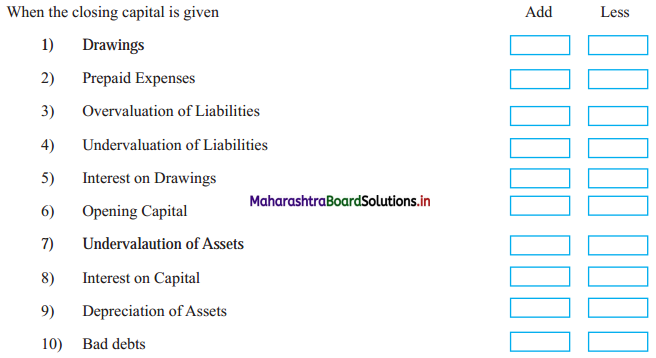
9. Complete the following table. Put Proper mark in Box.

Question 1.
Maharashtra Board 11th BK Textbook Solutions Chapter 10 Single Entry System 9 Q1
Answer:

  1. Add
  2. Add
  3. Add
  4. Less
  5. Add
  6. Less
  7. Add
  8. Less
  9. Less
  10. Less

Practical Problems

Question 1.
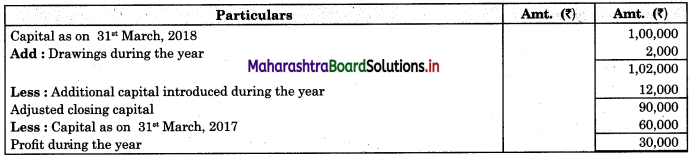
Mr. Poonawala keeps his books under the Single Entry System and gives the following information.
Capital as of 31.3.2017 – ₹ 60,000
Capital as on 31.3.2018 – ₹ 1,00,000
Drawings made during the year ₹ 2,000
Additional capital introduced during the year ₹ 12,000
Calculate Profit or Loss during the year.
Solution:
In the books of Mr. Poonawala
Statement of Profit or Loss for the year ended 31st March 2018
Maharashtra Board 11th BK Textbook Solutions Chapter 10 Single Entry System Practical Problems Q1

Maharashtra Board 11th BK Textbook Solutions Chapter 10 Single Entry System

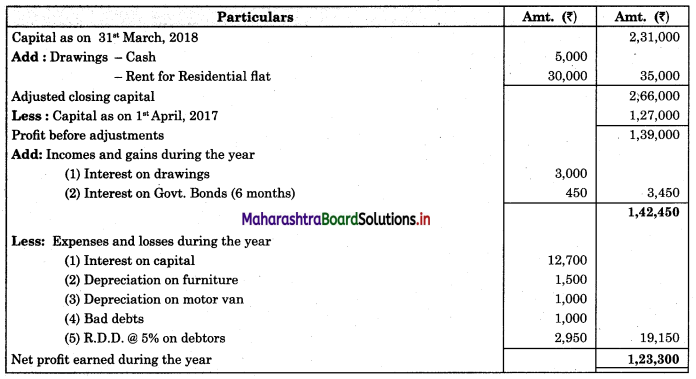
Question 2.
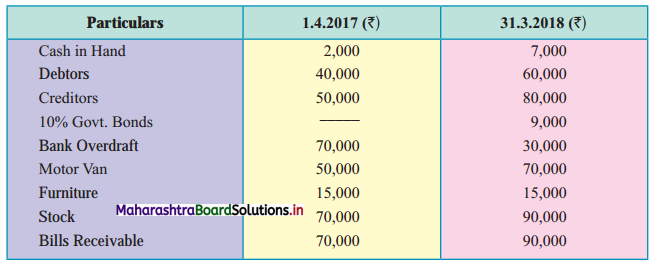
Sujit a small trader provides you with the following details of his business.
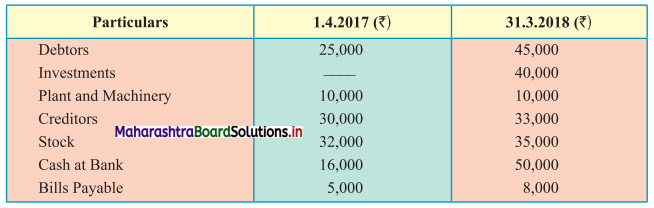
Maharashtra Board 11th BK Textbook Solutions Chapter 10 Single Entry System Practical Problems Q2
Additional information:
1. Sujit withdraws ₹ 5,000 for his personal use, on 1st Oct. 2017.
2. He had also withdrawn ₹ 30,000 for rent of his residential flat.
3. Depreciation Furniture by 10% p.a. and writes off ₹ 1,000 from Motor Van.
4. Charge interest on Drawings ₹ 3,000.
5. 10% Govt. Bonds were purchased on 1st Oct. 2017.
6. Allow interest on capital at 10% p.a.
7. ₹ 1,000 is written off as bad debts and provides 5% p.a. R.D.D. on Debtors.
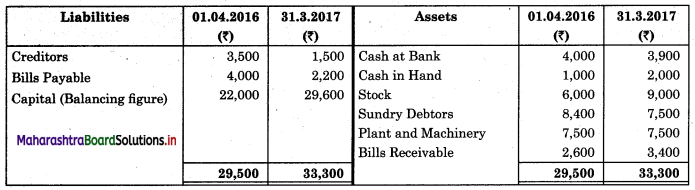
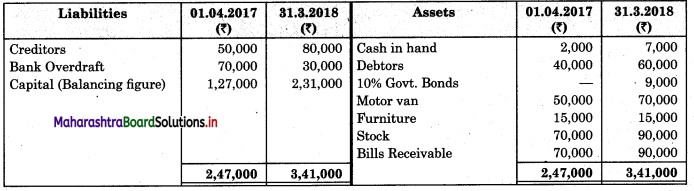
Prepare Opening Statement of Affairs, Closing Statement of Affairs, and Statement of Profit or Loss for the year ending 31st March 2018.
Solution:
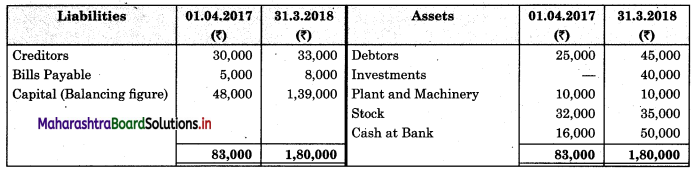
In the books of Sujit
Opening and closing statement of Affairs as on _______________
Maharashtra Board 11th BK Textbook Solutions Chapter 10 Single Entry System Practical Problems Q2.1
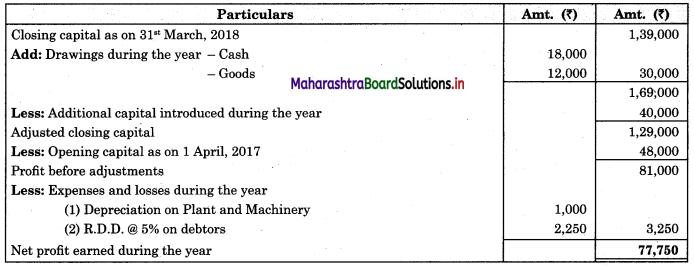
Statement of Profit or Loss for the year ended 31st March 2018
Maharashtra Board 11th BK Textbook Solutions Chapter 10 Single Entry System Practical Problems Q2.2

Question 3.
Anjali keeps her books by the Single Entry System. Her position on 1.4.2016 was as follows.
Cash at Bank ₹ 4,000, Cash in Hand ₹ 1,000, Stock ₹ 6,000; Sundry Debtors ₹ 8,400, Plant and Machinery ₹ 7,500, Bill Receivable ₹ 2,600, Creditors ₹ 3500; Bills Payable ₹ 4,000
On 31.3.2017 her position was as follows; cash at Bank ₹ 3,900, Cash in Hand ₹ 2,000. Stock ₹ 9000, Sundry Debtors, ₹ 7,500; Plant and Machinery ₹ 7,500; Bills Payable ₹ 2,200, Bills Receivable ₹ 3,400; Creditors ₹ 1,500.
During the year Anjali introduced further Capital of ₹ 1,500 and she spent ₹ 700 per month for her personal use.
Depreciation Plant and Machinery by 5% p.a. and create Reserve for Doubtful debts @ 5% p.a. on the debtor. Prepare Opening and Closing Statement of Affairs and Statement of Profit or Loss for the year ended 31.3.2017.
Solution:
In the books of Anjali
Opening and closing statement of Affairs as on _______________
Maharashtra Board 11th BK Textbook Solutions Chapter 10 Single Entry System Practical Problems Q3
Statement of Profit or Loss for the year ended 31st March 2017
Maharashtra Board 11th BK Textbook Solutions Chapter 10 Single Entry System Practical Problems Q3.1

Question 4.
Mr. Vijay is dealing in the business of fruits. He maintains an accounting record with a single entry. The following figures are taken from his record.
Maharashtra Board 11th BK Textbook Solutions Chapter 10 Single Entry System Practical Problems Q4
Additional information:
1. Mr. Vijay introduced ₹ 7,000 as fresh capital.
2. He spent ₹ 40,000 from his business for his daughter’s marriage.
3. Depreciate Building by ₹ 6,000.
4. Create a 5% reserve for doubtful debts on Sundry Debtor.
Prepare:
1. Opening Statement of Affairs.
2. Closing Statement of Affairs
3. Statement of Profit or Loss for the year ended 31.3.2018.
Solution:
In the books of Mr. Vijay
Opening and closing statement of Affairs as on _______________
Maharashtra Board 11th BK Textbook Solutions Chapter 10 Single Entry System Practical Problems Q4.1
Statement of Profit or Loss for the year ended 31st March 2018
Maharashtra Board 11th BK Textbook Solutions Chapter 10 Single Entry System Practical Problems Q4.2

Maharashtra Board 11th BK Textbook Solutions Chapter 10 Single Entry System

Question 5.
Miss. Fiza keeps her books on the Single Entry System and disclosed the following information about her business.
Maharashtra Board 11th BK Textbook Solutions Chapter 10 Single Entry System Practical Problems Q5
Additional information:
1. Miss. Fiza transferred ₹ 2,000 per month during the first half-year and ₹ 1000 per month for the second half-year from a business account to her personal account.
2. She sold her private asset for ₹ 40,000 and brought the proceeds into her business.
3. She also took goods worth ₹ 12,000 for private use.
4. Plant and Machinery is to be depreciated by 10% p.a.
5. Provide R.D.D. on debtors at 5% p.a.
Prepare:
1. Opening Statement of Affairs
2. Closing Statement of Affairs
3. Statement of Profit or Loss for the year ended 31.3.2018
Solution:
In the books miss Fiza
Opening and closing statement of Affairs as on _______________
Maharashtra Board 11th BK Textbook Solutions Chapter 10 Single Entry System Practical Problems Q5.1
Statement of Profit or Loss for the year ended 31st March 2018
Maharashtra Board 11th BK Textbook Solutions Chapter 10 Single Entry System Practical Problems Q5.2

Question 6.
Miss. Sanika keeps her books on the Single Entry System. The statement of affairs is given on 31st March 2018.
Maharashtra Board 11th BK Textbook Solutions Chapter 10 Single Entry System Practical Problems Q6
On 31st March 2018 their Assets and Liabilities were as follows:
Plant and Machinery ₹ 42,000, Stock ₹ 38,000, Cash in Hand ₹ 10,000, Creditors ₹ 7,000, Debtors ₹ 25,000, Bills Payable ₹ 6,000
Drawings during the year were ₹ 5,500, Plant and Machinery were found Overvalued by 5% p.a. and Stock was found Undervalued by 20% p.a., R.D.D. was to be created at 10% p.a. on Debtors, Interest on Capital was allowed at 10% p.a.
Prepare:
1. Closing Statement of Affairs.
2. Statement of Profit or Loss for the year ended 31st March 2018.
Solution:
In the books of miss Sanika
Closing statement of Affairs as on 31.03.2018
Maharashtra Board 11th BK Textbook Solutions Chapter 10 Single Entry System Practical Problems Q6.1
Statement of Profit or Loss for the year ended 31st March 2018.
Maharashtra Board 11th BK Textbook Solutions Chapter 10 Single Entry System Practical Problems Q6.2
Maharashtra Board 11th BK Textbook Solutions Chapter 10 Single Entry System Practical Problems Q6.3

Question 7.
Mr. Suhas commenced his business with the Capital of ₹ 1,50,000 on 1st April 2017. His financial position was as follows as on 31st March 2018, Cash ₹ 20,000, Stock ₹ 15,000, Debtors ₹ 30,000, Premises ₹ 90,000, Vehicles ₹ 45,000, Creditors ₹ 18,500, Bills Payable ₹ 10,000.
Additional information:
1. He brought additional capital ₹ 10,000 on 30th Sept. 2017, Interest on capital is to be provided at 5% p.a.
2. He withdrew ₹ 15,000 for personal use on which interest is to be charged at 5% p.a.
3. Write off Bad debts ₹ 500.
Prepare:
1. Closing Statement of Affairs
2. Statement of Profit or Loss for the year ended 31.3.2018.
Solution:
In the books of Mr. Suhas
Closing statement of Affairs as on 31.3.2018
Maharashtra Board 11th BK Textbook Solutions Chapter 10 Single Entry System Practical Problems Q7
Statement of Profit or Loss for the year ended 31st March 2018.
Maharashtra Board 11th BK Textbook Solutions Chapter 10 Single Entry System Practical Problems Q7.1

Maharashtra Board 11th BK Textbook Solutions Chapter 10 Single Entry System

Question 8.
Ganesh keeps his books by the Single Entry Method. Following are the details of his business:
Maharashtra Board 11th BK Textbook Solutions Chapter 10 Single Entry System Practical Problems Q8
During the year he has withdrawn ₹ 25,000 for his private purpose and goods of ₹ 3,000 for household use. On 1st Oct. 2016. He sold his household furniture for ₹ 4,000 and deposited the same amount in a business Bank Account.
Provide Depreciation on Plant and Machinery at 10% p.a. (assuming additions were made on 1st Oct. 2016) and Furniture at 5%.
Prepare:
1. Opening Statement of Affairs
2. Closing Statement of Affairs
3. Statement of Profit or Loss for the year ended 31.3.2017.
Solution:
In the books of Ganesh
Opening and Closing statement of Affairs as on _______________
Maharashtra Board 11th BK Textbook Solutions Chapter 10 Single Entry System Practical Problems Q8.1
Statement of Profit or Loss for the year ended 31st March 2017
Maharashtra Board 11th BK Textbook Solutions Chapter 10 Single Entry System Practical Problems Q8.2

Question 9.
Peter keeps his books on the Single Entry System. From the following particulars, Prepare Opening and Closing Statement of Affairs and Statement of Profit or Loss for the year ending 31st March 2018.
Maharashtra Board 11th BK Textbook Solutions Chapter 10 Single Entry System Practical Problems Q9
Additional Information:
1. Peter has withdrawn ₹ 15,000 from the business for his personal use.
2. He has introduced additional capital of ₹ 10,000 in the business on 1st January 2018.
3. Depreciate furniture @ 10% p.a.
4. Maintain reserve for doubtful debts @ 5% on Sundry Debtors.
5. Closing Stock is overvalued by 25% in the books.
Solution:
In the books of Peter
Opening and closing statement of Affairs as on _______________
Maharashtra Board 11th BK Textbook Solutions Chapter 10 Single Entry System Practical Problems Q9.1
Statement of Profit or Loss for the year ended 31st March 2018
Maharashtra Board 11th BK Textbook Solutions Chapter 10 Single Entry System Practical Problems Q9.2

Maharashtra Board 11th BK Textbook Solutions Chapter 10 Single Entry System

Question 10.
Suresh keeps his books by the Single Entry System. His position on 1.4.2017 was as follows.
Cash at Bank ₹ 4,000, Cash in Hand ₹ 3,000; Stock ₹ 8,000; Sundry Debtors ₹ 9,000; Plant & Machinery ₹ 10,000; Bills Receivable ₹ 3000; Creditors ₹ 1500; Bills Payable ₹ 2000.
On 31st March 2018, his position was as follows:
Cash at bank ₹ 6,400; Cash in Hand ₹ 1,800; Stock ₹ 10000; Sundry and Debtors ₹ 8,000; Plant & Machinery ₹ 10,000; Bills Payable ₹ 4,000; Bills Receivable ₹ 5,200; Creditors ₹ 2,000 During the year Suresh introduced further capital of ₹ 3,000 and his drawings were ₹ 700 per months. Depreciate Plant & Machinery by 5% and create a reserve for bad doubtful debts @ 5%.
Prepare:
1. Opening Statement of Affairs
2. Closing Statement of Affairs
3. Statement of Profit or Loss for the year ended 31.3.2018.
Solution:
In the books of Suresh
Opening and closing statement of Affairs as on _______________
Maharashtra Board 11th BK Textbook Solutions Chapter 10 Single Entry System Practical Problems Q10
Statement of Profit or Loss for the year ended 31st March 2018
Maharashtra Board 11th BK Textbook Solutions Chapter 10 Single Entry System Practical Problems Q10.1

Class 11 Commerce Book Keeping & Accountancy Textbook Solutions

11th Commerce BK Chapter 9 Exercise Final Accounts of a Proprietary Concern Practical Problems Solutions Maharashtra Board

Final Accounts of a Proprietary Concern 11th BK Commerce Chapter 9 Solutions Maharashtra Board

Balbharti Maharashtra State Board Bookkeeping and Accountancy 11th Solutions Chapter 9 Final Accounts of a Proprietary Concern Textbook Exercise Questions and Answers.

Class 11 Commerce BK Chapter 9 Exercise Solutions

1. Answer in One Sentence.

Question 1.
What is Trading Account?
Answer:
An account in which direct expenses are compared with direct incomes to find out gross profit or gross loss for a given period is known as Trading Account.

Question 2.
What do you mean by Profit and Loss Account?
Answer:
An account in which indirect expenses are compared with indirect incomes to find out net profit or net loss for a given period is known as the Profit and Loss Account.

Maharashtra Board 11th BK Textbook Solutions Chapter 9 Final Accounts of a Proprietary Concern

Question 3.
Why Balance Sheet is prepared?
Answer:
The balance sheet is prepared to ascertain the financial position of the business on a specific date usually at the end of the accounting year.

Question 4.
State the meaning of Final Accounts.
Answer:
Final Accounts are the group of Trading Account, Profit and loss account and Balance sheet prepared to know the results of business for a given period.

Question 5.
What is Net Profit?
Answer:
When the total credit side of Profit and Loss A/c is greater than the total of debit side, it indicates credit balance which is known as net profit.

Question 6.
What do you mean by Gross Profit?
Answer:
When the total credit side of Trading A/c is greater than the total of debit side, it indicates credit balance, which is called gross profit.

Question 7.
State the meaning of Accrued Income?
Answer:
Income that is due and accumulated but not yet actually received during the current accounting year is called accrued income.

Question 8.
State the meaning of Outstanding Expenses?
Answer:
The expenses which are incurred in the current year, but not paid partly or fully during the current accounting year are termed as outstanding expenses.

Maharashtra Board 11th BK Textbook Solutions Chapter 9 Final Accounts of a Proprietary Concern

Question 9.
What is Depreciation?
Answer:
Depreciation means a continuous reduction in the value of property or asset due to wear and tear, accident, fall in the market price, the passage of time, etc.

Question 10.
What do you mean by Prepaid Expenses?
Answer:
The expense which is paid in advance before they are due for payment is called prepaid expenses.

2. Give a word, term, or phrase which can substitute each of the following statements:

Question 1.
Expenses are paid before it is due.
Answer:
Prepaid Expenses

Question 2.
Income due but not yet received.
Answer:
Accrued Income

Question 3.
Carriage paid on the sale of goods.
Answer:
Carriage Outwards

Question 4.
Statement of Assets and liabilities.
Answer:
Balance Sheet

Question 5.
Account prepared to know Net Profit or Net loss.
Answer:
Profit and Loss A/c

Maharashtra Board 11th BK Textbook Solutions Chapter 9 Final Accounts of a Proprietary Concern

Question 6.
Value of goods remaining unsold at the end of the year.
Answer:
Closing Stock

Question 7.
The provision was made to compensate the loss on account of likely debts.
Answer:
Provision for Bad and Doubtful Debts

Question 8.
The accounts are prepared at the end of the accounting year to know the profit or loss and financial position of the business.
Answer:
Final Accounts

Question 9.
An amount spent on promoting the sale of goods.
Answer:
Selling Expenses

Question 10.
Additional information is provided below the Trial Balance.
Answer:
Adjustments

3. Select the most appropriate alternatives given below and rewrite the sentence:

Question 1.
_____________ is excess of assets over liabilities.
(a) Goodwill
(b) Capital
(c) Investments
(d) Drawings
Answer:
(b) Capital

Question 2.
Discount earned is transferred to credit side of _____________ account.
(a) Current
(b) Profit and Loss
(c) Trading
(d) Capital
Answer:
(b) Profit and Loss

Maharashtra Board 11th BK Textbook Solutions Chapter 9 Final Accounts of a Proprietary Concern

Question 3.
_____________ is a statement which shows the financial position of business on a specific date.
(a) Trading Account
(b) Trial Balance
(c) Profit and Loss A/c
(d) Balance Sheet
Answer:
(d) Balance Sheet

Question 4.
Outstanding expenses are shown on the _____________ side of Balance sheet.
(a) Assets
(b) Liability
(c) Both
(d) None of these
Answer:
(b) Liability

Question 5.
Interest on Drawing is credited to _____________ Account.
(a) Trading
(b) Profit and Loss
(c) Capital
(d) All
Answer:
(b) Profit and Loss

Question 6.
Debit balance of Trading Account means _____________
(a) Gross Loss
(b) Net Loss
(c) Net Profit
(d) Gross Profit
Answer:
(a) Gross Loss

Question 7.
Carriage Inward is debited to _____________ Account.
(a) Trading
(b) Profit and Loss
(c) Capital
(d) Bank
Answer:
(a) Trading

Question 8.
Excess of credit over to debit in Profit and Loss A/c indicates _____________
(a) Net Profit
(b) Gross Profit
(c) Gross Loss
(d) Net Loss
Answer:
(a) Net Profit

Maharashtra Board 11th BK Textbook Solutions Chapter 9 Final Accounts of a Proprietary Concern

Question 9.
Closing stock is always valued at cost or market price which is _____________
(a) more
(b) less
(c) zero
(d) equal
Answer:
(b) less

Question 10.
When specific date is not given, in that case interest on drawings is charged for _____________ month.
(a) Four
(b) Six
(c) Eight
(d) Nine
Answer:
(b) Six

4. State True or False with reasons:

Question 1.
In every adjustment at least there are three effects.
Answer:
This statement is False.
There are at least two effects in every adjustment of final accounts.

Question 2.
Every item of Trial Balance has only one effect.
Answer:
This statement is True.
Every transaction is recorded through journal or subsidiary books with the principle of the double-entry book-keeping system. Journal and subsidiary books are posted to the ledger account and trial balance is prepared from the balances of the ledger so there are already two effects passed. So every item of Trial Balance has only one effect.

Question 3.
Income due but not received is a liability.
Answer:
This statement is False.
Income due but not received is an Asset and not a liability.

Question 4.
Goodwill is not a fictitious asset.
Answer:
This statement is True.
Goodwill is the reputation or name and fame of a business organization in the market. It is the money value of a business reputation earned by a business. It is an intangible asset.
Fictitious assets are created by accounting entry in the books of accounts it doesn’t have any realizable value.
E.g.: Share issue expenses.

Maharashtra Board 11th BK Textbook Solutions Chapter 9 Final Accounts of a Proprietary Concern

Question 5.
The credit balance of the Profit & Loss account shows a net profit.
Answer:
This statement is True.
The credit side of profit and loss A/c represents incomes when the credit side is greater than the debit side (expenses) it shows the Net Profit of the year.

5. Fill in the blanks:

Question 1.
Gross Profit is transferred to _____________ account.
Answer:
Profit and Loss A/c

Question 2.
Debit Balance of Trading Account indicates _____________
Answer:
Gross Loss

Question 3.
Income Receivable appears on _____________ side of Balance Sheet.
Answer:
Asset

Question 4.
Interest on Bank Loan is debited to _____________ A/c.
Answer:
Profit and Loss A/c

Question 5.
Profit and Loss account is prepared to find out _____________ results of the business.
Answer:
Net Working

Question 6.
All indirect/operating expenses are transferred to _____________ account.
Answer:
Profit and Loss A/c

Question 7.
Interest of proprietor’s drawing is credited to _____________ account.
Answer:
Profit and Loss A/c

Maharashtra Board 11th BK Textbook Solutions Chapter 9 Final Accounts of a Proprietary Concern

Question 8.
An excess of debit over credit in the Profit & Loss A/c represents the _____________
Answer:
Net Loss

Question 9.
All direct expenses are transferred to _____________ account.
Answer:
Trading A/c

Question 10.
Balance Sheet is _____________ of assets & liabilities.
Answer:
Statement

6. Find the odd one:

Question 1.
Rent, Salary, Insurance, Plant, and Machinery.
Answer:
Plant and Machinery

Question 2.
Purchases, Closing stock, Debtors, Factory Rent.
Answer:

Question 3.
Capital, Bills Payable, Debtors, Outstanding wages.
Answer:
Debtors

Question 4.
Advertisement, Travelling Expenses, Factory Rent, Insurance.
Answer:
Factory Rent

Question 5.
Cash in Hand, Debtors, Outstanding Income, Reserve for Doubtful Debts.
Answer:
Reserve for Doubtful Debts

7. Do you agree or disagree with the following statements:

Question 1.
Reserve for bad debts is created by debiting Profit and Loss Account.
Answer:
Agree

Question 2.
A balance Sheet is a statement as well as an account.
Answer:
Disagree

Question 3.
Indirect Expenses are debited to Trading Account.
Answer:
Disagree

Maharashtra Board 11th BK Textbook Solutions Chapter 9 Final Accounts of a Proprietary Concern

Question 4.
Bank Overdraft is treated as an Internal Liability.
Answer:
Disagree

Question 5.
Capital is excess of Liabilities over Assets.
Answer:
Disagree

8. Correct and Rewrite the following statements:

Question 1.
The balancing figure of the Trading Account is Net Profit or Net Loss.
Answer:
The balancing figure of the Trading Account is Gross Profit or Gross Loss.

Question 2.
All direct expenses are debited to the Profit and Loss Account.
Answer:
All direct expenses are debited to Trading Account.

Question 3.
When the credit side of the Profit and Loss Account is greater than the debit side, it is called Net Loss.
Answer:
When the credit side of the Profit and Loss account is greater than the debit side, it is called Net Profit.

Question 4.
Capital A/c……………..Dr.
To Profit and Loss Account
(Being Net Profit transferred to Capital A/c)
Answer:
Profit and Loss Account…………….Dr.
To Capital A/c
(Being Net Profit transferred to Capital A/c)

Question 5.
Trading A/c……………Dr.
To Sales A/c
(Being Sales transferred to Trading A/c)
Answer:
Sales A/c…………Dr
To Trading A/c
(Being sales transferred to Trading A/c)

9. Calculate the following.

Question 1.
Calculate the Capital
Maharashtra Board 11th BK Textbook Solutions Chapter 9 Final Accounts of a Proprietary Concern 9 Q1
Solution:
Capital = Assets – Liabilities
= ₹ 1,00,000 – ₹ 39,950
= ₹ 60,050

Question 2.
The machinery of ₹ 35,500 is purchased on 1st July 2018 and on the same day ₹ 4,500 are spent on the installation of the Machinery. The proprietor has decided to Depreciate Machinery at the rate of 7% p.a. Calculate the amount of depreciation, assuming that accounting year is ending on 31st March every year.
Solution:
Cost of Machinery = Purchase Price + Installation Charges
= 35,500 + 4,500
= ₹ 40,000
Depreciation for 9 months = 40,000 × \(\frac{7}{100} \times \frac{9}{12}\) = ₹ 2,100

Maharashtra Board 11th BK Textbook Solutions Chapter 9 Final Accounts of a Proprietary Concern

Question 3.
Mr. Pramod borrowed a Loan from the State Bank of India ₹ 3,50,000 on 1st Oct. 2018 at the rate of interest of 12% p.a. Calculate the Interest on a bank loan for the year 2018-19, assuming that the financial year-end on 31st March every year.
Solution:
Interest on Bank loan for 6 months = 3,50,000 × \(\frac{12}{100} \times \frac{6}{12}\) = ₹ 21,000

Question 4.
Annual Insurance Premium ₹ 8,000 is paid on 1st Dec 2018. Calculate the amount of Insurance Premium for the accounting year ending on 31st March 2019.
Solution:
Annual Insurance Premium for 12 months = ₹ 8,000
Less: Prepaid for 8 months = ₹ 5,333
Insurance for 4 months (01.12.18 to 31.03.19) = ₹ 2,667

Question 5.
Calculate the Gross Profit/Gross Loss
Purchases A/c ₹ 15,500, Sales A/c ₹ 30,000, Carriage Inward ₹ 1,200, Opening Stock ₹ 5,000, Purchases Returns ₹ 500, Closing Stock ₹ 18,000
Solution:
Cost of Goods Sold = Opening Stock + Purchases – Purchases Returns + Carriage Inward – Closing Stock
= 5,000 + 15,500 – 500 + 1,200 – 18,000
= ₹ 3,200
Gross Profit = Sales – Cost of goods sold
= 30,000 – 3,200
= ₹ 26,800

Practical Problems

Question 1.
From the following Balances of Jayashri Traders, you are required to prepare Trading Account for the year ended 31/03/2019.
Maharashtra Board 11th BK Textbook Solutions Chapter 9 Final Accounts of a Proprietary Concern Practical Problems Q1
Solution:
In the books of Jayashri Traders
Maharashtra Board 11th BK Textbook Solutions Chapter 9 Final Accounts of a Proprietary Concern Practical Problems Q1.1

Question 2.
Prepare Profit and Loss Account of Sanjay Brothers for the year ended 31st March 2018 from the following balances.
1. Bank charges ₹ 22,000
2. Interest (Cr.) ₹ 16,000
3. Sundry expenses ₹ 42,000
4. Insurance ₹ 35,000
5. Salaries ₹ 40,000
6. Rates and Taxes ₹ 13,000
7. Postage ₹ 8,000
8. Advertisement ₹ 40,000
9. Rent paid ₹ 32,000
10. Bad debts ₹ 10,000
11. Commission (Cr) ₹ 17,500
12. Printing & Stationery ₹ 21,000
13. Loss by fire ₹ 18,000
14. Discount (Dr) ₹ 23,000
15. Discount (Cr) ₹ 37,000
16. Misc. Income ₹ 14,000
17. Depreciation ₹ 34,000
18. Carriage Outwards ₹ 60,000
19. Godown Expenses ₹ 40,000
Note: Gross Profit ₹ 4,07,500
Solution:
In the books of the Sanjay Brothers.
Maharashtra Board 11th BK Textbook Solutions Chapter 9 Final Accounts of a Proprietary Concern Practical Problems Q2

Maharashtra Board 11th BK Textbook Solutions Chapter 9 Final Accounts of a Proprietary Concern

Question 3.
From the following Trial Balance of Sanjiv & Sons. Prepare Trading Account and Profit & Loss Account for the year ending on 31st March 2019 and a Balance Sheet as on that date.
Maharashtra Board 11th BK Textbook Solutions Chapter 9 Final Accounts of a Proprietary Concern Practical Problems Q3
Additional information:
1. Closing stock on 31st March 2019, was at cost ₹ 60,000 and Market Price ₹ 70,000.
2. Outstanding expenses: Wages ₹ 4,000, Salary ₹ 2,400
3. Provide depreciation at 10% on Motor Van and 5% on Furniture.
4. Write off ₹ 2,000 for bad debts and create R.D.D. at 5% on debtors.
5. Provide 10% p.a. interest on capital.
Solution:
In the books of Sanjiv & Sons
Maharashtra Board 11th BK Textbook Solutions Chapter 9 Final Accounts of a Proprietary Concern Practical Problems Q3.1
Balance Sheet as of 31st March, 2019
Maharashtra Board 11th BK Textbook Solutions Chapter 9 Final Accounts of a Proprietary Concern Practical Problems Q3.2
Maharashtra Board 11th BK Textbook Solutions Chapter 9 Final Accounts of a Proprietary Concern Practical Problems Q3.3

Question 4.
From the following Trial Balance of Nandini & Co. as of 31st March 2019. Prepare Final Accounts after considering the adjustments given below.
Maharashtra Board 11th BK Textbook Solutions Chapter 9 Final Accounts of a Proprietary Concern Practical Problems Q4
Adjustments:
1. Closing stock valued at ₹ 1,00,000.
2. Write off ₹ 2,000 as bad debts and create a provision for doubtful debts @ 5% on Sundry Debtor.
3. Depreciate Machinery by 10% p.a. and Loose Tools is valued at ₹ 1,00,000.
4. Charge Interest on Capital @ 2% p.a.
Solution:
In the books of Nandini & Co.
Maharashtra Board 11th BK Textbook Solutions Chapter 9 Final Accounts of a Proprietary Concern Practical Problems Q4.1
Balance Sheet as of 31st March 2019
Maharashtra Board 11th BK Textbook Solutions Chapter 9 Final Accounts of a Proprietary Concern Practical Problems Q4.2
Maharashtra Board 11th BK Textbook Solutions Chapter 9 Final Accounts of a Proprietary Concern Practical Problems Q4.3

Question 5.
Prepare Final accounts of Abdul Traders for the year ending 31st March 2019 with the help of the following Trial Balance and Adjustments.
Trial Balance as of 31st March 2019.
Maharashtra Board 11th BK Textbook Solutions Chapter 9 Final Accounts of a Proprietary Concern Practical Problems Q5
Adjustments:
1. Closing stock valued at ₹ 89,600
2. Outstanding expenses Salaries ₹ 2,000, Wages ₹ 4,000
3. Charge depreciation on Machinery @ 10%
4. Bad debts are written off ₹ 2,000 and create a provision for bad and doubtful debts 5% on Sundry Debtors.
Solution:
In the books of Abdul Traders.
Maharashtra Board 11th BK Textbook Solutions Chapter 9 Final Accounts of a Proprietary Concern Practical Problems Q5.1
Maharashtra Board 11th BK Textbook Solutions Chapter 9 Final Accounts of a Proprietary Concern Practical Problems Q5.2
Balance Sheet as of 31st March 2019
Maharashtra Board 11th BK Textbook Solutions Chapter 9 Final Accounts of a Proprietary Concern Practical Problems Q5.3

Maharashtra Board 11th BK Textbook Solutions Chapter 9 Final Accounts of a Proprietary Concern

Question 6.
Following is the Trial Balance of Geeta Enterprises. You are required to prepare a Trading and Profit & Loss Account for the year ended 31st March 2019 and the Balance Sheet as of that date after taking into account the additional information provided to you.
Trial Balance as of 31st March, 2019
Maharashtra Board 11th BK Textbook Solutions Chapter 9 Final Accounts of a Proprietary Concern Practical Problems Q6
Additional information:
1. Closing stock of goods on 31st March 2019 valued at ₹ 7,100 at cost price and ₹ 7,500/- as market price.
2. Travelling expenses include ₹ 125 spent on personal traveling.
3. ₹ 175 is to be written off as bad debts which were due from Mr. Ashok, a debtor, and 5% R.D.D. is to be maintained on debtors.
4. Reserve for discount on debtors as well as on creditors is to be maintained at 2% and 3% respectively.
5. Provide 10% depreciation on Plant & Machinery and Furniture.
Solution:
In the books of Geeta Enterprises.
Maharashtra Board 11th BK Textbook Solutions Chapter 9 Final Accounts of a Proprietary Concern Practical Problems Q6.1
Balance Sheet as of 31st March 2019
Maharashtra Board 11th BK Textbook Solutions Chapter 9 Final Accounts of a Proprietary Concern Practical Problems Q6.2

Question 7.
Following are the closing ledger balances of Deepak & Co. Prepare Trading Account and Profit & Loss Account for the year ended 31st March 2019 and Balance sheet as of that date.
Ledger Balances of Mr. Deepak and Co. as of 31st March, 2019
Maharashtra Board 11th BK Textbook Solutions Chapter 9 Final Accounts of a Proprietary Concern Practical Problems Q7
Adjustments:
1. Closing stock was valued at ₹ 60,000
2. An amount of ₹ 3,000 is still to be received on account of commission.
3. Provision for discount on debtors and Provision for discount on Creditors are to be created 2% and 3% respectively.
4. Amount of Furniture is to reduce by ₹ 4,500 and Building by 10%.
5. Outstanding expenses Salaries ₹ 4,500 and Wages ₹ 1,500.
Solution:
In the books of Deepak & Co.
Maharashtra Board 11th BK Textbook Solutions Chapter 9 Final Accounts of a Proprietary Concern Practical Problems Q7.1
Balance Sheet as of 31st March 2019
Maharashtra Board 11th BK Textbook Solutions Chapter 9 Final Accounts of a Proprietary Concern Practical Problems Q7.2

Question 8.
Following is the Trial Balance extracted from the books of Raju Traders. You are required to prepare Trading A/c, Profit & Loss A/c for the year ending on 31st March 2019 and Balance Sheet as of that date after Considering the additional information given below.
Trial Balance as of 31st March 2019
Maharashtra Board 11th BK Textbook Solutions Chapter 9 Final Accounts of a Proprietary Concern Practical Problems Q8
Adjustments:
1. Closing stock is valued at ₹ 40,000 at Cost Price and ₹ 44,000 as Market Price.
2. Provide Depreciation on Plant & Machinery, Furniture, Computers @ 5%, 10%, 15% respectively.
3. Salaries are paid for 10 months only.
4. Further Bad debts amounted to ₹ 400 and provide 10% R.D.D. on Sundry Debtors.
5. Advertisement is paid for 2 years.
Solution:
In the books of Raju Traders.
Maharashtra Board 11th BK Textbook Solutions Chapter 9 Final Accounts of a Proprietary Concern Practical Problems Q8.1
Maharashtra Board 11th BK Textbook Solutions Chapter 9 Final Accounts of a Proprietary Concern Practical Problems Q8.2
Balance Sheet as of 31st March 2019
Maharashtra Board 11th BK Textbook Solutions Chapter 9 Final Accounts of a Proprietary Concern Practical Problems Q8.3

Maharashtra Board 11th BK Textbook Solutions Chapter 9 Final Accounts of a Proprietary Concern

Question 9.
From the following Trial Balance of Shradha Enterprises, you are required to prepare Final Accounts for the year ending on 31st March 2019.
Trial Balance as of 31st March 2019
Maharashtra Board 11th BK Textbook Solutions Chapter 9 Final Accounts of a Proprietary Concern Practical Problems Q9
Adjustments:
1. Insurance is prepaid to the extent of ₹ 2,250
2. Closing stock is valued at ₹ 3,80,000 Cost price and ₹ 4,00,000 as Market price.
3. Outstanding Expenses are Wages ₹ 6,000 and Rent ₹ 5,000
4. Write off further had debts ₹ 1,500 and provide 5% Reserve for doubtful debts.
5. Depreciation on Furniture and Plant & Machinery at 10% p.a. and on Freehold Premises at 15% p.a.
Solution:
In the books of Shradha Enterprises
Maharashtra Board 11th BK Textbook Solutions Chapter 9 Final Accounts of a Proprietary Concern Practical Problems Q9.1
Balance Sheet as of 31st March 2019
Maharashtra Board 11th BK Textbook Solutions Chapter 9 Final Accounts of a Proprietary Concern Practical Problems Q9.2

Question 10.
From the following Trial Balance of Ayub & Co. as of 31st March 2019, you are required to prepare Trading Account, Profit and Loss Account for the year ending 31st March 2019, and Balance Sheet as of that date after making necessary adjustments.
Trial Balance as of 31st March 2019
Maharashtra Board 11th BK Textbook Solutions Chapter 9 Final Accounts of a Proprietary Concern Practical Problems Q10
Adjustments:
1. Stock on hand on 31st March 2019 valued at ₹ 60,000
2. Rent amounting to ₹ 600 Prepaid.
3. Bad Debts ₹ 600 and create a Provision for Doubtful Debts 5%
4. Depreciation on Plant & Machinery by 10% and Furniture is valued at ₹ 4,500
5. Outstanding Salaries ₹ 900
Solution:
In the books of Ayub and Co.
Maharashtra Board 11th BK Textbook Solutions Chapter 9 Final Accounts of a Proprietary Concern Practical Problems Q10.1
Balance Sheet as of 31st March 2019
Maharashtra Board 11th BK Textbook Solutions Chapter 9 Final Accounts of a Proprietary Concern Practical Problems Q10.2

Question 11.
From the following Trial Balance of Rajnish & Sons and the additional information given below prepare Trading & Profit and Loss Account for the year ending on 31st March 2018 and Balance Sheet as on that date.
Trial Balance as of 31st March 2018
Maharashtra Board 11th BK Textbook Solutions Chapter 9 Final Accounts of a Proprietary Concern Practical Problems Q11
Adjustments:
1. Closing Stock valued at ₹ 3,00,000 cost price and ₹ 3,20,000 at Market price.
2. Salaries were paid for 10 months only.
3. Insurance is paid for one year ending on 30.06.2018
4. One of the debtors Mr. Amit became insolvent, from whom ₹ 10,000 was not received.
5. 5% R.D.D. is to be maintained on Debtors.
6. Depreciate Machinery & Furniture @ 10% and 5% respectively.
Solution:
In the books of Rajnish & Sons
Maharashtra Board 11th BK Textbook Solutions Chapter 9 Final Accounts of a Proprietary Concern Practical Problems Q11.1
Maharashtra Board 11th BK Textbook Solutions Chapter 9 Final Accounts of a Proprietary Concern Practical Problems Q11.2
Balance Sheet as of 31st March 2018
Maharashtra Board 11th BK Textbook Solutions Chapter 9 Final Accounts of a Proprietary Concern Practical Problems Q11.3

Maharashtra Board 11th BK Textbook Solutions Chapter 9 Final Accounts of a Proprietary Concern

Question 12.
From the following Trial Balance of John & Sons, you are required to prepare Trading Account, Profit and Loss Account for the year ending 31st March 2019 and Balance Sheet as of that date.
Trial Balance as of 31st March 2019
Maharashtra Board 11th BK Textbook Solutions Chapter 9 Final Accounts of a Proprietary Concern Practical Problems Q12
Adjustments:
1. Closing Stock ₹ 27,000
2. Charge Depreciation on Machinery and Motor car @ 10% and 5% respectively.
3. Create R.D.D. 5% on Sundry Debtors
4. Interest on Drawings @ 5% p.a.
5. Create Discount on Sundry Creditors 3%
6. Advertisement ₹ 1,000 is prepaid.
7. Outstanding Rent ₹ 1,500
Solution:
In the books of John and Sons
Maharashtra Board 11th BK Textbook Solutions Chapter 9 Final Accounts of a Proprietary Concern Practical Problems Q12.1
Balance Sheet as of 31st March 2019
Maharashtra Board 11th BK Textbook Solutions Chapter 9 Final Accounts of a Proprietary Concern Practical Problems Q12.2
Maharashtra Board 11th BK Textbook Solutions Chapter 9 Final Accounts of a Proprietary Concern Practical Problems Q12.3

Question 13.
From the following Trial Balance of Pushkraj, you are required to prepare Trading Account and Profit and Loss Account for the year ended 31st March 2019 and Balance Sheet as of that date.
Trial Balance as of 31st March 2019
Maharashtra Board 11th BK Textbook Solutions Chapter 9 Final Accounts of a Proprietary Concern Practical Problems Q13
Adjustments:
1. Stock on 31st March 2019 was valued at ₹ 28,000
2. Create a Provision for doubtful debts on Sundry Debtors @ 5%
3. Depreciate Motor car by 5% p.a. and Machinery by 7% p.a.
4. Outstanding expenses Rent ₹ 800 & Wages ₹ 1,000
5. Charge interest on Capital @ 3% p.a.
6. Goods of ₹ 4,000 withdrawn by the proprietor for personal use.
Solution:
In the books of Pushkraj
Maharashtra Board 11th BK Textbook Solutions Chapter 9 Final Accounts of a Proprietary Concern Practical Problems Q13.1
Maharashtra Board 11th BK Textbook Solutions Chapter 9 Final Accounts of a Proprietary Concern Practical Problems Q13.2
Balance Sheet as of 31st March 2019
Maharashtra Board 11th BK Textbook Solutions Chapter 9 Final Accounts of a Proprietary Concern Practical Problems Q13.3

Question 14.
From the following Trial Balance of Jyoti, Trading Co. Prepare the Trading Account and Profit and Loss Account for the year ended 31st March 2019 and Balance Sheet as of that date.
Trial Balance as of 31st March 2019
Maharashtra Board 11th BK Textbook Solutions Chapter 9 Final Accounts of a Proprietary Concern Practical Problems Q14
Adjustments:
1. Closing stock valued at ₹ 58,000 Cost Price while the Market price is ₹ 60,000
2. Write off ₹ 1,200 as Bad debts and create provision for doubtful debts 2% on Sundry Debtors and also create provision for discount on Creditors 5%.
3. Loose Tools is valued at ₹ 52,000 and depreciate Furniture by 10% p.a.
4. Outstanding expenses Salary ₹ 1,000 and Wages ₹ 225
5. Charge interest on Capital 2% and on Drawings 10%.
Solution:
In the books of Jyoti Trading Co.
Maharashtra Board 11th BK Textbook Solutions Chapter 9 Final Accounts of a Proprietary Concern Practical Problems Q14.1
Balance Sheet as of 31st March 2019
Maharashtra Board 11th BK Textbook Solutions Chapter 9 Final Accounts of a Proprietary Concern Practical Problems Q14.2

Maharashtra Board 11th BK Textbook Solutions Chapter 9 Final Accounts of a Proprietary Concern

Question 15.
From the following Trial Balance of Manish Enterprise, Prepare the Trading Account and Profit and Loss Account for the year ended 31st March 2019 and Balance sheet as of that date.
Trial Balance as of 31st March 2019
Maharashtra Board 11th BK Textbook Solutions Chapter 9 Final Accounts of a Proprietary Concern Practical Problems Q15
Adjustments:
1. Closing Stock was ₹ 32,000.
2. Write off 50% of patents, depreciate Plant & Machinery by 10% p.a and Office Equipment by 20%.
3. Reserve for bad debts is to be created 5% and discount on Debtors 2%.
4. Outstanding expenses Mobile charges ₹ 300 and Freight ₹ 500
5. Charge Interest on Capital @ 5%.
6. Goods of ₹ 2,000 distributed on free samples.
Solution:
In the books of Manish Enterprise
Maharashtra Board 11th BK Textbook Solutions Chapter 9 Final Accounts of a Proprietary Concern Practical Problems Q15.1
Balance Sheet as of 31st March 2019
Maharashtra Board 11th BK Textbook Solutions Chapter 9 Final Accounts of a Proprietary Concern Practical Problems Q15.2
Maharashtra Board 11th BK Textbook Solutions Chapter 9 Final Accounts of a Proprietary Concern Practical Problems Q15.3

Class 11 Commerce Book Keeping & Accountancy Textbook Solutions