The Triantiwontigongolope Poem Questions And Answers Class 5 English Chapter 9 Maharashtra Board

Std 5 English Lesson No 9 The Triantiwontigongolope Question Answer Maharashtra Board

Balbharti Maharashtra State Board Class 5 English Solutions Chapter 9 The Triantiwontigongolope Notes, Textbook Exercise Important Questions and Answers.

5th Std English Poem The Triantiwontigongolope Question Answer

English Balbharati Std 5 Digest Chapter 9 The Triantiwontigongolope Textbook Questions and Answers

1. Read the poem aloud using proper intonation.

Question 1.
Read the poem aloud using proper intonation.

Maharashtra Board Class 5 English Solutions Chapter 9 The Triantiwontigongolope

2. Note that we say ‘its appetite’, ‘its manners’ and not “it’s appetite’ or ‘it’s manners’.
It’s means ‘It is’ and its means ‘belonging to it.

Question 1.
Note that we say ‘its appetite’, ‘its manners’ and not “it’s appetite’ or ‘it’s manners’.
It’s means ‘It is’ and its means ‘belonging to it.
Answer:
Now, read the following sentences.

  • Its response was overwhelming,
  • It’s not good to be dishonest.
  • It’s a beautiful day,
  • It’s a pleasant surprise.
  • Its results will reveal if the experiment was a success.
  • Its conclusion was unclear.

Maharashtra Board Class 5 English Solutions Chapter 9 The Triantiwontigongolope

3. Activities

1. Is the insect described in the poem a real insect? Think about an imaginary creature. Describe it in your own words. You may draw its picture and label it.

Question 1.
Is the insect described in the poem a real insect? Think about an imaginary creature. Describe it in your own words. You may draw its picture and label it.
Answer:
The insect described in the poem is not real but imaginary by the poet’s own admission at the end of the poem. Let me tell you about Hopperslipograssipede, my friend, who lives in my garden. It thrives on plants. When no one is around it changes its colour according to its own whims and fancies.

2. Think of other funny names for imaginary creatures. Write any 3 of them.

Question 1.
Think of other funny names for imaginary creatures. Write any 3 of them.
Answer:

  1. Hopperslipograssipede
  2. Cenacaciapidekatydid
  3. Alfalfaaerialweevil

Maharashtra Board Class 5 English Solutions Chapter 9 The Triantiwontigongolope

English Balbharati Std 5 Answers Chapter 9 The Triantiwontigongolope Additional Important Questions and Answers

Answer the following questions.

Question 1.
What is the poem about?
Answer:
The poem is about an imaginary insect The Triantiwontigongolope’. The poet describes its funny ways only to disclose in the end that it was all a joke.

Maharashtra Board Class 5 English Solutions Chapter 9 The Triantiwontigongolope

Question 2.
What does the insect live on?
Answer:
The insect lives on weeds and wattle-gum.

Question 3.
What does Trianti wontigongolope do when we call it by its name?
Answer:
When we call Triantiwontigongolope by its name, it makes a sound of contentment, with a sense of pride.

Question 4.
The poet reveals in the end that it was a joke.
Were you disappointed by this confession? Justify your answer.
Answer:
The humorous character in the story made me laugh heartily but at the same time I was disappointed that I won’t be able to see the insect as it does not exist.

Maharashtra Board Class 5 English Solutions Chapter 9 The Triantiwontigongolope

Language Study

Question 1.
Pick out a word indicating sound from the poem:
Answer:
Purrs

Question 2.
Match the rhyming words.

AB
1. toesa. name
2. shameb. nose
3. confessc. green
4. beend. address

Answer:

AB
1. toesa. name
2. shamea. name
3. confessd. address
4. beenc. green

What do the underlined words mean:

Question 1.
If you sneer at it or scold it, it will scuttle off
in shame.
Answer:
If we scorn or scold the insect it will run away in shame.

Maharashtra Board Class 5 English Solutions Chapter 9 The Triantiwontigongolope

Question 2.
It lives on weeds and wattle-gum and has a funny face.
Answer:
It eats weeds and wattle-gum and it has a funny face.

Question 3.
Fill in the blanks with ‘it’s’ and ‘its’

  1. ……… effect is severe.
  2. ………. your choice.
  3. ………. a possibility.
  4. ………. impact was strong.
  5. …………. the most severe earthquake Nepal has ever witnessed.

Answer:

  1. Its
  2. It’s
  3. It’s
  4. Its
  5. Its

Maharashtra Board Class 5 English Solutions Chapter 9 The Triantiwontigongolope

Reading Skills, Vocabulary and Grammar

Read the following extract and answer the questions given below:

Question 1.
Complete the web
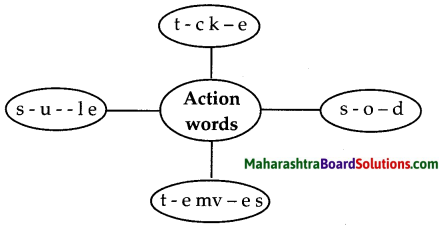
Maharashtra Board Class 5 English Solutions Chapter 9 The Triantiwontigongolope 1
Answer:

  • tickle
  • scold
  • trembles
  • scuttle

Select the proper alternative and complete the following:

Question 1.
Triantiwontigongolope ………………………. if you tread upon its toes.
(a) smiles
(b) trembles
(c) scuttles
Answer:
(b) trembles

Maharashtra Board Class 5 English Solutions Chapter 9 The Triantiwontigongolope

Question 2.
Pick out a line to prove that Trianti wontigongolope does not exist.
Answer:
For there isn’t such an insect.

Question 3.
The poet reveals in the end that it was a joke.
Were you disappointed by this confession? Justify your answer.
Answer:
The humorous character in the story made me laugh heartily but at the same time. I am disappointed that I won’t be able to see the insect as it does not exist.

The Triantiwontigongolope Summary in English

Summary :

The humorous poem ‘The Triantiwontigongolope’ written by C. J. Dennis tickles the reader’s funny bones and ushers laughter. The main character of this poem is a very funny insect with a very funny name. The poet describes its physical appearance, eating habits and other activities. At the end of the poem, the poet surprises us by concluding that the insect is imaginary and does not exist. We are willing to forgive the poet for his prank. After all, didn’t he make us laugh to our heart’s content?

Maharashtra Board Class 5 English Solutions Chapter 9 The Triantiwontigongolope

Meanings :

  1. spy (o) – catch sight of
  2. spider (n) – a small insect with eight legs.
  3. beetle (n) – an insect with wings which are hard.
  4. bee (n) – an insect which provides honey
  5. woolly (adj.) – covered with wool.
  6. grub (n) – a worm-like larva of an insect
  7. weeds (n) – unwanted wild plants
  8. wattlegum (n) – an Australian gum
  9. appetite (n) – desire for food
  10. disgrace (n) – loss of respect due to one’s action
  11. scare (v) – cause fear
  12. mope (v) – feel low and dejected
  13. tremble (v) – to shake due to excitement or fraility
  14. tickle (o) – light touch by someone which evokes laughter
  15. tread (v) – walk in a specific manner
  16. snubbish (adj.) – somewhat short and turned up at the end
  17. scold (v) – to rebuke
  18. scuttle (o) – to run hurriedly
  19. purrs (u) – sound that cat makes
  20. confess (o) – admit
  21. forgive (v) – cease or stop feeling angry or bitter towards someone for their mistake / their action.

English Balbharati Workbook Std 5 Answers Unit 2

Who’s the Greatest? Questions and Answers Class 6 English Chapter 1.2 Maharashtra Board

Balbharti Maharashtra State Board Class 6 English Solutions Chapter 1.2 Who’s the Greatest? Notes, Textbook Exercise Important Questions and Answers.

Std 6 English Lesson 1.2 Who’s the Greatest? Question Answer Maharashtra Board

Class 6 English Chapter 1.2 Who’s the Greatest? Textbook Questions and Answers

1. Listen to the stories carefully, as your teacher reads them aloud. Note down the new words, ideas or concepts. Discuss them in the class.

Question 1.
Listen to the stories carefully, as your teacher reads them aloud. Note down the new words, ideas or concepts. Discuss them in the class.

2. Guess the meaning of the following words and phrases:
untold wealth, closest to the Emperor’s heart, grave offence, banish.

Question 1.
Guess the meaning of the following words and phrases:
untold wealth, closest to the Emperor’s heart, grave offence, banish.
Answer:

  1. untold wealth: limitless wealth, the magnitude of which is not revealed
  2. closest to the Emperor’s heart: dear to the Emperor
  3. grave offence: serious mistake
  4. banish: send away into exile

Maharashtra Board Class 6 English Solutions Chapter 1.2 Who’s the Greatest?

3. Say with reasons, whether the following statements are true or false.

Question a.
Akbar wanted to punish the person who pulled his moustache.
Answer:
False. Akbar did tell his courtiers that someone had pulled his moustache. But it was his grandson who had lovingly pulled his moustache and Akbar did not have any intention of punishing him.

Question b.
Akbar thought he was greater than God.
Answer:
False. Akbar did not think so. It was his courtiers who said so in an attempt to praise him for receiving favours.

Question c.
Birbal thought Akbar was greater than God.
Answer:
True. Birbal thought Akbar was greater than God but only at one aspect. Unlike Akbar, God’s kingdom extended everywhere so the Almighty God could not banish anyone from his kingdom.

Maharashtra Board Class 6 English Solutions Chapter 1.2 Who’s the Greatest?

4. Write a sentence about three of your friends. Each time you should say what your friend cannot do, and yet, pay a compliment to your friend.

Question 1.
Write a sentence about three of your friends. Each time you should say what your friend cannot do, and yet, pay a compliment to your friend.
Answer:

  • My friend Raj cannot say no to others as he does not like to hurt others.
  • My friend Radha cannot hurt animals as she is concerned about their welfare.
  • My friend Sai cannot be rude to others because he is extremely loving and polite.

Maharashtra Board Class 6 English Solutions Chapter 1.2 Who’s the Greatest?

5. Write a short note on Emperor Akbar.

Question 1.
Write a short note on Emperor Akbar.
Answer:
Emperor Akbar or Akbar the Great is known as one of the greatest rulers in the world – not just because he had a vast empire, a very strong army, untold wealth but because he was a good human being. He cared for his subjects. He had great respect for scholars, writers, poets and artists belonging to different religions. He was a patron of art and culture. The nine gems or ‘nav-ratnas’ in his court were famous which included Birbal who was known for his wit and humour. He was the one who was very dear to Akbar.

6. Convert the stories into dialogues and read the dialogues aloud in the class.

Question 1.
Convert the stories into dialogues and read the dialogues aloud in the class.
(One is done for you.)
Answer:

  • Emperor Akbar: (With a serious expression.)
    I have a question for all of you. What should be the punishment for someone who pulls my moustache?
  • One Nobleman: Flog him! Give him fifty lashes of the whip.
  • Second Nobleman: That’s not enough. Put him in jail without food and water.
  • Third Nobleman: Whip him! Beat him up! Fourth Nobleman: Hang him!
  • Fifth Nobleman: Cut off his offending hands.
  • Akbar: What do you say Birbal?
    What is your opinion?
  • Birbal: In my opinion, given of peace to the world, the offender should be given his favourite sweetmeats.
  • Courtiers: Raja Birbal, are you out of your mind? Give sweetmeats for such a grave offence?
  • Birbal: Yes, who would be so bold as to pull the Emperor’s moustache? Only his own grandson!
    (Akbar burst out laughing as it was exactly what had happened in the morning.)

Maharashtra Board Class 6 English Solutions Chapter 1.2 Who’s the Greatest?

7. Form pairs and make a ‘pair presentation’ of any one of the two stories. To do so, each person presents only one sentence at a time, and the next one is immediately presented by the partner. Thus, each person in the pair presents alternate sentences without breaking the flow of the narration.

8. Find at least five other Akbar and Birbal stories and share them with your friends. Make a list of the stories collected by the entire class. Write your list in alphabetical order.

9. Visit a library. Find the stories of:

  • Mulla Nasiruddin
  • Gopal Bhand
  • Tenali Raman

Share them in the class.

Class 6 English Chapter 1.2 Who’s the Greatest? Additional Important Questions and Answers

Answer in one sentence.

Question 1.
Why is Emperor Akbar or Akbar the Great known as one of the greatest rulers in the world?
Answer:
Emperor Akbar or Akbar the Great is known as one of the greatest rulers in the world, not just because he had a vast empire, a very strong army, untold wealth, but because he was a good human being.

Question 2.
Give two examples to show that Akbar was an ideal ruler.
Answer:

  1. Akbar cared for his subjects.
  2. He had great respect for scholars, writers, poets and artists belonging to different religions.

Maharashtra Board Class 6 English Solutions Chapter 1.2 Who’s the Greatest?

Question 3.
Who did Akbar have great respect for?
Answer:
Akbar had great respect for scholars, writers, poets and artists belonging to different religious.

Question 4.
Which question posed by Akbar stunned the Emperor’s court? Why?
Answer:
The question, “What should be the punishment for someone who pulls my moustache?” stunned Akbar’s court as it was unheard of.

Question 5.
Write any one punishment suggested by any one nobleman.
Answer:
One nobleman suggested that the person who pulled the Emperor’s moustache should be flogged with fifty lashes of the whip.

Question 6.
What was Birbal’s suggestion regarding punishing the offender?
Answer:
Birbal suggested that the offender should be given his favourite sweetmeats.

Maharashtra Board Class 6 English Solutions Chapter 1.2 Who’s the Greatest?

Question 7.
What explanation did Birbal offer for his choice of punishment?
Answer:
Birbal explained that only his own grandson would be so bold to pull the Emperor’s moustache and so giving his favourite sweetmeats would be the best punishment.

Question 8.
Why did the courtiers compete with each other in praising Akbar?
Answer:
The courtiers competed with each other in praising Akbar as they wanted to get some favours from him.

Question 9.
What dilemma did the courtiers face?
Answer:
When the courtiers praised Akbar and said that he was greater than God Almighty, Akbar asked them to prove it or face punishment.

Question 10.
What was the one thing according to Birbal which Akbar could do but God Almighty could not?
Answer:
According to Birbal when Akbar wanted to punish someone, he could banish that person out of his kingdom, but as God’s kingdom extended everywhere, the Almighty couldn’t banish anyone from his kingdom.

Maharashtra Board Class 6 English Solutions Chapter 1.2 Who’s the Greatest?

Reading Skills, Vocabulary and Grammar

Read the following extract and complete the activities that follow.

Question 1.
State whether the following statements are true or false.
a. Akbar was happy to hear the praises from his courtiers.
b. Akbar was angry with Birbal’s response.
Answer:
a. False
b. False

Question 2.
What information did Akbar want?
Answer:
Akbar wanted to know if the courtiers had found an answer to his question.

Question 3.
Why could God not banish anyone from his kingdom?
Answer:
God couldn’t banish anyone from his kingdom because God’s kingdom extended everywhere.

Maharashtra Board Class 6 English Solutions Chapter 1.2 Who’s the Greatest?

Question 4.
Why did Akbar’s face lighten up with a smile?
Answer:
Akbar’s face lightened up with a smile because Birbal had given a clever reply.

Question 5.
Why did Akbar forgive the courtiers for their stupidity?
Answer:
Akbar was so pleased with the answer given by Birbal that he forgave the courtiers for their stupidity.

Question 6.
Find the odd word:
look, royal, good, proper
Answer:
look, The rest are adjectives.

Question 7.
Complete the analogy:
Answer:
prove: proof: punish: punishment

Question 8.
Everyone was curious to see what would happen next. (State the word class of the underlined word.)
Answer:
next: adverb

Maharashtra Board Class 6 English Solutions Chapter 1.2 Who’s the Greatest?

Question 9.
The Almighty cannot banish anyone from his kingdom. (Add a question tag)
Answer:
The Almighty cannot banish anyone from his kingdom, can he?

Question 10.
Do you believe in false praise? Elaborate.
Answer:
No, I don’t. Appreciating people for their good qualities is a good thing but resorting to false praise for receiving favours or for some ulterior motive is definitely something which we should refrain from.

Language Study

Do as directed.

Question 1.
You are the greatest of the kings. (Underline the adjective)
Answer:
greatest.

Question 2.
Put him in jail without food and water. (State the types of nouns)
Answer:
food, water – Material noun.

Maharashtra Board Class 6 English Solutions Chapter 1.2 Who’s the Greatest?

Question 3.
He was an patron of art and culture. (Correct the article)
Answer:
He was a patron of art and culture.

Question 4.
I believe you. ( Begin the sentence with ‘you are )
Answer:
You are believed (by me).

Question 5.
Flag him ! (State the type of sentence)
Answer:
Exclamatory sentence.

Question 6.
Akbar looked at Birbal thoughtfully (State the part of speech of the underlined word)
Answer:
thoughtfully – Adverb.

Maharashtra Board Class 6 English Solutions Chapter 1.2 Who’s the Greatest?

Make sentences using the following phrases.

  1. to have respect: I have great respect for my teachers who are my friends and my guide.
  2. to come up with: He came up with the most silly excuse.
  3. to be stunned: The whole world was stunned by the news .
  4. to offer an explanation: He realised his mistake and offered an explanation for them.
  5. to have an advantage: The other team in the game had an advantage because they were highly experienced.

Complete the following table.

NounAdjectiveVerb
carecarefulcare
beliefbelievablebelieve
competitioncompetitivecompete
punishmentpunishablepunish

Give the antonyms by providing appropriate suffixes.

  1. interesting × uninteresting
  2. human × inhuman
  3. pleased × displeased
  4. advantage × disadvantage
  5. proper × improper

Give one word for:

  1. very great in area or size: vast
  2. to beat someone hard with a whip: flog
  3. to be disturbed: agitated
  4. lack of cleverness: stupidity

Maharashtra Board Class 6 English Solutions Chapter 1.2 Who’s the Greatest?

Did you Know?

Birbal stories are very famous and popular in India among all ages of people. They are also known as Akbar-Birbal stories. Akbar, the Great, the Mughal Emperor in India, ruled from 1560 to 1605. He himself was illeterate but he invited several learned people in his court. Among these, nine people were very famous and were known as Nav-ratnas. Birbal was the favourite of Akbar, because of his wisdom, wit and subtle humour.

Who’s the Greatest? Summary in English

Who’s the Greatest? is an interesting lesson which narrates two of the very popular Akbar and Birbal stories. Akbar would always pose interesting questions and problems in his court and Birbal, one of his nine gems or ‘nav-ratnas’ never failed to come up with an answer displaying his wit and humour.

In this lesson, one of the stories talks about Akbar’s question to his courtiers:
“What should be the punishment for someone who pulls my moustache?”
While everyone called for strict actions for the grave offence, Birbal smilingly suggested that Akbar should give the offender his favourite sweetmeats. After all he said, who would be so bold to pull the Emperor’s moustache other than his own grandson?
The next story is about the challenge Akbar posed to his courtiers who showered him with false praises and called him greater than the God Almighty.
He told the courtiers to tell him atleast one thing he could do but God Almighty would not be able to do.
Here Birbal came to the courtier’s rescue. He said:
“When you want to punish someone, you can banish that person – you can throw him out of your kingdom. But God’s kingdom extends everywhere. The Almighty cannot banish anyone from his kingdom.” Akbar was pleased with the answer.
The humour and wit in the Akbar and Birbal stories are the reasons for their popularity.

Introduction:

‘Who’s the Greatest’ narrates Akbar and Birbal’s stories which reflect Birbal’s wit, humour and intelligence.

Maharashtra Board Class 6 English Solutions Chapter 1.2 Who’s the Greatest?

Glossary:

  1. vast (adj) – very great in area or size
  2. empire (n) – a large area ruled by an emperor or supreme authority
  3. scholars (n) – learned persons
  4. patrons (n) – a person supporting something. Here it is art and culture
  5. pose (v) – present a question
  6. generations (n) – all the people born in the same period
  7. agitated (adj) – angry, disturbed.
  8. courtiers (n) – attendants at the court
  9. offender (n) – one who commits an illegal act
  10. opportunity (n) – circumstances which ensure that something can be done
  11. displeasure (n) – annoyance
  12. banish (v) – send away into exile
  13. advantage (n) – something which provides one a favourable position

6th Std English Balbharati Textbook Solutions

It Can Be Done Poem Questions and Answers Class 6 English Chapter 3.1 Maharashtra Board

Balbharti Maharashtra State Board Class 6 English Solutions Chapter 3.1 It Can Be Done Notes, Textbook Exercise Important Questions and Answers.

Std 6 English Lesson 3.1 It Can Be Done Question Answer Maharashtra Board

Class 6 English Chapter 3.1 It Can Be Done Textbook Questions and Answers

1. Answer the following questions in one sentence each.

Question a.
Who misses all the fun?
Answer:
The man who has a negative approach in trying out new things and says ‘it can’t be done’ is the man who misses all the fun.

Maharashtra Board Class 6 English Solutions Chapter 3.1 It Can Be Done

Question b.
What does the title of the poem suggest?
Answer:
The title of the poem positively suggests that the things that we set our mind to complete can most definitely be done.

Question c.
What does the man who misses all the fun do?
Answer:
The man who misses all the fun wears an expression of solemn pride, remains away from other people and harshly criticizes any kind of new venture.

Question d.
What does ‘who misses all the fun’ mean?
Answer:
In the poem, this line refers to a person who likes to remain away from other people because of his solemn pride and is never ready to face any obstacle with a positive attitude of overcoming it.

Maharashtra Board Class 6 English Solutions Chapter 3.1 It Can Be Done

Question e.
What would he do if he had the power in him?
Answer:
If he had the power in him, he would happily erase all the developments made by man and also the history of the human race.

Question f.
What examples of man’s progress have been given in the poem?
Answer:
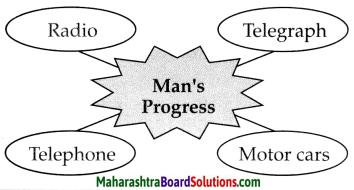
The examples of man’s progress given in the poem are – radio, motor cars, street lights, telegraph and the telephone.

Question g.
What should human beings do to make progress?
Answer:
Human beings should have a positive outlook towards life which will help them overcome their difficulties and fears, and certainly help them to go ahead in the path of progress.

2. Form groups. List a few articles of everyday use. Discuss how they can be improved.

Question 1.
Form groups. List a few articles of everyday use. Discuss how they can be improved.
Answer:
1. Doorbell: The doorbell that everyone has in their homes can only be clearly heard in one room. In order to improve the doorbell, we can install the doorbell device in the other rooms too.

2. Mosquito racket: Mosquitoes are the worst nuisance for man. The rackets work pretty well, but it would be better if we had a bigger net to easily capture the sly mosquitoes.

3. Mobile phones: Even though the mobile phone is owned by almost everyone, its battery life is pretty less, so it would be feasible if the battery life sustains for a longer time.

Maharashtra Board Class 6 English Solutions Chapter 3.1 It Can Be Done

3. Form pairs. Discuss and prepare a list of things which can be and will be done in future. (5 things) Spot the modal verbs in your answer. 

Question 1.
Form pairs. Discuss and prepare a list of things which can be and will be done in future. (5 things) Spot the modal verbs in your answer.
Answer:

  1. The Leaning Tower of Pisa may be straightened.
  2. Cars will be travelling through air rather than by road.
  3. People might make trips to the moon for a vacation.
  4. We could have floating homes on water.
  5. People would be skating or cycling to their place of work.

The modal verbs in the above sentences are:

  • may
  • will
  • might
  • could
  • would Let us do some more:

Maharashtra Board Class 6 English Solutions Chapter 3.1 It Can Be Done

4. Complete the following sentences using your ideas. 
(a) I can …………….., (b) They can …………….., (c) We can ……………..

Question 1.
Complete the following sentences using your ideas. :
a. I can ……………..
b. They can ……………..
c. We can ……………..
Answer:
a. I can succeed.
b. They can overcome their fears.
c. We can conquer the world.

Class 6 English Chapter 3.1 It Can Be Done Important Questions and Answers

Reading Skills and Poetic Device

Read the following extract and complete the activities that follow:

Question 1.
Complete the web diagram with words from the extract:
Answer:
Maharashtra Board Class 6 English Solutions Chapter 3.1 It Can Be Done 1

Question 2.
Explain: The man who misses all the fun. Is he who says, “It can’t be done.”
Answer:
The man who lacks courage to try out new things, and does not have positive attitude towards life is a man who misses all the fun and progress in life.

Question 3.
Pick out a word from the extract which means ‘an adventure’.
Answer:
venture

Question 4.
Pick out two pairs of rhyming words from the poem.
Answer:

  • fun – done
  • aloof – reproof
  • efface – race
  • cars – stars
  • telephone – stone
  • run – done

Question 5.
What would you do to achieve success?
Answer:
I would try my very best in everything I do.
I would not be disheartened with failures, instead it would motivate me to strive harder. I would not shirk my responsibilities when faced with difficult situations but would try my level best to come out of it successfully.

Writing Skills:

Question 1.
Write a paragraph on ‘Never Giving Up’.
Answer:
Always complete well whatever you have begun even if you come across difficulties. God has given us the capacity and the capability so we should use it to the fullest. Never let the word ‘cannot do’ come into your mind. Always be positive. The small spider in the story of ‘King Bruce’ shows us that if we keep trying, we will surely succeed. Remember, never give up easily, ‘Try, try till you succeed’.

Project Wheels:

Question 1.
Think carefully for a minute. Tag your memory and recall all the things/objects on which you have seen wheels. Write them down.
Answer:
Cycles, cars, trucks, trains, aeroplanes, carts, watches, toys, our National Flag, chair, table, trolley, skateboard, motorbike, bags, vacuum cleaner, baby carriage.

Maharashtra Board Class 6 English Solutions Chapter 3.1 It Can Be Done

Question 2.
Now talk to your friend or elders; refer to books and read about all the objects in which wheels are used. List them (How many did you miss out on in your first list? Why?)
Answer:
Students should go through books and list down as many things they can find with wheels. (There was a time limit of one minute and so could not list down more.)

Question 3.
The wheel which was probably invented more than 6000 years ago is thought of as one of the greatest technological advances made by man. Why do you think the wheel is so important in human civilisation?
Answer:
Though the wheel was made during the Stone Age period, it was the beginning of a revolution. Wheels helped the early man to transport goods from one place to another and thus began trade. Wheels moved slowly at first and caught momentum. Today we have progressed so far just because of wheels that is why I think the wheel is very important in human civilisation.

Question 4.
Can you imagine life without wheels? Try and think of what life would be like if there were no wheels around.
Answer:
I cannot imagine life without wheels. Things would all be done at a very slow pace. There would be no technological development and we would not have reached the moon and other places without wheels.

Maharashtra Board Class 6 English Solutions Chapter 3.1 It Can Be Done

Question 5.
Have you seen how wheels move on different surfaces like sand, gravel, grass or on a proper road? What are the differences you see?
Answer:
Experience it yourself and write down how the wheels move on different surfaces. The first one is done for you.
(a) On sandy surfaces, wheels find it difficult to move. It is not smooth at all.
(Tip: Students can ride their bicycles on the above mentioned surfaces and jot down their findings.)

It Can Be Done Summary in English

Introduction:

The poem “It Can Be Done” generalises that a person who lacks confidence and motto is the type of a person who remains stagnant in life and naturally unsuccessful. The poem explains that without hard work and sheer determination, man’s life wouldn’t be as developed as it is now.

Paraphrase:

The poem suggests that the things that we set our mind to complete can most definitely be done. The man who misses all the fun wears an expression of solemn pride, remains very aloof and harshly criticizes any kind of new venture.

If he had the power, he would happily erase all the developments made by man and also the history of the human race. We would then have no radio, no motorcars, no streetlights, no telegraphs, no telephone. We would still be living in the Stone Age. The poet says that the world would sleep if things were run by such men who had a negative approach to life saying, ’It can’t be done’.

Maharashtra Board Class 6 English Solutions Chapter 3.1 It Can Be Done

Glossary:

  1. in solemn pride (phrase) – here it means looking very serious, grand and important
  2. aloof (adj) – separately, without getting involved in
  3. venture (n) – adventure, a dangerous or risky task
  4. reproof (n) – criticism, negative comments
  5. efface (v) – wipe out, remove
  6. linger (v) – to stay or remain in a place

Don’t Give Up! Questions and Answers Class 6 English Chapter 1.1 Maharashtra Board

Balbharti Maharashtra State Board Class 6 English Solutions Chapter 1.1 Don’t Give Up! Notes, Textbook Exercise Important Questions and Answers.

Std 6 English Lesson 1.1 Don’t Give Up! Question Answer Maharashtra Board

Class 6 English Chapter 1.1 Don’t Give Up! Textbook Questions and Answers

1. Have you ever given up on something good? Share your story.

Question 1.
Have you ever given up on something good? Share your story.
Answer:
I was a very good cricketer. But on a couple of occasions, I got a feeling that my team failed due to my poor performance. I stopped pursuing the game, but today I regret my decision. I realised very late that: ‘A quitter never wins and a winner never quits’.

Maharashtra Board Class 6 English Solutions Chapter 1.1 Don’t Give Up!

2. Your friend fell down learning to ride a bicycle and now has given it up altogether. What do you think will be the poet’s advice?

Question 1.
Your friend fell down learning to ride a bicycle and now has given it up altogether. What do you think will be the poet’s advice?
Answer:
‘Rise each time you fall, never give up’ would be the advice the poet would give my friend. While riding a bicycle or acquiring any new skills, we are bound to fall or face disappointments. The poet would advise him to be patient and rise stronger and achieve what he has set out to achieve with determination and resilience.

Class 6 English Chapter 1.1 Don’t Give Up! Additional Important Questions and Answers

Answer the following questions.

Question 1.
What should we not do if we have tried but not won?
Answer:
If we have tried but not won, we should never stop for crying or feel dejected about the same.

Question 2.
Name two elements of nature mentioned in the poem which display determination and strength.
Answer:
‘Young birds’ and the ‘oak tree’.

Question 3.
Pick out two describing words used in the poem.
Answer:
Young, sturdy

Maharashtra Board Class 6 English Solutions Chapter 1.1 Don’t Give Up!

Question 4.
Circle the odd word. great good patient (blast)
Answer:
Blast, the rest are describing words.

Question 5.
Name any one personality from the pages of history who didn’t give up till he succeeded. Justify your answer.
Answer:
Our Father of the Nation, Mahatma Gandhi, did not give up or buckle under pressure in our struggle for independence. Finally, due to his relentless efforts and determination, we became free from the British rule and became an independent nation.

Question 6.
Explain the line: “If by easy work you beat, who the more will prize you?”
Answer:
The above lines from the poem ‘Don’t Give Up’ written by Phoebe Cary convey the message that if success comes to us easily it will not be considered as our achievement. Rising above challenges and failures, and emerging a winner is true success, according to the poet.

Maharashtra Board Class 6 English Solutions Chapter 1.1 Don’t Give Up!

Reading Skills, Poetic Device

Read the following stanza and answer the questions that follow.

Question 1.
Pre-reading activity:
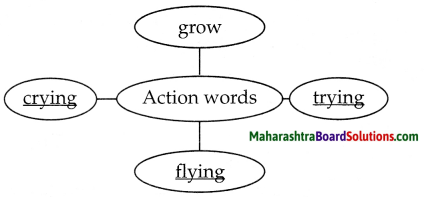
Complete the web diagram with action words from the poem.
Answer:
Maharashtra Board Class 6 English Solutions Chapter 1.1 Don’t Give Up! 1

Question 2.
What is the central idea of the poem?
Answer:
The central idea of the poem is that we should never give up and be patient in the face of failures as we continue to keep trying. Failures are bound to occur. We should not lose heart and stop trying but gain victory from defeat with our willpower and our determination.

Question 3.
According to the poet, how has the great and good been done in this world?
Answer:
According to the poet, all that’s great and good is done just by trying, with patience and determination till we achieve our goal.

Question 4.
What happens to the young birds while they try to fly?
Answer:
The young birds fall as they try to fly.

Question 5.
Pick out lines to prove that the oak has survived many blows of stormy winds.
Answer:
‘She has risen again and grown, Loftier and prouder’.

Maharashtra Board Class 6 English Solutions Chapter 1.1 Don’t Give Up!

Question 6.
Pick out a contraction from the extract.
Answer:
You’ve (It stands for you have)

Question 7.
Do you agree with the maxim: ‘Try, try, till you succeed’?
Answer:
Yes. I agree with the maxim: ‘Try, try till you succeed’. We should remember that ‘A quitter never wins and winner never quits’.
People like Mahatma Gandhi, Sachin Tendulkar, A.P.J. Abdul Kalam and others have proved the above maxim to be right, with their life and work.
We should remember that disappointments and failures are bound to occur in our journey to succeed, but we should never lose heart. We should keep trying patiently till we accomplish our goal.

Poetic Device/Appreciation:

Question 1.
Find the meaning of the following expressions.
Answer:

  1. All that’s great and good: All the great achievements and accomplishments we see around us.
  2. Has known many a blast: The tree has survived many blows of stormy weather.
  3. The test that tries: A situation which is challenging, and which tests our endurance, our resilience and our willpower.

Poetic Devices:

Question 1.
Pick out two pairs of rhyming words from the poem.
Answer:

  • won – done
  • stronger – longer
  • known-grown

Maharashtra Board Class 6 English Solutions Chapter 1.1 Don’t Give Up!

Question 2.
Name the rhyme scheme used in the first four lines of the poem.
Answer:
abab

Question 3.
Name and explain the figure of speech used in the line.
‘That’s the test that tries you’.
Answer:
The figure of speech used in the above line is Alliteration as the sound of the alphabet’t’ is repeated for a better poetic effect.

Student’s Activity:

Question 1.
Find real life stories of some indians, abled and disabled, who have beaten all odds to become great achievers. You can also make a power point presentation with the help of your teacher.

Don’t Give Up! Summary in English

‘Don’t Give Up’ written by Phoebe Cary has a beautiful message for each one of us. The poet advises us never to be disheartened or dejected by failures. We are reminded that all the great and good things in this world is done just by patience and relentless efforts of the concerned people.

The poet gives the example of young birds who in their initial flights, fall but rise higher and stronger each time, thus proving that resilience and determination can help scale great heights.

The sturdy oak too has withstood challenges of time before rising up taller, stronger and prouder. Our achievements and our accomplishments may not be celebrated by others if it had come to us easily. But despite all odds, overcoming all challenges, rising above defeats when we achieve our goal and gain victory, that will be our true test, our real victory.

Introduction:

‘Don’t Give Up’ written by Phoebe Cary conveys the message that failures should not discourage us from achieving what we have set out to do. In a nutshell, the poet is conveying the message that we should never quit, however hard the situation and emerge a winner.

Maharashtra Board Class 6 English Solutions Chapter 1.1 Don’t Give Up!

Glossary:

  1. patient (adj) – a person with calm endurance
  2. sturdy (adj) – strong
  3. oak (n) – a deciduous forest tree
  4. victory (n) – success achieved
  5. test that tries (phr) – something done to discover/test our ability
  6. give up (phr) – lose heart and stop trying
  7. has known many a blast (phr) – has survived many blows of stormy winds
  8. loftier (adj) – taller and stronger
  9. you beat (phr) – you win (here)
  10. resilience (n) – able to recover quickly from difficult conditions.

6th Std English Balbharati Textbook Solutions

An Autumn Greeting Poem Questions and Answers Class 6 English Chapter 4.8 Maharashtra Board

Balbharti Maharashtra State Board Class 6 English Solutions Chapter 4.8 An Autumn Greeting Notes, Textbook Exercise Important Questions and Answers.

Std 6 English Lesson 4.8 An Autumn Greeting Question Answer Maharashtra Board

Class 6 English Chapter 4.8 An Autumn Greeting Textbook Questions and Answers

1. Recite the poem with proper rhythm and intonation.

An Autumn Greeting Poem Questions And Answers Question 1.
Recite the poem with proper rhythm and intonation.

Maharashtra Board Class 6 English Solutions Chapter 4.8 An Autumn Greeting

Class 6 English Chapter 4.8 An Autumn Greeting Additional Important Questions and Answers

Analysis of the poem.

An Autumn Greeting Poem Std 6 Question 1.
Name of the poem: An Autumn Greeting
Poet: George Cooper
Answer:
1. Central Idea: Tracing the journey of the little leaves in autumn from the treetops to their earthy beds, that is the ground and how they are embedded under the winter snow. A beautiful description of changes observed in nature during autumn.

2. Stanzas: Three stanzas with 8 lines in each stanza.

3. Poetic Device:
a. Rhyming words used:

  1. day – play
  2. gold – cold
  3. call-all
  4. flew – knew
  5. went – content
  6. beds – heads

(b) Figures of speech used: Personification is the figure of speech used in this poem, i.e., a figure of speech wherein inanimate objects are given the human qualities. It has added effectiveness to the human qualities. It has added to the beauty of the poem.
e.g.:
‘Come little leaves’- send the wind one day.
1. As the leaves heard the wind’s loud call.

4. Imagery:
Imagery is used to make a poem vivid and descriptive thus providing clarity to the readers. With the beautiful use of imagery the poet has taken the poem to another level.
e.g.:
Down they came fluttering,
One and all;
Over the meadows
They danced and flew ………..

Maharashtra Board Class 6 English Solutions Chapter 4.8 An Autumn Greeting

An Autumn Greeting Summary in English

This journey of the leaves from the tree to their earthy beds is aided by their friend ‘the wind’. He ushers them to come over the meadows in their red and gold dresses and play with him. The wind reminds the leaves that summer has bid them goodbye, and winter has set in. The leaves as if waiting for the wind’s call, come down fluttering, dancing, flying and singing. Their journey continues till they reach their earthy beds and they fall into deep sleep with snow covered over their heads.

Introduction:

The poet describes the beauty of the autumn season. Come autumn and the leaves begin to change colour. They change into red and gold and they start falling off the trees. With the weather getting colder, the leaves are covered by the snow.

Glossary:

  1. meadows (n) – a field which has grass and flowers growing on it
  2. fluttering (v) – moving (flying) up and the grass down or side to side with quick movements
  3. to be content (v) – to be satisfied
  4. mantle (n) – (here) a layer of ice covering

Maharashtra Board Class 6 English Solutions Chapter 4.8 An Autumn Greeting

6th Std English Balbharati Textbook Solutions

Announcements Poem Questions And Answers Class 5 English Chapter 6 Maharashtra Board

Std 5 English Lesson No 6 Announcements Question Answer Maharashtra Board

Balbharti Maharashtra State Board Class 5 English Solutions Chapter 6 Announcements Notes, Textbook Exercise Important Questions and Answers.

5th Std English Poem Announcements Question Answer

English Balbharati Std 5 Digest Chapter 6 Announcements Textbook Questions and Answers

1. Choose a suitable heading for each announcement from those given below.

Question 1.
Choose a suitable heading for each announcement from those given below.
1. Change in School Hours
2. Cleanliness
3. Story-telling Competition
4. Lost and Found
5. Warning
6. Football Match
Answer:

Announcement NumberHeading
1.Cleanliness
2.Change in school hours
3.Football match
4.Story-telling competition
5.Warning
6.Lost and found

Maharashtra Board Class 5 English Solutions Chapter 6 Announcements

2. Present any one of these announcements yourself, orally.

Question 1.
Present any one of these announcements yourself, orally.
Answer:
Announcements

OrallyNotice – board
Cleanliness–
Change in school hoursChange in school hours
Football matchFootball match
–Story-telling competition Warning
WarningWarning
Lost and foundLost and found

Maharashtra Board Class 5 English Solutions Chapter 6 Announcements

3. Group Work

Question 1.
An announcement can be made in every class, orally. Or, it can be put up on the school notice-board. Discuss and decide what method should be used for each of the announcements given here.

  • Oral announcement
  • Written notice
  • Both

Question 2.
Make groups. One person in the group chooses an announcement. Everyone in the group reads that announcement silently but carefully and closes their books. Then that person presents the announcement, changing one of the details in the announcement. Others spot the change. For example, you might say ‘red’ key chain instead of ‘blue’ in the last announcement.

Question 3.
Name the occasion or reason for which each of the announcements is being made. Then think of an occasion and prepare an announcement for it as a group activity.
Answer:

Ganesh Chaturthi Celebrations

All the members of the society are hereby informed that the Ganesh pandals will be set with other decorations in the society compound. Members are requested to contribute as much as they can and handover the amount to the Secretary by tomorrow.

Jt. Secretary
XYZ

Maharashtra Board Class 5 English Solutions Chapter 6 Announcements

4. Activity

Question 1.
Prepare an announcement for an occasion like the ones mentioned here.
Answer:
1.

Little Scholars’ School

Beware! The floor here is wet A pipeline in the boys’ washroom on the second floor is broken. There is water seepage from the walls and the staircase. The floor is wet and slippery. Students using the passages hould be cautious. They are warned not to run, for they might slip and get injured.

Supervisor
XYZ

2.

Little Scholars School Medical Camp

Dt. 01 Sept. 2015 The school has organized a medical checkup programme for classes V, VI and VII from 13th September, 2015 to 16th September, 2015. Try not to remain absent on these days.
Principal
XYZ

3.

Blossoms Laughter Club

Laughter Club has started a laughter session in Tilak Garden every morning at 7 a.m. All those who are interested in cheering up their busy life, kindly register your names with Mr. Pawar, the organizer.

Secretary
XYZ

4.

Blossoms High School Return of Library Books

It has been noticed that library books are not returned on time. Many of the books returned are not in proper condition. Strict action will be taken if there is a delay in returning the books. A fine will also be charged for unkempt books.

Librarian
XYZ

English Balbharati Std 5 Answers Chapter 6 Announcements Additional Important Questions and Answers

Answer the following questions:

Question 1.
What did the Head Boy and the Head Girl observe?
Answer:
The Head Boy and the Head Girl observed that certain classes did not clean up their classrooms before leaving.

Question 2.
Why will the school close an hour earlier?
Answer:
The school will close an hour earlier as the teachers have to attend an important meeting.

Maharashtra Board Class 5 English Solutions Chapter 6 Announcements

Question 3.
Which classes will be competing in the football match?
Answer:
Classes VIII and IX will be competing in the football match.

Question 4.
Give the date, time and venue of the Elocution Competition.
Answer:
The Elocution Competition will be held on the 21st July, at 10 a.m. in the morning in the school hall.

Question 5.
What are the students cautioned about?
Answer:
The students are cautioned to stay away from the fence at the construction site.

Maharashtra Board Class 5 English Solutions Chapter 6 Announcements

Announcements Summary in English

Summary :

The lesson Announcements’ tells us that an announcement is used to communicate with students in school or people in general. Announcements are made to give information or a message about something. Announcements can be in the written or the oral form. In the written form, a notice is put up in class or on the notice board of the school.

Announcements to indicate different timings and days are put up in the written format as it is likely that one may forget the timings or days. On the other hand, short messages without date and time can be announced orally While announcements are being made, one should pay attention to it so that doubts can be cleared right away.

Maharashtra Board Class 5 English Solutions Chapter 6 Announcements

Meanings :

  1. observed (o) – watched carefully.
  2. littered (o) – dirtied with papers thrown around.
  3. detained (u) – forced to stay back in the same place
  4. P.T.A (abbrev.) – Parents’ and Teachers’ Association
  5. cautioned (v) – warned
  6. distracted (u) – diverted the attention of
  7. organized (v) – made arrangements
  8. register (o) – to put one’s name in an official list

Balbharti English Textbook Std 5 Unit 1

The Sword in the Stone Poem Questions and Answers Class 6 English Chapter 4.7 Maharashtra Board

Balbharti Maharashtra State Board Class 6 English Solutions Chapter 4.7 The Sword in the Stone Notes, Textbook Exercise Important Questions and Answers.

Std 6 English Lesson 4.7 The Sword in the Stone Question Answer Maharashtra Board

Class 6 English Chapter 4.7 The Sword in the Stone Textbook Questions and Answers

1. Read the passage. Underline the new words. Guess their meaning from the context. Verify it from a good dictionary.

Question 1.
Read the passage. Underline the new words. Guess their meaning from the context. Verify it from a good dictionary.

2. Put the following events in chronological order.

Question a.
The sword in the stone appeared in the churchyard.
Answer:
Ancient Britain was invaded by wild Barbarians.

Maharashtra Board Class 6 English Solutions Chapter 4.7 The Sword in the Stone

Question b.
Lord Uther died.
Answer:
Lord Uther drove the Barbarians away.

Question c.
Lord Uther drove the barbarians away.
Answer:
Lord Uther drove the Barbarians away.

Question d.
The Lords and Knights began to fight for the kingdom.
Answer:
Merlin entrusted a baby to Sir Ector.

Question e.
Sir Kay left his sword behind at home.
Answer:
Lord Arthur grew up in Sir Ector’s house.

Question f.
Merlin announced that Arthur was the son of Lord Uther.
Answer:
Lord Uther died.

Maharashtra Board Class 6 English Solutions Chapter 4.7 The Sword in the Stone

Question g.
Arthur brought the sword from the churchyard.
Answer:
The Lords and Knights began to fight for the kingdom.

Question h.
Ancient Britain was invaded by wild Barbarians.
Answer:
The sword in the stone appeared in the churchyard.

Question i.
Many knights tried to pull the sword out of the stone.
Answer:
Many knights tried to pull the sword out of the stone.

Question j.
Arthur grew up in Sir Ector’s house.
Answer:
Sir Kay left his sword behind at home.Arthur brought the sword from the churchyard.

Maharashtra Board Class 6 English Solutions Chapter 4.7 The Sword in the Stone

Question k.
Merlin entrusted a baby to Sir Ector.
Answer:
Merlin announced that Arthur was the son of Lord Uther.

3. What do the following events/actions tell us about the characters? Discuss.

Question a.
The Archbishop announced that everyone was free to try his hand at the sword and called all the Lords to the Great Tournament.
Answer:
The Archbishop is a bishop or priest of the highest rank. By giving a chance to all the lords to try their hand at the sword, he showed that he was fair and impartial. Through this act, he proved that he believed in giving everyone an equal chance. He acted responsibly in finding the rightful King of Britain.

Question b.
Arthur agreed to bring Sir Kay a sword at once.
Answer:
Arthur wanted his brother to win the tournament. He was dutiful and wanted to do all he could to help him achieve success at the tournament. He was excited about the prospects of this brother’s victory.

Maharashtra Board Class 6 English Solutions Chapter 4.7 The Sword in the Stone

Question c.
Sir Ector asked Sir Kay to show him whether he could draw the swords out the stone.
Answer:
Sir Ector was a man of integrity and honesty. He believed in always being truthful. These were the very lessons he had taught his sons too. Sir Ector insisted that Sir Kay show him whether he could draw the sword of the stone to ascertain whether his son’s claim was true.

Question d.
Sir Ector kneeled before Arthur.
Answer:
Sir Ector did a splendid job of bringing up Arthur. But on realizing that he was the son of the good Lord Uther Pendragon he bowed down to authority with the devotion as Arthur was the King of Britain. This shows that he respected the king of the land though he had brought him up as his own son.

4. Find five words each.

Question a.
with the suffix:
-less,
-ly,
-ness
Answer:

-less-lv-ness
speechlessangrilylawlessness
thanklessneatlyanxiousness
helplessurgentlybrightness
aimlessgentlycarelessness
carelesssilentlyfarsightedness

Maharashtra Board Class 6 English Solutions Chapter 4.7 The Sword in the Stone

Question b.
with the prefix:
un- in-
Answer:

un……………in……………
1. Unsafe
2. uncomfortable
3. unaware
4. unknown
5. uncommon
1. Insecure
2. insignificant
3. infamous
4. incomplete
5. inactive.

5. Visit a library: Read the stories of King Arthur and his Knights of the Round Table.

Question 1.
Visit a library: Read the stories of King Arthur and his Knights of the Round Table.

Class 6 English Chapter 4.7 The Sword in the Stone Additional Important Questions and Answers

Answer in one or two sentences.

Question 1.
Why did people make Lord Uther the King of Britain and give him the title Pendragon?
Answer:
In ancient Britain, at a time when the land was invaded by wild Barbarians, the good and noble Lord Uther fought them bravely and drove them away from his land. The people made him King of Britain and gave him the title, Pendragon, meaning ‘dragon’s head’.

Maharashtra Board Class 6 English Solutions Chapter 4.7 The Sword in the Stone

Question 2.
Write one instance to prove that lawlessness prevailed in Britain after the King died.
Answer:
Armed robbers roamed the countryside, pillaging farms and fields, and people felt unsafe and insecure in their own homes.

Question 3.
Which strange event was witnessed on Christmas morning?
Answer:
On Christmas morning, in the churchyard was a large stone, and on it an anvil of steel, and in the steel a naked sword was held, and about it was written in letters of gold that whoever pulled out the sword would by right of birth become the King of England.

Question 4.
Who crowded on the field to participate in the Great Tournament?
Answer:
Dukes and Counts, Earls, Barons and Knights crowded on the field to participate in the Great Tournament.

Question 5.
Who was Sir Ector?
Answer:
Sir Ector was a noble knight who had two sons, Sir Kay and young Arthur who he loved dearly. While Kay was his own son who was a knight, Arthur was an orphan who was brought up as a foster son by Sir Ector.

Maharashtra Board Class 6 English Solutions Chapter 4.7 The Sword in the Stone

Question 6.
What did Sir Kay realise as he was preparing to join the tournament?
Answer:
As Sir Kay was preparing to join the tournament, he realised that he had left his sword behind at home.

Question 7.
Why was Sir Kay speechless?
Answer:
Sir Kay was speechless as his younger brother Arthur had pulled out the magic sword from the anvil of steel placed on the large stone which had appeared in the courtyard. It signified that he was the King of England by the right of birth.

Question 8.
Write in brief about Arthur’s qualities and skills.
Answer:
Arthur had always been a brave and valiant boy, and he had excelled in fencing and archery.

Question 9.
What had Sir Ector always told his sons?
Answer:
Sir Ector had always told his sons that what mattered most for a knight was integrity, being honest and truthful at all times, and on all occasions.

Maharashtra Board Class 6 English Solutions Chapter 4.7 The Sword in the Stone

Question 10.
Why did Sir Kay fall on his knees before his younger brother?
Answer:
When Arthur drew the sword out, Sir Kay realised that he was the son of the great Lord Uther Pendragon, the King of Britain from then on. So as a mark of respect and devotion, Sir Kay fell on the knees of King Arthur.

Reading, Vocabulary and Grammar.

Question 1.
State whether the following statements are true or false.
a. As soon as the Archbishop announced that Arthur was the rightful king, the crowd cheered happily.
b. The entire assemblage watched Arthur’s feat in awe.
Answer:
a. False
b. True

Question 2.
What does the extract deal with?
Answer:
The extract deals with the introduction of Arthur by the Archbishop to the assemblage and their reaction on seeing their newfound prince.

Maharashtra Board Class 6 English Solutions Chapter 4.7 The Sword in the Stone

Question 3.
What was the reaction when the Archbishop announced that King Arthur was the King of England?
Answer:
There was silence and anger as the assemblage was not ready to believe that an unknown boy whose whereabouts were not known was the King of England. The Lords and Knights wanted to know how he was any better than any one of them.

Question 4.
How did the Knights display their loyalty to their newfound Prince?
Answer:
Each time more and more knights drew their swords and held them high in a gesture of loyalty to their new found prince.

Question 5.
How did the common people react?
Answer:
The common people reacted with loud cheers and they were eager to greet their new king.

Question 6.
Pick out proof to show that Merlin was appreciative of what Sir Ector had done.
Answer:
You have done a splendid job of bringing up the heir to the British throne.

Maharashtra Board Class 6 English Solutions Chapter 4.7 The Sword in the Stone

Question 7.
Give the noun forms of:
a. believe
b. high
Answer:
a. belief
b. height

Question 8.
Find the odd word. (According to the extract)
assembly, cheers, rose
Answer:
rose: The rest of the words are nouns.

Question 9.
Loud cheers rose from the common people. (Pick out the describing words)
Answer:
Loud, common

Question 10.
Why do we need a good leader?
Answer:
Every society needs a good leader to run the administration effectively. It is the responsibility of a good leader to work towards the progress and prosperity of the society. It is rightly said: ‘A society cannot rise above its leaders’.

Language Study.

Do as directed.

Question 1.
There was no heir to the throne of Britain. (Pick out the nouns)
Answer:
Nouns – heir, throne, Britain

Maharashtra Board Class 6 English Solutions Chapter 4.7 The Sword in the Stone

Question 2.
He who draws the sword will be crowned king. (Form a Wh-question to get the underlined part as the answer)
Answer:
Who will be crowned king?

Question 3.
Then you must help me out. (Pick out the modal and state its function)
Answer:
modal-must
function – compulsion

Question 4.
He rushed to his brother and handed the sword to him. (Begin the sentence with: Rushing back ………)
Answer:
Rushing back to his brother, he handed the sword to him.

Question 5.
Kay’s mind was working rapidly. (State the word class of the underlined word and state its kind)
Answer:
rapidly – Adverb of manner

Maharashtra Board Class 6 English Solutions Chapter 4.7 The Sword in the Stone

Question 6.
Sir Ector was overwhelmed. (Make it exclamatory sentence)
Answer:
How overwhelmed Sir Ector was!

Question 7.
I shall await your return. (Separate the subject and predicate)
Answer:
I – Subject
shall await your return – Predicate

Question 8.
The Archbishop took them all to the churchyard. (Rewrite the sentence beginning with: They were all ………..)
Answer:
They were all taken to the churchyard by the Archbishop.

Question 9.
Merlin stepped out of the shadow and addressed the crowds. (Pick out the article)
Answer:
the

Maharashtra Board Class 6 English Solutions Chapter 4.7 The Sword in the Stone

Question 10.
He is your rightful king. (Pick out the describing word)
Answer:
rightful – describing word

Complete the table.

Question 1.
Complete the table.
Answer:

NounAdjectiveVerb
1. invasioninvasiveinvade
2. attentionattentiveattend
3. participationparticipatoryparticipate
4. breathbreathlessbreathe
5. informationinformativeinform

Make sentences using the following:

Question 1.
Make sentences using the following:
[to assemble, to accompany, to be breathless with excitement, to await one’s return, to watch in awe]
Answer:

  1. to assemble – The crowd assembled near the village to witness the sight.
  2. to accompany – We decided to accompany him to the place where the event was being organised.
  3. to be breathless with excitement – When the result was announced, I was breathless with excitement as I had excelled in all subjects.
  4. to await one’s return – I was awaiting the return of my friend who had gone to visit his grandparents.
  5. to watch in awe – I watched in awe as the magician demonstrated the tricks.

Maharashtra Board Class 6 English Solutions Chapter 4.7 The Sword in the Stone

Student’s Activity.

Question 1.
Use a dictionary and find the meanings of: Dukes and Counts; Earls; Barons; Knights

The Sword in the Stone Summary in English

After Lord Uther’s death, the Lords and Knights began to fight for becoming the King of Britain. A sword appeared in the churchyard with the message: “Whoso pulleth out this sword is by right of birth King of England’. Many knights tried to pull the sword out of the stone but failed. On New Year’s Day, Sir Ector, a noble knight and his two sons, Sir Kay and young Arthur too had gathered to witness the Great Tournament.

Sir Kay who wanted to participate in the tournament had forgotten to bring the sword from home. He entrusted the job to Arthur who unknowingly brought a sword which he sighted in the churchyard. He thus proved that he was the rightful heir to the throne.

Merlin appeared and explained that young Arthur was entrusted to Sir Ector for safety as both Lord Uther and Merlin knew the great danger that lay ahead for the kingdom and King Arthur.
The Archbishop announced to the assembly that King Arthur was the rightful King of England. This announcement was first met with anger but when King Arthur proved that he could draw the sword easily, it was accepted amidst cheers and jubiliation.

Introduction:

A legend set in ancient Britain, ‘The Sword in the Stone’ narrates the story of King Arthur, one of the bravest and noblest kings of Britain. His journey from being an orphan to the King of Britain is traced in this lesson.

Maharashtra Board Class 6 English Solutions Chapter 4.7 The Sword in the Stone

Glossary:

  1. ancient (adj) – very old
  2. traitors (n) – disloyal people
  3. pillaging (v) – plundering/looting
  4. insecure (adj) – lack of confidence
  5. assembled (v) – gathered
  6. attempted (v) – tried
  7. foster child (n) – a child raised by someone who is not its natural or adoptive parent
  8. signified (v) – shown by a sign
  9. valiant (adj) – courageous and brave
  10. excelled (v) – to do extremely well
  11. fencing (n) – a sport wherein two people fight using swords
  12. archery (n) – a sport which uses bow to propel arrows
  13. implied (v) – meant indirectly
  14. integrity (n) – strong moral principles
  15. intended (v) – planned to
  16. grip (n) – something that grasps and holds
  17. hesitation (n) – delay due to uncertainty

6th Std English Balbharati Textbook Solutions

Yonamine and Bushi Poem Questions and Answers Class 6 English Chapter 2.7 Maharashtra Board

Balbharti Maharashtra State Board Class 6 English Solutions Chapter 2.7 Yonamine and Bushi Notes, Textbook Exercise Important Questions and Answers.

Std 6 English Lesson 2.7 Yonamine and Bushi Question Answer Maharashtra Board

Class 6 English Chapter 2.7 Yonamine and Bushi Textbook Questions and Answers

1. Read the story and write about the following in short.

Question a.
Yonamine Chiru of Okinawa
Answer:
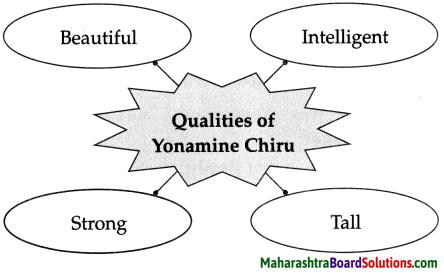
Yonamine Chiru was the most admired girl in Okinawa. She was intelligent, tall, strong, beautiful and so well trained in Karate that no one could beat her. She had put a condition that she would marry the man who would defeat her in a fair fight.

Question b.
Kojo
Answer:
Kojo was one of the first men to ask for Yonamine Chiru’s hand. He was so tall and well-built that his hands were like shovels, and his legs resembled tree trunks. He played foul and broke the rules of the game and thus lost his chance to marry Yonamine Chiru.

Maharashtra Board Class 6 English Solutions Chapter 2.7 Yonamine and Bushi

Question c.
Bushi Kiyo
Answer:
Bushi Kiyo had decided to marry a girl who enjoyed wrestling. He was trained under the Karate master Sakugawa. He was such an expert that he was recruited by Shoko, the king of Okinawa, to be his personal guard. He did not want to marry a delicate, fragile girl, but someone who was big and strong. He defeated Yonamine Chiru in a wrestling match and thus won her hand in marriage.

2. Discuss and write 1 – 2 lines about the following.

Question a.
Yonamine’s idea about marriage.
Answer:
Yonamine had her own ideas about marriage. She had declared firmly that she would only marry a man who could beat her in a fair fight.

Question b.
How Bushi defeated Yonamine in the wrestling match?
Answer:
The wrestling match began with Yonamine and Bushi bowing to each other and then began the attack. Both used their best techniques and it looked as if the match was going to be a tie. But, at a crucial moment in the fight, Yonamine paused very briefly. Bushi took advantage of this and brought her down with a swift punch.

Maharashtra Board Class 6 English Solutions Chapter 2.7 Yonamine and Bushi

Question c.
Why Bushi told Yonamine not to travel at night?
Answer:
Yonamine decided to visit her parents. She told Bushi that she would leave in the evening and return the next day in time to cook dinner. Bushi told her not to travel during the night because there were bandits roaming about and it was not safe for a woman to go out alone after dark.

Question d.
Yonamine’s fight with Bushi (disguised as a bandit).
Answer:
Bushi’s wife decided to go to visit her parents one evening. Bushi warned her not to go out alone at night because it would be dangerous as there were bandits around. Yonamine, his wife told him not to worry as she could . take care of herself. To teach her a lesson, because he thought she was overconfident, he disguised as a bandit. He ran ahead of her and hid behind a tree. He confronted her as a bandit would. Yonamine with her swift, sharp attacks made the attacker unconscious. Yonamine then dragged the attacker and tied him to a tree and then set off to her parents’ home, as if nothing had happened.

Question e.
The lesson that Bushi learnt.
Answer:
Bushi learnt not to underestimate anybody, especially women.

Maharashtra Board Class 6 English Solutions Chapter 2.7 Yonamine and Bushi

3. Divide the story into different sections to show the different events and time periods in it. Give a suitable title to each section.
Examples:
Maharashtra Board Class 6 English Solutions Chapter 2.7 Yonamine and Bushi 1

Question 1.
Divide the story into different sections to show the different events and time periods in it. Give a suitable title to each section.
Examples:
Maharashtra Board Class 6 English Solutions Chapter 2.7 Yonamine and Bushi 1
Answer:

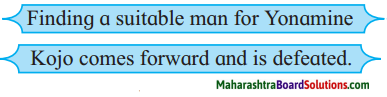
  • Bushi Kiyo accepts the challenge.
  • Bushi Kiyo wins Yonamine Chiru’s hand.
  • Bushi Kiyo and Yonamine happily married.
  • Bushi Kiyo decides to teach his wife a lesson.
  • Bushi Kiyo learns a lesson himself.

4. Write a short monologue using one of the following ideas. Write down the monologue and present it in the class.

Question a.
Yonamine’s father worrying about getting her married.
Answer:
I am Yonamine Chiru’s father. My daughter is intelligent, strong, beautiful and well trained in Karate that no one can beat her. This is where the problem lies. She has become of a marriageable age and I would love to see her
married. After all she is my only child and I want her to be happy. She is the heir to all my fortunes and I want to see her married off happily when I am alive.

I know that there are men who wants to marry her but I am unsure if they want my daughter or her fortune. To add to this misery my daughter has put a condition regarding her marriage that she would marry only that man who would defeat her in a fair fight. She is so well trained in Karate that I barely see anyone defeating her. I am really worried for my daughter and I hope she finds her match.

Maharashtra Board Class 6 English Solutions Chapter 2.7 Yonamine and Bushi

Question b.
Bushi disguised as a bandit
Answer:
I am Bushi Kiyo, husband of Yonamine. My wife is overconfident and thinks herself to be strong and an expert in Karate. I forbade her to travel at night but she refused to listen. I felt that she must be taught a lesson for her own good. So as Yonamine left for her father’s place, I disguised myself as bandit wearing shabby clothes, smearing dark colour over my hands.

I covered my face with a scarf and hid behind a clump of trees. When I saw Yonamine passing by, I jumped from behind the trees and tried to attack her. But Yonamine was too swift and sharp and attacked me instead. Besides she also tied me up to a tree and left for her father’s house.

Maharashtra Board Class 6 English Solutions Chapter 2.7 Yonamine and Bushi

5. Form groups and hold debates on the following topics. Make bulleted lists of points in favour of the topic (pros) and those against it (cons). (3 – 6 points each)

Question a.
Debate on ‘Boys cannot cook or do any housework’.
Answer:

Pros (for)Cons (against)
1. Today, boys can cook and do household chores. A vivid example is the programme ‘Master Chef’ in which we see more boys than girls participating and normally the boys end up winning the finals.1. That is outside the house. In the house they expect everything to be done either by their mothers or sisters.
2. After the 1960’s men/boys do more work than they used to.2. Even today boys feel that cooking and household chores are women’s work.
3. There is less housework to do because of machines that makes work easy and so is quickly done by the ladies in the house.3. Boys should remember that it is their house too and should get started and help in the chores and lighten the work.

Let us conclude this debate by letting everyone present that there is no ‘her job’ or ‘his job’. Today men and women have to share equal responsibilities because in most of the families both parents are bread earners. Sharing responsibilities makes work lighter and quicker and a sense of equality prevails.

Maharashtra Board Class 6 English Solutions Chapter 2.7 Yonamine and Bushi

Question b.
Girls cannot do everything that boys do.
Answer:

ProsCons
1. Indian society still thrives on male ego wherein girls are secondary and are not allowed to do what they wants.1. Today time has changed. Girls can do whatever they sets their heart to.
2. There is no taboo for boys. Indian society feels that boys are better than girls in every respect.2. Today a lot of changes in the laws have given girls the confidence to stand equal to their male counterpart.
3. Girls are not allowed to take part in many games as well as jobs terming them as ‘boy’s games’ or ‘boy’s jobs’.3. Today society has become more open to the idea that girls too are capable of playing any game or doing any task.

Question c.
You should never lose a match.
Answer:

ProsCons
1. Whenever we play, we should play to win.1. Winning and losing are two sides of the same coin.
2. Participate only if you know for sure that you will win or don’t participate at all.2. One cannot predict the result of the game. You cannot tell how the ball will turn. You can be a hero or a zero. You cannot always win.
3. Winning is a great feeling. You feel you have conquered the world.3. This feeling is only for some time. Losing is also a part of the game. We learn from our mistakes and can always do better.

Maharashtra Board Class 6 English Solutions Chapter 2.7 Yonamine and Bushi

Question d.
You should admit your mistakes.
Answer:

ProsCons
1. It is always right and a good habit to admit your mistakes. You feel good.1. Many a times when mistakes are admitted it fires back. You are always blamed.
2. Admitting a mistake makes you understand that you have done something wrong and you should not repeat the same.2. Admitting a mistake, many-a-times is not taken positively. You are taunted about it every time.
3. Admitting your mistake keeps your conscience clear.3. Though one should admit one’s mistake, one does not admit because of the attitude of the people around him.

6. Visit a library: Read more stories from Japan, China and Korea.

Question 1.
Visit a library: Read more stories from Japan, China and Korea.

Class 6 English Chapter 2.7 Yonamine and Bushi Important Questions and Answers

Answer in one or two sentences.

Question 1.
Why was Yonamine the most admired girl in Okinawa?
Answer:
Yonamine was intelligent, tall, strong, big and beautiful and a matchless Karate player. This made her the most admired girl in Okinawa.

Question 2.
What was Yonamine’s idea about her marriage?
Answer:
Yonamine stated firmly, “I will only marry a man who can beat me in a fair fight!”

Maharashtra Board Class 6 English Solutions Chapter 2.7 Yonamine and Bushi

Question 3.
Who was the first young man to ask Yonamine’s hand? Why was he rejected?
Answer:
Kojo, a tall and well-built man, was the first to ask Yonamine’s hand. He was rejected because he played foul with her in a contest of martial arts.

Question 4.
How did Yonamine defeat Kojo?
Answer:
Kojo broke the rules of the games by throwing a punch at Yonamine. She twisted his arm so powerfully that he fell down and he was defeated.

Question 5.
Who was Bushi Kiyo?
Answer:
Bushi Kiyo was an expert Karate player and the personal guard of Shoka, the King of Okinawa.

Question 6.
Describe Kiyo’s features.
Answer:
Kiyo was tall and slim, with dark piercing eyes and appeared fearless.

Maharashtra Board Class 6 English Solutions Chapter 2.7 Yonamine and Bushi

Question 7.
How do you know that Yonamine was a good housewife?
Answer:
Yonamine was kind and loving. She cooked and cleaned and kept the house spick and span.

Question 8.
What opinion did Bushi have of Yonamine?
Answer:
Bushi opined that Yonamine was overconfident of her strength and skill.

Question 9.
Why did Bushi disguise himself as a bandit?
Answer:
Bushi disguised himself as a bandit to scare Yonamine who dared to travel in the dark. Also he wanted to teach her a lesson for her own good.

Maharashtra Board Class 6 English Solutions Chapter 2.7 Yonamine and Bushi

Question 10.
What lesson did B ushi learn at the end of the day?
Answer:
Bushi learnt a lesson ‘Never to underestimate anybody, especially a woman.’

Reading Skills, Vocabulary and Grammar

Read the extract and do the activities.

Question 1.
Complete the web diagram.
Answer:
Maharashtra Board Class 6 English Solutions Chapter 2.7 Yonamine and Bushi 2

Question 2.
Complete the following sentences.

Question a.
Many wrestlers were eager ………….. .
Answer:
To win her in a contest of martial arts.

Maharashtra Board Class 6 English Solutions Chapter 2.7 Yonamine and Bushi

Question b.
Yonamine’s father began to worry …………… .
Answer:
When it was time to get her married.

Question 3.
What was Yonamine’s condition about marriage?
Answer:
Yonamine laid down a condition that she would only marry a man who could beat her in a fair fight.

Question 4.
She was intelligent, tall, strong and beautiful. (Pick out the adjectives in the sentence)
Answer:
Adjectives – intelligent, tall, strong, beautiful

Question 5.a.
Yonamine was the most admired girl. (Change into present tense)
Answer:
Yonamine is the most admired girl.

Maharashtra Board Class 6 English Solutions Chapter 2.7 Yonamine and Bushi

Question b.
She was a beautiful girl with a fortune! (Identify the kind of sentence)
Answer:
Exclamatory sentence

Question c.
She was a beautiful girl. (Change into negative)
Answer:
She was not an ugly girl.

Personal Response

Question 1.
Have you ever won a contest? How does it feel?
Answer:
Yes, I have won a couple of contests in singing and drawing. Winning a contest makes me feel very confident and a feeling of pride too. I put in my best and try not to be overconfident.

Maharashtra Board Class 6 English Solutions Chapter 2.7 Yonamine and Bushi

Language Study

Do as directed.

Question 1.
He loved his daughter. (Add a question tag)
Answer:
He loved his daughter, didn’t he?

Question 2.
She crossed the clump of trees. (Change into past perfect)
Answer:
She had crossed the clump of trees.

Question 3.
Add prefixes to the following so as to get their opposites:

  1. important
  2. wanted
  3. customary
  4. respect
  5. defeated
  6. cooked

Answer:

  1. unimportant
  2. unwanted
  3. uncustomary
  4. disrespect
  5. undefeated
  6. uncooked

Maharashtra Board Class 6 English Solutions Chapter 2.7 Yonamine and Bushi

Question 4.
Word building: Write the noun form of the following:

  1. intelligent
  2. strong
  3. beautiful
  4. important
  5. rich
  6. splendid

Answer:

  1. intelligence
  2. strength
  3. beauty
  4. importance
  5. richness
  6. splendour

Question 5.
He loved his daughter. (Change into Negative sentence)
Answer:
He did not hate his daughter.

Question 6.
She cooked and cleaned and kept the house spick and span. (Pick out a phrase from the sentence which means neat, clean and tidy)
Answer:
spick and span

Question 7.
Yonamine’s father was a very happy man. (Separate subject and predicate)
Answer:
Subject – Yonamine’s father
Predicate – was a very happy man.

Maharashtra Board Class 6 English Solutions Chapter 2.7 Yonamine and Bushi

Question 8.
She held her attacker by the hand. (Pick out the verb and state its kind)
Answer:
held – transitive verb

Question 9.
Bushi disguised himself as a bandit. (Frame a Wh-question so as to get the underlined word as the answer)
Answer:
What did Bushi disguise himself as?

Question 10.
But he played foul! (Kind of sentence)
Answer:
Exclamatory sentence

Do you know?

1. Mannerisms in Japan, China and Korea Bowing is one aspect of each culture all over the world.
2. In Japan and Korea and a slight bow when greeting each other and a deeper bow in more formal situations is still considered appropriate. However in China the handshake has actually become a common greeting with only a slight head nod rather than the traditional bow.

Yonamine and Bushi Summary in English

The story revolves around a girl named Yonamine, who is intelligent, tall, strong, beautiful and admired by everyone. She is very good at Karate too. She is the only heir to her rich father’s property. Her father wants to see her happily married, but she has got certain conditions/ ideas about her marriage. She marries Bushi Kiyo after he passes the contest. She performs her duties as a wife and both are happy.

Once she decides to visit her parents at night. Her husband warns her against going out at night saying that it is not safe to travel at night, especially for ladies. Yonamine tells her husband not to worry and sets out to meet her parents. Bushi feels that his wife was overconfident and that she should be taught a lesson. He disguises as a bandit and attacks Yonamine. Yonamine with her swift and sharp actions hits her attacker, rendering him unconscious. She ties him to a tree and sets off to her parents’ home.

The next day she leaves her parents’ home to reach her home in time to cook her husband’s evening meal. Bushi who had been untied by his wife, reaches home dull and tired. Bushi returns the white sash his wife had used to tie him. When Yonamine realises that it was her husband she had tied up, she has a hearty laugh. Bushi learns a lesson not to underestimate anybody, especially a woman.

Introduction:

It is a true story that took place in Japan wherein Yonamine Chiru, a beautiful intelligent girl marries Bushi Kiyo after he defeats her in a wrestling match which was the condition of her marriage. They live a happy married life and an incident which took place makes Bushi Kiyo realise that he should not underestimate anybody, especially a woman.

Glossary:

  1. karate (n) – an Okinawa martial art
  2. inherit (v) – to receive money, property or title as heir at the death of the previous holder
  3. fortune (n) – a large amount of money or assets
  4. martial (adj) – relating to fighting or war
  5. foul (adj) – wicked or immoral
  6. customary (adj) – according to custom
  7. opponent (n) – a player of the opposite team
  8. recruited (v) – a person selected for service
  9. challenge (n) – dare
  10. fragile (adj) – thin
  11. earnest (adj) – reality, seriousness
  12. crucial (adj) – of great importance
  13. bandit (n) – one who robs others
  14. depart (v) – to leave
  15. fork (n) – an interjection in a road where one road is spilt into two
  16. captivity (n) – being imprisoned or confined

6th Std English Balbharati Textbook Solutions

Water in the Well Poem Questions And Answers Class 5 English Chapter 26 Maharashtra Board

Std 5 English Lesson No 26 Water in the Well Question Answer Maharashtra Board

Balbharti Maharashtra State Board Class 5 English Solutions Chapter 26 Water in the Well Notes, Textbook Exercise Important Questions and Answers.

5th Std English Poem Water in the Well Question Answer

English Balbharati Std 5 Digest Chapter 26 Water in the Well Textbook Questions and Answers

1. Find a word that has a similar meaning.

Question 1.
Find a word that has a similar meaning.

  1. sorry
  2. whole
  3. happily
  4. unfair
  5. remove

Answer:

  1. pitiful
  2. full
  3. joufully
  4. unjust
  5. draw

2. Answer the following questions.

Question 1.
What does a farmer need most for his fields?
Answer:
A farmer needs a good source of water for his field.

Question 2.
Where was the well situated?
Answer:
The well was situated just outside the boundary of Kasim’s field.

Question 3.
What did Ahmad tell Kasim when he dug a channel and began to draw water?
Answer:
When Kasim dug a channel and began to draw water, Ahmad questioned him about what he was doing and asked how he dared to touch the water in his presence.

Maharashtra Board Class 5 English Solutions Chapter 26 Water in the Well

Question 4.
What did the Judge tell Ahmad?
Answer:
The Judge told Ahmad that he had no right to keep his belongings in Kasim’s property and that it had to be removed immediately or else he would have to pay a daily rent to Kasim, only then he would be allowed to use the well.

Question 5.
How do we come to know that Kasim was a generous man?
Answer:
Despite the Judge giving the judgement that Ahmad would have to pay a daily rent to Kasim, Kasim never troubled Ahmad for the ‘rent’ that was due to him. In this way, we come to know that Kasim was a generous man.

3. Find the meaning of the following phrase and use them in your own sentence.

Question 1.
again and again
Answer:
again and again: repeatedly.
I could not believe the bad news, so I read it again and again.

Question 2.
thought over
Answer:
thought over- consider.
Ivan thought over the suggestion made by his friend but was not convinced.

Maharashtra Board Class 5 English Solutions Chapter 26 Water in the Well

Question 3.
in his mind’s eye
Answer:
in his mind’s eye- in his imagination.
He could see the scene and the events in his mind’s eye.

Question 4.
in store for…
Answer:
in store for- awaiting for something to happen in future.
The thief did not think of what was in store for him if he got caught.

Question 5.
(his/her) …… heart sank
Answer:
(his/her) heart sank- to be disappointed.
His heart sank when he heard that he was not selected for the match.

Question 6.
heart of hearts
Answer:
heart of hearts: know something but not admit it
I knew in my heart of hearts that something was wrong.

Maharashtra Board Class 5 English Solutions Chapter 26 Water in the Well

4. Group work:

Question 1.
Form groups of 5-8. In each group, rewrite the story in the form of a play. Present scenes from your play in the classroom.
Answer:
(Ahmad and Kasim are standing near Ahmad’s well).

Ahmad:Why do you come begging for water time and again? I feel sorry to turn down your request every time. I have a suggestion for you, collect some money and buy the whole well from me.
Kasim:(thinks to himself) Ahmad would ask for a lot of money but the channel of water which will come running from the field will indeed change my fortune. (Next day)
Ahmad:So you have come again!
Kasim:I bring to you all my savings. I have decided to buy the whole well from you.
(Next day Kasim is at the well digging out a channel)
Ahmad:What are you doing Kasim? How dare you touch the water in my presence?
Kasim:What do you mean? Haven’t you sold this well to me?
Ahmad:Ah, I sold the well all right, but not the water in the well. The water still belongs to me, you can’t use it. If you needed the water along with the well, you should have said so. I have a suggestion for you, pay for the water separately and use it. You can buy freshwater every day. I don’t mind.
(Kasim rushes to the Qazi and tells him the whole story. Ahmad is summoned to the court and the Qazi hears his argument patiently and then…..)
Qazi:Hmm, I see that you are right. What you have sold is the well, the water is all yours. Isn’t that so?
Ahmad:My Lord, I am so grateful you understand the fine points of this case. The water does indeed belong to me.
Qazi:In that case Ahmad, why are you keeping it in Kasim’s well? You have no right to keep your belongings in his property. You must remove the water immediately or else, you can pay a daily rent to Kasim. Then he will allow you to use his well.
(Ahmad is dumbfounded, people present in the court laugh)
Kasim:(thinks to himself) I will never trouble Ahmad for the ‘rent’. After all I got justice.
(Curtain falls)

Maharashtra Board Class 5 English Solutions Chapter 26 Water in the Well

English Balbharati Std 5 Answers Chapter 26 Water in the Well Additional Important Questions and Answers

Answer the following:

Question 1.
What does a farmer need most for his field?
Answer:
A farmer needs a good source of water for his field.

Question 2.
Do you think Ahmad was right in what he did? Why?
Answer:
Ahmad was not right in what he did as he had sold the well to Kasim. Later he claimed that it was only the well and not the water in the well which he had sold. It was indeed unfair and unjust.

Maharashtra Board Class 5 English Solutions Chapter 26 Water in the Well

Activities :

Question 1.
Give one word for:

  1. The limit of an area or line marking it
  2. A conclusion reached after consideration
  3. Make known to public
  4. A reason put forward
  5. A place where legal cases are heard

Answer:

  1. boundary
  2. decision
  3. announce
  4. argument
  5. court

Question 2.
Spot some describing words used in the lesson and fill in the blank.
Maharashtra Board Class 5 English Solutions Chapter 26 Water in the Well 1
Answer:

  1. good
  2. whole
  3. some
  4. fresh

Language Study :

Question 1.
Find a word that has similar meaning:
1. cunning
2. proposal
Answer:
1. crafty
2. suggestion

Maharashtra Board Class 5 English Solutions Chapter 26 Water in the Well

Find the meaning of the following phrases and use them in your own sentences.

Question 1.
again and again : repeatedly.
Answer:
I could not believe the bad news, so I read it again and again.

Question 2.
thought over : consider.
Answer:
Ivan thought over the suggestion made by his friend but was not convinced.

Question 3.
in his mind’s eye : in his imagination.
Answer:
He could see the scene and the events in his mind’s eye.

Question 4.
in store for: awaiting for something to happen in future.
Answer:
The thief did not think of what was in store for him, if he got caught.

Maharashtra Board Class 5 English Solutions Chapter 26 Water in the Well

Question 5.
his/her heart sank: to be disappointed.
Answer:
His heart sank when he heard that he was not selected for the match.

Question 6.
heart of hearts : know something but not admit it
Answer:
I knew in my heart of hearts that something was wrong.

Do as directed :

Question 1.
What a farmer needs most for his fields is a good source of water. (pick out the nouns in the sentence given above)
Answer:
farmer, field, source water

Question 2.
Ahmad, the man who owned the well, was a crafty old man (Pick out adjectives from the sentence given above)
Answer:
crafty, old. – adjectives

Maharashtra Board Class 5 English Solutions Chapter 26 Water in the Well

Question 3.
Kasim thought over the suggestion and liked it. (State the part of speech of the underlined Trond)
Answer:
and – conjunction

Question 4.
What are you doing Kasim how dare you touch the water in my presence said Ahmad (Punctuate)
Answer:
“What are you doing Kasim? How dare you touch the water in my presence?” said Ahmad.

Question 5.
Pay for the water separately. (Pick out the adverb)
Answer:
separately – adverb

Question 6.
But Kasim was a generous man. (Add a question lag)
Answer:
But Kasim was a generous man, wasn’t he?

Maharashtra Board Class 5 English Solutions Chapter 26 Water in the Well

Reading Skills, Vocabulary and Grammar

Read the following extract and answer the questions given below:

Question 1.
State whether the following statements are true or false.
1. Ahmad had always thought that the Qazi would side with him.
2. Ahmad was a generous man.
Answer:
1. False
2. False

Question 2.
Write about the setting of the above given extract.
Answer:
The above extract was set in the court.

Question 3.
Why was Ahmad overjoyed?
Answer:
Ahmad was overjoyed as he thought that the Qazi was speaking in his favour.

Question 4.
Kasim’s heart sank (Explain the words underlined above)
Answer:
Being a simple man Kasim thought that the Qazi was on Ahmad’s side, and that he had lost the case, so he was disappointed.

Maharashtra Board Class 5 English Solutions Chapter 26 Water in the Well

Question 5.
How did the Qazi prove his wisdom?
Answer:
Since Ahmad maintained that he had only sold the well and not the water to Kasim, the Qazi said that Ahmad had no right to keep his belongings in Kasim’s property. A classic example of ‘Tit for tat’. He also passed an order that either he had the water removed from Kasim’s well immediately or pay a daily rent to Kasim.

Question 6.
Give a suitable moral for the extract.
Answer:
A suitable moral for the extract is ‘you can fool some people some time, but not all the people all the time.’

Question 7.
(a) Give the adjective forms of :

  1. right – righteous
  2. thought – thoughtful

(b) Give the noun forms of:

  1. allow – allowance
  2. laugh .- laughter

Maharashtra Board Class 5 English Solutions Chapter 26 Water in the Well

Water in the Well Summary in English

Summary :

‘Water in the well is a story which revolves around two main characters, Kasim and Ahmad. Kasim was a farmer and he had an eye on Ahmad’s well as that would help him to channelise water to his fields. Each time Kasim would beg for access to Ahmad’s well his request would be turned down by Ahmad. Finally one day, Ahmad suggested to Kasim that he could buy the well from him. Kasim who liked the idea, which he considered beneficial, bought the well at the cost of all his savings.

The next day Kasim went to his own well (or so he thought) and dug out a channel to draw water. Ahmad questioned him how he dared to touch the water in his presence and further continued that he had only sold the well to him and not the water in the well which still belonged to him. He even put forward a suggestion that Kasim could pay him for the water separately on a daily basis and use it A shocked Kasim rushes to the Qazi who heard the argument patiently.

The Qazi’s wisdom comes to light when he tells Ahmad that he had no right to keep his belongings, i.e. the water in Kasim’s property. He also instructed him to remove the water immediately or pay daily rent to Kasim after which Kasim would allow him to use the well. A confused Ahmad was left speechless. But Kasim who was a generous man never troubled Ahmad for the ‘rent’.

Meanings :

  1. boundary (n) – the limit of an area or the line marking it .
  2. crafty (adj) – cunning
  3. access (n) – approach or enter
  4. suggestion (n) – a proposal
  5. decision (n) – a conclusion reached after consideration
  6. channel (n) – passage or a stretch of water
  7. announced (o) – make known to public
  8. presence (n) – being present
  9. argument (n): a reason put forward
  10. court (n) – a place where legal cases are heard
  11. summoned (v) – send for
  12. patiently (adv) – calmly endure
  13. Qazi (n) – one who dispenses justice (here)

English Balbharati Std 5 Answers Unit 4

A Kabaddi Match Questions and Answers Class 6 English Chapter 1.5 Maharashtra Board

Balbharti Maharashtra State Board Class 6 English Solutions Chapter 1.5 A Kabaddi Match Notes, Textbook Exercise Important Questions and Answers.

Std 6 English Lesson 1.5 A Kabaddi Match Question Answer Maharashtra Board

Class 6 English Chapter 1.5 A Kabaddi Match Textbook Questions and Answers

1. Form pairs. Make a list of as many games as you can. (At least 25) Then classify the games using the following criteria:

  • indoor and outdoor games.
  • Games played with and without any equipment.
  • Games which have one-to-one matches and those in which teams play against each other (Single player or team)
  • Games played mostly by children and games played by adult players.
  • Shape and size of the court or field.
  • Use the following figures to show your classification.

Maharashtra Board Class 6 English Solutions Chapter 1.5 A Kabaddi Match 1

Question 1.
indoor and outdoor games.
Answer:

Indoor GamesOutdoor Games
BilliardsArchery
BowlingCricket
BoxingDiving
ChessGolf
GymnasticsHockey
JudoTennis
KarateVolleyball
Kung fuKho-Kho
Squash
Swimming
Table tennis
Weight lifting
Wrestling

Maharashtra Board Class 6 English Solutions Chapter 1.5 A Kabaddi Match

Question 2.
Games played with and without any equipment.
Answer:

BowlingCricketJudo
BilliardsBasketballKarate
DivingTable tennisBoxing
SquashGolfWeight lifting
ArcheryChessSoccer
BoxingHockeyKung fu
BadmintonWrestlingKho-Kho
VolleyballGymnasticsSwimming

Question 3.
Games which have one-to-one matches and those in which teams play against each other (Single player or team)
Answer:
Maharashtra Board Class 6 English Solutions Chapter 1.5 A Kabaddi Match 4

Maharashtra Board Class 6 English Solutions Chapter 1.5 A Kabaddi Match

Question 4.
Games played mostly by children and games played by adult players.
Answer:

Games played by childrenGames played by adults
Blind man’s buffChess
Cops and robbersSnooker
Dodge ballHockey
Four squareCricket
I spyBadminton
Leap frogFootball
Pick-up-sticksPolo
Ring a Ring o’ RosesBilliards

Maharashtra Board Class 6 English Solutions Chapter 1.5 A Kabaddi Match

Question 5.
Shape and size of the court or field.
Answer:

Name of the gameShape of the court fieldSize of the field
BasketballRectangular26 m in length, 14 m in width measured from the inside edges of the boundary lines.
BoxingSquareThe ring should not be less than 12 feet or more than 20 feet square. The height from the ring floor level to the top rope should not be less than four feet, nor more than five feet.

2. Read the description of the Kabaddi match and do the following:

Question a.
Note down the names of the players and say whether each one belongs to 9A or 9B.
Answer:

Name of the studentClass
Govind9A
Suresh9B
Ravi9B
Mohan9B
Vinod9B
Mangesh9A
Ajinkya9B
Mihir9B
Sohan9A
Vivek9A

Maharashtra Board Class 6 English Solutions Chapter 1.5 A Kabaddi Match

Question b.
Describe, in your own words, the important events in the first half.
Answer:
With the spectators clapping and boosting the morale of both the teams, the match got off to a good start. Having won the toss 9A sent their raider, Govind. Catching the opponent unawares, he touched Suresh from 9B and in no time headed towards home thus scoring a point.

Ravi being a strong player, with the knowledge of the right techniques appeared relaxed as he was aware of his strengths. Mangesh was wrestled down by Ravi and his friend, but Mangesh proved his capability. Even as he was on the ground with the anti¬raiders catching hold of his waist and legs, he slowly inched towards his court.

The best efforts of the anti-raiders failed in pulling him back and Mangesh successfully touched the mid-line scoring three points and getting three players of the anti-raiders out from the game.

Now, 9B began to play by exercising caution. Mihir and one of their raider tasted early success as they managed to tag Sohan in 9A. The other few raids were futile. Now, it was the turn of Vivek, the strategist. The remaining three players from 9B trapped Vivek. He slowly made his way back towards his court with the anti-raiders moving with him.

When they caught Vivek’s arm and tried to pull him back, Vivek slipped his leg beyond the midline with the anti-raiders still hanging onto his arm. Thanks to Vivek’s efforts, the whole of 9B was declared out.

Maharashtra Board Class 6 English Solutions Chapter 1.5 A Kabaddi Match

Question c.
Write in your own words, what happened in the second half.
Answer:
The half time break was over, the star players of 9A were brimming with confidence. They did an encore by catching hold of ace raiders Mohan, Ajinkya and Ravi. As they say, the best team wins. Since 9A displayed excellence in all areas of the game, they emerged the winners. This coupled with team spirit, their confidence, strategies, swiftness and suppleness helped them emerge the winners beating 9B – a team which had never been defeated in any game of Kabaddi.

Question d.
Choose any one event and draw a diagram to show what happened.

3. List all the words specially used in the game of Kabaddi.

Maharashtra Board Class 6 English Solutions Chapter 1.5 A Kabaddi Match 2

4. From the internet or other sources, find the other names by which Kubaddi is known in different parts of our country and the world.

Question 1.
From the internet or other sources, find the other names by which Kubaddi is known in different parts of our country and the world.

Maharashtra Board Class 6 English Solutions Chapter 1.5 A Kabaddi Match

5. What characteristics are needed to be a good player of Kabaddi? What should you do to develop each? Discuss this in groups of 5 and write a composition on it.

Question 1.
What characteristics are needed to be a good player of Kabaddi? What should you do to develop each? Discuss this in groups of 5 and write a composition on it.

6. Read the following note from a school girl’s diary:

Maharashtra Board Class 6 English Solutions Chapter 1.5 A Kabaddi Match 3

Write diary entries for the interesting or important events that take place in your school. Write at least 3 entries.

Question 1.
Write diary entries for the interesting or important events that take place in your school. Write at least 3 entries.
Answer:
Dairy 1.

15th June, 2016.

Dear Diary,
Today was the first day of our new academic year. It was a fun filled day meeting new teachers and friends.
I am looking forward to the days ahead. My friends and I have made several plans to make the most of our time in school. The new textbooks are really very informative and colourful.
I am all excited about the days ahead.

– XYZ

Dairy 2.

15th Aug, 2016.

Dear Diary,
We had a tree plantation drive in our school on the occasion of Independence Day. All of us had to take saplings to school. I had taken a mango sapling. I wonder when my sapling will grow into a huge tree. There were posters everywhere, one which said – “Plant and preserve, Plant and protect, Plant and prosper, Plant and perish”.

-XYZ

Dairy 3.

12th Dec, 2016.

Dear Diary,
Today was our Sports Day. It was inaugurated by our Sports Minister. After the speeches, the competitions started. Various competitions were held. The most exciting were the Tug of War and Relay. I won the gold medal in 100 m Running. What an eventful day it was!

-XYZ

Maharashtra Board Class 6 English Solutions Chapter 1.5 A Kabaddi Match

7. Language Study: Degrees of comparison.
We use different forms of adjectives and adverbs to show comparison. They are known as degrees of comparison.

  • Positive: Mangesh was ac strong ac Ravi.
    She is as tall as her sister.
  • Comparative: Mangesh was stroll gel’ than other players.
    She is taller than her sister.
  • Superlative: Mungesh was the strongest player in the team.
    Their sister is the tallest amongst the three.

8. Complete the following sentences using your own ideas.

  1. The princess was as …………. as………… . (Positive)
  2. The princess was ……………. than …………….. .(Comparative)
  3. The princess was the ……………. amongst all ………… .(Superlative)

Note that we usually add ‘-er’, ‘-est’ to short adjectives and use more’ or ‘moSt’ with longer adjectives.
Examples:

  • high – higher – highest
  • attractive – more attractive – most attractive
  • nice – nicer – nicest
  • interesting – more interesting – most interesting

Question 1.
Complete the following sentences using your own ideas.

  1. The princess was as …………. as………… . (Positive)
  2. The princess was ……………. than …………….. .(Comparative)
  3. The princess was the ……………. amongst all ………… .(Superlative)

Answer:

  1. The princess was as beautiful as Princess lane.
  2. The princess was taller than Prince Arthur.
  3. The princess was the best among all girls.

Maharashtra Board Class 6 English Solutions Chapter 1.5 A Kabaddi Match

9. Read the following words and name the degree of comparison shown by each.
good – better – best bad – worse – worst

Class 6 English Chapter 1.5 A Kabaddi Match Additional Important Questions and Answers

Answer the following in one or two sentences.

Question 1.
What led to the hopes of class 9 A soaring?
Answer:
The inclusion of three new students in class 9A, who were outstanding Kabaddi players led to the hopes of the class soaring.

Question 2.
How did the spectators boost the morale of both the teams?
Answer:
When the match started, all the spectators clapped and boosted the morale of both the teams.

Question 3.
How was the first point of the game scored?
Answer:
Raider Govind was so swift that before the opponents realised it, he had touched Suresh from 9B and was already heading home and a point was scored.

Maharashtra Board Class 6 English Solutions Chapter 1.5 A Kabaddi Match

Question 4.
What was the strength of Ravi from 9B?
Answer:
Ravi from 9B, was a very strong player and he could single-handedly catch hold of any player tightly in between his legs, twisted like scissors. Releasing oneself from his grip would be next to impossible.

Question 5.
Why was Ravi relaxed?
Answer:
Ravi was relaxed as he had never dreamt of any strong opposition from any team.

Question 6.
Which quality helped Mangesh to prove his mettle?
Answer:
The quality of determination helped Mangesh . to prove his mettle.

Question 7.
What was the result of Mangesh’s efforts?
Answer:
Mangesh, through his efforts not only saved himself but was able to score three points for his team as Ravi, Mohan and Ajinkya who were holding him were also declared out.

Maharashtra Board Class 6 English Solutions Chapter 1.5 A Kabaddi Match

Question 8.
How was the whole of 9B team declared out?
Answer:
The three players from 9B trapped Vivek but he slowly moved back towards his court with the three anti-raiders moving with him. When they caught his arm and were trying to pull him back, Vivek slipped his leg beyond the midline with the anti-raiders still hanging on to his arm. Thus, the whole of 9B team was declared out.

Question 9.
What helped 9 A beat 9B who had never tasted defeat earlier in the game of Kabaddi?
Answer:
9A outplayed 9B in all areas of Kabaddi. Their team spirit, confidence, strategies, swiftness and suppleness helped them to beat 9B who had never tasted defeat before.

Reading Skill, Vocabulary and Grammar

Read the following passage and complete the activities that follow.

Question 1.
Prepare a word register for the word ‘sports’.
Answer:
courts, teams, opponents, players Extract:
In Kabaddi, two teams of seven members each, face each other on a flat rectangular court, divided by a midline. The game is usually played in two halves with a halftime break in between. After the break, the teams exchange their sides on the court.

To play the game, each team sends ‘raiders’ across the midline to the other team. The raider tries to ‘tag’ the opponents and run back to his side, all in one breath. To show that he hasn’t inhaled again, he has to chant ‘Kabaddi-Kabaddi’ all the time. If he has to inhale again, he is ‘out’.

The opponents try to catch the raider and stop him from going back to his half till he loses his breath, and has to inhale again. If the raider manages to go back successfully, all the persons he has tagged and all those who have touched him are declared out. For each player declared out, the opposite team scores a point. If all the seven players in a team are ‘out’, the opposite team gets bonus points – a Iona. The team with the maximum points wins the match.

The game of Kabaddi requires good health, muscular strength, strategic skills, a lot of practice and above all, great determination.

Maharashtra Board Class 6 English Solutions Chapter 1.5 A Kabaddi Match

Question 2.
Which aspects of the game of Kabaddi is highlighted in this extract?
Answer:
The rules of the game of Kabaddi and the qualities required to excel in this game are title two aspects discussed in this extract.

Question 3.
What should each team do to play the game?
Answer:
To play the game, each team sends ‘raiders’ across the midline to the other team.

Question 4.
What does the raider do?
Answer:
The raider tries to ‘tag’ the opponents and run back to his side, all in one breath.

Question 5.
Why should the raider chant ‘Kabaddi- Kabaddi’ all the time?
Answer:
To show that the raider has not inhaled again, the raider has to chant ‘Kabaddi-Kabaddi’ all the time.

Question 6.
When does the opposite team get bonus points?
Answer:
When all the seven players in a team are ‘out’, the opposite team gets bonus points – a Iona.

Maharashtra Board Class 6 English Solutions Chapter 1.5 A Kabaddi Match

Question 7.
Which team wins the match?
Answer:
The team with the maximum points wins the match.

Question 8.
What are the qualities essential to excel at Kabaddi?
Answer:
To excel in the game of Kabaddi one requires good health, muscular strength, strategic skills, a lot of practice and above all, great determination.

Question 9.
The team with the maximum points wins, the match. (State the word class of the underlined word.)
Answer:
maximum – adjective

Question 10.
Do you think sports plays an important role in development? Elaborate.
Answer:
Mahatma Gandhi, has rightly said: “Education is the all-round development of an individual – body, mind and spirit.”
Sports plays an important role in contributing to our physical fitness apart from developing essential values and virtues.

Maharashtra Board Class 6 English Solutions Chapter 1.5 A Kabaddi Match

Language Study

Do as directed.

Question 1.
The school sports meet was scheduled next month. (State the part of speech of the underlined word.)
Answer:
next – adjective

Question 2.
The practice matches had already begun. (Add a question tag.)
Answer:
The practice matches had already begun, hadn’t they?

Question 3.
When the match started, all the spectators clapped and boosted the morale of both the teams. (Pick out the action words.)
Answer:
started, clapped, boosted

Question 4.
9A won the toss and sent their raider Govind. (Begin the sentence with, “Winning the toss ……”)
Answer:
Winning the toss, 9A sent their raider Govind.

Question 5.
All the players were literally afraid of him. (Pick out the adverb.)
Answer:
Adverb: literally

Maharashtra Board Class 6 English Solutions Chapter 1.5 A Kabaddi Match

Question 6.
Mangesh from 9A was strong. (Form a Wh- question to get the underline word as the answer.)
Answer:
Who was strong?

Question 7.
Kabaddi is an ancient sport. (Pick out the article.)
Answer:
an – article

Question 8.
The team with the maximum points wins the match. (Pick out the collective noun.)
Answer:
team – collective noun

Question 9.
Indian girls and boys have always excelled at Kabaddi. (Pick out the naming words.)
Answer:
girls, boys, Kabaddi – Naming words

Maharashtra Board Class 6 English Solutions Chapter 1.5 A Kabaddi Match

Question 10.
One day, you may help win glory for your school. (Pick out the modal and state its function.)
Answer:
may – possibility

Change into the positive degree of comparison.

Question 1.
Kabaddi is the most popular game in this school.
Answer:
No other game is as popular as Kabaddi in this school.

Question 2.
Kevin was the strongest player.
Answer:
No other player was as strong as Kevin.

Question 3.
Kabaddi is more popular than that game.
Answer:
This game is not as popular as Kabaddi.

Maharashtra Board Class 6 English Solutions Chapter 1.5 A Kabaddi Match

Question 4.
He is the best Kabaddi player in the school.
Answer:
No other Kabaddi player in the school is as good as he is.

Name of Kabaddi in different parts of the world.

  • baibalea – Maldives
  • hadudu – Bangladesh
  • kabaddi – Denmark
  • kabaddi – Kenya
  • kabaddi – Spain

Complete the table.

NounAdjectiveVerb
practicepracticalpractise
strengthstrongstrengthen
inclusioninclusiveinclude
declarationdeclarativedeclare
strategystrategicstrategies

Maharashtra Board Class 6 English Solutions Chapter 1.5 A Kabaddi Match

Writing Skills

Flow Chart:

Question 1.
Arrange the points in proper order to show how the game of Kabaddi is played. Write the numbers in the blocks.
Answer:
Maharashtra Board Class 6 English Solutions Chapter 1.5 A Kabaddi Match 5

Essay:

Question 1.
Write an essay using the points given below.
What characteristics are needed to be a good player of Kabaddi?
What should we do to develop each of them?
Answer:
A Good Kabaddi Player
Any player requires various characteristics to emerge as a good player. The game of Kabaddi too requires physical and mental fitness. While good health, muscular strength and strategic skills are essential to emerge a winner, also equally important are other traits. Determination, dedication, devotion, consistency in performance and willingness to give one’s best, too are of paramount importance.

We can acquire these skills if we resolve to do our best and give our hundred percent to the game. Right skills, ample practice and the will to excel will help us reach our goal. Watching Kabaddi matches on television, seeking help from experts, finding one’s weak areas and working on them are ways in which we can develop attributes to become a good Kabaddi player.
‘Hardwork is the key to success’ in Kabaddi or any other game.

Maharashtra Board Class 6 English Solutions Chapter 1.5 A Kabaddi Match

Let Us Remember:

“The heights which great men,
Reached and kept,
Were not attained by sudden flight,
They, while their companions slept, were toiling upwards in the night.”

Do yoy know?

Kabddi World Cup
The 2016 World Cup, the third standard style Kabbadi World Cup was an international Kabbadi tournament contested from 7th October 2016 to 22nd October 2016 at the Arena, in Ahmedabad. 12 countries had competed in the tournament and 33 matches been played. The tournament was won by India who defeated Iran 38-29 in the Championship Games to win their third Kabbadi world cup.

Kabaddi Match Summary in English

The lesson begins with a School Sports Meet through which the rules and strategies of the game are shared with the reader. The extract also highlights the qualities displayed by the winning team – team spirit, confidence, right strategies, swiftness and suppleness.
The lesson goes on to talk about the rules of the game and ends with qualities essential to excel in this game.

Introduction:

This lesson is about Kabaddi, an outdoor sport which originated in India, and is now popular in many countries of the world.

Maharashtra Board Class 6 English Solutions Chapter 1.5 A Kabaddi Match

Glossary:

  1. sports meet (n) – an event where sports competitions are held
  2. scheduled (v) – planned
  3. outstanding (adj) – very good
  4. pectators (n) – people who watch a game
  5. opponents (n) – ones who compete with another in a game
  6. grip (n) – a firm hold
  7. literally (adv) – exactly
  8. anti-raiders (n) – every player in whose court, raid is being made
  9. determination (n) – firmness in purpose
  10. cautiously (adv) – in a guarded manner
  11. strategies (n) – plans of action to achieve an aim
  12. enviable (adj) – sought after
  13. ace (adj) – one who excels
  14. swiftness (n) – moving with rapid speed
  15. suppleness (n) – flexibility
  16. inhale (v) – breathe in
  17. tagged (v) – to follow someone from one place to another
  18. strategic (adj) – useful in achieving a plan
  19. resolve (n) – firm decision

6th Std English Balbharati Textbook Solutions