Maharashtra Board Class 6 Hindi Solutions Chapter 2 तूफानों से क्या डरना

Balbharti Maharashtra State Board Class 6 Hindi Solutions Sulabhbharati Chapter 2 तूफानों से क्या डरना Notes, Textbook Exercise Important Questions and Answers.

Maharashtra State Board Class 6 Hindi Solutions Chapter 2 तूफानों से क्या डरना

Hindi Sulabhbharti Class 6 Solutions Chapter 2 तूफानों से क्या डरना Textbook Questions and Answers

लेखन विभाग

स्वयं अध्ययन:

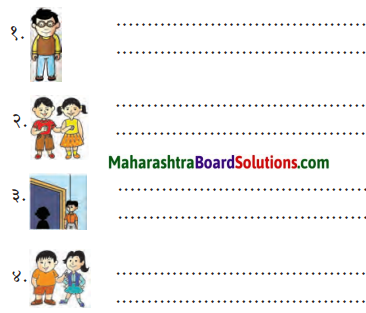
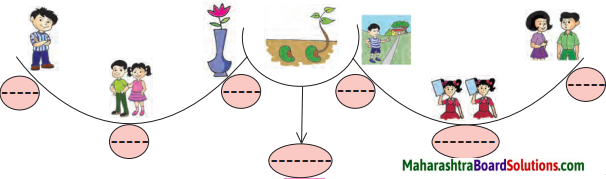
दिए गए चित्र को देखकर हाव-भाव की नकल कीजिए:
Maharashtra Board Class 6 Hindi Solutions Chapter 2 तूफानों से क्या डरना 1
Answer:
(१) खुशी का भाव
(२) क्रोध का भाव
(३) डर या भय का भाव
(४) हैरानी का भाव
(५) दुख-उदासी का भाव
(६) उपेक्षा का भाव
(७) बेफिक्री का भाव

Maharashtra Board Class 6 Hindi Solutions Chapter 2 तूफानों से क्या डरना

खोजबीन:

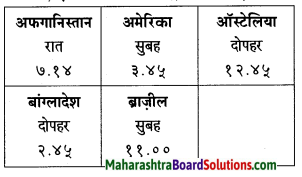
भारतीय स्थानीय समय के अनुसार देश – विदेश के समय की तालिका तैयार कीजिए:
(भारत में रात के ८.१४ बजने पर अन्य देशों का समय)
Answer:
Maharashtra Board Class 6 Hindi Solutions Chapter 2 तूफानों से क्या डरना 2

भाषा की ओर:

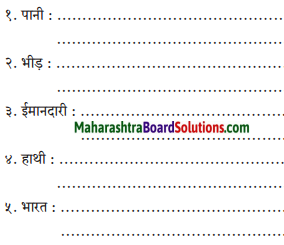
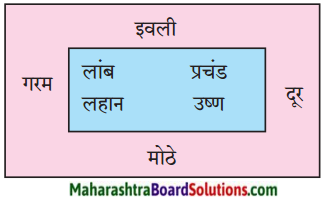
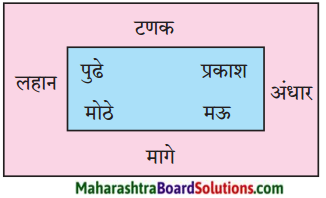
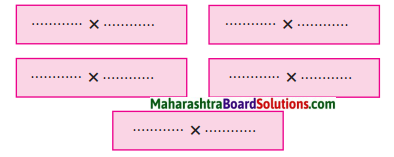
कविता में आए किन्हीं पाँच शब्दों के विरुद्धार्थी शब्द लिखो।
Maharashtra Board Class 6 Hindi Solutions Chapter 2 तूफानों से क्या डरना 4
Answer:
(१) अंत x आरंभ
(२) जीवन x मरण
(३) अँधेरा x उजाला
(४) प्यार x नफ़रत
(५) हार x जीत

सुनो तो जराः

छात्र रेडिओ पर एकाग्रता से भजन सुनेंगे और उसे दोहराएंगे।
Answer:
(छात्र स्वयं करेंगे।)

Maharashtra Board Class 6 Hindi Solutions Chapter 2 तूफानों से क्या डरना

बताओ तो सही:

साक्षरता अभियान के बारे में जानकारी लिखिए:
Answer:
साक्षरता अभियान भारत सरकार द्वारा शुरू किया गया एक ऐसा उपक्रम है, जिसके माध्यम से देश की अशिक्षित जनता को पढ़ाने-लिखाने एवं साक्षर बनाने का लक्ष्य सामने रखा गया है। इस अभियान के द्वारा समाज का निम्न या गरीब वर्ग जो शिक्षा से या उसके महत्त्व से दूर है, उसे साक्षर करने का भरकस प्रयास भारत सरकार द्वारा किया जा रहा है।

वाचन जगत से:

मीराबाई के पद पढ़िए और उनका सरल अर्थ लिखिए:
(दोहे और पद लेखन)
मतवारे बादल आये रे,
हरी को संदेसो कछु न लाये रे।
दादुर मोर पपीहा बोले,
कोएल सबद सुनावे रे।
काली अंधियारी बिजली चमके,
बिरहिना अती दर्पाये रे।
मन रे परसी हरी के चरण,
लिसतें तो मन रे परसी हरी के चारण।
Answer:
सरल अर्थ: मीराबाई कहती हैं कि बादल गरज – गरज कर आ रहे हैं, किंतु मेरे प्रभु का कोई संदेश नहीं लाये हैं। वर्षा ऋतु में मोर ने अपने पंख फैलाये हैं और कोयल भी मधुर आवाज में गा रही है। काले बादल घिर आए हैं और उनके भीतर बिजली कौंधने से मन अधिक व्याकुल हो रहा है। विरह की आग बढ़ती चली जा रही है। मन केवल प्रभु के दर्शन करने का अभिलाषी है।

Maharashtra Board Class 6 Hindi Solutions Chapter 2 तूफानों से क्या डरना

जरा सोचो ….. चर्चा करोः

यदि समय का चक्र रुक जाए तो ….’ विषय पर अपने विचार प्रकट करें। (काल्पनिक लेखन)
Answer:
विद्वानों के कथन के अनुसार ‘समय ही जीवन है। किंतु अगर हम कल्पना करें कि समय अपनी जगह रुक गया तो पूरी सजीव सृष्टि ही रुक जाएगी। सभी पशु-पक्षी, प्राणी, जलचर, प्रकृति की सभी चीजें यहाँ तक कि स्वयं मनुष्य भी अपनी जगह हारकर बैठ जाएगा। समय का पहिया चलता है, इसीलिए तो जीवन निरंतर अबाध गति से चलता रहता है। समय का चक्र रुकने से मनुष्य अपने वर्तमान और भविष्य दोनों से वंचित हो जाएगा। समय के कारण ही मनुष्य अपने जीवन में अग्रसर होते रहता है। समय का चक्र रुकने से पूरे संसार एवं मनुष्य का जीवन थम-सा जाएगा। पूरी दुनिया समय के चक्र के अनुसार ही चलती है।

कविता का सार:

इस कविता का सार लिखिए। (सारांश लेखन)
Answer:
इस कविता का मुख्य सार यह है कि जीवन में मुसीबतें तो आती रहती हैं। उन मुसीबतों का सामना हमें निडर होकर करना चाहिए। हमारे भीतर के घमंड़ रूपी अहंकार को हमें समाप्त कर परस्पर सहयोग से आगे बढ़ना चाहिए। नफ़रत को छोड़कर प्रेम-भाव से सबको गले लगाना चाहिए।

सदैव ध्यान में रखिए:

हमारी सोच सकारात्मक क्यों होनी चाहिए? (अनुच्छेद लेखन)
Answer:
मानव का मन अत्यंत चंचल होता है। उसमें कई विचार आते जाते रहते हैं, किंतु मनुष्य को हमेशा अपनी सोच सकारात्मक रखनी चाहिए। सकारात्मक सोच हमेशा अच्छे विचारों को जन्म देती है। इसके विपरीत नकारात्मक सोच मन में बुरे विचार पैदा कर मनुष्य के विकास में बाधा का निर्माण करती है। कई विद्वानों के अनुसार सकारात्मक सोच सामाजिक विकास के साथ-साथ मनुष्य का मानसिक एवं सर्वागीण विकास भी करती है।

विचार मंथन:

करत – करत अभ्यास के जड़मति होत सुजान। (अनुच्छेद लेखन)
Answer:
प्रस्तुत पंक्ति का अर्थ यह है कि निरंतर प्रयल एवं अभ्यास करने से बुद्धिहीन या मूर्ख व्यक्ति भी चतुर बन सकता है। निरंतर किसी भी कार्य में कार्यरत रहने से मनुष्य अपने लक्ष्य को प्राप्त कर सकता है।

Maharashtra Board Class 6 Hindi Solutions Chapter 2 तूफानों से क्या डरना

अध्ययन कौशलः

समाज सेवी महिला की जीवनी पढ़कर प्रेरणादायी अंश को चुनकर लिखिए एवं बताइए। (मदर टेरेसा की जीवनी)
Answer:
मदर टेरेसा के जीवन के प्रेरणादायी अंश निम्नलिखित हैं –

  • मदर टेरेसा के द्वारा कोई निर्धन खाली हाथ नहीं गया।
  • स्वयं को मिले सारे पुरस्कार गरीबों के नाम स्वीकार किए।
  • मदर टेरेसा ने ८ अगस्त, १९४८ को तीन साड़ियाँ और पाँच रुपये का एक नोट लेकर, मानवता की सेवा शुरू की।
  • एक भिक्षु की दी हुई भेंट उन्होंने केवल उसकी भावना को ठेस न पहुँचे इसके लिए स्वीकार की।
  • टीटागढ़ के कुष्ठ – सेवा केंद्र में कुष्ठरोगियों की नज़दीक से सेवा की।
  • समाज में स्थित निम्न, गरीब, पीड़ा से कराहते लोगों की पीड़ा को दूर किया।
  • ‘मैं तो प्रभु के हाथ की एक पेंसिल मात्र हूँ। यह उनका ही कार्य है।’ यह कहकर वे जीवन भर समाज के हित में कार्य करती रहीं।

समझो हमें:

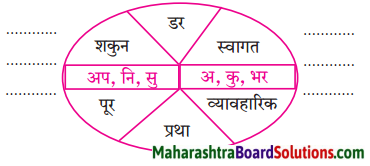
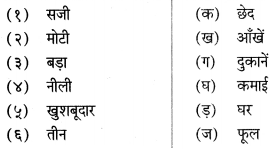
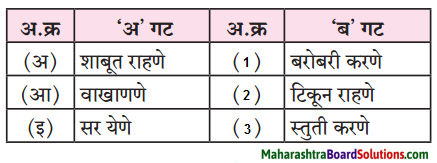
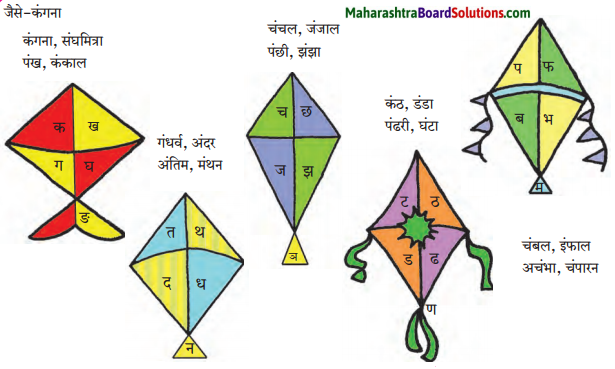
पंचमाक्षर (ङ, अ, ण, न, म) के अनुसार पंतगों में उचित शब्दों की जोड़ियाँ मिलाइए:
Answer:
Maharashtra Board Class 6 Hindi Solutions Chapter 2 तूफानों से क्या डरना 3

Maharashtra Board Class 6 Hindi Solutions Chapter 2 तूफानों से क्या डरना

Hindi Sulabhbharti Class 6 Solutions Chapter 2 तूफानों से क्या डरना Additional Important Questions and Answers

निम्नलिखित कविता की पंक्तियों को पूर्ण कीजिए:

Question 1.
धूप – छाँव जीवन का हिस्सा, ……….
Answer:
कभी उजाला, कभी अँधेरा

Question 2.
…………………, दूर अँधेरा करना जी।
Answer:
आत्मज्ञान के दीप जलाकर

Question 3.
तूफाँ तो आते रहते हैं, ……………………।
Answer:
इनसे भी क्या डरना जी

Question 4.
…………, जीवन में रंग भरना जी।
Answer:
सत्कर्मों की तूलिका से

Question 5.
नफ़रत करना नहीं किसी से, …..
Answer:
प्यार सभी से करना जी

Maharashtra Board Class 6 Hindi Solutions Chapter 2 तूफानों से क्या डरना

निम्नलिखित वाक्य सही हैं या गलत लिखिए:

Question 1.
जीवन में हमेशा सुख-दुख आते रहते हैं।
Answer:
सही

Question 2.
समय हमेशा बदलता रहता है।
Answer:
सही

Question 3.
जीवन में आनेवाली मुसीबतों से हमें डरना चाहिए।
Answer:
गलत

Question 4.
हमें जो मिलता है, उसी में हमें संतोष रखना चाहिए।
Answer:
सही

Question 5.
हमें सभी से नफ़रत करनी चाहिए।
Answer:
गलत

Maharashtra Board Class 6 Hindi Solutions Chapter 2 तूफानों से क्या डरना

निम्नलिखित शब्दों का वाक्यों में प्रयोग कीजिए:

Question 1.
हिम्मत
Answer:
कठिन प्रसंग में मनुष्य को अपनी हिम्मत नहीं हारनी चाहिए।

Question 2.
नफ़रत
Answer:
हमें किसी से भी नफ़रत नहीं करनी चाहिए।

Question 3.
सत्कर्म
उत्तरः
मनुष्य को हमेशा सत्कर्म करने चाहिए।

Question 4.
धीरज
Answer:
मुसीबत के समय हमें अपना धीरज नहीं खोना चाहिए।

Question 5.
अभिमान
Answer:
हमें अपने देश पर अभिमान होना चाहिए।

Maharashtra Board Class 6 Hindi Solutions Chapter 2 तूफानों से क्या डरना

निम्नलिखित प्रश्नों के उत्तर एक-एक वाक्य में लिखिए:

Question 1.
कवयित्री ने जीवन में किससे न डरने की बात कही है?
Answer:
कवयित्री ने जीवन में तूफान रूपी मुसीबतों से न डरने की बात कही है।

Question 2.
जीवन कौन-सा खेल है?
Answer:
जीवन हार-जीत का खेल है।

Question 3.
मनुष्य को अपना जीवन कैसे व्यतीत करना चाहिए?
Answer:
मनुष्य को अपना जीवन हँसकर व्यतीत करना चाहिए।

Question 4.
रात के बाद क्या आता है?
Answer:
रात के बाद हमेशा सवेरा आता है।

Maharashtra Board Class 6 Hindi Solutions Chapter 2 तूफानों से क्या डरना

Question 5.
प्रत्येक मनुष्य की एक-दूसरे के प्रति ज़िम्मेदारी क्या है?
Answer:
एक-दूसरे को सच्ची राह दिखाना प्रत्येक मनुष्य की ज़िम्मेदारी

Question 6.
कवयित्री ने कौन-सा दीप जलाने के लिए कहा है?
Answer:
कवयित्री ने आत्मज्ञान का दीप जलाने के लिए कहा है।

निम्नलिखित प्रश्नों के उत्तर दो-तीन वाक्यों में लिखिए:

Question 1.
हम अपने जीवन में किस प्रकार खुशहाली ला सकते
Answer:
हम अपने जीवन में अच्छे कर्म करके तथा दूसरों की मदद करके खुशहाली ला सकते हैं।

Question 2.
मनुष्य को अपने जीवन में धीरज क्यों धरना चाहिए।
Answer:
मनुष्य को अपने जीवन में धीरज इसलिए धरना चाहिए, क्योंकि मनुष्य के जीवन में आने वाला समय हमेशा एक जैसा नहीं रहता। सब्र का फल हमेशा मीठा ही होता है। दुःख के बाद सुख आता है। यही जीवन की रीत है।

Maharashtra Board Class 6 Hindi Solutions Chapter 2 तूफानों से क्या डरना

Question 3.
समाज में महामारी क्यों फैली हुई है?
Answer:
समाज मे महामारी मनुष्य के स्वयं के गलत कार्य और अभिमान के कारण फैली हुई है।

व्याकरण और भाषाभ्यास

निम्नलिखित शब्दों के समानार्थी शब्द लिखिए:

  1. दिन
  2. खुश
  3. हिस्सा
  4. समय
  5. राह

Answer:

  1. दिवस
  2. प्रसन्न
  3. भाग
  4. काल
  5. रास्ता

Maharashtra Board Class 6 Hindi Solutions Chapter 2 तूफानों से क्या डरना

निम्नलिखित शब्दों के समान तुक वाले (लयात्मक) शब्द लिखिए:

  1. हिम्मत
  2. खेल
  3. हाथ
  4. डरना
  5. सच्ची

Answer:

  1. कीमत
  2. भेल
  3. साथ
  4. मरना
  5. कच्ची

Maharashtra Board Class 6 Hindi Solutions Chapter 2 तूफानों से क्या डरना

निम्नलिखित वर्णों को सही स्थान पर रखकर अर्थपूर्ण शब्द तैयार कीजिए:

  1. दमद
  2. बजीन
  3. सहकर
  4. जाउला
  5. मयस
  6. महारीमा

Answer:

  1. मदद
  2. जीवन
  3. हँसकर
  4. उजाला
  5. समय
  6. महामारी

Maharashtra Board Class 6 Hindi Solutions Chapter 6 मेरा अहोभाग्य

Balbharti Maharashtra State Board Class 6 Hindi Solutions Sulabhbharati Chapter 6 मेरा अहोभाग्य Notes, Textbook Exercise Important Questions and Answers.

Maharashtra State Board Class 6 Hindi Solutions Chapter 6 मेरा अहोभाग्य

Hindi Sulabhbharti Class 6 Solutions Chapter 6 मेरा अहोभाग्य Textbook Questions and Answers

नाम तुम्हारे:

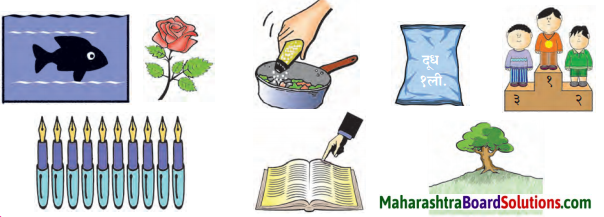
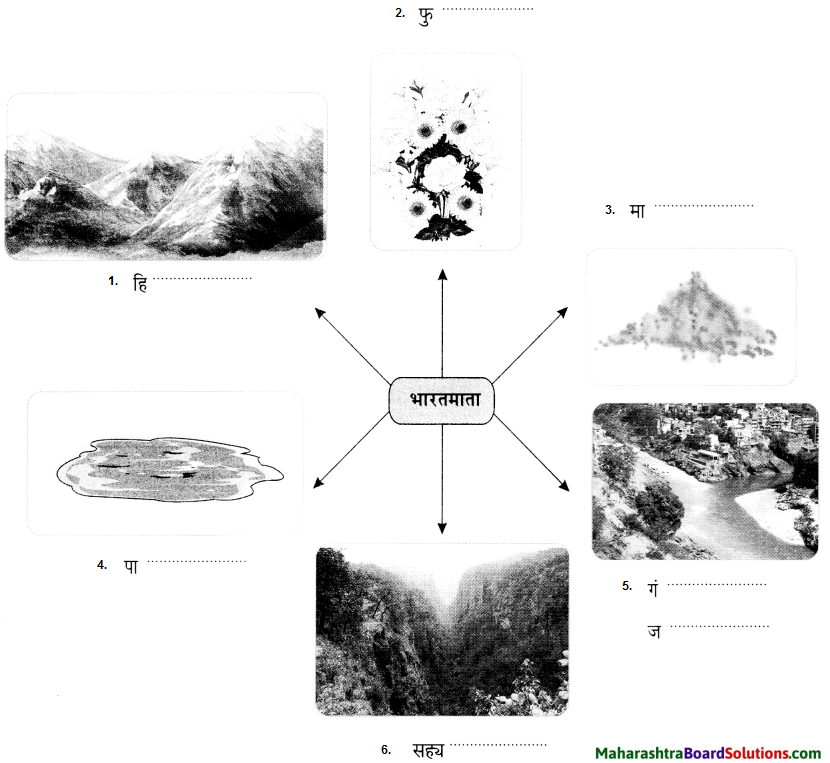
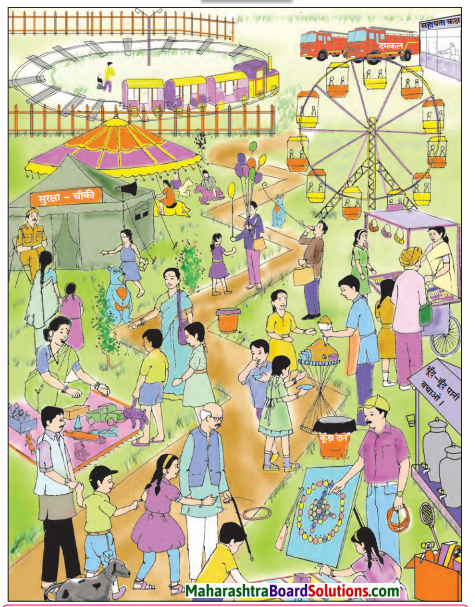
चित्र देखकर उचित सर्वनाम में लिखो:
Maharashtra Board Class 6 Hindi Solutions Chapter 6 मेरा अहोभाग्य 1
(तू, मैं, वह, यह, क्या, जैसा-वैसा, अपने-आप)
Answer:

  1. मैं
  2.  तू
  3. यह
  4. अपने-आप
  5. वह
  6. जैसा-वैसा
  7. क्या?

जरा सोचो ………बताओ:

यदि मैं पुस्तक होता/होती तो …….
Answer:
यदि मैं पुस्तक होता…..
स्वयं पुस्तक होना अपने आप में एक बहुत बड़ी बात है। यदि मैं पुस्तक होता तो लोगों को और दुनिया को ज्ञान देने के मेरे कर्तव्य को मैं भली-भाँति निभाता। मैं विद्यार्थियों के बौद्धिक, शारीरिक और सर्वांगीण विकास का ध्यान रखते हुए उन्हें योग्य मार्गदर्शन करता। सारे संसार को जीवन उपयोगी और मूल्यवान विचार प्रदान करता। पूरी मानव जाति के लिए उनके भले के लिए अपना पूरा जीवन त्याग देता।

Maharashtra Board Class 6 Hindi Solutions Chapter 6 मेरा अहोभाग्य

भाषा की ओर:

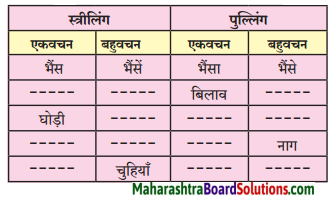
निम्नलिखित शब्दों के लिंग और वचन बदलकर लिखिए:
Maharashtra Board Class 6 Hindi Solutions Chapter 6 मेरा अहोभाग्य 2
Answer:

(१) बिल्ली, बिल्लियाँ, बिल्ले
(२) घोड़ियाँ, घोड़ा, घोड़े
(३) नागिन, नागिनें, नाग
(४) चुहिया, चूहा, चूहे

सुनो तो जराः

दैनिक समाचार सुनेंगे और मुख्य समाचार को फलक पर लिखकर कक्षा में सुनाएँगे:
Answer:
प्रश्न का उत्तर छात्र स्वयं तैयार करेंगे।

बताओ तो सही:

अपने मनपसंद व्यक्ति का साक्षात्कार लेने हेतु कोई पाँच प्रश्न लिखिए:
Answer:
मनपसंद व्यक्ति – प्रधानमंत्री श्री नरेंद्र मोदी जी

  1. महोदय, आपका पूरा नाम क्या है?
  2. आपका जन्म कब और कहाँ हुआ?
  3. आप अपने जीवन में क्या बनना चाहते थे?
  4. आप अपने देश के लिए और क्या करना चाहेंगे?
  5. आपके विचार से देश के सामने खड़ी सबसे बड़ी समस्या कौन-सी है?

Maharashtra Board Class 6 Hindi Solutions Chapter 6 मेरा अहोभाग्य

वाचन जगत से:

संत तुकाराम के अभंग पढ़ेंगे और गायेंगे:
Answer:
“तुका राम बहुत मीठा रे, भर राखें शरीर।
तनकी करूं नावरि, उतारूँ पैल तीर।।”

मेरी कलम से:

अपने परिवार से संबंधित कोई संस्मरण लिखिए:
(संस्मरण-लेखन / अनुच्छेद-लेखन)
Answer:
मनुष्य के जीवन से उसके कई संस्मरण जुड़े होते हैं। गतवर्ष मैं अपने परिवार के साथ अहमदाबाद गया था। वहाँ जाकर मुझे हमारे राष्ट्रपिता महात्मा गांधी का साबरमती आश्रम देखने का सौभाग्य प्राप्त हुआ। उनके स्वतंत्रता संग्राम योगदान के कई चित्र तथा उनकी लिखी किताबें और वहाँ का विस्तृत पुस्तकालय देखकर मानो मैं कहीं खो गया। घर के सभी लोग मुझे पूरे आश्रम में ढूँढ रहे थे। मैं मानो गांधी जी द्वारा लिखित उन किताबों में कहीं खो गया था। काफ़ी देर बाद पिताजी ने वहाँ आकर मुझे आवाज़ दी। मैंने देखा काफ़ी समय बीत चुका था। मैं करीब २ घंटे उस पुस्तकालय में मानो खो गया था। साबरमती आश्रम की यह भेंट मुझे भुलाए नहीं भूलती। यह मेरे जीवन का सबसे सुंदर संस्मरण है।

एक वाक्य में उत्तर लिखो:

Question 1.
साहित्यिक कार्यक्रम कहाँ होने वाला था?
Answer:
साहित्यिक कार्यक्रम शांति निकेतन में होने वाला था।

Question 2.
गुरुदेव की कहानियों में कौन-सी मनोवृत्ति के दर्शन होते हैं?
Answer:
गुरुदेव की कहानियों में ग्रामीण जनता की मनोवृत्ति के दर्शन होते हैं।

Maharashtra Board Class 6 Hindi Solutions Chapter 6 मेरा अहोभाग्य

Question 3.
संस्मरण में किस कहानी का उल्लेख किया गया है?
Answer:
संस्मरण में ‘काबुलीवाला’ कहानी का उल्लेख किया गया है।

Question 4.
लेखक आनंद विभोर क्यों हुए?
Answer:
लेखक आनंद विभोर इसलिए हुए क्योंकि लेखक जिस कमरे मे ठहरे थे, उसी कमरे में गुरुदेव रवींद्रनाथ ठाकुर ने ‘गीतांजली’ का अधिकांश भाग उसके बरामदे में लिखा था।

Question 5.
हिंदी वालों के दल को कहाँ ठहराया गया था?
Answer:
हिंदी वालों के दल को शांति निकेतन के सुंदर अतिथि-भवन में ठहराया गया था।

स्वयं अध्ययन:

महान विभूतियों की सूची बनाकर उनके कार्यों का उल्लेख करते हुए निबंध लिखिए:
Answer:

  1. महात्मा गांधी
  2. सुभाषचंद्र बोस
  3. लोकमान्य तिलक
  4. लालबहादुर शास्त्री
  5. सरदार वल्लभभाई पटेल
  6. पंडित जवाहरलाल नेहरू

देश के महापुरुष – देश की महान विभूतियों का योगदान

हमारे देश में प्राचीन काल में देश को स्वतंत्र कराने के लिए कई वीरों ने अपने प्राणों का बलिदान कर दिया। जिनके बलिदान के कारण ही आज हम खुली हवा में साँस ले रहे हैं। महात्मा गांधीजी ने लोगों को सत्य और अहिंसा की सीख दी तथा “करो या मरों” इस नारे के माध्यम से लोगों का हौसला बढ़ाया। अपनी स्वतंत्रता हासिल करने के लिए लोकमान्य तिलक ने ब्रिटिश सरकार को बताया कि ‘स्वराज्य मेरा जन्मसिद्ध अधिकार है, उसे मैं लेकर ही रहूँगा।’ उनकी इस घोषणा ने लोगों में सराहनीय जोश का संचार किया। सुभाषचंद्र बोस ने ‘तुम मुझे खून दो, मैं तुम्हें आजादी दूंगा।’ यह कहते हुए सभी युवकों और देशवासियों को संगठित होने का संदेश दिया।
लालबहादुर शास्त्री ने देशवासियों को स्वतंत्रता का महत्त्व समझाया और अंग्रेजों को देश से उखाड़ फेंकने के लिए लोगों में स्वतंत्रता की अलख जगाई। इस प्रकार देश के कई महापुरुषों ने स्वतंत्रता आंदोलन में अपना सहयोग दिया। इन सभी महापुरुषों के योगदान के कारण ही हमारा भारत देश १५ अगस्त, १९४७ को स्वतंत्र हो गया।

Maharashtra Board Class 6 Hindi Solutions Chapter 6 मेरा अहोभाग्य

सदैव ध्यान में रखो:

उल्लेखनीय कार्य ही व्यक्ति को महान बनाते हैं।
Answer:
इस संसार में प्रतिदिन कई लोग जन्म लेते हैं, तो कई लोगों की मृत्यु होती है। संसार सभी को याद नहीं रखता। जो व्यक्ति अपने कार्य-काल में समाज, देश एवं अपनी संस्कृति के लिए कुछ अतुलनीय कार्य करता है, उसी व्यक्ति को संसार याद रखता है। व्यक्ति अपने धन, संपत्ति एवं पद की प्रतिष्ठा से महान नहीं बनता, बल्कि अपने उल्लेखनीय कार्यों से ही महान बनता है।

विचार मंथन:

हे विश्वचि माझे घर।

मराठी में लिखी इस उक्ति के लिए संस्कृत में एक उक्ति है- ‘वसुधैव कुटुंबकम्’ अर्थात संपूर्ण विश्व ही मेरा घर है। बोली-भाषा, जाति-धर्म, रंग, संस्कृति, सरहद आदि के आधार पर हम भले ही अलग-अलग हों, पर सबसे पहले हम इंसान हैं। विश्व के प्रत्येक व्यक्ति को एक-दूसरे की आवश्यकता है। ऐसे में भेदभाव की दीवार को तोड़कर हम सभी को एक होना चाहिए।

खोजबीन:

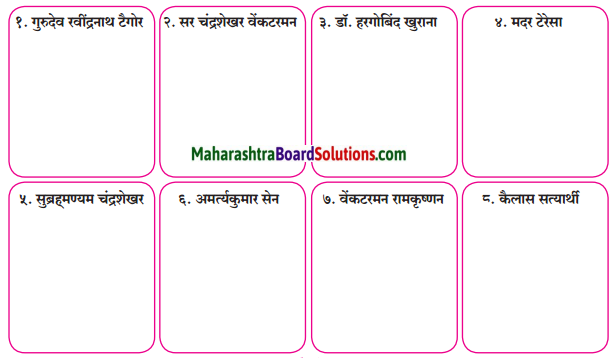
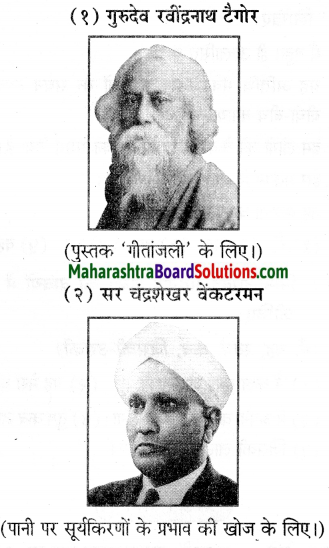
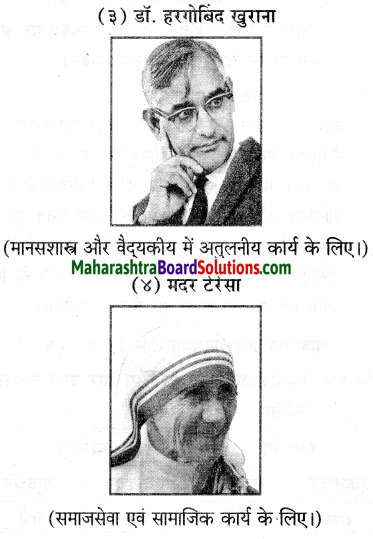
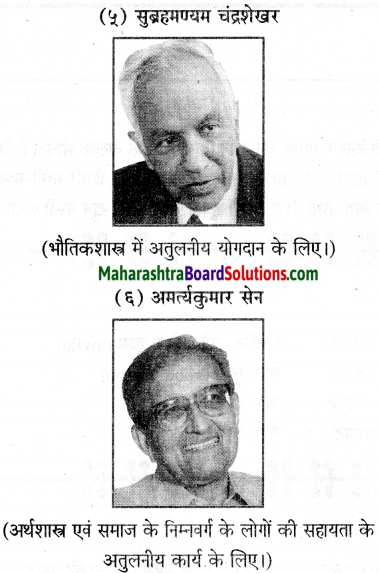
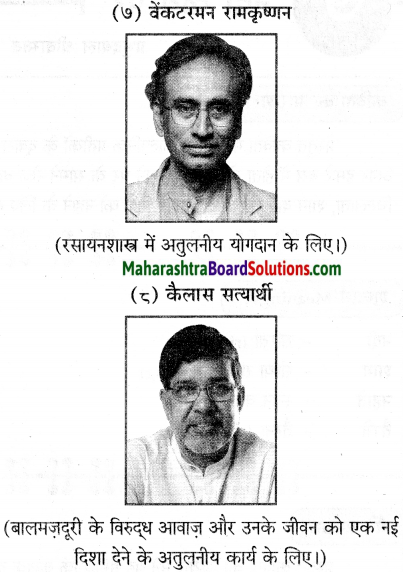
नोबल पुरस्कार प्राप्त विभूतियों के चित्र चिपकाओ। उन्हें यह पुरस्कार किसलिए प्राप्त हुआ है, बताओ?
Maharashtra Board Class 6 Hindi Solutions Chapter 6 मेरा अहोभाग्य 3
Answer:
Maharashtra Board Class 6 Hindi Solutions Chapter 6 मेरा अहोभाग्य 4
Maharashtra Board Class 6 Hindi Solutions Chapter 6 मेरा अहोभाग्य 5
Maharashtra Board Class 6 Hindi Solutions Chapter 6 मेरा अहोभाग्य 6

Maharashtra Board Class 6 Hindi Solutions Chapter 6 मेरा अहोभाग्य

Maharashtra Board Class 6 Hindi Solutions Chapter 6 मेरा अहोभाग्य 7

Hindi Sulabhbharti Class 6 Solutions Chapter 6 मेरा अहोभाग्य Additional Important Questions and Answers

निम्नलिखित शब्दों में से उचित शब्द चुनकर रिक्त स्थानों की पूर्ति कीजिए:

(बरामदा, धन्यवाद, ग्रामीण, मानसिक, गीतांजली)

Question 1.
गुरुदेव की प्रारंभिक कहानियों में ……………… जीवन के संसर्ग का वर्णन है।
Answer:
ग्रामीण

Question 2.
हम सबके लिए यह एक ……………… खाद्य था।
Answer:
मानसिक

Question 3.
हम सबने गुरुदेव को ……………… दिया।
Answer:
धन्यवाद

Maharashtra Board Class 6 Hindi Solutions Chapter 6 मेरा अहोभाग्य

Question 4.
गुरुदेव को उनकी रचना ……………… के लिए नोबल पुरस्कार प्राप्त हुआ।
Answer:
गीतांजली

Question 5.
कमरे के बाहर एक विस्तृत ……………… था।
Answer:
बरामदा

निम्नलिखित वाक्य सही हैं या गलत लिखिए:

Question 1.
कार्यक्रम की अध्यक्षता लेखक करने वाले थे।
Answer:
गलत

Question 2.
मध्याह्न के बाद गुरुदेव की भेंट हुई।
Answer:
सही

Question 3.
गुरुदेव ने लगभग १० मिनट बात की।
Answer:
गलत

Maharashtra Board Class 6 Hindi Solutions Chapter 6 मेरा अहोभाग्य

Question 4.
‘गीतांजली’ के लिए रवींद्रनाथ ठाकुर को भारत रत्न दिया गया।
Answer:
गलत

Question 5.
गुरुदेव की सेहत ठीक नहीं है – यह सुनकर लेखक को दुःख हुआ।
Answer:
सही

निम्नलिखित शब्दों का वाक्यों में प्रयोग कीजिए:

Question 1.
लोकप्रिय
Answer:
‘गोदान’ एक लोकप्रिय उपन्यास है।

Question 2.
उल्लास
Answer:
अपने सामने पुराने मित्र को अचानक खड़ा देखकर राम का मन उल्लास से भर गया।

Question 3.
दर्जन
Answer:
आज कल महँगाई के कारण ४० रुपये में केवल १ दर्जन केले ही आते हैं।

Maharashtra Board Class 6 Hindi Solutions Chapter 6 मेरा अहोभाग्य

Question 4.
उपवन
Answer:
मेरे घर के सामने एक उपवन है।

Question 5.
प्रात:काल
Answer:
मैं प्रात:काल घूमने जाता हूँ।

Question 6.
निराश
Answer:
अपने मित्र की मृत्यु का समाचार सुनकर मोहन निराश हो गया।

निम्नलिखित प्रश्नों के उत्तर एक-एक वाक्य में लिखिए:

Question 1.
साहित्यिक कार्यक्रम कहाँ होने वाला था?
Answer:
साहित्यिक कार्यक्रम शांति निकेतन में होने वाला था।

Question 2.
गुरुदेव की कहानियों में कौन-सी मनोवृत्ति के दर्शन होते हैं?
Answer:
गुरुदेव की कहानियों में ग्रामीण जनता की मनोवृत्ति के दर्शन होते हैं।

Question 3.
संस्मरण में किस कहानी का उल्लेख किया गया है?
Answer:
संस्मरण में ‘काबुलीवाला’ कहानी का उल्लेख किया गया है।

Maharashtra Board Class 6 Hindi Solutions Chapter 6 मेरा अहोभाग्य

Question 4.
लेखक आनंद विभोर क्यों हुए?
Answer:
लेखक आनंद विभोर इसलिए हुए क्योंकि लेखक जिस कमरे मे ठहरे थे, उसी कमरे में गुरुदेव रवींद्रनाथ ठाकुर ने ‘गीतांजली’ का अधिकांश भाग उसके बरामदे में लिखा था।

Question 5.
हिंदी वालों के दल को कहाँ ठहराया गया था?
Answer:
हिंदी वालों के दल को शांति निकेतन के सुंदर अतिथि-भवन में ठहराया गया था।

निम्नलिखित प्रश्नों के उत्तर दो-तीन वाक्यों में लिखिए:

Question 1.
दूसरे दिन लेखक और उनके दल को किस बात की जानकारी दी गई?
Answer:
दूसरे दिन लेखक और उनके दल को इस बात की जानकारी दी गई कि गुरुदेव का स्वास्थ्य ठीक न होने के कारण वे कार्यक्रम की बैठक में नहीं आ पाएँगे।

Question 2.
गुरुदेव की कहानियाँ संसार के किसी भी आदमी को क्यों भा सकती हैं?
Answer:
गुरुदेव की कहानियाँ संसार में किसी भी आदमी को इसलिए भा सकती हैं, क्योंकि मनुष्य-स्वभाव तो दुनिया में हर जगह एक सा ही होता है।

Maharashtra Board Class 6 Hindi Solutions Chapter 6 मेरा अहोभाग्य

Question 3.
लेखक की खुशियों का ठिकाना क्यों न रहा?
Answer:
लेखक की खुशियों का ठिकाना इसलिए नहीं रहा क्योंकि जिस कमरे में लेखक ठहरे हुए थे, उसी कमरे में गुरुदेव काफी समय तक रह चुके थे।

व्याकरण और भाषाभ्यास

निम्नलिखित शब्दों का विलोम लिखिए:

  1. दिन
  2. जैसा
  3. जीवन
  4. छोटी
  5. सच

Answer:

  1. रात
  2. वैसा
  3. मरण
  4. बड़ी
  5. झूठ

Maharashtra Board Class 6 Hindi Solutions Chapter 6 मेरा अहोभाग्य

निम्नलिखित शब्दों का वचन बदलिए:

  1. खुशी
  2. कहानी
  3. भाषा
  4. कल्पना
  5. मंज़िल

Answer:

  1. खुशियाँ
  2. कहानियाँ
  3. भाषाएँ
  4. कल्पनाएँ
  5. मंजिलें

निम्नलिखित बाक्यों में से सर्वनाम शब्द छाँटकर लिखिए:

  1. मैं बहुत ही उल्लासित था।
  2. यह अतिथि भवन अशोक वृक्षों के सघन उपवन के बीचो-बीच बनाया गया था।
  3. हम लोगों को केवल पंद्रह मिनटों का समय दिया है।
  4. इस मकान में जगह की भी कमी है।
  5. वह कहानी कल्पना की सृष्टि है।

Answer:

  1. मैं
  2. यह
  3. हम
  4. इस
  5. वह

Maharashtra Board Class 6 Hindi Solutions Chapter 6 मेरा अहोभाग्य

निम्नलिखित सर्वनाम शब्दों का वाक्यों में प्रयोग कीजिए:

मैं, यह, स्वयं, कब, जिसकी-उसकी
Answer:

  • मैं कल मुंबई जाऊँगा।
  • यह मेरा घर है।
  • मैं अपना काम स्वयं कर लूँगा।
  • तुम कब जाओगे?
  • जिसकी लाठी, उसकी भैंस।

Maharashtra Board Class 6 Geography Solutions Chapter 4 Weather and Climate

Balbharti Maharashtra State Board Class 6 Geography Solutions Chapter 4 Weather and Climate Notes, Textbook Exercise Important Questions and Answers.

Maharashtra Board Class 6 Geography Solutions Chapter 4 Weather and Climate

Class 6 Geography Chapter 4 Weather and Climate Textbook Questions and Answers

A. Who am I?

Question 1.
I keep on changing.
Answer:
Weather.

Question 2.
I am not the same in all places.
Answer:
Climate.

Question 3.
I am the solid state of water droplets.
Answer:
Snow.

Maharashtra Board Class 6 Geography Solutions Chapter 4 Weather and Climate

Question 4.
I am present in the atmosphere in the form of vapour.
Answer:
Moisture.

B. Answer the following:

Question 1.
Why is the climate of Mahabaleshwar cool ?
Answer:
The climate of Mahabaleshwar is cool because it is situated at a high elevation. So, as we move upward from sea-level, the temperature of air decreases.

Question 2.
Why is the climate near the sea humid?
Answer:
The climate near the sea is humid because it contains greater amount of vapour mixed in the air.

Maharashtra Board Class 6 Geography Solutions Chapter 4 Weather and Climate

Question 3.
What is the difference between weather and climate?
Answer:

WeatherClimate
(i) Weather is described on the basis of the conditions prevailing at the given time.(i) Climate is described on the basis of conditions prevailing over a longer period of time.
(ii) Weather keeps changing frequently and we can experience the change easily.(ii) Change in the climate takes place over a long ! period of time. These are not percieved easily.

Question 4.
What are the elements of weather?
Answer:
The elements of weather are:

  • Temperature
  • Air pressure
  • Winds
  • Moisture and
  • Precipitation.

Question 5.
What effects do nearness to the sea and height above mean sea level have on the climate?
Answer:
Nearness to the sea leads to a humid climate whereas height above mean sea level will lead to a cool climate.

C. For the climatic conditions mentioned in the table, name the representative places known to you. (Use an atlas.)

HotDeath valley
Hot and humid
Cold
Hot and dry
Cold and dry

Answer:

HotDeath valley
Hot and humidAmazon
ColdGreenland
Hot and drySahara desert
Cold and dryAtacama desert

Maharashtra Board Class 6 Geography Solutions Chapter 4 Weather and Climate

D. Complete the following table

WeatherClimate
Short-lived condition of the atmosphere
Does not change quickly
Expressed with respect to a specific place
Elements of climate: Temperature, pressure, winds, humidity and precipitation

Answer:

WeatherClimate
Short-lived condition of the atmosphereLong-lived condition of the atmosphere
Keeps changingDoes not change quickly
Expressed with respect to a specific placeExpressed with respect to a specific region
Elements of weather: Temperature, pressure, winds, humidity and precipitationElements of climate: Temperature, pressure, winds, humidity and precipitation

Activity:

Understand the climate of your place with the help of your teacher.

Class 6 Geography Chapter 4 Weather and Climate InText Questions and Answers

Can you tell?

A. The weather conditions of a few places in India are as follows on 10th June. Use the table to answer the questions.

S. No.PlaceStateTimeWeather
(1)KochiKerala12.30 pmCloudy
(2)BhopalM.P.12.30 pmHot and sunny
(3)MussoorieUttarakhand12.30 pmCold weather mild sun

Question 1.
In which place will the clothes on a clothesline dry quickly? Why?
Answer:
In Bhopal the clothes on the clothesline will dry quickly. Due to the hot sun the water in the wet clothes get converted into vapour quickly.

Question 2.
In which place will they dry slowly? Why?
Answer:
Clothes will take longer time to dry in Mussoorie because of the medium heat and cold air.

Question 3.
Will the atmospheric conditions at these places always remain the same or will they change?
Answer:
The atmospheric conditions of these places will change from time to time.

Maharashtra Board Class 6 Geography Solutions Chapter 4 Weather and Climate

B. Which of the following statements are applicable to the conditions that you have experienced today or yesterday at the place where you live?

  • It was cold in the morning.
  • In the afternoon it become hot and humid.
  • It rained suddenly in the afternoon.
  • Cool breeze was blowing in the morning.
  • Clouds gathered in the evening.
  • The night sky was full of stars and a pleasant breeze was blowing.

Answer:
Students have to give answer to this question depending on the weather condition of one particular day where they live.

C. Since childhood you have experienced summers, rainy seasons and winters. On the basis of your experience answer the following questions.

Question 1.
In which months do summer, monsoon season and winter occur in a year from January to December? Show it in a chart.
Answer:

SummerRainy seasonWinter
February to MayJune to SeptemberOctober to January

Question 2.
Which special clothes do we use if it is raining?
Answer:
If it is raining, we wear a raincoat or carry an umbrella.

Question 3.
When do we use woollen clothes?
Answer:
We wear woollen clothes in winter.

Question 4.
In which season do we mainly use thin cotton clothes?
Answer:
We wear cotton clothes in summer.

Use your brain power!

Question 1.
Which occupation will you practice in cold regions?
Answer:
Occupations practiced in cold region are lumbering and agriculture.

Question 2.
Which occupations will you practice in hot region?
Answer:
Occupations practiced in hot regions are animal husbandry and agriculture.

Maharashtra Board Class 6 Geography Solutions Chapter 4 Weather and Climate

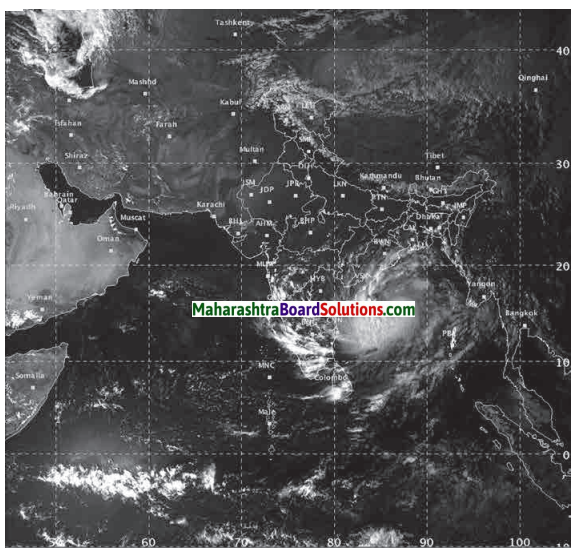
Observe the following map and write the answer to the question given below it.
Maharashtra Board Class 6 Geography Solutions Chapter 4 Weather and Climate 2
Question 1.
An Indian Meteorological Department image of the storm that visited in November 2014 was shown. Tell in which sea the storm was located.
Answer:
Bay of Bengal.

Class 6 Geography Chapter 4 Weather and Climate Additional Important Questions and Answers

Fill in the blanks with the right option in the brackets:

Question 1.
Atmospheric conditions prevailing at a place and at a given time is called ______. (wind, weather, climate)
Answer:
weather

Question 2.
The temperature goes on ______ from the equator towards both the poles. (decreasing, increasing, being constant)
Answer:
decreasing

Question 3.
The horizontal movement of air is called ______. (pressure, humidity, wind)
Answer:
wind

Question 4.
_____ is defined by elements such as temperature, wind and humidity. (precipitation, weather, climate)
Answer:
weather

Maharashtra Board Class 6 Geography Solutions Chapter 4 Weather and Climate

Question 5.
The air that has greater amount of vapour is called _____ air. (dry, hot, humid)
Answer:
humid

Question 6.
The humidity in the atmosphere is called _______. (moisture, oxygen, heat)
Answer:
moisture

Question 7.
The proportion of moisture in the atmosphere depends on ________.(winds, temperature, air pressure)
Answer:
temperature

Question 8.
Vapour in the atmosphere condenses into water droplets or snow and their showering on the earth is called ________.(precipitation, wind, climate)
Answer:
precipitation

Match the pairs correctly:

Question 1.

AB
(1) Winds(a) hailstorm
(2) Moisture(b) solar energy
(3) Precipitation(c) the difference in air pressure
(4) Temperature(d) vapor
(5) Weather(e) hot, cool, dry, sultry
(f) humidity

Answer:
1 – c
2 – d
3 – a
4 – b
5 – e

Maharashtra Board Class 6 Geography Solutions Chapter 4 Weather and Climate

Name the following statements:

Question 1.
Elements of weather:
Answer:
Temperature, pressure, winds, humidity and precipitation.

Question 2.
Forms of precipitation:
Answer:
Rainfall, snowfall and hailstorm.

Question 3.
Climate is generally expressed as:
Answer:
‘Cool and dry ‘or ‘hot and humid’ or ‘hot and dry’, etc.

Question 4.
Factors influencing climate:
Answer:
Latitudinal position, height above sea level, nearness to ocean and oceanic currents.

Answer the following questions in one sentence:

Question 1.
What is precipitation?
Answer:
Vapour in the atmosphere condenses into water droplets or snow particles, which shower on the earth. This is called as precipitation.

Question 2.
What is called air pressure?
Answer:
Air has weight and as a result it creates pressure. This is called air pressure.

Question 3.
What is wind?
Answer:
Air moving from high pressure towards low pressure areas in a horizontal direction is called wind.

Question 4.
What is called humid air?
Answer:
The atmosphere contains vapour. The air that has greater amount of vapour is called humid air.

Maharashtra Board Class 6 Geography Solutions Chapter 4 Weather and Climate

Give geographical reasons for the following statements:

Question 1.
As we move upward from the sea-level, temperature of the air decreases.
Answer:

  • The earth’s surface gets heat from the Sun.
  • Thus, the surface gets heated.
  • The air close to the earth surface starts becoming hot.
  • Later, different layers of air at higher elevation receive heat.
  • Therefore, as we move upward from sea-level, the temperature of air decreases.

Question 2.
Air pressure decreases with increasing height.
Answer:

  • The lowermost layers of air are subjected to the pressure of the upper layers.
  • So, the density of the lower layers of air increases.
  • There is greater air pressure near the surface of the earth.
  • Therefore, air pressure decreases with increasing height.

Answer the following questions:

Question 1.
What is known as precipitation?
Answer:
Vapour in the atmosphere condenses into water droplets or snow particles. Their showering on the earth is called precipitation.

Maharashtra Board Class 6 Geography Solutions Chapter 4 Weather and Climate

Question 2.
What is called moisture?
Answer:
The humidity in the atmosphere is called moisture. The proportion of moisture in the atmosphere depends on the temperature. Air with higher temperature holds a greater amount of moisture.

Maharashtra Board Class 6 History Solutions Chapter 11 Ancient India and the World

Balbharti Maharashtra State Board Class 6 History Solutions Chapter 11 Ancient India and the World Notes, Textbook Exercise Important Questions and Answers.

Maharashtra Board Class 6 History Solutions Chapter 11 Ancient India and the World

Class 6 History Chapter 11 Ancient India and the World Textbook Questions and Answers

1. Name the following:

Question 1.
Places where articles made in Rome were found.
Answer:
Kolhapur and Arikamedu in Tamil Nadu.

Question 2.
A new style of art emerged during the Kushana period in India.
Answer:
Gandhara style of art.

Question 3.
The language of the books Mahavansa and Deepvansa.
Answer:
Pali language.

Question 4.
A country to which Buddhism had spread in the ancient period.
Answer:
Sri Lanka.

2. Think and expand/elaborate:

Question 1.
Indian culture had an impact on southeast Asia.
Answer:

  • Indian culture had a deep impact on the art and cultural life of southeast Asia.
  • Dance-dramas based on stories from Ramayana and Mahabharata are popular in Indonesia even today.
  • In later years, temples of Lord Shiva and Vishnu were also built there.

Question 2.
The spread of Buddhism in China became easier.
Answer:

  • In the first century CE, the Ming emperor of China invited the Buddhist bhikkhus Dharmarakshaka and Kashyapmatanga to China.
  • The Bhikkhus translated many Indian Buddhist texts into Chinese language.
  • This made the spread of Buddhism in China easier.

3. What would you do if you are encouraged in your favourite hobby ?
Answer:
If someone encouraged me, it will make me very happy and boost my self-confidence. Thus I will further expand my horizon by gaining more knowledge and enhancing my hobby.

4. Describe a picture:

A picture of the Gandhara style sculpture on a stupa in Hadda, Afghanistan is given in this chapter. Observe it and write about it.

5. Find out more about:

Question 1.
The Gandhara style of art.
Answer:
Under the influence of the Greek art of sculpture, a new form of art emerged in India during the Kushana period. It is called Gandhara school of art. In the Gandhara, art school images of Gautam Buddha were mainly carved in Gandhara.

Question 2.
The Silk Route.
Answer:
Chinese silk was in great demand in India. Merchants in ancient India supplied Chinese silk to western countries. The land route by which the silk trade was carried on was called the silk route. Some ancient places in India were connected to this route. The Chinese Buddhist Bhikkhus also came to India through this silk route.

6. Mark the countries of Southeast Asia mentioned in the chapter on an outline map.

Activity:

Obtain information about a form of art of your choice and present it in your class.

Class 6 History Chapter 11 Ancient India and the World Additional Important Questions and Answers

Complete the sentence by choosing the correct option:

Question 1.
People of the Harappan civilisation had developed trade relations with the countries of the ______.
(a) north
(b) west
(c) south
Answer:
(b) west

Question 2.
________ had spread to Afghanistan and to many countries of Central Asia.
(a) Zoroastrianism
(b) Jainism
(c) Buddhism
Answer:
(c) Buddhism

Question 3.
The writings of the Greek historians introduced India to the ______ world.
(a) western
(b) eastern
(c) central
Answer:
(a) western

Question 4.
Under the influence of the Greek art of sculpture, a new form of art emerged in India during the ____ period.
(a) Gupta
(b) Kushana
(c) Vakataka
Answer:
(b) Kushana

Question 5.
In the Gandhara art school images of _______ were mainly carved.
(a) Gautam Buddha
(b) Vardhaman Mahavir
(c) Guru Nanak
Answer:
(a) Gautam Buddha

Question 6.
The early coins that were minted in India were also like _________ coins.
(a) Sri lanka
(b) Chinese
(c) Greek
Answer:
(c) Greek

Question 7.
The excavations at Arikamedu in Tamil Nadu have also brought to light many articles made in ______.
(a) Afghanistan
(b) Rome
(c) China
Answer:
(b) Rome

Question 8.
______was an important port in Egypt.
(a) Funan
(b) Kolhapur
(c) Alexandria
Answer:
(c) Alexandria

Question 9.
Beside Indian goods, the _______ also conveyed Indian philosophy and science to Europe.
(a) Chinese
(b) Arabs
(c) Greeks
Answer:
(b) Arabs

Question 10.
The concept of ‘__________ ‘ is one of India’s major contributions to the world.
(a) zero
(b) one
(c) mathematics
Answer:
(a) zero

Question 11.
Sanghamitra carried a branch of the _________ tree to Sri Lanka.
(a) Banyan
(b) Bodhi
(c) Pipal
Answer:
(b) Bodhi

Question 12.
There was a great demand in India for Sri Lankan _________ and other precious stones.
(a) diamonds
(b) rubies
(c) pearls
Answer:
(c) pearls

Question 13.
The wall paintings in Sigiriya caves bear a resemblance to the paintings in the _______ caves.
(a) Ellora
(b) Ajanta
(c) Nashik
Answer:
(b) Ajanta

Question 14.
Right from the ancient times, India and __________ had established trade and cultural relations.
(a) China
(b) Maharashtra
(c) Rome
Answer:
(a) China

Question 15.
Emperor Harshavardhan had even sent an ambassador to the _______ court.
(a) Greek
(c) Roman
(c) Chinese
Answer:
(c) Chinese

Question 16.
Chinese _______ was known as .’Chinanshuka’ and was in great demand in India.
(a) pearls
(b) diamond
(c) silk
Answer:
(c) silk

Question 17.
Merchants in ancient India supplied Chinese silk to _______ countries.
(a) eastern
(b) western
(c) northern
Answer:
(b) western

Question 18.
The land route by which the silk trade was carried on, was called the ________.
(a) Silk Route
(b) Trade Route
(c) Horse Route
Answer:
(a) Silk Route

Question 19.
The Chinese Buddhist bhikkhus Fa-hien and Yuan Chwang also came to ______ through this silk route.
(a) Nepal
(b) Rome
(c) India
Answer:
(c) India

Question 20.
The bhikkhus translated many Buddhist texts into the _____ language.
(a) Chinese
(b) Japanese
(c) Prakrit
Answer:
(a) Chinese

Question 21.
People of Funan knew ______ language.
(a) Marathi
(b) Chinese
(c) Sanskrit
Answer:
(c) Sanskrit

Question 22.
Indian culture had a deep impact on the art and cultural life of ________ Asia.
(a) Southeast
(b) Southwest
(c) Northeast
Answer:
(a) Southeast

Question 23.
Dance-dramas based on stories from the two Indian epics are popular in ______ even today.
(a) China
(b) Indonesia
(c) Japan
Answer:
(b) Indonesia

Question 24.
In the later years, ______ of Lord Shiva and Vishnu were also built.
(a) caves
(b) muttas
(c) temples
Answer:
(c) temples

Answer in one sentence:

Question 1.
What has India exchanged with the outside world?
Answer:
Having developed trade relations, India began economic and cultural exchange with the outside world.

Question 2.
Who introduced India to the western world?
Answer:
The writings of the Greek historians introduced India to the western world.

Question 3.
Besides Indian goods, what did the Arabs convey to Europe?
Answer:
Besides Indian goods, the Arabs also conveyed Indian philosophy and science to Europe.

Question 4.
Who were sent to Sri Lanka to spread Buddhism?
Answer:
King Ashoka sent his son Mahendra and daughter Sanghamitra to Sri Lanka to spread Buddhism.

Question 5.
Who introduced the Bodhi tree to Sri Lanka?
Answer:
Sanghamitra carried a branch of the Bodhi tree to Sri Lanka.

Question 6.
What is similar between the caves at Ajanta and Sigiriya?
Answer:
The wall paintings at Sigiriya bear resemblance to the paintings in the Ajanta caves.

Question 7.
What provides information about the dose relations between India and Sri Lanka?
Answer:
The Sri Lankan Buddhist works ‘Dipavamsa’ and ‘Mahavamsa’ provide information about the close relations between India and Sri Lanka.

Question 8.
Who sent an ambassador to the Chinese court?
Answer:
Emperor Harshavardhan sent an ambassador to the Chinese court.

Question 9.
What gave an impetus to the spread of Buddhism in China?
Answer:
The Bhikkhus translated many Indian Buddhist texts into Chinese Language. This gave an impetus to spread of Buddhism in China.

Question 10.
In the later years, which temples were built in South-Asian countries?
Answer:
the later years, temples of Lord Shiva and Vishnu were built in south-asian countries.

Elaborate:

Question 1.
Alexandria was an important port in Egypt?
Answer:
The Arab merchants carried Indian goods up to Alexandria. From there, they were sent to the countries in Europe. Besides Indian goods, the Arabs also conveyed Indian philosophy and science to Europe. The concept of ‘zero’ is one of India’s major contribution’ to the world . It was the Arabs who introduced this Indian concept to Europe.

Maharashtra Board Class 6 History Solutions Chapter 5 Religious Trends in Ancient India

Balbharti Maharashtra State Board Class 6 History Solutions Chapter 5 Religious Trends in Ancient India Notes, Textbook Exercise Important Questions and Answers.

Maharashtra Board Class 6 History Solutions Chapter 5 Religious Trends in Ancient India

Class 6 History Chapter 5 Religious Trends in Ancient India Textbook Questions and Answers

1. Fill in the blanks:

Question 1.
The principle of ______ is very important in Jainism.
(a) justice
(b) casteism
(c) non-violence
Answer:
(c) non-violence

Question 2.
An extraordinary feature of Gautam Buddha’s personality is his ______ for all living beings.
(a) compassion
(b) satisfaction
(c) anger
Answer:
(a) compassion

Maharashtra Board Class 6 History Solutions Chapter 5 Religious Trends in Ancient India

2. Answer in short:

Question 1.
What were the teachings of Vardhaman Mahavir?
Answer:
Vardhaman Mahavir taught the people that the greatness of man does not depend on his vama, but on his excellent conduct.

Question 2.
Which famous quotes of Gautam Buddha have you read here? What value does it uphold?
Answer:

  • One of the famous quotes of Gautam Buddha is that ‘Even the little quail can chirp freely in her nest’, this quote depicts the values of freedom and equality of his preaching.
  • Gautam Buddha preached that like men, women too had the right to their own upliftment.

Question 3.
What virtues are emphasized in Judaism?
Answer:
Judaism emphasizes justice, truth, peace, love, compassion, humility, charity, ethical speech and self-respect.

Question 4.
What are the teachings of Christianity?
Answer:

  • According to the teachings of Christianity, we are all brothers and sisters.
  • We should love everyone even our enemies.
  • We should forgive those who err or go wrong.

Maharashtra Board Class 6 History Solutions Chapter 5 Religious Trends in Ancient India

Question 5.
What are the teachings of Islam?
Answer:

  • The teachings of Islam is that Allah is eternal, absolute, all powerful and merciful.
  • The purpose of human existence is to worship Allah.
  • The Quran Sharif provides guidance as to how man should behave in life.

Question 6.
What is at the core of Parsee thinking?
Answer:
At the core of Parsee thinking are three main principles of conduct, namely, good thoughts, good words and good deeds.

3. Write notes on:

Question 1.
Aryasatya
Answer:
There are four truths at the root of all human affairs. They are called noble truths or Aryasatyas.

  • Dukha (suffering): There is suffering in the world.
  • The cause of suffering: There is a cause of suffering
  • Dukkha – nivaran: It is possible to end suffering.
  • Pratipad: Pratipad means the ‘way’ that leads to the end of suffering.

Question 2.
Panchasheel
Answer:
Gautam Buddha asked people to follow five rules called Panchasheel.

  • Stay away from killing animals.
  • Stay away from stealing.
  • Stay away from unethical conduct.
  • Stay away from telling lies.
  • Stay away from intoxicants.

4. Put the following in the proper place in the chart of the Five Great Vows and the Three Jewels.

  • Ahimsa
  • Samyak Darshan
  • Satya
  • Asteya
  • Samyak Jnan
  • Aparigraha
  • Samyak Charitra
  • Brahmacharya

Answer:

Five Great VowsThree Jewels
(1) Ahimsa(1) Samyak Darshan
(2) Satya(2) Samyak Jnan
(3) Asteya(3) Samyak Charitra
(4) Aparigraha
(5) Brahmacharya

Maharashtra Board Class 6 History Solutions Chapter 5 Religious Trends in Ancient India

5. Give reasons:

Question 1.
Why was the name ‘Jina’ given to Vardhaman Mahavir?
Answer:
Vardhaman Mahavir was called Jina or the Conqueror because the joy derived from physical comforts and the discomforts felt due to undesired things had no impact whatsoever on him.

Question 2.
Why did Gautam Buddha came to be called the Buddha?
Answer:
Gautam Buddha has attained knowledge of human life in its entirety. That is why he came to be known as the ‘Buddha’.

Activity:

  • Collect the information about and the pictures of various festivals.
  • Visit the prayer houses of different religions and describe the precincts in the classroom.

Class 6 History Chapter 5 Religious Trends in Ancient India Additional Important Questions and Answers

Complete the sentence by choosing the correct option:

Question 1.
Towards the end of the Vedic period, the minute details of yajna rites acquired ________ importance.
(a) undue
(b) least
(c) much needed
Answer:
(a) undue

Question 2.
A person’s social position was decided by the ______ into which he was born rather than by his achievements.
(a) ashrama
(b) varna
(c) Kula
Answer:
(b) varna

Question 3.
Jainism is one of the ancient _______ in India.
(a) topic
(b) religions
(c) civilization
Answer:
(b) religions

Question 4.
Vardhaman Mahavir is the _______ Tirthankar in the jain religious tradition.
(a) 24th
(b) 25th
(c) 26th
Answer:
(a) 24th

Question 5.
The principle of is very important in Jainism.
(a) justice
(b) casteism
(c) non-violence
Answer:
(c) non-violence

Question 6.
Vardhaman Mahavir was born in ________, a part of Vaishali.
(a) Kundagram
(b) Gaya
(c) Nepal
Answer:
(a) Kundagram

Question 7.
Vardhaman Mahavir left his house and all comforts for the attainment of ______.
(a) non-violence
(b) knowledge
(c) God
Answer:
(b) knowledge

Maharashtra Board Class 6 History Solutions Chapter 5 Religious Trends in Ancient India

Question 8.
He attained enlightenment after twelve and a half years of rigorous _______.
(a) tapa
(b) exercise
(c) good health
Answer:
(a) tapa

Question 9.
Vardhaman is said to be _______ because he had the resilience, the courage to conquer all passions.
(a) victorious
(b) saint
(c) Mahavir
Answer:
(c) Mahavir

Question 10.
The _______ held by the Tirthankar to preach to people was known as ‘samavasaran’.
(a) procession
(b) meeting
(c) assembly
Answer:
(c) assembly

Question 11.
Among the teachings of Mahavir, Anekantavada is considered to be very _____ in the quest for truth.
(a) honest
(b) important
(c) nice
Answer:
(b) important

Question 12.
In the Vedic tradition, the doors of knowledge had slowly been closed to ________.
(a) women
(b) men
(c) children
Answer:
(a) women

Question 13.
Gautam Buddha was the founder of ________.
(a) Christianity
(b) Buddhism
(c) Zoroastrianism
Answer:
(b) Buddhism

Question 14.
Gautam Buddha delivered his first sermon at _______ near Varanasi.
(a) Harappa
(b) Sarnath
(c) Lumbini
Answer:
(b) Sarnath

Question 15.
Pratipad means the ‘way’ that leads to the end of ________.
(a) suffering
(b) life
(c) preach
Answer:
(a) suffering

Maharashtra Board Class 6 History Solutions Chapter 5 Religious Trends in Ancient India

Question 16.
Gautam Buddha created a sangha of bhikkhus to ______ his religion.
(a) stretch
(b) reach
(c) preach
Answer:
(c) preach

Question 17.
People of all varnas and castes could _________ Buddhisms.
(a) reject
(b) embrace
(c) obey
Answer:
(b) embrace

Question 18.
An extraordinary feature of Gautam Buddha’s personality is his _______ for all living beings.
(a) compassion
(b) satisfaction
(c) anger
Answer:
(a) compassion

Question 19.
The tolerance preached by Gautam Buddha is a _____ principle not only for the Indian society but for all mankind even today.
(a) strict
(b) guiding
(c) aggressive
Answer:
(b) guiding

Question 20.
In the ancient period, new religious trends and thoughts went on ______ in India.
(a) emerging
(b) submerging
(c) revolting
Answer:
(a) emerging

Question 21.
Religions like Judaism, Christianity, Islam and Zoroastrianism also took ______ in the Indian society.
(a) stem
(b) branches
(c) root
Answer:
(c) root

Maharashtra Board Class 6 History Solutions Chapter 5 Religious Trends in Ancient India

Question 22.
A Jewish prayer house is known as ________.
(a) Temple
(b) Church
(c) Synagogue
Answer:
(c) Synagogue

Question 23.
_______ is a religion founded by Jesus Christ.
(a) Hinduism
(b) Christianity
(c) Judaism
Answer:
(b) Christianity

Question 24.
According to the teachings of Christianity there is only ______ God.
(a) three
(b) two
(c) one
Answer:
(c) one

Question 25.
The ________ is the holy book of Christianity.
(a) Geeta
(b) Bible
(c) Avesta
Answer:
(b) Bible

Question 26.
A Christian prayer house is known as ______.
(a) Synagogue
(b) Agyari
(c) Church
Answer:
(c) Church

Question 27.
The Quran Sharif provides guidance as to how a man should ______ in life.
(a) behave
(b) sing
(c) evolve
Answer:
(a) behave

Question 28.
Since ancient times there have been ______ relations between India and Arabia.
(a) friendly
(b) trade
(c) unfriendly
Answer:
(b) trade

Question 29.
The prayer house of ________ is known as a mosque or masjid.
(a) Christians
(b) Muslim
(c) Parsees
Answer:
(b) Muslim

Question 30.
The sacred text of the Parsee or Zoroastrians is the _______.
(a) Bible
(b) Quran
(c) Avesta
Answer:
(c) Avesta

Maharashtra Board Class 6 History Solutions Chapter 5 Religious Trends in Ancient India

Question 31.
The ______ came to India from the Pars or Fars province of Iran.
(a) Parsees
(b) Muslims
(c) Hindus
Answer:
(a) Parsees

Question 32.
Zarathushtra or Zoroaster was the _______ of the Parsees.
(a) priest
(b) founder
(c) follower
Answer:

Question 33.
_______ is the name of the Zoroastrian God.
(a) Allah
(b) Ahur Mazda
(c) Ram
Answer:
(b) Ahur Mazda

Question 34.
The elements of fire and water are very important in the _______ religion.
(a) Zoroastrian
(b) Judaism
(c) Hinduism
Answer:
(a) Zoroastrian

Question 35.
The sacred fire burns in the temples which is known as _______.
(a) Church
(b) Mosque
(c) Agyaris
Answer:
(c) Agyaris

Maharashtra Board Class 6 History Solutions Chapter 5 Religious Trends in Ancient India

Match the following:

Question 1.

Column AColumn B
(1) Vardhaman Mahavir(a) Buddhism
(2) Gautam Buddha(b) Synagogue
(3) Jesus Christ(c) Jainism
(4) Zoroastrianism(d) Quran Sharif
(5) Judaism(e) Christianity
(6) Islam(f) Agyari

Answer:
1 – c
2 – a
3 – e
4 – f
5 – b
6 – d

Answer the following in one sentence:

Question 1.
How was a person’s social position decided?
Answer:
In the latter vedic period, a person’s social position was decided by the vama into which he was bom rather than by his achievements.

Question 2.
What led to the establishment of new religions?
Answer:
Many people realized that every person is free to find ways of his own upliftment and this led to the establishment of new religions.

Question 3.
Where was Vardhaman Mahavir born?
Answer:
Vardhaman Mahavir was born in Kundagram, a part of Vaishali in the state of Bihar.

Maharashtra Board Class 6 History Solutions Chapter 5 Religious Trends in Ancient India

Question 4.
After how long did Vardhaman Mahavir attain enlightenment?
Answer:
Vardhaman Mahavir attained enlightenment after twelve and a half years of rigorous tapa.

Question 5.
What did Jainism lay stress on?
Answer:
Jainism laid great stress on good conduct.

Question 6.
How do we know that equality was practised in Jainism?
Answer:
The assembly held by the Tirthankar to preach to people (samavasaran) was based on equality. People of all varnas had entry to it, hence we know that equality was practised in Jainism.

Question 7.
What is Aparigraha?
Answer:
Man tends to accumulate property due to greed. Aparigraha means not hoarding or accumulating anything in this way.

Question 8.
State the quotes of Vardhaman Mahavir that lay emphasis on his teachings.
Answer:
‘Love all living things’, ‘Have mercy and compassion’, and ‘Live and let live’ are quotes that lay emphasis on his teachings.

Question 9.
Where was Gautam Buddha bom?
Answer:
Gautam Buddha was bom at Lumbini in Nepal.

Question 10.
Give the names of Gautam Buddha’s parents.
Answer:
Gautam Buddha’s father’s name was Shuddhodana and mother’s name was Mayadevi.

Question 11.
When did Gautam Buddha recieve enlightenment?
Answer:
On Vaishakha Purnima, when Gautam Buddha was sitting in deep meditation under a pipal tree at Uruvela, near the city of Gaya in Bihar, he attained ‘Bodhi’ – enlightenment or the highest knowledge.

Question 12.
Where did Gautam Buddha deliver his first sermon?
Answer:
Gautam Buddha delivered his first sermon at Samath near Vamasi.

Maharashtra Board Class 6 History Solutions Chapter 5 Religious Trends in Ancient India

Question 13.
In which language did Gautam Buddha preach?
Answer:
Gautam Buddha preached in the people’s language, Pali.

Question 14.
What does Pratipad mean?
Answer:
Pratipad means the ‘way’ that leads to the end of suffering.

Question 15.
What was extraordinary about Gautam Buddha’s personality?
Answer:
Compassion for all living beings was an extra ordinary feature of his personality.

Question 16.
Which religions took root in Indian society?
Answer:
Religions like Judaism, Christianity, Islam and Zoroastrianism took root in the Indian society.

Question 17.
What is a Jewish prayer house called?
Answer:
A Jewish prayer house is called a synagogue.

Question 18.
Who founded Christianity?
Answer:
Christianity is a religion founded by Jesus Christ.

Question 19.
What is the sacred book of the Christians called?
Answer:
The sacred book of the Christians is called ‘the Bible’.

Question 20.
What is the prayer house of the Christians called?
Answer:
The prayer house of the Christians is called ‘a Church’.

Question 21.
What is the holy book of Islam called?
Answer:
The holy book of Islam is called the Quran Sharif.

Question 22.
What is the prayer house of Islam called?
Answer:
The prayer house of Islam is known as a mosque or masjid.

Question 23.
What is the sacred text of Parsees called?
Answer:
The sacred text of the Parsees is the ‘Avesta’.

Question 24.
Why are the Zoroastrians called Parsees?
Answer:
The Zoroatrians came to India from the Pars or Fars province of Iran, therefore they are called as Parsees.

Maharashtra Board Class 6 History Solutions Chapter 5 Religious Trends in Ancient India

Question 25.
What is the name of the Zoroastrian God?
Answer:
The Zoroastrian god is called the ‘Ahur Mazda’.

Question 26.
What is the prayer house of the Zoroastrians called?
Answer:
The prayer house of the Zoroastrians is called the Agyari.

Answer in short:

Question 1.
State the principle of Tri-ratnas as taught by Vardhaman Mahavir.
Answer:
Tri-ratnas are the three jewels or the three principles taught by Vardhaman Mahavir.

  • Samyak Darshan or Right faith.
  • Samyak Jnati or Right knowledge.
  • Samyak Charitra or Right conduct.

Question 2.
What is sangha?
Answer:

  • Gautam Buddha created a sangha of Bhikkhus and Bhikkhunis to preach his religion.
  • These followers where those who gave up their domestic life and entered the sangha.
  • They travelled on foot like the Buddha to preach Dhamma to the people.

Question 3.
How did Gautam Buddha explain the concept of equality?
Answer:

  • Gautam Buddha announced the freedom based on vama.
  • He refused the discrimination based on vama.
  • No one is greater or smaller by birth, says Buddha.
  • He stressed that greatness depended on one’s behaviour or conduct.

Question 4.
Who came to spread Christianity to India?
Answer:

  • St. Thomas, one of the twelve disciples of Christ, came to Kerala in the first century of the Christian era.
  • He established a church at Pallayur in Trichur district in 52 CE.

Give reasons:

Question 1.
Why is Vardhaman said to be Mahavir?
Answer:
Vardhaman is said to be ‘Mahavir’ because he had the resilience, the courage to conquer all passions.

Maharashtra Board Class 6 History Solutions Chapter 5 Religious Trends in Ancient India

Question 2.
Why did Mahavir preach in Ardhamagadhi?
Answer:
Mahavir spoke in Ardhamagadhi, a people’s language, to make it easy for the people to understand his preachings.

Question 3.
Why is Buddha’s teachings termed as dhamma-chakka-pavattan?
Answer:
Buddha delivered his first sermon at Sarnath near Varanasi. His teaching in the first sermon are termed dhamma. He set in motion the wheel of dhamma in this sermon. Therefore this event is called dhamma – chakra.

Maharashtra Board Class 6 Geography Solutions Chapter 3 Comparing a Globe and a Map; Field Visits

Balbharti Maharashtra State Board Class 6 Geography Solutions Chapter 3 Comparing a Globe and a Map; Field Visits Notes, Textbook Exercise Important Questions and Answers.

Maharashtra Board Class 6 Geography Solutions Chapter 3 Comparing a Globe and a Map; Field Visits

Class 6 Geography Chapter 3 Comparing a Globe and a Map; Field Visits Textbook Questions and Answers

Question 1.
What characteristics of two and three dimensional devices did you note?
Answer:
Two-dimensional objects have length and width and its product is area. Three-dimensional objects have length, width and height and its product is volume.

Question 2.
What features can be shown on a very small globe?
Answer:
On a very small globe the entire earth can be represented.

Maharashtra Board Class 6 Geography Solutions Chapter 3 Comparing a Globe and a Map; Field Visits

Question 3.
Which device will be suitable for understanding the concept of day and night on the earth?
Answer:
The globe is suitable for understanding the concept of day and night on the earth.

Question 4.
Which device will be useful to show your village/city?
Answer:
A map can be useful to show a village/city.

Question 5.
Which device can be easily carried from one place to another?
Answer:
A map can be easily carried from one place to another.

Activity:

Make two groups. Each group should ask the other group to find the locations of different places on the globe. You may also do this with a map.

Class 6 Geography Chapter 3 Comparing a Globe and a Map; Field Visits Textbook Questions and Answers

Study the world map, a map of India and the globe and answer the following questions:
Maharashtra Board Class 6 Geography Solutions Chapter 3 Comparing a Globe and a Map Field Visits 1

Question 1.
Which device is flat?
Answer:
The world map and map of India are flat.

Maharashtra Board Class 6 Geography Solutions Chapter 3 Comparing a Globe and a Map; Field Visits

Question 2.
Which device is spherical?
Answer:
The globe is spherical.

Question 3.
Which of these devices allows you to see the entire area of the earth at the same time?
Answer:
The globe allows us to see the entire area of the earth at the same time.

Question 4.
Which device allows you to see only one side of the earth at a time?
Answer:
The map allows us to see only one side of the earth at a time.

Question 5.
Which device can be used for studying a particular region in detail?
Answer:
A map can be used for studying a particular region in detail.

Question 6.
Which device can be called a model of the earth?
Answer:
The globe can be called a model of the earth.

Class 6 Geography Chapter 3 Comparing a Globe and a Map; Field Visits Textbook Questions and Answers

Fill in the blanks with the correct option from the brackets:

Question 1.
Map is ______ dimensional whereas a globe is ______ dimensional. (one, tvo, three, four)
Answer:
two, three

Question 2.
______ is a representative model of theentire earth. (map, sphere, globe)
Answer:
Globe

Question 3.
A field visit is an important method of studying ________.(political science, geography, history)
Answer:
geography

Question 4. _______ is the largest operational globe in the world. (EARTHA, Earth, Earthia)
Answer:
EARTHA

Name the following:

Question 1.
Two objects which are two-dimensional.
Answer:
Map, land

Question 2.
Two objects which are three-dimensional.
Answer:
Globe, duster

Question 3.
Two places for students to be taken for field visit.
Answer:
Post office, mall

Maharashtra Board Class 6 Geography Solutions Chapter 3 Comparing a Globe and a Map; Field Visits

Question 4.
Place where EARTHA is housed.
Answer:
Yarmouth in the State of Maine in the United States of America.

Answer the following questions in detail:

Question 1.
How is a field visit an important method of studying geography?
Answer:

  • A field visit helps us to understand the geographical and social conditions of a place.
  • It provides an opportunity to directly interact with the local people and understand their problems.

Question 2.
Write a note on – EARTHA.
Answer:

  • EARTHA is the largest operational globe in the world.
  • It is housed at Yarmouth in the State of Maine in the United State of America.
  • The rotation and revolution speed of this globe is maintained as per that of the earth.

Maharashtra Board Class 6 Geography Solutions Chapter 3 Comparing a Globe and a Map; Field Visits

Question 3.
How is a map drawn?
Answer:
Various steps to draw a map:

  • A wire globe is prepared.
  • A source of light is placed inside the globe.
  • Thereafter projection of the wire graticule is obtained on a paper
  • This projection is used to drawmaps.

Maharashtra Board Class 6 Geography Solutions Chapter 2 Let us Use the Graticule

Balbharti Maharashtra State Board Class 6 Geography Solutions Chapter 2 Let us Use the Graticule Notes, Textbook Exercise Important Questions and Answers.

Maharashtra Board Class 6 Geography Solutions Chapter 2 Let us Use the Graticule

Class 6 Geography Chapter 2 Let us Use the Graticule Textbook Questions and Answers

A. Put a tick mark against the correct option in the space given:

Question 1.
66° 30′ North parallel means:
(i) Arctic Circle
(ii) Equator
(iii) Antarctic Circle
Answer:
Arctic Circle

Maharashtra Board Class 6 Geography Solutions Chapter 2 Let us Use the Graticule

Question 2.
Which parallel bisects the earth?
(i) Tropic of Cancer
(ii) Tropic of Capricorn
(iii) Equator
Answer:
Equator

Question 3.
What is the angular distance of the Arctic Circle from North Pole?
(i) 66° 30′
(ii) 90°
(iii) 23° 30
Answer:
23° 30′

Question 4.
Where do the Prime Meridian and the equator • intersect each other?
(i) Southern Ocean
(ii) Atlantic Ocean
(iii) African Continent
Answer:
African Continent

Question 5.
Up to which parallels from the equator can the j sun’s rays be perpendicular?
(i) Tropic of Cancer and Tropic of Capricorn
(ii) Arctic and Antarctic Circles
(iii) North and South Poles
Answer:
Tropic of Cancer and Tropic of Capricorn

Question 6.
What would be the latitude of a place on the South pole?
(i) 9o°S
(ii) 90°N
(iii) 0°D
Answer:
90° S

Maharashtra Board Class 6 Geography Solutions Chapter 2 Let us Use the Graticule

B. Read the following statements and correct the wrong ones:

Question 1.
While describing the location of a place mentioning the meridian is sufficient.
Answer:
While describing the location of a place, we need to consider one parallel and one meridian.

Question 2.
For describing the extent of a region, it is necessary to assume the latitude and longitude of the centre of the adjoining region.
Answer:
For describing the extent of a region, we need to consider two parallels and two meridians at the extreme ends of the same regions.

Question 3.
Location of a road can be described only with a map.
Answer:
Location of a road can be described with latitude and longitude of a point.

Question 4.
0° East meridian and 180° East meridian.
Answer:
0° meridian and 180° meridian.

Question 5.
The extent of a road or a river course is described with the help of the latitude of a point in the source and the longitude of a point at the end.
Answer:
The extent of a road or a river course is described with the help of the latitude and the longitude of a point in the source and also at the end.

Question 6.
8° 4′ N parallel to 37° 66° N parallel is the correct description of a location
Answer:
8° 4’ N parallel to 37° 66’ N parallel is the correct description of a location.

Maharashtra Board Class 6 Geography Solutions Chapter 2 Let us Use the Graticule

C. Find the locations of following cities from a world map, a map of India or a Globe and write down the latitude and longitude of each of them:

  1. Mumbai
  2. Guwahati
  3. Srinagar
  4. Bhopal
  5. Chennai
  6. Ottawa
  7. Tokyo
  8. Johannesburg
  9. New York
  10. London

Answer:

PlaceLatitudeLongitude
Mumbai19° 00′ N72 48’ E
Guwahati26° 12′ N91 48’ E
Srinagar34° 05′ N74 50’ E
Bhopal23° 18′ N77 24’ E
Chennai13° 06′ N80 18’ E
ottawa45° 27′ N75 42’ W
Tokyo35° 45′ N139 45’ E
Johannesburg26° 10′ S28 03’ E
New York43° 00′ N75 00’ W
London51° 31′ N0 7’ W

D. Find and write down the extent of the following. (Check them on the internet/ mobile):

Question 1.
Maharashtra (State)
Answer:
Question 1. 20° 00′ N / 76° 00’E

Question 2.
Chile (A country)
Answer:
35° 00′ S / 72° 00’W

Question 3.
Australia (A continent)
Answer:
10° 30′ S to 43° 39′ S – 113° E to 153° E

Maharashtra Board Class 6 Geography Solutions Chapter 2 Let us Use the Graticule

Question 4.
Sri Lanka (An island)
Answer:
7° 30′ N / 80° 50′ E

Question 5.
Trans Siberian Railway of Russia (Starting point – St. Petersburg, Terminal Point-Vladivostok)
Answer:
59° 55′ N / 30° 20′ E – 43° 10′ N / 131° 53’ E

E. Draw important parallels and meridians in the figure given below and label them with appropriate angular measures. (Use the protractor.)
Maharashtra Board Class 6 Geography Solutions Chapter 2 Let us Use the Graticule 1
Answer:
Maharashtra Board Class 6 Geography Solutions Chapter 2 Let us Use the Graticule 2

F. Write the important parallels and meridians in the following table:
Maharashtra Board Class 6 Geography Solutions Chapter 2 Let us Use the Graticule 5

Answer:
Maharashtra Board Class 6 Geography Solutions Chapter 2 Let us Use the Graticule 4

Class 6 Geography Chapter 2 Let us Use the Graticule InText Questions and Answers

Make friends with the globe!

Observe the globe and answer the following questions.
Maharashtra Board Class 6 Geography Solutions Chapter 2 Let us Use the Graticule 2
Question 1.
What are the horizontal lines on the globe called?
Answer:
The horizontal lines on the globe are called latitudes.

Maharashtra Board Class 6 Geography Solutions Chapter 2 Let us Use the Graticule

Question 2.
List the continents and oceans through which the equator passes.
Answer:
Continents – Africa, South America, Asia Oceans – Pacific, Atlantic and Indian

Question 3.
Encircle the intersection of 0° meridian and 0° parallel on the globe.
Answer:
Students may attempt this question of their own.

Question 4.
Which ocean is spread in all the four hemispheres?
Answer:
Pacific Ocean

Question 5.
Which continent is spread in all the four hemispheres?
Answer:
The continent of Africa

Question 6.
At which two parallels do all the meridians converge?
Answer:
90°N and 90°S parallels.

State the Importance of the following:

Question 1.
Prime Meridian
Answer:
The main purpose is to fix the global standard time and co-ordinate the standard times of different countries.

Question 2.
180° Meridian
Answer:
The International Date Line is marked with reference to this meridian.

Question 3.
Great Circles
Answer:
Great Circles are used for finding the minimum distance between any two places on the surface of the earth.

Maharashtra Board Class 6 Geography Solutions Chapter 2 Let us Use the Graticule

Let us use the graticule:

Answer the following questions about the location and extent with the help of figure page 11 of your textbook.

Maharashtra Board Class 6 Geography Solutions Chapter 2 Let us Use the Graticule 6

Question 1.
Which latitude and longitude define the location of the capital of Brazil- Brasilia?
Answer:
13°S latitude and 48°W longitude.

Question 2.
What would be the longitudinal extent of Brazil that spreads from 5° 15′ N to 33° 45′ S latitude?
Answer:
Longitudinal extent would be 34° 47’W to 73° 59’W.

Question 3.
In which hemispheres does Brazil extend in the north-south direction?
Answer:
Brazil extends in the both northern and southern hemispheres.

Maharashtra Board Class 6 Geography Solutions Chapter 2 Let us Use the Graticule

Question 4.
In which hemisphere does Brazil extend in the east-west direction?
Answer:
Brazil extends in the Western Hemisphere.

Question 5.
Which parallels and meridians should be used to describe the extend of River Sao Francisco?
Answer:
River Sao Francisco has its source at 40° 04′ W/ 20° 02’S and terminal point at 37°W/10°S.

Question 6.
Describe the location of Marajo Island using the graticule.
Answer:
Using the Graticules, the location of Marajo island is 0.4°N and 51°W.

Think a little!
Question 1.
Find on the globe, the meridians opposite to the ones mentioned below:
90°E, 170°W, 30°E, 20°W
Answer:

  • 90°E – 90°W
  • 170°W – 10°E
  • 30°E – 150°W
  • 20°W – 160°E

Think a little!

Question 1.
Which important parallel passes through India?
Answer:
Tropic of Cancer (23° 30′ N)

Question 2.
Which areas do not get perpendicular rays?
Answer:
Areas to the North of Tropic of Cancer (till Jammu and Kashmir).

Question 3.
Which region receives perpendicular ray on two days in a year?
Answer:
The region to the south of Tropic of Cancer (till Kaniyakumari).

Use your brain power!

Question 1.
In what direction should an aeroplane fly in order to cover the shortest distance between Kolkata and Chicago?
Answer:
To cover the shortest distance between Kolkata and Chicago, the aeroplane should move north west via Delhi.

Class 6 Geography Chapter 2 Let us Use the Graticule Additional Important Questions and Answers

Fill in the blanks:

Question 1.
______ is known as the smallest country in the world.
Answer:
Vatican City

Question 2.
The International Date line is marked with reference to _____ meridian.
Answer:
180°

Maharashtra Board Class 6 Geography Solutions Chapter 2 Let us Use the Graticule

Question 3.
The Prime Meridian is known as ________.
Answer:
Greenwich Meridian

Question 4.
Global Standard Time is known as ______.
Answer:
Greenwich Mean Time

Question 5.
Variation in the intensity of sunlight leads to regional diversity in ____ and ______.
Answer:
plant, animal life

Question 6.
Different temperature zones give rise to ______ belts.
Answer:
pressure

Question 7.
The 180° meridian lies opposite to the _______.
Answer:
Prime Meridian

Question 8.
The equator as well as all pairs of opposite meridians form ______.
Answer:
Great Circles

Question 9.
Due to the ______ and _______ of sunlight, different temperature zones are formed on the earth.
Answer:
duration, intensity

Question 10.
All places between 23° 30′ north and south of equator receives _______ rays on two days in a year.
Answer:
perpendicular

Match the pairs correctly:

Question 1.

A (Latitudes)B (Names)
(1)23°30’N(a) Antarctic Circle
(2) 23°30′ S(b) Tropic of Capricorn
(3)66°30’N(c) Tropic of Cancer
(4) 66°30′ S(d) Arctic Circle
(e) Great Circle
(f) Prime Meridian

Answer:
1 – c
2 – b
3 – d
4 – a

Maharashtra Board Class 6 Geography Solutions Chapter 2 Let us Use the Graticule

Complete the following sentence:

Question 1.
While describing the location of a place, we need to consider _______.
Answer:
only one parallel and one meridian

Question 2.
For describing the extent of a region, we need to consider _________.
Answer:
two parallels and two meridians at the extreme ends of the region

Question 3.
For describing the extent of linear features like a river or road we need to consider ______.
Answer:
the latitudes and longitude of their terminal points

Question 4.
All places between 23°30′ N and S of the ! equator receive perpendicular rays _____.
Answer:
on two days in a year

Question 5.
Depending on the seasons, daytime can be greater than 24 hours in areas between ________.
Answer:
the polar circles and the poles

Question 6.
All places between 23° 30′ N and South of equator ______ rays on two days in a year.
Answer:
receive perpendicular

Answer the following questions in one sentence:

Question 1.
What are Great Circles used for?
Answer:
Great Circles are used for finding the minimum distance between any two places on the surface of the earth.

Question 2.
Where is Vatican City located?
Answer:
Vatican City is the smallest country in the world located within Italy on the Italian peninsula.

Maharashtra Board Class 6 Geography Solutions Chapter 2 Let us Use the Graticule

Question 3.
Why is the Prime Meridian considered an important meridian?
Answer:
The prime meridian is an important meridian because its main purpose is to fix the global standard time and co-ordinate the standard times of different countries.

Maharashtra Board Class 6 History Solutions Chapter 10 Ancient India: Cultural

Balbharti Maharashtra State Board Class 6 History Solutions Chapter 10 Ancient India: Cultural Notes, Textbook Exercise Important Questions and Answers.

Maharashtra Board Class 6 History Solutions Chapter 10 Ancient India: Cultural

Class 6 History Chapter 10 Ancient India: Cultural Textbook Questions and Answers

1. Answer in one sentence:

Question 1.
Make a list of ancient Indian universities.
Answer:
The ancient Indian universities are Takshashila, Vamasi, Valabhi, Nalanda, Vikramshila and Kanchi.

Question 2.
Make a list of the Indian goods that were in demand in foreign countries.
Answer:
Indian goods like fine textiles, ivory, precious stones, spices, beautifully made earthen ; pottery were in great demand in foreign countries.

Maharashtra Board Class 6 History Solutions Chapter 10 Ancient India: Cultural

2. Name the following:

Question 1.
Epics and poetic composition of ancient India.
Answer:
Epics Silappadhikaram and Manimekhalai and Arsha epics Ramayana and Mahabharata and Paumchariya a poetic work are composition of ancient India.

3. Fill in the blanks:

Question 1.
The epic Ramayana was composed by rishi
(a) Vyas
(b) Valmiki
(c) Munni
Answer:
(b) Valmiki

Question 2.
The science of Indian medicine is called
(a) Ayurveda
(b) Homeopathy
(c) Alopathy
Answer:
(a) Ayurveda

Question 3.
Thousands of students could live at the University.
(a) Kanchi
(b) Takshashila
(c) Nalanda
Answer:
(c) Nalanda

Maharashtra Board Class 6 History Solutions Chapter 10 Ancient India: Cultural

4. Answer in brief:

Question 1.
Explain what is meant by ‘Tipitaka’.
Answer:
Tipitaka is a Buddhist religious text written in Pali. It contains three categories of texts.

  • Sutta Pitaka
  • Vinay Pitaka
  • Abhidhamma Pitaka

Question 2.
What is the message of the Bhagwad Gita?
Answer:

  • The Bhagwad Gita tells us that each one of us should do our duty without expecting rewards.
  • It also says that the path of devotion to God is open to all.

Question 3.
What aspects does Ayurveda take into account?
Answer:
Ayurveda is a very old traditional Indian medical science. Ayurveda not only seeks to understand the symptoms, diagnosis and treatment of an illness but also takes into account the prevention of the illness.

Question 4.
What is meant by Sangham Literature?
Answer:
Sangham means a gathering of learned men. The literature that is compiled in such gathering is known as Sangham literature.

Maharashtra Board Class 6 History Solutions Chapter 10 Ancient India: Cultural

5. Discuss:

Question 1.
Art and architecture of the Mauryan and Gupta period.
Answer:

  • Indian architecture reached its peak during the Mauryan and the Gupta periods.
  • The stone pillar erected by Emperor Ashoka at various places are excellent examples of Indian sculpture.
  • The stupa at Sanchi and cave sculptures at Karla, Nashik, Ajanta, Ellora, etc. show that the same tradition advanced even further.

6. What would you do ?

Question 1.
How would you obtain information about Ayurvedic medicine and use it in your day to day life?
Answer:
I will try to get information about Ayurveda from different literature that is available either in bookstores or on internet. I will try to deal with minor ailments like cough, cold, acidity, aches and pains in day to day life through ayurvedic stores. I will try to improve my health in order to prevent ailments by taking ayurvedic medicines to improve my immunity.

Question 2.
On a trip to a historical site, your friend in writes his name on the structure.
Answer:
When on a trip to a historical site, I see my friend write his name on the structure, I will gently tell him the importance of historical monuments and also how the ancient Indians must have built it with lots of effort, without modern technology and equipment. Thus invoking respect for the ancient fellow Indians is my friend. Also telling him how proud we Indians should be of their art and talents.

7. Observe the picture of the stupa at Sanchi and obtain more information about it.
Maharashtra Board Class 6 History Solutions Chapter 10 Ancient India Cultural 1
Answer:
Sanchi is an outstanding specimen of Buddhist art and architecture. The Sanchi stupa is one of the best preserved early stupa in central India. The Sanchi stupa is surrounded by a railing with four carved gateways facing in all four directions. An interesting characteristic about Sanchi stupa is that Lord Buddha has been symbolically represented by footsteps, wheels, thrones, etc. rather than by his own image. The Sanchi stupa is one of the most wonderful structures of ancient India.

Maharashtra Board Class 6 History Solutions Chapter 10 Ancient India: Cultural

Activity:

  • Obtain information from the elders in your family, about some special buildings in your neighbourhood.
  • Visit some historical buildings, memorials in your neighbourhood and write a note about the history you learn from the visits there.

Class 6 History Chapter 10 Ancient India: Cultural Additional Important Questions and Answers

Complete the sentence by choosing the correct option:

Question 1.
______ means a gathering of learned men.
(a) Pitaka
(b) Sangham
(c) Shreni
Answer:
(b) Sangham

Question 2.
The Agamgranthas are a collection of the teachings of ________.
(a) Guru Nanak
(b) Gautam Buddha
(c) Vardhaman Mahavir
Answer:
(c) Vardhaman Mahavir

Question 3.
Vimalsuri has told the story of ____ in Paumchariya a poetic work in Prakrit.
(a) Rama
(b) Harishchandra
(c) Buddha
Answer:
(a) Rama

Maharashtra Board Class 6 History Solutions Chapter 10 Ancient India: Cultural

Question 4.
Tipitaka is written in ______.
(a) English
(b) Pali
(c) Hindi
Answer:
(b) Pali

Question 5.
_______ women composed gathas about their own experience.
(a) Illiterate
(b) Housewives
(c) Learned
Answer:
(c) Learned

Question 6.
The Bhagwad Gita, which is a sacred text of the Hindu, is a part of the ______.
(a) Ramayana
(b) Arthashastras
(c) Mahabharata
Answer:
(c) Mahabharata

Question 7.
Adi Shankaracharya lived during the ______ century CE.
(a) seventh
(b) eighth
(c) ninth
Answer:
(b) eighth

Question 8.
Kautilya wrote the ______.
(a) Arthashastra
(b) Raghuvansha
(c) Brahmasutras
Answer:
(a) Arthashastra

Question 9.
Patanjali wrote _______.
(a) Kumarsambhava
(b) Upanishads
(c) Mahabhashya
Answer:
(c) Mahabhashya

Maharashtra Board Class 6 History Solutions Chapter 10 Ancient India: Cultural

Question 10.
‘Ramayana’ and ‘Mahabharata’ are the two _______ epics of ancient India.
(a) Arsha
(b) Modern
(c) Classical
Answer:
(a) Arsha

Question 11.
Arsha means _______ by rishis or sages.
(a) sung
(b) reported
(c) composed
Answer:
(c) composed

Question 12.
The main character of Ramayana is ________.
(a) Shri Ram
(b) rishis
(c) Kautilya
Answer:
(a) Shri Ram

Question 12.
Mahabharata has been composed by the sage ______.
(a) Kautilya
(b) Vyas
(c) Adi
Answer:
(b) Vyas

Question 14.
India has an ancient tradition of telling a ____ through songs, music and dance.
(a) story
(b) moral
(c) fairytale
Answer:
(a) story

Maharashtra Board Class 6 History Solutions Chapter 10 Ancient India: Cultural

Question 15.
_______ composed by Pandit Vishnusharma is an excellent example of narrative literature.
(a) Champak
(b) Chandamama
(c) Panchatantra
Answer:
(c) Panchatantra

Question 16.
________ was carried out by sea as well as land routes.
(a) Trade
(b) Travel
(c) Study
Answer:
(a) Trade

Question 17.
The concept of stitching clothes was introduced in India during the ______ period.
(a) Vakataka
(b) Kushana
(c) Satavahana
Answer:
(b) Kushana

Question 18.
Jeevaka was a well known ______ at the court of king Bimbisara.
(a) clown
(b) minister
(c) vaidya
Answer:
(c) vaidya

Question 19.
_______ were the first to use the numerals 1 to 9 and zero.
(a) Chinese
(b) Nepalese
(c) Indians
Answer:
(c) Indians

Question 20.
The scientist Aryabhatta wrote the book Aryabhatiya which included many formulae for ______ operations.
(a) mathematical
(b) scientific
(c) medical
Answer:
(a) mathematical

Maharashtra Board Class 6 History Solutions Chapter 10 Ancient India: Cultural

Question 21.
Aryabhatta was also an ________.
a) scientist
(b) astronomer
(c) astrologer
Answer:
(b) astronomer

Question 22.
________ was an important city on the ancient indian trade route.
(a) Nalanda
(b) Vikramshila
(c) Takshashila
Answer:
(c) Takshashila

Question 23.
Emperor Harshavardhan made generous donations to ________University.
(a) Nalanda
(b) Vikramshila
(c) Takshashila
Answer:
(a) Nalanda

Question 24.
Vikramshila University was established by king _______ in the eighth century CE.
(a) Harshavardhan
(b) Dharmapal
(c) Ashoka
Answer:
(b) Dharmapal

Question 25.
During the Pallava dynasty, ________ in Tamil Nadu emerged as an important centre of education.
(a) Nalanda
(b) Valabhi
(c) Kanchi
Answer:
(c) Kanchi

Question 26.
The stone pillars erected by Emperor Ashoka at various places are excellent examples of Indian ________.
(a) sculpture
(b) drawing
(c) photography
Answer:
(a) sculpture

Maharashtra Board Class 6 History Solutions Chapter 10 Ancient India: Cultural

Question 27.
_______ architecture developed during the in South India.
(a) Pillar
(b) Temple
(c) Statue
Answer:
(b) Temple

Question 28.
The art of making ______ images of deities emerged during the period of the Pallavas.
(a) copper
(c) gold
(c) bronze
Answer:
(c) bronze

Question 29.
The ______ pillar at Mehrauli near Delhi is evidence of the advanced knowledge of metallurgy of the ancient Indians.
(a) iron
(b) gold
(c) bronze
Answer:
(a) iron

Answer in one sentence:

Question 1.
In which languages was the ancient Indian literature written?
Answer:
Ancient Indian literature was written in Sanskrit, Ardhamagadhi, Pali and Tamil languages.

Question 2.
What variety was included in the ancient Indian literature?
Answer:
Ancient Indian literature included varieties like religious literature, treatises on grammar, epics, plays, stories, etc.

Question 3.
What does ‘Sangham’ mean?
Answer:
Sangham means a gathering of learned men.

Question 4.
Name two prominent Sangham epics.
Answer:
The two prominent epics are ‘Silappadhikarm’ and Manimekhalai’.

Maharashtra Board Class 6 History Solutions Chapter 10 Ancient India: Cultural

Question 5.
What do we learn from the Sangham literature?
Answer:
From the Sangham literature we learn about the political and social life in south India during the period.

Question 6.
Name the three important religious texts.
Answer:
The important religious texts are Agamgranth, Tipitaka and Bhagwad Gita.

Question 7.
In which languages are the Jain Agamgranth written?
Answer:
The Jain Agamgranthas are written in the Prakrit languages of Ardhamagadhi, Shaurseni and Maharashtri.

Question 8.
What does Agamgranthas contain?
Answer:
Agamgranthas are a collection of the teachings of Vardhaman Mahavir.

Question 9.
Give the literary work of Haribhadrasuri.
Answer:
Haribhadrasuri’s literary work Samaraichchakaha is well known.

Question 10.
What does Sutta Pitaka contain?
Answer:
Sutta Pitaka includes texts of Gautam Buddha’s teachings or sermons.

Question 11.
What instructions are given in Vinay Pitaka?
Answer:
The Vinay Pitaka gives the rules of behaviour which bhikkhus and bhikkhunis in the Bauddha Sangha should follow in their day- to-day lives.

Question 12.
Which is the sacred text of the Hindus?
Answer:
The Bhagvad Gita is the sacred text of the Hindus.

Question 13.
Who wrote the Arthashastra?
Answer:
Kautilya wrote the Arthashastra.

Maharashtra Board Class 6 History Solutions Chapter 10 Ancient India: Cultural

Question 14.
What is Ashtadhyayi?
Answer:
Ashtadhyayi is a treatise in grammar written by the grammarian Panini.

Question 15.
Name the two Arsha of ancient India.
Answer:
Ramayana and Mahabharata are the two ‘Arsha’ epics of ancient India.

Question 16.
What does ‘Arsha’ mean?
Answer:
Arsha means composed by rishis or sages.

Question 17.
Who wrote the Ramayana?
Answer:
Rishi Valmiki composed the Ramayana.

Question 18.
Who wrote the Mahabharata?
Answer:
The Mahabharata has been composed by sage Vyas.

Question 19.
Which literature is an excellent example of narrative literature?
Answer:
Panchatantra composed by Pandit Vishnusharma is an excellent example of narrative literature.

Question 20.
What are shrenis?
Answer:
Organisations of traders and artisans are called shrenis.

Question 21.
When was the concept of stitching clothes introduced in India?
Answer:
The concept of stitching clothes was introduced in India during the Kushana period.

Question 22.
What does Charaka Samhita contain?
Answer:
The Charaka Samhita contains detailed information about clinical diagnosis and pharmacy.

Maharashtra Board Class 6 History Solutions Chapter 10 Ancient India: Cultural

Question 23.
Explain the concept of decimal system.
Answer:
Indians invented the concept of decimal system in which the value of a digit changes according to its place ekam, daham, (units, terms, etc).

Question 24.
Name some of the students who attended the Takshashila University.
Answer:
A famous vaidya, Jeevaka, Chandragupta Maurya, the grammarian Panini and vaidya Charaka are some of the students of the Takshashila University.

Question 25.
Which Chinese scholar visited the Takshashila University?
Answer:
The famous Chinese Bauddha bhikkhu, Fa-hien visited the Takshashila University.

Question 26.
Name the Chinese Bhikkhus that visited Valabhi.
Answer:
Yuan Chwang and Itsing, the Chinese Bauddha Bhikkhus visited Valabhi.

Question 27.
Which emperor made generous donation to Nalanda University?
Answer:
Emperor Harshavardhan made generous donation to Nalanda University.

Question 28.
How could one get admission at the Nalanda University?
Answer:
Students seeking admission to the university had to appear for an examination at the entrance gate.

Question 29.
Who established the Vikramshila University?
Answer:
Vikramshila University was established by a king named Dharmapal in the eighth century

Question 30.
When did Kanchi emerge as an important centre of education?
Answer:
During the reign of the Pallava dynasty, Kanchi in Tamil Nadu emerged as an important centre of education.

Maharashtra Board Class 6 History Solutions Chapter 10 Ancient India: Cultural

Question 31.
How do we know that Indian sculpture was excellent?
Answer:
The stone pillars erected by Emperor Ashoka at various places are excellent examples of Indian sculptures.

Answer in brief:

Question 1.
What is a classical period in history?
Answer:
Sometimes there is such a period in the history of language, literature and art and that its glory remains undiminished even later on such a period is said to be classical.

Question 2.
Explain ‘Theatre’.
Answer:
India has an ancient tradition of telling a story through songs, music and dance. When these arts are presented with supporting dialogues they are known as ‘theatre’.

Question 3.
Give the importance of surgeon Sushruta’s treatise.
Answer:

(a) The famous surgeon Sushruta has discussed the diagnosis of different ailments and their remedies in his treatiste the ‘Sushruta Samhita’.

(b) The importance of this text is that it discusses the different causes leading to injuries, fractures, their types and the various types of surgeries required for them.

Answer the following:

Question 1.
Takshashila University
Answer:
(a) Takshashila was an important city on the ancient Indian trade route.

(b) Gautama Buddha and a famous vaidya, had studied at Takshashila University.

(c) Chandragupta Maurya the founder of the Mauryan Empire was educated at this university.

(d) The Greek historians who accompanied Alexander have also given a description of if the university. They have stated that such a university did not exist anywhere in Greece.

(e) The famous Chinese Bauddha bhikkhu, Fa- Hien who came to India around 400 CE also visited the Takshashila University. The university provided education in various subjects such as Vedic literature, Buddhist philiosophy, economics, logic, etc.

Maharashtra Board Class 6 History Solutions Chapter 10 Ancient India: Cultural

Maharashtra Board Class 6 History Solutions Chapter 9 Ancient Kingdoms of the South

Balbharti Maharashtra State Board Class 6 History Solutions Chapter 9 Ancient Kingdoms of the South Notes, Textbook Exercise Important Questions and Answers.

Maharashtra Board Class 6 History Solutions Chapter 9 Ancient Kingdoms of the South

Class 6 History Chapter 9 Ancient Kingdoms of the South Textbook Questions and Answers

1. Can you tell ?

Question 1.
Whose name did the Satavahana kings write before their own?
Answer:
Jhe Satavahana kings were known to follow the custom of writing their mother’s name before their own.

Question 2.
The ancient name of Kolhapur.
Answer:
The ancient name of Kolhapur was ‘Kuntal’.

2. Complete the table by reading the map in the lesson:

PallavaKanchi
Aihole, Badami, Pattdakal
Satavahana

Answer:

PallavaKanchi
ChalukyaAihole, Badami, Pattdakal
SatavahanaAjanta, Ellora, Nashik, Bhokardan

Maharashtra Board Class 6 History Solutions Chapter 9 Ancient Kingdoms of the South

3. Tabulate the following names as dynasties and their capitals:
Satavahana, Pandya, Chalukya,Vakataka, Pallava, Madurai, Pratishthan, Kanchipuram, Vatapi
Answer:

 Dynasty                                                                     Capital
SatavahanaPratishthan
ChalukyaVatapi
VakatakaVatsagulm
PallavaKanchipuram
PandyaMadurai

4. Observe any three picture in the lesson and write in your own words what you learn from them:
Answer:
The Kailas Temple:
Maharashtra Board Class 6 History Solutions Chapter 9 Ancient Kingdoms of the South 1
The Kailas temple at Ellora in Maharashtra was carved out during the reign of Krishna Raja I. This temple is the largest rock-cut monolithic ancient Hindu temple. This temple gets its name Kailas as it symbolizes mount Kailas, the home of Lord Shiva.

A Satavahana coin:
Maharashtra Board Class 6 History Solutions Chapter 9 Ancient Kingdoms of the South 3
Indian trade was at its zenith during the Satavahana period. Indian goods were exported to western countries and even as far as Rome. Trade took place by sea and this fact is known through coins which have the image of a ship carved on it.

The Ratha or chariot temples:
Maharashtra Board Class 6 History Solutions Chapter 9 Ancient Kingdoms of the South 2
The rathas or shrines shaped as temple chariot are hewn from the granite rock. They are a perfect example of monilithic rock-cut architecture of the Pallava dynasty. These group monuments at Mahabalipuram has been classified as a UNESCO World Heritage Site.

Maharashtra Board Class 6 History Solutions Chapter 9 Ancient Kingdoms of the South

5. Answer in one sentence:

Question 1.
Name the ancient dynasties of Southern India.
Answer:
The Cher, Pandya and Chola dynasty were the ancient dynasties of Southern India.

Question 2.
After the decline of the Mauryan Empire which local kings became independent?
Answer:
After the decline of the Mauryan Empire, the local kings in Maharashtra, Andhra Pradesh, Karnataka became independent.

6. Anwer in brief:

Question 1.
Write about the achievements of Mahendra Varman.
Answer:

  • Mahendra Varman was an able Pallava ruler.
  • He expanded the Pallava kingdom.
  • He was also a playwright.

Question 2.
What is meant by Tri-samudra-toya-peet- vahnah?
Answer:
Tri-samudra-toya-peet-vahnah means ‘one whose houses have drunk the water of three seas’. It simply means to describe the one whose kingdom is so vast that it extends to the three seas, i.e. Arabian sea, the Bay of Bengal and the Indian Ocean.

Question 3.
What goods were exported from the Muziris port?
Answer:
Goods like spices, pearls, precious stones were exported from the Muziris port.

Activity:

Make a collection of the pictures in the chapter and display them in the school exhibition

Maharashtra Board Class 6 History Solutions Chapter 9 Ancient Kingdoms of the South

Class 6 History Chapter 9 Ancient Kingdoms of the South Additional Important Questions and Answers

Complete the sentence by choosing the correct option:

Question 1.
Muziris is mentioned as an important port on the coast of _______.
(a) Kerala
(b) Tamil Nadu
(c) Chennai
Answer:
(a) Kerala

Question 2.
Muziris port was in the ______ Kingdom and was a major centre for export.
(a) Chola
(b) Pandya
(c) Cher
Answer:
(c) Cher

Question 3.
The Pandya kingdom was a part of today’s ______.
(a) Karnataka
(b) Tamil Nadu
(c) Maharashtra
Answer:
(b) Tamil Nadu

Question 4.
The capital of the Pandya kingdom was ______.
(a) Kodaikanal
(b) Maharashtra
(c) Madurai
Answer:
(c) Madurai

Question 5.
After the decline of the Mauryan Empire, the local kings in Maharashtra, Andhra Pradesh Karnataka also became _____.
(a) independent
(b) dependent
(c) republic
Answer:
(a) independent

Maharashtra Board Class 6 History Solutions Chapter 9 Ancient Kingdoms of the South

Question 6.
Pratishthan or the present day Paithan in ______ was the capital of Satvahana Dynasty.
(a) Delhi
(b) Maharashtra
(c) Andhra Pradesh
Answer:
(b) Maharashtra

Question 7.
King Simuk was the founder of the _______ dynasty.
(a) Satavahana
(b) Vakataka
(c) Chalukya
Answer:
(a) Satavahana

Question 8.
The inscription in the _______ caves near Junnar in Pune district bear the names of the important persons of this dynasty.
(a) Kanheri
(b) Kolhapur
(c) Naneghat
Answer:
(c) Naneghat

Question 9.
Of the ________ Kings, Gautamiputra Satakarni is particularly well known.
(a) Chalukya
(b) Satavahana
(c) Vakataka
Answer:
(a) Chalukya

Question 10.
Satakarni defeated the _________ king Nahpana.
(a) Shaka
(b) Cher
(c) Paithan
Answer:
(a) Shaka

Maharashtra Board Class 6 History Solutions Chapter 9 Ancient Kingdoms of the South

Question 11.
The famous poetic work Gatha-Saptashati in Maharashtri, was ________ by the Satavahana king Hala.
(a) composed
(b) edited
(c) sung
Answer:
(a) composed

Question 12.
Indian trade ________ greatly during the Satavahana period.
(a) decreased
(b) increased
(c) receded
Answer:
(b) increased

Question 13.
Paithan, Ter, Bhokardan, Kolhapur were recognised as important centres of ________.
(a) music
(b) culture
(c) trade
Answer:
(c) trade

Question 14.
Indian goods were exported as far away as ________.
(a) America
(b) Rome
(c) Sri Lanka
Answer:
(b) Rome

Question 15.
The cave sculptures at Ajanta, Nashik, Karla, Bhaje, Kanheri, Junnar in Maharashtra were carved during the ______ period.
(a) Satavahana
(b) Vakataka
(c) Cher
Answer:
(a) Satavahana

Maharashtra Board Class 6 History Solutions Chapter 9 Ancient Kingdoms of the South

Question 16.
The power of the Satavahanas began to _______ by the third century CE.
(a) strengthen
(b) weaken
(c) flourish
Answer:
(b) weaken

Question 17.
Among the dynasties that emerged after the Satavahana period was the Vakataka, a _______ dynasty.
(a) powerful
(b) varied
(c) dynamic
Answer:
(a) powerful

Question 18.
The Vakataka dynasty was founded by _____.
(a) King Pravarsen
(b) King Pulakeshi
(c) King Vindhyashakti
Answer:
(c) King Vindhyashakti

Question 19.
King Vindhyashakti was ______ by Pravarsen I.
(a) succeeded
(b) finalised
(c) demoralised
Answer:
(a) succeeded

Question 20.
Chandragupta II had married his daughter Prabhavati to _________, the Vakataka king.
(a) Dantidurg
(b) Setubandh
(c) Rudrasen II
Answer:
(c) Rudrasen II

Maharashtra Board Class 6 History Solutions Chapter 9 Ancient Kingdoms of the South

Question 21.
Varahdev, a minister of the Vakataka king Harishen, was a follower of _______.
(a) Judaism
(b) Buddhism
(c) Elinduism
Answer:
(b) Buddhism

Question 22.
Kalidasa’s ______ also belongs to the Vakataka period.
(a) Meghadoot
(b) Setubandh
(c) Saptashati
Answer:
(a) Meghadoot

Question 23.
The Chalukya dynasty in _____ was a powerful one.
(a) Sri Lanka
(b) Karnataka
(c) Nepal
Answer:
(b) Karnataka

Question 24.
Pulakeshi I established the rule of the Chalukya Ancient Kingdoms of the South dynasty in the _______ century CE.
(a) fourth
(b) fifth
(c) sixth
Answer:
(c) sixth

Question 25.
The famous temples at Badami, Aihole and Pattadakal were built during the _______ period,
(a) Vakataka
(b) Satavahana
(c) Chalukya
Answer:
(c) Chalukya

Question 26.
The Pallavas were also powerful dynasty in ______ India.
(a) South
(b) North
(c) East
Answer:
(a) South

Question 27.
_______ in Tamil Nadu was the capital of the Pallava dynasty.
(a) Mahabalipuram
(b) Kanchipuram
(c) Ellora
Answer:
(b) Kanchipuram

Maharashtra Board Class 6 History Solutions Chapter 9 Ancient Kingdoms of the South

Question 28.
Mahendra Varman was an able _______ ruler.
(a) Chalukya
(b) Pallava
(c) Vakataka
Answer:
(b) Pallava

Question 29.
The famous ‘ratha’ temples of ________ were sculpted during the reign of Mahendra Varman.
(a) Maharashtra
(b) Kaniyakumari
(c) Mahabalipuram
Answer:
(c) Mahabalipuram

Question 30.
The Pallavas had a powerful and well equipped ______.
(a) army
(b) navy
(c) airforce
Answer:
(b) navy

Question 31.
The Rashtrakuta dynasty was first established in ______ by king Dantidurg.
(a) Mahabalipuram
(b) Nepal
(c) Maharashtra
Answer:
(c) Maharashtra

Question 32.
Krishna Raja I had the famous Kailas temple carved at _______.
(a) Ellora
(b) Ajanta
(c) Kanheri
Answer:
(a) Ellora

Answer in one sentence:

Question 1.
Name the ancient dynasties of Southern India.
Answer:
The Cher, Pandya and Chola dynasty were the ancient dynasties of Southern India.

Question 2.
Which ancient port is mentioned as an important port?
Answer:
‘Muziris, is mentioned as an important port on the coast of Kerala.

Maharashtra Board Class 6 History Solutions Chapter 9 Ancient Kingdoms of the South

Question 3.
What was the capital of the Paridya kingdom?
Answer:
The capital of the Pandya kingdom was Madurai.

Question 4.
What was the capital of the Satavahana dynasty?
Answer:
Pratishthan or the preseht day Paithan in Maharashtra was the capital of the Satavahana dynasty.

Question 5.
Who was the founder of the Satavahana dynasty?
Answer:
iCing Simuk was the founder of the Satavahana dynasty.

Question 6.
Which custom did the Satavahana kings follow?
Answer:
The Satavahana kings were known to follow the custom of writing their mother’s name before their own.

Question 7.
Name a popular Satavahana king.
Answer:
Gautamiputra Satakarni was a very well known Satavahana king.

Question 8.
What title was given to Gautamiputra Satakarni?
Answer:
Gautamiputra Satakarni was awarded the title Tri-samudra-toya-peet-vahan’.

Maharashtra Board Class 6 History Solutions Chapter 9 Ancient Kingdoms of the South

Question 9.
Give the extent of the Satavahana empire.
Answer:
The Satavahana empire extended from the river Narmada in the north to the Tunga- bhadra river in the south.

Question 10.
Name the trade centres of the Satavahana period.
Answer:
Paithan, Ter, Bhokardan, Kolhapur were recognised as important trade centres of the Satavahana period.

Question 11.
Which caves were sculpted during the Satavahana period?
Answer:
The Caves at Ajanta, Nashik, Karla, Bhaje, Kanheri, Junnar in Maharashtra were carved during the Satavahana period.

Question 12.
Which dynasty emerged after the Satavahan dynasty?
Answer:
The Vakataka dynasty emerged after the Satavahana dynasty.

Question 13.
Who founded the Vakataka dynasty?
Answer:
The Vakataka dynasty was founded by king Vindhyashakti.

Question 14.
What did the Vakataka king, Pravarsen II compose?
Answer:
The Vakataka king Pravarsen II composed ‘Setubandh’ in Maharashtra.

Question 15.
What was the name of Kalidasa’s literature?
Answer:
Kalidasa’s literature was ‘Meghdoot’.

Maharashtra Board Class 6 History Solutions Chapter 9 Ancient Kingdoms of the South

Question 16.
Which powerful dynasty was from Karnataka?
Answer:
The Chalukya dynasty was a powerful dynasty from Karnataka.

Question 17.
Name the capital of the Chalukya dynasty.
Answer:
Badami or Vatapi was the capital of the Chalukya dynasty.

Question 18.
Name the temples built during the Chalukya period.
Answer:
The famous temples at Badami, Aihole and Pattadakal were built during the Chalukya period.

Question 19.
Which powerful dynasty existed in South India?
Answer:
The Pallavas were a powerful dynasty in South India.

Question 20.
Name the capital of the Pallava Kingdom.
Answer:
Kanchipuram in Tamil Nadu was the capital of the Pallava kingdom.

Question 21.
What is characteristic of the ‘ratha’ temples?
Answer:
The ‘ratha’ temples of Mahabalipuram are characteristic to have been sculpted from a single rock.

Question 22.
Write Yuan Chwang’s opinion about the Pallava kings.
Answer:
Yuan Chwang visited Kanchi and recorded that people of all religions received tolerant and just treatment under the rule of the Pallava kings.

Question 23.
Who was the founder of the Rashtrakuta Dynasty?
Answer:
King Dantidurg was the founder of the Rashtrakuta Dynasty.

Question 24.
Who sculpted the Kailas temple at Ellora?
Answer:
Krishna Raja I had the famous Kailas temple carved at Ellora.

Maharashtra Board Class 6 History Solutions Chapter 9 Ancient Kingdoms of the South

Answer in brief:

Question 1.
Describe the work of literature by king Hala.
Answer:
The Satavahana king Hala composed the famous poetic work Gatha-Saptashati in Maharashtrin a Prakrit language.
This work provides information about the life of the people during the Satavahana period.

Maharashtra Board Class 6 History Solutions Chapter 8 States after the Maurya Empire

Balbharti Maharashtra State Board Class 6 History Solutions Chapter 8 States after the Maurya Empire Notes, Textbook Exercise Important Questions and Answers.

Maharashtra Board Class 6 History Solutions Chapter 8 States after the Maurya Empire

Class 6 History Chapter 8 States after the Maurya Empire Textbook Questions and Answers

1. Can you tell ?

Question 1.
The kings who started the minting of gold coins in India.
Answer:
The Kushana kings

Question 2.
The city established by Kanishka in Kashmir.
Answer:
Kanishkapur

Question 3.
The king who played the veena.
Answer:
Samudragupta

Maharashtra Board Class 6 History Solutions Chapter 8 States after the Maurya Empire

Question 4.
Another name for Kamrup.
Answer:
Pragjyotish

2. Observe the map in the lesson. List the names of the modern cities which were part of the Gupta Empire.

3. Discuss and write:

Question 1.
Emperor Kanishka
Answer:

  • Kanishka’s Empire extended from Kabul in the west to Varanasi in the east.
  • Gold and copper coins minted by him have been found in North India.
  • The fourth Buddhist council was held in Kashmir during his reign.
  • He established the city of Kanishkapur in Kashmir.

Question 2.
Iron pillar at Mehrauli
Answer:

  • There is an iron pillar at Mehrauli near Delhi.
  • It has not rusted even in the course of the last fifteen hundred years. It is an excellent specimen of the metallurgical skill of the ancient Indian people.
  • The inscription on the pillar bears the names of a king called ‘Chandra’. It is on this basis that the iron pillar is assumed to be of the period of Chandragupta II.

4. Make a list of the various books and authors mentioned in the lesson:
Answer:

  • ‘Milind Panha’ – questions discussed between Milinda and Bikkhu Nagarsena.
  • ‘Buddhacharita and Vajrasuchi’ – Ashvaghosh
  • ‘Harshacharita’ – Banabhatta.
  • ‘Periplus of the Erythrean sea’.

5. Make a comparative chart of the Vardhan and Gupta dynasties based on the following points.
Answer:

PointsGupta DynastryVardhan Dynastry
FounderShriguptaPrabhakar Vardhan
Expansion of the kingdom/ empireThe Gupta empire spread from Assam upto the Punjab. He also conquered the eastern coastal region up to Kanchi Tamil Nadu.Harshavardhan, expanded the Vardhan Empire up to Nepal in the north, up to the river Narmada in the south, Assam in the east and Gujarat in the west.
Achievements(i) A pillar inscription at Prayag describes Samudragupta conquest and victories.
(ii) He minted coins.
(iii) There is an iron pillar at Mehrauli near Delhi which has not rusted even after a course of last fifteen hundred years.
(i) Trade flourished.
(ii) Knowledge also flourished, we know this as the famous Nalanda University existed during this time.
(iii) He wrote three Sanskrit plays Ratnavali, Naganand and Priyadarshika.

Maharashtra Board Class 6 History Solutions Chapter 8 States after the Maurya Empire

6. What would you do if you met foreign travellers like Yuan Chwang?
Answer:
If I were to meet a foreign traveller, I would extend my friendship, try to grasp information from his vast knowledge. Probably I would also have accompanied him to Nalanda University. I would also have emulated his virtues, learnt Chinese (Mandarin) and helped him translate Buddhist manuscripts.

7. Solve the Puzzle:
Maharashtra Board Class 6 History Solutions Chapter 8 States after the Maurya Empire 1
Down:

  1. A Chinese traveller to India.
  2. A famous Indo-Greek King had discussions with this Buddha Bhikkhu.
  3. A poet at the court of Emperor Harshavardhan, who also wrote his biography.
  4. Chandragupta II conquered this state in neighbouring Gujarat.
    Across:
  5. The most famous Indo-Greek King
  6. A Pali word that means question.
  7. Kanishka was the first Emperor to make this from gold.
  8. An ancient Indian University where the Chinese traveller Yuan Chwang stayed for two years.

Answer:

Down:

  1. Fa-Hien
  2. Milind
  3. Banabhatta
  4. Malwa
    Across:
  5. Panhai
  6. Menander
  7. Coin
  8. Nalanda

Activity:

Obtain more information about the rulers of the period following the Maurya period in India. Enact the role of a ruler of your choice.

Maharashtra Board Class 6 History Solutions Chapter 8 States after the Maurya Empire

Class 6 History Chapter 8 States after the Maurya Empire Additional Important Questions and Answers

Complete the sentence by choosing the correct option:

Question 1.
The last Mauryan emperor was _______.
(a) Chandragupta
(b) Brihadratha
(c) Ashoka
Answer:
(b) Brihadratha

Question 2.
The Indo-Greek kings had a tradition of putting the ,______ of the king on one side and that of a deity on the other side of the coin
(a) map
(b) picture
(c) family
Answer:
(b) picture

Question 3.
One of the famous Indo-Greek kings was _________.
(a) Menander
(b) Alexander
(c) Nagasena
Answer:
(a) Menander

Question 4.
Menander disussed Buddhist philosophy with the Buddhist bhikkhu _____.
(a) Fa-Hein
(b) Ashoka
(c) Nagasena
Answer:
(c) Nagasena

Question 5.
Menander is also referred to as ________.
(a) Pushyamitra
(b) Panha
(c) Milinda
Answer:
(c) Milinda

Question 6.
The Kushanas established their________ in the northwestern region and in Kashmir in the first century CE.
(a) family
(b) friends
(c) rule
Answer:
(c) rule

Maharashtra Board Class 6 History Solutions Chapter 8 States after the Maurya Empire

Question 7.
The Kushan kings were the first to start minting ________ coins in India.
(a) iron
(b) copper
(c) gold
Answer:
(c) gold

Question 8.
The ________ kings started the custom of putting the images of Gautam Buddha and different Indian deities on the coins.
(a) Kushana
(b) Gupta
(c) Vardhaman
Answer:
(a) Kushana

Question 9.
Gold and copper coins minted by Kanishka have been found in ________ India.
(a) south
(b) north
(c) east
Answer:
(b) north

Question 10.
The ________ Buddhist council was held in Kashmir during Kanishka’s reign.
(a) fourth
(b) fifth
(c) sixth
Answer:
(a) fourth

Question 11.
Kanishka established the city of _______ in Kashmir.
(a) Saurashtra
(b) Malwa
(c) Kanishkapur
Answer:
(c) Kanishkapur

Question 12.
The well-known poet _________ lived during the reign of Kanishka.
(a) Ashvaghosh
(b) Charaka
(c) Nagasena
Answer:
(a) Ashvaghosh

Question 13.
The famous vaidya ______ was also in Kanishka’s court.
(a) Chandra
(b) Charaka
(c) Shrigupta
Answer:
(b) Charaka

Maharashtra Board Class 6 History Solutions Chapter 8 States after the Maurya Empire

Question 14.
The Guptas remained in power for nearly _____ centuries.
(a) one
(c) two
(c) three
Answer:
(c) three

Question 15.
_____ was the founder of the Gupta dynasty.
(a) Shrigupta
(b) Samudragupta
(c) Brihadratha
Answer:
(a) Shrigupta

Question 16.
Samudragupta and Chandragupta II were the notable kings of the ________ dynasty.
(a) Maurya
(b) Gupta
(c) Nanda
Answer:
(b) Gupta

Question 17.
A pillar inscription at Prayag describes _________ conquests and victories.
(a) Samudragupta’s
(b) Chandragupta’s
(c) Ashoka’s
Answer:
(a) Samudragupta’s

Question 18.
Samudragupta was an excellent ______ player.
(a) drum
(b) guitar
(c) veena
Answer:
(c) veena

Question 19.
In the Gupta period, the Bauddha bhikkhu Fa-Hien came to ______ from China.
(a) Sri Lanka
(b) India
(c) Nepal
Answer:
(b) India

Question 20.
______ has written an account of his travels in India.
(a) Harshavardhan
(b) Yuan Chwang
(c) Fa-Hien
Answer:
(c) Fa-Hien

Question 21.
Prabhakar Vardhan was the _______ of Thanesar, near Delhi.
(a) general
(b) minister
(c) king
Answer:
(c) king

Question 22.
The Vardhan dynasty was founded by ______.
(a) Prabhakar Vardhan
(b) Harshavardhan
(c) Kamrup
Answer:
(a) Prabhakar Vardhan

Maharashtra Board Class 6 History Solutions Chapter 8 States after the Maurya Empire

Question 23.
Harshavardhan established friendly relations with the emperor of ________.
(a) Sri Lanka
(b) China
(c) Tamil Nadu
Answer:
(b) China

Question 24.
The capital of Harshavardhan’s Empire was ________.
(a) Kanauj
(b) Kamrup
(c) Nalanda
Answer:
(a) Kanauj

Question 25.
Harshavardhan spent a large portion of his ________ for the welfare of the people.
(a) kingdom
(b) revenue
(c) mines
Answer:
(b) revenue

Question 26.
The court poet ______ wrote Harshacharita a biography of Emperor Harshavardhan.
(a) Fa-Hien
(b) Banabhatta
(c) Nalanda
Answer:
(b) Banabhatta

Question 27.
Harshavardhan had become a follower of ________.
(a) Buddhism
(b) Jainism
(c) Judaism
Answer:
(a) Buddhism

Question 28.
The Buddhist Bhikkhu ________ had come to India from China during the regime of Harshavardhan.
(a) Yuan Chwang
(b) Fa-Hien
(c) Magasthenes
Answer:
(a) Yuan Chwang

Maharashtra Board Class 6 History Solutions Chapter 8 States after the Maurya Empire

Question 29.
Yuan Chwang stayed at the ________ University for two years.
(a) Mumbai
(b) Oxford
(c) Nalanda
Answer:
(c) Nalanda

Question 30.
Yuan Chwang translated many Buddhist manuscripts into _________.
(a) Hindi
(b) Chinese
(c) Pali
Answer:
(b) Chinese

Question 31.
The state of ______ emerged in the fourth century CE.
(a) Harappa
(b) Mohen-jo-daro
(c) Kamrup
Answer:
(c) Kamrup

Question 32.
The epics Mahabharta and Ramayana use the name Tragjyotish’ for ________.
(a) Kamrup
(b) Magdha
(c) Avanti
Answer:
(a) Kamrup

Question 33.
The capital of Pragjyotish state was _______.
(a) Kashmir
(b) Pragjyotishpur
(c) Manipur
Answer:
(b) Pragjyotishpur

Question 34.
During the reign of King Bhaskar Varman, Yuan Chwang had visited _________.
(a) Kamrup
(b) Nalanda
(c) Manipur
Answer:
(a) Kamrup

Maharashtra Board Class 6 History Solutions Chapter 8 States after the Maurya Empire

Match the following:

Question 1.

Column AColumn B
(1) Brihadratha(a) Vaidya at Kanishka’s court
(2) Menander(b) First to mint gold coins in India
(3) Charaka(c) Last Maurya king
(4) Kushana kings(d) Stayed at Nalanda university
(5) Yuan Chwang(e) Famous Indo-Greek kings

Answer:
1 – c
2 – e
3 – a
4 – b
5 – d

Answer in one sentence:

Question 1.
Who was the last Mauryan Emperor?
Answer:
The last Mauryan emperor was Brihadratha.

Question 2.
How did Pushyamitra become a king?
Answer:
The Mauryan general Pushyamitra Shunga revolted against Brihadratha, killed him and became the king himself.

Question 3.
Which kings are known as Indo-Greek kings?
Answer:
There were several small kingdoms in the northwest of the Indian subcontinent, ruled by Greek kings also known as Indo-Greek kings.

Question 4.
Which Indo-Greek tradition took root in India?
Answer:
The Indo-Greek had a tradition of putting the picture of the king on one side and that of a deity on the other of the coin. This tradition later took root in India.

Question 5.
Name of famous Indo-Greek king.
Answer:
One of the famous Indo-Greek king was Menander.

Question 6.
What is the content of Milind-Panha?
Answer:
The questions that were discussed between Bhikkhu Nagasena and Milinda is the content of the book ‘Milind-Panha’.

Maharashtra Board Class 6 History Solutions Chapter 8 States after the Maurya Empire

Question 7.
In which region did the Kushana tribe establish their rule in India?
Answer:
The Kushana tribe established their rule in the northwestern region and in Kashmir in the first century C.E.

Question 8.
Which custom was started by the Kushana kings?
Answer:
The Kushana kings started a custom of putting the images of Gautam Buddha and different Indian deities on the coins.

Question 9.
Where was the fourth Buddhist council held?
Answer:
The fourth Buddhist council was held in Kashmir during Kanishka’s reign.

Question 10.
Which poet and vaidya were well-known during the time of Kanishka?
Answer:
During the time of Kaniska, poet Ashvagosh and vaidya Charaka were well-known.

Question 11.
Who was the founder of the Gupta dynasty?
Answer:
Shrigupta was the founder of the Gupta dynasty.

Question 12.
Name two notable kings of the Gupta Dynasty.
Answer:
Samudragupta and Chandragupta II were the two notable kings of the Gupta Dynasty.

Question 13.
Why did Sri Lanka make treaties of friendship with Samudragupta?
Answer:
Due to Samudragupta’s victories, Sri Lanka came to be recognised everywhere. So Sri Lanka made a treaty of friendship with him.

Question 14.
Which Bhikkhu from China visited India during Chandragupta’s reign?
Answer:
The Buddha Bhikkhu Fa-Hein came to India from China during Chandragupta’s reign.

Question 15.
What do we learn from Fa-Hien’s account of his travels in India?
Answer:
From Fa-Hien’s account of his travels in India we learn about the efficient administration of the Gupta emperors.

Question 16.
Who was the founder of the Vardhan Dynasty?
Answer:
Prabhakar Vardhan was the founder of the . Vardhan Dynasty.

Maharashtra Board Class 6 History Solutions Chapter 8 States after the Maurya Empire

Question 17.
Where was the capital of Harshavardhan’s Empire?
Answer:
The capital of Harshavardhan’s Empire was Kanauj.

Question 18.
Which Chinese bhikkhu came to India during the reign of Harshavardhan?
Answer:
The Buddhist bhikkhu Yuan Chwang had come to India from China during Harshavardhan’s reign.

Question 19.
Why did Yuan Chwang stay at Nalanda?
Answer:
Yuan Chwang stayed at the Nalanda University for two years to learn and gain more knowledge about the Buddhist manuscripts.

Question 20.
Which state in ancient India is the present city of Guwahati?
Answer:
The ancient state of Pragjyotish is the present city of Guwahati in Assam.

Question 21
During whose reign did Yuan Chwang visit ‘Kamrup’?
Answer:
During the reign of king Bhaskar Varman, Yuan Chwang visited ‘Kamrup’.