A Crow in the House Poem Questions and Answers Class 7 English Chapter 3.3 Maharashtra Board

Balbharti Maharashtra State Board Class 7 English Solutions Chapter 3.3 A Crow in the House Notes, Textbook Exercise Important Questions and Answers.

Std 7 English Lesson 3.3 A Crow in the House Question Answer Maharashtra Board

Class 7 English Chapter 3.3 A Crow in the House Textbook Questions and Answers

1. A. Find antonyms for the following from the story.

Question A.

  1. motionless × …………..
  2. captivity × …………..
  3. frequent × …………..
  4. dull × …………..
  5. gentle × …………..
  6. co-operated × …………..
  7. deep × …………..

Answer:

  1. motionless × restless
  2. captivity × freedom
  3. frequent × sometimes
  4. dull × gleaming
  5. gentle × throaty
  6. co-operated × objected
  7. deep × shallow

Maharashtra Board Class 7 English Solutions Chapter 3.3 A Crow in the House

B. Now try to find out synonyms (words that mean the same. for the following: (You may use a dictionary/thesaurus.

Question B.
Now try to find out synonyms (words that mean the same. for the following: (You may use a dictionary/thesaurus.

  1. disapproved: …………..
  2. bits / pieces: …………..
  3. achievement: …………..
  4. attracted: …………..
  5. nuisance: …………..
  6. mishap: …………..
  7. controlled: …………..
  8. rebuke: …………..

Answer:

  1. disapproved: objected
  2. bits/pieces: shreds
  3. achievement: success
  4. attracted: fascinated
  5. nuisance: pest
  6. mishap: disaster
  7. controlled: restricted
  8. rebuke: scold

2. Using your imagination, write how the other pets in the house could have objected to Caesar living in their house.

Question 1.
Using your imagination, write how the other pets in the house could have objected to Caesar living in their house.
Answer:
The pet dog Bruno and the little pet cat Tisca would have got upset about the author’s attention-getting divided. Tisca would have refused to eat or drink and Bruno must have barked each time the author would play with Caesar. Bruno and Tisca would have leapt onto the writer’s lap to get his attention like before. Their pet parrot in the cage would have squabbled and squawked at the very sight of Caesar and called him names to tease him.

Maharashtra Board Class 7 English Solutions Chapter 3.3 A Crow in the House

3. Prepare a table to show Caesar’s pranks at home and outside.

Question 1.
Prepare a table to show Caesar’s pranks at home and outside.
Answer:

Caesar’s pranks at homeCaesar’s pranks outside
1. He danced about on the dining table.
2. He fidgeted about and investigated things.
3. He would empty the matchbox.
4. He would rip the daily paper to shreds.
5. He would overturn a vase of flowers.
6. He would tug at the tail of a dog.
7. He would squabble with the Hornbill and peck at his feet.
8. He knocked off Aunt Mabel’s spectacles.
1. He would visit neighbors’ houses frequently.
2. He would steal pens and pencils, hair ribbons, combs, keys, shuttlecocks, toothbrushes and false teeth.
3. He would snatch sweets from children.
4. He would take off clothes pegs from the clothesline.

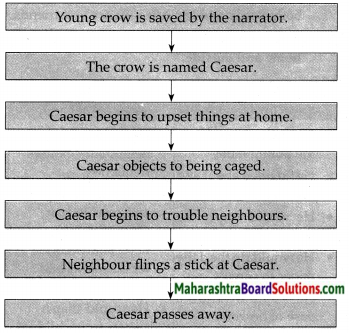
4. Relate the life-story of Caesar, rearranging the facts In a proper sequence in the form of a flow chart.

Question 1.
Relate the life-story of Caesar, rearranging the facts In a proper sequence in the form of a flow chart.
Answer:
Maharashtra Board Class 7 English Solutions Chapter 3.3 A Crow in the House 1

5. Rewrite in your own words.

Question a.
One event from the story.
Answer:
When Aunt Mabel paid the author a visit, Caesar impressed her by landing on her arm and demanding a kiss. As soon as Aunt Mabel (all delighted. put her cheeks forward, her spectacles grabbed his attention and he knocked them off.

Maharashtra Board Class 7 English Solutions Chapter 3.3 A Crow in the House

Question b.
One of the Caesar’s traits that makes you laugh.
Answer:
Begining with getting comfortable in the author’s house, caesar slowly started annoying the pets already there. He would tug at the tail of one of the dogs or sit on top of Harold, the hornbill’s cage and peck his feet and annoy him. This trait makes me laugh.

6. Hold a debate on ‘Pets or Pests’.

Question 1.
Hold a debate on ‘Pets or Pests’
Answer:
Pets are the most lovable beings around us. When it comes to dogs, loyalty is their trademark. Besides being friendly, they shower unconditional love. Their presence in itself is a stress buster. They have the art of lifting one’s spirit with their playfulness and joyful nature. Pets help combat depression. Most pets are least demanding.

When one comes home all tired from the workplace, pets are always there to welcome. Their cheerfulness is extremely contagious. Their very presence adds to the energy of the environment. Although they cannot speak like humans, they express their emotions far more effectively. When it comes to understanding emotions, pets sense it pretty fast.

So pets are a blessing to have. Pets are pests as they are quite demanding when it comes to food. All of us know how choosy a cat is. Besides, pets eat into one’s constructive time as they are dependent for their daily chores. They dirty the house and require special training. Not all pets are friendly. Some even create trouble for the neighbourhood and the owner of the pet is held responsible. Guests fear coming home when they know there is a pet dog.

Moreover, one cannot travel with a carefree mind when one has a pet back home. Making adjustments to keep the pet when one is away is another challenge. When one loses one’s pet, it becomes quite difficult to overcome the sorrow due to emotional attachment. Hence, at times, pets turn out to be pests.

Maharashtra Board Class 7 English Solutions Chapter 3.3 A Crow in the House

7. Do you have pet animals.

Question 1.
Write an interesting story about your own or your friend’s pet.
Answer:
Yes, I do have a pet dog named Brady. He usually gets along well with almost everyone. But one of my neighbours Ms. Miranda, an old woman, aged 70, never managed to impressed the canine. He would do did his utmost to make her life miserable. Sometimes tilting her dustbin kept outside her door, spreading garbage all over her entrance door, other times barking at her guests so fiercely to shoo them away before they could even meet her.

But one evening when Ms. Miranda got stuck in the lift, Brady immediately recognised her voice. He couldn’t bear to hear her cry of anxiety mixed with fear. Off he went running, searching for the security guard and rescued her. Since then both, Brady and Ms. Miranda are best friends.

8. Language Study.

Complement: There are two types of complement: subject complement and object complement. Subject complement Is a word or a phrase used after a verb that describes the subject. The underlined words and phrases in the following sentences are subject complements.
1. I am hungry.
2. My sister became a teacher.
The word ‘hungry’ and the phrase ‘a teacher’ describe the subjects of the verbs. Therefore, they are subject complements. An object complement comes after the object of a verb and gives us information about the object. The underlined words and phrases in the following sentences are object complements.
3. The class made her the monitor.
4. The teacher found my answer correct.
The phrase the monitor’ gives us information about the object ‘her’. The word ‘correct’ gives us information about the object ‘my answer’.

Class 7 English Chapter 3.3 A Crow in the House Additional Important Questions and Answers

Answer the following questions.

Question 1.
Who were the other members of the author’s family living in the same house?
Answer:
Author and his grandparents lived in the same house.

Maharashtra Board Class 7 English Solutions Chapter 3.3 A Crow in the House

Question 2.
Did the author’s Grandfather like animals? How do we know that? Give two examples from this page to support your answer.
Answer:
Yes, the author’s Grandfather liked animals. We know this from the fact that Grandfather already had some pets and Caesar was taken good care of by Grandfather when he was ailing.

Question 3.
What is implied in ‘He took over the administration of the house?
Answer:
Inspite of the opposition to caesar’s presence in the house from Grandmother, Aunt Mabel and Grandfather’s pets, he made himself comfortable there. This is what is meant by “He took over the administration of the house.”

Question 4.
Guess how Caesar learnt to say ‘Hello, hello’.
Answer:
The author laught caesar to, say ‘Hello, hello’ in a cracked throaty voice.

Question 5.
What is meant by ‘Aunt Mabel never was a success with the pets’? Can you think of the reasons why it was so?
Answer:
Aunt Mabel never was a success with the pets means she didn’t get along well with pets. She, probably, must be afraid of them or there must be some inherent dislike for pets. It came in the way of pets developing a rapport with her as they are very quick to sensing love.

Maharashtra Board Class 7 English Solutions Chapter 3.3 A Crow in the House

Question 6.
What is implied in the following sentence? Most of the neighbours were represented in our house by a toothbrush.
Answer:
Caeser stole and gathered toothbrush from his neighborhood and made a collection of them on top of the cupboard in his room. As, he was very fond of them. This implied that ‘Most of the neighbors were represented in our house by a toothbrush.

Question 7.
What actions of the author show that he loved Caesar?
Answer:
The author brought the injured crow home and called it Caesar. Despite Grandmother being unhappy about Caesar’s mischiefs, the author never got upset or thought of getting rid of him. When he died, the author dug a grave in the garden and buried Caesar there along with all the clothes, pegs and toothbrushes. He weven taught him how to talk and kiss These actions of the author show us that he loved Caesar.

Answer the following question in two or three sentences.

Question 1.
Why did the author not expect the crow to live?
Answer:
The author did not expect the crow to live because it was in a very sorry state with its beak gaping and head dropping.

Maharashtra Board Class 7 English Solutions Chapter 3.3 A Crow in the House

Question 2.
How did the author and his Grandfather revive the injured crow?
Answer:
The author and his Grandfather fed the crow little bread and milk; varied this diet with occassional doses of Grandmother’s home-made wine in order to revive the bird.

Question 3.
How did Caesar trouble Aunt Mabel?
Answer:
When caesar alighted on her arm, the delighted Aunt Mabel leaned forward for a kiss. But her glaming spectacles caught his altention and he knocked them off.

Question 4.
Where would the neighbours clothes be lying? Why?
Answer:
The neighbours clothes would be lying in the mud with no sign of pegs because Caesar would steal the pegs and take it to the writer’s house.

Reading Skills, Vocabulary and Grammar.

Simple Factual Questions.

Question 1.
Match the columns.

‘A’‘B’
1. A horse-drawn vehicle.a. shreds
2. Make small nervous movementb. prizing
3. Torn strips of paper.c. tonga
4. Use force to move apart.d. fidget

Answer:

‘A’‘B’
1. A horse-drawn vehicle.c. tonga
2. Make small nervous movementd. fidget
3. Torn strips of paper.a. shreds
4. Use force to move apart.b. prizing

Complex Factual Questions.

Question 1.
What dangers were likely to befall the young crow?
Answer:
The Young crow was in danger of being crushed by a cart or tonga or seized by a cat.

Maharashtra Board Class 7 English Solutions Chapter 3.3 A Crow in the House

Question 2.
To whom do these names refer?
1. Mabel
2. Caesar
Answer:
1. Mabel refers to the author’s aunt.
2. Caesar refers to the young crow brought home by the author.

Vocabulary.

Question 1.
Use appropriate form of the word given in brackets.
1. I picked it up and it home, (bring.
2. He was his freedom (offer.
Answer:
1. I picked it up and brought it home.
2. He was offered his freedom.

Grammar.

Complete the table.

Present TensePast TensePast Participle
……………broughtbrought
fall………………fallen
……………keptkept
give…………….given

Answer:

Present TensePast TensePast Participle
bringbroughtbrought
fallfellfallen
keepkeptkept
givegavegiven

Personal Response.

Question 1.
What pranks did Caesar engage in?
Answer:
During meal times Caesar would dance about on the dining table until he was given a bowl of meat soup and vegetables. He would empty the contents of the match-box, rip the daily paper to shreds, overturn a vase of flowers or tug at the tail of one of the dogs.

Maharashtra Board Class 7 English Solutions Chapter 3.3 A Crow in the House

Simple Factual Questions.

Complete the statements.

Question 1.
Caesar did not show any inclination to
Answer:
join the other crows in the banyan tree

Question 2.
Perching on top of Harold’s cage, Caesar would
Answer:
peck at the big bird’s feet

Complex Factual Questions.

Question 1.
Why did the writer not cage Caesar?
Answer:
When the writer put Caesar in a cage, he cawed and flapped his wings so fiercely that they thought that for their own peace of mind, it was best not to cage him.

Maharashtra Board Class 7 English Solutions Chapter 3.3 A Crow in the House

Question 2.
Why did Caesar not mingle with other crows, according to Grandfather?
Answer:
According to Grandfather, Caesar did not mingle with other crows because he was a jungle crow and looked at ordinary crows with contempt.

Vocabulary.

Question 1.
Use prefix ‘in’/’un’ with any two words from the extract to make its antonymns.
1. kind
2. human
Answer:
1. unkind
2. inhuman

Question 2.
Give verb forms.
1. little
2. inclination
Answer:
1. belittle
2. incline

Maharashtra Board Class 7 English Solutions Chapter 3.3 A Crow in the House

Question 3.
Give one word for the following.
1. to come down
2. shining brightly
Answer:
1. alighted
2. gleaming.

Grammar.

Question 1.
He would sit for hours outside the window. (Rewrite using modal auxiliary of past ability..
Answer:
He could sit for hours outside the window.

Question 2.
I had also taught him to sit on my arm. (Pick out the infinitive..)
Answer:
to sit – infinitive.

Personal Response.

Question 1.
Which two contrasting traits of Caesar does the passage highlight? Do all animals and birds have this?
Answer:
Caesar on one hand is a very snobbish and mischievous crow troubling the Hornbill and not mingling with other crows. But on the other hand, he comes across as a very loving bird greeting the writer and kissing him. Yes, I think all animals and birds have these contrasting traits just as we humans do. They are good to some people and mischievous with the ones who don’t like them.

Maharashtra Board Class 7 English Solutions Chapter 3.3 A Crow in the House

Simple Factual Questions.

State whether the following sentences true or false.
1. Caesar often managed to snatch sweets from children.
2. An occasional sip of Grandmother’s wine finally led to disaster.
Answer:
1. true
2. false.

Complex Factual Questions.

Question 1.
Where did Caesar store his stolen goods?
Answer:
Caesar stored his stolen goods on top of the author’s cupboard.

Question 2.
Why did Grandmother’s blood pressure go up?
Answer:
Watching Caesar steal combs, keys pens, pencils etc. from neighboring houses, Grandmother’s blood pressure went up.

Maharashtra Board Class 7 English Solutions Chapter 3.3 A Crow in the House

Question 3.
Where did the author bury him?
Answer:
The authors dug a shallow grave in the garden and buried him there.

Vocabulary.

Question 1.
Give norm forms for the following.

  1. restrict
  2. fascinate
  3. spy
  4. refuse

Answer:

  1. restriction
  2. fascination
  3. spy
  4. refusal

Question 2.
Use ‘spy’ as a noun and verb in sentences.
Answer:
Noun – Vijay’s brother worked as a spy for FBI
Verb – It is a very sensitive matter to spy for one’s country.

Grammar.

Grandfather and I washed and bandaged his leg and gave a sip of homemade wine. (Rewrite using ‘Not only but also’)
Answer:
Grandfather and I not only washed and bandaged his leg but also gave a sip of homemade wine.

Maharashtra Board Class 7 English Solutions Chapter 3.3 A Crow in the House

Personal Response.

Question 1.
Do you think the author had any feelings when he found Caesar dead?
Answer:
The expression “Poor Caesar!” by the author shows that he had a soft corner for Caesar. They both shared a loving relationship with Caesar welcoming the author back from school saying, ‘hello, hello’ and “Kiss, Kiss” by sitting on his arm and placing his head against the author’s mouth.

Language Study.

Question 1.
I dug a shallow grave in the garden. (End with ‘………. by me’)
Answer:
A shallow grave was dug in the garden by me.

Question 2.
He grew weaker day-by-day. (Make negative)
Answer:
He didn’t grow stronger day-by-day.

Make sentence.

Question 1.
to bring it round
Answer:
The doctors put in their best efforts to bring the patient round.

Maharashtra Board Class 7 English Solutions Chapter 3.3 A Crow in the House

Question 2.
to make oneself at home
Answer:
I made myself at home in the new hostel room within few days.

Question 3.
to tug at something
Answer:
The beggar tugged at my sleeve asking for some money.

Question 4.
to get rid off
Answer:
I got rid off the old story books by giving them to the child next door.

Question 5.
to find one’s way
Answer:
I found my way to the college on my own.

Question 6.
Caesar was joining us at mealtimes. (Identify the tense)
Answer:
was joining – past continuous tense.

Maharashtra Board Class 7 English Solutions Chapter 3.3 A Crow in the House

Question 7.
He danced about on the dining table. (Change into present continuous tense.)
Answer:
He is dancing about on the dining table.

Question 8.
Use the following phrases in sentence.
1. do your best
2. on the road to recovery
Answer:
1. My grandma tells me to do my best when I take up any task.
2. After the revaging floods, the state of of Kerala is on the road to recovery.

Writing Skills.

Question 1.
Write a character sketch on Caesar.
Answer:
Caesar was the author’s pet crow who had been brought home by him after an injury. Caesar, was typically wild with all his anti-social activities. He had made the life of his caretakers difficult. The other pets in the house too did not like him as he would not spare them as well. The fact that he did not mingle with other crows shows that he was too snobbish. He couldn’t be caged and so he made the most of the freedom that he got by troubling others.

He comes across as a hoarder who loved to amass various things ranging from essentials like toothbrushes and combs to false teeth. However, lying beneath this arrogant behaviour, was a layer of love and warmth for the writer whom he greeted with a ‘hello’ and a kiss. He was a good learner as he had learnt to say ‘hello’. But his own notorious action landed him in trouble and proved fatal when he was hit with a stick. In short, Caesar was a wild bird who loved to live a life on his own terms around the author’s house.

Maharashtra Board Class 7 English Solutions Chapter 3.3 A Crow in the House

Formative Assessment.

Question 1.
Crows are very common to India. Gather some information about them.

  1. Are crows intelligent?
  2. Can you teach a crow to talk?
  3. Are crows friendly?
  4. Do crows have funerals?

Answer:

  1. Crows are nearly as intelligent as ravens. They have a good memory for human faces and approach people differently.
  2. Several crows can mimic human speech.
  3. Crows are very social species and live in large extended family groups.
  4. When a bird dies, crows gather squawking loudly and gathering as many other birds as they can find to come and look at the dead body.

A Crow in the House Summary in English

This extract revolves around a crow who was injured and lying on the road. He was picked up and taken home by the author and nursed back to health. How he became a pet as well as a pest in -w the family is seen in this lesson.

Introduction:

Ruskin Bond is an Indian author of British descent. He has made significant contribution to the growth of children’s literature in India. He was a recipients of ‘Padmashri’ in 1999 and ‘Padmabhushan’ in 2014. His works reflect his love for things in nature and his keen sense of observation. The present extract is from his book “Grandfather’s Private Zoo”.

Maharashtra Board Class 7 English Solutions Chapter 3.3 A Crow in the House

Glossary:

  1. fluttering (v) – fly unsteadily
  2. tonga (n) – a light horse-drawn-two-wheeled vehicle used in India
  3. prizing (v) – use force to move apart
  4. recovery (n) – a return to a normal state of health
  5. grubs (n) – the larva of an insect, especially a beetle
  6. fidgeting (v) – to make small nervous movement of hands and feet
  7. rip (v) – tear or pull something away forcibly
  8. shreds (n) – torn strips or pieces of paper or cloth
  9. ruin (n) – destruction
  10. grumbled (v) – complain about something in a bad-tempered way
  11. fierce (adj) – violent and aggressive
  12. contemptuous (adj) – showing disregard
  13. squabble (v) – to quarrel noisily over a small matter
  14. gleaming (adj) – shining brightly
  15. engaging (adj) – charming and attractive
  16. spied (v) – to observe carefully and make out something
  17. disaster (n) – tragedy
  18. mend (v) – repair
  19. flung (v) – threw
  20. anti-social (adj) – contrary to the laws and customs of society
  21. grave (n) – burying place
  22. carrion crows (n) – crows feeding on dead or decaying flesh (and other garbage)

7th Std English Balbharati Textbook Solutions

Past, Present, Future Poem Questions and Answers Class 7 English Chapter 1.1 Maharashtra Board

Balbharti Maharashtra State Board Class 7 English Solutions Chapter 1.1 Past, Present, Future Notes, Textbook Exercise Important Questions and Answers.

Std 7 English Lesson 1.1 Past, Present, Future Question Answer Maharashtra Board

Class 7 English Chapter 1.1 Past, Present, Future Textbook Questions and Answers

1. Read the poem aloud using proper rhythm and intonation.

Question 1.
Read the poem aloud using proper rhythm and intonation.

Maharashtra Board Class 7 English Solutions Chapter 1.1 Past, Present, Future

2. Link the items in the three columns properly.

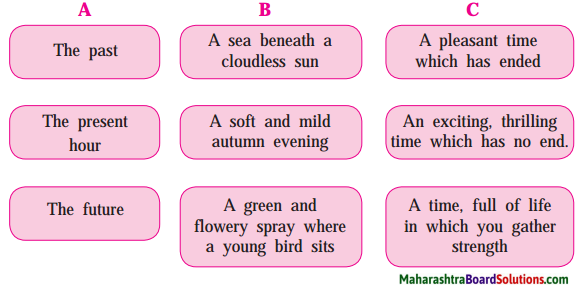
Question 1.
Link the items in the three columns properly.
Maharashtra Board Class 7 English Solutions Chapter 1.1 Past, Present, Future 1
Answer:

ABC
The pastA soft and mild autumn eveningA pleasant time which has ended
The present hourA green and flowery spray where a young bird sitsA time, full of life in which you gather strength
The futureA sea beneath a cloudless sunAn exciting, thrilling time which has no end

Maharashtra Board Class 7 English Solutions Chapter 1.1 Past, Present, Future

3. Find the meaning of the following words.
thee, mournfully, spray, mighty

Question 1.
Find the meaning of the following words.
thee, mournfully, spray, mighty
Answer:

  • thee – you (archaic/old usage)
  • mournfully – sadly
  • spray – a flowering branch
  • might – physical strength

4. WrIte the adjectives that are used to describe the following.
evening, spray, sea

Question 1.
Write the adjectives that are used to describe the following.
Answer:

  • evening – soft, mild
  • spray – green, flowery
  • sea – mighty, glorious, dazzling

5. Write one line about each of the following with the help of the poem.

Question 1.
Wind in the autumn evening
Answer:
It sighs expressing sadness.

Question 2.
Young bird on the spray.
Answer:
Sits on the flowery branch gathering all its physical and mental strength to explore the blue sky.

Maharashtra Board Class 7 English Solutions Chapter 1.1 Past, Present, Future

Question 3.
The Sea.
Answer:
Vast is the sea beneath the cloudless sun and as it stretches endlessly, it displays might, glorious and dazzling beauty.

6. Language Study:
A simile Is an imaginative comparison of two different things which have something in common. A simile always includes the words ‘as’ or ‘like’. For example: as tall as a tree, as lovely as a flower A metaphor is an imaginative expression that refers to someone/something as another person/thing. It shows thai the person or thing has some quality of that other person or thing. The words ‘as’ or ‘like’ are not used in a metaphor. For example : He is a gem of a person. Time is money. Books are our friends. The clouds are white sheep.
There are three metaphors in the poem. Can you find them?
Answer:
The three metaphors are:
Question i.
‘What is the past like to thee?
An autumn evening soft and mild’
Answer:
Here the past is compared to an autumn evening.

Question ii.
’Tell me, what is the present hour?
A green and flowery spray.’
Answer:
Here the present is compared to a green and flowery spray.

Maharashtra Board Class 7 English Solutions Chapter 1.1 Past, Present, Future

Question iii.
’And what is the future, happy one?
A sea beneath a cloudless sun.’
Answer:
Here the present is compared to a sea beneath a cloudless sun.

Class 7 English Chapter 1.1 Past, Present, Future Additional Important Questions and Answers

Answer the following questions:

Question 1.
What is the central idea of the poem?
Answer:
The central idea of the poem is the child’s definition of different periods of time which is presented in the form of a dialogue between the poetess and the child.

Question 2.
What does the past stand for according to the child?
Answer:
According to the child, the past was a pleasant time but they are moments which cannot be revisited as they would never return back.

Maharashtra Board Class 7 English Solutions Chapter 1.1 Past, Present, Future

Question 3.
How does the child define the present time?
Answer:
For the child, the present is a time where he/she
prepares for the future which is unknown, but also exciting so it is the time to gather strength.

Question 4.
How is the present moment viewed with optimism by the child?
Answer:
The child compares the present time to a green and flowery branch on which a bird is all set to take off and explore the unlimited possibilities which awaits it.
This tells us that the present is something which is viewed with optimism by the child as he believes that once we gather strength, nothing is impossible.

Question 5.
How do you define time?
Answer:
According to me, time is the most precious gift we possess. It is up to us to make utmost use of it. We should plan and prioritise to make use of most of the time in hand.
How true is the Estonian proverb!
“Wasting time is robbing oneself”

Maharashtra Board Class 7 English Solutions Chapter 1.1 Past, Present, Future

Reading Skills and Poetic Device

Read the following extract and do the activities.

Simple Factual Questions:

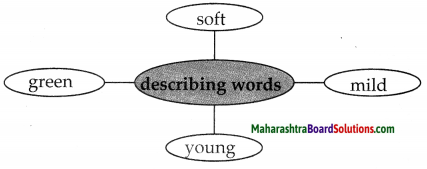
Question 1.
Fill in the blanks with any four describing words from the extract.
Answer:
Maharashtra Board Class 7 English Solutions Chapter 1.1 Past, Present, Future 2

Question 2.
Choose the correct alternative and complete the sentence:
For the child in the poem the past was
i. a pleasant time.
ii. an unpleasant experience.
Answer:
For the child in the poem the past was a pleasant time.

Complex Factual Questions:

Question 1.
What is the theme of the poem?
Answer:
The theme of the poem is about time and the child’s definition about the different periods of time.

Question 2.
How is this poem presented?
Answer:
This poem is presented as a dialogue between the poetess and a happy child.

Maharashtra Board Class 7 English Solutions Chapter 1.1 Past, Present, Future

Question 3.
What is the one characteristic of the past? Which is emphasised in the poem?
Answer:
One characteristic of the past which is emphasised in the poem is that we can never go back to it.

Question 4.
How should we make use of the present time?
Answer:
We should make use of the present time by using it to gather strength and courage to face the future.

Poetic Device:

Rewrite the Metaphors as Similes:

Question 1.
The past is an autumn evening soft and mild.
Answer:
The past is like an autumn evening soft and mild.

Question 2.
The present is a green and flowery spray.
Answer:
The present is like a green and flowery spray.

Question 3.
The future is a sea beneath a cloudless sun.
Answer:
The future is like a sea beneath a cloudless sun.

Question 4.
Give the rhyme scheme of the first stanza.
Answer:
The rhyme scheme of the first stanza is (a b a c).

Maharashtra Board Class 7 English Solutions Chapter 1.1 Past, Present, Future

Question 5.i.
Name and explain the figures of speech.
With a wind that sighs mournfully
Answer:
Personification – Wind is given human qualities,

Question ii.
What the past is like to thee?
‘An Autumn evening soft and mild.
Answer:
Simile – Direct comparison of past with an autumn evening.

Formative Assessment

Question 1.
Complete the following stanza to compose a poem on the topic:
The time gone by…….

Past, Present, Future Introduction:

Past, Present, Future written by Emily Bronte is a dialogue between the poetess and a happy child. They discuss what each period of time means to the child, a child with the ability to see beauty and optimism around it.

Past, Present, Future Summary in English

The poetess Emily Bronte begins the poem by asking a happy child what the past is like to him/ her. In response the child compares the past as an autumn evening which is soft and mild with a sad wind sighing in the background.

In response to the query about the present hour the child compares it to the pleasant green and flowery branch wherein a young bird gathers courage and power to mount and fly above the blue sky. In other words the child finds the present filled with hope, courage and aspiration to scale great heights; the time to gather strength.

On being asked about the future the child compares it with a sea under a cloudless sun, a sea which is mighty, glorious, dazzling and never ending. Through these words the child implies about the thrilling and never ending possibilities which awaits for him/her.

Maharashtra Board Class 7 English Solutions Chapter 1.1 Past, Present, Future

Glossary:

  1. autumn (n) – the season which follows summer when leaves fall from the trees
  2. mild (adj) – not severe or not very harsh
  3. mournfully (adv) – with sad feelings
  4. spray (n) – a flowering branch
  5. mount (n) – to ascend, get ready for take off
  6. glorious (adj) – marvellous
  7. dazzling (adj) – extremely bright
  8. stretching (v) – to be made longer
  9. infinity (n) – endlessness
  10. sighs (v) – to let out a long breath slowly to express sadness
  11. thee (pro) – you
  12. mighty (adj) – possessing great power or strength; very powerful
  13. beneath (prep) – under

7th Std English Balbharati Textbook Solutions

Home Sweet Home Poem Questions and Answers Class 7 English Chapter 4.4 Maharashtra Board

Balbharti Maharashtra State Board Class 7 English Solutions Chapter 4.4 Home Sweet Home Notes, Textbook Exercise Important Questions and Answers.

Std 7 English Lesson 4.4 Home Sweet Home Question Answer Maharashtra Board

Class 7 English Chapter 4.4 Home Sweet Home Textbook Questions and Answers

1. Write in your own words.

Question a.
How does the poet glorify his home in the first stanza?
Answer:
The poet glorifies his home in the first stanza by saying that we may roam places and stay in palaces but like magic we will get drawn to our home however modest it may be because there
is no place in the world better than our own home.

Maharashtra Board Class 7 English Solutions Chapter 4.4 Home Sweet Home

Question b.
How does the poet describe his home in the second stanza?
Answer:
The poet in the second stanza there is says that all the wonders in the world nothing as compared to his modest home. It is in his humble dwelling that he gets peace of mind which is more precious than anything in the world.

Question c.
What makes the poet remember his mother?
Answer:
The poet spends long periods of time away from home and while gazing at the moon in a faraway place he remembers his mother who must be looking at the moon from their home and remembering her child.

Question d.
What does the poet miss?
Answer:
The poet misses his loving father’s smile and the soothing caress of his loving mother.

Question e.
What does the poet hope for?
Answer:
The poet hopes to return to the warmth and comfort of his humble home and remain there forever.

Maharashtra Board Class 7 English Solutions Chapter 4.4 Home Sweet Home

Question f.
In which professions is a person forced to stay away from his home/homeland for a long time? Try to guess why the poet is forced to stay away from his home.
Answer:
A person is forced to stay away from his home/ homeland for a long time if he is an artist – could be an actor, a writer, a model, a businessman, an interpreter, a trader, a dancer, a singer, etc. A poet needs to be constantly on the move so that he gets inspired to write and create poetry. I think this is the reason the poet is forced to stay away from home.

2. Write out a few things that you would really miss about your home if you were to stay away from it for long.

Question a.
Write out a few things that you would really miss about your home if you were to stay away from it for long.
Answer:

  1. I would miss my family members in the first place.
  2. I would miss my friends.
  3. I would miss the food made at home by my mother.
  4. I would miss the love and care I get from my parents and relatives.
  5. I would miss the smell of my home, my bed.

Class 7 English Chapter 4.4 Home Sweet Home Additional Important Questions and Answers

Simple Factual Questions.

Question 1.
State Whether the statements are True or False
1. Though we may roam around palaces, but there is no place like home.
2. The birds sings dolefully and does not respond to the poet’s call
Answer:
1. True
2. False

Maharashtra Board Class 7 English Solutions Chapter 4.4 Home Sweet Home

Poetic Devices.

Question 1.
Pick out the rhyming words from the extract.
Answer:
roam-home, there-elsewhere, rain-again, call-all.

Question 2.
Mid pleasures and palaces though we may roam.
Answer:
Alliteration – The sound of ‘p’ is repeated for better poetic effect.

Question 3.
To thee I’ll return, overburdened with care. (Explain the line)
Answer:
The poet says that he’ll return home with a lot of worries.

Question 4.
Pick out the rhyming words from the extract.
Answer:

  1. smile – beguile
  2. roam – home
  3. care – there

Maharashtra Board Class 7 English Solutions Chapter 4.4 Home Sweet Home

Question 5.
Write the rhyme scheme for the first four lines of the extract.
Answer:
The rhyme scheme is aabb.

Name the figures of speech for the following.

Question 1.
How sweet ’tis to sit ‘neath a fond Father’s smile.
Answer:
Alliteration – The sound of’ s’ and’ f’ is repeated for better poetic effect.

Question 2.
But give me, oh, give me, the pleasures of home.
Answer:
Repetition – The words ‘give me’ have been repeated for better poetic effect.

Maharashtra Board Class 7 English Solutions Chapter 4.4 Home Sweet Home

Question 3.
No more from that cottage again will I roam.
Answer:
Inversion – The words are not in order for better poetic effect. The right order is, ‘No more will I roam again from that cottage’.

Question 4.
Be a poet. Try and write a poem on ‘My Home’.
Answer:
My Home

I have a cosy little home,
Made of cement, bricks and dome.
It is coloured beautifully,
With everything arranged wonderfully.
We are a family of five,
When together we come alive.
A place where I can rest.
My home, it is the best.

Home Sweet Home Summary in English

The poet John Howard Payne through his poem conveys the message that ‘Home Sweet Home’ assurs us that there is no place better than home. It is a poem that reaches into the heart. He says that home is a place where we experience independence, safety, privacy and where we can dispense hospitality. The poet says that wherever we might roam or live, there is no comfort like home however big or small it is, because a home is where our family is.

Introduction:

The poem ‘Home Sweet Home’ was written by John Howard Payne, an American actor, poet, playright and author. ‘Home Sweet Home’ is a song adapted from Payne’s opera ‘Clari, the Maid of Milan’.

Maharashtra Board Class 7 English Solutions Chapter 4.4 Home Sweet Home

Glossary:

  1. humble (adj) (here) – modest
  2. charm (n) – an object believed to have magic powers
  3. ‘neath (adj) – below or underneath
  4. hallow (v) – to make holy
  5. exile (n) – banished from one’s home or country
  6. splendour (n)- magnificent
  7. vain (adj) – useless
  8. gayly (adv) – cheerfully, happily
  9. dearer (adj) – precious or greatly valued by someone
  10. gaze (v) – to stare intently
  11. tread (v) – to walk
  12. drear (adj) – cheerless
  13. woodbine (n) – any of several climbing vines
  14. fragrance (n) – pleasant smell
  15. soothe (v) – comfort
  16. beguile (v) – to charm, delight or captivate
  17. overburdened (adj) – excessively burdened
  18. care (n) (here) – worries
  19. solace (n) – comfort in a time of loneliness or distress

7th Std English Balbharati Textbook Solutions

Under the Greenwood Tree Poem Questions and Answers Class 7 English Chapter 4.1 Maharashtra Board

Balbharti Maharashtra State Board Class 7 English Solutions Chapter 4.1 Under the Greenwood Tree Notes, Textbook Exercise Important Questions and Answers.

Std 7 English Lesson 4.1 Under the Greenwood Tree Question Answer Maharashtra Board

Class 7 English Chapter 4.1 Under the Greenwood Tree Textbook Questions and Answers

1. From the poem, find the old word used for each of the following.

Question a.
towards, here, does
Answer:
hither, hither, doth

Maharashtra Board Class 7 English Solutions Chapter 4.1 Under the Greenwood Tree

2. Write in your own words.

Question a.
Who does the poet invite to join him?
Answer:
The poet invites all those people who love nature and are ready to shun their ambitions and appreciate life in nature, to join him.

Question b.
How should that person sing?
Answer:
That person should sing happily just like a free bird.

Question c.
What message does the poem convey?
Answer:
The message conveyed through this poem is that if one wants to live a peaceful life without tensions, enemies and problems, he should spend his life in nature, wherein he would be happy and relaxed. He should forget all his desires and rejoice in the glory of nature like a free bird.

3. Pick out the lines that mean.

Question a.
Sing in such a manner
Answer:
turn his merry note

Maharashtra Board Class 7 English Solutions Chapter 4.1 Under the Greenwood Tree

Question b.
One who wishes to join me
Answer:
who loves to lie with me

Question c.
Who gives up his desire for wealth, power, fame, etc.
Answer:
who doth ambition shun

Question d.
Life in the forest is free from ill-wishers.
Answer:
here shall he see no enemy

Maharashtra Board Class 7 English Solutions Chapter 4.1 Under the Greenwood Tree

Question e.
Happy to eat whatever he can get.
Answer:
seeking the food he eats, and pleased with what he gets

4. Find from the Internet and write down.

Question a.
In which century did William Shakespeare write his famous plays ?
Answer:
William Shakespeare wrote his plays in the late sixteenth and early seventeenth century.

Question b.
From which play is this song extracted ?
Answer:
This song is extracted from William Shakespeare’s comedy play ‘As You Like It’.

Maharashtra Board Class 7 English Solutions Chapter 4.1 Under the Greenwood Tree

Question c.
Which character from the play sings this song?
Answer:
The song is sung by ‘Amiens’, a loyal courtier of Duke Senior.

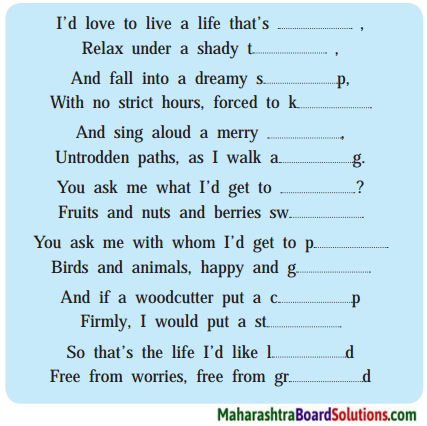
5. Be a poet. Try to complete the following poem with words that rhyme with each other.

Question a.
Maharashtra Board Class 7 English Solutions Chapter 4.1 Under the Greenwood Tree
Answer:
I’d love to live a life that’s free,
Relax under a shady tree,
And fall into a dreamy sleep,
With no strict hours, forced to keep And sing aloud a merry song,
Untrodden paths, as I walk along.
You ask me what I’d get to eat?
Fruits and nuts and berries sweet You ask me with whom I’d get to play Birds and animals, happy and gay And if a woodcutter put a chop Firmly, I would put a stop So that’s the life I’d like too to lead Free from worries, free from greed

Class 7 English Chapter 4.1 Under the Greenwood Tree Additional Important Questions and Answers

Reading Skills and Poetic Device.

Simple Factual Questions:

Under The Greenwood Tree Poem Questions Answers  Question 1.
State whether the following statement true or false.
1. The only enemy in the forest would be the winter and rough weather.
2. People who do not persue their ambition would be happy to live in nature.
Answer:
1. True
2. True.

Maharashtra Board Class 7 English Solutions Chapter 4.1 Under the Greenwood Tree

Poetic Device.

Under The Greenwood Tree Poem Question Answers Class 7 Question 1.
Pick out the rhyming words from the poem.
Answer:

  1. tree – me
  2. note – throat
  3. see – enemy
  4. hither – weather

Under The Greenwood Tree Question Answers Question 2.
Give the rhyme scheme for the 1st four lines.
Answer:
Tire rhyme scheme for the 1st four lines is aabb.

Under The Greenwood Tree Poem Question Answers Question 3.
Come hither, come hither. (Name the figure of speech of the above line)
Answer:
Tire figure of speech is Repetition. The words ‘come hither’ has been repeated for better poetic effect.

Do as directed.

4.1 Under The Greenwood Tree Question 1.
Give the rhyme scheme for the last four lines.
Answer:
The rhyme scheme for the last four lines is abba.

Maharashtra Board Class 7 English Solutions Chapter 4.1 Under the Greenwood Tree

Under The Greenwood Tree Question Answer Question 2.
Who doth ambition shun. (Name the figure of speech)
Answer:
Inversion – The words are not in proper order for better poetic effect. The proper order is ‘Who doth shun ambition’.

Under The Greenwood Tree Poem Question 3.
Here shall he see No enemy. (Figure of speech)
Answer:
Inversion – The words are not in proper order. The proper order is ‘Here he shall see no enemy’.

Under the Greenwood Tree Summary in English

Through the poem Shakespeare invites people to join him in enjoying the merry singing of the birds in the trees. There are no enemies there to be disturbed about except the vagaries of extreme cold and rough weather. They can be happy eating what they get enjoying the sunshine and giving up lofty ambitions.

Introduction:

This poem has been taken from William Shakespeare’s play ‘As you like it.’ Amiens, a courtier sings the song ‘under the Greenwood Tree’ in the play.

Maharashtra Board Class 7 English Solutions Chapter 4.1 Under the Greenwood Tree

Glossary:

  1. greenwood (n) – forest filled with trees full of green leaves
  2. merry (adj) – jolly and full of high spirits
  3. note (n) – a musical sound; a tone (musical)
  4. hither (adv) – come here; over here
  5. ambition (n) – desire to achieve something
  6. shun (v) – to avoid
  7. seeking (v) – searching; looking for
  8. pleased (adj) – happy; content

7th Std English Balbharati Textbook Solutions

From a Railway Carriage Poem Questions and Answers Class 7 English Chapter 2.1 Maharashtra Board

Balbharti Maharashtra State Board Class 7 English Solutions Chapter 2.1 From a Railway Carriage Notes, Textbook Exercise Important Questions and Answers.

Std 7 English Lesson 2.1 From a Railway Carriage Question Answer Maharashtra Board

Class 7 English Chapter 2.1 From a Railway Carriage Textbook Questions and Answers

1. Read the poem aloud with proper rhythm. What does the rhythm remind you of?

From A Railway Carriage Exercises Class 7 Question 1.
Read the poem aloud with proper rhythm. What does the rhythm remind you of?

2. Find pairs of rhyming words from the poem.

From A Railway Carriage Questions And Answers For Class 7 Question 1.
Find pairs of rhyming words from the poem.
Answer:
witches – ditches, battle – cattle, plain – rain – again, eye – by, scrambles – brambles, gazes – daisies, road – load, river – ever.

Maharashtra Board Class 7 English Solutions Chapter 2.1 From a Railway Carriage

3. Write the following: 

2.1 From A Railway Carriage Question Answer Question 1.
The sights seen through a railway carriage mentioned in the first stanza.
Answer:
The sights seen through a railway carriage mentioned in the first stanza are bridges, houses, hedges, ditches, horses and cattle in the meadows.

2.1 From A Railway Carriage Question 2.
The sights mentioned in the second stanza.
Answer:
The sights seen in the second stanza are hills, plains and painted stations.

From A Railway Carriage Poem Question 3.
The sights mentioned in the third stanza.
Answer:
The sights mentioned in the third stanza are a child clambering and scrambling to gather brambles, a tramp gazing at the train in wonder and green creepers for stringing the daisies.

Maharashtra Board Class 7 English Solutions Chapter 2.1 From a Railway Carriage

4. Think and answer:

From A Railway Carriage Questions And Answers For Class 7 Question 1.
Why are the sights said to ‘fly’?
Answer:
The sights are said to ‘fly’ because the poet is sitting in a fast-moving train and all the beautiful scenes he gets to see as glimpses just rush past him and disappear because of the speed of the train.

From A Railway Carriage Question Answer Question 2.
Does the last line make you happy or sad? Why?
Answer:
The last line ‘and gone forever’ makes me feel sad because all the pleasure and happiness got from enjoying the beauty of nature comes to an end and disappears forever as the railway carriage speeds ahead.

Maharashtra Board Class 7 English Solutions Chapter 2.1 From a Railway Carriage

5. List the lines that begin with ‘Here’ or ‘And here’.
Also list the sentences or phrases that begin with ‘And there’.
These phrases and sentences tell us about things that appear one after the other as the carriage moves. Can we tell which ones are closer to the train and which ones are at a distance? How?

From A Railway Carriage Questions And Answers Question 1.
List the lines that begin with ‘Here’ or ‘And there’.
Also list the sentences or phrases that begin with ‘And there’.
Answer:
The lines that begin with ‘Here’ or ‘And here’. ‘Here’ is an adverb which suggests ‘closeness’ of an object.

  1. Here is a child.
  2. Here is a tramp.
  3. Here is a cart.
  4. Here is a mill.

The above phrases show closeness to the train. ‘There’ is an adverb which suggests ‘distance’ of an object.

  • And there is the green.
  • And there is a river.

The above phrases show distance from the train.

Maharashtra Board Class 7 English Solutions Chapter 2.1 From a Railway Carriage

6. Read the following:

From A Railway Carriage Exercises Question 1.
Read the following:
Charging along like troops in a battle
Fly as thick as driving rain
Using your imagination, write one or two comparisons each with:
i. like…, ii. as… as
Answer:
i. like…

  1. This house looks like a castle.
  2. Her cheeks are red like a rose.
  3. He runs like a horse.
  4. The child chattered like a magpie.

ii. as… as

  1. He is as smart as a fox.
  2. He is as big as an elephant.
  3. He is as funny as a monkey.
  4. Our soldiers are as brave as lions.

Maharashtra Board Class 7 English Solutions Chapter 2.1 From a Railway Carriage

7. Write about the sights you may see from a bus or an aeroplane.
You may write it in the form of a short poem.

From A Railway Carriage Question And Answer Question 1.
Write the sights you may see from a bus or an aeroplane.
Answer:
The Red Bus
I’m out sightseeing in the red bus
With people around making a lot of fuss
I know I’m going to see wonderful sights
That’ll soar me to the heights
The greenery
The scenery
Oh! The wonderful luxury
Of travelling in the red, red bus.

Class 7 English Chapter 2.1 From a Railway Carriage Additional Important Questions and Answers

Answer the following questions.

From A Railway Carriage Questions And Answers For Class 7 Question 1.
What is the speed of the railway carriage compared to?
Answer:
The speed of the railway carriage is compared to the speed of fairies and witches.

From A Railway Carriage Poem In English Question 2.
Why is the child clambering and scrambling?
Answer:
The child is clambering and scrambling to collect brambles.

From A Railway Carriage Question 3.
What does the rhythm of the poem remind you of?
Answer:
The rhythm of the poem reminds me of the rhythm of the train.

Maharashtra Board Class 7 English Solutions Chapter 2.1 From a Railway Carriage

From A Railway Carriage Exercises Class 7 Question 4.
Have you travelled during a rainy day? What was your experience?
Answer:
Yes, I have travelled during the rainy season. Travelling on a rainy day is an awesome experience. You actually come in contact with nature’s beauty. The smell of the wet earth, the greenery, the colourful flowers, the waterfalls, etc. We get to see nature at its best.

Reading Skills and Poetic Device

Read the following extract and do the activities.

From A Railway Carriage Answers Class 7 Simple Factual Questions:

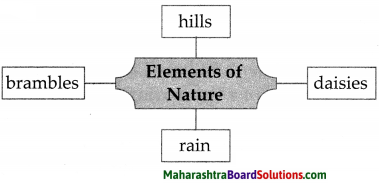
Question 1.
Complete the web diagram with words from the extract.
Answer:
Maharashtra Board Class 7 English Solutions Chapter 2.1 From a Railway Carriage 1

Question
What flies as thick as driving rain?
(Choose the right alternative)
i. Bridges and houses.
ii. Hill and plain.
iii. Hedges and ditches.
Answer:
ii. Hill and plain.

Complex Factual Questions:

Question 1.
How do the sights of the hills and plains move?
Answer:
The sights of the hills and plains move as thick as driving rain.

Maharashtra Board Class 7 English Solutions Chapter 2.1 From a Railway Carriage

Question 2.
What does the poet see the child doing?
Answer:
The poet sees the child clambering and scrambling and gathering brambles all by himself.

Question 3.
To what is the charging train compared?
Answer:
The charging train is compared to troops in a battle.

Poetic Device:

Question 1.
Pick out two pairs of rhyming words from the 1st stanza.
Answer:
witches – ditches, battle – cattle.

Maharashtra Board Class 7 English Solutions Chapter 2.1 From a Railway Carriage

Question 2.
Name the figure of speech for the following line.
“Faster than fairies, faster than witches”
Answer:

  • Repetition: The word ‘faster’ is repeated for poetic effect, or
  • Antithesis: The opposite words ‘fairies’ and ‘witches’ are used in the same line for better poetic effect.

Question 3.
Pick out a word from the extract which means ‘a woman having evil magical powers’.
Answer:
Witch.

From a Railway Carriage Summary in English

‘From a Railway Carriage’ written by R. L. Stevenson describes the scenes he sees through the window of a fast moving train. He is so amazed at the speed of the train and tries to grasp every glimpse he sees because they are out of sight the very next moment. The train moves with such great speed that everything he sees seems to be moving.

Introduction:

‘From a Railway Carriage’ written by Robert Louis Stevenson is a poem in which he shares his experience of a railway journey with us.

Maharashtra Board Class 7 English Solutions Chapter 2.1 From a Railway Carriage

Glossary:

  1. fairy (n) – a small imaginary being of the human form that has magical powers, especially good ones
  2. witch (n) – a woman thought to have magical powers especially evil ones
  3. hedge (n) – a fence or boundary formed by closely growing bushes or shrubs
  4. ditch (n) – a narrow channel dug at the side of a road or field, to hold or carry away water
  5. meadow (n) – a piece of grassland, especially one used for hay
  6. clamber (v) – climb or move in an awkward and laborious way, using both hands and feet
  7. scramble (v) – make one’s way quickly over rough ground by using one’s hands as well as feet
  8. tramp (n) – a person who travels from one place to another on foot in search of work, a homeless person
  9. lumping (v) – carry a heavy load somewhere with difficulty
  10. glimpse (n) – quick look, (v) – to catch sight of briefly
  11. bramble (v) – any rough, wild tangled prickly shrub, specifically the blackberry bush
  12. carriage (n) – a passenger train
  13. cart (n) – a horse-drawn vehicle with four wheels, used for transportation
  14. cattle (n) – domesticated animals like cow and bull
  15. gaze (v) – to look at something for a long time
  16. mill (n) – a building with a machine to grind grain into flour
  17. plain (n) – flat land having trees and grass
  18. sights (n)- things that one sees
  19. stringing (v) – with strings
  20. troop (n) – a group of soldiers
  21. meadow (n) – a field with grass and often wildflowers in it.
  22. daisy (n) – a small flower with white petals and a yellow centre, which often grows in the grass.

7th Std English Balbharati Textbook Solutions

The Red-Headed League Poem Questions and Answers Class 7 English Chapter 4.3 Maharashtra Board

Balbharti Maharashtra State Board Class 7 English Solutions Chapter 4.3 The Red-Headed League Notes, Textbook Exercise Important Questions and Answers.

Std 7 English Lesson 4.3 The Red-Headed League Question Answer Maharashtra Board

Class 7 English Chapter 4.3 The Red-Headed League Textbook Questions and Answers

Part-I

1. Find and write the descriptions of different people given in this story.

Red Headed League Questions And Answers Question 1.
Find and write the descriptions of different people given in this story.
Answer:
Character Sketch:
a. Sherlock Holmes: A private detective and the story’s protagonist. His keen observations and ability to reason allowing him to solve puzzles that astonish everyone. Sometimes quiet and contemplative, other times bursting with energy, he uses methods that can confuse and frustrate others. He is somewhat a mystery, rarely letting his thoughts known until he has already solved the crime.

b. Dr. John Watson: Sherlock Holmes’ partner and the story’s narrator. Good natured, brave and down-to-earth, Watson is Sherlock Holmes’ sidekick, even though he rarely helps Holmes actually solve any mysteries and Watson often mirrors the reader’s own confusion.

c. Jabez Wilson: A London pawn-broker, Jabez Wilson is an average man whose only remarkable feature is his lock of fiery red hair. His slow and trusting nature prevented him from seeing anything suspicious about either Vincent Spaulding or the preposterous Red-headed League.

d. John Clay / Vincent Spaulding: A notorious criminal working at Jabez Wilson’s pawnshop under the name of Vincent Spaulding. He is evil and haughty. John Clay catches the attention of Sherlock Holmes in spite of his clever plot.

e. Duncan Ross: John Clay’s partner-in-crime. Duncan’s red hair prompts John Clay to devise the Red-headed League to lure Wilson out of his pawnshop for four hours everyday.

Maharashtra Board Class 7 English Solutions Chapter 4.3 The Red-Headed League

2. Present Mr. Wilson’s story as it would be shown in a comic strip.

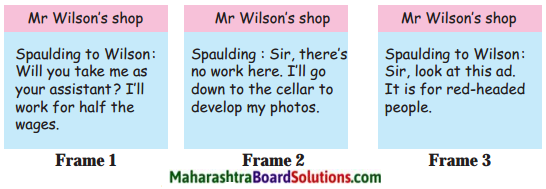
The Red-Headed League Questions And Answers  Question 1.
Write what picture you will show in each frame along with the dialogues. Write the dialogue with the help of the story. Examples:
Maharashtra Board Class 7 English Solutions Chapter 4.3 The Red-Headed League 1
Answer:
Frame 1.
Mr. Wilson’s shop:
Spaulding to Wilson: Sir, why don’t you try for this job?

Frame 2.
Mr. Wilson’s shop:
Spaulding to Wilson : It is to help the red-heads.

Frame 3.
Mr. Wilson’s shop
Spaulding to Wilson: They are paying handsomely. It will be an additional income for you.

Frame 4.
Mr. Wilson’s shop:
Spaulding to Wilson: Sir, I will go along with you. Let’s give it a try.

Maharashtra Board Class 7 English Solutions Chapter 4.3 The Red-Headed League

Frame 5.
At Fleet Street:
Wilson to Spaulding: Just see! It is crowded with red-headed people. I don’t stand a chance.

Frame 6.
At Fleet Street:
Spaulding to Wilson: Sir, don’t be disheartened.

Frame 7.
At Fleet Street:
Spaulding to Wilson: Sir, stay by my side. I’ll push you into the office.

Frame 8.
At the office:
Wilson to Spaulding: At last, we are in the office, but there is no one except one man.

Frame 9.
At the office:
Spaulding to Wilson: Sir, you don’t worry. Just answer his questions confidently.

Frame 10.
Mr. Duncan Ross to Wilson:
I’m pleased with your confidence. I’m glad to announce that you have got the job.

Frame 11.
At Fleet Street:
Wilson to Ross: Thank you so much, Sir. I’m highly obliged.

Maharashtra Board Class 7 English Solutions Chapter 4.3 The Red-Headed League

Frame 12.
At the office:
Wilson to Ross: Sir, what am I supposed to do? How much will I be paid?

Frame 13.
At Fleet Street:
Ross to Wilson: You will have to copy the encylopedia Britannica. You will be paid four pounds a week. And: your timings will be from 10 am to 2 pm.

Frame 14.
At the office:
Wilson to Ross: Wonderful Sir, when do I start?

Frame 15.
At the office:
Ross to Wilson: Mr. Wilson, you begin from tomorrow.

Frame 16.
At the office:
Wilson to Ross: Sir, I will put my heart and soul into my job.
Ross to Wilson: You will have to begin with one letter A and go alphabetically.
Wilson to Ross: Ok, Sir.

Maharashtra Board Class 7 English Solutions Chapter 4.3 The Red-Headed League

Frame 17.
At Wilson’s shop:
Spaulding to Wilson: How is your job going?
Wilson to Spaulding: Well I am enjoying it. Mr. Ross is visiting the office every day. He is very much particular about my timings.

Frame 18.
At the office:
Ross to Wilson: How are you finding your work? This is your salary.
Wilson to Ross: Thank you, Sir.

Frame 19.
At Wilson’s office:
Spaulding to Wilson: How are you Sir and how is your job going?
Wilson to Spaulding: It’s been 8 weeks and 1 am really enjoying. Now Mr. Ross has stopped coming to the office.

Frame 20.
At Wilson’s shop:
Spaulding to Wilson: Good morning. What happened today? You did not go out?
Wilson to Spaulding: The office of the League is shut and locked. There is a note nailed on the door saying the League is dissolved.

Frame 21.
At Wilson’s shop:
Wilson to Spaulding: Do you know anything about the League?

Frame 22.
At Wilson’s shop:
Spaulding to Wilson: 1 am unaware about what happened.

Maharashtra Board Class 7 English Solutions Chapter 4.3 The Red-Headed League

Frame 23.
Wilson to himself:
I should find out more about the League. This is a mystery and I want to know why they played this prank upon me.

Frame 24.
Wilson to himself:
Sherlock Holmes will be the best person to solve this mystery. I will go to him.

3. Form groups of five. Discuss how you can complete the rest of the story without referring to Part II of the story.

The Red Headed League Questions And Answers  Question 1.
Form groups of five. Discuss how you can complete the rest of the story without referring to Part II of the story.
Answer:
Mr. Holmes and Watson try to think out why the League shut so abruptly. Holmes feels he should meet Wilson at home to ask some questions that were bothering him. When he reached Wilson’s house, he notices someone leaving the house. Mr. Holmes enquires about that person and understands that he was Wilson’s assistant. Mr. Holmes feels that he has seen the assistants face before.

Later, he checks on records and finds out that the assistant is none but a notorious criminal clay who was absconding. Mr. Holmes already had a sketch of Mr. Ross. On enquiring he came to know that Ross and Spaulding were very close. Mr. Holmes goes to Mr. Ross’ house and threatens him. Mr. Ross spills the beans, that he and Spaulding were going to rob Mr. Wilson the very next day. Mr. Holmes informs the police and both Spaulding and Ross are caught and put behind bars.

Maharashtra Board Class 7 English Solutions Chapter 4.3 The Red-Headed League

4. Language Study.

Modal auxiliary: You have read about main verbs and auxiliary verbs in Sid VI. You know that auxiliary verbs are helping verbs. Modal auxiliary verbs or modal verbs are also helping verbs. They are used with main verbs to show changes/modifications in the meaning of the main verb. They show possibility, ability, permission, intention, etc.
The modal auxiliaries are:

  1. can, may, shall, will
  2. could, might, should, would
  3. must, ought to, used to, need, dare ………

Remember the following:

  1. We do not use ‘to’ before a modal.
  2. We do not add ‘-ed’ or ‘-Ing’ to a modal.
  3. We can form questions and negative sentences using modals without using the auxiliaries be, have, or do.

Examples:

  1. They can swim.
  2. May I come In?
  3. We shall sing.
  4. Can he swim?
  5. You may go.
  6. She ought to play.
  7. He cannot swim.
  8. You must go.
  9. They might come.

Frame simple sentences – statements, questions, requests. orders, permissions, etc. using the modals listed above.
Answer:

  1. Take an umbrella. It may rain today.
  2. You should not leave objects lying on the floor.
  3. Drivers must stop when the traffic light is red.
  4. Can you speak French?
  5. I could not solve the problem.
  6. May I ask you a question?
  7. You may take a holiday today.
  8. You should see a doctor.
  9. I could run fast when I was young.
  10. Can I go out?
  11. You need not buy any vegetables.
  12. Students shall not enter this room.
  13. What should I do to get rid of this pain?

The Red Headed League Question Answer Part – II

1. Put the following events in proper order.

The Red-Headed League 7th Standard Question Answer  Question 1.
Holmes and others go to the bank.
Answer:
The bank received a lot of gold from the Bank of France.

Maharashtra Board Class 7 English Solutions Chapter 4.3 The Red-Headed League

Questions Answers Of Red Headed League Question 2.
Clay digs a tunnel.
Answer:
Clay digs a tunnel.

The Red Headed League Std 7  Question 3.
Ross closes the office of the ‘Red-headed League’.
Answer:
Ross closes the office of the ‘Red-headed League’.

The Red-Headed League 7th Standard Question 4.
Holmes catches the criminal Clay.
Answer:
Holmes visits the area around Mr. Wilson’s shop.

Std 7 English The Red Headed League  Question 5.
Clay and Ross enter the cellar to steal the gold.
Answer:
Holmes and others go to the bank.

The Red Headed League Questions And Answers  Question 6.
The bank received a lot of gold from the Bank of France.
Answer:
Clay and Ross enter the cellar to steal the gold.

Maharashtra Board Class 7 English Solutions Chapter 4.3 The Red-Headed League

The Red Headed League Question And Answer  Question 7.
Holmes visits the area around Mr. Wilson’s shop.
Answer:
Holmes catches the criminal Clay.

2. From the passage, find adverbs that end with ‘-ly’.

Question a.
From the passage, find adverbs that end with ‘-ly’. Find the adjective in each of the adverb
Answer:


AdverbAdjective
franklyfrank
silentlySilent
carefullycareful
finallyfinal
suddenlysudden
beautifullybeautiful

3. Discuss the following elements of a detective or mystery story.

Question a.
Discuss the following elements of a detective or mystery story.

  1. a mystery
  2. strange happenings
  3. a smart detective who investigates the happenings
  4. a crime/possibility of a crime
  5. preventing the crime and catching the criminal.
  6. characteristics of the victim
  7. characteristics of the criminal
  8. characteristics of the detective

Use the elements to prepare outlines of detective stories using your imagination. Write a story using any one of the outlines.
Answer:
Outline:

  1. Disappearance of the ‘Will’.
  2. Death of the head of the family.
  3. Wife and two sons left behind.
  4. ‘Will’ to be read before family members.
  5. The elder brother in charge of the ‘Will’.
  6. He makes excuses of misplacing the ‘Will’ and shows the photocopy of the ‘Will’.
  7. The family lawyer insists on the original ‘Will’.
  8. The elder brother keeps insisting on having lost the ‘Will’.
  9. Mr. Karamchand, a clever and intelligent detective called.
  10. The detective makes the necessary enquiries.
  11. The elder brother, a gambler, a revelation.
  12. The detective catches the elder brother in his own act.
  13. The elder brother owns up.
  14. The lawyer with the help of the detective prevents a big crime from being executed.

Maharashtra Board Class 7 English Solutions Chapter 4.3 The Red-Headed League

Caught in his own act:

The disappearance of the ‘Will’ was a mystery in the Patwardhan family. The disappearance of the ‘Will’ came to light when it had to be read by the family members after the death of senior Mr. Patwardhan. Mr. Patwardhan had left behind a lot of property and wealth. Mr. Patwardhan had left behind his wife and two sons. When the family lawyer enquired about the ‘Will’, Mrs Patwardhan said that she had given it to her elder son who had said that he would keep it safely. The younger son was unaware of the ‘Will’ made by his father.

When the lawyer of the family asked him if he had read his father’s ‘Will’, he realised what they were saying and asked his mother to show the ‘Will’, she said that it was with her elder son. When the elder son was asked about the ‘Will’, he started making excuses by saying he had misplaced the ‘Will’ and could not find it. The family lawyer insisted that the ‘Will’ be shown to the younger son.

The elder son brought a photocopy of the ‘Will’. The younger son and the family lawyer demanded the original ‘Will’. The elder son kept on making excuses and also said that the original ‘Will’ was lost. There was something in this situation which was a mystery. This is when the younger son hires a smart and intelligent detective, Mr. Karamchand. Mr. Karamchand makes a lot of enquiries and comes to know that the elder son was in the habit of gambling and was in a lot of debts.

Mr. Karamchand also came to know that the elder son was a very sweet talker and could twist and turn situations to his advantage. On the other hand, the younger brother was quite a simpleton who was happy with what he had, making it easier for the elder brother to manipulate him.

Their mother being quite old, had bouts of memory loss. This was another good reason for the elder son to do as he pleased. Mr. Karamchand, very cleverly got the truth out from the elder son. Mr. Karamchand informed the family lawyer, who in turn, demanded the original copy of the ‘Will’ from the elder son.

The lawyer also told him that it was a crime not to show the ‘Will’ to the family members. The elder brother showed the ‘Will’ to the younger brother. The younger brother read the ‘Will’ and handed it to the family lawyer without suspecting anything. The family lawyer went through the ‘Will’ and found out that the ‘Will’ had been tampered with. The dates and certain words were changed for the benefit of the elder brother.

After a lot of interrogation, the elder brother accepted the crime committed by him. The family lawyer rectified the changes made and now the younger brother got his share of property and wealth.

4. Use the following outline to develop a story as a group activity. Then write the story individually.

Question a.
Family returns home late at night ……………. hear conversation between thieves from inside the locked house ……………. family gets ready to counter …………….. attack …………… father opens the …………… door ……………. all enter ………….. no one is seen ……………… but T.V. is on detective serial midway.
Answer:
A Family Drama:
After attending the reception cum dinner of their close friend’s daughter, at the famous five star hotel ‘The Oberoi’, Mr. Pai and his family were returning home discussing the evening. Mr. and Mrs Pai along with their two children Suhani and Soham had attended the function. It was quite late at night, and to add to it, it began to rain making the surroundings dark and scary.

Mr. Pai drove the car cautiously and reached their colony safely. Mr. Pai parked the car while the others waited for him at the entrance of their building. It was still raining and the watchman was nowhere in sight. The common light in the building was not on. The way leading to their house was in darkness. Somehow they gropped their way to the second floor, where they lived. As they reached their house, Mr. Pai felt that he heard footsteps and whispering coming from inside their house. He asked his wife to listen carefully and she too agreed that there was whispering. The conversation indicated robbers searching for valuables. There was no light in their house.

Mr. Pai was an army officer. He asked his family members to stand behind him and he opened the main door very slowly. He could hear conversation and movements too. He slowly went towards the bedroom from where the conversation was coming. The door was closed.

He took out his revolver and pushed the door open quickly only to understand that the conversation was from the T.V. serial ‘Crime Patrol’. He then remembered that he had been watching T.V. before leaving home and had forgotten to switch it off. The other family members who had followed him gave a huge sigh of relief.

Maharashtra Board Class 7 English Solutions Chapter 4.3 The Red-Headed League

5. Language Study.

Synonyms, antonyms, homonyms: Synonyms are the words from the same language that have the same or more or less the same meaning.
Examples:

  1. good – nice – pretty
  2. shut – closed – sealed
  3. intelligent – bright

Antonyms are words from the same language that have opposite meanings.
Examples :

  1. strong – weak
  2. right – wrong
  3. hard – soft
  4. up – down

Homonyms are words that are spelt and pronounced in the same way but
have different meaning.
Examples

  1. round adjective. – round noun.
  2. walk noun. – walk verb.

Maharashtra Board Class 7 English Solutions Chapter 4.3 The Red-Headed League

Start a collection of synonyms, antonyms and homonyms. Collect at least 50 each. Keep adding to your selection.
Answer:
Examples of Synonyms:

  1. advice – help – guidance – aid
  2. argument – dispute – squabble
  3. aromatic – fragrant
  4. backbone – spine
  5. choosy – picky
  6. constant – fixed
  7. defective – faulty
  8. enormous – huge – immense
  9. famous – popular – renowned
  10. fantastic – great – brilliant

Examples of Antonyms:

  1. predator × prey
  2. employer × employee
  3. former × latter
  4. exhale × inhale
  5. natural × artificial

Examples of homonyms:

  1. bark (n) – bark (y)
  2. bow (n) – bow (y)
  3. clear (adj) – clear (y)
  4. current (adj) – current (n)
  5. fair (adj) – fair (n)

Class 7 English Chapter 4.3 The Red-Headed League Additional Important Questions and Answers

Answer the following questions:

The Red-Headed League Questions And Answers Pdf  Question 1.
Who was well suited for the job?
Answer:
Mr. Wilson was well suited for the job.

Maharashtra Board Class 7 English Solutions Chapter 4.3 The Red-Headed League

The Red Headed League Answers  Question 2.
What would you suggest/advice Mr. Wilson to do in the given situation?
Answer:
The best thing to do when you know a crime is being committed or you are being cheated is to go to the lawful authority. I would suggest/ advice Mr. Wilson to go to the police and file a complaint against the people who had cheated him. It is better to do so rather than taking matters into your own hands and make the situation worse.

The Red-Headed League Book Back Answers Question 3.
What did Holmes want to see? Why?
Answer:
Holmes wanted to see the knees of Mr. Spaulding’s trousers. It was to see if thery were dirty.

The Red Headed League Class 7  Question 4.
Guess where Mr. Merryweather took the others.
Answer:
Mr. Merryweather led the others through an iron gate, down a narrow passage, that led through a dark, passage into a huge cellar, full of big boxes.

The Red Headed League 7th Standard Question 5.
How did Mr. Merryweather come to know about the crime?
Answer:
Mr. Merryweather got a hint of the crime from Mr. Sherlock Holmes.

The Red Headed League Class 8 Question Answer Question 6.
Why did Mr. Holmes think the criminals would act that night?
Answer:
Mr. Holmes had a strong feeling that the criminals would act that night because it was a Friday and the banks and offices would be closed for the weekend making the work of the criminals easier.

Maharashtra Board Class 7 English Solutions Chapter 4.3 The Red-Headed League

Question 7.
How did the criminals enter the cellar?
Answer:
The criminals had made a square gash on the wall which separated Mr. Wilson’s house and the bank’s cellar. They removed a broad stone which left a square hole enabling the criminals to enter into the cellar.

Question 8.
Who were the two criminals?
Answer:
The two criminals were none other than Mr. Vincent Spaulding alias Clay and Mr. Duncan Ross.

Question 9.
Why did Holmes become suspicious?
Answer:
Mr. Holmes became suspicious when he heard that Mr. Spaulding, Mr. Wilson’s assistant worked for only half the wages.

Question 10.
How did Holmes find out that the assistant was a criminal?
Answer:
Mr. Holmes used Mr. Wilson’s description of his assistant, made further enquiries and found out that Mr. Spaulding was none other than Clay, a criminal.

Maharashtra Board Class 7 English Solutions Chapter 4.3 The Red-Headed League

Question 11.
How did Mr. Holmes guess that Mr. Spaulding was digging a tunnel?
Answer:
Mr. Holmes suspected that Mr. Spaulding was digging a tunnel because when Mr. Spaulding Clay. answered the doorbell, the knees of his trousers were wrinkled and stained and this confirmed his suspicion.

Reading Skills, Vocabulary and Grammar

Question 1.
Simple Factual Questions:
Match the columns.

Columns ‘A’Columns ‘B’
Mr. HopkinsRepresentative of the Red-headed league
Mr. WilsonAmerican Millionaire
Vincent SpauldingPawnbroker
Mr. Duncan RossAssistant to Wilson

Answer:

Columns ‘A’Columns ‘B’
Mr. HopkinsAmerican Millionaire
Mr. WilsonPawnbroker
Vincent SpauldingAssistant to Wilson
Mr. Duncan RossRepresentative of the Red-headed league

Complex Factual Questions:

Question 1.
Why did Wilson like his assistant Spaulding?
Answer:
Wilson liked his assistant Spaulding as he was smart, efficient and worked for only half the normal wages.

Maharashtra Board Class 7 English Solutions Chapter 4.3 The Red-Headed League

Question 2.
Why was Fleet Street full of red-headed people?
Answer:
There was an advertisement in the newspaper calling red-headed people in person to apply for a job at the office of the league. As the office was on Fleet Street, it was full of red-headed people.

Question 3.
What did Mr. Wilson think looking at the crowd?
Answer:
Seeing the crowd of red-headed people on the street, Mr. Wilson lost all hope of getting the job. Hence he wanted to go back.

Question 4.
What happened when Mr. Duncan Ross saw Mr. Wilson?
Answer:
Mr. Duncan was very pleased to see Mr. Wilson and announced immediately that he was well situated for the job. He sent back all the other candidates.

Maharashtra Board Class 7 English Solutions Chapter 4.3 The Red-Headed League

Question 5.
Why did Mr. Wilson accept the job?
Answer:
Mr. Wilson accepted the job because the pay was not only very good but also Spaulding assured Mr. Wilson that he would look after Mr. Wilson’s business in his absence.

Vocabulary.

Question 1.
Make 4 words of minimum 4 letters from the given words.
1. advertisement
2. representative
Answer:
1. adverse, verse, meant, said
2. present, pretest, native, resent

Question 2.
Give nouns form.

  1. smart
  2. efficient
  3. develop
  4. sat
  5. announce
  6. explain.

Answer:

  1. smartness
  2. efficiency
  3. development
  4. seat
  5. announcement
  6. explanation

Maharashtra Board Class 7 English Solutions Chapter 4.3 The Red-Headed League

Grammar.

Question 1.
There was nothing in the office but a couple of chairs and a table. Remove negative.
Answer:
There were only a couple of chairs and a table in the office.

Personal Response:

Question 1.
Who do you think is smarter – Mr. Wilson or his assistant?
Answer:
I think Mr. Wilson’s assistant, Spaulding was smarter. It was he who showed the advertisement to Mr. Wilson and urged and encouraged him to apply for the job. Seeing the large number of people trying to get the job, Mr. Wilson wanted to go back but spaulding pushed through the crowed and took him inside the office and saw to it that he got the job.

Question 2.
Would you like to do such a job?
Answer:
I would not like to do such a meaningless mundane and uninteresting job. Jobs should be interesting, challenging and provide scope for further learning and application of different skills which is totally absent in the job taken up by Mr. Wilson.

Maharashtra Board Class 7 English Solutions Chapter 4.3 The Red-Headed League

Question 3.
Why would anyone want to copy an encyclopedia?
Answer:
No one in their right sense would copy an encyclopedia/ However, for reference in some study, students as well as teachers could copy down specific matter they need. In the same very, someone who is challenging some matter given or want to upgrade it can copy relevant portion of an encyclopedia.

Question 4.
What would we do today, if we needed copies of text from a big book?
Answer:
Today, one would just take a photocopy xerox. of the required material.

Question 5.
What is the difference between a dictionary and an encyclopedia?
Answer:
An encyclopedia is a set of books with a collection of information about various topics and subjects while a dictionary contains meanings of different words. Both are arranged in alphabetical order.

Maharashtra Board Class 7 English Solutions Chapter 4.3 The Red-Headed League

Question 6.
Suggest a few words that may appear under ‘A’ after ‘Archery’ in an encyclopedia.
Answer:
Words that may appear under ‘A’ after ‘Archery’ in an encyclopedia could be as follows: architect, aromatics, asparagus, assassinator, astrobiologist, astrophysical, etc.

Simple Factual Questions.

Question 1.
Complete the following.

  1. And then suddenly the whole ……………
  2. The rooms had been rented ……………
  3. Holmes found Mr. Wilson’s story ……………
  4. Small, stout, with ……………

Answer:

  1. business came to an end.
  2. under a false name
  3. very unusual
  4. no hair on his face

Complex Factual Questions.

Question 1.
Why was Mr. Wilson shocked?
Answer:
Mr. Wilson has been working for eight weeks and as usual when he reached the office at ten o’ clock, he found the door shut and locked. He found a little note nailed on, it which said that the Red-headed league was dissolved. This shocked him.

Maharashtra Board Class 7 English Solutions Chapter 4.3 The Red-Headed League

Question 2.
What did Mr. Wilson do next?
Answer:
Mr. Wilson enquired at the nearly offices, but no one knew anything about the league.

Question 3.
Why did Mr. Wilson go to Mr. Holmes?
Answer:
Mr. Wilson felt cheated when he suddenly lost his job with a good pay. He was curious to find out about the league and why they played a prank upon him. He had also heard about the ability of Mr. Holmes to solve mysteries.

Question 4.
How did Mr. Wilson describe his assistant?
Answer:
Mr. Wilson described his assistant as small, stout, with no hair an his face and had a white splash of acid on his forehead.

Question 5.
What kind of a man was Mr. Wilson?
Answer:
Mr. Wilson was a simpleton. He could be easily taken for a ride. He was hardworking and diligent.

Vocabulary.

Question 1.
Give one word for the following.

  1. sincerely and tirelessly
  2. A playful trick that causes no harm
  3. Something which cannot be explained
  4. happening quickly and unexpectedly
  5. Solidly built

Answer:

  1. diligently
  2. prank
  3. mystery
  4. suddenly
  5. stout

Maharashtra Board Class 7 English Solutions Chapter 4.3 The Red-Headed League

Question 2.
Frame a sentence of your own with ‘diligently’.
Answer:
We must always work diligently.

Grammar.

Question 1.
On Saturday I got my salary. (Identify the subject and predicate)
Answer:
Subject-I
Predicate – got my salary on Saturday

Question 2.
I had written Abbots, Archery etc. (Begin with ‘Abbots…’)
Answer:
Abbots, Archery etc. had been written by me.

Maharashtra Board Class 7 English Solutions Chapter 4.3 The Red-Headed League

Question 3.
He did not come at all. Add a question tag.
Answer:
He did not come at all, did he?

Question 4.
Mr. Wilson wrote diligently for four hours. (Identify the part of speech of the underlined words)
Answer:
diligently – adverb
four – adjective

Question 5.
He locked the door of the office. (End with ‘……. the office’)
Answer:
Didn’t he lock the door of the office?

Personal Response.

Question 1.
What would you advice Mr. Wilson to do in the given situation?
Answer:
I feel Mr. Wilson made the right decision to take the help of Mr. Holmes about whom he had heard a lot.

Maharashtra Board Class 7 English Solutions Chapter 4.3 The Red-Headed League

Simple Factual Questions.

Question 1.
Complete the following.

  1. Mr. Holmes asked ……………
  2. The offices and banks will be ……………
  3. We followed him down a ……………
  4. We are in the cellar of the city branch of ……………

Answer:

  1. the way to the Strand
  2. closed for the weekend
  3. narrow passage
  4. one of the main banks of London

Complex Factual Questions.

Question 1.
Tell the name of the young man who opened the door to Mr. Holmes.
Answer:
The young man who opened the door to Mr. Holmes was his assistant Mr. Vincent Spaulding.

Maharashtra Board Class 7 English Solutions Chapter 4.3 The Red-Headed League

Question 2.
What announcement did Mr. Holmes make?
Answer:
Mr. Holmes announced that they were going to hunt one of the smartest criminals in London.

Vocabulary.

Question 1.
Provide suitable adjective to the nouns given below.

  1. weekend
  2. banker
  3. road
  4. passage

Answer:

  1. long weekend
  2. successful banker
  3. busy road
  4. interesting passage

Grammar.

Question 1.
We went to the square were Mr. Wilson had his shop. (Change into future tense.)
Answer:
We will go to the square where Mr. Wilson has his shop.

Maharashtra Board Class 7 English Solutions Chapter 4.3 The Red-Headed League

Question 2.
We followed him down a narrow passage. (Rewrite the sentence beginning…. He was followed….)
Answer:
He was followed by us down a narrow passage.

Personal Response.

Question 1.
Why did the criminals take interest in the cellar?
Answer:
Mr. Merryweather’s banks had borrowed a huge quantity of gold from the Bank of France and the boxes in the cellar were full of gold. Hence the criminals were interested in the cellar.

Complex Factual Questions.

Question 1.
Was Clay successful in using his revolver? Why?
Answer:
No, Clay was not successful in using his revolver because Mr. Holmes at once hit him on his wrist and the revolver fell on the floor.

Maharashtra Board Class 7 English Solutions Chapter 4.3 The Red-Headed League

Question 2.
Who came out of the square hole?
Answer:
Mr. Spaulding and Mr. Ross came out of the square hole.

Grammar.

Question 1.
A boyish face emerged. (Pick out the adjective)
Answer:
boyish

Question 2.
He had a companion with him. (Add a question tag)
Answer:
He had a companion with him, didn’t he?

Personal Response.

Question 1.
Who tried to get away? Do you think he was able to escape? Why?
Answer:
Mr. Duncan Ross tried to get away. But, he was not successful in escaping because there were three men waiting for him at the other end.

Maharashtra Board Class 7 English Solutions Chapter 4.3 The Red-Headed League

Simple Factual Questions.

Question 1.
Say if the statements are true or false.

  1. Dr. Watson foiled one of the cunning attempts at bank robbery.
  2. Using the tunnel they entered the bank.
  3. The assistant working for half the wages made Mr. Holmes suspicious.

Answer:

  1. False. It was’t Dr. Watson, if was Holmes,
  2. False
  3. True

Complex Factual Questions.

Question 1.
Why did Mr. Merryweather thank Mr. Holmes?
Answer:
Mr. Merryweather thanked Mr. Holmes as he had foiled one of the most cunning attempts at banks robbery.

Maharashtra Board Class 7 English Solutions Chapter 4.3 The Red-Headed League

Question 2.
What was strange about the advertisement?
Answer:
The advertisement and the peculiar job was purly to get Mr. Wilson away from his shop for some hours every day.

Question 3.
Why did clay and his companion dig the underground tunnel?
Answer:
Clay and his companion dug the underground tunnel to enter the bank and steal the gold without breaking open the doors of the bank.

Question 4.
What confirmed Mr. Holmes’ suspicion?
Answer:
When clay answered the bell, the knees of his trousers were wrinkled and stained, this confirmed his suspicion that he was digging.

Maharashtra Board Class 7 English Solutions Chapter 4.3 The Red-Headed League

Question 5.
“You reasoned it out beautifully!” Express it differently.
Answer:
You solved the puzzle very logically.
or
You connected the dots beautifully.

Vocabulary.

Question 1.
Averbs forms of.

  1. thank
  2. grateful
  3. obvious
  4. suspicious
  5. admiration

Answer:

  1. thankfully
  2. gratefully
  3. obviously
  4. suspiciously
  5. admirably

Grammar.

Question 1.
Pick four adjectives from the passage.
Answer:
cunning, cleaver, suspicious, beautifully

Personal Response.

Question 1.
Explain the trick of the ‘Red-headed League’. How was it related to Mr. Wilson’s hair?
Answer:
The ‘Red-headed League’ was a clever idea of Mr. Spaulding and Mr. Ross, to keep away Mr. Wilson from his own home for some time during the day so that they could dig a tunnel from Mr. Wilson’s house to the bank in the hope of stealing the gold from the bank without breaking open the doors of the bank. The ‘Red-headed League’ was no way connected to Mr. Wilson’s hair. It was just a way to get Mr. Wilson to apply for the job.

Maharashtra Board Class 7 English Solutions Chapter 4.3 The Red-Headed League

Language Study.

Question 1.
Complete the exercise by filling in with the right modals.

  1. You …………… be late again, (mustn’t / needn’t)
  2. You …………… do it now; you can finish it later. (mustn’t / needn’t)
  3. I think you ……………….. see a doctor, (should / can)
  4. …………… you help me? (May / Will)
  5. Students ……………… arrive to class on time, (can / must)
  6. I ……………. eat or I’ll faint, (ought to / would)

Answer:

  1. mustn’t
  2. needn’t
  3. should
  4. Will
  5. must
  6. ought to

Question 2.

  1. The ……………. (fare/fair) in the village was breathtaking. Fill in with the correct homophone.
  2. Mohan won a ……………. (meddle / medal) in the swimming competition. Fill in with the correct homophone.
  3. When it …………….(rains/reins), it pours. Fill with the correct word.
  4. We were early but they were ……………. (Fill in with the antonym of the underlined word)
  5. I (heard / herd) that the assistant worked for half the wages. (Cross out the wrong word)
  6. They planned to steal the gold. (Frame a ‘Wh’ question so as to get the underlined words as the answer)

Answer:

  1. fair
  2. medal
  3. rains
  4. late
  5. herd

Formative Assessment.

Question 1.
What do you have to do when you are told to ‘apply in person’ ?
Answer:

  1. i. Before applying for a job in person, it’s necessary to check out who is hiring.
  2. ii. Take time to research the employers before applying for jobs in person.
  3. iii. You have to know what you need to take when you go there.
  4. iv. The information youll need to complete a job application.
  5. v. How to prepare for, on the spot interview.
  6. vi. These points will guide you to provide all the information you need to apply in person, make a good impression and successfully get hired.

Question 2.
Find samples of ‘classified ads’ from an English newspaper. Where will the advertisement given here be seen in the classifieds?
Answer:
Samples of classified ads from The Times of India:
Maharashtra Board Class 7 English Solutions Chapter 4.3 The Red-Headed League 2
The advertisement given in the story will be seen in ‘Situations Vacant’ or ‘Part Time Jobs’.

Question 3.
Find out how photographs were developed in those days.
Answer:
Louis Daguerre was the inventor of the first practical process of photography.
Steps followed:

  1. Fix the image on a sheet of silver plate.
  2. Polish silver plate and coat it in iodine.
  3. Put plate in camera and expose it for a few minutes.
  4. Once image is painted by light, the plate is put into a solution of silver chloride.
  5. This process will create an image that would last a long time and will not get exposed to light.
  6. Students should find out more methods of photography.

The Red-Headed League Summary in English

This story is filled with mystery and suspense which keeps the reader wanting to know more. It is about a pawn-broker named Mr. Wilson, who goes to Sherlock Holmes and Watson and tells them about a strange business with a red-haired man. He tells them how his assistant encouraged him to apply for the job which he got. He worked for eight weeks. Suddenly the office closed without any notice. Holmes’ detective mind finds something fishy about the happenings as narrated by Mr. Wilson. The story ends with Mr. Wilson’s assistant Mr. Spaulding being a criminal, and he along with his friend Mr. Ross had planned to rob gold from a bank, through an underground tunnel dug out from Wilson’s house to the bank. However, Sherlock Holmes foiled their plan and put them behind bars.

Introduction:

The lesson The Red-Headed League’ is one of the 56 Sherlock Holmes’ short stories written by Sir Arthur Conan Doyle. It involves mystery and suspense.

Maharashtra Board Class 7 English Solutions Chapter 4.3 The Red-Headed League

Glossary:

  1. fiery (adj) – glowing
  2. pawn-broker (n) – a person who lends money on interest against things of value
  3. efficient (adj) – able to work well and produce good results
  4. assured (v) – guaranteed
  5. diligently (adv) – carefully, sincerely
  6. bade (v) – to tell
  7. dissolved (v) – disbanded (here) it means the organization was closed down.
  8. league (n) – an association or a formal group of people.
  9. prank (n)- playful trick that causes no harm.
  10. foiled (v) – laid waste, prevented
  11. splash (n) – sound made by something hitting the surface of some liquid.
  12. Strand (n) – a famous place in London
  13. cellar (n) – a room used for storage under a building
  14. take the criminals by surprise (phr) – catch then when they least expect it.
  15. object (v) – purpose, reason
  16. stopped all the holes (phr) – closed all the routes by which criminal may escape/run away
  17. seized by the collar (phr) – hold by the neck
  18. Frank (adj) – honest and outspoken
  19. gash (n) – a long deep cut
  20. attempt (v) – to endeavour to do, to try

7th Std English Balbharati Textbook Solutions

A Collage Poem Questions and Answers Class 7 English Chapter 1.6 Maharashtra Board

Balbharti Maharashtra State Board Class 7 English Solutions Chapter 1.6 A Collage Notes, Textbook Exercise Important Questions and Answers.

Std 7 English Lesson 1.6 A Collage Question Answer Maharashtra Board

Class 7 English Chapter 1.6 A Collage Textbook Questions and Answers

Answer the following questions.

Question 1.
What did Swami Vivekanand make the world aware of?
Answer:
Swami Vivekanand made the world aware of the greatness of Indian Philosophy.

Question 2.
Why did Swami Vivekanand receive a standing ovation at the Parliament of World’s religions?
Answer:
At the Parliament of World’s religions, Swami Vivekanand began his speech with “Sisters and brothers of America!”. For these words, he received a standing ovation.

Maharashtra Board Class 7 English Solutions Chapter 1.6 A Collage

Question 3.
What did Swami Vivekanand emphasize upon?
Answer:
Swami Vivekanand emphasized the importance of selflessness and service to mankind.

Question 4.
What is Swami Vivekanand regarded as?
Answer:
Swami Vivekanand is regarded as a patriotic saint.

Question 5.
What is a collage?
Answer:
A collage is a collection of various materials such as pictures, articles and quotes, put together in an artistic and creative manner.

Question 6.
What does the collage given in the textbook talk about?
Answer:
The collage talks about Swami Vivekananda and displays a few famous quotes by him.

Maharashtra Board Class 7 English Solutions Chapter 1.6 A Collage

Question 7.
What can you include in a collage?
Answer:
Photographs, pictures, famous quotes/lines and information about a particular person can be included in a collage.

Question 8.
A mosaic is similar to a collage. Can you say how?
Answer:
A mosaic is a design that is formed by putting pieces of colourful glass, stones or tiles together in a creative manner/pattern, which sounds similar to a collage i.e. a collection of various pictures and quotes, put together in an artistic way.

Question 9.
Where can you see the collage pattern being used?
Answer:
The collage pattern can be seen in paintings, architectural work and photography.

Maharashtra Board Class 7 English Solutions Chapter 1.6 A Collage

Explain the quotes.

Question 1.
Arise! Awake! And stop not until the goal is reached.
Answer:
The given quote says that one should rise up to achieve one’s goal and until it is achieved, one should not stop to rest. Achieving one’s goal should be a relentless affair.

Question 2.
Talk to yourself atleast once in a day… otherwise you may miss a meeting with an excellent person in the world.
Answer:
The given quote says that each one of us is unique and excellent in our own way. We spend most of our lives talking to others but forget to have a conversation with ourselves and hence do not realize our own qualities.

Question 3.
Fill the brain with high thoughts, highest ideals. Place them day and night before you and out of that will come great work.
Answer:
High thoughts and high ideals act as an inspiration to achieve higher goals. Reading the life and work of great men motivates us to believe in ourselves. The outcome of which is great work.

Maharashtra Board Class 7 English Solutions Chapter 1.6 A Collage

Question 4.
Take up one idea. Make that one idea your life – think of it, live on that idea. Let the brain, muscles, nerves every part of your body, be full of that idea, and just leave every other idea alone. This is way of success.
Answer:
Swami Vivekanand through these lines tells us to eat, sleep and breathe our dreams. We must focus on that one dream so much that it becomes our very life. Only when we completely focus our energy on that one dream and give our heart and soul to it, can we be successful.

Question 5.
Whatever you think, that you will be. If you think yourself weak, weak you will be. If you think yourself strong, strong you will be.
Answer:
The given lines emphasize the importance of thoughts. The quality of our thoughts determine the quality of our lives because we are what our thoughts are. So by carefully choosing empowering thoughts, we can become what we wish to become.

A Collage Summary in English

The lesson, presented in the form of a collage, talks about Swami Vivekanand, his beliefs, his work and his contribution. The lesson also has some of his famous quotes, each of which has a deep meaning to it.

Introduction:

A collage is a piece of art made by sticking various different materials such as photographs and pieces of paper or fabric on to a background.

Maharashtra Board Class 7 English Solutions Chapter 1.6 A Collage

Glossary:

  1. philosophy (n) – a theory or attitude that acts as a guiding principle for behaviour
  2. emphasize (v) – give special importance to something
  3. patriotic (adj) – having or expressingdevotion to one’s country
  4. inspirational (adj) – something that encourages and inspires
  5. ideal (n) – a principle
  6. standing ovation (n) – display of appreciation by standing up and clapping continuously
  7. collage (n) – a piece of art made by sticking various different materials such as photographs or pieces of paper or fabric ontoa larger and firmer surface.

7th Std English Balbharati Textbook Solutions

News Analysis Poem Questions and Answers Class 7 English Chapter 3.5 Maharashtra Board

Balbharti Maharashtra State Board Class 7 English Solutions Chapter 3.5 News Analysis Notes, Textbook Exercise Important Questions and Answers.

Std 7 English Lesson 3.5 News Analysis Question Answer Maharashtra Board

Class 7 English Chapter 3.5 News Analysis Textbook Questions and Answers

1. Write your own impression about the news items given in (a), (b), (c), (d) in the table given below.

Question 1.
Write your own impression about the news items given in (a), (b), (c), (d) in the table given below.
Maharashtra Board Class 7 English Solutions Chapter 3.5 News Analysis 1
Answer:

Good/Bad NewsReliable/ Unreliable NewsInteresting/ Uninteresting/ Boringothers
goodreliableinterestingLists down DO’s and DON’TS for candidate.
badunreliableboringNo authenticity. Might be based on rumours.
badreliableinterestingCreates an awareness about environmental problems.
badunreliableboringHighlights the need to adopt a more scientific attitude.

Maharashtra Board Class 7 English Solutions Chapter 3.5 News Analysis

2. Write a letter to your class teacher or the Principal of your school to make any one of the following requests.

a. You wish to start a news bulletin for your school/class. It will be a one-page bulletin to be published every week. A different group of students will manage the preparation of the bulletin every time.
Answer:
C/1, Elixir Apartments,
V. S. Road,
Dadar (West),
Mumbai – 400 028.
7th July, 2017.

To
The Principal,
St. John’s School,
Dadar (West),
Mumbai – 400 028.
Sub: Request to start a news bulletin. Respected Sir,
I, XYZ, the monitor of VII – B, would wish to request you to grant us permission to start a news bulletin for our school. As part of the Literary Club activity, the bulletin will serve as a platform for those who wish to enhance their writing skills and try their hands at journalism right in school.

The bulletin would be a single page weekly, covering news related to schools in our neighbourhood and their notable innovative activities and of our own school activities, achievements and programmes. This gives opportunity to students to scout around, explore and express their observations, thoughts and ideas and expose them to a new career option for later life.

Kindly consider my earnest request and grant us the permission so that the Literary Club may flourish –
Thanking you,
Yours truly,
XYZ

b. Your school library subscribes to a few newspapers. Your class wants old issue of the newspaper for some educational activity in the classroom. You are required to make cuttings/news clipping. Therefore, the papers cannot be returned to the liabrary but you will use them in a responsible manner. Use the format of a formal letter given below.
Maharashtra Board Class 7 English Solutions Chapter 3.5 News Analysis 2
Answer:
C/1, Elixir Apartments,
V. S. Road,
Dadar (West),
Mumbai – 400 028.
7th July, 2017.

To
The Principal,
St. John’s School,
Dadar (West),
Mumbai – 400 028.

Sub: Request to issue old newspapers for a project.
Respected Sir,
I, XYZ, of class VII-B would wish to request you to grant us permission to use old newspaper clippings from the Library for our English project.

The project aims at making us aware of various types of news articles, the language used in newspaper reports and enable us to compare and see the changes that have taken place in terms of presentation and news that is printed. However, we do not have access to newspapers of the past five years.

May I earnestly request you to allow us to make use of newspaper clippings of the last five years from the school Library? I assure you that the newspaper will be used in a responsible manner.

We intend to hold competitions that will further encourage students to put in their best. Your support and guidance will help serve the purpose better.
Thanking you,
Yours truly,
XYZ

Maharashtra Board Class 7 English Solutions Chapter 3.5 News Analysis

3. Hold a discussion in the classroom about the differences between printed newspaper, radio news bulletins, T.V. news bulletins.

Question 1.
Hold a discussion in the classroom about the differences between printed newspaper, radio news bulletins, T.V. news bulletins. Discuss the merits, demerits and popularity of each.
Answer:
The merits and demerits of the print Media are as follows:
a. Print Media (Newspapers):
Merits: These are more accessible. They are available at a low cost. They are also delivered at one’s doorstep. Besides this, one can always choose to read news of one’s choice by just turning over the pages. More suitable for senior citizens who are not tech-savvy.

Demerits: The illiterate cannot make use of the Print Media. It occupies more space after some time when the newspapers pile up. Usually the news articles are based on the thought process of the owners of the Newspaper advertisements news articles.

b. Electronic Media:
Merits: As the T.V. is an audiovisual medium it appeals to the sense of hearing and sight. The illiterate can have entertainment as well as information. It is more lively as the person can see the reporter or the panel discussing a given topic. Various news channels offer a wide variety of topics and programmes. An animated map with weather forecast is much more interesting to see as compared to reading it in black and white.

Demerits of Electronic media: Electronic media includes radio, television tablets, all phones etc. with the flooding of TV channels, cell phones with enormous features etc have enslaved man. People are hooked on to these items and direct human communication has broken down within the families too. The reason is everybody is busy with either the TV or cell phone most of the time. Children are also hooked on to these from a very early stage in life. These technologies also bring with them problems of radiation and health risks and take away personal time.

Class 7 English Chapter 3.5 News Analysis Additional Important Questions and Answers

Answer in one sentence.

Question 1.
Who is Stephen Hawking?
Answer:
Stephen Hawking was a physics professor.

Maharashtra Board Class 7 English Solutions Chapter 3.5 News Analysis

Question 2.
Why did people flock to Ralewadi?
Answer:
People flocked to Ralewadi to get a special powder from Miribaba that was supposed to cure all ailments.

Question 3.
What was the cost of the herbal powder packet?
Answer:
The packet of powder was priced at Rs. 25/-

Question 4.
Name some herbs?
Answer:
Some Common herbs are ginger, tulsi, mint.

Simple Factual Questions.

Question 1.
Complete the web diagram with all non-electronic items prohibited in the examination hall as per the news item.
Answer:
Maharashtra Board Class 7 English Solutions Chapter 3.5 News Analysis 3

Question 2.
What is the meaning of issued, candidates and invigilators?
Answer:

  1. issued – distributed.
  2. candidates – a person who applies for some job (here).
  3. invigilators – people who watch students taking an exam.

Maharashtra Board Class 7 English Solutions Chapter 3.5 News Analysis

Complex Factual Questions.

Question 1.
Who is conducting the test?
Answer:
Shivam Institute of Innovative Technology in Bengaluru is conducting the test.

Vocabulary.

Question 1.
Form four 4 letter words from the following:

  1. Bengaluru
  2. prestigious
  3. examination

Answer:

  1. Bengaluru – Bengal, bugle, lure, rule, glue
  2. prestigious – Press, rest, gist, sprout, priest
  3. examination – name, exam, mine, animation, nation

Grammar.

Question 1.
The pens will be provided in the hall by the invigilators. (Begin with ‘………….. The invigilators’)
Answer:
The invigilators will provide the pens in the hall.

Personal Response.

Question 1.
Why is this news published in newspapers?
Answer:
This news is published in the newspaper to make the readers and other institutions aware of the steps some educational institutions are taking to prevent malpractices during exams. It also prepares the candidates taking the exam by distributing a ‘Do’s and ‘Don’ts list beforehand.

Maharashtra Board Class 7 English Solutions Chapter 3.5 News Analysis

Simple Factual Questions.

Question 1.
What words are used for the following in the news item:
1. Film industry.
2. Something on which a lot of money is spent.
Answer:
1. Film industry – Bollywood.
2. Something on which a lot of money is spent – big-budget.

Complex Factual Questions.

Question 1.
Guess why ‘Ant’ is a big-budget movie?
Answer:
’Ant’ could be a big-budget movie as it must be an animated film with a lot of sound and visual effects and also because the makers had roped in Ritika, a highly paid Bollywood star.

Question 2.
What will be Ritika’s reaction to this news?
Answer:
Ritika might be surprised to read this news as there may be no truth in it.

Maharashtra Board Class 7 English Solutions Chapter 3.5 News Analysis

Vocabulary.

Question 1.
Guess the meaning of ‘most highly paid’, ‘revealed’, ‘sign films’.
Answer:

  1. most highly paid – someone who is paid the highest amount of salary.
  2. revealed – to make something new known to others.
  3. sign films – to agree to do a film by signing a contract.

Grammar.

Question 1.
She refused to give any reasons for her decision. (Change into a negative sent)
Answer:
She did not give any reasons for her decision.

Question 2.
Make adjectives.
Answer:
1. heart
2. decision
3. reason
Answer:
1. hearty
2. decisive
3. reasonable

Maharashtra Board Class 7 English Solutions Chapter 3.5 News Analysis

Personal Response.

Question 1.
Can you think of other reasons for Ritika’s decision to not sign any more movies after ‘Ant’?
Answer:
There could be many reasons for Ritika’s decision to not sign any more movies after ‘Ant’ like disillusion with film world, desire to seek work in some foreign country, the urge to raise a family and settle down, etc.

Simple Factual Questions.

Question 1.
Which words or phrases in the news refer to the earth?
Answer:
The word ‘planet’ and ‘world’ in the news refer to the earth.

Complex Factual Questions.

Question 1.
Which of the following problems do you believe is the most serious:
a. climate change,
b. overpopulation,
c. epidemic diseases?
Answer:
Overpopulation is the most serious problem faced by the world today leading to a host of other problems.

Maharashtra Board Class 7 English Solutions Chapter 3.5 News Analysis

Question 2.
Within two minutes tell as many words as possible related to the following words:
Answer:
a. news – reporters, T.V, radio, crime, politics, movies, sports, newspaper, responsibility
b. T.V. – serials, sports, music, entertainment, education, innovation, remote control, news channels.
c. radio – AIR, Akashwani, Radio Mirchi, news, songs, recordings, talks, interviews.
d. mobile – messages, Whatsapp, charger, camera, music, games, internet, connectivity, camera, instant communication, global.

Vocabulary.

Question 1.
Guess the meaning of ‘mankind’?
Answer:
mankind – human race.

Grammar.

Question 1.
1. Hawking said that the world today is facing huge challenges.
2. We have only one planet and we need to work together to protect it.
Answer:
1. that
2. and

Maharashtra Board Class 7 English Solutions Chapter 3.5 News Analysis

Question 2.
Make verb.
Answer:

  1. dangerous – endanger
  2. work – work
  3. challenge – challenge

Personal Response.

Question 1.
Prof. Hawking wrote about the problem in the Guardian. Why is it given as ‘news’ in other papers?
Answer:
Although Prof. Hawking wrote about the problem in the Guardian, it is given as ‘news’ in other papers to create awareness about the gravity of the situation and the need to take urgent, constructive steps to protect our planet from further degradation by mending our ways. As the problem in discussion concerns the whole world, putting it in other papers will help spread awareness and take some corrective steps.

Fill in the blanks.

Question 1.
1. He has developed this powder from a special herb in the …………… .
2. Dr. …………… of Ambegaon Civil Hospital said number of patients increased in last few weeks.
Answer:
1. Himalayas
2. Karnik.

Maharashtra Board Class 7 English Solutions Chapter 3.5 News Analysis

Complex Factual Questions.

Question 1.
Why is there a question mark in the heading?
Answer:
There is a question mark in the heading as the article leaves it on us to decide or find out the truth about Miribaba’s cure. The question mark indicates that it is not certain whether the powder has the power to cure ailments.

Question 2.
Which part of the news is reliable? Which part may not be reliable? How do we learn that?
Answer:
A report from Dr. Karnik of Ambegaon civil Hospital that there was an increase in member of patients in the last few weeks is probably more reliable. It could be that people out of blind faith went to Miribaba with their problems and were treated with some unnamed herbal powder. When their problems got out of hand or did not get better, they must have visited the civil hospital.

The claim of Miribaba’s followers that the herbal packs blessed by him cured thousands of people may be a story to cure more people towards Baber.

Question 3.
Will Miribaba and his followers like the news?
Answer:
Miribaba and his followers will definitely not like the news.

Vocabulary.

Question 1.
Guess the meaning of ‘flock’ and ‘followers’.
Answer:

  1. flock – gather or move in large numbers
  2. followers – people supporting someone whom they believe in disciples.

Grammar.

Question 1.
Hundreds of people flock every hour to Ralewadi. (Frame a Wh – question to get the underlined word as an answer)
Answer:
Where do hundreds of people flock every hour?

Maharashtra Board Class 7 English Solutions Chapter 3.5 News Analysis

Question 2.
Each packet is specially blessed by him. (Separate the subject and predicate)
Answer:
Each packet – Subject is specially blessed by him – Predicate.

Personal Response.

Question 1.
What should you do when you fall ill?
Answer:
When one falls ill one mus identify the cause of the discomfort and how it can be set right with rest and correct food. Safe home remedies could be tried and if no improvement is found, one should consult a doctor immediately.

Language Study.

Question 1.
Complete the table.
Answer:

NounVerbAdjectiveAdverb
innovationinnovateinnovativeinnovatively
measurementmeasuremeasurablemeasurably
decisiondecidedecisivedecisively
dangerendangerdangerousdangerously

Make sentences using the following phrases/ idioms, also write its meaning.

Question a.
to break someone’s heart – to make someone very sad.
Answer:
I kept up my promise of taking my five-year-old nephew out as I didn’t want to break his heart.

Maharashtra Board Class 7 English Solutions Chapter 3.5 News Analysis

Question b.
to flock – to gather.
Answer:
Thousands of flamingoes flock to Sewri every year.

Question 2.
She refused to give any reasons for her decision. (Make negative)
Answer:
She did not give any reasons for her decision.

Question 3.
We have the technology to destroy the planet on which we live. (Add a question tag)
Answer:
We have the technology to destroy the planet on which we live, don’t we?

Question 4.
We will have built colonies amid the stars. (Rewrite in Future Perfect Continuous tense)
Answer:
We will have been building colonies amid the stars.

Maharashtra Board Class 7 English Solutions Chapter 3.5 News Analysis

Question 5.
The world today is facing huge challenges. (Rewrite ending with world today’)
Answer:
Huge challenges are being faced by the world today.

Question 6.
She wants to make a career in politics. (Use Modal auxiliary of possibility)
Answer:
She might want to make a career in politics.

Question 7.
Hawking wrote recently in the Guardian newspaper. (Write in question form)
Answer:
Didn’t Hawking write in the Guardian newspaper recently?

Question 8.
Mankind is facing the most dangerous time in its history today. (Rewrite using ‘Positive degree’)
Answer:
No other time faced by mankind in its history is as dangerous as today.

Maharashtra Board Class 7 English Solutions Chapter 3.5 News Analysis

Question 9.
Imagine how this news item helped people understand the truth that Miribaba’s powder cannot cure diseases. Write the story about it in short.
Answer:
After reading the article in the newspaper regarding ailing people, some truth-seekers made their way to the Ambegaon Civil Hospital. On checking the records and after talking to the patients, it was clear that Miribaba was a fraud and there was nothing miraculous in the powder as claimed by him. To set things straight, these people headed towards to Ralewadi. But the news of the truth being revealed had already reached Miribaba who fled away to save his life.

Question 10.
Go through a few specimens of major newspaper. You will see that each page carries only a certain type of news. Read all the news items given in the lesson of your textbook and decide their types.
Answer:
Nature
a. Educational
b. Entertainment
c. Environment
d. exploitation

Question 11.
Which other items do you find in a newspaper besides news?
Answer:
Besides news, we find advertisements, classifieds, cartoon strips, daily horoscope, brain teaser games, recipes, letters to the editor, entertainment, etc.

News Analysis Summary in English

News Analysis is a detailed examinations of the elements of the news item presented. Here we have news items from different fields such as academics, entertainment, environment and exploitation of gullible people. It is our responsibility to read, reflect and analyse news items and verify the authenticity of the news before we share it with others.

Introduction:
With the application of technology in mass media, we have access to news through various newspapers, magazines, T.V. Channels and through the internet.

Maharashtra Board Class 7 English Solutions Chapter 3.5 News Analysis

Glossary:

  1. analysis (n) – detailed examination of the elements give out officially of something.
  2. issued (v) – distributed
  3. candidate (n) – a person who applies for something (here, exam)
  4. prestigious (ad]) – having high status
  5. invigilators (n) – people who supervise
  6. gadget (n) – a small mechanical or electronic device
  7. informal (adj) – friendly, unofficial
  8. epidemic (n) – a widespread occurrence of an infectious disease
  9. flock (v) – gather
  10. settlement (n) – a village
  11. winding (adj) – twisting
  12. claim (v)- assert that something is the case
  13. amid (prep) – in the middle of candidates taking an exam

7th Std English Balbharati Textbook Solutions

Seeing Eyes Helping Hands Poem Questions and Answers Class 7 English Chapter 1.5 Maharashtra Board

Balbharti Maharashtra State Board Class 7 English Solutions Chapter 1.5 Seeing Eyes Helping Hands Notes, Textbook Exercise Important Questions and Answers.

Std 7 English Lesson 1.5 Seeing Eyes Helping Hands Question Answer Maharashtra Board

Class 7 English Chapter 1.5 Seeing Eyes Helping Hands Textbook Questions and Answers

1. This passage contains four different types of invitations. They are:
A: A formal invitation
C: An oral invitation
B: A notice
D: Another oral invitation
Read each invitation carefully, keeping in mind the list of eight questions given below. Note the answers in your notebook. Verify that the formal invitation ‘A’ covers all the eight points.

  1. Who is sending/giving the information?
  2. What is the programme?
  3. What is the name of the project?
  4. Who will inaugurate it?
  5. Who will preside over the function?
  6. What time will the function start?
  7. Where will it take place?
  8. How many names get mentioned in the invitation?

Now see which of these eight points are covered in the other invitations ‘B’, ‘C’ and ‘D’. Put tickmarks against the points that are covered.
Maharashtra Board Class 7 English Solutions Chapter 1.5 Seeing Eyes Helping Hands 1

2. Prepare a formal invitation for a function you have arranged at home.
It should clearly state the following points:

  • Who is inviting people to the function.
  • What the programme is.
  • The date and time.
  • The venue. (The place where
  • A polite request to attend the function. the function will take place.

Maharashtra Board Class 7 English Solutions Chapter 1.5 Seeing Eyes Helping Hands

Question 1.
Prepare a formal invitation for a function you have arranged at home.
Answer:
Maharashtra Board Class 7 English Solutions Chapter 1.5 Seeing Eyes Helping Hands 2

3. Write an imaginary telephone conversation in which you invite your friend to the above function.

Question 1.
Write an imaginary telephone conversation in which you invite your friend to the above function.
Answer:

    • Mohan: Hello! Could I speak to Shashank.
    • Shashank: Yes, speaking.
    • Mohan: Hi! I have called you up to invite you to the house-warming ceremony of our new home.
    • Shashank: Oh, thanks. Where have you shifted your residence?
    • Mohan: Very close to you. We are now at Shri Laxmi Niwas.
    • Shashank: Next to Blue Dales School?
    • Mohan: Yes, you got it right. Please do come with your parents.
    • Shashank: My parents are out, in Pune for about a week. When is the function?
    • Mohan: On the 25th of this month. It is a Sunday.
    • Shashank: Yes, they will be back by then. When should we come?
    • Mohan: The pooja will begin at 11.00 am.
    • Shashank: I will surely be there.
    • Mohan: Thanks. See you then.
    • Shashank: You’re welcome. See you, bye.

Maharashtra Board Class 7 English Solutions Chapter 1.5 Seeing Eyes Helping Hands

4. Imagine someone has invited your family to a programme and you were the only person at home when the invitation was given orally. Write a note (4-5 lines) to pass on the message to the other people in your family. Or, Write an imaginary conversation in which you pass on the message to your parents.

Question 1.
Imagine someone has invited your family to a programme and you were the only person at home when the invitation was given orally. Write a note (4-5 lines) to pass on the message to the other people in your family. Or, Write an imaginary conversation in which you pass on the message to your parents.
Answer:
Dear Mom and Dad,
Sudhir uncle has invited us for a surprise birthday party given for Anita aunty, tomorrow, 8th November at Grand Central Hotel at 7.00 pm.

Mona.

Class 7 English Chapter 1.5 Seeing Eyes Helping Hands Additional Important Questions and Answers

Answer the following questions:

Question 1.
Find different ways in which you can send an invitation using the internet.
Answer:
Through the internet an invitation can be sent via email, WhatsApp, Facebook, Twitter and other such social networking sites.

Question 2.
Many times the school authorities have to communicate with your parents. How is it done in school? How are written communications sent?
Answer:
In my school, written communications are sent through notices, SMS, Telephone, invitation cards, web pages, newsletters, quarterly report card comments and via school staff such as the peon or an attendant.

Question 3.
When do we write formal invitations and why?
Answer:
The write formal invitations for a formal event to invite the people with whom we want to celebrate and also the people we are close to. The best way to invite people to such planned events is by sending them a formal invitation. Another important reason behind writing an invitation is that it gives our invitees proper information regarding the programme, its time, date and venue.

Maharashtra Board Class 7 English Solutions Chapter 1.5 Seeing Eyes Helping Hands

Question 4.
What are some ways in which you can send invitations to your family and friends, apart from using the internet?
Answer:
Some other ways in which we can send invitation to our family and friends are as follows:

  1. By using Indian Postal Service.
  2. Using SMS or mobile phone.
  3. Hand delivering.
  4. Through telephone call and
  5. Through courier.

Reading Skills, Vocabulary and Grammar

Read the following passage and do the activities.

Simple Factual Questions:

PrincipalTeacher in-chargePresiding dignitarySchool
Suhasini AmbekarV. S. AjinkyaDr. A. M. Dr. A. M. Chaudhary, DeanNew Vision High School

Complex Factual Questions:

Question 1.
Who prepared the formal invitation?
Answer:
The Principal prepared the formal invitation.

Question 2.
Where is the venue of inauguration?
Answer:
The venue of the inauguration is the Assembly Hall of New Vision High School, Off Main street, Girgaon.

Maharashtra Board Class 7 English Solutions Chapter 1.5 Seeing Eyes Helping Hands

Question 3.
Who are the student secretaries?
Answer:
The student secretaries are Komal Shelar and Nitin Valke.

Vocabulary:

Question 1.
Make verb forms.
Answer:

  • invitation – invite
  • vision – envision

Question 2.
Give homophones of the following words from the passage.
Answer:

  • maid – made
  • knew – new

Grammar:

Question 1.
The art teacher and her students made copies of it. (Add a question tag)
Answer:
The art teacher and her students made copies of it, didn’t they?

Maharashtra Board Class 7 English Solutions Chapter 1.5 Seeing Eyes Helping Hands

Question 2.
We solicit your presence at the inauguration of the project. (Write in question form)
Answer:
Don’t we solicit your presence at the inauguration of the project?

Personal Response:

Question 1.
What according to you is a formal invitation?
Answer:
A formal invitation is a letter or a card in which the important person is courteously requested to attend an important event.

Read the following passage and do the activities.

Simple Factual Questions:

Question 1.
State whether the statements are true or false.
1. The News Editor will not be sent an official invitation.
2. The News Editor refused to come for the function.
Answer:
1. False
2. False

Complex Factual Questions:

Question 1.
What is the purpose of the project?
Answer:
The purpose of the project is to make students aware of their social responsibilities.

Maharashtra Board Class 7 English Solutions Chapter 1.5 Seeing Eyes Helping Hands

Question 2.
Why was Mr. Shashank invited?
Answer:
Mr. Shashank, Newspaper Editor, was invited to cover the function prominently.

Vocabulary:

Question 1.
Make a sentence using the phrase/idiom ‘to set a trend’.
Answer:
Their school is setting new trends in Activity based learning.

Question 2.
Pick out words that mean.
1. Notice or attention given to someone or something by the media.
2. To a large extent.
Answer:
1. publicity
2. prominently

Grammar:

Question 1.
I have made a note of it. (Change the voice)
Answer:
A note of it has been made by me.

Maharashtra Board Class 7 English Solutions Chapter 1.5 Seeing Eyes Helping Hands

Question 2.
The project is an important one. (Make exclamatory)
Answer:
What an important one the project is!

Personal Response:

Question 1.
Do you think it is a good idea to invite a Newspaper Editor to such programmes? Why?
Answer:
Yes, it is a good idea to cover such programmes done for a noble cause in the newspaper, as it sets a trend for other schools to follow and children also become aware of their social responsibilities.

Language Study:

Do as directed.

Question 1.
“Mummy, you and Daddy are invited to our school on Sunday, the ninth” said Sameer.
(Write in indirect speech)
Answer:
Sameer informed his mother and father that both she and daddy were invited to his school on Sunday, the ninth.

Maharashtra Board Class 7 English Solutions Chapter 1.5 Seeing Eyes Helping Hands

Question 2.
We are all going to visit places. (Rewrite in past perfect tense)
Answer:
We had all gone to visit places.

Question 3.
I see. (Add a question tag)
Answer:
I see, don’t I?

Question 4.
Daddy and I can’t both go. (Remove negative)
Answer:
Either Daddy or I can go.

Question 5.
Teachers made phone calls to some special invitees. (Frame a wh- question to get the underlined part as an answer)
Answer:
Who made phone calls to some special invitees?

Maharashtra Board Class 7 English Solutions Chapter 1.5 Seeing Eyes Helping Hands

Question 6.
Write the noun forms of.

  1. inaugurate
  2. converse
  3. participate

Answer:

  1. inauguration
  2. conversation
  3. participation

Question 7.
Write noun for the following ending in ’-er’ or ’-or’ to show the work or function or description of the person:

  1. help
  2. edit
  3. visit
  4. speak
  5. teach
  6. preach

Answer:

  1. helper
  2. editor
  3. visitor
  4. speaker
  5. teacher
  6. preacher

Maharashtra Board Class 7 English Solutions Chapter 1.5 Seeing Eyes Helping Hands

Writing Skills:

With your teacher’s help, get two or three specimens of the notices/announcements put up on the school notice board.

Question 1.
Specimen 1
Answer:
Maharashtra Board Class 7 English Solutions Chapter 1.5 Seeing Eyes Helping Hands 3

Question 2.
Specimen 2
Answer:
Announcement:
This is to inform the students of Std. VIII that the Nature Club has organized a one day nature trail to CEC at BNHS, Goregaon on 26th July, 2017. The timing for the same is 7.00 am to 5.00 pm. Students interested in going for the trail should register their names with the Nature Club advisor, Mrs. Ketki Dhuri by paying Rs. 500/-(Inclusive of transport and entry fees).

– By Order

Seeing Eyes Helping Hands Summary in English

The lesson discusses various means of sending an invitation for an inaugural function in New Vision High School. Formal invitation, oral invitation and notice being some of them. With the help of a sample invitation the lesson conveys that one can choose among various means of communication, the one that best suits one’s need.

Introduction:

Communication is a vital tool. In today’s times, with the rise in technological media, communication has undergone a drastic change. From letters to emails; invitations and messages can be sent in a short time.

Glossary:

  1. inauguration (n) – the beginning or introduction of something ‘
  2. scheduled (v) – to arrange that an event or activity will happen at a particular time
  3. formal (adj) – done in accordance with convention or etiquette
  4. sample (n) – a specimen
  5. conversation (n) – a talk, especially an informal one
  6. to set a trend – to do something that becomes accepted or fashionable, something that a lot of other people copy
  7. accompany (v)-to go along with someone
  8. specimens (n) – examples of something; samples
  9. solicit (v) – to formally ask for help
  10. preside (v) – to be in charge of a formal meeting or ceremony
  11. invitee (n) – person who is invited
  12. sec. – short form for second
  13. trend (n) – a general direction in which something is developing or changing
  14. prominently (adv) – in a way that many people will know about it

7th Std English Balbharati Textbook Solutions

The Brook Poem Questions and Answers Class 7 English Chapter 3.4 Maharashtra Board

Balbharti Maharashtra State Board Class 7 English Solutions Chapter 3.4 The Brook Notes, Textbook Exercise Important Questions and Answers.

Std 7 English Lesson 3.4 The Brook Question Answer Maharashtra Board

Class 7 English Chapter 3.4 The Brook Textbook Questions and Answers

1. Read the poem aloud with proper pace and rhythm.

2. Find the meaning of the following words.

  1. ridges: Long narrow hill to or range (mountain bridges.
  2. brimming: full of the margin/over followed. Full of water up to the to pledge.
  3. eddying: spiral movement of water.
  4. babble: meaningless talking/sound made when ones talk loudly
  5. fallow: wasteland/left land
  6. trout: A big freshwater fish
  7. netted: Form of a net.

Maharashtra Board Class 7 English Solutions Chapter 3.4 The Brook

3. Answer the following.

The Brook Question Answers Class 7 Question 1.
Who is the speaker in this poem?
Answer:
The brook is the speaker in this poem.

The Brook Poem Class 7 Question 2.
Which lines are repeated in the poem? What do they mean?
Answer:
The lines ‘For men may come and men may go, But I go on forever’ are repeated. They mean that nature is immortal whereas we are mortal. Men are born and will die but nature is eternal.

3.4 The Brook Question 3.
Where does the brook join the river?
Answer:
The brook joins the river near Philip’s farm.

The Brook Poem Class 7 Solutions Question 4.
Mention the various places that the brook flows past.
Answer:
The brook flows past the dwellings of coot and hern, the ferns, a town, villages, valleys, hills, ridges, several bridges and Philip’s farm.

Maharashtra Board Class 7 English Solutions Chapter 3.4 The Brook

English Brook Class 7 Solutions Question 5.
Often the brook speaks of itself as if it is human. For example, ‘I bicker down a valley’. Find two other examples of the human activities of the brook.
Answer:
1. I slip, I slide, I gloom, I glance.
2. I murmur under moon and stars.

4. Spot and write any three alliterative phrases or sentences from the poem.

The Brook Poem Std 7 Question Answer Question 1.
Spot and write any three alliterative phrases or sentences from the poem. (Alliterative phrases/sentences are those in which the same sound is repeated.)
Answer:
1. I slip, I slide, I gloom, I glance.
Sound of ‘s’ and ‘g’ is repeated.
2. I bubble into eddying bays.
I babble on the pebble.
Sound of ‘b’ is repeated.
3. By many a field and fallow.
Sound of ’f’ is repeated.

Maharashtra Board Class 7 English Solutions Chapter 3.4 The Brook

5. List the prepositions you find in this poem.

The Brook Poem Question And Answers Class 7 Question 5.
List the prepositions you find in this poem.
Answer:
from, among, to, in, with, etc.

6. List the phrases which have the expression ‘many a…’.

Maharashtra Board Class 7 English Solutions Question 6.
List the phrases which have the expression ‘many a…’.
Answer:
many a curve, many a fairy foreland, many a silvery water break.

7. The poet uses words to create pictures or ‘images’ in the reader’s mind.

3.4 The Brook Question Answer Question 7.
The poet uses words to create pictures or ‘images’ in the reader’s mind. For example, ‘And sparkle out among the fern’. Write down other lines that create images or pictures in your mind. (Any 3)
Answer:

  1. By twenty thorpes, a little town An half a hundred bridges.
  2. By thirty hills I hurry down, or slip between the ridges.
  3. I make the netted sunbeam dance Against my sandy shallows.

Maharashtra Board Class 7 English Solutions Chapter 3.4 The Brook

8. Write a short autobiography of a brook.

The Brook Class 7 Question 8.
Write a short autobiography of a brook. (20 to 30 lines)
Answer:

Autobiography of a Brook

I took origin among the mountains and glaciers in the lap of a slopy snowy terrain as a bubbly ever youthful brook. Many others joined me making me look bigger. I express my happiness by dancing and jumping as I flow down the valley. I am ever so glad to help birds and animals to quench their thirst. The trees in the valley are so grateful to me that they honour me by showering flowers upon me.

As I reach the plains, I slow down. My calm within and outside, inspires many great poets to offer their literary best. I am obstructed by many boulders, but I do not stop. I find my way by flowing around them. By the time I meet the big river, many small rivulets have formed from me. But now, their number is decreasing,.

I hear that the rains are often scanty. If this goes on, I might not exist at all in the future. I have served mankind for as long as I know. I plead with you all to plant more trees and preserve and protect nature for our mutual well being. Help us to survive and continue to serve you.

9. Which other things in nature can say.

The Brook Poem Std 7 Question 9.
Which other things in nature can say – ‘For men may come and men may go, But I go on forever.’?
Answer:
The sun, stars, clouds, moon, wind, space are things in nature that can say the given lines.

Maharashtra Board Class 7 English Solutions Chapter 3.4 The Brook

10. Use the internet, your school library or other sources for the following activities.

The Brook Poem Question And Answers Question 10.
Use the internet, your school library or other sources for the following activities.
1. Try to find other nature poem.
Answer:
Maharashtra Board Class 7 English Solutions Chapter 3.4 The Brook 1

Class 7 English Chapter 3.4 The Brook Additional Important Questions and Answers

Answer in one sentence.

Question 1.
What does the chattering sound of the brook seem like?
Answer:
The chattering sound of the brook seems like musical sounds.

Question 2.
Why does the bank fret?
Answer:
The bank frets because the brook changes its shape quite often by curving.

Maharashtra Board Class 7 English Solutions Chapter 3.4 The Brook

Question 3.
The brook mentions exact numbers of hills, villages and bridges. What does it mean?
Answer:
The brook mentions exact numbers to maintain the rhythm of the poem. It actually means that it flows past several hills, villages and bridges.

Question 4.
What do we learn from the brook?
Answer:
The brook teaches us to be cheerful and enjoy what we do. It also teaches us that we should never stop when we come across obstacles. With grit and patience, we should overcome these obstacles and achieve our goals.

Reading Skills, Vocabulary and Grammar.

Simple Factual Questions.

Question 1.
What do the following do?
Answer:

  • blossom – sail
  • swallow – skim
  • sunbeam – dance

Complex Factual Questions.

Question 1.
Name the marine beings mentioned in the poem?
Answer:
The poet mentions fishes such as trout and grayling and also the swallow bird.

Maharashtra Board Class 7 English Solutions Chapter 3.4 The Brook

Question 2.
Which words of movement does this part of the extract mention?
Answer:
The extract mentions many words of movement such as travel, go, slip, slide, flow sail, loiter.

Poetic device.

Question 1.
Pick out an example of Antithesis.
Answer:
I wind about, and in and out.

Question 2.
State the rhyme scheme used in the second last stanza.
Answer:
Rhyme scheme – abab.

Question 3.
What according to you is the tone/mood of the poem? Why?
Answer:
The mood/tone of the poem is cheerful as it traces the journey of a happy brook right from its origin to its mouth. There is a hint of music in lines that helps us visualize the flow of the brook.

State and explain the figures of speech.

Question 1.
I come from haunts of coot and hem.
Answer:
Alliteration – the sound of ’h’ is repeated in ’haunts’ and ’hern’ in a pleasant manner.

Maharashtra Board Class 7 English Solutions Chapter 3.4 The Brook

Question 2.
I make a sudden sally.
Answer:
Alliteration – the sound of ’s’ is repeated in ’sudden’ and ’sally’ for a better poetic effect.

Question 3.
To bicker down a valley.
Answer:
Personification – the brook has been given the human quality of ’bickering’.

Question 4.
By thirty hills I hurry down.
Answer:
Inversion: the prose order has been changed. The correct word order is ’I hurry down by thirty hills’.
Alliteration: the sound of ‘h’ repeated in hills and hurry for poetic effect.

Question 5.
By twenty thorpes, a little town An half a hundred bridges.
Answer:
Hyperbole – the statement is exaggerated for a poetic effect.

Question 6.
Till last by Philip’s farm I flow
Answer:
Alliteration – the sound of ’f is repeated in ’farm’ and ’flow’ for a better poetic effect and also the word Philip as it has an ’f sound.

Maharashtra Board Class 7 English Solutions Chapter 3.4 The Brook

Question 7.
I chatter over stony ways
Answer:
Personification – the brook has been given the human quality of ’chattering’.

Question 8.
With many a curve my banks I fret
Answer:
Inversion – the word order has been changed. The correct word order is T fret my banks with many a curve’.

Question 9.
With willow-weed and mallow
Answer:
Alliteration – the sound of ‘w’ is repeated in the world ‘with’, ‘willow’ and ‘weed’.

Question 10.
I chatter, chatter as I flow
Answer:
Repetition – the word ‘chatter’ is repeated for a poetic effect.

Question 11.
I wind about and in and out
Answer:
Antithesis – two opposite words ‘in’ and ‘out’ are used in the same line for a better poetic effect.

Maharashtra Board Class 7 English Solutions Chapter 3.4 The Brook

Question 12.
And here and there a lusty trout
Answer:
Antithesis – two words of opposite meaning ‘here’ and ‘there’ are used in the same line for poetic effect.

Question 13.
And here and there a foamy flake
Answer:
Alliteration – the sound of ‘f is repeated in ‘foamy’ and ‘flake’ for a better poetic effect.

Question 14.
For men may come and men may go
Answer:
1. Antithesis: two words it opposite meaning ‘come’ and ‘go’ are used in the same line for a better poetic effect.
2. Repetition: the word ‘men’ is repeated for a better poetic effect.

Question 15.
I make the netted sunbeam dance
Answer:
Personification – sunbeam is given the human quality of ‘dancing’.

Maharashtra Board Class 7 English Solutions Chapter 3.4 The Brook

Question 16.
I linger by my shingly bars;
I loiter round my cresses
Answer:
Personification – the brook is given the human quality of ‘lingering’ and ‘loitering’.

The Brook Summary in English

The narrator of the poem, The Brook, takes us along its course. It narrates that it begins from the places often visited by birds. It makes noise while coming down the valley. The sunlight makes the brook’s water sparkle as it flows among the ferns and through several villages. Finally it passes by Philip’s farm and joins the overflowing river. It creates a lot of bubbles and noise while swirling around an obstacle.

The brook says that it makes a lot of turns and etches out a path full of curves. Passing by many ups and downs, the brook carries blossoms on its way. A lot of fishes accompany it. Moving through different curves, the brook clashes and creates silvery water break. At the base of the brook, there are golden coloured stones. The reflection of the sunlight on the moving waters of the brook makes it seems as if the sun beams are dancing. At night under the moon and the stars, it murmurs through thorny bushes. Avoiding the obstacles, it finally flows into the river.

Introduction:

The poem ‘The Brook’ by Lord Tennyson or Alfred Lord Tennyson traces the journey of a brook from its origin to its mouth. Though very simple, the poem conveys a very deep message in a very subtle manner. The refrain in the poem ‘But I go on forever’ tells us that nature is eternal whereas we are emphemeral or short lived. We may come and go but nature stays forever.

Maharashtra Board Class 7 English Solutions Chapter 3.4 The Brook

Glossary:

  1. haunt (n) – a place that one visits often, where one spends a lot of time
  2. coot and hem (n) – water birds
  3. sally (n) – a quick journey like an entrance to fairy land
  4. bicker (v) – run noisily
  5. ridges (n) – a long, narrow mountain range
  6. thorpes (n) – old English word for a village
  7. brimming (adj) – be full to the point of overflowing
  8. sharpes and trebles (n) – musical sounds
  9. eddying (adj) – move in a circular motion.
  10. babble (v) – to make murmuring sound of on the bottom. water flowing over stones
  11. fret (v) – wear out, gnaw
  12. fallow (n) – uncultivated land
  13. fairy foreland (n) – a scenic place that looks
  14. willow-weed (n) – a type of plant
  15. mallow (n) – a plant with purple flowers
  16. lusty (adj) – healthy and strong
  17. front (n) – a freshwater fish
  18. flake (n)- small, flat piece of something
  19. water break (n) – a place in a brook where the surface of the water is broken by irregularities on the bottom.
  20. grayling – a freshwater fish with a long fin.
  21. gravel (n) – pounded stones
  22. skimming swallows (n) – swallows that touch the brook lightly and quickly as they or stones. fly over it.
  23. shallows – an area of the brook where the water is not very deep.
  24. brambly (adj) – full of prickly shrubs.
  25. wildernesses (n) – an uncultivated region
  26. shingly (adj) – full of small, rounded pebbles
  27. bars (n) – barrier, obstacle
  28. cresses (n) – small plants
  29. trout (n) – freshwater fish of salmon family

7th Std English Balbharati Textbook Solutions