Maharashtra Board Class 7 Geography Solutions Chapter 4 Air Pressure

Balbharti Maharashtra State Board Class 7 Geography Solutions Chapter 4 Air Pressure Notes, Textbook Exercise Important Questions and Answers.

Maharashtra State Board Class 7 Geography Solutions Chapter 4 Air Pressure

Class 7 Geography Chapter 4 Air Pressure Textbook Questions and Answers

1. Give reasons:

Question 1.
Air pressure decreases with increasing altitude.

Answer:

  • The proportion of dust in the air, water vapour, heavy gases, etc. is higher in the air and closer to the surface of the earth.
  • This proportion decreases with increasing altitude.
  • As one moves higher and higher from the surface of the earth, the air becomes thinner and thinner.
  • As a result, the air pressure decreases with increasing altitude.

Maharashtra Board Class 7 Geography Solutions Chapter 4 Air Pressure

Question 2.
Pressure belts oscillate.
Answer:

  • The duration and the intensity of sunrays varies during particular periods of the year in both the hemispheres.
  • So, the locations of the temperature zones and the pressure belts dependent on the sun’s heat also vary.
  • This change is of the order of 5° to 7° towards the north in Uttarayan1 and 5° to 7° south in Dakshinayan2.
  • In this way pressure belts oscillate.

2. Give short answers to the following questions.

Question 1.
What effect does temperature have on air pressure?
Answer:

  • Temperature and air pressure are closely related. Wherever the temperature is high, the air pressure is low.
  • As the temperature rises, the air gets heated, expands, and becomes lighter.
  • This lighter air in the vicinity of the earth’s surface starts moving up towards the sky
  • As a result, the air pressure in such areas decreases.

Question 2.
Why is the subpolar low pressure belt formed?
Answer:

  • Due to earth’s curvature, the area between two parallels gets reduced as we move towards the poles.
  • This results in lesser friction1 of the air with the earth’s surface.
  • Air in this region is thrown out because of this reduced friction and also because of the earth’s rotational motion.
  • This leads to the development of a low pressure belt in the sub polar region i.e. in area between 55° & 65° parallels in both the hemispheres.

3. Write notes on:

Question 1.
Mid-latitudinal high pressure belts.
Answer:

  • The heated air from the equatorial region becomes lighter, starts ascending and after reaching higher altitudes, moves towards the polar region, i.e., towards the North and the South Pole.
  • Due to low temperatures at the higher altitudes, the air cools down and becomes heavier.
  • This heavier air descends down in both the hemispheres in the region between 25° to 35° parallels.
  • This leads to the formation of high pressures, belts in these parallels of latitudes in both the hemispheres.
  • This air is dry, hence the region does not get rainfall.
  • Consequently, most of the hot deserts on the earth are found in these regions.

Maharashtra Board Class 7 Geography Solutions Chapter 4 Air Pressure

Question 2.
Horizontal distribution of air pressure.
Answer:

  • The heat received from the sun is uneven in different regions.
  • The distribution of temperature is uneven from the equator to the poles.
  • This difference can lead to difference in air pressure.
  • There are four air pressure belts formed on the earth surface.
  • Equatorial low-pressure belt between 5°N and 5°S parallels as the temperature is high here.
  • Mid latitudinal high-pressure belt between 25° and 35° parallels due to descending heavier air.
  • Subpolar low-pressure belt formed between 55° and 65° parallels due to friction and rotation.
  • Polar high-pressure belt formed between 80° and 90° parallels due to low temperatures.

4. Fill in the gaps with the appropriate option.

Question 1.
At higher altitudes air becomes ________. (thicker, thinner, hotter, more humid)
Answer:
thinner

Question 2.
Air pressure is expressed in _______ .(millibars, millimeters, milliliters, milligrams)
Answer:
millibars

Question 3.
On the earth, air pressure is _______.(uniform, uneven, high, low)
Answer:
uneven

Question 4.
The ______ pressure belt spreads between 5° North and 5° South parallel. (equatorial low, polar high, subpolar low, mid-latitudinal high)
Answer:
equatorial low

5. How does a high-pressure belt get formed near 30 ° parallel? Why does this region have hot deserts?
Answer:
(i) The heated air from the equatorial region becomes lighter, starts ascending and after reaching higher altitudes, moves towards the polar region, i.e., towards the North and the South Pole.

(ii) Due to low temperatures at the higher altitudes, the air cools down and becomes heavier. This heavier air descends down in both the hemispheres in the region between 25° to 35° parallels.

(iii) This leads to the formation of high pressures belts in these parallels of latitudes in both the hemispheres.

(iv) This air is dry, hence the region does not get rainfall. Consequently, most of the hot deserts on the earth are found in these regions.

6. Draw a neat diagram showing pressure belts. Label the diagram.
Answer:
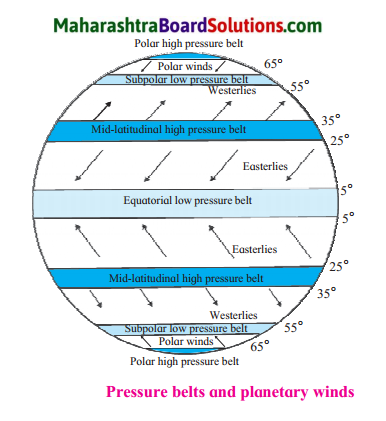
Maharashtra Board Class 7 Geography Solutions Chapter 4 Air Pressure 4

Class 7 Geography Chapter 4 Air Pressure InText Questions and Answers

Formative Assessment
Can you tell?

Observe the diagram Fig. (a) and (b) carefully and answer the following questions:
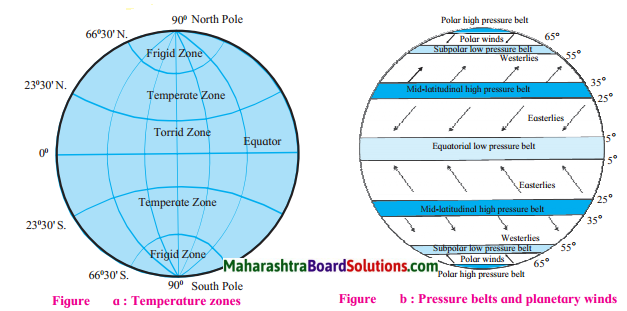
Maharashtra Board Class 7 Geography Solutions Chapter 4 Air Pressure 2
Question 1.
Which pressure belt is mainly found in the Tropics?
Answer:
Equatorial low pressure belt is mainly found in the tropics.

Question 2.
With which pressure belt are the polar winds associated? In which temperature zone are they observed?
Answer:
The polar winds are associated with polar high pressure belt and sub polar low pressure belt. It is observed in the frigid zone.

Maharashtra Board Class 7 Geography Solutions Chapter 4 Air Pressure

Question 3.
What could be the reason behind a low pressure belt in the Tropics?
Answer:
Low pressure belt is formed in the tropics because the temperature is high.

Question 4.
With which pressure belts are the winds in the Temperate zone associated?
Answer:
The winds in temperate zone are associated with mid latitudinal high pressure belt.

Question 5.
Write the latitudinal extent of the low pressure belts.
Answer:
The latitudinal extent of Equatorial low pressure belt is between 50°N & 50°S parallel & the latitudinal extent of the sub polar low pressure belt is between 55° & 65° parallel in both the hemispheres.

Observe the map given above and study the distribution of air pressure and answer the following
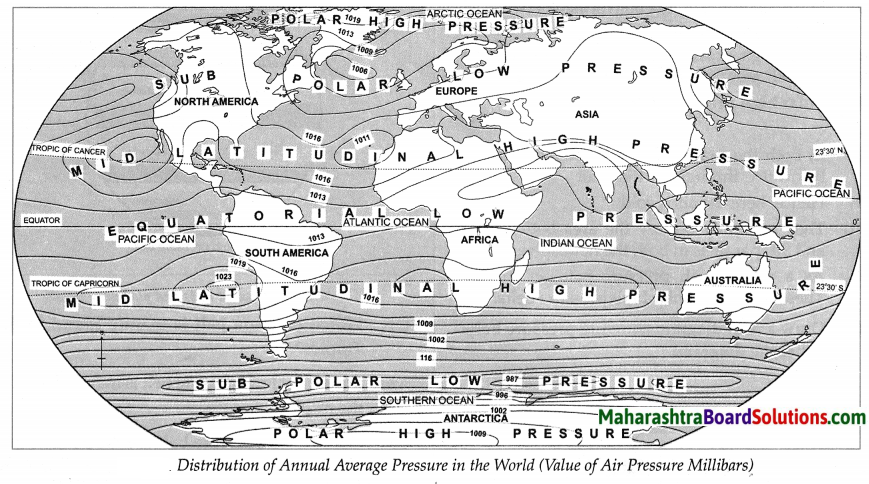
Maharashtra Board Class 7 Geography Solutions Chapter 4 Air Pressure 3
Question 1.
The nature of the isobars.
Answer:
The isobars are joining places of equal air pressure on the map.

Question 2.
High and low pressure belts and their latitudinal position.
Answer:
(i) The latitudinal position of high pressure belt is between 25° & 35° parallels and between 80° & 90° parallels in both the hemisphere
(ii) The latitudinal position of low pressure belt is between 0° & 5° parallels and between 55° & 65° parallels in both the hemispheres.

Question 3.
The direction of the isobars and the distance between successive isobars over the oceans and continents.
Answer:
(i) In the northern hemisphere most of the isobars are in southwest to north east direction over the continents. Also the distance between the isobars varies.

(ii) Closely spaced isobars indicate large pressure changes over a small area. Widely spaced isobars indicate gentle or gradual pressure change.

(iii) In the southern hemisphere, the isobars extend  in east-west direction. The distance between the isobars is fairly constant over the oceans & so the isobars are fairly parallel to each other.

Maharashtra Board Class 7 Geography Solutions Chapter 4 Air Pressure

Question 4.
Comparison of the isobars in the northern and the southern hemispheres.
Answer:
In the northern hemisphere the isobars are far spaced and uneven, whereas in the southern hemispheres it is closely spaced and parallel.

Use your brainpower !

Question 1.
If there is low pressure at the equator, what will be the condition of air pressure in the Arctic Zone?
Answer:
The Arctic zone will experience high pressure as the temperature is lower than 0°C.

Try this:

Question 1.

  • Take a flying lantern.
  • Tie an approximately 5m long thread to the flying lantern so that you can bring the lantern down whenever required.
  • After carefully reading the instructions given on the package of the lantern open it and light the candle placed in it.
  • After some time, bring the lantern down with the help of the thread and put off the candle.

Question 2.
Did the flying lantern start ascending immediately after the candle was lit?
Answer:
Yes

Question 2.
What would have happened to the flying lantern had the candle got extinguished after the lantern had gone up in the air?
Answer:
The lantern would have fallen back on the earth.

Give it a try: 

Question 1.
Study the temperative distribution map given in your std VI textbook and the pressure distribution map in this lesson to find the correlation between air temperature and air pressure.
Answer:

  • The temperature deceases continuously from the equator to the poles but the air pressure varies alternately.
  • In the equatorial region the average temperature is high. Hence, the air pressure is low.
  • In the polar regions, the temperature is low & hence the air pressure is comparative high.

Class 7 Geography Chapter 4 Air Pressure Additional Important Questions and Answers

Fill in the blanks choosing the correct option from the bracket:

Question 1.
Pressure belts oscillates between ______ parallels. (5° to 7°, 10° to 20°, 80° and 90°, 25° to 30°)
Answer:
5° to 7°

Maharashtra Board Class 7 Geography Solutions Chapter 4 Air Pressure

Question 2.
The instrument used to measure air pressure is ______ .(barometer, thermometer, hygrometer, seismometer)
Answer:
barometer

Question 3.
In both the polar regions, the temperature is below ________ throughout the year. (5°C, 0°C, 7°C, 6°C)
Answer:
0°C

Question 4.
The line that joins the places of equal pressure on the map is called an _______. (isotherm, isohytes, millibars, isobar)
Answer:
isobar

Match the following:

Question 1.

A (Pressure Belt)B (Parallels)
(1) Sub Polar low pressure

(2) Mid latitudinal high pressure

(3) Polar high pressure

(4) Equatorial low pressure

(a) 25° to 35°

(b) 5°N and 5°S

(c) 55° to 65°

(d) 80° to 90°

Answer:
1 – c
2 – a
3 – d
4 – b

Fill in the blanks:

Question 1.
The latitudinal extent of the temperate zones is much _____ while belts are narrower.
Answer:
Larger

Question 2.
The extent of air pressure belt is upto ______ parallel.
Answer:
10°

Question 3.
Pressure belts are formed between the _______ and the pole.
Answer:
Equator

Question 4.
The sun rays fall perpendicular between the ______and ________.
Answer:
Tropic of Cancer, Tropic of Capricorn

Question 5.
Due to the earths curvature, the area betweentwo parallels gets ______ as we move towards the poles.
Answer:
reduced

Question 6.
The air pressure at sea level is ______ millibars.
Answer:
1013.2

Maharashtra Board Class 7 Geography Solutions Chapter 4 Air Pressure

State whether the following statements are true or false:

Question 1.
Air pressure is uniform on all places on the earth’s surface.
Answer:
false

Question 2.
Whenever the temperature is high, the air pressure is also high.
Answer:
false

Question 3.
The heat received from the sun, is uneven in different regions.
Answer:
true

Question 4.
In both the polar regions, the temperature is low throughout the year.
Answer:
true

Question 5.
Air pressure is measured in units of millimetres.
Answer:
false

Answer the following questions in one to two sentence:

Question 1.
Which factors influence air pressure?
Answer:
The altitude of a region, temperature of the air and the amount of water vapour in the air are some factors influencing air pressure.

Question 2.
What is the extent of air pressure belt?
Answer:
The extent of air pressure belt is generally upto 10° parallel.

Question 3.
What is the latitudinal extent of temperate zone?
Answer:
The latitudinal extent of temperate zone is from 23°30’N to 66°30’N and 23° 30’S to 66° 30’S.

Question 4.
What is the temperature in the polar region?
Answer:
In both the polar regions, the temperature is below 0°C throughout the year.

Question 5.
Why do all things in and on the earth stay earth bound?
Answer:
All things in and on the earth stay bound due to the earth’s gravity.

Question 6.
Why are temperature zones created on the surface of the earth?
Answer:
The heat received from the sun is uneven in different regions. Hence the distribution of the temperature is uneven from the equator to the poles. As a result, temperature zones are created.

Question 7.
Most of the hot deserts on the earth are found in which region?
Answer:
Most of the hot deserts on the earth are found in the mid latitudinal high pressure belt ie; between 25° to 30° parallels in both hemispheres.

Maharashtra Board Class 7 Geography Solutions Chapter 4 Air Pressure

Give reasons:

Question 1.
Air pressure is maximum at sea level.
Answer:

  • All things in and on the earth stay earthbound because of the earth’s gravity. This includes air which is in the gaseous form.
  • Due to the earth’s gravity, air is pulled to the earth’s surface.
  • Also as one moves higher & higher from the earth’s surface the air becomes thinner & thinner.
  • Therefore, the air pressure is maximum at sea- level.

Question 2.
A low pressure belt is formed near the equator.
Answer:

  • The sunrays can be perpendicular between the Tropic of Cancer and the Tropic of Capricorn.
  • The temperature is higher in this region.
  • Hence air in this region gets heated, expands and becomes lighter and moves towards the sky.
  • As this process operates continuously, a low pressure belt gets formed in the central part of this region between the parallels 5° N and 5° S, near the equator.

Question 3.
High pressure belt is formed near the polar region.
Answer:

  • In both the polar regions, the temperature is below 0° throughout the year.
  • The air is cold.
  • Hence, high pressure belt is formed in the polar region.

Question 4.
Low pressure belt is observed between 55° and 65° parallels in both the hemispheres.
Answer:

  • Due to the earth’s curvature, the area between two parallels gets reduced as we move towards the poles. This results in lesser friction of the air with the earth’s surface.
  • The air between 55° and 65° parallels is thrown out because of the reduced friction and also due to the earth’s rotation.
  • Therefore, a low pressure belt is observed between 55° and 65° parallels in both the hemispheres.

Question 5.
Temperature and air pressure are closely related.
Answer:

  • Wherever the temperature is high, the air pressure is low. As the temperature rises the air gets heated, expands, and become lighter.
  • Thin, lighter air in the vicinity3 of the earth’s surface starts moving up towards the sky. As a result the air pressure in such area decreases.
  • Hence, temperature and air pressure are closely related.

Question 6.
Most of the hot deserts on the earth are found in mid-latitudinal high pressure belts.
Answer:

  • The air in mid-latitudinal high pressure belt (between 25° to 35° parallels in both hemisphere) is found to be dry.
  • The amount of water vapour is very low & hence this region gets extremely scarce or no rainfall.
  • Consequently, most of the hot deserts on the earth are found in mid latitudinal high pressure belts.

Give short answers to the following questions:

Question 1.
What are the effects of air pressure?
Answer:
Air pressure has the following effects.

  • Origin of winds.
  • Generation of storms
  • Convectional type of rain.

Maharashtra Board Class 7 Geography Solutions Chapter 4 Air Pressure

Question 2.
What is the difference between the temperature zones and pressure belts?
Answer:
(i) The difference between the temperature zones & pressure belts is that the latitudinal extent of temperature zones is much larger while pressure belts are narrower.

(ii) For example, the Temperate zone extends from 23°30′ to 66°30′ in both hemisphere. Compared to this the pressure belt has limited extent which is generally upto 10° parallel.

(iii) Also the temperature zones are continuous & spread from the equator to the poles from Torrid to Frigid.

(iv) Pressure belts are not continuous & areas of high & low pressure are found in different regions from the equator to the poles.

Question 3.
How does a high pressure belt get formed near 30° parallel? Why does this region have hot deserts?
Answer:
(i) The heated air from the equatorial region becomes lighter, starts ascending and after reaching higher altitudes, moves towards the polar region, i.e., towards the North and the South Pole.

(ii) Due to low temperatures at the higher altitudes, the air cools down and becomes heavier. This heavier air descends down in both the hemispheres in the region between 25° to 35° parallels.

(iii) This leads to the formation of high pressures belts in these parallels of latitudes in both the hemispheres.

(iv) This air is dry, hence the region does not get rainfall. Consequently, most of the hot deserts on the earth are found in these regions.

Think about it:

Question 1.
What will be the effect on air pressure if the temperature drops? Why?
Answer:
If the temperature drops, the air pressure will increase as the air becomes heavy.
Maharashtra Board Class 7 History Solutions Chapter 5 The Foundation of the Swaraj

Balbharti Maharashtra State Board Class 7 History Solutions Chapter 5 The Foundation of the Swaraj Notes, Textbook Exercise Important Questions and Answers.

Maharashtra State Board Class 7 History Solutions Chapter 5 The Foundation of the Swaraj

Class 7 History Chapter 5 The Foundation of the Swaraj Textbook Questions and Answers

1. Find the odd man out:

Question 1.
Pune, Supe, Chakan, Bengaluru
Answer:
Bengaluru

Maharashtra Board Class 7 History Solutions Chapter 5 The Foundation of the Swaraj

Question 2.
Jadhavs of Phaltan, Mores of Javali, Ghorpades of Mudhol, Sawants of Sawantwadi
Answer:
Jadhavs of Phaltan

Question 3.
Torana, Murumbdev, Sinhgad,Sindhudurg
Answer:
Sindhudurg.

2. Write about in your words:

Question 1.
The efforts Veermata Jijabai took for Shivaji Maharaj’s education.
Answer:
The following were the efforts Veermata Jijabai took for Shivaji Maharaj’s education.
(i) She instilled in Shivaji the values like modesty, vigilance, truthfulness, oratory, courage and fearlessness.
(ii) She inspired the will to win the dream of Swaraj.

Question 2.
Shivaji Maharaj started his work of founding Swaraj in the Maval region.
Answer:
(i) The Maval terrain was full of hills and valleys and was not easily accessible.
(ii) He made use of these geographical features of Maval very skilfully for the purpose of the foundation of the Swaraj.

3. List the companions and associates of Shivaji Maharaj.
Answer:

  1. Yesaji Kank
  2. Baji Pasalkar
  3. Bapuji Mudgal
  4. Kavji Kondhalkar
  5. Jiva Mahala
  6. Tanaji Malusare
  7. Kanhoji Jedhe
  8. Bajiprabhu Deshpande
  9. Dadaji Narasprabhu Deshpande.
  10. Narhekar Deshpande brothers

Maharashtra Board Class 7 History Solutions Chapter 5 The Foundation of the Swaraj

4. Find out and write:

Question 1.
Why Shahaji Maharaj is termed Swaraj visionary.
Answer: .
(i) Shahajiraje was valiant, courageous, intelligent a great political expert.
(ii) He was an excellent archer.
(iii) He was also an expert in using the sword, patta and spear.
(iv) He loved his subjects.
(v) He had won many regions in Maharashtra, Karnataka and Tamil Nadu. South India was in awe of him.
(vi) While Shivaji and Jijabai were at Bengaluru he had arranged for providing excellent education to Shivaji so as to enable him to become a king.
(vii) He himself aspired to established Swaraj by ousting the powers of foreign people. That is why he is known as Swaraj visionary.

Question 2.
Shivaji Maharaj paid attention to building a Navy.
Answer:
(i) After the conquest of Javali, Kalyan, Bhiwandi, Shivaji Maharaj came in contact with the Siddi, Portuguese and British power on the western Coast.
(ii) He realized that in order to fight these powers, it was necessary to have a strong naval force. Hence Shivaji Maharaj paid attention to raise a Navy.

Question 3.
Shivaji Maharaj entered into a treaty with the Adilshah.
Answer:
(i) On one hand, Aurangzeb had Sent Shaistakhan to invade the Pune Province and on other hand the conflict with Adilshah continued.
(ii) Therefore, Shivaji Maharaj realized that it would hot be prudent to fight both the enemies at the same time.
Therefore Shivaji Maharaj entered into a treaty with the Adilshah.

Maharashtra Board Class 7 History Solutions Chapter 5 The Foundation of the Swaraj

Question 4.
How did Shivaji Maharaj escape from Panhalgad?
Answer:
(i) When Shivaji Maharaj took shelter in Panhala fort, Siddi soldiers laid siege to the fort for about five months.
(ii) Shivaji Maharaj found himself trapped inside the fort.
(iii) Netoji Palkar tried to raise the siege by attacking Siddi’s army from outside.
(iv) He couldn’t succeed as his forces were meagre (inadequate)
(v) Siddi showed no sign of relenting so he decided to have open talks with him.
(vi) Shiva Kashid, a brave youth who resembled Shivaji Maharaj in looks came forward.
(vii) He dressed up like Shivaji Maharaj and sat in a palanquin.
(viii) The palanquin left by the Raj-dindi gate and was captured by Siddi’s army and Kashid sacrificed himself for Swaraj.
(ix) In the meanwhile, Shivaji Maharaj left the fort using another route.

Activities:

  1. Describe a fort you have seen. Suggest measures for conserving a historical site.
  2. Find out what a 7/12 extract means and relate it to the words in the chapter.

Class 7 History Chapter 5 The Foundation of the Swaraj Additional Important Questions and Answers

Complete the sentence by choosing the appropriate words from the options given below:

Question 1.
Shivaji Maharaj started the work of establishing Swaraj in the ______ region. (Maval, Javali, Chakan)
Answer:
Maval

Question 2.
Jijabai was the daughter of the great Sardar ______ (Shahajiraje, Netaji Palkar, Lakhujiraje)
Answer:
Lakhujiraje

Question 3.
______ was the first capital of Swaraj. (Pratapgad, Rajgad, Panhala)
Answer:
Rajgad

Question 4.
Shivaji Maharaj renamed Khelna as ______.(Vishalgad, Pratapgad, Rajgad)
Answer:
Vishalgad

Question 5.
The Adilshah gave Siddi the title of _____ (Salabatkhan, Adilshahi, Nizamshahi)
Answer:
Salabatkhan

Question 6.
Badi Sahiba sent ______ to curb Shivaji Maharaj. (Nizamshah, Afzalkhan, Shaistakhan)
Answer:
Afzalkhan

Question 7.
________ was a pre-eminent Sardar in the Deccan.(Lakhujiraje, Bajiprabhu Deshpande, Shahajiraje)
Answer:
Shahajiraje

Question 8.
The Nizamshahi came to an’end in _______. (1636 CE, 1648 CE, 1630 CE)
Answer:
1636 CE

Question 9.
Shahajiraje sent ______ and _______ from Bangalore to Pune with some loyal and competent associates. (Yesaji Rank and Jiva Mahala, Dalvi and Surve, Shivaji and Jijabai)
Answer:
Shivaji and Jijabai

Maharashtra Board Class 7 History Solutions Chapter 5 The Foundation of the Swaraj

Question 10.
Shivaji Maharaj took shelter in the _______ Fort. (Rajgad, Panhala, Vishalgad)
Answer:
Panhala

Match the following:

Question 1.

Column ‘A’Column ‘B’
(1) Nizamshahi came to an end(a) 1660 CE
(2) Shivaji’s birth date(b) 10th November 1659
(3) A meeting between Shivaji and Afzalkhan(c) 1636 CE
(4) Siddi Jauhar attacked on Shivaji Maharaj(d) 19th February 1630.

Answer:
1 – c
2 – d
3 – b
4 – a

Question 2.

Column ‘A’Column ‘B’
(1) Shivneri(a) Javali Valley
(2) Pratapgad(b) Siege by Siddi Jauhar
(3) Raigad(c) Birth place of Shivaji Maharaj
(4) Panhalgad(d) The first capital of the Swaraj

Answer:
1 – c
2 – a
3 – d
4 – b

Arrange in chronological order:

Question 1.
(i) A treaty with Adilshah
(ii) Defeat of Afzalkhan
(iii) Shivaji Maharaj captured Javali
(iv) Shivaji Maharaj escaped from Panhala Fort
Answer:
(i) Shivaji Maharaj captured Javali
(ii) Defeat of Afzalkhan
(iii) Shivaji Maharaj escaped from Panhala Fort
(iv) A treaty with Adilshah

Maharashtra Board Class 7 History Solutions Chapter 5 The Foundation of the Swaraj

Question 2.
(i) Meeting with Afzalkhan
(ii) End of Nizamshahi
(iii) Siege to Panhala
(iv) Attack on Javali
Answer:
(i) End of Nizamshahi (1636 CE)
(ii) Attack on Javali (1656 CE)
(iii) Meeting with Afzalkhan (1659 CE)
(iv) Siege to Panhala (1660 CE)

Question 3.
(i) Siddi Jauhar marched against Shivaji Maharaj
(ii) Birth of Shivaji Maharaj
(iii) Shivaji Maharaj built Pratapgad
(iv) Shahajiraje became a Sardar of Adilshah
Answer:
(i) Birth of Shivaji Maharaj
(ii) Shahajiraje became a Sardar of Adilshah
(iii) Shivaji Maharaj built Pratapgad
(iv) Siddi Jauhar marched against Shivaji Maharaj

Answer the following in one sentence:

Question 1.
What were the extraordinary qualities of Shahajiraje.
Answer:
Shahajiraje was a valiant, courageous, intelligent and a great political leader.

Question 2.
Which Jagirs were granted to Shahajiraje from Nizamshah?
Answer:
Shahajiraje was granted the jagirs of Pune, Supe, Indapur and Chakan parganas located between the Bheema and Neera rivers.

Question 3.
Who was Afzalkhan?
Answer:
Afzalkhan was a powerful and experienced Adilshahi General.

Question 4.
Which forts did Shivaji Maharaj capture while laying the foundation of Swaraj?
Answer:
Shivaji Maharaj captured the forts of Torana, Murumbdev, Kondhana and Purandar while laying the foundation of Swaraj.

Maharashtra Board Class 7 History Solutions Chapter 5 The Foundation of the Swaraj

Question 5.
Whom did Shahajiraje entrust the jagir of Pune?
Answer:
Shahajiraje entrusted the jagir of Pune to Shivajiraje and Veermata Jijabai.

Question 6.
Who was looking after the administration of the Adilshahi?
Answer:
Badi Sahiba was looking after the administration of the Adilshahi.

Question 7.
Whom did Badi Sahiba send to curb Shivaji Maharaj?
Answer:
Badi Sahiba sent Afzalkhan, a powerful and experienced Adilshahi General to curb Shivaji Maharaj.

Question 8.
What is inscribed on the Royal Seal?
Answer:
Shivaji Maharaja’s objective of establishing Swaraj was clearly expressed in his Royal Seal.

Question 9.
Who was Chandrarao More?
Answer:
Chandrarao More of Javali in Satara district was a powerful Sardar in the Adilshahi, who was against the founding of the Swaraj.

Question 10.
When was Shivaji Maharaj bom?
Answer:
Shivaji Maharaj was bom on 19th February, 1630 and as per Hindu Calendar on Phagun Vadya Tritiya, Shaka year 1551.

Find the odd man out:

Question 1.
Yesaji Kank, Baji Pasalkar, Tanaji Malusare the Mores of Javali
Answer:
The Mores of Javali.

Maharashtra Board Class 7 History Solutions Chapter 5 The Foundation of the Swaraj

Question 2.
Portuguese, Siddi, British, Mughals
Answer:
Mughals

Give reasons for the following:

Question 1.
Shivaji Maharaj decided to acquire the forts that were within his own jagir.
Answer:

  • The forts situated within the jagir of Shivaji Maharaj were not under his control but were under the control of Adilshah.
  • In those days, forts were of special significance.
  • With a firm hold over a fort, it was possible to control the surrounding area. Hence, Shivaji Maharaj decided to acquire the forts that were within his own jagir.

Question 2.
Conquest of Javali increased Shivaji Maharaj strength in all respects.
Answer:

  • Shivaji Maharaj attacked Javali and captured the region in 1656 CE.
  • Shivaji Maharaj established his post in Javali.
  • He also captured Raigad. He attained a huge wealth from Javali.
  • After this victory, his activities in Konkan increased.
  • He built the Pratapgad fort in the Javali valley.
  • In this way, the conquest of Javali increased his strength in all respects.

Question 3.
Bajiprabhu dies a hero’s death.
Answer:

  • Shivaji Maharaj left the fort using another difficult route.
  • He was accompanied by Bajiprabhu Deshpande and some chosen soldiers.
  • Bajiprabhu army pursued Shivaji Maharaj.
  • Shivaji Maharaj entrusted the responsibility of stopping Siddi’s army at the foot of Vishalgad to Bajiprabhu Deshpande.
  • Bajiprabhu Deshpande checked Siddi’s army at the Ghod pass near Gajapur.
  • He fought with the greatest valour.
  • Bajiprabhu died a hero’s death in the battle.

Maharashtra Board Class 7 History Solutions Chapter 5 The Foundation of the Swaraj

Find out and write:

Question 1.
Adilshah sent Siddi Jauhar, the Sardar of the Kamul region against Shivaji Maharaj in 1600 CE.
Answer:

  • Shivaji Maharaj captured the Adilshahi forts of Panhala, Vasantgad and Khelna.
  • Shivaji Maharaj had posed a big challenge before the Adilshahi.
  • Therefore, Adilshah sent Siddi Jauhar, the Sardar of the Kamul region against Shivaji Maharaj in 1660 CE.

Write in short about:

Question 1.
Defeat of Afzalkhan
Answer:

  • Badi Sahiba sent the powerful and experienced Afzalkhan to curb Shivaji Maharaj.
  • A meeting between Afzalkhan and Shivaji was arranged at the foot of Pratapgad near Wai.
  • At the meeting, Afzalkhan attempted treachery.
  • In return, Shivaji Maharaj killed Afzalkhan and routed the Adilshahi army.

Question 2.
Royal Seal (Rajmudra)
Answer:

  • The objective of Shivaji Maharaj of establishing of Swaraj is expressed in his Royal Seal.
  • The meaning expressed is that this seal will grow in splendour like the new moon. The seal of Shivaji, the son of Shivaji receiving homage from the whole world denotes the welfare of the people.

Question 3.
Veermata Jijabai
Answer:

  • Jijabai was daughter of the great Sardar Lakhujiraje Jadhav of Sindkhedraja in Buldhana district.
  • At a young age, she had received military education along with learning various arts.
  • She helped and encouraged Shahaji Maharaj to realise his dream of establishing Swaraj
  • She was a competent and visionary political expert.

Let’s Learn:

Observe the official seal of our country.

Question 1.
What features do you observe?
Answer:

  • Official seal is called the National Emblem of India.
  • Elephant is in East, Horse in west (left), Bull south (right) and lion in North.
  • There are four lions standings back to back, but in the emblem three are seen.
  • There is a wheel under the lions.
  • Underneath there are the words “Satyameva Jayate’ in Devnagri script.

Maharashtra Board Class 7 History Solutions Chapter 5 The Foundation of the Swaraj

Question 2.
In which places is the official seal used?
Answer:
Coins, currency notes, postcards, envelops, passport and Government documents.

Practice Set 50 Class 7 Answers Chapter 14 Algebraic Formulae – Expansion of Squares Maharashtra Board

Algebraic Formulae – Expansion of Squares Class 7 Maths Chapter 14 Practice Set 50 Solutions Maharashtra Board

Balbharti Maharashtra State Board Class 7 Maths Solutions covers the 7th Std Maths Practice Set 50 Answers Solutions Chapter 14 Algebraic Formulae – Expansion of Squares.

Std 7 Maths Practice Set 50 Solutions Answers

Question 1.
Expand:
i. (5a + 6b)²
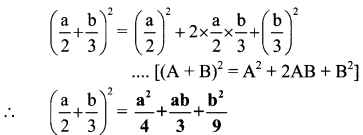
ii. \(\left(\frac{\mathrm{a}}{2}+\frac{\mathrm{b}}{3}\right)^{2}\)
iii. (2p – 3q)²
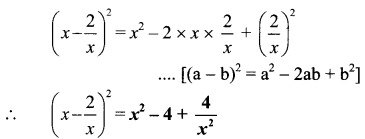
iv. \(\left(x-\frac{2}{x}\right)^{2}\)
v. (ax + by)²
vi. (7m – 4)²
vii. \(\left(x+\frac{1}{2}\right)^{2}\)
viii. \(\left(a-\frac{1}{a}\right)^{2}\)
Solution:
i. (5a + 6b)²
Here, A = 5a and B = 6b
(5a + 6b)² = (5a)² + 2 × 5a × 6b + (6b)²
…. [(A + B)² = A² + 2AB + B²]
∴ (5a + 6b)² = 25a² + 60ab + 36b²

ii. \(\left(\frac{\mathrm{a}}{2}+\frac{\mathrm{b}}{3}\right)^{2}\)
Here A = \(\frac { a }{ 2 }\) and B = \(\frac { b }{ 3 }\)
Maharashtra Board Class 7 Maths Solutions Chapter 14 Algebraic Formulae - Expansion of Squares Practice Set 50 1

iii. (2p – 3q)²
Here, a = 2p and b = 3q
(2p – 3q)² = (2p)² – 2 × (2p) × (3q) + (3q)²
…. [(a – b)² = a² – 2ab + b²]
∴ (2p – 3q)² = 4p² – 12pq + 9q²

iv. \(\left(x-\frac{2}{x}\right)^{2}\)
Here a = x and b = \(\frac { 2 }{ x }\)
Maharashtra Board Class 7 Maths Solutions Chapter 14 Algebraic Formulae - Expansion of Squares Practice Set 50 2

v. (ax + by)²
Here, A = ax and B = by
(ax + by)² = (ax)² + 2 × ax × by + (by)²
…. [(A + B)² = A² + 2AB + B²]
∴ (ax + by)² = a²x² + 2abxy + b²y²

vi. (7m – 4)²
Here, a = 7m and b = 4
(7m – 4)² = (7m)² – 2 × 7m × 4 + 4²
…. [(a – b)² = a² – 2ab + b²]
∴ (7m – 4)² = 49m² – 56m + 16

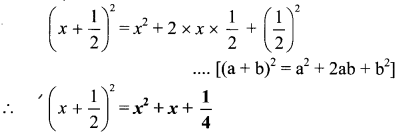
vii. \(\left(x+\frac{1}{2}\right)^{2}\)
Here a = x and b = \(\frac { 1 }{ 2 }\)
Maharashtra Board Class 7 Maths Solutions Chapter 14 Algebraic Formulae - Expansion of Squares Practice Set 50 3

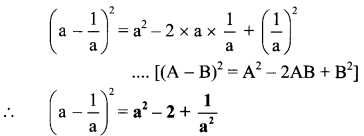
viii. \(\left(a-\frac{1}{a}\right)^{2}\)
Here A = a and B = \(\frac { 1 }{ a }\)
Maharashtra Board Class 7 Maths Solutions Chapter 14 Algebraic Formulae - Expansion of Squares Practice Set 50 4

Question 2.
Which of the options given below is the square of the binomial
(A) \(64-\frac{1}{x^{2}}\)
(B) \(64+\frac{1}{x^{2}}\)
(C) \(64-\frac{16}{x}+\frac{1}{x^{2}}\)
(D) \(64+\frac{16}{x}+\frac{1}{x^{2}}\)
Solution:
(C) \(64-\frac{16}{x}+\frac{1}{x^{2}}\)

Hint:
= \(\left(8-\frac{1}{x}\right)^{2}=8^{2}-2 \times 8 \times \frac{1}{x}+\left(\frac{1}{x}\right)^{2}\) …[(a – b)² = a² – 2ab + b²]
= \(64-\frac{16}{x}+\frac{1}{x^{2}}\)

Question 3.
Of which of the binomials given below is the m²n² + 14mnpq + 49p²q² the expansion?
(A) (m + n) (p + q)
(B) (mn – pq)
(C) (7mn + pq)
(D) (mn + 7pq)
Solution:
(D) (mn + 7pq)

Hint:
Here, square root of the first term = mn
Square root of the last term = 7pq
∴ Required binomial = (mn + 7pq)²

Question 4.
Use an expansion formula to find the values of:
i. (997)²
ii. (102)²
iii. (97)²
iv. (1005)²
Solution:
i. (997)² = (1000 – 3)²
Here, a = 1000 and b = 3
(1000 – 3)² = (1000)² – 2 x 1000 x 3 + 3²
…. [(a – b)² = a² – 2ab + b²]
= 1000000 – 6000 + 9
= 994009
∴ (997)² = 994009

ii. (102)² = (100 + 2)²
Here, a = 100 and b = 2
(100 + 2)² = (100)² + 2 x 100 x 2 + 2²
…. [(a + b)² = a² + 2ab + b²]
= 10000 + 400 + 4
= 10404
∴ (102)² = 10404

iii. (97)² = (100 – 3)²
Here, a = 100 and b = 3
(100 – 3)² = (100)² – 2 x 100 x 3 + 3²
…. [(a – b)² = a² – 2ab + b²]
= 10000 – 600 + 9
= 9409
∴ (97)² = 9409

iv. (1005)² = (1000 + 5)²
Here, a = 1000 and b = 5 (1000 + 5)²
= (1000)² + 2 x 1000 x 5 + 5²
…. [(a + b)² = a² + 2ab + b²]
= 1000000+ 10000 + 25
= 1010025
∴ (1005)² = 1010025

Maharashtra Board Class 7 Maths Chapter 14 Algebraic Formulae – Expansion of Squares Practice Set 50 Intext Questions and Activities

Question 1.
Use the given values to verify the formulae for squares of binomials. (Textbook pg. no. 92)
i. a = -7, b = 8
ii. a = 11,b = 3
iii. a = 2.5,b = 1.2
Solution:
i. (a + b)² = (-7 + 8)²
= 1²
= 1
a² + 2ab + b² = (-7)² + 2 x (-7) x 8 + 8²
= 49 – 112 + 64
= 1
∴(a + b)² = a² + 2ab + b²
(a – b)² = (-7 – 8)²
= (-15)²
= 225
a² – 2ab + b² = (-7)² – 2 x (-7) x 8 + (8)²
= 49 + 112 + 64
= 225
∴(a – b)² = a² – 2ab + b²

ii. (a + b)² = (11 + 3)²
= 14²
= 196
a² + 2ab + b² = 11² + 2 x 11 x 3 + 3²
= 121 + 66 + 9
= 196
∴(a + b)² = a² + 2ab + b²
(a – b)² = (11 – 3)² = 8²
= 64
a² – 2ab + b² = 11² – 2 x 11 x 3 + 3²
= 121 – 66 + 9
= 64
∴(a – b)² = a² – 2ab + b²

iii. (a + b)² = (2.5 + 1.2)²
= 3.7²
= 13.69
a² + 2ab + b² = (2.5)² + 2 x 2.5 x 1.2 + (1.2)²
= 6.25 + 6 + 1.44
= 13.69
∴(a + b)² = a² + 2ab + b²
(a – b)² = (2.5 – 1.2)²
= 1.32
= 1.69
a² – 2ab + b² = (2.5)² – 2 x 2.5 x 1.2 + (1.2)²
= 6.25 – 6 + 1.44
= 1.69
∴(a – b)² = a² – 2ab + b²-

Class 7 Maths Solution Maharashtra Board

The Muscular System and Digestive System in Human Beings Class 7 Questions And Answers Maharashtra Board

Std 7 Science Chapter 12 The Muscular System and Digestive System in Human Beings Question Answer Maharashtra Board

Balbharti Maharashtra State Board Class 7 Science Solutions Chapter 12 The Muscular System and Digestive System in Human Beings Notes, Textbook Exercise Important Questions and Answers.

Class 7 Science Chapter 12 The Muscular System and Digestive System in Human Beings Question Answer Maharashtra Board

1. Fill in the blanks with the right word from the brackets:

Question a.
The process of digestion starts from the ………….. (stomach, mouth).
Answer:
mouth

Question b.
Eyelids have …………… muscles. (voluntary, involuntary)
Answer:
involuntary

Question c.
……………. is not a function of muscular system. (production of blood cell, performing movement)
Answer:
Production of blood cells

Maharashtra Board Class 7 Science Solutions Chapter 12 The Muscular System and Digestive System in Human Beings

Question d.
Muscles of the heart are …………….. . (ordinary muscles, cardiac muscles)
Answer:
cardiac muscles

Question e.
Pushing forward the food that has been chewed is the function of the …………… . (stomach, oesophagus)
Answer:
Oesophagus.

2. Find a match for me.

Question a.

Column ‘A’Column B’
1. Cardiac musclea. Always functions in pairs
2. Are brought about by muscleb. We never feel tired
3. Pepsinc. Uncontrolled and painful contraction of muscles
4. Crampsd. Chewing movement of the jaw
5. Skeletal musclese. Enzymes of the gastric juice

Maharashtra Board Class 7 Science Solutions Chapter 12 The Muscular System and Digestive System in Human Beings

3. Who is telling a lie?

Question a.

OrganStatement
1. Tonguea. My taste buds can tell only a sweet taste.
2. Liverb. I am the largest gland in the body.
3. Large intestinec. I am 7.5 metre long.
4. Appendixd. Digestion is impossible without me
5. Lunge. I play an important role in excretion.

Answer:

  1. Lie. My taste buds can tell all tastes – sweet sour, bitter.
  2. Truth.
  3. Lie. It is 1.5 metre long.
  4. Truth.
  5. Lung → Lie. It plays important role in breathing.

4. Give reasons.

Question 1.
Food becomes acidic in the stomach.
Answer:

  1. The gastric glands of stomach secrete gastric juice.
  2. Food that has entered stomach is churned.
  3. Three components of gastric juice namely hydrochloric acid, pepsin and mucus are mixed with food here and the food becomes acidic.

Maharashtra Board Class 7 Science Solutions Chapter 12 The Muscular System and Digestive System in Human Beings

Question 2.
Cardiac muscles are said to be involuntary muscles.
Answer:

  1. Cardiac muscles are found in the heart.
  2. These muscles bring about the contraction and relaxation (beating) of the heart.
  3. Their movement is involuntary.
  4. Cardiac muscles cause our heart to relax and contract continuously at a rate of about 70 times per minute. They do not depend upon our will.
  5. Beating is carried out in their own fixed manner.

So cardiac muscles are said to be involuntary muscles.

Question 3.
Intoxicating substances should not be consumed.
Answer:

  1. Physical health is important for our organ system to function properly.
  2. But harmful habits like smoking, chewing of tobacco, drinking alcohol affect our health adversely.
  3. If we consume any tobacco products, the mouth, pharynx, alimentary canal, and other organs of the digestive system cannot function properly.
  4. It causes problems like vomiting, nausea, and headache.
  5. Tobacco particles stick to teeth, gums, and skin of the mouth cavity and slowly cause injury to those parts resulting in their dysfunction.
  6. This causes swelling of the gums and pain when moving the jaws.
  7. The pharynx and intestine become inflamed it progress into cancer leading to death.

Maharashtra Board Class 7 Science Solutions Chapter 12 The Muscular System and Digestive System in Human Beings

Question 4.
Your muscles should be strong and efficient.
Answer:
Muscles are bundles of fibres that can contract and relax as required.

  1. The action of muscles is necessary for all kinds of movements from the small movements of eyelid to those that demand great strength when chopping wood with an axe.
  2. We use muscles for various movements like talking laughing, walking, jumping, throwing etc.
  3. Therefore our muscles should be strong and efficient to do our day today work well and smooth functioning of life processes.

5. Answer the following. 

Question a.
How many types of muscles are there? Which are those types?
Answer:
Muscles are bundles of fibres that can contract and relax as required. There are three types of muscles.

  • Skeletal muscles.
  • Heart or cardiac muscles.
  • Smooth muscles.

1. Skeletal muscles: (a) Skeletal muscles work with bones, the two ends of each of these muscles are attached to two different bones. (b) They are responsible for holding the bones of the skeleton together and giving shape to our body, (c) Skeletal muscles permits movement of t the body and maintain the posture of the body. (d) Skeletal muscle is voluntary e.g. muscles in our arms and legs are voluntary muscles, their action depends upon our will. That’s why they are called voluntary muscles.

2. Heart or cardiac muscles: (a) Heart or cardiac muscles bring about the contraction and relaxation (beating) of the heart. (b) Their movement is involuntary, (c) Cardiac muscles cause our heart to relax and contract continuously at a rate of about 70 times per minute, (d) Cardiac muscle is found in heart.

3. Smooth muscles: (a) These muscles are present in the internal organs other than the heart, e.g. muscles of the stomach, intestine, blood vessels, uterus etc. (b)Their movements are involuntary and slow, (c) They are not according to our will. (d) Various vital functions of our body such as digestion, respiration and movement of food material of which we remain quite unaware, are carried out by these special muscles.

Maharashtra Board Class 7 Science Solutions Chapter 12 The Muscular System and Digestive System in Human Beings

Question b.
What causes the problem of acidity? What is its effect on the body?
Answer:

  1. Stress is the main cause of acidity.
  2. Hectic lifestyle and stress can lead to unhealthy or irregular meals, not good for digestion process, and this may cause acidity.
  3. Other reasons are eating spicy food, drinking too much alcohol, missing meals, an empty stomach may lead to acidity.
  4. Acidity leads to stomach upset, burning sensation in chest and stomach, constriction of blood vessels, weight gain, obesity, cardiovascular damage.

Question c.
Name the different types of teeth. What is the function of each type?
Answer:
There are four types of teeth, namely incisors, canines, pre-molars, and molars.
Each tooth is covered by a hard substance called enamel. Enamel is made up of calcium salt.
The process of digestion begins with the function of the teeth in the mouth.
1. Incisors: (a) These come in first 6-months of age. Incisors are the eight teeth in the front and centre four on top and four on bottom, (b) They are sharp and blade like for cutting food. e.g. for biting an apple, (c) We use them to take first bite of food.

2. Canines: (a) These are strong and pointed, sharpest of all for tearing food. e.g. to tear off a piece of tough meat, (b) They play important role in digestion of food, (c) They appear between 11 and 20 months of age.

3. Pre-molar: Pre molar share features of both canines and molars. (a) You can use them for grinding and chewing food. So that it becomes semi-liquid helping to gulp down the throat easily, (b) They are situated at each side of your mouth in deep settings, (c) They appear at the age of 10 years.

4. Molar: (a) These are broad and flat on top for crushing and grinding food. e.g. to grind up nutmeats. (b) Two teeth above and two teeth below, they appear at the age 11-13 years. (c) Molars are more prone to germ attack because of their remote location in our mouth.
So we should keep them clean.

Maharashtra Board Class 7 Science Solutions Chapter 12 The Muscular System and Digestive System in Human Beings

6. Sketch and label a diagram of the digestive system and describe it in your own words.

Question a.
Sketch and label a diagram of the digestive system and describe it in your own words.
Answer:

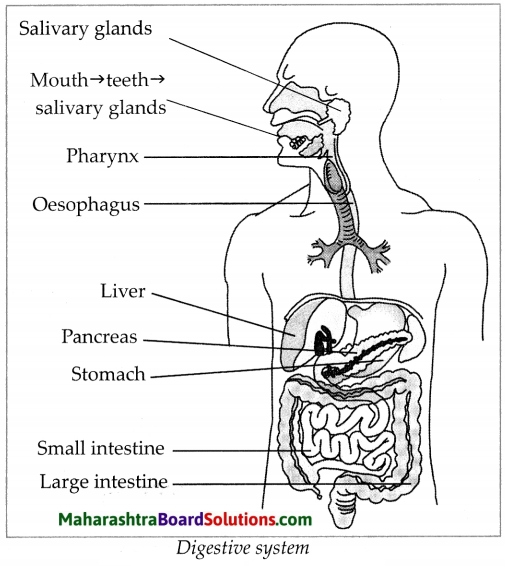
Maharashtra Board Class 7 Science Solutions Chapter 12 The Muscular System and Digestive System in Human Beings 1

  1. Conversion of food into a soluble form and its absorption into the blood is called digestion.
  2. The digestive system consists of the alimentary canal and digestive glands.
  3. The total length of alimentary canal is about 9 metres.
  4. Its main parts are the mouth, pharynx, oesophagus, stomach, small intestine, large intestine, rectum and anus.
  5. The salivary glands, liver, pancreas are the digestive glands connected to the alimentary canal.
  6. Different organs of the digestive system perform the function of digestion.
  7. There are different stages in the process of digestion of food.
  8. The process of digestion begins with the function of the teeth in the mouth, food is chewed into small pieces.
  9. There are four types of teeth, incisors, canines, pre-molars and molars.
  10. Saliva in the mouth contains enzymes, ptyalin, or amylase. It converts starch into maltose.

a. Oesophagus:

  1. It is a tube leading from the pharynx to the stomach,
  2. It pushes the food towards the stomach.

b. Stomach:

  1. The large sac like part of the alimentary canal is called the stomach.
  2. Food that has entered is churned.
  3. The gastric glands of stomach secrete gastric juice which contain hydrochloric acid, pepsin and mucus.
  4. They mix with food and food becomes acidic.
  5. Mainly proteins are digested in stomach.
  6. Due to the churning and actions of gastric juice, food become a semi-solid slurry which is pushed into the small intestine.

c. Small intestine: (6m long)

  1. Bile secreted by liver mixes with food in small intestine,
  2. Most of the digestion and absorption of food takes place here.

d. Large intestine: (1.5m long) only water is absorbed in the large intestine. Undigested remain is thrown out of the body through the anus.

Maharashtra Board Class 7 Science Solutions Chapter 12 The Muscular System and Digestive System in Human Beings

Project:

Question 1.
Make charts about maintaining good health.

Question 2.
Design a power point presentation about the digestive system and present it in the class.

Class 7 Science Chapter 12 The Muscular System and Digestive System in Human Beings Important Questions and Answers

Choose and write the correct word.

Question 1.
The structure that connects bones to the muscles is the ………………….. .
(a) ligament
(b) tendon
(c) fascicle
(d) skin
Answer:
(b) tendon

Question 2.
………………….. is not performed by muscles.
(a) Motion
(b) Excretion
(c) Maintenance of posture
(d) Heat production
Answer:
(d) Heat production

Maharashtra Board Class 7 Science Solutions Chapter 12 The Muscular System and Digestive System in Human Beings

Question 3.
Approximately ………………….. skeletal muscles are there in the human body.
(a) 1000
(b) 600
(c) 100
(d) 60
Answer:
(b) 600

Question 4.
Most of the fat digestion occurs in ………………….. .
(a) rectum
(b) stomach
(c) small intestine
(d) large intestine
Answer:
(c) small intestine

Question 5.
Protein digestion is accomplished in ………………….. .
(a) stomach
(b) ileum
(c) rectum
(d) duodenum
Answer:
(b) ileum

Maharashtra Board Class 7 Science Solutions Chapter 12 The Muscular System and Digestive System in Human Beings

Question 6.
The main function of the muscular system is ………………….. .
(a) excretion
(b) digestion
(c)movement
(d) contraction
Answer:
(c)movement

Question 7.
The largest muscle of our body is in the ………………….. .
(a) arm
(b) face
(c) thigh
(d) None
Answer:
(c) thigh

State whether True or False. Correct the false statement and rewrite:

Question 1.
Saliva is mixed with food in the mouth.
Answer:
True.

Maharashtra Board Class 7 Science Solutions Chapter 12 The Muscular System and Digestive System in Human Beings

Question 2.
Gastric juice makes food alkaline.
Answer:
False. Gastric juice makes food acidic.

Question 3.
Pancreas is the largest gland in the body.
Answer:
False. Liver is the largest gland in the body.

Question 4.
Food becomes acidic in stomach.
Answer:
True

Maharashtra Board Class 7 Science Solutions Chapter 12 The Muscular System and Digestive System in Human Beings

Question 5.
Cardiac muscles are said to be voluntary muscles.
Answer:
False. Cardiac muscles are involuntary.

Question 6.
Muscles contribute 60% of the weight of a healthy adult human body.
Answer:
False. Muscles contribute almost 40% of the weight of a healthy adult human body.

Question 7.
There are about 30 muscles in the human face.
Answer:
True

Question 8.
Muscles in our arms and legs have involuntary muscles.
Answer:
False. Muscles in our arm and legs are voluntary muscles.

Maharashtra Board Class 7 Science Solutions Chapter 12 The Muscular System and Digestive System in Human Beings

Question 9.
Functions of organs like stomach, intestine, heart are carried out by voluntary muscles.
Answer:
False. Functions of these organs are carried out by involuntary muscles.

Question 10.
Smooth muscles are involuntary muscles.
Answer:
True.

Question 11.
The digestive function of the liver is to produce bile.
Answer:
True.

Maharashtra Board Class 7 Science Solutions Chapter 12 The Muscular System and Digestive System in Human Beings

Question 12.
The muscular tissue has the ability to contract or shorten.
Answer:
True.

Find a match for me.

Question 1.

Column A’Column B’
1. Salivary glanda. Making food acidic
2. Liverb. Regulation of sugar level
3. Pancreasc. Digestion of carbohydrates
4. Stomachd. Digestion of protein, fats, carbohydrate

Answer:

Column A’Column B’
1. Salivary glandc. Digestion of carbohydrates
2. Liverd. Digestion of protein, fats, carbohydrate
3. Pancreasb. Regulation of sugar level
4. Stomacha. Making food acidic

Maharashtra Board Class 7 Science Solutions Chapter 12 The Muscular System and Digestive System in Human Beings

Question 2.

Column ‘A’Column B’
1. Salivaa. Gastric juice
2. Juice in mouthb. Bile
3. Juice produced by stomachc. Ptyalin
4. Juice stored by gall bladderd. Lubricates food

Answer:

Column ‘A’Column B’
1. Salivad. Lubricates food
2. Juice in mouthc. Ptyalin
3. Juice produced by stomacha. Gastric juice
4. Juice stored by gall bladderb. Bile

Maharashtra Board Class 7 Science Solutions Chapter 12 The Muscular System and Digestive System in Human Beings

Question 4.

Column ‘A’Column B’
1. Cardiac musclea. Inside of organs like stomach
2. Skeletal muscleb. Found in heart
3. Smooth musclec. Attached to bones

Answer:

Column ‘A’Column B’
1. Cardiac muscleb. Found in heart
2. Skeletal musclec. Attached to bones
3. Smooth musclea. Inside of organs like stomach

Find the odd man out:

Question 1.
Stomach, esophagus, liver, small intestine, rectum
Answer:
Liver which is a gland and others are parts of digestive tract.

Maharashtra Board Class 7 Science Solutions Chapter 12 The Muscular System and Digestive System in Human Beings

Question 2.
Saliva, bile, pancreatic juice, gastric juice chyme
Answer:
Chyme, it is a liquid food others are digestive juices.

Name the following:

Question 1.
Gastric juices in stomach
Answer:
Hydrochloric acid, Pepsin, Mucus.

Question 2.
Juices secreted by liver
Answer:
Bile.

Question 3.
Pancreatic juices.
Answer:
Trypsin, Lipase, Amylase.

Question 4.
Salivary gland secretion.
Answer:
Saliva

Maharashtra Board Class 7 Science Solutions Chapter 12 The Muscular System and Digestive System in Human Beings

Question 5.
Enzyme present in saliva.
Answer:
Ptyalin or Amylase.

Question 6.
Types of muscles.
Answer:
Skeletal, Cardiac and Smooth muscles.

Question 7.
Study of muscles.
Answer:
Myology

Give scientific reason:

Question 1.
Skeletal muscles give shape to our body.
Answer:

  1. Skeletal muscles are voluntary muscles. The two ends of each of these muscles are attached to two different bones.
  2. Muscles of the arms and legs are skeletal muscles.
  3. They are responsible for holding the bones of the skeleton together and giving shape to our body.

Maharashtra Board Class 7 Science Solutions Chapter 12 The Muscular System and Digestive System in Human Beings

Question 2.
The process of digestion begins in the mouth.
Answer:

  1. The process of digestion begins with the function of the teeth.
  2. There are 4 types of teeth – incisors, canines, pre-molar, and molar.
  3. They are responsible for grinding the food.
  4. Saliva present in the mouth mixes with the food and makes it soft.
  5. An enzyme present in saliva called ptyalin amylase converts starch into maltose. Thus, the process of digestion begins in the mouth.

Question 3.
Metabolic processes are impossible without enzymes.
Answer:

  1. Enzymes are substances secreted’ in the body of an organism which bring about specific chemical reactions.
  2. Enzymes are specific type of proteins. They are most active at normal body temperature.
  3. Digestion enzymes of the digestive system bring about changes in the food material.
  4. Food is digested with the help of enzymes and converted into more soluble and simple form.

Maharashtra Board Class 7 Science Solutions Chapter 12 The Muscular System and Digestive System in Human Beings

Write short notes on:

Question 1.
Voluntary muscles
Answer:

  1. Working with our hands, walking, eating are functions that depend upon our will.
  2. Muscles used in these actions are called voluntary muscles, e.g. skeletal muscles are voluntary muscles.

Question 2.
Involuntary muscles
Answer:

  1. Various processes like breathing, blood circulation, digestion are vital function, essential for life.
  2. They do not depend upon our will.
  3. The muscles of organs which carry out these involuntary functions are called involuntary muscles.
  4. Functions of organs like the stomach, intestine, heart are carried out in their own fixed manner by involuntary muscles, e.g. cardiac muscle present in heart, smooth muscles in lining of stomach, small intestine, blood vessel, uterus.

Question 3.
Muscle and its types
Answer:
There are three types of muscles in body

  1. Skeletal Muscles
  2. Cardiac Muscles
  3. Smooth Muscles

Maharashtra Board Class 7 Science Solutions Chapter 12 The Muscular System and Digestive System in Human Beings

Question 4.
Digestive glands
Answer:
The salivary glands, liver and pancreas are the digestive glands connected to the alimentary canal.
1. Salivary glands: (a) Saliva is produced in the salivary glands in the mouth cavity, located in front of the ears, below the tongue, (b) It is carried to the mouth via ducts, (c) It is mixed with food during the process of chewing.

2. Saliva: contains an enzyme called Ptyalin or salivary amylase. Ptyalin convdrtfe starch into a sugar called maltose.

3. Liver: (a) The liver is the largest gland in the body, (b) Main function is storage of glucose, (c) The digestive juice secreted by the liver is bile, (d) Bile is carried into small intestine, it mixes with food and helps in digestion of fats.

4. Pancreas: The pancreas secretes the pancreatic juice that contains various enzymes

  • Trypsin → converts proteins into amino acids.
  • Lipase → converts fats into fatty acids, glycerol
  • Amylase → converts complex carbohydrate into simple sugar

Question 5.
Enzymes
Answer:
Enzymes are substances secreted in the body an organism which bring about specific chemical reactions.

  1. Metabolic processes are impossible without enzymes.
  2. Digestive exzymes of the digestive system bring about changes in the find material.
  3. They break down the food into simple form.
  4. They are a type of protein.
  5. Saliva contain pytalin which converts starch into maltose.
    • Trypsin: Convert proteins into amino acids.
    • Lipase: Convert fats into fatty acid.
    • Amylase: Converts complex carbohydrates into simple sugar.

Maharashtra Board Class 7 Science Solutions Chapter 12 The Muscular System and Digestive System in Human Beings

Question 6.
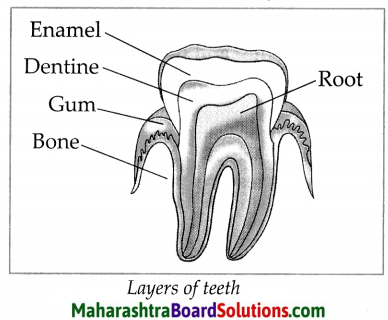
Draw the structure of the different layers of the tooth.
Answer:
Maharashtra Board Class 7 Science Solutions Chapter 12 The Muscular System and Digestive System in Human Beings 2.2

Differentiate between:

Question 1.
Voluntary and Involuntary muscles.
Answer:

Voluntary muscleInvoluntary muscle
1. Voluntary muscle means you can control it consciously.1. Involuntary muscles are controlled by your subconscious. You have no control over them.
2. Skeletal muscles are voluntary muscles.2. Cardiac muscles and smooth muscles are involuntary muscles.
3. Muscles in our arms and legs are voluntary muscles.3. Muscles in heart, stomach, blood vessel, intestine are involuntary muscles.

Maharashtra Board Class 7 Science Solutions Chapter 12 The Muscular System and Digestive System in Human Beings

Question 2.
Skeletal muscle and Cardiac muscle.
Answer:

Skeletal muscleCardiac muscle
1. Skeletal muscles are voluntary muscles.1. Cardiac muscles are involuntary muscles.
2. Muscles in our arms and legs are voluntary muscles.2. Muscles in heart, stomach, blood vessel, intestine are involuntary muscles.
3. They hold bones of the skeleton together and gives shapes to our body.3. They bring about contraction and relaxation of heart.

Maharashtra Board Class 7 Science Solutions Chapter 12 The Muscular System and Digestive System in Human Beings

Answer the following:

Question 1.
What is meant by organ system?
Answer:

  1. There are different structural organizational levels in living organism.
  2. Cells → tissues → organ → organ system → organism
  3. Different organs together form one organ system.

Question 2.
How are the bones in our body joined to each other?
Answer:
Skeleted muscles join two bones with the help of tendons.

Can you tell?

Answer the following questions:

Question 1.
What is the mutual relationship between muscles and bones?
Answer:

  1. Muscles are firmly attached to bones by means of tendons.
  2. When muscles contract there is movement at the joint and there is pull on tendon which in turn pull on the bones to which they are attached.

Maharashtra Board Class 7 Science Solutions Chapter 12 The Muscular System and Digestive System in Human Beings

Question 2.
Are the muscles of the different organs in our body identical?
Answer:
No, muscles of the different organs are not identical, some are voluntary, some are involuntary.

Question 3.
How do muscles perform their functions?
Answer:

  1. Muscles in our body always work in groups.
  2. When some muscles contract other muscles of the same group relax.
  3. This is how muscles help in proper performance of the various functions of own body.

Answer the following questions:

Question 1.
Which parts of our body are made up only of muscles?
Answer:
Tongue, heart, stomach, liver, pancreas, intestines are made up of only muscles.

Question 2.
What would happen if the cardiac muscles do not move?
Answer:

  1. Cardiac muscles cause our heart to relax and contract continuously at a rate of about 70 times per minute.
  2. These muscles bring about the contraction and relaxation (beating) of the heart.
  3. If the cardiac muscles do not move, heart will stop beating, and will not pump blood to other parts of the body and person will die.

Maharashtra Board Class 7 Science Solutions Chapter 12 The Muscular System and Digestive System in Human Beings

Question 3.
Food enters the stomach and the stomach muscles do not move.
Answer:

  1. Smooth muscles are present in the lining of stomach.
  2. Their movement is responsible for churning of food.
  3. If the muscles do not move, food will not be digested.

Question 4.
During digestion does all the food that we have eaten get converted into useful nutritive substances?
Answer:

  1. During digestion not all the food is converted into useful nutritive substance, only whatever nutrients we obtain by digestion of food gets absorbed into the blood in small intestine.
  2. Undigested remains of the food enters the large intestine and thrown out of the body through the anus.

Maharashtra State Board Class 7 Science Textbook Solutions

Natural Resources Class 7 Questions And Answers Maharashtra Board

Std 7 Science Chapter 16 Natural Resources Question Answer Maharashtra Board

Balbharti Maharashtra State Board Class 7 Science Solutions Chapter 16 Natural Resources Notes, Textbook Exercise Important Questions and Answers.

Class 7 Science Chapter 16 Natural Resources Question Answer Maharashtra Board

1. Describe natural resources with reference to the following 3 types:

Question a.
Mineral resources
Answer:
Mineral wealth has an important place among natural resources. The rocks on the earth are mainly made of minerals. These minerals can be obtained by mining. Minerals that contain a high proportion of metals are ores, (i) Minerals are formed from the magma in the earth’s crust and the lava from the eruption of volcanoes when they cool and get transformed into crystals e.g. magnetite, mica, (ii) Minerals get transformed from one form into another due to large changes in temperature and pressure e.g. Diamond, Graphite, (iii) There are 3 types of minerals according to their properties Non-metal minerals: e.g. mica, sulphur, potash, diamond.

  • Metals minerals: e.g. Iron, gold, silver, tin, bauxite, platinum.
  • Energy minerals: e.g. Coal, mineral oil, natural gas, diamond, ruby, sapphire, jade are used as gems.

Some important minerals and ores are Iron ore, manganese, bauxite, copper and mica.

Maharashtra Board Class 7 Science Solutions Chapter 16 Natural Resources

Question b.
Forest resources
Answer:

  1. A forest is a natural habitat of plants, animals and microbes.
  2. Forest perform certain specific protective and productive functions.
  3. We get different types of wood and many medicinal plants from forests.
  4. Forest wealth includes fire wood, trees like teak, mahogany, neem, acacia, subabhul, fibers, paper, rubber, gum, aromatic substances.
  5. We get fragrant essential oils from lemon grass, vanilla, kewada, vetiver (khus) and eucalyptus.
  6. Sandalwood and oil of eucalyptus are used for making soaps, cosmetics and incense sticks.
  7. Also we get fruits, bulbs, roots, honey, sealing wax, dyes from forest.
  8. Many medicinal plants adulsa, bel, neem, periwinkle, cinnamon, are used for treatment of various diseases such as cough cold, malaria, diarrhoea, cancer, fever and cold.
  9. Wood is used as a source of energy for cooking purpose and for keeping warm.
  10. For making furniture, tool handles, matches, bridges, boats etc.
  11. Bamboos are used for matting, flooring, basket, ropes, rafts, cots etc.
  12. Bamboos, wood are used in the manufacture of rayon, yams, artificial silk-fibers.

Question c.
Ocean resources
Answer:

  1. Oceans occupy about 70% of a earth’s surface.
  2. Energy can be obtained on a large scale from oceans.
  3. Sea waves at high and low tide and ocean currents are being used for generation of power.
  4. There are billions of tons of minerals dissolved in ocean water.
  5. There are large reserves of tin, chromium, potassium, phosphates, copper, zinc, iron, lead, thorium, manganese, sulphur, uranium in the ocean and sea beds.
  6. Also we get many types of gems, conches, shells and pearls from the sea.
  7. There are large reserves of mineral oil and natural gas at the bottom of sea.
  8. We get fishes, dried shrimp, shells, fungi, shark, cod fish and sea cucumber from the ocean.

Maharashtra Board Class 7 Science Solutions Chapter 16 Natural Resources

2. Write answers to the following questions in your own words.

Question a.
What is meant by fossil fuel? What are their types?
Answer:

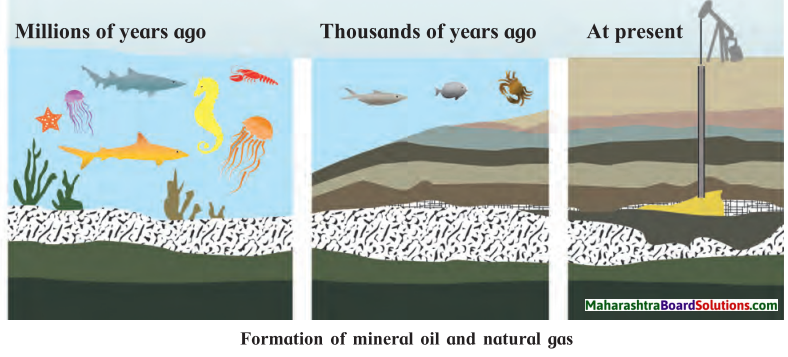
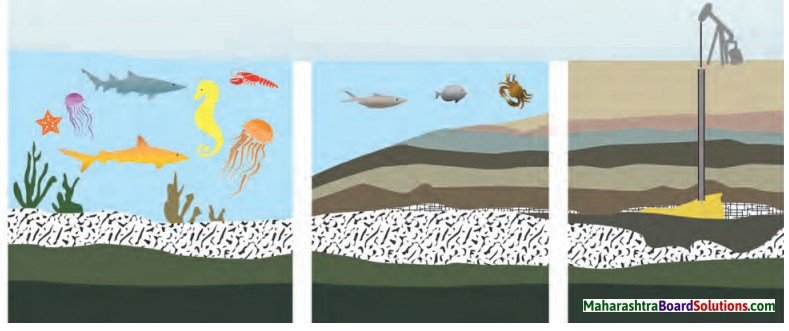
  1. Fossil fuels (such as coal or natural gas) are formed in the earth from dead plants and animals, due to high pressure from above and the heat from the earth’s interior.
  2. The dead plants, animals get transformed into fossil fuel.
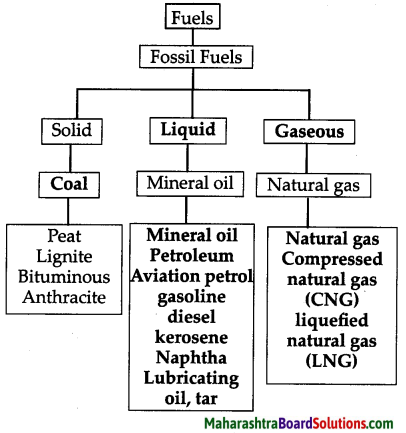
  3. There are three types of fossil fuels which can be used for energy production, Coal, oil and natural gas.

a. Coal:

  1. Coal is a solid fossil fuel formed over millions of years by the decay of land vegetation,
  2. Coal is a store house of carbon. Coal is found in mines,
  3. It is like porous, hard, black rock.
  4. It is burnt to obtain heat energy.
  5. It is used as a fuel in thermal power plants and to run boilers and railway engines, for cooking and baking bricks.
  6. Anthracite is the coal of the highest grade.
  7. Producer gas and water gas are obtained from coal.

b. Mineral oil:

  1. Mineral oil is the liquid fuel formed by the decomposition of organic substances buried underground,
  2. The underground mineral oil is extracted through oil wells.
  3. Mineral oil is found mainly in oil sands, shale, sandstone and limestone at a depth of about 1000 to 3000 metres.
  4. Mineral oil is also known as petroleum or crude oil. It is greenish-brown in colour.
  5. Petroleum is a mixture of many compounds mainly of the hydrocarbon type.
  6. It also contains compounds of oxygen, nitrogen and sulphur.
  7. Petroleum is extracted through oil wells and refined by fractional distillation to separate other components,
  8. Aviation petrol, gasoline, diesel, kerosene, naphtha, lubricating oil, tar are all obtained from petroleum.
  9. They are used as fuel and for production of dyes, pesticides, perfumes and artificial fibres.

c. Natural gas:

  1. Natural gas is an important fossil fuel.
  2. It is lighter than air. It is found with petroleum in underground oil wells and in some places as natural gas alone.
  3. The main component of natural gas is methane (CH4), ethane (C2H6), propane (C3H8) and butane (C4H10) are present in small proportions.
  4. This gas is highly flammable.
  5. This fuel can be carried over long distance by means of a gas pipeline.
  6. In absence of pipeline, it is transformed under high pressure into compressed natural gas (CNG) and liquefied natural gas (LNG).

Maharashtra Board Class 7 Science Solutions Chapter 16 Natural Resources

Question b.
Make a list of the components we obtain from mineral oil.
Answer:

  1. Mineral oil is the liquid fuel. It is also known as petroleum or crude oil. Petroleum is refined by fractional distillation to separate other components.
  2. Aviation petrol, gasoline, diesel, kerosene, naphtha, lubricating oil, tar are the components we obtain from mineral oil.

Question c.
What do we get from forest?
Answer:

  1. A forest is a natural habitat of plants, animals and microbes. We get wood, firewood from trees like teak, mahogany, neem, subabhul.
  2. Also we get fibers, paper, rubber, gum and aromatic substances.
  3. We get many medicinal plants like Adulsa, Bel, Neem, Periwinkle, Cinnamon, Cinchona which are used for treatment of various diseases like cough, cold, diarrhea, fever, cancer, diarrhoea, nausea, malaria.
  4. We get fragrant essential oils from lemon grass, vanilla, kewada, khus, eucalyptus.
  5. In addition to this we get fruits, bulbs and roots, honey, sealing wax, catechu, dyes from forest.

Maharashtra Board Class 7 Science Solutions Chapter 16 Natural Resources

Question d.
What are the items included in ocean resources? What are their uses?
Answer:

  1. Tons of minerals are found in ocean water.
  2. They are tin, chromium, phosphates, copper, zinc, iron, lead, manganese, sulphur, uranium etc.
  3. We also get many types of gems, conches, shells and pearls from the sea.
  4. Mineral oil and natural gas is found at the bottom of sea.

Bio-resources in oceans

  • Fishes – like pomfret, seer fish as also shrimps
  • prawns – they are sources of proteins and vitamins, therefore, mainly used as sea food
  • Dried shrimp, Bombay duck powder – used as poultry feed and is a good manure.
  • Shells – used for preparation of medicines, ornaments and decorative articles.
  • Fungi – used for the production of antibiotics.
  • shark and cod fish – used for producing edible oil rich in Vitamins A, D and E.
  • Sea cucumbers – used as medicine for treating cancer and tumours.

Mineral resources from oceans

  • Thorium – used in the production of atomic energy.
  • Magnesium – used in the flash bulb of a camera.
  • Potassium – the main ingredient in production of soap, glass, fertilizer.
  • Sodium – used in the production of cloth and paper.
  • Sulphate – used in making artificial silk.

Maharashtra Board Class 7 Science Solutions Chapter 16 Natural Resources

Question e.
Why should we prevent the wastage of fuels used for vehicles?
Answer:

  1. Vehicles are powered by gasoline or diesel petrol.
  2. Nowadays compressed natural gas (CNG) is also used.
  3. Aviation petrol, gasoline, diesel, we get from petroleum after fractional distillation.
  4. Petroleum is a non-renewable source of energy.
  5. It is getting depleted day by day and the demand for fuel has increased greatly due to the rapidly growing population.
  6. But the reserves of petroleum (fossil fuel) are limited.
  7. It is becoming difficult to meet the increased demand. So we should prevent the wastage of fuel.

Question f.
Why is the diversity of plants and animals in the forests declining?
Answer:

  1. The major causes of biodiversity decline are land use changes, pollution, changes in atmosphere, CO2 concentration, changes in the nitrogen cycle, acid rain, climate alteration and introduction of exotic species.
  2. All this is due to population growth.
  3. This is the main cause of the loss of biodiversity. More of wood for fuel is been used, more land is required for food production, livestock grazing etc.
  4. Rainforest land is converted to industrial and residential usage, so natural habitat of birds, animals is destroyed.
  5. Due to population growth most of wild land is converted to crop land. So no space for animals to live, their natural habitat is destroyed.

Maharashtra Board Class 7 Science Solutions Chapter 16 Natural Resources

Question g.
Write the names of five minerals and the useful substances obtained from them.
Answer:
Some important minerals and ores are:

  1. Iron ore: It is used for making farming implements, rails of railway tracks etc.
  2. Manganese: Compounds of manganese are used in the preparation of medicines and for giving a pink tinge to glass. Manganese is also used in electrical appliances.
  3. Bauxite: It contains 55% Aluminium. Therefore, it is used mainly in aeroplanes, transport vehicles and to make electric wire.
  4. Copper: It is used to make electric wires as well as in radios, telephones, vehicles, and for making kitchen utensils and statues.
  5. Mica: Mica has many uses such as in ayurvedic medicines, dyes, electric machines and equipment, wireless communication equipment, etc.

Maharashtra Board Class 7 Science Solutions Chapter 16 Natural Resources

Question h.
Name the two important stages in the process of obtaining metals from ores.
Answer:
The two important stages in the process of obtaining metals from ores are extraction and purification.

3. What steps are taken for protection and conservation of natural resources?

Question a
What steps are taken for protection and conservation of natural resources?
Answer:

  1. Protection and conservation of natural resources is necessary to protect the natural world. (CNRM) Community Natural Resource Management has been promoted in recent years for biological conservation.
  2. The World Conservation Union has been formed. It is the world’s leading authority and democratic platform in conservation and sustainability.
  3. Young trees should not be cut. More and more trees need to be grown.
  4. The stringent restrictions/ laws/ Regulations regarding use of forests should be strictly followed. Awareness is being created through Mass media.

Maharashtra Board Class 7 Science Solutions Chapter 16 Natural Resources

4. Complete the Flow Chart:

Question a.
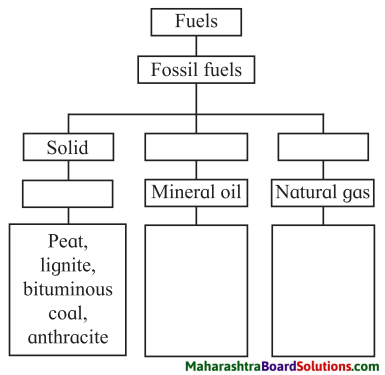
Maharashtra Board Class 7 Science Solutions Chapter 16 Natural Resources 1

Answer:
Maharashtra Board Class 7 Science Solutions Chapter 16 Natural Resources 2

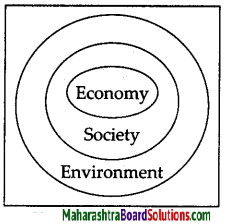
5. How does the economic condition of a nation depend on its natural resources?

Question a.
How does the economic condition of a nation depend on its natural resources?
Answer:
1. Natural resources are a necessary condition for economic growth.
2. Three circles enclosed within one another shows how both economy and society are subsets of our planetary ecological system.
Maharashtra Board Class 7 Science Solutions Chapter 16 Natural Resources 3
3. Natural resource economics deals with the supply, demand and allocation of the Earth’s natural resources.
4. Economic growth is an increase in the value of goods and services produced in an economy.
5. The natural resources of a country depend on the climatic and environmental conditions.
6. Countries having plenty of natural resources enjoy good growth than countries with small amount of natural resources.
7. A country having skilled and educated work force with rich natural resources takes the economy on the growth path, because skilled and educated people can efficiently utilize or exploit natural resources, e.g. Saudi Arabia: their economic growth is high, because they have oil wells.
8. All countries import fuel or oil from them so Saudi Arabia is economically a rich country.

6. Which medicinal plants will you grow on your school premises and near your house? Why?

Question a.
Which medicinal plants will you grow on your school premises and near your house? Why?
Answer:
1. I will grow tulsi, neem, lemon grass, bel, adulsa, periwinkle, cinnamon, ashwagandha, shatavari, amla, hirda, behda.
2. These plants are used for treatment of various diseases.

  • Tulsi → for cough and cold.
  • Amla, hirda, behda → Help in digestion of food or any stomach related problems.
  • Adulsa → for cough and cold
  • Bel → for Diarrhoea
  • Neem → Fever and cold
  • Periwinkle → Cancer
  • Cinnamon → Diarrhoea, nausea.
  • Cinchona → Malaria.
  • Ashwagandha → It can reduce blood sugar levels. It can reduce stress and anxiety, may reduce symptom of depression.
  • Shatavari → has been used for centuries in Ayurveda to support the reproductive system.
  • Amla → Excellent source of vitamin C. Amla juice is best tonic to keep you younger for long.
  • Hirda → This fruit is commonly called Haritaki. It is used for treating arthritis, dental problems like caries, bleeding gums.
  • Behda →(Beleric) is a rejuvenative and laxative, proves beneficial for hair, throat and eyes.
  • Tulsi → Tulsi has germicidal, fungicidal, anti-bacterial anti-biotic properties, cures fever. Treats diabetes, protects the heart. Tulsi has anti-oxidant component Eugenol which keeps one’s blood pressure under control.

Maharashtra Board Class 7 Science Solutions Chapter 16 Natural Resources

Project:

Question 1.
Collect conches and shells of various shapes and colours and make a decorative article.

Question 2.
Collect information about the mines of various minerals.

Class 7 Science Chapter 16 Natural Resources Important Questions and Answers

Fill in the blanks:

Question 1.
………….. is the major raw material for biogas.
Answer:
cow dung

Question 2.
Atomic energy is obtained by using ores of ………….. .
Answer:
Uranium

Maharashtra Board Class 7 Science Solutions Chapter 16 Natural Resources

Question 3.
Biogas generation is mainly based on the principle of ………….. .
Answer:
Fermentation

Question 4.
Floods can be prevented by ………….. .
Answer:
Afforestation

Question 5.
Coal, petroleum, natural gas are ………….. resources.
Answer:
non-renewable

Question 6.
The total percent of land of world under forest cover is ………….. .
Answer:
30%

Question 7.
A naturally occurring substance ………….. .
Answer:
minerals

Question 8.
Minerals that contain a high proportion of metal are called ………….. .
Answer:
ore

Maharashtra Board Class 7 Science Solutions Chapter 16 Natural Resources

Question 9.
Coal, mineral oil and natural gas are ………….. .
Answer:
fossil fuel

Question 10.
Deposits of common salt are also found in the earth. This salt is called ………….. .
Answer:
rock salt

Question 11.
………….. is the liquid fuel formed by the decomposition of organic substances.
Answer:
Mineral oil

Question 12.
The underground mineral oil is extracted through ………….. .
Answer:
oil wells

Maharashtra Board Class 7 Science Solutions Chapter 16 Natural Resources

Question 13.
Mineral oil is also known as ………….. or ………….. .
Answer:
petroleum, crude oil

Question 14.
………….. are the preserved remains of dead organisms in rock.
Answer:
Fossil

Question 15.
Coal can be formed from ………….. .
Answer:
Fossils

Question 16.
Impurities of sand and soil in ore are called ………….. .
Answer:
Gangue

Question 17.
Coal mainly contains ………….. .
Answer:
carbon

Maharashtra Board Class 7 Science Solutions Chapter 16 Natural Resources

Question 18.
Petroleum is formed from ………….. .
Answer:
organisms in sea

Question 19.
Separation of various fractions of petroleum is called ………….. .
Answer:
Refining

Question 20.
We can obtain minerals from rocks by ………….. .
Answer:
mining

Question 21.
………….. is the most important ore of aluminium
Answer:
Bauxite

Question 22.
………….. is the coal of the highest grade.
Answer:
Anthracite

Maharashtra Board Class 7 Science Solutions Chapter 16 Natural Resources

Question 23.
Metals are obtained from their ore by ………….. and ………….. .
Answer:
extraction, purification

Question 24.
………….. is the largest oil and gas research and production company in India.
Answer:
ONGC

Question 25.
Natural gas is transformed under high pressure into ………….. and ………….. .
Answer:
LNG and CNG

Maharashtra Board Class 7 Science Solutions Chapter 16 Natural Resources

Question 26.
The main component of Natural gas is ………….. .
Answer:
Methane

Question 27.
………….. and ………….. are used for adding fragrance in soaps and incense sticks.
Answer:
Sandalwood and oil of Encalyptus

Question 28.
………….. is a natural herbal medicine for cough and cold.
Answer:
Adulsa

Maharashtra Board Class 7 Science Solutions Chapter 16 Natural Resources

Answer the following:

Question 1.
What is meant by natural resources?
Answer:

  1. We get many substances from nature.
  2. They satisfy a variety of our daily needs. Soil, stones, minerals, air, water, plants and animals on the earth are all various kinds of natural resources.

Question 2.
What are alternative fuels?
Answer:
Hydrogen, biofuels, methanol or wood alcohol, ethanol or green alcohol are some of the alternative fuels.

Maharashtra Board Class 7 Science Solutions Chapter 16 Natural Resources

Question 3.
What is meant by fuels?
Answer:

  1. Fuel is a substance that is used in day-to-day life and burned to generate energy.
  2. Fuels such as coal, wood, oil, gas provide energy when burned.
  3. Fuels are found in solid, liquid or gaseous state.

Question 4.
Which natural resources do we use as fuels?
Answer:
We use coal, mineral oil and natural gas as fuels.

Question 5.
What is meant by forests?
Answer:
An extensive area of land covered by a variety of plants is called a forest. A forest is a natural habitat of plants, animals and microbes.

Maharashtra Board Class 7 Science Solutions Chapter 16 Natural Resources

Question 6.
What are the uses of forests?
OR
Write short note on forest and its uses.
Answer:

  1. A forest is a natural habitat of plants, animals and microbes.
  2. Forest help improve and maintain the quality of environment.
  3. Forest helps in prevention of soil-erosion, help to control floods, protects wild life, maintains the balance of atmospheric gases.
  4. We get many medicinal plants from forest which help in treatment of various diseases.
  5. Examples Adulsa, Bel, Neem, periwinkle, amla tulsi, cinnamon.
  6. We also get wood, firewood from trees like teak, mahogani, neem, sababhul. Wood is useful for making furniture, farming implements, in construction work.
  7. Forest wealth includes fibres, paper, rubber, gum and aromatic substances.
  8. We get fragrant essential oils from lemon grass, vanilla, kewada and eucalyptus.
  9. They are used for making soaps, cosmetics and incense sticks. We get various fruits, bulbs, roots, honey, sealing wax, catechu dyes etc. from forest.

Question 7.
Are minerals to be found in seas and on the seabed as they are found inside the earth?
Answer:
Yes, there are very large reserves of tin chromium, phosphates, copper, zinc, iron, lead, manganese, sulphur, uranium etc. in the ocean and seabed.

Maharashtra Board Class 7 Science Solutions Chapter 16 Natural Resources

Question 8.
How is mineral oil formed?
Answer:
Maharashtra Board Class 7 Science Solutions Chapter 16 Natural Resources 4

  1. Mineral oil is the liquid fuel formed by the decomposition of organic substances buried underground.
  2. Millions of years ago, bodies of dead sea organisms sank to the bottom of the sea.
  3. Layers of soil and sand collected on them.
  4. Due to high pressure and temperature the remains of the dead organisms were transformed into mineral oil.
  5. The underground mineral oil is extracted through oil wells.

Maharashtra Board Class 7 Science Solutions Chapter 16 Natural Resources

Use your brain power!

Question 1.
Why are all minerals not ores?
Answer:

  1. Minerals that contain a high proportion of metal are called ores.
  2. Majority of the metals occur in the form of compounds called ores.
  3. But all minerals are not ores.
  4. Few metals like gold, silver, copper, platinum and bismuth occur in free state in nature. So all minerals are not ores.

Question 2.
What is meant by metal mineral and non¬metal mineral?
Answer:

  1. Metal-minerals contain metallic elements in their chemical formula. So they are called metal-minerals, for example, iron, copper, gold, silver etc.
  2. They contain metal in raw form.
  3. Non-metallic minerals do not contain metal elements in their inorganic chemical formula Example, Clay, Diamond, Dolomite, Gypsum, Mica, Quartz.

Maharashtra Board Class 7 Science Solutions Chapter 16 Natural Resources

Question 3.
Why is mineral oil called ‘liquid gold’?
Answer:
Because of its high price and value and its economic need, the mineral oil is called liquid gold. It’s reserve is less and demand is more.

Question 4.
Why is coal called black gold?
Answer:

  1. Coal is a storehouse of carbon. Coal is used as a fuel, in thermal power plants as well as to run boilers and railway engines.
  2. It is used as a fuel for cooking and for baking bricks in kilns on a large scale.
  3. The gaseous fuels, producer gas and water gas are obtained from coal.
  4. Coal as an energy resource, contributes greatly to industrial development.
  5. As coal is black in colour and worth a lot of money just like gold, it is called black gold.

Question 5.
What would happen if underground mineral resources are exhausted?
Answer:

  1. Coal, petroleum and other mineral are all non-renewable sources of energy.
  2. The reserve is less and demand is more. They would get exhausted one day.
  3. If such a situation occurs, we will not get electricity.
  4. All our household and industries depend on electricity.
  5. Transportation and household items, and food items would become very costly.
  6. The survival of human life will be ver\ difficult.

Maharashtra Board Class 7 Science Solutions Chapter 16 Natural Resources

Question 6.
Why is natural gas an eco-friendly fuel?
Answer:

  1. Natural gas is an important source of energy which is eco-friendly because of its low carbon dioxide emission.
  2. When burned it produces 45% less CO2 than coal, 30% less than oil, and about 15% less than wood.
  3. It does not produce carbon monoxide, sulphur dioxide or airborne particles, all of which are harmful to human and animal health.
  4. It is referred as the clean energy source and is fuel for the present century as it does not ‘ pollute the atmosphere or contribute to global warming.

Question 7.
What useful things will we have to do without if rubber is no longer available?
Answer:

  1. Rubber has played a largely hidden role in global environment history for more than 150 years.
  2. In industries, rubber is needed to connect and protect all moving parts of machines.
  3. Native people used rubber for rubber boots.
  4. Household uses rubber in everything viz dish washing gloves, toys, jar seals, tyres in vehicles.
  5. Welcome mat at the door, Boots, raincoats, mattress cushions, earplugs, hot water bottles, surgical tubing and gloves, in labs, birth control device.
  6. In schools rubber bands, erasers, mouse pads, key board, rolling chair wheels. Head phone pads, rubber stamps are useful items used in schools and offices.

Maharashtra Board Class 7 Science Solutions Chapter 16 Natural Resources

Question 8.
What are the adverse effects of clearing of forest or cutting down trees?
Answer:

  1. Clearing of forest is also called Deforestation.
  2. Removal or cutting down of trees has resulted in damage to habitat, biodiversity loss and aridity.
  3. If has adverse impacts on concentration of atmospheric carbon dioxide. (Trees use up carbon dioxide from the atmosphere for the process of photosynthesis.)
  4. Deforestation is a main contributor to global warming. Major cause of enhanced greenhouse effect. Deforestation cause carbon dioxide to linger in the atmosphere.
  5. Deforestation reduced the content of water in the soil and ground water and atmospheric moisture, because trees extract ground water through the roots and release it into the atmosphere.
  6. When a part of forest is removed the trees no longer transpire this water, resulting in much drier climate.
  7. Due to deforestation soil erosion and flooding, landslide problems occur.
  8. Deforestation results in decline in biodiversity, on a natural global scale is known to cause the extinction of many species.
  9. Forest is habitat for wild life, and many medicinal plants. If forests are removed it will affect wild life and also we will not get medicinal plants.

Find out:

Question 1.
How did the various ages of the prehistoric period get their names on the basis of the uses of metals.
Answer:
1. The three-age system in history archaeology, and physical anthropology is a methodological concept adopted during the 19th century by which artifacts and events of late prehistory and early history could be ordered into a recognizable chronology.

2. Initially developed by C. J. Thomson, director of the Royal Museum of Nordic Antiquities, Copenhagen – as a means to classify the museum’s collection according to whether the artifacts were made of stone, bronze or iron.

3. Depending-upon the use of stone, bronze, iron, that period was known as stone age, bronze age, and iron age, respectively.

Maharashtra Board Class 7 Science Solutions Chapter 16 Natural Resources

Answer the following:

Question 1.
Write down the difference between Metal minerals and Non-metallic minerals.
Answer:

Metal mineralsNon-metallic minerals
1. Metal minerals contain metal in raw form.1. Non-metallic minerals do not contain metal.
2. These metals are generally associated with igenous rocks.2. These metals are generally associated with sedimentary rocks.
3. They are usually hard and have shine of their own.3. They are not usually hard, have no shine of their own.
4. e.g. Iron, copper tine, bauxite.4. e.g. Salt, coal, mica, clay.

Question 2.
Write down the different types of coal.
Answer:
Peat, lignite (brown coal), bituminous coal and anthracite are various types of coal.
Anthracite is the coal of the highest grade.

Maharashtra Board Class 7 Science Solutions Chapter 16 Natural Resources

Question 3.
Write down the characteristics of Compressed Natural Gas.
Answer:
Characteristics of CNG:

  1. Catches fire easily.
  2. No solid waste remains after combustion.
  3. Carbon dioxide and water are formed in small quantities.
  4. Other pollutants are not produced.
  5. Can be transported easily.
  6. Combustion can be controlled easily.

Observe the pictures and answer the question.

Maharashtra Board Class 7 Science Solutions Chapter 16 Natural Resources 5

Question a.
What is the process shown in the given picture?
Answer:
The process shown is formation of mineral oil and natural gas.

Maharashtra Board Class 7 Science Solutions Chapter 16 Natural Resources

Question b.
Explain the process.
Answer:

  1. Mineral oil is the liquid fuel formed by the decomposition of organic substances buried underground.
  2. Millions of years ago, bodies of dead sea organisms sank to the bottom of the sea.
  3. Layers of soil and sand collected on them.
  4. Due to high pressure and temperature the remains of the dead organisms were transformed into mineral oil.
  5. The underground mineral oil is extracted through oil wells.

Question c.
What are the gaseous substances formed in the above process?
Answer:
Natural gas is also formed along with mineral oil. It contains methane, ethane, propane and butane gases.

Maharashtra Board Class 7 Science Solutions Chapter 16 Natural Resources

Question d.
When the products of the process is refined, what other components are produced?
Answer:
When mineral oil is refined by fractional distillation products produced are petrol, diesel, kerosene, naphtha lubricating oil, tar, etc.

Maharashtra State Board Class 7 Science Textbook Solutions

In the World of Stars Class 7 Questions And Answers Maharashtra Board

Std 7 Science Chapter 20 In the World of Stars Question Answer Maharashtra Board

Balbharti Maharashtra State Board Class 7 Science Solutions Chapter 20 In the World of Stars Notes, Textbook Exercise Important Questions and Answers.

Class 7 Science Chapter 20 In the World of Stars Question Answer Maharashtra Board

1. Write the proper words in the blanks:
(meridian, horizon, twelve, nine, apparent, celestial, ecliptic)

Question a.
When seen from a great distance, the sky seems to be touching the ground along a circle. This circle is called the …………… .
Answer:
horizon

Question b.
The ………….. is used while defining the zodiac sign.
Answer:
meridian

Maharashtra Board Class 7 Science Solutions Chapter 20 In the World of Stars

Question c.
Classified according to seasons, one season will have ………… nakshatras.
Answer:
nine

Question d.
The rising of the sun in the east and its setting in the west is the ………. motion of the sun.
Answer:
apparent

2. A star rises at 8 pm. tonight. At what time will it rise after a month? Why?

Question a.
A star rises at 8 pm. tonight. At what time will it rise after a month? Why?
Answer:

  1. Str s rise and set 4 minutes earlier every day. If star rises at 8 pm tonight, it will rise at 7:56 pm tomorrow.
  2. It will rise at 5:24 pm after a month.
  3. The sun and the moon are seen to move from the west to the east against the background of stars.
  4. The sun moves through one degree every day and the moon through 12 to 13 degrees.
  5. This happens due to the motion of the earth around the sun and the moon around the earth which affects the duration of the stars and shortens its time period.

Maharashtra Board Class 7 Science Solutions Chapter 20 In the World of Stars

3. What is meant by “The sun enters a nakshatra?” It is said that in the rainy season the sun enters the mrug nakshatra. What does it mean?

Question a.
What is meant by “The sun enters a nakshatra?” It is said that in the rainy season the sun enters the mrug nakshatra. What does it mean?
Answer:

  1. When we look at the sun we see not only the sun but also constellation behind the sun.
  2. The constellation cannot be seen in bright sunlight but it is indeed present behind the sun.
  3. As the earth changes its position, a different constellation or zodiac sign or raashi appears behind the sun.
  4. This is what we express when we say that the sun enters a particular zodiac sign or raashi.
  5. In rainy season due to the perceived motion of the sun, it enters mrug nakshatra and that is how it is expressed.

Maharashtra Board Class 7 Science Solutions Chapter 20 In the World of Stars

4. Answer the following questions. 

Question a.
What is a constellation?
Answer:
A group of stars occupying a small portion of the celestial sphere is called a constellation.

Question b.
What points should be considered before a skywatch?
Answer:

  1. The place for sky watching should be away from the city and as far as possible it should be new moon night.
  2. Binoculars or telescopes should be used for skywatch.
  3. Identifying the pole star in the north makes the skywatch easier. Hence the pole star should be used as a reference point for skywatch.
  4. As the stars in the west set early, sky watching should begin with stars in the west.
  5. (a) On a sky map, the north and south are towards the bottom and top of the map respectively, (b) This is because the sky map is to be held overhead in such a way that the direction we face is at the bottom side.

Question c.
It is wrong to say that the planets, stars and nakshatras affect human life. Why?
Answer:

  1. Science has proved that the constituents of the solar system e.g. planets, satellites and comets as also distant stars and constellations do not have any influence on human life.
  2. Man has stepped on the moon and will conquer Mars in the 21st century.
  3. Hence, in this age of science, holding on to beliefs which have been proved wrong by numerous scientific tests, is an unnecessary waste of time and energy.
  4. It is important to consider all these issues with a scientific frame of mind.

Maharashtra Board Class 7 Science Solutions Chapter 20 In the World of Stars

5. Write a paragraph on the birth and life cycle of stars using following figure.

Question a.
Write a paragraph on the birth and life cycle of stars using following figure.
Maharashtra Board Class 7 Science Solutions Chapter 20 In the World of Stars 1Answer:
Stars are born out of nebulae. Nebulae are clouds made up mainly of hydrogen gas and dust particles which are attracted towards one another by the force of gravity, (i) As a result of pressure, the internal temperature increases and the cloud becomes dense and spherical in shape, (ii) From the diagram, life cycle of two stars can be explained.

(a) Ordinary star: (i) The ordinary star forms a Red giant star at the later stage of its evolution when it runs out of hydrogen gas at its core. (ii) At the end stage of its life it forms a white dwarf. Stars like the sun become white dwarf when its nuclear fuel is totally exhausted. (iii) It is 1% in diameter of its original size.

(b) Massive Star: (i) Massive star forms Red super giant star at the end of its life cycle, (ii) They are also called super red giants with a relatively cool outer surface, (iii) Supernova is the explosive death of the star of the end of its life with the brightness of 100 million stars in a short amount of time, (iv) A neutron star is the dense core of the supernova. (v) It is the smallest and the densest star known to exist with a 10 km radius, (vi) Neutron stars sometimes end as a black hole, (vii) Black holes are not seen from telescopes and are identified by their intense gravitational pull where even light cannot escape.

Maharashtra Board Class 7 Science Solutions Chapter 20 In the World of Stars

Project:

Question a.
Visit a planetarium, collect information and present it in your school on Science day.

Class 7 Science Chapter 20 In the World of Stars Important Questions and Answers

Fill in the blanks:

Question 1.
The different group of stars is known as ………….. .
Answer:
constellation

Question 2.
The pole star is ………….. .
Answer:
North star

Question 3.
The moon moves around the earth in about ………….. days.
Answer:
27 days

Maharashtra Board Class 7 Science Solutions Chapter 20 In the World of Stars

Question 4.
The celestial objects are ………….. .
Answer:
The stars

Question 5.
The star that lies close to the aris of rotation of the earth ………….. .
Answer:
Pole star

Question 6.
The definite elliptical path in which a planet revolves around the sun is called ………….. .
Answer:
Orbit

Question 7.
Our earth as well as the sun belongs to the galaxy which has a spiral shape called ………….. .
Answer:
milky way

Question 8.
………….. is made up of five bright stars which are distributed along the figure of the letter M.
Answer:
Sharmishtha

Maharashtra Board Class 7 Science Solutions Chapter 20 In the World of Stars

Question 9.
The pole star has ……………. on one-side and ……………… on the other.
Answer:
Saptarashi, Sharmishtha

Question 10.
The continuous empty space between the planets and stars in the sky is called ………….. .
Answer:
space

Name the following:

Question 1.
The brightest star in the nakshatra.
Answer:
Yogatara

Question 2.
The stars forming a group that has a recognizable shape.
Answer:
Constellation

Question 3.
Millions of stars and planets present in the sky forming a group.
Answer:
Milky way

Maharashtra Board Class 7 Science Solutions Chapter 20 In the World of Stars

Question 4.
The clouds from which stars are bom.
Answer:
Nebulae

Question 5.
Saptarshi constellation in English.
Answer:
Great Bear

Question 6.
The festival celebrated when sun enters Makar raashi.
Answer:
Makara Sankranti

Maharashtra Board Class 7 Science Solutions Chapter 20 In the World of Stars

Question 7.
The brightest star in the Orion constellation.
Answer:
Sirius

State whether the following statements are True or False. Correct the false statements:

Question 1.
The hydrogen gas and dust particles in a nebulae are attracted towards each other by gravity.
Answer:
True

Question 2.
While standing on the ground, the celestial sphere exactly below our feet is called the Zenith.
Answer:
False. The point on the celestial sphere exactly above our head is called the Zenith

Question 3.
The circle describing the apparent motion of the earth around the sun is called the ecliptic.
Answer:
False. Ecliptic is the apparent motion of sun around the earth

Maharashtra Board Class 7 Science Solutions Chapter 20 In the World of Stars

Question 4.
Vrushchik or Scorpio is a constellation with 10 to 12 stars.
Answer:
True

Question 5.
Makar raashi is also known as Capricorn zodiac sign.
Answer:
True

Match the following:

Question a.

Column ‘A’Column ‘B’
1. Saptarshia. Divided into 88 constellations
2. Mmg nakshatra.b. In the north direction.
3. Orionc. Group of 7 bright stars (kite)
4. Vrushchikd. Made up of 5 bright stars (M)
5. Pole stare. 7 – 8 stars.
6. Celestial spheref. Group of 10 -12 stars

Answer:

Column ‘A’Column ‘B’
1. Saptarshic. Group of 7 bright stars (kite)
2. Mmg nakshatra.d. Made up of 5 bright stars (M)
3. Orione. 7 – 8 stars.
4. Vrushchika. Divided into 88 constellations
5. Pole starb. In the north direction.
6. Celestial spheref. Group of 10 -12 stars

Maharashtra Board Class 7 Science Solutions Chapter 20 In the World of Stars

Answer in one line:

Question 1.
In which direction stars move in the sky except polar star?
Answer:
When seen from earth, stars appear to move from east to west.

Question 2.
What activity does IUCAA carry out?
Answer:
IUCAA which is present in PUNE carries out fundamental research in astronomy.

Question 3.
Define constellation.
Answer: A group of stars occupying a small portion of the celestial sphere is called constellation.

Maharashtra Board Class 7 Science Solutions Chapter 20 In the World of Stars

Question 4.
What is Nakshatra?
Answer:
The moon completes one revolution around the earth in approximately 27 days. The portion celestial sphere traversed by the moon in one day is called a nakshatra.

Question 5.
What is yogatara?
Answer:
A nakshatra is known from the brightest star that it contains. The brightest star is called the yogatara.

Define the following:

Question 1.
Horizon
Answer:
Far away the sky seems to be touching the ground. The line at which they meet is caled horizon.

Question 2.
Zenith
Answer:
While standing on the ground the point on the celestial sphere exactly above our head is called the Zenith.

Question 3.
Nadir
Answer:
While standing on the ground the point on the celestial sphere exactly below our feet is called the nadir.

Maharashtra Board Class 7 Science Solutions Chapter 20 In the World of Stars

Question 4.
Meridian
Answer:
The great circle which passes through both the celestial poles and the observer’s zenith and nadir is called a meridian.

Question 5.
Celestial equator
Answer:
If we uniformly expand earth’s equator in all directions indefinitely, it will penetrate the celestial sphere along a circle. This circle is known as the celestial equator.

Question 6.
Ecliptic
Answer:
The earth moves around the sun, but seen from the earth, the sun appears to move along a circle on the celestial sphere. This circle describing the apparent motion of the sun around the ‘ earth is called the ecliptic.

Maharashtra Board Class 7 Science Solutions Chapter 20 In the World of Stars

Question 7.
Zodiac sign
Answer:
The ecliptic has been imagined to divided into 12 equal parts. Each part subtends 30 degrees at the centre of the celestial sphere. Each of these part is called a raashi or zodiac sign.

Question 8.
Mrug Nakshatra or Orion
Answer:
It has 7 – 8 starts of which four are at the comers of quadrangle. The line passing through the three middle stars of the constellation when extended meets a very bright star. This is Vyadh or Sirius.

Maharashtra Board Class 7 Science Solutions Chapter 20 In the World of Stars

Find out.

Answer the following questions

Question 1.
Using a Marathi calendar collect information about 27 nakshatras, and divide them into the following 3 categories.
(i) Monsoon Nakshatra (ii) Winter Nakshatra (iii) Summer Nakshatra
Answer:
27 nakshtras: Ashwini, Bharani, Krittika, Rohini, Mrigashirasha, Ardra, Punarvasu, Pushya, Ashlesha, Magha, PurvaPhalguni, Uttara Phalguni, Hasta, Chitra, Swati, Vishakha, Anuradha, Jyeshtha, Mula, Purva Ashadha, Uttara Ashadha, Abhijit, Shravana, Dhanishtha, Shatabhishta, Purva Bhadrapada, Uttara Bhadrapada, Revati

Monsoon SeasonWinter SeasonSummer Season
Ashwini KartheKrittikaVisakha
Bharani KartheRohiniAnuradha
Arudra KartheMrigashirshaJyeshtha
PushyaniArdraMula
AsleshaPunarvasuPurva Ashadha
MaghaUttara Ashadha
Purva PhalguniShravana
Uttara Phalguni
Chitra
Hasta

Maharashtra Board Class 7 Science Solutions Chapter 20 In the World of Stars

Question 2.
Write the difference between constellations Saptarshi and Mrug nakshatra
Answer:

SaptarshiMrug nakshatra
1. It is made up of five bright stars which are distributed along the figure of the letter M.1. It is made up of seven-eight stars of which four are at the corners of a quadrangle.
2. Pole star is the brightest star in the constellation.2. Sirius is the brigh jveutr0n Starie constellation.
3. It is on the meridian in the month of April and in the month of October.3. It is on the meridian in the month of February and in June.
4. In English, it is called the Great Bear.4. In English, it is called Orion.

Maharashtra Board Class 7 Science Solutions Chapter 20 In the World of Stars

Question 3.
Draw sketches to show the relative position of prominent stars in Ursa major and Orion.
Answer:
a. Ursa major (Saptarshi) appears like a big dipper, (or kite shape). There are 3 bright stars in the handle and 4 stars in the bowl of the dipper. (It can be seen during April in summer in northern skies).
Maharashtra Board Class 7 Science Solutions Chapter 20 In the World of Stars 2

(b) Orion appears like a hunter. Three bright stars appear in the belt, 5 bright stars are arranged in the form of a quadrilateral. (It is visible during winter in the northern skies)

Maharashtra Board Class 7 Science Solutions Chapter 20 In the World of Stars 3

Question 4.
Why is the pole star important for sky watch?
Answer:

  1. Identifying the Pole Star in the north makes the sky watch easier. Hence the pole star should be used as a reference point for skywatch.
  2. If we extend one side of the quadrangle of Saptarshi, it reaches the Pole Star.
    The pole star has Saptarshi on one side and Sharmishtha on the other.

Maharashtra Board Class 7 Science Solutions Chapter 20 In the World of Stars

Question 5.
What is the relation between the pole star and the constellations Saptarshi and Sharmishtha?
Answer:

  1. Saptarshi is in the shape of a quandrangle with a tail made up 3 stars resembling a kite. If we extend one side of the quadrangle it reaches the Pole Star.
  2. The constellations of Saptarshi and Sharmishtha are useful in locating the Pole Star.
  3. The perpendicular bisector of the line joining the third and fourth stars in Sharmishtha goes towards the Pole star.
  4. The Pole Star has Saptarshi on one side and Sharmishtha on the other.

Maharashtra Board Class 7 Science Solutions Chapter 20 In the World of Stars 4

Use your brain power!

Answer the following questions.

Question 1.
One Zodiac Sign = ………….. nakshatras
Answer:
27 nakshatras. Each nakshatra is divided in padas or charan. Every nakshatra has 4 padas. These 27 nakshatra complete the entire circle of 360° of zodiac.
The zodiac comprises of 360°.

Maharashtra Board Class 7 Science Solutions Chapter 20 In the World of Stars

Question 2.
Is sun the only star present in our Milky Way galaxy?
Answer:
No. Sun is not the only star present in the Milky Way. There are lakhs of stars in the Milky Way, some of them being many times bigger than our sun. Some of them have their own planetary systems with a great diversity in colour, brightness, as well as size.

Maharashtra State Board Class 7 Science Textbook Solutions

Materials We Use Class 7 Questions And Answers Maharashtra Board

Std 7 Science Chapter 15 Materials We Use Question Answer Maharashtra Board

Balbharti Maharashtra State Board Class 7 Science Solutions Chapter 15 Materials We Use Notes, Textbook Exercise Important Questions and Answers.

Class 7 Science Chapter 15 Materials We Use Question Answer Maharashtra Board

1. Fill appropriate terms in the blanks:
(white cement, soap, detergent, wearing of bones, tooth decay, hard, soft, portiand, fatty acid)

Question a.
The substance that helps water to remove dirt from the surface of material is called …………… .
Answer:
soap

Question b.
Fluoride is used in toothpaste to prevent …………… .
Answer:
tooth decay

Maharashtra Board Class 7 Science Solutions Chapter 15 Materials We Use

Question c.
Soap is a salt of …………… and sodium hydroxide.
Answer:
fatty acid

Question d.
Synthetic detergents can be used in …………… water as well.
Answer:
hard

Question e.
For construction purposes …………… Cement is the most commonly used cement.
Answer:
white cement

2. Write answers to the following questions. 

Question a.
How does the use of a detergent help to clean soiled clothes?
Answer:

  1. A molecule of a detergent holds on to a water molecule at one end and an oil molecule at the other.
  2. As a result the molecules of oil mix with the water.
  3. This is how detergent acts on our soiled clothes. So detergent removes any oil or dirt sticking on to our clothes.
  4. Due to the property of holding on to both oil and water, soap water spreads easily on many types of surfaces.
  5. This property of spreading on a surface is called surface activity.
  6. Detergents are surface active.
  7. One effect of surface activity is lather formation.

Maharashtra Board Class 7 Science Solutions Chapter 15 Materials We Use

Question b.
How will you check with the help of soap powder whether water is hard?
Answer:

  1. In the hard water, (of a well or a tube-well), soap does not give lather but forms a scum.
  2. As a result, soap loses its cleansing property. So with help of soap we will come to know that it is a hard water.

Question c.
What are the important ingredients of a tooth paste and what is the function of each?
Answer:

  1. The important ingredients of a toothpaste are calcium carbonate and calcium hydrogen phosphate.
  2. They remove the dirt on teeth. These ingredients also polish the teeth.
  3. A certain proportion of fluoride in the tooth paste helps prevent tooth decay.
  4. It is essential for the enamel covering of teeth.

Maharashtra Board Class 7 Science Solutions Chapter 15 Materials We Use

Question d.
What are the ingredients of cement?
Answer:

  1. Cement is a dry, greenish grey powder with fine particles.
  2. It is made from silica (sand), alumina (aluminium oxide), lime, iron oxide and magnesia (magnesium oxide).

Question e.
What will happen if cement is not used in making concrete?
Answer:

  1. In making concrete strong, the ingredients cement, water, sand and gravel should usually be mixed in the ratio of 1 : 2 : 3 : 0.5 to achieve maximum strength.
  2. If enough cement is not used then the concrete will eventually fall apart, as cement is used as a binding agent.

Question f.
Make a list of detergents, that you use. Answer: There are two types of detergents that we use, (a) Natural (b) Man-made detergents.

  1. Natural detergents are soap nut (ritha) soap pod (shikekai).
  2. Man-made detergents are soap, hard soaps, soft soaps.
  3. Synthetic detergents have taken the place of soap.
    • Detergents are commonly available as powders or concentrated solution.
    • Detergents are for laundry, washing clothes and cleaning dishes.
  4. Alkaline detergents used for hard surface cleaning.

Maharashtra Board Class 7 Science Solutions Chapter 15 Materials We Use

Question g.
What should be expected from a detergent for delicate garments?
Answer:

  1. Detergents should not be strong, they may spoil the texture, colour of delicate garments.
  2. Now a days many detergents are available especially for woollen, delicate clothes.
  3. They should not contain bleach, phosphorous which will harm delicate clothes.

Question h.
What is meant by surface activity? Name three chemicals responsible for the surface activity of various detergents.
Answer:

  1. Due to the property of holding on to both oil and water, soap water spreads easily on many types of surfaces.
  2. The property of a substance of spreading on a surface is called surface activity and the substance is called surfactant.
  3. Detergents are surface active.
  4. They increase the spreading and wetting ability of water by reducing its surface tension.
  5. Chemicals responsible for the surface activity of various detergents is phenol, Aprotinin.

Maharashtra Board Class 7 Science Solutions Chapter 15 Materials We Use

3. What are the similarities and differences between:

Question a.
Natural detergents and Man-made detergents
Answer:

Natural detergentsMan-made detergents
1. Soap nut (ritha) and soap pod (shikekai) are the natural detergents.1. Soap is man-made detergent soft soap and hard soap.
2. Natural detergents do not have harmful effect on human skin or on silk or woollen clothes.2. Soap has effect on skin and cloth because it has chemicals in it.
3. Soap nut, soap pod contain a chemical saponin.3. Soap has acid in it, soap is sodium and potassium salt of fatty acids.
4. It is naturally available.4. It is man made using chemicals and oil.

Maharashtra Board Class 7 Science Solutions Chapter 15 Materials We Use

Question b.
Soap and Synthetic detergents
Answer:

SoapSynthetic detergents
1. Soap is man-made detergent, it is in use since ancient times.1. Synthetic detergent have taken the place of soap.
2. Soap loses its cleansing property in hard water it does not give lather.2. Synthetic detergent can be used in hard water also.
3. Soap was prepared by using animal fat and wood ash.3. Synthetic detergent are obtained by subjecting fats, kerosene to various chemical processes.
4. Variety of soaps are available, soft soap for bathing, hard soap for washing, cleaning.4. Variety of synthetic detergents are available – Ariel, Surf Excel, etc.

Question c.
Bath soap and Soap for washing clothes
Answer:

Bath soapSoap for washing clothes
1. Soft soap is used for bathing.1. Hard soap is used for washing clothes.
2. Soft soap is potassium salt is fatty acids.2. Hard soap is sodium salt of fatty acid.
3. Soft soap dissolves more easily readily in water.3. Hard soap do not dissolve easily in water.
4. Now a days many perfumes, moisturizes are mixed to make it more attractive and useful.4. In this type of soap now a days germicides, anti foaming agents are mixed to make it more useful.

Maharashtra Board Class 7 Science Solutions Chapter 15 Materials We Use

Question d.
Modern cement and Ancient cement
Answer:

Modem cementAncient cement
1. Cement manufactured from 60% lime, silica 25% and alumina 5%. the rest is iron oxide and gypsum.1. Romans used to make aqueous cement by mixing volcanic ash in moistened lime. It was very durable.
2. It is the most commonly used cement for Construction work.2. It is Roman cement volcanic ash prevent cracks from spreading.
3. It is called Portland Cement.3. It is called Aqueous Cement.

4. Explain why –

Question a.
Soap cannot be used in hard water.
Answer:

  1. In the hard water of a well or a tube well, soap does not give lather but forms a scum.
  2. As a result soap loses its cleansing property. So soap cannot be used in hard water.

Maharashtra Board Class 7 Science Solutions Chapter 15 Materials We Use

Question b.
Oil does not mix in water. However, oil and water become homogenous if a sufficient quantity of detergent is added.
Answer:

  1. A molecule of a detergent holds on to a water molecule at one end and an oil molecule at the other.
  2. As a result the molecules of oil mix with the water, and we will see that the water and oil have become homogenous and the colour of the mixture appears milky.

Question c.
Synthetic detergents are superior to soap.
Answer:

  1. Soap is a man-made detergent which has been in use since ancient times.
  2. It was prepared by using animal fat and wood ash. In hard water, soap does not give lather, it loses its cleansing property.
  3. So we can not use soap in hard water. Now synthetic detergents have taken the place of soap.
  4. They can be used in hard water as well
  5. Synthetic detergents have many more advanced properties like they are added with perfumes, conditioner for fabric, etc.

Maharashtra Board Class 7 Science Solutions Chapter 15 Materials We Use

Question d.
Often coloured spots are formed on clothes during washing.
Answer:

  1. Curry stains stick fast to the criss-crossing threads of the material of our clothes.
  2. Curry contains turmeric a natural indicator which turns red in a basic solution.
  3. Soaps are sodium salts of fatty acids and are basic in nature.
  4. While washing the clothes, turmeric reacts with soap solution and turns red forming red spots on the clothes.
  5. But the spots disappear after washing the clothes with plenty of water.

Question e.
Tobacco masheri should not be used for cleaning teeth.
Answer:

  1. Masheri is the smokeless form of tobacco. It is tobacco, containing teeth cleaning powder
  2. It contains tobacco leaves.
  3. Tobacco contains toxic and Carcinogenic chemicals which can cause cancer, oral cancer, mouth and throat cancer, gum disease, tooth decay.
  4. Its use can cause abnormal delivery in pregnant women.

Maharashtra Board Class 7 Science Solutions Chapter 15 Materials We Use

Project:

Question 1.
Visit a cement factory. See how cement is prepared and discuss the process.

Question 2.
Write a conversation based on cement houses, mud-houses and wattle-and-daub houses.

Class 7 Science Chapter 15 Materials We Use Important Questions and Answers

Fill in the blanks:

Question 1.
The principal ingredients of a toothpaste are ………………. and ………………. which remove the dirt on the teeth.
Answer:
Calcium carbonate, calcium hydrogen phosphate

Question 2.
………………. in the toothpaste helps prevent tooth decay.
Answer:
Fluoride

Maharashtra Board Class 7 Science Solutions Chapter 15 Materials We Use

Question 3.
The property of a substance of spreading on a surface is called ………………. .
Answer:
surface activity

Question 4.
………………. and ………………. are the natural detergent in common use.
Answer:
Soap nut, Soap pod

Question 5.
Soap nut and soap pod contain a chemical named ………………. .
Answer:
Saponin

Question 6.
………………. is a man-made detergent.
Answer:
Soap

Question 7.
………………. is used for washing clothes.
Answer:
Hard soap

Question 8.
………………. is used for bathing.
Answer:
Soft soap

Maharashtra Board Class 7 Science Solutions Chapter 15 Materials We Use

Question 9.
Hard soap is ………………. salt of fatty acids.
Answer:
Sodium

Question 10.
Soft soap is ………………. salt of fatty acids.
Answer:
Potassium

Name the following:

Question 1.
A substance which is spread on a given surface and used for cleaning.
Answer:
Surfactant

Question 2.
A chemical contained in soap nut and pod.
Answer:
Saponin

Question 3.
An element which helps prevent tooth decay which is used in toothpastes.
Answer:
Fluoride

Maharashtra Board Class 7 Science Solutions Chapter 15 Materials We Use

Question 4.
The latin word which means detergent.
Answer:
Detergere

Question 5.
A cement used for construction purpose.
Answer:
Portland cement

Question 6.
A mixture of cement, water, sand and gravel.
Answer:
Concrete

Question 7.
A natural detergent.
Answer:
Soap nut

Maharashtra Board Class 7 Science Solutions Chapter 15 Materials We Use

Choose the correct option:

Question 1.
Which one of these material grows on an animal
(cotton, rubber, wood, wool)
Answer:
Wool

Question 2.
Which of these is man-made?
(oranges, apples, plastic bags, tomatoes)
Answer:
Plastic bags

Question 3.
The statue is made from marble, marble is a ………….. material.
(weak, elastic, man-made, natural)
Answer:
Natural

Maharashtra Board Class 7 Science Solutions Chapter 15 Materials We Use

Question 4.
Toy Duck is made from plastic. Plastic is a ………….. material.
(natural, man-made, raw, precious)
Answer:
Man-made

Question 5.
Which of these materials is natural?
(Nylon, Rock, Plastic, Polythene)
Answer:
Rock

Question 6.
Which one of these is a natural material?
(Lemonade, Cola, Water, Ice cream)
Answer:
Water

Question 7.
The toy plane made from wood. Wood is a ………….. material.
(man-made, natural, weak)
Answer:
Natural

Maharashtra Board Class 7 Science Solutions Chapter 15 Materials We Use

Question 8.
Which one of these materials is natural?
(Nylon, cotton, polythene, polyesters)
Answer:
Cotton

Match the following:

Question 1.

Column ’A’Column ’B’
1. Fluoridea. Man-made detergent
2. Soap nutb. Sodium salt of fatty acid
3. Soapc. Man-made material
4. Cottond. Prevents tooth decay
5. Nylone. Potassium salt of fatty acid.
6. Hard soapf. Natural detergent
7. Calcium carbonateg. Natural material
8. Soft soaph. Main ingredients of toothpaste

Answer:

Column ’A’Column ’B’
1. Fluorided. Prevents tooth decay
2. Soap nutf. Natural detergent
3. Soapa. Man-made detergent
4. Cottong. Natural material
5. Nylonc. Man-made material
6. Hard soapb. Sodium salt of fatty acid
7. Calcium carbonateh. Main ingredients of toothpaste
8. Soft soape. Potassium salt of fatty acid.

Maharashtra Board Class 7 Science Solutions Chapter 15 Materials We Use

Find out:

Answer the following questions:

Question 1.
What is the source of the fluoride in a tooth paste or tooth powder?
Answer:
A naturally occurring mineral found in tooth paste and drinking water. Sodium Fluoride (NaF) is the source of fluoride in toothpaste.

Question 2.
Note down all the information given on a tooth powder/toothpaste container or carton and discuss.
Answer:
1. The carton shows the name of the company and name of toothpaste and its contains all the ingredients present in toothpaste.

2. Licence No. of company, Regd. Trade Mark of Colgate Palmolive Co-manufactured by Colgate-Palmolive (India) Ltd. Licenced user of Trade Mark made in India. Tooth paste contains 1000 ppm max of available fluoride when packed.

Maharashtra Board Class 7 Science Solutions Chapter 15 Materials We Use 2

3. Ingredients: Calcium carbonate, sorbitol, sodium lauryl sulphate, silica, sodium silicate flavour, sodium monoflouro phosphate, sodium bicarbonate, benzyl alcohol.

4. Direction for use: Brush thoroughly atleast twice a day.
5. Children under 6 years of age should have adult supervision and use only appropriate amount.

Maharashtra Board Class 7 Science Solutions Chapter 15 Materials We Use

Question 3.
Now a days why are the roads made of concrete?
Answer:

  1. Concrete is prepared by mixing cement, limestone, sand, gravel, and water. It is solid, more durable and strong.
  2. There is no erosion for many years and roads are smoother. So the roads are made of concrete.

Question 4.
What causes the hardness of water?
Answer:

  1. Hardness is a measure of amount of dissolved salts in water.
  2. It is caused by dissolved salts like carbonates, chlorides mostly of calcium and magnesium
  3. Presence of these makes washing of clothes by soap difficult.
  4. Hard water is water that has high mineral content.
  5. Hard water is formed when water percolates through deposits of limestone and chalk.

Can you tell?

Answer the following questions:

Question 1.
Which substances were used earlier for cleaning teeth?
Answer:
In olden times neem twigs, coal powder ash, tooth powder, salt, pomegranate rind, were used for cleaning teeth.

Maharashtra Board Class 7 Science Solutions Chapter 15 Materials We Use

Question 2.
What do we use today to clean our teeth?
Answer:
Now a days we use variety of toothpastes and tooth powders to clean our teeth.

Question 3.
What do we use for cleansing our body?
Answer:
Soap, many liquid body wash are also used to clean our body.

Question 4.
What are the materials used for construction?
Answer:
Metals, wood, stone, cement, concrete, timber, bricks, metal sheet, soil, Earth, marble, aluminium, iron, steel, bamboo, glass, plastic.
Concrete: is a wet mixture of sand, gravel, cement, and water used to create building foundations, footpaths or roads.

Question 5.
Which of the houses seen in the pictures here have a strong structure? Why?
Maharashtra Board Class 7 Science Solutions Chapter 15 Materials We Use 1.1
Answer:
The houses made from stone, bricks, and cement and concrete have a strong structure.

Write short notes on or Explain:

Question 1.
Natural detergent
Answer:

  1. It is naturally available soap nut (ritha) and soap pod (shikekai) are the natural detergents in common use.
  2. They contain a chemical named saponin.
  3. Soap nut and soap pod do not have any harmful effect on human skin or on silk, woollen threads, and cloth.

Maharashtra Board Class 7 Science Solutions Chapter 15 Materials We Use

Question 2.
Man-made detergents
Answer:

  1. Detergent which is made by processing naturally available material, soap is a man-made detergent which has been in use since ancient times.
  2. In those days soap was prepared by using animal fat and wood ash.
  3. Therefore two types of soap (a) Hard Soap is used for washing clothes. It is a sodium salt of fatty acids, (b) Softsoap is used for bathing. It is a potassium salt of fatty acids.
  4. It does not cause irritation of the skin.
  5. But we can’t use soap in hard water because soap does not give lather but forms a scum. So, soap loses its cleansing property so now synthetic detergent have taken the place of soap.
  6. Synthetic detergents are obtained by subjecting these raw materials (fats and kerosene) to a variety of chemical processes. These can be used in hard water as well.

Question 3.
Soap
Answer:
Two types of soap are:
1. Hard soap is used for washing clothes. It is a sodium salt of fatty acids.
2. (a) Softsoap is used for bathing. It is a potassium salt of fatty acids, (b) It does not cause irritation of the skin, (c) But we can’t use soap in hard water because soap does not give lather but forms a scum, (d) So, soap loses its cleansing property so now synthetic detergents have taken place of soap, (e) Synthetic detergents are obtained by subjecting these raw materials (fats and kerosene) to a variety of chemical processes, (f) These can be used in hard water as well.

Question 4.
Concrete
Answer:

  1. Concrete is prepared by mixing cement, water, sand and gravel.
  2. For making a strong and leak proof slab certain substances are mixed in concrete.
  3. Now a days, roads are made of concrete because they are very durable, strong and smooth.

Maharashtra Board Class 7 Science Solutions Chapter 15 Materials We Use

Question 5.
Surface activity
Answer:

  1. Soap molecule has the property of holding on to both oil and water soap water spreads easily on many types of surfaces.
  2. The property of a substance of spreading on a surface is called surface activity and the substance is said to be a surfactant.
  3. Detergents are surface-active. One effect of surface activity is lather formation.

Question 6.
Explain the method of preparation of soap.
Answer:
Material required for preparation soap are 15 g sodium hydroxide, 60 ml coconut oil, 15 g salt, perfume, a glass rod, beaker, tripod, wire gauze, burner, water mould etc.
Procedure:

  1. Take 60 ml of coconut oil in a beaker.
  2. Dissolve 15 g sodium hydroxide in 50 ml water. Mix the sodium hydroxide solution in the oil slowly, while stirring with a glass rod.
  3. Heat the mixture, and boil it for 10 – 12 minutes, stirring it all the while.
  4. Take care that the mixture does not boil over while heating.
  5. Dissolve 15 g salt in 200 ml water, pour this solution into the above mixture and stir.
  6. The soap formed by the chemical reaction now floats on the water. After some time, it becomes thick.
  7. Now separate the thick soap and add the perfume to it, shape the bar of soap using the mould.
  8. In this process, fat and alkali combine to form salts of fatty acids.
  9. Chemically, soap is a sodium or potassium salt 4 of fatty acids.

Maharashtra State Board Class 7 Science Textbook Solutions

Cell Structure and Micro-organisms Class 7 Questions And Answers Maharashtra Board

Std 7 Science Chapter 11 Cell Structure and Micro-organisms Question Answer Maharashtra Board

Balbharti Maharashtra State Board Class 7 Science Solutions Chapter 11 Cell Structure and Micro-organisms Notes, Textbook Exercise Important Questions and Answers.

Class 7 Science Chapter 11 Cell Structure and Micro-organisms Question Answer Maharashtra Board

1. Answer the following questions.

Question a.
What is a cell?
Answer:
The cell is the fundamental, structural and functional unit of living organism.

Question b.
Name the different organelles in a cell.
Answer:
The nucleus, endoplasmic reticulum, Golgi bodies, lysosomes, mitochondria, vacuoles, plastids, chloroplasts are the different organelles in a cell.

Maharashtra Board Class 7 Science Solutions Chapter 11 Cell Structure and Micro-organisms

Question c.
What are micro-organisms?
Answer:
The organisms which cannot be seen with our eyes but can only be observed under a microscope are called micro-organisms.

Question d.
Which are the different types of micro-organisms?
Answer:
Algae, fungi, bacteria, protozoa and viruses are various types of micro-organism. Some are unicellular and others are multicellular. Some of them are useful and some are harmful.

2. Fill in the blanks with the proper word.

Question a.
The organelle called the ……………. is present in the plant cells only.
Answer:
chloroplasts

Question b.
Garbage is converted into ……….. by microorganisms.
Answer:
fertilizer

Maharashtra Board Class 7 Science Solutions Chapter 11 Cell Structure and Micro-organisms

Question c.
In the cell, photosynthesis is carried out with the help of …………… .
Answer:
chloroplast

Question d.
An electron microscope is necessary for the study of ……………… .
Answer:
micro-organism

Question e.
The process of preparing their own food in presence of sunlight and chloroplast by plants cells is known as ……….. .
Answer:
photosynthesis.

3. What is the difference between us?

Question a.
Plant cell and animal cell.
Answer:

Plant cellAnimal cell
1. Plant cell has cell wall.1. Cell wall is absent in animal cell.
2. Plant cell has definite shape due to presence of cell wall.2. Animal cell do not have definite shape.
3. Plant cell has one big vacuole.3. Animal cells have many small vacuoles.
4. Plant cell has chloroplast so they produce their own food.4. Animal cells do not have chloroplast, so they cannot produce their own food.
5. Plant cell has plastids.5. Plastids are absent in animal cell.
6. Centrosomes are absent in plant cell.6. Centrosomes are present near the nucleus.
7. Lysosomes are absent in plant cell.7. Lysosomes are present in animal cell.

Maharashtra Board Class 7 Science Solutions Chapter 11 Cell Structure and Micro-organisms

Question b.
Prokaryotic cell and Eukaryotic cell
Answer:

Prokaryotic cellEukaryotic cell
1. No well defined nucleus.1. Well defined nucleus with a nuclear membrane
2. Ribosomes are small.2. Ribosomes are large.
3. A single length of DNA is present.3. Several lengths of genetic materials (DNA) is present.
4. No other cell organelles are present.4. Several organelles like mitochondria, chloroplasts, etc. are present.
5. Examples: Bacteria, blue green algae5. Examples: Euglena, Amoeba, all plant and animal cells

Maharashtra Board Class 7 Science Solutions Chapter 11 Cell Structure and Micro-organisms

4. Sketch and describe in your on words, the plant cell and animal cell.

Question a.
Sketch and describe ¡n your on words, the plant cell and animal cell.
Answer:
There are two types of cell-animal cells and plant cells. These cells contain various types of membrane beyond cell-organelles. Plant cells have a definite shape due to the presence of cell wall. Besides, unlike animal cells, plant cells contain single large vacuole. All these cells are known as eukaryotic cells. It cell has four main parts: the cell wall, cell membrane, cytoplasm and cell organelles.
1. Cell wall: The cell wall is the outermost covering of a cell. It is present only in plant cells.

2. Plasma membrane: The plasma membrane, also called the cell membrane, is a kind of thin covering, (a) It is extremely delicate and flexible, (b) It is the outermost covering of animal cells.

3. Cytoplasm: The liquid part in the cell, present around the nucleus is called cytoplasm, (a) It occupies the space between the plasma membrane and nucleus, (b) Cell organelles are scattered in the cytoplasm.

4. Cell organelles: These mainly include the nucleus, endoplasmic reticulum, Golgi bodies, lysosomes, mitochondria, vacuoles, plastids etc.

Plant cells contain chloroplasts.
(a) The nucleus is the most important organelle of the cell, (b) There is a porous double membrane around it. (c) The nucleus controls all functions of the cell, (d) The endoplasmic reticulum is a sprawling net-like organelle. Its function is to make necessary changes in the proteins produced by ribosomes and send them to the Golgi bodies, (e) Golgi bodies are made up of several flat sacs. Their function is the proper distribution of proteins.

(f) Mitochondria and plastids are organelles with double outer coverings, (g) As mitochondria produce energy, they are called the powerhouses of the cell, (h) The chloroplasts in plant cells carry out the function of photosynthesis, (i) Vacuoles help to throw out waste products of the cell, (j) Vacuoles in animal cells are small whereas there is only one large vacuole in a plant cell.

Maharashtra Board Class 7 Science Solutions Chapter 11 Cell Structure and Micro-organisms

5. Explain the uses and the harmful effects of micro-organisms.

Question a.
Explain the uses and the harmful effects of, micro-organisms.
Answer:
Micro-organisms which are helpful are called useful micro-organisms.
Uses:
1. Micro-organisms present in nodules of leguminous plants, convert atmospheric nitrogen into its compounds and these compounds help to increase the soil fertility and protein content in the soil.

2. Some micro-organisms are useful in process of fermentation, making the food easily digestible and more nutritious. For producing milk products like butter, buttermilk, cheese, paneer, etc.

3. Microbes present in soil, dung etc. decompose garbage and convert into manure of best quality and surrounding is kept clean.

4. Microbes are also useful for sewage disposal. They help in decomposition of organic compounds in it.
5. Microbes are used in production of vaccines.

6. Microbes are also used in processes like tanning of skin, production of ropes and strings, from agave.
7. Some microbes use oil for their growth. Such microbes are used to clear a layer of oil floating on the surface of an ocean or lake formed due to leak or spill.

8. Farm waste, human urine and faeces, wet garbage etc. is collected and used in a biogas plant to produce biogas and fertilizer.

Harmful effects:
1. Disease producing micro-organisms are called pathogens, they are harmful micro-organisms.

2. Fungus grows on moist food, and microbes release enterotoxins into the food. Such toxins spoil the foods. Eating such spoiled food causes food poisoning i.e. loose motions and vomiting.

3. Pathogens may be present in water bodies contaminated with sewage, and dirt from surroundings, in food with flies sitting on it. If such contaminated food or water is consumed, we may fall ill with diseases like amoebiasis, typhoid, cholera, hepatitis, gastro, etc.

4. Pathogens are released in the air by a person having infection of the respiratory, sneezes or coughs. A healthy person may get infected by pathogens on breathing in the same air and contract diseases like common cold, cough, diphtheria, pneumonia, tuberculosis, etc.

5. Microbes that cause diseases like malaria, dengue, elephantiasis, yellow fever, chikunguniya, zike
fever etc. gain entry into the human body through the bite of a female mosquito.

Maharashtra Board Class 7 Science Solutions Chapter 11 Cell Structure and Micro-organisms

6. Give reasons.

Question a.
Diseases spread on a large scale during periods of heavy rainfall and floods.
Answer:

  1. Due to floods there is shortage of clean, safe drinking water.
  2. It gets contaminated with sewage and dirt having disease causing pathogens, causing disease of alimentary canal, typhoid, cholera, dysentery.
  3. Due to stagnant water, many mosquitoes breed on it and cause diseases like malaria, dengue, etc.

Question b.
There is a possibility of food poisoning if we eat stale food.
Answer:

  1. Fungus grows quickly on moist and stale food. Micro-organisms grown on the food release toxic materials like enterotoxin into the food.
  2. Such toxins spoil the food.
  3. Eating such spoiled food may cause loose motions and vomiting. So, we should eat food which is freshly prepared.

Question c.
Soil is turned over during tilling.
Answer:

  1. Tilling is done to loosen the soil in initial agricultural practice.
  2. Loose soil allows the penetration of roots of the plant.
  3. By turning of soil, it allows uniform mixing of manure and fertilizer.
  4. It increases the fertility of soil. Seeds also germinate easily in aerated soil. Hence, soil is turned during tilling.

Maharashtra Board Class 7 Science Solutions Chapter 11 Cell Structure and Micro-organisms

Question d.
Fungus grows quickly in moist or humid condition.
Answer:

  1. Fungus needs water and moisture for its growth.
  2. Humidity brings about spore germination and the fungus is able to grow and reproduce quickly in moist or humid condition.

Question e.
A refrigerator is used in almost every home.
Answer:

  1. Refrigerator is used to keep food item in healthy condition and to keep them fresh.
  2. If the food items are kept outside, they spoil very fast due to growth of micro-organisms and they make food spoiled and harmful.
  3. The optimum temperature for the growth of micro-organism is 15°C to 35°C.
  4. In refrigerator the temperature is kept very low. So, the food is preserved in refrigerator.

Question f.
Bread rises during baking.
Answer:

  1. The process of fermentation is used in baking, for example, in making bread. Yeast is added to make the dough rise.
  2. The fermentation is a chemical process of conversion of one type of carbon compound into another type of carbon compound by the action of micro-organisms.
  3. Heat is generated in this process. Carbon dioxide (CO2) and some other gases are released.
  4. These gases cause an increase in volume so the bread dough rises.

Maharashtra Board Class 7 Science Solutions Chapter 11 Cell Structure and Micro-organisms

Question g.
Fodder is soaked in water before offering to cattle.
Answer:

  1. In dry fodder only some part of it is useful for cattle and rest is wasted.
  2. When fodder is soaked in water, it sprouts.
  3. So, to make the fodder more nutritious and more easy to digest it is soaked in water before offering to cattle.

7. When will you use a simple microscope and when a compound microscope?

Question a.
When will you use a simple microscope and when a compound microscope?
Answer:

  1. I will use a simple microscope to magnify the objects and to see the growth of a fungi or mucor on a piece of moist bread.
  2. I will use a compound microscope in Research Laboratory and high school science lab to observe micro-organisms which we are not able to see with our naked eye.

Maharashtra Board Class 7 Science Solutions Chapter 11 Cell Structure and Micro-organisms

Project:

Question 1.
Visit a bakery in your area, collect information about the process of manufacture of their products and make one of them at home.

Class 7 Science Chapter 11 Cell Structure and Micro-organisms Important Questions and Answers

Fill in the blanks and rewrite the sentences:

Question 1.
………… is the fundamental, structural and functional unit of living organism.
Answer:
Cell

Question 2.
The four main parts of the plant cell are …………, …………, ………… and ………… .
Answer:
cell wall, cell membrane, cytoplasm, cell organelle

Question 3.
Plant cell contains ………… which carry out the process of photosynthesis.
Answer:
chloroplast

Maharashtra Board Class 7 Science Solutions Chapter 11 Cell Structure and Micro-organisms

Question 4.
…………… are called the power houses of the cell.
Answer:
Mitochondria

Question 5.
The outermost covering of plant cell is …………. .
Answer:
cell wall

Question 6.
The outermost covering of animal cell is ………….
Answer:
plasma membrane

Question 7.
The ………… is the most important organelle of the cell.
Answer:
nucleus

Question 8.
………… is a national movement started several years ago to increase awareness about public hygiene and personal hygiene.
Answer:
Swach Bharat Abhiyan

Maharashtra Board Class 7 Science Solutions Chapter 11 Cell Structure and Micro-organisms

Question 9.
The body temperature of a healthy human being is about ………… .
Answer:
37°C

Question 10.
Micro-organisms use food stuffs for their own nutrition and release toxic materials called ………. .
Answer:
enterotoxins

Name the following:

Question 1.
An instrument used to observe cells.
Answer:
Microscope

Question 2.
I control the function of a cell.
Answer:
Nucleus

Maharashtra Board Class 7 Science Solutions Chapter 11 Cell Structure and Micro-organisms

Question 3.
I am like a policeman. I do not allow anything and everything to get in and out of the cell.
Answer:
Cell membrane

Question 4.
Outermost layer of the plant cell.
Answer:
Cell wall

Question 5.
Outermost layer of the animal cell.
Answer:
Cell membrane

Question 6.
I am the jelly like substance containing all the organelles.
Answer:
Cytoplasm

Maharashtra Board Class 7 Science Solutions Chapter 11 Cell Structure and Micro-organisms

Question 7.
I contain thread like structures called chromosome.
Answer:
Nucleus

Question 8.
Which part of the cell contain organelles.
Answer:
Cytoplasm

Question 9.
The unit of measurement used for expressing dimension, size of the cell.
Answer:
Nanometer, micrometer

Question 10.
The power house of the cell.
Answer:
Mitochondria

Question 11.
Largest organelle in the plant cell.
Answer:
Vacuole

Question 12.
It is necessary for photosynthesis.
Answer:
Chlorophyll

Maharashtra Board Class 7 Science Solutions Chapter 11 Cell Structure and Micro-organisms

Question 13.
The living substance in the cell.
Answer:
Cytoplasm

Question 14.
A group of cells.
Answer:
Tissue

Question 15.
Empty structures in cytoplasm.
Answer:
Vacuole

State whether the following statements are True or False. Correct and rewrite the false statement:

Question 1.
Cells can be easily seen with naked eyes.
Answer:
False. We can’t see cells with naked eyes, can be seen under microscope

Maharashtra Board Class 7 Science Solutions Chapter 11 Cell Structure and Micro-organisms

Question 2.
A single cell can perform all the functions in a unicellular organism.
Answer:
True

Question 3.
Cell wall is present in both plant cells and animal cells.
Answer:
False. Cell wall is present only in plant cell

Question 4.
Vacuoles are not found in plant cell.
Answer:
False. Large vacuole is found in plant cell

Question 5.
Tissue is a group of dissimilar cells.
Answer:
False. Tissue is a group of similar cells.

Maharashtra Board Class 7 Science Solutions Chapter 11 Cell Structure and Micro-organisms

Question 6.
Unicellular organisms have one celled body.
Answer:
True.

Question 7.
The basic living unit of an organism is an organ.
Answer:
False. The basic living unit of an organism is the cell.

Question 8.
The unit of measurement used for expressing dimension size of the cell is centimetre.
Answer:
False. It is nanometer.

Question 9.
Micro-organism cannot grow in extreme adverse conditions.
Answer:
False. Some micro-organisms can survive in extreme adverse conditions e.g. ocean floor, ice polar region, hot water spring.

Maharashtra Board Class 7 Science Solutions Chapter 11 Cell Structure and Micro-organisms

Question 10.
Some micro-organisms can grow without oxygen.
Answer:
True

Question 11.
Amoeba has irregular shape.
Answer:
True

Question 12.
The process of fermentation is used for making yogurt from milk.
Answer:
True

Question 13.
Micro-organisms need an optimum temperature of 55°C to 70°C to grow.
Answer:
False. They need temperatures between 15°C to 35°C to grow well.

Question 14.
Cells with membrane bound organelles inside them are called prokaryotic cells.
Answer:
False. Cells with membrane bound organelles inside them are called eukaryotic cells.

Maharashtra Board Class 7 Science Solutions Chapter 11 Cell Structure and Micro-organisms

Question 15.
Golgi bodies are the power houses of the cells.
Answer:
False. Mitochondria are the power houses of the cell.

Choose the correct word.

Question 1.
Which one of the following terms is not a part of the nucleus?
(a) ribosome
(b) DNA
(c) chromosome
(d) gene
Answer:
(a) ribosome

Question 2.
A suitable term for the various components of cell is.
(a) tissue
(b) cell organelle
(c) chromosome
(d) gene
Answer:
(b) cell organelle

Maharashtra Board Class 7 Science Solutions Chapter 11 Cell Structure and Micro-organisms

Question 3.
The jelly like fluid substance present in the cells is called.
(a) protoplasm
(b) chromosome
(c) chloroplast
(d) cytoplasm
Answer:
(d) cytoplasm

Question 4.
The units of measurement used for expressing dimension size of the cell are,
(a) centimetre
(b) micrometre
(c) nanometre
(d) metre
Answer:
(c) nanometre, (b) micrometre.

Question 5.
The largest cell in the human body
(a) nerve
(b) muscle
(c) liver
(d) kidney
Answer:
(a) nerve

Question 6.
The barrier between protoplasm and other environment in animal cell
(a) plasma membrane
(b) cell wall
(c) nucleus membrane
Answer:
(a) plasma membrane

Maharashtra Board Class 7 Science Solutions Chapter 11 Cell Structure and Micro-organisms

Question 7.
The term cell wall is given by
(a) Leeuwenhoek
(b) Robert Hooke
(c) Fleming
Answer:
(b) Robert Hooke

Question 8.
The cell theory was proposed by.
(a) Watsonar Cricks
(b) Schleiden
(c) Schwann
(d) Mengal Morgan
Answer:
(b) Schleiden, (c) Schwann.

Question 9.
Which of the following features will help you in distinguishing a plant cell from an animal cell.
(a) cell wall
(b) cell membrane
(c) mitochondria
(d) nucleus
Answer:
(a) cell wall

Question 10.
The gas released during the preparation of bread,
(a) O2
(b) CO2
(c) nitrogen
(d) sulphur oxide
Answer:
(b) CO2

Maharashtra Board Class 7 Science Solutions Chapter 11 Cell Structure and Micro-organisms

Question 11.
The structural-functional unit of life is called.
(a) cell
(b) tissue
(c) organ
(d) organism
Answer:
(a) cell

Question 12.
Which organelle is called power house of the cell?
(a) centrosome
(b) lysosome
(c) plastid
(d) mitochondria
Answer:
(d) mitochondria

Question 13.
Living substance of cell is called.
(а) cytoplasm
(b) protoplasm
(c) nucleus
(d) chromosome
Answer:
(а) cytoplasm

Give scientific reasons:

Question 1.
Mitochondria are called the power houses of the cell.
Answer:

  1. Mitochondria are tiny organelles inside the cells that are involved in releasing energy from food.
  2. This process is known as cellular respiration.
  3. It is for this reason that mitochondria are often referred to as the power houses of the cell.

Maharashtra Board Class 7 Science Solutions Chapter 11 Cell Structure and Micro-organisms

Question 2.
A compound microscope is used for observing cells.
Answer:

  1. Cell are extremely minute in size.
  2. We cannot see cells with naked eye.
  3. An object when kept on a glass slide is magnified many times by the lenses of this microscope.
  4. Hence, compound microscope is used for observing cells.

Question 3.
Cells are the basic structural units of living organism.
Answer:

  1. Cells are the smallest unit from which a living organism is made.
  2. A cell contains all the necessary structures which are required to carry out various biological processes.
  3. A group of cells makes a tissue, which further makes an organ and many organs together make an organ system and finally organism. Thus, the cells are the basic structural units of living organism.

Answer the following in short:

Question 1.
What is a vaccine?
Answer:
Vaccine is a live micro-organism which is weak but in a very small amount, and is injected into a person so that antibodies are produced against that micro-organism.

Maharashtra Board Class 7 Science Solutions Chapter 11 Cell Structure and Micro-organisms

Question 2.
What are the similarities between the Plant cell and Animal cell?
Answer:
They both have cell membrane, cytoplasm, nucleus, ribosomes, golgi bodies, mito-chondria, vacuoles and chromosomes.

Question 3.
What do micro-organisms need for growth?
Answer:
Micro-organisms need soil, water and decaying material. Temperature suitable for microbial growth is 15 to 35°C moist, humid and warm climate.

What is the difference between us:

Question 1.
Simple microscope and Compound microscope.
Answer:

Simple microscopeCompound microscope
1. It consists of single lens.1. It consists of 2 lenses.
2. Magnification power is upto 300X2. Magnification power is upto 2000X.
3. It uses natural light source.3. It uses illumination as light source.
4. It is used to observe small objects.4. It is used to observe very tiny objects or cells which we cannot see with naked eye.

Maharashtra Board Class 7 Science Solutions Chapter 11 Cell Structure and Micro-organisms

Answer in details:

Question 1.
Explain the functions of organelles in a cell.
Answer:
1. Functions of cell wall: It consist of cellulose. It is present in plant cell only. It is a protective layer outside the cell membrane. It provides structural support and protection.

2. Function of cell membrane: It controls the movement of substances in and out of the cell. It protect the cell from its surrounding.

3. Function of cytoplasm: It is the jelly like liquid, it occupies space between cell membrane and nucleus. All the organelles are scattered in it.

4. Function of Nucleus: It is the brain of the cell. It directs all cell activities, and contains genetic material called chromosomes made of DNA.

5. Function of mitochondria: It is the power house of cell. It produces energy in the form of ATP from the food.

6. Vacuoles: It is the largest organelle in the plant cell surrounded by membrane. It holds material and waste. It maintains proper pressure. It helps to throw out waste products of cell.

Maharashtra Board Class 7 Science Solutions Chapter 11 Cell Structure and Micro-organisms

Explain:

Question 1.
Ram ate chaat from a street hawker, when he reached home he fell ill and complained of stomach ache. What could be the reason?
Answer:

  1. he chaat Ram ate from a street hawker must be contaminated with harmful micro-organism due to dirty water used in it or stale potato used in it.
  2. Toxins are produced by micro-organisms in food.
  3. Ram ate that and suffered from food poisoning.

Question 2.
With the help of diagram describe Prokaryotic cell.
Maharashtra Board Class 7 Science Solutions Chapter 11 Cell Structure and Micro-organisms 4
Answer:

  1. Prokaryotic cell do not have well-defined nucleus.
  2. The plasma membrane, cytoplasm and nucleoid are the only components.
  3. The prokaryotic cells have smaller ribosomes compared to eukaryotic cells.
  4. Bacteria and blue green algae are examples of prokaryotic cell.

Maharashtra Board Class 7 Science Solutions Chapter 11 Cell Structure and Micro-organisms

Question a.
Draw neat and labelled diagram of plant cell.
Answer:
Maharashtra Board Class 7 Science Solutions Chapter 11 Cell Structure and Micro-organisms 5

Question b.
Draw neat and labelled diagram of animal cell.
Answer:
Maharashtra Board Class 7 Science Solutions Chapter 11 Cell Structure and Micro-organisms 6

Name the types of cells shown in the diagrams.

Question 1.
Maharashtra Board Class 7 Science Solutions Chapter 11 Cell Structure and Micro-organisms 3
Answer:
Maharashtra Board Class 7 Science Solutions Chapter 11 Cell Structure and Micro-organisms 2
(a) A fat cell
(b) A nerve cell
(c) A sperm cell
(d) Spirogyra
(e) Red Blood cells

Maharashtra Board Class 7 Science Solutions Chapter 11 Cell Structure and Micro-organisms

Try this:

Answer the following questions:

Question 1.
Keep a moistened piece of bread or bhakari in a closed box. What will you observe after 3-4 days?
Answer:

  1. I will observe growth of fungus or mucor. White cotton like layer or black spots.
  2. As we know fungus grows in presence of moisture.

Question 2.
Observe a drop of muddy water or water from a stagnant puddle, under the compound microscope.
Answer:

  1. We will observe, living things, micro-organism, bacteria, fungi.
  2. It will be swarming withbacteria,paramoecium, amoeba, ciliated bacteria and protozoa, etc.

Question 3.
Take a drop of yoghurt or buttermilk on a glass slide and observe it under a compound microscope.
Answer:

  1. I will see Lactobacillus rod shapted bacteria and streptococcus spherical shape bacteria which may be in clusters.
  2. Lactobacillus use lactose present in the milk and produce lactic acid which gives tangy taste to yoghurt.

Maharashtra Board Class 7 Science Solutions Chapter 11 Cell Structure and Micro-organisms

Find out:

Answer the following questions:

Question 1.
Which diseases do micro-organism cause in plants and animals?
Answer:
Diseases caused by micro-organism in plants and animals are:

PlantsAnimals
Cankers, Downy Mildew, Ergot, Root rot, Rust, Seed Decay, Smut, Soft rot, Wilts, Leaf spot, Crown gel, Curly top, Mosaic leaf, Yellowing of leaf etc.Anthrax in cattle, Dysentery in monkey, Diphtheria in rabbit, Tuberculosis in cattle, Plaque in rats.

Question 2.
Why are infants vaccinated according to fixed time schedule?
Answer:
Vaccination is done to protect the child against diseases.
1. If a baby is vaccinated by true vaccine schedule, that baby will have immunity to over 14 diseases by the age of two. With the recommended schedule, babies visit their doctor 5 times in the first 15 months and receive protection against upto 14 diseases in as little as 18 shots.
2. We immunize children so young against these diseases because infancy is the time period that kids are most vulnerable to life threatening diseases.
3. It is not advisable to skip or delay vaccines as this will leave the child vulnerable to disease for a longer period of time.

Can you tell?

Answer the following questions:

Question 1.
Observe cells from various parts of plants like leaves, bark, root tips, etc.
Answer:
Question a.
Are the cells that you observed, all alike?
Answer:
No, all cells do not look alike, each one has different shape and size.

Maharashtra Board Class 7 Science Solutions Chapter 11 Cell Structure and Micro-organisms

Question b.
What are their shapes?
Answer:

  1. The cells of leaves, show a green pigment because of chloroplast.
  2. The shape of the cell may be spherical or polygonal.
  3. The shape of root tips are oval or polygonal and the cells of back are hexagonal in shape.

Question 2.
Observe the roots of the pea, bean and fenugreek plants. What could be the functions of the nodules on their roots.
Answer:

  1. Micro-organisms are present in the root nodules.
  2. They fix the atmospheric nitrogen and make it available for plants.

Question 3.
What happens if clothes remain damp in the rainy season?
Answer:

  1. During rainy season the humidity in the air is quite high and also.
  2. Due to presence of moisture in clothes it becomes breeding ground for fungus.
  3. It is the favourable condition for growth of fungus.
  4. We can see white cotton like growth of fungus on clothes.

Maharashtra Board Class 7 Science Solutions Chapter 11 Cell Structure and Micro-organisms

Question 4.
What are the black or white spots sometimes seen on gunny bags?
Answer:
These spots are the growth of many microbes such as fungi, mucus, mold, etc.

Question 5.
Why are leather articles like purses, wallets, belts, footwear always polished before storing away?
Answer:
They are polished so as to protect them from the growth of fungus.

  1. Polish creates a layer of wax on them so that moisture cannot enter from atmosphere.
  2. It prevents the growth of fungus, which damages the leather.

Question 6.
What is the powdery material found on old currency notes or old rubber or paper?
Answer:

  1. The powdery material is the spores of fungi.
  2. All the materials like gunny bags, cotton clothes, paper, rubber, etc. are plant products and leather is an animal product.
  3. In a humid atmosphere, fungi and some other micro-organisms grow on these articles and spoil or damage them.

Question 7.
Why children are vaccinated?
Answer:

  1. A vaccine is produced in a laboratory with the help of microbes, that gives immunity against particular diseases.
  2. Vaccine is actually a live micro-organism which is weak.
  3. When injected into a person in small amount, antibodies are produced.
  4. It increases the resistance power against the disease produced by that micro-organism. So, the possibility of contracting that disease is greatly reduced.

Maharashtra Board Class 7 Science Solutions Chapter 11 Cell Structure and Micro-organisms

Question 8.
Try this and answer the following questions:

In pot AIn pot B
Soil + garden waste + dung + fruit peel vegetable stalksPieces of glass + scrap metal + plastic bags + Soil.

Maharashtra Board Class 7 Science Solutions Chapter 11 Cell Structure and Micro-organisms 1

Question a.
Did the garbage in pot B remain unchanged.
Answer:

  1. Yes, the garbage in pot B remained unchanged because micro-organisms need nutrients for their growth.
  2. In pot B there was no medium for growth of micro-organisms.

Question b.
Where did the garbage in pot ‘A’ disappear? Why?
Answer:

  1. Microbes present in soil, dung, etc. decompose the garbage to obtain food material.
  2. As a result garbage is soon converted into manure of the best quality and our surroundings are kept clean.

Maharashtra Board Class 7 Science Solutions Chapter 11 Cell Structure and Micro-organisms

Question 9.
What does your mother do to make yoghurt from milk?
Answer:

  1. Few drops of yoghurt or buttermilk are mixed with lukewarm milk and it is kept at room temperature for 8-10 hours.
  2. Microbes present in the drops of yoghurt quickly multiply and the milk gets converted into yoghurt. This is a process of fermentation.

Question 10.
Who discovered the process of fermentation?
Answer:

  1. Louis Pasteur established that fermentation is initiated by living organisms.
  2. It involves yeast microbes, breaking down molecules of complex carbohydrates into simple sugar, alcohol and CO2.

Use your brain power!

Answer the following questions:

Question 1.
How will you know that a foodstuff is spoilt?
Answer:

  1. When the food is kept for a long time it allows the growth of bacteria and fungi.
  2. We can see the white layer of bacterial or fungal growth on it, it causes a typical odour, or smell, and also the food tastes sour due to presence of enterotoxins produced by fungi in the food.

Maharashtra Board Class 7 Science Solutions Chapter 11 Cell Structure and Micro-organisms

Question 2.
What precautions will you take while purchasing food? Why?
Answer:

  1. We will see the expiry date. If the food is kept for a long period of time, it may allow the growth of many microbes which can cause disease or food poisoning.
  2. We will check for any fungal growth, any white or black spots on it.

Question 3.
Why do food poisoning incidents occur during marriage or other community feasts?
Answer:
1. During marriage feast, food is prepared in very large quantity and food may not be properly washed or if it is cooked with water contaminated, with sewage or dirt which has many disease causing microbes, or the people handling the food may be having dirty hands

2. Also the utensils used for cooking and storing food may be dirty, contaminated with dirt and may produce microbes. The consumption of such food is responsible for food poisoning.

Question 4.
How do the cells acquire definite shapes?
Answer:
The cells acquire definite shapes due to the presence of cell wall.

Question 5.
How are cells protected?
Answer:

  1. Plant cells are protected due to presence of cell wall.
  2. Animal cells are protected by the double plasma membrane.

Maharashtra Board Class 7 Science Solutions Chapter 11 Cell Structure and Micro-organisms

Question 6.
What are the needs of cells?
Answer:

  1. The most important things for a cell are oxygen and glucose.
  2. Cell uses these during process of glycolysis and makes ATP which is energy source.

Question 7.
Can the point of a needle accommodate micro-organism?
Answer:
Yes, they are smaller than the point of a needle.

Question 8.
Why should dry and wet waste be collected separately?
Answer:

  1. Dry waste consist of plastic, glass, metals, paper, etc. It is easier to segregate dry waste so that it is easier for treatment and recycling of waste.
  2. Wet waste consists of organic matter. Wet garbage is converted into manure of the best quality and surroundings are kept clean.

Question 9.
Why is yoghurt mixed in the batter or dough for making rava-idli, butter naan?
Answer:

  1. The microbes present in yoghurt are allowed to grow in batter or dough.
  2. They break down these substances producing new compound and gases are released as they grow and multiply in them which allows the batter, dough to rise.
  3. This process is called fermentation.
  4. This makes the food soft and nutritious.

Maharashtra Board Class 7 Science Solutions Chapter 11 Cell Structure and Micro-organisms

Question 10.
How do preparation like yoghurt, idli, dosa become easy to digest?
Answer:
Fermentation does detoxification and splits complex carbohydrates and proteins into simple ones. Thus, making it easy to digest.

Question 11.
What is the co-relation between the normal body temperature of humans which is 37°C and the optimum temperature for the growth of micro-organism, 15 °C to 35 °C?
Answer:

  1. Each micro-organism needs a specific environment for growth and reproduction.
  2. Optimum temperature for the growth of micro-organism is 15°C to 35°C.
  3. Normal body temperature of human body is 37°C. At that temperature micro-organism can not grow and cause disease.

Question 12.
How do micro-organism survive the adverse conditions?
Answer:

  1. During adverse conditions micro-organisms form a thick covering around themselves and stop their life processes.
  2. On return of favourable conditions they come out of the protective covering and continue their life processes.

Maharashtra State Board Class 7 Science Textbook Solutions

Elements, Compounds and Mixtures Class 7 Questions And Answers Maharashtra Board

Std 7 Science Chapter 14 Elements, Compounds and Mixtures Question Answer Maharashtra Board

Balbharti Maharashtra State Board Class 7 Science Solutions Chapter 14 Elements, Compounds and Mixtures Notes, Textbook Exercise Important Questions and Answers.

Class 7 Science Chapter 14 Elements, Compounds and Mixtures Question Answer Maharashtra Board

1. Who are my companions?

Question a.

Column ‘A’Column B’
1. Stainless steela. Non-metal
2. Silverb. Compound
3. Bhajani mixture for millingc. Mixture
4. Saltd. Element
5. Coale. Alloy
6. Hydrogenf. Metal

Answer:

Column ‘A’Column B’
1. Stainless steele. Alloy
2. Silverf. Metal
3. Bhajani mixture for millingc. Mixture
4. Saltb. Compound
5. Coala. Non-metal
6. Hydrogend. Element

Maharashtra Board Class 7 Science Solutions Chapter 14 Elements, Compounds and Mixtures

2. Write the names of elements from the following symbols:
Zn, Cd, Xe, Br, Ti, Cu, Fe, Si, Ir, Pt.

Question a.
Write the names of elements from the following symbols:
Zn, Cd, Xe, Br, Ti, Cu, Fe, Si, Ir, Pt.
Answer:

SymbolElement
ZnZinc
CdCadmium
XeXenon
BrBromine
TiTitanium
CuCopper
FeIron
SiSilicon
IrIridium
PtPlatinum

Maharashtra Board Class 7 Science Solutions Chapter 14 Elements, Compounds and Mixtures

3. What are the molecular formulae of the following compounds?
(Hydrochloric acid, Sulphuric acid, Sodium chloride, Glucose, Methane)

Question a.
What are the molecular formulae of the following compounds?
(Hydrochloric acid, Sulphuric acid, Sodium chloride, Glucose, Methane)
Answer:

  • Hydrochloric acid → HCl
  • Sulphuric acid → H2SO4
  • Sodium Chloride → NaCl
  • Glucose → C6H12O6
  • Methane → CH4
  • Water → H2O
  • Carbon dioxide → CO2
  • Sucrose (sugar) → C12H22O11

Maharashtra Board Class 7 Science Solutions Chapter 14 Elements, Compounds and Mixtures

4. Give scientific reasons:

Question a.
Buttermilk is churned to get butter.
Answer:

  1. Churning is the process of shaking up buttermilk to make butter.
  2. Butter is essentially the fat of milk.
  3. Churning physically agitates the cream until it ruptures the membrane surrounding milk fat
  4. Fat droplets can join with each other to form clumps of fat.

Question b.
In Chromatography the ingredients of a mixture rise up to a limited height when water rises up to the upper end of the paper.
Answer:
In Chromatography two properties of substances are used, (a) They are the stability of the substances in the solvent that moves up. The ability of the substance to stick to the stationary filter paper, (b) So all the components of the mixture do not rise all the way to the upper end of the filter paper but remain behind at limited heights.

Question c.
A wet cloth is wrapped around a water storage container in summer.
Answer:
A wet cloth will absorb the heat from the surroundings and it will keep the water in the container, cool for a longer time.

Maharashtra Board Class 7 Science Solutions Chapter 14 Elements, Compounds and Mixtures

5. Explain the difference.

Question a.
Metals and Non-metals
Answer:

MetalsNon-metals
1. Metals are good conductors of heat and electricity.1. Non-metals are poor conductors of heat and electricity.
2. Metals are solids at room temperature except for mercury.2. Non-metals exists in all three states.
3. Metals are lustrous, (shiny)3. Non-metals are not lustrous, (dull appearance) except graphite.
4. Metals are malleable (can be hammered into sheets)4. Non-metals are brittle, not malleable.
5. Metals are ductile, can be drawn into wire.5. Non-metals are not ductile.
6. Metals are very hard and strong.6. Non-metals are brittle, will break down into pieces except diamond.

Maharashtra Board Class 7 Science Solutions Chapter 14 Elements, Compounds and Mixtures

Question b.
Mixture and Compound
Answer:

MixtureCompound
1. The different substances are not chemically joined together to form a mixture but mixed physically.1. A compound is formed when two or more elements chemically combine together e.g. H2O → chemical formula of water.
2. Each substance in the mixture retains its own properties2. Compound has fixed properties.
3. Mixtures are impure substances.3. Compounds are pure substances.
4. Substances from the mixture can easily be separated by physical methods.4. The constituents of a compound can be separated only by chemical methods.
5. The constituents of a mixture are present in varying proportions.5. The constituents of a compound are present in fixed proportion.

Maharashtra Board Class 7 Science Solutions Chapter 14 Elements, Compounds and Mixtures

Question c.
Atoms and Molecules
Answer:

AtomsMolecules
1. An atom is the fundamental part of matter.1. A molecule is a group of chemically bonded atoms.
2. Atoms are basic building blocks of matter.2. Molecule is the smallest unit of a chemical compound
3. It is foundation of molecules.3. It is foundation of chemical compound.

Question d.
Separation by distillation and Separation by separating funnel
Answer:

Separation by distillationSeparation by separating funnel
1. Distillation is used for purification of impure liquids, for separating liquid and solids (Separation of mixture containing two miscible liquids) e.g. to separate salt and water from saltwater.1. This procedure is used for separating two liquids e.g. separating oil and water, (two immiscible liquids)

Maharashtra Board Class 7 Science Solutions Chapter 14 Elements, Compounds and Mixtures

6. Write answers to the following questions in your own words.

Question a.
How are the components of mixture separated by simple methods?
Answer:
1. Component of mixtures are separated by straining, filtering, sifting, picking, sorting, winnowing, combing with a magnet and sublimation.
2. In a mixture, the constituent substances do not lose their identity, they can be separated easily by physical methods.
a. Sedimentation: (i) It is a process of separating an insoluble solid from a liquid in which it is suspended, by allowing it to settle to the bottom of the container, e.g. Muddy water contains heavier particles like sand and soil, (ii) Leave this muddy water undisturbed for some time, (iii) The heavier soil and sand particles settle down and the clear upper water is poured out by decantation.

b. Filtration: It is used for separating insoluble solids from a liquid, e.g. mixture of chalk and water is poured through a filter paper in a funnel while the water gets

Maharashtra Board Class 7 Science Solutions Chapter 14 Elements, Compounds and Mixtures 1.1

collected in the beaker below, chalk is retained in the filter paper.

c. Evaporation: It is used for recovering dissolved solid substances from solutions by evaporation e.g. sugar can be recovered from sugar-water.

d. Distillation: It is a process of heating a solution containing soluble solids to form vapours of the liquid and then cooling the vapours to get the liquid back. e.g. A mixture of common salt and water is taken in distillation flask and heated. Steam rises up and comes out into condenser.

Maharashtra Board Class 7 Science Solutions Chapter 14 Elements, Compounds and Mixtures 2

e. Sublimation: It is a process in which some solids on heating are transformed directly to vapour without passing through the liquid state, (i) It is used to separate a mixture of solids. The vapours are cooled separately, (ii) Used to separate ammonium chloride, iodine, camphor and sulphur from any mixture.

f. Magnetic separation: A mixture with iron fillings as one of the components can be separated using magnet to attract the iron particles away from the mixture.

Maharashtra Board Class 7 Science Solutions Chapter 14 Elements, Compounds and Mixtures

Question b.
Which elements (metals, non-metals) compounds and mixtures do we use in our day to day life?
Answer:
Elements – non-metal

  • Oxygen, nitrogen → present in air
  • Hydrogen → present in water
  • Silicon → in memory card
  • Lithium → to make batteries
  • Neon → in neon signs/lights
  • Sulphur → used in water treatment, agricultural pesticides

Elements – metals

  • Calcium → in milk
  • Silver, gold → used in jewellery
  • Aluminium, copper, iron → Kitchen vessels
  • Mercury → in thermometer
  • Copper → electric wires

Compounds:

  • Sodium chloride → table salt
  • Sodium carbonate → washing soda
  • Sodium bicarbonate → baking soda
  • Sodium hypochloride → bleaching powder
  • Sodium hydroxide, Potassium hydroxide → in making soaps
  • Calcium oxide, Calcium hydroxide → in white washing the buildings.
  • Hydrochloric acid → in cleaning toilets
  • Sucrose → sugar used in cooking and baking.

Mixtures:

  • Bhel → mixture of puffed rice, sev, groundnuts, lemon juice
  • Concrete → mixture of cement, sand and rocks
  • Salad → mixture of onion, cucumber, tomato, lettuce, etc.
    Sherbet and saltwater are also mixtures.

Maharashtra Board Class 7 Science Solutions Chapter 14 Elements, Compounds and Mixtures

Question c.
In everyday life, where and for what purpose do we use centrifugation?
Answer:
Centrifugation: It is a process which involves application of centrifugal force.
1. It is used in industrial and laboratory settings. It is used for separation of fluids, gas or liquid based on density. In centrifugation mixture is separated through spinning and the solid settles to the bottom and the solution is clear.

2. Best example of centrifugal force is working of washing machine when it dries the clothes. The wet clothes are moving in circular path and a force acts on water particles in clothes and this force pulls water all outer side. Force involved is centrifugal force which removes the water from the clothes and clothes are dried in this way.

3. Cream separation: When the machine moves, the rod set inside milk moves and milk is pressurised and solid part from this milk goes outside due to centrifugal force and this solid part is cream. In this way the cream is separated from the milk.

Question d.
Where are methods of separation by distillation and by separating funnel used?
Answer:
1. Distillation: It is the process of separating the components or substances from a compound. It is a process of heating a solution containing soluble solids to form vapours of the liquid and then cooling the vapours to get the liquid back.
Distillation method is used in the following:

  • to separate components of air into oxygen, nitrogen, argon, etc.
  • to separate salt from saltwater.
  • to purify impure liquids.
  • to prepare distilled water.

2. Separating funnel: When a mixture of two immiscible liquids is left undisturbed, two layers are clearly seen to have formed, (a) The heavier of the liquids remain below and the lighter liquid floats on it. (b) So two liquids in a mixture can be separated by making use of this property, e.g.

  • to separate kerosene and water.
  • to separate oil and water.

Maharashtra Board Class 7 Science Solutions Chapter 14 Elements, Compounds and Mixtures

Question e.
Which precaution will you take while using the methods of distillation and separation by separating funnel?
Answer:
In using distillation:

  1. Allow sufficient space to work in, working area should be well lit and well ventilated to prevent the accumulation of alcoholic vapours.
  2. Keep a fire extinguisher handy.
  3. There should be no obstruction in the piping that could cause pressure build-up in the stills and cause it to burst.

In using separating funnel:

  1. Stopper should be tightly fitted so that the solution does not leak out when the separating funnel is inverted.
  2. Never throw any layer away until you are absolutely sure that you isolated the final product.

Project:

Question a.
Visit a jaggery or a sugar factory. Obtain information about the methods that are used to separate the components of the mixture while making jaggery or sugar. Present it in the class.

Class 7 Science Chapter 14 Elements, Compounds and Mixtures Important Questions and Answers

Fill in the blanks and rewrite the sentences:

Question 1.
………………, ……………….. and are three states of matter.
Answer:
Solid, liquid, gaseous

Question 2.
Molecules in ……………….. phase of matter are tightly packed together.
Answer:
solid

Maharashtra Board Class 7 Science Solutions Chapter 14 Elements, Compounds and Mixtures

Question 3.
A ……………….. has a definite volume, but not a definite shape, it takes the shape of its container.
Answer:
liquid

Question 4.
The temperature at which a liquid becomes a solid is called ……………….. .
Answer:
freezing point

Question 5.
Anything that takes up space and has mass is called ……………….. .
Answer:
matter

Question 6.
A ……………….. has no definite shape and no definite volume.
Answer:
Gas

Question 7.
The amount of space that matter occupies is called ……………….. .
Answer:
volume

Maharashtra Board Class 7 Science Solutions Chapter 14 Elements, Compounds and Mixtures

Question 8.
A ……………….. has a definite shape and definite volume.
Answer:
solid

Question 9.
When a liquid is heated it will ……………….. .
Answer:
expand

Question 10.
A ……………….. is formed by mixing different elements or compounds.
Answer:
mixture

Question 11.
The substance formed by a chemical combination of two or more elements is called a ……………….. .
Answer:
compound

Question 12.
The elements that show some properties of metals and non-metals are called ……………….. .
Answer:
metalloids

Maharashtra Board Class 7 Science Solutions Chapter 14 Elements, Compounds and Mixtures

Question 13.
Elements are generally classified into ……………….. and ……………….. .
Answer:
metal, non-metals

Question 14.
The smallest particles of substances are called ……………….. .
Answer:
molecules

Question 15.
To date, scientists have discovered ……………….. elements and of these ……………….. elements occur in nature.
Answer:
118, 92

Question 16.
……………….. was the first scientist to use symbols for elements.
Answer:
Berzelius

Question 17.
Symbol for Tungsten is and it is ……………….. and it is derived from its German name ……………….. .
Answer:
W, Wolfram

Question 18.
22-carat gold is an ……………….. of gold.
Answer:
alloy

Maharashtra Board Class 7 Science Solutions Chapter 14 Elements, Compounds and Mixtures

Question 19.
……………….. of a compound is a short form of its name written using symbols of its constituent elements.
Answer:
Molecular formula

Question 20.
For separating insoluble particles of blood (blood cells) from its liquid part (plasma), ……………….. method is used.
Answer:
centrifugation

Give scientific reason.

Question 1.
Saltwater is a mixture.
Answer:

  1. The salt and water are mixed to give saltwater and can both be separated.
  2. It can be separated by boiling saltwater.
  3. Water can be obtained by condensation whereas the salt will be leftover.
  4. As the salt and water do not react chemically and they are separated by simple processes therefore saltwater is called a mixture.

Maharashtra Board Class 7 Science Solutions Chapter 14 Elements, Compounds and Mixtures

Question 2.
Classify the following substances according to their properties
(water, thermocol, soil, iron, coal, paper, rubber, copper, coir, plastic)
Answer:

MetalsMixturesCompounds
Copper, IronSoil, ThermocolPaper, Coir, Plastic, Rubber, Water

Can you tell?

Answer the following questions:

Question 1.
What are objects made of?
Answer:
An object is made of a certain substance, (i) The term matter is also used as a synonym of substance, (ii) Object is made of matter.

Question 2.
What are these articles of everyday use made of?
Answer:

  • Electric wire → copper-metal
  • Kitchen utensils → stainless steel, Brass-alloy (aluminium-metal).
  • Nails → iron-metal
  • Tables, chairs → wood, plastic
  • Sugar → sucrose
  • Window panes → glass
  • Salt → NaCl (Sodium chloride) it is a compound.

Maharashtra Board Class 7 Science Solutions Chapter 14 Elements, Compounds and Mixtures

Question 3.
What do the short-forms Dr, H.M., AC, Adv., C.M., DC stand for?
Answer:
Short forms of Dr. – Doctor, H.M. – Headmaster, AC – Air conditioner, Adv – Advance, C.M. – Chief Minister, DC – Direct current

Question 4.
Which metals do we use in day-to-day life?
Answer:

  • Gold and silver → used in jewellery, computer and solar cells
  • Iron, copper, aluminium → used to make utensils
  • Copper → used in electrical gadgets
  • Tungsten → used in electric bulbs.
  • Zinc → for coating on iron to prevent rusting
  • Tin → for coating on copper and brass vessels
  • Iron → nails, agricultural equipments, in construction of buildings, to make steel

Question 5.
Are metals elements?
Answer:
Yes, metals are elements.

Question 6.
Which element helps combustion?
Answer:
Oxygen helps combustion.

Maharashtra Board Class 7 Science Solutions Chapter 14 Elements, Compounds and Mixtures

Question 7.
Does water help combustion?
Answer:

  1. Water is formed by a combination of hydrogen and oxygen but does not help combustion.
  2. It is used to extinguish a fire.

Question 8.
What are the mixtures used in everyday life?
Answer:
Oil and water, lemon juice and sherbet, bhel, honey and tea, milk and chocolate, coffee and cream, salt and water, smog (smoke + fog) air (oxygen + nitrogen), salad, milk.

Question 9.
Are all mixtures useful to us?
Answer:
No, adulterated foodstuff is also a kind of mixture and it is not useful. It is harmful, because when an unwanted and harmful substance is mixed with another substance the resulting mixture no longer remains useful.

Maharashtra Board Class 7 Science Solutions Chapter 14 Elements, Compounds and Mixtures

Question 10.
How will you separate each component from a mixture of semolina, salt and iron filings?
Answer:

  1. If a magnet is moved through this mixture all iron filings will stick to the magnet, remove them.
  2. Add water to the remaining mixture, all salt will dissolve and then filter through filter paper.
  3. Samolina will settle in filter paper.
  4. The filtrate will be saltwater and salt can be separated by evaporation or distillation.

Use your brainpower!

Answer the following questions:

Question 1.
In day to day life we come across many things in our surroundings. We touch them, we study their properties. Are all these things made from only one kind of matter or from more than one kind of matters?
Answer:

  1. Things are made from only one kind of matter or may be made from more than one kind of matter.
  2. When a matter is made up of only one type of atoms it is called an element.
  3. We find many elements in our surroundings.
  4. But we also see many substances which are made up of two or more elements they are called compounds.
  5. Also we see many substances which are formed by physically mixing two or more elements, they are called mixtures.

Maharashtra Board Class 7 Science Solutions Chapter 14 Elements, Compounds and Mixtures

Question 2.
Classify the following according to the nature of matter in them – whether it is made from one kind of matter or from more than one kind of matter, and whether it is in solid, liquid or gaseous state: an engraved idol, gold, milk, water, a plank, concrete, salt, soil, coal, smoke, sherbet, cooked khichadi, steam.
Answer:
Maharashtra Board Class 7 Science Solutions Chapter 14 Elements, Compounds and Mixtures 3

Question 3.
Which of the following are mixtures?
(water, sharbet, iron, steel, coal, air, salt, copper, brass, soil)
Answer:
Mixtures: sherbet, steel, air, brass and soil

Maharashtra Board Class 7 Science Solutions Chapter 14 Elements, Compounds and Mixtures

Question 4.
Which elements are present in air?
Answer:
Nearly all of the earth’s atmosphere is made up of gases → Nitrogen, Oxygen, Carbon dioxide, Argon and Neon, Helium and Krypton.

Question 5.
Is carbon dioxide an element?
Answer:
No, carbon dioxide is a compound. A molecule of the compound CO2 contains one atom of the element carbon and two atoms of the element oxygen.

Question 6.
What are the properties of elements due to?
Answer:
Properties of elements are due to molecules present in it. The molecules are made of one or more atoms which are exactly alike. The mass and volume of atoms of different elements are different.

Question 7.
Are the atoms of different elements similar or dissimilar?
Answer:
The atoms of different elements are dissimilar.

Maharashtra Board Class 7 Science Solutions Chapter 14 Elements, Compounds and Mixtures

Question 8.
Is the water that falls from clouds naturally pure?
Answer:

  1. Any form of water that falls from the clouds is known as precipitation. Several forms → rain, snow, hail stones.
  2. Yes, it is pure as water vapours condense to form rain.
  3. The same process is used in distillation to obtain the purest water.

Question 9.
Which properties of a liquid are seen in the distillation method?
Answer:
Liquid when boiled turns into gaseous state (e.g. water vapours) and on cooling it condenses to liquid.

Question 10.
For what purposes is distilled water used?
Answer:
Distilled water is used in pharmacy as a solvent, in photography to wash the negatives, in laboratory experiments and in cleaning medical tools.

Answer the following questions:

Question 1.a.
Take a piece of chalk and keep on dividing it in to smaller pieces, what will happen?
Answer:
We will get very tiny particles of chalk.

Maharashtra Board Class 7 Science Solutions Chapter 14 Elements, Compounds and Mixtures

Question b.
Wipe a drop of ink with a handkerchief what effect does it have on the cloth of the handkerchief?
Answer:
The cloth will absorb the ink drop and cloth will have a stain mark on it.

Question c.
What happens when the lid of a bottle of perfume is opened?
Answer:
The molecules of perfume move out of the bottle and collide with other molecules in the air and eventually perfume spreads throughout the room.

Question 2.
Fill water in a spray pump, spray the water and observe the spray.
Answer:
When we spray the water, spray is composed of small particles of water. They are very tiny that we can not see them.

Maharashtra Board Class 7 Science Solutions Chapter 14 Elements, Compounds and Mixtures

Question 3.
Take water in a tea pot and cover it, heat the water to a boil. What do you see on the inside of the lid?
Answer:

  1.  When we boil the water in a tea pot it boils and changes into gaseous state.
  2. We find vapours (steam) but when we cover it with a lid, the water vapour cools down, condenses into liquid. So we find water droplets on the inside of the lid.

Maharashtra Board Class 7 Science Solutions Chapter 14 Elements, Compounds and Mixtures 4

Question 4.a.
Take sugar in a test tube and heat the test tube. Observe what happens. What remains behind?
Answer:
When a test tube containing sugar is heated, the sugar melts and then it loses water leaving behind a black substance. This black substance is carbon.
Sugar is sucrose, a molecule of sugar is composed of 12 atoms of carbon, 22 atoms of hydrogen and 11 atoms of oxygen. (C12H22O11).

  1. Sugar is a compound made from these three elements carbon, hydrogen, oxygen.
  2. It is a Carbohydrate.

Maharashtra Board Class 7 Science Solutions Chapter 14 Elements, Compounds and Mixtures

Question b.
Using tongs hold a magnesium ribbon in a flame and observe what changes took place?
Answer:
When a magnesium ribbon is ignited, light and heat are produced. Magnesium reacts chemically with oxygen in the air
2Mg(s) + O2(g) → 2MgO(s)
Magnesium oxide is produced.

Question c.
What does the name carbon dioxide imply – how many and which elements is this substance made of?
Answer:

  1. Carbon dioxide is a compound. It is a tasteless, odourless gas. It is a natural product of respiration.
  2. Plants use this to produce food.
  3. Humans breath out the CO2.

[A molecule of the compound carbon dioxide contains one atom of the element carbon and two atoms of the element oxygen.]

Question d.
Which of these are compound, which are elements?
Answer:

  • Water → compound H2O (hydrogen + oxygen), Oxygen → Element
  • Carbon dioxide → compound CO2 (Carbon + Oxygen)

Maharashtra Board Class 7 Science Solutions Chapter 14 Elements, Compounds and Mixtures

Question e.
What is the smallest particle of a compound called?
Answer:
The smallest particle of a compound is called molecule.

Question 5.
From the internet or reference books obtain information about elements and prepare a table according to the format given below:
Answer:
Maharashtra Board Class 7 Science Solutions Chapter 14 Elements, Compounds and Mixtures 5 Maharashtra Board Class 7 Science Solutions Chapter 14 Elements, Compounds and Mixtures 6

Maharashtra Board Class 7 Science Solutions Chapter 14 Elements, Compounds and Mixtures

Question 6.
Some methods of separating the components of a mixture.
Maharashtra Board Class 7 Science Solutions Chapter 14 Elements, Compounds and Mixtures 7
Answer:

  1. Winnowing
  2. Filteration
  3. Hand picking
  4. Churning
  5. Sieving

Question 7.
What is a molecular formula?
Answer:
Like an element, a compound is also written in an abridged form. A molecule of a compound is formed by a chemical combination of atoms of two or more elements. Therefore a molecular formula is used to represent a compound. Molecular formula of a compound is a short form of its name written with the help of the symbols of constituent elements and the number of their respective atoms, e.g.: Nael – Sodium chloride.

Maharashtra Board Class 7 Science Solutions Chapter 14 Elements, Compounds and Mixtures

Question 8.
Collect information and prepare table:
Maharashtra Board Class 7 Science Solutions Chapter 14 Elements, Compounds and Mixtures 8 Maharashtra Board Class 7 Science Solutions Chapter 14 Elements, Compounds and Mixtures 9

Write short notes on:

Question a.
Atoms
Answer:
Atoms are basic building blocks of matter. Desk, chair, air are made up of atoms.

Maharashtra Board Class 7 Science Solutions Chapter 14 Elements, Compounds and Mixtures

Question b.
Compounds
Answer:
1. A compound is a pure substance that contains two or more elements. Compounds are chemical combination of elements with properties that are different from the elements that formed them.
2. Substance is a compound only if its molecules are made up of atoms of different types e.g. Water, one molecule of water is made of two atoms of hydrogen and one atom of oxygen.

Question c.
Mixtures
Answer:

  1. A mixture is two or more elements or compounds which are combined physically but no chemical reaction occurs.
  2. This means you can separate them again, e.g. air, brass.

Question 9.
Write short notes on:
(1) Distillation (2) Sublimation (3) Magnetic separation (4) Sedimentation (5) Filtration (6) Evaporation
Answer:
1. Distillation: It is a process of heating a solution containing soluble solids to form vapours of the liquid and then cooling the vapours to get the liquid back. e.g. A mixture of common salt and water is taken in distillation flask and heated. Steam rises up and comes out into condenser.

2. Sublimation: It is a process in which some solids on heating are transformed directly to vapour without passing through the liquid state, (i) It is used to separate a mixture of solids. The vapours are cooled separately, (ii) Used to separate ammonium chloride, iodine, camphor and sulphur from any mixture.

3. Magnetic separation: A mixture with iron fillings as one of the components can be separated using magnet to attract the iron particles away from the mixture.

4. Sedimentation: (i) It is a process of separating an insoluble solid from a liquid in which it is suspended, by allowing it to settle to the bottom of the container, e.g. Muddy water contains heavier particles like sand and soil, (ii) Leave this muddy water undisturbed for some time, (iii) The heavier soil and sand particles settle down and the clear upper water is poured out by decantation.

5. Filtration: It is used for separating insoluble solids from a liquid, e.g. mixture of chalk and water is poured through a filter paper in a funnel while the water gets collected in the beaker below, chalk is retained in the filter paper.

6. Evaporation: It is used for recovering dissolved solid substances from solutions by evaporation e.g. sugar can be recovered from sugar-water.

Maharashtra Board Class 7 Science Solutions Chapter 14 Elements, Compounds and Mixtures

Question 10.
Name the method you will use to separate the following mixtures:

  1. Cream from buttermilk.
  2. Mud from muddy water.
  3. Stones from grains.
  4. Tea leaves from boiled tea.
  5. Salt from water.
  6. Kerosene and water.
  7. Blood cells and plasma.
  8. Ink from water

Answer:

  1. Churning
  2. Sedimentation and decantation
  3. hand picking
  4. filtration
  5. distillation
  6. separating funnel
  7. Centrifugation
  8. Chromatography

Maharashtra Board Class 7 Science Solutions Chapter 14 Elements, Compounds and Mixtures

Question 11.
Draw the experimental setup of weperation using separating funnel:
Answer:
Maharashtra Board Class 7 Science Solutions Chapter 14 Elements, Compounds and Mixtures 10

Maharashtra State Board Class 7 Science Textbook Solutions

Properties of a Magnetic Field Class 7 Questions And Answers Maharashtra Board

Std 7 Science Chapter 19 Properties of a Magnetic Field Question Answer Maharashtra Board

Balbharti Maharashtra State Board Class 7 Science Solutions Chapter 19 Properties of a Magnetic Field Notes, Textbook Exercise Important Questions and Answers.

Class 7 Science Chapter 19 Properties of a Magnetic Field Question Answer Maharashtra Board

1. Write the appropriate terms in the blanks:

Question a.
The alloys called …………. and …………. are used for making industrial magnets.
Answer:
alnico, Nipermag

Question b.
A magnetic field can pass through ………… and …………. .
Answer:
cardboard, bottle

Maharashtra Board Class 7 Science Solutions Chapter 19 Properties of a Magnetic Field

Question c.
The intensity of a magnetic field is indicated by the lines of …………. .
Answer:
force

Question d.
The real test of a magnet is ……………… .
Answer:
repulsion

2. With whom should I pair up?

Question a.

Column ‘A’Column ‘B’
1. Compassa. The highest magnetic force
2. Door of a cupboardb. Like poles
3. Repulsionc. A magnet
4. Magnetic poled. A magnetic needle

Answer:

Column ‘A’Column ‘B’
1. Compassd. A magnetic needle
2. Door of a cupboardc. A magnet
3. Repulsionb. Like poles
4. Magnetic polea. The highest magnetic force

Maharashtra Board Class 7 Science Solutions Chapter 19 Properties of a Magnetic Field

3. Write answers to the following questions:

Question a.
Distinguish between the two methods of making artificial magnets
Answer:

Single touch methodDouble touch method
1. In this method, one magnet is used to magnetise the steel bar.1. In this method, two magnets are used to magnetise the steel bar.
2. In this method, the magnet is dragged from one end of the steel bar to another end.2. In this method, two magnets are dragged from the middle of the steel bar to the opposite directions.
3. As only one magnet is used to induce magnetism, this method is called single touch method.3. As two bar magnets are used to induce magnetism, this method is called double-touch method.
4. The magnetism created by this method is of low strength and lasts for a short time.4. The magnetism created by this method is of high strength and lasts for a longer time.

Maharashtra Board Class 7 Science Solutions Chapter 19 Properties of a Magnetic Field

Question b.
Which substances are used for making electromagnets?
Answer:
The substances used for making electromagnets are, an iron nail, insulated copper wire, one or more batteries and a pair of wire strippers.

Question c.
Write a note on magnetic field
Answer:
Maharashtra Board Class 7 Science Solutions Chapter 19 Properties of a Magnetic Field 1

  1. The region around a magnet where the magnetic force acts on an object is called a magnetic field.
  2. The magnetic field around a magnet can be shown by means of magnetic lines of force.
  3. The intensity of the magnetic field can be obtained from the number of lines of force.
  4. The intensity of a magnetic field is low where the lines of force are sparse and the intensity is high where the lines of force are concentrated.
  5. A magnetic field is the magnetic effect of electric currents and magnetic materials.
  6. The magnetic field at any given point is specified by both the direction and the magnitude.
  7. Magnetic fields are produced by electric current.

Maharashtra Board Class 7 Science Solutions Chapter 19 Properties of a Magnetic Field

Question d.
Why is a magnetic needle used in a compass?
Answer:
Maharashtra Board Class 7 Science Solutions Chapter 19 Properties of a Magnetic Field 2

  1. The magnetic compass is the most familiar compass type.
  2. It functions as a pointer to magnetic ‘north’ the local magnetic meridian, because the magnetized needle at its heart aligns itself with the horizontal component of the earth’s magnetic field.
  3. A compass is an instrument used for navigation and orientation that shows direction relative to the geographic cardinal direction.

Question e.
Explain with the help of a diagram how the intensity and direction of the magnetic field of a bar magnet can be determined.
Answer:
Maharashtra Board Class 7 Science Solutions Chapter 19 Properties of a Magnetic Field 1

  1. The region around a magnet where the magnetic force acts on an object is called a magnetic field.
  2. The magnetic field around a magnet can be shown by means of magnetic lines of force.
  3. The intensity of the magnetic field can be obtained from the number of lines of force.
  4. The intensity of a magnetic field is low where the lines of force are sparse and the intensity is high where the lines of force are concentrated.
  5. A magnetic field is the magnetic effect of electric currents and magnetic materials.
  6. The magnetic field at any given point is specified by both the direction and the magnitude.
  7. Magnetic fields are produced by electric current.

Maharashtra Board Class 7 Science Solutions Chapter 19 Properties of a Magnetic Field

4. Give detailed information about how the merchants of olden times used a magnet while travelling.

Question a.
Give detailed information about how the merchants of olden times used a magnet while travelling.
Answer:

  1. The merchants of older times used a magnet whose north-south side was known.
  2. When the magnet is freely suspended, the north pole of the magnet settles in the direction of the geographic north pole of the earth.
  3. This is how the merchants come to know the directions while travelling.
  4. The idea for using loadstone in a compass first appeared in China.
  5. The first compass were made of loadstone, a naturally magnetised ore of iron.
  6. The Chinese used “south pointing spoon” which when thrown upon the ground comes to rest pointing at the south.
  7. Then the transition was made from loadstone spoons to iron needles.
  8. In the medieval period a magnetic needle in the shape of a fish, floating in the bowl of water was used as a compass, pointing south.
  9. It was called floating compass.
  10. In the twentieth century, liquid filled magnetic compass began to appear.
  11. There is a lesser known compass called dry mariners compass.

Maharashtra Board Class 7 Science Solutions Chapter 19 Properties of a Magnetic Field

Project:

Question a.
Obtain information about the function of metal detectors.

Class 7 Science Chapter 19 Properties of a Magnetic Field Important Questions and Answers

Write the appropriate terms in the blanks:

Question 1.
The magnetic lines of force always run from the north pole to the ……………. .
Answer:
south pole

Question 2.
The unit of magnetic field strength is …………….. .
Answer:
A/M (Amperes per metre)

Question 3.
The earth behaves like a giant ………… .
Answer:
barmagnet

Maharashtra Board Class 7 Science Solutions Chapter 19 Properties of a Magnetic Field

Question 4.
The ……………. properties of magnetic field was proposed by scientist
Answer:
Michael Faraday

Question 5.
The region around a magnet where the magnetic force acts on an object is called the …………. .
Answer:
magnetic field

Question 6.
The ……………. of the magnetic field can be obtained from the number of lines of force.
Answer:
strength

Question 7.
The function of the metal detector is based on ………… .
Answer:
electromagnets

Question 8.
The magnetism is ………….. in the case of an electromagnet.
Answer:
temporary

Maharashtra Board Class 7 Science Solutions Chapter 19 Properties of a Magnetic Field

Match the following:

Question 1.

Column ‘A’Column ‘B’
1. Iron, nickel, cobalta. Electromagnet
2. Doorbell magnetb. Permanent magnet
3. Nickel, cobalt, aluminiumc. Iron, nickel, titanium, aluminium
4. Cupboard magnetd. Magnetic metals
5. Lodestonee. Mariner’s compass
6. Nipermagf. Alnico

Answer:

Column ‘A’Column ‘B’
1. Iron, nickel, cobaltd. Magnetic metals
2. Doorbell magneta. Electromagnet
3. Nickel, cobalt, aluminiumf. Alnico
4. Cupboard magnetb. Permanent magnet
5. Lodestonee. Mariner’s compass
6. Nipermagc. Iron, nickel, titanium, aluminium

Maharashtra Board Class 7 Science Solutions Chapter 19 Properties of a Magnetic Field

Write True or False correct and rewrite the false statements:

Question 1.
Material alnico is a mixture of aluminium, nickel and iron.
Answer:
False. Alnico is an alloy of aluminium, nickel and cobalt

Question 2.
Nipermag is alloy of iron, nickel, cobalt.
Answer:
False. Nipermag is an alloy of iron, nickel, aluminium and titanium

Question 3.
The magnetic force is concentrated at the centre of the magnet.
Answer:
False. The magnetic force is concentrated at the poles of the magnet.

Question 4.
Magnetism of electromagnet is permanent.
Answer:
False. Magnetism of electromagnet is temporary

Maharashtra Board Class 7 Science Solutions Chapter 19 Properties of a Magnetic Field

Question 5.
Like poles attract each other and unlike poles repel each other.
Answer:
False. Like poles repel each other and unlike poles attract each other

Question 6.
Two poles of a magnet cannot be separated from each other.
Answer:
True.

Answer in one or two sentences:

Question 1.
In which direction does a freely suspended magnet settle?
Answer:
The north pole of a freely suspended magnet settles in the direction of the geographic north pole of the earth. It settles in north-south direction.

Maharashtra Board Class 7 Science Solutions Chapter 19 Properties of a Magnetic Field

Question 2.
Write any two functions of metal detectors.
Answer:

  1. Metal detectors are used in very important places like an airport, bus station, certain temples and buildings to inspect those who are entering these places.
  2. To detect very precious articles.

Question 3.
Which magnetic poles attract each other?
Answer:
Opposite magnetic poles attract each other.

Question 4.
What metals are used for making magnets?
Answer:

  1. Magnets are made from alloys of iron, cobalt and nickel.
  2. Nipermag is an alloy made up of iron, nickel, aluminium and titanium whereas alnico is an alloy made up of aluminium, nickel and cobalt.

Give scientific reasons:

Question 1.
Earth is called as a gigantic magnet.
Answer:

  1. The earth is called as a gigantic magnet because north pole of a freely suspended magnet always settles in the direction of the geographic north pole of the earth.
  2. It means that the South pole of some gigantic magnet must be near the geographic north pole of that magnet, near the geographic south pole of the earth.
  3. Gilbert inferred from this that the earth itself is a gigantic magnet.

Maharashtra Board Class 7 Science Solutions Chapter 19 Properties of a Magnetic Field

Question 2.
A bar magnet kept on the cardboard arranges the iron fillings in line.
Answer:

  1. A bar magnet kept on the cardboard arranges the iron fillings in line because of the ‘magnetic lines of force’.
  2. These magnetic lines gauge the intensity of the bar magnet.
  3. The intensity of the magnetic field is low where the lines of force are sparse and the intensity is high where the lines of force are concentrated.
  4. Therefore, the iron fillings arrange themselves according to intensity of the magnetic lines of force.

Write short note on:

Question 1.
Functions of metal detector.
Answer:

  1. A metal detector is an electronic instrument which detects the presence of metals nearby.
  2. The function of these machines is based on electromagnets.
  3. Metal detectors are useful for finding metal inclusions hidden within objects, or metal objects buried underground.
  4. They often consist of a handheld unit with a sensor probe which can be swept over the ground or other objects.
  5. Metal detectors in the food manufacturing industry are used to detect and eliminate threats of metal contaminants in food.
  6. Metal detectors are used in very important places like an airport, bus station, temples, hospitals, railway stations, theaters, malls.
  7. They are used for inspection of persons entering these places.
  8. In geology, these machines are used to detect the presence and quantity of metals.

Maharashtra Board Class 7 Science Solutions Chapter 19 Properties of a Magnetic Field

Question 2.
Write down the characteristics of magnets.
Answer:

  1. A freely suspended magnet settles in the north- south direction always.
  2. Magnets attract objects of iron, cobalt and nickel.
  3. The force of attraction of a magnet is greater at its poles than in the middle.
  4. Like poles of two magnets repel each other.
  5. Opposite poles of two magnets attract each other.
  6. If a bar magnet is suspended by a thread and if it is free to rotate its south pole will move towards the north pole of the earth.

Question 3.
Characteristic of magnetic lines of force
Answer:

  1. Magnetic lines of force start from the north pole and end at the south pole.
  2. They are continuous through the body of magnet. These are imaginary lines.
  3. Magnetic lines of force can pass through iron more easily than air
  4. The number of magnetic lines force determines the strength of the magnetic field at a particular point.
  5. Two magnetic lines of force do not intersect each other.
  6. They contract longitudinally and expand laterally.

Maharashtra Board Class 7 Science Solutions Chapter 19 Properties of a Magnetic Field

Can you tell?

Answer the following questions:

Question 1.
Why does freely suspended magnet always settle in the north-south direction?
Answer:
Maharashtra Board Class 7 Science Solutions Chapter 19 Properties of a Magnetic Field 3

  1. Gilbert gave a scientific explanation that earth itself is a gigantic magnet.
  2. The north pole of a freely suspended magnet settles in the direction of the geographic north pole of the earth since unlike poles attract.
  3. It means that the south pole of some gigantic magnet must be near the geographic north pole of the earth.
  4. In other words, the thing we call Earth’s geographic north pole is actually the south pole of the magnet inside the earth.
  5. That is why a freely suspended magnet always settles in geographic north-south attracted by opposite poles of the earth as a great magnet.

Maharashtra Board Class 7 Science Solutions Chapter 19 Properties of a Magnetic Field

Question 2.
Which magnetic poles attract each other?
Answer:
Opposite magnet poles attract each other.

Question 3.
Which pole of a spherical magnet will get attracted towards the south pole of the bar magnet?
Answer:
The north pole of the spherical magnet will get attracted towards the south pole of the bar magnet.

Question 4.
Why does a bar magnet kept at a distance doesn’t attract pins?
Answer:

  1. The region around the magnet where the magnetic force acts is known as the magnetic field.
  2. It has its influence over a certain distance where these magnetic lines of force act.
  3. As these pins are outside this area of influence, a bar magnet does not attract those pins which are at a distance.

Maharashtra Board Class 7 Science Solutions Chapter 19 Properties of a Magnetic Field

Question 5.
What is an electromagnet?
Answer:

  1. A soft metal core made into a magnet by the passage of electric current through a coil surrounding it is called an electromagnet.
  2. An electromagnet is a magnet in which the magnetic field is produced by electricity.
  3. The strength of an electromagnet can easily be changed by changing the amount of electric current that flows through it.
  4. The poles of an electromagnet can even be reversed by reversing the flow of electricity.
  5. An electromagnet works because an electric current produces a magnetic field.
  6. The magnetic field produced by electric current forms circles around the electric current.
  7. The magnetic field disappears when the current is turned off.

Question 6.
How can an electromagnet be made?
Answer:
Maharashtra Board Class 7 Science Solutions Chapter 19 Properties of a Magnetic Field 4

  1. It is easy to make an electromagnet. To make an electromagnet we needs an iron nail of 10 cm length 1 metre long insulated copper wire, a battery cell, pins.
  2. Neatly wrap some insulated copper wire around an iron nail.
  3. The more wires you wrap around the nail, the stronger will be the electromagnet.
  4. Attach a battery to the wire, an electric current will begin to flow and the iron nail will become magnetised.
  5. When the battery is disconnected the iron nail will lose its magnetism.

Maharashtra Board Class 7 Science Solutions Chapter 19 Properties of a Magnetic Field

Use your brainpower!

Answer the following questions:

Question 1.
Which direction will a magnetic needle show on the geographic north pole?
Answer:
North, all magnetic needle will show north direction.

Question 2.
Is magnetic force a vector or a scalar quantity?
Answer:

  1. It is a vector quantity. Because a magnetic field is the magnetic effect of electric current and magnetic materials.
  2. The magnetic field at any given point is specified by both direction and magnitude as such it is represented by a vector field.

Maharashtra Board Class 7 Science Solutions Chapter 19 Properties of a Magnetic Field

Question 3.
What is meant by magnetic force?
Answer:

  1. The magnetic force, is a consequence of the electromagnet force, one of the four fundamental forces of nature.
  2. It occurs whenever objects interact in which there is charge in motion, eg. compass, a motor.
  3. Magnetic force is an attraction or repulsion that arises between electrically charged particles because of their motion.

Question 4.
How does a magnetic force act without direct contact?
Answer:
Magnetic force acts without even direct contact because of the penetrating ability of the magnetic field.

Question 5.
What is the difference between the gravitational force and magnetic force?
Answer:

Gravitational ForceMagnetic Force
1. Gravitational force acts between any objects with mass.1. Magnetic force acts between objects with specific properties.
2. It depends on the mass of the objects.2. It does not depend on the mass of objects.
3. It acts over long-range as a gravitational field is large.3. It acts over short-range as magnetic field is short.
4. Object are always attracted to each other.4. Objects are either attracted or repelled.

Maharashtra Board Class 7 Science Solutions Chapter 19 Properties of a Magnetic Field

Question 6.
Why is repulsion the real test for identifying a magnet?
Answer:
A magnet can attract the opposite pole of the magnet as well as magnetic substances (iron, cobalt, nickel).
So if a magnet attracts another object, we cannot say that other object is a magnet or a magnetic substance.
But if the magnet repels the object then we can surely say that the other object is a magnet because like poles of magnets repel each other.

Question 7.
How will you find a magnet from among the various articles given to you?
Answer:

  1. Magnet has the property to attract things made of iron, cobalt, nickel.
  2. A magnet has magnetic field which is invisible but it has the property of attracting, pulling other
  3. ferromagnetic material such as iron, cobalt and nickle.
  4. So if we bring any iron, nickle objects near it, they will be pulled toward the magnet.
  5. The real test is repulsion.
  6. The article which shows repulsion when one of the poles of a magnet is brought near is surely a magnet.

Find out:

Answer the following questions:

Question 1.
Why does the magnetic needle of a compass not settle parallel to the ground but at an angle to it?
Answer:

  1. Freely suspended magnet does not point to north, but aligns to earth’s magnetic field axially ie – north-south.
  2. The magnetic pole of the earth is different from true north (geographic north) because the magnetic north is constantly changing.
  3. It leads to a margin of error called declination in which there is an angle of difference (11.51)° between Magnetic North and True North.
  4. That is the reason the magnetic needle does not settle parallel to the ground.

Maharashtra Board Class 7 Science Solutions Chapter 19 Properties of a Magnetic Field

Observe the diagrams and answer the questions given below:
Maharashtra Board Class 7 Science Solutions Chapter 19 Properties of a Magnetic Field 5

Question 1.
Name the methods shown.
Answer:
Single touch and Double touch methods of magnetising a steel bar.

Maharashtra Board Class 7 Science Solutions Chapter 19 Properties of a Magnetic Field

Question 2.
Give 2 points of difference between the methods.
Answer:

Single touch methodDouble touch method
1. In this method, one magnet is used to magnetise the steel bar.1. In this method, two magnets are used to magnetise the steel bar.
2. In this method, the magnet is dragged from one end of the steel bar to another end.2. In this method, two magnets are dragged from the middle of the steel bar to the opposite directions.
3. As only one magnet is used to induce magnetism, this method is called single touch method.3. As two bar magnets are used to induce magnetism, this method is called double-touch method.
4. The magnetism created by this method is of low strength and lasts for a short time.4. The magnetism created by this method is of high strength and lasts for a longer time.

Maharashtra State Board Class 7 Science Textbook Solutions