The Living World: Adaptations and Classification Class 7 Questions And Answers Maharashtra Board

Std 7 Science Chapter 1 The Living World: Adaptations and Classification Question Answer Maharashtra Board

Balbharti Maharashtra State Board Class 7 Science Solutions Chapter 1 The Living World: Adaptations and Classification Notes, Textbook Exercise Important Questions and Answers.

Class 7 Science Chapter 1 The Living World: Adaptations and Classification Question Answer Maharashtra Board

1. Find my match!

Question a.

Column ‘A’Column ‘B’
1. Lotusa. Flower and leaves attract insects
2. Aloeb. Haustorial roots for absoption of food
3. Cuscutac. Adapted to live in deserts
4. Venus fly trapd. Adapted to live in water

Answer:

Column ‘A’Column ‘B’
1. Lotusd. Adapted to live in water
2. Aloec. Adapted to live in deserts
3. Cuscutab. Haustorial roots for absoption of food
4. Venus fly trapa. Flower and leaves attract insects

Maharashtra Board Class 7 Science Solutions Chapter 1 The Living World: Adaptations and Classification

2. Read the paragraph and answer the following questions:

I am a penguin. I live in polar region covered by snow. My abdomen is white. My skin is thick with a layer of fat underneath. My body is spindle-shaped. My wings are small. My toes are webbed. We live in flocks.

Question a.
Why is my skin white and thick and why is there a thick layer of fat underneath?
Answer:

  1. White skin colour camouflage with the snow so penguins cannot be easily spotted and they get protected from enemies.
  2. Thick skin and thick layer of fat underneath gives them protection from severe cold.

Question b.
Why do we live in flocks sticking close to each other?
Answer:
Penguins live in flocks sticking close to each other because sticking close to each other reduce the relative area so there is least loss of heat and they get protection from cold.

Question c.
Which geographical region do I inhabit? Why?
Answer:

  1. Penguins inhabit Antarctica region. Antarctica is surrounded by ocean. Climate is colder, drier and windier.
  2. It does not have human population. This climate is suitable for penguins, so they inhabit Antarctica.

Question d.
Which adaptations should you have to enable you to live permanently in the polar region? Why?
Answer:

  1. I should be a warm blooded animal. This should allow me to permanently live in polar region.
  2. My body has to be covered with thick fur or scale so that loss of heat will be very less and I can survive in severe cold.

3. Who is lying?

Question a.
Cockroach – I have five legs.
Answer:
Cockroach is lying. It has six legs.

Maharashtra Board Class 7 Science Solutions Chapter 1 The Living World: Adaptations and Classification

Question b.
Hen – My toes are webbed.
Answer:
Hen is lying because hen’s toes are not webbed. Duck has webbed toes.

Question c.
Cactus – My fleshy, green part is a leaf.
Answer:
Cactus is lying. It’s fleshy, green part is a stem not a leaf.

4. Read each of the following statements. Write a paragraph about adaptation with reference to each statement.

Question a.
There is extreme heat in deserts.
Answer:

  1. Plant’s stem is fleshy, leaves get modified into thorns to reduce loss of water. Steam perform photosynthesis in the absence of leaves.
  2. Animals have cushioned soles, hump, long legs and nostrils are protected by folds of skin. Eyelashes are long and thick.

Question b.
Grasslands are lush green.
Answer:
Insects like grasshoppers have green colour so they can be camouflaged amidst grasses.

Question c.
We hide.
Answer:
In equatorial region grasses are very tall, so to protect themselves animals like tiger, elephants and deer remain hidden in these tall grasses.

Maharashtra Board Class 7 Science Solutions Chapter 1 The Living World: Adaptations and Classification

Question d.
We have long ears.
Answer:
It helps the animals to receive sounds from long distance, and they can protect themselves from predators.

5. Answer the following:

Question a.
Why is the camel called the ‘ship of the desert’?
Answer:

  1. Camel lives in a desert easily due to following adaptations. It has long legs and cushioned soles which keep the body of camel above the sand and cushioned soles do not allow to sink in sand while walking.
  2. The nostrils are protected by folds of skin.
  3. The eyelashes are long and thick.
  4. It has hump which stores fats so it helps camel to survive in desert for many days without food and water.

Due to above adaptations camel is used to carry people and transport goods from one place to another place in the desert. Therefore, camel is called the ship of the desert.

Maharashtra Board Class 7 Science Solutions Chapter 1 The Living World: Adaptations and Classification

Question b.
How can the plants like cactus and acacia live in deserts with scarce water?
Answer:
The plants like cactus and acacia live in deserts with scarce water due to the following adaptations.

  1. Leaves are like small needles or have been modified into thorns, as a result they lose very little water by evaporation.
  2. The stem stores water and food so it is fleshy.
  3. The stems are green as they perform photosynthesis in the absence of leaves.
  4. Their roots penetrate deep into the soil in search of water.
  5. There is a thick layer of a waxy substance on the stems.

Question c.
What is the inter-relationship between adaptations of organisms and their surroundings?
Answer:
1. Adaptations of organisms depend on the changes in the surroundings.

2. To adjust with those changes in the surroundings adaptation takes place gradually and continuously in organisms.

3. Changes that take place in the various organs and life processes of organisms, enable them to live, feed, reproduce to perpetuate themselves and to protect themselves from their enemies in specific surroundings, depending upon the habitat and its geographical conditions, are called adaptations.

Maharashtra Board Class 7 Science Solutions Chapter 1 The Living World: Adaptations and Classification

Question d.
How are organisms classified?
Answer:

  1. Different scientists have used different criteria and independently classified plants and animals.
  2. A hierarchy is formed in the classification that starts with kingdom Animalia or kingdom Plantae, further groups and sub-groups are formed depending upon basic similarities and differences.
  3. This is called the ‘hierarchy of classification’.
  4. Binomial nomenclature is used to identify each organism. Accordingly, a scientific name has been assigned to each organism.
  5. It consists of two parts – first part is ‘genus’ and second ‘species’.
  6. All identified organisms have been assigned a binomial name as per the guidelines of the International code of Nomenclature. For e.g.
GenusSpecies
MangoMangiferaIndica
HumanHomoSapiens

Activity:

Question 1.
Find out how the gradual adaptation from primitive man to modern man must have taken place.

Class 7 Science Chapter 1 The Living World: Adaptations and Classification Important Questions and Answers

Fill in the blanks.

Question 1.
Leaves of some aquatic plants are …………. and …………. ike a ribbon.
Answer:
thin, slender

Question 2.
…………. in stems and …………. of aquatic plants are useful for floating in water.
Answer:
Air spaces, petioles

Question 3.
Leaves of desert plants are modified into …………. .
Answer:
thorns

Maharashtra Board Class 7 Science Solutions Chapter 1 The Living World: Adaptations and Classification

Question 4.
The stems of desert plants are green as they perform …………. in the absence of leaves.
Answer:
photosynthesis

Question 5.
…………. roots of grasses prevent soil erosion.
Answer:
Fibrous

Question 6.
Grasses in the …………. region are very tall.
Answer:
equatorial

Question 7.
…………. are found in hilly areas as well as plains.
Answer:
Vast meadows

Question 8.
Plants need …………., …………. and …………. for growth.
Answer:
nitrogen, phosphorus, potassium

Question 9.
Dodder has …………. roots for absorbing nutrients from the host plant.
Answer:
haustorial (sucking)

Maharashtra Board Class 7 Science Solutions Chapter 1 The Living World: Adaptations and Classification

Question 10.
Fungi do not have …………. so cannot perform photosynthesis.
Answer:
chlorophyll

Question 11.
Fish breathe with …………. instead of a nose.
Answer:
gills

Question 12.
Fish have …………. within the body to help them to float.
Answer:
air bladders

Question 13.
Frog and duck have …………. toes.
Answer:
webbed

Question 14.
Tigers have …………. paws.
Answer:
padded

Question 15.
Bats can fly with the help of …………. .
Answer:
patagium.

Question 16.
Desert plants are either leafless or their leaves are like …………. or modified into …………. .
Answer:
needles, thorns

Maharashtra Board Class 7 Science Solutions Chapter 1 The Living World: Adaptations and Classification

Question 17.
Spring like …………. on the stems of some climbers are examples of their adaptation.
Answer:
Tendrils

Question 18.
…………. is not a sudden process, it is gradual and continuous.
Answer:
Adaptation

Question 19.
…………. proposed the theory of the survival of the fittest.
Answer:
Charles Darwin

Match the columns:

Question 1.

Column ‘A’Column ‘B’
1. Cactusa. Herbivorous animal
2. Pineb. Carnivorous animal
3. Tigerc. Snowy region plant
4. Blackbuckd. Desert plant

Answer:

Column ‘A’Column ‘B’
1. Cactusd. Desert plant
2. Pinec. Snowy region plant
3. Tigerb. Carnivorous animal
4. Blackbucka. Herbivorous animal

Maharashtra Board Class 7 Science Solutions Chapter 1 The Living World: Adaptations and Classification

Question 2.

Column ‘A’Column B’
1. Doga. Hibiscus roso sinensis
2. Cowb. Sorghum bicolor
3. Hibiscusc. Bos taurus
4. Joward. Canis lupus familiarise

Answer:

Column ‘A’Column B’
1. Dogd. Canis lupus familiarise
2. Cowc. Bos taurus
3. Hibiscusa. Hibiscus roso sinensis
4. Jowarb. Sorghum bicolor

Maharashtra Board Class 7 Science Solutions Chapter 1 The Living World: Adaptations and Classification

Name the following:

Question 1.
Animals which live in desert in deep burrows.
Answer:
Rats, snakes, spiders, lizards

Maharashtra Board Class 7 Science Solutions Chapter 1 The Living World: Adaptations and Classification

Question 2.
Animals which have webbed feet.
Answer:
Frog, duck

Question 3.
Plants of snowy regions.
Answer:
Deodar, pine

Question 4.
Plants that eat insects.
Answer:
Drosera, venus flytrap, pitcher plant

Question 5.
World Frog Protection Day.
Answer:
29th April

Maharashtra Board Class 7 Science Solutions Chapter 1 The Living World: Adaptations and Classification

Question 6.
2 parts of bionomial nomenclature.
Answer:
genus and species.

Who am I?

Question 1.
My leaves trap insects.
Answer:
Venus fly trap or pitcher plant.

Question 2.
I have waxy feathers and webbed feet.
Answer:
Duck

Question 3.
I breath through skin in water and through lungs on land.
Answer:
Frog

Question 4.
I have sucking roots through which I take nutrition from my host plant.
Answer:
Dodder (cuscuta)

Question 5.
I have silvery white body with thick long hair
Answer:
Snow animals like polar bear.

Maharashtra Board Class 7 Science Solutions Chapter 1 The Living World: Adaptations and Classification

Question 6.
I have waxy broad leaves and air spaces in my stem.
Answer:
Lotus (or aquatic plants)

Question 7.
My Scientific name is Bos taurus.
Answer:
Cow

Question 8.
I discovered Binomial nomenclature.
Answer:
Carl Linnaeus

Question 9.
I have special thin folds in between my forelegs and hind legs called patagium.
Answer:
Bat

Maharashtra Board Class 7 Science Solutions Chapter 1 The Living World: Adaptations and Classification

Question 10.
I am mango, my genus is?
Answer:
Mangifera

Say whether true or false, correct and rewrite the false statements:

Question 1.
Killing or harming frogs is prohibited by the Wild Life Protection Act.
Answer:
True

Question 2.
Scientific name of jowar is Bos taurus.
Answer:
False. Scientific name of jowar is Sorghum bicolor

Question 3.
Theory of natural selection was found by Charles Darwin.
Answer:
True

Maharashtra Board Class 7 Science Solutions Chapter 1 The Living World: Adaptations and Classification

Question 4.
T.V. Channels like National Geographic, Wild and Discovery show about the feeding habits of animals.
Answer:
True

Question 5.
The spindle shaped body of birds maximizes the resistance of air while flying.
Answer:
False. The spindle shaped body of birds minimises the resistance of air while flying.

Question 6.
House lizard and monitor lizards have webbed toes.
Answer:
False. House lizard and monitor lizards have clawed toes.

Question 7.
Crocodiles use their muscles for creeping.
Answer:
True

Maharashtra Board Class 7 Science Solutions Chapter 1 The Living World: Adaptations and Classification

Question 8.
The eyes of predatory carnivores are located on either side of the head.
Answer:
False. The eyes of predatory carnivores are located in the front of their head.

Question 9.
A frog is an amphibian.
Answer:
True

Question 10.
Diverse types of bushes and grasses are found in the grasslands.
Answer:
True.

Complete the given table:

Question 1.
Maharashtra Board Class 7 Science Solutions Chapter 1 The Living World Adaptations and Classification 1

Question 2.
Give one special adaptation or features of the following plant or animal to suit its habitat surrounding
Answer:

Plant/animalSpecial adaptation/features
1. FishStream lined body
2. BirdHollow bones, feathers
3. CamelThick skin, folds in skin near nosetrils
4. Deerlong and tapering legs with strong hooves
5. TigerPadded paws, sharp canine teeth
6. Duckwaxy feathers, webbed toes
7. FungiRoot like fibers
8. CuscutaLeafless, yellow thread like stem with haustorial (sucking) roots
9. Venus fly trapTrigger hair inside their traps
10. Deodar treeConical shape and needle shaped leaves
11. Grape vineTendrils for support
12. AcaciaFleshy thick green stem with leaves turned into thorns.

Maharashtra Board Class 7 Science Solutions Chapter 1 The Living World: Adaptations and Classification

Who is lying?

Question 1.
Camel has thin skin and short eyelashes.
Answer:
Camel is lying – It has thick skin and long and thick eyelashes.

Answer in one or two sentences:

Question 1.
What is called ‘hierarchy of classification’?
Answer:

  1. A hierarchy is formed in the classification that starts with kingdom Animalia or Kingdom Plantae, further groups and sub-groups are formed depending upon basic similarities and differences.
  2. This is called the ‘hierarchy of classification’.

Question 2.
What theories were proprosed by Charles Darwin
Answer:
The theories of Charles Darwin are Theory of natural selection and theory of survival of the fittest.

Maharashtra Board Class 7 Science Solutions Chapter 1 The Living World: Adaptations and Classification

Question 3.
Explain the terms Autotrophic and Parasitic
Answer:
1. Plants which are able to produce their own food with the help of the process of photosynthesis are called autotrophic plants eg. All green plants.

2. Plants which are not able to produce their own food but depend upon other plants for their nutrition are called parasitic plants They are leafless and non green in colour eg. Dodder (cuscuta). They have haustorial (sucking) roots for absorbing nutrients from the host plant.

Give scientific reasons:

Question 1.
Leaves of some aquatic plants are thin and slender like a ribbon.
Answer:
Leaves of some aquatic plants are thin and slender like a ribbon because this shape helps them to withstand fast currents of water.

Question 2.
Some aquatic plants have air spaces in stems.
Answer:
Some aquatic plants have air spaces in stems because air spaces help the plants to float on water.

Maharashtra Board Class 7 Science Solutions Chapter 1 The Living World: Adaptations and Classification

Question 3.
Desert plants have thorns.
Answer:

  1. Desert plants have thorns because in deserts, due to scarcity of water these plants are either leafless or their leaves are like small needles or modified into thorns.
  2. They lose very little water by evaporation due to little surface area. This helps plants to survive in desert.

Question 4.
Desert plants have green stem.
Answer:
Desert plants have green stem because green stem performs photosynthesis in the absence of leaves.

Question 5.
Desert plants have strong roots.
Answer:
Desert plants have strong roots so they can penetrate deep into the soil in search of water.

Question 6.
Deodar tree is conical in shape.
Answer:
Deodar tree grows in snowy region and conical shape of the tree doesn’t allow snow to accumulate on the tree and thus protect the tree from snow.

Question 7.
Pine tree has thick bark.
Answer:
Pine tree grows in snowy region where it is extremely cold and its thick bark helps the tree to withstand the cold.

Maharashtra Board Class 7 Science Solutions Chapter 1 The Living World: Adaptations and Classification

Question 8.
Plants in forest grow tall.
Answer:
In forest region variety of trees, shrubs and herbs are found. These plants compete amongst themselves for sunlight. Hence trees grow tall to get sunlight.

Question 9.
Cuscuta has haustorial roots.
Answer:

  1. Cuscuta is a parasitic plant. It is leafless and cannot prepare food on its own.
  2. So to get food haustorial (sucking) roots penetrate up to the conducting vessels of the host plant to absorb water and food, the Cuscuta has haustorial roots.

Question 10.
Fungi have root-like fibers.
Answer:

  1. Fungi are parasitic.
  2. They do not have chlorophyll and cannot perform photosynthesis.
  3. So these root-like fibers help to absorb the food from the starchy foodstuffs like bhakri and bread.

Question 11.
Pitcher plant eats insects.
Answer:

  1. Pitcher plant grows in a soil where nitrogen, phosphorous and potassium are very less. But the plant needs these for the growth.
  2. So to fulfill the need for nitrogen, pitcher plant consumes insects.

Maharashtra Board Class 7 Science Solutions Chapter 1 The Living World: Adaptations and Classification

Question 12.
Duck and frog have webbed feet.
Answer:
When duck and frog are in water at that time the webbed feet act as oars and help them to swim in water.

Question 13.
Frogs can swim easily in water.
Answer:
Frogs have webbed toes, slippery, smooth skin and triangular head. This helps the frog to swim easily through water.

Question 14.
Tiger has sharp and pointed canine teeth.
Answer:
Tiger is a carnivorous animal. So the sharp and pointed canine teeth help the tiger to tear the prey and eat.

Question 15.
Blackbuck has eyes on either side of the head.
Answer:
Blackbuck is a herbivore animal and eyes on either side of the head gives them wide angle vision which helps to protect themselves from predators.

Maharashtra Board Class 7 Science Solutions Chapter 1 The Living World: Adaptations and Classification

Question 16.
Tigers have padded paws.
Answer:
Tigers are carnivorous animals. So these padded paws enable them to silently stalk their prey and capture it easily.

Question 17.
The eyes of predatory carnivores are located in the front of their head.
Answer:
The eyes of predatory carnivores are located in the front of their head because it helps them to spot their prey from a long distance.

Question 18.
Camel can live in desert.
Answer:

  1. Camel can live in desert because it has thick skin to prevent loss of water from the body. Their legs are long with flat and cushioned soles.
  2. The nostrils are protected by folds of skin. The eyelashes are long and thick so these adaptations enable Camels to live in desert easily.

Maharashtra Board Class 7 Science Solutions Chapter 1 The Living World: Adaptations and Classification

Question 19.
White fox has white body colour.
Answer:

  1. White fox lives in snowy region which throughout the year is covered with snow.
  2. White colour of fox matches with the snow so it gets camouflaged in snow and it can save itself from predators.

Question 20.
Birds can fly in the air.
Answer:

  1. Birds can fly in the air because the spindle shaped body minimises the resistance of air while flying.
  2. Their hollow bones, body covering of feathers and forelegs being modified into wings, their body being light in weight, all these factors make the birds adapted to fly in the air.

Can you tell?

Answer the following questions:

Question 1.
Arc the plants and animals from Kashmir and Rajasthan of the same type? Can you elaborate on any differences between the two?
Answer:
Plants and animals from Kashmir and Rajasthan are of different types.
Differences in plants:

  1. Plants of Kashmir, which is a snowy region, are conical in shape due to their sloping branches.
  2. This shape prevents the snow accumulation on the tree and the thick bark helps the tree to withstand the cold.
  3. But the plants of Rajasthan, which is a desert region, are either leafless or their leaves are small, needle shaped or have been modified into thorns. So the loss of water can be reduced
  4. The stem stores water and food so they are fleshy. The stem performs photosynthesis in the absence of leaves.

Differences in animals:

  1. Animals of Kashmir have thick hair and white or silver body colour camouflaged with snow. This helps them to get protection in snowy region.
  2. The animals of Rajasthan have long legs with flat and cushioned soles.
  3. The nostrils are protected by folds of skin. The eyelashes are long and thick. It gives protection from sand and heat.

Maharashtra Board Class 7 Science Solutions Chapter 1 The Living World: Adaptations and Classification

Question 2.
In what way are sloping branches useful to plants in a snowy region?
Answer:
In a snowy region sloping branches of a plant gives conical shape to the tree and it doesn’t allow snow to accumulate on tree inspite of heavy snowfall and thus protect the tree from severe cold and snow.

Question 3.
What is the main difference between vehicles on the road and aeroplanes?
Answer:
The two main differences between vehicles on the road and aeroplanes are:

  1. aeroplanes have wings whereas vehicles on the road do not have wings.
  2. The body of aeroplanes are spindle shaped and the body of vehicles on the road depends on the number of wheels they have.

Use your brain power!

Answer the following questions:

Question 1.
Why does water trickle off lotus leaves?
Answer:

  1. Water trickles off lotus leaves because it is coated with waxy covering on it.
  2. It is one of the adaptations of aquatic plants to survive in water without getting wet and rot or sink to the bottom.

Maharashtra Board Class 7 Science Solutions Chapter 1 The Living World: Adaptations and Classification

Question 2.
Why don’t the leaves of lotus plants rotinwatei?
Answer:
leaves of these plants do not rot in water because it is covered with waxy coating on it so that they do not get wet.

Question 3.
Why are roots of lotus plants short and fibrous?
Answer: –

  1. These plants grow in water so the roots do not need to go deep down in search of water. Their roots are not anchored in the soil.
  2. So their roots are short and fibrous.

Question 4.
The lotus stalk has holes or air spaces?
Answer:

  1. The air spaces in stems and petioles of aquatic plants are useful for making them float in water and also to prevent them from rotting
  2. Hence, the lotus stalk has holes or air spaces.

Maharashtra Board Class 7 Science Solutions Chapter 1 The Living World: Adaptations and Classification

Answer in detail:

Question 1.
Explain the Darwin’s theory of evolution.
Answer:
Charles Darwin, a biologist suggested two principles in his theory of evolution.

  1. Theory of survival of the fittest: He said that only those organisms are likely to survive which can best adapt themselves to a changing environment. This is called the theory of survival of the fittest.
  2. Theory of ‘Natural selection’: If an organism is bom with a new beneficial characteristic and is able to survive, this change is preserved in the next generation. This is called the theory of ‘natural selection’.

Diagram based questions:

Draw a neat labelled diagram of fish and answer the following questions.
Answer:
Maharashtra Board Class 7 Science Solutions Chapter 1 The Living World Adaptations and Classification 2

Question a.
Why do fish have a body tapering towards both its ends?
Answer:
Fish have its body tapering towards its ends, to allow them to swim with least resistance in water.

Maharashtra Board Class 7 Science Solutions Chapter 1 The Living World: Adaptations and Classification

Question b.
Why do Fish have transparent eyelids.
Answer:
The transparent eyelids of fish protect the eyes from the substance in the water

Question c.
How are they able to float?
Answer:
Fish have air bladders within their body which help them to float.

Observe the diagram and answer the questions.
Answer:
Maharashtra Board Class 7 Science Solutions Chapter 1 The Living World Adaptations and Classification 3

Question a.
What habitat does this camel live in?
Answer:
Camel lives in desert habitats or in areas where there is scarcity of water.

Maharashtra Board Class 7 Science Solutions Chapter 1 The Living World: Adaptations and Classification

Question b.
State any 2 of its body adaptations to survive in desert?
Answer:

  1. Thick skin to prevent loss of water from the body
  2. The eyelashes are long and thin
  3. Their legs are long and flat with cushioned soles

Question c.
How does a camel protect itself from sand storms or winds carrying sand?
Answer:
Camels have nostrils protected by folds of skin and long thick eyelashes to prevent entry of fir dust and sand into its nose and eyes.

Paragraph based questions:

Compare and contrast:

Question 1.
Compare the lotus plant to the Acacia plant and Hibiscus plant.
Answer:

Lotus plantHibiscus plantAcacia plant
I. Stem have air spaces in themStem do not have air spaces and do not store too much of water and foodStem is fleshy and stores water and food
ii. Leaves have a waxy coatingLeaves do not have a waxy coating and have thin laminaLeaves are not present and if present are very tiny or modified into thorns

Maharashtra Board Class 7 Science Solutions Chapter 1 The Living World: Adaptations and Classification

Question 2.
What is the difference between the plants given in the pictures. Give 2 points of difference taking into consideration their adaptations with their surroundings.
Maharashtra Board Class 7 Science Solutions Chapter 1 The Living World Adaptations and Classification 4
Answer:

A. CactusB. LotusC. Deodar tree
i. Stem is green and fleshyStem is with air spaceShape of tree is conical
ii. leaves are reduced or absent and replaced by thornsLeaves are broad and with a waxy coatingLeaves are needle shaped

Maharashtra State Board Class 7 Science Textbook Solutions
Properties of Natural Resources Class 7 Questions And Answers Maharashtra Board

Std 7 Science Chapter 3 Properties of Natural Resources Question Answer Maharashtra Board

Balbharti Maharashtra State Board Class 7 Science Solutions Chapter 3 Properties of Natural Resources Notes, Textbook Exercise Important Questions and Answers.

Class 7 Science Chapter 3 Properties of Natural Resources Question Answer Maharashtra Board

Fill in the blanks with the appropriate term.

Question 1.
The capacity of air to hold moisture depends upon the …………… of the air.
Answer:
temperature

Question 2.
Water does not have a …………… but has definite ………… and ………. .
Answer:
shape, volume, mass

Maharashtra Board Class 7 Science Solutions Chapter 3 Properties of Natural Resources

Question 3.
While freezing, the ………….. of water is lowered.
Answer:
density

Question 4.
…………….. soil has pH 7.
Answer:
neutral

2. Why is the said that –

Question a.
Air is a homogeneous mixture of various gases.
Answer:

  1. Air is made of oxygen, nitrogen, carbondioxide, water vapour and dust particles.
  2. All these are in different proportions. Therefore air is a mixture.

Maharashtra Board Class 7 Science Solutions Chapter 3 Properties of Natural Resources

Question b.
Water is a universal solvent.
Answer:

  1. Water dissolves more substances than any other liquid. It dissolves solids, other liquids and even gases in it. Therefore, it is called as Universal solvent.
  2. Water is used as a solvent in factories, laboratories, foodstuffs and in various types of biological processes occurring in the body such as digestion, excretion, etc.

Question c.
There is no alternative to water for cleaning purposes.
Answer:
Water is a universal solvent. It dissolves more substances than any other liquid so there is no alternative to water for cleaning purposes.

3. What will happen if……

Question a.
The amount of water vapour in the air increases.
Answer:
We feel the dampness or the humidity.

Maharashtra Board Class 7 Science Solutions Chapter 3 Properties of Natural Resources

Question b.
Only one crop is grown repeatedly in the soil.
Answer:
The fertility of the soil decreases.

4. With whom should I pair up? 

Question a.

Column ‘A’Column ‘B’
1. Aira. Excretion
2. Waterb. Scattering of light
3. Soilc. Plasticity

Answer:

Column ‘A’Column ‘B’
1. Airb. Scattering of light
2. Watera. Excretion
3. Soilc. Plasticity

Maharashtra Board Class 7 Science Solutions Chapter 3 Properties of Natural Resources

5. State whether the following statements are true or false.

Question a.
Sandy soil has low capacity for holding water.
Answer:
True

Question b.
Sea water is a bad conductor of electricity.
Answer:
False. Sea water is a good conductor of electricity

Question c.
The substance in which a solute dissolves is called a solvent.
Answer:
True

Maharashtra Board Class 7 Science Solutions Chapter 3 Properties of Natural Resources

Question d.
The pressure exerted by air is called atmospheric pressure.
Answer:
True

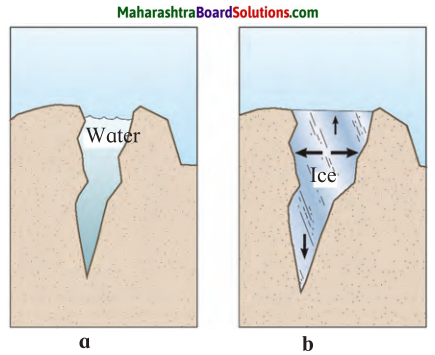
6. Explain the picture in your own words. 

Question a.
Explain the picture in your own words.
Maharashtra Board Class 7 Science Solutions Chapter 3 Properties of Natural Resources 1
Answer:

  • Diagram (a): Water is filled in the crack.
  • Diagram (b): Water in the crack turns to ice due to decrease in temperature. When it turns to ice the volume increases and it expands. Due to expansion, the size of crack widens more than in diagram (a).

Maharashtra Board Class 7 Science Solutions Chapter 3 Properties of Natural Resources

 7. Write answers to the following questions in your own words. 

Question a.
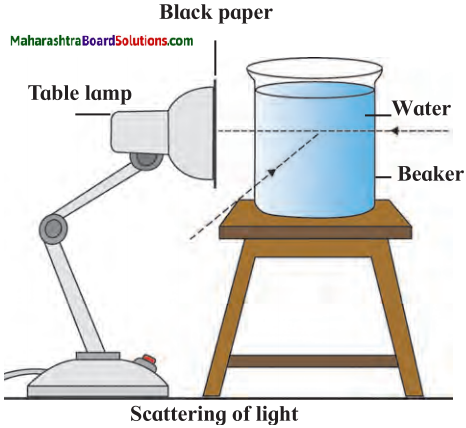
How is light scattered by the air?
Answer:
Air is a mixture of very fine particles of some gases, dust, smoke and moisture. When rays of light fall on these minute particles, the particles spread the light in all the directions. This natural phenomenon is called scattering of light.

Question b
Explain the various properties of water.
Answer:
Various properties of water are as follows:

  1. It is a fluid substance because it can flow.
  2. It does not have its own shape, it takes the shape of a container in which it is kept.
  3. It has a definite volume.
  4. It is a transparent liquid and it has no colour.
  5. It is tasteless and odourless.
  6. It is a universal solvent.

Question c.
Why is the density of seawater is more than that of rainwater?
Answer:
Seawater has many minerals dissolved in it as compared to rainwater. So due to more dissolved salts, density of seawater is more than that of rainwater.

Maharashtra Board Class 7 Science Solutions Chapter 3 Properties of Natural Resources

Question d.
What is the importance of good soil structure?
Answer:
The fertility of soil depends upon soil structure. So importance of good soil structure is as follows: (a) Roots get sufficient supply of oxygen, (b) Water drainage is good therefore the roots of plants grow well.

Question e.
What are the various uses of soil?
Answer:
The uses of soil are as follows:
Plant conservation: To help plants grow. Water conservation: Soil holds water. As a result, by means of bunds and lakes, we can get water for use throughout the year.
Plasticity: (a) Soil can be given any required shape. This property of soil is called plasticity, (b) Because of its plasticity, we can use it to make articles of a variety of shapes, (c) These articles can be baked to make them hard, (d) Water storage earthen pots, earthen lamps, idols, bricks etc. are articles made from soil.

Maharashtra Board Class 7 Science Solutions Chapter 3 Properties of Natural Resources

Question f.
What is the need and importance of soil testing from the point of view of farmers?
Answer:

  1. The properties of the various ingredients of soil can be determined by soil testing.
  2. During soil testing, the soil is examined for colour, texture and the proportion of organic matter in it.
  3. Soil is tested to find out if there is a deficiency of any ingredients and to decide what measures should be taken to remove the deficiency. These information would enable the farmers to maintain the fertility of the soil.

Question g.
What is the importance of air in transmission of sound?
Answer:

  1. Air is useful as a medium for the transmission of sound. Density of the air changes with temperature.
  2. If the density of air increases, we can hear the sound more loud and clear.

Question h.
Why should a glass bottle completely filled with water never be kept in a freezer?
Answer:

  1. Due to anomalous behaviour of water, when you cool water below 4°C, the volume of the water increases.
  2. Therefore when the glass bottle completely filled with water is kept in a freezer, water expands on cooling and its volume increases so glass bottle breaks.
  3. To avoid this, completely filled bottle is never kept in a freezer.

Maharashtra Board Class 7 Science Solutions Chapter 3 Properties of Natural Resources

Project:

Question a.
Visit a soil testing laboratory. Learn the process of soil testing and share it with others.

Class 7 Science Chapter 3 Properties of Natural Resources Important Questions and Answers

Fill in the blanks with the appropriate term.

Question 1.
Air is a …………… of gases.
Answer:
mixture

Question 2.
Atmospheric pressure is the …………… in all the directions.
Answer:
same

Question 3.
…………… is used to measure atmospheric pressure.
Answer:
Barometer

Maharashtra Board Class 7 Science Solutions Chapter 3 Properties of Natural Resources

Question 4.
As we go higher the sea level and the atmospheric pressure …………… .
Answer:
decreases

Question 5.
Pressure of air …………… when its velocity …………… .
Answer:
increases, decreases

Question 6.
…………… an effect of the difference in air pressure.
Answer:
Wind

Question 7.
The level of …………… in the air is determined by its capacity to hold water vapour.
Answer:
humidity

Question 8.
When the temperature of air is low, its capacity to hold the vapour is …………… .
Answer:
less

Maharashtra Board Class 7 Science Solutions Chapter 3 Properties of Natural Resources

Question 9.
Air is useful as a …………… for the transmission of sound.
Answer:
medium

Question 10.
Water is a …………… substance.
Answer:
fluid

Question 11.
Ice is …………… than water.
Answer:
lighter

Question 12.
Density of ice is …………… than that of water.
Answer:
less

Question 13.
The space occupied by a substance is its …………… .
Answer:
volume

Maharashtra Board Class 7 Science Solutions Chapter 3 Properties of Natural Resources

Question 14.
The storage of matter in a substance is its …………… .
Answer:
mass

Question 15.
The density of water is maximum at …………… °C.
Answer:
4°C

Question 16.
The substance in which the solute dissolves is called …………… .
Answer:
solvent

Question 17.
The particles of sandy soil are made of the mineral called …………… .
Answer:
silicon dioxide (quartz)

Question 18.
…………… soil has a highest water holding capacity.
Answer:
clay

Maharashtra Board Class 7 Science Solutions Chapter 3 Properties of Natural Resources

Question 19.
…………… soil is red in colour.
Answer:
Terracotta

Question 20.
…………… soil is used in cosmetics.
Answer:
Multani

Question 21.
…………… is celebrated as World Soil Day.
Answer:
5th December

Question 22.
The excess of water vapour during the night or dawn is transformed into ………….. .
Answer:
dew

Maharashtra Board Class 7 Science Solutions Chapter 3 Properties of Natural Resources

Question 23.
Under ordinary conditions atmospheric pressure at sea level is …………… Newtons per square mater.
Answer:
101400

Question 24.
Swedish Scientist …………… put forth the important principle that the pressure of air decreases when its velocity increases.
Answer:
Daniel Bernoulli

Question 25.
When rays of light fall on fine particles of air, the particles spread light in all the directions, this is called …………… of light.
Answer:
Scattering

Question 26.
…………… soil is easy to plough but less fertile.
Answer:
Sandy

Say whether true or false, correct and rewrite the false statements.

Question 1.
Terracotta soil is white in colour.
Answer:
False. Terracotta soil is red in colour

Question 2.
The fertility of soil depends upon soil structure.
Answer:
True

Maharashtra Board Class 7 Science Solutions Chapter 3 Properties of Natural Resources

Question 3.
Multani soil is used to make statues and idols.
Answer:
False. Shadu soil is used to make statues and idols

Question 4.
Clay soil has the maximum proportion of small particles.
Answer:
True

Question 5.
Silt soil is not as ploughable as sandy soil.
Answer:
True

Question 6.
The colour of soil near land surface is darker than the colour of the lower layers.
Answer:
True

Question 7.
Kerosene is a universal solvent.
Answer:
False. Water is an universal solvent

Question 8.
The density of substance is the inter-relation between the volume and mass of a substance.
Answer:
True

Question 9.
Water is lighter than ice.
Answer:
False. Ice is lighter than water

Maharashtra Board Class 7 Science Solutions Chapter 3 Properties of Natural Resources

Question 10.
Rotation of crops decreases the fertility of the soil.
Answer:
False. Rotation of crop increases the fertility of the soil.

Match the columns:

Question 1.

Column ‘A’Column ‘B’
1. Concept of pHa. pH higher than 7.5
2. Acidic Soilb. pH 6.5 – 7.5
3. Neutral Soilc. pH less than 6.5
4. Alkaline Soild. Sorensen

Answer:

Column ‘A’Column ‘B’
1. Concept of pHd. Sorensen
2. Acidic Soilc. pH less than 6.5
3. Neutral Soilb. pH 6.5 – 7.5
4. Alkaline Soila. pH higher than 7.5

Write short answers.

Question 1.
What is atmospheric pressure?
Answer:
The molecules of the gases in the air are in constant motion. When these molecules strike a body, they create pressure on that body. This pressure of air is called atmospheric pressure.

Maharashtra Board Class 7 Science Solutions Chapter 3 Properties of Natural Resources

Question 2.
What is Bernoulli’s principle?
Answer:
Bernoulli’s principle is that the pressure of air ‘ decreases when its velocity increases while the pressure of air increases when its velocity decreases.

Give scientific reasons.

Question 1.
When the piston of a syringe is released, it is immediately pushed in.
Answer:

  1. On pulling the piston of a syringe with the inlet hole of the syringe closed, more space becomes available to the air in the syringe, and it becomes rarified.
  2. As a result, the pressure of the air in the syringe is lowered.
  3. Comparatively the pressure of the outside air is very high. So when the pulled out piston is A released, it is immediately pushed in.

Question 2.
Water droplets are seen on the outer surface of a glass having ice cubes in it.
Answer:

  1. Due to the ice cubes in the glass, the air surrounding the glass cools down.
  2. As the water vapour in this air cools down, it condenses and gets transformed into water.
  3. It is this water that collects on the outer surface of the glass.

Question 3.
Early morning dew drops are found on the grass.
Answer:

  1. During the dawn (early morning) when the temperature of air is low, its capacity to hold the vapour is less.
  2. At such times, the excess vapour is transformed into water droplets and we call them as dew drops.

Maharashtra Board Class 7 Science Solutions Chapter 3 Properties of Natural Resources

Question 4.
During the afternoon we feel that the air is dry.
Answer:

  1. In the afternoon, when the temperature of the air is high, the capacity of the air to hold the moisture also increases.
  2. Then, compared to its full capacity to hold water the proportion of moisture in the air is less and we feel that the air is dry.

Question 5.
Earth’s surface remains warm and suitable for the living world on the earth.
Answer:

  1. The earth receives energy from the sun. This energy is reflected by the earth in the form of heat.
  2. The constituents of air surrounding the earth, such as water vapour, carbon dioxide, absorb a part of this heat and give it to the other constituents of air.
  3. So the Earth’s surface remains warm and suitable for the living world on the earth.

Question 6.
We can hear the whistle of a distant train clearly early in the morning in winter.
Answer:

  1. The density of air changes due to change in its temperature.
  2. In winter, temperature is low so the density of the air is more. So we can hear the whistle of a distant train clearly early in the morning in winter.

Question 7.
Ice floats on water.
Answer:

  1. When water freezes means it transforms into the soild state therefore its volume increases.
  2. When volume increases its density decreases
  3. Therefore, density of ice is less than the water, so ice floats on water.

Maharashtra Board Class 7 Science Solutions Chapter 3 Properties of Natural Resources

Question 8.
In cold countries aquatic animals remain alive even after the rivers or lakes freeze in water.
Answer:
1. Due to anomalous behaviour of water, in cold countries when water gets cool and turn to ice, its volume increases, so its density decreases
2. Due to less density ice floats on water.
3.  (a) Ice is a bad conductor of heat and electricity, (b) It doesn’t allow outside heat to go from the ice to water so water temperature below the ice doesn’t change, (c) It remains as water so aquatic animals remain alive even after the rivers or lakes freeze in winter.

Question 9.
It is easier to swim in the sea than in a well or a lake.
Answer:

  1. Sea water is saline. It contains salt whereas it is not so in well or a lake water.
  2. Due to salts dissolved in sea water, density of sea water is more, so the swijnmer will not sink.
  3. Hence, it is easier to swim in the sea than in a well or a lake.

Question 10.
Sandy soil is less fertile.
Answer:

  1. Sandy soil is made up of large particles and these particles of sandy soil are made of the mineral called silicon dioxide.
  2. These particles do not dissolve in water therefore soil has very little capacity to supply nutrients, so sandy soil is less fertile.

Maharashtra Board Class 7 Science Solutions Chapter 3 Properties of Natural Resources

Question 11.
China clay is used for making crockery.
Answer:
China clay is used for making crockery because on heating, this clay acquires a glaze and hardness. It can be moulded into any shape and being a bad conductor of heat, it is easy to handle.

Answer the following:

Question 1.
Write the properties of air.
Answer:

  1. Air is a mixture of gases.
  2. Air has mass and volume.
  3. It spreads in all directions.
  4. It exerts pressure.
  5. It is colourless.

Question 2.
Name the tests for finding out the characteristic of soil. Describe any one method of it.
Answer:
There are two tests for finding out the characteristics of soil: (1) pH (2) electrical conductivity tests.
1. pH tests: The Danish scientist Sorensen put forth the concept of pH, based on the concentration of hydrogen ions. To determine the pH of soil, a mixture of water and soil in the proportion of 1 : 2 is taken and tested using several indicators.
Accordingly, soil may be found to be one of the following types.

  • Acidic soil – pH less than 6.5
  • Neutral soil – pH 6.5 – 7.5
  • Alkaline soil – pH higher than 7.5

2. By Electrical conductivity tests we come to know how many nutrients are present in the soil.

Maharashtra Board Class 7 Science Solutions Chapter 3 Properties of Natural Resources

Question 3.
Write the causes of diminished soil fertility.
Answer:
Following are the causes of diminished soil fertility.

  1. Soil pH less than 6 or higher than 8.
  2. Low proportion of organic matter.
  3. No proper drainage of water.
  4. Repeated cultivation of the same crop.
  5. Continuous use of saline water.
  6. Excessive use of chemical fertilizers and pesticides.

Question 4.
Which crops reduce the fertility of soil and Which crops increase the fertility of soil?
Answer:
Wheat reduces the fertility of soil and leguminous crops like peanut, moong, moth bean, pea, lentil, Bengal gram, soyabean increase the fertility of soil.

Question 5.
Name and explain some useful types of soil.
Answer:
Following are some useful types of soil.

  1. China clay (Kaolin): (a) It is white in colour, (b) It is used to make crockery, bathroom tiles, tanks, laboratory apparatus, masks, jars etc.
  2. Shadu soil: (a) It is whitish in colour, (b) It is used for making statues and idols.
  3. Terracotta soil: (a) This soil is red in colour, (b) Decorative articles and pots used for growing plants are made from this soil.
  4. Multani soil: This soil is used in cosmetics.

Maharashtra Board Class 7 Science Solutions Chapter 3 Properties of Natural Resources

Question 6.
Explain the types of soil on the basis of its texture.
Answer:
There are 3 types of soil on the basis of its texture.
1. Sandy soil: (a) Large particles are high in sandy soil, (b) Water drains rapidly through sandy soil, (c) It is easy to plough this soil, (d) It is less fertile because the particles of sandy soil are made of the mineral called silicon dioxide (quartz), (e) These particles do not dissolve in water and therefore the soil has very little capacity to supply dissolved nutrients.

2. Silt soil: (a) The particles of silt soil are of medium size, (b) Silt soil is not as ploughable as sandy soil but is much more ploughable than clay soil, (c) This soil contains a large proportion of organic materials, (d) Its capacity to supply nutrients is much greater, (e) Silt soil is also called sedimentary soil.

3. Clay soil: (a) The proportion of small particles is maximum, (b) The particles of clay soil feel smooth to touch, (c) Clay soil has a high water holding capacity.

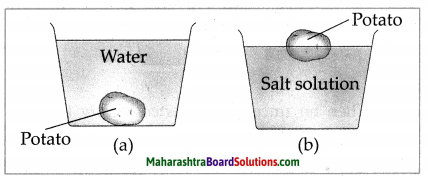
Explain the given picture in your own words.

Question 1.
Maharashtra Board Class 7 Science Solutions Chapter 3 Properties of Natural Resources 3
Answer:
1. The potato will sink in water as potato’s density is more than water.
2. This is the effect of density. The potato will float in salt solution as the density of salt solution is more than potato. The density of the water becomes greater due to the dissolved salt. That is why it is easier to swim in sea than in a well or a lake.

Can you tell?

Answer the following questions.

Question 1.
What change takes place in a balloon on filling air in it?
Answer:
On filling air in balloon, the shape of the balloon changes. Its size increases due to expansion.

Maharashtra Board Class 7 Science Solutions Chapter 3 Properties of Natural Resources

Question 2.
Why is it easier to swim in the sea than in a well or a lake?
Answer:

  1. Sea water is salty due to minerals in it. Whereas it is absent in well or a lake water.
  2. Due to presence of salts, density of seawater is more than well or lake water, so it is easier to swim in the sea than in a well or lake.

Use your brain power!

Answer the following questions.

Question 1.
What is the effect of increased temperature on the pressure of air?
Answer:
Condition for closed environment:

  1. When the temperature increases, the pressure of air also increases.
  2. For example, as the air warms up, the molecules in the air become more active.
  3. They use up more individual space even though there is same number of molecules. T1 s causes an increase in the air pressure.

Question 2.
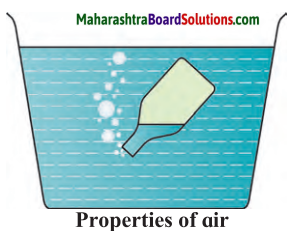
Dip an uncorked inverted empty bottle in a slanting position into the water in a wide container. What do you observe?
Maharashtra Board Class 7 Science Solutions Chapter 3 Properties of Natural Resources 2
Answer:

  1. When an uncorked inverted empty bottle is kept slanting in the water container bubbling sound will be heard.
  2. Air bubbles come out from the empty bottle and water enters the bottle.
  3. Empty bottle is actually not empty but it is occupied by air.
  4. When this air comes out, its place is taken by water. This shows that air occupies space.

Maharashtra Board Class 7 Science Solutions Chapter 3 Properties of Natural Resources

Question 3.
In cold countries how do aquatic animals remain alive even after the rivers or lakes freeze in winter.
Answer:

  1. Due to anomalous behaviour of water, in cold countries, water changes to ice.
  2. Due to this change, its volume increases and density decreases. So ice floats on water.
  3. Ice is a bad conductor of heat so it doesn’t allow heat to go inside so the water below ice remains as it is. So aquatic animals remain alive even after the rivers or lakes freeze in winter.

Question 4.
Why is it difficult to plough clay soil?
Answer:
It is difficult to plough clay soil because in clay soil the proportion of small particles is maximum. The particles of clay soil feel smooth to touch and has high water holding capacity, making it very difficult to penetrate through it.

Question 5.
Why is it easy to plough sandy soil?
Answer:

  1. Sandy soil has large sized particles. It has weak structure due to less organic matter and large spaces between them.
  2. The water also drains quickly through it making it dry and allows the plough to penetrate through it.

Question 6.
What is the water holding capacity of silt soil?
Answer:
Silt occurs as a deposit in riverbeds. The size of silt particles is between those of sand and clay. This soil also has humus in it which makes it the best soil to hold the right amount of water.

Maharashtra Board Class 7 Science Solutions Chapter 3 Properties of Natural Resources

Question 7.
Which soil is suitable for cultivation? Why?
Answer:
The silt soil is suitable for cultivation.

  1. The particles of silt soil is of medium size.
  2. Silt soil is much more ploughable than clayey soil.
  3. It contains large proportions of organic material.
  4. This helps the soil in retention of water for a proper amount of time and makes it suitable for crops to grow.

Maharashtra State Board Class 7 Science Textbook Solutions
Disaster Management Class 7 Questions And Answers Maharashtra Board

Std 7 Science Chapter 10 Disaster Management Question Answer Maharashtra Board

Balbharti Maharashtra State Board Class 7 Science Solutions Chapter 10 Disaster Management Notes, Textbook Exercise Important Questions and Answers.

Class 7 Science Chapter 10 Disaster Management Question Answer Maharashtra Board

1. Find the odd man out:

Question a.
Famine, earthquake, cloudburst, railway accident.
Answer:
Railway accident.

Question b.
Drought, heavy rains/storm, tsunami.
Answer:
Drought.

Question c.
Lava, hot mud, ash, locusts.
Answer:
Locusts.

Maharashtra Board Class 7 Science Solutions Chapter 10 Disaster Management

Question d.
Washing away of crops, attack of pests on crops, volcano, singeing of crops.
Answer:
Volcano.

2. What are the remedial measures for the following calamities?

Question a.
Famine:
Answer:
Following are the remedial measures for famine:

  1. Supply food and water to the people those who are dying due to hunger.
  2. Give medicines to the people those who are suffering from malnutrition.
  3. Government should start helping centres for the people those who are suffering from famine.
  4. Give them temporary shelter in some other places where water and food are available.
  5. Shift the animals to safer places.
  6. Do proper planning so that region doesn’t get famine again and again.
  7. Reuse water
  8. grow more trees.

Question b.
Lightning strike:
Answer:
Following are the remedial measures for lightning strike:

  1. Give immediate treatment to the lightning affected persons so their life can be saved.
  2. Keep the people away from the open ground and swimming pool.
  3. Provide them proper guidelines to cure for the lightning strike.

Maharashtra Board Class 7 Science Solutions Chapter 10 Disaster Management

Question c.
Storm:
Answer:

  1. Supply food, water and medicines to the people
  2. Shift them to safe places.
  3. Maintain peace, and advice the people not to panic.
  4. Give time to time report on T.V. and radio.

Question d.
Cloudburst:
Answer:
Following are the remedial measures for cloudburst:

  1. Shift people to safe places with the help of airplane, helicopter and army.
  2. Supply them food, clothes, water and medicines.
  3. Give time to time weather report.
  4. Open more helpline centres.
  5. Government should immediately send the help in terms of money and army to the people.

3. True or false? Give reasons for your answer.

Question a.
Information about a forthcoming storm is to be kept secret.
Answer:
False. Information about a forthcoming storm is not to be kept secret because, with this information we can take immediate steps for disaster management. Large scale damage of property and loss of life can be avoided.

Maharashtra Board Class 7 Science Solutions Chapter 10 Disaster Management

Question b.
You should not swim when there is lightning in the sky.
Answer:
True. Lightning carries some electric charges which causes electric current in it. Water catches this current so if any person is swimming pool during lightning in the sky, then there are more chances that lightning may strike in water and the person may die due to it.

Question c.
It is possible to prevent the eruption of a volcano.
Answer:
False. It is not possible to prevent the eruption of a volcano because it is a natural event. However, by means of science and technology, it is possible to predict an eruption in advance and to take immediate steps for disaster management.

Maharashtra Board Class 7 Science Solutions Chapter 10 Disaster Management

Question d.
Heavy rains result in famine.
Answer:
True. Heavy rains result in flood so crops get washed away or damaged in the flood and results in famine.

Question e.
A loud crashing sound follows a lightning.
Answer:
True, Friction and brushing happens between two clouds making them charged and lightning is produced between two clouds or one cloud and earth. The temperature increases and air pressure also increases to high amount and produces a loud sound of thunder.

4. Write answers to the following questions in our own words.

Question a.
What is a tsunami? What gives rise to a tsunami?
Answer:

  1. Waves generated by an earthquake or volcano occurring on the ocean floor is called ‘tsunami’. ‘Tsunami’ is a Japanese word which means ‘harbour wave’.
  2. As on land, earthquakes and volcanic eruptions occur, at the bottom of the sea, too.
  3. If an earthquake occurs at the bottom of ocean, the energy released pushes the water upwards. As a result of this particular type of waves are formed.
  4. These waves are not very high near the source, but they start spreading very fast to long distances.
  5. The velocity of these waves is 800 to 900 km/hr. When they reach a coastal area, their velocity is reduced, but their height is found to have increased tremendously even to about 30 m. These are tsunami waves.

Maharashtra Board Class 7 Science Solutions Chapter 10 Disaster Management

Question b.
What is cloudburst?
Answer:

  1. Sometimes the water coming down from rain clouds does not reach the land in the form of rain. Instead, due to very high temperature near the land, it vaporizes and goes back into the same clouds.
  2. As a result the amount of vapour in those clouds becomes very high.
  3. Due to rapid condensation, it rains suddenly over a specific and small region at a rate of 100 mm per hour or more. This is known as a cloudburst.

Question c.
Explain the effects of a volcano.
Answer:
Following are the effects of a volcano:

  1. The chemical substances such as lava, vapour, hot mud, sulphur etc. get collected on the surface of the earth and thereby mountains and hills are created
  2. The atmosphere gets polluted due to the ash and gases ejected by the volcano.
  3. Often, it rains as a result of a volcanic eruption.
  4. The temperature rises due to hot gases.
  5. Forests and settlement get buried under the hot mud.

Maharashtra Board Class 7 Science Solutions Chapter 10 Disaster Management

Question d.
What are the measures to prevent loss of life due to lightning?
Answer:
Following are the measures to prevent loss of life due to lightning:

  1. Do not stand on open ground, below a tree, on high location, near an electric pole, near a telephone pole or a tower etc.
  2. Do not lean on wire fences around a farm, a compound, a garden or a house.
  3. If you are on two-wheeler, a bicycle, a tractor or a boat, get off immediately and go to safe place.
  4. Do not gather all together in one place.
  5. Take care to keep a distance of 15 feet between any two persons.
  6. Do not use plugged in electrical appliances. Do not use a mobile or telephone.
  7. Stand on dry wood, a plastic sheet, sack or jute cloth or dry leaves.
  8. Keeping your feet together support yourself on the soles of your feet placing your hands on your knees and crouch low.
  9. Swimmers and fishermen should immediately come out of the water.
  10. A pucca house is the safest place. Find out if there is a lightning conductor on any tall building near your house. If necessary get a lightning conductor fitted on your house.

Maharashtra Board Class 7 Science Solutions Chapter 10 Disaster Management

5. What measures have been taken to deal with calamities such as floods and landslides under the disaster management programme in Maharashtra?

Question a.
What measures have been taken to deal with calamities such as floods and landslides under the disaster management programme in Maharashtra?
Answer:
In Maharashtra, all districts have their own disaster management plan to deal with calamities such as floods and landslides.

  1. The plan deals extensively with the emergency, and evacuation measures to be taken up in cases of flood and landslide.
  2. The district-level disaster management plan has detailed information about geographical details, population, flood-prone areas, villages and other macro details.
  3. Nearly 14 such key departments are engaged in disaster mitigation measures and each one has been assigned a specific task to do at times of natural disasters.
  4. The administration is now training master trainers at the district level who in turn will train key persons at village and taluka levels to deal with a natural disaster.
  5. The administration through radio jingles, public advertisements and other measures is informing people about how to react at times of flood and landslide.
  6. Currently, the Indian Meteorological Department (IMD) gives weather forecast on daily basis and for the next 5 days with advice to farmers on when to start crop sowing and harvesting etc.

6. With reference to disaster management what are the things in your house that you will check?

Question a.
With reference to disaster management what are the things in your house that you will check?
Answer:
With reference to disaster management, we should keep the following things at home and check regularly.

  1. Keep proper first aid kit at a handy place.
  2. Keep all the electric connections in proper condition.
  3. Keep the gas line or tube connection proper.
  4. Keep self-powered flashlights and self-powered radios.
  5. Keep non-perishable food which will last for a week.
  6. Keep a fire extinguisher handy and in proper condition.
  7. Keep updated telephone diary which should have emergency phone numbers.

Maharashtra Board Class 7 Science Solutions Chapter 10 Disaster Management

Project:

Question 1.
With the help of the Internet, collect information about the places where a calamity has occurred.

Question 2.
Collect information from the Internet about how cyclonic storms are named.

Class 7 Science Chapter 10 Disaster Management Important Questions and Answers

Fill in the blanks:

Question 1.
………… and ………… disasters are related to each other.
Answer:
Natural manmade.

Question 2.
………… implemented a canal scheme for drinking water in Aurangabad.
Answer:
Malik Ambar.

Question 3.
………… has turned out to be the most famine-affected contents of the world.
Answer:
Asia

Maharashtra Board Class 7 Science Solutions Chapter 10 Disaster Management

Question 4.
The government of India established the ………… in 1976.
Answer:
National Flood Commission

Question 5.
The ………… that occurred in Mumbai on 26th August 2005 was extraordinary and unforgettable.
Answer:
cloudburst.

Question 6.
A cloudburst occurred at ………… on 6th August, 2010.
Answer:
Ladakh (Leh)

Question 7.
About ………… lightning flashes occur per second in the atmosphere.
Answer:
40.

Question 8.
The temperature generated by ………… is higher than that of the sun.
Answer:
lightning

Maharashtra Board Class 7 Science Solutions Chapter 10 Disaster Management

Question 9.
When some substances comes out of the earth’s crust in an eruption and start flowing is called a ………… .
Answer:
volcano

Question 10.
Some islands are created due to the eruption, of ………… in the sea.
Answer:
volcano

Question 11.
………… is a Japanese word which means ‘harbour wave’.
Answer:
Tsunami.

Question 12.
About ………… nations from all over the world are members of the UNDP.
Answer:
177.

Maharashtra Board Class 7 Science Solutions Chapter 10 Disaster Management

Question 13.
………… established a standing international organization UNDP in 1965.
Answer:
United Nations.

Question 14.
………… is celebrated as International Day for Disaster Reduction.
Answer:
13th October

Question 15.
The condition that arises due to long term and severe scarcity of food grains and water is called………. .
Answer:
famine

Can you tell?

Question 1.
Is it possible to prevent the loss of life caused by lightning?
Answer:
Yes, it is possible to prevent the loss of life caused by lightning, by taking precautions.

Maharashtra Board Class 7 Science Solutions Chapter 10 Disaster Management

Question 2.
What should be done to prevent the bunds on a farm from getting washed away in the rainy season?
Answer:

  1. Grow more trees near the bunds.
  2. Grow grass strips.
  3. Make stone lines near the bunds.
  4. Use contour ploughing and tillage network method to prevent the bunds on a farm from getting washed away in the rainy season.

Question 3.
Why do we experience water scarcity?
Answer:
Lessor no rain leads to water scarcity.

Maharashtra Board Class 7 Science Solutions Chapter 10 Disaster Management

Question 4.
What causes rain?
Answer:

  1. Due to heat of the sun, water from the sea, lake and river gets evaporated and this water vapour is light in weight so it goes higher and higher and forms the cloud.
  2. At a certain level the amount of vapour in those clouds becomes very heavy and it burst and rain occurs.

Question 5.
Have you seen a flash of lightning in the sky? When?
Answer:
Students will answer this question based on their experience.

Question 6.
What causes lightning?
Answer:

  1. Where air and clouds rub against each other in the sky, the upper part of some clouds on the upper side becomes positively charged and the lower sides become negatively charged.
  2. When this negative charge on the bottom of the cloud becomes much larger than the charge on the ground it starts flowing towards the ground in stages.
  3. This happens very fast, in much less than a second and heat, light and sound energy are produced along with the electric current.

Maharashtra Board Class 7 Science Solutions Chapter 10 Disaster Management

Use your brainpower!

Answer the following questions:

Question 1.
We should not wait at the foothill while it is raining heavily.
Answer:
During heavy rain there are chances of landslide and flood, so we should not wait at the foothill while it is raining heavily.

Maharashtra State Board Class 7 Science Textbook Solutions
Measurement of Physical Quantities Class 7 Questions And Answers Maharashtra Board

Std 7 Science Chapter 6 Measurement of Physical Quantities Question Answer Maharashtra Board

Balbharti Maharashtra State Board Class 7 Science Solutions Chapter 6 Measurement of Physical Quantities Notes, Textbook Exercise Important Questions and Answers.

Class 7 Science Chapter 6 Measurement of Physical Quantities Question Answer Maharashtra Board

1. Write answers to the following questions in your own words:

Question a.
Why is the weight of the same object different on different planets?
Answer:
The weight of the same object is different on different planets because weight depends on the gravitational force of the planet and gravitational force on every planet is different so the weight also differs from planet to planet.

Maharashtra Board Class 7 Science Solutions Chapter 6 Measurement of Physical Quantities

Question b.
What precautions will you take to make accurate measurements in day-to-day affairs?
Answer:
Following precautions will be taken to make accurate measurements in day to day affairs:

  1. The balance should carry the stamp of standardisation by the department of weights and measures.
  2. Balance should be stable and the pointer of the balance should be upright.
  3. The underside of the pan should not be tampered with any other weight or layers of other metal.
  4. The weight should be made of metal.

Question c.
What is the difference between mass and weight?
Answer:

MassWeight
1. The amount of matter present in a substance is called mass.1. The gravitational force that acts on this mass is called its weight.
2. It is a scalar quantity.2. It is a vector quantity.
3. Mass remains same everywhere on the earth.3. Weight changes from place to place on the ‘        earth.

Maharashtra Board Class 7 Science Solutions Chapter 6 Measurement of Physical Quantities

2. Who is my companion? 

Class 7 Science Chapter 6 Measurement Of Physical Quantities Exercise Question 1.

Column ‘A’Column ‘B’
1. Velocitya. Litre
2. Areab. Kilogram
3. Volumec. metre/second
4. Massd. kilogram/cubic metre
5. Densitye. square metre

Answer:

Column ‘A’Column ‘B’
1. Velocityc. metre/second
2. Areae. square metre
3. Volumea. Litre
4. Massb. Kilogram
5. Densityd. kilogram/cubic metre

3. Explain giving examples. 

Question a.
Scalar quantity:
Answer:
A quantity that can be completely expressed by its magnitude alone is called a scalar quantity, e.g. length, breadth, area, mass, temperature, density, time, work. In all these examples a value with a unit is used to express quantities. Thus, we say that the length of a tunnel is 2 km.

Maharashtra Board Class 7 Science Solutions Chapter 6 Measurement of Physical Quantities

Question b.
Vector quantity:
Answer:
The quantity that is expressed completely only.’ v when magnitude and direction are both given is called a vector quantity. Displacement, velocity are vector quantities e.g. a displacement of 20 km towards north, the aeroplane flying at a velocity of 500 km/hr towards Mumbai.

4. Explain, giving examples, the errors that occur while making measurements.

Question a.
Explain, giving examples, the errors that occur while making measurements.
Answer:
Major causes of errors in measurement are:

  1. Not using the appropriate device.
  2. Not using the device properly.

Example: While buying things at grocery shops and the vegetable market remember to look out for the following:

  • The balance should carry the stamp of standardisation by the department of weights and measures.
  • Balance should be stable. The pointer of the balance should be upright.
  • No changes should be done on the underside of the pan of the balance.
  • Weight should be made up of metals and it has to be standardized.

5. Give reasons:

Question a.
It is not proper to measure quantities by using body parts as units.
Answer:
It is not proper to measure quantities by using body parts as units because length of the body parts changes from person to person, so accurate measurement can not be found with the body parts as units.

Question b.
It is necessary to get the weights and measures standardized at regular intervals.
Answer:
It is necessary to get the weights and measures standardized at regular intervals because of that accurate weight and measurement can be taken. Errors will be avoided.

Maharashtra Board Class 7 Science Solutions Chapter 6 Measurement of Physical Quantities

6. Explain the need for accurate measurement and the devices to be used for that.

Question a.
Explain the need for accurate measurement and the devices to be used for that.
Answer:

  1. Measurement of substances that are precious or of great importance and used in very small quantities is done meticulously and accurately.
  2. Due to advancements in technology, devices that measure very small magnitudes of quantities like distance, mass, time and temperature are available now.
  3. e.g. distance and time in connection with very important sports competitions, mass of gold, body temperature etc.
  4. Devices to be used for this are thermometer, digital balance (Analytical balance) etc.

Project:

Class 7 Science Chapter 6 Measurement Of Physical Quantities Question 1.
Collect information about various physical quantities used in day-to-day life and the devices used for their measurement.

Class 7 Science Chapter 6 Measurement of Physical Quantities Important Questions and Answers

Fill in the blanks:

Std 7 Science Chapter 6 Measurement Of Physical Quantities Question 1.
The amount of matter present in a substance is called ………………. .
Answer:
mass

Measurement Of Physical Quantities Class 7 Exercise Question 2.
…………. is the qualitative measure of the inertia of an object.
Answer:
mass

Maharashtra Board Class 7 Science Solutions Chapter 6 Measurement of Physical Quantities

6. Measurement Of Physical Quantities Question 3.
The larger the mass, the ……………. is the inertia.
Answer:
greater

6.Measurement Of Physical Quantities Question 4.
Mass is a …………… quantity.
Answer:
scalar

Physical Quantities And Measurement Class 7 Question 5.
…………… does not change from place to place anywhere in the world.
Answer:
mass

Measurement Of Physical Quantities Class 7 Question 6.
The gravitational force that acts on a mass is called its ……………. .
Answer:
weight

6 Measurement Of Physical Quantities Question 7.
Wright is a …………… quantity.
Answer:
vector

Question 8.
System International (SI) is also called ………….. .
Answer:
metric system

Maharashtra Board Class 7 Science Solutions Chapter 6 Measurement of Physical Quantities

Question 9.
In Egypt in ancient times, the distance from a man’s elbow to the tip of his middle finger was called a ………… .
Answer:
cubit

Question 10.
Gold was weighed in a unit called …………… .
Answer:
gun

Who is my companion?

Question 1.

Column ‘A’Column ‘B’
1. Golda. Hour glass
2. Timeb. Vector
3. Distancec. Gunj
4. Weightd. Cubit

Answer

Column ‘A’Column ‘B’
1. Goldc. Gunj
2. Timea. Hour glass
3. Distanced. Cubit
4. Weightb. Vector

Maharashtra Board Class 7 Science Solutions Chapter 6 Measurement of Physical Quantities

Say whether true or false. Correct and rewrite the false statements:

Question 1.
The standards of the six fundamental units are kept in the National Physical Laboratory at New Delhi.
Answer:
True

Question 2.
Matter has a natural tendency to resist a change in its state, which is called inertia.
Answer:
True

Question 3.
Weight and mass are both equal quantities.
Answer:
False. Weight and mass are both different quantities

Question 4.
Work is a vector quantity.
Answer:
False. Work is a scalar quantity

Maharashtra Board Class 7 Science Solutions Chapter 6 Measurement of Physical Quantities

Question 5.
Velocity is a scalar quantity.
Answer:
False. Velocity is a vector quantity

Question 6.
Unit of time in both the systems is second.
Answer:
True

Question 7.
Unit of mass in C.G.S. system is kilogram
Answer:
False. Unit of mass in C.G.S. system is gram

Question 8.
Symbol of unit of second is sec.
Answer:
False. Symbol of unit of second is ‘s’

Question 9.
1 cubic foot means 28.317 ml
Answer:
False. 1 cubic foot means 28.317 litres.

Maharashtra Board Class 7 Science Solutions Chapter 6 Measurement of Physical Quantities

Question 10.
Vector quantity requires magnitude only.
Answer:
False. Vector quantity required magnitude and direction both.

Give scientific reasons:

Question 1.
Weight of our body on the moon is less than that on the earth.
Answer:

  1. Gravitational power of moon is less than the earth.
  2. Weight depends on the gravitational power of that place.
  3. Since the gravitational power of the moon is less than that of the earth, the weight on moon is less than that on the earth.

Question 2.
Mass is a scalar quantity
Answer:
Mass is a scalar quantity because it can be completely expressed by its magnitude alone, so it is scalar quantity.

Maharashtra Board Class 7 Science Solutions Chapter 6 Measurement of Physical Quantities

Question 3.
Weight is a vector quantity.
Answer:
Weight can be expressed completely only when magnitude and direction are both given so weight is a vector quantity.

Distinguish between the following:

Question 1.
Scalar quantity and Vector quantity
Answer:

Scalar quantityVector quantity
1. A quantity that can be completely expressed by its magnitude alone is called a scalar quantity.1. The quantity that is expressed completely only when magnitude and direction are both given is called a vector quantity.
2. e.g. mass, length, area, breadth, density, time, work etc.2. e.g. velocity displacement

Maharashtra Board Class 7 Science Solutions Chapter 6 Measurement of Physical Quantities

Question 2.
M.K.S. system and C.G.S. system
Answer:

M.K.S. systemC.G.S. system
1. In this system distance is measured in metres, mass in kilograms and time in seconds.1. In this system distance is measured in centimetres, mass in grams and time in seconds.
2. e.g. Unit of velocity is m/sec, Unit of area is square metre.2. e.g. Unit of velocity is cm/sec, Unit of area is square centimetre.

Define the following:

  1. Mass: The amount of matter present in a substance is called mass.
  2. Inertia: Matter has a natural tendency to resist a change in its state, which is called Inertia.
  3. Weight: The gravitational force that acts on the mass is called its weight.
  4. Physical Quantities: The quantities in day to day life which can be measured are called physical quantities.
  5. Standardization: The process of checking things against a standard measure from time to time is called standardization.

Write answers to the following questions in your own words.

Question 1.
What is an atomic clock?
Answer:
An extremely accurate type of clock which is regulated by the vibrations of an atomic or molecular system such as caesium atom or ammonia is called atomic clock. It is used to maintain standard times of countries accurately.

Answer the following questions:

Question 1.
Why would the weight of an object be; maximum at the poles and minimum at the equator?
Answer:

  1. The gravitational force that acts on the mass is called the weight.
  2. The earth is not exactly spherical, it flattens at the poles.
  3. As the distance increases the gravitational force decreases.
  4. Therefore due to reduced distance at the poles compared to the equator, the weight is maximum at the poles than equator.

Maharashtra Board Class 7 Science Solutions Chapter 6 Measurement of Physical Quantities

Question 2.
Why is the weight of an object at a high altitude less than its weight at the sea-level?
Answer:

  1. The gravitational force that acts on the mass is called the weight.
  2. The gravitational force is always inversely proportional to the distance.
  3. So as the distance increases between the earth and the object, the gravitational force decreases.
  4. The gravitational force by which the earth attracts an object towards its centre is called weight.
  5. The weight at the sea-level is higher than at higher altitude, as the object is at a greater distance at higher altitudes compared to sea-level.

Maharashtra State Board Class 7 Science Textbook Solutions
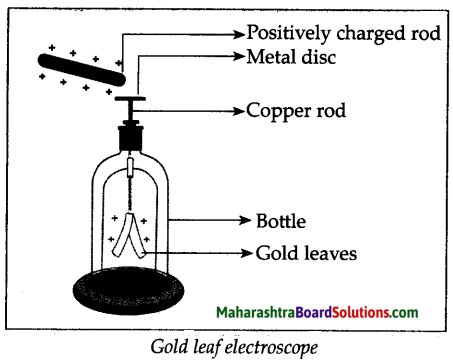
Plants: Structure and Function Class 7 Questions And Answers Maharashtra Board

Std 7 Science Chapter 2 Plants: Structure and Function Question Answer Maharashtra Board

Balbharti Maharashtra State Board Class 7 Science Solutions Chapter 2 Plants: Structure and Function Notes, Textbook Exercise Important Questions and Answers.

Class 7 Science Chapter 2 Plants: Structure and Function Question Answer Maharashtra Board

1. Give examples of 3 plants that have:

Question a.
Spiny fruits
Answer:
Jack fruit, Pineapple, Lychee (litchi), Datura

Question b.
Spiny stem
Answer:
Cactus, Wild rose, Catclaw acacia, Silk, Cotton

Question c.
Red flowers
Answer:
Rose, Dahlia, Hibiscus, Tulips,

Maharashtra Board Class 7 Science Solutions Chapter 2 Plants: Structure and Function

Question d.
Yellow flowers
Answer:
Marigold, Daffodil, Sunflower, Daisy

Question e.
Leaves which close at night
Answer:
Mimosa plant, Tallwood, Prayer plant, Gulmohar

Question f.
Single seeded fruits
Answer:
Mango, Lychee, Jamun

Question g.
Many seeded fruits
Answer:
Custard apple, Papaya, Watermelon.

2. Observe any one flower and its various parts and describe it in your own words.

Question a.
Answer:
Maharashtra Board Class 7 Science Solutions Chapter 2 Plants Structure and Function 1

A flower has following parts:
1. Pedicel: (a) Flower may have a long or a short stalk called pedicel, (b) One end of the pedicel is attached to the stem, (c) The other end of the pedicel is expanded and swollen. It is called the receptacle, (d) Petals and other parts of the flower are supported on the receptacle.
2. Calyx: In the bud condition, the petals are covered by leaf like parts called sepals which are green in colour. They form the calyx.
3. Corolla: This is made up of colourful parts called petals.
4. Androecium: (a) This is the male reproductive part of the flower, (b) It consists of stamens, (c) Each stamen is made up of anther and filament.
5. Gynoecium: (a) This is the female reproductive part of the flower, (b) This is made up of carpels, (c) A carpel consists of stigma, style and ovary.

Maharashtra Board Class 7 Science Solutions Chapter 2 Plants: Structure and Function

3. What are the similarities and differences between?

Question a.
Jowar and Moong
Differences:

JowarMoong
i. It has fibrous root.i. It has tap root.
ii. It is a monocotyledonous seed.ii. It is a dicotyledonous seed.
iii. It is a rabi crop.iii. It is a kharif crop

Similarities:
Jowar and Moong both are angiosperms.

Maharashtra Board Class 7 Science Solutions Chapter 2 Plants: Structure and Function

Question b.
Onion and Coriander
Differences:

OnionCoriander
i. It is a biennial plant.i. It is an annual plant.
ii. It has monocoty­ledonous seed.ii. It has dicotyledonous seeds.
iii. It has fibrous root.iii. It has tap root but later on changes to fibrous root system.

Similarities:

  1. Both are used in cooking.
  2. Both are edible.
  3. Both belongs to kingdom plantae.

Question c.
Leaves of banana and Leaves of mango
Answer:

Leaves of bananaLeaves of mango
i. It has parallel venation.i. It has reticulate venation.
ii.  It is very large in size.ii. It is small in size.
iii. It is a monocotyledonous plant.iii. It is a dicotyledonous plant.

Maharashtra Board Class 7 Science Solutions Chapter 2 Plants: Structure and Function

Question d.
Coconut tree and Jowar stalk plant
Answer:
Differences:

Coconut treeJowar stalk plant
i. It is tall and has a thick stemi. It is small and has a thin stem.
ii. It has strong root system.ii. It has weak root system.
iii. Each and every part of tree is useful.iii. Only seeds are useful.

Similarities:

  1. Both are from same kingdom plantae.
  2. Both are autotrophic.
  3. Both are monocotyledonous plants.

4. Explain the following images in your own words.

Question a.
Maharashtra Board Class 7 Science Solutions Chapter 2 Plants Structure and Function 2
Answer:

  1. Diagram A is of maize seed. It is a monocotyledonous seed and does not divide into two equal parts. The plant has fibrous root system.
  2. Diagram B is of bean seed. It is a dicotyledonous seed and it divides into two equal parts. The plant has tap root system.

Maharashtra Board Class 7 Science Solutions Chapter 2 Plants: Structure and Function

5. Describe the functions of various parts of a plant.

Question a.
Describe the functions of various parts of a plant.
Answer:
The functions of various parts of a plant are as below.
1. Root: (a) Fixation: It anchors the plant body to the soil, so helps in fixation, (b) Absorption: It absorbs water and nutrients from the soil, so helps in absorption, (c) Conduction: The root translocates water and mineral salts into the stem. (d) Storage: A certain amount of food is stored in the root which is utilized as it grows.
(e) Preventing soil erosion: It helps to bind the soil particles and prevent them from being blown away by wind or water.
2. Stem: (a) It supports and holds leaves, flower and fruits, (b) The stem conducts the water and minerals from roots to leaves and fruits, (c) It stores the food.
3. Leaves: (a) It synthesizes food for the plant, (b) Stomata, the tiny openings in the leaf help in gaseous exchange and are responsible for the process of transpiration.
4. Flower: It helps in pollination.
5. Fruit: (a) It protects the seed, (b) It helps in seed dispersal.
6. Seed: A new plant develops from it.

6. Certain properties are mentioned below. Find a leaf corresponding to each property and describe those plants.

Question a.
Certain properties are mentioned below. Find a leaf corresponding to each property and describe those plants.
leaves with smooth surface, leaves with rough surface, fleshy leaf, spines on leaf.
Answer:

  1. Leaves with smooth surface: e.g. Banana leaf. It is large in size. It is closely rolled up one over the other. Together they look like a trunk but they form only an apparent trunk. It has parallel venation.
  2. Leaves with rough surface: e.g. Hibiscus leaf. It has reticulate venation. Leaf margin is toothed.
  3. Fleshy leaf: e.g. Jade plant, water hyacinth. It has fleshy, glossy and smooth leaves. They are coloured jade green and having a slightly red tinge towards the edge of leaves when exposed to higher level of light.
  4. Spines on leaf: e.g. Opuntia, Ci/cas, kevda. Opuntia is a desert plant. Leaf is thick, fleshy and having spines on it.

Maharashtra Board Class 7 Science Solutions Chapter 2 Plants: Structure and Function

7. Find the plant parts.

Question a.
Maharashtra Board Class 7 Science Solutions Chapter 2 Plants Structure and Function 3
Answer:
Maharashtra Board Class 7 Science Solutions Chapter 2 Plants Structure and Function 4
ROOT, ROOT CAP, ROOT HAIR, BUD, PETALS, STEM, RADICLE, FLOWER, LEAF, VEIN, CALYX, NODE, OVUM.

Class 7 Science Chapter 2 Plants Structure And Function Question Answer Activity:

Sketch various types of leaves in Paintbrush on the computer and save the sketches in a folder of your own name.

Class 7 Science Chapter 2 Plants: Structure and Function Important Questions and Answers

Plants Structure And Function Exercise Fill in the blanks:

Plants Structure And Function Class 7 Questions And Answers Question 1.
The part that grows from inside the seed towards the soil is called the …………….. .
Answer:
radicle

Maharashtra Board Class 7 Science Solutions Chapter 2 Plants: Structure and Function

Plants Structure And Function Class 7 Question 2.
The part that grows above the soil from the seed is called the …………….. .
Answer:
plumule

Plants Structure And Function Question And Answer Question 3.
The part of the plant growing below the soil from radicle for support is called …………….. .
Answer:
root

Plants Structure And Function Class 7 Exercise Question 4.
The …………….. protects the root-tip from injuries.
Answer:
root cap

Plants Structure And Function Exercise Question 5.
Roots bearing hair like processes near the root tips are called …………….. .
Answer:
root hairs

Class 7 Science Chapter 2 Plants Structure And Function Question Answer Question 6.
Thread-like or fibre like roots arising from the stem are called ……………. .
fibrous roots

Question 7.
The stem grows above the soil from the …………….. of the sprouting seed.
Answer:
plumule

Question 8.
Leaves come out at the …………….. .
Answer:
nodes

Maharashtra Board Class 7 Science Solutions Chapter 2 Plants: Structure and Function

Question 9.
The part of the stem between two nodes is called …………….. .
Answer:
inter node

Question 10.
The tip or the apical end of the stem is called a …………….. .
Answer:
bud

Question 11.
The broad, spread out part of the leaf is called the …………….. or …………….. .
Answer:
leaf blade, lamina

Question 12.
The tip of the leaf is called the …………….. .
Answer:
leaf apex

Question 13.
Leaves of some plants have a stalk called a …………….. .
Answer:
petiole

Question 14.
The portion of the leaf attached to the stem is called the …………….. .
Answer:
leaf base

Question 15.
Small leaf like structures near the leaf base is called …………….. .
Answer:
stipides

Maharashtra Board Class 7 Science Solutions Chapter 2 Plants: Structure and Function

Question 16.
Flowers may have a long or a short stalk called …………….. .
Answer:
pedicel

Question 17.
One end of the pedicel is attached to the …………….. .
Answer:
stem

Question 18.
…………….. is a male reproductive organ of the flower.
Answer:
Androecium

Question 19.
…………….. is a female reproductive organ of the
Answer:
gynoecium

Question 20.
Androecium consists of …………….. .
Answer:
stamens

Question 21.
Gynoecium consists of …………….. .
Answer:
carpels

Question 22.
Seeds which get divided into two equal parts are called …………….. seeds.
Answer:
dicotyledonous

Maharashtra Board Class 7 Science Solutions Chapter 2 Plants: Structure and Function

Question 23.
Seeds which do not divide into two equal parts are …………….. called seeds.
Answer:
monocotyledonous

Question 24.
Petals and other parts of the flower are supported on the …………….. .
Answer:
receptacle

Question 25.
Sepals are …………….. in colour.
Answer:
green.

Match the columns:

Question  1.

Column ‘A’Column ‘B’
1. Peepala. carpels
2. Maizeb. stamen
3. Androeciumc. parallel venation
4. Gynoeciumd. reticulate venation

Answer:

Column ‘A’Column ‘B’
1. Peepald. reticulate venation
2. Maizec. parallel venation
3. Androeciumb. stamen
4. Gynoeciuma. carpels

Maharashtra Board Class 7 Science Solutions Chapter 2 Plants: Structure and Function

Question 2.

Column ‘A’Column B’
1. Tap rootsa. stem
2. Fibrous rootsb. root
3. Radiclec. monocotyledonous plants
4. Plumuled. dicotyledonous plants

Answer:

Column ‘A’Column B’
1. Tap rootsd. dicotyledonous plants
2. Fibrous rootsc. monocotyledonous plants
3. Radicleb. root
4. Plumulea. stem

Maharashtra Board Class 7 Science Solutions Chapter 2 Plants: Structure and Function

Question 3.

Column A’Column B’
1. Leaf-tipa. petiole
2. Edge of leaf bladeb. leaf margin
3. Portion of leaf attached to stemc. lamina
4. Stalk of leafd. leaf apex
e. leaf base

Answer:

Column A’Column B’
1. Leaf-tip d. leaf apex
2. Edge of leaf bladeb. leaf margin
3. Portion of leaf attached to steme. leaf base
4. Stalk of leafa. petiole

Maharashtra Board Class 7 Science Solutions Chapter 2 Plants: Structure and Function

Say whether True or False Correct and rewrite the false statements:

Question 1.
Stem grows from radicle.
Answer:
False. Stem grows from the Plumule

Question 2.
Leaf margins may be entire, dentate or lobed.
Answer:
True

Question 3.
The leaf blade of leaves in some plants is divided into many small parts called leaflets.
Answer:
True

Question 4.
Maize plant has reticulate venation.
Answer:
False. Maize plant has parallel venation

Question 5.
A carpel consists of stigma, style and ovary.
Answer:
True.

Maharashtra Board Class 7 Science Solutions Chapter 2 Plants: Structure and Function

Question 6.
A stamen is made up of nodes and internodes.
Answer:
False. A stamen is made up of anther filament

Question 7.
The ovary develops into a fruit.
Answer:
True

Question 8.
Fertilized ovules form the seeds.
Answer:
True

Question 9.
A mango fruit contains many seeds.
Answer:
False. A mango fruit contains only one seed

Question 10.
A fruit like cashew have seed outside the fruit.
Answer:
True.

Question 11.
Leaves of some plants do not have a petiole.
Answer:
True

Maharashtra Board Class 7 Science Solutions Chapter 2 Plants: Structure and Function

Question 12.
The peepal leaf has parallel venation.
Answer:
False. It has reticulate venation.

Find the odd one out:

Question 1.
Pea, Moong, maize, groundnut
Answer:
Maize – Its seed is monocotyledonous, while others have dicotyledonous seeds.

Question 2.
Cashew, apple, mango, chikoo
Answer:
Cashew – Its seed is outside the fruit, others have internal seeds.

Question 3.
Stigma, anther, style, ovary
Answer:
Anther – It is a part of androecium, while others are a part of gynoecium.

Maharashtra Board Class 7 Science Solutions Chapter 2 Plants: Structure and Function

Question 4.
Petiole, vein, calyx, apex
Answer:
Calyx – It is a part of flower, whereas others are parts of leaf.

Question 5.
Aerial, stilt, runner, lobed
Answer:
Lobed – It is a type of leaf margin, while others are types of modified roots.

Answer the following in one or two sentences:

Question 1.
Which types of roots do the fenugreek, spinach and onion plants have?
Answer:

  1. Fenugreek and spinach have tap roots with a few secondary roots whereas onion has fibrous root.
  2. Fenugreek roots also have some nodules which contain nitrogen fixing bacteria.

Question 2.
What are called prop roots?
Answer:
Roots emerging from the trunk and branches of a banyan tree grow towards the soil. These roots are called prop roots.

Maharashtra Board Class 7 Science Solutions Chapter 2 Plants: Structure and Function

Question 3.
What is called reticulate venation?
Answer:

  1. A leaf is divided into two equal parts by a single mid-vein which lies along the midline of the leaf blade.
  2. Secondary veins arise from the mid-vein. They are branched and form a network or reticulum. Such a type of venation is called reticulate venation.

Question 4.
What is called parallel venation?
Answer:
In a leaf all the veins are parallel, running from the leaf base to the leaf apex. Such a venation is called parallel venation.

Question 5.
What is pollination?
Answer:
After maturity, anthers burst and the pollen grains which are released fall on the stigma. This process is called pollination.

Question 6.
Why are the underground parts of plants like radish, carrot, beet and sweet potato thick, fleshy and swollen? Which parts of the plant are they?
Answer:
The underground parts of plants like radish, carrot, beet and sweet potato are thick, fleshy and swollen because they store food in the form of starch. These are the root part of the plant.

Maharashtra Board Class 7 Science Solutions Chapter 2 Plants: Structure and Function

Distinguish between:

Question 1.
Tap roots and fibrous roots.
Answer:

Tap rootsFibrous roots
1. Roots of some plants produce secondary roots that grow obliquely and spread far and wide in the soil. This type of root is called a tap root.1. Thread like or fibre roots arising from the stem are called fibrous roots.
2. It is found in dicotyledonous plant.2.  It is found in monocotyle-donous plant.

Question 2.
Dicotyledonous seeds and monocotyledonous seeds.
Answer:

Dicotyledonous seedsMonocotyledonous seeds
1. Seeds which get divided into two equal parts are called dicotyledonous seeds.1. Seeds which do not divide into two equal parts are called monocotyledonous seeds.
2. Dicotyledonous seeded plants have tap root system.2. Monocotyledonous seeded plants have fibrous root system.

Maharashtra Board Class 7 Science Solutions Chapter 2 Plants: Structure and Function

Draw neat and labelled diagram for the following:

Question 1.
Tap root
Answer:
Maharashtra Board Class 7 Science Solutions Chapter 2 Plants Structure and Function 5

Question 2.
Parts of a leaf.
Answer:
Maharashtra Board Class 7 Science Solutions Chapter 2 Plants Structure and Function 6

Question 3.
Parts of stem
Answer:
Maharashtra Board Class 7 Science Solutions Chapter 2 Plants Structure and Function 7

Maharashtra Board Class 7 Science Solutions Chapter 2 Plants: Structure and Function

Do as directed:

Question 1.
Certain properties are mentioned below. Find a leaf corresponding to each property and describe those plants.
Answer:

  1. Leaves with smooth surface: e.g. Banana leaf. It is large in size. It is closely rolled up one over the other. Together they look like a trunk but they form only an apparent trunk. It has parallel venation.
  2. Leaves with rough surface: e.g. Hibiscus leaf. It has reticulate venation. Leaf margin is toothed.
  3. Fleshy leaf: e.g. Jade plant, water hyacinth. It has fleshy, glossy and smooth leaves. They are coloured jade green and having a slightly red tinge towards the edge of leaves when exposed to higher level of light.
  4. Spines on leaf: e.g. Opuntia, Cycas, kevda. Opuntia is a desert plant. Leaf is thick, fleshy and having spines on it.

Use your brainpower!

Answer the following questions:

Question 1.
What would have happened if plants like tamarind, banyan and mango had fibrous roots?
Answer:
If plants like banyan, mango, tamarind had fibrous roots they would get uprooted and fall even with a little strong wind as the roots would not be able to support and anchor the trees firmly.

Question 2.
What will happen if the root-tip is injured?
Answer:

  1. Root cap helps the root to grow downward It protects the sensitive part of the root and eases the movement of the root through the soil.
  2. Injury of the root tip causes the root to grow randomly and it also may lead to injury of the sensitive part of the root.

Maharashtra Board Class 7 Science Solutions Chapter 2 Plants: Structure and Function

Question 3.
Which types of roots do the fenugreek, spinach and onion plants have?
Answer:

  1. Fenugreek and spinach have tap roots with a few secondary roots whereas onion has fibrous root.
  2. Fenugreek roots also have some nodules which contain nitrogen-fixing bacteria.

Question 4.
Of what use to a plant are the insects flitting about around its flowers?
Answer:

  1. The insects try to suck the nectar from the flowers and in that process the pollen grains stick to their legs.
  2. When they sit on another flower the pollen grain stick to the stigma and the pollination takes place. Thus, these insects help in the pollination.

Observe the figure and answer the questions given.

1.
Maharashtra Board Class 7 Science Solutions Chapter 2 Plants Structure and Function 8

Question a.
What is shown in the picture?
Answer:
The picture shows the arrangement of leaves on the stem.

Maharashtra Board Class 7 Science Solutions Chapter 2 Plants: Structure and Function

Question b.
What arrangement is shown in (A), (B), and (C)?
Answer:
(A) Alternate (B) Opposite (C) Whorled

2.
Maharashtra Board Class 7 Science Solutions Chapter 2 Plants Structure and Function 9

Question a.
Lable parts 1 to 6.
Answer:

  1. Gynoecium or carpel
  2. Corolla
  3. Androecium (Stamen)
  4. Ovary
  5. Corolla
  6. Pedicel

Question b.
Name the female reproductive part.
Answer:
Gynoecium

Maharashtra Board Class 7 Science Solutions Chapter 2 Plants: Structure and Function

Question c.
Name the colourful part of the flower.
Answer:
Corolla

Question d.
Which part develops into fruit?
Answer:
Ovary

Question e.
Which pa pollination?
Answer:
The transfer of pollen grains from the anther to the stigma of flower is called pollination.

Maharashtra State Board Class 7 Science Textbook Solutions
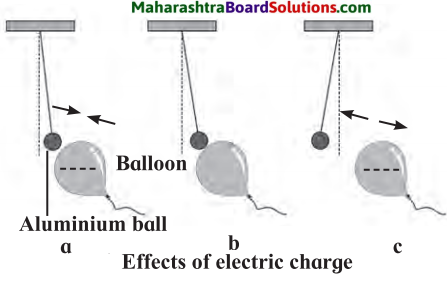
Heat Class 7 Questions And Answers Maharashtra Board

Std 7 Science Chapter 9 Heat Question Answer Maharashtra Board

Balbharti Maharashtra State Board Class 7 Science Solutions Chapter 9 Heat Notes, Textbook Exercise Important Questions and Answers.

Class 7 Science Chapter 9 Heat Question Answer Maharashtra Board

Fill in the blanks:

Question a.
Maximum heat is absorbed by a ………….. coloured object.
Answer:
black

Question b.
……………. of heat does not require a medium.
Answer:
Radiation

Maharashtra Board Class 7 Science Solutions Chapter 9 Heat

Question c.
Conduction of heat takes place through a ……………. substance.
Answer:
solid

Question d.
The shining surface in a thermos flask decreases the outgoing heat by ……………… .
Answer:
reflection

Question e.
Cooking utensils are made from metals due to their property of ……………… .
Answer:
conduction

Question f.
The earth receives heat from the sun by ………………. .
Answer:
radiation

Maharashtra Board Class 7 Science Solutions Chapter 9 Heat

2. What will absorb heat?
Steel spoon, wooden board, glass vessel, iron griddle (lava), glass, wooden spoon, plastic plate, soil, water, wax.

Question a.
What will absorb heat?
Steel spoon, wooden board, glass vessel, iron griddle (lava), glass, wooden spoon, plastic plate, soil, water, wax.
Answer:
Following will absorb heat fast: steel spoon, iron griddle, water, wax. Remaining objects also obsorb heat but very slowly.

3. Write Answers to the following questions. 

Question a.
How does a fever get lowered by putting a cold compress on the forehead of a patient?
Answer:
The water in the cold compress will evaporate by the heat of fever thus taking some local heat of the body and temperature of the body is lowered, therefore the fever gets lowered by putting a cold compress on the forehead of a patient.

Question b.
Why are the houses in Rajasthan painted white?
Answer:
Rajasthan being a desert, temperature is very high. So there is excess heat. White colour doesn’t absorb the heat but reflects back, so houses will not become hot due to excess heat and inside of the house will be cool. So the houses in Rajasthan are painted white.

Maharashtra Board Class 7 Science Solutions Chapter 9 Heat

Question c.
What are the modes of heat transfer?
Answer:
There are three modes of heat transfer:

  1. conduction
  2. convection
  3. radiation.

Question d.
Explain which mode of heat transfer causes sea breezes and land breezes?
Answer:

  1. Unequal heating of air above the sea and land sets up convection currents which cause sea breezes during the day time.
  2. The land near the sea is heated by sunlight to a higher temperature than the sea.
  3. As the air above the land is heated, it becomes lighter and moves upwards, its place is then taken by cooler air moving from the sea towards the land.
  4. Sea breezes are thus set up. At night, the land cools faster than water in the sea. Therefore air above sea water is hotter than air above the land.
  5. So cooler air from the land moves towards the sea forming land breeze.

Question e.
Why is the outer coat of the penguins of Antarctica black?
Answer:
The outer coat of the penguins of Antarctica is black because black colour absorbs heat so penguins get lots of heat due to this black colour and they can live easily in very, very cold Antarctica region.

Maharashtra Board Class 7 Science Solutions Chapter 9 Heat

Question f.
Why are heaters fitted near the floor and air conditioners near the ceiling of a room?
Answer:
1. Due to air conditioners, air becomes cool so its density increases and it becomes heavy. So it goes down and warm air with less density comes up and take the place of cold air. This cycle goes on and on and the whole room becomes cool.
2. If it is fitted near the floor then cool air of high density can’t go up and upper air with low density cannot come down and cooling of the room does not take place properly so air conditioners are fitted near the ceiling of a room.
3. Heaters are fitted near the floor. Due to heating, air becomes hot which is lighter than cold air. So it goes up and upper air with high density comes down.
4. This cycle goes on and on and the full room becomes warm. So heaters are fitted near the floor.

4. Give scientific reasons.

Question a.
An ordinary glass bottle cracks when boiling water is poured into it, but a borosil glass bottle does not.
Answer:

  1. An ordinary glass bottle cracks when we pour boiling water into it because there is a lot of temperature difference between the inner and outer parts of the glass.
  2. The inner part gets hot and expands while the outer part remains cold since glass is a bad conductor of heat.
  3. This unequal expansion causes the crack of glass bottle.
  4. But the borosil glass bottle has a very high melting point so the temperature difference is very less, hence it doesn’t crack.

Maharashtra Board Class 7 Science Solutions Chapter 9 Heat

Question b.
The telephone wires which sag in summer become straight in winter.
Answer:

  1. Telephone wires are made up of copper metal. Metals expand on heating.
  2. In summer the copper wire expands, thus the length of the wire increases between the two poles and instead of remaining straight it sags.
  3. In winter due to cold, it contracts and comes back to the original position, so it becomes straight in winter.

Question c.
Dewdrops form on the grass in winter.
Answer:

  1. During the winter, the temperature of air is low, its capacity to hold the vapour is less.
  2. At such times the excess water vapour is transformed into water droplets due to cold. And so the dew drops form on the grass in winter.

Question d.
In winter, why does an iron pillar feel colder than a wooden pole.
Answer:

  1. Iron is a metal and metals are very good conductors of heat so it transfers heat at a much faster rate than wood.
  2. That means, when we touch them, metals conducts away energy in the form of heat emitted by our hand and temperature of our hand lowers down and we get a cold’ sensation.
  3. This is what makes the metal appear colder than the wood.
  4. The wood is taking away heat at a much slower rate.

Maharashtra Board Class 7 Science Solutions Chapter 9 Heat

Project:

Question 1.
Make a note of the various examples of heat transfer seen in day-to-day life.

Class 7 Science Chapter 9 Heat Important Questions and Answers

Fill in the blanks:

Question 1.
………………… is an indicator of the heat in a substance.
Answer:
Temperature

Question 2.
………………. flows from higher temperature to lower temperature.
Answer:
Heat

Maharashtra Board Class 7 Science Solutions Chapter 9 Heat

Question 3.
Transfer of heat from one place to another takes place by ……………. or ……………. .
Answer:
conduction, convection, radiation

Question 4.
During conduction, particles of the substance …………….. in their place.
Answer:
vibrate

Question 5.
In a convection current, warm air travels …………….. .
Answer:
upwards

Question 6.
A …………….. is necessary for the conduction of heat.
Answer:
medium

Maharashtra Board Class 7 Science Solutions Chapter 9 Heat

Question 7.
The ………………. of conduction of heat through a medium depends on the medium.
Answer:
speed

Question 8.
Convection takes place only in …………… medium.
Answer:
fluid

Question 9.
Transfer of heat in the absence of a medium is called ……………… .
Answer:
radiation

Maharashtra Board Class 7 Science Solutions Chapter 9 Heat

Question 10.
Substances through which heat travels easily and quickly are called …………… .
Answer:
good conductors

Question 11.
Substances through which heat travels very slowly are called ………… of heat.
Answer:
bad conductors

Question 12.
Copper is a better ………… of heat than …………. .
Answer:
conductor, iron

Maharashtra Board Class 7 Science Solutions Chapter 9 Heat

Question 13.
………………. made first thermos flask in 1892.
Answer:
Sir James Dewar

Question 14.
Neither conduction nor convection of the heat occurs in thermos flask due to the ……………… .
Answer:
vacuum.

Match the following:

Question 1.

Column ‘A’Column ‘B’
1. Good conductora. flow of particles
2. Bad conductorb. particles vibrate
3. Conductionc. glass
4. Convectiond. copper

Answer:

Column ‘A’Column ‘B’
1. Good conductord. copper
2. Bad conductorc. glass
3. Conductionb. particles vibrate
4. Convectiona. flow of particles

Maharashtra Board Class 7 Science Solutions Chapter 9 Heat

Question 2.

Column ‘A’Column ‘B’
1. Radiationa. convection current
2. Black bodyb. conduction
3. Vibrationc. absorbs more heat
4. A rotating paper lanternd. no medium

Answer:

Column ‘A’Column ‘B’
1. Radiationd. no medium
2. Black bodyc. absorbs more heat
3. Vibrationb. conduction
4. A rotating paper lanterna. convection current

Maharashtra Board Class 7 Science Solutions Chapter 9 Heat

Say whether true or false, correct and rewrite the false statements:

Question 1.
Glass is a bad conductor of heat.
Answer:
True

Question 2.
In a thermos flask, hot things remain hot and cold things become warm.
Answer:
False. In a thermos flask, hot things remain hot and cold things remain cold.

Question 3.
Radiation of heat depends upon the colours of the outer surface of the body.
Answer:
True

Maharashtra Board Class 7 Science Solutions Chapter 9 Heat

Question 4.
During radiation, the particles of the medium vibrate.
Answer:
True

Question 5.
Copper is better conductor of heat than iron.
Answer:
True

Question 6.
During conduction, particles of the conductor leave their original place.
Answer:
False. During conduction, particles of the conductor do not leave their original place, but only vibrate in their own place.

Question 7.
Hot water is heavier than cold water.
Answer:
False – Hot water is lighter than cold water.

Maharashtra Board Class 7 Science Solutions Chapter 9 Heat

Question 8.
A convection current always travels down wards.
Answer:
False – A convection current always travels upwards.

Question 9.
Every warm substance continuously emits heat in all directions around itself.
Answer:
True

Question 10.
Air is a bad conductor of heat.
Answer:
True

Define the following:

  1. Conduction
  2. convection
  3. radiation
  4. Transfer of heat.

Answer:

  1. Conduction: The transfer of heat from one end of a solid substance to the other, without the particles leaving their original place is called conduction.
  2. Convection: Transfer of heat in fluids due to formation of currents is called convection.
  3. Radiation: Transfer of heat in all directions in the absence of a medium is called radiation.
  4. Transfer of heat: The flow of heat from one place to another is called transfer of heat.

Maharashtra Board Class 7 Science Solutions Chapter 9 Heat

Give scientific reasons:

Question 1.
Cricketers wear white clothes when playing in the sun.
Answer:
White clothes do not absorb heat but reflect back therefore cricketers wear white clothes while playing in the sun.

Question 2.
Sawdust is a bad conductor of heat.
Answer:
Sawdust is a bad conductor of heat because heat travels very slowly through it.

Question 3.
We can feel the heat of table lamp under it.
Answer:
We can feel the heat of table lamp under it because every warm substance continuously emits heat in all directions around itself by radiation.

Maharashtra Board Class 7 Science Solutions Chapter 9 Heat

Question 4.
Medium is necessary for conduction.
Answer:
Conduction is the transfer of heat from one end of a substance to another. Transfer of heat has to be done by particles of a substance and particles of a substance are particles of a medium. Hence, a medium is necessary for conduction.

Question 5.
Explain the structure and functioning of thermometer containers-
Answer:

  1. Thermoware containers keep food hot. These containers consist two boxes fitted one inside the other.
  2. The outer box is made up of plastic while the inner one is made up of a shiny metal, there is air between the two boxes.
  3. Air is a bad conductor of heat. Thus, heat is not lost by either conduction or convection. Also, the shiny inner surface prevents heat loss due to radiation.
  4. The container has a plastic lid. This also prevents any transfer of heat.

Question 6.
what is mailed infrared camera? Write its uses.
Answer:

  1. Radiation of heat takes place from many objects in nature such as trees, mountains, stones and roads.
  2. A camera has been developed which uses these radiations to make our surroundings visible even at night. This is called infrared camera.
  3. It is used to keep watch on the movements of the enemy during the night.
  4. It is also used to track the movements of animals in the wild.

Maharashtra Board Class 7 Science Solutions Chapter 9 Heat

Question 7.
Why is mercury used in a thermometer?
Answer:
Mercury is used in a thermometer because of the following properties.

  1. There is a big difference between the freezing point and boiling point of mercury. Its freezing point is – 39° C and its boiling point is 357° C.
  2. It is shiny and can be easily seen.
  3. It does not stick to glass.
  4. It expands regularly and uniformly in all conditions.

Question 8.
Write the difference between Conduction, Convection and Radiation.
Answer:

ConductionConvectionRadiation
1. It is a mode of transfer of heat from hot part of an object to the cold part.It is a mode of transfer of heat by means of convection currents.It is a mode of transfer of heat in all directions without any medium.
2. It occurs in solids.It occurs in liquids and gases.It occurs in all objects of high temperature and vacuum.
3. It is a slow process.It is a slow processIt is a fast process.

Maharashtra Board Class 7 Science Solutions Chapter 9 Heat

Question 9.
Draw and explain about the Thermos flask or Dewar flask.
Answer:
Maharashtra Board Class 7 Science Solutions Chapter 9 Heat 1

Principle:
1. As there is no medium in the vacuum between the two bottles, no transfer of heat can take place by conduction or convection.
2. Radiant heat is reflected back inside from the shiny surfaces.
3. Glass and plastic are bad conductors of heat hence they do not transfer heat either into or out of the bottle. Thus transfer of heat does not take place by any of the three modes, namely conduction, convection or radiation Hence, hot things in the flask remain hot and cold things cold.

Structure:

  1. A thermos flask consists of two thin glass bottles fitted one inside the other.
  2. The inner surfaces of the bottles have a silver coating to shine like a mirror.
  3. A vacuum is created in the space between the two bottles by removing all the air from it.
  4. A plastic or cork lid is provided to fit on the mouth of the bottle.

Maharashtra Board Class 7 Science Solutions Chapter 9 Heat

Draw neat labelled diagrams of:

Question 1.
The relation between density and convection
Answer:
Maharashtra Board Class 7 Science Solutions Chapter 9 Heat 2

Question 2.
Conduction of heat
Answer:
Maharashtra Board Class 7 Science Solutions Chapter 9 Heat 3

Question 3.
Convection of heat
Answer:
Maharashtra Board Class 7 Science Solutions Chapter 9 Heat 4

Question 4.
Expansion and contraction of a liquid
Answer:
Maharashtra Board Class 7 Science Solutions Chapter 9 Heat 5

Question 5.
Thermos flask
Answer:
Maharashtra Board Class 7 Science Solutions Chapter 9 Heat 1

Can you tell?

Answer the following questions:

Question 1.
Why does the halwai wrap up cloth around the end of his slotted spoon while stirring the boiling milk in his large kadhai?
Answer:
The halwai wrap up cloth around the end of his slotted spoon while stirring the boiling milk in his large kadhai because (i) His slotted spoon is made up of metal and metal is a good conductor of heat so due to constant heating spoon gets very hot which makes hand to get burnt, (ii) But cloth is a bad conductor of heat so it does not allow heat to reach till hand and halwai does not feel hot when he stirs the boiling milk.

Maharashtra Board Class 7 Science Solutions Chapter 9 Heat

Question 2.
Why do we hold a steel glass in a handkerchief while drinking hot milk from it?
Answer:

  1. Steel is metal and it is a good conductor of heat. So due to hot milk it becomes hot and it is difficult to hold. Person’s hand get burnt due to it.
  2. So it is better to hold in a handkerchief because handkerchief is made up of cloth which is a bad conductor of heat. So your hand does not feel hot.

Use your brain power!

Question 1.
Why do we wear woollen clothes in winter?
Answer:
We wear woollen clothes in winter because

  1. Air is a poor conductor of heat and woollen clothes do not allow the transfer of body heat.
  2. Therefore we do not feel cold in woollen clothes and get protected from cold in winter.

Question 2.
Why do we use white clothes in summer and dark or black clothes in winter?
Answer:

  1. White clothes do not absorb heat, so in summer, weather is very hot and white clothes protect us from heat whereas in winter it is very cold so we need more heat.
  2. Dark or black clothes absorb more heat so we get protection from cold.

Maharashtra Board Class 7 Science Solutions Chapter 9 Heat

Question 3.
Why is there a gap at the joints of rails and of cement concrete bridges?
Answer:

  1. The joints of rails and cement concrete bridges are made of iron. Metal is a good conductor of heat so in summer due to heat it expands and its length will be increased.
  2. To allow for this expansion, gaps are kept.
  3. If these gaps are not kept, then after expansion the rails and cement concrete would have buckled upwards due to lack of space.
  4. Due to that bridges would crack and railway tracks get crooked.

Question 4.
Why is mercury or alcohol used in a thermometer?
Answer:
Mercury is used in a thermometer because of the following properties.
Alcohol is used in a thermometer for the following properties.

  1. It can measure a low temperature because its freezing point is low. (-115°C) but it can not measure higher temperature as its boiling point is low.
  2. It can measure the temperature precisely because it has large expansion coefficient.
  3. It’s expansion is regular.
  4. Less hazardous.

Maharashtra Board Class 7 Science Solutions Chapter 9 Heat

Question 5.
Why hot substance does not remain as hot after two or three hours?
Answer:
A little heat is lost from around the lid and by a small amount of conduction through the vessel. So hot substance does not remain as hot after two or three hours.

Diagram based questions.

Observe the diagram and answer the given questions below it.

1.
Maharashtra Board Class 7 Science Solutions Chapter 9 Heat 2

Question a.
What is the diagram about?
Answer:
The diagram is showing us the relation between density and convection.

Question b.
Why is the ice wrapped in wire gauze?
Answer:
Ice floats on water, to make it sink, it is wrapped in wire gauze.

Maharashtra Board Class 7 Science Solutions Chapter 9 Heat

Question c.
What does this experiment prove?
Answer:
When a liquid is heated, its density decreases and it rises upwards. This leads to the convection currents which makes the heated liquid rise upwards and cooler liquid takes it place.

2.
Maharashtra Board Class 7 Science Solutions Chapter 9 Heat 6

Question a.
What is the diagram about?
Answer:
Expansion and contraction of a solid substance.

Question b.
Does the same thing happen in liquids and gases?
Answer:
Yes. Generally substances solids, liquids and gases expand on heating and contract on cooling.

Maharashtra Board Class 7 Science Solutions Chapter 9 Heat

Question c.
Give one example of this property in everyday life.
Answer:
Gaps are present in between two railway line track joints so that they do not bend due to expansion.

3.
Maharashtra Board Class 7 Science Solutions Chapter 9 Heat 7

Question a.
Label parts 1 – 4
Answer:

  1. Vacuum
  2. metal/plastic jar
  3. Spring
  4. silvered surface of the glass.

Question b.
What is the principle of this object?
Answer:
As there is no medium in the vacuum between the two bottles, no transfer of heat takes place due to conduction and convection and radiated heat is reflected back by the shiny surface.

Question c.
State the uses of the given object.
Answer:
The temperature of substances inside it are maintained for some time. Hot things remain hot and cold things cold for 2 – 3 hours.

Maharashtra Board Class 7 Science Solutions Chapter 9 Heat

Question d.
What is an infrared camera?
Answer:
It is a camera which uses radiations to make our surroundings visible at night. Using this camera, it is possible to keep a watch on the movements of the enemy during the night.

Question e.
What is thermoware?
Answer:
Thermoware are object which do not allow heat to escape from them. So things stay warm in them. eg. hot pot, thermos flask.

Maharashtra State Board Class 7 Science Textbook Solutions
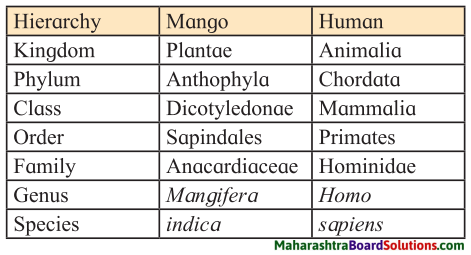
Nutrition in Living Organisms Class 7 Questions And Answers Maharashtra Board

Std 7 Science Chapter 4 Nutrition in Living Organisms Question Answer Maharashtra Board

Balbharti Maharashtra State Board Class 7 Science Solutions Chapter 4 Nutrition in Living Organisms Notes, Textbook Exercise Important Questions and Answers.

Class 7 Science Chapter 4 Nutrition in Living Organisms Question Answer Maharashtra Board

1. Classify according to food-type.
Tiger, cow, vulture, bacteria, deer, goat, human, fungus, lion, sparrow, buffalo, frog, cockroach, tick.
Answer:

  • Carnivores: tiger, Lion
  • Herbivores: cow, deer, goat, buffalo
  • Scavengers: vulture
  • Decomposers: fungus, bacteria
  • Granivores: sparrow
  • Insectivores: frog Parasitic: tick
  • Omnivores: human, cockroach

Maharashtra Board Class 7 Science Solutions Chapter 4 Nutrition in Living Organisms

2. Nutrition In Living Organisms Class 7 Exercise Match the pairs.

Class 7 Science Chapter 4 Nutrition In Living Organisms Question Answer Question 1.

Column ‘A’Column ‘B’
1. Parasitic planta. Mushroom
2. Parasitic plantb. Lichen
3. Saprophytic plantc. Drosera
4. Symbiotic plantd. Cuscuta

Answer:

Column ‘A’Column ‘B’
1. Parasitic plantd. Cuscuta
2. Parasitic plantc. Drosera
3. Saprophytic planta. Mushroom
4. Symbiotic plantb. Lichen

3. Answer the following questions in your words. 

Question a.
Why do living organisms need nutrition?
Answer:
Living organisms need nutrition due to the following: (a) To supply the energy required for doing work, (b) For growth and development of the body, (c) To replace the damaged cells and repair tissues, (d) To fight diseases.

Maharashtra Board Class 7 Science Solutions Chapter 4 Nutrition in Living Organisms

Question b.
Explain the process of production of food in plants.
Answer:
1. Green plants can produce their own food. With the help of sunlight and chlorophyll, plants make their own food in their leaves, using water and nutrients from the soil and carbon dioxide from the air.

2. This process is called as photosynthesis. In this process plants give out oxygen and take in carbon dioxide.

Maharashtra Board Class 7 Science Solutions Chapter 4 Nutrition in Living Organisms 1

Question c.
What is meant by parasitic plants? Name their different types with examples of each.
Answer:
The plants that grow on the body of other plants to obtain food are called as parasitic plants.

There are two types of parasitic plants:

  • Holoparasites: e.g. Rafflesiaceae
  • Hemiparasites: e.g. Loranthaceae

Maharashtra Board Class 7 Science Solutions Chapter 4 Nutrition in Living Organisms

Question d.
Explain the various steps of nutrition in animals.
Answer:
Steps of nutrition in animals are as follows:

  1. Ingestion: Food is taken into the body.
  2. Digestion: Conversion of food into simple soluble forms.
  3. Absorption: Transfer of soluble food to the blood.
  4. Assimilation: Utilization of absorbed food by cells and tissues for energy production, growth and repair.
  5. Egestion: Removal of waste products and undigested food from body.

Question e.
Name some unicellular organisms in which all life processes take place within their unicellular body.
Answer:
Unicellular organisms like amoeba, euglena, paramoecium in which all life processes take place within their unicellular body.

4. Give reasons.

Question a.

Insectivorous plants are attractively coloured.
Answer:

  1. Insectivorous plants generally grow in soil or water deficient in nitrogen compounds.
  2. The plant body of the Drosera burmanii has a flower like appearance. It grows close to the ground. Even its leaves are attractively pink or red in colour with hairs at the margin.
  3. Droplets of a sticky substances found on tips of the hairs attract insects.
  4. These plants consume insects to fulfill their need for nitrogen. To attract the insects these plants are attractively coloured.

Maharashtra Board Class 7 Science Solutions Chapter 4 Nutrition in Living Organisms

Question b.
Butterflies have a long tube-like proboscis.
Answer:
Holozoic mode of nutrition means the feeding of solid and liquid food by animals. Butterflies live on nectar from flowers. Therefore to suck the nectar from flowers, they have a long tube-like structure called proboscis.

5. Prepare and complete the flowchart according to type of nutrition.

Question a.
Prepare and complete the flowchart according to type of nutrition.
Maharashtra Board Class 7 Science Solutions Chapter 4 Nutrition in Living Organisms 2
Answer:
Maharashtra Board Class 7 Science Solutions Chapter 4 Nutrition in Living Organisms 3

6. Think and answer.

Question a.
We prepare a variety of foodstuffs and dishes at home. Are we then autotrophic organisms?
Answer:

  1. We prepare a variety of foodstuffs and dishes at home but we are not autotrophic organisms.
  2. In autotrophic organisms they have chlorophyll in their body and food is prepared here with help of sunlight, water and CO2 for the organisms.
  3. But the food which we prepare at home is not generated in our body.

Maharashtra Board Class 7 Science Solutions Chapter 4 Nutrition in Living Organisms

Question b.
Which organisms are greater in number – autotrophs or heterotrophs? Why?
Answer:

  1. Autotrophs have chlorophyll in the cell and here the organic food is prepared using sunlight, water and CO2.
  2. They do not depend on any other organism for survival.
  3. But the heterotrophs depend on autotrophs and other organisms for survival. Hence autotrophs are more in number than heterotrophs.

Question c.
The number of heterotrophs found in desert regions is smaller. However, they are found in greater numbers in the sea. Why is this so?
Answer:

  1. In desert region due to scarcity of water and excess heat, very few cactus are found as autotrophs compared to sea. As autotrophs are less, number of heterotrophs dependent on autotrophs are smaller.
  2. Whereas in sea due to greater numbers of autotrophs, greater number of heterotrophs are found.

Question d.
What damage or harm do ectoparasitic and endoparasitic animals cause?
Answer:

  1. Ectoparasitic animals suck the blood of the animal on which it remains and endoparasitic animals get readymade food from the body of animal in which it remain.
  2. This way both the parasites make the animal weak by sucking their blood or by eating prepared food from them.

Maharashtra Board Class 7 Science Solutions Chapter 4 Nutrition in Living Organisms

Question e.
Why is plant food not produced in any other parts of the plant except the green ones?
Answer:
Plant food is not produced in any other parts of the plant except the green ones because only green part contains chlorophyll and chlorophyll is very necessary for the production of food.

Class 7 Science Chapter 4 Nutrition In Living Organisms Project:

Question 1.
Many heterotrophic organisms live on one and the same plant. Observe one such plant in your neighborhood and find out about the heterotrophs that depend upon it for their food. Observe and make flotes about other organisms that use these heterotrophs as their food.

Question 2.
Prepare a Power point presentation on the topic ‘Nutrition in Living Organisms’.

Class 7 Science Chapter 4 Nutrition in Living Organisms Important Questions and Answers

Nutrition In Living Organisms Class 7 Exercise Fill in the blanks.

Nutrition In Living Organisms Class 7 Exercise Question 1.
Leaves have microscopic openings called ……………. .
Answer:
Stomata

Class 7 Science Chapter 4 Nutrition In Living Organisms Question 2.
In the process of photosynthesis plants take in ……………. and ……………. gas is given out.
Answer:
Carbondioxide, oxygen

Question 3.
The ……………. transports minerals and water from roots to all aerial parts of the plant.
Answer:
xylem

Maharashtra Board Class 7 Science Solutions Chapter 4 Nutrition in Living Organisms

Question 4.
The ……………. transports the food from the leaves to other parts of the plant.
Answer:
phloem

Question 5.
Plants produce ……………. by the process of photosynthesis.
Answer:
Carbohydrates

Question 6.
……………. are made from carbon, hydrogen, oxygen.
Answer:
Carbohydrates

Question 7.
……………. are made from carbon, hydrogen and oxygen and nitrogen.
Answer:
proteins

Question 8.
……………. plants contain rhizobium micro-organisms.
Answer:
leguminous

Maharashtra Board Class 7 Science Solutions Chapter 4 Nutrition in Living Organisms

Question 9.
Micro-organisms like ……………. are present in soil.
Answer:
azotobacter

Question 10.
Lichen is of a symbiosis between ……………. and ……………. .
Answer:
algae, fungi

Question 11.
The scientist ……………. identified Drosera plant in Sri Lanka in 1737.
Answer:
Johannes Burman

Question 12.
Fungi like mushroom and yeast are ……………. .
Answer:
saprophytes

Question 13.
Removal of waste products and undigested food from the body is called …………….
Answer:
Egestion

Maharashtra Board Class 7 Science Solutions Chapter 4 Nutrition in Living Organisms

Question 14.
Amoeba moves with the help of ……………. .
Answer:
pseudopodia

Question 15.
Butterflies suck food with a tube like ……………. .
Answer:
proboscis

Question 16.
The ……………. or ……………. is an ant eating animal found in India.
Answer:
bobcat, udmanjar

Question 17.
Seed eating animals are called ……………. .
Answer:
granivores

Question 18.
Fruit eating animals are called ……………. .
Answer:
frugivores

Question 19.
Animals that obtain their food from both plants and animals are called ……………. .
Answer:
Omnivores

Maharashtra Board Class 7 Science Solutions Chapter 4 Nutrition in Living Organisms

Question 20.
Roundworms are known as ……………. .
Answer:
endoparasites

Class 7 Science Chapter 4 Nutrition In Living Organisms Match the column:

Question 1.

Column ‘A’Column ‘B’
1. Endoparasitea. Vulture
2. Ectoparasiteb. Human
3. Seed eating animalsc. Tapeworm
4. Fruit eating animalsd. Bed bug
5. Scavengere. granivores
6. Omnivoref. frugivores

Answer:

Column ‘A’Column ‘B’
1. Endoparasitec. Tapeworm
2. Ectoparasited. Bed bug
3. Seed eating animalse. granivores
4. Fruit eating animalsf. frugivores
5. Scavengera. Vulture
6. Omnivoreb. Human

Maharashtra Board Class 7 Science Solutions Chapter 4 Nutrition in Living Organisms

Say whether true or false, correct and rewrite the false statements.

Question 1.
Bed bug is an example of endoparasitic nutrition.
Answer:
False, Bed bug is an example of ectoparasitic nutrition

Question 2.
Spider shows saprozoic nutrition.
Answer:
True

Question 3.
The anteater is found in India.
Answer:
False. The anteater is found in Central and South America

Question 4.
Yellowing of leaves occur due to deficiency of iron.
Answer:
True

Question 5.
Mushroom is used in making bread.
Answer:
False. Yeast is used in making bread

Maharashtra Board Class 7 Science Solutions Chapter 4 Nutrition in Living Organisms

Question 6.
Cuscuta is completely a parasitic plant.
Answer:
True

Question 7.
The nitrogen dioxide dissolves in rainwater and is converted into nitric acid.
Answer:
True

Question 8.
Micro-organism Rhizobium is found in soil.
Answer:
False. Micro-organism Azotobacter is found in soil.

Question 9.
Fixation of nitrogen occurs by biological and atmospheric methods.
Answer:
True

Question 10.
The chloroplasts present in the leaves contain chlorophyll.
Answer:
True

Maharashtra Board Class 7 Science Solutions Chapter 4 Nutrition in Living Organisms

Question 11.
Decomposers obtain their food from living organisms.
Answer:
False, They obtain their food by decomposing the dead bodies of organisms or other materials

Question 12.
Carbondixode is given out during the process of photosynthesis.
Answer:
False, Oxygen is given out during the process of photosynthesis

Question 13.
Phloem transports the food from leaves to other parts of the plant.
Answer:
True

Question 14.
Carbohydrates are made up of carbon, hydrogen oxygen and nitrogen.
Answer:
False, Protein are made up of carbon, hydrogen, Oxygen and nitrogen.

Maharashtra Board Class 7 Science Solutions Chapter 3 Properties of Natural Resources

Give scientific reasons.

Question 1.
Micro-organisms like Rhizobium are useful.
Answer:

  1. Rhizobium micro-organisms are useful because plants cannot take gaseous nitrogen from air.
  2. These micro-organisms absorb atmospheric nitrogen and convert it into its nitrate, a compound which is useful for plant.

Question 2.
Lichen is an example of a symbiotic nutrition.
Answer:
Lichen is a symbiosis between algae and fungi in which fungi provides water, minerals, as well as shelter to algae and in return the algae Master Key General Science (Std. 7), provide food to the fungi. So Lichen, is an example of symbiotic nutrition.

Question 3.
Drosera burmanii is an insectivorous plant.
Answer:
Drosera burmanii grows in a soil which has nitrogen deficiency. It feeds upon insects to obtain nitrogen, so it is an insectivorous plant.

Maharashtra Board Class 7 Science Solutions Chapter 4 Nutrition in Living Organisms

Question 4.
Human is an omnivore.
Answer:
Humans obtain their food from both, plants and animals so human is an omnivore.

Question 5.
Tapeworm is an endoparasite.
Answer:
Tapeworm lives inside the body of other animals and obtain its food. So tapeworm is an endoparasite.

Question 6.
Decomposers are important for the ecosystem
Answer:
Decomposers feed on dead and decaying matter and therefore indirectly clean the ecosystem. If decomposers were not there then nutrients would not be able to return back and get recycled. Therefore decomposers are very important for the ecosystem.

Maharashtra Board Class 7 Science Solutions Chapter 4 Nutrition in Living Organisms

Question 7.
Cuscuta is a total parasite while Loranthus is a partial parasite.
Answer:
Cuscuta is a nongreen yellow thread-like plant completely dependent on the host plant, loranthus is a partial parasitic because it can prepare its own food and it only takes water and minerals from the host plant.

Answer the following in your own words:

Question 1.

Classify the types of nutrients.
Answer:
There are two types of nutrients.

  1. Nutrients like carbohydrates, proteins and fats are required in large quantity. These are macro-nutrients.
  2. Minerals and vitamins are required in very small quantity. They are called micro-nutrients.

Question 2.
Explain the types of nutrition.
Answer:
There are two types of nutrition.

  1. Some organisms can produce their own food and thus nourish themselves. This is called autotrophic nutrition.
  2. Some organisms depend on other organisms, plants and animals for their food. This is called heterotrophic nutrition.

Maharashtra Board Class 7 Science Solutions Chapter 4 Nutrition in Living Organisms

Question 3.
Write differences between xylem and phloem.
Answer:

xylemPhloem
1.  The xylem transports minerals and water from the root to all aerial parts of the plant.1. The phloem transports the food (glucose) from the leaves to other parts of the plant where it is either consumed or stored.

Question 4.
What is chemosynthesis? Which plants produce their food by chemosynthesis?
Answer:

  1. Chemosynthesis is the biological conversion of one or more carbon-containing molecules and nutrients into organic matter.
  2. It uses the oxidation of inorganic compounds or methane as a source of energy rather than sunlight.
  3. Sulphur bacteria and nitrosomonas produce their food by chemosynthesis.

Question 5.
Name the micro-organisms which help in biological fixation of nitrogen. How?
Answer:
Two different types of micro-organisms can bring about biological nitrogen fixation.

  1. Root-nodules of leguminous plants contain the micro-organism rhizobium. These micro-organisms absorb atmospheric nitrogen and convert if into its nitrate, a compound.
  2. Micro-organisms like azotobacter are’present in soil. They also convert atmospheric nitrogen into nitrates.

Maharashtra Board Class 7 Science Solutions Chapter 4 Nutrition in Living Organisms

Question 6.
What is symbiotic nutrition? Give one example of it.
Answer:

  1. Two or more than two different types of plant live together to fulfill their needs of nutrition, protection, support etc. with each other’s help. This type of nutrition is called symbiotic nutrition.
  2. e.g. Lichen is an example of symbiosis between algae and fungi.

Question 7.
Write about Drosera burmanii.
Answer:

  1. It is art insectivorous plant.
  2. The scientist Johannes Burman identified this plant in Sri Lanka in 1737. Hence, the plant is named after him.
  3. It grows close to the ground.
  4. Its leaves are attractively pink or red in colour with hairs at the margin.
  5. Droplets of a sticky substance found at the tips of the hairs attract insects.
  6. It grows in a place where deficiency of nitrogen in the soil. To get nitrogen for its growth, it eats insects.

Question 8.
What are called saprophytic plants? Give Examples.
Answer:
Plants which obtain the food from dead and decaying bodies of other organisms are called saprophytic plants e.g. Yeast and mushrooms.

Maharashtra Board Class 7 Science Solutions Chapter 4 Nutrition in Living Organisms

Question 9.
Classify the animals according to the type of food they eat.
microbes, vulture, monkey, tiger, lion, goat, cow, buffalo, crow, hyena, human, chimpanzee
Answer:

  • Herbivores: goat, cow, buffalo.
  • Carnivores: tiger, lion
  • Omnivores: monkey, human, chimpanzee
  • Scavengers: vulture, crow, hyena
  • Decomposers: microbes

Explain the terms:

  1. Herbivores: Animals that depend on plants only for their food are called Herbivores.
  2. Carnivores: Animals that depend on other animals for their food are called Carnivores.
  3. Granivores: Animals that eat grains (seed) are called Granivores.
  4. Frugivores: Animals that eat fruits are called frugivores.
  5. Omnivores: Animals that obtain their food from both plants and animals are called omnivores.
  6. Scavengers: Animals that obtain their food from dead bodies of animals are called Scavengers.
  7. Decomposers: Microbes which obtain their food by decomposing the dead bodies of organisms or other materials are called decomposers.
  8. Ectoparasitic nutrition: Some animals live on the body surface of other animals and obtain their food by sucking their blood. This is called ectoparasitic nutrition.
  9. Endoparasitic nutrition: Some animals live inside the body of other animals and obtain their food. This is called endoparasitic nutrition.
  10. Symbiotic nutrition: In some cases, two or more than two different types of plants live together to fulfill their needs of nutrition, protection, support etc. with each other’s help. This type of nutrition is called symbiotic nutrition.

Write the role of different nutrients like nitrogen, phosphorus, potassium,magnesium, Iron, manganese and zinc and effects of their deficiency on plants.

Question 1.
Write the role of different nutrients like nitrogen, phosphorus, potassium, magnesium, Iron, manganese and zinc and effects of their deficiency on plants.
Answer:
Role of nutrients and effects of their deficiency on plants:

NutrientsFunctionEffects of deficiency
NitrogenImportant components of proteins, chlorophyll and cytoplasm.Retarded/stunted growth, yellowing of leaves.
PhosphorusConversion of light energy into chemical energy.Early leaf-fail, late flowering, slow growth of roots.
PotassiumNecessary for metabolic activities.Weak stem, wilting of leaves, failure to produce carbohydrates.
MagnesiumProduction of chlorophyllSlow/retarded growth, yellowing of leaves.
IronProduction of chlorophyllYellowing of leaves
ManganeseProduction of main plant hormonesRetarded growth, spotted leaves
ZincProduction of hormones and their intermediatesRetarded growth, yellowing of leaves

Maharashtra Board Class 7 Science Solutions Chapter 4 Nutrition in Living Organisms

Can you tell?

Answer the following question: 

Question 1.
How does ingestion occur in unicellular animals like amoeba?
Answer:
Maharashtra Board Class 7 Science Solutions Chapter 4 Nutrition in Living Organisms 4

  1. Amoeba does not have organs like hands and mouth.
  2. It is a unicellular animal. It can take in food through any part of the surface of its unicellular body.
  3. It surrounds the food particle from all sides to take it into the cell.
  4. After that it digests the food with the help of different enzymes.
  5. Undigested food is left behind as the amoeba moves further with the help of pseudopodia.
  6. In unicellular animals like amoeba, euglena, paramoecium,. etc. all the steps of nutrition occur within their unicellular body.

Maharashtra Board Class 7 Science Solutions Chapter 4 Nutrition in Living Organisms

Question 2.
How do plants produce their own food?
Answer:
Green plants produce their own food with the help of sunlight, chlorophyll, water, nutrients from soil and carbon dioxide from the air. This process is called as photosynthesis

Maharashtra Board Class 7 Science Solutions Chapter 4 Nutrition in Living Organisms 5

Use your brain power!

Answer the following questions:

Question 1.
Write the uses of yeast and mushrooms.
Answer:
Yeast is used in fermentation processes and making bread.
Mushrooms are a rich source of vitamins and iron.

Question 2.i
Which part of the loranthus plant carries out photosynthesis?
Answer:
Leaves of the loranthus plant carries out photosynthesis.

Maharashtra Board Class 7 Science Solutions Chapter 4 Nutrition in Living Organisms

Question 2.ii
From where do they obtain minerals and water?
Answer:
They obtain water and minerals from the xylem and phloem of the other host plant.

Question 2.iii
Why is loranthus known as a partially parasitic plant?
Answer:
Loranthus is known as partially parasitic plant because it does photosynthesis with the help of leaves but only for water and minerals it depends on other plants.

Question 3.
Why does the pitcher plant feed on insects even though it produces food by photosynthesis?
Answer:
Pitcher plants grow in a place where soil has deficiency of nitrogen compounds so to fulfill the need of nitrogen they feed on insects.

Observe the diagram and answer the following questions.

Maharashtra Board Class 7 Science Solutions Chapter 4 Nutrition in Living Organisms 6

Question a.
Name the process shown in the picture.
Answer:
The process shown is photosynthesis.

Maharashtra Board Class 7 Science Solutions Chapter 4 Nutrition in Living Organisms

Question b.
Which type of plants use the above process for their nutrition?
Answer:
Autotrophic plants (green plants) use the above process for their nutrition.

Question c.
What is the pigment in the leaf that helps in the above process?
Answer:
Chlorophyll

Question d.
Give the chemical equation of the above process?
Answer:
Maharashtra Board Class 7 Science Solutions Chapter 4 Nutrition in Living Organisms 7

Question e.
What is the importance of this process to living things?
Answer:
Photosynthesis helps the plants to prepare their own food and also store it in their plant bodies. Animals depend upon this stored food for their nutrition.
During photosynthesis, oxygen is given out which is important for all living organisms for respiration.

Observe the diagram and answer the following questions.

Maharashtra Board Class 7 Science Solutions Chapter 4 Nutrition in Living Organisms 8

Question a.
What is shown in the picture?
Answer:
Roots of leguminous plants having root nodules.

Maharashtra Board Class 7 Science Solutions Chapter 4 Nutrition in Living Organisms

Question b.
What is the importance of these types of plants?
Answer:
These types of plants help to provide nitrogen to the soil.

Question c.
What is the process called?
Answer:
Biological Nitrogen fixation

Question d.
Explain the process.
Answer:
Root nodules of leguminous plants contain Rhizobium micro-organisms. These micro¬organisms convert atmospheric nitrogen into nitrates. Thus the soil becomes rich in nitrogen.

Maharashtra State Board Class 7 Science Textbook Solutions
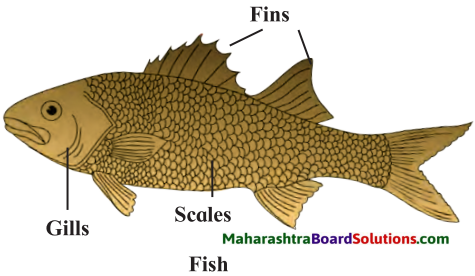
Food Safety Class 7 Questions And Answers Maharashtra Board

Std 7 Science Chapter 5 Food Safety Question Answer Maharashtra Board

Balbharti Maharashtra State Board Class 7 Science Solutions Chapter 5 Food Safety Notes, Textbook Exercise Important Questions and Answers.

Class 7 Science Chapter 5 Food Safety Question Answer Maharashtra Board

1. Complete the following statements by using the correct option from those given below.
(Irradiation, dehydration, pasteurization, natural, chemical)

Question a.
Drying the food grains from farms under the hot sun is called …………. .
Answer:
dehydration

Maharashtra Board Class 7 Science Solutions Chapter 5 Food Safety

Question b.
Materials like milk are instantly cooled after heating up to a certain high temperature. This method of food preservation is called ……….. .
Answer:
pasteurization

Question c.
Salt is a ……….. type of food preservative.
Answer:
natural

Question d.
Vinegar is a …………. type of food preservative.
Answer:
chemical

2. Answer the following questions in your own words. 

Question a.
How is milk pasteurised?
Answer:
Boil the milk at 80°C for 15 minutes and cool it quickly. This destroys the microbes present in the milk and it can remain for a longer duration. This process is called pasteurization of milk.

Maharashtra Board Class 7 Science Solutions Chapter 5 Food Safety

Question b.
Why should we not consume adulterated food materials?
Answer:
Different types of adulterants affect our health in different ways. Some adulterants cause abdominal discomfort or poisoning while some may affect the functioning of some organs if consumed over a long period of time or even cause cancer.

Question c.
What precautions do your parents take to keep foodstuffs safe?
Answer:
Our parents take following care to keep foodstuffs safe

  1. Drying of grains.
  2. Boiling of milk, soups and curries from time to time.
  3. Refrigeration of vegetables, fruits, milk and cooked food.
  4. Candying of jams.
  5. Use natural preservatives like oil, spices, neem leaves, salt, etc.
  6. Use chemical preservatives in sauces, ketchups, pickles, jams and squashes.

Question d.
How does food spoilage occur? Which are the various factors spoiling the food?
Answer:
Food spoilage is the process in which food deteriorates to the point in which it is not edible to humans or its quality of edibility becomes reduced.
Following are the factors for spoiling of food:

  1. Bacteria causes food to spoil
  2. Incorrect storage may spoil the food.
  3. Infestation by pests.
  4. Chemical reaction takes place in food and it gets spoiled.

Maharashtra Board Class 7 Science Solutions Chapter 5 Food Safety

Question e.
Which methods of food preservation would you use?
Answer:
I use following methods to preserve the food:

  1. Freezing
  2. Boiling
  3. Salting of pickles
  4. drying of grains
  5. candying of jams.

3. What shall we do?

Question a.
There are vendors selling uncovered sweet-meats in open places in the market.
Answer:
We should tell them to sell the covered sweets because uncovered sweets are harmful to eat because it contains dust, dirt and germs. And buyers also should not purchase these uncovered sweets.

Question b.
A ‘pani-puriwala’ is serving the panipuri with dirty hands.
Answer:
We should tell him to wear gloves before serving panipuri because dirty hands contain dirt and germs which are harmful to us.

Question c.
We have purchased a large quantity of fruits and vegetables.
Answer:
We should keep them in refrigerator because in refrigerator, due to low temperature, fruits and vegetables do not spoil and biological and chemical reactions in fruits and vegetables are slowed down at low temperature.

Maharashtra Board Class 7 Science Solutions Chapter 5 Food Safety

Question d.
We need to protect foodstuffs from pests like rats, cockroaches, wall-lizards etc.
Answer:

  1. If we do not protect foodstuffs from pests like rats, cockroaches, wall-lizards etc. then the food get spoiled by them and germs carried by them enters into the food.
  2. If we eat this food then we may get food poisoning and we fall sick so we need to protect foodstuffs from pests like rat, cockroaches, wall lizards etc.

4. Find the odd-man-out. 

Question a.
Salt, vinegar, citric acid, sodium benzoate.
Answer:
Salt

Question b.
Lakhi dal, brick dust, metanyl yellow, turmeric powder.
Answer:
Turmeric powder

Question c.
Banana, apple, guava, almond.
Answer:
Almond

Maharashtra Board Class 7 Science Solutions Chapter 5 Food Safety

Question d.
Storing, freezing, settling, drying
Answer:
Storing

5. Complete the chart below.

Question a.
Maharashtra Board Class 7 Science Solutions Chapter 5 Food Safety 1
Answer:

FoodstuffAdulterant
1. Turmeric powderMetanil yellow
2. Black pepperDried papaya seeds
3. RavaIron filings
4. HoneySugar, water and jaggery

Maharashtra Board Class 7 Science Solutions Chapter 5 Food Safety

6. Explain why this happens and suggest possible remedies.

Question a.
Qualitative wastage of food.
Answer:
Qualitative wastage of food happens due to wrong methods of protecting food, excessive use of food preservatives, over-cooking, washing the vegetables after cutting them, mis¬handling of fruits like grapes and mangoes, miscalculation of the time required to transport food from producers to consumers are some of the reasons of qualitative wastage of food.
Possible remedies:

  1. Avoid overcooking of food.
  2. Store grains and other perishable foodstuffs like vegetables, fruits, milk etc. using proper methods.
  3. Wash fruits and vegetables before cutting it.

Question b.
The cooked rice is underdone.
Answer:
Sometimes in a hurry if we cook the rice it is underdone.
Possible remedies: Use proper pressure cooker to cook the rice.

Question c.
The wheat that was bought is a bit moist.
Answer:
Sometimes due to sudden rain, wheat gets a bit moist. Possible remedies: Do not store the moist wheat, it gets spoiled due to fungus so first sundry it and then store in a clean and dry container to avoid microbial growth.

Question d.
The taste of yoghurt is too sour/slightly bitter.
Answer:
The taste of yoghurt is too sour/slightly bitter means it is spoiled. This happens if it is not kept in the refrigerator.
Possible remedies:- Always keep the yoghurt in refrigerator to avoid biological and chemical reactions in food materials.

Maharashtra Board Class 7 Science Solutions Chapter 5 Food Safety

Question e.
Cut fruits turned black.
Answer:
Fruit contains an enzyme called polyphenol oxidase or tyrosinase that reacts with oxygen. The oxidation reaction basically forms a sort of rust on the surface of fruits so it turns black.
Possible remedies:

  1. Coat the fruits with sugar syrup
  2. Add lemon juice on fruits.

7. Give reasons.

Question 1.
Food remains safe at 5° Celsius.
Answer:
Food remains safe at 5° Celsius because at 5°C, micro-organisms stop growing.

Maharashtra Board Class 7 Science Solutions Chapter 5 Food Safety

Question 2.
Nowadays, food is served in buffet style during large gatherings.
Answer:
Nowadays, food is served buffet style during large gatherings because due to buffet style quantitative wastage of food can be avoided, as people take only as much as they could eat.

Project:

Question 1.
Go to your kitchen und take notes about the food safety measures and the food wastage you see there.

Question 2.
In a science exhibition demonstrate the various methods of detecting food adulteration.

Class 7 Science Chapter 5 Food Safety Important Questions and Answers

Complete the following statements by using the correct option from those given below.
(Irradiation, dehydration, pasteurization, natural, chemical)

Question 1.
………………………. is celebrated as “World Food Day”.
Answer:
16th October

Maharashtra Board Class 7 Science Solutions Chapter 5 Food Safety

Question 2.
FSSAI means ………………………. .
Answer:
Food Safety and Standardization Authority of India

Question 3.
………………………. gas is filled in tight packets of potato wafers.
Answer:
Nitrogen

Question 4.
Common name of acetic acid is ……………………….
Answer:
Vinegar

Question 5.
………………………. is sprayed on the gunny bags containing food grains.
Answer:
Melathion

Maharashtra Board Class 7 Science Solutions Chapter 5 Food Safety

Question 6.
………………………. is used in smoking method.
Answer:
Aluminium phosphide

Question 7.
………………………. and ………………………. are emitted by radioactive isotopes in irradiation method.
Answer:
X – rays, gamma rays

Question 8.
In Maharashtra, irradiation plants have been installed at ………………………. for onions and potatoes and at for spices and condiments.
Answer:
Lasalgaon, Navi Mumbai

Question 9.
………………………. found the pasteurisation method.
Answer:
Louis Pasteur

Question 10.
………………………. adulterant is added to turmeric powder.
Answer:
Metanyl yellow

Maharashtra Board Class 7 Science Solutions Chapter 5 Food Safety

Question 11.
………………………. adulterant is added to red chilly powder.
Answer:
Brickdust

Question 12.
………………………. is used to make fruits more attractive.
Answer:
calcium carbide

Question 13.
………………………. and ………………………. harmful chemicals are mixed with cold drinks.
Answer:
carbonated soda, phosphoric acid

Maharashtra Board Class 7 Science Solutions Chapter 5 Food Safety

Question 14.
Shopkeepers change the of the ………………………. food packets fo avoid a financial loss.
Answer:
expiry date

Question 15.
Milk vendors add ………………………. to the milk to appear as higher fat content.
Answer:
urea

Question 16.
The shelf life of potatoes and onions ………………………. due to slowed-down of sprouting.
Answer:
increases

Question 17.
Serving too much food to guests at traditional feasts and banquets leads to ………………………. wastage of food.
Answer:
Quantitative

Maharashtra Board Class 7 Science Solutions Chapter 5 Food Safety

Question 18.
Miscalculation of the time required to transport food from producers to consumers leads to ……………………… . wastage of food.
Answer:
Qualitative

Question 19.
Prevention of food spoilage by microbial growth and infestation by pests is called ………………………. .
Answer:
food protection

Question 20.
………………………. is an example of a chemical preservative.
Answer:
Sodium benzoate.

Say whether True or False,, Correct and rewrite the false statement.

Question 1.
To prevent adulteration of food, it is inspected by the “Food and Drug Administration department of the government”.
Answer:
True

Maharashtra Board Class 7 Science Solutions Chapter 5 Food Safety

Question 2.
Overcooking of food increases the quality of food.
Answer:
False. Over cooking of food spoils it

Question 3.
Peanuts become rancid then, it is not good to eat.
Answer:
True

Question 4.
Oil and ghee contain fats.
Answer:
True

Question 5.
Prevention of food spoilage by microbial growth and infestation by pests is called food wastage.
Answer:
False. Prevention of food spoilage by microbial growth and infestation by pests is called food protection.

Maharashtra Board Class 7 Science Solutions Chapter 5 Food Safety

Question 6.
Serve yourself only as much as you can eat.
Answer:
True

Question 7.
Salt, sugar and oil are naturally available preservatives.
Answer:
True

Question 8.
Pickles can be preserved by salting.
Answer:
True

Question 9.
Milk vendors add urea to the milk so that it appears to have higher fat content.
Answer:
True

Maharashtra Board Class 7 Science Solutions Chapter 5 Food Safety

Question 10.
Shelf life of fruits and vegetables decreases by gamma rays emitted by radio-active isotopes.
Answer:
False. Shelf life of fruits and ‘ vegetables increases by gamma rays emitted by radioactive isotopes.

Give scientific reasons.

Question 1.
Refrigerators are used in the kitchen.
Answer:

  1. Biological and chemical reactions in food materials are slowed down at low temperature.
  2. As a result food remains in good condition for a longer period. Therefore refrigerators are used in the kitchen.

Question 2.
Potatoes and onions are treated with gamma rays.
Answer:
Potatoes and onions are treated with gamma rays because irradiation with gamma rays prevents their wastage due to sprouting and increases their shelf life.

Question 3.
Grains are sun-dried.
Answer:
Grains are sun-dried to preserve them because on sun drying their water content gets reduced and hence they last longer.

Maharashtra Board Class 7 Science Solutions Chapter 5 Food Safety

Question 4.
We boil milk from time to time.
Answer:
We boil milk from time to time to kill microorganisms in it and thus prevent it from getting spoilt.

Question 5.
Jams or pickles get spoilt if their jars are not sealed properly.
Answer:
If the jar is not sealed properly, micro¬organisms from the air enter in the jar and start growing on the food. Oxygen in the air helps the micro-organisms and fungi to grow faster and hence bring about the spoilage of the jams and pickles.

Question 6.
Some vendors add urea to the milk.
Answer:
Some vendors add urea to the milk so that it appears to have higher fat content.

Question 7.
Food wastage should be avoided.
Answer:
In countries like India, the food requirement is plenty and people do not get proper meals even once in a day. If food is not wasted then it could have met the need of many others. Therefore, food should not be wasted and proper measures should be implemented to stop quantitative and qualitative wastage of food.

Question 8.
Adulterated food should not be consumed.’
Answer:

  1. The health of all people is endangered by food adulteration.
  2. Different types of adulterants affect our health in different ways.
  3. Some adulterants cause abdominal discomfort or poisoning, while some may affect the functioning of some organs if consumed over a long period of time or even cause cancer.

Maharashtra Board Class 7 Science Solutions Chapter 5 Food Safety

Can you tell?

Answer the following questions:

Question 1.
How and where food is wasted?
Answer:
Quantitative wastage of food:
1. Wrong methods of farming like hand sowing of, ts seeds, inadequate threshing, improper storage and wrong methods of distribution are some reasons for quantitative wastage of food.

2. Besides, much food is wasted as a result of the custom of offering and serving too much food to guests at traditional feasts or banquets.

3. Had it not been wasted, all this food could have met the need of many others Qualitative wastage of food: Using wrong methods of protecting food, excessive use of food preservatives, over-cooking, washing the vegetables after cutting them, mis-handling of fruits like grapes and mangoes, mis-calculation of the time required to transport food from producers to consumers, are some of the causes of quantitative wastage of food.

Maharashtra Board Class 7 Science Solutions Chapter 5 Food Safety

Question 2.
How is the food adulterated?
Answer:
Food is adulterated by the following ways:

  1. Removal of some important components of food. e.g. removal of fat content of milk, essence of cloves, cardamoms, etc.
  2. Mixing of a low quality inedible or cheaper material or harmful colour with food.
  3. Mixing of some harmful materials like small stones, fine sand, iron filings, urea, dung of horse, sawdust etc.

How will you find out if food has been adulterated?

Maharashtra Board Class 7 Science Solutions Chapter 5 Food Safety 2

Maharashtra State Board Class 7 Science Textbook Solutions
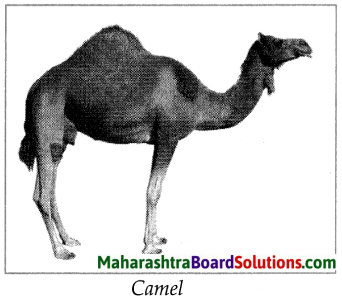
Motion, Force and Work Class 7 Questions And Answers Maharashtra Board

Std 7 Science Chapter 7 Motion, Force and Work Question Answer Maharashtra Board

Balbharti Maharashtra State Board Class 7 Science Solutions Chapter 7 Motion, Force and Work Notes, Textbook Exercise Important Questions and Answers.

Class 7 Science Chapter 7 Motion, Force and Work Question Answer Maharashtra Board

1. Fill ¡n the blanks with the proper words from the brackets.
(stationary, zero, changing, constant, displacement, velocity, speed. acceleration, stationary but not zero. inc reuses)

Question a.
If a body traverses a distance in direct proportion to the time, the speed of the body is ……………… .
Answer:
constant

Maharashtra Board Class 7 Science Solutions Chapter 7 Motion, Force and Work

Question b.
If a body is moving with a constant velocity, its acceleration is ……………… .
Answer:
zero

Question c.
……………. is a scalar quantity.
Answer:
Speed

Question d.
…………….. is the distance traversed by a body in a particular direction in unit time.
Answer:
Velocity

2. Observe the figure and answer the questions.

Maharashtra Board Class 7 Science Solutions Chapter 7 Motion, Force and Work 1

Sachin and Sarneer started on a motorbike from place A, took the turn at 13, did a task at C, travelled by the route CD to D and then went on to E. Altogether, they took one hour for this journey. Find out the actual distance traversed by them and the displacement from A to E. From this, deduce their speed. What was their velocity from A to E in the direction AE’? Can this velocity be called average velocity?

Question a.
Observe the figure and answer the questions
Maharashtra Board Class 7 Science Solutions Chapter 7 Motion, Force and Work 1

Sachin and Sarneer started on a motorbike from place A, took the turn at 13, did a task at C, travelled by the route CD to D and then went on to E. Altogether, they took one hour for this journey. Find out the actual distance traversed by them and the displacement from A to E. From this, deduce their speed. What was their velocity from A to E in the direction AE’? Can this velocity be called average velocity?
Answer:
1. Actual distance = \(\overline{\mathrm{AB}}\) + \(\overline{\mathrm{BC}}\) + \(\overline{\mathrm{CD}}\) + \(\overline{\mathrm{DE}}\) = 3 + 4 + 5 + 3
Actual distance = 15 km

2. Displacement = \(\overline{\mathrm{AB}}\) + \(\overline{\mathrm{BD}}\) + \(\overline{\mathrm{DE}}\)
= 3 + 3 + 3
Displacement = 9 km

3. Speed = \(\frac{\text { Distance travelled }}{\text { Total time }}\)
Distance = 15 km = 15 × 1000 = 15000 m
Time = 1 hr = 1 × 60 × 60 = 3600 sec.
s = \(\frac{15000}{3600}\) or s = \(\frac{15 \mathrm{~km}}{1 \text { hour }}\) = 15km/hour
= 4.16 m/sec. or 15 km/hour

4. Velocity = \(\frac{\text { Distance travelled }}{\text { Total time }}\)
Displacement = 9 km = 9 × 1000 = 9000 m
Time = 1 hr = 1 × 60 × 60 = 3600 sec
V = \(\frac{9000}{3600}\) or V = \(\frac{9 \mathrm{~km}}{1 \text { hour }}\) = 9 km/hour
= 2.5 m/sec. or 9 km/hour

5. Yes, this velocity can be called as average velocity.

Maharashtra Board Class 7 Science Solutions Chapter 7 Motion, Force and Work

3. From the groups B and C, choose the proper words, for each of the words in group A.

Question a.
From the groups B and C, choose the proper words, for each of the words in group A.
Maharashtra Board Class 7 Science Solutions Chapter 7 Motion, Force and Work 2
Answer:

Group ‘A’Group B’Group ‘C’
WorkJouleerg
ForceNewtondyne
DisplacementMetrecm

4. A bird sitting on a wire, flies, circles around and comes back to its perch. Explain the total distance it traversed during its flight and its eventual displacement.

Question a.
Answer:
The total distance the bird has traversed is the length of the distance covered by circling, but the eventual displacement are the bird is zero as its initial and final position are one and the same.

Maharashtra Board Class 7 Science Solutions Chapter 7 Motion, Force and Work

5. Explain the following concepts in your own words with everyday examples: force, work, displacement, velocity, acceleration, distance.

Question a.
Explain the following concepts in your own words with everyday examples: force, work, displacement, velocity, acceleration, distance.
Answer:
1. Force: The interaction that brings about the acceleration is called force.
e.g: An ox is pulling a cart, applying brakes to a bicycle, lifting heavy iron object with a crane.

2. Work: When an object is displaced by applying a force on it, work is said to be done.
e.g: A bucketful of water is to be drawn from a well and taken to the home by walking from well to home.

3. Displacement: The minimum distance
traversed by a moving body in one direction from the original point to reach the final point is called displacement.
e.g: A rolling of a ball from point A to point B in the same direction.

4. Velocity: Velocity is the distance traversed by a body in a specific direction in unit time.
e.g: A truck is covering a distance of 40km from A to D in a straight line in 1 hour.
Maharashtra Board Class 7 Science Solutions Chapter 7 Motion, Force and Work 5

5. Acceleration: It is change in velocity per second. It can be deduced.
Acceleration = \(\frac{\text { Change in velocity }}{\text { Time taken for change }}\)
e.g:
Maharashtra Board Class 7 Science Solutions Chapter 7 Motion, Force and Work 6

(i) In the above example a truck covered the distance AB at velocity of 60 km/hr, BC at 30 km/hr and CD at 40 km/hr. (ii) It means that the velocity for the distance CD is greater than the velocity for the distance BC. (iii) From the number of seconds required for this change in velocity to take place, the change in velocity per second can be deduced. This is called acceleration (iv) Distance: The length of the route actually traversed by a moving body irrespective of the direction is called distance.
e.g: Ranjit travelled 1km. from his home to school.

6. A ball is rolling from A to D on a flat and smooth surface. Its speed is 2 cm/s. On reaching B, it was pushed continuously up to C. On reaching D from C, its speed had become 4 cm/s. It took 2 seconds for it to go from B to C. What is the acceleration of the ball as it goes from B to C.

Maharashtra Board Class 7 Science Solutions Chapter 7 Motion, Force and Work 3

Question a.
A ball is rolling from A to D on a flat and smooth surface. Its speed is 2 cm/s. On reaching B, it was pushed continuously up to C. On reaching D from C, its speed had become 4 cm/s. It took 2 seconds for it to go from B to C. What is the acceleration of the ball as it goes from B to C.
Maharashtra Board Class 7 Science Solutions Chapter 7 Motion, Force and Work 3
Answer:
As its initial and final positions are one and the same.
Initial Velocity = 2 cm/s.
Final Velocity = 4 cm/s
Time taken for the change in velocity from B to
D = 4 cm/s – 2 cm/s = 2 cm/s
Maharashtra Board Class 7 Science Solutions Chapter 7 Motion, Force and Work 4

7. Solve the following problems.

Question a.
A force of 1000 N was applied to stop a car that was moving with a constant velocity. The car stopped after moving through 10m. How much is the work done?
Answer:
Force (F) = 1000 N
displacement (s) = 10m
work done (W) = ?
W = Fs
= 1000 × 10
W = 10,000 Joule

Maharashtra Board Class 7 Science Solutions Chapter 7 Motion, Force and Work

Question b.
A cart with mass 20 kg went 50 m in a straight line on a plain and smooth road when a force of 2 N was applied to it. How much work was done by the force?
Answer:
Force (F) = 2 N
Displacement (s) = 50 m
Work done (W) = ?
W = Fs
= 2 × 50
W = 100 Joule

Project:

Question a.
Collect information about the study made by Sir Isaac Newton regarding force and acceleration and discuss it with your teacher.

Class 7 Science Chapter 7 Motion, Force and Work Important Questions and Answers

Fill in blanks:

Question 1.
Displacement is a …………. quantity.
Answer:
vector

Question 2.
The …………. of an object can change even while it is moving along a straight line.
Answer:
velocity

Maharashtra Board Class 7 Science Solutions Chapter 7 Motion, Force and Work

Question 3.
The …………. velocity can be different at different times.
Answer:
instantaneous

Question 4.
Change in velocity per second is called …………. .
Answer:
acceleration

Question 5.
The interaction that brings about the acceleration is called …………. .
Answer:
force

Question 6.
The scientist …………. was the first to study force and the resulting acceleration.
Answer:
Sir Isaac Nezvton

Question 7.
Ability to do work is called …………. .
Answer:
Energy

Maharashtra Board Class 7 Science Solutions Chapter 7 Motion, Force and Work

Question 8.
W = …………. × S.
Answer:
F

Question 9.
Unit of work is …………. and …………. .
Answer:
Joule, erg

Question 10.
Unit of force is …………. and …………. .
Answer:
Newton, dyne

Question 11.
Force is a …………. quantity.
Answer:
vector

Question 12.
The velocity at a particular time is called …………. velocity.
Answer:
instantaneous

Maharashtra Board Class 7 Science Solutions Chapter 7 Motion, Force and Work

Question 13.
The …………. of a body is the distance traversed per unit time.
Answer:
speed

Question 14.
Unit of acceleration is …………. and …………. .
Answer:
m/s2 and cm/s2

Question 15.
Force is measured by the …………. that it produces.
Answer:
acceleration

Question 16.
Work done by a body with no displacement will be …………. .
Answer:
zero

Say whether True or False, correct the false 1 statements:

Question 1.
Velocity is distance travelled per unit of time.
Answer:
False. Speed is distance travelled per unit of time

Maharashtra Board Class 7 Science Solutions Chapter 7 Motion, Force and Work

Question 2.
In displacement, both distance and direction are taken into account.
Answer:
True

Question 3.
Speed = Distance/time.
Answer:
True

Question 4.
Change in speed per second is acceleration.
Answer:
False. Change in velocity per second is acceleration

Question 5.
Work done depends on the force and the displacement.
Answer:
True

Question 6.
C.G.S. unit of acceleration is m/s2.
Answer:
False. C.G.S. unit of acceleration is cm/s2.

Question 7.
M.K.S. unit of force is dyne.
Answer:
False. M.K.S. unit of force is Newton

Maharashtra Board Class 7 Science Solutions Chapter 7 Motion, Force and Work

Question 8.
Force is measured by the acceleration that it produces.
Answer:
True

Write the difference between the following:

Question 1.
Speed and Velocity
Answer:

SpeedVelocity
1. Speed is distance travelled per unit of time.1. Velocity is the distance traversed by a body in a specific direction in unit time.
2. It is a scalar quantity.2. It is a vector quantity.
3. Formula:
Speed = \(\frac{\text { Distance traversed }}{\text { Total time }}\)
3. Formula:
Velocity = \(\frac{\text { Displacement }}{\text { Total time }}\)

Question 2.
Distance and Displacement
Answer:

DistanceDisplacement
1. The length of the route actually traversed by a moving body, irrespective of the direction is called distance.1. The minimum distance traversed by a moving body in one direction from the original point to reach the final point is called displacement.
2. It is a scalar quantity.2. It is a vector quantity.

Maharashtra Board Class 7 Science Solutions Chapter 7 Motion, Force and Work

Solve the following problems!

Question 1.
A bus travelled 200 km in the first 3 hours and then 100 kms for the next one and a half hours and then 120 kms for the next one and a half hours. What is the average velocity of the bus if it has moved in a straight line for the whole journey.
Answer:
Maharashtra Board Class 7 Science Solutions Chapter 7 Motion, Force and Work 7

Question 2.
See the diagram and calculate the Distance and Displacement travelled by the body from A to I.
Maharashtra Board Class 7 Science Solutions Chapter 7 Motion, Force and Work 8
Answer:
Distance travelled =
A → B → C → D → E → F → G → H + I
= 5 + 7 + 6 + 3 + 5 + 4 + 6 + 5
= 41 m
Displacement = A → I in a straight line shortest distance
= 1m

Maharashtra Board Class 7 Science Solutions Chapter 7 Motion, Force and Work

Use your brainpower:

Question 1.
The unit of acceleration is m/s2, verify this.
Answer:
Maharashtra Board Class 7 Science Solutions Chapter 7 Motion, Force and Work 9

Question 2.
Acceleration is a vector quantity. Is force a vector quantity too?
Answer:
Yes, acceleration and force both are vector quantities, because both can be expressed completely only when magnitude and direction are given and the quantity which needs direction and magnitude both is called a vector quantity.

Maharashtra State Board Class 7 Science Textbook Solutions
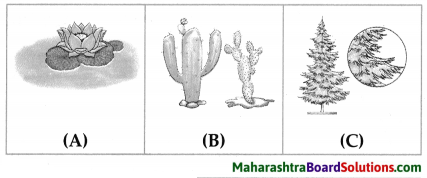
Practice Set 11 Class 7 Answers Chapter 3 HCF and LCM Maharashtra Board

HCF and LCM Class 7 Maths Chapter 3 Practice Set 11 Solutions Maharashtra Board
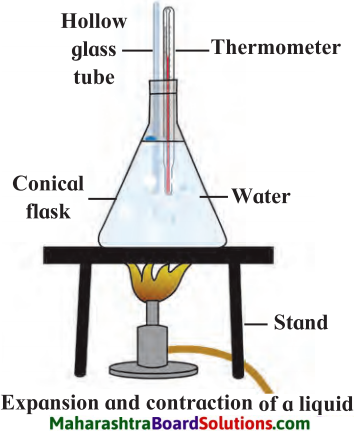
Balbharti Maharashtra State Board Class 7 Maths Solutions covers the 7th Std Maths Practice Set 11 Answers Solutions Chapter 3 HCF and LCM.
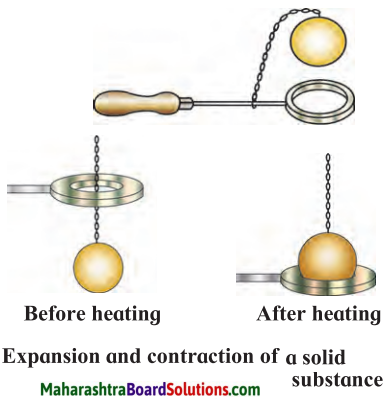
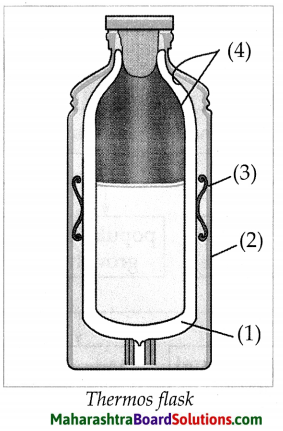
Std 7 Maths Practice Set 11 Solutions Answers

Question 1.
Factorize the following numbers into primes:
i. 32
ii. 57
iii. 23
iv. 150
v. 216
vi. 208
vii. 765
viii. 342
ix. 377
x. 559
Solution:
i. 32
Maharashtra Board Class 7 Maths Solutions Chapter 3 HCF and LCM Practice Set 11 1
∴ 32 = 2 × 2 × 2 × 2 × 2

ii. 57
Maharashtra Board Class 7 Maths Solutions Chapter 3 HCF and LCM Practice Set 11 2
∴ 57 = 3 × 19

iii. 23
Maharashtra Board Class 7 Maths Solutions Chapter 3 HCF and LCM Practice Set 11 3
∴ 23 = 23 × 1

iv. 150
Maharashtra Board Class 7 Maths Solutions Chapter 3 HCF and LCM Practice Set 11 4
∴ 150 = 2 × 3 × 5 × 5

v. 216
Maharashtra Board Class 7 Maths Solutions Chapter 3 HCF and LCM Practice Set 11 5
∴ 216 = 2 × 2 × 2 × 3 × 3 × 3

vi. 208
Maharashtra Board Class 7 Maths Solutions Chapter 3 HCF and LCM Practice Set 11 6
∴ 208 = 2 × 2 × 2 × 2 × 13

vii. 765
Maharashtra Board Class 7 Maths Solutions Chapter 3 HCF and LCM Practice Set 11 7
∴ 765 = 3 × 3 × 5 × 17

viii. 342
Maharashtra Board Class 7 Maths Solutions Chapter 3 HCF and LCM Practice Set 11 8
∴ 342 = 2 × 3 × 3 × 19

ix. 377
Maharashtra Board Class 7 Maths Solutions Chapter 3 HCF and LCM Practice Set 11 9
∴ 377 = 13 × 29

x. 559
Maharashtra Board Class 7 Maths Solutions Chapter 3 HCF and LCM Practice Set 11 10
∴ 559 = 13 × 43

Class 7 Maths Solution Maharashtra Board