Std 9 English Poem The Fun they Had 1.2 Question Answer Maharashtra Board

Class 9 English Chapter 1.2 Question Answer Maharashtra Board

Balbharti Maharashtra State Board Class 9 English Solutions My English Coursebook Chapter 1.2 The Fun they Had Notes, Textbook Exercise Important Questions and Answers.

The Fun they Had Poem 9th Std Question Answer

My English Coursebook Std 9 Digest Chapter 1.2 The Fun they Had Textbook Questions and Answers

Warming up!

Chit-chat:

  • What do you like best about your school?
  • Do you think school is fun?
  • Which is the part that you don’t like?
  • How often should the teacher ‘? give you a test?

Maharashtra Board Class 9 My English Coursebook Solutions Chapter 1.2 The Fun they Had

Classify!

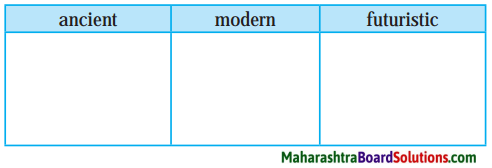
1. Listen carefully and write each word in the appropriate column/columns.

Maharashtra Board Class 9 My English Coursebook Solutions Chapter 1.2 The Fun they Had 1

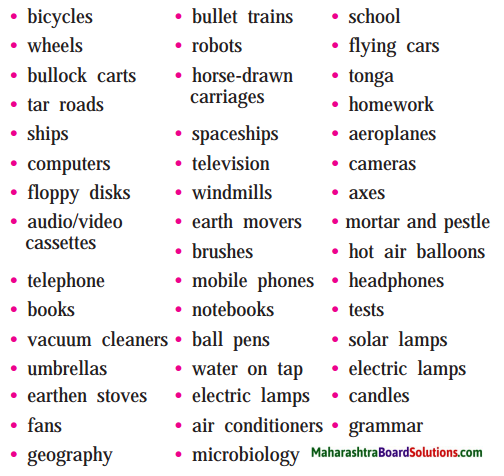
Maharashtra Board Class 9 My English Coursebook Solutions Chapter 1.2 The Fun they Had 2

Question 1.
Listen carefully and write each word given on textbook page no. 5 in the appropriate column/columns:
Answer:

ancientmodemfuturistic
earthen stovesbicyclesflying cars
tongatelephonespaceships
horse-drawnaudio-video
carriagescassettes
computers

Maharashtra Board Class 9 My English Coursebook Solutions Chapter 1.2 The Fun they Had

2. Listen to the pronunciation of these words and practise saying them properly yourself. 

  • grandfather
  • geography
  • satisfactory
  • superior
  • pronouncing
  • betcha
  • nonchalantly

Question 1.
Listen to the pronunciation of these words and practise saying them properly yourself. V

  • grandfather
  • geography
  • satisfactory
  • superior
  • pronouncing
  • betcha
  • nonchalantly

English Workshop:

1. Use the proper punctuation mark

Question a.
Where did you find it
Answer:
“Where did you find it?”

Maharashtra Board Class 9 My English Coursebook Solutions Chapter 1.2 The Fun they Had

Question b.
What’s it about
Answer:
“What’s it about?”

Question c.
They had a teacher.
Answer:
“They had a teacher.”

Question d.
How could a man be a teacher
Answer:
“How could a man be a teacher?”

Question e.
sure, if they were the same age
Answer:
“Sure, if they were the same age.”

Maharashtra Board Class 9 My English Coursebook Solutions Chapter 1.2 The Fun they Had

2. The following sentences have an unusual meaning in the context of the story. Write what these sentences would mean today, and what they mean in the context of the story.

Question a.
She had been hoping they would take the teacher away altogether.
Answer:

  • Meaning today: She had been hoping they would officially dismiss the teacher from his job forever.
  • Meaning in the content of the story: She had been hoping they would remove the teacher from the screen permanently.

Question b.
They had taken Tommy’s teacher away for nearly a month.
Answer:
Meaning today: They had suspended Tommy’s teacher for nearly one month.

Maharashtra Board Class 9 My English Coursebook Solutions Chapter 1.2 The Fun they Had

Question c.
It wasn’t a regular teacher. It was a man.
Answer:

  • Meaning today: It wasn’t the teacher who regularly did the teaching work in school. It was some person who taught the students.
  • Meaning in the context of the story: It was the mechanical teacher who gave lessons to students on screen, regularly.

Question d.
How could a man be a teacher?
Answer:
Meaning today: This question is meaningless in these days because teaching work is always done by some person (male teacher or female teacher).
Meaning in the context of the story: They had the mechanical teacher and they didn’t expect a man in place of the mechanical teacher.

Maharashtra Board Class 9 My English Coursebook Solutions Chapter 1.2 The Fun they Had

Question e.
A teacher has to be adjusted to fit the mind of each boy and girl it teaches.
Answer:
Meaning today: The teacher has to deal with the students according to the need of the whole class and use a suitable method of teaching.
Meaning in the context of the story: The mechanical teacher has to be repaired and made suitable according to the need of individual students or the subject taught.

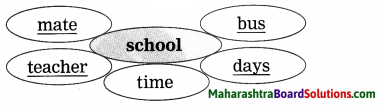
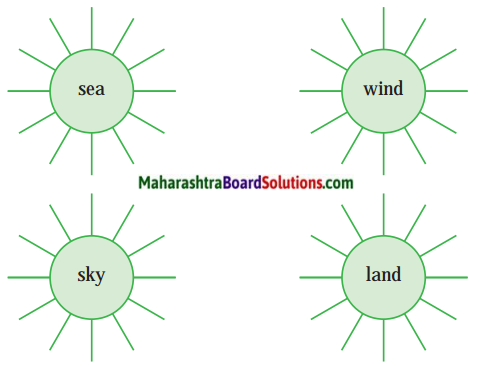
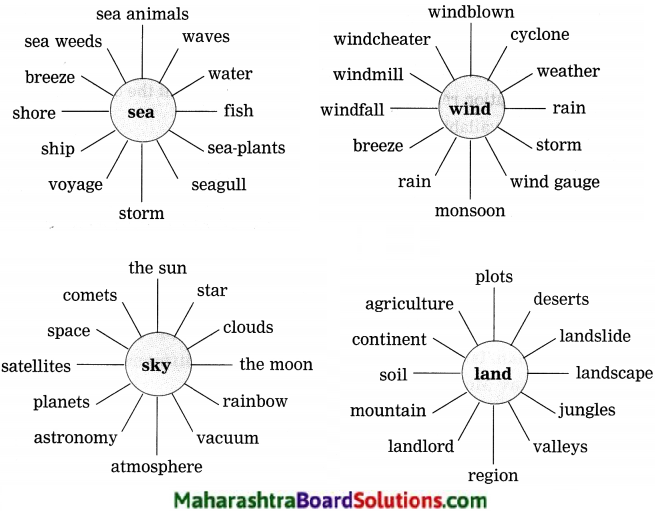
3. Write words related to the following words. (At least ten words each.)

Maharashtra Board Class 9 My English Coursebook Solutions Chapter 1.2 The Fun they Had 3

Question 1.
Write words related to the following words. (At least ten words each.)
Answer:
Maharashtra Board Class 9 My English Coursebook Solutions Chapter 1.2 The Fun they Had 4

Maharashtra Board Class 9 My English Coursebook Solutions Chapter 1.2 The Fun they Had 5

Maharashtra Board Class 9 My English Coursebook Solutions Chapter 1.2 The Fun they Had 6

Maharashtra Board Class 9 My English Coursebook Solutions Chapter 1.2 The Fun they Had

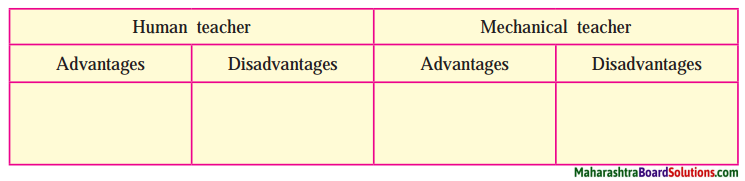
4. Discuss: How would you like to learn from a human teacher or a mechanical teacher? Present your arguments in the form of a chart.

Maharashtra Board Class 9 My English Coursebook Solutions Chapter 1.2 The Fun they Had 7

Question 1.
Discuss: How would you like to learn from a human teacher or a mechanical teacher? Present your arguments in the form of a chart.
Answer:
No, I wouldn’t like to have my own mechanical teacher because I won’t get the joy of learning together with my friends and the love and affection we get from our teachers.

5. Rewrite the following using complete words instead of contracted forms.
(a) … when you’re through.
(b) …. and it’s good for plenty more.
(c) I wouldn’t throw it away.
(d) She hadn’t seen as many tale books.
(e) “What’ s it about?”
(f) I’ve slowed it up.
(g) I don’t know.
(h) It wasn’t a regular teacher.

Question a.
… when you’re through.
Answer:
… when you are through.

Maharashtra Board Class 9 My English Coursebook Solutions Chapter 1.2 The Fun they Had

Question b.
…. and it’s good for plenty more.
Answer:
… and it is good for plenty more.

Question c.
I wouldn’t throw it away.
Answer:
I would not throw it away.

Question d.
She hadn’t seen as many tale books.
Answer:
She had not seen as many tale books.

Question e.
“What’s it about?”
Answer:
“What is it about?”

Maharashtra Board Class 9 My English Coursebook Solutions Chapter 1.2 The Fun they Had

Question f.
I’ve slowed it up.
Answer:
I have slowed it up.

Question g.
I don’t know.
Answer:
I do not know.

Question h.
It wasn’t a regular teacher.
Answer:
It was not a regular teacher.

Maharashtra Board Class 9 My English Coursebook Solutions Chapter 1.2 The Fun they Had

Language study:

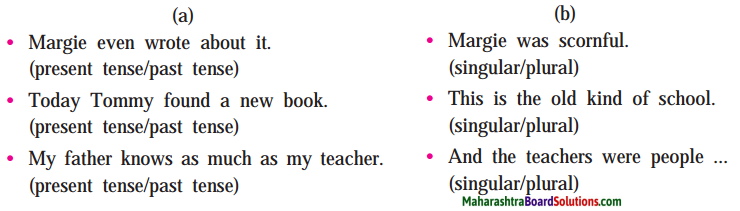
6. Underline the verbs and choose the correct option from the brackets.

Maharashtra Board Class 9 My English Coursebook Solutions Chapter 1.2 The Fun they Had 8
Thus, we see that verb forms show tense, number, etc. Here, the verb form changes according to the subject. A verb form which is decided by and changes according to the subject of the sentence is known as a finite verb.
Example: ‘You are very kind.’ If the subject ‘you’ is changed to ‘she’, the sentence will be ‘She is very kind.’
Now change the verb form according to the change in the subject.

  • I don’t know: Change ‘I’ to ‘She’.
  • My father knows: Change ‘My father’ to ‘We’
  • I am following in your footsteps: Change ‘I’ to ‘He’.

Question 1.
Underline the verbs and choose the correct options from the brackets:

  1. Margie even wrote about it. (present tense/past tense)
  2. Today Tommy found a new book. (present tense/past tense)
  3. Margie was scornful, (singular/plural)
  4. What’s there to write about school? (singular/plural)

Answer:

  1. Margie even wrote about it. – past tense.
  2. Today Tommy found a new book. – past tense
  3. Margie was scornful, (singular/plural)
  4. What’s there to write about school? (singular/plural)

Maharashtra Board Class 9 My English Coursebook Solutions Chapter 1.2 The Fun they Had

7. Activity: Live English: Online shopping

Question a.
Read the following conversation between two cousins.

  • Tejaswini: Hi, Santosh. What are you thinking about?
  • Santosh: Hi, Teju. Next week’s Didi’s birthday. We want to give her a surprise gift.
  • Tejaswini: Great idea! What is your surprise gift?
  • Tejaswini: Great idea’ What is your surprise gift?
  • Santosh: Well, we don’t have any big shops here, there’s little to choose from. Nothing new or surprising.
  • Tejaswini: So why don’t you try online shopping?
  • Santosh: Is it safe?
  • Tejaswini: Yes, it is. If we take proper care, it is one of the most convenient ways of shopping. Plus, you will get so much variety.
  • Santosh: True. But I don’t know how to do it.
  • Tejaswini: It’s ok. I will show you. Do you have an internet connection?
  • Santosh: Yes.
  • Tejaswini: That’s good, then. We can do it in five easy steps. Let’s start.

Maharashtra Board Class 9 My English Coursebook Solutions Chapter 1.2 The Fun they Had 9

Question b.
Write in a step-by-step manner, how Tejaswini and Santosh bought a gift for Didi online.
Answer:
They signed up and created their account in the website. Then they selected the gift of their choice from the given categories. They added the gift to the cart and paid the total amount via online banking. When the gift was delivered to them they checked and ensured that the gift was genuine.

Maharashtra Board Class 9 My English Coursebook Solutions Chapter 1.2 The Fun they Had

Question c.
Use this website (www.chalashikuva.com) to try your hand at a practicaL/mock trial of online shopping.
Look at the above webpage and tell :

  1. The name of the website
  2. What we can buy there
  3. The offer on poster colours

Answer:

  1. The name of the website: www.chalashikuya.com
  2. What we can buy there: we can buy books, educational toys, stationery, e-leaming.
  3. The offer on poster colours: a paint brush free

Maharashtra Board Class 9 My English Coursebook Solutions Chapter 1.2 The Fun they Had

Question d.
Read the following questions and answers. Form pairs and frame similar questions and answers for this website.How to use this website:
1. If I want to buy a story book on this website, where can I find it?
– In the categories on the left, in the options under Books you will find story books. Click that option.

2. I want a CD of the dictionary.
– Go to ‘e-learning’. Under that Click the ‘dictionary’ option.

3. Where can I look for books in the Hindi language?
– You can go to the Languages option on the left and tick the box before Hindi.

4. How can I find what discounts are available?
– Under the filters on left you will find discounts.

5. Are there any specific deals/offers on specific days?
– There is a CSY (Chalashikuya) deal. You can click on it and find out the deal of the day.

6. Can I purchase only one thing at a time?
– No, you can buy many things at a time. Select whatever you want and add to the cart and then browse again for another product.

7. When will my order be delivered?
– Maximum in 10 working days. You can also track your order by clicking the icon ‘track order.

8. There is one icon ‘Gift Coupons’. What does it mean?
– You can give a gift coupon to your friend by using this icon and he/she can purchase the product of his/her choice with the help of it.

9. Is this site only for purchasing?
– No, you can also sell your old books and other educational things here.

10. How can I find out whether the product is good or not?
– You can see the ratings and reviews of users below each product.
Answer:
Students do this activity on their own.

Maharashtra Board Class 9 My English Coursebook Solutions Chapter 1.2 The Fun they Had

Question e.
Suppose one of your parents or an older relative wants to know about online shopping and you are explaining how to do it. Write a conversation between you and your parent/relative about it:
Answer:
A conversation about online shopping between me and Dad.
(Dad enters while you are surfing on the internet)

  • Dad: Son, I need to buy sport shoes for my marathon next week. I wish to try online shopping, but I don’t know the process.
  • Me: Don’t you worry, Dad! I’m there to help you. Let’s sign you up first.
  • Dad: I suppose it’s quite complicated.
  • Me: Not at all, Dad. Now go on the search bar and type whichever shoes you need.
  • Dad: I don’t have any particular shoes in mind.
  • Me: Well, then we will click here on the ‘shoes’ option and select sport shoes.
  • Dad: These seem nice and are in my budget.
  • Me: Then add them to the cart. Now we have ordered the sports shoes. They will deliver the product within 10 days.
  • Dad: Very good! It’s very simple, isn’t it?
  • Me: Sure it is. Now, do you want to pay via net banking, credit card or cash on delivery?
  • Dad: I prefer cash on delivery.
  • Me: O.K. we are done here. We can even track our order to find where your shoes have reached.
  • Dad: That’s very impressive! Thank you, son.
  • Me: It’s my pleasure, dad.

Maharashtra Board Class 9 My English Coursebook Solutions Chapter 1.2 The Fun they Had

Question f.
Form pairs. Discuss the advantages and disadvantages of online shopping and fill the following table.
Answer:

AdvantagesDisadvantages
1. Time-saving(a) Delay in delivery.
2. Wide concessional(b) Required Internet connection.
3. Cheap/concessional(c) Quality and condition of product uncertain.
4. Various filters to find our pick(d) Delivery and shipping.
5. Quick payments(e) Delivery and shipping charges are expensive.

Write a paragraph on ‘Online Shopping’ using the points in the above table.

Question 1.
Write a paragraph on ‘Online Shopping’ using the points in the above table.

My English Coursebook 9th Class Solutions Chapter 1.2 The Fun they Had Additional Important Questions and Answers

Read the following passage and do the activities:

Simple Factual Activity:

Question 1.
Complete the following sentences:
(Answers are directly given.)

  1. The incident in the story has taken place on 17 May 2157.
  2. Their television screen must have had a million books on it.
  3. Margie’s great grandfather told that in old times all stories were printed on paper.
  4. According to Margie, ‘a real book’ means a printed book.

Note: Here we have given the complete passage. However henceforward, only the first and last lines of the related passage of prose lessons have been given. Refer to the Textbook for the complete passages.

Maharashtra Board Class 9 My English Coursebook Solutions Chapter 1.2 The Fun they Had

Question 2.
Read the sentences and fill in the blank with correct alternatives:
(Answers are directly given.)
Answer:
1. The County Inspector was a round little man with a red face.
(a) The teacher
(b) The County Inspector.

2. Margie hated most was the slot where she had to put homework and test papers.
(a) the teacher
(b) the slot.

3. Large and black and ugly is the description of the teacher.
(a) the teacher
(b) the Inspector

4. Margie had hoped the Inspector wouldn’t know how to put the teacher together.
(a) take the teacher apart.
(b) put the teacher together.

Question 3.
Say whether the following statements are True or False: (Answers are directly given.)
Answer:

  1. Tommy is Margie’s brother. – False
  2. Tommy found the old book in the attic.- True
  3. Margie was older than Tommy. – False
  4. The old book was about school. – True

Maharashtra Board Class 9 My English Coursebook Solutions Chapter 1.2 The Fun they Had

Question 4.
Complete the following sentences using proper words from the passage:
(Answers are directly given.)

  1. Father knew as much as his teachers.
  2. How can a man be a teacher?
  3. They had a teacher, but it wasn’t a regular teacher.
  4. Margie wouldn’t want a strange man in her house to teach her.

Question 5.
Write if the following statements are True or False:
Answer:

  1. Margie’s school was in her house. – True
  2. In those old days kids went to a special building for learning. – True
  3. Margie was not interested in reading the old book. – False
  4. Tommy went away home with the book. – True

Question 6.
Complete the following sentences using the information from the passage:
(Answers are directly given.)

  1. The arithmetic lesson was on the addition of proper fractions.
  2. And the teachers were people.
  3. The mechanical teacher was flashing on the screen.
  4. Margie inserted yesterday’s homework in the slot with a sigh.

Maharashtra Board Class 9 My English Coursebook Solutions Chapter 1.2 The Fun they Had

Complex Factual Activity:

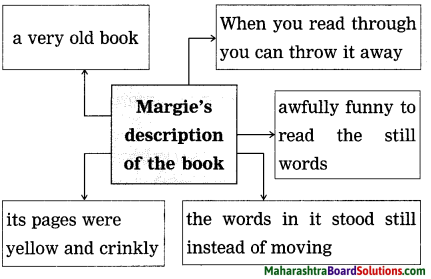
Question 1.
Complete the following web:
(Answers are directly given.)
Answer:
Maharashtra Board Class 9 My English Coursebook Solutions Chapter 1.2 The Fun they Had 10

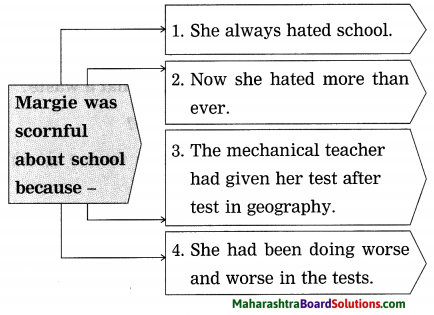
Question 2.
Complete the following:
Answer:
(Answers are directly given.)

  1. She always hated school.
  2. Now she hated more than ever.
  3. The mechanical teacher had given her test after test in geography.
  4. She had been doing worse and worse in the tests.

Question 3.
Arrange the following in order of occurrence:
1. She wrote them out in a punch code.
2. All the lessons were shown and questions were asked on the screen.
3. The County Inspector took the teacher apart and then put it together again.
4. The mechanical teacher calculated the marks.
Answer:
3. The County Inspector took the teacher apart and then put it together again.
2. All the lessons were shown and questions were asked on the screen.
1. She wrote them out in a punch code.
4. The mechanical teacher calculated the marks,

Maharashtra Board Class 9 My English Coursebook Solutions Chapter 1.2 The Fun they Had

Question 4.
What was the fault with the mechanical teacher? How was the fault repaired?
Answer:
There was a fault in the geography sector of the mechanical teacher. It was geared a little too quick. The County Inspector repaired it and slowed it up to an average ten-year level.

Question 5.
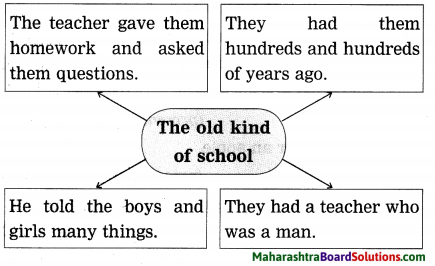
Complete the web about the ‘Old School’, using the information told by Tommy.
(Answers are directly given.)
Answer:
Maharashtra Board Class 9 My English Coursebook Solutions Chapter 1.2 The Fun they Had 11

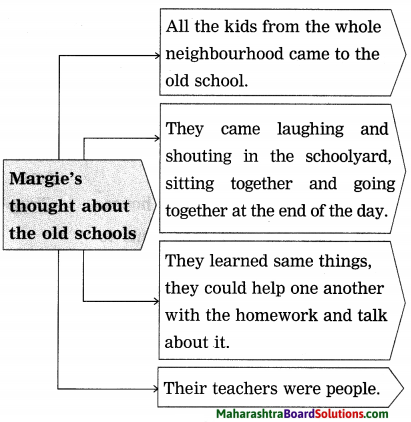
Question 6.
Complete the web:
Answer:
Maharashtra Board Class 9 My English Coursebook Solutions Chapter 1.2 The Fun they Had 12

Maharashtra Board Class 9 My English Coursebook Solutions Chapter 1.2 The Fun they Had

Question 7.
What do you know from the passage about j the teachers, the school and the students of the old times?
Answer:
Unlike the mechanical teacher, the teacher in old times didn’t live in the house. They went to a special building called school to teach the children who also went there. The students learnt the same things if they were in the same age group or the same class.

Question 8.
Complete the web:
(Answers are directly given.)
Answer:
Maharashtra Board Class 9 My English Coursebook Solutions Chapter 1.2 The Fun they Had 13

Activities based on vocabulary:

Question 1.
Match the words in Column ‘A’ with their

‘A’‘B’
1. real(a) very amusing
2. crinkly(b) exactly the one/ones referred to
3. same(c) having a lot of thin folds
4. awfully funny(d) genuine and not false

Answer:

‘A’‘B’
1. real(d) genuine and not false
2. crinkly(c) having a lot of thin folds
3. same(b) exactly the one/ones referred to
4. awfully funny(a) very amusing

Maharashtra Board Class 9 My English Coursebook Solutions Chapter 1.2 The Fun they Had

Question 2.
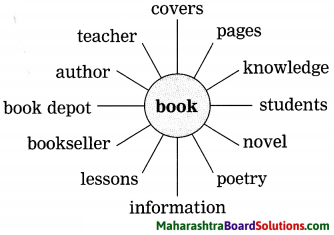
Write at least ten words related to book:
(Answers are directly given.)
Answer:
teacher-author book depot bookseller lessons

Question 3.
Write any four adjectives like ‘scornful’.
Answer:

  1. faithful
  2. helpful
  3. careful
  4. sorrowful.

Question 4.
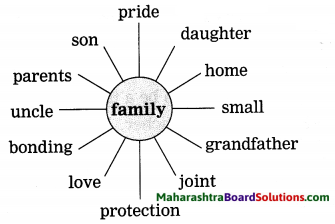
Write at least ten words related to family:
Answer:
pride

Maharashtra Board Class 9 My English Coursebook Solutions Chapter 1.2 The Fun they Had

Question 5.
Match the words in Column ‘A’ with their meaning in Column ‘B’:

‘A’‘B’
1. betcha(a) in superior manner
2. pronouncing(b) to debate
3. loftily(c) expressing the word strongly
4. dispute(d) surely, bet you

Answer:

‘A’‘B’
1. betcha(d) surely, bet you
2. pronouncing(c) expressing the word strongly
3. loftily(a) in superior manner
4. dispute (b) to debate

Maharashtra Board Class 9 My English Coursebook Solutions Chapter 1.2 The Fun they Had

Question 6.
Match the similar meaning words:

‘A’‘B’
1. kid(a) under
2. same(b) fast
3. beneath(c) similar
4. quickly(d) child

Answer:

‘A’‘B’
1. kid(d) child
2. same(c) similar
3. beneath(a) under
4. quickly(b) fast

Question 7.
What do the following words describe in the passage.

  1. same
  2. funny
  3. dusty
  4. special.

Answer:

  1. age
  2. schools
  3. book
  4. building.

Maharashtra Board Class 9 My English Coursebook Solutions Chapter 1.2 The Fun they Had

Question 8.
Write the words from the passage that show actions taken place in the old school:
Answer:
came, laughing, shouting, sitting, going, learned, help, talk

Activities based on contextual grammar:

Question 1.
My father knows. (Change ‘My father’ to ‘We’.)
Answer:
We know.

Question 2.
I am following in your footsteps.
Answer:
He is following in your footsteps.

Question 3.
He wouldn’t know.
Answer:
He would not know.

Question 4.
That wasn’t so bad.
Answer:
That was not so bad.

Maharashtra Board Class 9 My English Coursebook Solutions Chapter 1.2 The Fun they Had

Question 5
It’s not the little girl’s fault.
Answer:
It is not the little girl’s fault.

Question 6.
Underline the verb and choose the correct option from the brackets:
(Answers are underlined directly)
1. He patted Margie’s head.
(present tense/past tense)
2. He gave her an apple.
(present tense/past tense)
3. Those things happen sometimes.
(present tense/past tense)
4. Her progress is satisfactory.
(present tense/past tense)

Question 7.
The kids were laughing and shouting.
(Use simple past tense and rewrite the sentence.)
Answer:
The kids laughed and shouted.

Maharashtra Board Class 9 My English Coursebook Solutions Chapter 1.2 The Fun they Had

Question 8.
I sing a song. (Change the subject T to ‘she’ and rewrite the sentence.)
Answer:
She sings a song.

Question 9.
He went to school today. (Make the sentence negative using the word ‘not’).
Answer:
He did not go to school today.

Maharashtra Board Class 9 My English Coursebook Solutions Chapter 1.2 The Fun they Had

Question 10.
… are you going now? (who, what, where) (Choose the correct wh-word from the brackets to frame a question)
Answer:
Where are you going now?

Personal Response:

Question 1.
Do you sometimes hate your school? Why?
Answer:
No, never. I always love my school because I regard it as my Mother. My progress in life depends on the knowledge and education that I receive in school.

Question 2.
About what did Tommy say, “What a waste!” Why, do you think, did he say so?
Answer:
Tommy said it about the old printed book. I think he said so because he thought that it is a waste of paper. After reading the book its purpose is lost and it becomes useless. He did not think of its importance and thought of throwing it away.

Maharashtra Board Class 9 My English Coursebook Solutions Chapter 1.2 The Fun they Had

Question 3.
Do you like to take tests? Give the reason for your answer:
Answer:
Yes, I like to take tests, because the result of the tests shows our progress in learning. We know our drawbacks and we can try to improve our weak subjects.

Question 4.
Do you think the school described in the ‘book’ existed centuries ago?
Answer:
Yes, the school described in the ‘old book’ did exist centuries ago, but the educational institutions were of different kinds and their methods of teaching were different.

Maharashtra Board Class 9 My English Coursebook Solutions Chapter 1.2 The Fun they Had

Question 5.
Would you like to have your own mechanical teacher? why?
Answer:
Yes, I would like to have my own mechanical teacher if it is affordable to my family. Though my school teachers are there to guide me in my school, this mechanical teacher will help me to have individual teaching and guidance. I can prepare well in all my subjects with the help provided by the mechanical teacher.

Write the following using complete words instead of contracted forms:

Question 1
They weren’t even half finished.
Answer:
They were not even half finished.

Question 2.
And it’s probably time for Tommy, too.
Answer:
And it is probably time for Tommy, too.

Maharashtra Board Class 9 My English Coursebook Solutions Chapter 1.2 The Fun they Had

Question 3.
you don’t know much.
Answer:
you do not know much.

Question 4.
They didn’t do it that way.
Answer:
They did not do it that way.

Rewrite the sentences with a different words for the underlined word.

Question 1.
It is probably time for Tommy.
Answer:
It is probably time for lunch.

Maharashtra Board Class 9 My English Coursebook Solutions Chapter 1.2 The Fun they Had

Question 2.
They had a special building.
Answer:
They had a special invitation.

Activities Based on Language study

Do as directed:

Question 1.
Complete the following words by using correct letters: 2

  1. ab _ ut
  2. f _ nny
  3. ni _ ht
  4. qu _ ck

Answer:

  1. about
  2. funny
  3. night
  4. quick.

Maharashtra Board Class 9 My English Coursebook Solutions Chapter 1.2 The Fun they Had

Question 2.
Copy the following sentences correctly in your notebook:
Answer:
1. On the page headed 17 May, 2057, she wrote, ‘Today Tommy found a real book !’
2. “A man? How could a man be a teacher?”

Question 3.
Put the following words in alphabetical order:
1. progress, teacher, homework, answers.
2. superior, shaken, screamed, shouting.
Answer:
1. answers, homework, progress, teacher.
2. screamed, shaken, shouting, superior.

Maharashtra Board Class 9 My English Coursebook Solutions Chapter 1.2 The Fun they Had

Question 4.
Punctuate the following sentences:
(Note: Two sentencess will be asked.)

Question a.
i hate school
Answer:
“I hate school.”

Question b.
same with mine said margie
Answer:
“Same with mine,” said Margie.

Question c.
can I read the book some more with you after school
Answer:
“Can I read the book some more with you after school?”

Maharashtra Board Class 9 My English Coursebook Solutions Chapter 1.2 The Fun they Had

Question 5.
Write four small words (minimum 3 letters each) using the letters in the given word:
“schoolyard”
Answer:

  1. school
  2. cool
  3. holy
  4. yard.

Question 6.
Spot the error and rewrite the correct sentences:

  1. I doesn’t know what kind of school they had all that time ago.
  2. Margie’s grandfather said to her, when he was a little boy his grandfather told him that there is a time when all stories are printed on paper.

Answer:

  1. I don’t know what kind of school they had all that time ago.
  2. Margie’s grandfather said to her when he was a little boy his grandfather told him that there was a time when all stories were printed on paper.

Maharashtra Board Class 9 My English Coursebook Solutions Chapter 1.2 The Fun they Had

Question 7.
Write related words as shown in the example:
(Answer is directly given.)
Answer:
Maharashtra Board Class 9 My English Coursebook Solutions Chapter 1.2 The Fun they Had 14

Question 8.
Complete the following word-chain of nouns. Add four words each beginning with the last letter of the previous word:
screen → ……………… → ………….. → ……………. → ………………..
Answer:
screen → number → rabbit → trainer → routes.

Question 9.
Make your own meaningful sentence by using the phrase ‘to be able to’.
Answer:
My friend was in financial problem but I was not able to help him.

Question 10.
Add a prefix or suffix to make new words and use any one of the root words to make your own sentence:
1. miracle
2. hazard
Answer:
1. miraculous
2. hazardous
Sentence: We must know the hazards of junk food.

Maharashtra Board Class 9 My English Coursebook Solutions Chapter 1.2 The Fun they Had

Question 11.
Make the following sentence bigger by adding clause:
The police captured the thief
Answer:
The police captured the thief who was trying to break the shop.

My English Coursebook Std 9 Digest Pdf Unit 1

Std 9 English Poem Comparisons 2.1 Question Answer Maharashtra Board

Class 9 English Chapter 2.1 Question Answer Maharashtra Board

Balbharti Maharashtra State Board Class 9 English Solutions My English Coursebook Chapter 2.1 Comparisons Notes, Textbook Exercise Important Questions and Answers.

Comparisons Poem 9th Std Question Answer

My English Coursebook Std 9 Digest Chapter 2.1 Comparisons Textbook Questions and Answers

Warming up!

Chit-chat:

  • What is your favourite colour?
  • What does it remind you of?
  • Are you afraid of the dark?
  • What does it make you think of?
  • If you were asked to design a big garden, what will you include in it?

Maharashtra Board Class 9 My English Coursebook Solutions Chapter 2.1 Comparisons

Expanding Word Webs:

Question 1.
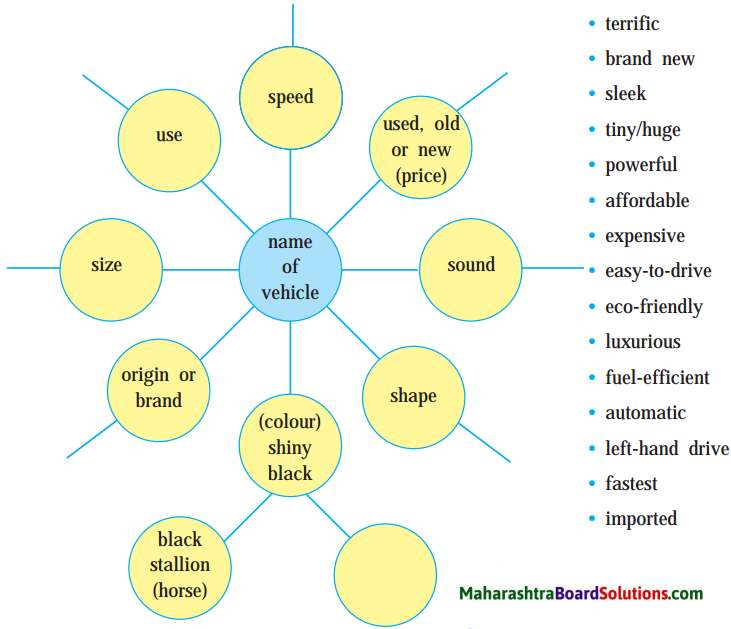
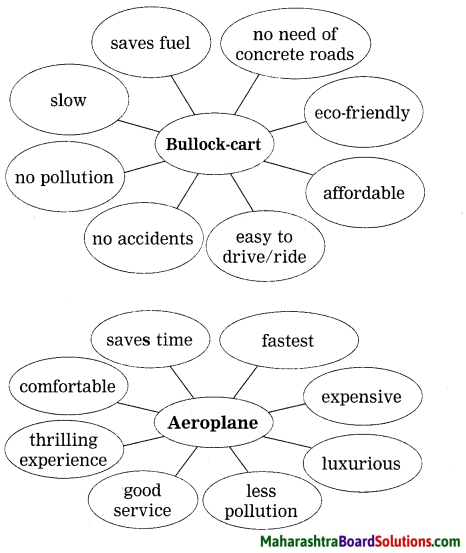
Form pairs. List the names of as many vehicles as you can. Choose any two of them, but they must be of different types. Then draw a word web for each of them to show their appearance, qualities and the things that these features remind you of. You may use words as well as phrases in the web.
Maharashtra Board Class 9 My English Coursebook Solutions Chapter 2.1 Comparisons 1
Answer:
Words that can be used in Word-web:

  1. terrific
  2. brand-new
  3. sleek
  4. tiny/huge
  5. powerful
  6. affordable
  7. expensive
  8. easy-to-drive
  9. eco-friendly
  10. luxurious – arrows.
  11. fuel-efficient
  12. automatic
  13. lefthand drive
  14. fastest
  15. imported

Name of the vehicles:

  1. bicycle
  2. bullock-cart
  3. car
  4. bus
  5. truck
  6. motorcycle
  7. scooter
  8. boat
  9. ship
  10. train
  11. helicopter
  12. aeroplane.

Choose any two of above vehicles and write related

Maharashtra Board Class 9 My English Coursebook Solutions Chapter 2.1 Comparisons 2

Maharashtra Board Class 9 My English Coursebook Solutions Chapter 2.1 Comparisons

Question 2.
Note the difference between drive and ride. Use the two words correctly in your own sentences :
Answer:

  1. Ride – to sit on and be carried by an animal or a two wheeler.
    Sentence – I don’t like to ride on a camel.
  2. Drive – to sit in a vehicle and force to go in some directions.
    Sentence – My father drives the car with full speed.

Question 3.
Describe your dream vehicle in a few lines :
Answer:
Flying car is my dream vehicle. It will fly in the air. It will fly fast and save our time. There will be no traffic jam problem. No need to construct roads for it. It will save fuel and will be eco-friendly.

Maharashtra Board Class 9 My English Coursebook Solutions Chapter 2.1 Comparisons

English Workshop:

1. List all the adjectives in the poem. Use the comparative forms of at least 8 of them to write new comparisons. Two of them have been given as examples.

Question 1.
List all the adjectives in the poem. Use the comparative forms of at least 8 of them to write new comparisons. Two of them have been given as examples.
Answer:

  1. as rapid as spaceship
  2. as tough as snail
  3. as dangerous as dinosaur
  4. as brave as tiger
  5. as nice as lamb
  6. as yellow as lemon
  7. as delicious as jam
  8. as hot as desert
  9. as deep as sea
  10. as fine as house
  11. as green as pea
  12. as dark as cave
  13. as crunchy as toast
  14. as heavy as road drill
  15. as fearful as ghost

Maharashtra Board Class 9 My English Coursebook Solutions Chapter 2.1 Comparisons

2. List all the nouns in the poem. Find a suitable adjective – other than the ones given here – for each of the nouns and write meaningful similes for at least 8 of them.
For example, as yellow as a lemon.

Question 1.
List all the nouns in the poem. Find a suitable adjective – other than the ones given here – for each of the nouns and write meaningful similes for at least 8 of them.
For example, as yellow as a lemon.
Answer:

  1. as useful as ore
  2. as lovely as a kitten
  3. as stable as a rock
  4. as warm as a mitten
  5. as narrow as tunnel
  6. as cute as an elf
  7. as tricky as a mountain path
  8. as safe as shelf

Maharashtra Board Class 9 My English Coursebook Solutions Chapter 2.1 Comparisons

3. Form groups of 6-8. Think of similes using different objects, for example,
Dry as land, Wet as a puddle.
Now try to put together the similes to make a poem with rhyming lines.

Question 1.
Form groups of 6-8. Think of similes using different objects, for example,
Dry as land, Wet as a puddle.
Now try to put together the similes to make a poem with rhyming lines.

4. Write the pairs of rhyming words.

Question 1.
Write the pairs of rhyming words.
Answer:

  1. kitten – mitten
  2. moon – noon
  3. elf – shelf
  4. shelf – yourself.
  5. snail – nail
  6. lamb – jam
  7. sea – pea
  8. toast – ghost.

Maharashtra Board Class 9 My English Coursebook Solutions Chapter 2.1 Comparisons

5. Start a collection of idioms with comparisons. Use the following categories:

Question 1.
Start a collection of idioms with comparisons. Use the following categories:
Answer:
(a) idioms with colours:

  1. as black as coal
  2. as white as snow
  3. as red as blood
  4. as blue as the sky
  5. as green as an emerald
  6. as pink as a rose
  7. as yellow as gold
  8. as orange as a pumpkin
  9. as brown as a coffee bean

(b) Idioms with animals:

  1. as cunning as a fox
  2. as brave as a lion
  3. as hairy as a gorilla
  4. as hungry as a horse

(c) Idioms with objects:

  1. as black as coal
  2. as soft as butter
  3. as light as cotton

6. Given below are some idiomatic comparisons with ‘like’. Can you guess their meaning? Look them up in a good dictionary. You won’t find them under ‘like’.
Which words will you look up to find these comparisons?

  • Like a bull in a china shop (Here, china means delicate articles of porcelain)
  • Like a cat on a hot tin roof.
  • Like a red rag to a bull.
  • Like a cat that stole the cream.
  • Like water off a duck’s back.
  • Memory like a sieve.

Using your imagination write more comparisons using ‘like’.

Maharashtra Board Class 9 My English Coursebook Solutions Chapter 2.1 Comparisons

My English Coursebook 9th Class Solutions Chapter 2.1 Comparisons Additional Important Questions and Answers

Read the following extract and do the activities:

Simple Factual Activities:

Question 1.
Read the extract and complete the following by choosing the correct alternative:
(Answers are directly given.)
Answer:

  1. While comparing a spaceship with a snail, the narrator used speed, as a common feature in both. (speed/weight)
  2. Square and round are shapes, commonly used to compare, (shapes/objects)

Maharashtra Board Class 9 My English Coursebook Solutions Chapter 2.1 Comparisons

Question 2.
Match the following:

‘A’‘B’
1. big(a) toast
2. fierce(b) desert
3. dry(c) cave
4. warm(d)  dinosaur
(e)  tiger

Answer:

‘A’‘B’
1. big(d)  dinosaur
2. fierce(e)  tiger
3. dry(b) desert
4. warm(a) toast

Question 3.
Answer in 1-2 words:
Answer:

  1. How is a mountain path? – crooked
  2. What is the world full of? – opposites
  3. What is hard and what is soft? – a rock, a mitten
  4. What is commonly compared in a giant and an elf? – height

Maharashtra Board Class 9 My English Coursebook Solutions Chapter 2.1 Comparisons

Question 4.
Match the following :

‘A’‘B’
1. dark(a) elf
2. hard(b) ox
3. strong(c) cool
4. short(d) rock
(e) tunnel

Answer:

‘A’‘B’
1. dark(e) tunnel
2. hard(d) rock
3. strong(b) ox
4. short(a) elf

Complex Factual Activity:

Question 1.
Complete the following:
(Answers are directly given.)
Answer:
1. According to the poet a spaceship is fast whereas a snail is slow.
2. The poet says a road drill is noisy and a ghost is quiet.

Maharashtra Board Class 9 My English Coursebook Solutions Chapter 2.1 Comparisons

Appreciation of Poem:

1. Title: The title of the poem is ‘Comparisons’.
2. Poet: The poem is by an anonymous (= unknown) poet.

3. Theme/Central Idea: The central idea of the poem is given in the last but one line of the poem. The poem celebrates the diversity in the universe. The poem also reminds us that all sorts of people and things are needed to make our world beautiful.

4. Rhyme Scheme: The rhyme Scheme of first six stanzas is ‘abcb’. The last stanza has six lines and its rhyme scheme is ‘abcbdb’.
5. Figure of Speech: Similes.

6. Special Features: The structural quality is a special feature of this poem. The quatrain stanzas and their ‘abcb’ rhyme scheme flows with the force of ballad. Here, in the conclusive two lines, the pace of the poem slows down and poet’s argument sinks deep down in our hearts.
7. Favourite line: The world is full of opposites, so think of some yourself.

8. Why I like the poem: I like this poem because it made me think for the first time the extreme diversity in the world around me. I think the poem helped me in looking at the world around me in a different light.

Vocabulary Focus:

Question 1.
Write adjectives/words used here, to show – shape, size, temperature:
Answer:

  • shape – round, square
  • size – big, small
  • temperature – dry, wet.

Maharashtra Board Class 9 My English Coursebook Solutions Chapter 2.1 Comparisons

Question 2.
List all the adjectives in the poem. Use the comparative forms to write new comparisons:
Answer:
1. (a) faster than the wind
(b) slower than a tortoise

2. (a) bigger than my brother
(b) smaller than my sister

3. (a) fiercer than a giant
(b) gentler than a butler

4. (a) cooler than ice
(b) warmer than a sweater

5. (a) sourer than tamarind
(b) sweeter than mango

6. (a) noisier than a machine
(b) quieter than a cave.

7. (a) stronger than a tiger
(b) weaker than a rabbit

8. (a) taller than a tree
(b) shorter than plant

9. (a) darker than night
(b) lighter than tubelight

10. (a) harder than a stone
(b) softer than butter

11. (a) crooked than hillroad
(b) straighter than a railway line

My English Coursebook 9th Class Pdf Unit 2
Std 9 English Poem Autumn 2.5 Question Answer Maharashtra Board

Class 9 English Chapter 2.5 Question Answer Maharashtra Board

Balbharti Maharashtra State Board Class 9 English Solutions Kumarbharati Chapter 2.5 Autumn Notes, Textbook Exercise Important Questions and Answers.

Autumn 9th Std Question Answer

English Kumarbharati 9th Solutions Chapter 2.5 Autumn Textbook Questions and Answers

Warming up:

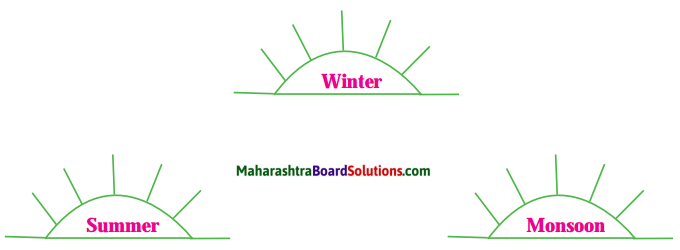
1. What changes do you see in nature in each of the following seasons? A few sentences are given below as examples. Use these and your own to describe a season appropriately.

  • New grass sprouts.
  • We see mist in the morning.
  • Tender leaves shoot out on plants or trees.
  • There are sudden showers and
  • Migratory birds return. hailstorms.
  • The sun shines brighter than before.
  • Trees blossom.

Maharashtra Board Class 9 English Kumarbharati Solutions Chapter 2.5 Autumn 1

Question 1.
What changes do you see in nature in each of the following seasons? Use the sentences given on textbook page 49 and your own to describe each season appropriately.
Answer:
(a) Summer:

  1. Migratory birds return.
  2. The sun shines brighter than before.
  3. Many trees blossom.
  4. Humidity in the air increases.

(b) Winter:

  1. We see fog in the morning.
  2. Nights become longer and the days shorter.
  3. There may sometimes be hail or snow in some places.
  4. Humidity levels in the air decrease.

(c) Monsoon:

  1. New grass sprouts.
  2. Tender leaves shoot out on plants and trees.
  3. There are sudden showers and hailstorms.
  4. There is the fresh smell of wet earth.

Question a.
Name the six seasons according to the Indian calendar. Which of these seasons is equivalent to Autumn?
Answer:
The six seasons according to the Indian calendar are :
Vasant, Grishma, Varsha, Sharad, Hemant and Shishir. Sharad Ritu is equivalent to Autumn.

Maharashtra Board Class 9 English Kumarbharati Solutions Chapter 2.5 Autumn

Question b.
What changes do we see in the life of human beings when the season changes? Write with reference to their (a) clothes (b) diet
(c) celebrations.
Answer:
(a) clothes :
Points :

  1. summer: wear cotton clothes – loose garments – head protection like caps, turbans – open shoes – goggles – long-sleeved shirts, blouses for protection from rays of sun, etc.
  2. winter: sweaters, mufflers, closed shoes, sometimes gloves, socks, etc.
  3. monsoon : light synthetic clothes – rubber or plastic footwear – umbrellas or raincoats, etc.

(b) diet :
Points :

  1. summer : more liquids-fresh fruits and juices – less spice, less oil, light diet, etc.
  2. winter : more oil, heavy food – hot food – special types of food which provide warmth – etc.
  3. monsoon : only cooked food – boiled water – less liquids – more foods that will give internal warmth, etc.

(c) celebrations :
Points :

  1. summer – Many Hindu festivals like Holi, Gudi padva, holidays – harvest festivals – family get-togethers, etc.
  2. winter – many weddings, parties – festivals like Diwali, Christmas, New Year, etc.
  3. monsoon – many festivals like Ganesh Chaturthi, farmers’ festivals, busy season for farmers, etc.

Maharashtra Board Class 9 English Kumarbharati Solutions Chapter 2.5 Autumn

2. Guess what is personified and fill in the gaps. Choose from the brackets.
(Sun, alarm, bird, car, wind, stars, machine)

Question 1.
Guess what is personified and fill in the gaps with words from the brackets :
(sun, alarm, bird, car, wind, stars, machine) (The answers are given directly.)
(a) The weary ……… was also petrol – hungry.
(b) The playful …….. whistled among the trees.
(c) The annoying ……. screamed at 5 am.
(d) The naughty …….. winked at me from above.
(e) The rising ……. stretched its arms.
(f) The cheerful …… sang as it perched on a tree.
(g) The tireless …….. hummed as it worked hard.
Answer:
(a) The weary car was also petrol-hungry.
(b) The playful wind whistled among the trees.
(c) The annoying alarm screamed at 5 a.m.
(d) The naughty stars winked at me from above.
(e) The rising sun stretched its arms.
(f) The cheerful bird sang as it perched on a tree.
(g) The tireless machine hummed as it worked hard.

Maharashtra Board Class 9 English Kumarbharati Solutions Chapter 2.5 Autumn

English Workshop:

1. Find three lines each, that contain images of nature in the autumn season. ..

Question 1.
Find three lines each, that contain images of nature in the autumn season :
(a) During daytime
1. ……………………..
2. ……………………..
3. ……………………..
(b) At night
1. ……………………..
2. ……………………..
3. ……………………..
Answer:
(a) During daytime :

  1. With nodding rice-stems in her hair.
  2. And lilies in her face.
  3. In flowers of grasses she is clad.

(b) At night :

  1. A diadem adorns the night! Of multitudinous stars.
  2. Her silken robe is white moonlight.
  3. And on her face (the radiant moon).

Maharashtra Board Class 9 English Kumarbharati Solutions Chapter 2.5 Autumn

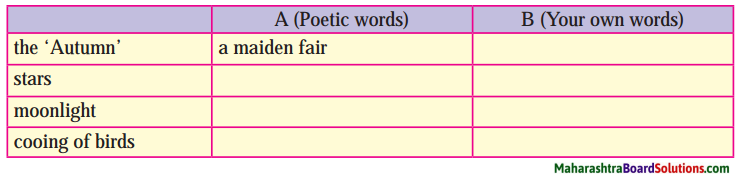
2. Pick out words from the poem that describe the following. List them in Column ‘A’. Substitute each of those describing words with another word/phrase of the same meaning.

Maharashtra Board Class 9 English Kumarbharati Solutions Chapter 2.5 Autumn 2

Question 1.
Pick out words from the poem that describe the following. List them in Column A. Substitute each of those describing words with another word/ phrase of the same meaning.
Answer:

A (Poetic words)B (Your own words)
1. The AutumnA maiden fairA beautiful maiden
2. StarsMultitudinousNumerous, Countless
3. MoonlightWhiteSilvery
4. Cooing of birdsA bracelet’s tinklingA musical sound

Maharashtra Board Class 9 English Kumarbharati Solutions Chapter 2.5 Autumn

3. Find one example of each of the following from the poem :
Simile
Metaphor

Question 1.
Simile
Answer:
Simile – Birds greet her with their cooing glad, Like a bracelet’s tinkling sound.

Question 2.
Metaphor
Answer:
Metaphor – The Autumn comes, a fair maiden.

4. Write the rhyme scheme of the poem.

Question 1.
Write the rhyme scheme of the poem.
Answer:
The rhyme scheme is ababcdcd.

5. Think and write in your own words.

Question a.
Why is the maiden Autumn said to wear rice stems in her hair?
Answer:
Probably the harvest of the rice crop is just over at the beginning of Autumn; hence the maiden Autumn is said to wear rice stems in her hair.

Maharashtra Board Class 9 English Kumarbharati Solutions Chapter 2.5 Autumn

Question b.
How can the tender maiden Autumn become a full grown woman? What change in nature does it imply?
Answer:
When the Autumn season is just beginning, Autumn is a tender maiden, young and graceful. As the season progresses and sets in properly, she becomes a full grown, mature woman. It implies that time has passed and the season has changed.

Question c.
Why do you think that birds greet the autumn season gladly?
Answer:
Probably the birds enjoy the cool autumn after the hot summer. They may also get more grains and seeds to eat.

6. Compare the Indian Monsoon season to a powerful king of a prosperous kingdom. Write down a few similarities. Use them to compose a poem of your own.

Question 1.
Compare the Indian Monsoon season to a powerful king of a prosperous kingdom. Write down a few similarities. Use them to compose a poem of your own.
Answer:
(Students may attempt this on their own.)

Maharashtra Board Class 9 English Kumarbharati Solutions Chapter 2.5 Autumn

7. Which is your favourite ‘Nature’ poem from your mother tongue? Write the poem and try to translate it into English. Your translation can be in the form of a poem or a paraphrase.

Question 1.
Which is your favourite ‘Nature’ poem from your mother tongue? Write the poem and try to translate it into English. Your translation can be in the form of a poem or a paraphrase.
Answer:
(Students may attempt this on their own.)

Maharashtra Board Class 9 English Kumarbharati Solutions Chapter 2.5 Autumn

8. Read the ode ‘To Autumn’ by the famous poet John Keats. ‘Season of mists and mellow fruitfulness…’

Question 1.
Read the ode ‘To Autumn’ by the famous poet John Keats. ‘Season of mists and mellow fruitfulness…’

English Kumarbharati 9th Digest Chapter 2.5 Autumn Additional Important Questions and Answers

Read the following poem carefully and complete the activities:

Simple Factual Activity:

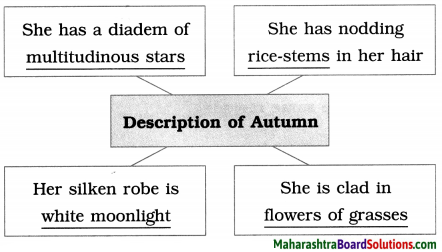
1. Complete the web:
(The answers are underlined directly.)
Maharashtra Board Class 9 English Kumarbharati Solutions Chapter 2.5 Autumn 3

Complex Factual Activities:

Question 1.
What is the cooing of birds compared to?
Answer:
The cooing of birds is compared to the tinkling song of a bracelet.

Maharashtra Board Class 9 English Kumarbharati Solutions Chapter 2.5 Autumn

Question 2.
How does Autumn dress up at night?
Answer:
At night Autumn wears a twinkling crown made of countless stars. Her robe of silk is the white moonlight, set free from the cloudy patches.

Question 3.
Why is Autumn called a ‘maiden fair’?
Answer:
Autumn is said to be slender and graceful. She has adorned herself by having rice-stems in her hair and lilies in her face. She is dressed in flowers of grasses. Hence, she is called a ‘maiden fair’.

Maharashtra Board Class 9 English Kumarbharati Solutions Chapter 2.5 Autumn

Paragraph Format:

In the poem ‘Autumn’, the poet Kalidas has lovingly and picturesquely described the advent of the Autumn season. The original poem in Sanskrit is translated into English by Prof. A. W. Ryder.

The Rhyme Scheme is ababcdcd. A Figure of Speech that stands out is Alliteration: ‘She seems a slender maid, who soon…’. Repetition of the sound of the letter ‘s’. Other figures of speech are Simile and Metaphor.

The poet has compared Autumn to a slender and graceful maiden who has adorned herself in various ways.
The poem is enchanting because of the imagery and the beautiful, imaginative description of Autumn. It shows us the imagination of the poet. Autumn is personified in the entire poem and compared to a slender and graceful maiden.

Maharashtra State Board Class 9 English Solutions

English Kumarbharati 9th Digest Answers Pdf 2020 Unit 2

Std 9 English Poem The Tempest 4.4 Question Answer Maharashtra Board

Class 9 English Chapter 4.4 Question Answer Maharashtra Board

Balbharti Maharashtra State Board Class 9 English Solutions My English Coursebook Chapter 4.4 The Tempest Notes, Textbook Exercise Important Questions and Answers.

The Tempest Poem 9th Std Question Answer

My English Coursebook Std 9 Guide Chapter 4.4 The Tempest Textbook Questions and Answers

Warming up!
Chit-chat

  1. Do you have a pet? What do you call it?
  2. How old is it? What does it look like?
  3. What does it eat? Who takes care of it?
  4. Does it understand you? What does it do?
  5. Have you taught it any tricks?
  6. Do you refer to it as ‘it’ or as ‘he’/ ‘she’?

Maharashtra Board Class 9 My English Coursebook Solutions Chapter 4.4 The Tempest

1. You must have seen and liked a play (in any language) on the stage. Write down the following details about it:

Question 1.
You must have seen and liked a play (in any language) on the stage. Write down the following details about it: (Answers are directly given.)
Answer:
(a) Name of the play: “All the best” – By Devendra Pem.
(b) Important Characters: A blind, A dumb, A deaf, and A girl.
(c) Its main theme: All the three best friends like the same girl and do not want her to know of their disabilities. They try to outdo each other to win her affection.
(d) Whether it was a Comedy/Tragedy/Social Theme or any other: It was a total comedy.
(e) Why you liked it: The play is a humorous take on three friends and the situation that arises when they fall in love with the same girl. It is presented in such a lively manner that one can’t stop laughing while watching it. So I liked it very much.
(f) Message of the play: A modern perspective towards love, especially the hardships in the love of physically challenged.
(g) Any other information about the play: The roles played by all characters are amazing and we never feel bored while watching it. Their ploy and plans to woo and win the girl are source of wit in the play.

2. The following are the different steps in a drama/play. They are in a mixed up order. Rearrange them in ‘a’ proper order. Just write the order numbers in brackets:

Question 1.
The following are the different steps in a drama/play. They are in a mixed up order. Rearrange them in ‘a’ proper order. Just write the order numbers in brackets:
Answer:
(a) Characters Enter (2)
(b) Climax (6)
(c) Curtain opens (1)
(d) Action begins (3)
(e) Scene of the play (5)
(f) Curtain closes (8)
(g) Finale (Final outcome) (7)
(h) Interaction of characters (4)

Maharashtra Board Class 9 My English Coursebook Solutions Chapter 4.4 The Tempest

3. William Shakespeare was one of the greatest playwrights of all times. He lived in the 16th century. Many of Shakespearean plays have been written in the short-story form. Find out the names of at least 5 of Shakespearean plays:

Question 1.
William Shakespeare was one of the greatest playwrights of all times. He lived in the 16th century. Many of Shakespearean plays have been written in the short-story form. Find out the names of at least 5 of Shakespearean plays: Example: Romeo and Juliet.
Answer:

  1. As you like it
  2. Hamlet
  3. Othello
  4. Twelfth Night
  5. The Taming of the Shrew.

English Workshop:

1. Write down the relation between the characters given below:

Question 1.
Write down the relation between the characters given below:
(Answers are directly given.)
Answer:
(a) Prospero and Miranda – Father and daughter
(b) Prospero and Antonio – Brothers
(c) Gonzalo and Prospero – Lord and Duke
(d) Sycorax and Caliban – mother and son
(e) Alonso and Sebastian – brothers
(f) Alonso and Ferdinand – father and son

Maharashtra Board Class 9 My English Coursebook Solutions Chapter 4.4 The Tempest

2. Find two supporting points from the story to prove the following facts:

Question 1.
Antonio was a disloyal and dangerous man.
(a) …………………………………………………………..
(b) …………………………………………………………..
Answer:
(a) He wanted to become Duke of Milan in his brother’s place.
(b) Antonio wouldn’t have hesitated to kill his brother Prospero.

Question 2.
Gonzalo was loyal to the rightful Duke.
(a) …………………………………………………………..
(b) …………………………………………………………..
Answer:
(a) Among Prospero’s courtiers was a true and loyal Lord called Gonzalo.
(b) Out of love and loyalty for the rightful duke he had secretly placed in the boat fresh water, food and clothes, and along with them, Prospero’s most valued possessions, his books.

Question 3.
Prospero was a great magician.
(a) …………………………………………………………..
(b) …………………………………………………………..
Answer:
(a) Prospero was a great magician for his life had been devoted to the study of magic.
(b) The power of his art enabled him to set free “the imprisoned spirits of whom Ariel was the chief’.

Question 4.
Miranda was very kind-hearted.
(a) …………………………………………………………..
(b) …………………………………………………………..
Answer:
(a) Miranda, a kind-hearted girl begged her father to have pity on the people caught in the storm.
(b) Please, please quell the storm now! Save the poor souls on board!

Maharashtra Board Class 9 My English Coursebook Solutions Chapter 4.4 The Tempest

Question 5.
Ariel was very faithful to Prospero.
(a) …………………………………………………………..
(b) …………………………………………………………..
Answer:
(a) Ariel appeared before Prospero to give an account of the storm.
(b) He gave lively story of the fears of the sailors, the anxiety of the lords and how Prince Ferdinand had leaped into the sea.

Question 6.
The story ‘The Tempest’ has a happy ending.
(a) …………………………………………………………..
(b) …………………………………………………………..
Answer:
(a) Prospero was happy and pleased to be I back in Milan and forgave his old enemies who had wronged him cruelly.
(b) Even though they had been at mercy, he did not take revenge on them, but very nobly forgave them.

3. Who said to whom and when?

Question 1.
Who said to whom and when?
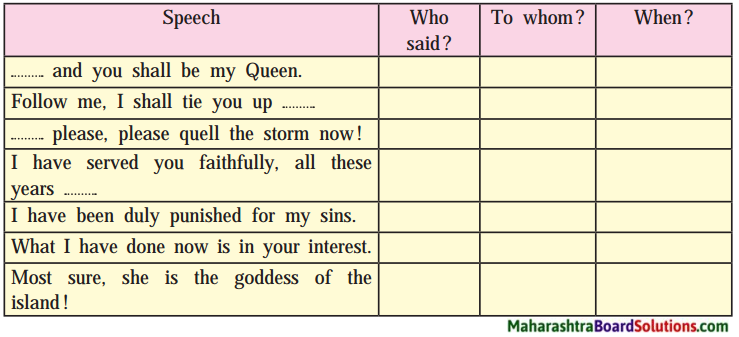
Maharashtra Board Class 9 My English Coursebook Solutions Chapter 4.4 The Tempest 1

  1. ………. and you shall be my Queen.
  2. “Follow me, I shall tie you up, neck and feet together.”
  3. …………… “Please, please quell the storm now!”
  4. “Remember, Master, I have served you joyfully all these years!”
  5. “I have been duly punished for my sins.”
  6. “What I have done now is in your interest!”
  7. Most sure, she is the goddess of the island!

Answer:

  1. Ferdinand said to Miranda when he fell in love with Miranda.
  2. Ferdinand said to himself when he saw Miranda on the isolated island for the first time.
  3. Miranda said to her father when she saw the ship struggling on the wild waves.
  4. Ariel said to Prospero when Prospero told Ariel to bring Ferdinand at once.
  5. Alonso said to Prospero, when he realized that he had lost his son.
  6. Prospero told his daughter when she requested him to quell the storm.
  7. Prospero said to Ferdinand when he pretended to be angry.

Maharashtra Board Class 9 My English Coursebook Solutions Chapter 4.4 The Tempest

4. Match the paragraphs in Column A with their suitable title in Column B: (Only the first and last words of the paragraph are given in Column A to identify it.)

Question 1.
Match the paragraphs in Column A with their suitable title in Column B: (Only the first and last words of the paragraph are given in Column A to identify it.)
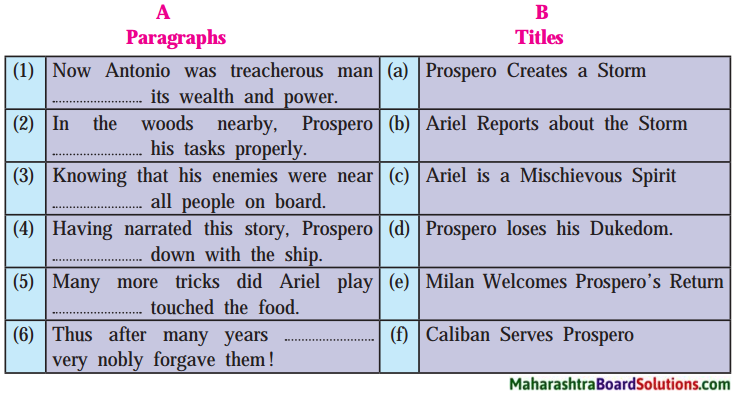
Maharashtra Board Class 9 My English Coursebook Solutions Chapter 4.4 The Tempest 2
Answer:

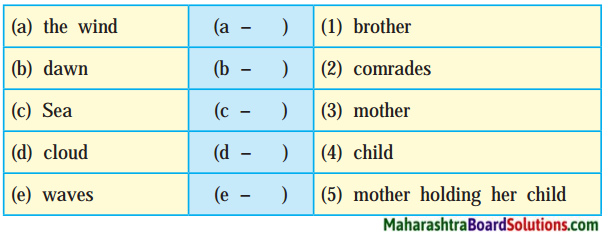
  1. Now Antonio was treacherous man … its wealth and power. – Prospero Loses his Dukedom.
  2. In the woods nearby, Prospero … his tasks properly. – Caliban Serves Prospero
  3. Knowing that his enemies were near … all people on board. – Prospero Creates a Storm
  4. Having narrated this story, Prospero … down with the ship. – Ariel Reports about the Storm
  5. Many more tricks did Ariel play … touched the food. – Ariel is a Mischievous Spirit
  6. Thus after many years … very nobly forgave them! – Milan Welcomes Prospero’s Return

5. Activity: Live English: Tourism

Maharashtra Board Class 9 My English Coursebook Solutions Chapter 4.4 The Tempest 3

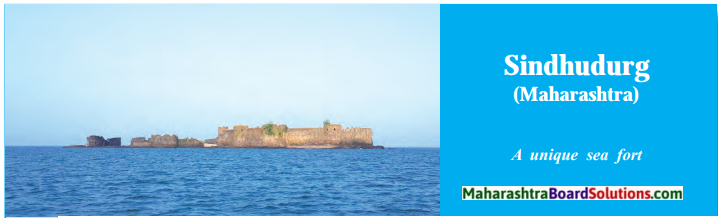
Location: Sindhudurg fort is located on the southernmost edge of the Maharashtra coast.
History: A sea fort, built by Chhatrapati Shivaji Maharaj.
Languages: Marathi, Hindi, English
Best time to visit: Winter
Where to stay: MTDC Holiday Resort: The resort at Tarkarli has 10 cottages with 20 sea-facing double bedrooms and one house boat.
What to see: Temples of Maruti, Bhavani, Chhatrapati Shivaji
How to get there:
By Air: The nearest international airport is Chhatrapati Shivaji International Airport, Mumbai.
By Rail: The nearest railhead is Sindhudurg on the Konkan Railway. Kankawali and Kudal are the other important railway stations nearby.
By Road: Mumbai-Tarkarli: 540 km.
Sites nearby: Sawantwadi, Malwan City, Tarkarli Beach. Redi Ganesh Temple, Vijaydurg, Kunkeshwar Temple, Amboli.

Maharashtra Board Class 9 My English Coursebook Solutions Chapter 4.4 The Tempest

Maharashtra Board Class 9 My English Coursebook Solutions Chapter 4.4 The Tempest 4

Location: Located on the outskirts of Chandrapur district, Tadoba Andhari Tiger Reserve is Maharashtra’s oldest and largest national park.
Languages: Marathi, Hindi, English, Tribal
The best season to visit: 15th October to 15th June. Hot summers are the ideal time to view mammals near water sources.
Where to stay: MTDC Jungle Resort (Mohrali) offers self-contained rooms, ideal for families. The rooms are comfortable, and offer a fine lake view.
How to get there:
By Air: The nearest international airport is Chhatrapati Shivaji International Airport, Mumbai.
By Rail: The nearest railhead is Sindhudurg on the Konkan Railway. Kankawali and Kudal are the other important railway stations nearby.
By Road: Chandrapur-Tadoba 45km. State transport buses ply from Chandrapur to Tadoba.
Attractions: Tiger, Panther, Bison, Sloth Bear, Hyena, Jackal, Wild Dog, Sambar, Leopard and Barking Deer.
Sights nearby: Bhadrawati, Markanda, Bhamragarh, Anandwan

Chit – Chat

  1. Do you like to travel?
  2. How do you like to travel?
  3. Which is the nearest place to which you have travelled?
  4. Which is the farthest?
  5. Have you ever travelled by ………….. ?
  6. What do you like to carry with you when you travel?
  7. What souvenirs do you like to bring back from your travels?

1. Observe the tourist leaflets given on page no. 114 of the textbook and answer the questions:

Question (a)
Which place do these leaflets describe?
Answer:
These leaflets describe ‘Sindhudurg’ and ‘Tadoba National Park’.

Maharashtra Board Class 9 My English Coursebook Solutions Chapter 4.4 The Tempest

Question (b)
What are the main points given in each leaflet?
Answer:
The main points given in each leaflet are –

  1. Location
  2. History
  3. Languages
  4. Best time to visit
  5. Where to stay?
  6. What to see?
  7. How to go there? (by air, by rail, by road)
  8. Sites nearby.

Question (c)
How can one reach Tadoba? why?
Answer:
One can reach Tadoba by taking a plane to Nagpur. One can also reach Tadoba by going to Chandrapur in a train and then taking a bus for the 45 km journey to Tadoba National Park.

Question (d)
Which is the best season to visit Tadoba? Why?
Answer:
The best season to visit Tadoba is hot summers, from 15th October to 15th June, to view mammals near water resources.

Question (e)
List the words related to tourism, e.g. tourist, reservation, etc.
Answer:
Tourism-related words are –

  1. tourist
  2. booking
  3. travel
  4. ticket
  5. flight
  6. train
  7. buses
  8. forts
  9. trek.
  10. resort
  11. mountains
  12. hill stations
  13. history
  14. MTDC
  15. ST

Maharashtra Board Class 9 My English Coursebook Solutions Chapter 4.4 The Tempest

2. Prepare a tourist leaflet for a historical place or a hill station using the following points:

Question 1.
Prepare a tourist leaflet for a historical place or a hill station using the following points:

  1. Place
  2. Special features
  3. Distance
  4. How to go there
  5. Accommodation
  6. Food
  7. Climate

Answer:
1. Place: Hill Station: Mahabaleshwar

2. Special features: The jungles of Mahabaleshwar are known for their density and a stunning array of birds and wildlife located in Western ghats at the elevation of approximately 353 metres. It offers appealing view of evergreen valleys and hills of the Konkan and the Deccan coast. The climate is cool and pleasant suitable for cultivation of strawberries.

3. Distance: Mumbai – Mahabaleshwar – 262 kms

  • Pune – Mahabaleshwar – 125 kms
  • Satara – Mahabaleshwar – 62 kms
  • Mahad – Mahabaleshwar – 32 kms

4. How to go there:

  • By Air: Pune airport lies 120 km from the place is the nearest airport.
  • By Rail: Satara is the nearest railway station, about 62 km.
  • By Road: Many ST buses run from Mumbai and Pune. Private buses and taxis are also available.

5. Accommodation: Mahabaleshwar has no dearth of accommodation options. There are many hotels ranging from deluxe to budget. Other options include tourist lodges, guest houses, private bungalows and MTDC Resort.

6. Food:

  • Maharashtrian and any type of Indian and continental foods are available.
  • Mahabaleshwar is famous for strawberry ice cream, milk shake, jam, jelly, etc.

7. Climate :

  • Throughout the year the climate is mild and pleasing.
  • It receives incessant showers from July to September when temperature ranges between 20 to 25 degree.

Maharashtra Board Class 9 My English Coursebook Solutions Chapter 4.4 The Tempest

3. If you want to become a tourist guide at the following place, which languages will you need to learn?

Question 1.
If you want to become a tourist guide at the following place, which languages will you need to learn?

  1. Ajanta
  2. Belgavi
  3. Delhi
  4. Tarkarli

Answer:

  1. Ajanta: Marathi, Hindi, English
  2. Belgavi: Kannada, English
  3. Delhi: Hindi, English
  4. Tarkarli: Marathi, English, Hindi

4. Imagine you are a tourist guide at (1) Sindhudurg (2) Tadoba. Write two sentences each about the following points to help foreign tourists:

Question 1.
Imagine you are a tourist guide at
1. Sindhudurg
2. Tadoba.
Write two sentences each about the following points to help foreign tourists:
(a) About the place: History, languages spoken, special attractions.
(b) Food: speciality, local delicacies, options (Indian, continental)
(c) Shopping: authenticity of local artefacts, price, variety.
Answer:
1. Sindhudurg:
(a) About the place: The place is located in Sindhudurg district just off the coast of Maharashtra in Western India. The fortress lies on the shore of Malvan town of Sindhudurg district in Konkan region. It was built by Chhatrapati Shivaji Maharaj. It is believed that Shivaji personally selected the site for the construction of the fort. The languages spoken here are Marathi, Malvani, Hindi and English.

(b) Food: The place is famous for its sea food, kombdi vade and the local Malvani cuisine. It is also popular for Alphonso mangoes.

(c) Shopping: Local delicacies made by the people out of mangoes, jackfruits, kokam and cashewnuts can be bought from the city. Mangoes of good quality and taste are also available here.

2. Tadoba:

(a) About the place: Tadoba Andhari Reserve is the largest National Park in Maharashtra. It is a tiger reserve in Chandrapur district of Maharashtra. It was created in 1955. Marathi, Hindi, and some tribal languages are spoken here.
(b) Food: The local cuisine is the Vidarbha cuisine. Veg. and non veg. hotels and restaurants nearby area also provide Indian and continental food as well.
(c) Shopping: The Tiger Reserve souvenirs can be brought at reasonable rates from the shops around the reserve.

Maharashtra Board Class 9 My English Coursebook Solutions Chapter 4.4 The Tempest

5. Prepare an attractive tourist leaflet for your native place, in English as well as in your mother tongue:

Question 1.
Prepare an attractive tourist leaflet for your native place, in English as well as in your mother tongue: [Note : The tourist leaflet of Kolhapur is given below, as an example. Students are expected to prepare leaflet of their own native place.]
Answer:
Kolhapur

1. Location: Kolhapur is an inland city located in South-west Maharashtra state, 228 km south of Pune. It is a historic city of Maharashtra, famous for temple of a Hindu Goddess – Mahalakshmi.

2. History: Kolhapur was established by Tarabai in 1707 during succession dispute over the Maratha Kingship. The state was annexed by the British in the 19th century. It was ruled by Bhosale Royal clan of the Maratha Empire.

3. Languages: Marathi, Kannada, Hindi, English.

4. Best time to visit: Summers here are very hot, hence the months between June and February are the best time to visit.

5. Accommodation: 2 star and 3 star hotels, private bungalows and MTDC Resorts. Tourists can choose from a wide range of hotels based on their budget and preferences.

6. How to go there:

  • By Air: Belgaum is the nearest airport from Kolhapur, which is connected through airlines from Mumbai.
  • By Rail: Kolhapur is connected by a good rail network to other cities like Mumbai, Bengaluru, Pune and Tirupati.
  • By Road: It is 450 km from Mumbai. One can get direct buses (ST and Private) to Kolhapur from Mumbai, Pune, Bengaluru, Belgaum, Mangaluru and Hubli.

7. Attractions: The city has multiple options that can be explored. Mahalaxmi Temple, Rankala Lake. Panhala fort, Jyotiba Temple, Siddagiri Museum, Shahuji Maharaj Museum/palace, Kopeshwar Temple are some of the attractions in city. Kolhapur is famous for special mutton dishes especially Pandhara and Tambda Rassa, Kolhapuri Bhel and Misal.

6. Suppose a foreigner comes to visit your place and you have to accompany him for sight seeing. Prepare a dialogue between you and the foreigner:

Question 1.
Suppose a foreigner comes to visit your place and you have to accompany him for sight seeing. Prepare a dialogue between you and the foreigner:
Answer:

  • Myself: So, you are here to visit our city. Would you like to accompany me for sight seeing?
  • Foreigner: Being native of this city, I think you would be of great help to me. So from where shall we start?
  • Myself: Better we start from the place out of the city, Verul caves, which is the main attraction of the tourists.
  • Foreigner: How much time will it take? Can we see another place also along with it?
  • Myself: It takes around 4-5 hours to see all the caves in detail. We can also visit Grishneshwar Jyotirling Temple nearby. It is believed to be an ancient temple of Hindus.
  • Foreigner: Oh that’s great! So after lunch better we come back in the city.
  • Myself: Yes, in city too in evening you can visit Bibi ka Maqbura, a replica of Taj Mahal and Pawan Chakki (wind mill).
  • Foreigner: Very nice. We will go there in the evening. So what is left for tomorrow?
  • Myself: Tomorrow we can go to Ajanta Caves. It takes a whole day for travelling and viewing it.
  • Foreigner: I have heard about an ancient fort also.
  • Myself: Yes, you are right. But it’s not possible to see at a time. We can go there day after tomorrow.
  • Foreigner: That’s great idea. You have been a great help for me. Thanks a lot, dear.
  • Myself: You are welcome!

Maharashtra Board Class 9 My English Coursebook Solutions Chapter 4.4 The Tempest

7. Using the Internet, find the following information about a place you wish to visit using the following points:

Question 1.
Using the Internet, find the following information about a place you wish to visit using the following points:

  1. Distance from your place
  2. Available modes of transport
  3. Accommodation facilities
  4. Historical facts
  5. Climate
  6. Famous sites.

My English Coursebook 9th Class Solutions Chapter 4.4 The Tempest Additional Important Questions and Answers

Simple Factual Activities:

Question 1.
State whether the following statements are True or False: (Answers are directly given.)
Answer:

  1. Prospero was the duke of Milan, in the kingdom of Naples. – True
  2. Prospero’s brother Gonzalo was a very treacherous man. – False
  3. Books were Prospero’s most valued possessions. – True
  4. The king Antonio landed safely on an enchanted island. – False

Question 2.
Who were all sailing in the ship, close to the enchanted island ?
Answer:
The King of Naples – Alonso, his brother – Sebastian, Antonio, Prince Ferdinand of Naples, and the old, loyal courtier Gonzalo.

Question 3.
Who am I? (Answers are directly given.)
Answer:

  1. I am a great magician. – Prospero
  2. I am the chief of the imprisoned spirits. – Ariel
  3. I am the twisted, ugly monster. – Caliban
  4. I am the king of Naples. – Alonso

Maharashtra Board Class 9 My English Coursebook Solutions Chapter 4.4 The Tempest

Question 4.
Complete the following sentences:
Answer:

  1. Prospero led his daughter to the shore of the island.
  2. Miranda begged her father to have pity on the people caught in the storm.
  3. Prospero explained to his daughter that he had caused the tempest in order to bring his enemies Alonso and Sebastian, within his power.
  4. Ariel gave a lively account of the fears of the sailors, the anxiety of the lords and how Prince Ferdinand had leaped into the sea.

Question 5.
Arrange the following sentences in chronological order:
Answer:

  1. Prospero narrated the story of their past life to his daughter.
  2. Prospero raised a great tempest with his power of magic.
  3. He wanted to show how the ship was struggling on the wild waves due to his magic.
  4. Being kind-hearted, Miranda requested her father to have pity on the people caught in the storm. Answer:
  5. Prospero raised a great tempest with his power of magic.
  6. He wanted to show how the ship was struggling on the wild waves due to his magic.
  7. Being kind-hearted, Miranda requested her father to have pity on the people caught in the storm.
  8. Prospero narrated the story of their past life to his daughter.

Question 6.
State whether you Agree or Disagree with the following statements: (Answers are directly given.)
Answer:

  1. Miranda had never ever seen any human being except her father. – Agree
  2. Prospero was not happy when his daughter saw Ferdinand. – Disagree
  3. Miranda was the goddess of the island. – Disagree
  4. Ariel was very faithful to Prospero. – Agree

Question 7.
Fill in the blanks with one word:
(Answers are directly given.)
Answer:

  1. Prospero took the prince to a cave.
  2. Ferdinand wanted to be the king of Naples.
  3. Many more tricks were played on Prospero’s enemies by Ariel.
  4. Antonio wanted to kill king Alonso.

Maharashtra Board Class 9 My English Coursebook Solutions Chapter 4.4 The Tempest

Question 8.
State whether the following statements are Right or Wrong:
Answer:

  1. People in Milan welcomed Prospero with great love and joy. – Right
  2. Prospero nobly forgave his old enemies. – Right
  3. Ferdinand and Miranda got married on the enchanted island. – Wrong
  4. Ariel was as free as air at the end. – Right

Question 9.
Complete the following sentences with the help of the passage: (Answers are directly given.)
Answer:

  1. Prospero decided to give up the practice of magic.
  2. Ariel promised everyone calm seas and favourable winds while sailing.
  3. Alonso was happy to see his lost son.
  4. Prospero assured Alonso that their ship was safely anchored and each and every sailor was safe on board.

Complex Factual Activities:

Question 1.
What evil deed did Antonio do, to become a Duke himself ?
Answer:
Antonio conspired with the king of Naples, Alonso to take his brother’s Dukedom. They took Prospero and his baby daughter Miranda far away from land. They left them in a broken, old boat and sailed away.

Question 2.
What had the faithful Lord Gonzalo done to help Prospero?
Answer:
Out of his love and loyalty for the rightful duke, Prospero, Gonzalo had secretly placed fresh water, food and clothes and most valued possessions, his books in the boat to help Prospero.

Maharashtra Board Class 9 My English Coursebook Solutions Chapter 4.4 The Tempest

Question 3.
Complete the difference between Prospero and Antonio:
Answer:

ProsperoAntonio
1. Prospero was a Studious and learned scholar.1. Antonio was a treacherous man.
2. He spent most of his time reading books.2. He managed the business of rullmg the kingdom and wanted to become Duke of Milan in his brother’s place.

Question 4.
What good deed did Prospero do on the enchanted island?
Answer:
The enchanted island was under the spell of Sycorax, a dead witch. Prospero, set free all the imprisoned good spirits on that island and compelled them to follow his orders. Being a good magician, he could do it so all the spirits were grateful and obedient to him.

Question 5.
What did Prospero do when he saw Alonso, Sebastian and Antonio sailing in a ship close to enchanted island?
Answer:
When Prospero came to know that Alonso, Sebastian and Antonio were sailing in a ship close to enchanted island, he raised a great tempest with the power of his magic. The royal ship was turned and tossed on the stormy waves. It seemed as if it would sink any moment, along with all the people on board.

Question 6.
For what two reasons did Prospero raise a great tempest?
Answer:
1. Prospero raised a great tempest in his daughter’s interest.
2. He also wanted to bring his enemies, Alonso and Antonio within his power. So he raised a great tempest.

Question 7.
How did Ferdinand get separated from his father?
Answer:
When the ship was struggling in the waves, Ferdinand had jumped into the sea. So everyone on the ship thought that he was dead. But actually he got separated from his father and was left alone on a beach.

Question 8.
Who said to whom and when:
1. “Obey my commands now, and in two days I shall set you free!”
2. “All your troubles were merely trials of your love”.
Answer:
1. Prospero said to Ariel when Ariel reminded him of his promise.
2. Prospero said to Ferdinand when he was sure that Ferdinand loves his daughter.

Maharashtra Board Class 9 My English Coursebook Solutions Chapter 4.4 The Tempest

Question 9.
How did Ferdinand and Miranda react on seeing each other?
Answer:
Miranda had never seen any other human being in her life beside her father so when she saw Ferdinand she was thrilled and thought that he was divine and noble. On the other hand Ferdinand was astonished to see a beautiful girl on an isolated island. Basically both of them gazed at each other in wonder, admiration and love.

Question 10.
What gave Prospero a secret pleasure?
Answer:
When Ferdinand was brought there, he and Miranda looked at each other in wonder, admiration and love. Actually Prospero brought him there for his daughter. So seeing his daughter get attracted to Ferdinand, Prospero was pleased.

Question 11.
How did Ariel save king Alonso’s life?
Answer:
Antonio and Sebastian had plotted to murder of king Alonso. Ariel saved his life by waking up the king from his sleep in the nick of time.

Question 12.
What tricks did Ariel play on Prospero’s enemies?
Answer:

  1. He caused them to wander about.
  2. He filled their ears with strange and frightful noises.
  3. When they were faint with hunger, he set a huge banquet before them, only to take it away when they touched the food.

Question 13.
What surprise awaited king Alonso when Prospero drew back the curtain?
Answer:
When Prospero drew back the cmtain from the entrance of his cave, King Alonso saw Ferdinand, his lost son happily playing a game of chess with Miranda. That was a pleasant surprise for the king Alonso.

Find two supporting points from the story to prove the following fact:

Question 1.
King Alonso felt ashamed for his deed.
Answer:
(a) The king and other courtiers were ashamed.
(b) They begged Prospero’s forgiveness.

Activities based on vocabulary:

Question 1.
Find out adjectives used to describe the following nouns: (Answers are directly given.)
Answer:

  1. enchanted island
  2. evil witch
  3. broken boat
  4. freshwater.

Maharashtra Board Class 9 My English Coursebook Solutions Chapter 4.4 The Tempest

Question 2.
Choose the correct alternative given for the synonym of the words given below:
(Answers are directly given.)
Answer:
1. studious: bookish
(a) outstanding
(b) concerned
(c) bookish
(d) clever.

2. treacherous: unreliable
(a) foolish
(b) tricky
(c) unreliable
(d) favourite.

3. witch: an ugly evil
(a) spirit
(b) an ugly evil
(c) ghost
(d) magician.

4. rightful: lawful
(a) lawful
(b) expert
(c) faithful
(d) true.

Question 3.
Find out antonyms for the following from the passage: (Answers are directly given.)
Answer:

  1. disillusioned × enchanted
  2. kindhearted × vicious
  3. thankless × grateful
  4. sympathetic × brutal

Question 4.
Give one word from the passage for the following description :
(Answers are directly given.)
Answer:

  1. A minor nature goddess usually depicted as a beautiful maiden – sea nymph
  2. Linear unit of measurement for water depth – fathom
  3. Causing fear or terror – dreadful
  4. a relative permanent state of worry and nervousness – anxiety

Question 5.
Make a word register related with “sea”.
Answer:
A word register related with “sea” – shore, island, ship, waves, storm, sailors, fathom, sea- nymphs.

Maharashtra Board Class 9 My English Coursebook Solutions Chapter 4.4 The Tempest

Question 6.
Complete the following table by writing related words to the given mood:
(Answers are directly given.)
Answer:

Happy moodSurprise mood
1. joyfullyastonished
2. thrilledwonder

Question 7.
Write down minimum four infinitives from the passage:
Answer:
to defend, to capture, to go, to see, to stand obey, remember, follow.

Question 8.
Match the words in Column ‘A’ with their meanings in Column ‘B’:

Column ‘A’Column ‘B’
1. treacherous(a) a grand dinner party
2. revealed(b) very valuable
3. banquet(c) showed
4. priceless(d) deceitful

Answer:

Column ‘A’Column ‘B’
1. treacherous(d) deceitful
2. revealed(c) showed
3. banquet(a) a grand dinner party
4. priceless(b) very valuable

Question 9.
Find out two words from the passage with suffix ‘ness’ and write your own two words with suffix ‘ness’.
Answer:
Words from the passage:
1. wickedness
2. kindness.
My own words:
1. happiness
2. sadness.

Question 10.
Complete the following table:
Answer:

Present TensePast TensePast Participle
givegavegiven
seesawseen
assureassuredassured
forgiveforgaveforgiven

Question 11.
Pick the odd man out:
Answer:

  1. heir, cave, ship, old, wind – old
  2. take, wander, safe, punish, hear – safe
  3. happy, thrilling, calm, revenge, favourable – revenge
  4. nobly, safely, happily, marry, duly – marry

Maharashtra Board Class 9 My English Coursebook Solutions Chapter 4.4 The Tempest

Activities based on contextual grammar:

Question 1.
Add a question tag:
(Answers are directly given.)
Answer:

  1. Prospero was the Duke of Milan, wasn’t he?
  2. Antonio would not have hesitated to kill Prospero, would he?
  3. You can imagine the hardships faced by Prospero, can’t you?
  4. The spirits remained trapped in their prisons, didn’t they?

Make the following sentences exclamatory:

Question 1.
Antonio was a treacherous man.
Answer:
What a treacherous man Antonio was!

Question 2.
Gonzalo was a true and loyal courtier.
Answer:
What a true and loyal courtier Gonzalo was!

Question 3.
Identify the tense:

  1. The ship was carrying Prince Ferdinand of Naples.
  2. He had devoted his life to the study of magic.
  3. They promised to be ever obedient to his will.

Answer:

  1. Past Continuous Tense
  2. Past Perfect Tense
  3. Simple Past Tense.

Question 4.
Begin the sentence with the underlined word/words:
1. Prospero raised a great tempest with the power of his magic.
2. In the woods nearby, Prospero found Caliban, a twisted, ugly monster.
Answer:
1. A great tempest was raised with the power of his magic by Prospero.
2. Caliban, a twisted, ugly monster was found by Prospero in the woods nearby.

Use ‘As soon as’ in the following sentences:

Question 1.
Prospero touched Miranda with his magic stick and she fell fast asleep.
Answer:
As soon as Prospero touched Miranda with his magic stick, she fell fast asleep.

Maharashtra Board Class 9 My English Coursebook Solutions Chapter 4.4 The Tempest

Question 2.
As the tempest raged, Prospero led his daughter to the shore of the island.
Answer:
As soon as the tempest raged, Prospero led his daughter to the shore of the island.

Question 3.
Rewrite the following sentences as per the instructions:
1. Prospero waved his magic stick.
(Rewrite the sentence in past continuous tense.)
2. Ariel informed Prospero that the ship, was safely anchored in one corner of the island.
(Rewrite the sentence in past perfect tense.)
Answer:
1. Prospero was waving his magic stick.
2. Ariel had informed Prospero that the ship was safely anchored in one corner of the island.

Question 4.
Rewrite the following sentences in polite request in form of question:
1. Obey my commands now!
2. Bring Ferdinand here at once.
Answer:
1. Will you please obey my commands now?
2. Can you please bring Ferdinand here at once?

Question 5.
Prospero said to Ferdinand, “All your troubles were merely trials of your love and you have nobly stood the test. Now, I give you my daughter, a priceless gift.”
(Rewrite the sentence in indirect narration.)
Answer:
1. Prospero told Ferdinand that all his troubles were merely trials of his love and he had nobly I stood the test. He further added that he gave him (Ferdinand), his daughter, a priceless gift.

Question 6.
Begin the sentences with the underlined object and rewrite it:
1. Ariel brought them before Prospero.
2. He thanked Gonzalo for his kindness.
Answer:
1. They were brought before Prospero by Ariel.
2. Gonzalo was thanked for his kindness by him.

Question 7.
Make them assertive:
1. How happy Alonso was to see his lost son!
2. How thrilled Alonso was to hear that Ferdinand was to marry the duke of Milan’s beautiful daughter.
Answer:
1. Alonso was very happy to see his lost son.
2. Alonso was very much thrilled to hear that Ferdinand was to marry the duke of Milan’s beautiful daughter.

Maharashtra Board Class 9 My English Coursebook Solutions Chapter 4.4 The Tempest

Question 8.
Use ‘not only … but also’ :
1. Prospero was happy and pleased to be back in Milan.
2. Ariel promised them calm seas and favourable winds in their journey.
Answer:
1. Prospero was not only happy but also pleased to be back in Milan.
2. Ariel promised them not only calm seas but also favourable winds in their journey.

Do as directed:

Question 1.
Complete the words by using correct letters:

  1. o_der
  2. gre_t
  3. ne_er
  4. ma _ ic

Answer:

  1. order
  2. great
  3. never
  4. magic

Question 2.
Copy the following sentences correctly in your notebook:
Answer:
1. Prospero was the Duke of Milan in the kingdom of Naples.
2. “Obey my commands now,” Prospero said to him.

Question 3.
Put the following words in alphabetical order:
1. earthen, natural, different, leisure
2. renowned, rectangles, residing, recording
Answer:
1. different, earthen, leisure, natural.
2. recording, rectangles, renowned, residing.

Question 4.
Punctuate the following sentences:
1. every child is an artist the problem is how to remain an artist once we grow up said Picasso
2. oh i didn’t see you come in said the teacher to ritesh
Answer:
1. “Every child is an artist. The problem is how to remain an artist once we grow up?” said Picasso.
2. “Oh, I didn’t see you come in !” said the teacher to Ritesh.

Maharashtra Board Class 9 My English Coursebook Solutions Chapter 4.4 The Tempest

Question 5.
Write four small words (minimum 3 letters each) using the letters in the given word:
“treacherous”
Answer:

  1. teach
  2. reach
  3. each
  4. hero.

Question 6.
Spot the error and rewrite the correct sentence:
1. Raza win many national and international awards.
2. Gond art have spread mainly in Central India.
Answer:
1. Raza won many national and international awards.
2. Gond art has spread mainly in Central India.

Question 7.
Write related words as shown in the example: (Answers are directly given.)
Answer:
Maharashtra Board Class 9 My English Coursebook Solutions Chapter 4.4 The Tempest 5

Question 8.
Complete the following word-chain of nouns. Write four words each beginning with the last letter of the previous word:
wealth → …………….. → ………………. → …………….. → ……………..
Answer:
wealth → humour → reaction → nectar → rainbow.

Maharashtra Board Class 9 My English Coursebook Solutions Chapter 4.4 The Tempest

Do as directed:

Question 1.
Make your own meaningful sentence by using the phrase ‘to look after’:
Answer:
It is our duty to look after our parents in their old age.

Question 2.
Add a prefix or suffix to make new
words and use any one of the root words in your own sentence:
1. regular
2. wicked.
Answer:
1. regular – irregular
2. wicked – wickedness.
Sentence: The wicked man was about to kill his own friend.

Question 3.
Add a clause to expand the sentence meaningfully:
She did not know ………………..
Answer:
She did not know how she would be able to come to the decision.

Personal Response:

Question 1.
What will you do if you are left alone on an isolated island by your friends?
Answer:
If I am left alone on an isolated island by my friends, first I will try to track the location with my mobile. Then I will send it to my parents and other faithful friends. If they get that location, they will definitely reach where I am and I would come out of that isolated island.

Question 2.
Why did Prospero raise a great tempest?
Answer:
Prospero was a great magician and staying on the enchanted island. When he saw a ship carrying his enemies near his island, he wanted to show them his power of magic without doing them any harm so that they would not come nearby his island again.

Maharashtra Board Class 9 My English Coursebook Solutions Chapter 4.4 The Tempest

Question 3.
If you were given the power of magic for one day, what would you do? How would you use the power of magic?
Answer:
If I were given the power of magic for one day, I would do something for the society and for the nation. First, I would try to eradicate poverty from the society, I would give employment opportunities to each and every individual to raise the national income and to make my country developed.

Question 4.
Do you think the power of magic can make you successful? Why?
Answer:
I don’t believe in magic. As we are living in the 21st century, I believe to be at right place at right time. Luck, timing and magic, none of them will make you successful unless you work hard continuously. So I believe in hard work not in magic.

Question 5.
“Ariel was a faithful spirit” – why do you think so?
Answer:
Ariel was the chief of imprisoned good spirits. Prospero promised him that he would set him free with his power of magic. He was serving Prospero and helping him faithfully in every need of an hour to set himself free.

Maharashtra Board Class 9 My English Coursebook Solutions Chapter 4.4 The Tempest

Question 6.
What could be the reason for Prospero to give up the practice of magic?
Answer:
After using the power of his magic at an enchanted island he was back to his own kingdom, Milan. He wanted a new beginning, he wanted to rule his kingdom with human values and virtues rather than magical spells. So he might have given up the practice of magic.

My English Coursebook 9th Class Digest Unit 4

Std 9 English Poem Coromandel Fishers 3.1 Question Answer Maharashtra Board

Class 9 English Chapter 3.1 Question Answer Maharashtra Board

Balbharti Maharashtra State Board Class 9 English Solutions My English Coursebook Chapter 3.1 Coromandel Fishers Notes, Textbook Exercise Important Questions and Answers.

Coromandel Fishers Poem 9th Std Question Answer

My English Coursebook Std 9 Guide Chapter 3.1 Coromandel Fishers Textbook Questions and Answers

Warming up:
Chit-chat

  1. What time do you get up in the morning?
  2. What time do you go to bed?
  3. Where do you spend your holidays?
  4. What adventures do you like boating, trekking, scuba diving, mountaineering or something else?
  5. After you finish your education, would you like to work close to nature?
  6. What would you like to do?

Maharashtra Board Class 9 My English Coursebook Solutions Chapter 3.1 Coromandel Fishers

Expanding Horizons

Question (a)
Write as many words as you can, related to the following. You should have at least twenty words each. You may refer to your geography textbook or other sources for that purpose. Then try to find English words/items for the ones you have written.
Maharashtra Board Class 9 My English Coursebook Solutions Chapter 3.1 Coromandel Fishers 1
Answer:
Maharashtra Board Class 9 My English Coursebook Solutions Chapter 3.1 Coromandel Fishers 2

Question (b)
Prepare a bilingual glossary for each of these topics:

Question (c)
Arrange the glossary in two ways:
1. According to the alphabetical order of letters in your mother tongue.
2. According to the alphabetical order ‘a-z’
[Students may attempt (b) & (c) above on ther own.

Maharashtra Board Class 9 My English Coursebook Solutions Chapter 3.1 Coromandel Fishers

English Workshop:

Answer the following questions.

Question (a)
How many stanzas are there in the poem?
Answer:
There are three stanzas in the poem.

Question (b)
How many lines are there in the poem?
Answer:
There are twelve lines in the poem.

Question (c)
List the rhyming words in each stanza:
Answer:

  1. First stanza: light – night, free – sea
  2. Second stanza: call – all, drives – lives
  3. Third stanza: grove – love, glee – sea

2. You know that many poems have rhyming words or rhymes at the end of the lines in each stanza. The pattern of rhyming is usually shown with the help of small letters such as ‘a’, ‘b’, ‘c’, etc. This pattern of rhyme is known as the rhyme scheme. The rhyme scheme of each stanza in this poem is aabb. Verify.

Question 1.
You know that many poems have rhyming words or rhymes at the end of the lines in each stanza. The pattern of rhyming is usually shown with the help of small letters such as ‘a’, ‘b’, ‘c’, etc. This pattern of rhyme is known as the rhyme scheme. The rhyme scheme of each stanza in this poem is aabb. Verify.

Maharashtra Board Class 9 My English Coursebook Solutions Chapter 3.1 Coromandel Fishers

3. What do the following expressions refer to? Write in a word or phrase:

Question 1.
What do the following expressions refer to? Write in a word or phrase:

  1. leaping wealth of the tide: …………
  2. kings of sea: …………..
  3. at the fall of the sun: …………
  4. the edge of the verge: ………..

Answer:

  1. leaping wealth of the tide: fish
  2. kings of sea : fishermen
  3. at the fall of the sun : at the sunset
  4. the edge of the verge : horizon

4. Match the following:

Question 1.
Match the following:
Maharashtra Board Class 9 My English Coursebook Solutions Chapter 3.1 Coromandel Fishers 3
Answer:
(a) the wind – child
(b) dawn – mother holding her child
(c) sea – mother
(d) cloud – brother
(e) waves – comrades

Maharashtra Board Class 9 My English Coursebook Solutions Chapter 3.1 Coromandel Fishers

5. Find and write the lines in the poem that refer to:

Question 1.
Find and write the lines in the poem that refer to:
(a) early morning
(b) evening
(c) full moon night
Answer:
(a) early morning: Rise, brother, rise; the wakening skies pray to the morning light.
(b) evening: What though we toss at the fall of the sun where the hand of the sea-god drives?
(b) full moon light: And sweet are the sands at the full o’ the moon with the sound of the voices we love

6. Write the lines that show that the fishermen are not afraid of the sea or of drowning.

Question 1.
Write the lines that show that the fishermen are not afraid of the sea or of drowning.
Answer:
He who holds the storm by the hair, will hide in his breast our lives.

7. In the last stanza, two lines refer to a landscape, and two lines refer to a ‘seascape’. Which are they? Copy them from the poem correctly:

Question 1.
In the last stanza, two lines refer to a landscape, and two lines refer to a ‘seascape’. < Which are they? Copy them from the poem correctly:
Maharashtra Board Class 9 My English Coursebook Solutions Chapter 3.1 Coromandel Fishers 4
Answer:

LandscapeSeascape
Sweet is the shade of the coconut glade, and the scent of the mango grove,

And sweet are the sands at the full o’ the moon with the sound of the voices we love.

But sweeter, brothers, the kiss of the spray and the dance of the wild foam’s glee;

Row, brothers, row to the edge of the verge, where the low sky mates with the sea.

Maharashtra Board Class 9 My English Coursebook Solutions Chapter 3.1 Coromandel Fishers

8. Using the internet, find photographs /pictures of landscapes /seascapes to illustrate the images used in the poem.

Question 1.
Using the internet, find photographs /pictures of landscapes /seascapes to illustrate the images used in the poem.

9. Select a few lines from your favourite nature poem in your mother tongue and translate them into English.

Question 1.
Select a few lines from your favourite nature poem in your mother tongue and translate them into English.
Answer:
1. Title: Coromandel Fishers
2. Poet/Poetess: This poem is written by Sarojini Naidu.

3. Theme/Central Idea: The theme of the poem is that when human beings come together for a common purpose, no force or adversary can adversary can block their way. There could be risk in any challenging enterprise, but human progress depends on facing them courageously.

4. Rhyme Scheme: The rhyme scheme of the poem is ‘aabb’.

5. Figure of Speech: Simile, Metaphor

6. Special Feature: This is a didactic poem. A didactic poem is an instructive one. It is aimed at imparting certain advice or some moral principles. “When we come together for a common purpose and put our faith in God, we can accomplish great things” – This is the moral principle of this poem.

7. Favourite Lines: My favourite lines from the poem are :

  • “He who holds the storm by the hair, will hide in his breast our lives”.
  • But sweeter, O brothers, the kiss of the spray and the dance of the wild foam’s glee.

8. Why I like the poem: I like this poem because it imparts a very positive message. It says that if we trust in God and do our work promptly, success is ours.

My English Coursebook 9th Class Solutions Chapter 3.1 Coromandel Fishers Additional Important Questions and Answers

Simple Factual Activities:

Question 1.
Who holds the storm by the hair?
Answer:
God holds the storm by the hair.

Maharashtra Board Class 9 My English Coursebook Solutions Chapter 3.1 Coromandel Fishers

Question 2.
What type of boat do the fishermen use?
Answer:
The fishermen use catamaran boats.

Complex Factual Activities :

Question 1.
As the sea-gull flies away calling it appears as though, he is showing the way-What does the way lead to?
Answer:
The way leads the fishermen to the sea where plenty of fish can be caught.

Paragraph format:

The title of the poem is ‘Coromandel Fishers.’ The poem is written by Sarojini Naidu. The theme of the poem is that when human beings come together for a common purpose, no force or adversary can block their way. There could be risk in any challenging enterprise, but human progress depends on facing them courageously. The fishermen in the poem prove this fact.

The rhyme scheme of the poem is ‘aabb’. The figures of speech in the poem are simile and Metaphor. The special feature of this poem is that it a didactic poem. It is an instructive poem which is aimed at imparting certain advice or some moral principles. “ When we come together for a common purpose and put our faith in God, we can accomplish great things. ” This is the moral principle of this poem.

My favourite lines from the poem are:

1. “He who holds the storm by the hair, will hide in his breast our lives.” This line shows the fishermen put their full faith in the sea-god.
2. “But sweeter, O brothers, the kiss of spray and the dance of the wild foam’s glee.” I like the poem because it gives a very positive message. It says that if we trust in God and do our work promptly, success is ours.

My English Coursebook 9th Class Solutions Unit 3

Std 9 English Poem Mark Twain 2.3 Question Answer Maharashtra Board

Class 9 English Chapter 2.3 Question Answer Maharashtra Board

Balbharti Maharashtra State Board Class 9 English Solutions My English Coursebook Chapter 2.3 Mark Twain Notes, Textbook Exercise Important Questions and Answers.

Mark Twain Poem 9th Std Question Answer

My English Coursebook Std 9 Digest Chapter 2.3 Mark Twain Textbook Questions and Answers

Warming up!

Chit-chat:

  • Who is your favourite comedian?
  • What do you like better – to listen to a joke, or to tell a joke?
  • Do you like cartoons and cartoon films?
  • Which one do you like best?

Maharashtra Board Class 9 My English Coursebook Solutions Chapter 2.3 Mark Twain

Quick Thinkers:

Within one minute, write as many meaningful phrases as possible using the numbers given below. Do not repeat the ideas.

Question 1.
Within one minute, write as many meaningful phrases as possible using the numbers given below. Do not repeat the ideas.
Maharashtra Board Class 9 My English Coursebook Solutions Chapter 2.3 Mark Twain 1
Answer:

  • One – one boy
  • Two – two girls
  • Three – three facebook accounts
  • Four – four complaints
  • Five – five gardens
  • Six – six policemen
  • Seven – seven roads
  • Forty – forty feet
  • A hundred – a hundred messages

Maharashtra Board Class 9 My English Coursebook Solutions Chapter 2.3 Mark Twain

Try to imagine a situation context where all the above items fit in. Describe it in 8 – 10 lines.
Think of a title for your passage.

Question 1.
Try to imagine a situation context where all the above items fit in. Describe it in 8 – 10 lines. Think of a title for your passage.
Answer:
Tit for tat
There was a boy in one city. He was studying in standard nine. He opened three fake Facebook accounts and started sending indecent messages to two girls from his class. The girls complained to their teacher four times but he continued sending ‘the same kinds of messages.

At last, the girls’ parents complained to Five gardens police station. Six policemen from the police station came to his school and took the boy to a remand home where seven roads meet. Now the boy is in a forty feet room and taking his punishment for sending hundreds of – indecent messages to the innocent girls.

Maharashtra Board Class 9 My English Coursebook Solutions Chapter 2.3 Mark Twain

Try to draw a map incorporating your phrases in a meaningful way. (Two examples are given below.) Write a key/index for your map.

Question 1.
Try to draw a map incorporating your phrases in a meaningful way. (Two examples are given below.) Write a key/index for your map.
Answer:
Maharashtra Board Class 9 My English Coursebook Solutions Chapter 2.3 Mark Twain 2

English Workshop:

1. Answer the following questions:

Question a.
Did Twain tell the barber who he was?
Answer:
Twain did not tell the barber who he was because he didn’t want to disclose his identity. But he told him that it was his first visit to that town.

Question b.
Was Twain particular about how he dressed when he was visiting friends?
Answer:
Yes, Twain was particular about his dress because when Mrs. Stowe saw him without any collar and tie she was surprised. She disapproved his dressing, it shows that he was always in formal, particular dress.

Maharashtra Board Class 9 My English Coursebook Solutions Chapter 2.3 Mark Twain

Question c.
Was Twain particular about what words he used?
Answer:
Yes, Twain was very much particular about what words he used.

Question d.
Do you think Twain approved of spelling reforms? Give reasons for your answer.
Answer:
Twain proposed a different plan for the improvement of English spellings. He wanted to convey that further changes and reformation in English spellings would be harmful for the language. So I think he did not approve of spelling reforms.

Question e.
How did Twain explain the spider in the paper? What did he want to highlight?
Answer:
Twain explained that the spider was on the paper to see which merchant was not advertising, so that he could go to that store; spin his web across the door and lead a life of undisturbed peace afterwards. He wanted to highlight that there was no logical reason behind superstitions as the spider just happened to be there on the newspaper by chance. He also wanted to highlight that we should not believe in superstitions.

Maharashtra Board Class 9 My English Coursebook Solutions Chapter 2.3 Mark Twain

2. Read the following and write the two meanings of ‘mind’ and ‘matter’ :
‘Age is an issue of mind over matter. If you don’t mind, it doesn’t matter.’

Question 1.
Read the following and write the two meanings of ‘mind’ and ‘matter’.
Age is an issue of mind over matter. If you don’t mind, it doesn’t matter.
Answer:
Here mind and matter both are used as a nouns first and then they are used as verbs.

3. Enact any one anecdote in the classroom.

Question 1.
Enact any one anecdote in the classroom.

4. Translate any five of the quotations you like.

Question 1.
Translate any five of the quotations you like.

5. Form groups of four to six.
Discuss whether and how you can improve English spelling.

Question 1.
Discuss whether and how you can improve English spelling.

Maharashtra Board Class 9 My English Coursebook Solutions Chapter 2.3 Mark Twain

6. Arrange a ‘Jokes’ session in the classroom where each student tells a joke. The jokes must be told in English.

Question 1.
Arrange a ‘Jokes’ session in the classroom where each student tells a joke. The jokes must be told in English.

Language Study:

7. Many actions involve two people/things – one that performs the action and one that is affected by the action. Example: Sonali ate the mango.
Here, the action of eating involves Sonali (who eats) and the mango (which gets eaten).
Sonali is the subject and ‘mango’ is the object of the verb ‘eat’. When you want to talk about who performed the action, the doer of the action is the subject.
Sometimes, you want focus on the object – the thing affected by the action. Then you make it the subject of that sentence. Example: The mango was eaten.
You may or may not mention the doer – here, Sonali or the person who ate it.
This is passive construction or passive voice. In this type of construction, the thing affected by the verb is the subject of the sentence, the verb is in the passive form (be + past participle), and the ‘doer’ of the action may or may not be mentioned.
In the following examples of passive voice, the ‘doer’ of action is not mentioned.
Examples :

  • The plants are pruned.
  • A cup of tea is offered to any guest …
  • Many anecdotes related to Mark Twain are told …

If we wish to mention the ‘doer’ in passive sentences, we mention it by adding ‘by’
before it. Examples :
This pen was given to me by my Aunt.
Note that only transitive verbs can be used in the passive voice.

Maharashtra Board Class 9 My English Coursebook Solutions Chapter 2.3 Mark Twain

8. Refer to the Language Study pages and read the entries ‘irony’ and ‘pun’. Find one example of each from the passage or the quotations.

Question 1.
Find the examples of ‘irony’ and ‘pun’ from the lesson or the quotations.
Answer:
irony – use of words to imply the opposite of what they mean.
Examples:

  1. A writer is working on his manuscript; and it’s a comedy.
  2. ‘classic’ – A book which people praise and don’t read.

pun – a play on words based on their different meanings, for a humorous effect.
Examples:

  1. A bicycle can’t stand on its own because it is two-tired.
  2. Age is an issue of mind over matter. If you don’t mind, it doesn’t matter.

(2 examples of irony and pun are given here. Students are expected to find more examples from the lesson.)

Maharashtra Board Class 9 My English Coursebook Solutions Chapter 2.3 Mark Twain

8. Activity: Live English: Customer Care

Question a.
Read the following conversation.
Answer:

  • Vaishali: Mother, how’s your new Zap3 mobile working?
  • Mother: Oh It’s a fantastic piece and I’ve got a Bhramar simcard free with this mobile but somehow the Internet Is not working.
  • Vaishali: Go to the settings and see if the mobile data is switched on.
  • Mother: Yes, dear, I’ve done that so many times, but still I am not getting connected.
  • Vaishali: Let’s contact the customer support at Bhramar and take their help. Look, the number Is given on the back of the simcard packet.
  • Mother: Yes. I’ll contact them immediately.
  • Vaishali: Put your mobile on speaker phone so that I can guide you.
    (Mother dials Bhramar Telecom customer care.)
  • Bhramar CC: Hello. This is Bhramar customer care service. For information in English, press for Hindi, press 2, for Marathi, press 3, to talk to our customer care executive, press 4.
    (Mother presses 1.)
  • Bhramar CC: For information regarding bills and your account, press 1 for internet queries and offers, press 2 for other services, press 3 to talk to our customer care executive, press 4.
    (Mother presses 2.)
  • Bhramar CC: For different Internet plans, press: 1 to talk to our customer care executive, press 2.
    (Mother presses 2.)
  • Bhramar CC: How can I help you?
  • Mother: I bought a new Bhramar SIM yesterday. I have opted for the 349 rupees unlimited plan.
  • Bhramar CC: Yes, it Is reflected against your number.
  • Mother: But I am not getting connected to the Internet.
  • Bhramar CC: Go to Settings’ and in APN type internet and save it. After that just switch off the phone and then switch it on again. The internet will start working. Any other queries, Madam?
  • Mother: No, thank you. If I have any problem, I will call you back.
  • Bhramar CC: Thanks for calling Bhramar Customer Care service. (Hangs up.)
  • Vaishali: See, Mummy, It’s quiet simple.

Maharashtra Board Class 9 My English Coursebook Solutions Chapter 2.3 Mark Twain

Question b.
You have purchased some games CDs online through ChalaShikuya. corn (CSY). You are not able to access the CD. It is published by Cithuttigarnes. When you contact the customer care service of Chhuttigarnes. what questions will you ask?
Answer:
Questions to ask chalashikuya.com. customer care service of chhuttigames.

  1. Is it customer care service of chhuttigames?
  2. I want to talk to the person who deals with customer complaints, who is the right ¡erson to talk to?
  3. Recently I have purchased some games CD online through your website. It’s not working properly. How can I resolve my problem?
  4. Is it possible to exchange the CD?
  5. How can I send it back to you?
  6. How much time will you take to replace it?
  7. What is the guarantee that new CD wifi work properly?
  8. Will you return the money which I paid for CDs?

Question c.
Find out who the service provider is for your parents mobile. With your parents’ pennission. call the customer care service to get information regarding the active plans on your number. (For example. SMS plan, internet plan, etc. and share this information in your classroom.)
Answer:
Telephonic conversation with the customer care service.

  • Myself: Hello, is it Airtel Service Centre?
  • ServIceman: Yes, what can I do you for you, Sir?
  • Myself: My mother’s number is 9867XXXX10 and I want to enquire about new plans for this number.
  • Serviceman: Could you hold on for a moment please? I will just put you through to our expert.
  • Myself: It’s all right.
  • Serviceman: What do you want to ask, Sir? I can’t get through to him at the moment. If you tell me, I wifi definitely pass on your message to him.
  • Myself: I want to ask about the active plan on my mobile. Especially about SMS plan and Internet plan.
  • Serviceman: I think the operator has hung up. I will pass on your message to him, call you back in some time.
  • Myself: 0k Sir, Thanks a lot!
  • Serviceman: Welcome Sir, Have a good day.

Maharashtra Board Class 9 My English Coursebook Solutions Chapter 2.3 Mark Twain

Question d.
Prepare simple telephone conversations using the expressions below.
Some useful ‘telephone’ phrases
Hold on, please. (Wait): Could you hold on for a moment please?
Put (a call) through (Connect): I will just put you through to our expert.
Get through (Get connected): I can’t get through to him at the moment, could you call back later, please?
Hang up (End the call): I think the operator has hung up.
Call back: I’ll check your plan and call you back in some time.

  • Pick up
  • Answer the phone
  • Call
  • Give a ring

Maharashtra Board Class 9 My English Coursebook Solutions Chapter 2.3 Mark Twain 3

My English Coursebook 9th Class Solutions Chapter 2.3 Mark Twain Additional Important Questions and Answers

Read the following passage and do the activities:

Simple Factual Activities:

Question 1.
Complete the following sentences with the help of the given passage:
(Answers are directly given.)
Answer:

  1. The real name of Mark Twain was Samuel Langhorne Clemens.
  2. Mark Twain went to a local barber shop for a shave.
  3. Many anecdotes related to Mark Twain are told and enjoyed even today.
  4. The young Mark Twain ran over early to say goodbye to Mrs. Stowe.

Maharashtra Board Class 9 My English Coursebook Solutions Chapter 2.3 Mark Twain

Question 2.
Name the following:
Answer:

  1. The popular American Writer – Mark Twain
  2. The place where Mrs Stowe was going – Florida
  3. The home country of Mark Twain – America
  4. The person who was going to Florida – Mrs Stowe

Question 3.
Answer the following in words :
Answer:

  1. How many times did Mark Twain hear the story. – Three times
  2. Who was telling the story? – Henry Irving

Question 4.
Complete the following sentences :
(Answers are directly given.)
Answer:
1. Henry Irving asked Mark Twain if he had heard the story before “because he wanted to assure that he had not heard the story which he was telling him.”
2. Mark Twain could not lie the third time at any cost because he had not only heard the story but also invented it after hearing it for the third time.

Maharashtra Board Class 9 My English Coursebook Solutions Chapter 2.3 Mark Twain

Question 5.
State whether the following statements are True or False: (Answers are directly given.)
Answer:

  1. Mark Twain received a letter from the editor of a small Missouri newspaper. – False
  2. Finding a spider in a paper is good luck for the reader according to Mark Twain. – False
  3. Mark Twain’s birth was heralded by the return of Halley’s comet. – True
  4. Mark Twain died in November 1835. – False

Complex Factual Activities:

Question 1.
Describe Mark Twain.
Answer:
Mark Twain was a popular American writer who was famous for his humorous stories, novels and other writings. Many anecdotes related to Mark Twain are told and enjoyed even today. He was a great defender of human values like liberty, equality and fraternity.

Maharashtra Board Class 9 My English Coursebook Solutions Chapter 2.3 Mark Twain

Question 2.
Complete the following web describing Mark Twain:
(Answers are directly given.)
Answer:
Maharashtra Board Class 9 My English Coursebook Solutions Chapter 2.3 Mark Twain 4

Question 3.
Complete the following:
(Answers are directly given.) The two social activities that Mark Twain supported:
1. Being a great defender of human values like liberty, equality and fraternity, Mark Twain opposed wars and imperialism.
2. He also supported the cause of labourers and of the black people in his country.

Maharashtra Board Class 9 My English Coursebook Solutions Chapter 2.3 Mark Twain

Question 4.
Was Twain particular about what words he used?
Answer:
Yes, Twain was very much particular about what words he used.

Question 5.
Why was Henry Irving asking Mark Twain the same question again and again?
Answer:
While telling a humorous story to Mark Twain, Henry Irving noticed his friend’s face. He noticed some unknown gestures on his face. Thinking, he might have heard the story, Henry was reassuring whether Mark Twain had heard the story or not so to make it sure he was asking the same question again and again.

Question 6.
What did Mark Twain propose? What was his plan at the year 6-12?
Answer:
Mark Twain proposed a plan for the improvement of English Spelling. At the year 6-12 his plan was modifying vowels and the remaining voiced and unvoiced consonants.

Maharashtra Board Class 9 My English Coursebook Solutions Chapter 2.3 Mark Twain

Question 7.
How did Twain explain the spider in the paper? What did he want to highlight?
Answer:
1. Twain explained that the spider was on the paper to see which merchant was not advertising, so that he could go to that store spin his web across the door and lead a life of undisturbed peace afterwards.
2. He wanted to highlight that there was no logical reason behind superstitions as the spider just happened to be there on the newspaper by chance. He also wanted to highlight that we should not believe in superstitions.

Question 8.
Which episode shows that Mark Twain did not believe in superstitions?
Answer:
A letter was received by Mark Twain from a reader asking him whether finding a spider in his j paper portended good or bad luck. His reply to the reader shows that he did not believe in superstitions, whereas we should take such situations humorously.

Activities based on vocabulary:

Question 1.
Find out similar meaning words (synonyms) for the following from the passage :
(Answers are directly given.)
Answer:

  1. freedom – liberty
  2. protector – defender
  3. brotherhood – fraternity
  4. considered – regarded

Maharashtra Board Class 9 My English Coursebook Solutions Chapter 2.3 Mark Twain

Question 2.
Complete the following word-web with the words related to literature:
(Answers are directly given.)
Answer:
Maharashtra Board Class 9 My English Coursebook Solutions Chapter 2.3 Mark Twain 5

Question 3.
Find out any four wrongly spelled words and correct them:
Answer:

  1. Iear – Year
  2. konsonant – consonant
  3. fainali – finally
  4. lojikl – logical

Question 4.
Find out from the passage the words used for the following words:
Answer:

  1. world – werld
  2. replace – riplais
  3. respectively – respective
  4. modifying – modifaiing

Maharashtra Board Class 9 My English Coursebook Solutions Chapter 2.3 Mark Twain

Question 5.
Classify the following words in the given table:
reader, remind, wonder, spider, merchant, return, declare, comet.
Answer:

NounsVerbs
reader, spider, merchant, comet.remind, wonder, return, declare.

Activities based on contextual grammar:

Question 1.
Change the following sentences in indirect speech:
1. “You have chosen a good time to come,” the barber said to Mark Twain.
2. The barber said to Mark Twain, “Have you bought your ticket?”
Answer:
1. The barber told Mark Twain that he had chosen a good time to come.
2. The barber asked Mark Twain if he had bought his ticket.

Maharashtra Board Class 9 My English Coursebook Solutions Chapter 2.3 Mark Twain

Question 2.
Use ‘not only’ …. ‘but also’ and rewrite the sentences:
1. Many anecdotes related to Mark Twain are told and enjoyed even today.
2. Mark Twain opposed wars and imperialism.
Answer:
1. Many anecdotes related to Mark Twain are not only told but also enjoyed even today.
2. Mark Twain opposed not only wars but also imperialism.

Identify the mistakes in the following ( sentences and write the correct sentences:

Question 1.
Jenerally, then, the improvement would kontinue iear bai iear.
Answer:
Generally, then, the improvement would continue year by year.

Question 2.
it wud fainali bi possible to meik ius ov thi ( ridandant letez.
Answer:
It would finally be possible to make use of the redundant letters.

Maharashtra Board Class 9 My English Coursebook Solutions Chapter 2.3 Mark Twain

Identify the tense:

Question 1.
1. Henry Irving was telling a humorous story.
2. Mark Twain proposed a plan for the improvement of English Spelling
Answer:
1. Past Continuous Tense.
2. Simple Past Tense.

Make the sentences affirmative:

Question 1.
1. A man cannot be comfortable without his own approval.
2. Don’t be careless about reading health books.
Answer:
1. A man is (can be) uncomfortable without his own approval.
2. Be careful about reading health books.

Frame a wh-question to get the underlined part as an answer in each sentences:

Question 1.
Mark Twain received a letter from a reader.
Answer:
What did Mark Twain receive from a reader?

Maharashtra Board Class 9 My English Coursebook Solutions Chapter 2.3 Mark Twain

Question 2.
Mark Twain’s birth was heralded by the return of Halley’s comet.
Answer:
What was heralded by the return of Halley’s comet?

Personal Response:

Question 1.
What is the importance of humour in our life?
Answer:
Humour is the most effective and important ingredient, to spice up the dish of life. It is enjoyed by all irrespective of age, caste, gender, whatever. It is one thing which can bind us all and generate a positive and happy environment. Even the most difficult situations can be handled with ease, if we are armed with humorous mind and disposition.

Question 2.
What do you know about Mark Twain?
Answer:
Mark Twain, was an American writer, humorist, publisher and lecturer. He was born on 30th November, 1835 in Florida (U.S.). Twain earned a great deal of money from his humorous writings and lectures. He was lauded as the greatest American humorist of his age. The Adventures of Tom Sawyer and The Adventures of Huckleberry Finn were his two major classics of American literature.

Question 3.
Why should we avoid spelling mistakes while writing?
Answer:
Correct spelling improves the overall presentation of our work and helps with our confidence in writing. Incorrect spelling can be both embarrassing and damaging. It changes the meaning of the sentences. It also leaves a bad impression of the writer on the readers’ mind.

Maharashtra Board Class 9 My English Coursebook Solutions Chapter 2.3 Mark Twain

Question 4.
How can you improve English spellings?
Answer:
We can improve our English spellings in the following ways:

  1. By learning a few rules of forming words.
  2. By learning commonly misspelled words.
  3. By checking word origins in the dictionary.
  4. By separating words into chunks.
  5. By using the words in its context.
  6. By playing word games/solving puzzles.

Question 5.
Why should we take part in humorous sessions?
Answer:
Jokes can make people laugh and this impacts the blood circulation. Humorous sessions are often considered as good time for individuals with heart and other cardiovascular problems. It indirectly improves immune system by increasing infection-fighting antibodies. It reduces pains and takes us out from our problems.

Activities Based on Language study

Do as directed:

Question 1.
Complete the words by using correct letters:

  1. t o _ a y
  2. s _ a v e
  3. a _ a i n
  4. p _ i c e

Answer:

  1. t o d a y
  2. s h a v e
  3. a g a i n
  4. p r i c e.

Maharashtra Board Class 9 My English Coursebook Solutions Chapter 2.3 Mark Twain

Question 2.
Copy the following sentences correctly:
Answer:
1. “Have you bought your ticket yet?”
2. “You’ve chosen a good time to come,” he declared.

Question 3.
Put the following words In alphabetical order:
1. reader, spider, merchant, honour.
2. careless, classic, curiosity, cosmically.
Answer:
1. honour, merchant, reader, spider.
2. careless, classic, cosmically, curiosity.

Question 4.
Punctuate the following sentences:
1. are you quite sure you havent heard this he demanded suspiciously.
2. i not only heard the story invented it said mark twain.
Answer:
1. “Are you quite sure you haven’t heard this?” he demanded suspiciously.
2. “1 not only heard the story, I invented It!” said Mark Twain.

Question 5.
Write four small words (minimum 3 letters each) using the letters in the given word:
‘generalizations’
Answer:

  1. general
  2. gents
  3. ration
  4. lion.

Maharashtra Board Class 9 My English Coursebook Solutions Chapter 2.3 Mark Twain

Question 6.
Spot the error and rewrite the correct sentences:
1. A man does not be comfortable without his own approval.
2. Mark Twain will oppose wars and imperialism and supported the cause of labourers.
Answer:
1. A man cannot be comfortable without his own approval.
2. Mark Twain opposed wars and imperialism and supported the cause of labourers.

Question 7.
Write related words as shown in the example:
(Answers are directly given.)
Answer:
Maharashtra Board Class 9 My English Coursebook Solutions Chapter 2.3 Mark Twain 6

Question 8.
Complete the following word-chain of verbs. Add four words, each beginning with the last letter of the previous word:
find → ……………… → ……………. → …………….. → ……………… .
Answer:
find → drinkkeepplayyell.

Do as directed:

Question 1.
Make your own meaningful sentence by using the phrase ‘to wait for’.
Answer:
We should always wait for the right opportunity.

Maharashtra Board Class 9 My English Coursebook Solutions Chapter 2.3 Mark Twain

Question 2.
Add a prefix or suffix to make new words and use one of the root words in your own sentence:
1. advantage
2. agree.
Answer:
1. disadvantage
2. disagree.
Sentence: There are many advantages of reading good books.

Question 3.
Add a clause to expand the sentence meaningfully:
I bought a new mobile …………………. .
Answer:
I bought a new mobile which is not at all useful for me.

Activities:

Question 1.
Can you think of other examples of irregularities in English spelling?
(Few examples are given here. Students may think and write other examples.)
Answer:

  • Name – Nikki, Nicky, Toni & Tony
  • – centre, center
  • – weight, height
  • – headache, know

Maharashtra Board Class 9 My English Coursebook Solutions Chapter 2.3 Mark Twain

Question 2.
Write a few sentences according to the improvements suggested for each year:
Answer:

YearSentencesSuggested improvements
1I never drink cool water.I never drink kool water.
2She baked one cake.She baked won kake.
3He replied angrily.He replied angrili.
5Finally, she stopped overeating.Finali she stoped overeeting.
6 to 12It would be nice to eat peanuts.It wud bi naise tu eet peenats.
15the shop was shut.Xe yop was yut.
20This has to change soon.Xis has tu ccej sun.

My English Coursebook 9th Class Pdf Unit 2
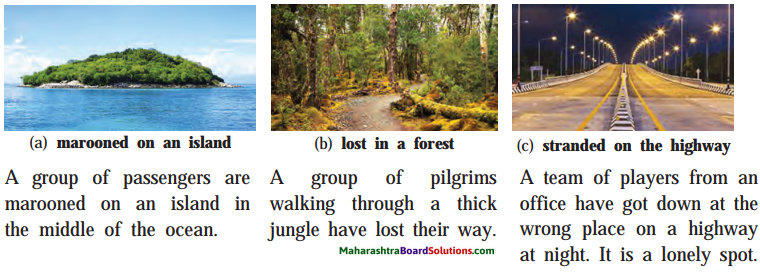
Std 9 English Poem Invictus 2.1 Question Answer Maharashtra Board

Class 9 English Chapter 2.1 Question Answer Maharashtra Board

Balbharti Maharashtra State Board Class 9 English Solutions Kumarbharati Chapter 2.1 Invictus Notes, Textbook Exercise Important Questions and Answers.

Invictus Poem 9th Std Question Answer

English Kumarbharati 9th Solutions Chapter 2.1 Invictus Textbook Questions and Answers

Warming Up:

Let’s introspect!

1. Think and respond with a ‘YES’ or ‘NO’. When you are faced with a very serious problem or some grave danger, what do you experience?
Maharashtra Board Class 9 English Kumarbharati Solutions Chapter 2.1 Invictus 1

Write about your feelings and reactions In 4-5 lines. You may describe your feelings and reactions usIng other words than those given here.

Form groups of four. Discuss what you actually feel and do In difficult situations and some of the things you could do and would like to do In those situations.

Question 1.
Think and respond with a ‘YES’ or ‘NO’. When you are faced with a very serious problem or some grave danger, what do you experience?
Answer:
(Students can attempt this activity on page 27 of the textbook on their own.)

Maharashtra Board Class 9 English Kumarbharati Solutions Chapter 2.1 Invictus

Question 2.
Write about your feelings and reactions In 4-5 lines. You may describe your feelings and reactions usIng other words than those given here.
Answer:
[Students may write this based on responses made in (a).]
(Some other words you can use to describe your feelings and reactions :fear, nervousness, uncertainty, lack of confidence, aggressiveness, insecurity, courage, optimism, despair, etc.)

Maharashtra Board Class 9 English Kumarbharati Solutions Chapter 2.1 Invictus

Question 3.
Form groups of four. Discuss what you actually feel and do In difficult situations and some of the things you could do and would like to do In those situations.
Answer:
In difficult situations :
(a) What I actually feel and do :

  1. feel frightened and corf used
  2. feel depressed and cry
  3. run away and hide
  4. tell lies or blame others.

(b) What I could do and would like to do :

  1. be calm and brave
  2. accept the situation and look for solutions
  3. take due responsibility for what has happened
  4. share my problems and look for support. (Students can add their own points and discuss this activity in groups.)

Maharashtra Board Class 9 English Kumarbharati Solutions Chapter 2.1 Invictus

2. Guess what the following symbolize and match the pairs : 

Question 1.
Guess what the following symbolize and match the pairs :

AB
1. a tall mountain(a) beauty
2. a dark night(b) freedom
3. a rose(c) deep distress
4. sunrise(d) anger
5. a flying bird(e) strength/firmness
6. thunder(f) hope

Answer:

AB
1. a tall mountain(e) strength/firmness
2. a dark night(c) deep distress
3. a rose(a) beauty
4. sunrise(f) hope
5. a flying bird(b) freedom
6. thunder(d) anger

Maharashtra Board Class 9 English Kumarbharati Solutions Chapter 2.1 Invictus

English Workshop:

1. Choose the correct option :

Question a.
Out of the night that covers me, Black as the pit from pole to pole.
i. There is a pit between two poles which you cannot see at night.
ii. I am in a pit that is covered with a black sheet.
iii. The circumstances are as bad as they can be, with nothing to hope for from any corner.
Answer:
iii. The circumstances are as bad as they can be, with nothing to hope for from any corner.

Question b.
In the fell clutch of circumstance, I have not winced nor cried aloud.
i. I fell down and cried aloud.
ii. I have not expressed my grief even when I had to suffer great pain.
iii. I freed myself from a difficult situation and cried.
Answer:
ii. I have not expressed my grief even when I had to suffer great pain.

Maharashtra Board Class 9 English Kumarbharati Solutions Chapter 2.1 Invictus

Question c.
Under the bludgeonings of chance, My head is bloody …
i. I have suffered many setbacks and losses, for which there was no reason.
ii. I got hurt due to my own faults.
iii. My enemies hit me till I started bleeding.
Answer:
i. I have suffered many setbacks and losses, for which there was no reason.

Question d.
And yet the menace of the years, Finds, and shall find me, unafraid.
i. My enemies threaten me but cannot find me.
ii. A great bully found me once, but shall not find me in future.
iii. Even though I am growing old, I am not, and shall not be, afraid.
Answer:
iii. Even though I am growing old, I am not, and shall not be, afraid.

Question e.
How charged with punishments the scroll….
i. The scroll is very expensive.
ii. I may have to pay for many of my mistakes.
iii. I have to pay money as punishment.
Answer:
ii. I may have to pay for many of my mistakes.

Maharashtra Board Class 9 English Kumarbharati Solutions Chapter 2.1 Invictus

Question f.
I am the master of my fate.
i. I take responsibility for everything that happens in my life.
ii. My fate is my master.
iii. I am the master of this world.
Answer:
i. I take responsibility for everything that happens in my life.

Question g.
I am the captain of my soul.
i. I am the captain of a team.
ii. My soul is the captain of my team.
iii. My actions are the result of my own feelings.
Answer:
iii. My actions are the result of my own feelings.

2. Write the rhyme scheme of the poem.

Question 1.
Write the rhyme scheme of the poem.
Answer:
Rhyme scheme: abab.

Maharashtra Board Class 9 English Kumarbharati Solutions Chapter 2.1 Invictus

3. Read the poem ‘Where lies the land ……..’ by A.C. Clough.

Question 1.
Read the poem ‘Where lies the land ……..’ by A.C. Clough.

English Kumarbharati 9th Digest Chapter 2.1 Invictus Additional Important Questions and Answers

Complex Factual Activities :

Question 1.
What is the poet thankful for?
Answer:
The poet is thankful for his unconquerable soul.

Question 2.
What does the poet have full control over?
Answer:
The poet has full control over his fate, his soul and his life.

Maharashtra Board Class 9 English Kumarbharati Solutions Chapter 2.1 Invictus

Question 3.
Which lines show that the poet has suffered his hardships bravely?
Answer:
The lines that show that the poet has suffered his hardships bravely are :
i. I thank whatever gods may be
For my unconquerable soul.

ii. In the fell clutch of circumstance
I have neither winced nor cried aloud.
Under the bludgeoning of chance
My head is bloody but unbowed.

Question 4.
What is meant by ‘the place of wrath and tears’?
Answer:
‘The place of wrath and tears’ means the place of anger and sadness. That is, the world where we live.

Activities based on Poetic Devices :

Question 1.
‘Under the bludgeonings of chance’. Pick out and explain the figure of speech from this line.
Answer:
Personification – Chance (fate) is personified. It is said to be beating the poet violently with a club.

Maharashtra Board Class 9 English Kumarbharati Solutions Chapter 2.1 Invictus

Paragraph Format :

The poem ‘Invictus’ is by William Ernest Henley. The Rhyme Scheme of the poem is abab. One example of a Figure of Speech is Personification: ‘In the fell clutch of circumstance’, ‘Circumstance’ is personified. It is said to be clutching wickedly.

‘Invictus’ is a powerful poem. It is all about showing courage in the face of death, and of the will to survive with dignity in the face of severe hardships. The poet stresses that he alone is responsible for his actions, and though he has been battered by fate, he has not been conquered.

Maharashtra State Board Class 9 English Solutions

English Kumarbharati 9th Digest Answers Pdf 2020 Unit 2
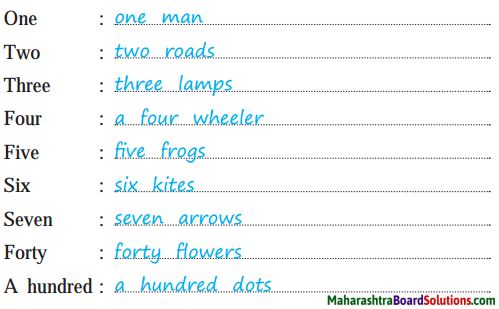
Std 9 English Poem Intellectual Rubbish 4.3 Question Answer Maharashtra Board

Class 9 English Chapter 4.3 Question Answer Maharashtra Board

Balbharti Maharashtra State Board Class 9 English Solutions Kumarbharati Chapter 4.3 Intellectual Rubbish Notes, Textbook Exercise Important Questions and Answers.

Intellectual Rubbish 9th Std Question Answer

English Kumarbharati 9th Solutions Chapter 4.3 Intellectual Rubbish Textbook Questions and Answers

Warming Up:

1. How will you react in the following situations?

Question (a)
Your Science teacher tells you plants exposed to the sunlight grow faster than those always in the shade.
………………………………………………………………………………
………………………………………………………………………………
………………………………………………………………………………
Answer:
Points: change the location of your plants – disbelieve her, try some experiments, etc.

Question (b)
Your aunt tells you not to go for a job interview because it’s a no moon day, that very same day.
………………………………………………………………………………
………………………………………………………………………………
………………………………………………………………………………
Answer:
Points: you ignore her words – you listen to her words – you ask for proof etc.

Question (c)
Your friend argues with you that Mount Everest is not the highest peak in the world.
………………………………………………………………………………
………………………………………………………………………………
………………………………………………………………………………
Answer:
Points: you pity his ignorance – you believe him – you look up the internet to check, etc.

Question (d)
A stranger at your door claims to be a magician and promises your mother to turn all her silver jewellery into gold.
………………………………………………………………………………
………………………………………………………………………………
………………………………………………………………………………
Answer:
Points: you slam the door – you call the police – you try to trick him, you give the gold, etc.

Maharashtra Board Class 9 English Kumarbharati Solutions Chapter 4.3 Intellectual Rubbish

2. What do you notice about the following pairs of words?

Question (a)
What do you notice about the following pairs of words?

  1. act naturally
  2. liquid gas
  3. open secret
  4. sound of silence
  5. sweet sorrow
  6. original copy
  7. only choice
  8. growing smaller

Answer:
They are all contrasting pairs of words used together. Such contrasting pairs of words that go together are called Oxymorons.

Now try to add a contradictory word (Oxymoron) to the following:

Question (a)
What a ……………… mess you’ve got us into!
Answer:
What a wonderful mess you’ve got us into!

Question (b)
It’s a …………… imitation of a diamond necklace.
Answer:
It’s a genuine imitation of a diamond necklace.

Question (c)
My trip to Matheran was a …………. holiday.
Answer:
My trip to Matheran was a working holiday.

Question (d)
With such heavy makeup, she looks ……………. ugly.
Answer:
With such heavy make-up, she looks pretty ugly.

Maharashtra Board Class 9 English Kumarbharati Solutions Chapter 4.3 Intellectual Rubbish

Question (e)
A ……………. crowd gathered to see the magic show.
Answer:
A tiny crowd gathered to see the magic show.

Note:- Contrasting words that go together are examples of the language device called Oxymoron.

English Workshop:

1. The following expressions are a combination of a noun preceded by a describing word.
Replace the describing words with as many others as you can, that go with the underlined nouns.
eg. silly mistake, grave mistake, careless mistake, obvious mistake etc.

Question (a)
fatal mistake
Answer:
silly mistake, grave mistake, careless mistake, obvious mistake.

Question (b)
foreign customs
Answer:
established customs, local customs, traditional customs, age-old customs.

Question (c)
unappetizing diet
Answer:
nutritious diet, healthy diet, unhealthy diet, strict diet, balanced diet, staple diet, vegetarian diet.

Question (d)
plentiful supply
Answer:
sufficient supply, regular supply, continuous supply, irregular supply.

Maharashtra Board Class 9 English Kumarbharati Solutions Chapter 4.3 Intellectual Rubbish

Question (e)
simple device
Answer:
complicated device, expensive device, helpful device, useless device, clever device, ingenious device, safety device.

Question (f)
savage controversy
Answer:
raging controversy, bitter controversy, unending controversy, fierce controversy.

Question (g)
modern technique
Answer:
new technique, conventional technique, advanced technique, simple technique.

Question (h)
foolish custom:
Answer:
quaint custom, ancient custom, Indian custom, accepted custom.

2. Use the following idioms/expressions in sentences of your own.

Question (a)
to be prone to …………………………………
Answer:
We are prone to infections during monsoon.

Question (b)
to have a difference of opinion ………………………
Answer:
If you have a difference of opinion with someone, you must settle it amicably.

Maharashtra Board Class 9 English Kumarbharati Solutions Chapter 4.3 Intellectual Rubbish

Question (c)
to go beyond …………………………….
Answer:
The fight between the two women was going beyond the limits of decent behaviour.

Question (d)
to have a beneficial effect ……………………………………
Answer:
Exercising regularly has a beneficial effect on the body.

Question (e)
to have a bias ………………………………
Answer:
We should not have a bias against foreign ideas.

Question (f)
to undo ……………………………………..
Answer:
“Do not undo all the good that I have done,” said the psychiatrist to the woman.

Question (g)
to be wary of ………………………………..
Answer:
One should be wary of schemes which promise to make one rich overnight.

Question (h)
under the influence ……………………………….
Answer:
He committed the crime when he was under the influence of alcohol.

3. Say ‘WHY’?

Question (a)
One should avoid getting angry about a difference of opinion.
Answer:
One should avoid getting angry about a ; difference of opinion because if one gets angry, it will show that one’s belief is going beyond what the evidence indicates or states.

Maharashtra Board Class 9 English Kumarbharati Solutions Chapter 4.3 Intellectual Rubbish

Question (b)
The writer found his stay abroad very profitable.
Answer:
The writer found his stay abroad very profitable because it helped him to become aware of foreign ideas and customs and diminish the intensity of his insular prejudice.

Question (c)
The writer grew less dogmatic and more open-minded.
Answer:
When the writer was young, he lived for some time outside his country. He became aware of foreign ideas and customs. This made him grow less dogmatic and more open-minded.

Question (d)
Men declaring that they are saints write letters to the writer.
Answer:
The writer is a renowned person. The men who declare themselves as saints want the writer to mention them in his lectures so that they get some free publicity. Hence they write letters to the writer.

Question (e)
The writer claims that all false beliefs need not be replaced by cold science.
Answer:
The writer claims that all false beliefs need not be replaced by cold science because if this is done, the world would lose some of its interest and variety.

4. Make sentences of your own to show the difference of usage of the following words:

Question (a)
1. device
2. devise
Answer:
1. Today, we make use of various devices to help us.
2. Mothers must devise ways of keeping their children out of mischief.

Maharashtra Board Class 9 English Kumarbharati Solutions Chapter 4.3 Intellectual Rubbish

Question (b)
Make sentences of your own to show the difference of usage of the following homophones :
1. advice
2. advise
Answer:
1. It is very easy to give advice but difficult to follow it.
2. The teacher advised the girl not to waste time.

Question (c)
Make sentences of your own to show the difference of usage of the following homophones:
1. practice
2. practise
Answer:
1. Dowry is an evil practice prevalent in India.
2. I have to practise every day if I want to win the dance competition.

5. When a family member is very ill for long, the grandmother of the family urges everyone to send for a person who claims he can cure victims of black magic. Compose a dialogue with her, in which her granddaughter politely convinces her that she should not believe in such things.

Question 1.
When a family member is very ill for long, the grandmother of the family urges everyone to send for a person who claims he can cure victims of black magic. Compose a dialogue with her, in which her granddaughter politely convinces her that she should not believe in such things.
Answer:

  • Grandmother: What a situation! Now that you have tried all your fancy modern medicines, listen to me. Call Cureybaba.
  • Granddaughter: Who is he? Never heard of him.
  • Grandmother: I am certain that your mother is the victim of black magic. Cureybaba will cure her. You saw him at our neighbour’s house a few days back. He is bald and …
  • Granddaughter: Grandma, for Heavens Sake! Mom was ill, no doubt, but her illness has been diagnosed and it is easily curable! There are plenty of medicines in the market.
  • Grandmother: She’s been ill for so long now! Granddaughter: Oh, Grandma, only for two months! The diagnosis took long.
  • Grandmother: Cureybaba will cure her in one sitting.
  • Granddaughter: Listen, Granny dear, these people are all frauds. If your Cureybaba was so good, why doesn’t he get some hair on his head – we know he wears a wig – or cure his horrible cough? Why doesn’t he cure his own mother who is so ill? And has he cured that poor little girl next door? No, he hasn’t. He’s a fraud, Granny.
  • Grandmother: But … but, ……….
  • Granddaughter: Granny, there’s no such thing as black magic. You know that full well. You have seen enough of these ‘babas’ being exposed. Then why ………….
  • Grandmother: Oh, OK. If you say your mother’s 5 illness can be cured by modern medicines easily, I will forget Cureybaba and black magic. Now that I come to think of it, our other neighbour was telling me how he cheated somebody the other day ……….
  • Granddaughter: There you are, Granny!

Maharashtra Board Class 9 English Kumarbharati Solutions Chapter 4.3 Intellectual Rubbish

6. List the various ways of avoiding error 1 mentioned in the passage.

Question 1.
List the various ways of avoiding error 1 mentioned in the passage.
Answer:
The various ways of avoiding error are:

  1. make observations yourself
  2. make yourself aware of your bias
  3. be on your guard when you find yourself getting angry about a difference of opinion.

7. Answer the following questions:

Question (a)
If an opinion contrary to your own makes you angry, what does it indicate?
Answer:
If an opinion contrary to my own makes me angry, it indicates that I am subconsciously aware of having no good reason for thinking as I do.

Question (b)
What are the most savage controversies about?
Answer:
The most savage controversies are about ! those matters as to which there is no good evidence either way.

Question (c)
What are the benefits of travel?
Answer:
Travelling helps you to become aware of foreign ideas and customs. You begin to accept them and get rid of your own narrow outlook.

Question (d)
Is the influence of foreign customs always beneficial?
Answer:
No, not always. Very often, the influence of foreign customs can be harmful and we must be cautious while following them.

Maharashtra Board Class 9 English Kumarbharati Solutions Chapter 4.3 Intellectual Rubbish

Question (e)
What are the advantages of an imaginary argument with a person having a different bias?
Answer:
The advantage of an imaginary argument with a person having a different bias is that it is not subject to the limitations of time and space. One can have this argument at any time and at any place.

Question (f)
Why should one be wary of opinions that flatter one’s self-esteem?
Answer:
One should be wary of opinions that flatter one’s self-esteem because there may be opinions with abundant evidence to prove the exact opposite to what one believes.

Question (g)
How does fear lead us to error?
Answer:
Fear leads us to error by making us do things like inventing rumours of disaster in wartime, imagining objects of terror, such as ghosts, or by creating belief in something comforting, like the elixir of life, or heaven for ourselves and hell for our enemies.

Question (h)
Write down the way of avoiding error mentioned in the passage.
Answer:
The way of avoiding error mentioned in the passage is to try to conquer fear.

Maharashtra Board Class 9 English Kumarbharati Solutions Chapter 4.3 Intellectual Rubbish

8. What is the meaning of ‘intellectual rubbish’?

Question 1.
What is the meaning of ‘intellectual rubbish’?
Answer:
This is an oxymoron, where the writer has used contrasting or contradictory words that go together. The writer uses the phrase to describe all false beliefs, baseless opinions, dogmatism, fears and superstitions of various kinds. People follow certain beliefs, ideas and customs without inquiring into their validity. Sometimes, many of these beliefs and customs lead to evil and suffering in the world.

9. Find the opposites of the following:

Question 1.
Find the opposites of the following:

  1. cautious
  2. dogmatic
  3. contrary
  4. savage
  5. beneficial
  6. reasonable
  7. hypothetical
  8. cruelty
  9. immune

Answer:

  1. cautious × reckless (incautious)
  2. dogmatic × open-minded
  3. contrary × same
  4. savage × mild
  5. reasonable × unreasonable
  6. hypothetical × real
  7. beneficial × harmful
  8. cruelty × kindness/compassion
  9. immune × vulnerable

Maharashtra Board Class 9 English Kumarbharati Solutions Chapter 4.3 Intellectual Rubbish

10. Write an imaginary dialogue contesting opposite views on a topic of your choice, e.g. ‘Girls should learn to do all the housework and not boys.’

Question 1.
Write an imaginary dialogue contesting opposite views on a topic of your choice, e.g. ‘Girls should learn to do all the housework and not boys.’
Answer:

  • Topic: Girls should learn to do all the housework and not boys
  • Myself: Mom, what is this? Why should I learn to do the housework, and not Rohan?
  • Mom: You are a girl. Girls have to look after the ! house.
  • Myself: Why? Don’t boys live in a house?
  • Mom: A woman can look after a home better than a man.
  • Myself: That’s ancient history, Mom! Haven’t you heard of something called gender equality?
  • Mom: These new-fangled notions of yours!
  • Myself: And these notions of only girls having to do housework are all man-made. Look at the west – men and women both do housework. (… and so on. Students can complete this imaginary dialogue.)

(Some topics for imaginary dialogues: should school students be permitted to bring cell phones to school/should coaching classes be banned/should the weight of school bags be monitored/should there be entrance exams for professional courses/should i there be uniforms in schools and colleges.)

English Kumarbharati 9th Digest Chapter 4.3 Intellectual Rubbish Additional Important Questions and Answers

Simple Factual Activity:

Question 1.
Complete the following statements:
Answer:

  1. Thinking that you know when in fact you don’t is a fatal mistake.
  2. If the matter is one that can be settled by observation, you must make the observation yourself.
  3. Many matters are less easily brought to the test of experience.
  4. Most of mankind has passionate convictions on many matters.

Maharashtra Board Class 9 English Kumarbharati Solutions Chapter 4.3 Intellectual Rubbish

Complex Factual Activities:

Question 1.
What erroneous notion did Aristotle have? What does his example convey to you?
Answer:
Aristotle had the erroneous notion that women had fewer teeth than men, when in fact he didn’t verily it. His example conveys to us that we must be cautious. We must not think that we know something for sure till we make the observation ourselves.

Activities based on Contextual Grammar:

Question 1.
Underline the pronouns in the following sentence:
I believe myself that hedgehogs eat black beetles, because I have been told that they do.
Answer:
I believe myself that hedgehogs eat black beetles, because I have been told that they do.

Question 2.
Rewrite the sentence replacing the gerund with an infinitive:
Thinking that you know when in fact you don’t is a fatal mistake.
Answer:
To think that you know when in fact you don’t is a fatal mistake.

Personal Response:

1. What do you feel when:

Question (a)
Someone opposes your strong belief.
Answer:
I generally get angry but later on I think about it and try to analyse the whole issue.

Maharashtra Board Class 9 English Kumarbharati Solutions Chapter 4.3 Intellectual Rubbish

Question (b)
Someone insists that 2 + 2 = 5.
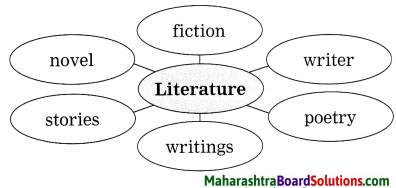
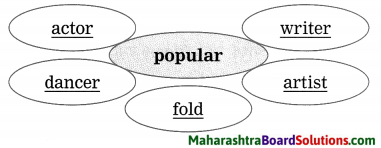
Answer:
I merely laugh at him/her or feel pity at his/her ignorance.

Simple Factual Activity:

Question 1.
Write if the following statements are True or False:
Answer:

  1. The writer lived in many countries in his youth – True
  2. It was a Chinese custom for the women to have small feet – True
  3. The Manchus followed the Chinese custom – True
  4. Travelling increases the intensity of insular prejudice – False

Complex Factual Activities:

Question 1.
How can you prevent yourself from developing a dogmatic attitude?
Answer:
You can prevent yourself from developing a dogmatic attitude by becoming aware of opinions held in social circles different from your own.

Maharashtra Board Class 9 English Kumarbharati Solutions Chapter 4.3 Intellectual Rubbish

Question 2.
List the various ways of avoiding error mentioned in the passage.
Answer:
The various ways of avoiding error are:
1. become aware of opinions held in social circles different from your own
2. travel, and if you cannot, seek out people with whom you disagree and talk to them.

2. Use the following idioms/expressions in a sentence of your own.

Question 1.
to become aware of:
Answer:
I became aware of the bear only when it growled loudly.

Question 2.
Find the opposites of the following :
1. diminishing
Answer:
1. diminishing × increasing

Activities based on Contextual Grammar:

Question 1.
Replace the gerund in the following sentence with an infinitive:
It is a good way of ridding yourself of certain kinds of dogmatism.
Answer:
It is a good way to rid yourself of certain kinds of dogmatism.

Maharashtra Board Class 9 English Kumarbharati Solutions Chapter 4.3 Intellectual Rubbish

Question 2.
Frame a Wh-question to get the underlined part as the answer:
This reflection should generate a certain caution.
Answer:
What should generate a certain caution?

Personal Response:

Question 1.
Do you think that traveling helps us to become more tolerant and understanding?
Answer:
Yes, it certainly does. It shows us the way different people live, their ideas and customs, the difficulties they face and the way they solve these difficulties. It gives us a much broader view of life.

Simple Factual Activity:

Question 1.
Complete the following web:
Answer:
Maharashtra Board Class 9 English Kumarbharati Solutions Chapter 4.3 Intellectual Rubbish

Complex Factual Activities:

Question 1.
Write down the way of avoiding error mentioned in the passage.
Answer:
The way of avoiding error mentioned in the passage is to have imaginary arguments with people having different bias.

Activities based on Vocabulary.

Question 1.
good plan
Answer:
cunning plan, thoughtful plan, well-made plan, secret plan, master plan, career plan.

Maharashtra Board Class 9 English Kumarbharati Solutions Chapter 4.3 Intellectual Rubbish

Activities based on Contextual Grammar:

Question 1.
It is a good plan to imagine an argument with a person having a different bias. (Rewrite the sentence beginning ‘Imagining
Answer:
Imagining an argument with a person having a different bias is a good plan.

Question 2.
You may never meet anyone who holds this opinion. (Rewrite the sentence as a simple sentence.)
Answer:
You may never meet anyone with/having this opinion.

Personal Response:

Question 1.
Have you ever had an imaginary argument with anyone?
Answer:
Yes. I often have an imaginary argument with my mother. In my imagination, she asks me why have got peor marks in some particular subject and I reply. Then she says something else and I counter that one as well. We argue. I Imagine what she well say and provide the answers.

Simple Factual Activity:

Question 1.
Fill in the blanks:
Answer:

  1. Be wary of opinions that flatter your self-esteem.
  2. We are all persuaded that our own nation is superior to all others.
  3. We try to show that the merits possessed b our nation are really important ones.
  4. We think that the demerits of our own country are comparatively trivial.

Maharashtra Board Class 9 English Kumarbharati Solutions Chapter 4.3 Intellectual Rubbish

Complex Factual Activities:

Question 1.
What two examples does the writer give to those who have opinions that flatter their self-esteem?
Answer:
The writer says that if a man points out that most poets and men of science are male, a woman can say that most criminals are also male. The second example he gives is that of general human conceit. For this, we need to remind ourselves that other parts of the cosmos may contain beings as superior to ourselves as we are to Jelly-fish.

Question 2.
What is the only way to tackle such self-pride?
Answer:
The only way to tackle such self-pride is to remind ourselves that man is a brief episode in the life of a small planet In a little corner of the universe, and that other parts of the cosmos may contain beings as superior to ourseLves as we are to Jelly-fish.

Question 3.
Why should one be wary of opinions that flatter one’s self-esteem?
Answer:
One should be wary of opinions that flatter one’s self-esteem because there may be opinions with abundant evidence lo prove the exact opposite to what one believes.

Question 4.
Write down the way of avoiding error mentioned in the passage.
Answer:
The way of avoiding error mentioned in the passage Is to be wary of opinions that hatter your self-esteem.

Use the following Idioms/expressions in sentences of your own….,

Question 1.
to deal with:
Answer:
The lawyer had to deal with a large number of court cases.

Maharashtra Board Class 9 English Kumarbharati Solutions Chapter 4.3 Intellectual Rubbish

Question 2.
Give the noun forms of the following:

  1. flatter
  2. abundant
  3. rational
  4. argue

Answer:

  1. flatter – flattery
  2. abundant – abundance
  3. rational – rationality
  4. argue – argument

Activity-based on Contextual Grammar:

Question 1.
Rewrite the following sentences adding question tags:
1. The question is inherently insoluble.
2. Self-esteem conceals this from most people.
Answer:
1. The question is inherently insoluble, isn’t it?
2. Self-esteem conceals this from most people, doesn’t it?

Maharashtra Board Class 9 English Kumarbharati Solutions Chapter 4.3 Intellectual Rubbish

Personal Response:

Question 1.
Do you think that there are living beings superior to man in other parts of the universe?
Answer:
Yes, I do. The universe is so huge. There is probably a whole lot of life elsewhere that is superior to us. There may also be a lot of life inferior to us, too. We should not make the mistake of thinking that ; we are the greatest.

Simple Factual Activity:

Question 1.
Write whether the following statements are Right or Wrong:
Answer:

  1. Fear has many forms. Right
  2. Fear operates directly and indirectly. Right
  3. You must never admit your own fears to yourself. Wrong
  4. We can become wise only when we conquer fear. Right

Complex Factual Activities:

Question 1.
What two evils does fear lead to? How can one overcome fear?
Ans.
Two evils that fear leads us to are superstition and cruelty. One can overcome fear by firstly admitting one’s own fears to oneself and then guarding oneself against their myth-making power.

Complex Factual Activities:

Question 1.
What two evils does fear lead to? How can one overcome fear?
Answer:
Two evils that fear leads us to are superstition and cruelty. One can overcome fear by firstly admitting one’s own fears to oneself and then guarding oneself against their myth-making power.

Maharashtra Board Class 9 English Kumarbharati Solutions Chapter 4.3 Intellectual Rubbish

Question 2.
How does fear lead us to error?
Answer:
Fear leads us to error by making us do things like inventing rumours of disaster in wartime, imagining objects of terror, such as ghosts, or by creating belief in something comforting, like the elixir of life, or heaven for ourselves and hell for our enemies.

Activity-based on Vocabulary:

Question 1.
Match the adjectives in Column A with the nouns in Column B:

AB
1. specific(a) effort
2. vague(b) terrors
3. difficult(c) beliefs
4. religious(d) fear

Answer:

  1. specific – terrors
  2. vague – fear
  3. difficult – effort
  4. religious – beliefs.

Activities based on Contextual Grammar:

Question 1.
Fear is the main source of superstition. (Rewrite beginning ‘It is ……………)
Answer:
It is fear that is the main source of superstition.

Maharashtra Board Class 9 English Kumarbharati Solutions Chapter 4.3 Intellectual Rubbish

Question 2.
Until you have admitted your own fears to yourself, you cannot hope to think about other matters. (Rewrite using ‘only when
Answer:
Only when you have admitted your own fears to yourself, can you hope to think about other matters.

Personal Response:

Question 1.
What are the things you are afraid of?
Answer:
I am generally afraid of things regarding my education. I am afraid that I will not do well in my j exams and not get a seat in the college of my choice. I am also afraid that I will be separated from my friends and will not be able to make new friends at a new place. I will be lost without friends.

Simple Factual Activity:

Question 1.
Fill in the blanks:
Answer:
1. Primitive magic has the purpose of securing safety either by injuring enemies or by protecting oneself by talismans, spells or incantations.
2. Neither a man nor a crowd nor a nation can be trusted to act humanely or to think sanely under the influence of a great fear.

Complex Factual Activities:

Question 1.
What is the aim of primitive magic?
Answer:
The aim of primitive magic is to secure safety, either by injuring enemies or by protecting oneself by talismans, spells or incantations.

Maharashtra Board Class 9 English Kumarbharati Solutions Chapter 4.3 Intellectual Rubbish

Question 2.
What are the two ways of avoiding fear?
Answer:
The two ways of avoiding fear are:
1. by persuading ourselves that we are immune from disaster and
2. by the practice of sheer courage.

Question 3.
Write down the way of avoiding error mentioned in the passage.
Answer:
The way of avoiding error mentioned in the passage is to avoid fear in various ways.

Activities based on Vocabulary:

Question 1.
Use the following idioms/expressions in sentences of your own.
1. at a certain point
Answer:
1. Rhea realised at a certain point during the argument that it was better to keep quiet.

Activities based on Contextual Grammar:

Question 1.
Poltroons are more prone to cruelty than brave men, and are also more prone to superstition.
(Rewrite using not only … but also…….)
Answer:
Poltroons are not only more prone to cruelty than brave men, but also more prone to superstition.

Maharashtra Board Class 9 English Kumarbharati Solutions Chapter 4.3 Intellectual Rubbish

Question 2.
Science has now lessened the belief in magic.
(Pick out the verb and state its tense.)
Answer:
has lessened – present perfect tense.

Personal Response:

Question 1.
How do you try to overcome your fears?
Answer:
I try to overcome my fears by telling my parents and friends about them and getting their advice and support. I also pray to God and this helps me the most.

Simple Factual Activity:

Question 1.
Write whether the following statements are True or False:
Answer:

  1. Superstitions sometimes add to the gaiety of life. True
  2. The writer used to give lectures. True
  3. The ‘prophetess’ walked on water successfully. False

Maharashtra Board Class 9 English Kumarbharati Solutions Chapter 4.3 Intellectual Rubbish

Complex Factual Activities:

Question 1.
How did the prophetess befool her believers?
Answer:
The prophetess announced to her numerous | followers that she possessed the power of walking on water, and that she proposed to do so at 11 o’clock on a certain morning. On that day, she asked them whether they were all convinced that she could walk on water. When they replied in the affirmative, she said that then there was no need for her to prove herself. Thus she fooled her believers.

Activity-based on Contextual Grammar:

Question 1.
Rewrite the following sentences as compound sentences:
1. Although I did not enroll myself among his worshippers, his letter gave me pleasure.
2. I received once a communication from the god Osiris, giving me his telephone number.
Answer:
1. I did not enroll myself among his worshippers but his letter gave me pleasure.
2. I received once a communication from the god Osiris and he gave me his telephone number.

Simple Activities:

Question 1.
Write two compound words from the lesson.
Answer:
steamboat, self-esteem

Question 2.
Make a meaningful sentence using the phrase ‘of great importance’.
Answer:
It is of great importance to understand the rules of the land.

Maharashtra Board Class 9 English Kumarbharati Solutions Chapter 4.3 Intellectual Rubbish

Question 3.
Spot the error and correct the sentence:
Fear have many forms – fear of death, fear of the dark, etc.
Answer:
Fear has many forms-fear of death, fear of the dark, etc.

Question 4.
Pick out a gerund from the given sentence:
You may never have an opportunity of meeting anyone who has this opinion.
Answer:
meeting – gerund

Question 5.
Identify the type of sentence:
Mahatma Gandhi deplored railways and steamboats.
Answer:
Assertive sentence

Question 6.
Find out two hidden words from the given word : hypothetical
Answer:
hypothetical – poetic, poetical (topic, topical).

Question 7.
Form the present and past participle of a verb in the lesson in which the last letter is doubled.
Answer:
admit-admitted, admitting

Maharashtra Board Class 9 English Kumarbharati Solutions Chapter 4.3 Intellectual Rubbish

Question 8.
Write the following words in alphabetical order:
dogmatism, dominion, deplored, device.
Answer:
deplored, device, dogmatism, dominion.

Medium-Level Activities:

Question 1.
Use the word ‘spell’ in two separate sentences, the word having different meanings (homographs).
Answer:
(a) “Be sure that you spell every word correctly,” said the teacher.
(b) The witch was angry and cast a spell over the princess.

Question 2.
She announced to her numerous followers that she possessed the power of walking on water.
(Rewrite using direct speech.)
Answer:
She announced to her numerous followers, “I possess the power of walking on water.”

Question 3.
The rational man will admit that there is no right answer.
(Use the future perfect tense of the verb.)
Answer:
The rational man will have admitted that there is no right answer.

Maharashtra Board Class 9 English Kumarbharati Solutions Chapter 4.3 Intellectual Rubbish

Question 4.
Science has now lessened the belief in magic.
(Change the voice beginning ‘The belief. ’.)
Answer:
The belief in magic has now been lessened by science.

Challenging Activities:

Question 1.
Although I did not enroll myself among his worshippers, his letter gave me pleasure. (Pick out the clauses and identify the type of sentence.)
Answer:
his letter gave me pleasure – main clause
Although I did not enroll myself among his worshippers – subordinate clause. Complex sentence

Question 2.
Use the two words ‘evidence’ and ‘opinion’ in a single sentence of your own.
Answer:
In the opinion of the judge, the evidence was false.

Maharashtra State Board Class 9 English Solutions

Kumarbharati 9th Std English Textbook Answers Unit 4

Std 9 English Poem The Necklace 1.5 Question Answer Maharashtra Board

Class 9 English Chapter 1.5 Question Answer Maharashtra Board

Balbharti Maharashtra State Board Class 9 English Solutions My English Coursebook Chapter 1.5 The Necklace Notes, Textbook Exercise Important Questions and Answers.

The Necklace Poem 9th Std Question Answer

My English Coursebook Std 9 Digest Chapter 1.5 The Necklace Textbook Questions and Answers

Warming up!

Chit-chat:

  • Do you like jewellery and ornaments?
  • Do you like to dress up for special occasions?
  • How do you do that?
  • What makes a person happy and confident’?
  • during special functions and parties?

Maharashtra Board Class 9 My English Coursebook Solutions Chapter 1.5 The Necklace

Talking about Myself:

Write a few lines about yourself – your name, appearance. family, the place where you live, your school, your friends. neighbours. relatives, your likes, dislikes, hobbies, what you are good at, etc.

Now create an imaginary ‘persona’ for yourself. It should be quite different from your real self. Or, you may choose a fictional character – a character from a novel, story, etc. Write a few lines about this imaginary persona and introduce yourself in that role.

Maharashtra Board Class 9 My English Coursebook Solutions Chapter 1.5 The Necklace 1

Imaginary Persona

  • Hi, I am Vishalbahu.
  • I like to obstruct and punish criminals.
  • I simply love stunts and fights.
  • I enjoy flying secretly all over the world.
  • I don’t like people who trouble common people.
  • I hate crimes and injustice caused to innocent people.
  • I find exercises, combats very interesting.
  • I can do any impossible things in the world.
  • I am good at every difficult or hard work.
  • I am not so good at office work and housework.

Maharashtra Board Class 9 My English Coursebook Solutions Chapter 1.5 The Necklace

A Turn by Turn Story:

Form groups of 6-8. One person chooses any familiar object and announces its name in the group. All the others talk about it one by one, adding one (new) complete sentence at a time. The person who has chosen the object takes down all the sentences. After 2-3 rounds, read the sentences together and try to build a story around them.

Part I

English Workshop:

1. Read each of the following sentences aloud. Write who said it and to whom.

Question 1.
(a) Look. here’s something for you.”
(b) “Why. the dress you go to the theater in!”
(c) ‘I would rather not go to the party.”
(d) ‘Choose, my dear.”
(e) You have nothing else?”
(f) “Would you lend me this, just this?”
(g) “What ! … How ! … That’s impossible!
Answer:
(b) Mathilde’s husband said to Mathilde.
(c) Mathilde said to her husband.
(d) Madame Forestier said this to Mathilde.
(e) Mathilde said this to Madame Forestier.
(f) Mathilde said this to Madame Forestier.
(g) Mathilde’s husband said this to Mathilde.

Maharashtra Board Class 9 My English Coursebook Solutions Chapter 1.5 The Necklace

2. Read the conversations in the story aloud using proper intonation.

Question 1.
Read the conversations in the story aloud using proper intonation.

3. Write a few lines about what Mathilde had and what she dreamt about.

Question 1.
Write a few lines about what Mathilde had and what she dreamt about.

4. Write what you think about the following thoughts and actions of Mathilde.

Question a.
Mathilde was beautiful, and so she wanted to marry an aristocrat.
Answer:
She was not wrong to think so, because I think every woman, beautiful or not, wants to marry a person, who has a good position and wealth.

Question b.
Mathilde was sad because she did not get any luxuries.
Answer:
Her thinking was not correct. Not every one gets a luxurious life. She should have managed in whatever they were earning and lived a simple but happy life.

Maharashtra Board Class 9 My English Coursebook Solutions Chapter 1.5 The Necklace

Question c.
Mathilde felt that her house was shabby and poorly furnished.
Answer:
Her feelings are wrong because it depends on the people who live in the house to keep the house clean, tidy and beautiful with whatever furniture, things they have got.

Question d.
Mathilde wanted other people to envy her.
Answer:
Mathilde’s thought was wrong because happiness does not depend on making the people envy you. She wished that people would have admired her if she had rich dresses and jewels.

Question e.
Mathilde was not happy to see the invitation.
Answer:
Mathilde did not care about the importance of the invitation, her husband had received. She was thinking only about the dress she would wear there.

Question f.
Mathilde wanted a new dress for herself.
Answer:
Mathilde wanted a new dress for herself only to selfishly corner her husband for extorting money from him to buy a new dress. Her thought was silly and unreasonable.

Maharashtra Board Class 9 My English Coursebook Solutions Chapter 1.5 The Necklace

Question g.
Mathilde borrowed a diamond necklace from her friend and wore it to the party.
Answer:
Borrowing a diamond necklace was not a dire need of Mathilde. She could have used flowers instead; but she wanted another woman’s necklace to make a show of her beauty. She did not understand that borrowing is begging.

Question h.
Mathilde lost her necklace.
Answer:
Mathilde was so overwhelmed and captivated by her success that she was not aware of her responsibility of safe-keeping the borrowed necklace carefully. She lost it only because of her carelessness.

Maharashtra Board Class 9 My English Coursebook Solutions Chapter 1.5 The Necklace

5. Prepare a formal invitation using the following format:

Maharashtra Board Class 9 My English Coursebook Solutions Chapter 1.5 The Necklace 2
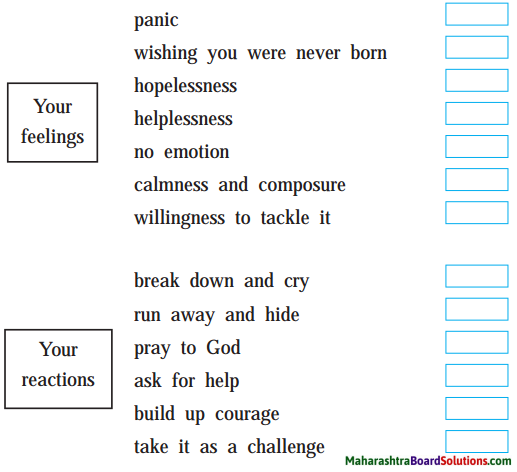
Language Study:

6. Read the phrases: The necklace, an error, all these things, another woman, one evening, her husband. In all these phrases we see some words used before the nouns. They specify or make it clear what noun we are talking about. These words that are used at the beginning of a noun phrase are known as determiners.
Determiners include articles (a, an, the), possessive pronouns (my, our, your, her, etc.), words like this, that, much, many, all, and numbers.

Part II

Chit-chat:

  • Have you ever lost anything valuable?
  • Name a book/movie that made you think.
  • What was it about?
  • What was the best part about the book/movie?

Maharashtra Board Class 9 My English Coursebook Solutions Chapter 1.5 The Necklace

English Workshop:

1. Spot and circle the error m the following sentences. Then rewrite the sentences after correcting them.

Question 1.
Spot and circle the error m the following sentences. Then rewrite the sentences after correcting them.
(a) But they could not found it.
(b) You must right to your friend.
(c) At the end of one week, they have lose all hope.
(d) He would borrowed the rest.
(e) You should have return it sooner.
(f) And this life lasted for ten year.
(g) “No, I am Mathilde bisel.”
(h) Madame Forestier were stunned.
Answer:
(a) But they could not find it.
(b) You must write to your friend.
(c) At the end of one week, they have lost all hope.
(d) They stared at each other
(e) He would borrow the rest.
(f) You should have returned it sooner.
(g) And this life lasted ten years.
(h) “No, I am Mathilde Loisel.”
(i) Madame Forestier was stunned.

Maharashtra Board Class 9 My English Coursebook Solutions Chapter 1.5 The Necklace

2. Complete the following table.

Maharashtra Board Class 9 My English Coursebook Solutions Chapter 1.5 The Necklace 3
Question 1.
Complete the following table.
Maharashtra Board Class 9 My English Coursebook Solutions Chapter 1.5 The Necklace 4
Maharashtra Board Class 9 My English Coursebook Solutions Chapter 1.5 The Necklace 5

3. Write what you think about the following thoughts and actions of Mathilde

Question a.
Mathilde was shocked despaired over the loss of her necklace
Answer:
I think her reaction to the loss of her necklace was natural. But she herself was responsible for the tragedy. Her stubborn behaviour is to be blamed for the loss.

Question b.
Mathilde wrote a note to her friend as dictated by her husband.
Answer:
The couple couldn’t find the lost necklace even after a long search. They expected to find it some day. For that they needed some more time and Mathilde was compelled to write the false letter to I her friend. Her action of telling lies and betraying her friend was immoral and ridiculous.

Question c.
Mathilde and her husband decided to replace the necklace.
Answer:
I think that their decision of replacing the necklace was immature and insincere. Instead, they should have clearly and openly told Madame Forestier about the incident. It could have saved them from the horrible life they had to face and the dreadful debt they had to pay.

Maharashtra Board Class 9 My English Coursebook Solutions Chapter 1.5 The Necklace

Question d.
Mathilde returned the diamond necklace to her friend
Answer:
I think, it was her moral responsibility to return the borrowed diamond necklace immediately after the party day but she delayed. She did so to hide the fact that she had lost the diamond necklace. Her negligence made her to make one more wrong.

Question e.
Mathilde did not tell her friend about the loss and replacement.
Answer:
It was another big mistake she committed. It was her thoughtless action. Had she told her friend about the loss of the necklace, further ruinous incidents wouldn’t have occurred and the remedy for the problem would have been very simple and easy.

Question f.
Mathilde worked very very hard to pay the debt.
Answer:
Mathilde’s action shows that she was a completely transformed woman. She had changed her attitude towards her lifestyle. She forgot her dreams of living a luxurious life. She worked hard and saved money for repaying the debt. She felt duty-bound for coming out of the devastating situation, she was responsible for.

Maharashtra Board Class 9 My English Coursebook Solutions Chapter 1.5 The Necklace

Question g.
Mathilde and her husband paid off the debt in ten years.
Answer:
The income of Mathilde’s husband was meagre. So both of them worked very hard for ten long years to save money for repaying the debt. They curtailed their needs severely, her husband worked extra to ease the burden of debt. Somehow they faced the woes together bravely and sincerely.

4. Form pairs. Discuss how ‘Part II’ of the story could have been different. Write your storyline in the form of bullets showing the main events.

Question 1.
Form pairs. Discuss how ‘Part II’ of the story could have been different. Write your storyline in the form of bullets showing the main events.
Answer:
The cabman, who dropped them at their door found the necklace after two days while cleaning his cab → behind the space of the seats → fallen from the gaps of the seats → remembered the lady wearing the necklace → was an honest and God-fearing man → went to their house →handed over the necklace to them → it could have changed the whole story.

Maharashtra Board Class 9 My English Coursebook Solutions Chapter 1.5 The Necklace

5. Imagine what must have happened after Mathilde’s friend discovered that the diamonds were real. Do you think she would return it to Mathilde? Would that make Mathilde happy?

Question 1.
Imagine what must have happened after Mathilde’s friend discovered that the diamonds were real. Do you think she would return it to Mathilde? Would that make Mathilde happy?
Answer:
Mathilde’s friend was rich but a kind-hearted and generous woman. She knew that Mathilde had to face many miseries for ten years. I think she would return the necklace to Mathilde. Mathilde would be happy to find some relief after ruinous sufferings.

6. Discuss the following and write about it in your own words in 5-6 lines.

Question 1.
Discuss the following and write about it in your own words in 5-6 lines.
(a) What would you do, if something like this happens to you?
(b) What opinion do you form about Mathilde’s husband from lier story?
(c) Which events in the story (Part I and Part II) changed Mathilde’s life?
Answer:
(Use the following points to write your answers.)
(a) Points:

  • would go to friend and explain-
  • would ask for time to return the money for the necklace –
  • since friend rich, she may have accepted the idea.)

(b) Points:

  • Husband
  • good – kind – supportive
  • considerate – a very nice human being.

(c) Points :

  • Invitation to party – borrowing the necklace
  • losing the necklace – returning the necklace by borrowing money

Maharashtra Board Class 9 My English Coursebook Solutions Chapter 1.5 The Necklace

Language study:

7. Read the table of verb forms given below.

Question 1.
Read the table of verb forms given below.
Maharashtra Board Class 9 My English Coursebook Solutions Chapter 1.5 The Necklace 6

The base form is used as an infInitive: You may go. She will go.
in orders: Go home. and in the simple present tense: I go to school. We go
home. Do you go there every day? The children/They go up, etc.
Note that we use the ‘-s form’ with ‘he’, ‘she’, ‘it’, third-person singular subjects to show the simple present.
The past tense form has ‘-ed’ at the end. But many commonly used verbs have different past tense forms. Examples: Came, went, spoke.
. The ‘-ing’ form is known as the present participle. It is used with forms of ‘be’ to show continuous action – Examples: I am eating. You were eating. She was eating.
It is also used in certain constructions like He sat copying a manuscript.

The past participle used with forms of ‘have’ shows completed action – Examples: I have eaten. They have come, etc.
It is also used in certain constructions like ‘They looked at each other, stunned!’
It is also used in passive constructions. We will learn about ‘passive voice’ later.

Make a table of verb forms for your own reference. Try to arrange the verbs in alphabetical order. Keep adding new verbs to your table from time to time. When you write, check your work to see whether you have used the correct verb form.

Question 1.
Read the different following information about different forms of verbs:
Answer:
1. The base form is used as an infinitive: You may go. She will go.
In orders: Go home. And in simple present tense: I go to school. We go home. Do you go there every day? The children/They go up, etc.

2. Note that we use the e-s form’ with ‘he’, ‘she’, ‘it’, third person singular subjects to show
the simple present.

3. The past tense form has ‘-ed’ at the end. But many commonly used verbs have different past tense forms. Examples: came, went, spoke.

4. The ‘-ing’ form is known as the present participle. It is used with forms of ‘be’ to show continuous action – Examples: I am eating. You were eating. She was eating. It is also used in certain constructions like : He sat copying a manuscript.

5. The past participle used with forms of ‘have’ shows completed action.
Examples: I have eaten. They have come, etc.
It is also used in certain constructions like ‘They looked at each other, stunned!’

Maharashtra Board Class 9 My English Coursebook Solutions Chapter 1.5 The Necklace

My English Coursebook 9th Class Solutions Chapter 1.5 The Necklace Additional Important Questions and Answers

Read the following passage and do the activities :

Simple Factual Activities :

Question 1.
Say whether the following statements are True or False :
Answer:

  1. Mathilde was married to a big officer at the Ministry of Education. – False
  2. Mathilde’s former schoolmate was very rich. – True
  3. Mathilde had rich dresses, jewels and everything that she loved. – False
  4. Mathilde was happy with the invitation brought by her husband – False

Question 2.
Who said to whom? Complete the table :
(Answers are directly given.)
Answer:

DialogueWho saidTo whom
1. “Here’s something for you.”Mathilde’s husbandMathilde
2. “What do you want me to do with that?”MathildeMathilde’s husband

Question 3.
What did the envelope hold?
Answer:
The envelope held an invitation from the Minister of Education and Mme. Georges Rampouneau to Mr and Mrs. Loisel.

Maharashtra Board Class 9 My English Coursebook Solutions Chapter 1.5 The Necklace

Question 4.
State whether the following statements ) are True or False :
Answer:

  1. Mathilde’s husband suggested her to wear the dress she wore when she went to the theatre. – True
  2. Mathilde was upset for three days because she had no good dress to wear. – False
  3. Mathilde was ready to wear flowers. – False
  4. She demanded four hundred francs for her dress. – True

Question 5.
Write who said it and to whom :
“But I don’t know what you like.”
Answer:
Madame Forestier said this to Mathilde.

Question 6.
Choose the correct option from the brackets and complete the sentences :
(Answers are directly given.)
Answer:

  1. Mathilde went to Madame Forestier. (The jeweller/Madame Forestier)
  2. Madame Forestier took out a large box from her mirrored wardrobe. (large box/necklace)
  3. Mathilde tried on the jewellery in the mirror. (dress/jewellery)
  4. Mathilde discovered a diamond necklace in Madame Forestier’s large box. (a black satin box/a diamond necklace)

Question 7.
What did Madame Forestier’s large box contain?
Answer:
Madame Forestier’s large box contained bracelets, necklaces and other jewellery.

Maharashtra Board Class 9 My English Coursebook Solutions Chapter 1.5 The Necklace

Question 8.
Complete the following sentences using the information given in the passage:
(Answers are directly given.)
Answer:

  1. Mathilde was floating in a cloud of happiness.
  2. Both, husband and wife left at about four o’clock in the morning.
  3. In front of the mirror Mathilde took a final look at herself in all her glory.
  4. She no longer had the necklace round her neck.

Question 9.
Who said it and to whom :

Question a.
“I no longer have Madame Forestier’s necklace.”
Answer:
Mathilde said this to her husband.

Question 10.
Complete the following sentences with the information given in the passage :
(Answers are directly given.)
Answer:

  1. She remained in her ball dress all night, her mind blank.
  2. At the end of one week they had lost all hope.
  3. The husband and wife were sick with grief and anguish.
  4. Mr. Loisel said, “We must consider how to replace the jewel.

Question 11.
Who said this to whom :
1. “I might have needed it.”
2. “Don’t sell it for three days.”
Answer:
1. Madame Forestier said this to Mathilde.
2. Mr. Loisel and Mathilde said to the jeweler.

Maharashtra Board Class 9 My English Coursebook Solutions Chapter 1.5 The Necklace

Question 12.
Say if the following statements are True or False:
(Answers are directly given.)
Answer:

  1. Madame Forestier was rather angry with Mathilde for returning the necklace late. – True
  2. A string of diamonds they found at Palais Royal was worth thirty-six thousand francs. – False
  3. The new necklace cost them thirty- four thousand francs. – False
  4. Mr Loisel borrowed money from every type of money-lender. – True

Question 13.
Complete the sentences using the information from the passage :
(Answers are directly given.)
Answer:

  1. At the end of ten years, they had paid off everything.
  2. How little is needed for one to be ruined or saved!
  3. Mathilde played her part heroically.
  4. She came to know the drudgery of housework.

Question 14.
Answer the following questions :

Question a.
Who is Madame Loisel?
Answer:
Madame Loisel is Mathilde.

Question b.
What work did Mathilde’s husband do for a tradesman?
Answer:
Mathilde’s husband did accounts for a tradesman.

Maharashtra Board Class 9 My English Coursebook Solutions Chapter 1.5 The Necklace

Question 15.
Say whether the following statements are True or False:
(Answers are directly given.)
Answer:

  1. Madame Forestier recognised her dear friend immediately. _ False
  2. Madame Forestier still looked young, beautiful and charming. – True
  3. It had taken them ten years to pay for the imitation diamond neclace. – True
  4. The imitation was not worth five hundred francs at most! – False

Complex Factual Activities :

Question 1.
Complete the following :
(Answers are directly given.)
Answer:
Maharashtra Board Class 9 My English Coursebook Solutions Chapter 1.5 The Necklace 7

Question 2.
Why was Mathilde married to a minor official’?
Answer:
Mathilde was a pretty, charming girl but was born in a family of clerks. This had decided her future. Because of her ill-fate she had to marry a ‘minor official’.

Question 3.
Why did Mathilde weep with misery after visiting her schoolmate?
Answer:
Mathilde wept with misery after visiting her schoolmate because she couldn’t get the riches and the luxurious life in which the schoolmate was relishing. She dreamt of all those things her friend was enjoying. She herself could not have them because of her destiny.

Question 4.
Mathilde was sad, restless and anxious though her dress was ready because ….
Answer:
Mathilde was sad, restless and anxious though her dress was ready because she had no jewels, she had not a single precious stone to wear. She almost had decided not to go to the party.

Maharashtra Board Class 9 My English Coursebook Solutions Chapter 1.5 The Necklace

Question 5.
Mathilde’s husband turned pale because….
Answer:
Mathilde’s husband turned pale because he had been saving the exact amount demanded by Mathilde to buy a gun for a hunting summer, in the country near Nanterre. He would lose his opportunity for buying dress for Mathilde.

Question 6.
Write the following sentences in order of their occurrence :
1. Her friend put a large box of jewellery before Mathilde.
2. She fled home with her treasure.
3. Mathilde went to Madame Forestier.
4. She discovered a diamond necklace.
Answer:
3. Mathilde went to Madame Forestier.
1. Her friend put a large box of jewellery before Mathilde.
4. She discovered a diamond necklace.
2. She fled home with her treasure.

Question 7.
Which sentences tell us that Mathilde greatly desired the necklace?
Answer:
The Sentences: Her heart began to beat with uncontrolled desire. Her hands trembled as she took it. She stood lost in ecstasy as she looked at herself in the mirror. She asked her friend anxiously, “Would you lend me this, just this?”

Maharashtra Board Class 9 My English Coursebook Solutions Chapter 1.5 The Necklace

Question 8.
Complete the web :
Answer:
Maharashtra Board Class 9 My English Coursebook Solutions Chapter 1.5 The Necklace 12

Question 9.
Describe the efforts made by the couple to find the lost necklace:
Answer:
They looked in the folds of Mathilde’s dress, in the folds of her cloak, in her pockets, everywhere. Mr. Loisel walked over the whole route they had walked to find the necklace. He went to the police station, to the newspapers to offer a reward, to the cab companies and everywhere they expected to find the necklace but found nothing.

Question 10.
Complete the web
(Answers are directly given.)
Answer:
Maharashtra Board Class 9 My English Coursebook Solutions Chapter 1.5 The Necklace 14

Question 11.
How did life of Mathilde change after the horrible incident?
Answer:
Mathilde’s life was completely changed. She dismissed her maid and did extremely unpleasant labours in the kitchen. She washed the dishes, the dirty linen, she carried the garbage down to the street every morning, carried up the water and dressed like a common woman. She had to bargain at markets, quarrel and face insults over every miserable sou. She lived the horrible life of the very poor.

Maharashtra Board Class 9 My English Coursebook Solutions Chapter 1.5 The Necklace

Question 12.
Arrange the following sentences in order of their occurence:
1. Mathilde tells Madame Forestier about her hard time and miseries.
2. Madame Forestier tells that the necklace was an imitation.
3. Madame Forestier did not recognise Mathilde because she was completely changed.
4. Mathilde met Madame Forestier in the Champs Elysees on Sunday.
Answer:
4. Mathilde met Madame Forestier in the Champs Elysees on Sunday.
3. Madame Forestier did not recognise Mathilde because she was completely changed.
1. Mathilde tells Madame Forestier about her hard time and miseries.
2. Madame Forestier tells that the necklace was an imitation.

Activities based on vocabulary:

Question 1.
Match the words in Column ‘A’ with their meaning in Column ‘B’ :

‘A’‘B’
1. aristocrat(a) destiny
2. fate(b) great success
3. shabby(c) nobleman
4. triumph(d) nearly worn out

Answer:

‘A’‘B’
1. aristocrat(c) nobleman
2. fate(a) destiny
3. shabby(d) nearly worn out
4. triumph(b) great success

Maharashtra Board Class 9 My English Coursebook Solutions Chapter 1.5 The Necklace

Question 2.
Write any four words from the passage that show the feeling of great pain:
Answer:
regret, despair, misery and tormented.

Question 3.
Write English terms that stand for the French terms Monsieur and Mme:
Answer:
Mr and Mrs.

Question 4.
Write the long forms of the following contracted forms:

  1. Let’s
  2. don’t
  3. hadn’t
  4. what’s.

Answer:

  1. Let us
  2. do not
  3. had not
  4. what is.

Question 5.
Write four words from the passage that reflect (show) that the person is in difficult situation.
Answer:
stammered, stunned, distressed, stuttered.

Maharashtra Board Class 9 My English Coursebook Solutions Chapter 1.5 The Necklace

Question 6.
Fill in the blanks with proper letters so as to find the words: (Answers are directly given.)
Answer:
1. the objects such as rings, necklaces, etc. that
Maharashtra Board Class 9 My English Coursebook Solutions Chapter 1.5 The Necklace 8

2. a large cupboard for hanging clothes.
Maharashtra Board Class 9 My English Coursebook Solutions Chapter 1.5 The Necklace 9

3. a piece of ornament consisting of chain of beads, diamonds, etc. worn around the neck =
Maharashtra Board Class 9 My English Coursebook Solutions Chapter 1.5 The Necklace 10

4. a strong wish to have something =
Maharashtra Board Class 9 My English Coursebook Solutions Chapter 1.5 The Necklace 11

Question 7.
Write any four adjectives from the passage.
Answer:
elegant, gracious, smiling, panic-stricken.

Question 8.
Write any four adverbs with ‘-ly’ from the passage.
Answer:
wildly, fmally, sadly, suddenly.

Question 9.
Which words from the passage are related with ‘success’?
Answer:
full of joy, triumph, cloud of happiness, glory.

Maharashtra Board Class 9 My English Coursebook Solutions Chapter 1.5 The Necklace

Question 10.
Write the meanings of:
(Answers are directly given.)
Answer:

  1. glimmer of hope: a small sign of hope/success.
  2. a hollow, pale figure: a person having empty mind and almost white face because of frustration and exhaustion.
  3. sick with grief and anguish: mentally ill because of great sadness and pain.
  4. cloak: ladies’ garment without sleeves, worn over their other clothes.

Question 11.
Find and write all the numbers mentioned in the passage :
Answer:
Forty thousand, thirty-six thousand, thirty- four thousand, eighteen thousand.

Question 12.
Write from passage the words related to money matters.
Answer:
worth, sell, borrow, notes, agreements, dealt, money-lender.

Maharashtra Board Class 9 My English Coursebook Solutions Chapter 1.5 The Necklace

Question 13.
Write from the passage the phrases related to ‘housework’.
Answer:
Drudgery of housework, odious labours of the kitchen, washing dishes, washing dirty linen, carry the garbage, carry up the water, bargain at markets.

Question 14.
Match from the passage the adjectives in Column ‘A’ with the nouns in Column ‘B’ :

‘A’‘B’
1. dreadful(a) sou
2. miserable(b) labours
3. horrible(c) debt
4. odious(d) life

Answer:

‘A’‘B’
1. dreadful(c) debt
2. miserable(a) sou
3. horrible(d) life
4. odious(b) labours

Maharashtra Board Class 9 My English Coursebook Solutions Chapter 1.5 The Necklace

Question 15.
Match the words in Column ‘A’ with their meaning in Column ‘B’ :

‘A’‘B’
1. familiarly(a) artificial/not real
2. astonished(b) in a friendly manner
3. imitation(c) very surprised
4. innocent(d) having not done anything wrong

Answer:

‘A’‘B’
1. familiarly(b) in a friendly manner
2. astonished(c) very surprised
3. imitation(a) artificial/not real
4. innocent(d) having not done anything wrong.

Maharashtra Board Class 9 My English Coursebook Solutions Chapter 1.5 The Necklace

Question 16.
Write from the passage the verbs that end : with ‘-ed’.
Answer:
astonished, addressed, stammered, uttered, changed, stunned, smiled, moved.

Activities based on contextual grammar :

Question 1.
Find and write the adjectives from the passage for the following nouns :

  1. house
  2. girl
  3. official
  4. mansion.

Answer:

  1. shabby and poorly furnished
  2. pretty and charming
  3. minor
  4. grand and palatial.

Question 2.
He turned a little pale.
(Change the sentence into simple present Tense.)
Answer:
He turns a little pale.

Maharashtra Board Class 9 My English Coursebook Solutions Chapter 1.5 The Necklace

Question 3.
Choose the correct option of the question tag:
I can give you four hundred francs.
(i) , can I?
(ii) , don’t I?
(iii) , can’t I?
(iv) , couldn’t I?
Answer:
I can give you four hundred francs, can’t I?

Question 4.
She replied,” I am upset that I have no jewels.” (Choose the correct option to transform it into Reported speech.)
a. She replied that I was upset that I had no jewels.
b. She replied that she is upset that she has no jewels.
c. She replied she was upset that she has no jewels.
d. She replied that she was upset that she had no jewels.
Answer:
c. She replied she was upset that she has no jewels.

Question 5.
Choose the correct wh-question from the alternatives to get the underlined part as an answer:
She discovered, in a black satin box, a diamond necklace.
(a) What did she discover in a black satin box?
(b) When did she discover a diamond necklace in a black satin box?
(c) Where did she discover a diamond necklace?
(d) Why did she discover a diamond necklace?
Answer:
(c) Where did she discover a diamond necklace?

Question 6.
Write the following sentence in simple present tense:
She threw her arms around her friend’s neck.
Answer:
She throws her arms around her friend’s neck.

Maharashtra Board Class 9 My English Coursebook Solutions Chapter 1.5 The Necklace

Question 7.
Find the determiners from the following sentences and underline them :
(Answers are directly underlined.)
Answer:
1. They were dropped off at their door in the Rue des Martyrs.
2. Forgetting everything in the triumph of her beauty.

Question 8.
Do as directed :

  1. She took a final look at herself. (Write simple present tense form for the underlined word.)
  2. The day of the party arrived. (Rewrite the sentence using simple future tense.)
  3. She danced wildly (Use past progressive tense and rewrite the sentence.)

Answer:

  1. She takes a final look at herself.
  2. The day of the party will arrive.
  3. She was dancing wildly.

Question 9.
It was worth forty thousand francs.
(Use ‘They’ in place of ‘It’ and rewrite the correct sentence.)
Answer:
They were worth forty thousand francs.

Maharashtra Board Class 9 My English Coursebook Solutions Chapter 1.5 The Necklace

Question 10.
He went to get the new necklace. (Rewrite the sentence using simple present tense for the underlined verb.)
Answer:
He goes to get the new necklace.

Question 11.
Change the following sentences in passive voice :
1. They dismissed their maid.
2. They rented a garret under the roof.
Answer:
1. Their maid was dismissed by them.
2. A garret under the roof was rented by them.

Question 12.
How strange life is!
(Make it an assertive sentence,)
Answer:
Life is very strange.

Maharashtra Board Class 9 My English Coursebook Solutions Chapter 1.5 The Necklace

Question 13.
Complete the table with the correct forms of the given verbs.
Answer:
Maharashtra Board Class 9 My English Coursebook Solutions Chapter 1.5 The Necklace 15

Do as directed :

Question 1.
1. She had no rich dresses : (Make the sentence affirmative without changing the meaning.)
2. These were the only things she loved. (Make the sentence negative without changing the meaning.)
Answer:
1. She had poor dresses.
2. She loved nothing but (except) these things.

Question 2.
They could not find it.
(Begin with It could not… and change the voice.)
Answer:
It could not be found by them.

Maharashtra Board Class 9 My English Coursebook Solutions Chapter 1.5 The Necklace

Question 3.
He said to Mathilde, “Tell her you have broken the clasp of the necklace.”
(Change into Indirect speech.)
Answer:
He told Mathilde to tell her she had broken the clasp of the necklace.

Question 4.
Use simple present tense form and rewrite the following sentences :

Question a.
He went to the police station.
Answer:
He goes to the police station.

Question b.
They lost all hope.
Answer:
They lose all hope.

Maharashtra Board Class 9 My English Coursebook Solutions Chapter 1.5 The Necklace

Question 5.
How you’ve changed!
(Make an assertive sentence.)
Answer:
You’ve completely changed,

Question 6.
They were similar.
(Make it negative without changing meaning.)
Answer:
They were not different.

Question 7.
I am Mathilde Loisel.
(Choose correct Question Tag,)
(i) , am I?
(ii) , amn’t I?
(iii) , aren’t I?
(iv) , don’t I?
Answer:
(iii) , aren’t I?

Maharashtra Board Class 9 My English Coursebook Solutions Chapter 1.5 The Necklace

Question 8.
Fill in the table with correct verb forms.
(Answers are directly given.)
Answer:

base formPast tensePast participle
bringbroughtbrought
seesawseen
feelfeltfelt
singsangsung

Personal Response:

Question 1.
What do you feel when you receive an invitation for a party? Why?
Answer:
When I receive an invitation for a party, I feel very happy because we get to meet our friends and relatives at the party and we can spend some time rejoicing. We also get to eat tasty food in the party.

Maharashtra Board Class 9 My English Coursebook Solutions Chapter 1.5 The Necklace

Question 2.
Was Mathilde’s husband a considerate person? How do you know that?
Answer:
Mathilde’s husband was really a very considerate person. Though his wife was obstinate and stubborn, he tried to fulfill all her unreasonable wishes. He sacrificed his own hunting joy and gave his savings to please Mathilde. This shows that he was a very considerate person.

Question 3.
Mathilde asked her friend, “Would you lend me this, just this?”
Why, do you think, did Mathilde say ‘just this’?
Answer:
I think, Mathilde was fully satisfied with the diamond necklace she got. It looked beautiful in her neck as she had desired. So she did not want anything else except that diamond necklace and so she insisted to lend her that and only that necklace.

Question 4.
Why, do you think, did Mathilde not notice the loss of her necklace?
Answer:
I think, she was thinking only about the triumph of her beauty and success in the party. She had lost her attention towards her necklace. Secondly, they left the party early in the morning, could not find a cab and had to walk for a long distance. This also must be the cause of the distraction.

Maharashtra Board Class 9 My English Coursebook Solutions Chapter 1.5 The Necklace

Question 5.
Do you think, the arrangement made by Mr Loisel with the jeweller, was fair? Give your reason:
Answer:
Yes I think the arrangement was fair. According to the arrangement the jeweller would take the necklace back for thirty-four thousand if the other (the lost) necklace was found before the end of February. It would help them to get some more time to find the necklace and again they would ; be losing only two thousand francs instead of thirty- 5 six thousand.

Question 6.
Why does Madame Forestier speak coldly to Mathilde?
Answer:
Mathilde returned the necklace after so many days. Madame Forestier did not like it and was angry with Mathilde. It is the usual tradition to return the borrowed things immediately after the work is done, but Mathilde did not do it. By speaking coldly Madame Forestier expresssed her anger and displeasure.

Question 7.
What is meant by the horrible life of the very poor?
Answer:
The horrible life of the poor means a very tiring, bad, unpleasant and painful life. The poor are the people who live a miserable life with very little or no money at all. They have no money to satisfy their day-to-day basic needs. They have to work hard all the day to make both ends meet. Mathilde experienced this horrible life of the poor for saving money to clear the debt.

Maharashtra Board Class 9 My English Coursebook Solutions Chapter 1.5 The Necklace

Question 8.
Write what you think about the following thought and action of Mathilde :
Mathilde told her friend about the lost necklace.
Answer:
Mathilde was now a relieved person. Though it was her fault, she must have thought that she should tell the truth to her friend and tell her how she struggled for ten long years that made her look old.

Question 9.
Who do you think was responsible for Mathilde’s misery? Was it her friend, she herself, her husband or the circumstances?
Answer:
It was Mathilde who was mainly responsible for her misery. Her wilfulness and obstinate behaviour were the root cause of the disastrous incident. She borrowed the necklace and lost it and that led to her misery. Her friend and her husband were, in no way, responsible for it. Of course the circumstances, to some extent too are responsible for it.

Oral Work:

Question 1.
Read the conversations in the story aloud using proper intonation.

Maharashtra Board Class 9 My English Coursebook Solutions Chapter 1.5 The Necklace

Writing Skill:

Question 1.
Prepare a formal invitation using the format given on the textbook page no. 27.
Answer:
Maharashtra Board Class 9 My English Coursebook Solutions Chapter 1.5 The Necklace 13

Activities Based on Language study

Do as directed!

Question 1.
Complete the words by using correct letters :

  1. o _ h e r
  2. y o _ n g
  3. p _ o u d
  4. s p e _ k

Answer:

  1. o t h e r
  2. y o u n g
  3. p r o u d
  4. s p e a k

Question 2.
Copy the following sentences correctly in your notebook :
Answer:
1. He said,” Here’s something for you!”
2. “What’s the matter? Let’s see, Mathilde.”

Maharashtra Board Class 9 My English Coursebook Solutions Chapter 1.5 The Necklace

Question 3.
Put the following words in alphabetical order:
1. glory, street, amount, pleasure.
2. mansion, mirror, mutter, matter.
Answer:
1. amount, glory, pleasure, street.
2. mansion, matter, mirror, mutter.

Question 4.
Punctuate the following sentences :
1. you could wear flowers he said they are very fashionable at this time of year
2. what is the matter asked her husband
Answer:
1. “You could wear flowers,” he said,
“They are very fashionable at this time of year.”
2. “What is the matter?” asked her husband.

Maharashtra Board Class 9 My English Coursebook Solutions Chapter 1.5 The Necklace

Question 5.
Write four small words (minimum letters each) using the letters in the given word:
‘schoolmate’ :
Answer:

  1. school
  2. come
  3. late
  4. home.

Question 7.
Write related words as shown in the example :
(Answers are directly given.)
Answer:
Maharashtra Board Class 9 My English Coursebook Solutions Chapter 1.5 The Necklace 16

Question 8.
Complete the following word-chain withing for.m. Add four words, each beginning with the last letter of the previous word:
going → ………………. →……………. →…………… → ………….. .
Answer:
going → growing → gaining → guarding → grumbling.

Question 9.
Make your own meaningful sentence by using the phrase ‘to be aware of’.
Answer:
We should be aware of the consequences of bad habits.

Maharashtra Board Class 9 My English Coursebook Solutions Chapter 1.5 The Necklace

Question 10.
Add a prefix or suffix to make new words. and use any one of the root words in your own sentence:
1. annoy
2. exhaust
Answer:
1. annoyance
2. exhaustion
Sentence: There is no need to exhaust yourself for such a petty job.

Question 11.
Add a clause to expand the sentence meaningfully:
I don’t remember ………………………………… .
Answer:
I don’t remember when I met him last.

My English Coursebook Std 9 Digest Pdf Unit 1

Std 9 English Poem What is Success? 4.1 Question Answer Maharashtra Board

Class 9 English Chapter 4.1 Question Answer Maharashtra Board

Balbharti Maharashtra State Board Class 9 English Solutions My English Coursebook Chapter 4.1 What is Success? Notes, Textbook Exercise Important Questions and Answers.

What is Success? Poem 9th Std Question Answer

My English Coursebook Std 9 Guide Chapter 4.1 What is Success? Textbook Questions and Answers

Warming up:
Chit-chat

  1. Do you have a hobby?
  2. Do you play a musical instrument?
  3. What is the latest thing that you learnt to do?
  4. Have you ever taught someone else to do something?

Maharashtra Board Class 9 My English Coursebook Solutions Chapter 4.1 What is Success?

1. Prepare a speech to deliver in an interschool competition on ‘How to achieve success in life’ with the help of the following web chart:

Question 1.
Prepare a speech to deliver in an interschool competition on ‘How to achieve success in life’ with the help of the following web chart:
Maharashtra Board Class 9 My English Coursebook Solutions Chapter 4.1 What is Success 1
Answer:

How to achieve success in life?

Honourable chairperson, respected headmaster, teachers and my dear friends, Today I am going to limit my speech on “How to achieve success in life:” I request you to listen to me carefully. So my friends, success is very important in everyone’s life. Everyone has a dream of becoming a successful human being in life. There is a good saying that, “Success is a journey and not a destination.”

How true it is! If we look at the life of all successful people, we realize the truthfulness of the statement. The definition of success is different for every person. For a child success is to solve a puzzle, for a S.S.C. student, a success is to get good marks, for a businessman, a success is to get a contract and for grandparents, success is to see the whole family together.

Everyone wants to become rich and successful in life. To achieve ambition, there are many steps which are to be followed. First of all, we have to set our goal, means we have to decide what we are and what we want to be. So proper plan and execution of the plan are very important. The tragedy of life does not lie in not reaching the goal, the tragedy lies in having no goal to reach.

For a great success we need a lot of confidence, patience, knowledge, perseverance and hard work. We should not waste our time because time is money. Don’t compare yourself with any other person in the world. If you do so you are demeaning yourself. The main thing is that we should always think positively and never give up hope because many of our failures are the people who did not realize how close they were to success when they gave up.

Always remember that the word “Impossible” means, I’m possible and if destiny is accompanied with the three D’s: determination, dedication, and devotion then everything becomes possible. We should learn from our own mistakes. We should always follow in the footsteps of great, successful people. Let’s take an example of Dhirubhai Ambani.

He was born in a poor family, but struggled a lot to achieve his ambition and never gave up hope because he knew that there is always a room at the top. He kept the hope alive in his heart and tried his level best and as you know he was one of the richest industrialists in the world. After all, no gains, without pains.

There is a great saying that successful people do not do different things, they do things differently. So work hard, continuously. God’s blessings are always there with you. Thank you for listening to me carefully.

Jai Hind.

Maharashtra Board Class 9 My English Coursebook Solutions Chapter 4.1 What is Success?

2. What might success mean to the following people? Think about it and write:

Question 1.
A student ………………………….. .
Answer:
Showing consistent improvement in his academic pursuit, participating in sports and different competitions.

Question 2.
A businessman ………………………. .
Answer:
Gaining a huge profit, and achieving his target in business.

Question 3.
A doctor …………………………… .
Answer:
Diagnosing and treating patients and even saving a dying person.

Question 4.
A sportsperson ………………………. .
Answer:
Setting his/her own record by participating in different tournaments, winning medals and trophies.

Question 5.
A politician ………………………… .
Answer:
Winning an election and working for the welfare of society.

Question 6.
A person who has applied for a job ………………………… .
Answer:
Getting a job with a huge package of salary.

Question 7.
A teacher ………………………. .
Answer:
Helping his/her students to excel, reaching every child of his/her class.

Maharashtra Board Class 9 My English Coursebook Solutions Chapter 4.1 What is Success?

Question 8.
A Parent ……………………………. .
Answer:
Raising a child and to make him/her a good human being.

English Workshop:

1. Tick the correct alternative:

Question 1.
The poet says that success is:
(a) to laugh less and work more
(b) to laugh never at all
(c) to laugh often and much
(d) to laugh less and low
Answer:
(c) to laugh often and much

Question 2.
The poet wants us to:
(a) earn a lot of money
(b) earn profits
(c) earn property
(d) earn the appreciation of honest critics
Answer:
(d) earn the appreciation of honest critics

Question 3.
The poet wants us to appreciate:
(a) riches
(b) God
(c) beauty
(d) society
Answer:
(c) beauty

Maharashtra Board Class 9 My English Coursebook Solutions Chapter 4.1 What is Success?

Question 4.
The poet wants us to leave the world a bit
(a) bitter
(b) better
(c) broader
(d) bared
Answer:
(b) better

2. Compare this poem with ‘Walk a little slower …………’ and fill in the chart:

Question 1.
Compare this poem with ‘Walk a little slower …………’ and fill in the chart:
Maharashtra Board Class 9 My English Coursebook Solutions Chapter 4.1 What is Success 2
The poem ‘What is Success?’ is an example of free verse.
Answer:

Structure of the poemWalk a little slower…What is Success?
Does it have rhyming words?YesNo
Does it have a steady rhythm?YesNo
Are the lines of equal length?YesNo
Are there stanzas with equal number of lines?YesNo

3. Based on the poet’s idea of true success, think of four people in your surroundings- your family, neighbours, friends, teachers, classmates, etc. who have achieved true success. Write in short what makes them successful.

Question 1.
Based on the poet’s idea of true success, think of four people in your surroundings- your family, neighbours, friends, teachers, classmates, etc. who have achieved true success. Write in short what makes them successful.
Answer:

My family

My father is the backbone of my family. He works hard to fulfil our dreams. He has been working with determination continuously so that we can enjoy happy family life. We can understand his feelings and help him whenever he wants our help. We try to keep him happy and satisfied. He has made positive impact on our family members as well as on his circle of friends. So he is a role model for all of us.

Maharashtra Board Class 9 My English Coursebook Solutions Chapter 4.1 What is Success?

4. List all the ‘to infinitives’ verbs used in the poem.

Question 1.
List all the ‘to infinitives’ verbs used in the poem.
Answer:
to laugh, to win, to appreciate to find, to leave, to know, to have.

5. In your opinion what things will help to make the world a better place? Discuss with your friends and write down at least three of the things.

Question 1.
In your opinion what things will help to make the world a better place? Discuss with your friends and write down at least three of the things.
Answer:
To make the world a better place, I think the following things will help a lot:

  1. No fights, quarrels on the basis of caste, creed and religion.
  2. Everyone should get a chance to earn his/her bread and butter.
  3. Everyone should be mentally and physically fit and able.
  4. Education: Basic right of education to all.

6. Think of different types of people who have to face great difficulties. Write what you can do to help at least one of them.

Question 1.
Think of different types of people who have to face great difficulties. Write what you can do to help at least one of them.
Answer:
There are number of people in our society who have to face great difficulties. There are people like physically disabled, poor, old, sick, etc. The people who are poor, are under poverty line. So we can provide them various facilities related to education and fulfil their basic needs so that their standard of living would be improved.

Maharashtra Board Class 9 My English Coursebook Solutions Chapter 4.1 What is Success?

7. Prepare a set of questions to interview:

Question 1.
Prepare a set of questions to interview:
(a) A famous author
(b) A well-known social worker in your area.
Answer:
(a) A famous author:

  1. What are your feelings after the overwhelming response to your newly published book?
  2. Had you thought about such amazing response to your book?
  3. What inspires you to write such a lovely book?
  4. Are you working on any new book?
  5. Do you think about the readers’ choice before writing?
  6. Who is your favourite writer? Why?
  7. Have you thought about the Booker prize while writing this book?
  8. What is your ambition as a writer?
  9. What message would you like to give to your readers?

(b) A well-known social worker in your area:

  1. Are you really grateful to the voters of your area? Why?
  2. How will you help this area to develop?
  3. What are your future plans for the development of this area?
  4. Are there any social problems that the people in this area are facing?
  5. According to you, what is the role of education to develop society?
  6. What have you done to make available educational facilities in our area?
  7. What measures should be taken to fight against illiteracy, superstitions in our society?
  8. What motivated you to be a social worker?
  9. Is there any message that you would like to give to the citizens of this area?

My English Coursebook 9th Class Solutions Chapter 4.1 What is Success? Additional Important Questions and Answers

Simple Factual Activities:

Question 1.
There are lines in the poem.
(a) two
(b) fourteen
(c) seven
(d) four
Answer:
(b) fourteen.

Maharashtra Board Class 9 My English Coursebook Solutions Chapter 4.1 What is Success?

Question 2.
Complete the following sentences with the help of the given poem:
(Answers are directly given.)
Answer:

  1. A person who takes wise decisions and works for the benefit of everyone wins the respect of intelligent people.
  2. A person who is kind, sweet and helpful wins the affection of children.
  3. A person who puts a lot of efforts and works against all odds is appreciated by honest critics.
  4. A friend who is selfish and dishonest betrays a friend.

Complex Factual Activities:

Question 1.
What is success according to the poet Ralph Waldo Emerson?
Answer:
According to the poet Ralph Waldo Emerson, success lies in winning the respect, affection and appreciation of the people around us and to be able to respect, appreciate and care for people in return and how you make them happy.

Question 2.
Which lines tell you that a parent, a good gardener, a social reformer are all successful people?
Answer:
The lines that tell us that a parent, a good gardener, a social reformer are all successful people are: “To leave the world a bit better, whether by a healthy child, a gardener patch or a redeemed social condition To know even one life has breathed easier because you have lived; This is to have succeeded.”

Maharashtra Board Class 9 My English Coursebook Solutions Chapter 4.1 What is Success?

Poetic device Activities:

Question 1.
Give your own rhyming words for the following – (i) find (ii) patch.
Answer:
1. find – mind
2. patch – match.

Appreciation of Poem:

Point format

  1. Title: What is success?
  2. Poet/Poetess: The poet of the poem is Ralph Waldo Emerso.
  3. Theme/Central Idea: The theme of the poem is quite evident from the title of the poem itself. As the answer to the question posed in the title, the poet defines success as precisely as possible in the following lines.
  4. Rhyme Scheme: The poem is an example of ‘free verse’.
  5. Figure of Speech: Repitition, Euphemism.
  6. Special Features: This poem is an example of ‘free verse’. The lines of a ‘free verse’ do not have any steady rhythm. The lines are of irregular length and lack clear-cut stanza divisions. It has no rhyme scheme.
  7. Favourite Line: My favourite lines from the poem are:
    • (1) To find the best in others;
    • (2) To appreciate beauty To find the best in others
  8. Why I like the poem: I like this poem because it defines ‘success’ in a very special way.

Here, ‘success’ is not just an individual achievement. It is not taking advantage of others around us. It is, instead, giving back to society it is about making society a better place by our little contribution.

My English Coursebook 9th Class Digest Unit 4