Std 9 English Poem The Necklace 1.5 Question Answer Maharashtra Board

Class 9 English Chapter 1.5 Question Answer Maharashtra Board

Balbharti Maharashtra State Board Class 9 English Solutions My English Coursebook Chapter 1.5 The Necklace Notes, Textbook Exercise Important Questions and Answers.

The Necklace Poem 9th Std Question Answer

My English Coursebook Std 9 Digest Chapter 1.5 The Necklace Textbook Questions and Answers

Warming up!

Chit-chat:

  • Do you like jewellery and ornaments?
  • Do you like to dress up for special occasions?
  • How do you do that?
  • What makes a person happy and confident’?
  • during special functions and parties?

Maharashtra Board Class 9 My English Coursebook Solutions Chapter 1.5 The Necklace

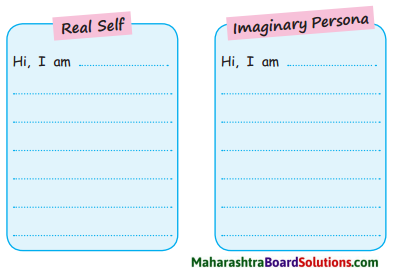
Talking about Myself:

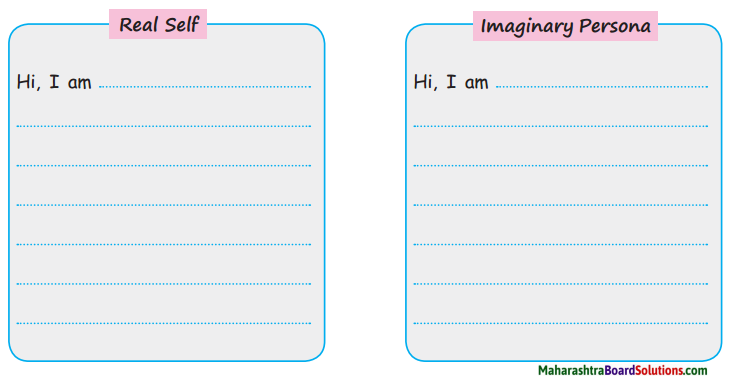
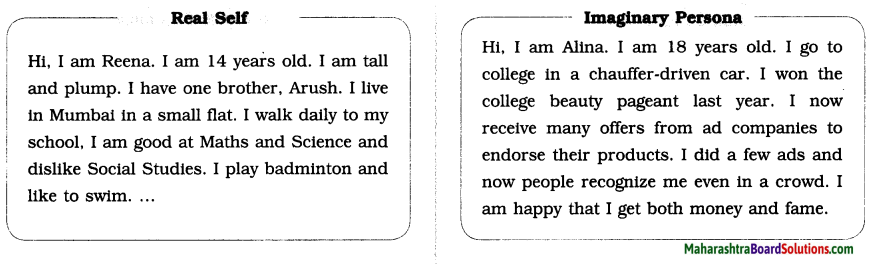
Write a few lines about yourself – your name, appearance. family, the place where you live, your school, your friends. neighbours. relatives, your likes, dislikes, hobbies, what you are good at, etc.

Now create an imaginary ‘persona’ for yourself. It should be quite different from your real self. Or, you may choose a fictional character – a character from a novel, story, etc. Write a few lines about this imaginary persona and introduce yourself in that role.
Maharashtra Board Class 9 My English Coursebook Solutions Chapter 1.5 The Necklace 1

Imaginary Persona

  • Hi, I am Vishalbahu.
  • I like to obstruct and punish criminals.
  • I simply love stunts and fights.
  • I enjoy flying secretly all over the world.
  • I don’t like people who trouble common people.
  • I hate crimes and injustice caused to innocent people.
  • I find exercises, combats very interesting.
  • I can do any impossible things in the world.
  • I am good at every difficult or hard work.
  • I am not so good at office work and housework.

Maharashtra Board Class 9 My English Coursebook Solutions Chapter 1.5 The Necklace

A Turn by Turn Story:

Form groups of 6-8. One person chooses any familiar object and announces its name in the group. All the others talk about it one by one, adding one (new) complete sentence at a time. The person who has chosen the object takes down all the sentences. After 2-3 rounds, read the sentences together and try to build a story around them.

Part I

English Workshop:

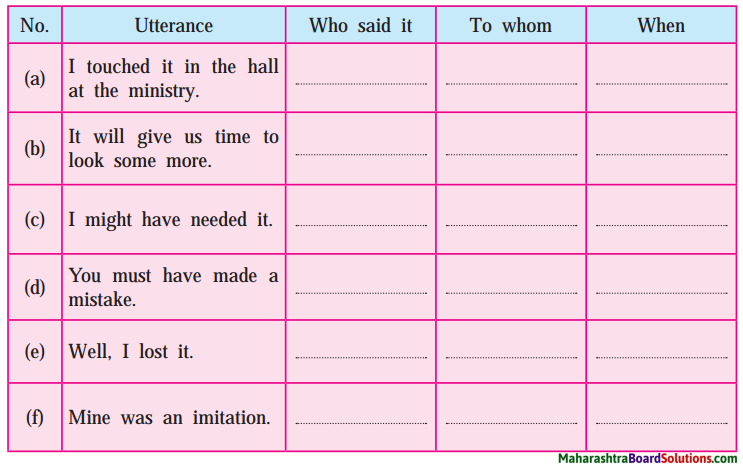
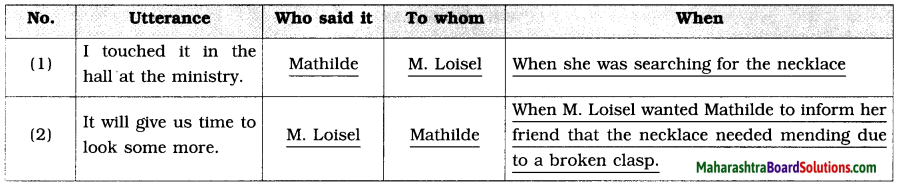
1. Read each of the following sentences aloud. Write who said it and to whom.

Question 1.
(a) Look. here’s something for you.”
(b) “Why. the dress you go to the theater in!”
(c) ‘I would rather not go to the party.”
(d) ‘Choose, my dear.”
(e) You have nothing else?”
(f) “Would you lend me this, just this?”
(g) “What ! … How ! … That’s impossible!
Answer:
(b) Mathilde’s husband said to Mathilde.
(c) Mathilde said to her husband.
(d) Madame Forestier said this to Mathilde.
(e) Mathilde said this to Madame Forestier.
(f) Mathilde said this to Madame Forestier.
(g) Mathilde’s husband said this to Mathilde.

Maharashtra Board Class 9 My English Coursebook Solutions Chapter 1.5 The Necklace

2. Read the conversations in the story aloud using proper intonation.

Question 1.
Read the conversations in the story aloud using proper intonation.

3. Write a few lines about what Mathilde had and what she dreamt about.

Question 1.
Write a few lines about what Mathilde had and what she dreamt about.

4. Write what you think about the following thoughts and actions of Mathilde.

Question a.
Mathilde was beautiful, and so she wanted to marry an aristocrat.
Answer:
She was not wrong to think so, because I think every woman, beautiful or not, wants to marry a person, who has a good position and wealth.

Question b.
Mathilde was sad because she did not get any luxuries.
Answer:
Her thinking was not correct. Not every one gets a luxurious life. She should have managed in whatever they were earning and lived a simple but happy life.

Maharashtra Board Class 9 My English Coursebook Solutions Chapter 1.5 The Necklace

Question c.
Mathilde felt that her house was shabby and poorly furnished.
Answer:
Her feelings are wrong because it depends on the people who live in the house to keep the house clean, tidy and beautiful with whatever furniture, things they have got.

Question d.
Mathilde wanted other people to envy her.
Answer:
Mathilde’s thought was wrong because happiness does not depend on making the people envy you. She wished that people would have admired her if she had rich dresses and jewels.

Question e.
Mathilde was not happy to see the invitation.
Answer:
Mathilde did not care about the importance of the invitation, her husband had received. She was thinking only about the dress she would wear there.

Question f.
Mathilde wanted a new dress for herself.
Answer:
Mathilde wanted a new dress for herself only to selfishly corner her husband for extorting money from him to buy a new dress. Her thought was silly and unreasonable.

Maharashtra Board Class 9 My English Coursebook Solutions Chapter 1.5 The Necklace

Question g.
Mathilde borrowed a diamond necklace from her friend and wore it to the party.
Answer:
Borrowing a diamond necklace was not a dire need of Mathilde. She could have used flowers instead; but she wanted another woman’s necklace to make a show of her beauty. She did not understand that borrowing is begging.

Question h.
Mathilde lost her necklace.
Answer:
Mathilde was so overwhelmed and captivated by her success that she was not aware of her responsibility of safe-keeping the borrowed necklace carefully. She lost it only because of her carelessness.

Maharashtra Board Class 9 My English Coursebook Solutions Chapter 1.5 The Necklace

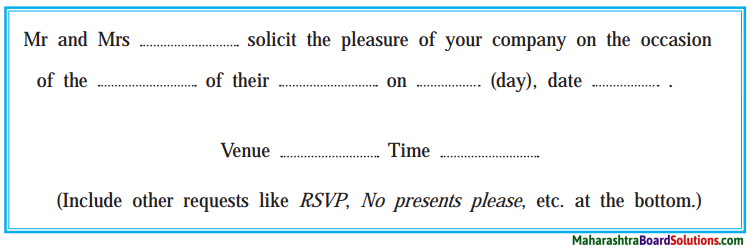
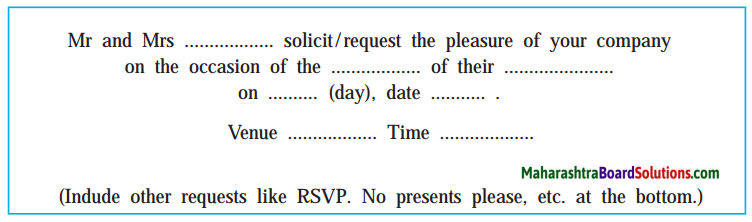
5. Prepare a formal invitation using the following format:
Maharashtra Board Class 9 My English Coursebook Solutions Chapter 1.5 The Necklace 2

Language Study:

6. Read the phrases: The necklace, an error, all these things, another woman, one evening, her husband. In all these phrases we see some words used before the nouns. They specify or make it clear what noun we are talking about. These words that are used at the beginning of a noun phrase are known as determiners.
Determiners include articles (a, an, the), possessive pronouns (my, our, your, her, etc.), words like this, that, much, many, all, and numbers.

Part II

Chit-chat:

  • Have you ever lost anything valuable?
  • Name a book/movie that made you think.
  • What was it about?
  • What was the best part about the book/movie?

Maharashtra Board Class 9 My English Coursebook Solutions Chapter 1.5 The Necklace

English Workshop:

1. Spot and circle the error m the following sentences. Then rewrite the sentences after correcting them.

Question 1.
Spot and circle the error m the following sentences. Then rewrite the sentences after correcting them.
(a) But they could not found it.
(b) You must right to your friend.
(c) At the end of one week, they have lose all hope.
(d) He would borrowed the rest.
(e) You should have return it sooner.
(f) And this life lasted for ten year.
(g) “No, I am Mathilde bisel.”
(h) Madame Forestier were stunned.
Answer:
(a) But they could not find it.
(b) You must write to your friend.
(c) At the end of one week, they have lost all hope.
(d) They stared at each other
(e) He would borrow the rest.
(f) You should have returned it sooner.
(g) And this life lasted ten years.
(h) “No, I am Mathilde Loisel.”
(i) Madame Forestier was stunned.

Maharashtra Board Class 9 My English Coursebook Solutions Chapter 1.5 The Necklace

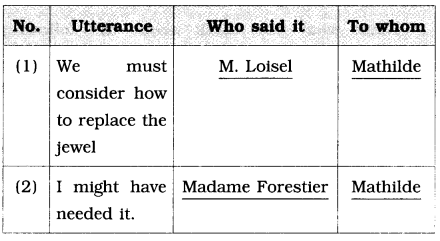
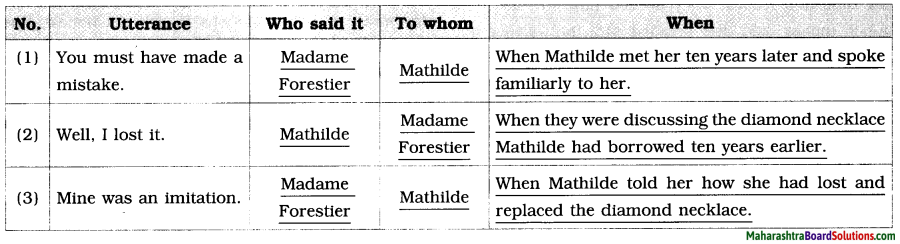
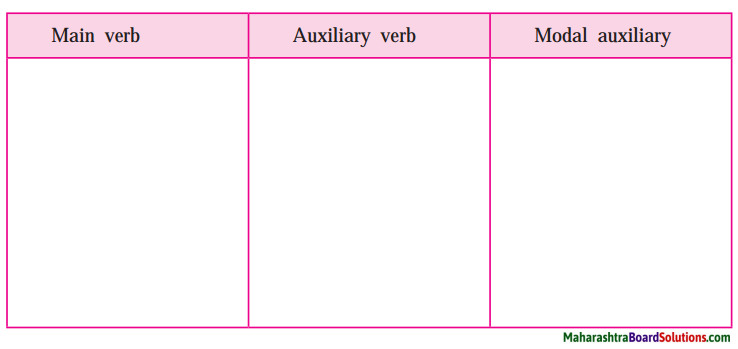
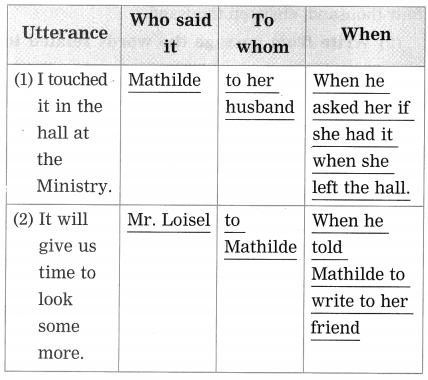
2. Complete the following table.

Maharashtra Board Class 9 My English Coursebook Solutions Chapter 1.5 The Necklace 3
Question 1.
Complete the following table.
Maharashtra Board Class 9 My English Coursebook Solutions Chapter 1.5 The Necklace 4
Maharashtra Board Class 9 My English Coursebook Solutions Chapter 1.5 The Necklace 5

3. Write what you think about the following thoughts and actions of Mathilde

Question a.
Mathilde was shocked despaired over the loss of her necklace
Answer:
I think her reaction to the loss of her necklace was natural. But she herself was responsible for the tragedy. Her stubborn behaviour is to be blamed for the loss.

Question b.
Mathilde wrote a note to her friend as dictated by her husband.
Answer:
The couple couldn’t find the lost necklace even after a long search. They expected to find it some day. For that they needed some more time and Mathilde was compelled to write the false letter to I her friend. Her action of telling lies and betraying her friend was immoral and ridiculous.

Question c.
Mathilde and her husband decided to replace the necklace.
Answer:
I think that their decision of replacing the necklace was immature and insincere. Instead, they should have clearly and openly told Madame Forestier about the incident. It could have saved them from the horrible life they had to face and the dreadful debt they had to pay.

Maharashtra Board Class 9 My English Coursebook Solutions Chapter 1.5 The Necklace

Question d.
Mathilde returned the diamond necklace to her friend
Answer:
I think, it was her moral responsibility to return the borrowed diamond necklace immediately after the party day but she delayed. She did so to hide the fact that she had lost the diamond necklace. Her negligence made her to make one more wrong.

Question e.
Mathilde did not tell her friend about the loss and replacement.
Answer:
It was another big mistake she committed. It was her thoughtless action. Had she told her friend about the loss of the necklace, further ruinous incidents wouldn’t have occurred and the remedy for the problem would have been very simple and easy.

Question f.
Mathilde worked very very hard to pay the debt.
Answer:
Mathilde’s action shows that she was a completely transformed woman. She had changed her attitude towards her lifestyle. She forgot her dreams of living a luxurious life. She worked hard and saved money for repaying the debt. She felt duty-bound for coming out of the devastating situation, she was responsible for.

Maharashtra Board Class 9 My English Coursebook Solutions Chapter 1.5 The Necklace

Question g.
Mathilde and her husband paid off the debt in ten years.
Answer:
The income of Mathilde’s husband was meagre. So both of them worked very hard for ten long years to save money for repaying the debt. They curtailed their needs severely, her husband worked extra to ease the burden of debt. Somehow they faced the woes together bravely and sincerely.

4. Form pairs. Discuss how ‘Part II’ of the story could have been different. Write your storyline in the form of bullets showing the main events.

Question 1.
Form pairs. Discuss how ‘Part II’ of the story could have been different. Write your storyline in the form of bullets showing the main events.
Answer:
The cabman, who dropped them at their door found the necklace after two days while cleaning his cab → behind the space of the seats → fallen from the gaps of the seats → remembered the lady wearing the necklace → was an honest and God-fearing man → went to their house →handed over the necklace to them → it could have changed the whole story.

Maharashtra Board Class 9 My English Coursebook Solutions Chapter 1.5 The Necklace

5. Imagine what must have happened after Mathilde’s friend discovered that the diamonds were real. Do you think she would return it to Mathilde? Would that make Mathilde happy?

Question 1.
Imagine what must have happened after Mathilde’s friend discovered that the diamonds were real. Do you think she would return it to Mathilde? Would that make Mathilde happy?
Answer:
Mathilde’s friend was rich but a kind-hearted and generous woman. She knew that Mathilde had to face many miseries for ten years. I think she would return the necklace to Mathilde. Mathilde would be happy to find some relief after ruinous sufferings.

6. Discuss the following and write about it in your own words in 5-6 lines.

Question 1.
Discuss the following and write about it in your own words in 5-6 lines.
(a) What would you do, if something like this happens to you?
(b) What opinion do you form about Mathilde’s husband from lier story?
(c) Which events in the story (Part I and Part II) changed Mathilde’s life?
Answer:
(Use the following points to write your answers.)
(a) Points:

  • would go to friend and explain-
  • would ask for time to return the money for the necklace –
  • since friend rich, she may have accepted the idea.)

(b) Points:

  • Husband
  • good – kind – supportive
  • considerate – a very nice human being.

(c) Points :

  • Invitation to party – borrowing the necklace
  • losing the necklace – returning the necklace by borrowing money

Maharashtra Board Class 9 My English Coursebook Solutions Chapter 1.5 The Necklace

Language study:

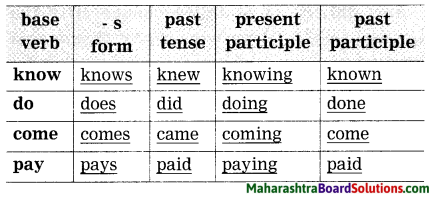
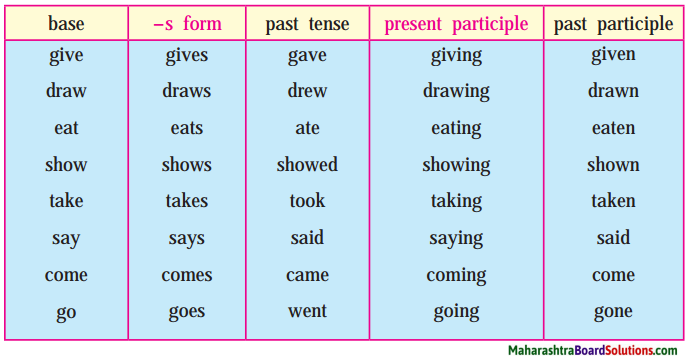
7. Read the table of verb forms given below.

Question 1.
Read the table of verb forms given below.
Maharashtra Board Class 9 My English Coursebook Solutions Chapter 1.5 The Necklace 6

The base form is used as an infInitive: You may go. She will go.
in orders: Go home. and in the simple present tense: I go to school. We go
home. Do you go there every day? The children/They go up, etc.
Note that we use the ‘-s form’ with ‘he’, ‘she’, ‘it’, third-person singular subjects to show the simple present.
The past tense form has ‘-ed’ at the end. But many commonly used verbs have different past tense forms. Examples: Came, went, spoke.
. The ‘-ing’ form is known as the present participle. It is used with forms of ‘be’ to show continuous action – Examples: I am eating. You were eating. She was eating.
It is also used in certain constructions like He sat copying a manuscript.

The past participle used with forms of ‘have’ shows completed action – Examples: I have eaten. They have come, etc.
It is also used in certain constructions like ‘They looked at each other, stunned!’
It is also used in passive constructions. We will learn about ‘passive voice’ later.

Make a table of verb forms for your own reference. Try to arrange the verbs in alphabetical order. Keep adding new verbs to your table from time to time. When you write, check your work to see whether you have used the correct verb form.

Question 1.
Read the different following information about different forms of verbs:
Answer:
1. The base form is used as an infinitive: You may go. She will go.
In orders: Go home. And in simple present tense: I go to school. We go home. Do you go there every day? The children/They go up, etc.

2. Note that we use the e-s form’ with ‘he’, ‘she’, ‘it’, third person singular subjects to show
the simple present.

3. The past tense form has ‘-ed’ at the end. But many commonly used verbs have different past tense forms. Examples: came, went, spoke.

4. The ‘-ing’ form is known as the present participle. It is used with forms of ‘be’ to show continuous action – Examples: I am eating. You were eating. She was eating. It is also used in certain constructions like : He sat copying a manuscript.

5. The past participle used with forms of ‘have’ shows completed action.
Examples: I have eaten. They have come, etc.
It is also used in certain constructions like ‘They looked at each other, stunned!’

Maharashtra Board Class 9 My English Coursebook Solutions Chapter 1.5 The Necklace

My English Coursebook 9th Class Solutions Chapter 1.5 The Necklace Additional Important Questions and Answers

Read the following passage and do the activities :

Simple Factual Activities :

Question 1.
Say whether the following statements are True or False :
Answer:

  1. Mathilde was married to a big officer at the Ministry of Education. – False
  2. Mathilde’s former schoolmate was very rich. – True
  3. Mathilde had rich dresses, jewels and everything that she loved. – False
  4. Mathilde was happy with the invitation brought by her husband – False

Question 2.
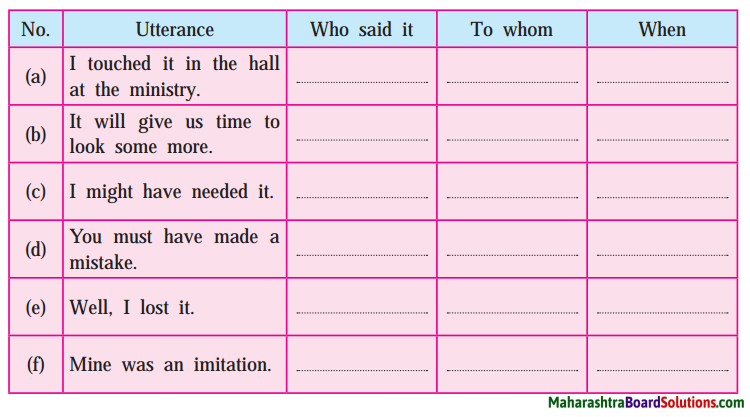
Who said to whom? Complete the table :
(Answers are directly given.)
Answer:

DialogueWho saidTo whom
1. “Here’s something for you.”Mathilde’s husbandMathilde
2. “What do you want me to do with that?”MathildeMathilde’s husband

Question 3.
What did the envelope hold?
Answer:
The envelope held an invitation from the Minister of Education and Mme. Georges Rampouneau to Mr and Mrs. Loisel.

Maharashtra Board Class 9 My English Coursebook Solutions Chapter 1.5 The Necklace

Question 4.
State whether the following statements ) are True or False :
Answer:

  1. Mathilde’s husband suggested her to wear the dress she wore when she went to the theatre. – True
  2. Mathilde was upset for three days because she had no good dress to wear. – False
  3. Mathilde was ready to wear flowers. – False
  4. She demanded four hundred francs for her dress. – True

Question 5.
Write who said it and to whom :
“But I don’t know what you like.”
Answer:
Madame Forestier said this to Mathilde.

Question 6.
Choose the correct option from the brackets and complete the sentences :
(Answers are directly given.)
Answer:

  1. Mathilde went to Madame Forestier. (The jeweller/Madame Forestier)
  2. Madame Forestier took out a large box from her mirrored wardrobe. (large box/necklace)
  3. Mathilde tried on the jewellery in the mirror. (dress/jewellery)
  4. Mathilde discovered a diamond necklace in Madame Forestier’s large box. (a black satin box/a diamond necklace)

Question 7.
What did Madame Forestier’s large box contain?
Answer:
Madame Forestier’s large box contained bracelets, necklaces and other jewellery.

Maharashtra Board Class 9 My English Coursebook Solutions Chapter 1.5 The Necklace

Question 8.
Complete the following sentences using the information given in the passage:
(Answers are directly given.)
Answer:

  1. Mathilde was floating in a cloud of happiness.
  2. Both, husband and wife left at about four o’clock in the morning.
  3. In front of the mirror Mathilde took a final look at herself in all her glory.
  4. She no longer had the necklace round her neck.

Question 9.
Who said it and to whom :

Question a.
“I no longer have Madame Forestier’s necklace.”
Answer:
Mathilde said this to her husband.

Question 10.
Complete the following sentences with the information given in the passage :
(Answers are directly given.)
Answer:

  1. She remained in her ball dress all night, her mind blank.
  2. At the end of one week they had lost all hope.
  3. The husband and wife were sick with grief and anguish.
  4. Mr. Loisel said, “We must consider how to replace the jewel.

Question 11.
Who said this to whom :
1. “I might have needed it.”
2. “Don’t sell it for three days.”
Answer:
1. Madame Forestier said this to Mathilde.
2. Mr. Loisel and Mathilde said to the jeweler.

Maharashtra Board Class 9 My English Coursebook Solutions Chapter 1.5 The Necklace

Question 12.
Say if the following statements are True or False:
(Answers are directly given.)
Answer:

  1. Madame Forestier was rather angry with Mathilde for returning the necklace late. – True
  2. A string of diamonds they found at Palais Royal was worth thirty-six thousand francs. – False
  3. The new necklace cost them thirty- four thousand francs. – False
  4. Mr Loisel borrowed money from every type of money-lender. – True

Question 13.
Complete the sentences using the information from the passage :
(Answers are directly given.)
Answer:

  1. At the end of ten years, they had paid off everything.
  2. How little is needed for one to be ruined or saved!
  3. Mathilde played her part heroically.
  4. She came to know the drudgery of housework.

Question 14.
Answer the following questions :

Question a.
Who is Madame Loisel?
Answer:
Madame Loisel is Mathilde.

Question b.
What work did Mathilde’s husband do for a tradesman?
Answer:
Mathilde’s husband did accounts for a tradesman.

Maharashtra Board Class 9 My English Coursebook Solutions Chapter 1.5 The Necklace

Question 15.
Say whether the following statements are True or False:
(Answers are directly given.)
Answer:

  1. Madame Forestier recognised her dear friend immediately. _ False
  2. Madame Forestier still looked young, beautiful and charming. – True
  3. It had taken them ten years to pay for the imitation diamond neclace. – True
  4. The imitation was not worth five hundred francs at most! – False

Complex Factual Activities :

Question 1.
Complete the following :
(Answers are directly given.)
Answer:
Maharashtra Board Class 9 My English Coursebook Solutions Chapter 1.5 The Necklace 7

Question 2.
Why was Mathilde married to a minor official’?
Answer:
Mathilde was a pretty, charming girl but was born in a family of clerks. This had decided her future. Because of her ill-fate she had to marry a ‘minor official’.

Question 3.
Why did Mathilde weep with misery after visiting her schoolmate?
Answer:
Mathilde wept with misery after visiting her schoolmate because she couldn’t get the riches and the luxurious life in which the schoolmate was relishing. She dreamt of all those things her friend was enjoying. She herself could not have them because of her destiny.

Question 4.
Mathilde was sad, restless and anxious though her dress was ready because ….
Answer:
Mathilde was sad, restless and anxious though her dress was ready because she had no jewels, she had not a single precious stone to wear. She almost had decided not to go to the party.

Maharashtra Board Class 9 My English Coursebook Solutions Chapter 1.5 The Necklace

Question 5.
Mathilde’s husband turned pale because….
Answer:
Mathilde’s husband turned pale because he had been saving the exact amount demanded by Mathilde to buy a gun for a hunting summer, in the country near Nanterre. He would lose his opportunity for buying dress for Mathilde.

Question 6.
Write the following sentences in order of their occurrence :
1. Her friend put a large box of jewellery before Mathilde.
2. She fled home with her treasure.
3. Mathilde went to Madame Forestier.
4. She discovered a diamond necklace.
Answer:
3. Mathilde went to Madame Forestier.
1. Her friend put a large box of jewellery before Mathilde.
4. She discovered a diamond necklace.
2. She fled home with her treasure.

Question 7.
Which sentences tell us that Mathilde greatly desired the necklace?
Answer:
The Sentences: Her heart began to beat with uncontrolled desire. Her hands trembled as she took it. She stood lost in ecstasy as she looked at herself in the mirror. She asked her friend anxiously, “Would you lend me this, just this?”

Maharashtra Board Class 9 My English Coursebook Solutions Chapter 1.5 The Necklace

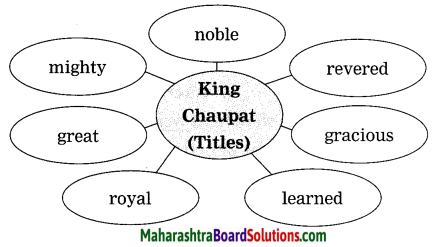
Question 8.
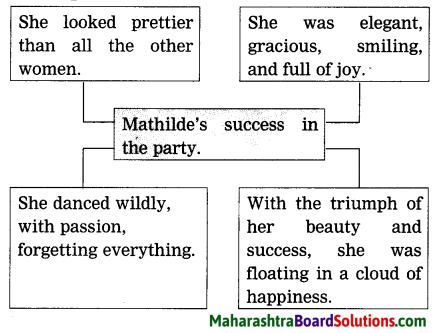
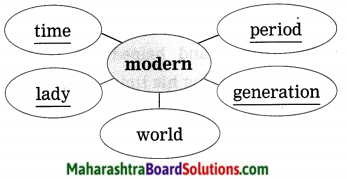
Complete the web :
Answer:
Maharashtra Board Class 9 My English Coursebook Solutions Chapter 1.5 The Necklace 12

Question 9.
Describe the efforts made by the couple to find the lost necklace:
Answer:
They looked in the folds of Mathilde’s dress, in the folds of her cloak, in her pockets, everywhere. Mr. Loisel walked over the whole route they had walked to find the necklace. He went to the police station, to the newspapers to offer a reward, to the cab companies and everywhere they expected to find the necklace but found nothing.

Question 10.
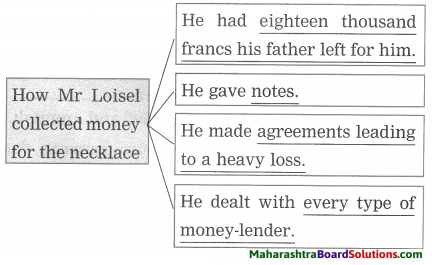
Complete the web
(Answers are directly given.)
Answer:
Maharashtra Board Class 9 My English Coursebook Solutions Chapter 1.5 The Necklace 14

Question 11.
How did life of Mathilde change after the horrible incident?
Answer:
Mathilde’s life was completely changed. She dismissed her maid and did extremely unpleasant labours in the kitchen. She washed the dishes, the dirty linen, she carried the garbage down to the street every morning, carried up the water and dressed like a common woman. She had to bargain at markets, quarrel and face insults over every miserable sou. She lived the horrible life of the very poor.

Maharashtra Board Class 9 My English Coursebook Solutions Chapter 1.5 The Necklace

Question 12.
Arrange the following sentences in order of their occurence:
1. Mathilde tells Madame Forestier about her hard time and miseries.
2. Madame Forestier tells that the necklace was an imitation.
3. Madame Forestier did not recognise Mathilde because she was completely changed.
4. Mathilde met Madame Forestier in the Champs Elysees on Sunday.
Answer:
4. Mathilde met Madame Forestier in the Champs Elysees on Sunday.
3. Madame Forestier did not recognise Mathilde because she was completely changed.
1. Mathilde tells Madame Forestier about her hard time and miseries.
2. Madame Forestier tells that the necklace was an imitation.

Activities based on vocabulary:

Question 1.
Match the words in Column ‘A’ with their meaning in Column ‘B’ :

‘A’‘B’
1. aristocrat(a) destiny
2. fate(b) great success
3. shabby(c) nobleman
4. triumph(d) nearly worn out

Answer:

‘A’‘B’
1. aristocrat(c) nobleman
2. fate(a) destiny
3. shabby(d) nearly worn out
4. triumph(b) great success

Maharashtra Board Class 9 My English Coursebook Solutions Chapter 1.5 The Necklace

Question 2.
Write any four words from the passage that show the feeling of great pain:
Answer:
regret, despair, misery and tormented.

Question 3.
Write English terms that stand for the French terms Monsieur and Mme:
Answer:
Mr and Mrs.

Question 4.
Write the long forms of the following contracted forms:

  1. Let’s
  2. don’t
  3. hadn’t
  4. what’s.

Answer:

  1. Let us
  2. do not
  3. had not
  4. what is.

Question 5.
Write four words from the passage that reflect (show) that the person is in difficult situation.
Answer:
stammered, stunned, distressed, stuttered.

Maharashtra Board Class 9 My English Coursebook Solutions Chapter 1.5 The Necklace

Question 6.
Fill in the blanks with proper letters so as to find the words: (Answers are directly given.)
Answer:
1. the objects such as rings, necklaces, etc. that
Maharashtra Board Class 9 My English Coursebook Solutions Chapter 1.5 The Necklace 8

2. a large cupboard for hanging clothes.
Maharashtra Board Class 9 My English Coursebook Solutions Chapter 1.5 The Necklace 9

3. a piece of ornament consisting of chain of beads, diamonds, etc. worn around the neck =
Maharashtra Board Class 9 My English Coursebook Solutions Chapter 1.5 The Necklace 10

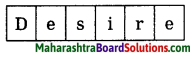
4. a strong wish to have something =
Maharashtra Board Class 9 My English Coursebook Solutions Chapter 1.5 The Necklace 11

Question 7.
Write any four adjectives from the passage.
Answer:
elegant, gracious, smiling, panic-stricken.

Question 8.
Write any four adverbs with ‘-ly’ from the passage.
Answer:
wildly, fmally, sadly, suddenly.

Question 9.
Which words from the passage are related with ‘success’?
Answer:
full of joy, triumph, cloud of happiness, glory.

Maharashtra Board Class 9 My English Coursebook Solutions Chapter 1.5 The Necklace

Question 10.
Write the meanings of:
(Answers are directly given.)
Answer:

  1. glimmer of hope: a small sign of hope/success.
  2. a hollow, pale figure: a person having empty mind and almost white face because of frustration and exhaustion.
  3. sick with grief and anguish: mentally ill because of great sadness and pain.
  4. cloak: ladies’ garment without sleeves, worn over their other clothes.

Question 11.
Find and write all the numbers mentioned in the passage :
Answer:
Forty thousand, thirty-six thousand, thirty- four thousand, eighteen thousand.

Question 12.
Write from passage the words related to money matters.
Answer:
worth, sell, borrow, notes, agreements, dealt, money-lender.

Maharashtra Board Class 9 My English Coursebook Solutions Chapter 1.5 The Necklace

Question 13.
Write from the passage the phrases related to ‘housework’.
Answer:
Drudgery of housework, odious labours of the kitchen, washing dishes, washing dirty linen, carry the garbage, carry up the water, bargain at markets.

Question 14.
Match from the passage the adjectives in Column ‘A’ with the nouns in Column ‘B’ :

‘A’‘B’
1. dreadful(a) sou
2. miserable(b) labours
3. horrible(c) debt
4. odious(d) life

Answer:

‘A’‘B’
1. dreadful(c) debt
2. miserable(a) sou
3. horrible(d) life
4. odious(b) labours

Maharashtra Board Class 9 My English Coursebook Solutions Chapter 1.5 The Necklace

Question 15.
Match the words in Column ‘A’ with their meaning in Column ‘B’ :

‘A’‘B’
1. familiarly(a) artificial/not real
2. astonished(b) in a friendly manner
3. imitation(c) very surprised
4. innocent(d) having not done anything wrong

Answer:

‘A’‘B’
1. familiarly(b) in a friendly manner
2. astonished(c) very surprised
3. imitation(a) artificial/not real
4. innocent(d) having not done anything wrong.

Maharashtra Board Class 9 My English Coursebook Solutions Chapter 1.5 The Necklace

Question 16.
Write from the passage the verbs that end : with ‘-ed’.
Answer:
astonished, addressed, stammered, uttered, changed, stunned, smiled, moved.

Activities based on contextual grammar :

Question 1.
Find and write the adjectives from the passage for the following nouns :

  1. house
  2. girl
  3. official
  4. mansion.

Answer:

  1. shabby and poorly furnished
  2. pretty and charming
  3. minor
  4. grand and palatial.

Question 2.
He turned a little pale.
(Change the sentence into simple present Tense.)
Answer:
He turns a little pale.

Maharashtra Board Class 9 My English Coursebook Solutions Chapter 1.5 The Necklace

Question 3.
Choose the correct option of the question tag:
I can give you four hundred francs.
(i) , can I?
(ii) , don’t I?
(iii) , can’t I?
(iv) , couldn’t I?
Answer:
I can give you four hundred francs, can’t I?

Question 4.
She replied,” I am upset that I have no jewels.” (Choose the correct option to transform it into Reported speech.)
a. She replied that I was upset that I had no jewels.
b. She replied that she is upset that she has no jewels.
c. She replied she was upset that she has no jewels.
d. She replied that she was upset that she had no jewels.
Answer:
c. She replied she was upset that she has no jewels.

Question 5.
Choose the correct wh-question from the alternatives to get the underlined part as an answer:
She discovered, in a black satin box, a diamond necklace.
(a) What did she discover in a black satin box?
(b) When did she discover a diamond necklace in a black satin box?
(c) Where did she discover a diamond necklace?
(d) Why did she discover a diamond necklace?
Answer:
(c) Where did she discover a diamond necklace?

Question 6.
Write the following sentence in simple present tense:
She threw her arms around her friend’s neck.
Answer:
She throws her arms around her friend’s neck.

Maharashtra Board Class 9 My English Coursebook Solutions Chapter 1.5 The Necklace

Question 7.
Find the determiners from the following sentences and underline them :
(Answers are directly underlined.)
Answer:
1. They were dropped off at their door in the Rue des Martyrs.
2. Forgetting everything in the triumph of her beauty.

Question 8.
Do as directed :

  1. She took a final look at herself. (Write simple present tense form for the underlined word.)
  2. The day of the party arrived. (Rewrite the sentence using simple future tense.)
  3. She danced wildly (Use past progressive tense and rewrite the sentence.)

Answer:

  1. She takes a final look at herself.
  2. The day of the party will arrive.
  3. She was dancing wildly.

Question 9.
It was worth forty thousand francs.
(Use ‘They’ in place of ‘It’ and rewrite the correct sentence.)
Answer:
They were worth forty thousand francs.

Maharashtra Board Class 9 My English Coursebook Solutions Chapter 1.5 The Necklace

Question 10.
He went to get the new necklace. (Rewrite the sentence using simple present tense for the underlined verb.)
Answer:
He goes to get the new necklace.

Question 11.
Change the following sentences in passive voice :
1. They dismissed their maid.
2. They rented a garret under the roof.
Answer:
1. Their maid was dismissed by them.
2. A garret under the roof was rented by them.

Question 12.
How strange life is!
(Make it an assertive sentence,)
Answer:
Life is very strange.

Maharashtra Board Class 9 My English Coursebook Solutions Chapter 1.5 The Necklace

Question 13.
Complete the table with the correct forms of the given verbs.
Answer:
Maharashtra Board Class 9 My English Coursebook Solutions Chapter 1.5 The Necklace 15

Do as directed :

Question 1.
1. She had no rich dresses : (Make the sentence affirmative without changing the meaning.)
2. These were the only things she loved. (Make the sentence negative without changing the meaning.)
Answer:
1. She had poor dresses.
2. She loved nothing but (except) these things.

Question 2.
They could not find it.
(Begin with It could not… and change the voice.)
Answer:
It could not be found by them.

Maharashtra Board Class 9 My English Coursebook Solutions Chapter 1.5 The Necklace

Question 3.
He said to Mathilde, “Tell her you have broken the clasp of the necklace.”
(Change into Indirect speech.)
Answer:
He told Mathilde to tell her she had broken the clasp of the necklace.

Question 4.
Use simple present tense form and rewrite the following sentences :

Question a.
He went to the police station.
Answer:
He goes to the police station.

Question b.
They lost all hope.
Answer:
They lose all hope.

Maharashtra Board Class 9 My English Coursebook Solutions Chapter 1.5 The Necklace

Question 5.
How you’ve changed!
(Make an assertive sentence.)
Answer:
You’ve completely changed,

Question 6.
They were similar.
(Make it negative without changing meaning.)
Answer:
They were not different.

Question 7.
I am Mathilde Loisel.
(Choose correct Question Tag,)
(i) , am I?
(ii) , amn’t I?
(iii) , aren’t I?
(iv) , don’t I?
Answer:
(iii) , aren’t I?

Maharashtra Board Class 9 My English Coursebook Solutions Chapter 1.5 The Necklace

Question 8.
Fill in the table with correct verb forms.
(Answers are directly given.)
Answer:

base formPast tensePast participle
bringbroughtbrought
seesawseen
feelfeltfelt
singsangsung

Personal Response:

Question 1.
What do you feel when you receive an invitation for a party? Why?
Answer:
When I receive an invitation for a party, I feel very happy because we get to meet our friends and relatives at the party and we can spend some time rejoicing. We also get to eat tasty food in the party.

Maharashtra Board Class 9 My English Coursebook Solutions Chapter 1.5 The Necklace

Question 2.
Was Mathilde’s husband a considerate person? How do you know that?
Answer:
Mathilde’s husband was really a very considerate person. Though his wife was obstinate and stubborn, he tried to fulfill all her unreasonable wishes. He sacrificed his own hunting joy and gave his savings to please Mathilde. This shows that he was a very considerate person.

Question 3.
Mathilde asked her friend, “Would you lend me this, just this?”
Why, do you think, did Mathilde say ‘just this’?
Answer:
I think, Mathilde was fully satisfied with the diamond necklace she got. It looked beautiful in her neck as she had desired. So she did not want anything else except that diamond necklace and so she insisted to lend her that and only that necklace.

Question 4.
Why, do you think, did Mathilde not notice the loss of her necklace?
Answer:
I think, she was thinking only about the triumph of her beauty and success in the party. She had lost her attention towards her necklace. Secondly, they left the party early in the morning, could not find a cab and had to walk for a long distance. This also must be the cause of the distraction.

Maharashtra Board Class 9 My English Coursebook Solutions Chapter 1.5 The Necklace

Question 5.
Do you think, the arrangement made by Mr Loisel with the jeweller, was fair? Give your reason:
Answer:
Yes I think the arrangement was fair. According to the arrangement the jeweller would take the necklace back for thirty-four thousand if the other (the lost) necklace was found before the end of February. It would help them to get some more time to find the necklace and again they would ; be losing only two thousand francs instead of thirty- 5 six thousand.

Question 6.
Why does Madame Forestier speak coldly to Mathilde?
Answer:
Mathilde returned the necklace after so many days. Madame Forestier did not like it and was angry with Mathilde. It is the usual tradition to return the borrowed things immediately after the work is done, but Mathilde did not do it. By speaking coldly Madame Forestier expresssed her anger and displeasure.

Question 7.
What is meant by the horrible life of the very poor?
Answer:
The horrible life of the poor means a very tiring, bad, unpleasant and painful life. The poor are the people who live a miserable life with very little or no money at all. They have no money to satisfy their day-to-day basic needs. They have to work hard all the day to make both ends meet. Mathilde experienced this horrible life of the poor for saving money to clear the debt.

Maharashtra Board Class 9 My English Coursebook Solutions Chapter 1.5 The Necklace

Question 8.
Write what you think about the following thought and action of Mathilde :
Mathilde told her friend about the lost necklace.
Answer:
Mathilde was now a relieved person. Though it was her fault, she must have thought that she should tell the truth to her friend and tell her how she struggled for ten long years that made her look old.

Question 9.
Who do you think was responsible for Mathilde’s misery? Was it her friend, she herself, her husband or the circumstances?
Answer:
It was Mathilde who was mainly responsible for her misery. Her wilfulness and obstinate behaviour were the root cause of the disastrous incident. She borrowed the necklace and lost it and that led to her misery. Her friend and her husband were, in no way, responsible for it. Of course the circumstances, to some extent too are responsible for it.

Oral Work:

Question 1.
Read the conversations in the story aloud using proper intonation.

Maharashtra Board Class 9 My English Coursebook Solutions Chapter 1.5 The Necklace

Writing Skill:

Question 1.
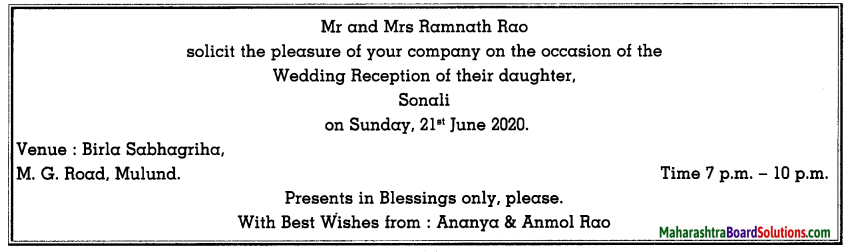
Prepare a formal invitation using the format given on the textbook page no. 27.
Answer:
Maharashtra Board Class 9 My English Coursebook Solutions Chapter 1.5 The Necklace 13

Activities Based on Language study

Do as directed!

Question 1.
Complete the words by using correct letters :

  1. o _ h e r
  2. y o _ n g
  3. p _ o u d
  4. s p e _ k

Answer:

  1. o t h e r
  2. y o u n g
  3. p r o u d
  4. s p e a k

Question 2.
Copy the following sentences correctly in your notebook :
Answer:
1. He said,” Here’s something for you!”
2. “What’s the matter? Let’s see, Mathilde.”

Maharashtra Board Class 9 My English Coursebook Solutions Chapter 1.5 The Necklace

Question 3.
Put the following words in alphabetical order:
1. glory, street, amount, pleasure.
2. mansion, mirror, mutter, matter.
Answer:
1. amount, glory, pleasure, street.
2. mansion, matter, mirror, mutter.

Question 4.
Punctuate the following sentences :
1. you could wear flowers he said they are very fashionable at this time of year
2. what is the matter asked her husband
Answer:
1. “You could wear flowers,” he said,
“They are very fashionable at this time of year.”
2. “What is the matter?” asked her husband.

Maharashtra Board Class 9 My English Coursebook Solutions Chapter 1.5 The Necklace

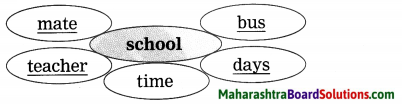
Question 5.
Write four small words (minimum letters each) using the letters in the given word:
‘schoolmate’ :
Answer:

  1. school
  2. come
  3. late
  4. home.

Question 7.
Write related words as shown in the example :
(Answers are directly given.)
Answer:
Maharashtra Board Class 9 My English Coursebook Solutions Chapter 1.5 The Necklace 16

Question 8.
Complete the following word-chain withing for.m. Add four words, each beginning with the last letter of the previous word:
going → ………………. →……………. →…………… → ………….. .
Answer:
going → growing → gaining → guarding → grumbling.

Question 9.
Make your own meaningful sentence by using the phrase ‘to be aware of’.
Answer:
We should be aware of the consequences of bad habits.

Maharashtra Board Class 9 My English Coursebook Solutions Chapter 1.5 The Necklace

Question 10.
Add a prefix or suffix to make new words. and use any one of the root words in your own sentence:
1. annoy
2. exhaust
Answer:
1. annoyance
2. exhaustion
Sentence: There is no need to exhaust yourself for such a petty job.

Question 11.
Add a clause to expand the sentence meaningfully:
I don’t remember ………………………………… .
Answer:
I don’t remember when I met him last.

My English Coursebook Std 9 Digest Pdf Unit 1

Std 9 English Poem What is Success? 4.1 Question Answer Maharashtra Board

Class 9 English Chapter 4.1 Question Answer Maharashtra Board

Balbharti Maharashtra State Board Class 9 English Solutions My English Coursebook Chapter 4.1 What is Success? Notes, Textbook Exercise Important Questions and Answers.

What is Success? Poem 9th Std Question Answer

My English Coursebook Std 9 Guide Chapter 4.1 What is Success? Textbook Questions and Answers

Warming up:
Chit-chat

  1. Do you have a hobby?
  2. Do you play a musical instrument?
  3. What is the latest thing that you learnt to do?
  4. Have you ever taught someone else to do something?

Maharashtra Board Class 9 My English Coursebook Solutions Chapter 4.1 What is Success?

1. Prepare a speech to deliver in an interschool competition on ‘How to achieve success in life’ with the help of the following web chart:

Question 1.
Prepare a speech to deliver in an interschool competition on ‘How to achieve success in life’ with the help of the following web chart:
Maharashtra Board Class 9 My English Coursebook Solutions Chapter 4.1 What is Success 1
Answer:

How to achieve success in life?

Honourable chairperson, respected headmaster, teachers and my dear friends, Today I am going to limit my speech on “How to achieve success in life:” I request you to listen to me carefully. So my friends, success is very important in everyone’s life. Everyone has a dream of becoming a successful human being in life. There is a good saying that, “Success is a journey and not a destination.”

How true it is! If we look at the life of all successful people, we realize the truthfulness of the statement. The definition of success is different for every person. For a child success is to solve a puzzle, for a S.S.C. student, a success is to get good marks, for a businessman, a success is to get a contract and for grandparents, success is to see the whole family together.

Everyone wants to become rich and successful in life. To achieve ambition, there are many steps which are to be followed. First of all, we have to set our goal, means we have to decide what we are and what we want to be. So proper plan and execution of the plan are very important. The tragedy of life does not lie in not reaching the goal, the tragedy lies in having no goal to reach.

For a great success we need a lot of confidence, patience, knowledge, perseverance and hard work. We should not waste our time because time is money. Don’t compare yourself with any other person in the world. If you do so you are demeaning yourself. The main thing is that we should always think positively and never give up hope because many of our failures are the people who did not realize how close they were to success when they gave up.

Always remember that the word “Impossible” means, I’m possible and if destiny is accompanied with the three D’s: determination, dedication, and devotion then everything becomes possible. We should learn from our own mistakes. We should always follow in the footsteps of great, successful people. Let’s take an example of Dhirubhai Ambani.

He was born in a poor family, but struggled a lot to achieve his ambition and never gave up hope because he knew that there is always a room at the top. He kept the hope alive in his heart and tried his level best and as you know he was one of the richest industrialists in the world. After all, no gains, without pains.

There is a great saying that successful people do not do different things, they do things differently. So work hard, continuously. God’s blessings are always there with you. Thank you for listening to me carefully.

Jai Hind.

Maharashtra Board Class 9 My English Coursebook Solutions Chapter 4.1 What is Success?

2. What might success mean to the following people? Think about it and write:

Question 1.
A student ………………………….. .
Answer:
Showing consistent improvement in his academic pursuit, participating in sports and different competitions.

Question 2.
A businessman ………………………. .
Answer:
Gaining a huge profit, and achieving his target in business.

Question 3.
A doctor …………………………… .
Answer:
Diagnosing and treating patients and even saving a dying person.

Question 4.
A sportsperson ………………………. .
Answer:
Setting his/her own record by participating in different tournaments, winning medals and trophies.

Question 5.
A politician ………………………… .
Answer:
Winning an election and working for the welfare of society.

Question 6.
A person who has applied for a job ………………………… .
Answer:
Getting a job with a huge package of salary.

Question 7.
A teacher ………………………. .
Answer:
Helping his/her students to excel, reaching every child of his/her class.

Maharashtra Board Class 9 My English Coursebook Solutions Chapter 4.1 What is Success?

Question 8.
A Parent ……………………………. .
Answer:
Raising a child and to make him/her a good human being.

English Workshop:

1. Tick the correct alternative:

Question 1.
The poet says that success is:
(a) to laugh less and work more
(b) to laugh never at all
(c) to laugh often and much
(d) to laugh less and low
Answer:
(c) to laugh often and much

Question 2.
The poet wants us to:
(a) earn a lot of money
(b) earn profits
(c) earn property
(d) earn the appreciation of honest critics
Answer:
(d) earn the appreciation of honest critics

Question 3.
The poet wants us to appreciate:
(a) riches
(b) God
(c) beauty
(d) society
Answer:
(c) beauty

Maharashtra Board Class 9 My English Coursebook Solutions Chapter 4.1 What is Success?

Question 4.
The poet wants us to leave the world a bit
(a) bitter
(b) better
(c) broader
(d) bared
Answer:
(b) better

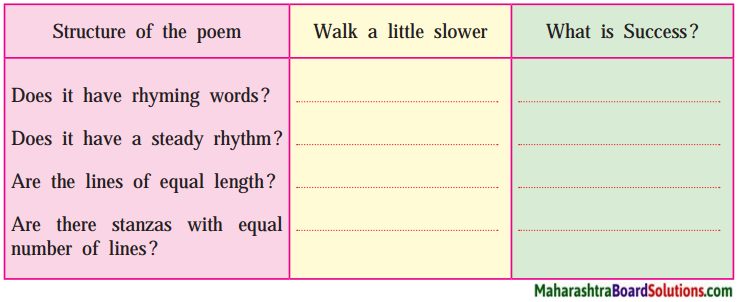
2. Compare this poem with ‘Walk a little slower …………’ and fill in the chart:

Question 1.
Compare this poem with ‘Walk a little slower …………’ and fill in the chart:
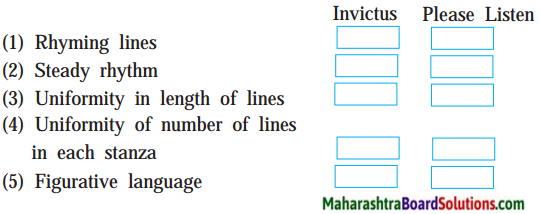
Maharashtra Board Class 9 My English Coursebook Solutions Chapter 4.1 What is Success 2
The poem ‘What is Success?’ is an example of free verse.
Answer:

Structure of the poemWalk a little slower…What is Success?
Does it have rhyming words?YesNo
Does it have a steady rhythm?YesNo
Are the lines of equal length?YesNo
Are there stanzas with equal number of lines?YesNo

3. Based on the poet’s idea of true success, think of four people in your surroundings- your family, neighbours, friends, teachers, classmates, etc. who have achieved true success. Write in short what makes them successful.

Question 1.
Based on the poet’s idea of true success, think of four people in your surroundings- your family, neighbours, friends, teachers, classmates, etc. who have achieved true success. Write in short what makes them successful.
Answer:

My family

My father is the backbone of my family. He works hard to fulfil our dreams. He has been working with determination continuously so that we can enjoy happy family life. We can understand his feelings and help him whenever he wants our help. We try to keep him happy and satisfied. He has made positive impact on our family members as well as on his circle of friends. So he is a role model for all of us.

Maharashtra Board Class 9 My English Coursebook Solutions Chapter 4.1 What is Success?

4. List all the ‘to infinitives’ verbs used in the poem.

Question 1.
List all the ‘to infinitives’ verbs used in the poem.
Answer:
to laugh, to win, to appreciate to find, to leave, to know, to have.

5. In your opinion what things will help to make the world a better place? Discuss with your friends and write down at least three of the things.

Question 1.
In your opinion what things will help to make the world a better place? Discuss with your friends and write down at least three of the things.
Answer:
To make the world a better place, I think the following things will help a lot:

  1. No fights, quarrels on the basis of caste, creed and religion.
  2. Everyone should get a chance to earn his/her bread and butter.
  3. Everyone should be mentally and physically fit and able.
  4. Education: Basic right of education to all.

6. Think of different types of people who have to face great difficulties. Write what you can do to help at least one of them.

Question 1.
Think of different types of people who have to face great difficulties. Write what you can do to help at least one of them.
Answer:
There are number of people in our society who have to face great difficulties. There are people like physically disabled, poor, old, sick, etc. The people who are poor, are under poverty line. So we can provide them various facilities related to education and fulfil their basic needs so that their standard of living would be improved.

Maharashtra Board Class 9 My English Coursebook Solutions Chapter 4.1 What is Success?

7. Prepare a set of questions to interview:

Question 1.
Prepare a set of questions to interview:
(a) A famous author
(b) A well-known social worker in your area.
Answer:
(a) A famous author:

  1. What are your feelings after the overwhelming response to your newly published book?
  2. Had you thought about such amazing response to your book?
  3. What inspires you to write such a lovely book?
  4. Are you working on any new book?
  5. Do you think about the readers’ choice before writing?
  6. Who is your favourite writer? Why?
  7. Have you thought about the Booker prize while writing this book?
  8. What is your ambition as a writer?
  9. What message would you like to give to your readers?

(b) A well-known social worker in your area:

  1. Are you really grateful to the voters of your area? Why?
  2. How will you help this area to develop?
  3. What are your future plans for the development of this area?
  4. Are there any social problems that the people in this area are facing?
  5. According to you, what is the role of education to develop society?
  6. What have you done to make available educational facilities in our area?
  7. What measures should be taken to fight against illiteracy, superstitions in our society?
  8. What motivated you to be a social worker?
  9. Is there any message that you would like to give to the citizens of this area?

My English Coursebook 9th Class Solutions Chapter 4.1 What is Success? Additional Important Questions and Answers

Simple Factual Activities:

Question 1.
There are lines in the poem.
(a) two
(b) fourteen
(c) seven
(d) four
Answer:
(b) fourteen.

Maharashtra Board Class 9 My English Coursebook Solutions Chapter 4.1 What is Success?

Question 2.
Complete the following sentences with the help of the given poem:
(Answers are directly given.)
Answer:

  1. A person who takes wise decisions and works for the benefit of everyone wins the respect of intelligent people.
  2. A person who is kind, sweet and helpful wins the affection of children.
  3. A person who puts a lot of efforts and works against all odds is appreciated by honest critics.
  4. A friend who is selfish and dishonest betrays a friend.

Complex Factual Activities:

Question 1.
What is success according to the poet Ralph Waldo Emerson?
Answer:
According to the poet Ralph Waldo Emerson, success lies in winning the respect, affection and appreciation of the people around us and to be able to respect, appreciate and care for people in return and how you make them happy.

Question 2.
Which lines tell you that a parent, a good gardener, a social reformer are all successful people?
Answer:
The lines that tell us that a parent, a good gardener, a social reformer are all successful people are: “To leave the world a bit better, whether by a healthy child, a gardener patch or a redeemed social condition To know even one life has breathed easier because you have lived; This is to have succeeded.”

Maharashtra Board Class 9 My English Coursebook Solutions Chapter 4.1 What is Success?

Poetic device Activities:

Question 1.
Give your own rhyming words for the following – (i) find (ii) patch.
Answer:
1. find – mind
2. patch – match.

Appreciation of Poem:

Point format

  1. Title: What is success?
  2. Poet/Poetess: The poet of the poem is Ralph Waldo Emerso.
  3. Theme/Central Idea: The theme of the poem is quite evident from the title of the poem itself. As the answer to the question posed in the title, the poet defines success as precisely as possible in the following lines.
  4. Rhyme Scheme: The poem is an example of ‘free verse’.
  5. Figure of Speech: Repitition, Euphemism.
  6. Special Features: This poem is an example of ‘free verse’. The lines of a ‘free verse’ do not have any steady rhythm. The lines are of irregular length and lack clear-cut stanza divisions. It has no rhyme scheme.
  7. Favourite Line: My favourite lines from the poem are:
    • (1) To find the best in others;
    • (2) To appreciate beauty To find the best in others
  8. Why I like the poem: I like this poem because it defines ‘success’ in a very special way.

Here, ‘success’ is not just an individual achievement. It is not taking advantage of others around us. It is, instead, giving back to society it is about making society a better place by our little contribution.

My English Coursebook 9th Class Digest Unit 4

Std 9 English Poem The Fall of Troy 2.4 Question Answer Maharashtra Board

Class 9 English Chapter 2.4 Question Answer Maharashtra Board

Balbharti Maharashtra State Board Class 9 English Solutions Kumarbharati Chapter 2.4 The Fall of Troy Notes, Textbook Exercise Important Questions and Answers.

The Fall of Troy Poem 9th Std Question Answer

English Kumarbharati 9th Solutions Chapter 2.4 The Fall of Troy Textbook Questions and Answers

Warming up:

Building a Story :
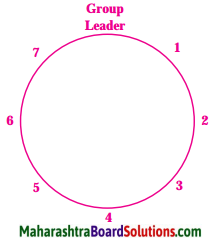
Form groups of eight. The group leader prepares slips of paper for each of the seven points given below and distributes them among the others. The group sits in a circle, taking their seats according to the number on the slip they have. Then each one completes the sentence on his/her slip without sharing it with the others. The group leader collects the slips and reads all the sentences aloud as one continuous passage. Does the story make sense? The group then works on the story to make it more meaningful and interesting.

This game may be played again, changing the groups, to form new stories.
Maharashtra Board Class 9 English Kumarbharati Solutions Chapter 2.4 The Fall of Troy 1

1. Once there was a ……………………….
2. Who lived in a ……………………….
3. He/She ate ……………………….
4. She/He went ……………………….
5. There she/he saw ……………………….
6. She/He was …………………………
7. That is why ……………………….

Question 1.

  1. Once there was a ……………………….
  2. Who lived in a ……………………….
  3. He/She ate ……………………….
  4. She/He went ……………………….
  5. There she/he saw ……………………….
  6. She/He was …………………………
  7. That is why ……………………….

Answer:

  1. Once there was a beautiful princess.
  2. Who lived in a dirty old shoe in a park.
  3. He/She ate nails and screws and paper.
  4. She/He went on a plane to the Arctic Circle.
  5. There she/he saw green mountains, lush forests and thundering waterfalls.
  6. She/He was very happy to go to Mars in the spaceship.
  7. That is why the doctor gave me the bitter medicine.

Maharashtra Board Class 9 English Kumarbharati Solutions Chapter 2.4 The Fall of Troy

The sentences as one continuous passage :

Once there was a beautiful princess who lived in a dirty old shoe in a park. She/He ate nails and screws and paper. She went on a plane to the Arctic Circle. There she saw green mountains, lush forests and thundering waterfalls. She was very happy to go to Mars in the spaceship. That is why the doctor gave me the bitter medicine.

The sentences read as one continuous passage do not make sense. However, if we make changes in the story, the passage will make sense.

  1. Once there was a beautiful princess.
  2. Who lived in a beautiful palace in a large forest.
  3. She ate only fresh fruits, vegetables and salads for every meal.
  4. She went on a voyage to the Arctic Circle.
  5. There she saw frozen seas, ice bergs and a variety of sea animals.
  6. She was thrilled to see so many different things, which she had never seen before.
  7. That is why she decided to visit a new place every year.

When we put these sentences given above as a continuous passage, they form a small and sensible story.
(Students can play the game again, changing the groups, to form new stories.)

Maharashtra Board Class 9 English Kumarbharati Solutions Chapter 2.4 The Fall of Troy

Interviews:

(a) Why? : Form groups of five. Choose a familiar character from any one of the epics you know. One person from the group plays the role of that character. Others in the group frame questions related to that character’s life. The condition is that all the questions should begin with ‘Why …?‘. They interview the character using these ‘Why -?‘ questions. Practise and present the interview in the classroom.
(b) How? : Follow the above procedure. Now all questions should begin with ‘How -?‘
(c) Prepare a short script of your interviews.

Question a.
Why?
Answer:
Form groups of five. Choose a familiar character from any one of the epics you know. One person from the group plays the role of that character. Others in the group frame questions related to that character’s life. The condition is that all the questions should begin with a ‘Why…’? They interview the character using these ‘Why?’ questions. Practice and present the interview in the classroom.
Example: Questions for Lord Rama. Epic: Ram ay an

  1. Why did you marry Sita?
  2. Why did your father ask you to leave the kingdom?
  3. Why did your stepmother want you to leave the kingdom?
  4. Why did Lakshman accompany you to the forest?
  5. Why did Lakshman leave Sita alone in the hut?

Question b.
How? : Follow the above procedure. Now all questions should begin with ‘How -?‘
Answer:
Example :

  1. How did you marry Sita?
  2. How many brothers did you have?
  3. How did your stepmother make you leave the kingdom?
  4. How did Ravana trick Sita?
  5. How did Hanuman help you?

Question c.
A short script of the interviews:
Answer:
Example :

Question 1.
Why did your father ask you to leave the kingdom?
Answer:
My father fulfilled my stepmother Kaikeyi’s wish and banished me from Ayodhya.

Maharashtra Board Class 9 English Kumarbharati Solutions Chapter 2.4 The Fall of Troy

Question 2.
Why did your stepmother want you to leave the kingdom?
Answer:
My stepmother Kaikeyi wanted her son Bharat to become the king. This would not have been possible if I had been in Ayodhya. Hence she wanted me to leave the kingdom.

Question 3.
Why did Lakshman accompany you to the forest?
Answer:
Lakshman loved me and wanted to ensure my safety in the forest. Hence he accompanied me to the forest.

Part – I

English Workshop:

1. Read the passage and name the following.

(a) He composed the Illiad and Odyssey: ……………….
(b) He persuaded Helen to elope wjth him: ……………….
(c) She was wife of the King Menelaus: ……………….
(d) He led the defence of Troy for nthe years: ……………….
(e) He was killed by a poisoned arrow that entered his heel: ……………….

Question 1.
(a) He composed the Illiad and Odyssey: ……………….
(b) He persuaded Helen to elope with him: ……………….
(c) She was wife of the King Menelaus: ……………….
(d) He led the defense of Troy for nine years: ……………….
(e) He was killed by a poisoned arrow that entered his heel: ……………….
Answer:
(a) He composed The Iliad and – The Odyssey Homer
(b) He persuaded Helen to elope with him. Paris
(c) She was the wife of King Menelaus. Helen
(d) He led the defense of Troy for nine years Hector
(e) He was killed by a poisoned arrow that entered his heel. Achilles

Maharashtra Board Class 9 English Kumarbharati Solutions Chapter 2.4 The Fall of Troy

2. Find antonyms of the following from the passage.
(a) barren × ……………..
(b) offended × ……………..
(c) cowardly × ……………..
(d) peace × ……………..
(e) surrender × ……………..
(f) exposed × ……………..
(g) defenceless × ……………..

Question 1.
Find antonyms of the following from the passage.
(a) barren × ……………..
(b) offended × ……………..
(c) cowardly × ……………..
(d) peace × ……………..
(e) surrender × ……………..
(f) exposed × ……………..
(g) defenceless × ……………..
Answer:
(a) barren × fertile
(b) offended × pleased
(c) cowardly × brave
(d) peace × war
(e) surrender × attack
(f) exposed × protected.
(g) defenceless × safe.

Maharashtra Board Class 9 English Kumarbharati Solutions Chapter 2.4 The Fall of Troy

3. From other sources find synonyms of the following words used in the story.
(a) great (hero)
(b) beautiful (woman)
(c) fight (verb)
(d) rich (city)
(e) safe
(f) strong (city)
(g) brave

Question 1.
From other sources find synonyms of the following words used in the story.
(a) great (hero)
(b) beautiful (woman)
(c) fight (verb)
(d) rich (city)
(e) safe
(f) strong (city)
(g) brave
Answer:
(a) great – gallant (hero)
(b) beautiful – entrancing (woman).
(c) fight – attack (verb)
(d) rich – prosperous (city)
(e) safe – sheltered.
(f) strong – well-protected (city)
(g) brave – courageous.

Maharashtra Board Class 9 English Kumarbharati Solutions Chapter 2.4 The Fall of Troy

4. Correct the following sentences using facts from the passage.
(a) Troy traded in cattle and grass, with other cities.
(b) During war, Trojans jumped over the fort gates to fight die enemy.
(c) Helen eloped with Menelaus.
(d) Troy was attacked because it was a strong. rich city.
(e) The Greek armies and heroes always defeated the Trojans.
(f) Both the enemies were eager to continue fighting.
(g) The great heroes avoided one another.
(h) Achilles was killed by an arrow that pierced his heart.

Question a.
Correct the following sentences using facts from the passage.
(a) Troy traded in cattle and grass, with other cities.
(b) During war, Trojans jumped over the fort gates to fight die enemy.
(c) Helen eloped with Menelaus.
(d) Troy was attacked because it was a strong. rich city.
(e) The Greek armies and heroes always defeated the Trojans.
(f) Both the enemies were eager to continue fighting.
(g) The great heroes avoided one another.
(h) Achilles was killed by an arrow that pierced his heart.
Answer:
(a) Troy traded in goods and grain with other cities.
(b) During the war, Trojans came out of the open fort gates to fight the enemy.
(c) Helen eloped with Paris.
(d) Troy was attacked because its Prince Paris had! persuaded Helen, the wife of a Greek king Menelaus, to elope with him.
(e) Sometimes the Trojans seemed to have the better of the fight and sometimes the Greeks.
(f) The Trojans were tired of being shut up in their city and the Greeks were longing to see their homes again.
(g) Sometimes there were single fights, between two great heroes.
(h) Achilles was killed by an arrow that pierced his heel.

Maharashtra Board Class 9 English Kumarbharati Solutions Chapter 2.4 The Fall of Troy

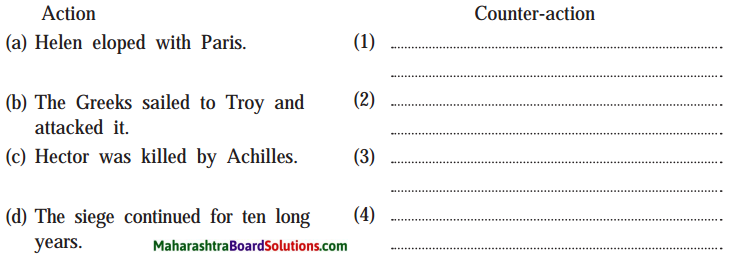
5. State the counter-action for the following actions.

Question 1.
State the counter-action for the following actions.
Maharashtra Board Class 9 English Kumarbharati Solutions Chapter 2.4 The Fall of Troy 2

Answer:

ActionCounter-action
1. Helen eloped with Paris.Greece declared war against the Troy.
2. The Greeks sailed to Troy and attacked it.The Trojans fought hard and the siege continued for ten years.
3. Hector was killed by Achilles.Achilles himself was killed later by a poisoned arrow.
4. The siege continued for ten long years.The Trojans fought hard and the fighting went on daily.

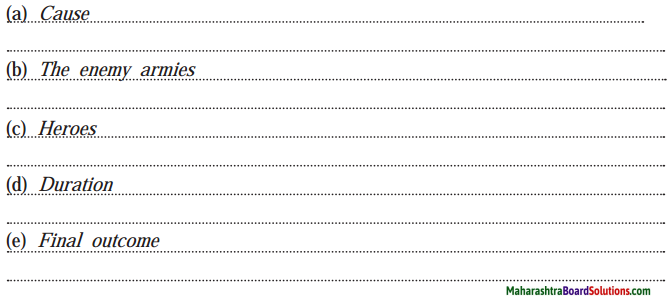
6. From either of our two Indian epics, find out which battle/war lasted the longest? Write down about its cause, the enemy armies, its heroes, its duration and the final outcome.

Maharashtra Board Class 9 English Kumarbharati Solutions Chapter 2.4 The Fall of Troy 3

7. Complete the following sentences with reference to the passage.
(a) Epics are long poems that ………………… .
(b) They may be composed and sung or recited for many years before …………….. .
(c) Nobody knows for certain who ………………………….. .
(d) It is believed that ……………. Homer, who ………….. and who ……………… to all who ……………. .
(e) At the back rose the high peak of Mount Ida, from which ………….. .

Question 1.
Complete the following sentences with reference to the passage.
(a) Epics are long poems that ………………… .
(b) They may be composed and sung or recited for many years before …………….. .
(c) Nobody knows for certain who ………………………….. .
(d) It is believed that ……………. Homer, who ………….. and who ……………… to all who ……………. .
(e) At the back rose the high peak of Mount Ida, from which ………….. .
Answer:
(a) Epics are long poems that relate the deeds of a great national hero or a great national war.
(b) They may be composed and sung or recited for many years before they are actually written down.
(c) Nobody knows for certain who the author of these early epics is.
(d) It is believed that The Iliad and The Odyssey were composed and recited by a blind poet named Homer, who lived about 900 BCE and who wandered from one Greek city or village to another, singing his poems to all who would receive him in their homes.
(e) At the back rose the high peak of Mount Ida, from which flowed many rivers and streams.

Underline the clauses in the above sentences and also the words that link or connect the clauses.

Question 1.
Epics are long poems that relate the deed of a great national hero or a great national war.
Answer:
Epics are long poems – Clause
that relate the deed of a great national hero or a great national war – Clause

Maharashtra Board Class 9 English Kumarbharati Solutions Chapter 2.4 The Fall of Troy

Question 2.
They may be composed and sung or recited for many years before they are actually written down.
Answer:
They may be composed – Clause (they may be)
sung – Clause (they may be)
recited for many years – Clause
before they are actually written down – Clause

Question 3.
Nobody knows for certain who the author of these early epics is.
Answer:
Nobody knows for certain – Clause
who the author of these early epics is – Clause

Question 4.
It is believed that The Iliad and The Odyssey were composed and recited by a blind poet named Homer, who lived about 900 BCE and who wandered from one Greek city or village to another, singing his poems to all who would receive him in their homes.
Answer:
It is believed – Clause
that The Iliad and The Odyssey were composed – Clause
(that The Iliad and The Odyssey were)
recited by a blind poet named Homer – Clause
who lived about 900 BCE – Clause

Maharashtra Board Class 9 English Kumarbharati Solutions Chapter 2.4 The Fall of Troy

Question 5.
At the back rose the high peak of Mount Ida, from which flowed many rivers and streams.
Answer:
At the back rose the high peak of Mount Ida – Clause
from which flowed many rivers and streams – Clause

Part – II

1. Find and write the Greek and Trojan names used in the story (Part I and II).

Question 1.
Find and write the Greek and Trojan names used in the story (Part I and II).

2. List all the words related to ‘war’ from both parts of the story.

Question 1.
List all the words related to ‘war’ from both parts of the story.

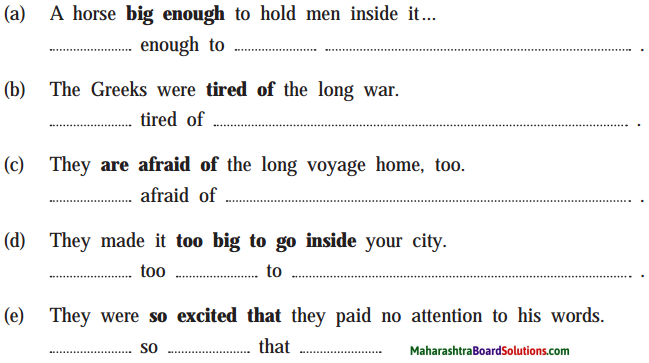
3. Note the following constructions carefully and then use them to express your ideas:

Question 1.
Note the following constructions carefully and then use them to express your ideas:

Maharashtra Board Class 9 English Kumarbharati Solutions Chapter 2.4 The Fall of Troy 4

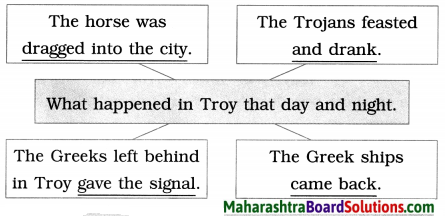
4. Put the following events in the order in which they took place. Number them accordingly.

Question 1.
(a) The Trojans found a Greek man under the big wooden horse. [ ]
(b) They broke down part of the wall and brought the horse in. [ ]
(c) The cunning Odysseus thought of a plan. [ ]
(d) The Greeks burnt their tents and sailed away. [ ]
(e) Troy was burnt down. [ ]
(f) The Greeks built a big wooden horse. [ ]
(g) The great heroes hid inside the horse. [ ]
(h) The priest warned the Trojans not to break the wall. [ ]
(i) The Trojans were happy to see the Greek ships go. [ ]
(j) The Trojans slept soundly. [ ]
(k) The Greeks came out of the horse and opened the gates. [ ]
(l) The Greek army entered the city. [ ]
Answer:
(a) The Trojans found a Greek man under the big wooden horse. [f]
(b) They broke down part of the wall and brought the horse in. [h]
(c) The cunning Odysseus thought of a plan. [a]
(d) The Greeks burnt their tents and sailed away. [d]
(e) Troy was burnt down. [i]
(f) The Greeks built a big wooden horse. [b]
(g) The great heroes hid inside the horse. [c]
(h) The priest warned the Trojans not to break the wall. [g]
(i) The Trojans were happy to see the Greek ships go. [e]
(j) The Trojans slept soundly. [i]
(k) The Greeks came out of the horse and opened the gates. [j]
(l) The Greek army entered the city. [k]

Maharashtra Board Class 9 English Kumarbharati Solutions Chapter 2.4 The Fall of Troy

5. Form pairs. Imagine you are a pair of Trojans and you have come to know about Odysseus’s plan. Make a counter plan to defeat the Greeks. Write down your plan as you would explain it to your fellow Trojans.

Question 1.
Form pairs. Imagine you are a pair of Trojans and you have come to know about Odysseus’s plan. Make a counter plan to defeat the Greeks. Write down your plan as you would explain it to your fellow Trojans.

6. Identify one example of a main clause and one example of a dependent clause from page 46. (Read the entry regarding clause in the Language Study pages.)

Question 1.
Identify one example of a main clause and one example of a dependent clause from page 46. (Read the entry regarding clause in the Language Study pages.)
Answer:
Many of the Trojans were killed before they could put on their armour.
Many of the Trojans were killed – Main Clause before they could put on their armour – Dependent Clause

Maharashtra Board Class 9 English Kumarbharati Solutions Chapter 2.4 The Fall of Troy

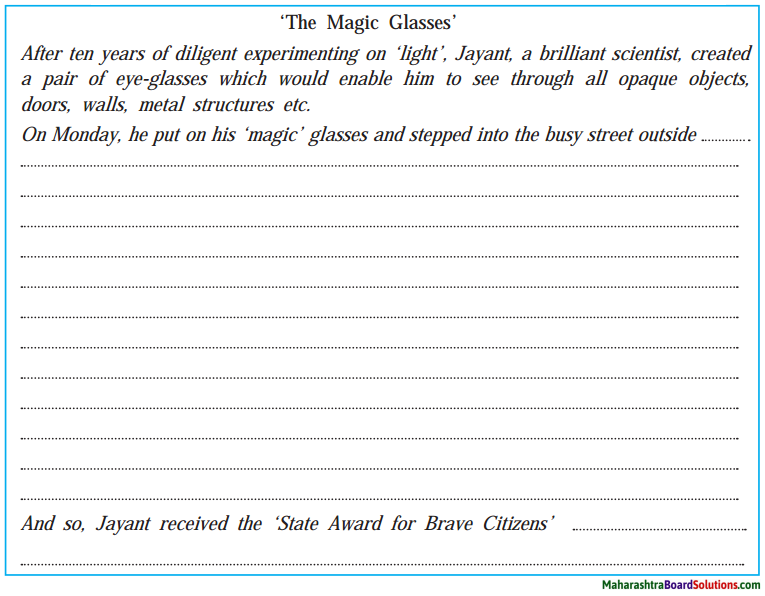
7. Be a writer.
(a) Now read the beginning and end of a sci-fi story given below and complete the story using your imagination.

Maharashtra Board Class 9 English Kumarbharati Solutions Chapter 2.4 The Fall of Troy 5

Question a.
Now read the beginning and end of a sci-fi story given below and complete the story using your imagination.
Answer:
‘The Magic Glasses’
After ten years of diligent experimenting on ‘light’, Jayant, a brilliant scientist, created a pair of eye-glasses that would enable him to see through all opaque objects, doors, walls, metal structures, etc. .
On Monday, he put on his ‘magic’ glasses and stepped into the busy street outside …

Everything seemed normal – the traffic, the crowds, etc. Suddenly, Jayant tripped over something and he looked down. It was the metal covering of a manhole. As he looked, he saw a strange sight. There were three little children below, deep under the footpath! How was that possible? Why was no one helping them? They were crying and wailing, sitting in the mess inside the drain. He looked up, and then realized that he had seen them because of his magic eye-glasses.

“Come on, help!” he shouted. “There are children trapped under this footpath, inside this drain!”
Several people stopped. “How do you know?” asked a non-believer.
“What is going on here?” asked an officious- looking policeman.
“Don’t talk – just help!” snapped Jayant, trying to prise open the manhole cover. It was heavy, and several good Samaritans stepped forward to help. Within a few moments, the heavy lid was in their hands.
Everyone peered into the dark, gloomy and smelly drain. They could hear the faint sounds of crying. “I’m going down,” said Jayant. “Those little ones will not be able to bear the poisonous gases much longer.”
With the help of the cooperative by-standers, Jayant went down into the manhole and rescued the little kids – all of whom were below the age of five. Everyone clapped when he came out, dirty and smelly, with the three half-conscious kids.
And so, Jayant received the ‘State Award for Brave Citizens’. ………………………………………………………………
…………………………………………………………………………………………………………………………………………………………………………. .

Maharashtra Board Class 9 English Kumarbharati Solutions Chapter 2.4 The Fall of Troy

Question b.
Read the following and observe the use of tenses.
‘Last week I witnessed a strange accident. Let ¡ne tell you about it. The signal flashes green. Vehicles start from the opposite direction. They ¡nove fast. Suddenly a speeding motorcyclist tries to cut across, from the wrong side. He is about to collide with a loaded truck. He applies the brakes. He falls and slides out with his bike from under the truck. He comes out unscathed on the other side.’ When an event, which has occured in the past, is narrated in the Present Tense to create a dramatic effect its Tense is called the ‘Dramatic Present Tense’ Now try to relate Jayant s sci-fI story, in brief, in the dramatic past tense.
……………………………………………………………………………………………………………………….
……………………………………………………………………………………………………………………….
……………………………………………………………………………………………………………………….
Answer:
Jayant wears his magic glasses and steps into the street. He trips over a manhole and looks down. What! Are there three little kids trapped inside the drain under the footpath? Jayant looks around for help, but there are non – believers around him. He tries to prise open the manhole cover. Suddenly, willing hands help him.

The cover is open, and they hear the sounds of children crying. Jayant bravely lowers himself down the dirty drain. He soon rescues the three kids trapped inside. As he hands over the kids to the policeman, the people around clap for him. He is a hero. Jayant later receives the ‘State Award for Brave Citizens’.

Maharashtra Board Class 9 English Kumarbharati Solutions Chapter 2.4 The Fall of Troy

English Kumarbharati 9th Digest Chapter 2.4 The Fall of Troy Additional Important Questions and Answers

Read the following passages carefully and complete the activities :

Simple Factual Activity :

1. Name the following :
(The answers are given directly and underlined.)

  1. The language of The Iliad and The Odyssey : Ancient Greek
  2. The language of The Mahabharata : Sanskrit
  3. The most beautiful woman in the world : Helen of Troy.

2. Complete the following sentences :
(The answers are given directly and underlined.)

  1. Odysseus thought of a plan to obtain victory.
  2. Troy was taken, not by force but by a trick.
  3. Two great heroes, Menelaus and Odysseus, entered the horse.
  4. Only one man was left behind to persuade the Trojans to drag the horse into their city.

Maharashtra Board Class 9 English Kumarbharati Solutions Chapter 2.4 The Fall of Troy

3. Write the correct number against the sentences in the order in which it happened :

  1. They found a Greek with his hands tied together. ]2]
  2. Let us make a hole in the wall and drag the horse in. [4]
  3. They saw the huge, wooden horse. [1]
  4. The Greek told them his tale. [3]

4. Complete the web:
(The answers are given directly and underlined.)
Maharashtra Board Class 9 English Kumarbharati Solutions Chapter 2.4 The Fall of Troy 6

Complex Factual Activity :

Question 1.
How were epics transmitted from generation to generation?
Answer:
Epics were transmitted from generation to generation through songs and recitals for many years before they were actually written down.

Maharashtra Board Class 9 English Kumarbharati Solutions Chapter 2.4 The Fall of Troy

Question 2.
Why is Homer honoured with the title ‘Father of European Poetry?’
Answer:
It is believed that the two great epics of European literature, The Iliad and The Odyssey, were composed and recited by Homer. Hence he has been honoured with the title ‘Father of European Poetry’.

Question 3.
How did Odysseus plan to defeat the Trojans ?
Answer:
Odysseus advised the Greeks to build a great wooden horse, big enough to hold men inside it. Some of their best fighters would hide inside the horse. Then they would burn their tents and pretend to sail away in their ships. But instead of sailing away, they would return at midnight. One man would be left behind with the horse to persuade the Trojans to drag the horse into their city.

After the horse with the soldiers had entered the city, at the appropriate time, the door in the horse would be opened and the soldiers hiding inside would attack Troy. The gates would be opened to allow the remaining Greek soldiers from the ships into the city. The combined force of the Greeks would defeat the Trojans and they would destroy the city of Troy.

Question 4.
What was the reason for Troy to rejoice and celebrate?
Answer:
The Trojans rejoiced and celebrated because after ten long years, the siege was finally over. The tents of the Greeks had been burnt. The shore was deserted. The Greek ships had all gone. The Trojans could go out on the plain and move around as they pleased.

Maharashtra Board Class 9 English Kumarbharati Solutions Chapter 2.4 The Fall of Troy

Activities based on Vocabulary :

Question 1.
Find the synonyms of the following words used in the story :
famous
Answer:
famous – well-known

Question 2.
Write the adjective forms of the following words :

  1. hospitality
  2. hero
  3. history
  4. poem

Answer:

  1. hospitality – hospitable
  2. hero – heroic
  3. history – historical
  4. poem – poetic.

Maharashtra Board Class 9 English Kumarbharati Solutions Chapter 2.4 The Fall of Troy

Question 3.
Write from the passage words that sound the same (homophones) as the following :

  1. grate
  2. sale
  3. would
  4. site

Answer:

  1. great
  2. sail
  3. wood
  4. sight.

Question 4.
Use the phrase ‘enough to’ in your own sentence :
Answer:
Our school auditorium was big enough to hold a grand function.

Question 5.
Give one word from the passage for :

  1. great surprise
  2. pulled out forcibly

Answer:

  1. great surprise – astonishment
  2. pulled out forcibly – dragged

Maharashtra Board Class 9 English Kumarbharati Solutions Chapter 2.4 The Fall of Troy

Question 6.
Use these phrases in your own sentences :
(Please refer to textbook page 47 for examples.)

  1. tired of
  2. afraid of
  3. too … to …

Answer:

  1. We were tired of the long wait for the bus.
  2. The children were afraid of the commotion.
  3. The bed was too big to be kept in the room.

Question 7.
Use the phrases in your own sentences :

  1. so … that
  2. as soon as
  3. all that day
  4. in order to

Answer:

  1. The teenagers were so excited that it was difficult to control them.
  2. I opened my umbrella as soon as it began to rain.
  3. Though their mother shouted at them, the girls lazed about all that day.
  4. We have to work hard in order to do well in life.

Maharashtra Board Class 9 English Kumarbharati Solutions Chapter 2.4 The Fall of Troy

Activity-based on Contextual Grammar :

Question 1.
Change the voice of the following sentences :

  1. It is believed that The Iliad and The Odyssey were composed by Homer.
  2. Nobody knows who the author of these epics is.

Answer:

  1. People believe that Homer composed The Iliad and The Odyssey.
  2. It is not known who the author of these epics is.

Question 2.
When the Trojans are asleep, we will attack the city. (Pick out and name the clauses.)
Answer:
we will attack the city – Main Clause.
When the Trojans are asleep – Subordinate Adverb Clause of Time.

Question 3.
The Greek leaders decided to follow the advice of the wise Odysseus. (Frame a Wh-question to get the underlined part as the answer.)
Answer:
Whose advice did the Greek leaders decide to follow?

Maharashtra Board Class 9 English Kumarbharati Solutions Chapter 2.4 The Fall of Troy

Question 4.
Rewrite the sentence using ‘no sooner than’ :
As soon as they were hidden by an island, they had lowered their sails.
Answer:
No sooner were they hidden by an island, than they had lowered their sails.

Question 5.
Rewrite the sentence using ‘too … to’ :
They were so excited that they paid no attention to his words.
Answer:
They were too excited to pay any attention to his words.

Personal Response :

Question 1.
Have you seen any of the stories mentioned in the passage in TV serials or movies?
Answer:
Yes, I have seen both the Ramayana and the Mahabharata as TV serials.

Question 2.
Who are considered to be the authors of the epics ‘Ramayana’ and ‘Mahabharata’ respectively?
Answer:
Sage Valmiki is considered to be the author of ‘The Ramayana’ and Ved Vyasa is considered to be the author of ‘The Mahabharata’.

Maharashtra Board Class 9 English Kumarbharati Solutions Chapter 2.4 The Fall of Troy

Question 3.
What do you think about Odysseus?
Answer:
I think that Odysseus was cunning and used underhand methods to win the war. The war should have been fought and won honestly, not by the use of a trick. Odysseus should not have given such advice and the Greeks should not have taken it.

Question 4.
What, do you think, is needed for a city to be prosperous?
Answer:
To be prosperous, a city must be well situated and have good natural resources, like water and fertile land. It should be safe from enemies. The people and the rulers should be intelligent, sensible and honest. They should also be hard-working. If all these factors are present, then a city will become prosperous.

Maharashtra Board Class 9 English Kumarbharati Solutions Chapter 2.4 The Fall of Troy

Question 5.
Do you think that wars can solve problems?
Answer:
No, they cannot. Problems can be solved only by sitting around a table and sorting out the disputes. The practice of ‘an eye for an eye’ will only end up making the whole world blind. Wars kill people and destroy civilizations.

Question 6.
Do you think the Greeks and Trojans were superstitious? Give reasons for your answer.
Answer:
There is nothing to indicate that the Greeks were superstitious. But the Trojans were superstitious and believed that the wooden horse would bring them luck if they dragged it into their city.

Question 7.
How could the fall of Troy been avoided?
Answer:
The fall of Troy could have been avoided if the Trojans had been wise enough to detect the ‘wooden horse plot’ hatched by the Greeks. They should also not have been stupid enough to believe the silly story told by the lone Greek. They should at least, have listened to their wise priest who had warned them that the horse could be a trick to destroy Troy.

Maharashtra Board Class 9 English Kumarbharati Solutions Chapter 2.4 The Fall of Troy

Question 8.
What do you think the Trojans should have done when they found the horse?
Answer:
The Trojans should not have believed the Greeks. They should have been cautious and examined the horse minutely. They should also not have been superstitious enough to bring the horse into the city, expecting good luck. They should have heeded the words of the wise priest.

Complex Factual Activities :

Question 1.
How did the location of Troy help it to grow into a very rich, prosperous city?
Answer:
Troy was well situated. In front of it was the sea over which sailed the ships of Troy, carrying goods and grain. At the back rose the high peak of Mount Ida, from which flowed many rivers and streams. The valleys were well-watered and fertile. Cattle fed on the rich grass of the meadows while sheep fed on the slopes of the hills. Thus, it was well situated, both for commerce and agriculture, and grew into a rich, prosperous city.

Question 2.
How were the Trojans protected during wartime?
Answer:
The Trojans had built a strong wall around the city so that no enemy should attack them from the sea. There were huge gates in the wall. In times of war, the gates would be closed, and then the city was like a strong fortress, quite safe from all attack.
It was thus protected by the walls around it as well as by the hills behind.

Maharashtra Board Class 9 English Kumarbharati Solutions Chapter 2.4 The Fall of Troy

Question 3.
Was it enough to use the wooden horse to hide? What was done to make the Trojans take it inside the city?
Answer:
It was not enough to use the wooden horse to hide. It had to be taken inside the city. To achieve this, a Greek, who had been left behind for this very purpose, said that the horse had been left behind as an offering to the god of the sea. It had been made very big so that the Trojans could not take it inside their city. If they did so, the luck would go to the Trojans and not to the Greeks. When they heard this, the Trojans wanted to take the wooden horse inside the city, and they broke their walls to do so.

Question 4.
How did the cunning Greek explain the presence of such a large wooden horse?
Answer:
The cunning Greek said that the Greeks who had left were afraid of the long voyage home. They had made the horse and left it behind as an offering to the god of the sea. It had been made very big so that the Trojans could not take it inside their city. If they did so, the luck would go to the Trojans and not to the Greeks.

Maharashtra Board Class 9 English Kumarbharati Solutions Chapter 2.4 The Fall of Troy

Question 5.
What was the cause of the ten-year-old war between the Greeks and the Trojans?
Answer:
Paris, a prince of Troy, had persuaded Helen, wife of a Greek King called Menelaus, to elope j with him. He had brought her to Troy. The Greeks wanted to take revenge on Troy for the wrong done to Menelaus. This was the cause of the ten-year-old war between the Greeks and the Trojans.

Question 6.
What reckless, thoughtless step did the Trojans take?
Answer:
The reckless/thoughtless step that the Trojans took was to break down part of their wall and drag the wooden horse into the city. They also celebrated and slept soundly.

Question 7.
How did the Greeks enter the city of Troy?
Answer:
When the cunning Greek who had been left behind saw the Greek fleet returning to the shores of Troy, he crept to the wooden horse and gave the signal. The side of the horse opened, and the Greeks who were inside climbed out and opened the gates. * The whole Greek army entered the city.

Maharashtra Board Class 9 English Kumarbharati Solutions Chapter 2.4 The Fall of Troy

Question 8.
How did the Greek ships remain hidden from Troy?
Answer:
As soon as the Greek ships were hidden : by an island, they lowered their sails and dropped anchor. Thus they remained hidden from Troy.

Activities based on Contextual Grammar :

Question 1.
Round their city the Trojans had built a strong wall. (Pick out the verb and state its tense.)
Answer:
had built – past perfect tense.

Question 2.
The wall was so broad that people could stand on it. (Pick out the modal auxiliary and state what it indicates.)
Answer:
could – indicates ability.

Maharashtra Board Class 9 English Kumarbharati Solutions Chapter 2.4 The Fall of Troy

Question 3.
Pick out the clauses from the following sentence and state their type :
He spoke and told them this false tale.
Answer:
He spoke – Main Clause.
(He) told them this false tale – Main Clause.

Question 4.
Rewrite the sentence using ‘which’ :
They saw on the sands the huge, wooden horse.
Answer:
They saw on the sands a huge horse which
was made of wood.

Question 5.
He had brought her to Troy.
(Rewrite beginning ‘She …’)
Answer:
She had been brought to Troy (by him).

Question 6.
The fighting went on daily, but the siege did not end. (Rewrite replacing the underlined word with its verb form.)
Answer:
They fought daily, but the siege did not end.

Maharashtra Board Class 9 English Kumarbharati Solutions Chapter 2.4 The Fall of Troy

Question 7.
Write two present participles from the passage, used as adjectives. Also, write the nouns they modify:
Answer:

Present Participles used as AdjectivesNouns they modify
1. leapingflames
2. weepingwomen
3. sleepingTrojans

Simple Activities :

Question 1.
Write two compound words of your own.
Answer:
walking stick, fire engine

Question 2.
Make a meaningful sentence using the phrase : ‘among the hills’
Answer:
The tribal communities living among the hills are very poor.

Maharashtra Board Class 9 English Kumarbharati Solutions Chapter 2.4 The Fall of Troy

Question 3.
Spot the error and correct the sentence :
It is believe that The Iliad and The Odyssey were compose by Homer.
Answer:
It is believed that The Iliad and The Odyssey were composed by Homer.

Question 4.
Pick out a present participle from the given sentence :
The valleys were fertile, with corn growing in the fields.
Answer:
present participle – growing.

Question 5.
Identify the type of sentence :
But all the kings and heroes had declared war against the Trojans.
Answer:
Assertive sentence

Question 6.
Find out two hidden words from the word ‘hospitality
Answer:
hospitality – hospital, soapy, (spoil, host)

Question 7.
Form a present participle in which the last letter is doubled.
Answer:
hit-hitting

Maharashtra Board Class 9 English Kumarbharati Solutions Chapter 2.4 The Fall of Troy

Question 8.
Write the following words in alphabetical order.
great, grain, final, fight
Answer:
fight, final, grain, great.

Question 9.
Make a word chain of four more abstract nouns:
revenge →
Answer:
revenge → empathy → youth → health → humility

Maharashtra Board Class 9 English Kumarbharati Solutions Chapter 2.4 The Fall of Troy

Question 10.
Write two compound words of your own.
Answer:
policeman, washing machine

Question 11.
Make a meaningful sentence using the phrase : ‘to follow the advice’
Answer:
Our parents told us to follow the advice of the counseller.

Question 12.
Spot the error and correct the sentence :
Paris himself were killed, also by a poisoned arrow.
Answer:
Paris himself was killed, also by a poisoned arrow.

Question 13.
Use the word ‘sleeping’ as a gerund in your own sentence :
Answer:
I love sleeping.

Maharashtra Board Class 9 English Kumarbharati Solutions Chapter 2.4 The Fall of Troy

Question 14.
Identify the type of sentence, and state ; whether it is affirmative or negative :
The Greeks have gone and the walls are no longer necessary.
Answer:
Assertive sentence (negative)

Question 15.
Find out two hidden words from the word :
celebration
Answer:
celebration – liberate, berate, (clear, brain).

Question 16.
Pick out the verb from the following that forms its past participle by doubling the last letter :
mail, cut, hit, rot
Answer:
rot (rotted)

Maharashtra Board Class 9 English Kumarbharati Solutions Chapter 2.4 The Fall of Troy

Question 17.
Arrange these words in alphabetical order :
wooden, walls, terror, tower
Answer:
terror, tower, walls, wooden

Medium-Level Activities :

Question 1.
Use the word ‘peak’ and its homophone in two separate sentences :
Answer:
(a) Mt. Everest is one peak I wish to climb.
(b) I might take a peek at the proposed site.

Question 2.
The Trojans fought hard. (Use the past perfect progressive tense of the verb.)
Answer:
The Trojans had been fighting hard.

Maharashtra Board Class 9 English Kumarbharati Solutions Chapter 2.4 The Fall of Troy

Question 3.
Prepare a word register for all the words related to ‘war’ from the lesson.
Answer:
war-enemy, attack, fortress, soldiers, siege, battles, armies, heroes, fought, fighting, killed, taken, victory, fighters, terror, death, weapons, armour, conquerors.

Question 4.
Use the word ‘sail’ and its homophone in two separate sentences :
Answer:
(a) The sea gull sat on the sail of the boat.
(b) There is a wonderful sale at the mall this week.

Question 5.
The Greeks burned their tents.
(Use the present perfect tense of the verb.)
Answer:
The Greeks have burned their tents.

Maharashtra Board Class 9 English Kumarbharati Solutions Chapter 2.4 The Fall of Troy

Question 6.
“ But why did the Greeks make such a huge horse?” some of the Trojans asked.
(Rewrite using reported speech.)
Answer:
Some of the Trojans asked why the Greeks had made such a huge horse.

Question 7.
Prepare a word register of all the Greek and Trojan names in the story.
Answer:
Greek and Trojan names – Odysseus, Menelaus, Agamemnon, Troy, King Priam, Hector, Helen, Aphrodite, Iliad, Odyssey, Achilles, Homer, Ilium, Aegean Sea, Mount Ida, Greece, Paris.

Challenging Activities :

Question 1.
Use the word ‘force’ as a noun and a verb in two separate sentences.
Answer:
(a) The policeman had to use a lot of force ; to open the door, (noun)
(b) Parents should not force children into careers j that the children do not like, (verb)

Maharashtra Board Class 9 English Kumarbharati Solutions Chapter 2.4 The Fall of Troy

Question 2.
The Trojans too fought hard and the siege j continued for ten long years. (Pick out the clauses j and write the type of sentence.)
Answer:
The Trojans too fought hard – Coordinate Clause the siege continued for ten long years – Coordinate Clause ; Compound Sentence

Question 3.
Use the words ‘rejoicing’ and ‘voyage’ in a single sentence.
Answer:
There was a lot of rejoicing by the seamen on the voyage home.

Question 4.
It may be a trick that will ruin us. (Pick out the modal and state its function.)
Answer:
may-possibility

Maharashtra State Board Class 9 English Solutions

English Kumarbharati 9th Digest Answers Pdf 2020 Unit 2

Std 9 English Poem The Necklace 1.5 Question Answer Maharashtra Board

Class 9 English Chapter 1.5 Question Answer Maharashtra Board

Balbharti Maharashtra State Board Class 9 English Solutions Kumarbharati Chapter 1.5 The Necklace Notes, Textbook Exercise Important Questions and Answers.

The Necklace Poem 9th Std Question Answer

English Kumarbharati 9th Solutions Chapter 1.5 The Necklace Textbook Questions and Answers

Warming up :

Talking About Myself :

1. Write a few lines about yourself – your name, appearance, family, the place where you live, your school, your friends, neighbours, relatives, your likes, dislikes, hobbies, what you are good at, etc.

Now create an imaginary ‘persona’ for yourself. It can be quite different from your real self. Or, you may choose a fictional character – a character from a novel, story, etc. Write a few lines about this imaginary persona and introduce yourself in that role.

Maharashtra Board Class 9 English Kumarbharati Solutions Chapter 1.5 The Necklace 1

Question 1.
Write a few lines about yourself – your name, appearance, etc. Then create an imaginary ‘persona’ for yourself. It may be quite different from your real self. Or you may choose a fictional character and introduce yourself in that role.
(Only a few lines have been given here. Students can expand the paragraphs as they wish.)
Answer:
Maharashtra Board Class 9 English Kumarbharati Solutions Chapter 1.5 The Necklace 2

Maharashtra Board Class 9 English Kumarbharati Solutions Chapter 1.5 The Necklace

My Dream Possession :

Is there something that you would like to own more than anything else? Describe your dream possession with the help of the following points. You may add your own points, too.

Maharashtra Board Class 9 English Kumarbharati Solutions Chapter 1.5 The Necklace 3

Question 1.
Is there something that you would like to own more than anything else? Describe your dream possession with the help of the following points. You may add your own points, too.
Answer:
Maharashtra Board Class 9 English Kumarbharati Solutions Chapter 1.5 The Necklace 4

Part – I

English Workshop :

1. Read each of the following sentences aloud. Write who said it and to whom.

(a) “Look, here’s something for you.”
(b) “Why, the dress you go to the theatre in!”
(c) “I would rather not go to the party.”
(d) “Choose, my dear.”
(e) “You have nothing else?”
(f) “Would you lend lue this, just this?”
(g) “What ! … how ! … That’s impossible!”

Question a.
“Look, here’s something for you.”
Answer:
Mathilde’s husband said this to Mathilde.

Question b.
“Why, the dress you go to the theatre in!”
Answer:
Mathilde’s husband said this to Mathilde.

Maharashtra Board Class 9 English Kumarbharati Solutions Chapter 1.5 The Necklace

Question c.
“I would rather not go to the party.”
Answer:
Mathilde said this to her husband.

Question d.
“Choose, my dear.”
Answer: Madame Forestier said this to Mathilde.

Question e.
“You have nothing else?”
Answer:
Mathilde said this to Madame Forestier.

Question f.
“Would you lend me this, just this?”
Answer:
Mathilde said this to Madame Forestier.

Maharashtra Board Class 9 English Kumarbharati Solutions Chapter 1.5 The Necklace

2. Write a few lines about what Mathilde had and what she dreamt about.

Question 1.
Write a few lines about what Mathilde had and what she dreamt about.
Answer:
Mathilde had plain dresses and a shabby, poorly furnished house. She dreamt of a grand. palatial mansion, with vast rooms and inviting smaller rooms, perfumed for afternoon chats with close friends.

3. Write what you think about the following thoughts and actions of Mathilde.
(a) Mathilde was beautiful, and so she wanted to marry an aristocrat.
(b) Mathilde was sad because she did not get any luxuries.
(c) Mathilde felt that her house was shabby and poorly furnished.
(d) Mathilde wanted other people to envy her.
(e) Mathilde was not happy to see the invitation.
(f) Mathilde wanted a new dress for herself.
(g) Mathilde borrowed a diamond necklace from her friend and wore it to the party.
(h) Mathilde lost the necklace.

Question a.
Mathilde was beautiful and so she wanted to many an aristocrat.
Answer:
I think that this is a natural but childish wish. What Mathilde does not realize is that happiness does not lie in money or status. It depends on the character of a person.

Maharashtra Board Class 9 English Kumarbharati Solutions Chapter 1.5 The Necklace

Question b.
Mathilde was sad because she did not get any luxuries.
Answer:
I feel sympathetic towards Mathilde. Everyone wants luxuries, but not everyone can get them. Mathilde should have realized this and been content with whatever she had. She should have tried to improve her living conditions in some way.

Question c.
Mathilde felt that her house was shabby and poorly furnished.
Answer:
This shows Mathilde’s inability to deal with reality. Mathilde should have tried to make the house a home by keeping it clean and doing things with love, instead of looking at the material things that were there.

Question d.
Mathilde wanted other people to envy her.
Answer:
This is a very natural feeling. To some extent, we all want others to admire and envy us; but Mathilde should have kept this feeling under control.

Maharashtra Board Class 9 English Kumarbharati Solutions Chapter 1.5 The Necklace

Question e.
Mathilde was not happy to see the invitation.
Answer:
This Is a natural reaction on her part, for she wanted to be well-dressed and look pretty when she went to an important party. However, she should not have disappointed her husband by immediately showing her unhappiness. She could have later presented her case less bluntly.

Question f.
Mathilde wanted a new dress for herself.
Answer:
Mathilde was young and pretty and wanted new things. But she should have first asked her husband what he had saved the money for, and then decided what was more important – her dress or his gun. He was very generous and she should also have shown some genuine consideration.

Question g.
Mathilde borrowed a diamond necklace from her friend and wore it to the party.
Answer:
Mathilde should not have borrowed such an expensive necklace just to show off. One should never borrow expensive things from others.

Maharashtra Board Class 9 English Kumarbharati Solutions Chapter 1.5 The Necklace

Question h.
Mathilde lost the necklace.
Answer:
Mathilde was very thrilled by her own triumph at the party. She forgot everything in the revelry. In my opinion, she should have taken care and not been so Irresponsible, especially when she was wearing borrowed jewels.

4. Prepare a formal invitation using the following format:

Maharashtra Board Class 9 English Kumarbharati Solutions Chapter 1.5 The Necklace 5

Question 1.
Prepare a formal invitation using the format given on page 21 of the textbook.
Answer:
Maharashtra Board Class 9 English Kumarbharati Solutions Chapter 1.5 The Necklace 6

Maharashtra Board Class 9 English Kumarbharati Solutions Chapter 1.5 The Necklace

5. Read the following :

  • The necklace
  • an error
  • all these things
  • another woman
  • one evening
  • her husband.

1. In all these phrases we see some words used before the nouns.

2. They specify or make it clear what noun we are talking about. These words that are used at the beginning of a noun phrase are known as determiners.

3. Determiners include articles (a, an, the), possessive pronouns (my, our, your, her, etc.), demonstratives (words like this, that), quantifiers (much, many, etc.), numerals, etc.

4. Write your phrases using each of type of determiner.

Question 1.
Write your own phrases using the possessive pronouns ‘my’, ‘his’ and ‘your’.
Answer:
my daughter, his clothes, your umbrella

Question 2.
Write your own phrases using the articles a, an, the.
Answer:
a house, a flower, an invitation, an enquiry, the Arabian Sea, the Himalayas

Question 3.
Write your own phrases using the ; demonstratives (this, that, these, those) :
Answer:
this tree, that building, these flowers, those hills.

Maharashtra Board Class 9 English Kumarbharati Solutions Chapter 1.5 The Necklace

Question 4.
Write your own phrases using the following quantifiers :
1. much
2. many
Answer:
1. much trouble, much hope
2. many apples, many trees

Part – II

1. Complete the following table.  

Maharashtra Board Class 9 English Kumarbharati Solutions Chapter 1.5 The Necklace 7

Question 1.
Complete the following table.
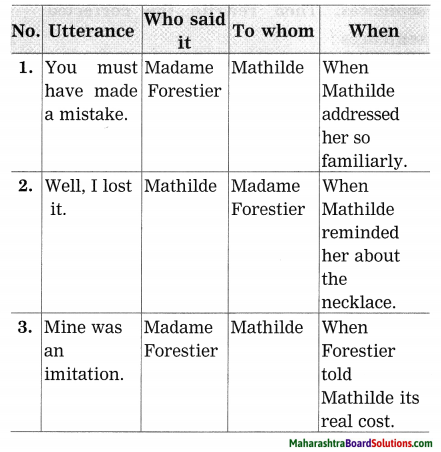
Answer:
Maharashtra Board Class 9 English Kumarbharati Solutions Chapter 1.5 The Necklace 8
Maharashtra Board Class 9 English Kumarbharati Solutions Chapter 1.5 The Necklace 9 Maharashtra Board Class 9 English Kumarbharati Solutions Chapter 1.5 The Necklace 10

2. Write what you think about the following thoughts and actions of Mathilde :

Question a.
Mathilde despaired over the loss of her necklace.
Answer:
Mathilde was frightened that she had lost a j valuable necklace and she would have to replace it. She realised her mistake in borrowing such a valuable jewel. Anyone else in her place would have felt the same.

Maharashtra Board Class 9 English Kumarbharati Solutions Chapter 1.5 The Necklace

Question b.
Mathilde wrote a note to her friend as dictated by her husband.
Answer:
I think that Mathilde realized her foolishness and was now willing to listen to whatever her husband i said to make good the loss of the necklace.

Question c.
Mathilde and her husband decided to replace the necklace.
Answer:
Yes, that was the right thing to do, for Mathilde had borrowed the necklace. Madame Forestier had been generous to give it. Mathilde could not allow her friend to suffer a loss because of her foolishness.

Question d.
Mathilde returned the diamond necklace to her friend.
Answer:
There was no other option for her under the circumstances. Mathilde was foolish but honest. She also had enough pride not to want to be in debt.

Maharashtra Board Class 9 English Kumarbharati Solutions Chapter 1.5 The Necklace

Question e.
Mathilde did not tell her friend about the loss and the replacement.
Answer:
I think that Mathilde was proud and did not want to accept her carelessness in front of her friend.

Question f.
Mathilde worked very very hard to pay the debt.
Answer:
I appreciate Mathilde for working very hard even though she did not like it. She did this in order to pay off the debt which she had got into because of her foolishness in borrowing the necklace.

Question g.
Mathilde and her husband paid off the debt in ten years.
Answer:
I respect both Mathilde and her husband for working so hard for so many years, and living in poverty in order to pay off the debt. They did not take any easy way out.

Maharashtra Board Class 9 English Kumarbharati Solutions Chapter 1.5 The Necklace

Question h.
Mathilde told her friend about the lost necklace.
Answer:
Maybe it was a foolish action on Mathilde’s part. Mathilde will now feel terrible when she knows that she wasted ten years of her life struggling to replace the imitation necklace.

3. Form pairs. Discuss how ‘Part II’ of the story could have been different. Write your storyline in the form of bullets showing the main events.

Question 1.
Form pairs. Discuss how ‘Part II’ of the story could have been different. Write your storyline in the form of bullets showing the main events.

4. Imagine what must have happened after Mathilde’s friend discovered that the diamonds were real. Do you think she would return the necklace to Mathilde? Would that make Mathilde happy?

Question 1.
Imagine what must have happened after Mathilde’s friend discovered that the diamonds were real. Do you think she would return the necklace to Mathilde? Would that make Mathilde happy?
Answer:
Mathilde’s friend, Madame Forestier, has been shown to be a kind-hearted and generous woman. She was also rich. So she would have probably returned the necklace to Mathilde. Mathilde, proud but greedy, would probably have taken it and been happy. But she would have been unhappy over the lost years of her youth.

Maharashtra Board Class 9 English Kumarbharati Solutions Chapter 1.5 The Necklace

5. Discuss the following and write about each in your own words in 5-6 lines.
(a) What would you do, if something like this happens to you?
(b) What opinion do you form about Mathilde’s husband from her story?
(c) Which events in the story (Part I and Part II) changed Mathilde’s life?

Question 1.
Discuss the following and write about each in your own words in 5-6 lines.
(a) What would you do, if something like this happens to you?
(b) What opinion do you form about Mathilde’s husband from her story?
(c) Which events in the story (Part I and Part II) changed Mathilde’s life?

6. Read, recall and remember. Read the table of verb forms given below.
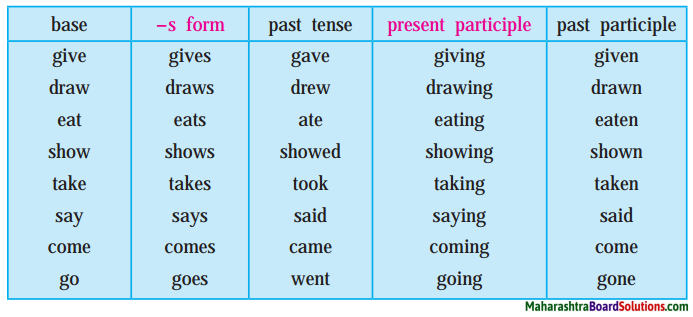
Maharashtra Board Class 9 English Kumarbharati Solutions Chapter 1.5 The Necklace 11

The base form is used as an infinitive: You may go. She will go, in orders: Go home; and in the simple present tense: I go to school. We go home. Do you go there every day? The children/They go up, etc.

Note that we use the ‘-s form’ with ‘he’, ‘she’, ‘it’, third-person singular subjects to show the simple present.

The past tense form has ‘-ed’ at the end. But many commonly used verbs have different past tense forms.
Examples: came, went, spoke.

The ‘-ing’ form is known as the present participle. It is used with forms of ‘be’ to show continuous action
Examples: I am eating You were eating She was eating It is also used in certain constructions like He sat copying a manuscript.

The past participle used with forms of ‘have’ shows completed action –
Examples: I have eaten. They have come, etc.
It is also used in certain constructions like ‘They looked at each other, stunned! It is also used in passive constructions.
(a) Make a table of verb forms for your own reference. Try to arrange the verbs in alphabetical order. Keep adding new verbs to your table from time to time. When you write, check your work to see whether you have used the correct verb form.
(b) List at least 10 verbs, the last letter of which is doubled in the present participle.
Example: put – putting
(c) List at least 10 verbs, the last letter of which is doubled in the past participle.
Example: write – written
(d) List at least 10 verbs, the last letter of which is doubled in the past tense form.
Example: sob – sobbed.

Maharashtra Board Class 9 English Kumarbharati Solutions Chapter 1.5 The Necklace

7. Read: ‘The Gift of the Magi’ by O. Henry.

Question 1.
Read: ‘The Gift of the Magi’ by O. Henry.

English Kumarbharati 9th Digest Chapter 1.5 The Necklace Additional Important Questions and Answers

Read the following passages carefully and complete the activities:

Simple Factual Activity:

Question 1.
Write whether the following statements are True or False:
Answer:

  1. Mathilde was born into a rich family. False
  2. Mathilde was content with what she had. False
  3. Mathilde had no rich dresses or jewels. True
  4. Mathilde was wedded to an aristocrat. False

Complex Factual Activity:

Question 1.
Why was Mathilde married to a ‘minor official’?
Answer:
Mathilde, a pretty and charming girl, was born into a family of clerks. She had no means of becoming known, understood, loved or be wedded to an aristocrat. So she was married to a ‘minor official’,

Maharashtra Board Class 9 English Kumarbharati Solutions Chapter 1.5 The Necklace

Question 2.
Why did Mathilde weep with misery after visiting her schoolmate?
Answer:
Mathilde had no rich dresses and no jewels, and these were the only things she loved. She found that her schoolmate, who was rich, had all the things that she, Mathilde, wanted so desperately. Hence, she wept with regret, despair and misery after visiting her schoolmate.

Activity-based on Vocabulary :

Question 1.
Match the following nouns with their adjectives :

AB
1. minor(a) house
2. shabby(b) mansion
3. palatial(c) friends
4. close(d) official

Answer:

AB
1. minor(d) official
2. shabby(a) house
3. palatial(b) mansion
4. close(c) friends

Maharashtra Board Class 9 English Kumarbharati Solutions Chapter 1.5 The Necklace

Activities based on Contextual Grammar:

Question 1.
She dreamed of a grand, palatial mansion. (Frame a wh-question to get the underlined words as the answer.)
Answer:
What did she dream of?

Question 2.
She suffered because of her shabby house. (Rewrite using the noun form of the underlined word.)
Answer:
Her suffering was because of her shabby house.

Maharashtra Board Class 9 English Kumarbharati Solutions Chapter 1.5 The Necklace

Personal Response :

Question 1.
Is anyone entitled to all the luxuries of life due to reasons of birth or other innate qualities?
Answer:
No, I don’t think that a person is entitled to all the luxuries of life due to reasons of birth or other innate qualities. A person must work hard to acquire the luxuries and not get them just because of his birth. Only when he/she works hard will he/she I know the real value of things.

Complex Factual Activity :

Question 1.
What did the envelope hold?
Answer:
The envelope held an invitation for a party at the Ministry of Education.

Question 2.
Was the husband a considerate person? How do we know that?
Answer:
The husband was very happy to give Mathilde the invitation to the party for he felt that she would be pleased. When she began to cry, he was distressed to see her tears. When he realized that she wanted to buy a dress for the party, he sacrificed the money he had saved to buy himself a gun for a hunting summer with friends. He gave her the money for her new dress. This shows that the husband was a considerate person.

Maharashtra Board Class 9 English Kumarbharati Solutions Chapter 1.5 The Necklace

Activity-based on Vocabulary :

Question 1.
Match the words with their meanings :

AB
1. triumph(a) shocked
2. computing(b) stammered
3. stunned(c) calculating
4. stuttered(d) victory

Answer:

AB
1. triumph(d) victory
2. computing(c) calculating
3. stunned(a) shocked
4. stuttered(b) stammered

Activities based on Contextual Grammar :

Question 1.
He hadn’t thought of that.
(Add a question tag.)
Answer:
He hadn’t thought of that, had he?

Maharashtra Board Class 9 English Kumarbharati Solutions Chapter 1.5 The Necklace

Question 2.
One evening her husband came home with an air of triumph.
(Replace the underlined phrase with an adverb.)
Answer:
One evening her husband came home triumphantly.

Complex Factual Activities :

Question 1.
Why did Mathilde go to her friend’s house and tell her of her distress?
Answer:
Mathilde wanted to have jewellery to wear for the party. She did not have any, but she knew that her friend was rich and would have a good collection of jewels. So she went to her friend’s house and told her of her distress so that she could borrow some jewellery from her.

Question 2.
What did Madame Forestier’s large box contain?
Answer:
Madame Forestier’s large box contained jewellery.

Maharashtra Board Class 9 English Kumarbharati Solutions Chapter 1.5 The Necklace

Question 3.
Which sentences tell us that Mathilde greatly desired the necklace?
Answer:
The following sentences tell us that Mathilde greatly desired the necklace :

  1. Her heart began to beat with uncontrolled desire. Her hands trembled as she took it. She fastened it around her neck and stood lost in ecstasy.
  2. Then she asked anxiously, hesitating, “Would you lend me this, just this?”
  3. She threw her arms around her friend’s neck rapturously, then fled with her treasure.

Activities based on Vocabulary :

Question 1.
Write down two adjectives from the passage that describe Mathilde :
Answer:
sad, restless (anxious, strange).

Maharashtra Board Class 9 English Kumarbharati Solutions Chapter 1.5 The Necklace

Question 2.
Write down the adjective forms of:

  1. ecstasy
  2. fashion.

Answer:

  1. ecstasy – ecstatic
  2. fashion – fashionable.

Activities based on Contextual Grammar :

Question 1.
She kept asking, “You have nothing else?” (Rewrite as an affirmative sentence.)
Answer:
She kept asking, “Is this all you have?”

Question 2.
“You’ve been acting strange these last three days.” (Rewrite as a negative sentence.)
Answer:
“You’ve not been acting normally these last three days.”

Personal Response :

Question 1.
Try to express the thoughts that must have passed through Mathilde’s mind on seeing the necklace?
Answer:
On seeing the necklace, Mathilde must have thought: “Oh, how beautiful I will look with these diamonds round my neck I will be the prettiest woman at the party. All the others will crowd round me and admire me. I will be the most elegant and gracious woman there. Everyone will envy me!”

Maharashtra Board Class 9 English Kumarbharati Solutions Chapter 1.5 The Necklace

Simple Factual Activity :

Write who said the following sentences and to whom :

Question 1.
“What! … how! … That’s impossible!”
Answer:
Mathilde’s husband said this to Mathilde.

Question 2.
“What’s the matter?”
Answer:
Mathilde’s husband said this to Mathilde.

Complex Factual Activity :

Question 1.
Why did Mathilde not notice the loss of her necklace earlier? ;
Answer:
Mathilde was a great success at the party. She was full of joy for she was prettier than all the other women. She danced wildly, with passion, forgetting everything in the triumph of her success, floating in a cloud of happiness. In all this excitement, she did not notice the loss of her necklace.

Activities based on Vocabulary :

Question 1.
Pick out four adverbs ending in ‘-ly’ from the passage.
Answer:
wildly, finally, sadly, suddenly.

Maharashtra Board Class 9 English Kumarbharati Solutions Chapter 1.5 The Necklace

Question 2.
Write the adverb forms of the following :

  1. pretty
  2. elegant
  3. gracious
  4. impossible

Answer:

  1. prettily
  2. elegantly
  3. graciously
  4. impossibly.

Activities based on Contextual Grammar :

Question 1.
Rewrite the following conversation in Indirect Speech :
“You could wear flowers,” he said. “They are very fashionable at this time of the year.”
Answer:
He said that she could wear flowers, and s that they were very fashionable at that time of the year.

Question 2.
She threw her arms round her friend’s neck.
(Pick out the subject and predicate.)
Answer:
Subject – She
Predicate – threw her arms round her friend’s neck.

Language Study Activities
(based on vocabulary and grammar)

Simple Activities :

Question 1.
Write two compound words of your own.
Answer:
daydream, candle-stick

Maharashtra Board Class 9 English Kumarbharati Solutions Chapter 1.5 The Necklace

Question 2.
Make a meaningful sentence using the phrase ‘with an air of triumph’
Answer:
The magician drew out a rabbit from the hat with an air of triumph.

Question 3.
Spot the error and correct the sentence :
You’ve be acting strange these last three days.
Answer:
You’ve been acting strange these last three days.

Question 4.
Pick out the infinitive from the given sentence :
He had been saving that exact amount to buy a gun.
Answer:
to buy

Question 5.
Identify the type of sentence :
What is the matter?
Answer:
Interrogative sentence

Maharashtra Board Class 9 English Kumarbharati Solutions Chapter 1.5 The Necklace

Question 6.
Pick out the word that cannot be formed using the letters of the given word :
fashionable – fashion, blush, sheaf, shine
Answer:
blush

Question 7.
Form a present participle in which the last letter is doubled.
Answer:
control – controlling

Question 8.
Write the following words in alphabetical order :
stuttered, treasure, strange, tormented.
Answer:
strange, stuttered, tormented, treasur

Question 9.
Make a word chain of 4 adjectives : charming →
Answer:
charming → gracioussaddelicate elegant.

Maharashtra Board Class 9 English Kumarbharati Solutions Chapter 1.5 The Necklace

Medium-Level Activities :

Question 1.
Mathilde saw some bracelets. (Use simple future tense of the verb.)
Answer:
Mathilde will see some bracelets.

Question 2.
She threw the invitation on the table. (Change the voice beginning ‘The invitation ’.)
Answer:
The invitation was thrown on the table by her.

Question 3.
One evening her husband said to her, “What’s the matter?” (Rewrite using indirect speech.)
Answer:
One evening her husband asked her what the matter was.

Challenging Activities :

Question 1.
When they were finally in the street, they could not find a cab.
(Pick out the clauses and state the type.)
Answer:
they could not find a cab – Main Clause, when they were finally in the street – Subordinate clause.

Maharashtra Board Class 9 English Kumarbharati Solutions Chapter 1.5 The Necklace

Question 2.
“Would you lend me this, just this?”
(Pick out the modal auxiliary and state the function.)
Answer:
would – permission

Complex Factual Activity :

Question 1.
What efforts did Loisel make to find the necklace?
Answer:
Loisel and Mathilde searched through her clothes to find the necklace. But they could not find it. Then Loisel went out and walked back over the whole route they had taken to see if he could find it. He went to the police, to the newspapers to offer a reward, to the cab companies, and everywhere that the tiniest glimmer of hope led him.

Question 2.
What was the arrangement with the jeweller? Do you think it was fair?
Answer:
Madame and M. Loisel found the string of diamonds they were looking for. The price was thirty- six thousand francs. They needed time to raise that much money, and they pleaded with the jeweller not to sell it to anyone for three days. They made an arrangement that the jeweller would buy it back for thirty-four thousand francs if the other necklace was found before the end of February. Yes, I think the deal was quite fair.

Maharashtra Board Class 9 English Kumarbharati Solutions Chapter 1.5 The Necklace

Question 3.
Why did Madame Forestier speak coldly to Mathilde?
Answer:
Mathilde had returned the borrowed necklace after a long delay. Madame Forestier felt that she should have returned it sooner for she, Madame Forestier, might have needed it. She probably felt that Mathilde had taken advantage of her goodness and hence spoke coldly to her.

Activities based on Vocabulary :

Question 1.
What is implied in the expression ‘a hollow, pale figure’?
Answer:
It means an unhappy, exhausted person.

Question 2.
Give the meaning of the following expressions :
1. a glimmer of hope
2. her mind blank.
Answer:
1. a glimmer of hope – a slight chance of success.
2. her mind blank – without having any thoughts.

Maharashtra Board Class 9 English Kumarbharati Solutions Chapter 1.5 The Necklace

Question 3.
Make sentences of your own using the following expressions :
1. lost all hope
2. sick with grief and anguish
Answer:
1. The rescuers have lost all hope of saving the trapped animal.
2. When Meena’s cat died, she was sick with grief and anguish.

Activity-based on Contextual Grammar :

Question 1.
Rewrite the following sentences as compound sentences :
1. They went from jeweller to jeweller, looking for a necklace like the other one.
2. At the end of one week they had lost all hope.
Answer:
1. They went from jeweller to jeweller and looked for a necklace like the other one.
2. It was the end of one week and they had lost all hope.

Simple Factual Activity :

Complete the following sentences :
(The answers are given directly and underlined.)

  1. The dreadful debt must be paid.
  2. They rented a garret under the roof.

Complex Factual Activity :

Question 1.
What is meant by the horrible life of the very poor?
Answer:
The horrible life of the very poor means the very difficult and tiring life of the very poor, who have to live in terrible conditions and work extremely hard to make ends meet.

Maharashtra Board Class 9 English Kumarbharati Solutions Chapter 1.5 The Necklace

Activity-based on Vocabulary :

Question 1.
Fill in the blanks with the correct adjectives from the passage :

  1. ………… life
  2. ………… labours
  3. ………….. debt
  4. ……………. linen

Answer:

  1. horrible life
  2. odious labours
  3. dreadful debt
  4. dirty linen.

Activity-based on Contextual Grammar :

Question 1.
Rewrite the following sentences as assertive sentences :
1. What would have happened if she had not lost that necklace?
2. How little is needed for one to be ruined or saved!
Answer:
1. She wondered what would have happened if she had not lost that necklace.
2. Very little is needed for one to be ruined or saved.

Maharashtra Board Class 9 English Kumarbharati Solutions Chapter 1.5 The Necklace

Complex Factual Activity:

Question 1.
What contrast is implied by the use of necklace. She wanted to tell her that she had been the word ‘still’ in still young, still beautiful, still through some hard times because of her friend and charming?
Answer:
It means that Mathilde looked old after ten years. while Madame Forestier looked young. beautiful and charming even after ten years.

Question 2.
Why did Mathilde decide to speak to her friend?
Answer:
Mathilde felt emotional. She decided to speak to her friend and tell her the story of the necklace. She wanted to tell her that she had been through some hard times because of her friend and her necklace. She also felt proud that she had tricked her friend and given her not the same necklace she had borrowed but a similar one.

Activity-based on Vocabulary :

Question 1.
Give the noun forms of the following :

  1. charming
  2. astonished
  3. familiarly
  4. remember

Answer:

  1. charming – charm
  2. astonished – astonishment
  3. familiarly – familiarity
  4. remember – remembrance.

Maharashtra Board Class 9 English Kumarbharati Solutions Chapter 1.5 The Necklace

Activity-based on Contextual Grammar :

Question 1.
Pick out the main clauses in the following sentences :
1. You say that you bought a diamond necklace to replace mine.
2. One day, as she was walking in the Champs Elysees, she saw Madame Forestier.
Answer:
1. You say – Main Clause.
2. One day she saw Madame Forestier – Main Clause.

Language Study Activities
(based on vocabulary and grammar)

Simple Activities :

Question 1.
Write two compound words from the lesson.
Answer:
newspaper, money-lender.

Question 2.
Punctuate :
she went up to her and said good morning jeanne
Answer:
She went up to her and said, “Good morning, Jeanne.”

Maharashtra Board Class 9 English Kumarbharati Solutions Chapter 1.5 The Necklace

Question 3.
Make a meaningful sentence using the following phrase : before the end of February
Answer:
The snow had vanished before the end of February.

Question 4.
Spot the error and correct the sentence : They was dropped off at their door.
Answer:
They were dropped off at their door.

Question 5.
Use the word ‘stopping’ as a present participle it in your own sentence.
Answer:
Stopping on the way, she bought some groceries.

Question 6.
Identify the type of sentence: Oh, my poor Mathilde!
Answer:
Exclamatory Sentence

Maharashtra Board Class 9 English Kumarbharati Solutions Chapter 1.5 The Necklace

Question 7.
Find out two hidden words from the given word : familiarly
Answer:
familiarly – familiar, family (frail, rally)

Question 8.
Form a past participle in which the last letter is doubled.
Answer:
beg – begged

Medium-Level Activities :

Question 1.
“I’m going back,” he said.
(Rewrite in indirect speech.)
Answer:
He said that he was going back.

Maharashtra Board Class 9 English Kumarbharati Solutions Chapter 1.5 The Necklace

Question 2.
Each month they had to pay some loans. (Change the voice.)
Answer:
Some loans had to be paid each month by them. / Each month some loans had to be paid by them.

Question 3.
Use the word ‘made’ and its homophone in two sentences of your own.
Answer:
(a) The salad was made in the hotel for a special occasion.
(b) Suman always treated her maid with courtesy.

Question 4.
It seemed to be exactly what they were looking for. (Rewrite using the past perfect progressive tense of the underlined verb.)
Answer:
It seemed to be exactly what they had been looking for.

Challenging Activities :

Question 1.
Use the following word in two separate sentences, once as a noun and once as a verb :clasp
Answer:
(a) I lost a valuable bracelet as the clasp was weak, (noun)
(b) I saw the poor woman clasp the doctor’s hands in gratitude, (verb)

Maharashtra Board Class 9 English Kumarbharati Solutions Chapter 1.5 The Necklace

Question 2.
Madame Forestier, astonished to be addressed so familiarly, did not recognize her.
(Rewrite as a compound sentence.)
Answer:
Madame Forestier was astonished to be addressed so familiarly and did not recognize her.

Grammar Focus:

Question 1.
Make a table of verb forms for your own reference. Try to arrange the verbs in alphabetical order. Keep adding new verbs to your table from time to time.
Answer:
(Students may attempt this on their own.)

Question 2.
List at least ten verbs, the last letter of which is doubled in the present participle.
Answer:
sit – sitting, dig – digging, run – running, hit – hitting, knit – knitting, bat – batting, forget – forgetting, jog – jogging, begin – beginning, plan – planning.

Maharashtra Board Class 9 English Kumarbharati Solutions Chapter 1.5 The Necklace

Question 3.
List at least ten verbs, one last letter of S which is doubled in the past participle.
Answer:
bite – bitten, fall – fallen, hide – hidden, rot – rotten, stop – stopped, prefer – preferred, rub – rubbed, slip – slipped, bar – barred, occur – occurred.

Question 4.
List at least ten verbs, the last letter of which is doubled in the past tense form.
Answer:
rob – robbed; knot – knotted, flit – flitted, jog – jogged, tip – tipped, tug – tugged, beg – begged, emit – emitted, rot – rotted, plan – planned.

Maharashtra State Board Class 9 English Solutions

English Kumarbharati 9th Textbook Answers Solutions Unit 1

Std 9 English Poem Please Listen 4.1 Question Answer Maharashtra Board

Class 9 English Chapter 4.1 Question Answer Maharashtra Board

Balbharti Maharashtra State Board Class 9 English Solutions Kumarbharati Chapter 4.1 Please Listen Notes, Textbook Exercise Important Questions and Answers.

Please Listen 9th Std Question Answer

English Kumarbharati 9th Solutions Chapter 4.1 Please Listen! Textbook Questions and Answers

Warming Up:

1. Form groups of 6-8. One person (leader) chooses one item – a picture, a paragraph or a lesson from any one of the 9th standard textbooks and writes the reference on a piece of paper and folds it. Others ask him/her questions and try to guess what it is, from his/her answers. Example: (The leader thinks and writes something on a piece of paper. He folds it and keeps it on the table. Others ask questions.)

Question 1.
Is it something from social studies?
Answer:
No.

Maharashtra Board Class 9 English Kumarbharati Solutions Chapter 4.1 Please Listen!

Question 2.
From Science or Maths?
Answer:
No.

Question 3.
Languages?
Answer:
Yes.

Question 4.
From the English Kumarbharati?
Answer:
Yes.

Question 5.
A prose lesson?
Answer:
No.

Question 6.
A nature poem?
Answer:
No.

Maharashtra Board Class 9 English Kumarbharati Solutions Chapter 4.1 Please Listen!

Question 7.
Is it in the first unit?
Answer:
No.

Question 8.
Second unit?
Answer:
Yes.

Question 9.
Inspirational poem?
Answer:
Yes.

Invictus!!
Leader shows the folded paper; answer is Invictus!

Agreements and Disagreements.

2. Form pairs. List the things on which you ! have the same opinion and also the ones on which you have different opinions. Prepare a list of ten things in all and see how far you agree or disagree with your friend. Some useful phrases are given alongside.

Question 1.
Form pairs. List the things on which you ! have the same opinion and also the ones on which you have different opinions. Prepare a list of ten things in all and see how far you agree or disagree with your friend. Some useful phrases are given alongside.
You could talk about:

  1. Clothes, latest fashion.
  2. Performance of sportsmen and women.
  3. Trafficll’ransport in your area.
  4. Cleanliness and hygiene in your area.
  5. Future occupations/Careers.
  6. Latest news items.
  7. TV programmes
  8. Mobile Apps
  9. Any subject of your choice.

Maharashtra Board Class 9 English Solutions Chapter 4.1 Please Listen 1

English Workshop:

1. The poet uses a free, conversational style in his poem. It is also called Colloquial style. Pick out and write down such lines or expressions that support the above statement.

Question 1.
The poet uses a free, conversational style in his poem. It is also called Colloquial style. Pick out and write down such lines or expressions that support the above statement.
(a) ………………………. You have not done what I asked.
(b) ……………………………………………………………………..
(c) ……………………………………………………………………..
(d) ……………………………………………………………………..
(e) ……………………………………………………………………..
(f) ……………………………………………………………………..
Answer:
(a) You have not done what I asked.
(b) You are trampling on my feelings.
(c) All that I ask is that you listen.
(d) When you do something for me that I can and need to do for myself, you contribute to my fear and inadequacy.
(e) But when you accept as a simple fact that I feel what I feel.
(f) then I can stop trying to convince you have not done what I asked.

Maharashtra Board Class 9 English Kumarbharati Solutions Chapter 4.1 Please Listen!

2. Put the following expressions in a table of Dos and Don’ts as expressed by the poet.

Question 1.
Put the following expressions in a table of Dos and Don’ts as expressed by the poet.
(a) Please listen.
(b) give me advice.
(c) tell me why.
(d) solve my problem
(e) just hear me.
(f) accept as a simple fact
(g) contribute to my fear
(h) wait a minute
Maharashtra Board Class 9 English Solutions Chapter 4.1 Please Listen 2
Answer:

DosDon’ts
1. please listen1. give me advice
2. just hear me2. tell me why
3. accept my feelings as a simple fact3. solve my problem
4. wait a minute4. contribute to my fear

3. Write in your own words.

Question a.
What does the listener do when the poet asks him to just listen? Give 3 points.
Answer:
When the poet asks the listener to just listen, the listener either:

  1. gives advice
  2. tells him why he shouldn’t feel that way, or
  3. tries to solve the; poet’s problem.

Maharashtra Board Class 9 English Kumarbharati Solutions Chapter 4.1 Please Listen!

Question b.
Why does the poet remark that advice is cheap?
Answer:
The poet remarks that advice is cheap because everyone is willing to give advice. You only had to write to the agony column of any newspaper with your problems and you could get advice from the columnists. You had to spend just 20 cents to buy the paper.

Question c.
Which two facts show that the poet is confident of overcoming his irrational feelings?
Answer:
The two facts that show that the poet ; is confident of overcoming his irrational feelings 5 are : first, he says he will understand what is behind these feelings. Second, he says that when the answers become obvious, he will not need any advice.

4. According to the poet, how does God help people when they pray to Him for help?

Question 1.
According to the poet, how does God help people when they pray to Him for help?
Answer:
According to the poet, God doesn’t try to give advice or fix things. He is silent and let’s one work things out by oneself. That is how God helps people when they pray to Him for help.

5. Why should one learn to tackle one’s problems by one’s own self?

Question 1.
Why should one learn to tackle one’s problems by one’s own self?
Answer:
When one tackles one’s problems by oneself, one overcomes feelings of fear and inadequacy. Hence one should learn to tackle one’s problems by one’s own self.

Maharashtra Board Class 9 English Kumarbharati Solutions Chapter 4.1 Please Listen!

6. Why should seniors not over-protect or over-pamper juniors?

Question 1.
Why should seniors not over-protect or over-pamper juniors?
Answer:
If seniors over-protect or over-pamper juniors, the juniors will be unable to stand on their own feet and face the world. They will not be able to overcome their feelings of fear and inadequacy. They will not become confident. Hence, seniors should not over-protect or over-pamper juniors.

7. Find out and write down some proverbs/ axioms/quotations that convey a message similar to ‘Self-help is the best help.’

Question 1.
Find out and write down some proverbs/ axioms/quotations that convey a message similar to ‘Self-help is the best help.’
Answer:
Examples:

  1. God helps those who help themselves.
  2. Self-help is the root of all success.

8. Maintain a diary for at least a week. Write about your interactions with other people in your surroundings in 3-4 lines. Also write whether you find the interactions happy – unhappy, satisfactory – unsatisfactory, enjoyable – stressful, etc.

Question 1.
Maintain a diary for at least a week. Write about your interactions with other people in your surroundings in 3-4 lines. Also write whether you find the interactions happy – unhappy, satisfactory – unsatisfactory, enjoyable – stressful, etc.
Answer:
Jan. 1: Today is New Year’s day. Holiday for J everyone. Mummy baked a yummy cake. I helped her. Papa and I went for a long walk in the park. Have made heaps of resolutions. Intend to keep every one of them. Am full of determination. Have decided to ‘ ask Seemadidi for help. A wonderful day!

Jan. 2: Not such a good day. Broke my first resolution. Overslept and had to rush to school with my shoes in my hand! Luckily my homework was all done. Kept my resolution of doing my studies before going out to play football. Had an argument with Sahil on the ground. But it ended well.

Maharashtra Board Class 9 English Kumarbharati Solutions Chapter 4.1 Please Listen!

9. Write an informal letter from a teenager to his/her parent expressing a few thoughts from the poem.

Question 1.
Write an informal letter from a teenager to his/her parent expressing a few thoughts from the poem.
Answer:
Room No. 3
Ladies’ Hostel
Aundh Road
Pune – 411 007.
14th October, 2020

Dearest Mom,

Hi! Sorry, sorry, dear Mom. Are you surprised to see this letter? I wanted to talk to you about this, but then I thought I will be able to express myself better in a letter.

Mom, when I told you about the problems I was having 1 with my roommate here at the hostel, I only wanted j you to listen. I knew I was being irrational at times, and I was trying to understand this feeling. It would have taken me some time, but I would have finally got things sorted out on my own. I’m sorry, but I did not need advice, or any solutions. Now I’ve solved my problem and I am at peace.

I’m sorry, Mom, if I’ve hurt you by snapping at your good intentions. But I’m learning. I still need your support, but I have to make my own way in this world, and this is the first step. Please try to understand this.

Love you always.
Your loving daughter,
Ananya

Maharashtra Board Class 9 English Kumarbharati Solutions Chapter 4.1 Please Listen!

10. Read aloud a couple of stanzas of the poem j ‘Invictus’ and ‘Please Listen’. In what ways do j they differ? Think and fill up the table with a ‘Yes’ or ‘No’.

Question 1.
Read aloud a couple of stanzas of the poem ‘Invictus’ and ‘Please Listen’. In what ways do j they differ? Think and fill up the table with a ‘Yes’ or ‘No’.
Maharashtra Board Class 9 English Solutions Chapter 4.1 Please Listen 3
‘Invictus’ is an example of Traditional Poetry. ‘Please Listen’ is an example of Free Verse.
Answer:

InvictusPlease Listen
1. Rhyming linesYesNo
2. Steady rhythmYesNo
3. Uniformity in length of linesYesNo
4. Uniformity in number of lines in each stanzaYesNo
5. Figurative languageYesNo
6. Example ofTraditional poetryFree verse

English Kumarbharati 9th Digest Chapter 4.1 Please Listen Additional Important Questions and Answers

Simple Factual Activity:

Question 1.
Say whether the following statements are True or False:
Answer:

  1. The poet wants advice from the listener – False
  2. The poet wants sympathy from the listener – False
  3. The poet wants solutions from the listener – False
  4. The poet wants the listener to listen to him silently – True

Maharashtra Board Class 9 English Kumarbharati Solutions Chapter 4.1 Please Listen!

Complex Factual Activity.

Question 1.
How old is the speaker in the poem?
Answer:
The speaker must be a teenager or a young person who is impatient and does not want advice or solutions.

Question 2.
Who is he/she talking to?
Answer:
He /She is talking to someone older a parent or a friend.

Activities based on Poetic Devices.

Question 1.
Pick out the two verbs that are repeated ; throughout the extract.
Answer:
The verbs ‘ask’ and ‘listen’ are repeated throughout the extract.

Question 2.
What style is the poem written in?
Answer:
The poem is written in the conversational or colloquial style.

Maharashtra Board Class 9 English Kumarbharati Solutions Chapter 4.1 Please Listen!

Simple Factual Activity.

Question 1.
Fill in the blanks with the correct words:
Answer:
1. The poet says that he may be discouraged and faltering, but he is not helpless.
2. The poet accepts that he has irrational feelings.

Complex Factual Activities.

Question 1.
Is the speaker aware of his shortcomings?
Answer:
Yes, the speaker is aware of his/her shortcomings.

Question 2.
What must have happened before the speaker says all this?
Answer:
The speaker must have had some emotional stress and problems, some feelings that he/she could not find reasonable explanations for.

Activities based on Poetic Devices.

Question 1.
Is there any figurative language in the poem?
Answer:
No, there is not much figurative language in the poem.

Maharashtra Board Class 9 English Kumarbharati Solutions Chapter 4.1 Please Listen!

Simple Factual Activity.

Question 1.
Complete the web:
(The answers are given directly and underlined.)
Maharashtra Board Class 9 English Solutions Chapter 4.1 Please Listen 4

Think discuss and answer:

Question a.
Does he/she want to improve?
Answer:
Yes, he/she wants to improve.

Question b.
Is he/she confident that he/she can improve?
Answer:
Yes, he/she is confident that he/she can improve.

Maharashtra Board Class 9 English Kumarbharati Solutions Chapter 4.1 Please Listen!

Question c.
How does he/she want to work it out?
Answer:
He/She wants to work it out on his/her own.

Question d.
Is the poet willing to listen to others?
Answer:
Yes, the poet is willing to listen to others.

Answer the following questions:

Question 1.
Discuss how you can be a good listener.
Answer:
To be a good listener, we must pay attention to what a person is saying without interruption. We must only listen and not try to form replies and counter-arguments in our own mind. We must also nod and show correct expressions to encourage the speaker.

Activities based on Poetic Devices:

Question 1.
The poet uses a free, conversational style in his poem. It is also called Colloquial style. Pick out and write down such lines or expressions that support the above statement.
Answer:
1. So please listen, and just hear me
2. And if you want to talk, wait a minute for your turn – and I will listen to you.

Maharashtra Board Class 9 English Kumarbharati Solutions Chapter 4.1 Please Listen!

Question 2.
Comment upon the length of lines and the number of lines in each stanza.
Answer:
There is no uniformity in the length of lines or the number of lines in each stanza. It appears as if the poem has first been written in prose and then broken up into separate lines.

Point Format (for understanding).

  • Title: Please Listen!
  • Poet: Unknown (anonymous)
  • Rhyme Scheme: The poem is in free verse. Hence there is no rhyme scheme.
  • Figure of Speech: Repetition. ‘When I ask you to listen to me’. This line has been repeated in the poem for emphasis.
  • Theme/Central idea: The poet tells us how he just wishes that people would listen to a person’s problems silentiy, instead of giving advice.

The poet is confident that he will find out the reasons behind his irrational feelings and then he will be able to solve his problems by himself. He feels that prayers probably work because God just listens to us silently when we pray and then lets us work things out ourselves. Through the poem, the poet implies that we too should work things out ourselves when we are faced with difficulties or have some irrational feelings.

Paragraph Format.

The poem ‘Please Listen!’ is written by an unknown poet (anonymous).

The poem is in free verse. Hence there is no rhyme scheme. There are not many figures of speech. The important Figure of Speech is Repetition: ‘When I ask you to listen to me’. This line has been repeated in the poem for emphasis.

The poet tells us how he just wishes that people would listen to a person’s problems silently, instead of giving advice. The poet is confident that he will find out the reasons behind his irrational feelings and then he will be able to solve his problems by himself. He feels that prayers probably work because God just listens to us silently when we pray and then lets us work things out ourselves. Through the poem, the poet implies that we too should work things out ourselves when we are faced with difficulties or have some irrational feelings.

Maharashtra Board Class 9 English Kumarbharati Solutions Chapter 4.1 Please Listen!

Vocabulary Focus.

Question 1.
What is the difference between ‘hear’ and ‘listen’?
Answer:

  1. ‘To hear’ means to receive with the ear the sound made by someone or something; to be aware of some sound.
  2. ‘To listen’ means to consciously give one’s attention to a sound and try to understand it.

Maharashtra State Board Class 9 English Solutions

శ్రీ ఆంజనేయ సహస్రనామ స్తోత్రమ్

Kumarbharati 9th Std English Textbook Answers Unit 4

Std 9 English Poem Great Scientists 3.5 Question Answer Maharashtra Board

Class 9 English Chapter 3.5 Question Answer Maharashtra Board

Balbharti Maharashtra State Board Class 9 English Solutions My English Coursebook Chapter 3.5 Great Scientists Notes, Textbook Exercise Important Questions and Answers.

Great Scientists Poem 9th Std Question Answer

My English Coursebook Std 9 Guide Chapter 3.5 Great Scientists Textbook Questions and Answers

Warming up:
Chit-chat

  1. What would you like to learn about in your Science period?
  2. Have you ever tried to do an experiment on your own?
    If yes, tell me about it.
    If no, tell me why you’ve never tried.
  3. What would you like to learn about in your English classes?

Maharashtra Board Class 9 My English Coursebook Solutions Chapter 3.5 Great Scientists

Inventions

Question (a)
Think of as many examples of the following as you can and write them in the appropriate column:
Maharashtra Board Class 9 My English Coursebook Solutions Chapter 3.5 Great Scientists 1
Answer:

Type of machineExamples
Simple machines that are operated by handScrewdriver, pincers, auger chisel, drill machine, spanner, etc.
Machines that run on electricityelectric motor, fan, air conditioner, hair drier, geyser, mixer, oven, etc.
Electronic devicesMobile phones, tablets, laptops, computer, speakers, etc.

Question (b)
Write as many uses of the following as you can:
(a) A cloth bag
(b) a wicker basket
(c) a glass bottle or jar
(d) a steel bowl
(e) a thick string or rope
Answer:
(a) a cloth bag: to carry things, for keeping clothes, shopping, using instead of paper bags, etc.
(b) a wicker basket: for keeping fruits, grains, carrying and selling vegetables, fruits, fish, etc.
(c) a glass bottle or jar: for keeping jam, liquids, juice, pickles, water for drinking, for medicine, kerosene, storing liquids, etc.
(d) a steel bowl: to keep eatables while eating, for drinking medicine, while serving curry, dal, shrikhand, aamras, etc.
(e) a thick string or rope: to tie things, to play, to hold things together, used in adventure sports like trekking, mountaineering, etc., to tether cattle.

English Workshop:

1. Write what is implied in the following sentence:

Question (a)
But few know his inspirational life story, which is all about courage and fighting against the odds. (What does it tell you about Faraday’s life?)
Answer:
Faraday was born in a poverty-stricken family, suffered from a speech defect as a child, had to start working at the age of thirteen. Poor Faraday had to struggle hard against all odds because he had no social status, no money and no education. Even then he toiled hard and achieved a great success after all his difficulties.

Question (b)
Even then Davy did not have much hope for Faraday: (Choose the correct question tag.)

  1. didn’t he?
  2. have he?
  3. does he?
  4. did he?

Answer:
Even then Davy did not have much hope for Faraday, did he?

Maharashtra Board Class 9 My English Coursebook Solutions Chapter 3.5 Great Scientists

Question (c)
People started telling Davy that of all his discoveries, the best was Faraday himself. (What does it suggest about Davy’s work?)

2. Break the passage into convenient smaller sections. Give sub-headings or titles to each section:

Question 1.
Break the passage into convenient smaller sections. Give sub-headings or titles to each section:
Answer:
1. Passage: Michael Faraday is regarded as ………….. produce the first consistent light bulb.
Title: Faraday’s childhood and his work as a bookbinder.

2. Passage: That day in 1812 Faraday ………………. to see some Davy’s leading experiments.
Title: Faraday’s association with Davy.

3. Passage: Even then Davy did not have much ……………….. born out of mockery directed at Faraday.
Title: Faraday discovered the ‘induction motor’

4. Passage: Faraday became a celebrity scientist ………………. inspire him during difficult times.
Title: Davy’s jealousy and Faraday’s failure!

5. Passage: In 1829, Davy died and Faraday concept called polarization.
Title: 1. Faraday becomes head of Davy’s laboratory.
2. Finds concept of polarization.

6. Passage: He then took the age-old experiment ………………. ‘It does not matter who you are’.
Title:
1. Fortune favours Faraday!
2. Association with Maxwell and Maxwell’s equations creates revolution!

3. List the different gadgets and instruments mentioned in the passage. Find more information about at least 3 of them, using the internet:

Question 1.
List the different gadgets and instruments mentioned in the passage. Find more information about at least 3 of them, using the internet:
Answer:
Gadgets and instruments from the lesson:
fans, air conditioning, sewing machines, photographs, power tools, cars, telescopes, microscopes, electrical generators, dynamos, Electronics and communication system, etc.

Maharashtra Board Class 9 My English Coursebook Solutions Chapter 3.5 Great Scientists

4. Find out more about the following scientists with the help of the Internet.

Question 1.
Find out more about the following scientists with the help of the Internet.

  1. Michael Faraday
  2. Humphry Davy
  3. Thomas Edison
  4. James Maxwell:

(Students do this on their own using the Internet.)

Language Study:

5. Find the following matter in the passage and copy the missing words:

Question 1.
Find the following matter in the passage and copy the missing words:
(Answers are directly underlined.)
(a) When he was twelve, …………………………… school ………………….
(b) One day he came across a book on ………………………….. .
(c) Faraday decided that ………………… scientist
(d) Davy never believed ……………………. science …………………….
(e) People started telling Davy that ……………………. discoveries, ……………………….
(f) He handed him a piece of Bavarian glass, which ……………………. microscopes, ………………….
(g) He went on to prove that …………………… filings;
(h) It was Maxwell who …………………… equations ………………….
Answer:
(a) When he was twelve, his mother was forced to take him out of school.
(b) One day he came across a book on electricity which had been sent to his master for binding.
(c) Faraday decided that day that he wanted to be a great scientist.
(d) Davy never believed Faraday could do anything in the field of science.
(e) People started telling Davy that of all his discoveries, the best was Faraday himself, this made him even more jealous.
(f) He handed him a piece of Bavarian glass, which was used in the lenses in telescopes and microscopes, and asked him to reverse engineer it.
(g) He went on to prove that these patterns were not a property of the iron filings.
(h) It was Maxwell who translated Faraday’s idea into a set of equations that are now called Maxwell’s equations.

Maharashtra Board Class 9 My English Coursebook Solutions Chapter 3.5 Great Scientists

6. Now Complete the following sentences using your own words/phrases:

Question 1.
Now Complete the following sentences using your own words/phrases:
(Answers are directly given.)
(a) When he was twelve, ………………………. .
(b) One day he came across a book on ………………… .
(c) He decided that …………………. .
(d) He never believed ……………… .
(e) People started telling that ………………. .
(f) He handed him which ……………………. .
(g) He went on to prove that ………………… .
(h) It was ……………….. who ………………… .
Answer:
(a) When he was twelve, he took lessons in martial arts.
(b) One day he came across a book on ‘How to make friends’.

My English Coursebook 9th Class Solutions Chapter 3.5 Great Scientists Additional Important Questions and Answers

Simple Factual Activities:

Question 1.
State if the following statements are True or False : (Answers are directly given.)
Answer:
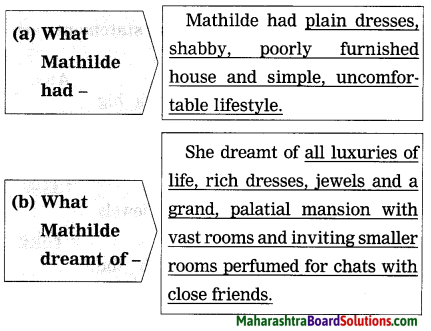
  1. Faraday’s work on electricity is still a subject of study. – True
  2. Faraday as a child, had a speech defect. – True
  3. Faraday disliked reading. – False
  4. The first consistent light bulb was produced by Davy. – False

Question 2.
What is the passage about?
Answer:
The passage is about the great scientists and their qualities.

Question 3.
Complete the following statements by giving reasons: (Answers are directly given.)
Answer:
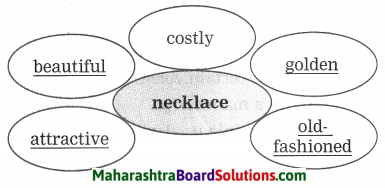
  1. Faraday forgot to applaud with the rest of the crowd because he was fully engrossed in Davy’s lecture.
  2. Faraday didn’t just want to sell books because he wanted to be a great scientist.
  3. Davy decided to hire Faraday as his secretary because a chemical explosion had temporarily blinded Davy.
  4. Davy promoted Faraday to his lab assistant because Faraday worked day and night and learnt a lot about Davy’s experiments.

Maharashtra Board Class 9 My English Coursebook Solutions Chapter 3.5 Great Scientists

Question 4.
What was the subject of Davy’s lecture?
Answer:
Davy’s lecture was about the mysterious force of electric fluid.

Question 5.
Complete the sentences using the information given in the passage:
(Answers are directly given.)
1. The induction motor spurred a revolution.
2. Davy and William Wollaston were trying to re-create a famous electromagnetism experiment.

Complex Factual Activity:

Question 1.
What were the odds against Faraday in his childhood?
Answer:
Faraday faced many odds as a child. He was born in a very poor family and lived in a dirty London Suburb. He suffered from a speech defect, so much that other children laughed on his pronounces. At the age of twelve he was forced to leave his school and it was the end of his formal education. At the age of thirteen he had to take up working as a bookbinder for living.

Question 2.
What actions and thoughts of Faraday show that he was inspired by Davy?
Answer:
Faraday took notes of Davy’s lecture on ‘mysterious force of electric fluid’s comprehensively. He bound them into a book for giving a gift to Davy someday. From that day he thought of becoming a great scientist and to write his own books. Davy became his role model. He wanted Davy to become his mentor. Though, Davy did not agree, Faraday was not unhappy and disappointed and just kept trying to get his favour.

Question 3.
Was Davy fair in his treatment of Faraday? How did Faraday respond to that treatment?
Answer:
Davy definitely was not fair in his treatment of Faraday. But Faraday was not deterred and was relentless. He continued working hard day and night to learn as much as he could about Davy’s experiments. Though his work was cleaning the labs, Faraday considered himself lucky to get to see some of Davy’s experiments.

Maharashtra Board Class 9 My English Coursebook Solutions Chapter 3.5 Great Scientists

Question 4.
What happens when an electric current is applied to a wire?
Answer:
When an electric current is applied to a wire, it causes that wire to behave like a magnet and the forces are connected.

Question 5.
An induction motor is a commonly used electrical machine. What examples of its use are given here?
Answer:
The induction motor is used in fans, air conditioning, sewing machines, photographs, power tools, cars and even trains and aeroplane engines.

Give one example each to show that –

Question (a)
Faraday was a good pupil.
Answer:
Faraday respected Davy though he was jealous of Faraday. Davy gave him an impossible task to reverse engineer the Bavarian glass but Faraday accepted the assignment despite knowing that it would be very difficult. This shows that Faraday was a good pupil.

Question (b)
Davy was not a good mentor.
Answer:
Davy was jealous of his pupil’s achievement and never helped him in his difficulties. He gave Faraday an impossible task to keep him out of his way. He knew that with the equipment available in the lab, Faraday would never be able to accomplish the task. He wanted to enjoy his pupil’s failure. This shows that Davy was not a good mentor.

Question 1.
Why did Faraday keep a souvenir of his failure as a source of inspiration?
Answer:
Faraday kept a single glass brick on his shelf as a souvenir to remind himself of those difficult days. He wanted to remember his failure and the hard work he had done during those difficult days. He believed that it would inspire him in such difficult days.

Maharashtra Board Class 9 My English Coursebook Solutions Chapter 3.5 Great Scientists

Activities based on vocabulary:

What is the meaning of the following sentences:

Question (a)
Reading became his obsession.
Answer:
Faraday’s mind was completely filled with thoughts of reading and he did not think of anything else other than reading.

Question (b)
Electricity became his lifelong fascination.
Answer:
Electricity became Faraday’s very strong attraction lasting all through his life.

Question 1.
Write two compound words from the passage :
Example: bookbinder.
Answer:
1. poverty-stricken
2. lifelong

Question 2.
Match the words in Column ‘A’ with the meaning in Column ‘B’:
Answer:

‘A’‘B’
1. pursue(a) a person that you admire and try to follow him/her
2. role model(b) to continue to do or achieve something
3. mentor(c) to cheer with claps
4. applaud(d) an expert who advises and helps less experienced persons

Answer:

‘A’‘B’
1.  pursue(b) to continue to do or achieve something
2. role model(a) a person that you admire and try to follow him/her
3. mentor(d) an expert who advises and helps less experienced persons
4. applaud(c) to cheer with claps

Maharashtra Board Class 9 My English Coursebook Solutions Chapter 3.5 Great Scientists

Question 3.
Write four words from the passage that tell us the state of mind of a person :
Answer:

  1. spellbound
  2. engrossed
  3. dejected
  4. relentless.

Question 4.
Write words using each letter of the following words:

  1. about
  2. angry
  3. thing
  4. from.

Answer:

  1. ant, ball, odd, use, table.
  2. and, not, give, ray, yes.
  3. that, high, inn, note, goat.
  4. frog, road, ox, mango.

Question 5.
Choose the correct words from the passage and complete the table:
Answer:

Describing wordsThe nouns described
1. circularpatterns
2. invisiblemagnetic fields
3. formaleducation
4. age-oldexperiment
5. impossibletasks
6. emptyspace

Question 6.
Find and write the past tense verbs with ‘-ed’ from the passage :
Answer:
filled, disturbed, copied, accepted, favoured, translated, combined, helped, designed, started.

Maharashtra Board Class 9 My English Coursebook Solutions Chapter 3.5 Great Scientists

Activities based on contextual grammar:

Question 1.
Write any four words that begin with ‘re-’ as a prefix ;
Answer:

  1. rewrite
  2. replace
  3. replay
  4. redirect.

Question 2.
He dismissed Faraday’s aspirations.
(Begin with Faraday’s aspiration-and make the sentence of Passive voice.)
Answer:
Faraday’s aspirations were dismissed by him.

Question 3.
He forgot to applaud with the rest of the crowd.
(Make the sentence negative without changing the meaning.)
Answer:
He did not remember to applaud with the rest of the crowd.

Question 4.
Find and write from the passage the adjectives used for the following nouns :

  1. force
  2. notes
  3. explosion
  4. memory.

Answer:

  1. mysterious force
  2. comprehensive notes
  3. chemical explosion
  4. excellent memory.

Maharashtra Board Class 9 My English Coursebook Solutions Chapter 3.5 Great Scientists

Question 5.
He needed an assistant.
(Frame a Wh-question to get the underlined part of the sentence as an answer.)
Answer:
What did he need?

Question 6.
Use the following phrases in the sentences of your own

  1. figure out
  2. born out of
  3. try one’s hand at
  4. to spur a revolution

Answer:

  1. He couldn’t figure out the reason behind his friend’s behaviour with him.
  2. Every invention is bom out of inquisitiveness.
  3. Father asked me to try my hand at preparing the food item.
  4. Computers have spurred a revolution in this modern world.

Question 7.
It would be very difficult
(Make it a negative sentence.)
Answer:
It would not be very easy.

Question 8.
He accepted the assignment. (Change the voice.)
Answer:
The assignment was accepted by him.

Frame wh-question to get the underlined part as answers:

Question (a)
He used the same glass now.
Answer:
What did he use now?

Maharashtra Board Class 9 My English Coursebook Solutions Chapter 3.5 Great Scientists

Question (b)
They found the strange object under a bench in the garden.
Answer:
Where did they find the strange object?

Question 1.
He was unable to explain them.
(Make it a negative sentence without changing meaning,)
Answer:
He could not explain them.

Question 2.
He made hundreds of such drawings.
(Choose the correct sentence of passive voice.)
(a) Hundreds of such drawings are made by him.
(b) Hundreds of such drawings will be made by him.
(c) Hundreds of such drawings were made by him.
(d) Hundreds of such drawings have made by him.
Answer:
(c) Hundreds of such drawings were made by him.

Do as directed:

Question 1.
Complete the words by using correct letters:

  1. p _ ove
  2. fi_ld
  3. e _ pty
  4. mi_ht

Answer:

  1. prove
  2. field
  3. empty
  4. might

Question 2.
Copy the following sentences correctly in your notebook:
Answer:
1. He couldn’t even say his own name and would call himself ‘Faraday’.
2. faraday was spellbound by Davy’s lecture in 1812.

Maharashtra Board Class 9 My English Coursebook Solutions Chapter 3.5 Great Scientists

Question 3.
Put the following words in alphabetical order:
1. epitomise, generate, convert, accomplish
2. destiny, determine, disturb, dismiss
Answer:
1. accomplish, convert, epitomise, generate.
2. destiny, determine, dismiss, disturb.

Question 4.
Punctuate the following sentences:
1. he worked day and night and learnt as much as he could about davys experiments
2. Faraday had a never give up attitude and he respected davy
Answer:
1. He worked day and night and learnt as much as he could about Davy’s experiments.
2. Faraday had a never-give-up attitude and he respected Davy.

Question 5.
Write four small words (minimum letters each) using the letters in the given word: ‘comprehensive’:
Answer:

  1. come
  2. cohesive
  3. hen
  4. hive.

Spot the error and circle it. Then rewrite the corrected sentence:

Question 1.
Maharashtra Board Class 9 My English Coursebook Solutions Chapter 3.5 Great Scientists 2
Answer:
Our teacher was absent yesterday.

Maharashtra Board Class 9 My English Coursebook Solutions Chapter 3.5 Great Scientists

Question 2.
Maharashtra Board Class 9 My English Coursebook Solutions Chapter 3.5 Great Scientists 3
Answer:
She has forgotten her notebook in school.

Write related words as shown in the example: (Answers are directly given.)

Question 1.
Write related words as shown in the example: (Answers are directly given.)
Answer:
Maharashtra Board Class 9 My English Coursebook Solutions Chapter 3.5 Great Scientists 4

Complete the following word-chain with any four words. Add four words, each beginning with the last letter of the previous word:

Question (a)
Complete the following word-chain with any four words. Add four words, each beginning with the last letter of the previous word:
poverty → ………. → ………. → ………… → ………….
Answer:
poverty → yank → knowing → gorgeous → slap.

Question 2.
Make a meaningful sentence by using the following phrase in your own sentence, “for a while”.
Answer:
Please wait for a while, I will come with you.

Question 3.
Add a prefix or suffix to make new words and use one of the root words in your own sentence:
1. ignore
2. achieve
Answer:
1. ignorance
2. achievement.
Sentence: We should not ignore our duties towards our motherland.

Maharashtra Board Class 9 My English Coursebook Solutions Chapter 3.5 Great Scientists

Question 4.
Complete the following sentences using your own words: (Answers are directly given.)
OR
Add a clause to expand the sentence meaningfully:
(One senteces will be asked in the activity sheet)
Answer:

  1. He went on to prove that the pug marks found in the mud were not of a dog but of a tiger’s.
  2. It was Sardar Patel who led the famous Bardoli Satyagraha.
  3. This is where his decision went against him.
  4. He did not know much about the customs of the Adivasis.

Personal Response:

Question 1.
Why do you think Faraday’s friend gave him a free ticket to Davy’s programme?
Answer:
I think, the friend knew that Faraday was poor and could not afford to buy a ticket for such a big programme. He also must be knowing about Faraday’s fascination about the subject of electricity, and that would be a great opportunity for him to attend the lecture of the renowned scientist Humphry Davy’s work on the subject chemicals and electrical lighting.

Question 2.
Is it necessary to have social status, money to pursue your goal? Explain why.
Answer:
I think it is not necessary to have social status or money to pursue our goal. Only that, you must have a dream to achieve the goal and continue to work hard towards it. You must keep on trying day and night with perseverance and sincerity.

Maharashtra Board Class 9 My English Coursebook Solutions Chapter 3.5 Great Scientists

Question 3.
Write what is implied in the following sentence: Even then Davy did not have much hope for Faraday. (What do the words ‘even then’ suggest?)
Answer:
Faraday wanted to be a great scientist. But Davy dismissed all his aspirations in the field of science. He made Faraday his secretary then his lab assistant. Faraday worked day and night and learnt about Davy’s experiments. Even after doing such hard work and getting knowledge and experience Davy was not hopeful about Faraday’s scientific career, because of his social status and education.

Question 4.
Write what is implied in the following sentence: People started telling Davy that of all his discoveries, the best was Faraday himself. (What does it suggest about Davy’s work?)
Answer:
Humphry Davy was a renowned chemist who made many discoveries about chemicals and electrical lighting. Faraday wanted Davy to become his mentor but Davy never believed in Faraday’s ability and always tried to keep him away from the experiments he was doing. Davy became jealous of Faraday when he became a celebrity scientist overnight. But Faraday did not receive recognition for his success from Davy. So people started telling Davy that Faraday himself was his best discovery.

Question 5.
Do you agree with Faraday’s following quotation? Explain with his own examples:
‘In order to succeed, your desire for success should be greater than your fear of failure’.
Answer:
Yes. I fully agree with Faraday’s quotation. He wants to say that if you want to get success you should never fear of failures. If your desire for success is greater than your fear of failures, you can definitely achieve your success with determination and perseverance. Davy asked him to reverse engineer Bavarian glass. He toiled hard but failed to do it. He had lost his memory but the disease did not stop him. His failures did not become obstacles in the way of his success.

Question 6.
When you wish to achieve some goal, does it matter what you are?
Answer:
No. When you wish to achieve some goal it does not matter who you are. You may not have status in the society or wealth or even education but still you can achieve your goal with hard work, perseverance, conviction, keen observation and intelligence.

Maharashtra Board Class 9 My English Coursebook Solutions Chapter 3.5 Great Scientists

Activity:

Question (a)
Information about 3 gadgets/instruments
Answer:
1. Telescopes:
A telescope is an optical instrument that aids the observation of remote objects by collecting electromagnetic radiation (such as visible light). The first known practical telescope was invented in Netherlands at the beginning of the 17th century, by using glass lenses. It has use in both terrestrial applications and astronomy. There are many types of telescopes, for example, radio telescope, X-ray telescope, optical telescope, etc. They are generally made up of two lenses placed at a fixed distance to enlarge far away images.

2. Fan:
A fan is a machine used to create flow within a fluid, typically a gas such as air. The fan consists of a rotating arrangements of blades which act on the fluid. The rotating assembly of blades and hub is I known as rotor. A fan concentrates the airflow in the required direction. The punkah fan was used in India about 500 BC. It was a handheld fan made of bamboo strips and other plant fibre. This evolved over the years to the modern fans we see in our rooms daily now.

3. Sewing machine:
It is a machine used to stitch fabric and other material together with a thread. Sewing machines were invented during the Industrial Revolution to decrease the amount of manual sewing work. In a modern sewing machine the fabric easily glides in and out without the inconvenience of needles and thimbles but the earlier sewing machines were partially manual and helped the tailor do the stitching faster saving his time.

Maharashtra Board Class 9 My English Coursebook Solutions Chapter 3.5 Great Scientists

Inventions

Question 1.
Choose any one machine or device and prepare a short note about it. Use the points given in margin of the textbook page no. 88.
Answer:

A Note on Fan

A fan is a machine/device used to create flow within fluid, typically a gas such as air. The fan consists of a rotating arrangement of blades that act on air concentrating the flow of air in one direction. The rotating assembly of blades and motor is known as rotor. Fans are powered by electricity. The ‘punkha’ (fan) was used in India about 500 BC. It was handheld fan made of bamboo. These fans evolved after centuries to the fans, we see today in our homes.
Maharashtra Board Class 9 My English Coursebook Solutions Chapter 3.5 Great Scientists 5

My English Coursebook 9th Class Solutions Unit 3

Std 9 English Poem The Story of Tea 1.4 Question Answer Maharashtra Board

Class 9 English Chapter 1.4 Question Answer Maharashtra Board

Balbharti Maharashtra State Board Class 9 English Solutions My English Coursebook Chapter 1.4 The Story of Tea Notes, Textbook Exercise Important Questions and Answers.

The Story of Tea Poem 9th Std Question Answer

My English Coursebook Std 9 Digest Chapter 1.4 The Story of Tea Textbook Questions and Answers

Warming up!

Chit-chat:

  • Can you make tea?
  • How do you make tea?
  • What brand do you like?
  • At home, who makes tea/coffee for everybody?
  • Have you seen a tea-plantation?
  • What was it like?

Maharashtra Board Class 9 My English Coursebook Solutions Chapter 1.4 The Story of Tea

Write the names of as many beverages as you can within two minutes. What do the following beverages remind you of? Draw word webs to show your associations.

Question 1.
Write the names of as many beverages as you can within two minutes. What do the following beverages remind you of? Draw word webs to show your associations.
Maharashtra Board Class 9 My English Coursebook Solutions Chapter 1.4 The Story of Tea 1
Answer:
Maharashtra Board Class 9 My English Coursebook Solutions Chapter 1.4 The Story of Tea 2
Maharashtra Board Class 9 My English Coursebook Solutions Chapter 1.4 The Story of Tea 3

English Workshop:

1. List all the names of Geographical places mentioned in the passage.

Question 1.
List all the names of Geographical places mentioned in the passage.
Answer:
Assam, China, Cambod, Darjiling, Nilgiris.

Maharashtra Board Class 9 My English Coursebook Solutions Chapter 1.4 The Story of Tea

2. Make smaller words using the letters in the given words. (At least 5 words each)

Question 1.
Make smaller words using the letters in the given words. (At least 5 words each)

  • actually
  • refreshing
  • immediately
  • investigations
  • meditation
  • enjoyable
  • loneliness
  • friendship

Answer:

  1. actually – act, all, tall, call, ally.
  2. refreshing – fresh, refresh, ring, sing, fin.
  3. immediately – dial, ate, die, mat, date.
  4. investigation – invest, nation, station, nest, vest.
  5. meditation – tan, edition, meat, edit.
  6. enjoyable – enjoy, able, joy, enables, noble.
  7. loneliness – lone, one, line, nine, less.
  8. friendship – friend, ship, end, fried, find
  9. powdered – pod, were, red, owe, power
  10. hospitality – hospital, spit, pity, host, hit.

Maharashtra Board Class 9 My English Coursebook Solutions Chapter 1.4 The Story of Tea

3. From the passage, copy correctly any three sentences that begin with ‘How’.

Question 1.
From the passage, copy correctly any three sentences that begin with ‘How’.

4. Find the meanings of the following from a good dictionary :

Question 1.
Find the meanings of the following from a good dictionary :

  • infusion
  • restorative
  • inscriptions
  • radicals
  • connoisseurs

5. List the words related to
(a) agriculture
(b) chemistry from this passage.

Question 1.
List the words related to
(a) agriculture
(b) chemistry from this passage.

Maharashtra Board Class 9 My English Coursebook Solutions Chapter 1.4 The Story of Tea

6. Complete the following sentences with the help of the passage:

Question 1.

Complete the following sentences with the help of the passage:
(a) Camellia sinensis is an evergreen plant that grows in
(b) The teas we buy are usually classified according to
(c) In many countries around the world, tea drinking is an
(d) Our body produces chemicals called
Answer:
(a) Camellia sinensis is an evergreen plant that grows in tropical and sub-tropical climates.
(b) The teas we buy are usually classified according to the size of their leaves.
(c) In many countries around the world, tea drinking is an
(d) Our body produces chemicals called

7. Prepare a flow chart to show the growth and journey of tea from the plantation to our homes. Use information from the lesson.

Question 1.
Prepare a flow chart to show the growth and journey of tea from the plantation to our homes. Use information from the lesson.
Maharashtra Board Class 9 My English Coursebook Solutions Chapter 1.4 The Story of Tea 5
Answer:
Maharashtra Board Class 9 My English Coursebook Solutions Chapter 1.4 The Story of Tea 4

Language  Study:

8. From the passage, find all the words or pairs of words that begin with ‘tea’.
Examples: teapot, tea plants.
When two words come together to form a new word, the new word is called a compound word. What words do you see in the following compounds – evergreen, blood pressure, every day?
Note that some compound words are written as one word (teapot), some with a hyphen between them (tea-making) and some as two separate words (tea club).

Maharashtra Board Class 9 My English Coursebook Solutions Chapter 1.4 The Story of Tea

9. Sometimes the form of a verb in a sentence names the action but does not change according to tense, number or person. Such a form is known as a non-finite form or an ui1lnitii. An infinitive is used with or without ‘to’.
Examples: How did people first begin to drink tea? Can you name the beverage?
Underline the infinitive in the following sentences.
It was funny to read words that stood still.
Can I read the book?
They could help one another with the homework and talk about it.
To be or not to be – that is the question.

My English Coursebook 9th Class Solutions Chapter 1.4 The Story of Tea Additional Important Questions and Answers

Read the following passage and do the activities:

Simple Factual Activity:

Question 1.
Complete the sentences using the information given in the passage:
(Answers are directly given.)
Answer:

  1. The most popular beverage in the world is tea.
  2. Tea plants require at least 100-125 cm of rainfall a year.
  3. World’s famous tea estates are located on hill slopes.

Question 2.
Complete the following sentences using the information given in the passage :
(Answers are directly given.)
Answer:

  1. Most people agree that tea is a refreshing drink.
  2. Emperor Shennong was called the father of Chinese agriculture and medicine.
  3. Bodhidharma found that chewing tea leaves acted as a stimulant.
  4. Tea got its distinctive flavour by its theanine as well as caffeine.

Maharashtra Board Class 9 My English Coursebook Solutions Chapter 1.4 The Story of Tea

Question 3.
Write whether the following statements are True or False :
(Answers are directly given.)
Answer:

  1. The first Indian tea was sent to England for public sale in 1823. – False
  2. Tea became a fashionable and popular drink in Europe. – True
  3. Our body produces chemicals called free radicals. – True
  4. The word ‘chai’ is now sometimes used in English to refer to China tea. – False

Question 4.
Complete the following sentences with the help of the information given in the passage :
(Answers are directly given.)
Answer:

  1. In many countries around the world, tea drinking is an important social occasion.
  2. Tea ceremonies give people the time to relax and enjoy the taste and smell of tea.
  3. For many people tea is a popular drink to have with friends.
  4. Koreans still have tea ceremonies on the occasions of special birthdays and anniversaries.

Maharashtra Board Class 9 My English Coursebook Solutions Chapter 1.4 The Story of Tea

Question 5.
Choose the correct alternatives and complete the following sentences :
(Answers are directly given.)
Question a.
In Russia, tea is made and served in ………….. .
(a) cups
(b) pots
(c) samovars
Answer:
(c) samovars

Question b.
In Japan, tea is made using ……………… .
(a) a bamboo whisk
(b) sugar
(c) green tea
Answer:
(a) a bamboo whisk

Maharashtra Board Class 9 My English Coursebook Solutions Chapter 1.4 The Story of Tea

Question c.
In India, tea is served as a token of ……………….. .
(a) love
(b) hospitality
(c) affection
Answer:
(b) hospitality

Question d.
In China, tea is made in small ………………. teapots.
(a) clay
(b) metal
(c) glass
Answer:
(a) clay

Complex Factual Activities:

Question 1.
Which geographical conditions (features) are required for growing tea plants?
Answer:
Tea plants require tropical and sub-tropical climates. They need at least 100-125 cm of rainfall and acidic soils. They grow well on hill slopes at elevations of up to 1500 metres where they acquire a richer flavour at that height.

Maharashtra Board Class 9 My English Coursebook Solutions Chapter 1.4 The Story of Tea

Question 2.
Why are tea plants pruned?
Answer:
The tea plants are pruned and kept at height of about three feet to make it possible for them to ; pluck the tea leaves easily.

Question 3.
How is tea the beverage made?
Answer:
Tea is made by brewing, that is by infusing tea leaves in boiling water.

Maharashtra Board Class 9 My English Coursebook Solutions Chapter 1.4 The Story of Tea

Question 4.
Complete the web:
(Answer are directly given.)
Answer:
Maharashtra Board Class 9 My English Coursebook Solutions Chapter 1.4 The Story of Tea 6

Question 5.
Who was Emperor Shennong? Why did he carry out further investigations about tea?
Answer:
Emperor Shennong was the father of Chinese agriculture and medicine. On drinking the boiled water of tea leaves, he was amazed by the rich flavour and the refreshing quality of the infusion he was so excited that he decided to carry out further investigation.

Question 6.
Arrange the following sentences in proper order of their occurrence :
1. Japanese priests studying under Buddhist teachers in China carried tea seeds and leaves to Japan.
2. Turkish traders began to bargain for tea on the border of Mongolia.
3. Bodhidharma, a Buddhist monk introduced tea among his disciples in China.
4. The Chinese Emperor Hui Tsung failed to notice that Mongolia had actually taken over his empire.
Answer:
3. Bodhidharma, a Buddhist monk introduced tea among his disciples in China.
1. Japanese priests studying under Buddhist teachers in China carried tea seeds and leaves to Japan.
2. Turkish traders began to bargain for tea on border of Mongolia.
4. The Chinese Emperor Hui Tsung failed to notice that Mongolia had actually taken over his empire.

Maharashtra Board Class 9 My English Coursebook Solutions Chapter 1.4 The Story of Tea

Question 7.
Complete the web :
(Answers are directly given.)
Answer:
Maharashtra Board Class 9 My English Coursebook Solutions Chapter 1.4 The Story of Tea 7

Question 8.
Guess the origin of the Marathi word ‘Chaim’:
Answer:
Instead of earlier word ‘t’u’ Chinese started using ‘ch’a’ to describe tea. The word ‘Ch’a’ was close to the Hindi word ‘chai’ and was used all over India. Then slightly changed word ‘chaha’ was used in Marathi. It was the combination of the words ‘ch’a’ and ‘chai’ in Marathi version.

Maharashtra Board Class 9 My English Coursebook Solutions Chapter 1.4 The Story of Tea

Question 9.
Complete the following choosing information from the passage :
Answer:
Maharashtra Board Class 9 My English Coursebook Solutions Chapter 1.4 The Story of Tea 8

Question 10.
How do Indians like to have their tea?
Answer:
Most Indians like to have their tea hot with a good deal of milk and sugar in it. In the rainy season, tea is brewed with ginger to give it additional medicinal properties. Some others add spices like cardamom, cloves or mace to add to its taste and flavour. They have their morning and evening tea after spicy snacks. Some connoisseurs enjoy delicately flavoured jasmine tea, green tea, lemon tea and even iced tea.

Maharashtra Board Class 9 My English Coursebook Solutions Chapter 1.4 The Story of Tea

Activities based on vocabulary:

Question 1.
Match the words in Column ‘A’ with their meaning in Column ‘B’:

‘A’‘B’
1. aromatic(a) any liquid for drinking
2. brew(b) the hot regions of the world
3. beverage(c) fragrant
4. tropical(d) to make tea etc. by boiling

Answer:

‘A’‘B’
1. aromatic(c) fragrant
2. brew(d) to make tea etc. by boiling
3. beverage(a) any liquid for drinking
4. tropical(b) the hot regions of the world

Question 3.
List the qualities of the special type of tea.
Answer:
unique in taste, aroma, strength, flavour.

Maharashtra Board Class 9 My English Coursebook Solutions Chapter 1.4 The Story of Tea

Question 4.
Match the words in Column ‘A’ with their meaning in column ‘B’:

‘A’‘B’
1. investigation(a) a scientific examination for finding the truth.
2. stimulant(b) a drink made by leaving shrubs (leaves), etc. in boiling water.
3. infusion(c) making you strong and healthy again.
4. restorative(d) a substance (tea) that helps you to stay awake.

Answer:

‘A’‘B’
1. investigation(a) a scientific examination for finding the truth.
2. stimulant(d) a substance (tea) that helps you to stay awake.
3. infusion(b) a drink made by leaving shrubs (leaves), etc. in boiling water.
4. restorative(c) making you strong and healthy again.

Maharashtra Board Class 9 My English Coursebook Solutions Chapter 1.4 The Story of Tea

Question 5.
Match the verbs in ‘A’ with the related phrases/words in ‘B’ from the passage:

‘A’‘B’
1. reduce(a) viruses in our body
2. control(b) us live longer
3. fight(c) the risk of cancer
4. help(d) blood pressure

Answer:

‘A’‘B’
1. reduce(c) the risk of cancer
2. control(d) blood pressure
3. fight(a) viruses in our body
4. help(b) us live longer

Question 6.
Write the words related to ‘medicine’ from the passage :
Answer:
cancer, blood pressure, viruses, antioxidants, free radicals, system, body, health, damage.

Question 7.
List the things from the passage that are used for making tea.
Answer:
powdered green tea, bamboo whisk, milk, sugar, ginger, spices like cardamom, cloves, mace, jasmine, lemon.

Maharashtra Board Class 9 My English Coursebook Solutions Chapter 1.4 The Story of Tea

Activities based on contextual grammar:

Question 1.
Underline the adverbs from the following sentences :
(Answers are directly underlined.)
Answer:

  1. Can you name the most widely consumed beverage in the world, after water?
  2. The tree plants grow slowly.

Question 2.
Underline the infinitives in the following sentence:
(Answers are directly given.)
Answer:

  1. It was funny to read words that stood still.
  2. Do I have to read the book?
  3. Turkish traders began to bargain for tea.
  4. A servant was boiling some water for the king to drink.

Question 3.
Find the subject and the object from the following sentences :
1. The water immediately changed colour.
2. He carried out further investigations.
Answer:
1. Subject: The water: Object: colour
2. Subject: He; Object: investigations.

Maharashtra Board Class 9 My English Coursebook Solutions Chapter 1.4 The Story of Tea

Question 4.
Underline the infinitives in the following sentences :
(Answers are directly underlined.)
Answer:

  1. The word ch’a’ is used in English to refer to China tea.
  2. Tea may be able to reduce the risk of cancer.

Question 5.
Choose the proper article from the given brackets to complete the sentences.
(Answers are directly given.)
Answer:
1. He has to attend an important meeting. (a, an)
2. He was looking at the setting sun. (the, a, an)

Question 6.
Replace the underlined words with another words and rewrite the sentences :

Question a.
The ceremonies give people the time to relax.
Answer:
The ceremonies give people the time to enjoy.

Maharashtra Board Class 9 My English Coursebook Solutions Chapter 1.4 The Story of Tea

Question b.
For many people tea is a popular drink.
Answer:
For many people tea is a refreshing drink.

Question c.
Make any question using the wh-words given below:

  1. Where
  2. What
  3. Who
  4. When

Answer:

  1. Where is our friend, Amar?
  2. What shall we do now?
  3. Who was there with you just now?
  4. When will you meet me again?

Maharashtra Board Class 9 My English Coursebook Solutions Chapter 1.4 The Story of Tea

Question 7.
Read the sentences and fill in the blanks with correct prepositions given in the brackets :
(Answers are directly given.)
Answer:

  1. Tea is served in a small clay pot. (in, on, with)
  2. The tea is mixed with boiled water using cloves, (for, with, at)
  3. They still have tea ceremonies for important occasions, (for, to, in)
  4. Some people use mace to add to its taste. (for, to, with)

Question 8.
Arrange the following words in correct order to frame sentences :
1. is tea cup of a offered guests to.
2. brewed ginger is Tea with.
Answer:
1. A cup of tea is offered to guests.
2. Tea is brewed with ginger.

Maharashtra Board Class 9 My English Coursebook Solutions Chapter 1.4 The Story of Tea

Do as directed :

Question 1.
We have three different tea-growing regions in India. (Frame a Wh-question to get the underlined word as an answer.)
Answer:
How many different tea-growing regions are there in India?

Question 2.
Choose the correct form of the verb from the brackets :
(Answers are directly given.)
Answer:

  1. A new flush appears on the plant every seven to ten days, (appear/appears)
  2. Tea plants require at least 100-125 cm of rainfall a year, (require/requires)
  3. Each of these regions is famous for the special type of tea. (is/are)
  4. It is said that the tea plants grow slowly. (are/is)

Personal Response :

Question 1.
What are botanical names? How are they decided?
Answer:
Botanical names are actually scientific names. These names are according to binomial (two words) naming system. The first name tells us the genus of a plant and the second name is the species of the plant. Throughout the world there should be only one uniform name, that is why the scientific naming system is used.

Maharashtra Board Class 9 My English Coursebook Solutions Chapter 1.4 The Story of Tea

Question 2.
What is the difference between legends or stories and history?
Answer:
Legends or stories may not be true but history tells you the facts and true events of the past. History is the written or recorded or spoken events of the past. They are concerned with the real persons, places, arts, etc. that really existed in the past whereas legends are mostly imaginary and passed down from generations to generations in the form of story telling. So they are likely to change but the events in history are generally unchangeable.

Question 3.
What is the difference between ‘claim’ and ‘fact’?
Answer:
The word ‘claim’ is used to say that something is true although it has not been proved or approved by all people totally. Fact means reality. It is used to refer that a particular situation or incident existed and considered to be true and that it can be proved as real.

Question 4.
Do you have any ceremonies associated with food items?
Answer:
There are no any ceremonies directly associated with particular food items. While celebrating marriage ceremony, house warming ceremony, anniversaries, etc. variety of food items are served by the hosts and people enjoy different food items with different flavours and tastes. When people celebrate the festivals of Holi, Diwali, Makar Sankrant etc. people particularly prepare and enjoy food items like puran poli, sweets, laddoos, tilgul, kheer, etc.

Maharashtra Board Class 9 My English Coursebook Solutions Chapter 1.4 The Story of Tea

Question 5.
What is your favourite beverage? Tell your reasons :
Answer:
My favourite beverage is coffee. I love to have it because of its rich flavour and unique taste. I feel refreshed when I drink hot, slightly bitter coffee with brown colour.

Do as directed :

Question 1.
Complete the words by using correct letters :

  1. j u _ c e
  2. d _ i n k
  3. s _ o p e
  4. w o _ l d

Answer:

  1. j u i c e
  2. d r i n k
  3. s l o p e
  4. w o r l d

Maharashtra Board Class 9 My English Coursebook Solutions Chapter 1.4 The Story of Tea

Question 2
Copy the following sentences in your notebook:
1. Japan, China, Russia and Korea have special tea ceremonies and traditions.
2. Can you name the most widely consumed beverage in the world, after water?

Question 3.
Put the following words in alphabetical order :
1. evergreen, acidic, flavour, beverage.
2. emperor, elevation, enable, establish.
Answer:
1. acidic, beverage, evergreen, flavour.
2. elevation, emperor, enable, establish.

Question 4.
Punctuate the following sentences :
1. are there any wild animals in this forest Sahil asked the tour guide
2. what a fantastic landscape it is the visitor exclaimed.
Answer:
1. “Are there any wild animals in this forest?” Sahil asked the tour guide.
2. “What a fantastic landscape it is !” the visitor exclaimed.

Maharashtra Board Class 9 My English Coursebook Solutions Chapter 1.4 The Story of Tea

Question 5.
Spot the error and rewrite the correct sentences:
1. How and when did people first began to drink tea?
2. We has three very distinct and different tea growing regions in India.
Answer:
1. How and when did people first begin to drink tea?
2. We have three very distinct and different tea-growing regions in India.

Question 6.
Write related words as shown in the example :
(Answer is directly given.)
Answer:
Maharashtra Board Class 9 My English Coursebook Solutions Chapter 1.4 The Story of Tea 9

Question 7.
Complete the following word-chain of nouns. Add four words, each beginning with the last letter of the previous word :
proteins → ……………. → …………… → …………….. → …………….
Answer:
proteinssugarremanddreammop.

Maharashtra Board Class 9 My English Coursebook Solutions Chapter 1.4 The Story of Tea

Do as directed :

Question 1.
Make your own meaningful sentence by using the phrase ‘to look for’.
Answer:
Amav lost his pen in his school and now he is looking for it in his home.

Question 2.
Add a prefix or suffix to make new words and use any one of the root word in your own sentence :
1. confident
2. absent.
Answer:
1. confidence
2. absence.
Sentence: Ramesh was very confident when he began to give his speech.

Maharashtra Board Class 9 My English Coursebook Solutions Chapter 1.4 The Story of Tea

Question 3.
Add a clause to expand the sentence meaningfully:
We know
Answer:
We know that trees are very important for all of us.

Language Study:

Question 1.
Compound word :
Find all the words or pairs of words that begin with ‘tea’.
Answer:
teapot, tea plants, tea gardens, tea-estates, tea leaves, tea seeds, tea-tasting, tea whisking, tea minded, tea growing, tea club, tea ceremony, tea kettle, tea lovers.

Maharashtra Board Class 9 My English Coursebook Solutions Chapter 1.4 The Story of Tea

Question 2.
Underline the infinitive in the following sentences :
(The answers are underlined directly.)
Answer:

  1. It was funny to read words that stood still.
  2. To be or not to be – that is the question.
  3. Can I read the book?
  4. They could help one another with the homework and talk about it.

My English Coursebook Std 9 Digest Pdf Unit 1
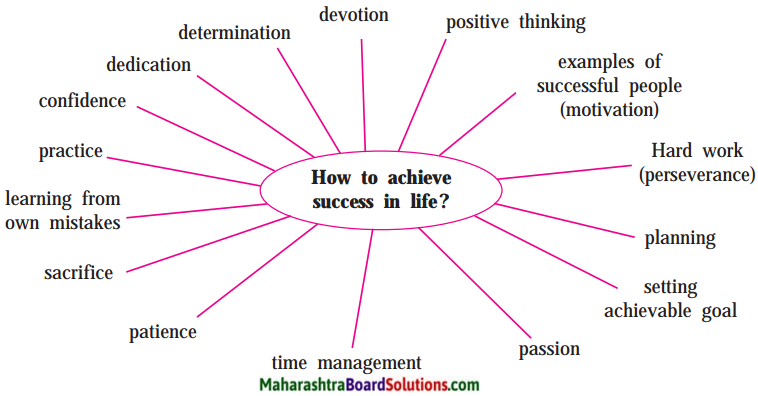
Std 9 English Poem To a Butterfly 3.3 Question Answer Maharashtra Board

Class 9 English Chapter 3.3 Question Answer Maharashtra Board

Balbharti Maharashtra State Board Class 9 English Solutions My English Coursebook Chapter 3.3 To a Butterfly Notes, Textbook Exercise Important Questions and Answers.

To a Butterfly Poem 9th Std Question Answer

My English Coursebook Std 9 Guide Chapter 3.3 To a Butterfly Textbook Questions and Answers

Warming up:
Chit-chat:

  1. What games did you play when you were a small child – in pre-primary or primary school?
  2. Who were your playmates?
  3. What do you remember best from that time?

Maharashtra Board Class 9 My English Coursebook Solutions Chapter 3.3 To a Butterfly

Short Poems

Question 1.
Use the following formats to write your own poems.
noun
noun + verb
noun + verb + adverb
determiner/adjective + noun + verb + adverb
exclamation
noun + verb

If necessary, the teacher should revise the parts of speech mentioned the activity and write plenty of examples of each on the blackboard.
adjective 1
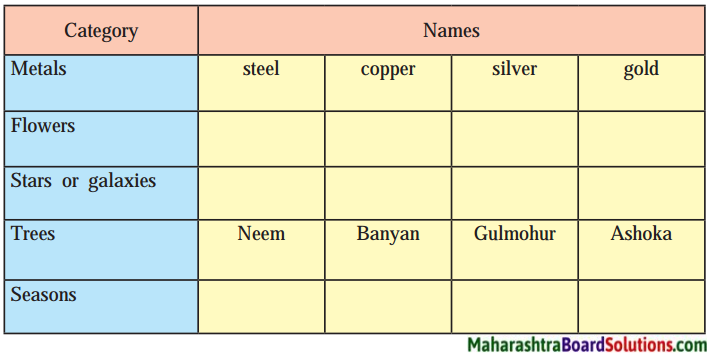
adjective 2
adjective 3
adjective 4
adjective 5
noun

verb
verb + adverb
verb + adverb + adverb
noun + verb + adverb + adverb
determiner/adjective + noun + verb + adverb + adverb
question (simple/rhetorical)

English Workshop:

Question 1.
Pick out from the first stanza, four expressions where the poet pleads with the butterfly not to go away:
Answer:

    1. STAY near me
    2. do not take thy flight!
    3. A little longer stay in sight!
    4. Float near me do not yet depart!

Maharashtra Board Class 9 My English Coursebook Solutions Chapter 3.3 To a Butterfly

Question 2.
Match the words/lines and their meaning:

Words/LinesMeaning
1. Do not take thy flight(a) reminder of my childhood days
2. Much converse do I find in thee(b) I want to talk to you about many things
3. Historian of my infancy(c) Do not fly away
4. Dead time revive in theec I rushed upon the prey (butterfly)
5. A very hunter did I rush upon the prey(e) In you, I see the time that has gone by

Answer:

Words/LinesMeaning
1. Do not take thy flight(c) Do not fly away
2. Much converse do I find in thee(b) I want to talk to you about many things
3. Historian of my infancy(a) reminder of my childhood days
4. Dead time revive in thee(e) In you, I see the time that has gone by
5. A very hunter did I rush upon the prey(e) I rushed upon the prey (butterfly)

3. Say WHO.

Question 1.
Say WHO.
Answer:
(a) Reminds the poet of his – butterfly childhood
(b) Is afraid to touch the butterfly – Poet’s sister
(c) Is like a hunter – the poet
(d) Is the poet’s sister – Emmeline

Maharashtra Board Class 9 My English Coursebook Solutions Chapter 3.3 To a Butterfly

4. Sometimes, the normal word order is changed in the lines of a poem, to emphasise something or to make the lines sound better. This change in word order is called ‘inversion’.

Question 1.
Sometimes, the normal word order is changed in the lines of a poem, to emphasise something or to make the lines sound better. This change in word order is called ‘inversion’. Can you find examples of inversion in this poem? Write them down. Then rewrite the lines using regular word order and compare the effect.
Example: A little longer stay in sight!
Stay in sight a liitle longer.
Answer:
1. Much converse do I find in thee.
Regular word order: I do find much converse ! in thee.
2. You bring’st, gay creature as thou art!
A Solemn image to my heart, My father’s family!
Regular word order: As thou art gay creature you bringst a solemn image (of) my father’s family to my heart!

5. The rhyme scheme of the first stanza is a a b b c b c c b. Now write the rhyming words in the second stanza.

Question 1.
The rhyme scheme of the first stanza is a a b b c b c c b. Now write the rhyming words in the second stanza. Note the words ‘rush’, ‘bush’, ‘brush’. Their spellings look similar, but the pronunciation of the words is different. It is known as eye rhyme. Find examples of ‘eye rhymes’ and true rhymes from other sources.
Answer:

  1. flight – sight,
  2. depart – art – heart,
  3. days – plays,
  4. I – butterfly,
  5. rush – brush,
  6. springs – wings

My English Coursebook 9th Class Solutions Chapter 3.3 To a Butterfly Additional Important Questions and Answers

Simple Factual Activities:

Question 1.
Is the poet a grown-up person or a child?
Answer:
The poet is a grown-up person.

Maharashtra Board Class 9 My English Coursebook Solutions Chapter 3.3 To a Butterfly

Poetic device Activities:

Question 1.
Write old English words used in the poem:
Answer:
Thy, thee, bring’st, thou, art.

Appreciation of Poem:

1. Title: ‘To a Butterfly’.
2. Poet: William Wordsworth.

3. Theme/Central Idea: The speaker of the poem (here, the poet himself) is a grown-up person who looks back to his childhood days. The sight of a butterfly reminds him of the pleasant childhood days he spent together with his sister chasing butterflies on the countryside. This is the theme of the poem.

4. Rhyme Scheme: The rhyme scheme of the first stanza is: aabbcbccb. The rhyme scheme of the second stanza is: aabbcacca

5. Figure of Speech: Inversion, Tautology.

6. Special Features: This poem is a lyric. A lyric poem expresses the mood or emotion of a single speaker. Here the poet himself, looks back to his childhood days with great fondness. The sight of a butterfly reminds him of the pleasant childhood days he spent with his sister chasing butterflies on the countryside.

7. Favourite Lines:

  1. Stay near me-do not take they flight.
    A Little longer stay in sight.
  2. Dead times review in thee.

8. Why I like the poem: I like this poem for its simplicity. The happy days of childhood are portrayed here with great effect in a few lines.

Maharashtra Board Class 9 My English Coursebook Solutions Chapter 3.3 To a Butterfly

Short Poems

Question 1.
Use your own ideas, words to write your own poems:
Examples:
1. Rolling, roaring deep blue sea
We always long to visit and see.
2. Playing and laughing,
Heedless of everything,
We pass our childhood days,
Like colourful morning rays.

My English Coursebook 9th Class Solutions Unit 3

Std 9 English Poem Silver 3.1 Question Answer Maharashtra Board
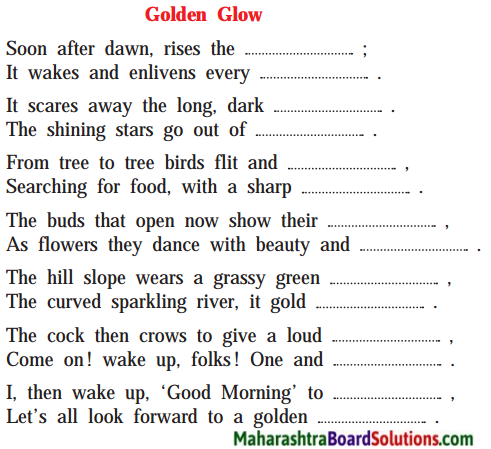
Class 9 English Chapter 3.1 Question Answer Maharashtra Board

Balbharti Maharashtra State Board Class 9 English Solutions Kumarbharati Chapter 3.1 Silver Notes, Textbook Exercise Important Questions and Answers.

Silver 9th Std Question Answer

English Kumarbharati 9th Solutions Chapter 3.1 Silver Textbook Questions and Answers

Warming Up:

Question 1.
Imagine that your class has to be divided into groups or houses. Each house will have their own colour, symbol/emblem, motto, dress code, a common room with objects of their interest and suitable furniture. Think of sets of four names for the groups. Form groups and work out the (imaginary) details for each set. Some suggestions are : Neem – Colour, yellow; Symbol, the sun; Motto, ‘Health is wealth’; Dress code, yellow waist belt; etc. Cane furniture, green and yellow curtains and herbariums in the common room.
Maharashtra Board Class 9 English Solutions Chapter 3.1 Silver 1
Answer:
Example:

  1. House name – Banyan
  2. Colour – Green
  3. Symbol – the Moon
  4. Flower – Sunflower
  5. Season – Summer
  6. Metal – Copper
  7. Dress Code – Scarf with ‘Save the Environment’ slogan on it
  8. Special interests – Activities dealing with Environmental Pollution
  9. Motto – Save the Environment.

Maharashtra Board Class 9 English Kumarbharati Solutions Chapter 3.1 Silver

2. Read the lines of the following poem. Guess and fill in suitable words to make the lines rhyme:

Maharashtra Board Class 9 English Solutions Chapter 3.1 Silver 2

Question 1.
Read the lines of the following poem. Guess and fill in suitable words to make the lines rhyme :
Answer:
Golden Glow:

Soon after dawn, rises the sun;
It wakes and enlivens every one.
It scares away the long, dark night.
The shining stars go out of sight.
From tree to tree birds flit and fly.
Searching for food, with a sharp eye.
The buds that open now show their colour,
As flowers they dance with beauty and splendour.
The hill slope wears a grassy green dress,
The curved sparkling river, it gold possess.
The cock then crows to give a loud call,
Come on! wake up, folks! One and all.
I, then wake up, ‘Good Morning’ to say,
Let’s all look forward to a golden day.

Maharashtra Board Class 9 English Kumarbharati Solutions Chapter 3.1 Silver

English Workshop:

Question 1.
If you were asked to draw a detailed picture of the scene described in the poem, what objects, animals, natural features, etc. will you show in the picture? Make a list.
Answer:
I would show the following in my picture : moon, trees, fruits, the night sky, a house with a thatched roof, a dog in a kennel, doves in their dovecotes, a mouse, a stream, fish and reeds.

Question 2.
Write the rhyming words and rhyme scheme of the poem.
Answer:
Rhyming words are : moon – shoon, sees – trees, catch – thatch, log – dog, peep – sleep, by – eye, gleam – stream. The rhyme scheme is aa, bb, cc, and so on in rhyming couplets.

Question 3.
Underline the word silver/silvery in the poem. In what lines does it occur? What pattern S does it show?
Ans.
The word silver/silvery occurs in the second | line of every couplet. It shows a pattern of repetition for pleasing effect. (A couplet is a pair of successive lines of verse, which are usually of the same length, and rhyme.)

Question 4.
Can you think of a parallel scene of dawn or evening when everything is steeped in golden light?
Answer:
Yes, I can think of a seaside scene, with the setting sun throwing golden light over everything.

Maharashtra Board Class 9 English Kumarbharati Solutions Chapter 3.1 Silver

Question 5.
The same landscape appears different at different times. What message can we draw from this?
Answer:
The landscape changes according to the light from the sky. In this poem, the poet makes us look at ordinary moonlight in a different way. The message we can draw from this is how, in different situations, we might perceive the same scene completely differently.

Question 6.
Read ‘The Listeners’ and ‘Someone’ – poems by Walter de la Mare.

English Kumarbharati 9th Digest Chapter 3.1 Silver Additional Important Questions and Answers

Simple Factual Activity:

Question 1.
Which of the objects, animals, etc. mentioned in the poem are at rest without any motion?
Answer:
1. The objects that are at rest without any motion : trees, casements, thatch, kennel, cote, water.
2. The animals that are at rest without any motion : dog, doves, fish.

Maharashtra Board Class 9 English Kumarbharati Solutions Chapter 3.1 Silver

Complex Factual Activities.

Question 1.
How has the harvest mouse been described?
Answer:
The moonlight reflects on the eye and claws of the harvest mouse, making them look silvery. The mouse is running somewhere quickly.

Question 2.
How has the poet described the scene near the stream?
Answer:
The stream is gleaming with silver light. The fish in the stream are motionless and shining. There are silver reeds near the stream.

Question 3.
The poet has described a countryside scene. What tells you this?
Answer:
The poet talks about the moonlight falling on fruits, trees, thatched houses, a dog in the kennel, doves, a harvest mouse, reeds and streams with fish. All this will be present only in the countryside and not in cities.

Activities based on Poetic Devices.

Question 1.
Explain the figure of speech ‘Personification’ j in the first two lines.
Answer:
In these lines, the moon is personified. She is i given the human quality of walking in her silver shoes.

Maharashtra Board Class 9 English Kumarbharati Solutions Chapter 3.1 Silver

Question 2.
Give one example of Alliteration from the poem.
Ans.
‘By silver reeds in a silver stream.’ The sound of the letter ‘s’ is repeated.

Appreciation of Poem.

Note: The point format given in Appreciation of Poem is for easy understanding. However, it is to be written in the form of a paragraph in the examination.

Point Format(for understanding).

  1. Title: Silver
  2. Poet: Walter de la Mare
  3. Rhyme Scheme: aa, bb, and so on (rhyming couplets).
  4. Figures of Speech: Personification. ‘This way and that she peers and sees’. The moon is given the human quality of peering this way and that. The other figures of speech are Alliteration and Repetition.
  5. Theme/Central idea: The poet describes the magical effects of the silvery moonlight on the countryside at night, and shows a beautiful and | peaceful scene of the countryside at night under the moonlight.

Maharashtra Board Class 9 English Kumarbharati Solutions Chapter 3.1 Silver

Paragraph Format:

The poem ‘Silver’ is written by Walter de la Mare.

The rhyme scheme is aa, bb and so on. The poem is in rhyming couplets, i.e., two lines rhyming with each other. Personification is a Figure of Speech used by the poet: ‘This way and that she peers and sees’. The moon is given the human quality of peering this way and that. The other figures of speech are Alliteration and Repetition.

In this poem the poet describes the magical effects of the silvery moonlight on the countryside at night. Everything turns silver. The poem also shows a beautiful and peaceful scene of the countryside at night under the moonlight and gives a clear word picture of the different animals and objects reflecting the moonlight.

Maharashtra State Board Class 9 English Solutions

English Kumarbharati 9th Workbook Answers Unit 3

Std 9 English Poem A Play 2.5 Question Answer Maharashtra Board

Class 9 English Chapter 2.5 Question Answer Maharashtra Board

Balbharti Maharashtra State Board Class 9 English Solutions My English Coursebook Chapter 2.5 A Play Notes, Textbook Exercise Important Questions and Answers.

A Play Poem 9th Std Question Answer

My English Coursebook Std 9 Digest Chapter 2.5 A Play Textbook Questions and Answers

Warming up!

Chit-chat:

  • Do you like to watch plays?
  • Which is the last play you saw?
  • Do you watch TV serials? Which ones?
  • Do you like slow-moving serials?
  • Do you like stories from the past?
  • What type of stories do you like?

Maharashtra Board Class 9 My English Coursebook Solutions Chapter 2.5 A Play

Two Truths, One Lie

Make groups of 10-15. In this game, each person writes three sentences about himself/herself, two of which are true and the third one is a lie. Read aloud your sentences, while others guess which two are true and which is a lie.
Examples: Hello, everyone! I am Sonali. I have a brother and a sister. I live in Amalner. We have a pet dog at home.

Question 1.
Make groups of 10-15. In this game, each person writes three sentences about himself/herself, two of which are true and the third one is a lie. Read aloud your sentences, while others guess which two are true and which is a lie.
Examples: Hello, everyone! I am Sonali. I have a brother and a sister. I live in Amalner. We have a pet dog at home.
Answer:
1. Hello everyone!
I am Sahil.
I live in Pune at Shivaj inagar.
I am one of the most studious students of our class.
I visited Sri Lanka last month with my parents.

2. Hello everyone!
I am Ruta.
I am Bharat Natyam dancer.
I have won many dance competitions.
But I want to be a classical singer.

Maharashtra Board Class 9 My English Coursebook Solutions Chapter 2.5 A Play

Lost and Found

Question 1.
Divide the students into groups of five. They sit in a circle. They choose one object of daily use such as a bag, wallet, box, etc. The group leader writes four sentences about it.
Answer:
I have found a water bottle.
It’s pink.
It’s cylindrical in shape.
It’s transparent.
It has a steel cap.
I found it in our school library.

Others, too, write four sentences each.

  • I have lost a tiffin box.
  • It’s colour is pink.
  • It’s square in shape.
  • I lost it in our school canteen.

They all open and read their lines, beginning with the group leader. The player whose description matches the group leader’s the most gets the object.

Part I

1. List the characters that have appeared so far in the play.

Question 1.
List the characters that have appeared so far in the play.
Answer:
Fourth Guard Messenger, Thief, Thiefs friend, King, Merchant, Bricklayer, Mortar-maker.

Maharashtra Board Class 9 My English Coursebook Solutions Chapter 2.5 A Play

2. List all the different titles they use to address the King.

Question 1.
List all the different titles they use to address the King.
Answer:
First Guard, Second Guard, Disciple, King Chaupat.

3. Copy the exclamations from the play. (At least 5)

Question 1.
Copy the exclamations from the play. (At least 5)
Answer:
1. How boring!
2. Oh, Most Great King!
(Students can copy such examples from the play on their own.)

4. Copy the orders (imperative sentences) from the play.

Question 1.
Copy the orders (imperative sentences) from the play.
Answer:

  1. Spare my daughter.
  2. Bring the money-lender’s daughter.
  3. Summon the mortar-maker at once.
  4. Show mercy to this humble potter.

Maharashtra Board Class 9 My English Coursebook Solutions Chapter 2.5 A Play

5. Use your imagination and the details from the play and draw a map of Andher Nagari.

Question 1.
Use your imagination and the details from the play and draw a map of Andher Nagari.
Answer:
(Students can draw the map using their imagination.)

6. Write what each of the following should have said after listening to the complaint against him/her:

Question 1.
Write what each of the following should have said after listening to the complaint against him/her:
(a) Daughter …………………
(b) Potter …………………….
(c) Mortar-maker …………………
(d) Bricklayer ………………..
(e) Merchant ………………………….
Answer:
(a) Daughter: Daughter should have said that, she was going to get married next week, so she should be excused from being punished.
(b) Potter: I never make defective pots. Mortar- maker might have brought it from somewhere else.
(c) Mortar-maker: I always use a bottle-necked pot to pour water, it is the bricklayer’s idea to blame me.
(d) Bricklayer: Extremely sorry to say, My Lord. I have never worked carelessly in my entire life. I am faithful to my profession.
(e) Merchant: If I had been the merchant, I would have asked the king to punish the thieves as they were trying to break in my house when my whole family was not there at home and it is a crime. So they should be punished.

Maharashtra Board Class 9 My English Coursebook Solutions Chapter 2.5 A Play

7. What should the king have said to the thief ?

Question 1.
What should the king have said to the thief ?
Answer:
The king should have said to the thief that it was the fault of him and his friend and not of the merchant. As they had entered his house with the intention of stealing when his family was away. So he and his friend were totally responsible for what had happened.

8. Will a thief appear in a court on his own? Why does this Thief dare to do so?

Question 1.
Will a thief appear in a court on his own? Why does this Thief dare to do so?
Answer:
A thief will never appear in a court on his own. This thief dares to do so because the king of his kingdom was not powerful and the rules and regulations of his kingdom were not so strict.

Maharashtra Board Class 9 My English Coursebook Solutions Chapter 2.5 A Play

Language study:

9. Read the following sentences and find the subject and the verb in each.

Question 1.
Read the following sentences and find the subject and the verb in each.
Maharashtra Board Class 9 My English Coursebook Solutions Chapter 2.4 Please Listen! 7
Answer:

SentenceSubjectverb
1. You are a stranger.Youare
2. I am a visitor here.Iam
3. You have heard right.Youhave
heard
4. The king will not hang me.The kingwill
hang
5. He must pay with his lifeHemust
pay

Maharashtra Board Class 9 My English Coursebook Solutions Chapter 2.5 A Play

10. Read the following sentences. Tick the ones in passive voice. Copy them correctly.

Question 1.
Read the following sentences. Tick the ones in passive voice. Copy them correctly.

  1. I have heard amazing stories [ ]
  2. I am especially impressed by the fact [ ]
  3. I am quite happy about it. [ ]
  4. I beg for justice. [ ]
  5. ……. and my friend was instantly killed [ ]
  6. My house has been recently built [ ]
  7. It is the fault of the bricklayer [ ]

Answer:

  1. I have heard amazing stories …. [ ]
  2. I am especially impressed by the fact…. [✓]
  3. I am quite happy about it. [ ]
  4. I beg for justice. [ ]
  5. … and my friend was instantly killed ….. [✓]
  6. My house has been recently built …. [✓]
  7. It is the fault of the bricklayer …. [ ]

Part II

1. List the characters that appear for the first time in this part of the play. Write one or two lines about each of them.

Question 1.
List the characters that appear for the first time in this part of the play. Write one or two lines about each of them.
Answer:

  1. Goldsmith: He was dutiful and tried to follow the king’s order by setting aside all his work.
  2. Hangman: He was also faithful towards his duties. He tried to follow the King’s order. He was an executioner who hangs the culprits.
  3. Sage: A wise man from a neighbouring forest who smartly saved his disciple from the J punishment given by King Choupat.

Maharashtra Board Class 9 My English Coursebook Solutions Chapter 2.5 A Play

2. Say whether the following sentences are true or false:

Question 1.
Say whether the following sentences are true or false:
(a) The Goldsmith blamed the King for the delay in his work.
(b) The King thought that the Goldsmith had a good reason to delay the Daughter’s work.
(c) The Goldsmith was hanged.
(d) The noose did not fit the Goldsmith’s neck.
(e) The noose did not fit the disciple’s neck.
(f) The Sage wanted to die on that day.
(g) The Sage wanted to save his Disciple.
(h) The King wanted to be King again in his next birth.
Answer:
(a) The Goldsmith blamed the King for the delay in his work. – True
(b) The King thought that the Goldsmith had a good reason to delay the Daughter’s work. – False
(c) The Goldsmith was hanged. – False
(d) The noose did not fit the Goldsmith’s neck. – True
(e) The noose did not fit the disciple’s neck. – False
(f) The sage wanted to die on that day. – True
(g) The sage wanted to save his disciple. – True
(h) The king wanted to be king again in his next birth. – True

Maharashtra Board Class 9 My English Coursebook Solutions Chapter 2.5 A Play

3. Write any three instances of funny rules and twisted logic used in Andher Nagari.

Question 1.
Write any three instances of funny rules and twisted logic used in Andher Nagri.
Answer:
Example:

  1. The disciple came to Andher Nagari to pay respects to the mighty King Choupat but to his surprise the king ordered the Hangman to hang him without delay.
  2. The blame game continued one after another and the king ordered the Hangman everytime to hang the person without verifying his/her mistake.
  3. The king requested the guards to take him to the gallows and hang him without any delay to become the next king of the same kingdom in his next life.

4. List the proverbs and sayings used in the play.

Question 1.
List the proverbs and sayings used in the play.
Answer:
1. Justice delayed is justice denied.
2. Our actions speak louder than words.

Maharashtra Board Class 9 My English Coursebook Solutions Chapter 2.5 A Play

5. Read the entire play and complete the following blame game flow chart.

Question 1.
Read the entire play and complete the following blame game flow chart.
Maharashtra Board Class 9 My English Coursebook Solutions Chapter 2.4 Please Listen! 8 Maharashtra Board Class 9 My English Coursebook Solutions Chapter 2.4 Please Listen! 9
Answer:

Who is blaming?Who does he blame?For what does he blame that person?
ThiefOwner of the houseFor not constructing a strong wall.
Owner of the house (Merchant)BricklayerFor carelessly building a weak wall.
BricklayerMortar- makerFor mixing too much water in Mortar.
Mortar-makerPotterFor making a defective pot with a large mouth.
PotterMoney­ lender’s DaughterFor disturbing him with tinkling of anklets.
Money-lender’s DaughterGoldsmithFor delay in the delivery of her ornaments.
GoldsmithKingFor giving orders to set aside all other work to make the Queen’s ornaments.

6. Form groups. Translate one page of the play into your mother tongue as a group activity. Gather the pages translated by different groups and prepare a translated script of the entire play.

Question 1.
Form groups. Translate one page of the play into your mother tongue as a group activity. Gather the pages translated by different groups and prepare a translated script of the entire play.

Maharashtra Board Class 9 My English Coursebook Solutions Chapter 2.5 A Play

Langauge Study:

7. Divide the play (Part I as well as Part II) into sections.
Form groups and assign roles. Practise your lines in groups.
Hold play reading sessions in the classroom.
Which group/student presents the most effective reading?
Note the features that make an oral presentation effective. Some of them are :

  • Meaningful reading – taking proper pauses
    (breaking the speech into meaningful chunks)
  • Using suitable intonation
  • Speaking clearly
  • Good pronunciation – using English sounds and stress patterns
  • Pleasant and confident appearance of the speakers.

8. Look up the following entries in the Language Study pages given at the end.

  • stress
  • intonation
  • sound
  • consonant
  • vowel

Question 1.
Look up the following entries in the Language Study pages given at the end.

  • stress
  • intonation
  • sound
  • consonant
  • vowel

Maharashtra Board Class 9 My English Coursebook Solutions Chapter 2.5 A Play

9. Note the way the dialogue in the play is presented. Look up the word ‘colon’ in the ‘Language Study’ pages and note how ills used in the play.

Question 1.
Note the way the dialogue in the play is presented. Look up the word ‘colon’ in the ‘Language Study’ pages and note how ills used in the play.

10. Listen carefully and write the verbs in the appropriate column.

Question 1.
Listen carefully and write the verbs in the appropriate column.
Maharashtra Board Class 9 My English Coursebook Solutions Chapter 2.4 Please Listen! 10
Teacher: can, give, following, commanded, get, has, been, spare, does, take, hand, have, fall, forgive, let, drag, return, will, is, try, has, must, be, resist, force, speak, are, were, should, had, thought, lost, would, says, was, are, does, may, cannot, demand, shall, shouldn’t, become, reign
Answer:

Main verbAuxiliary verbModel auxiliary
give, following, commanded, spare, take, hand, fall, have, forgive, drag, get, does, return, try, resist, become, force, speak, demand, reign, says, thought, losthas, been, let, is, be, are, were, had, was, doescan, will, must, should, would, may, cannot, shall, shouldn’t

Maharashtra Board Class 9 My English Coursebook Solutions Chapter 2.5 A Play

My English Coursebook 9th Class Solutions Chapter 2.5 A Play Additional Important Questions and Answers

Read the following passage and do the activities:

Simple Factual Activities:

Question 1.
Name the following:
Answer:

  1. Name of the kingdom – Andher Nagari
  2. Name of the king – Chaupat
  3. The person who was not – Second guard alert
  4. The forest from where a – Ghangor visitor came

Maharashtra Board Class 9 My English Coursebook Solutions Chapter 2.5 A Play

Question 2.
State whether the following statements are Right or Wrong:
Answer:

  1. The first guard was at ease, all day. – Wrong
  2. The visitor was a disciple of the Wise Sage from the Ghangor forest. – Right
  3. Taka ser bhaji, taka ser khaja is an Indian proverb. – Right
  4. The disciple wanted to attend the court to pay his respects to the mighty King Chaupat. – Right

Question 3.
Complete the following sentences:
(Answers are directly given.)
Answer:

  1. The thieves were hard working and honest.
  2. Both the thieves were true to their profession.
  3. The house in which the thief peered through the hole belonged to a merchant.
  4. According to the merchant, brick layer had carelessly built the wall of his house.

Question 4.
Complete the following sentences:
(Answers are directly given.)
Answer:
1. The mortar-maker’s family comprised of his wife and two young children.
2. According to the mortar-maker excess water poured down into the mortar mixture because the pot had an extraordinary large mouth.

Maharashtra Board Class 9 My English Coursebook Solutions Chapter 2.5 A Play

Question 5.
Who said to whom:
1. “I was merely following your Highness’s order.”
2. “Take him to the gallows without further delay.”
Answer:
1. The goldsmith said to the King.
2. The King commanded the Hangman and guards.

Choose the correct alternative to answer the following questions:

Question A.
Who was the old man?
(a) a king
(b) a sage
(c) a guard
(d) a stranger
Answer:
(b) a sage

Maharashtra Board Class 9 My English Coursebook Solutions Chapter 2.5 A Play

Question B.
Who had a wonderful fate in his next life?
(a) the king
(b) the disciple
(c) the sage
(d) the hangman
Answer:
(a) the king

Question C.
Who was going to be hanged?
(a) the young stranger
(b) the hangman
(c) the guard
(d) the sage
Answer:
(a) the young stranger

Question D.
According to the sage how was the king?
(a) holy
(b) wise
(c) generous
(d) great
Answer:
(c) generous

Maharashtra Board Class 9 My English Coursebook Solutions Chapter 2.5 A Play

Question 6.
State whether the following statements are True or False:
(Answers are directly given.)
Answer:
The old man was a wise and learned sage. – True

Complex Factual Activities:

Question 1.
Why did a disciple of the Wise Sage from the Ghangor forest come to Andher Nagari?
Answer:
A disciple of the Wise Sage from the Ghangor forest had heard amazing stories about Andher Nagari and the great King Chaupat. He was impressed by the fact that everything in the market is sold at the same price. So it was a good idea to settle in that land. So to pay his respects to the mighty King Chaupat, the disciple had come to Andher Nagari.

Maharashtra Board Class 9 My English Coursebook Solutions Chapter 2.5 A Play

Question 2.
Arrange the following sentences in chronological order:
1. The wall collapsed while entering the house and the thief’s friend was instantly killed.
2. One day they made a hole in the wall of a merchant’s house.
3. There were two hardworking and honest thieves in the great land of Andher Nagari.
4. They were very true to their profession from the last several years.
Answer:
3. There were two hardworking and honest thieves in the great land of Andher Nagari.
4. They were very true to their profession from the last several years.
2. One day they made a hole in the wall of a merchant’s house.
1. The wall collapsed while entering the house and the thief’s friend was instantly killed.

Question 3.
List the characters that have appeared so far in the passage :
Answer:
Mortar-maker, Fourth Guard Messenger, Potter, Money-lender and his daughter.

Question 4.
What is the Mortar-maker’s excuse? Is it believable?
Answer:
According to the Mortar-maker, he poured water with an extraordinary large mouth-pot into
the mortar mixture. The excess water was poured down because of a useless pot made by the potter. It was not a believable excuse as pouring water can be controlled by us.

Maharashtra Board Class 9 My English Coursebook Solutions Chapter 2.5 A Play

Question 5.
Is the Daughter’s complaint about the Goldsmith true?
Answer:
Yes, it is true the daughter was going to get married the next week and her jewellery was not ready. She had to leave the house to request the Gold¬smith to work faster and hand over her ornaments on time for her marriage. She wouldn’t have gone out of her house if there wouldn’t be such an urgency.

Question 6.
What is the goldsmith’s excuse?
Answer:
The king commanded the goldsmith to set aside all his work and get the Queen’s ornaments ready before Her Highness’s birthday. So there had been a delay in making the lady’s (the money lender’s daughter’s) bridal ornaments. This was the goldsmith’s excuse for not making the lady’s ornaments.

Question 7.
What was the sage’s request? Why did he make such a strange request?
Answer:
The sage’s request was that he should be hanged instead of his disciple because he wanted to save his disciple at any cost by using some tricks.

Question 8.
What does the King want to know?
Answer:
The King wants to know why the sage, being a wise and holy man wishes to obstruct the course of justice. He also wants to know why the sage wanted to be hanged in place of his disciple.

Maharashtra Board Class 9 My English Coursebook Solutions Chapter 2.5 A Play

Question 9.
Why did the King want to die?
Answer:
The sage told the King that, the great prophets had foretold that one who would be hanged on that day, in that kingdom, would become the next king and conquer many more nations. The King wanted to become the next great king of Andher Nagari. He also wanted to be a famous royal monarch. So he wanted to die to become the king of Andher Nagari.

Activities based on vocabulary:

Question 1.
Make a list of describing words used for King Chaupat in the form of a web:
(Answers are directly given.)
Answer:
Maharashtra Board Class 9 My English Coursebook Solutions Chapter 2.4 Please Listen! 11

Question 2.
Find out synonyms from the extract for the following:
(Answers are directly given.)
Answer:

  1. delicious – delectable
  2. awesome – amazing
  3. knowledgeable – learned
  4. make – enliven

Maharashtra Board Class 9 My English Coursebook Solutions Chapter 2.5 A Play

Question 3.
Find out the adverbs which are used along with the following verbs:
(Answers are directly given.)
Answer:

  1. instantly killed
  2. recently built
  3. immediately bring
  4. recently collapsed

Question 4.
Pick out the verbs and state their kind:
1. My friend peered through the hole.
2. The merchant was living in a house.
Answer:
1. peered – Past Tense
2. was living – Past Continuous.

Maharashtra Board Class 9 My English Coursebook Solutions Chapter 2.5 A Play

Question 5.
Find out minimum four infinitives from the passage:
Answer:
Infinitives – to blame, to pour, to urge, to work.

Question 6.
Find out a suitable word from the extract and complete the following sentences:
(Answers are directly given.)
Answer:

  1. If you disturb the class, your teacher will give you punishment.
  2. Most of the women are crazy for ornaments.
  3. King Shibi was very generous.
  4. It is our duty to follow our parent’s orders.

Question 7.
Arrange the following words in the following columns as per their meanings:
Words: force, excuse, order, apologise, forgive
Answer:

OrdersRequests
1. order(1) pardon
2. command(2) apologise
3. force(3) excuse
4. shout(4) forgive

Maharashtra Board Class 9 My English Coursebook Solutions Chapter 2.5 A Play

Question 8.
Match the following words in Column ‘A’ with their meaning in Column ‘B’ :

‘A’           .‘B’
1. yonder(a) give the right to
2. conquer(b) over there
3. recluse(c) favouring a solitary life
4. entitled(d) capture

Answer:

‘A’           .‘B’
1. yonder(b) over there
2. conquer(d) capture
3. recluse(c) favouring a solitary life
4. entitled(a) give the right to

Question 9.
Write any suitable noun from the passage for the given adjectives to make correct combination!

  1. generous ………………..
  2. wonderful ………………..
  3. great ………………..
  4. learned ………………..

Answer:

  1. king
  2. prophet
  3. fate
  4. sage.

Maharashtra Board Class 9 My English Coursebook Solutions Chapter 2.5 A Play

Activities based on contextual grammar:

Question 1.
Identify the types of the following sentences:

  1. Give your identity.
  2. How boring!
  3. You have heard right.
  4. What brings you here?

Answer:

  1. Imperative sentence (order)
  2. Exclamatory sentence
  3. Statement (simple sentence)
  4. Interrogative sentence (wh-question)

Question 2.
Frame Verbal Questions:
1. There was too much of water mixed in it.
2. My friend was instantly killed.
Answer:
1. Was there too much of water mixed in it?
2. Was my friend instantly killed?

Maharashtra Board Class 9 My English Coursebook Solutions Chapter 2.5 A Play

Question 3.
It is the fault of the bricklayer. He carelessly built such a weak wall.
(Combine the sentence with ‘who’)
Answer:
It is the fault of the bricklayer who carelessly built such a weak wall.

Question 4.
Pick out the subject and object in the following sentences:
1. The guards dragged the goldsmith.
2. You commanded me
3. he Hangman forced the disciple.
4. The Hangman overpowers them.
Answer:

SubjectObject
1. The guards1. the goldsmith
2. You2. me/I
3. The Hangman3. the disciple
4. The Hangman4. they

Maharashtra Board Class 9 My English Coursebook Solutions Chapter 2.5 A Play

Question 5.
Add a tail tag to the following sentences:
(Answers are directly given.)
Answer:

  1. You have not carried out my orders, have you?
  2. Your excuse does not hold good, does it?
  3. This noose does not fit the goldsmith’s neck, does it?
  4. Take him to the gallows, will you?

Question 6.
Make the following sentences Assertive :
(Answers are directly given.)

Question a.
What a strange appeal!
Answer:
It was indeed a strange appeal.

Question b.
What a wonderful fate in my next life – a king once again!
Answer:
A king once again in my next life is really a wonderful fate.

Maharashtra Board Class 9 My English Coursebook Solutions Chapter 2.5 A Play

Question 7.
Rewrite using ‘as well as’ :
1. He is a wise and learned sage from the forest.
2. The old man begged and pleaded that he should be hanged instead of the young stranger.
Answer:
1. He is a wise as well as learned sage from the forest.
2. The old man begged as well as pleaded that he should be hanged instead of the young stranger.

Personal Response:

Question 1.
Do you think this is a good land to settle in? why?
Answer:
Yes, I think the land of Andher Nagari is a good land to settle in because it is the only land where everything is sold at the same price. There will be no complications. We can settle there very well even if our income is low.

Question 2.
Can we call the thieves truly hard-working and honest?
Answer:
No, not at all. Thieves cannot be hard ; working and honest as they rob the possessions | earned by others by working hard. If they are honest, they would not do such crimes.

Question 3.
Do you think the potter is telling the truth? Why?
Answer:
The potter said when he was shaping the mouth of the pot he heard the sweet, delicate tinkling of anklets of money-lender’s daughter. I think he must be telling the truth as it might have disturbed his work and the mouth of pot became too wide.

Maharashtra Board Class 9 My English Coursebook Solutions Chapter 2.5 A Play

Question 4.
Why is the daughter so confident that the king will not hang her? Does her prediction come true?
Answer:
The daughter was very much confident that the king will not hang her because she knew that she was not guilty and she also knew the king very well. Yes, her prediction came true.

Question 5.
Is the Goldsmith telling the truth? Give reasons for your answer.
Answer:
Yes, I think the Goldsmith was telling the truth. After making that ladies ornaments the Goldsmith could have received the money from her. But he did not think about the money whereas he thought about the respect and honour of the King. So he started making the Queen’s ornaments instead of that lady’s bridal ornaments.

Question 6.
What is your opinion about the king is he ? wicked, greedy, stupid or all of these? Which of his actions/words show that?
Answer:
I think the king is stupid. He believes every person of his kingdom without any proof. “Guards! Take me to the gallows and hang me at once without any delay.” This action shows that he was really stupid. Being a king he should have thought of his action.

Maharashtra Board Class 9 My English Coursebook Solutions Chapter 2.5 A Play

Question 7.
Was the King willing to hang the Sage? Why?
Answer:
No, the King was not willing to hang the sage because the sage told him that the one who would be hanged on that day, in that kingdom, would become the next king. So to become the next great king of Andher Nagari, he didn’t want to hang the sage whereas he wanted himself to be hanged.

Activities Based on Language study

Do the following as instructed:

Question 1.
Complete the words by using correct letters:

  1. c o _ r t
  2. g u _ r d
  3. g _ e a t
  4. f a u _ t

Answer:

  1. c o u r t
  2. g u a r d
  3. g r e a t
  4. f a u l t.

Question 2.
Copy the following sentences correctly in your notebook:
Answer:
1. Why have you not carried out my orders?
2. What a wonderful fate in my next life a king once again!

Maharashtra Board Class 9 My English Coursebook Solutions Chapter 2.5 A Play

Question 3.
Put the following words in alphabetical order:
1. forgive, excess, mercy, guilty.
2. moulding, mortar, Majesty, measure.
Answer:
1. excess, forgive, guilty, mercy.
2. Majesty, measure, mortar, moulding.

Question 4.
Punctuate the following sentences:
1. oh do not fret father the king will not hang me said daughter
2. the king said ah justice at last take him to the gallows without further delay
Answer:
1. “Oh, do not fret, father. The king will i not hang me,” said daughter.
2. The King said, “Ah! Justice at last! Take him to the gallows without further delay.”

Question 5.
Write four small words (minimum 3 letters each) using the letters in the given word:
‘explanation.’
Answer:

  1. explain
  2. nation
  3. plain
  4. plant.

Maharashtra Board Class 9 My English Coursebook Solutions Chapter 2.5 A Play

Question 6.
Spot the error and rewrite the correct sentences:
1. O Noble King, you were most generous.
2. The great prophets has foretold that the one who will be hanged on this day shall become the next king and conquer many more nations.
Answer:
1. O Noble King, You are most generous.
2. The great prophets have foretold that the one who will be hanged on this day shall become the next king and conquer many more nations.

Question 7.
Write related words as shown in the
example:
(Answers are directly given.)
Answer:
Maharashtra Board Class 9 My English Coursebook Solutions Chapter 2.4 Please Listen! 12

Question 8.
Complete the following word-chain of adjectives. Add four words, each beginning with the last letter of the previous word:
young → ……………. → ……………. → ………….. → ………….. .
Answer:
young → greatterribleequallovely

Do as directed:

Question 1.
Make your own meaningful sentence by using the phrase ‘to say goodbye’.
Answer:
It is quite difficult to say goodbye to our school.

Maharashtra Board Class 9 My English Coursebook Solutions Chapter 2.5 A Play

Question 2.
Add a prefix or suffix to make new
words and use any one of the root words in your own sentence: 2
1. mercy
2. complicate.
Answer:
1. mercy – merciful
2. complicate – complication.
Sentence: The bricklayer begged for mercy.

Question 3.
Add a clause to expand the sentence meaningfully:
The teacher suggested …………………..
Answer:
The teacher suggested that we should follow the rules and regulations of our country.

My English Coursebook 9th Class Pdf Unit 2