Std 9 English Poem The Fall of Troy 3.2 Question Answer Maharashtra Board

Class 9 English Chapter 3.2 Question Answer Maharashtra Board

Balbharti Maharashtra State Board Class 9 English Solutions My English Coursebook Chapter 3.2 The Fall of Troy Notes, Textbook Exercise Important Questions and Answers.

The Fall of Troy Poem 9th Std Question Answer

My English Coursebook Std 9 Guide Chapter 3.2 The Fall of Troy Textbook Questions and Answers

Warming up:
Chit-chat:

  1. Do you know stories from any epics or mythological poems?
  2. Who is your favourite mythological character? What do you like about that character?
  3. Who is your favourite warrior?
  4. If you could visit a place in the ancient world or the mytholocial world, which place would you choose? Which event would you like to see?

Maharashtra Board Class 9 My English Coursebook Solutions Chapter 3.2 The Fall of Troy

Building a Story

Form groups of eight. The group leader prepares slips of paper for each of the seven points given below and distributes them among the others. The group sits in a circle, taking their seats according to the number on the slip they have. Then each one completes the sentence on his/her slip without sharing it with the others. The group leader collects the slips and reads all the sentences aloud as one continuous passage. Does the story make sense? The group then works on the story to make it more meaningful and interesting.

  1. Once there was a …………………………
  2. Who lived in a …………………………
  3. He/She ate …………………………
  4. She/He went …………………………
  5. There She/He saw …………………………
  6. She/He was …………………………
  7. That is why …………………………

Part – I

English Workshop:

1. Find antonyms of the following from the passage:

Question 1.
Find antonyms of the following from the passage: (Answers are directly given.)
Answer:

  1. barren × fertile
  2. surrender × attack
  3. cowardly × brave
  4. defenceless × safe
  5. offended × pleased
  6. peace × war
  7. exposed × closed

Maharashtra Board Class 9 My English Coursebook Solutions Chapter 3.2 The Fall of Troy

2. Correct the following sentences using facts from the passage:

Question (a)
Troy traded in cattle and grass with other cities.
Answer:
Troy traded in goods and grain.

Question (b)
During war, Trojans jumped over the fort gates.
Answer:
During war, Trojans would close the doors of the fort.

Question (c)
Helen escaped with Menelaus.
Answer:
Helen eloped with Paris, a prince of Troy.

Question (d)
The Greek armies and heroes always defeated the Trojans.
Answer:
Sometimes the Greeks defeated the Trojans and sometimes the Trojans defeated the Greeks.

Question (e)
Both the enemies were eager to continue fighting.
Answer:
Both the armies were tired of war. The Trojans of being shut in their city and the Greeks of living away from home.

Question (f)
Troy was attacked because it was strong rich city.
Answer:
Troy was attacked because the Greeks wanted to take revenge on Troy for the wrong’done to their King Menelaus.

3. State the counteraction for the following actions:

Question (a)
Helen eloped with Paris.
Answer:
Counteraction: The Greeks wanted to take revenge on Troy they sailed and laid siege to the city of Troy.

Maharashtra Board Class 9 My English Coursebook Solutions Chapter 3.2 The Fall of Troy

Question (b)
The Greeks sailed to Troy and attacked it.
Answer:
Counteraction: The Trojans fought hard and the siege continued for ten long years.

Question (c)
Hector was killed by Achilles.
Answer:
Counteraction: Achilles himself was killed later on by a poisoned arrow that entered his heel, the only part of his body, where he could be wounded.

Question (d)
The siege continued for ten long years.
Answer:
Counteraction: The Trojans were tired of being shut up in their city and the Greeks deeply desired to see their homes again.

Question (e)
The fighting went on daily.
Answer:
Counteraction: Even then the siege did not end. The Greeks could not take the city, on the other hand, the Trojans could not force them to sail away back to Greece.

4. From either of our two Indian epics, find out which battle/war lasted the longest? Write down about its cause, the enemy armies, its heroes, its duration and the final outcome.

Question 1.
From either of our two Indian epics, find out which battle/war lasted the longest? Write down about its cause, the enemy armies, its heroes, its duration and the final outcome.
Answer:
Mahabharat
1. Cause: Kauravas took possession of the kingdom of Hastinapur forcibly, which rightfully belonged to Pandavas and they were not ready to give even an inch of the land to Pandavas. So, it led to the outbreak of the war.

2. The enemy armies:
Kauravas: 100 Kaurava brothers and many friendly kings like Shakuni, Shalya, Kama, etc. with their armies.
Pandavas: 5 Pandavas, Kashiraja, King Drupad, King Virat, Dhrushtadhyumna, etc. and their armies.

3. Heroes:

  • Pandavas : Dharma (Yudhishthir), Arjun, Bhim, Nakul, Sahadev, Abhimanyu and Shri Krishna as the charioteer of Arjun.
  • Kauravas: Duryodhan, Dushasan, Kama, Bhishmacharya, Dronacharya, Jaydrath.

4. Duration: The war lasted for eighteen days.

5. Final outcome: The war ended in victory to Pandavas. All mighty warriors from Kaurava side except Ashwathama were killed and it was a complete ruin for them. Pandavas regained Hastinapur.

Maharashtra Board Class 9 My English Coursebook Solutions Chapter 3.2 The Fall of Troy

5. Underline the subject in the following sentences:

Question 1.
Underline the subject in the following sentences:
(a) Paris had brought her to Troy.
(b) The Greeks waited to take revenge on Troy.
(c) The Greek armies sailed to Troy.
(d) The fighting went on daily.
(e) Reading is a good habit.

Here, we see that the ‘-ing’ form of the verb ‘fight’ is used as a subject in ‘The fighting went on’. It does the work of a noun. When the ‘-ing’ form of a verb is used as a noun, it is known as a gerund or verbal noun.

  1. Gardening is an art.
  2. Cooking is a science.
  3. I enjoy reading poems.
  4. I like writing, too.

Rewrite the above sentences using other appropriate gerunds in place of the ones given here.
Example: Speaking is an art.

  1. Gardening is an art.
  2. Cooking is a science.
  3. I enjoy reading poems.
  4. I like writing, too.
  5. Swimming is a good exercise.
  6. He is good at running.
  7. I am fond of playing.
  8. Travelling refreshes our minds.

Part – II

English Workshop:

1. Find and write the Greek and the Trojan names used in the story (Part I and II).

Question 1.
Find and write the Greek and the Trojan names used in the story (Part I and II).
Answer:
1. Greek names: Menelaus, Helen, Achilles, Odysseus, Agamemnon, Aphrodite (goddess).
2. Trojan names: Paris, Hector, King Priam.

Maharashtra Board Class 9 My English Coursebook Solutions Chapter 3.2 The Fall of Troy

2. List all the words related to ‘war’ from both parts of the story.

Question 1.
List all the words related to ‘war’ from both parts of the story.
Answer:
enemy, attack, fortress, ships, protect, defend, brave soldiers, heroes, kings, countries, revenge, siege, fighting, battles, killing, arrows, victory, engineer, peace, disaster, terror, death, conquerors.

3. Note the following constructions carefully and then use them to express your own ideas:

Question (a)
A horse big enough to hold men inside it.
……………. enough to …………… ………….
Answer:
A stick long enough to fell mangoes from the tree.

Question (b)
The Greeks were tired of the long war.
……………. tired of …………… ………….
Answer:
We are tired of the tedious work.

Question (c)
They are afraid of the long voyage home, too.
……………. afraid of …………… ………….
Answer:
They are afraid of the impending storm.

Question (d)
They made it too big to go inside your city.
……………… too ………………. to ……………….
Answer:
They bought a cupboard that was too big to go inside our house.

Question (e)
They were so excited that they paid no attention to his words.
……………….. so ………………. that ………………..
Answer:
We were so excited that we could not think of anything except our picnic.

Maharashtra Board Class 9 My English Coursebook Solutions Chapter 3.2 The Fall of Troy

4. Put the following events in the order in which they took place. Number then accordingly:

Question 1.
Put the following events in the order in which they took place. Number then accordingly:
Answer:
(a) The Trojans found a Greek man under the big wooden horse.  [1]
(b) They broke down a part of the wall and brought the horse in.  [3]
(c) The cunning Odysseus thought of a plan. [1]
(d) The Greeks burnt their tents and sailed away. [4]
(e) Troy was burnt down. [3]
(f) The Greeks built a big wooden horse. [2]
(g) The great heroes hid inside the horse. [3]
(h) The priest warned the Trojans not to break the wall.  [2]
(i) The Trojans were happy to see the Greek ships go. [5]
(j) The Trojans slept soundly.  [4]
(k) The Greek army entered the city. [2]

5. Form pairs. Imagine you are a pair of Trojans and you have come to know about Odysseus’s plan. Make a counter plan to defeat the Greeks. Write down your plan as you explain to your fellow Trojans:

Question 1.
Form pairs. Imagine you are a pair of Trojans and you have come to know about Odysseus’s plan. Make a counter plan to defeat the Greeks. Write down your plan as you explain to your fellow Trojans:
Answer:
While observing the large wooden horse, I heard some movements inside it. Friends, I am sure it is some trick to attack our city at night. Their great heroes must be inside the horse. They have not sailed away. They must be somewhere near and will return only when they will get the signal from the Greeks in the horse.

Friends, they will not get the signals from them. Look, we shall get bundles of ropes and tie the ropes tightly around the whole of the horse, so that no one would be able to come out and give signals. That Greek man also is in my custody. We shall arrange heavy barricades to close our wall gates. We shall take this opportunity to lift their siege.

We shall hold these heroes in the horse to ransom, in order to force them to lift the siege, surrender and leave our shore. Let’s come together and implement this plan immediately.

Maharashtra Board Class 9 My English Coursebook Solutions Chapter 3.2 The Fall of Troy

Language Study:

6. Refer to the Language Study pages and read the following entries:

Question (a)
Refer to the Language Study pages and read the following entries:

  1. word
  2. phrase
  3. clause
  4. sentence

Question (b)
A phrase is a meaningful group of words. Read the following phrases :

  • the wise Odysseus
  • a great horse of wood
  • a skilful engineer
  • the greatest heroes
  • the secret of opening and shutting the entrance
  • on the seashore outside the walls
  • in the darkness
  • watching for the return of the fleet
  • part of their strong wall

Question 1.
Write three phrases on your own.
All the above phrases are parts of sentences they do not form a complete sentence by themselves. A sentence expresses a complete idea. You know that it has a subject and a predicate. A sentence has at least one finite verb in it.

Read the following examples:

  • The tents had been burnt.
  • The shore was deserted.
  • The Greek ships had all gone.

Maharashtra Board Class 9 My English Coursebook Solutions Chapter 3.2 The Fall of Troy

2. Write three sentences using your own ideas.

Question (c)
When we read the story of ‘The Fall of Troy’, we see that here (as elsewhere), many sentences express two or more complete ideas linked together. For example,

  1. When the Trojans dragged him out, the man pretended to be very frightened of them.
  2. They wanted also to kill me and offer me as a sacrifice to the sea-god but I escaped and hid from them.
  3. In the darkness the fleet sailed back, and the leading ship, which was Agamemnon’s, bore a red light high on its mast.

All these sentences consist of clauses. A clause has a subject and a verb. Some clauses can stand by themselves as a complete sentence.
Example: The man pretended to be frightened of them.

But some clauses do not make complete sense by themselves.
Example: When the Trojans dragged him out
It is only when we read the entire sentence that we understand what is being said.

Thus, we have seen that a clause is a part of a sentence and there are two types of clauses:
(a) Main clause – It can stand by itself.
(b) Subordinate or dependent clause : It depends on the main clause, and is incomplete without it.

Note that a sentence can have two or more main clauses or a main clause and one or more dependent clauses, but we cannot have a sentence without a main clause.

Question 3.
Identify one example of a main clause and one example of a dependent clause from page 74.

My English Coursebook 9th Class Solutions Chapter 3.2 The Fall of Troy Additional Important Questions and Answers

Simple Factual Activities:

Question 1.
Fill in the blanks with correct information from the passage. Choose the correct option from the brackets: (Answers are directly given.)
Answer:

  1. Troy was a rich trading city in Asia Minor. (beautiful/trading)
  2. Troy was a strong city protected by its wall. (Mount Ida/wall)
  3. Troy was well situated for commerce and agriculture, (fertile fields/commerce and agriculture)
  4. Helen was the wife of a Greek king Menelaus. (Paris/Menelaus)

Maharashtra Board Class 9 My English Coursebook Solutions Chapter 3.2 The Fall of Troy

Question 2.
Complete the following sentences using the information from the passage:
(Answers are directly given.)
Answer:

  1. The Greek leaders decided to follow the advice of the wise Odysseus.
  2. The Trojans thought that the long siege was over at last.
  3. The last man who entered the wooden horse was the architect himself.
  4. Troy was taken, not by force but by a trick.

Question 3.
State whether the following statements are True or False:
Answer:

  1. The huge wooden horse was an offering to the god of the sea. – False
  2. The man left by the Greeks told the false story of the horse. – True
  3. Their wise priest told the Trojans not to make a hole in the wall. – True
  4. The Greeks were tired of the long war and had sailed away. – False

Complex Factual Activities:

Question 1.
How did the location of Troy help it to grow into a very rich/prosperous city?
Answer:
The city was well situated for commerce and agriculture. Their ships sailed and carried goods and grain over the sea in front of the city. Many rivers and streams flowed from Mount Ida. Well-watered and fertile valleys among the hills grew corn in fertile fields cattle were reared on the rich grass of the meadows. So Troy became a rich/ prosperous city.

Question 2.
How were the Trojans protected?
Answer:
The Trojans had built a strong wall around their city to prevent the enemy attack from the sea. The great gates of the wall were kept closed in time of war. They were safe from all attacks by the walls surrounding the city as well as by the hills behind the city.

Maharashtra Board Class 9 My English Coursebook Solutions Chapter 3.2 The Fall of Troy

Question 3.
What was the cause of the ten year old war between the Greeks and the Trojans?
Answer:
Paris, a prince of Troy, had persuaded Helen, wife of a Greek king Menelaus, to elope with him. Paris brought her to Troy. The Greeks wanted to take revenge on Troy and laid siege to the city. The fight began and the war continued for ten long years.

Who were the brave heroes on either side who were killed in the war? How?

Question 1.
Who were the brave heroes on either side who were killed in the war? How?
Answer:
Great heroes on both sides were killed in the course of time. Hector was killed by Achilles. Achilles himself was killed later on by a poisoned arrow that entered his heel. The prince of Troy, Paris, was also killed by a poisoned arrow.

Question 2.
How did Odysseus plan to defeat the Trojans?
Answer:
Odysseus advised his men to build a great wooden horse, big enough to hold men inside it and let some of their best fighters hide in the horse. Then let them burn their tents and pretend to sail away in their ships. But instead of sailing away, they would return in the night. When the Trojans were asleep, they would attack the city and burn, kill and defeat the Trojans.

Question 3.
What was the reason for Trojans to rejoice and celebrate?
Answer:
The Trojans woke up and came out for fighting as usual. They were delighted and surprised what they saw on the seashore outside the walls. The tents of the Greeks were burnt, the shore was deserted so they thought that the long siege was over at last. They were sure that the Greeks had gone. They were glad to be free to go where they pleased. That was the reason for the Trojans to rejoice and celebrate.

Question 4.
How did the cunning Greek explain the presence of such a large wooden horse?
Answer:
The cunning Greek explained to the Trojans that the Greeks were tired of the long war and had sailed away in their ships. They were afraid of the long voyage home and so they made a large horse and left that as an offering to the god of the sea.

Maharashtra Board Class 9 My English Coursebook Solutions Chapter 3.2 The Fall of Troy

Question 5.
What reckless/thoughtless step did the Trojans take?
Answer:
Thinking that the horse would bring them good luck the Trojans broke down a part of their strong wall in order to drag the horse in the city and that brought the ruin of their city.

Activities based on vocabulary:

Question 1.
Write the words related to ‘Geography’ from the passage.
Answer:
Asia Minor, trading city, Aegean, Black Sea, agriculture, grain, peak of Mount Ida, rivers, streams, valleys, hills, fertile fields, cattle, grass, fortress, meadows.

Question 2.
Match the adjectives in Column ‘A’ with the nouns in Column ‘B’:

‘A’‘B’
1. high(a) fortress
2. brave(b) peak
3. fertile(c) fields
4. strong(d) soldiers

Answer:

  1. high – peak
  2. brave – soldiers
  3. fertile – fields
  4. strong – fortress.

Question 3.
Write the words related to war from the passage.
Answer:
fighting, siege, force, battles, armies, heroes, I kill, defence, resist, poisoned arrow, wounded.

Question 4.
Find the nouns for the following adjectives from the passage :

  1. skilful
  2. cunning
  3. wonderful
  4. wooden

Answer:

  1. engineer
  2. Odysseus
  3. piece of work
  4. horse.

Maharashtra Board Class 9 My English Coursebook Solutions Chapter 3.2 The Fall of Troy

Question 5.
Write all the words ending with ‘-mg’ form of verbs:
Answer:
Sailing, being, opening, shutting, expecting.

Question 6.
Arrange the letters properly to make a meaningful word :

  1. aagni
  2. bndeih
  3. rohse
  4. seegi.

Answer:

  1. again
  2. behind
  3. shore
  4. siege

Question 7.
Write the meaningful sentences from the jumbled words:
1. the Greeks did a large such Why horse make?
2. wise their them priest warned not so to do.
Answer:
1. Why did the Greeks make such a large horse?
2. Their wise priest warned them not to do so.

Question 8.
Match the names of the persons in Column ‘A’ with the information in Column ‘B’:
Answer:

  1. Agamemnon – sailing in the leading ship of Greeks
  2. Aphrodite – a Greek goddess
  3. Priam – Old Trojan King
  4. Helen – wife of King Menelaus.

Maharashtra Board Class 9 My English Coursebook Solutions Chapter 3.2 The Fall of Troy

Question 9.
Write the phrases related to Greeks’ attack on Troy.
Answer:
Set fire to houses, burn and kill, sight of leaping flames, sound of shouting, noise of weapons, cries of weeping women, the sleeping Trojans taken by surprise, put on their armour, seize their weapons, went up in flames, all in vain.

Activities based on contextual grammar:

Question 1.
A prince of Troy had persuaded Helen.
(Begin with ‘Helen had – ’ and change the voice.)
Answer:
Helen had been persuaded by a prince of Troy.

Question 2.
The city was strongly defended by its brave soldiers. (Choose the correct option of Active voice)
(a) Its brave soldiers defended strongly by the city.
(b) Its brave soldiers defended the city strongly.
Answer:
Its brave soldiers defended the city strongly.

Question 3.
Underline the infinitives in the sentences:
(Answers are directly underlined.)
1. Paris persuaded Helen to elope with him.
2. The Greeks wanted to take revenge.

Question 4.
Greeks could not take the city. (Make the sentence affirmative.)
Answer:
Greeks were unable to take the city.

Question 5.
Every day Greeks came out of their gates. (Rewrite the sentence using Past Continuous tense.)
Answer:
Every day Greeks were coming out of their gates.

Maharashtra Board Class 9 My English Coursebook Solutions Chapter 3.2 The Fall of Troy

Question 6.
The Trojans, too, fought hard. (Add a question tag.)
Answer:
The Trojans, too, fought hard, didn’t they? ‘

Question 7.
Find the gerund from the sentence. The fighting went on daily.
Answer:
fighting.

Question 8.
They will return in the night. (Frame a Wh-question to get the underlined part as an answer.)
Answer:
When will they return?

Question 9.
They went to sleep.
(Write the sentence in Past Progressive tense.)
Answer:
They were going to sleep.

Question 10.
Why did the Greeks make such a huge horse?
(Rewrite the sentence using Past Perfect tense.)
Answer:
Why had the Greeks made such a huge horse?

Question 11.
The walls are no longer necessary.
(Add a question tag.)
Answer:
The walls are no longer necessary, are they?

Question 12.
The Greeks have gone.
(Rewrite the sentence using Simple Past tense.)
Answer:
The Greeks went.

Choose the correct alternative from the brackets and complete the following sentences:

Question 1.
Choose the correct alternative from the brackets and complete the following sentences:
(Answers are directly underlined.)
Answer:

  1. They were killed with their great heroes. (with/for)
  2. They found the car m their own garage. (on/in)
  3. He jumped into the river to save the child. (over/into)
  4. She was gazing at the strange person. (on/at)

Maharashtra Board Class 9 My English Coursebook Solutions Chapter 3.2 The Fall of Troy

Question 2.
Write the past tense and past participle forms of the following verbs:
(Answers are directly given.)
Answer:

VerbPast tensePast participle
comecamecome
leadledled
speakspokespoken
swimswamswum

Complete the words by using correct letters:

Question 1.
Complete the words by using correct letters:

  1. s _ ege
  2. ro_nd
  3. bra _ e
  4. w_ong

Answer:

  1. siege
  2. round
  3. brave
  4. wrong

Copy the following sentences correctly in your notebook:

Question 1.
Copy the following sentences correctly in your notebook:
Answer:
1. The Greek wanted to take revenge on Troy for the wrong done to Menelaus.
2. “But why did the Greeks make such a huge horse?”

Put the following words in alphabetical order:

Question 1.
Put the following words in alphabetical order:
Answer:
1. fields, battles, ships, arrows
2. grain, grow, gates, Greek
3. arrows, battles, fields, ships.
4. gates, grain, Greek, grow.

Maharashtra Board Class 9 My English Coursebook Solutions Chapter 3.2 The Fall of Troy

Punctuate the following sentences:

Question 1.
1. Then he asked the boys where are you going children and for what
2. The king said what a strange appeal
Answer:
1. Then he asked the boys, “Where are you going, children, and for what?”
2. The King said, “What a strange appeal!”

Question 2.
Write four small words (minimum 3 letters each) using the letter in the given word :
“sometimes.”
Answer:

  1. some
  2. time
  3. mime
  4. tie

Question 3.
Spot the error and rewrite the correct sentences:
1. Great heroes on both sides was killed in the course of the war.
2. The Trojans came out of their gates, and the Greeks came out of their tents and ships and the fighting goes on.
Answer:
1. Great heroes on both sides were killed in the course of the war.
2. The Trojans came out of their gates, and the Greeks came out of their tents and ships and the fighting went on.

Question 4.
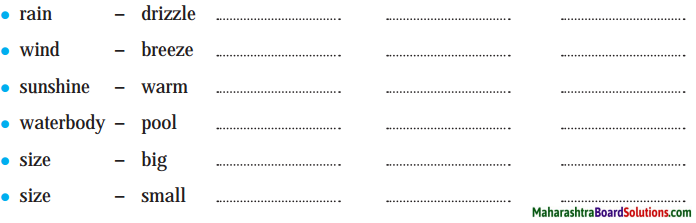
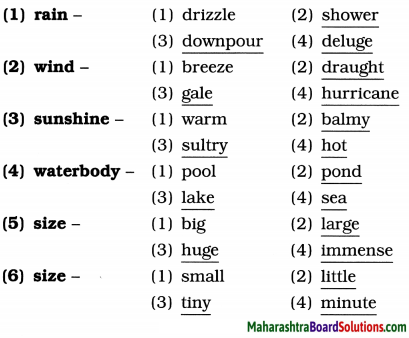
Write related words as shown in the example: (Answers are directly given.)
Answer:
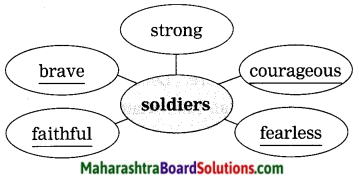
Maharashtra Board Class 9 My English Coursebook Solutions Chapter 3.2 The Fall of Troy

Question 5.
Complete the following word-chain of nouns Add four words, each beginning with the last letter of the previous word:
Stream → ……………., ……………….., …………….., ……………..
Answer:
Stream → mountain → nature → electricity → years.

Question 6.
Make your own meaningful sentence by using the phrase ‘in front of.
Answer:
There is a big ground in front of our school.

Maharashtra Board Class 9 My English Coursebook Solutions Chapter 3.2 The Fall of Troy

Question 7.
Add a prefix or suffix to make new words and use any one of the root words in your own sentence:
1. imagine
2. education
Answer:
1. imaginary
2. educational
Sentence: Just try to imagine that you are a rich person.

Question 8.
Add a clause to expand the sentence meaningfully:
The person cried for help ………………
Answer:
The person cried for help because he was caught in the big fire.

Personal Response:

Question 1.
Do you know one of the wars in ancient India was fought over a woman? Describe it in short.
Answer:
I know such a war was fought between Ram and Ravan. Ravan, the demon king of Lanka, came in disguise as a Sadhu and forcefully took away Seeta, the wife of Ram. Ram with his monkey army reached Lanka. He fought against Ravan, defeated him and killed Ravan and brought back Seeta to Ayodhya.

Question 2.
Why, do you think, did the Greeks burn their tents?
Answer:
The Greeks burnt their tents to show the Trojans that they have left for Greece and did not wish to continue the siege any more. They wanted them (Trojans) to be careless and carefree about the Greek attack and their army.

Question 3.
Was it enough to use the wooden horse to hide some soldiers? What was done to make the Trojans take it inside the city?
Answer:
No, it was not enough to use it for hiding some soldiers. The Greeks wanted their entry into the city with all their army men. Unless the walls around the city were broken down they would not have got that opportunity. That’s why they made the horse very large and lured the Trojans to take it inside the city by breaking the walls.

Maharashtra Board Class 9 My English Coursebook Solutions Chapter 3.2 The Fall of Troy

Question 4.
Was the big wooden horse really an offering to the god of the sea?
Answer:
No, the big wooden horse really was not an offering to the god of the sea. It was a false tale of the Greek who was found under the big horse by the Trojans. It was told to lure the Trojans for taking the horse inside the city for sudden attack without their knowledge.

Question 5.
Why, do you think, were the Trojans so excited?
Answer:
I think, the Trojans thought that the siege by the Greeks was lifted and there would be no war any more. Again they thought that they were bringing in good luck for the city by presence of the wooden horse. They did not think of the impending danger.

Question 6.
Do you think that the conquerors of war are happy after their victory?
Answer:
No, I don’t think so. Both defeated and victorious countries have to bear the brunt of war. Both have to suffer because of the disastrous consequences they face. Both suffer the loss of lives, money, peace and so many other things. It takes a long time for both to regain their normal life.

Question 7.
Which of the following are the adverse effects of war? Tick [✓] them in the given box:
Answer:

  1. Many people are killed. [✓]
  2. The country gains fame and glory. [✗]
  3. They lose peace in the land. [✓]
  4. Thousands are wounded. [✓]
  5. Soldiers enjoy fighting. [✗]
  6. Those who win the war become rich and famous. [✓]

Maharashtra Board Class 9 My English Coursebook Solutions Chapter 3.2 The Fall of Troy

Oral Work

Question 1.
Read the story and retell it in your mother tongue, Read the following passage and do the activities:

My English Coursebook 9th Class Solutions Unit 3
Std 9 English Poem Tansen 4.5 Question Answer Maharashtra Board

Class 9 English Chapter 4.5 Question Answer Maharashtra Board

Balbharti Maharashtra State Board Class 9 English Solutions Kumarbharati Chapter 4.5 Tansen Notes, Textbook Exercise Important Questions and Answers.

Tansen 9th Std Question Answer

English Kumarbharati 9th Solutions Chapter 4.5 Tansen Textbook Questions and Answers

Warming Up:

Question (a)
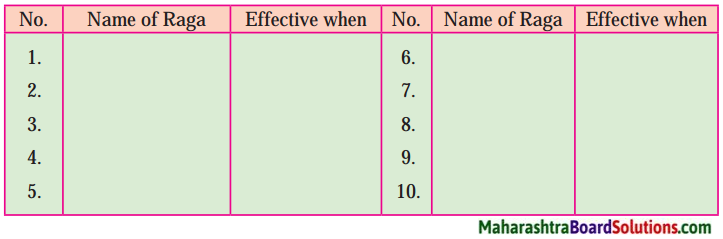
Indian Classical Music consists of many Ragas. Find out from an expert or from the internet, the names of at least 10 Ragas and the time they are sung to produce greater effect.
Maharashtra Board Class 9 English Kumarbharati Solutions Chapter 4.5 Tansen 1
Answer:

Name of RagaEffective when
1. Pahadievening
2. Bhairavsung in the morning
3. Deepakevening
4. Malkoussmall hours of the morning
5. Yamansunset to late evening
6. Bhimpalasilate afternoon to sunset
7. Kedarlate evening to midnight
8. Jogsmall hours of the morning
9. Bhairavioften at the end of a long musical performance.
10. Gaud Malharmonsoon

(Students can find more information from the Internet.)

Maharashtra Board Class 9 English Kumarbharati Solutions Chapter 4.5 Tansen

Question (b)
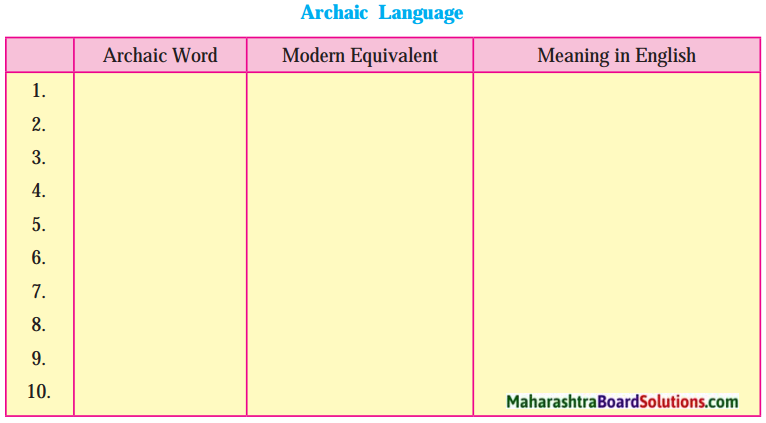
Archaic words are those that are no longer used in a language, but sometimes their usage adds a historical or old-times flavour to a piece of writing.
Examples:

  1. behold – look
  2. afeared – frightened
  3. forsooth – indeed
  4. hither – this place

Now find out some archaic words from your mother tongue or another language that you are proficient in and write down at least ten of them, and against each, their modern equivalent and meaning in English.
Maharashtra Board Class 9 English Kumarbharati Solutions Chapter 4.5 Tansen 2
Answer:

Archaic wordModem equivalentMeaning in English
1.
2.

(Students can find out from their parents or other elders, and attempt this in their own mother tongue.)

Question (c)
There are many legends about the ‘nine gems’ in Akbar’s Court. Can you name some of the nine gems and the stories associated with them?
Answer:
The nine gems of Akbar’s court were:

  1. Abu’l Fazi ibn Mubarak
  2. Raja Todar Mai
  3. Abdul Rahim Khan-i-Khana
  4. Raja Birbal
  5. Mulla Do-Piyaza
  6. Faizi
  7. Fakir Aziao-Din
  8. Tansen and
  9. Raja Man Singh I.

There Eire plenty of Akbar-Birbal stories and those of Akbar and Tansen that are famous.
(Students can read these stories either from the library or from the internet.)

English Workshop:

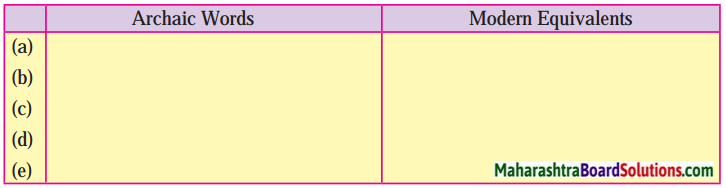
1. Pick out the archaic words from the poem and give their modern equivalents:

Question 1.
Pick out the archaic words from the poem and give their modern equivalents:
Maharashtra Board Class 9 English Kumarbharati Solutions Chapter 4.5 Tansen 3
Answer:

Archaic WordsModem Equivalents
1. thyyour
2. thineyours
3. ’twereit were
4. o’erover
5. theeyou

Maharashtra Board Class 9 English Kumarbharati Solutions Chapter 4.5 Tansen

2. Write who said the following words, to whom, and when:

Question 2.
Write who said the following words, to whom, and when:
(The answers are given directly and underlined.)
Answer:

The expression/sentencesWho said itTo whomWhen
1. “Ah, no, to thee I sing: he sings to God.”TansenAkbarWhen Akbar asks him to sing the same musical composition that Ostad had sung, in the same way.
2. ‘What theme this is that holds the soul enchanted.’AkbarTansenWhen Akbar hears the beautiful musical composition that Ostad had sung.

3. Rearrange the following in their proper order as in the poem. Write the serial number against each line:

Question 1.
Rearrange the following in their proper order as in the poem. Write the serial number against each line:
(The answer is given directly.)
Answer:
(a) The Ostad sang the Malkous Raga enchantingly. [6]
(b) Akbar followed Tansen, dressed miserably. [4]
(c) I request you to sing such a song that I will experience unmatched joy. [9]
(d) Ostad was nowhere to be seen. [8]
(e) O Divine Teacher, please gift us the joy of your song. [5]
(f) One day, the singer sang Deepak Raga in the court. [1]
(g) Akbar expressed his wish to meet the Teacher. [3]
(h) He experienced heavenly delight. [7]
(i) Tansen sings to please the earthly king but Ostad devotes his songs to God. [10]
(j) She sang Raga Malhar, which had a cooling effect. [2]

4. Write the reason in your own words:

Question (a)
Akbar strongly desired to hear Ostad (the teacher) sing.
Answer:
Akbar was enraptured with Tansen’s singing. He said that Tansen’s teacher must be and divine for Tansen to have learnt to sing so magically under his coaching. Akbar then felt that Ostad’s singing would be even better, and so he strongly desired to hear Ostad sing.

Maharashtra Board Class 9 English Kumarbharati Solutions Chapter 4.5 Tansen

Question (b)
Akbar had to dress like a slave.
Answer:
Akbar badly wanted to meet Tansen’s teacher and hear him sing. However, the teacher did not think it worthy to sing to kings, and hence Tansen suggested that it would be better for Akbar to meet him as a poor slave. Therefore Akbar changed his kingly attire and wore the robes of a poor man.

Question (c)
After the song, Ostad had vanished.
Answer:
Ostad vanished because he probably did not; want to hear any praise or any demands for more songs.

Question (d)
Ostad’s song was more elating than Tansen’s songs.
Answer:
Ostad’s song was more elating than Tansen’s songs because Tansen sang to Akbar, a human being, while Ostad sang to God.

5. What message does the poet wish to convey through this narrative poem, ‘Tansen’?

Question 1.
What message does the poet wish to convey through this narrative poem, ‘Tansen’?
Answer:
The poet wishes to convey that one can reach great heights in one’s field if one becomes unworldly and devotes one’s talents to someone or something higher than mere human beings.

Maharashtra Board Class 9 English Kumarbharati Solutions Chapter 4.5 Tansen

6. Summarise the poem in your own words in 8-10 lines, highlighting only the main points.

Question 1.
Summarise the poem in your own words in 8-10 lines, highlighting only the main points.
Answer:

Tansen

Tansen was a singer in Akbar’s court. One day, he sang the Deepak Raga so well that Akbar was enraptured. He wished to meet the teacher at whose feet Tansen had learnt to sing so magically. However, the teacher lived in a remote cave in the Himalayas. He shunned wealth and disdained to sing to earthly kings. Akbar donned the clothes of a slave and went with Tansen to meet him. On their request, Ostad sang the Malkous Raga. It was so enchanting that Akbar felt as if he had been transported to Heaven. Soon after this, Ostad vanished. Akbar asked Tansen whether he could sing the same musical composition that Ostad had sung. Tansen replied that he could not, for he, Tansen, sang to earthly kings, while his Ostad sang to God.

English Kumarbharati 9th Digest Chapter 4.5 Tansen Additional Important Questions and Answers

Simple Factual Activity:

Question 1.
Say whether the following statements are True or False:
Answer:
(The answers are given directly and underlined.)

  1. Akbar was fond of music. True
  2. Malhar is the Song of Fire. False
  3. Akbar rewarded Tansen for his singing. True
  4. Tansen did not come back to normal. False

Question 2.
Write who said the following words, to whom, and when:
(The answers are given directly and underlined.)
Answer:

UtteranceWho said itTo whomWhen
“Mighty thy teacher must be and divine.”AkbarTansenAfter hearing the wonderful Deepak Raga.
“He dwells within a cave of Himalay.”TansenAkbarWhen Akbar praised Tansen and asked him about his teacher.
“As you desire, Huzoor.”TansenAkbarWhen Akbar told Tansen that he wanted to see the teacher and hear him sing.
“O Holy Master, bless us with thy song!”Akbar and TansenThe teacherWhen they met the teacher in the mountains.

Complex Factual Activity:

Question 1.
How did Akbar reward Tansen for the ecstatic effect of his singing?
Answer:
Akbar rewarded Tansen by praising him, gifting him a lot of jewels and calling him the chief jewel in his diadem.

Maharashtra Board Class 9 English Kumarbharati Solutions Chapter 4.5 Tansen

Question 2.
What happened to Tansen when he sang the Deepak Raga with great fervour?
Answer:
When Tansen sang the Deepak Raga with great fervour, his body burst into flames and burnt like a pyre.

Question 3.
How did he (Tansen) come back to normal again?
Answer:
He(Tansen) came back to normal again when a maiden sang Malhar, the song of cold water, and put out the fire.

Question 4.
What does the incident tell us about Tansen’s singing?
Answer:
The incident tells us that Tansen’s singing was whole-hearted, magical and divine.

Question 5.
What did Tansen tell Akbar about his teacher?
Answer:
Tansen told Akbar that his teacher stayed in a remote cave in the Himalayas, far away from the unworthy crowds, scorning worldly wealth. He did not think it worthy to sing to kings, and hence Tansen suggested that it would be better for Akbar to meet him as a poor slave.

Maharashtra Board Class 9 English Kumarbharati Solutions Chapter 4.5 Tansen

Question 6.
What was the magical effect of Ostad’s rendering the Malkous Raga?
Answer:
When Ostad sang the Malkous Raga, the birds and beasts gathered around, enchanted with the song. Akbar felt waves of heavenly rapture. He felt his soul was enchanted and his heart was filled with delight.

Question 7.
What happened before Akbar could come out of his trance?
Answer:
Ostad had vanished before Akbar could come out of his trance.

Question 8.
Why did Tansen’s singing not produce the same effect as that by Ostad?
Answer:
Tansen’s singing did not produce the same effect as that by Ostad because Tansen sang to Akbar – a human being – while Ostad sang to God.

Activities based on Poetic Devices:

Question 1.
Pick out the rhyming pairs of words in the first six lines.
Answer:
Rhyming words: Court – Fort, bells – tells, gem – diadem.

Maharashtra Board Class 9 English Kumarbharati Solutions Chapter 4.5 Tansen

Question 2.
‘His voice rang like the sound of silver bells.’ Pick out and explain the figure of speech in this line.
Answer:
Simile: His voice is compared to the sound of silver bells, with the use of the word ‘like’.

Question 3.
Pick out the rhyming words in the last six lines of the extract. What is the rhyme scheme?
Answer:
Rhyming words are: slave – cave, feet – sweet, long – song. The rhyme scheme is aa, in rhyming couplets.

Question 4.
Pick out the figure of speech in the sentence:
‘He felt the waves of heavenly rapture roll.’
Answer:
The figure of speech is Alliteration; repetition of the sound of the letter ‘r’.

Point Format (for understanding)

  • Title: Tansen
  • Poet: Hazrat Inayat Khan
  • Rhyme Scheme: The poem is in rhyming couplets. So the rhyme scheme is aa.
  • Figure of Speech: Alliteration. ‘Tell me, Tansen, what theme this is that holds’. Repetition of the sound of the letter ‘t’. The other figures of speech are Simile and Inversion.
  • Theme/Central idea: This narrative poem depicts Akbar’s appreciation of Tansen’s singing, his meeting with Tansen’s teacher, and what he felt during this meeting. The final lines lead to the climax of the narration.

Maharashtra Board Class 9 English Kumarbharati Solutions Chapter 4.5 Tansen

Paragraph Format:

‘Tansen’ by Hazrat Inayat Khan is a narrative poem depicting Akbar’s appreciation of Tansen’s singing, his meeting with Tansen’s teacher, and what he felt during this meeting. The final lines lead to the climax of the narration.

The poem is in rhyming couplets. So the Rhyme Scheme is aa. A Figure of Speech : Alliteration: ‘Tell me, Tansen, what theme this is that holds’ – Repetition of the sound of the letter ‘t’. The other figures of speech are Simile and Inversion.

The poet wishes to convey that one can reach great heights in one’s field if one becomes unworldly and devotes one’s talents to someone or something higher than mere human beings. The story is told systematically and logically and can be easily understood.

Maharashtra State Board Class 9 English Solutions

Kumarbharati 9th Std English Textbook Answers Unit 4

Std 9 English Poem Life 1.1 Question Answer Maharashtra Board

Class 9 English Chapter 1.1 Question Answer Maharashtra Board

Balbharti Maharashtra State Board Class 9 English Solutions Kumarbharati Chapter 1.1 Life Notes, Textbook Exercise Important Questions and Answers.

Life Poem 9th Std Question Answer

English Kumarbharati 9th Solutions Chapter 1.1 Life Textbook Questions and Answers

Warming Up:

1. There are many popular lines like:
‘life Is a game – play ft well’.
‘life Is a Journey – keep going ahead’.
Discuss and write down a few such metaphorical lines about ‘life’. You can make them up yourselves.
1. …………………………….. .
2. …………………………….. .
3. …………………………….. .
4. …………………………….. .
5. …………………………….. .

Question 1.
Discuss and write down a few metaphorical lines about life, like the two lines given on page 2 of the textbook.
Answer:
(Some examples)

  1. Life is a movie – enjoy it to the full.
  2. Life is a short picnic – relish it.
  3. Life is a see-saw – sometimes up, sometimes down.

Maharashtra Board Class 9 English Kumarbharati Solutions Chapter 1.1 Life

2. Prepare as many ‘acrostics’ using the word LIFE, as you can. Two examples are given below.

Maharashtra Board Class 9 English Kumarbharati Solutions Chapter 1.1 Life
You can turn it into a game, using a time – limit. Make sure your acrostics are related to ‘life’.

Question 1.
Prepare as many acrostics as you can, using the word ‘LIFE’.
Answer:
(Some examples)
1. Love
Inspiration
Friendship
Enjoyment

2. Lively
Interesting
Fascinating
Enchanting

Maharashtra Board Class 9 English Kumarbharati Solutions Chapter 1.1 Life

3. Listen carefully and write the word in the appropriate column.

Maharashtra Board Class 9 English Kumarbharati Solutions Chapter 1.1 Life 2
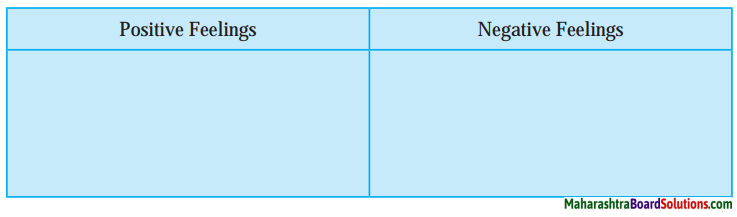
Teacher: hopeful, lonely, happy, jealous, surprised, shy, loving, proud, cheerful, anxious, nervous, excited, embarrassed, scared, silly, comfortable, peaceful, depressed, enthusiastic, motivated, inspired, threatened, crushed, angry Note that it is possible to feel both kinds of emotions at the same time. Have you experienced it? Try to describe the situation in short.

Question 1.
Listen carefully to the words spoken by the teacher and write them in the appropriate columns :
(The answer is given directly.)
Answer:

Positive FeelingsNegative Feelings
hopeful, excited, happy, surprised, loving, cheerful, comfortable, peaceful, enthusiastic, motivated, inspired.lonely, jealous, shy,  proud, anxious, nervous, embarrassed, scared, silly, depressed, angry, threatened, crushed.

Maharashtra Board Class 9 English Kumarbharati Solutions Chapter 1.1 Life

English Workshop :

1. Pick out from the extract two lines each that reflect an optimistic (positive) attitude and pessimistic (negative) attitude.

Optimism :
1. …………… .
2. ……………. .

Pessimism :
1. …………….. .
2. …………….. .

Question 1.
Pick out from the extract two lines each that reflect an optimistic (positive) attitude and pessimistic (negative) attitude.
Answer:
Optimism :

  1. Foretells a pleasant day.
  2. But these are transient all.

Pessimism :

  1. Oft a little morning rain.
  2. Sometimes there are clouds of gloom.

(Note: These lines cannot actually be called pessimistic. The poetess looks on problems as temporary and feels that any difficulties we face always foretell a happy future. There are no lines that are absolutely pessimistic.)

Maharashtra Board Class 9 English Kumarbharati Solutions Chapter 1.1 Life

2. Give other ‘-ly’ adverbs of similar meaning for the following. Use a thesaurus if needed.

(a) rapidly → ……………… .
(b) merrily → ……………… .
(c) gratefully → ………………
(d) cheerily → ……………… .
(e) manfully → ……………… .
(f) fearlessly → ……………… .
(g) gloriously → ……………… .
(h) victoriously → ……………… .

Question 1.
Give other ‘-ly’ adverbs of similar meaning for the following. Use a thesaurus if needed :
(The answers are given directly.)
Answer:
(a) rapidly → swiftly
(b) merrily → cheerfully
(c) gratefully → thankfully
(d) cheerily → happily
(e) manfully → bravely
(f) fearlessly → courageously
(g) gloriously → wonderfully
(h) victoriously → triumphantly

Maharashtra Board Class 9 English Kumarbharati Solutions Chapter 1.1 Life

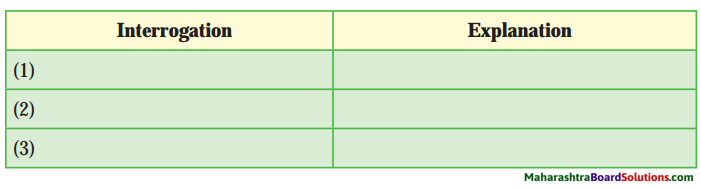
3. Pick out three examples of interrogation (rhetorical questions) from the poem.
a. Explain in your own words the point that each one makes.
Maharashtra Board Class 9 English Kumarbharati Solutions Chapter 1.1 Life 3

b. Explain the metaphor in the following lines :
1. Oft a little morning rain ………………………………….
Foretells a pleasant day ……………………………………
2. Sometimes there are clouds ………………………………….
3. … the shower will make the roses bloom ………………………………….
4. Life’s sunny hours flit by ………………………………….

c. Pick out four examples of personification. Write what is personified in each :
1. ………………………………….
2. ………………………………….
3. ………………………………….
4. ………………………………….

d. ‘And calls our Best away’ is a gentle way of expressing the unpleasant idea of a loved one dying. It is an example of euphemism. Think and write down 3 or 4 ways in which we can express the idea of ‘death’ in a tactful and gentle manner.
1. ………………………………….
2. ………………………………….
3. ………………………………….
4. ………………………………….

Question a.
Pick out two examples of interrogation (rhetorical questions) from the extract. Explain in your own words the point that each one makes.
Answer:

InterrogationExplanation
1. What though death at times steps in, And calls our Best away?If death, at times takes away the people we love most, we must accept it and hope for better times.
2. What though sorrow seems to win, O’er hope a heavy sway?It does not matter if we are overcome by sorrow and hope seems to be far away.

Maharashtra Board Class 9 English Kumarbharati Solutions Chapter 1.1 Life

Question b.
Explain the metaphor in the following lines :

1. Oft a little morning rain ………………….
Foretells a pleasant day …………….
2. SometImes there are clouds……………..
3. … the shower wifi make the roses bloom …………..
4. life’s sunny hours flit by ……………

Question 1.
Oft a little morning rain
Foretells a pleasant day.
Answer:
If we have difficulties at some stage, there will be joyous times following it. Difficulties are implicitly compared to rain and joyous times to a pleasant day.

Maharashtra Board Class 9 English Kumarbharati Solutions Chapter 1.1 Life

Question 2.
Sometimes there are clouds.
Answer:
Sometimes there are problems. Problems are implicitly compared to clouds.

Question 3.
……. the shower will make the roses bloom.
Answer:
The problems we face will make for better times ahead. Problems are implicitly compared to the showers of rain and better times Eire implicitly compared to roses blooming.

Question 4.
Life’s sunny hours flit by.
Answer:
The happy times of our life go by very quickly. Here, the happy times are implicitly compared to sunny hours.

Maharashtra Board Class 9 English Kumarbharati Solutions Chapter 1.1 Life

Question c.
Pick out four examples of personification from the extract. Write what is personified in each.
Answer:

  1. ‘Death steps in.’ Death is personified.
  2. ‘Sorrow seems to win.’ Sorrow is personified.
  3. ‘Yet Hope again elastic springs, Unconquered though she fell.’ Hope is personified.
  4. ‘Can courage quell despair!’ Courage is personified.

Question d.
‘And calls our Best away’ is a gentle way of expressing the unpleasant idea of a loved one dying. It is an example of euphemism. Think and write down 3 or 4 ways in which we can express the idea of ‘death’ in a tactful and gentle manner.
Answer:

  1. The person has left for his heavenly abode.
  2. He/She has gone to meet his/her Maker.
  3. He/She has become the beloved of God.
  4. He/She has completed his work on this earth.

Maharashtra Board Class 9 English Kumarbharati Solutions Chapter 1.1 Life

4. ‘…………. and that’s how I realised that courage and hope can help me overcome any major mishap/problem in life.’ Write an episode/experience from your own life that leads to the above conclusion.

Question 1.
‘…… and that’s how I realized that courage and hope can help me overcome any major mishap/ problem in life.’ Write an episode/experience from your own life that leads to the above conclusion.
Answer:
I am a lover of sports. My favourite game is football. I wanted to play in my school team, and right from the age of eleven, I had been practising very sincerely.

Then one unfortunate day, when I was twelve, I fell down the stairs of my building and fractured my leg , badly. I was devastated. How could I play my favourite game? How could I make it to the team? Would my leg ever become completely alright again? Would I be I able to run around and kick the ball as before? I felt that my world had ended.

This was the time when my family gave me their full support. My grandparents helped me to while away the long hours; my parents made nutritious food for me and saw to the medical treatment. My sister, who is four years older than me, gave me sound advice and courage. She understood what I was going through.

She told me of various people who had suffered terrible disasters and had risen I above them. She brought me videos of umpteen cases where the mind had won over the body. She made me read biographies of achievers like Wilma Rudolph and Sudha Chandran. She made me do my exercises regularly and keep in touch with my sport. Slowly but surely, I regained courage and confidence.

Believe it or not, two years later I made it to my football team! My doctor and my family said that it was optimism and a positive attitude that had helped me recover completely. And that’s how I realized that courage and hope can help me (or anybody) overcome any major mishap/problem in life.

5. Read: ‘The Psalm of Life’ – a poem by H. W. Longfellow.

English Kumarbharati 9th Digest Chapter 1.1 Life Additional Important Questions and Answers

Warming Up:

Question 1.
It is possible to feel both kinds of emotions at the same time. Have you experienced it? Try to describe such a situation in short.
(An example is given below.)
Answer:
Yes, I have experienced it. Once, when I stood first in class and got excellent marks in Science and Maths, my parents gave a party. All my friends were also present. My father gave a speech praising me. At that time, I was happy as well as embarrassed.

Read the following extracts carefully and complete the activities :

Simple Factual Activity :

Question 1.
Say whether the following statements are True or False :
Answer:

  1. The sages say that life is a dark dream. True
  2. The clouds of gloom are permanent. False
  3. We must enjoy the happy hours of our life. True
  4. Life’s sunny hours flit by quickly. True

Complex Factual Activities :

Question 1.
What do the sages say?
Answer:
The sages say that life is a dark dream.

Question 2.
What does the rain often foretell?
Answer:
The rain often foretells a pleasant day.

Maharashtra Board Class 9 English Kumarbharati Solutions Chapter 1.1 Life

Question 3.
What should we do during joyful times in life?
Answer:
We should enjoy the joyful times of our life gratefully and cheerfully.

Question 4.
Complete the following :
We should not be unhappy when we have difficulties because
Answer:
We should not be unhappy when we have difficulties because these difficulties are temporary. If we have difficulties at some stage in our lives, there will be joyous times following it later.

Activities based on Poetic Devices :

Question 1.
Pick out an example of interrogation (rhetorical question) from the extract. Explain j in your own words the point that it makes.
Answer:

InterrogationExplanation
If the shower will make the roses bloom, Oh, why lament its fall?If a little rain helps the roses to flower, we should not feel unhappy about it. This means that we must not express regret for the difficulties we face in life.

Simple Factual Activity :

Complete the following :
(The answers are given directly and underlined.)

1. One should bear the day of trial courageously and fearlessly.
2. The wings of hope are golden and buoyant, (strong, elastic)

Complex Factual Activity :

Question 1.
Does sorrow actually win over hope, according to the poet?
Answer:
No. Though hope is temporarily defeated, it springs up again and helps us to bear the days of trials.

Maharashtra Board Class 9 English Kumarbharati Solutions Chapter 1.1 Life

Question 2.
Who does ‘Our Best’ refer to?
Answer:
‘Our Best’ refers to those whom we love and cherish the most.

Question 3.
Why are the wings of hope ‘golden’?
Answer:
Gold is the colour of optimism. The wings of hope are golden because hope helps us bear up with
our problems and suppress despair.

Activities based on Poetic Devices :

Question 1.
Write an appreciation of this poem. With the help of given points in paragraph format :
Note: The point format given for Appreciation of Poem is for easy understanding. However, it is to be written in I the form of a paragraph in the examination.
Answer:
Point Format
(for understanding)

  • Title: Life
  • Poet: Charlotte Bronte
  • Rhyme Scheme: abeb in the first stanza, and abab in all the remaining stanzas.
  • Figures of Speech: ‘What though death at times steps in’. The figure of speech is Personification, Death is given the human quality of ‘stepping in’.
  • The other important figures of speech are Metaphor and Interrogation (Rhetorical Questions).
  • Theme/Central idea: This is a motivating and optimistic poem. The poet says that the bad things of life are transient, and good things invariably follow them.
  • Hope will rescue us and help us to bear our trials, even during times of great adversity. We must be optimistic, and have the courage to overcome any mishaps or problems.

Maharashtra Board Class 9 English Kumarbharati Solutions Chapter 1.1 Life

Paragraph Format:

The poem ‘Life’ is by Charlotte Bronte. It is a motivating and optimistic poem. The Rhyme Scheme is abeb for the first stanza and abab in all remaining stanzas. There are many figures of speech e.g. Personification ‘What though death at times steps in’. Here, death is given the human quality of ‘stepping in’. The other important figures of speech are Metaphor and Interrogation (Rhetorical Questions).

The poetess says that the bad things of life are temporary. Good things invariably follow it. Even during times of great adversity, hope will rescue us and help us to bear our trials. We must look at the positive side of life, and have the courage to overcome any mishaps or problems. The poem makes one feel good and is easy to understand.

Maharashtra State Board Class 9 English Solutions

English Kumarbharati 9th Textbook Answers Solutions Unit 1

Std 9 English Poem Helen Keller and Anne Sullivan 2.2 Question Answer Maharashtra Board

Class 9 English Chapter 2.2 Question Answer Maharashtra Board

Balbharti Maharashtra State Board Class 9 English Solutions My English Coursebook Chapter 2.2 Helen Keller and Anne Sullivan Notes, Textbook Exercise Important Questions and Answers.

Helen Keller and Anne Sullivan Poem 9th Std Question Answer

My English Coursebook Std 9 Digest Chapter 2.2 Helen Keller and Anne Sullivan Textbook Questions and Answers

Warming up!

Chit-chat:

  • What is your favourite school subject?
  • Which subject do you find the most difficult?
  • What do you do to try to understand it better?
  • Can I help you to ……….. ?
  • Can you help me to ………………. ?

Maharashtra Board Class 9 My English Coursebook Solutions Chapter 2.2 Helen Keller and Anne Sullivan

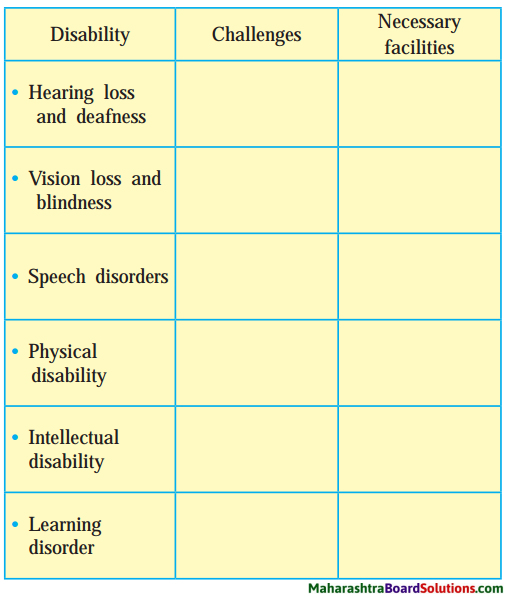
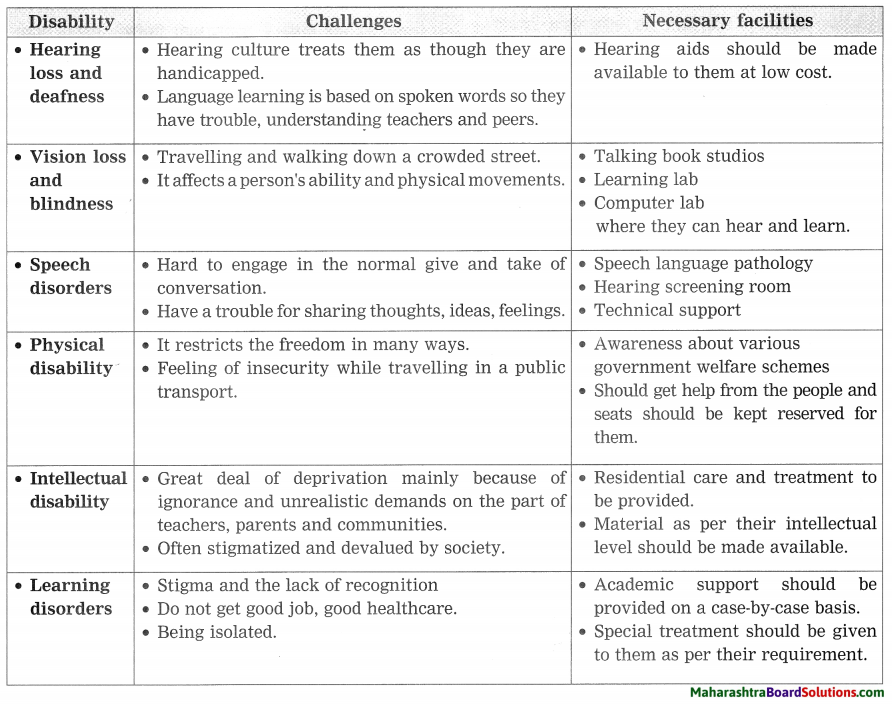
1. Discuss the challenges that people have to face due to disabilities.
What provisions should be made in public places so that everyone gets the same access to public facilities?
Observe your surroundings and write whether such facilities are available. How can you help to improve the situation?

Maharashtra Board Class 9 My English Coursebook Solutions Chapter 2.2 Helen Keller and Anne Sullivan 1

Question 1.
Discuss the challenges that people have to face due to disabilities :
Answer:

  • Unfriendly public places –
  • abused – exploited – excluded
  • inferiority complex

Question 2.
What provisions should be made in public places so that everyone gets the same access to public facilities?
Answer:

  1. Suitably altering buses, airplanes, train compartments to make them accessible to persons with disabilities.
  2. Making necessary curbs, cuts and slopes in pavement for wheelchair users.
  3. Providing ramps at all public places.
  4. Engraving edges of railway platforms for the benefits of the visually impaired.

Maharashtra Board Class 9 My English Coursebook Solutions Chapter 2.2 Helen Keller and Anne Sullivan

Question 3.
Observe your surroundings and write whether such facilities are available. How can you help to improve the situation?
Answer:
Maharashtra Board Class 9 My English Coursebook Solutions Chapter 2.2 Helen Keller and Anne Sullivan 2

English Workshop:

1. Say whether the following sentences are true or false:

Question 1.
Say whether the following sentences are true or false:
(a) The most important day in Helen Keller’s life was when her teacher came to her.
(b) When young Helen stretched out her hand, her mother took it.
(c) Young Helen learnt to spell many words without understanding them.
(d) One day, young Helen understood that everything has a name.
(e) Young Helen did not try to put the pieces of the doll together.
(f) Young Helen felt sorry that she had broken the doll.
Answer:
(a) The most important day in Helen Keller’s life was when her teacher came to her. – True
(b) When young Helen stretched out her hand, her mother took it. – False
(c) Young Helen learnt to spell many words without understanding them. – True
(d) One day young Helen understood that everything has a name. – True
(e) Young Helen did not try to put the pieces of doll together. – True
(f) Young Helen felt sorry that she had broken the doll. – False

Maharashtra Board Class 9 My English Coursebook Solutions Chapter 2.2 Helen Keller and Anne Sullivan

2. Listen carefully and classify the following into ‘one’ and ‘many’.
day, contrasts, teacher, lives, months, years, afternoon, porch, signs, face, fingers, leaves, blossoms, anger, bitterness, weeks, struggle, ship, darkness

Question 1.
Listen carefully and classify the following into ‘one’ and ‘many’.
day, contrasts, teacher, lives, months, years, afternoon, porch, signs, face, fingers, leaves, blossoms, anger, bitterness, weeks, struggle, ship, darkness
Maharashtra Board Class 9 My English Coursebook Solutions Chapter 2.2 Helen Keller and Anne Sullivan 3
Answer:

onemany
day, teacher, afternoon, porch, face, anger, bitterness, struggle, ship, darknesscontrast, lives, months, years, signs, fingers, leaves, blossoms, weeks.

3. This narrative is written in the first person – using ‘I’. Rewrite the following sentences using ‘Helen Keller/Young Helen’ appropriately in place of ‘I’ and making other neccessary changes in the sentences

Question a.
I did not know what the future held of marvel or surprise for me.
Answer:
Young Helen did not know what the future held of marvel or surprise for her.

Question b.
The morning after my teacher came she led me into her room and gave me a doll.
Answer:
The morning after Helen Keller’s teacher came, she led her into her room and gave her a doll.

Maharashtra Board Class 9 My English Coursebook Solutions Chapter 2.2 Helen Keller and Anne Sullivan

Question c.
On entering the door I remembered the doll I had broken.
Answer:
On entering the door, young Helen remembered the doll she had broken.

Question d.
Then my eyes filled with tears for I realised l what I had done, and for the first time I felt repentance and sorrow.
Answer:
Then young Helen’s eyes filled with tears: for she realised what she had done, and for the first time she felt repentance and sorrow.

Maharashtra Board Class 9 My English Coursebook Solutions Chapter 2.2 Helen Keller and Anne Sullivan

4. Read the following sentences and frame at least two relevant questions on each.
(a) I was like that ship before my education began.
Questions with ‘who’, ‘what’, ‘when’.
Example: Who was like that ship before her education began?)
(b) One day I was playing with the new doll.
(c) I learnt a great many new words that day.
(d) She brought my hat.
(e) We walked down the path to the well-house.
(f) That living word awakened my soul.

Question b.
One day I was playing with the new doll.
Answer:
(i) When was I playing with the new doll?
(ii) What was I doing one day?

Maharashtra Board Class 9 My English Coursebook Solutions Chapter 2.2 Helen Keller and Anne Sullivan

Question c.
I learnt a great many words that day.
Answer:
(i) What did I learn that day?
(ii) Who learnt many words that day?

Question d.
She brought my hat.
Answer:
(i) What did she bring?
(ii) Who brought my hat?

Question e.
We walked down the path to the well-house.
Answer:
(i) Where did we walk down?
(ii) Who walked down the path to the well- house?

Question f.
That living word awakened my soul.
Answer:
(i) What awakened my soul?
(ii) What did that living word awaken?

Maharashtra Board Class 9 My English Coursebook Solutions Chapter 2.2 Helen Keller and Anne Sullivan

5. Write about your own experience. Do you remember an occasion when you did something successfully for the first time? Write about it in short (10-12 lines). Prepare an outline of your composition before you write it.

Question 1.
Write about your own experience. Do you remember an occasion when you did something successfully for the first time? Write about it in short (10-12 lines). Prepare an outline of your composition before you write it.
Answer:
The occasion when I was successful
When our teacher gave us an assignment to write a poem on nature, it was quite a difficult job for me. I tried my level best to arrange some words but I could not do it successfully. Then I took the help of my brother. He guided me how to do it. As per his guidance I collected some words related to nature. Then I tried to weave the words in lines. I tried to match the rhymes also.

Somewhere it was quite easy, whereas somewhere it was a difficult job for me. At last, after a lot of efforts and trials, I was successful to write a poem based on ‘Nature’. It gave me immense pleasure and joy. When I read it in the class, I got good praise and applause from the teacher as well as from my classmates. It was really a memorable occasion for me.

6. Gather more information about the following:

Question a.
Different types of impairment that limit a person’s activity or make it difficult for him/her to mix with others in society.
Answer:
Different types of impairment that limit a person’s activity.

  • Visual impairment
  • Hearing impairment
  • impairment of speech production
  • impairment of language comprehension
  • Intellectual impairment
  • Reading impairment

Maharashtra Board Class 9 My English Coursebook Solutions Chapter 2.2 Helen Keller and Anne Sullivan

Question b.
How modern technology can be used to overcome these problems.
Answer:
Modern technology has been playing an important role in our day-to-day life. But it is more useful for the disabled people than the common man in the society. It facilitates as per the requirement of the person. It will be a boon for them. Devices like Captioned Television, Live Speech Captioning, Telecommunication Devices for the Deaf are useful for Hearing impairments. In the same way, other devices based on modern technology are also available for other impairments.

7. Complete the following sentences using your own ideas:
(a) The most important day I remember in all my life is the one on which ………… .
(b) I did not know what ………… .
(c) One day. while I was playing ………… .
(d) I realised what ………… .
(e) I do not remember what ………… .

Question a.
The most important day I remember in all my life is the one on which ………… .
Answer:
The most important day I remember in all my life is the one on which I was saved in a horrible accident when I was learning to ride bike. I lost my control and dashed the car in front of me. I fell down with bike on my legs. The people around came and lifted the bike and I was rescused.

Question b.
I did not know what ………… .
Answer:
I did not know what to do at that situation.

Maharashtra Board Class 9 My English Coursebook Solutions Chapter 2.2 Helen Keller and Anne Sullivan

Question c.
One day. while I was playing, ………… .
Answer:
One day, while I was playing, I got fracture in my leg.

Question d.
I realised what ………… .
Answer:
I realised what I was doing was wrong.

Question e.
I do not remember what ………… .
Answer:
I do not remember what exactly I did at that moment.

Maharashtra Board Class 9 My English Coursebook Solutions Chapter 2.2 Helen Keller and Anne Sullivan

Language study:

7. Find three examples of the following from the passage.
(a) articles
(b) compound words
(c) present participles
(d) past participles

Question 1.
Find three examples of the following from the passage.
(a) articles
(b) compound words
(c) present participles
(d) past participles.

My English Coursebook 9th Class Solutions Chapter 2.2 Helen Keller and Anne Sullivan Additional Important Questions and Answers

Read the following passage and do the activities:

Simple Factual Activity:

Question 1.
Say whether the following statements are True or False:
(Answers are given directly.)
Answer:

  1. Anne Mansfield Sullivan was Helen Keller’s mother. – False
  2. The author compares herself to the great ship that groped her way towards the shore. – False
  3. The writer was standing on the porch dumb and expectant on that eventful day. – True
  4. Helen’s eyes filled with tears when she realised what she had done. – True

Maharashtra Board Class 9 My English Coursebook Solutions Chapter 2.2 Helen Keller and Anne Sullivan

Question 2.
Fill in the blanks and complete the following sentences: (Answers are directly given.)

  1. The writer was interested in finger play so she tried to imitate.
  2. When young Helen succeeded in making the letters correctly, she was flushed with childish pleasure and pride.
  3. Earlier in the day Helen and Miss Sullivan had a tussle over the words mug and water.
  4. When Miss Sullivan brought Helen’s hat, she realised that she was going out into the warm sunshine.

Question 3.
Complete the following sentences:
(Answers are directly given.)
1. The writer and her teacher were attracted by the fragrance of the honeysuckle with which the well house was covered.
2. As the cool stream gushed over Helen’s hand, she realised that water meant the wonderful cool something that was flowing over her hand.

Complex Factual Activities:

Question 1.
The author refers to two contrasting emotions, what are they?
Answer:

  1. The first is when her teacher Anne Sullivan came in her life and she was filled with wonder.
  2. On the afternoon of that eventful day she guessed vaguely from her mother’s signs and guessed something unusual was about to happen.

Maharashtra Board Class 9 My English Coursebook Solutions Chapter 2.2 Helen Keller and Anne Sullivan

Question 2.
Match the following:

Group ‘A’Group ‘B’
1. The afternoon sun penetrated the mass of honeysuckle …(a) when she considered the immeasurable contrasts between the two lives.
2. The writer was filled with wonder …(b) how near the harbour she was.
3. The familiar leaves and blossoms came forth …(c) and fell on the writer’s upturned face.
4. The writer was like compass or sounding-line and no way of knowing…(d) to greet the sweet southern spring.

Answer:

Group ‘A’Group ‘B’
1. The afternoon sun penetrated the mass of honeysuckle …(c) and fell on the writer’s upturned face.
2. The writer was filled with wonder …(a) when she considered the immeasurable contrasts between the two lives.
3. The familiar leaves and blossoms came forth …(d) to greet the sweet southern spring.
4. The writer was like compass or sounding-line and no way of knowing…(b) how near the harbour she was.

Question 3.
What did young Helen’s teacher do when they first met?
Answer:
When Helen met her teacher for the first time, she caught Helen’s hand and held her close in her arms.

Maharashtra Board Class 9 My English Coursebook Solutions Chapter 2.2 Helen Keller and Anne Sullivan

Question 4.
What were Helen’s reactions when she succeeded in making letters correctly?
Answer:
When Helen succeeded in making the letters correctly, she was flushed with childish pleasure and pride. She ran downstairs and held up her mother’s hand and made the letters for doll. She was simply making her fingers go in monkey-like imitation.

Question 5.
Arrange the following sentences in chronological order:
1. Helen learnt many words without understanding them.
2. Helen learnt the word ‘doll’ by imitation from her teacher for the very first time.
3. She realized that everything has a name.
4. When she was successful in making the letters of ‘doll’, she showed it to her mother.
Answer:
2. Helen learnt the word ‘doll’ by imitation from her teacher for the very first time.
4. When she was successful in making the letters of ‘doll’, she showed it to her mother.
1. Helen learnt many words without understanding them.
3. She realized that everything has a name.

Question 6.
What were the barriers? How could they be swept away?
Answer:
When the writer realised that every object had a name, each name gave birth to a new thought. Every object that she touched seemed to quiver with life as everything was strange and new to her. As every living word could give her new experience but some of them couldn’t. By trying to touch every living object she could name it. But she could not do it with objects that were invisible. ’

Maharashtra Board Class 9 My English Coursebook Solutions Chapter 2.2 Helen Keller and Anne Sullivan

Question 7.
Why did young Helen feel repentance and sorrow?
Answer:
When young Helen broke her new doll into pieces, she had no idea that every part of it had a name. But when she realized that every object that existed has a name, she saw everything with a strange, new sight. When she remembered her broken doll she felt repentance and sorrow for what she had done.

Activities based on vocabulary:

Question 1.
Guess the meaning of:
Answer:

  1. immeasurable contrasts – a vast difference
  2. eventful day – the day full of events/activities
  3. upturned – directed upward
  4. unconsciously – without realizing
  5. white darkness – It is symbolic to her condition (she was quite close to her destiny without being able to know it.)

Question 2.
Find out antonyms for the following from the extract. (Answers are directly given.)
Answer:

  1. shrinked × stretched
  2. died/ceased × existed
  3. pain × pleasure
  4. dully × keenly.

Maharashtra Board Class 9 My English Coursebook Solutions Chapter 2.2 Helen Keller and Anne Sullivan

Question 3.
Pick out 4 infinitives from the extract:
Answer:

  1. to reveal
  2. to imitate
  3. to impress
  4. to love.

Question 4.
Classify the following words in the given columns:
fragrance, attract, stream, learn, hearth, enter, sorrow, realise
Answer:

NounsVerbs
fragrance, stream, hearth, sorrowattract, learn, enter, realise

Question 5.
Find out four compound words from the lesson:
Answer:

  1. honeysuckle
  2. sounding-line
  3. everything
  4. well-house.

Maharashtra Board Class 9 My English Coursebook Solutions Chapter 2.2 Helen Keller and Anne Sullivan

Activities based on contextual grammar:

Question 1.
Add a tail tag to the following sentences:
(Answers are directly given.)

  1. She did not know what the future held of marvel or surprise for her, did she?
  2. Helen was like that ship before her education began, wasn’t she?
  3. Helen had no way of knowing how near the harbour was, had she?
  4. The afternoon sun penetrated the mass of honeysuckle, didn’t it?

Rewrite the sentences by using ‘As soon as’:

Question 1.
On entering the door, I remembered the doll I had broken.
Answer:
As soon as I entered the door, I remembered the doll I had broken.

Personal Response:

Question 1.
What is the difference between wordless sensation and thought?
Answer:
Sensation is a physical feeling or perception resulting from something that happens to or comes into contact with the body. It is the ability to feel something physically and express without using words.

Thought is an idea or opinion produced by thinking or occurring suddenly in the mind. Sensation is different from thought. Thoughts are generated centrally in the brain and sensations occur at different places.

Maharashtra Board Class 9 My English Coursebook Solutions Chapter 2.2 Helen Keller and Anne Sullivan

Question 2.
How can modern technology be used to overcome impairments?
Answer:
Technology has created a revolution in the life of disabled learners.
a. Disabled students have an adequate educational opportunities but application of computer based technology has created a sea of changes in available options for disabled students.

b. Computer programs have been designed to make it easier for disabled students to access material, communicate their ideas and work and participate in educational experiences.

Question 3.
Why should we help disabled people?
Answer:
We should help disabled people because though no fault of their own, they are in a situation where they require more assistance. If we help them wherever they want our help, they can boost their confidence to get success in their life. We are human and we are supposed to have empathy. So it is our duty to assist them wherever they want.

Maharashtra Board Class 9 My English Coursebook Solutions Chapter 2.2 Helen Keller and Anne Sullivan

Activities Based on Language study

Do as directed:

Question 1.
Complete the words by using correct letters:

  1. w _ i c h
  2. h o u _ e
  3. g _ e e t
  4. a _ g e r

Answer:

  1. w h i c h
  2. h o u s e
  3. g r e e t
  4. a n g e r.

Maharashtra Board Class 9 My English Coursebook Solutions Chapter 2.2 Helen Keller and Anne Sullivan

Question 2.
Copy the following sentences in your notebook:
Answer:
1. “Light! give me light!” was the wordless cry of my soul.
2. Those words that were to make the world blossom for me ‘like Aaron’s rod, with flower.’

Question 3.
Put the following words in alphabetical order :
1. porch, dumb, expectant, blossom.
2. interested, imitate, impress, impatient.
Answer:
1. blossom, dumb, expectant, porch.
2. imitate, impatient, impress, interested.

Question 4.
Punctuate the following sentences :
1. why dont you try to understand my situation ruta said her father
2. the tourist exclaimed what a beautiful place kashmir is
Answer:
1. “Why don’t you try to understand my situation Ruta?” said her father.
2. The tourist exclaimed, “What a beautiful place Kashmir is!”

Maharashtra Board Class 9 My English Coursebook Solutions Chapter 2.2 Helen Keller and Anne Sullivan

Question 5.
Write four small words (minimum 3 letters each) using the letters in the given f word:
“immeasurable”
Answer:

  1. sure
  2. measure
  3. ease
  4. able.

Question 6.
Spot the error and rewrite the correct sentences:
1. My father have been working in a bank from last 20 years.
2. Yesterday I will see him while going to office.
Answer:
1. My father has been working in a bank from last 20 years.
2. Yesterday I saw him while going to office.

Maharashtra Board Class 9 My English Coursebook Solutions Chapter 2.2 Helen Keller and Anne Sullivan

Question 7.
Write related words as shown in the example
(Answers are directly given.)
Answer:
Maharashtra Board Class 9 My English Coursebook Solutions Chapter 2.2 Helen Keller and Anne Sullivan 4

Question 8.
Complete the following word-chain of adjectives. Add four words, each beginning with the last letter of the previous word:
white → …………… → ……………… → ………………. → …………….. .
Answer:
white → enormous → sacred → decent → tired.

Do as directed:

Question 1.
Make your own meaningful sentence by using the phrase ‘to be able to’.
Answer:
I was not able to complete my paper in given time.

Question 2.
Add a prefix or suffix to make new words and use any one of the root words in your own sentence:
Answer:
1. unusual
2. conscious
Sentence: He was late as usual.

Maharashtra Board Class 9 My English Coursebook Solutions Chapter 2.2 Helen Keller and Anne Sullivan

Oral Work:

Question 1.
What is the difference between finger play, spelling a word mechanically and writing a meaningful word?

Question 2.
Read aloud the paragraph ‘We walked down… be swept away’ using proper intonation.

My English Coursebook 9th Class Pdf Unit 2

Std 9 English Poem The Last Lesson 4.5 Question Answer Maharashtra Board

Class 9 English Chapter 4.5 Question Answer Maharashtra Board

Balbharti Maharashtra State Board Class 9 English Solutions My English Coursebook Chapter 4.5 The Last Lesson Notes, Textbook Exercise Important Questions and Answers.

The Last Lesson Poem 9th Std Question Answer

My English Coursebook Std 9 Guide Chapter 4.5 The Last Lesson Textbook Questions and Answers

Warming up!
Chit-chat

  1. How was this year for you?
  2. Are you happy with what you could study this year?
  3. What did you miss, or could not do ?
  4. What do you plan to do about it-about the things you could not do /study well?
  5. What was the best moment for you this year?

Maharashtra Board Class 9 My English Coursebook Solutions Chapter 4.5 The Last Lesson

Growing sentences

Form pairs/groups and do the following activities:

1. Form pairs. Write two sentences of two words each.
Examples:
1. Stand up.
2. Don’t disturb.

2. Form groups of three. Write three sentences of three words each.
Examples:

  1. Please come here.
  2. Open your books.
  3. You can go.

3. Form groups of four. Write four sentences of four words each.
Examples:

  1. Complete your notebooks now.
  2. Is it your book?
  3. I like my school.
  4. Mother cooks nice food.

4. Continue to write as many sentences as the number of students in the group, till you reach the number 10.

5. After that, go on forming bigger groups and writing sentences with as many words as the number of students in the group. However, you may write only one or two sentences at each step after 10.
Examples:

  • Sentence of 5 words: Can you please help me? Sentence of 6 words : Avanish works hard for his future.
  • Sentence of 7 words: You are free to choose your career.
  • Sentence of 8 words: I got this gift on my tenth birthday.
  • Sentence of 9 words: My mother corrects me when I make a mistake.
  • Sentence of 10 words: We should follow the rules and regulations of our society.

6. See if you can make a sentence with as many words in it as there are students in your classroom.

7. Write the sentence in big letters on chart paper and display it in the classroom.

English Workshop:

1. Find the meaning of the following words from a good dictionary:

Question 1.
Find the meaning of the following words from a good dictionary:
Answer:

  1. Sawmill – a factory where wood is cut with machinery
  2. Prussian – German inhabitant of Prussia
  3. Apprentice – a person who learns some skill needed in his/her job.
  4. nuisance – annoyance
  5. cranky – irritable
  6. hold fast to something – to possess something (here language) firmly despite of many difficulties.
  7. at one stroke – with a single immediate action.
  8. might – strength.

Maharashtra Board Class 9 My English Coursebook Solutions Chapter 4.5 The Last Lesson

2. List the people and their occupation in the passage.

Question 1.
List the people and their occupation in the passage.
Answer:
1. M. Hamel – French teacher
2. Franz – the narrator student

3. Find five words ending with ‘-ing’ and five words ending with ‘-ed’ from the lesson.

Question 1.
Find five words ending with ‘-ing’ and five words ending with ‘-ed’ from the lesson.
Answer:

Words ending with ‘ing’Words ending with ‘ed’
1. fluttering1. dismissed
2. writing2. turned
3. scratching3. looked
4. choking4. leaned

4. Find five examples of commonly used past participles from the story. For example, said, learnt.

Question 1.
Find five examples of commonly used past participles from the story. For example, said, learnt.
Answer:
Commonly used past participles from the passage:

  1. got
  2. saw
  3. wore
  4. came
  5. put

5. What is the meaning of the following words and phrases in the passage? Choose the correct alternative.

Question (a)
…………….. was in great dread of
1. was in a great hall
2. was in great demand
3. was afraid of
4. was angry with.
Answer:
3. was afraid of

Maharashtra Board Class 9 My English Coursebook Solutions Chapter 4.5 The Last Lesson

Question (b)
……………….. did not know the first word about them
1. did not know anything about them
2. did not care about them
3. knew all the words except the first word
4. had not learnt them by heart.
Answer:
1. did not know anything about them

Question (c)
…………………… terrible iron ruler
1. a great king
2. a ruler made of poor quality iron
3. a magic ruler
4. ruler with which the master hit the student hard.
Answer:
4. ruler with which the master hit the student hard.

Question (d)
…………… got a little over my fright
1. got very frightened
2. got something because I was frightened
3. became little
4. got less frightened
Answer:
4. got less frightened

Question (e)
What a thunderclap these words were to me!
1. The words came as a shock.
2. He shouted the words at me.
3. There was thunder and lightning.
4. The words were accompanied by claps.
Answer:
1. The words came as a shock.

Maharashtra Board Class 9 My English Coursebook Solutions Chapter 4.5 The Last Lesson

Question (f)
……………… she put off learning tomorrow
1. she prepare for learning
2. she did not learn at that time
3. she cancelled tomorrow’s learning
4. she studied the word ‘tomorrow’.

6. Fill in the following blanks using proper words from ‘who’, ‘when’, ‘what’, ‘how’ or I ‘why’:

Question 1.
Fill in the following blanks using proper words from ‘who’, ‘when’, ‘what’, ‘how’ or I ‘why’:
(a) She started jumping for joy ……………… she heard the news.
(b) You must tell ………………… I mustn’t do it.
(c) The person ……………… is making the speech is my friend.
(d) They wondered ……………….. had happened to him.
(e) You must show me ………………….. to mix the solutions.
(f) I’ll tell you …………………… it is time to leave.
Answer:
(a) She started jumping for joy when she heard the news.
(b) You must tell why I mustn’t do it.
(c) The person who is making the speech is my friend.
(d) They wondered what had happened to him.
(e) You must show me how to mix the solutions.
(f) I’ll tell you when it is time to leave.

Question 2.
Write a letter of thanks to your English teacher. Thank him/her for everything that he/she did for you:
Answer:
Ishan More
16, Gnyaneshwari,
Aarey Road,
Goregaon (East),
Mumbai – 400 063.
30th April, 2020.

Dear Gogate madam,

I take this opportunity to thank you from my bottom of heart for whatever you have done for me and to improve my English skills. I think words fail me toexpress my gratitude.

Madam, when I saw this new book for the first time, I was worried as I didn’t understand how to study it and improve my writing and speaking skills. But while taking activities of every lesson and poem you not only boosted our courage but also made us confident to write and speak English fluently.

While taking activities, you gave opportunity to every one, so that we could think, imagine and express. At the same time by, taking activities based on vocabulary and grammar you laid a good foundation of it. Now, each and every student of our class wishes to learn English on their own. You created interest in learning the language.

I am really proud to say that throughout the journey of my life, I will be thankful for your efforts taken for the development of our language. I am sure, only because of your support and help I can now speak and write English fluently.

Thank you for the guidance you have given throughout the year and for making it so wonderful. I will forever be obliged to you.

Yours obediently,
Ishan More

Maharashtra Board Class 9 My English Coursebook Solutions Chapter 4.5 The Last Lesson

7. Write a short note on your mother tongue and the attempts you make to study it well.

Question 1.
Write a short note on your mother tongue and the attempts you make to study it well.
Answer:
My mother tongue is Marathi. It is spoken all over Maharashtra. Konkani, Malvani, Ahirani, Varhadi are some of the dialects of Marathi. According to many writers and philosophers, it is the most beautiful language in India.

The moment when I heard the first Marathi word ‘Aai’, I have been learning this language till today. I learnt it from my parents, grandparents, neighbours and my Marathi teachers. I read a lots of books including novels of renowned authors in Marathi. People say Marathi is rich in its literature. By reading Marathi newspapers, magazines and by listening Marathi news bulletins I improved my vocabulary and even the beauty of structure. Being my mother tongue, I haven’t taken any special efforts to learn this language as I learnt it from my surroundings.

8. Write points and counter points on the following topics:

Question 1.
You should study all subjects in your mother tongue:
Answer:
Points:
1. Language is a symbol that reflects the culture of one’s community and ethnic identity and speaking in one’s own mother tongue can create a sense of personal identity for the students across the globe.
2. When students don’t understand the instructions given by the teachers in English they lose their confidence and they either choose to sit silently or repeat mechanically, leading to frustration and ultimately repetition, failure and school drop out.

Counterpoints:

1. India is a country with too many languages with some being state specific and Hindi being the national language. English being an international language has now become language connecting the whole of India. On the other hand, we have our mother tongues which teach the kids about our culture and about our past.

2. If the instructions are given in mother tongue then the question arises, “How will they cope up with English later on? The educationists and policy makers need to give it a thought.

Maharashtra Board Class 9 My English Coursebook Solutions Chapter 4.5 The Last Lesson

Question 2.
You must memorise the rules of grammar : Points:
Answer:
1. Language is the base of almost everything we do as human beings. We cannot communicate without language. If we want to understand linguistic dimension of our existence we need to learn the rules and regulations of grammar as it is fundamental organizing principle of language.
2. It has been observed that the explicit teaching of grammar rules leads to better learning and understanding and this lasts over time. Learning about grammar provides basic knowledge for learning other languages.
Counterpoints:
1. The difference between a literate and educated person is that an educated person knows to read and write. Anyone who knows to read and write knows grammar. It is a part of learning a language. Why to take it up as a separate thing to learn and add to the stress level of the students.
2. Language is a means of communication, people have been communicating with each other for ages. Functional grammar is still acceptable but learning rules looks like wastage of time and energy. There are pros and cons of everything and so is of learning grammar rules. I think that at least the basics of grammar should be taught till primary level and then we can shift to functional grammer.

9. Why was Franz sad?

Question 1.
Why was Franz sad?
Answer:
When Franz came to know that M. Hamel was leaving, he realized that he had not learned a single word of French, his own language and now they will start teaching German. He was also sad thinking about the condition of M. Hamel who was leaving the school after forty years of faithful service.

Maharashtra Board Class 9 My English Coursebook Solutions Chapter 4.5 The Last Lesson

10. What should people never lose even when they lose freedom?

Question 1.
What should people never lose even when they lose freedom?
Answer:
Even when the people lose their freedom, they should not lose their own language.

My English Coursebook 9th Class Solutions Chapter 4.5 The Last Lesson Additional Important Questions and Answers

Simple Factual Activities:

Question 1.
State whether you Agree or Disagree with the following statements:
Answer:

  1. A little boy Franz is narrating the story. – Agree
  2. Mr. Hamel is the teacher in Franz’s school. – Agree
  3. Franz had learnt all his participles well. – Disagree
  4. All bad news had come from the bulletin board which was kept in front of Franz’s school. – Disagree

Question 2.
List the profession/occupation of the people mentioned in the passage:
Answer:

  1. Little Franz: student/narrator
  2. M. Hamel: teacher
  3. Watcher: blacksmith
  4. Classmates: students studying in the same class.
  5. Prussians: Soldiers
  6. Villagers: former mayor former postmaster.

Question 3.
Complete the following sentences:
Answer:

  1. The story takes place in Alsace and Loraine.
  2. The order from Berlin forced on teaching German instead of French in the schools of Alsace and Loraine.
  3. Franz studies grammer, French and history of the saints in school.

Maharashtra Board Class 9 My English Coursebook Solutions Chapter 4.5 The Last Lesson

Question 4.
Complete the following sentences by using one word: (Answers are directly given.)
Answer:

  1. According to M. Hamel, French was the most beautiful language in the world.
  2. M. Hamel had put on his Sunday clothes.
  3. M. Hamel had put in forty years of faithful service.
  4. Franz had not studied participles.

Question 5.
State whether the following statements are True or False: (Answers are directly given.)
Answer:

  1. The people of the village gathered in the school to thank M. Hamel. – True
  2. Franz can neither speak nor write French. – True
  3. Franz’s parents were very much anxious in his studies. – False
  4. Franz had never listened M. Hamel so carefully before. – True

Question 6.
Complete the following sentences:
Answer:

  1. M. Hamel lived above the school room.
  2. His sister lived with him.
  3. M. Hamel wrote “VIVE LA FRANCE”! on the blackboard with all his might.
  4. M. Hamel wrote France, Alsace, France, Alsace on the grammar copy.

Complex Factual Activities:

Question 1.
Complete the following sentences:
Answer:
1. The iron ruler is said to be terrible because M. Hamel hit the students with this ruler.
2. The narrator was thinking not to go to school because he thought M. Hamel would question him about participles and scold him for not doing the participles.

Maharashtra Board Class 9 My English Coursebook Solutions Chapter 4.5 The Last Lesson

Question 2.
Describe the scene usually like when school begins?
Answer:
Usually, when school begins there was a great bustle which could be heard out in the street – the opening and closing of desks, lessons repeated in unison, very loud, and the teacher’s great ruler rapping on the table.

Question 3.
In what time period does the story take place?
Answer:
During the France-Prussian war 1870-1871.

Question 4.
How did M. Hamel dress up on special occasions?
Answer:
On special occasions, M. Hamel dressed up in his beautiful green coat, frilled shirt and a little black embroidered silk cap.

Question 5.
Is the school closing down?
Answer:
No, the school is not closing down whereas a German teacher is going to take the place of M. Hamel who teaches French in that school.

Question 6.
Why were the old men of the village attending school that day?
Answer:
The old men of the village were sorry that they had not gone to school in their life. They also wanted to thank M. Hamel for his selfless service of forty years and show their respect for their country which did not belong to them now. So they were attending the school that day.

Maharashtra Board Class 9 My English Coursebook Solutions Chapter 4.5 The Last Lesson

Question 7.
Why did M. Hamel not scold Franz?
Answer:
Franz was feeling guilty for not learning French properly even though he had a good chance to learn. He also knew that it was not his fault. Whereas his parents were also responsible for the same so M. Hamel did not scold Franz.

Question 8.
According to M. Hamel, who are the people that did not take education seriously? What examples does he give to support his view?
Answer:
According to M. Hamel, the people of Alsace did not take education seriously. He gave the example of Franz’s parents who wanted Franz to work on a farm or at the mill instead of going to school and learn.

Question 9.
Why does Franz understand his lesson well?
Answer:
Being the last lesson of French, Franz was serious. He heard it more carefully that day. He also realized that M. Hamel was teaching patiently as if he wanted to give everything he knew, before going away. So Franz understands his lesson well.

Question 10.
Why does the author say, “I never saw him look so tall”?
Answer:
The author was always afraid of his French teacher M. Hamel. He also did not understand what he taught. But on the last day of his lecture, the narrator understood and remembered that last lesson. He also developed respect and love for M. Hamel seeing his patriotism. So he says. “I never saw him look so tall.”

Maharashtra Board Class 9 My English Coursebook Solutions Chapter 4.5 The Last Lesson

Question 11.
Complete the following sentences:
Answer:

  1. The only sound in the classroom was the scratching of the pens over the paper.
  2. M. Hamel’s sister moved in the room above to pack their trunks.
  3. The gesture to students with his hand by M. Hamel was school is dismissed – you may go.
  4. Only the desks and benches had been worn smooth.

Activities based on vocabulary:

Question 1.
Make a Word Register related with “School” based on the given passage.
Answer:
School: desks, participles, lessons, questions, teacher, classmates, table, ruler.

Question 2.
Complete the following table with the help of the passage given:
Answer:

Words ending with ‘ing’Words ending with ‘ed’
morning, scolding,
running, spending,
chirping, drilling,
reading, making,
closing, opening,
rapping, walking,
beginning, etc.
started, passed,
hurried, happened,
frightened, called, etc.

Maharashtra Board Class 9 My English Coursebook Solutions Chapter 4.5 The Last Lesson

Question 3.
Find out examples of commonly used past participles from the passage.
Answer:
Commonly used past participles from the passage:
1. knew
2. forgot.

Question 4.
Write the meaning of the following words :
(Answers are directly given.)
Answer:

  1. bustle – busy and noisy activity
  2. attentive – thoughtful
  3. solemn – sincere.

Question 5.
Find out opposites from the passage for the following : (Answers are directly given.)
Answer:

  1. disrespect × respect
  2. unfaithful × faithful
  3. carefree × anxious
  4. best × worst

Question 6.
Arrange the following words in alphabetical order:
prison, patience, people, poor, participles, plenty, pretend, parents.
Answer:
Alphabetical order:
parents, participles, patience, people, plenty, poor, pretend, prison.

Maharashtra Board Class 9 My English Coursebook Solutions Chapter 4.5 The Last Lesson

Question 7.
Find out synonyms from the passage for –
(Answers are directly given.)
Answer:

  1. awesome – beautiful
  2. flapping – fluttering
  3. intone – chant
  4. discharged – dismissed

Activities based on contextual grammar:

Frame a Wh-question to get underlined answer:

Question 1.
The birds were chirping at the edges of the woods.
Answer:
Where were the birds chirping?

Question 2.
The blacksmith was there with his apprentice.
Answer:
Who was there with his apprentice?

Question 3.
The narrator was blushed and frightened.
Answer:
How was the narrator?

Question 4.
The morning was warm and bright.
Answer:
What was warm and bright?

Maharashtra Board Class 9 My English Coursebook Solutions Chapter 4.5 The Last Lesson

Question 5.
Find out two imperative and two exclamatory sentences from the passage:
Answer:
1. Imperative sentences:

  • Don’t go so fast, boy.
  • Go to your place quickly.

2. Exclamatory sentences:

  • It was so warm, so bright!
  • But now it was all so still!

Pick out the infinitive from the sentence and use it in your own sentence:

Question 1.
The order has come from Berlin to teach only German in the schools.
Answer:
Infinitive – to teach
Sentence: I don’t like to teach the people, I like to learn from the people.

Question 2.
So heavy to carry my grammar and my history of the saints.
Answer:
Infinitive – to carry
Sentence: Most of the youngsters don’t like to carry anything with them.

Question 3.
M. Hamel said, “My children, this is the last lesson I shall give you. The order has come from Berlin to teach only German in the schools of Alsace and Loraine.” (Rewrite it in indirect narration.)
Answer:
M. Hamel told his children that, it was the last lesson he would give them. He further told them that the order had come from Berlin to teach only German in the schools of Alsace and Loraine.

Maharashtra Board Class 9 My English Coursebook Solutions Chapter 4.5 The Last Lesson

Question 4.
Add a question tag given.
Answer:

  1. They had not gone to school, had they?
  2. Your parents were not anxious enough to have you learn, were they?
  3. You are not the worst, are you?
  4. I had never listened so carefully, had I?

Make it affirmative without changing the meanings:

Question 1.
He had never explained everything with so much patience.
Answer:
He had hardly explained everything with so much patience.

Question 2.
I had not learnt my participles so I could not say a single word.
Answer:
I had hardly learnt my participles so I was unable to say a single word.

Question 3.
I thought to myself, “Will they make them sing in German, even the pigeons?”
(Rewrite it in indirect narration.)
Answer:
I thought to myself that they would make them sing in German, even the pigeons.

Do as directed:

Question 1.
He could not go on. (Use ‘to be able to’)
Answer:
He was not able to go on.

Maharashtra Board Class 9 My English Coursebook Solutions Chapter 4.5 The Last Lesson

Question 2.
He took a piece of chalk, he wrote as large as he could. (Begin the sentence with ‘After taking …’)
Answer:
After taking a piece of chalk, he wrote as large as he could.

Question 3.
Complete the words by using correct letters:

  1. s _ old
  2. fie_d
  3. pr _ ze
  4. t_ach

Answer:

  1. scold
  2. field
  3. prize
  4. teach

Question 4.
Copy the following sentences in your notebook:
Answer:
1. “Don’t go so fast, boy; you’ll get to your school in plenty of time!”
2. I thought myself “What can be the matter now?”

Question 5.
Put the following words in alphabetical order:
1. wondering, participles, mayor, bustle.
2. scolding, solemn, scratching, soldiers.
Answer:
1. bustle, mayor, participles, wondering.
2. scolding, scratching, soldiers, solemn.

Maharashtra Board Class 9 My English Coursebook Solutions Chapter 4.5 The Last Lesson

Question 6.
Punctuate the following sentences:
1. I thought to myself will they make them sing in german even the pigeons
2. this is your last french lesson I want you to be very attentive m hamel said
Answer:
1. I thought to myself, “Will they make them sing in German, even the pigeons?”
2. “This is your last French lesson. I want you to be very attentive,” M. Hamel said.

Question 7.
Write four small words (minimum letters each) using the letters in the given word:
‘thunderclap’
Answer:

  1. thunder
  2. clap
  3. under
  4. tune

Question 8.
Spot the error and rewrite the correct sentences:
1. Through the window I see my classmates, already in their place.
2. They were sorry because they has not gone to school more.
Answer:
1. Through the window I saw my classmates, already in their place.
2. They were sorry because they had not gone to school more.

Maharashtra Board Class 9 My English Coursebook Solutions Chapter 4.5 The Last Lesson

Question 9.
Write related words as shown in the example: (Answers are directly given.)
Answer:
Maharashtra Board Class 9 My English Coursebook Solutions Chapter 4.5 The Last Lesson

Question 10.
Complete the following word-chain of verbs. Add four words each beginning with the last letter of the previous words:
chirp → ………………… → ……………….. → ……………… →…………….. .
Answer:
chirp → ping → grow → watch → heal.

Do as directed:

Question 1.
Make your own meaningful sentence by using the phrase “Once in a blue moon”.
Answer:
My uncle lives in Australia, so I see him only once in a blue moon.

Question 2.
Add a prefix or suffix to make new words and use any one of the root words in your own sentence:
1. motion
2. faith
Answer:
1. motion – motionless
2. faith – faithful.
Sentence: My grandmother was sitting without any motion in her chair.

Maharashtra Board Class 9 My English Coursebook Solutions Chapter 4.5 The Last Lesson

Question 3.
Add a clause to expand the sentence meaningfully:
The people realized …………….. .
Answer:
The people realized that trees should be protected at any cost.

Personal Response:

Question 1.
What is the scene like when your own school begins? Describe it in short.
Answer:
When my school begins, students are busy in different activities. There is chaos everywhere, students rush to their classes hurriedly. They meet and greet each other. They run laugh, chat and enjoy the beginning of the school.

Maharashtra Board Class 9 My English Coursebook Solutions Chapter 4.5 The Last Lesson

Question 2.
How do your teachers punish you when you make a mistake in the class?
Answer:
I never give any chance to my teachers to punish me. Being studious and serious in studies, I always do my work on time. I participate in all the activities in the class. So my teachers always praise me and my work. So even if I make a mistake they never punish me.

Question 3.
Why is it the last lesson?
Answer:
An order had come from Berlin to teach only German in the schools of Alsace and Loraine. M. Hamel used to teach French there. By order a new German teacher was supposed to come the next day to teach German in that school. It was the last lesson of French and the French teacher.

Question 4.
We should be grateful to our teachers – support your views.
Answer:
We should be grateful to our teachers because whatever they do, they do it for the development of their students. They do it selflessly. They want every student to be successful. By telling us what is good and what is bad they always show us the right path. They always lead like a ‘torch bearer’ to us.

Question 5.
Why M. Hamel was leaving the country?
Answer:
M. Hamel was extremely patriotic towards I France and had a deep love for the French language. The Prussians had taken over Alsace and Loraine. He might be leaving the country as he did not want to live under the Prussians’ rule where even teaching the French language was prohibited.

Maharashtra Board Class 9 My English Coursebook Solutions Chapter 4.5 The Last Lesson

Question 6.
With the coming of Prussians, will language be the only thing that will change? What other changes may take place?
Answer:
With the coming of Prussians not only language but also the whole life of the people of France will be changed because they will be bound by German laws. They will not get their fundamental rights. They will have to obey their orders and live like slaves. They will squeeze money out of them and leave them financially bankrupt.

My English Coursebook 9th Class Digest Unit 4

Std 9 English Poem How the First Letter was Written 3.4 Question Answer Maharashtra Board

Class 9 English Chapter 3.4 Question Answer Maharashtra Board

Balbharti Maharashtra State Board Class 9 English Solutions Kumarbharati Chapter 3.4 How the First Letter was Written Notes, Textbook Exercise Important Questions and Answers.

How the First Letter was Written 9th Std Question Answer

English Kumarbharati 9th Solutions Chapter 3.4 How the First Letter was Written Textbook Questions and Answers

Warming Up:

1. List the materials that man used for the following purposes in the different ages:

Question 1.
List the materials that man used for the following purposes in the different ages:
Maharashtra Board Class 9 English Solutions Chapter 3.4 How the First Letter was Written 1
Answer:
Maharashtra Board Class 9 English Solutions Chapter 3.4 How the First Letter was Written 1.1

Maharashtra Board Class 9 English Kumarbharati Solutions Chapter 3.4 How the First Letter was Written

2. Write your name in bold capitals.

Question 2.
Write your name in bold capitals.
(a) Now, within 3 minutes try to make as many words as you can using the letters in your name. You cannot use the same letter twice in a word, unless It Is so In your name.
(b) You may use the above Idea to devise a game with your friends.
Answer:
(An example is given below.)
Name: Sandeep Joshi
Words: deep, seep, pane, pain, heap, sheep. etc.

3. List words from your mother tongue or from Hindi which do not have an exact English equivalent. Try to write their meaning in English.

Question 1.
List words from your mother tongue or from Hindi which do not have an exact English equivalent. Try to write their meaning in English.

4. Now, list at least twenty English words which do not have an exact equivalent in your mother tongue.

Question 1.
Now, list at least twenty English words which do not have an exact equivalent in your mother tongue.

5. Browse the internet to find names of people/ places, etc. in any language that is not familiar to you.

Question 1.
Browse the internet to find names of people/ places, etc. in any language that is not familiar to you. Can you pronounce the names correctly? How will you find the correct pronunciation? (An example is given below.)
Answer:
1. Names of people: The name Xi in Chinese is pronounced as ‘she’ and the English name ‘Sean’ is pronounced as ‘Shawn’.
2. Name/es of place/es: The name of a town ‘Muvattupuzhe’ in Kerala is not pronounced the way it is written. The last three letters are pronounced as ‘rh’ with a roll of the tongue. I will get the information from the net or ask people when I want to know the correct pronunciation of names or places.

Maharashtra Board Class 9 English Kumarbharati Solutions Chapter 3.4 How the First Letter was Written

English Workshop:

1. Read the remaining part of the original story.

2. Make as many 5 – 8 letter words as you can within five minutes from the name:

Question 1.
Make as many 5 – 8 letter words as you can within five minutes from the name: Teshumai Tewindrow: (A few examples have been given. Students can more words)
Maharashtra Board Class 9 English Solutions Chapter 3.4 How the First Letter was Written 2
Answer:

Five-letter wordsSix-letter wordsSeven-letter wordsEight-letter words
drawn,
shore,
sword
window,
wander,
estate
shutter,
smatter,
maestro
estimate,
minutest,
meditate

3. How do the following characters in the story live up to their names? Provide points from the story:

Question a.
Tegumai Bopsulai:
Answer:
The meaning of Tegumai is Man-who-does- not-put-his-foot-forward-in-a-hurry. He lived up to his name when he showed patience in mending his spear and did not just rush off home or send Taffy back to get another spear. He also did not ask Taffy too many questions about what she had been doing when he was busy repairing his spear, or about her conversation with the Stranger-man. He was patient and cautious.

Maharashtra Board Class 9 English Kumarbharati Solutions Chapter 3.4 How the First Letter was Written

Question b.
Taffimai Metallumai:
Answer:
The meaning of Taffimai is Small-person- without-any-manners-who-ought-to-be-spanked. She lived up to her name in the way in which she ordered the stranger ‘Come here’, stamped her foot and called him silly. She wanted the stranger to do her bidding and she succeeded in it. She pulled off the shark’s tooth from his necklace without his permission. She would not tell her father what she had done and she wanted him to promise to be surprised. This was a silly thing to do but he did it.

Question c.
Teshumai Tewindrow :
Answer:
The meaning of Teshumai is Lady-who-asks- very-many-questions. Though she did not ask many questions, she talked and shouted continuously at the poor stranger. She drew wrong conclusions and she spoke continuously to her friends telling them all that she had understood from Taffy’s drawing.

4. The story is written in an informal, colloquial style – the way it would be told orally. Find and write expressions where the author addresses the audience directly in the story. for example, ‘but we, O Best Beloved, will…….’, ‘Now attend and listen!’

Question 1.
The story is written in an informal, colloquial style – the way it would be told orally. Find and write expressions where the author addresses the audience directly in the story. for example, ‘but we, O Best Beloved, will…….’, ‘Now attend and listen!’
Answer:
Expression: ‘He did this, Best Beloved’.

Maharashtra Board Class 9 English Kumarbharati Solutions Chapter 3.4 How the First Letter was Written

5. Write the character sketch of the ‘Stranger- man’ using examples from the story to support the following attributes:

Question 1.
Write the character sketch of the ‘Stranger- man’ using examples from the story to support the following attributes:
a. ignorant, innocent and polite
b. calm and cool
c. jumps to wrong conclusions
d. hasty and unwise at times
Answer:
The ‘Stranger-man’ was a very simple and ignorant person. He was so innocent and ignorant that he thought that Tegumai was a great tribal chief merely because he ignored him. He was polite enough to disregard Tegumai’s rudeness in ignoring him. He admired every action of Taffy’s, drawing his own wrong conclusions from them. He did not even object when Taffy pulled the shark’s tooth from his necklace.

He again jumped to wrong conclusions when he saw Taffy’s drawing, and without even waiting to consult Tegumai he rushed off to do Taffy’s bidding. This was very unwise of him, because Taffy’s mother drew her own wrong conclusions from the drawing. He was cool, calm and polite when he met Teshumai, even though he was tired, his legs were scratched with brambles and Teshumai was rude to him.

6. Note the punctuation used in the story. Here, single inverted commas or quotation marks have been used to show conservation. Rewrite the following sentences using double quotation marks:

Question 1.
Note the punctuation used in the story. Here, single inverted commas or quotation marks have been used to show conservation. Rewrite the following sentences using double quotation marks:
1. ‘Here’s a pretty kettle of fish!’ said Tegumai.
2. ‘It will take me half the day to mend this.’
Answer:
1. “Here’s a pretty kettle of fish!” said Tegumai.
2. “It will take me half the day to mend this.”

Maharashtra Board Class 9 English Kumarbharati Solutions Chapter 3.4 How the First Letter was Written

7. Underline the main clauses in the following sentences:

Question 1.
Underline the main clauses in the following sentences:
(a) And she was Tegumai Bopsulai’s Best Beloved and lier own Mummy’s Best Beloved, and she was not spanked half as much as was good for her, and they were all three very happy.
(b) One-day Tegumai Bopsulai went down through the beaver-swamp to the Wagai river to spear carp-fish for dinner, and Taffy went too.
(c) They were miles and miles from home and Tegumai had forgotten to bring any extra spears.
(d) Just then a Stranger-man came along the river, but he belonged to a far tribe, the Tewaras, and he did not understand one word of Tegumai’s language.

8. Imagine Taffy comes to you for help to write a letter of apology in the modem script we use. She wants to express her regret to the Stranger – man for her mother’s action. Write that letter of apology (informal) on her behalf.

Question 1.
Imagine Taffy comes to you for help to write a letter of apology in the modem script we use. She wants to express her regret to the Stranger – man for her mother’s action. Write that letter of apology (informal) on her behalf.
Answer:
Neolithic Cave
Bopsu Forest
Rassamalai
28th July, 2020

Dear Stranger-man Uncle,

I am Taffy, the girl who gave you the drawing on the birch-bark two days back and sent you to my Mummy with it.

When we reached home that day, Mummy told me j that you had come with the birch-bark. She also told me what she had understood from my drawing, and how she had treated you. I was really horrified.

Stranger-man Uncle, I am really very sorry for what happened to you. I did not know that Mummy would misunderstand my drawing and beat you up. Please i accept my apology. See, I am not spoilt like people say. I am sorry for what happened. I will learn to write j properly so that such things do not happen again.

From a sorry little girl,
Taffy.

Maharashtra Board Class 9 English Kumarbharati Solutions Chapter 3.4 How the First Letter was Written

9. Imagine the Stranger-man narrates how the Neolithic ladies overpowered him. Write an account of the same, making him the narrator.

Question 1.
Imagine the Stranger-man narrates how the Neolithic ladies overpowered him. Write an account of the same, making him the narrator.
Answer:
I reached the cave and saw the little girl’s mother standing there with some other women. I recognized her immediately, for she looked very much like the little girl. Relieved, I handed over the birch-bark to her. I thought that she would immediately call upon the other members of the tribe to go to the Chiefs help but she did nothing of the sort.

She screamed something to the other ladies, and they immediately pounced on me and flattened me. I was caught completely unawares, and thrown onto the ground. Those heavy and strong ladies sat on my back to prevent me from escaping. The little girl’s mother began shouting and pulling my hair. I wonder why they are doing all this, instead of helping their poor Chief?

10. Making suitable groups, convert the entire episode into a short skit and write it down. Each group leader must discuss it with the others and add a different end to the skit:

Question 1.
Making suitable groups, convert the entire episode into a short skit and write it down. Each group leader must discuss it with the others and add a different end to the skit:
1. Happy ending
2. Sad ending
3. Surprise ending
4. Humorous ending
Answer:
(Tegumai Bopsulai accidentally broke his spear while fishing. He had forgotten to bring any extra spears, and mending the broken spear would take him half a day.)

  • Tegumai Bopsulai: Oh, no! It will take me half a day to mend this!
  • Taffy: I’ll run back to the cave and ask Mummy to give your big black spear.
  • Tegumai Bopsulai: It’s too far, daughter, and you may fall into the beaver-swamp. I’ll try to mend this.
    (Tegumai settles down to mend the spear. A Stranger-man comes along and Taffy begins to talk to him.)
  • Taffy: Do you know where my Mummy lives? Oh! I see! You want my Mummy’s living address? Well, I can’t write, but I can draw pictures if I have something sharp. Please lend me the shark’s tooth off, your necklace.

(Taffy pulls at the necklace. The Stranger-man was already in awe of Taffy and afraid of her father. He is even more impressed when she pulls at the shark’s tooth and comes to no harm, for the sharks’ tooth was supposed to be a magic one, which would make the person touching it swell up or burst.)
(The beginning lines have been given. Students can complete the skit in the same format in groups, changing the ending.)

Maharashtra Board Class 9 English Kumarbharati Solutions Chapter 3.4 How the First Letter was Written

11. Write a short passage/essay on ‘Women Power’ in the Neolithic, Medieval and Present times.

Question 1.
Write a short passage/essay on ‘Women Power’ in the Neolithic, Medieval and Present times.
Answer:
‘Women Power’ – in Neolithic, Medieval and Present times

The position of women in society and the power they wield has changed through the ages. During the Neolithic Age, women spent their days gathering berries, roots, nuts, etc. They also gathered materials to make pots and weapons. Women stayed on the home front and looked after the children, but were thought to be equal to men. The men hunted and brought home the food. Later on, with the start of agriculture, women also began to farm and weave cloth.

Medieval society, however, was patriarchal, Women were to fall under male control, and regardless of class women had to submit to the male head of her household. Rural women had many domestic responsibilities, like caring for the children, preparing food and tending livestock. They also had to lend a hand in other household activities like grinding, brewing and spinning. During harvest time,, women often helped their husbands in the field to bring in the crops. However, slowly women were increasingly relegated to low-paying tasks like spinning. They suffered a lot of criticism, lacked freedom and stood nowhere next to men.

Today, around the world, women’s status in each society and culture varies. In some societies, women’s status improved gradually, while in other, it has declined or remained unchanged. This is due to the major changes that have taken place in areas such as legislations, education, employment, awareness of their rights on the part of women, etc. In some societies, women have emerged as major political leaders, statesmen, doctors, lawyers, etc. In some places, she is still subjected to inhuman cruelty, sexual exploitation, domestic violence, etc.

12. Read: ‘Just so stories’ and ‘The Jungle Book’ by Rudyard Kipling.

English Kumarbharati 9th Digest Chapter 3.4 How the First Letter was Written Additional Important Questions and Answers

Simple Factual Activity.

Question 1.
Complete the following statements: (The answers are given directly and underlined.)
Answer:

  1. One-day Tegumai Bopsulai went down through the beaver swamp to the Wagai river.
  2. Tegumai’s spear was made of wood with shark’s teeth at the end.
  3. He accidentally broke it clean across.
  4. Tegumai had forgotten to bring any extra spears.

Maharashtra Board Class 9 English Kumarbharati Solutions Chapter 3.4 How the First Letter was Written

Complex Factual Activity.

Question 1.
Who is the author telling the story to?
Answer:
The author is telling us the story.

Question 2.
Write three things about Tegumal.
Answer:
Tegumal wore very few clothes. He couldn’t read and write and he lived a happy life, except when he was hungry.

Activities based on Vocabulary:

Question 1.
Give one word for the meaning of each of the following names:
Answer:

  1. Tegurnal Bopsulal
  2. Teshumai Tewindrow
  3. Taffimal Metallumai

OR

Question 2.
Complete the following table.
Answer:

NamesMeaningsOne word for meanings
1. Tegumai BopsulaiMan who does not put his foot forward in a hurrycautious
2. Teshumai TewindrowLady who asks a very many questionscurious/ inquisitive
3. Taffimai MetallumaiSmall person without any manners who ought to be spankedspoilt

Maharashtra Board Class 9 English Kumarbharati Solutions Chapter 3.4 How the First Letter was Written

Personal Response.

Question 1.
Do you like reading books or seeing films about primitive/prehistoric/Neolithic human beings and how they evolved?
Answer:
No, I don’t. I am very much a modern person and I wish to know how to do better in today’s environment. I like modern technology and the comforts it offers. Though I do like to understand evolution, I am not very interested in it.

Simple Factual Activity.

Question 1.
Complete the diagram: (The answers are given directly and underlined.)
Answer:
Maharashtra Board Class 9 English Solutions Chapter 3.4 How the First Letter was Written 3

Complex Factual Activity.

Question 1.
Why had Taffy stamped her foot?
Answer:
Taffy stamped her foot because she saw a shoal of very big carp going up the river just when her father couldn’t use his spear.

Activity-based on Vocabulary.

Question 1.
Give the meanings of the following expressions and use them in sentences of your own :
1. a pretty kettle of fish
2. make the best of a bad job
Answer:
1. a pretty kettle of fish : a messy situation.
Sentence: “What a pretty kettle of fish!” exclaimed the old man when he saw the ruined house.
2. make the best of a bad job: do something as well as one can under difficult circumstances.

Sentence: When he found that he had broken the switch while repairing it, he tried to make the best of a bad job by taping it together.

Personal Response.

Question 1.
What is your opinion of Taffy?
Answer:
Taffy was smart and wanted to help her father. She felt no shyness or fear when she saw the stranger and did not think twice before speaking to him. She was upset when she saw that her father was losing a big catch because his spear had broken at the wrong time.

Maharashtra Board Class 9 English Kumarbharati Solutions Chapter 3.4 How the First Letter was Written

Simple Factual Activity.

Question 1.
Write whether the following statements are True or False:
Answer:

  1. Tegumai did not speak to the stranger because he was busy – True
  2. The stranger was impressed with Taffy – True
  3. Taffy wanted the stranger to help her father repair his spear – False
  4. Taffy could read and write well – False

Complex Factual Activity.

Question 1.
What did the stranger make of Taffy’s stamping her foot?
Answer:
The stranger thought that Taffy was a very wonderful child because she stamped her foot at him and made faces.

Question 2.
Why did the stranger offer Taffy a big piece of birch-bark?
Answer:
The stranger offered Taffy a big piece of birch-bark to show that his heart was as white as the birch-bark and that he meant no harm.

Activities based on Vocabulary.

Question 1.
Write the antonyms of the following from the passage :

  1. idle
  2. fake
  3. rudely
  4. humble

Answer:

  1. idle × busy
  2. fake × genuine
  3. rudely × politely
  4. humble × haughty.

Maharashtra Board Class 9 English Kumarbharati Solutions Chapter 3.4 How the First Letter was Written

Activities based on Contextual Grammar.

Question 1.
Your legs are longer than mine. (Rewrite using the positive degree of comparison.)
Answer:
My legs are not as long as yours.

Question 2.
“Don’t bother grown-ups,” said Tegumai to Taffy. (Rewrite in reported speech.)
Answer:
Tegumai ordered Taffy not to bother grown-ups.

Personal Response.

Question 1.
What do you think about the stranger?
Answer:
The stranger seems to be very simple and foolish. He cannot understand Taffy’s body language and the non-verbal communication. He interprets Tegumai’s behavior too in the wrong manner. He seems to be in awe of Tegumai and Taffy, thinking that Tegumai is a haughty chief.

Simple Factual Activity.

Question 1.
Name the following: (The answers are given directly and underlined.)
Answer:

  1. The necklace was made of this: bead and seed and shark-tooth.
  2. This was what Taffy drew first: her father fishing.
  3. She wanted the stranger to fetch this: the black-handled spear.
  4. This is what Taffy drew with: the shark’s tooth.

Maharashtra Board Class 9 English Kumarbharati Solutions Chapter 3.4 How the First Letter was Written

Complex Factual Activities.

Question 1.
Why did the stranger’s admiration for Taffy grow?
Answer:
The shark’s tooth on the stranger’s necklace was a magic shark’s tooth. He had been told that if anybody touched it without his permission, that person would immediately swell up and burst. Taffy had touched it without his permission, but she hadn’t swollen up or burst. This made the stranger’s admiration for Taffy grow.

Question 2.
Is Taffy’s drawing realistic? In how many ways does it fail to show the real picture?
Answer:
Taffy’s drawing is not at all realistic. It does not show the true picture of Tegumai. The black-handled spear, which Taffy wanted the stranger to fetch, looked as if it was sticking in Tegumai’s back. Her hair was standing up in the picture, which it didn’t in real life. The stranger, who was nice, was not depicted as being ‘pretty’.

Activity-based on Vocabulary.

Question 1.
Match the adjectives in Column A with the nouns in Column B:
Answer:

AB
1. wonderful(a) spear
2. magic(b) child
3. beautiful(c) tooth
4. black-handled(d) pictures

Answer:

  1. wonderful – child
  2. magic – tooth
  3. beautiful – pictures
  4. black-handled – spear.

Maharashtra Board Class 9 English Kumarbharati Solutions Chapter 3.4 How the First Letter was Written

Activities based on Contextual Grammar.

Question 1.
1.The Stranger-man didn’t say anything.
2. You mustn’t joggle.
Answer:
1. The Stranger-man remained silent.
2. You must refrain from joggling.

Personal Response.

Question 1.
Who does the author refer to when he says ‘some people’?
Answer:
When he says ‘some people’ he means the city dwellers of the modern age. The author has created a humorous mixture of the past and the present.

Simple Factual Activity.

Question 1.
Complete the flow-chart: (The answers are given directly and underlined.)
Answer:
Maharashtra Board Class 9 English Solutions Chapter 3.4 How the First Letter was Written 4

Complex Factual Activity.

Question 1.
Is Taffy’s drawing realistic? In how many ways does it fail to show the real picture?
Answer:
Taffy’s drawing is not realistic. She had put the spear in the stranger’s hands, when he did not have any spear. The beavers did not look like beavers and only the heads could be seen. The cave looked as high as the hills, which it was not. The spear was actually inside the cave but she had drawn it outside the cave.

Maharashtra Board Class 9 English Kumarbharati Solutions Chapter 3.4 How the First Letter was Written

Activities based on Vocabulary.

Question 1.
Write:
1. ‘fended’ and
2. ‘splain’ with their proper spellings.
Answer:
1. offended
2. explain.

Question 2.
Pick out four adverbs from the passage.
Answer:
very, hard, scratchily, really, quite, inside, etc.

Activities based on Contextual Grammar.

Question 1.
Rewrite the sentences correctly:
1. She is the most beautifullest Mummy there ever was.
2. She’ll be pleased of me.
Answer:
1. She is the most beautiful Mummy there ever was.
2. She’ll be pleased with me.

Do as directed.

Question 1.
The cave isn’t as high as the hills. (Rewrite using the comparative form of the adjective.)
Answer:
The hills are higher than the cave.

Question 2.
I haven’t put in all the beavers. (Rewrite beginning ‘All the beavers …
Answer:
All the beavers haven’t been put in (by me).

Maharashtra Board Class 9 English Kumarbharati Solutions Chapter 3.4 How the First Letter was Written

Personal Response.

Question 1.
Do you think that giving clear directions to someone, narrating an incident clearly, etc. is important?
Answer:
Yes, it is. If your directions are not clear, people may land up at a different place, or do something completely different from what you intend. If a story or an incident is not narrated logically, people may get confused or bored.

Simple Factual Activity.

Question 1.
Complete the following statements: (The answers are given directly and underlined.)
Answer:

  1. The Stranger-man looked at the picture and nodded very hard.
  2. The Stranger-man raced off into the bushes like the wind.
  3. Tegumai had mended his spear and was carefully waving it to and fro.
  4. “It’s a little berangement of my own, Daddy dear,” said Taffy.

Complex Factual Activities.

Question 1.
How did the stranger interpret Taffy’s drawing?
Answer:
When the stranger looked at Taffy’s drawing, he thought that the beavers she had drawn were the Chiefs enemies who were coming up from all sides with spears. According to the stranger, the Chief was afraid that his enemies were hiding in the bushes and would see him. Therefore he had turned his back on the stranger and let Taffy draw a picture showing his difficulties. This was the stranger’s interpretation of Taffy’s drawing.

Question 2.
What mistaken notions made the stranger race off like the wind?
Answer:
After looking at the picture, the stranger thought that Tegumai would be slain by his enemies who were coming up from all sides with spears. Hence he raced off to get help for him from his tribe.

Maharashtra Board Class 9 English Kumarbharati Solutions Chapter 3.4 How the First Letter was Written

Activities based on Vocabulary.

Question 1.
Write the noun forms of:
1. wise
2. pleased
Answer:
1. wise – wisdom
2. pleased – pleasure.

Question 2.
Write the adjective forms of:
1. feared
2. picture
Answer:
1. feared – fearful/fearless/feared
2. picture – picturesque/pictorial.

Activities based on Contextual Grammar.

Question 1.
Pick out the adjectives in the following sentences:
1. He let the wise and wonderful child draw the terrible picture.
2. Now I see why the great Chief pretended not to notice me!
Answer:
1. wise, wonderful, terrible
2. great

Question 2.
Pick out the adverbs in the following sentences:
1. The stranger nodded very hard.
2. He was carefully waving his spear.
Answer:
1. very, hard
2. carefully

Maharashtra Board Class 9 English Kumarbharati Solutions Chapter 3.4 How the First Letter was Written

Personal Response.

Question 1.
Is it possible to promise that one will be surprised?
Answer:
No, it is not possible. Surprise is a spontaneous and not a pre-planned emotion. If one promises such a thing then one is prepared for it and will not be surprised. This is a promise one can make to a small child.

Simple Factual Activity.

Question 1.
Number the sentences according to their occurrence in the story: (The answers are given directly.)
Answer:

  1. The Neolithic ladies sat on the stranger. [3]
  2. The stranger ran for some miles. [1]
  3. Teshumai pulled his hair. [4]
  4. He found Teshumai at the door of her cave. [2]

Complex Factual Activities.

Question 1.
What was the stranger’s impression of Teshumai Tewindrow?
Answer:
The stranger thought that Taffy was very like Teshumai Tewindrow, especially about the upper part of the face and the eyes.

Question 2.
What terrible message had Taffy’s drawing conveyed to her Mummy?
Answer:
Taffy’s drawing conveyed the message that the stranger had stuck Tegumai full of spears and frightened Taffy so that her hair stood all on end. Teshumai thought that Tegumai’s arm was broken and he had a spear sticking into his back. She also thought that there was a man with a spear ready to throw, another man throwing a spear from a cave and a whole lot of people coming up behind Tegumai.

Maharashtra Board Class 9 English Kumarbharati Solutions Chapter 3.4 How the First Letter was Written

Activities based on Vocabulary.

Question 1.
Point out two humorous expressions from ‘all the Neolithic ladies sitting patiently on the Stranger-man’.
Answer:
Two humorous expressions:

  1. all the Neolithic ladies
  2. sitting patiently.

Question 2.
Pick out expressions that show you that this story took place in ancient times.
Answer:
Expressions:

  1. Neolithic ladies
  2. Primitive lunch.

Activity-based on Contextual Grammar.

Question 1.
Pick out the verbs in the following sentences and state their tense :
1. He had run hard so that he panted.
2. He has stuck my Tegumai all full of spears.
Answer:
1. had run – past perfect tense panted- simple past tense.
2. has stuck – present perfect tense.

Personal Response.

Question 1.
Did you enjoy reading the story? Write down one message it conveyed to you.
Answer:
Yes, I enjoyed the story. The message it conveyed was that if one does not communicate properly and clearly, it can lead to a lot of misunderstandings.

Simple Activities.

Question 1.
Write two compound words from the lesson.
Answer:
fireplace, drawing-room

Maharashtra Board Class 9 English Kumarbharati Solutions Chapter 3.4 How the First Letter was Written

Question 2.
Make a meaningful sentence using the phrase ‘to and fro’
Answer:
The old woman ran to and fro in search of her son.

Question 3.
Spot the error and correct the sentence: He done this to show that his heart was as white as the birch-bark.
Answer:
He did this to show that his heart was as white as the birch-bark.

Question 4.
Pick out a present participle/gerund/ infinitive from this sentence and use it in your own sentence: That’s the spear I want you to fetch.
Answer:
to fetch-infinitive.
Sentence: The poor little girl was told to fetch water from the well.

Question 5.
Identify the type of sentence:
Please lend me the shark’s tooth off your necklace.
Answer:
Imperative sentence

Question 6.
Form the present and past participle from a verb in the lesson in which the last letter is doubled.
Answer:
slip – slipped, slipping

Maharashtra Board Class 9 English Kumarbharati Solutions Chapter 3.4 How the First Letter was Written

Question 7.
Punctuate the following:
I cant make you pretty in the picture so you musnt be offended
Answer:
I can’t make you pretty in the picture, so you musn’t be offended.

Medium-Level Activities.

Question 1.
Use the word ‘hair’ and its homophone in two separate sentences :
Answer:
a. The hare rushed away when it saw the jackal.
b. The actress coloured her hair red.

Question 2.
“Don’t bother me,” said Tegumai to Taffy. (Rewrite using indirect speech.)
Answer:
Tegumai instructed Taffy not to bother him.

Question 3.
Teshumai was talking to some other ladies. (Use the present continuous tense of the verb.)
Answer:
Teshumai is talking to some other ladies.

Maharashtra Board Class 9 English Kumarbharati Solutions Chapter 3.4 How the First Letter was Written

Question 4.
The birch-bark was handed to Teshumai by the Stranger-Man. (Change the voice, beginning ‘The Stranger-Man’.)
Answer:
The Stranger-man handed the birch-bark to Teshumai.

Challenging Activities.

Question 1.
He stood on the bank and smiled at Taffy. (Rewrite as a simple sentence.)
Answer:
Standing on the bank, he smiled at Taffy.

Question 2.
She is the most beautiful mother. (Make it comparative.)
Answer:
She is more beautiful than all other mothers.

Maharashtra State Board Class 9 English Solutions

English Kumarbharati 9th Workbook Answers Unit 3

Std 9 English Poem The Storyteller 4.2 Question Answer Maharashtra Board

Class 9 English Chapter 4.2 Question Answer Maharashtra Board

Balbharti Maharashtra State Board Class 9 English Solutions Kumarbharati Chapter 4.2 The Storyteller Notes, Textbook Exercise Important Questions and Answers.

The Storyteller 9th Std Question Answer

English Kumarbharati 9th Solutions Chapter 4.2 The Storyteller Textbook Questions and Answers

Warming Up:

1. Short stories are of many types. Match the type of story in Column A with its description in Column B:

Question 1.
Short stories are of many types. Match the type of story in Column A with its description in Column B:
Maharashtra Board Class 9 English Kumarbharati Solutions Chapter 4.2 The Storyteller 1
Answer:

Story type (A)Description (B)
1. Anecdote(a) serious and ends in tragedy
2. Fable(b) untrue but realistic
3. Parable(c) short amusing account of an incident
4. Myth(d) where vices and folly are ridiculed
5. Legend(e) moral bearing story with animal characters
6. Fairy Tale(f) having historical base/characters but may not be true
7. Tragic Tale(g) having religious base and a message or moral
8. Fiction(h) exaggerated comedy
9. Farce(i) having supernatural characters/ a moral for children
10. Satire(j) originated in ancient time, authorship unknown
  1. Anecdote – (c) short amusing account of an incident
  2. Fable -(e) moral bearing story with animal characters
  3. Parable – (g) having religious base and a message or moral
  4. Myth-(j) originated in ancient time, authorship unknown
  5. Legend – (f) having historical base/characters but may not be true
  6. Fairy Tale – (i) having supernatural characters/a moral for children
  7. Tragic Tale – (a) serious and ends in tragedy
  8. Fiction – (b) untrue but realistic
  9. Farce -(h) exaggerated comedy
  10. Satire -(d) where vices and folly are ridiculed

Maharashtra Board Class 9 English Kumarbharati Solutions Chapter 4.2 The Storyteller

2. Complete the following story using the verbs in the brackets in their proper form:

Question 2.
Complete the following story using the verbs in the brackets in their proper form:

Footprint

One night a man ………………………….. (have) a dream. He …………………………….. (dream) that he was …………………. (walk) along the beach with god. Across the sky flashed scenes from his life. For each scene, he noticed two sets of foot prints in the sand; one …………………….. (belong) to him and the other, to God.

After the last scene ………………………….. (flash), he looked back at the footprints in the sand. He ………………………….. (observe) that many times along the path of his life there ………………………….. (be) only one set of footprints and that it ………………………….. (happen) at the saddest, most ………………………….. (trouble) times of his life.

He ………………………….. (question) God about it. “God, you ………………………….. (say) that once I ………………………….. (decide) to follow you, you ………………………….. (will) walk with me all the way. So I don’t understand, why you ………………………….. (leave) me alone, when I ………………….. (need) you most.”

God replied, “During your times of trials and sufferings, where you ………………………….. (see) only one set of footprints, they ………………………….. (be) mine for it was then that I ………………………….. (carry) you in my arms.”
Answer:

Footprint

One night a man had a dream. He dreamt that he was walking along the beach with God. Across the sky flashed scenes from his life. For each scene, he noticed two sets of footprints in the sand; one belonging to him and the other, to God.

After the last scene had flashed, he looked back at the footprints in the sand. He observed that many times along the path of his life there were only one set of footprints and that it had happened at the saddest, most troubled times of his life.

He questioned God about it. “God, you said that once I decided to follow you, you would walk with me all the way. So I don’t understand why you left me alone when I needed you the most.”

God replied, “During your times of trials and sufferings, where you saw only one set of footprints, they were mine, for it was then that I carried you in my arms.”

English Workshop:

1. From the story (Part I and Part II), find 4 words that begin with the prefIx ‘un-‘ and write their opposites.

Question 1.
From the story (Part I and Part II), find 4 words that begin with the prefIx ‘un-‘ and write their opposites.

  1. ………….. × …………..
  2. ………….. × …………..
  3. ………….. × …………..
  4. ………….. × …………..
  5. ………….. × …………..
  6. ………….. × …………..

Answer:

  1. unsympathetic × sympathetic
  2. unable × able
  3. unenterprising × enterprising
  4. uninteresting × interesting
  5. unexpected × expected
  6. unhappy × happy

Maharashtra Board Class 9 English Kumarbharati Solutions Chapter 4.2 The Storyteller

2. Find one example/examples of the following punctuation marks from the story and copy the lines in which they are used:

Question 1.
Find one example/examples of the following punctuation marks from the story and copy the lines in which they are used:
(a) colon
(b) semi-colon
Answer:
(a) colon – Bertha was terribly frightened and thought to herself ;
(b) semi-colon – The first thing that it saw in the park was Bertha;

3. Read the following pieces from the story and suggest a title for each as shown in the first one:

Question 1.
Read the following pieces from the story and suggest a title for each as shown in the first one:
Maharashtra Board Class 9 English Kumarbharati Solutions Chapter 4.2 The Storyteller 2
Answer:

FromUp toTitle
1. It was a hot afternoon ……….………….. said the aunt weakly.‘Children pester their aunt’.
2. The smaller girl created a diversion …………..………….. likely to lose his bet.‘The irritating little girl.’
3. In a low confidential voice ……………………….. it was so stupid,” said Cyril.‘Aunt tells a story.’
4. She (Bertha) did all that she was told …………..………….. must be an extra good child.‘The horribly good Bertha.’
5. The storyteller paused to let …………..………….. popular tunes of the day.‘Bertha’s outing at the park.’
6. Bertha was trembling very much …………..……… the three medals for goodness ……….‘The punishment.’

Maharashtra Board Class 9 English Kumarbharati Solutions Chapter 4.2 The Storyteller

4. Write your opinion, in your own words:

Question a.
Why, do you think, did the children dislike their aunt’s story?
Answer:
The story was uninteresting and unenterprising. The children did not like the good little girl in the story. She appeared to be too good. Besides, the aunt could not satisfy the questions that they asked. Obviously, not only was the aunt a very bad story-teller but the story too was boring. Hence the children disliked the story.

Question b.
Why did they appreciate and praise the stranger’s story?
Answer:
The children were probably tired of the moral education imparted by the aunt. So when they came across a girl who was ‘horribly’ good, and who met a terrible end, they were thrilled. Moreover, the stranger narrated the story well. Hence they appreciated and praised the story.

Question c.
Do you think Bertha should have met such a gory end to her life? Justify your answer.
Answer:
No, I don’t think that Bertha should have met such a gory end to her life. After all, she was only a small child and it was probably not her fault that she was vain about her goodness. She should have merely been frightened by the wolf, not devoured by it.

Question d.
What did the aunt fail to realize in Bertha’s story?
Answer:
The aunt failed to see Bertha’s pride in herself; she only saw that Bertha was good, but had j yet met a gory end. The aunt failed to realize that Bertha met a gory end as a punishment for her vanity.

Question e.
What is that one vice that nullifies all virtues that a person has?
Answer:
Pride is the one vice that nullifies all the virtues that a person has. However good or talented a person is, he/she is not liked if he/she is proud or vain. Many tragic heroes in fiction and history were the victims of their own pride. It is often said that ‘Pride comes before a fall’.

Maharashtra Board Class 9 English Kumarbharati Solutions Chapter 4.2 The Storyteller

Question f.
Write down two or three proverbs/axioms that suit the message in Bertha’s story;
Answer:

  1. “Pride goes before a fall.”
  2. “Wealth is a gift from God, and pride is bequeathed to us from the devil.”
  3. “Proud people breed sad sorrows for themselves.”

5. Write three to five sentences about each of the following characters:

Question 1.
Write three to five sentences about each of the following characters:
1. The Aunt ………………………………………………………….
……………………………………………………………………………….
……………………………………………………………………………….
……………………………………………………………………………….

2. The Bachelor …………………………………………………..
……………………………………………………………………………….
……………………………………………………………………………….
……………………………………………………………………………….

3. Cyril …………………………………………………………………..
………………………………………………………………………………..
………………………………………………………………………………..
………………………………………………………………………………..

4. Bertha ………………………………………………………………..
…………………………………………………………………………………
…………………………………………………………………………………
…………………………………………………………………………………
Answer:
1. The Aunt: The aunt was a meek and mild woman. She did not understand children, and could not control them. She had no imagination to make up a story, and no skills to present the story in an interesting manner. She believed that children needed a strict moral upbringing. She was upset with the bachelor’s story and thought that it was improper.

2. The Bachelor: The bachelor was impatient with the aunt’s inability to control the children. He understood kids well and knew what type of story they wanted. He was resourceful and found a method to keep the children quiet for ten minutes. He also enjoyed the fact that the children would now trouble their aunt for an improper story.

3. Cyril: Cyril was a normal, naughty and restless boy. He had many questions to ask and wanted answers for all those questions. He was quite outspoken in saying that he found the aunt’s story stupid. He found the bachelor’s unusual story beautiful.

4. Bertha: Bertha was a very, very good little girl. She was so good that she was horrible. She was also obedient and punctual. She won many medals for her good qualities. But she had one bad quality, and that was pride. However, the moment she was in danger, she wished that she had not been so extraordinarily good. She was finally devoured by the wolf.

Maharashtra Board Class 9 English Kumarbharati Solutions Chapter 4.2 The Storyteller

6. Say whether you agree or disagree.

  1. The children would have behaved well in the train if their aunt had scolded them harshly – Disagree
  2. The youngest child was most irritating – Agree
  3. Being a bachelor, the stranger had no patience with children – Disagree
  4. The children showed disinterest even in the bachelor’s story-telling, throughout – Disagree
  5. Bertha was very good but very proud too – Agree
  6. The Prince had rare, uncommon likes and dislikes – Disagree
  7. The wolf could not trace Bertha because she was behind a myrtle bush – Agree
  8. The bachelor had narrated an improper story to the children – Disagree

7. ‘The Storyteller’ has a story within a story.

Question 1.
‘The Storyteller’ has a story within a story. Search from the internet or your library books for other stories which have another story within. Enlist at least 3 to 5 of them.
Answer:
Ramayan. Mahabharat, Panchatantra.

8. List all the verbs related to ‘say’ or ‘tell’ from the passage.

Question 1.
List all the verbs related to ‘say’ or ‘tell’ from the passage.
Answer:

  1. Verbs related to ‘say’ or ‘tell’: said, exclaimed, added, asked, protested.
  2. Verbs related to ‘say’ or ‘tell’: demanded, admitted, said
  3. Verbs related to ‘say’ or ‘tell’: said, retort, demanded, began, asked.
  4. Verbs related to ‘say’ or ‘tell’: continued, quoted, demanded, said.
  5. Verbs related to ‘say’ or ‘tell’: said

Maharashtra Board Class 9 English Kumarbharati Solutions Chapter 4.2 The Storyteller

9. Read: ‘The Open Window by H.H. Munro (Saki).

English Kumarbharati 9th Digest Chapter 4.2 The Storyteller Additional Important Questions and Answers

Simple Factual Activities:

Question 1.
Complete the following:
Answer:

  1. The next stop of the train was at Templecombe.
  2. Most of the remarks of the aunt seemed to begin with ‘Don’t’.
  3. The bachelor said nothing out loud.
  4. The child moved reluctantly to the window.

Complex Factual Activity:

Question 1.
How many occupants did the compartment have?
Answer:
The compartment had five occupants.

Maharashtra Board Class 9 English Kumarbharati Solutions Chapter 4.2 The Storyteller

Question 2.
Why did the aunt have to use the word ‘Don’t’ so often?
Answer:
The children were very bored and restless and indulged in irritating activities like smacking the cushions of the seats. Hence the aunt had to use the word ‘Don’t’ very often.

Activities based on Vocabulary:

Question 1.
Write the antonyms of the following words using prefixes :
1. occupied
2. limited
Answer:
1.  occupied × unoccupied
2. limited × unlimited

Activities based on Contextual Grammar:

Question 1.
Rewrite the following as indirect speech:
“But there is lots of grass in that field,” protested the boy.
Answer:
The boy protested that there was lots of grass in that field.

Maharashtra Board Class 9 English Kumarbharati Solutions Chapter 4.2 The Storyteller

Question 2.
Find an example of the following punctuation mark from the passage and copy the sentence in which it is used: semi-colon
Answer:
“But there is lots of grass in that field,” protested the boy; “There’s nothing else but grass there.”

Personal Response:

Question 1.
Do you like to travel long distances by train?
Answer:
Yes, I do. Every year, we go to my native place by train, and we have a lovely time. Since we go during the Diwali holidays, the route along the Konkan Railway is very beautiful and scenic at that time. We watch the scenery flash by, and play card games when it gets dark.

Simple Factual Activities:

Question 1.
Write whether the following statements are True or False:
Answer:

  1. The bachelor was irritated with the situation – True
  2. The aunt was able to satisfy Cyril’s curiosity – False
  3. The smaller girl knew only one line of the poem – True
  4. They could see very few cows from the windows – False

Complex Factual Activity:

Question 1.
To which question from Cyril was aunt unable to give a reasonable answer?
Answer:
Aunt was unable to give a reasonable answer to Cyril’s question: ‘Why is the grass in the other field better?’

Maharashtra Board Class 9 English Kumarbharati Solutions Chapter 4.2 The Storyteller

Question 2.
How did the smaller of the two girls irritate the bachelor?
Answer:
The smaller of the two girls began to recite the poem ‘On the Road to Mandalay’. She only knew the first line, but she repeated the line over and over again, in a dreamy but resolute and very audible voice. This irritated the bachelor.

Activities based on Vocabulary:

Question 1.
List all the verbs related to ‘say’ or ‘tell’ from the passage.
Answer:
Verbs related to ‘say’ or ‘tell’: suggested, exclaimed, persisted, repeated, said.

Activities based on Contextual Grammar:

Question 1.
Rewrite the following as indirect speech:
“Perhaps the grass in the other field is better,” suggested the aunt fatuously.
Answer:
The aunt suggested fatuously that perhaps the grass in the other field was better.

Question 2.
Find an example of the following punctuation mark from the passage and copy the sentence in which it is used:
semi-colon.
Answer:
She repeated the line over and over again, in a dreamy but resolute and very audible voice: it I seemed ……… .

Maharashtra Board Class 9 English Kumarbharati Solutions Chapter 4.2 The Storyteller

Question 3.
Rewrite the following sentence using ‘not’:
She only knew the first line.
Answer:
She did not know any other line except the first.

Personal Response:

Question 1.
What is your opinion of the aunt?
Answer:
I feel very sorry for the aunt. She was very meek and completely unable to handle the three children. Knowing that she was going on a train journey with three small children, she should have brought something along to keep them occupied.

Who said the following words?

Question 1.
“Wouldn’t they have saved her if she hadn’t been good?”
Answer:
the bigger of the two girls

Question 2.
“Well, yes,”
Answer:
the aunt

Maharashtra Board Class 9 English Kumarbharati Solutions Chapter 4.2 The Storyteller

Question 3.
“I didn’t listen after the first bit.”
Answer:
Cyril

Question 4.
“It’s the stupidest story I’ve ever heard.”
Answer:
the bigger of the two girls

Complex Factual Activity:

Question 1.
How did the children show their disapproval of the aunt’s story?
Answer:
The children interrupted the story at frequent intervals with loud, petulant questionings. After the story was over, the bigger girl said that it was the stupidest story she had ever heard. Cyril agreed with her that it was stupid. The smaller girl had stopped listening and was repeating her favourite line from the poem.

Maharashtra Board Class 9 English Kumarbharati Solutions Chapter 4.2 The Storyteller

Activities based on Vocabulary:

Question 2.
Give the noun forms of the following words:
1. moral
2. stupid
Answer:
1. moral – morality
2. stupid – stupidity

Activities based on Contextual Grammar:

Question 1.
Rewrite the following as indirect speech:
“Wouldn’t they have saved her if she hadn’t been good?” demanded the bigger of the small girls.
Answer:
The bigger of the small girls demanded whether they wouldn’t have saved her if she hadn’t been good.

Question 2.
Frame Wh-questions to get the underlined parts in the following sentences as the answers:
1. Her reputation as a story-teller did not rank high.
2. In a low, confidential voice she began the story
Answer:
1. What did not rank high?
2. How did she begin the story?

Maharashtra Board Class 9 English Kumarbharati Solutions Chapter 4.2 The Storyteller

Factual Activities:

Question 1.
Write four words to describe Bertha to complete the web:
Answer:
Maharashtra Board Class 9 English Kumarbharati Solutions Chapter 4.2 The Storyteller 3

Complex Factual Activity:

Question 1.
What did the bachelor not agree with?
Answer:
The aunt said that it was a very difficult thing to tell stories that children can both understand and appreciate. The bachelor did not agree with this statement.

Question 2.
What roused the children’s interest in the story?
Answer:
The bachelor said that the good little Bertha was ‘horribly’ good. When the children heard this, their interest was roused. The word ‘horrible’ in connection with goodness was something new that they appreciated and found acceptable.

Maharashtra Board Class 9 English Kumarbharati Solutions Chapter 4.2 The Storyteller

Activities based on Vocabulary:

Question 1.
Write the gender of the following :

  1. bachelor
  2. aunt
  3. children
  4. infant

Answer:

  1. bachelor – masculine gender
  2. aunt – feminine gender
  3. children – common gender
  4. fant – common gender.

Activities based on Contextual Grammar:

Question 1.
Rewrite the following as indirect speech:
“Was she pretty?” asked the bigger of the small girls.
Answer:
The bigger of the small girls asked whether she was pretty,

Maharashtra Board Class 9 English Kumarbharati Solutions Chapter 4.2 The Storyteller

Question 2.
Find an example of the following punctuation mark from the passage and copy the sentences in which it is used:
semi-colon.
Answer:
1. The children’s momentarily-aroused interest began at once to flicker; all stories seemed………
2. There was a wave of reaction in favour of the story; the word horrible in connection with goodness…………

Question 3.
Rewrite the following sentences using ‘not only … but also …’ :
1. She was always truthful, she kept her clothes clean.
2. It’s a very difficult thing to tell stories that children can both understand and appreciate.
Answer:
1.She was not only always truthful, but she also kept her clothes clean.
2. It’s a very difficult thing to tell stories that children can not only understand but also appreciate.

Personal Response:

Question 1.
Do you like stories that have a moral or a message?
Answer:
That depends on the way the story is narrated and the message that is in the story. I don’t like the usual fairy-tale stories or the do-good type stories now; I like stories that make me think about something or affect me positively in some way.

Simple Activities:

Question 1.
Punctuate:
dont cyril dont exclaimed the aunt as the small boy began sacking the cushions of the seat
Answer:
“Don’t, Cyril, don’t,” exclaimed the aunt, as the small boy began sacking the cushions of the seat.

Maharashtra Board Class 9 English Kumarbharati Solutions Chapter 4.2 The Storyteller

Question 2.
Make a meaningful sentence using the I phrase ‘over and over again’:
Answer:
The little girl repeated the answer over and over again.

Question 3.
Spot the error and correct the sentence:
I doesn’t agree with you,” said the bachelor.
Answer:
“I don’t agree with you,” said the bachelor.

Question 4.
Pick out the present participle/s from the given sentence:
She began an unenterprising and uninteresting story about a little girl who was good.
Answer:
unenterprising, uninteresting

Question 5.
Identify the type of sentence:
Why is it better?
Answer:
Interrogative sentence

Maharashtra Board Class 9 English Kumarbharati Solutions Chapter 4.2 The Storyteller

Question 6.
Find out two hidden words from the word ‘character’.
Answer:
character-react, chart (heart, charter).

Question 7.
Form the present participle of a verb from the lesson in which the last letter is doubled.
Answer:
begin -beginning.

Question 8.
Write the following words in alphabetical order:
fatuously, inevitable, interest, estimation.
Answer:
estimation, fatuously, inevitable, interest.

Question 9.
Make a word chain of about four adjectives of your own.
Answer:
polite → excellent thoughtful → lovely → youthful

Medium-Level Activities:

Question 1.
Use the word fast in two separate sentences, the word having different meanings (homographs):
Answer:
(a) “This is a fast train and doesn’t stop at all the stations,” said the woman.
(b) The saint refused to break his fast.

Maharashtra Board Class 9 English Kumarbharati Solutions Chapter 4.2 The Storyteller

Question 2.
“Why is the grass in the other field better?” persisted Cyril. (Rewrite using indirect speech.)
Answer:
Cyril asked persistently why the grass in the other field was better.

Question 3.
The children moved listlessly. (Use the past continuous tense of the verb.)
Answer:
The children were moving listlessly.

Challenging Activities:

Question 1.
Use the following word in two separate sentences, once as a noun and once as a verb: interest
Answer:
(a) I have no interest in politics, (noun)
(b) Military history doesn’t really interest me. (verb)

Question 2.
This is the stupidest story I’ve ever heard. (Change the degree of comparison.)
Answer:
(a) I’ve never heard a story as stupid as this. (Positive)
(b) This story is stupider/more stupid than any story I’ve ever heard. (Comparative)

Maharashtra Board Class 9 English Kumarbharati Solutions Chapter 4.2 The Storyteller

Simple Factual Activities:

Question 1.
Write if the following statements are True or False:
Answer:

  1. There were no sheep in the park – True
  2. Bertha was allowed to walk in the park twice a week – False
  3. There were no animals at all in the park – False
  4. Bertha had the most medals in the town – True

Complex Factual Activity:

Question 1.
For which three values did Bertha win medals? What was exceptional about it?
Answer:
Bertha won medals for obedience, punctuality and good behaviour. This was exceptional because no other child in the town where she lived had as many as three medals, which Bertha had.

Question 2.
How did the Prince reward Bertha?
Answer:
The Prince rewarded Bertha by allowing her to walk in his beautiful park once a week. As no children were ever allowed in it, this was great honour for Bertha.

Maharashtra Board Class 9 English Kumarbharati Solutions Chapter 4.2 The Storyteller

Activities based on Vocabulary:

Question 1.
Write the plural of the following words:

  1. country
  2. dress
  3. storyteller
  4. punctuality

Answer:

  1. country – countries
  2. dress – dresses
  3. storyteller – storytellers
  4. punctuality – punctuality

Activities based on Contextual Grammar:

Question 1.
Find example /examples of the following punctuation marks from the story and copy the lines in which they are used:
1. colon
2. semi-colon
Answer:
1. colon – then he resumed
2. semi-colon – sink into the children’s imaginations

Maharashtra Board Class 9 English Kumarbharati Solutions Chapter 4.2 The Storyteller

Question 2.
Rewrite the following as indirect speech:
“Were there any sheep on the park?” demanded Cyril.
Answer:
Cyril asked in a demanding tone if there were any sheep in the park.

Question 3.
No other child in the town had as many as three medals. (Rewrite beginning ‘She was….’.)
Answer:
She was the only child in the town who had as many as three medals.

Personal Response:

Question 1.
Do you like listening to stories?
Answer:
I generally don’t like listening to stories; but if they are short and interesting, then I listen. It also depends on the narrator; if it is narrated well, then I like to listen. I used to listen to a lot of stories in my childhood, told by my grandmother.

Simple Factual Activities:

Question 1.
Answer what the following things are, in one or two words:
Answer:

  1. Bertha was sorry about the absence of this. flowers.
  2. Bertha meant to keep this. her promise.
  3. The flowers had been eaten by these. the animals.
  4. They clinked against one another. the medals.

Maharashtra Board Class 9 English Kumarbharati Solutions Chapter 4.2 The Storyteller

Complex Factual Activity:

Question 1.
Why did the children approve of the Prince’s decision?
Answer:
Maybe the children liked animals better than they liked flowers. Besides, they were probably happy that the good Bertha had no flowers she couldn’t pick. Hence they approved of the Prince’s decision.

Activities based on Vocabulary:

Question 1.
Fill in the blanks with the correct adjectives:

  1. ……………….. things
  2. ……………….. birds
  3. ………………….. parrots
  4. ………………. tunes

Answer:

  1. delightful things
  2. hummingbirds
  3. beautiful parrots
  4. popular tunes

Question 2.
Match the words with the parts of speech they belong to, with reference to the passage:

AB
1. with(a) adverb
2. approval(b) adjective
3. rather(c) preposition
4. green(d) noun

Answer:

  1. with – preposition
  2.  approval – noun
  3. rather – adverb
  4. green – adjective

Maharashtra Board Class 9 English Kumarbharati Solutions Chapter 4.2 The Storyteller

Activities based on Contextual Grammar:

Question 1.
Find example/examples of the following punctuation marks from the story and copy the j lines in which they are used:
1. colon
2. semi-colon
Answer:
1. colon: Bertha walked up and down and enjoyed herself immensely, and thought to herself
2. semi-colon: There was a murmur of approval at the excellence of the Prince’s decision

Question 2.
Rewrite the following as indirect speech:
“Because the animals had eaten them all,” said the bachelor promptly.
Answer:
The bachelor promptly said that it was because the animals had eaten them all.

Question 3.
It made her feel silly to find that there were no flowers to pick.
(Replace the underlined words with gerunds.)
Answer:
Finding that there were no flowers for picking made her feel silly.

Simple Factual Activities:

Question 1.
Complete the following statements:
Answer:

  1. An enormous wolf came prowling into the park.
  2. The wolf came after her with huge leaps and bounds.
  3. Bertha managed to reach a shrubbery of myrtle bushes.
  4. Bertha hid herself in one of the thickest of the bushes.

Maharashtra Board Class 9 English Kumarbharati Solutions Chapter 4.2 The Storyteller

Complex Factual Activity:

Question 1.
Why did Bertha wish she had never come to the park?
Answer:
Bertha saw an enormous wolf come stealing towards her. She was terribly frightened and wished she had never come to the park.

Question 2.
Why was the wolf unable to trace Bertha?
Answer:
The scent of the myrtle was so strong that the wolf could not sniff out where Bertha was hiding. The bushes were also too thick for him to see her.

Activity-based on Vocabulary:

Question 1.
Match the words in Columns A, B and C correctly:

ABC
1. whitemyrtleeyes
2. palelittlebushes
3. thickcleananimal
4. fatgreypinafore

Answer:

  1. white – clean – pinafore
  2. pale – grey – eyes
  3. thick – myrtle – bushes
  4. fat – little – animal.

Maharashtra Board Class 9 English Kumarbharati Solutions Chapter 4.2 The Storyteller

Do as Directed:

Question 1.
The scent of the myrtle was so strong that the wolf could not sniff out where Bertha was hiding. (Rewrite using ‘too … to …’.)
Answer:
The scent of the myrtle was too strong for the wolf to sniff out where Bertha was hiding.

Question 2.
She managed to reach a shrubbery of myrtle bushes and she hid herself in one of the thickest of the bushes. (Rewrite as a simple sentence.)
Answer:
Managing to reach a shrubbery of myrtle bushes, she hid herself in one of the thickest of the bushes.

Personal Response:

Question 1.
Do you like Bertha? Why?
Answer:
No, I don’t like Bertha. She is too good to be true. She also knows that she is good and she is proud of this fact. This makes her irritating and horrible.

Who said the following:

Question 1.
Unhappy woman!
Answer:
the bachelor

Maharashtra Board Class 9 English Kumarbharati Solutions Chapter 4.2 The Storyteller

Question 2.
The story began badly.
Answer:
the bigger of the small girls

Question 3.
A most improper story.
Answer:
the aunt

Question 4.
I kept them quiet for ten minutes.
Answer:
the bachelor

Complex Factual Activity:

Question 1.
What gave Bertha away and how did she meet her end?
Answer:
The clinking of her medals gave Bertha away. The wolf dashed into the bush in which she was hiding, dragged her out and devoured her to the last morsel.

Question 2.
What impact did the story have on the children?
Answer:
The children loved the story and said it was the most beautiful story they had ever heard. It had also kept them quiet for the remainder of the train journey.

Maharashtra Board Class 9 English Kumarbharati Solutions Chapter 4.2 The Storyteller

Question 3.
Why was their aunt annoyed with the bachelor?
Answer:
Their aunt had probably always been telling the children the advantages of having a good moral character. Now, in the bachelor’s story, the extremely good Bertha had met a terrible end. So the aunt was annoyed with the bachelor for undermining the effect of years of her careful teaching.

Activities based on Vocabulary:

Question 1.
List all the verbs related to ‘say’ or ‘tell’ from the passage.
Answer:
Verbs related to ‘say’ or ‘tell’: said, observed.

Question 2.
Pick out at least six abstract nouns from the passage :
Answer:
Abstract nouns are: obedience, conduct, punctuality, ferocity, triumph, goodness, (decision, opinion)

Activities based on Contextual Grammar:

Question 1.
Find example/examples of the following punctuation marks from the story and copy the ! sentence in which they are used: semi-colon
Answer:
1. The wolf was just moving away, when he heard the sound of the medals clinking and stopped to listen;
2. “Unhappy woman!” he observed to himself as he walked down the platform of Templecombe station.

Maharashtra Board Class 9 English Kumarbharati Solutions Chapter 4.2 The Storyteller

Question 2.
Rewrite the following as indirect speech:
“Unhappy woman!” he observed to himself.
Answer:
He observed to himself that she was an unhappy woman.

Simple Activities:

Question 1.
Punctuate:
it is the only beautiful story ive ever heard said cyril
Answer:
“It is the only beautiful story I’ve ever heard,” said Cyril.

Question 2.
Make a meaningful sentence using the phrase ‘from a great distance’.
Answer:
The frightened king watched the lion from a great distance.

Maharashtra Board Class 9 English Kumarbharati Solutions Chapter 4.2 The Storyteller

Question 3.
Spot the error and correct the sentence:
So many people would has decided the other way.
Answer:
So many people would have decided the other way.

Question 4.
Pick out the infinitive in the given sentence and use it in a sentence of your own:
She had meant to keep her promise.
Answer:
The maid was not allowed to keep the clothes in the cupboard.

Question 5.
Identify the type of sentence:
Why weren’t there any flowers?
Answer:
Interrogative sentence

Question 6.
Find out two hidden words from the word ‘belongings’.
Answer:
belongings – belong, longing (going, single)

Maharashtra Board Class 9 English Kumarbharati Solutions Chapter 4.2 The Storyteller

Question 7.
Form the present and past participle of a verb in which the last letter is doubled.
Answer:
excel – excelled, excelling

Question 8.
Write the given words in alphabetical order: approval, animals, enormous, beautiful
Answer:
animals, approval, beautiful, enormous

Medium-Level Activities:

Question 1.
Use the word ‘rage’ in two separate sentences, the word having different meanings (homographs) :
Answer:
(a) Thick denims soon became a great rage all over the world.
(b) She walked off the stage in a rage.

Maharashtra Board Class 9 English Kumarbharati Solutions Chapter 4.2 The Storyteller

Question 2.
“The story began badly,” said the smaller of S the small girls. (Rewrite using indirect speech.)
Answer:
The smaller of the small girls said that the story had begun badly.

Question 3.
She had meant to keep her promise.
(Use the present tense of the verb.)
Answer:
She means to keep her promise.

Question 4.
Everybody talked about her goodness.
(Change the voice beginning ‘Her….’.)
Answer:
Her goodness was talked about by everybody.

Challenging Activities:

Question 1.
Use the word ‘park’ in two separate sentences, once as a noun and once as a verb :
Answer:
(a) Children love going to the park to play. (noun)
(b) The driver was looking for a place to park the car. (verb)

Maharashtra Board Class 9 English Kumarbharati Solutions Chapter 4.2 The Storyteller

Question 2.
Use the words ‘immense’ and ‘beautiful’ in a single sentence of your own.
Answer:
The immense mountain had beautiful flowers on its slopes.

Maharashtra State Board Class 9 English Solutions

Kumarbharati 9th Std English Textbook Answers Unit 4

Std 9 English Poem Somebody’s Mother 2.3 Question Answer Maharashtra Board

Class 9 English Chapter 2.3 Question Answer Maharashtra Board

Balbharti Maharashtra State Board Class 9 English Solutions Kumarbharati Chapter 2.3 Somebody’s Mother Notes, Textbook Exercise Important Questions and Answers.

Somebody’s Mother Poem 9th Std Question Answer

English Kumarbharati 9th Solutions Chapter 2.3 Somebody’s Mother Textbook Questions and Answers

Warming up :

1. Read the following proverb that has a biblical reference.
‘Do unto others as you would have others do unto you.’ Now find at least 5 other proverbs/axioms/quotations which convey the same message. Search the internet/dictionary of proverbs.
……………………………………………………………………….
……………………………………………………………………….
……………………………………………………………………….
……………………………………………………………………….
……………………………………………………………………….

Question 1.
‘Do unto others as you would have others do unto you.’ Find at least five other proverbs/ axioms/quotations that convey the same message.
Answer:

  1. They that sow the wind shall reap the whirlwind.
  2. Life is an echo – what you send out comes back.
  3. As you sow, so shall you reap.
  4. Love begets love.
  5. Love your neighbour like yourself.

Maharashtra Board Class 9 English Kumarbharati Solutions Chapter 2.3 Somebody’s Mother

2. Study the following sets of words :
Set A – pleased, happy, joyful, ecstatic
Set B – letter, word, sentence, paragraph
Note: The words in these sets are arranged in an ascending order, each word showing a higher degree than the previous one. Now rearrange the following groups of words in the ascending order.
Maharashtra Board Class 9 English Kumarbharati Solutions Chapter 2.3 Somebody’s Mother 1

Question 1.
Arrange the following groups of words in the ascending order : (The answer is given directly.)
Answer:
Maharashtra Board Class 9 English Kumarbharati Solutions Chapter 2.3 Somebody’s Mother 3

Maharashtra Board Class 9 English Kumarbharati Solutions Chapter 2.3 Somebody’s Mother

Question 2.
Prepare similar word chains using the following ideas : (The answer is given directly and underlined.)

Maharashtra Board Class 9 English Kumarbharati Solutions Chapter 2.3 Somebody’s Mother 2
Answer:
Maharashtra Board Class 9 English Kumarbharati Solutions Chapter 2.3 Somebody’s Mother 4

English Workshop:

1. Pick out lines from the poem that help create images of the following in our mind and write them in the table.

Maharashtra Board Class 9 English Kumarbharati Solutions Chapter 2.3 Somebody’s Mother 5

Question 1.
Pick out lines from the poem that help create images of the following in our mind and write them in the table.
Answer:

Old WomanThe StreetSchool Boys
1. The woman was old and ragged and grey And bent with the chill of a winter’s dayThe streets were white with a recent snowDown the street with laughter and shout
2. At the crowded crossing she waited long, Jostled aside by the careless throngAt the crowded crossing she waited longCame happy boys, like a flock of sheep,
3. Her aged hand on his strong young arm She placed, and so without hurt or harm He guided the tremblIng feet alongCame happy boys, like a flock of sheep, Hailing the snow piled high and deepPast the woman so old and grey, Hastened the children on their way

Maharashtra Board Class 9 English Kumarbharati Solutions Chapter 2.3 Somebody’s Mother

2. Write at least 5 rhymes from the poem.

Question 1.
Write at least five rhymes from the extract.
Answer:

  1. Rhymes: troop – group, low – go, arm – harm, along – strong, went – content.
  2. Rhymes: gray – day, snow – slow, long – throng, by – eye, shout – out.

Maharashtra Board Class 9 English Kumarbharati Solutions Chapter 2.3 Somebody’s Mother

3. Give, in your own words, TWO reasons for each of the following :

Question a.
The woman was reluctant to cross the street by herself.
Answer:
The woman was reluctant to cross the street by herself because …

  1. the road was slippery because of the snow.
  2. there was heavy traffic of horse carriages on the road.

Question b.
The school boys were in a happy mood.
Answer:
The school boys were in a happy mood because …

  1. school was over for the day.
  2. the snow was piled high on the road.

Question c.
One of the schoolboys helped the old woman cross the street.
Answer:
One of the schoolboys helped the old woman cross the street because …

  1. she was old and afraid to cross on her own
  2. he hoped someone, sometime, may lend a hand to his own mother when he was not around.

Maharashtra Board Class 9 English Kumarbharati Solutions Chapter 2.3 Somebody’s Mother

Question d.
We must help those who are in need.
Answer:
We must help those who are in need because …

  1. we too may need help one day.
  2. we must show compassion to those in need.

4. Think and write In 5-6 lines, why most of the people on a road/street Ignore those In need of help. What about you? Write about your feelings after you have helped! not helped, when needed.
……………………………………………………………………………………………..
……………………………………………………………………………………………..
……………………………………………………………………………………………..
……………………………………………………………………………………………..
……………………………………………………………………………………………..

Question 1.
Think and write in 5-6 lines, why most of the people on a road/street ignore those in need of help. What about you? Write about your feelings after you have helped/not helped when needed.
Answer:
People, especially in the larger cities and towns, are always in a hurry to reach their place of work or their home. Hence they don’t have time to spare to help strangers. Some people may be purely selfish and don’t have compassion for others.

I always try to help people who genuinely need help. Once I lent a hand to an old man to get onto a bus. He was very grateful and thanked me. I felt very good about it.

I did not help a woman who had slipped and fallen down on the footpath during the monsoon. I just walked past her, ignoring her. I felt very guilty about it later. I wondered how I would feel if I had been in her place and had not got any help.

Maharashtra Board Class 9 English Kumarbharati Solutions Chapter 2.3 Somebody’s Mother

5. Read the poem: ‘Home they brought her warrior dead’ by Alfred Lord Tennyson

Question 1.
Read the poem: ‘Home they brought her warrior dead’ by Alfred Lord Tennyson

English Kumarbharati 9th Digest Chapter 2.3 Somebody’s Mother Additional Important Questions and Answers

Simple Factual Activity :

Question 1.
Write whether the following statements are True or False :
Answer:

  1. The woman’s feet were slow because of the snow. False
  2. The people around her did not bother about her. True
  3. The schoolboys were happy. True
  4. A boy came immediately to help the old woman. False

Guess the following, using references from the poem :

Question 1.
The setting-the region, the locality.
Answer:
The setting is a busy street, covered with a layer of fresh snow. The area is very crowded and there is a school nearby.

Maharashtra Board Class 9 English Kumarbharati Solutions Chapter 2.3 Somebody’s Mother

Question 2.
The time – the time of the year and the day.
Answer:
It is winter. The time of the day is probably late afternoon or early evening.

Activities based on Poetic Devices :

Question 1.
From the extract, pick out and explain an example of:

i. Simile –
Answer:
‘Came happy boys, like a flock of sheep.’ The happy boys have been directly compared to a flock of sheep.

ii. Alliteration –
Answer:
‘Should trample her down in the slippery street.’ Repetition of the sound of ‘s’ at the beginning of the words.

Maharashtra Board Class 9 English Kumarbharati Solutions Chapter 2.3 Somebody’s Mother

Simple Factual Activity :

Choose the correct alternative for each statement :

Question 1.
The person who helped the old lady was :
(i) hurt and harmed
(ii) kind and compassionate
(iii) slow and proud
(iv) dear and Jar away
Answer:
(ii) kind and compassionate

Question 2.
The old lady crossed the road :
(i) but fell down on the way
(ii) all by herself
(iii) with a merry troop
(iv) without hurt or harm
Answer:
(iv) without hurt or harm

Question 3.
The old lady was helped by :
(i) a group of young boys
(ii) a proud and nobleman
(iii) a strong and young boy
(iv) somebody’s mother
Answer:
(iii) a strong and young boy

Maharashtra Board Class 9 English Kumarbharati Solutions Chapter 2.3 Somebody’s Mother

Question 4.
The old lady at night :
(i) asked for blessings for the young boy
(ii) asked for a mother for the young boy
(iii) helped the young boy’s mother
(iv) helped somebody’s mother
Answer:
(i) asked for blessings for the young boy

Answer the following :

Question 1.
Was the old lady grateful to the young boy who had helped her? How do you know?
Answer:
Yes, the old lady was grateful to the young boy who had helped her. We know this because that night, in her home, she prayed to God to be kind to him.

Maharashtra Board Class 9 English Kumarbharati Solutions Chapter 2.3 Somebody’s Mother

Activities based on Poetic Devices :

Question 1.
From the extract, pick out and explain an example of:

i. Alliteration –
Answer:
‘His young heart happy and well-content.’ Repetition of the sound of ‘h’ at the beginning of the words.

ii. Inversion –
Answer:
‘Then back again to his friends he went.’ The correct prose order is : He then went back again to his friends.

Maharashtra Board Class 9 English Kumarbharati Solutions Chapter 2.3 Somebody’s Mother

Paragraph Format:

The poem ‘Somebody’s Mother’ is by Mary Dow Brine. The Rhyme Scheme of stanzas 3 and 6 is aabbcc. All the other stanzas have the rhyme scheme aabb. A Figure of Speech is Inversion: ‘At the crowded crossing she waited long.’ The correct prose order is She waited long at the crowded crossing. Other figures of speech are Simile and Alliteration.

The poem describes an incident in which a young boy helps a frightened old lady to cross the street when she was being ignored by everyone else. He tells his young friends that he hopes that when his own mother is old and needs help, someone will help her too if he is not at hand.

Maharashtra State Board Class 9 English Solutions

English Kumarbharati 9th Digest Answers Pdf 2020 Unit 2

Std 9 English Poem Walk a Little Slower 1.1 Question Answer Maharashtra Board

Class 9 English Chapter 1.1 Question Answer Maharashtra Board

Balbharti Maharashtra State Board Class 9 English Solutions My English Coursebook Chapter 1.1 Walk a Little Slower Notes, Textbook Exercise Important Questions and Answers.

Walk a Little Slower Poem 9th Std Question Answer

My English Coursebook Std 9 Digest Chapter 1.1 Walk a Little Slower Textbook Questions and Answers

Warming up!

Chit-chat:

Form pairs or groups of four. Use these questions to start a conversation with your friends.

  • Are you a talkative person?
  • Do you like to share your thoughts?
  • What would you like to do after 10th?

Maharashtra Board Class 9 My English Coursebook Solutions Chapter 1.1 Walk a Little Slower

My Thoughts:

1. Form groups of 4-6. Discuss the following with your friends in the group and then complete the sentences.

Question 1.
Form groups of 4-6. Discuss the following with your friends in the group and then complete the sentences.
Maharashtra Board Class 9 My English Coursebook Solutions Chapter 1.1 Walk a Little Slower 1

English Workshop:

1. Read the poem aloud.

Question 1.
Read the poem aloud.

Maharashtra Board Class 9 My English Coursebook Solutions Chapter 1.1 Walk a Little Slower

2. Put the words given in brackets in the proper blanks.

Question 1.
Put the words given in brackets in the proper blanks.
(a) The ………….. is talking to its . (father/child)
(b) The …………. is leading and the …………. is following. (father/child)
(c) Someday the ……………. will become a ………… (father/child)
(d) The ………….. does not wish to fall while following its …………… (father/child)
Answer:
(a) The child is talking to its father. (father/child)
(b) The father is leading and the child is following, (father/child)
(c) Someday the child will become a father. (father/child)
(d) The child does not wish to fall while following its father. (father/child)

Maharashtra Board Class 9 My English Coursebook Solutions Chapter 1.1 Walk a Little Slower

2. Find and write pairs of rhyming words from the poem. (Words that appear at the end of the line.)

Question 1.
Find and write pairs of rhyming words from the poem. (Words that appear at the end of the line.)
Answer:

  1. small-fall
  2. see-me.
  3. be-me
  4. true-you.

Maharashtra Board Class 9 My English Coursebook Solutions Chapter 1.1 Walk a Little Slower

3. The meanings of the words in the following pairs show that they are related

Maharashtra Board Class 9 My English Coursebook Solutions Chapter 1.1 Walk a Little Slower 2
Find five more pairs of related words:
Examples :

  • teacher: …………….
  • doctor: ………………
  • give: ………………….
  • ………………………….
  • ………………………….

Question 1.
Find five more pairs of related words:
Answer:

  1. teacher ⇄ student
  2. doctor ⇄ patient
  3. give ⇄ take
  4. owner ⇄ servant
  5. come ⇄ go.

4. The child in the poem requests his father to walk slower. Here, the poet implies that the child wants to understand his father’s actions better. The child would like to act the same way, but wants the father to be more understanding towards the child’s needs. What is implied in the following lines?

Question a.
Sometimes your steps are very fast…
Answer:
Sometimes the father’s actions are too quick for the child to follow them properly.

Maharashtra Board Class 9 My English Coursebook Solutions Chapter 1.1 Walk a Little Slower

Question b.
Sometimes your steps are hard to see …
Answer:
Sometimes the actions of the father are so difficult that the child cannot understand, observe and act accordingly.

Question c.
I would want to lead just right…
Answer:
The child who is grown up now wants to guide his child correctly in the journey of his life.

Question d.
And know that I was true …
Answer:
The grown up child is confident about his opinions, judgements and actions in his life. He was correct and sincere throughout his life like his father.

Maharashtra Board Class 9 My English Coursebook Solutions Chapter 1.1 Walk a Little Slower

5. Using your own ideas, frame three sentences that show continuous action.
Example: You are leading me.

Question 1.
Using your own ideas, frame three sentences that show continuous action.
Answer:

  1. My elder sister was helping me with my studies.
  2. He is making us laugh.
  3. Our team players are gaining confidence.

6. Using your own ideas, frame at least three sentences that show future action or state.
Examples:
Who’ll (who will) want to follow me.
When I’m all grown up …

Question 1.
Using your own ideas, frame at least three sentences that show future action or state.
Answer:

  1. Who will want to participate in the elocution competition?
  2. When I’m in Std. X.
  3. They are going to arrive tomorrow.
  4. I’ll be 16 years old in 2018.

Maharashtra Board Class 9 My English Coursebook Solutions Chapter 1.1 Walk a Little Slower

7. Discuss the following and write the summary of your discussion in the form of bullet points.

Question a.
How are certain ideas/customs/knowledge passed on from one generation to the next?
Answer:

  1. preserved by forefathers and passed on to new generations
  2. continued to exist till this date
  3. mythological literature, vedas, folklores, fables and arts instilled cultural values into them
  4. known to them through celebrations of festival and religious ceremonies
  5. Every community wants to preserve their cultural heritage because of their conservative mindset

Maharashtra Board Class 9 My English Coursebook Solutions Chapter 1.1 Walk a Little Slower

Question b.
Is it necessary for children to follow the footsteps of their forefathers? If yes, why? Why is it sometimes necessary to change the old ways?
Answer:

  1. Yes, it is necessary to follow the footsteps of our forefathers
  2. because of its importance in life and the moral values it involves
  3. Sometimes it is necessary to change the old ways because many of the traditions and customs are based on superstitions which cannot be explained by reason or science
  4. have to accept good modern ideas
  5. To safeguard the moral standard of people which is declining everywhere

8. Do you have a role model? What qualities do you appreciate in your role model?

Question 1.
Do you have a role model? What qualities do you appreciate in your role model?
Answer:
My role model is Dr. A.P.J. Abdul Kalam, the former President of India. He was known as the Missile-man – the man behind India’s missile programme. I appreciate his intelligence, dedication to his duty, hard work, serenity and simplicity, his commitment to inspire and guide the youth of India, there was no change in his simplicity, politeness, humility and thoughtfulness even in his capacity as the President.

Maharashtra Board Class 9 My English Coursebook Solutions Chapter 1.1 Walk a Little Slower

9. Think of an occasion when you did not like the decision/actions of your family members but realised later on that they were tight. Write about it in 5-8 lines.

Question 1.
Think of an occasion when you did not like the decision/actions of your family members but realised later on that they were tight. Write about it in 5-8 lines.
Answer:
Our class went for a trip to Lonavala. Before going there, all elderly persons warned me not to venture on any risky place especially if it is a river. At Lonavala, we saw a big river. All students were enjoying on the bank of the river. Some started swimming in it. I also tried to enter the river but suddenly slipped and fell into the river. I did not know swimming. I began to drown. I was terrified and cried for help. One of our teachers knew swimming. He boldly jumped into the river.

He swam towards me and holding my hand firmly brought me to the bank of river. I lay unconscious. Water in my stomach was removed. I felt a little better but could not enjoy the picnic anymore. The dangerous situation taught me the lesson of a life time. I realised that my family was right and decided never to disregard my parent’s advice.

Maharashtra Board Class 9 My English Coursebook Solutions Chapter 1.1 Walk a Little Slower

10. Within two minutes, write as many phrases or sentences as you can using ‘a little’.

Maharashtra Board Class 9 My English Coursebook Solutions Chapter 1.1 Walk a Little Slower 3

Question 1.
Within two minutes, write as many phrases or sentences as you can using ‘a little’.
Answer:

  • a little while.
  • I need a little more time.
  • Move a little forward.
  • a little earlier.
  • a little smaller.
  • You just need a little bit of luck.
  • a little old lady.
  • quite a little milk.
  • a little confusion.
  • I found him a little smarter.
  • a little improved.

My English Coursebook 9th Class Solutions Chapter 1.1 Walk a Little Slower Additional Important Questions and Answers

Read the following extract and do the activities:

Simple Factual Activities:

Question 1.
What would happen if the child tried to walk fast? Why?
Answer:
If the child tried to walk fast he/she will not be able to properly understand the actions, thoughts, etc. of his/her father and will fail to achieve success in life.

Maharashtra Board Class 9 My English Coursebook Solutions Chapter 1.1 Walk a Little Slower

Complex Factual Activities:

Question 1.
Does the word ‘walk’ refer only to the act of walking? What does the poet actually mean to say?
Answer:
No, the word ‘walk’ does not refer here only to the act of walking. The poet actually wants to say that the father should communicate his thoughts and feelings to the child and help him/her to learn or become familiar with the ways of life by showing him/her or explaining the child how to behave and act for living a good life.

Maharashtra Board Class 9 My English Coursebook Solutions Chapter 1.1 Walk a Little Slower

Question 2.
What do the ‘footsteps’ of the father refer to?
Answer:
The ‘footsteps’ of the father refers here to the father’s mannerisms, distinctive and individual gestures, traits of speaking and behaving, his actions and his all other characteristics that makes a person successful in life.

Question 3.
What qualities of your parents/eiders would you like to adopt?
Answer:
Their ability, noble thoughts and actions, kindness and love for others, discipline, hard work, I honesty, perseverance and to remain happy in good or bad condition.

Maharashtra Board Class 9 My English Coursebook Solutions Chapter 1.1 Walk a Little Slower

Appreciation of Poem:

1. Title: ‘Walk a little slower…’
2. Poet/Poetess: The poet is unknown.
3. Theme/Central Idea: The importance of l the father as a role model is the central idea of the poem. The child in the poem wants to observe and imitate the life led by his/her father. Hence the I child requests the father to be more considerate towards his/her needs.
4. Rhyme Scheme: The rhyme scheme of the stanzas is ‘abeb’.
5. Figure of Speech: Alliteration and metaphor
6. Special Features: This poem is a dramatic monologue. Dramatic monologue is a kind of poem in which the speech does not reveal the poet’s own thoughts. Instead, the thoughts of the character speaking are expressed.
7. Favourite Lines: My favourite lines from the poem are:
“I’m following in your footsteps And I don’t want to fall.”
Then I will have a little child Who’ll want to follow me.
8. Why I like the poem: I like this poem for its sheer simplicity. There is not a single difficult word in the poem. This helps me understand the poem fully. Even the implied meanings are easy to guess.

My English Coursebook Std 9 Digest Pdf Unit 1

Std 9 English Poem Have you thought of the verb ‘have’ … 1.4 Question Answer Maharashtra Board

Class 9 English Chapter 1.4 Question Answer Maharashtra Board

Balbharti Maharashtra State Board Class 9 English Solutions Kumarbharati Chapter 1.4 Have you thought of the verb ‘have’ … Notes, Textbook Exercise Important Questions and Answers.

Have you thought of the verb ‘have’ … Poem 9th Std Question Answer

English Kumarbharati 9th Solutions Chapter 1.4 Have you thought of the verb ‘have’ … Textbook Questions and Answers

1. Add sentences to those given in the passage to illustrate the uses of ‘have’ :

(a) To show possession
(b) To indicate relationship
(c) To refer to eating/drinking
(d) To show ownership
(e) To refer to events, activities and experiences
(f) To refer to a physical condition

Question 1.
Add sentences to those given in the passage to illustrate the uses of ‘have’ :
Answer:
(a) To show possession :

  1. I have a new motorcycle.
  2. The children have identical school bags,
  3. My neighbour has three dogs.

(b) To indicate relationship :

  1. I have a sister in Holland.
  2. Do you have any siblings?
  3. I have an aunt who is a singer.

(c) To refer to eating/drinking :

  1. We usually have dinner at eight o’clock.
  2. May I have that last piece of cake?
  3. Have some juice if you are thirsty.

(d) To show ownership :

  1. Our building has two lifts.
  2. The company has two manufacturing units.
  3. They have retail outlets throughout the country.

(e) To refer to events, activities and experiences :

  1. We had a wonderful time at the picnic.
  2. They have a funfair in their building every month.
  3. Our children had a drawing exam yesterday.

(f) To refer to a physical condition :

  1. My friend had fever last night.
  2. My mother has a toothache quite often.
  3. I have a broken nail which is painful.

Maharashtra Board Class 9 English Kumarbharati Solutions Chapter 1.4 Have you thought of the verb ‘have’ ...

2. Look up the following verbs in a good dictionary. List at least 20 different uses of each. You may include their use with different prepositions, adverbs or in idioms.

Maharashtra Board Class 9 English Kumarbharati Solutions Chapter 1.4 Have you thought of the verb ‘have’ 1.

Question 1.
Look up the following verbs in a good dictionary. List at least 20 different uses of each. You may include their use with different prepositions, adverbs or in idioms.

Maharashtra State Board Class 9 English Solutions

English Kumarbharati 9th Textbook Answers Solutions Unit 1