Practice Set 1.3 Algebra 9th Standard Maths Part 1 Chapter 1 Sets Solutions Maharashtra Board

9th Standard Maths 1 Practice Set 1.3 Chapter 1 Sets Textbook Answers Maharashtra Board

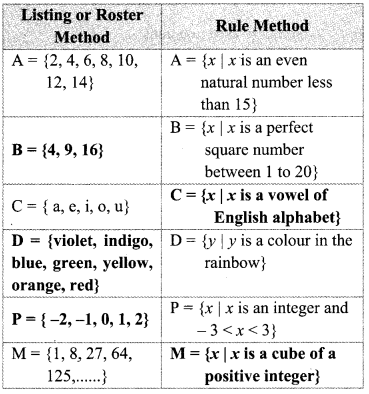
Balbharti Maharashtra State Board Class 9 Maths Solutions covers the Practice Set 1.3 Algebra 9th Class Maths Part 1 Answers Solutions Chapter 1 Sets.

Class 9 Maths Part 1 Practice Set 1.3 Chapter 1 Sets Questions With Answers Maharashtra Board

Question 1.
If A = {a, b, c, d, e}, B = {c, d, e, f}, C = {b, d}, D = {a, e}, then which of the following statements are true and which are false?
i. C ⊆ 3
ii. A ⊆ D
iii. D ⊆ B
iv. D ⊆ A
V. B ⊆ A
vi. C ⊆ A
Ans:
i. C = {b, d}, B = {c, d, e ,f}
C ⊆ B
False
Since, all the elements of C are not present in B.

ii. A = {a, b, c, d, e}, D = {a, e}
A ⊆ D
False
Since, all the elements of A are not present in D.

iii. D = {a, e}, B = {c, d, e, f}
D ⊆ B
False
Since, all the elements of D are not present in B.

iv. D = {a, e}, A = {a, b, c, d, e}
D ⊆ A
True
Since, all the elements of D are present in A.

v. B = {c, d, e, f}, A = {a, b, c, d, e}
B ⊆ A
False
Since, all the elements of B are not present in A.

vi. C = {b, d}, A= {a, b, c, d, e}
C ⊆A
True
Since, all the elements of C are present in A.

Question 2.
Take the set of natural numbers from 1 to 20 as universal set and show set X and Y using Venn diagram. [2 Marks each]
i. X= {x |x ∈ N, and 7 < x < 15}
ii. Y = { y | y ∈ N, y is a prime number from 1 to 20}
Answer:
i. U = {1, 2, 3, 4, …….., 18, 19, 20}
x = {x | x ∈ N, and 7 < x < 15}
∴ x = {8, 9, 10, 11, 12, 13, 14}
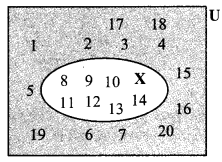
Maharashtra Board Class 9 Maths Solutions Chapter 1 Sets Practice Set 1.3 1

ii. U = {1, 2, 3, 4, …… ,18, 19, 20}
Y = { y | y ∈ N, y is a prime number from 1 to 20}
∴ Y = {2, 3, 5, 7, 11, 13, 17, 19}
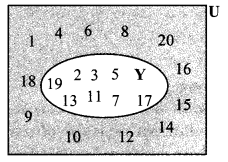
Maharashtra Board Class 9 Maths Solutions Chapter 1 Sets Practice Set 1.3 2

Question 3.
U = {1, 2, 3, 7, 8, 9, 10, 11, 12} P = {1, 3, 7,10}, then
i. show the sets U, P and P’ by Venn diagram.
ii. Verify (P’)’ = P
Solution:
i. Here, U = {1,2, 3, 7, 8,9, 10, 11, 12} P = {1, 3, 7, 10}
∴ P’ = {2, 8, 9, 11, 12}
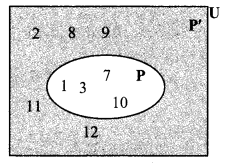
Maharashtra Board Class 9 Maths Solutions Chapter 1 Sets Practice Set 1.3 3

II. Here, U = {1, 2, 3, 7, 8, 9, 10, 11, 12}
P = {1, 3, 7, 10} ….(i)
∴ P’= {2, 8, 9, 11, 12}
Also, (P’)’ = {1,3,7, 10} …(ii)
∴ (P’)’ = P … [From (i) and (ii)]

Question 4.
A = {1, 3, 2, 7}, then write any three subsets of A.
Solution:
Three subsets of A:
i. B = {3}
ii. C = {2, 1}
iii. D= {1, 2, 7}
[Note: The above problem has many solutions. Students may write solutions other than the ones given]

Question 5.
i. Write the subset relation between the sets.
P is the set of all residents in Pune.
M is the set of all residents in Madhya Pradesh.
I is the set of all residents in Indore.
B is the set of all residents in India.
H is the set of all residents in Maharashtra.

ii. Which set can be the universal set for above sets ?
Solution:
i.
a. The residents of Pune are residents of India.
∴ P ⊆ B
b. The residents of Pune are residents of Maharashtra.
∴ P ⊆ H
c. The residents of Madhya Pradesh are residents of India.
∴ M ⊆ B
d. The residents of Indore are residents of India.
∴ I ⊆ B
e. The residents of Indore are residents of Madhya Pradesh.
∴ I ⊆ M
f. The residents of Maharashtra are residents of India.
∴ H ⊆B

ii. The residents of Pune, Madhya Pradesh, Indore and Maharashtra are all residents of India.
∴ B can be the Universal set for the above sets.

Question 6.
Which set of numbers could be the universal set for the sets given below?
i. A = set of multiples of 5,
B = set of multiples of 7,
C = set of multiples of 12

ii. P = set of integers which are multiples of 4.
T = set of all even square numbers.
Answer:
i. A = set of multiples of 5
∴ A = {5, 10, 15, …}
B = set of multiples of 7
∴ B = {7, 14, 21,…}
C = set of multiples of 12
∴ C = {12, 24, 36, …}
Now, set of natural numbers, whole numbers, integers, rational numbers are as follows:
N = {1, 2, 3, …}, W = {0, 1, 2, 3, …}
I = {…,-3, -2, -1, 0, 1, 2, 3, …}
Q = { \(\frac { p }{ q }\) | p,q ∈ I,q ≠ 0}
Since, set A, B and C are the subsets of sets N, W , I and Q.
∴ For set A, B and C we can take any one of the set from N, W, I or Q as universal set.

ii. P = set of integers which are multiples of 4.
P = {4, 8, 12,…}
T = set of all even square numbers T = {22, 42, 62, …]
Since, set P and T are the subsets of sets N, W, I and Q.
∴ For set P and T we can take any one of the set from N, W, I or Q as universal set.

Question 7.
Let all the students of a class form a Universal set. Let set A be the students who secure 50% or more marks in Maths. Then write the complement of set A.
Answer:
Here, U = all the students of a class.
A = Students who secured 50% or more marks in Maths.
∴ A’= Students who secured less than 50% marks in Maths.

Question 1.
If A = {1, 3, 4, 7, 8}, then write all possible subsets of A.
i. e. P = {1, 3}, T = {4, 7, 8}, V = {1, 4, 8}, S = {1, 4, 7, 8}
In this way many subsets can be written. Write five more subsets of set A. (Textbook pg. no, 8)
Answer:
B = { },
E = {4},
C = {1, 4},
D = {3, 4, 7},
F = {3, 4, 7,8}

Question 2.
Some sets are given below.
A ={…,-4, -2, 0, 2, 4, 6,…}
B = {1, 2, 3,…}
C = {…,-12, -6, 0, 6, 12, 18, }
D = {…, -8, -4, 0, 4, 8,…}
I = {…,-3, -2, -1, 0, 1, 2, 3, 4, }
Discuss and decide which of the following statements are true.
a. A is a subset of sets B, C and D.
b. B is a subset of all the sets which are given above. (Textbook pg. no. 9)
Solution:
a. All elements of set A are not present in set B, C and D.
∴ A ⊆ B,
∴ A ⊆ C,
∴ A ⊆ D
∴ Statement (a) is false.

b. All elements of set B are not present in set A, C and D.
∴ B ⊆ A,
∴ B ⊆ C,
∴ B ⊆ D
∴ Statement (b) is false.

Question 3.
Suppose U = {1, 3, 9, 11, 13, 18, 19}, and B = {3, 9, 11, 13}. Find (B’)’ and draw the inference. (Textbook pg. no. 10)
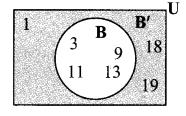
Maharashtra Board Class 9 Maths Solutions Chapter 1 Sets Practice Set 1.3 4
Solution:
U = {1, 3, 9, 11, 13, 18, 19},
B= {3, 9, 11, 13} ….(i)
∴ B’= {1, 18, 19}
(B’)’= {3, 9, 11, 13} ….(ii)
∴ (B’)’ = B … [From (i) and (ii)]
∴ Complement of a complement is the given set itself.

Maharashtra Board Class 9 Maths Solutions
Practice Set 1.2 Algebra 9th Standard Maths Part 1 Chapter 1 Sets Solutions Maharashtra Board

9th Standard Maths 1 Practice Set 1.2 Chapter 1 Sets Textbook Answers Maharashtra Board

Balbharti Maharashtra State Board Class 9 Maths Solutions covers the Practice Set 1.2 Algebra 9th Class Maths Part 1 Answers Solutions Chapter 1 Sets.

Class 9 Maths Part 1 Practice Set 1.2 Chapter 1 Sets Questions With Answers Maharashtra Board

Question 1.
Decide which of the following are equal sets and which are not ? Justify your answer.
A= {x | 3x – 1 = 2}
B = {x | x is a natural number but x is neither prime nor composite}
C = {x | x e N, x < 2}
Solution:
A= {x | 3x – 1 = 2}
Here, 3x – 1 = 2
∴ 3x = 3
∴ x = 1
∴ A = {1} …(i)

B = {x | x is a natural number but x is neither prime nor composite}
1 is the only number which is neither prime nor composite,
∴ x = 1
∴ B = {1} …(ii)

C = {x | x G N, x < 2}
1 is the only natural number less than 2.
∴ x = 1
∴ C = {1} …(iii)
∴ The element in sets A, B and C is identical. … [From (i), (ii) and (iii)]
∴ A, B and C are equal sets.

Question 2.
Decide whether set A and B are equal sets. Give reason for your answer.
A = Even prime numbers
B = {x | 7x – 1 = 13}
Solution:
A = Even prime numbers
Since 2 is the only even prime number,
∴ A = {2} …(i)
B= {x | 7x – 1 = 13}
Here, 7x – 1 = 13
∴ 7x = 14
∴ x = 2
∴ B = {2} …(ii)
∴ The element in set A and B is identical. … [From (i) and (ii)]
∴ A and B are equal sets.

Question 3.
Which of the following are empty sets? Why?
i. A = {a | a is a natural number smaller than zero}
ii. B = {x | x2 = 0}
iii. C = {x | 5x – 2 = 0, x ∈N}
Solution:
i. A = {a| a is a natural number smaller than zero}
Natural numbers begin from 1.
∴ A = { }
∴ A is an empty set.

ii. B = {x | x2 = 0}
Here, x2 = 0
∴ x = 0 … [Taking square root on both sides]
∴ B = {0}
∴B is not an empty set.

iii. C = {x | 5x – 2 = 0, x ∈ N}
Here, 5x – 2 = 0
∴ 5x = 2
∴ x = \(\frac { 2 }{ 5 }\)
Given, x ∈ N
But, x = \(\frac { 2 }{ 5 }\) is not a natural number.
∴ C = { }
∴ C is an empty set.

Question 4.
Write with reasons, which of the following sets are finite or infinite.
i. A = {x | x<10, xisa natural number}
ii. B = {y | y < -1, y is an integer}
iii. C = Set of students of class 9 from your school.
iv. Set of people from your village.
v. Set of apparatus in laboratory
vi. Set of whole numbers
vii. Set of rational number
Solution:
i. A={x| x < 10, x is a natural number}
∴ A = {1,2, 3,4, 5,6, 7, 8, 9}
The number of elements in A are limited and can be counted.
∴A is a finite set.

ii. B = (y | y < -1, y is an integer}
∴ B = { …,-4, -3, -2}
The number of elements in B are unlimited and uncountable.
∴ B is an infinite set.

iii. C = Set of students of class 9 from your school.
The number of students in a class is limited and can be counted.
∴ C is a finite set.

iv. Set of people from your village.
The number of people in a village is limited and can be counted.
∴ Given set is a finite set.

v. Set of apparatus in laboratory
The number of apparatus in the laboratory are limited and can be counted.
∴ Given set is a finite set.

vi. Set of whole numbers
The number of elements in the set of whole numbers are unlimited and uncountable.
∴ Given set is an infinite set.

vii. Set of rational number
The number of elements in the set of rational numbers are unlimited and uncountable.
∴ Given set is an infinite set.

Question 1.
If A = {1, 2, 3} and B = {1, 2, 3, 4}, then A ≠ B verify it. (Textbook pg. no. 6)
Answer:
Here, 4 ∈ B but 4 ∉ A
∴ A and B are not equal sets,
i.e. A ≠ B

Question 2.
A = {x | x is prime number and 10 < x < 20} and B = {11,13,17,19}. Here A = B. Verify. (Textbook pg. no. 6)
Answer:
A = {x | x is prime number and 10 < x < 20}
∴ A = {11, 13, 17, 19}
B = {11, 13, 17, 19}
∴ All the elements in set A and B are identical.
∴ A and B are equal sets, i.e. A = B

Maharashtra Board Class 9 Maths Solutions
Practice Set 1.4 Algebra 9th Standard Maths Part 1 Chapter 1 Sets Solutions Maharashtra Board

9th Standard Maths 1 Practice Set 1.4 Chapter 1 Sets Textbook Answers Maharashtra Board

Balbharti Maharashtra State Board Class 9 Maths Solutions covers the Practice Set 1.4 Algebra 9th Class Maths Part 1 Answers Solutions Chapter 1 Sets.

Class 9 Maths Part 1 Practice Set 1.4 Chapter 1 Sets Questions With Answers Maharashtra Board

Question 1.
If n(A) = 15, n(A ∪ B) = 29, n(A ∩ B) = 7, then n(B) = ?
Solution:
Here, n(A) = 15, n(A ∪ B) = 29, n(A ∩ B) = 7
n(A ∪ B) = n(A) + n(B) – n(A ∩ B)
∴ 29 = 15 + n(B) – 7
∴ 29 – 15 + 7 = n(B)
∴ n(B) = 21

Question 2.
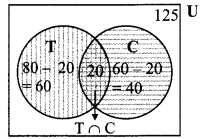
In a hostel there are 125 students, out of which 80 drink tea, 60 drink coffee and 20 drink tea and coffee both. Find the number of students who do not drink tea or coffee.
Solution:
i. Let U be the set of students in the hostel, T be the set of students who drink tea and C be the set of students who drink coffee.
n(U) = 125, n(T) = 80, n(C) = 60,
number of students who drink Tea and Coffee = n(T ∩ C) = 20

ii. n(T ∪ C) = n(T) + n(C) – n(T ∩ C)
= 80 + 60 – 20
∴ n(T ∪ C) = 120
∴ 120 students drink tea or coffee
Also, there are 125 students in the hostel.

iii. Number of students who do not drink tea or coffee = n(U) – n(T ∪ C)
= 125 – 120
= 5
∴ 5 students do not drink tea or coffee.

Alternate Method:
Let U be the set of students in the hostel, T be the set of students who drink tea and C be the set of students who drink coffee.
Maharashtra Board Class 9 Maths Solutions Chapter 1 Sets Practice Set 1.4 1
From Venn diagram,
Student who drinks tea or coffee = n(T ∪ C) = 60 + 20 + 40 = 120
∴ The number of students who do not drink tea or coffee = n(U) – n(T ∪ C)
= 125 – 120 = 5
∴ 5 students do not drink tea or coffee.

Question 3.
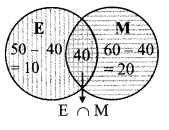
In a competitive exam 50 students passed in English, 60 students passed in Mathematics and 40 students passed in both the subjects. None of them failed in both the subjects. Find the number of students who passed at least in one of the subjects ?
Solution:
Let U be the set of students who appeared for the exam,
E be the set of students who passed in English and
M be the set of students who passed in Maths.
∴ n(E) = 50, n(M) = 60,
40 students passed in both the subjects
∴ n(M ∩ E) = 40
Since, none of the students failed in both subjects
∴ Total students = n(E ∪M)
= n(E) + n(M) – n(E ∩ M)
= 50 + 60 – 40
= 70
∴ The number of students who passed at least in one of the subjects is 70.

Alternate Method:
Let U be the set of students who appeared for the exam,
E be the set of students who passed in English and M be the set of students who passed in Maths.
Maharashtra Board Class 9 Maths Solutions Chapter 1 Sets Practice Set 1.4 2
Since, none of the students failed in both subjects
∴ Total student = n(E ∪M)
= 10 + 40 + 20
= 70
∴ The number of students who passed at least in one of the subjects is 70.

Question 4.
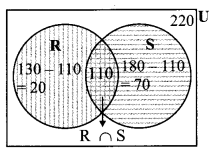
A survey was conducted to know the hobby of 220 students of class IX. Out of which 130 students informed about their hobby as ’rock climbing and 180 students informed about their hobby as sky watching. There are 110 students who follow both the hobbies. Then how many students do not have any of the two hobbies? How many of them follow the hobby of rock climbing only? How many students follow the hobby of sky watching only?
Solution:
i. Let U be the set of students of class IX,
R be the set of students who follow the hobby of rock climbing and
S be the set of students who follow the hobby of sky watching.
∴ n (U) = 220, n (R) = 130, n (S) = 180,
110 students follow both the hobbies
∴ n (R ∩ S) = 110

ii. n(R ∪ S)=n (R) + n (S) – n (R ∩ S)
= 130 + 180 – 110
∴n (R ∪ S) = 200
∴ 200 students follow the hobby of rock climbing or sky watching.

iii. Total number of students = 220.
Number of students who do not follow the hobby of rock climbing or sky watching
= n (U) – n (R ∪ S)
= 220 – 200
= 20

iv. Number of students who follow the hobby of rock climbing only
= n (R) – n(R ∩ S)
= 130 – 110
= 20

v. Number of students who follow the hobby of sky watching only
= n (S) – n (R ∩ S)
= 180 – 110
= 70

Alternate Method:
Let U be the set of students of class IX,
R be the set of students who follow the hobby of rock climbing and
S be the set of students who follow the hobby of sky watching.
Maharashtra Board Class 9 Maths Solutions Chapter 1 Sets Practice Set 1.4 3
From the Venn diagram
i. Students who follow the hobby of rock climbing or sky watching
= n(R ∪ S)
= 20 + 110 + 70
= 200

ii. Number of students who do not follow the hobby of rock climbing or sky watching
= n (U) – n(R ∪S)
= 220 – 200
= 20

iii. Number of students who follow the hobby of rock climbing only
= n (R) – n(R ∩S)
= 130 – 110
= 20

iv. Number of students who follow the hobby of sky watching only
= n (S) – n (R ∩ S)
= 180 – 110
= 70

Question 5.
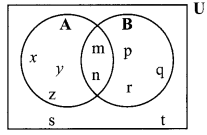
Observe the given Venn diagram and write the following sets.
Maharashtra Board Class 9 Maths Solutions Chapter 1 Sets Practice Set 1.4 4
i. A
ii. B
iii. A ∪ B
iv. U
v. A’
vi. B’
vii. (A ∪B )’
Ans:
i. A = {x, y, z, m, n}
ii. B = {p, q, r, m, n}
iii. A ∪ B = {x, y, z, m, n, p, q, r }
iv. U = {x, y, z, m, n, p, q, r, s, t}
v. A’ = {p, q, r, s, t}
vi. B’ = {x, y, z, s, t}
vii. (A ∪ B )’ = {s, t}

Question 1.
Take different examples of sets and verify the above mentioned properties. (Textbook pg.no. 12)
Solution:
i. Let A = {3, 5}, B= {3, 5, 8, 9, 10}
A ∩ B = B ∩ A = {3, 5}

ii. Let A = {3, 5}, B = {3, 5, 8, 9, 10}
Since, all elements of set A are present in set B.
∴ A ⊆ B
Also, A ∩ B = {3, 5} = A
∴ If A ⊆ B, then A ∩B = A.

iii. Let A = {2, 3, 8, 10}, B = {3,8}
A ∩ B = {3, 8} = B
Also, all the elements of set B are present in set A
∴ B ⊆ A
∴ If A ∩ B = B, then B ⊆ A.

iv. Let A = {2, 3, 8, 10}, B = {3, 8}, A ∩B = {3, 8}
Since, all the elements of set A n B are present in set A and B
A ∩ B ⊆ A and A ∩B ⊆B

v. Let U= {3, 4, 6, 8}, A = {6, 4}
∴ A’ = {3, 8}
∴ A ∩ A’= { } = φ

vi. A ∩ φ = { } = φ

vii. Let A = {6, 4}
∴ A ∩ A = {6, 4}
∴ A ∩ A = A

Question 2.
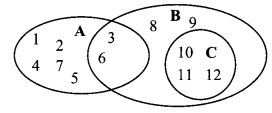
Observe the set A, B, C given by Venn diagrams and write which of these are disjoint sets. (Textbook pg. no. 12)
Maharashtra Board Class 9 Maths Solutions Chapter 1 Sets Practice Set 1.4 5
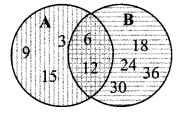
Solution:
Here, A = {1, 2, 3, 4, 5, 6, 7}
B = {3, 6, 8, 9, 10, 11, 12}
C = {10, 11, 12}
Now, A ∩ C = φ
∴ A and C are disjoint sets.

Question 3.
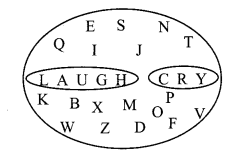
Let the set of English alphabets be the Universal set. The letters of the word ‘LAUGH’ is one set and the letter of the word ‘CRY’ is another set. Can we say that these are two disjoint sets? Observe that intersection of these two sets is empty. (Textbook pg. no. 13)
Maharashtra Board Class 9 Maths Solutions Chapter 1 Sets Practice Set 1.4 6
Solution:
Let A = {L, A, U, G, H}
B = {C, R, Y}
Now, A ∩ B = φ
∴ A and B are disjoint sets.

Question 4.
Fill in the blanks with elements of that set.
U = {1, 3, 5, 8, 9, 10, 11, 12, 13, 15}
A = {1,11, 13}
B = {8,5, 10, 11, 15}
A’ = { }
B’ = { }
A ∩ B = { }
A’ ∩ B’ = { }
A ∪ B = { }
A’ ∪ B’= { }
(A ∩ B)’ = { }
(A ∪ B)’ = { }
Verify: (A ∩ B)’ = A’ u B’, (A u B)’ = A’ ∩ B’ (Textbook pg. no, 18)
Solution:
U = {1, 3, 5, 8, 9, 10, 11, 12, 13, 15}
A = {1, 11, 13}
B = {8, 5, 10, 11, 15}
A’ = {3, 5, 8, 9, 10, 12, 15}
B’ = {1, 3, 9, 12, 13}
A∩ B= {11}
A’ ∩ B’= {3, 9, 12} …(i)
A ∪ B = {1, 5, 8, 10, 11, 13, 15}
A’ ∪ B’ = { 1, 3, 5, 8, 9, 10, 12, 13, 15} …(ii)
(A ∩ B)’= { 1, 3, 5, 8, 9, 10, 12, 13,15} …(iii)
(A ∪ B)’ = {3, 9, 12} ,..(iv)
(A ∩ B)’ = A’ ∪ B’ … [From (ii) and (iii)]
(A ∪ B)’ = A’ ∩ B’ … [From (i) and (iv)]

Question 5.
A = {1,2,3, 5, 7,9,11,13}
B = {1,2,4, 6, 8,12,13}
Verify the above rule for the given set A and set B. (Textbook pg. no. 14)
Solution:
A = {1, 2, 3, 5, 7, 9, 11, 13}
B = {1, 2, 4, 6, 8, 12, 13}
A ∪ B = {1, 2, 3, 4, 5, 6, 7, 8, 9, 11, 12, 13}
A ∩ B= {1, 2, 13}
n(A) = 8, n(B) = 7,
n(A ∪ B) = 12, n(A ∩ B) = 3
n(A ∩ B) = 12 …(i)
n(A) + n(B) – n(A ∩ B) = 8 + 7 – 3 = 12 …(ii)
∴ n(A ∪ B) = n(A) + n(B) – n(A ∩ B) … [From (i) and (ii)]

Question 6.
Verify the above rule for the given Venn diagram. (Textbook pg. no. 14)
Maharashtra Board Class 9 Maths Solutions Chapter 1 Sets Practice Set 1.4 7
Solution:
n(A) = 5 , n(B) = 6
n(A ∪ B) = 9 , n(A ∩ B) = 2
Now, n(A ∪ B) = 9 …(i)
n(A) + n(B) – n(A ∩ B) = 5 + 6 – 2 = 9 …(ii)
∴ n(A ∪ B) = n(A) + n(B) – n(A ∩ B). …[From (i) and (ii)]

Maharashtra Board Class 9 Maths Solutions
Practice Set 1.1 Algebra 9th Standard Maths Part 1 Chapter 1 Sets Solutions Maharashtra Board

9th Standard Maths 1 Practice Set 1.1 Chapter 1 Sets Textbook Answers Maharashtra Board

Balbharti Maharashtra State Board Class 9 Maths Solutions covers the Practice Set 1.1 Algebra 9th Class Maths Part 1 Answers Solutions Chapter 1 Sets.
Class 9 Maths Part 1 Practice Set 1.1 Chapter 1 Sets Questions With Answers Maharashtra Board

Question 1.
Write the following sets in roster form.
i. Set of even natural numbers
ii. Set of even prime numbers from 1 to 50
iii. Set of negative integers
iv. Seven basic sounds of a sargam (sur)
Answer:
i. A = { 2, 4, 6, 8,….}
ii. 2 is the only even prime number
∴ B = { 2 }
iii. C = {-1, -2, -3,….}
iv. D = {sa, re, ga, ma, pa, dha, ni}

Question 2.
Write the following symbolic statements in words.
i. \(\frac { 4 }{ 3 }\) ∈ Q
ii. -2 ∉ N
iii. P = {p | p is an odd number}
Answer:
i. \(\frac { 4 }{ 3 }\) is an element of set Q.
ii. -2 is not an element of set N.
iii. Set P is a set of all p’s such that p is an odd number.

Question 3.
Write any two sets by listing method and by rule method.
Answer:
i. A is a set of even natural numbers less than 10.
Listing method: A = {2, 4, 6, 8}
Rule method: A = {x | x = 2n, n e N, n < 5}

ii. B is a set of letters of the word ‘SCIENCE’. Listing method : B = {S, C, I, E, N}
Rule method: B = {x \ x is a letter of the word ‘SCIENCE’}

Question 4.
Write the following sets using listing method.
i. All months in the Indian solar year.
ii. Letters in the word ‘COMPLEMENT’.
iii. Set of human sensory organs.
iv. Set of prime numbers from 1 to 20.
v. Names of continents of the world.
Answer:
i. A = {Chaitra, Vaishakh, Jyestha, Aashadha, Shravana, Bhadrapada, Ashwina, Kartika, Margashirsha, Paush, Magha, Falguna}
ii. X = {C, O, M, P, L, E, N, T}
iii. Y = {Nose, Ears, Eyes, Tongue, Skin}
iv. Z = {2, 3, 5, 7, 11, 13, 17, 19}
v. E = {Asia, Africa, Europe, Australia, Antarctica, South America, North America}

Question 5.
Write the following sets using rule method.
i. A = {1, 4, 9, 16, 25, 36, 49, 64, 81, 100}
ii. B= {6, 12, 18,24, 30,36,42,48}
iii. C = {S, M, I, L, E}
iv. D = {Sunday, Monday, Tuesday, Wednesday, Thursday, Friday, Saturday}
v. X = {a, e, t}
Answer:
i. A = {x | v = n², n e N, n < 10}
ii. B = {x j x = 6n, n e N, n < 9}
iii. C = {y j y is a letter of the word ‘SMILE’} [Other possible words: ‘SLIME’, ‘MILES’, ‘MISSILE’ etc.]
iv. D = {z | z is a day of the week}
v. X = {y | y is a letter of the word ‘eat’}
[Other possible words: ‘tea’ or ‘ate’]

Question 1.
Fill in the blanks given in the following table. (Textbook pg. no. 3)
Answer:
Maharashtra Board Class 9 Maths Solutions Chapter 1 Sets Practice Set 1.1 1
Maharashtra Board Class 9 Maths Solutions
Problem Set 6 Algebra 9th Standard Maths Part 1 Chapter 6 Financial Planning Solutions Maharashtra Board

9th Standard Maths 1 Problem Set 6 Chapter 6 Financial Planning Textbook Answers Maharashtra Board

Balbharti Maharashtra State Board Class 9 Maths Solutions covers the Problem Set 6 Algebra 9th Class Maths Part 1 Answers Solutions Chapter 6 Financial Planning.
Class 9 Maths Part 1 Problem Set 6 Chapter 6 Financial Planning Questions With Answers Maharashtra Board

Question 1.
Write the correct alternative answer for each of the following questions.

i. For different types of investments what is the maximum permissible amount under section 80C of income tax ?
(A) ₹ 1,50,000
(B) ₹ 2,50,000
(C) ₹ 1,00,000
(D) ₹ 2,00,000
Answer:
(A) ₹ 1,50,000

ii. A person has earned his income during the financial year 2017-18. Then his assessment year is….
(A) 2016 – 17
(B) 2018 – 19
(C) 2017 – 18
(D) 2015 – 16
Answer:
(B) 2018 – 19

Question 2.
Mr. Shekhar spends 60% of his income. From the balance he donates ₹ 300 to an orphanage. He is then left with ₹ 3,200. What is his income ?
Solution:
Let the income of Shekhar be ₹ x.
Shekhar spends 60% of his income.
∴ Shekhar’s expenditure = 60% of x
∴ Amount remaining with Shekhar = (100 – 60)% of x
= 40% of x
= \(\frac { 1 }{ 2 }\) × x
= 0.4x
From the balance left, he donates ₹ 300 to an orphanage.
∴ Amount left with Shekhar = 0.4x – 300
Now, the amount left with him is ₹ 3200.
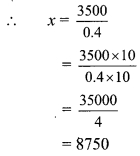
∴ 3200 = 0.4x- 300
∴ 0.4x = 3500
Maharashtra Board Class 9 Maths Solutions Chapter 6 Financial Planning Problem Set 6 1
∴ The income of Mr. Shekhar is ₹ 8750.

Question 3.
Mr. Hiralal invested ₹ 2,15,000 in a Mutual Fund. He got ₹ 3,05,000 after 2 years. Mr. Ramniklal invested ₹ 1,40,000 at 8% compound interest for 2 years in a bank. Find out the percent gain of each of them. Whose investment was more profitable ?
Solution:
Mr. Hiralal:
Amount invested by Mr. Hiralal in mutual fund = ₹ 2,15,000
Amount received by Mr. Hiralal = ₹ 3,05,000
∴ Mr. Hiralal’s profit = Amount received – Amount invested
= 305000 – 215000 = ₹ 90000
Mr. Hirala’s percentage of profit
= \(\frac { 90000 }{ 215000 }\) × 100
= 41.86%

Mr. Ramniklal:
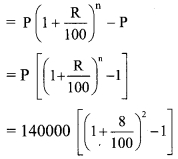
P = ₹ 140000, R = 8%, n = 2 years
∴ Compound interest (I)
= A – P
Maharashtra Board Class 9 Maths Solutions Chapter 6 Financial Planning Problem Set 6 2
= 140000 [(1 + 0.08)2 – 1]
= 140000 [ (1.08)2 – 1]
= 140000(1.1664 – 1)
= 140000 x 0.1664
= ₹ 23296
∴ Mr. Ramniklal’s percentage of profit
= \(\frac { 23296 }{ 140000 }\) × 100
= 16.64%
∴ The percentage gains of Mr. Hiralal and Mr. Ramniklal are 41.86% and 16.64% respectively, and hence, Mr. Hiralal’s investment was more profitable.

Question 4.
At the start of a year there were ₹ 24,000 in a savings account. After adding ₹ 56,000 to this the entire amount was invested in the bank at 7.5% compound interest. What will be the total amount after 3 years ?
Solution:
Here, P = 24000 + 56000
= ₹ 80000
R = 7.5%, n = 3 years
Total amount after 3 years
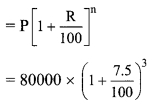
Maharashtra Board Class 9 Maths Solutions Chapter 6 Financial Planning Problem Set 6 3
= 80000 (1 + 0.075)3
= 80000 (1.075)3
= 80000 x 1.242297
= 99383.76
∴ The total amount after 3 years is ₹ 99383.76.

Question 5.
Mr. Manohar gave 20% of his income to his elder son and 30% to his younger son. He gave 10% of the balance income as donation to a school. He still had ₹ 1,80,000 for himself. What was Mr. Manohar’s income ?
Solution:
Let the income of Mr. Manohar be ₹ x.
Amount given to elder son = 20% of x
Amount given to younger son = 30% of x
Total amount given to both sons = (20 + 30)% of x = 50% of x
∴ Amount remaining with Mr. Manohar = (100 – 50)% of x
= 50% of x 50
= \(\frac { 50 }{ 100 }\) × 100
= 0.5 x
He gave 10% of the balance income as donation to a school.
Amount donated to school = 10% of 0.5x
= \(\frac { 10 }{ 100 }\) × 0.5x
= 0.05x
∴ Amount remaining with Mr. Manohar after donating to school = 0.5x – 0.05x
= 0.45x
Mr. Manohar still had 1,80,000 for himself after donating to school.
∴ 180000 = 0.45x
∴ \(x=\frac{180000}{0.45}=\frac{180000 \times 100}{0.45 \times 100}=\frac{18000000}{45}=400000\)
∴ The income of Mr. Manoliar is ₹4,00,000.

Question 6.
Kailash used to spend 85% of his income. When his income increased by 36% his expenses also increased by 40% of his earlier expenses. How much percentage of his earning he saves now ?
Solution:
Let the income of Kailash be ₹ x.
Kailash spends 85% of his income.
∴ Kailash’s expenditure = 85% of x
= \(\frac { 85 }{ 100 }\) × x = 0.85 x
Kailash’s income increased by 36%.
∴ Kailash’s new income = x + 36% of x
= x + \(\frac { 36 }{ 100 }\) × x
= x + 0.36x
= 1.36x
Kailash’s expenses increased by 40%.
∴ Kailash’s new expenditure = 0.85x + 40% of 0.85x
= 0.85x + \(\frac { 40 }{ 100 }\) × 0.85 × 100
= 0.85x + 0.4 × 0.85x
= 0.85x (1 + 0.4)
= 0.85x × 1.4
= 1.19x
∴ Kailash’s new saving = Kailash’s new income – Kailash’s new expenditure
= 1.36x – 1.19x
= 0.17x
Percentage of Kailash’s new saving
= \(\frac { 0.17x }{ 1.36x }\) × 100
= 12.5%
∴ Kailash saves 12.5% of his new earning.

Question 7.
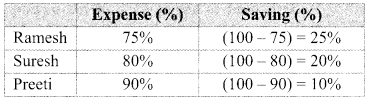
Total income of Ramesh, Suresh and Preeti is ₹ 8,07,000. The percentages of their expenses are 75%, 80% and 90% respectively. If the ratio of their savings is 16 : 17 : 12, then find the annual saving of each of them.
Solution:
Let the annual income of Ramesh, Suresh and Preeti be ₹ x, t y and ₹ z respectively.
Total income of Ramesh, Suresh and Preeti = ₹ 8,07,000
∴ x + y + z = 807000 …(i)
Maharashtra Board Class 9 Maths Solutions Chapter 6 Financial Planning Problem Set 6 4

∴ Savings of Ramesh = 25% of x
= ₹ \(\frac { 25x }{ 100 }\) ..(ii)
Savings of Suresh = 20% of y
= ₹\(\frac { 20y }{ 100 }\) …(iii)
Savings of Preeti = 10% of z
= ₹\(\frac { 10z }{ 100 }\) …..(iv)

Ratio of their savings = 16 : 17 : 12
Let the common multiple be k.
Savings of Ramesh = ₹ 16 k … (v)
Savings of Suresh = ₹ 17 k … (vi)
Savings of Preeti = ₹ 12 k .. .(vii)
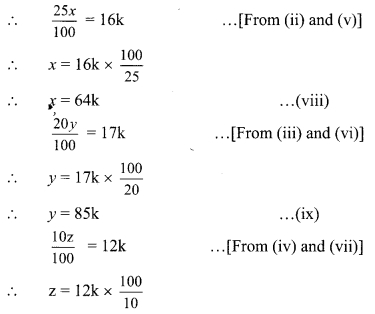
Maharashtra Board Class 9 Maths Solutions Chapter 6 Financial Planning Problem Set 6 5
∴ z = 120k …(x)
From (i), (viii), (ix) and (x), we get
64k + 85k + 120k = 807000
269k = 807000
k = \(\frac { 807000 }{ 269 }\)
k = 3000
∴ Annual saving of Ramesh = 16k
= 16 x 3000
= ₹ 48,000
Annual saving of Suresh = 17k
= 17 x 3000
= ₹ 51,000
Annual saving of Preeti = 12k
= 12 x 3000
= ₹ 36,000
The annual savings of Ramesh, Suresh and Preeti are ₹ 48,000, ₹ 51,000 and ₹ 36,000 respectively.

Question 8.
Compute the income tax payable by following individuals.
i. Mr. Kadam who is 35 years old and has a taxable income of ₹13,35,000.
ii. Mr. Khan is 65 years of age and his taxable income is ₹4,50,000.
iii. Miss Varsha (Age 26 years) has a taxable income of ₹2,30,000.
Solution:
i. Mr. Kadam is 35 years old and his taxable income is ₹13,35,000.
Mr. Kadam’s income is more than ₹ 10,00,000.
∴ Income tax = ₹1,12,500 + 30% of (taxable income -10,00,000)
= ₹ 1,12,500 + 30% of (13,35,000 – 10,00,000)
= 112500+ \(\frac { 30 }{ 100 }\) x 335000 100
= 112500+ 100500
= ₹ 213000
Education cess = 2% of income tax
= \(\frac { 2 }{ 100 }\) x 213000
= ₹ 4260.
Secondary and Higher Education cess
= 1% of income tax
= \(\frac { 1 }{ 100 }\) x 213000 100
= 2130
Total income tax = Income tax + Education cess + Secondary and higher education cess
= 213000 + 4260 + 2130 = ₹ 2,19,390
∴ Mr. Kadam will have to pay income tax of ₹ 2,19,390.

ii. Mr. Khan is 65 years old and his taxable income is ₹ 4,50,000.
Mr. Khan’s income falls in the slab ₹ 3,00,001 to ₹ 5,00,000.
∴ Income tax
= 5% of (taxable income – 300000)
= 5% of (450000 – 300000)
= \(\frac { 5 }{ 100 }\) x 150000 100
= ₹ 7500
Education cess = 2% of income tax
= \(\frac { 2 }{ 100 }\) x 7500
= ₹ 150
Secondary and Higher Education cess = 1 % of income tax
= \(\frac { 1 }{ 100 }\) x 7500
= 75
Total income tax = Income tax + Education cess + Secondary and higher education cess
= 7500+ 150 + 75
= ₹ 7725
Mr. Khan will have to pay income tax of ₹7725.

iii. Taxable income = ₹2,30,000
age = 26 years
The yearly income of Miss Varsha is less than ₹ 2,50,000.
Hence, Miss Varsha will not have to pay income tax.

Maharashtra Board Class 9 Maths Chapter 6 Financial Planning Problem Set 6 Intext Questions and Activities

Question 1.
With your parent’s help write down the income and expenditure of your family for one week. Make 7 columns for the seven days of the week. Write all expenditure under such heads as provisions, education, medical expenses, travel, clothes and miscellaneous. On the credit side write the amount received for daily expenses, previous balance and any other new income. (Textbook pg. no. 98)

Question 2.
In the holidays, write the accounts for the whole month. (Textbook pg. no. 98)

Question 3.
What is a tax? Which are different types of taxes? Find out more information on following websites
www.incometaxindia.gov.in,
www.mahavat.gov.in
www.gst.gov.in (Textbook pg. no. 99)

Question 4.
Obtain more information about different types of taxes from employees and professionals who pay taxes. (Textbook pg. no. 99)

Question 5.
Obtain information about sections 80C, 80G, 80D of the Income Tax Act. (Textbook pg. no. 103)

Question 6.
Study a PAN card and make a note of all the information it contains. (Textbook pg.no. 103)

Question 7.
Obtain information about all the devices and means used for carrying out cash minus transactions. (Textbook pg, no, 103)

Question 8.
Visit www.incometaxindia.gov.in which is a website of the Government of India. Click on the ‘incometax calculator’ menu. Fill in the form that gets downloaded using an imaginary income and imaginary deductible amounts and try to compute the income tax payable for this income. (Textbook pg.no. 107)
[Students should attempt the above activities on their own.]

Must Read:

NAVINFLUOR Pivot Point Calculator

Maharashtra Board 9th Maths Solution 

Practice Set 2.3 Class 8 Answers Chapter 2 Parallel Lines and Transversals Maharashtra Board

Parallel Lines and Transversals Class 8 Maths Chapter 2 Practice Set 2.3 Solutions Maharashtra Board

Balbharti Maharashtra State Board Class 8 Maths Solutions covers the Practice Set 2.3 8th Std Maths Answers Solutions Chapter 2 Parallel Lines and Transversals.
Std 8 Maths Practice Set 2.3 Chapter 2 Solutions Answers

Question 1.
Draw a line l. Take a point A outside the line. Through point A draw a line parallel to line l.
Solution:
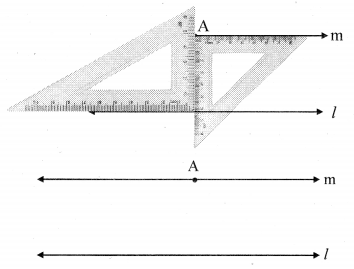
Steps of construction:

  1. Draw a line l and take any point A outside the line.
  2. Place a set-square, such that one arm of the right angle passes through A and the other arm is on line l.
  3. Place the second set-square as shown in the figure such that the vertex of the right angle is at point A.
  4. Hold the two set-squares in place and draw a line parallel to line l through the edge of the second set-square. Name the line as m.

Maharashtra Board Class 8 Maths Solutions Chapter 2 Parallel Lines and Transversals Practice Set 2.3 1

Line m is the required line parallel to line l and passing through point A.

Question 2.
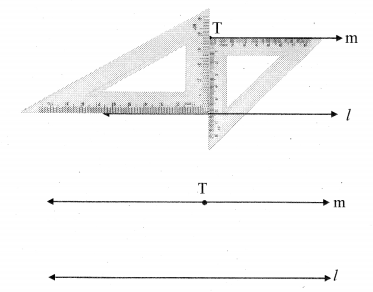
Draw a line l. Take a point T outside the line. Through point T draw a line parallel to line l.
Solution:
Steps of construction:

  1. Draw a line l and take any point T outside the line.
  2. Place a set-square, such that one arm of the right angle passes through T and the other arm is on line l.
  3. Place the second set-square as shown in the figure such that the vertex of the right angle is at point T.
  4. Hold the two set-squares in place and draw a line parallel to line l through the edge of the second set-square. Name the line as m.

Maharashtra Board Class 8 Maths Solutions Chapter 2 Parallel Lines and Transversals Practice Set 2.3 2
Line m is the required line parallel to line l and passing through point T.

Question 3.
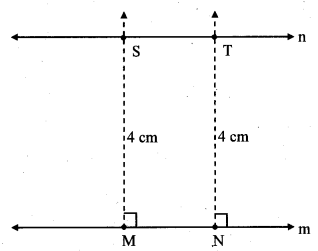
Draw a line m. Draw a line n which is parallel to line m at a distance of 4 cm from it.
Solution:
Steps of construction:

  1. Draw a line m and take any two points M and N on the line.
  2. Draw perpendiculars to line m at points M and N.
  3. On the perpendicular lines take points S and T at a distance 4 cm from points M and N respectively.
  4. Draw a line through points S and T. Name the line as n.

Maharashtra Board Class 8 Maths Solutions Chapter 2 Parallel Lines and Transversals Practice Set 2.3 3
Line n is parallel to line m at a distance of 4 cm from it.

Maharashtra Board Class 8 Maths Solutions
Practice Set 1.2 Class 8 Answers Chapter 1 Rational and Irrational Numbers Maharashtra Board

Rational and Irrational Numbers Class 8 Maths Chapter 1 Practice Set 1.2 Solutions Maharashtra Board

Balbharti Maharashtra State Board Class 8 Maths Solutions covers the Practice Set 1.2 8th Std Maths Answers Solutions Chapter 1 Rational and Irrational Numbers.
Std 8 Maths Practice Set 1.2 Chapter 1 Solutions Answers

Question 1.
Compare the following numbers.
i. 7, -2
ii. 0, \(\frac { -9 }{ 5 }\)
iii. \(\frac { 8 }{ 7 }\), 0
iv. \(-\frac{5}{4}, \frac{1}{4}\)
v. \(\frac{40}{29}, \frac{141}{29}\)
vi. \(-\frac{17}{20},-\frac{13}{20}\)
vii. \(\frac{15}{12}, \frac{7}{16}\)
viii. \(-\frac{25}{8},-\frac{9}{4}\)
ix. \(\frac{12}{15}, \frac{3}{5}\)
x. \(-\frac{7}{11},-\frac{3}{4}\)
Solution:
i. 7, -2
If a and b are positive numbers such that a < b, then -a > -b.
Since, 2 < 7 ∴ -2 > -7

ii. 0, \(\frac { -9 }{ 5 }\)
On a number line, \(\frac { -9 }{ 5 }\) is to the left of zero.
∴ 0 > \(\frac { -9 }{ 5 }\)

iii. \(\frac { 8 }{ 7 }\), 0
On a number line, zero is to the left of \(\frac { 8 }{ 7 }\) .
∴ \(\frac { 8 }{ 7 }\) > 0

iv. \(-\frac{5}{4}, \frac{1}{4}\)
We know that, a negative number is always less than a positive number.
∴ \(-\frac{5}{4}<\frac{1}{4}\)

v. \(\frac{40}{29}, \frac{141}{29}\)
Here, the denominators of the given numbers are the same.
Since, 40 < 141
∴ \(\frac{40}{29}<\frac{141}{29}\)

vi. \(-\frac{17}{20},-\frac{13}{20}\)
Here, the denominators of the given numbers are the same.
Since, 17 < 13
∴ -17 < -13
∴ \(-\frac{17}{20}<-\frac{13}{20}\)

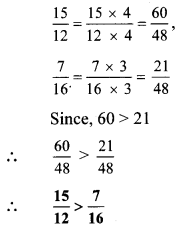
vii. \(\frac{15}{12}, \frac{7}{16}\)
Here, the denominators of the given numbers are not the same.
LCM of 12 and 16 = 48
Maharashtra Board Class 8 Maths Solutions Chapter 1 Rational and Irrational Numbers Practice Set 1.2 1
Alternate method:
15 × 16 = 240
12 × 7 = 84
Since, 240 > 84
∴ 15 × 16 > 12 × 7
Maharashtra Board Class 8 Maths Solutions Chapter 1 Rational and Irrational Numbers Practice Set 1.2 2
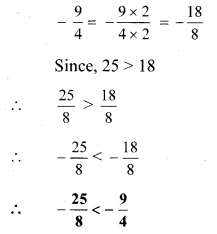
viii. \(-\frac{25}{8},-\frac{9}{4}\)
Here, the denominators of the given numbers are not the same.
LCM of 8 and 4 = 8
Maharashtra Board Class 8 Maths Solutions Chapter 1 Rational and Irrational Numbers Practice Set 1.2 3
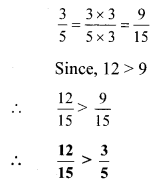
ix. \(\frac{12}{15}, \frac{3}{5}\)
Here, the denominators of the given numbers are not the same.
LCM of 15 and 5 = 15
Maharashtra Board Class 8 Maths Solutions Chapter 1 Rational and Irrational Numbers Practice Set 1.2 4
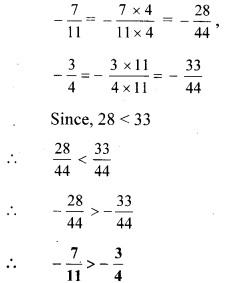
x. \(-\frac{7}{11},-\frac{3}{4}\)
Here, the denominators of the given numbers are not the same.
LCM of 11 and 4 = 44
Maharashtra Board Class 8 Maths Solutions Chapter 1 Rational and Irrational Numbers Practice Set 1.2 5

Maharashtra Board Class 8 Maths Solutions Chapter 1 Rational and Irrational Numbers Practice Set 1.2 Questions and Activities

Question 1.
Verify the following comparisons using a number line. (Textbook pg. no, .3)
i. 2 < 3 but – 2 > – 3
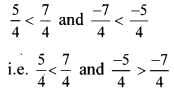
ii. \(\frac{5}{4}<\frac{7}{4}\) but \(\frac{-5}{4}<\frac{-7}{4}\)
Solution:
Maharashtra Board Class 8 Maths Solutions Chapter 1 Rational and Irrational Numbers Practice Set 1.2 6
We know that, on a number line the number to the left is smaller than the other.
∴ 2 < 3 and -3 < -2
i.e. 2 < 3 and -2 > -3
Maharashtra Board Class 8 Maths Solutions Chapter 1 Rational and Irrational Numbers Practice Set 1.2 7

Maharashtra Board Class 8 Maths Solutions

Std 9 English Poem My Financial Career 4.4 Question Answer Maharashtra Board

Class 9 English Chapter 4.4 Question Answer Maharashtra Board

Balbharti Maharashtra State Board Class 9 English Solutions Kumarbharati Chapter 4.4 My Financial Career Notes, Textbook Exercise Important Questions and Answers.

My Financial Career 9th Std Question Answer

English Kumarbharati 9th Solutions Chapter 4.4 My Financial Career Textbook Questions and Answers

Warming Up:

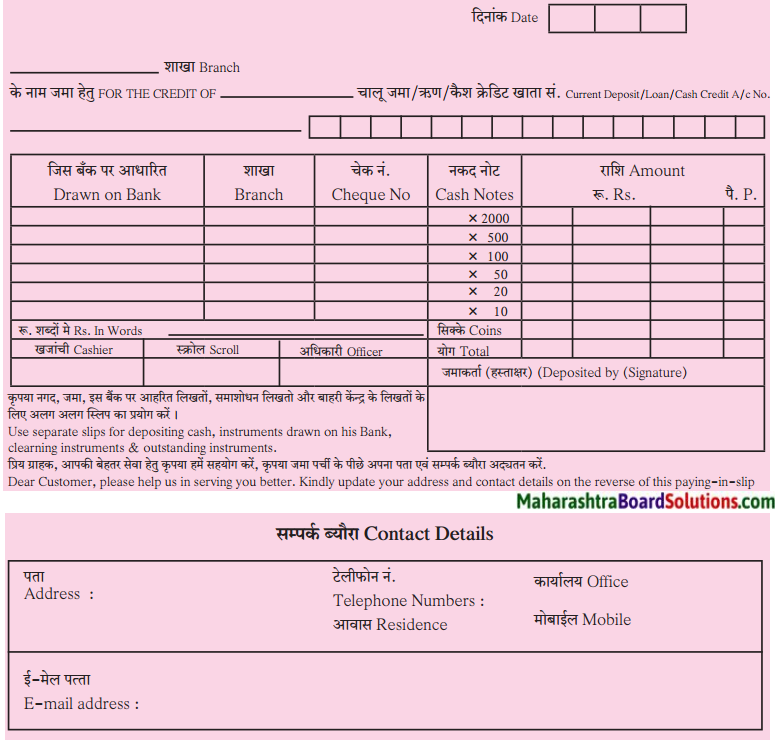
1. Observe the forms given on page 100 of the textbook and fill in your details:

Maharashtra Board Class 9 English Kumarbharati Solutions Chapter 4.4 My Financial Career 1

Maharashtra Board Class 9 English Kumarbharati Solutions Chapter 4.4 My Financial Career

2. Write in your own words:

Question (a)
Why does the bank need so many details of its customer?
Answer:
The bank has to be sure that the customer is not a fraud. The money deposited or withdrawn should be legal. The government has to be notified about various things. Letters have to be sent to the customer’s home/office or some information given to him about the transactions in his account. For all these reasons, the bank needs many details of its customers.

Question (b)
What problems do customers face when they have to make a cash deposit at a bank?
Answer:
First of all, the customer has to go to the bank during banking hours, which may not be convenient. He then has to stand in a queue, fill in the details in the paying-in-slip, etc. There may be a long queue or the staff may be few or slow, leading to a long wait. These are some of the problems that customers face when they have to make a cash deposit at a bank.

Question (c)
What are the latest modern methods of depositing money in your own or somebody else’s account?
Answer:
The latest modern method is net banking, that is, operating your account through your email or cell phone to transfer or deposit money.

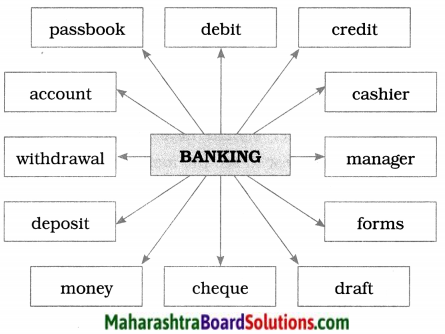
3. Make a word web of at least 12 words related to banking.

Question 1.
Make a word web of at least 12 words related to banking.
Answer:
Maharashtra Board Class 9 English Kumarbharati Solutions Chapter 4.4 My Financial Career 1.1

English Workshop:

1. Find from the lesson the antonyms of the following:

Question 1.
Find from the lesson the antonyms of the following:

  1. afterwards
  2. careful
  3. confidently
  4. cheerful

Answer:

  1. afterwards × beforehand
  2. careful × irresponsible
  3. confidently × timidly
  4. cheerful × sepulchral

Maharashtra Board Class 9 English Kumarbharati Solutions Chapter 4.4 My Financial Career

2. Fill in the blanks choosing the appropriate word/idiom from the lesson.

Question 1.
Fill in the blanks choosing the appropriate word/idiom from the lesson.
Answer:

  1. The detective solved the mysterious crime.
  2. In the examination, I did not know the answer, so I wrote something.
  3. He was dizzy and he shambled into the room.
  4. While arguing with his elders he had a fearfully quick temper.
  5. The sight of a snake rattles me.
  6. As soon as I cross the threshold of my home, I greet my family.

3. Using the following points frame a character sketch of the narrator.

Question 1.
Using the following points frame a character sketch of the narrator. Support each character trait with instances from the lesson:

  1. Diffident and timid
  2. Unusual behaviour
  3. Ignorant about banking
  4. Nervous and careless
  5. Economical

Answer:
Character sketch of the author:

The author was a diffident and timid person. Everything about the bank made him nervous; in fact, he was so nervous that he did not even know what he was doing and what he was signing. He behaved in an unusual manner, shambling into the bank and talking in a gloomy voice as if he had a secret. It was also unnecessary for him to ask the manager whether he could talk to him alone. He was quite ignorant about banking, and too nervous to seek the right guidance.

He did not know how to open an account or write a cheque correctly. He made careless mistakes because of his overwhelming nervousness. First, he wrote the wrong figure on the cheque. Even after realizing the mistake, he did not attempt to correct it. He was careful in spending his money, and saved enough to keep it in silver dollars in a sock at home.

Maharashtra Board Class 9 English Kumarbharati Solutions Chapter 4.4 My Financial Career

4. Rewrite the following in indirect speech:

Question (a)
“Can I see the manager?” I said.
“Certainly,” said the accountant.
Answer:
I asked the accountant whether I could see the manager. The accountant replied that I could certainly do so.

Question (b)
Rewrite the following in indirect speech:
“Good morning,” I said and stepped into the safe.
“Come out,” said the manager coldly.
Answer:
I wished the manager a ‘good morning’ and stepped into the safe. The manager coldly ordered me to come out.

Question (c)
Rewrite the following in indirect speech :
…… the words seem to mean, “Let us do this painful thing while the fit is on us.”
Answer:
…….. the words seem to mean that they should do that painful thing while the fit was on them.

Question (d)
“What! Are you drawing it all out again?” he asked in surprise.
“Yes, the whole thing,” I said.
Answer:
He asked me in surprise whether I was drawing it all out again. I replied in the affirmative and confirmed that I was drawing out the whole thing.

Question (e)
“How will you have it?” he said.
“In fifties,” I said.
Answer:
He asked me how I would have it. I replied that I would have it in fifties.

Maharashtra Board Class 9 English Kumarbharati Solutions Chapter 4.4 My Financial Career

5. Read the statement given below, and write first your views and then the counterview, in two separate passages: ‘Online/Net banking is better than going personally to the bank for transactions.’

Question 1.
Read the statement given below, and write first your views and then the counterview, in two separate passages: ‘Online/Net banking is better than going personally to the bank for transactions.’
Views:
…………………………..
…………………………..
…………………………..

Counterview:
…………………………..
…………………………..
…………………………..
Answer:
View:
Online/Net banking is certainly better than going personally to the bank for transactions. You do not have to wait for banking hours or worry about bank holidays. You do not have to stand in a queue or deal with indifferent staff. With net banking, the service is immediate – when you want it, and where you want it. You can operate your account from anywhere in the world. You will get all the information about your transactions at the click of a button. You can do the banking transactions in the cosy privacy of your home. There is no wastage of any sort, and complete privacy to what you are doing. Yes, net banking is worth it, any day!

Counterview:

Net banking? Certainly not. If you do all your transactions through a cell phone or a computer, where is the personal touch that is so necessary in our lives? No doubt, you may get things instantly, but is this all there is to life? Besides, if you have a problem, can you discuss it with a computer or a phone? And if you think your accounts are secure and private, that is a myth. Any reasonably good hacker will be able to hack the account and siphon off all your money before you have any idea that it has happened. You have to be extremely cautious and knowledgeable about the ins and outs of net banking to do it successfully. How many people do we have in our country who are so proficient? No, give me normal, face-to-face, personalised banking any day.

6. Read the story ‘Lord Emsworth and the Girl Friend’ by P. G. Wodehouse.

English Kumarbharati 9th Digest Chapter 4.4 My Financial Career Additional Important Questions and Answers

Simple Factual Activity:

Question 1.
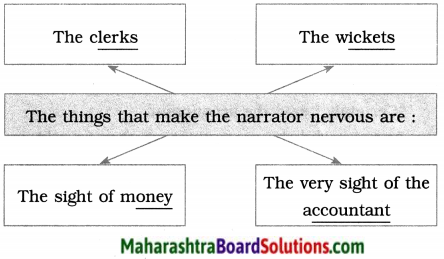
What makes the narrator nervous at a bank?

OR

Complete the following web:
(The answers are given directly and underlined.)
Answer:
Maharashtra Board Class 9 English Kumarbharati Solutions Chapter 4.4 My Financial Career 2

Complex Factual Activity:

Question 1.
What word should the writer have avoided in his request to see the manager?
Answer:
The writer should have avoided the word ‘alone’ in his request to see the manager.

Maharashtra Board Class 9 English Kumarbharati Solutions Chapter 4.4 My Financial Career

Question 2.
Why was the manager alarmed?
Answer:
The manager felt that the writer had some awful secret to reveal. Hence he was alarmed.

Activities based on Contextual Grammar:

Question 1.
Rewrite the following sentence as a simple sentence :
If I attempt to transact business there, I become an irresponsible idiot.
Answer:
On attempting to transact business there, I become an irresponsible idiot.

Personal Response:

Question 1.
Have you been to a bank? If so, how did you feel about it? If not, would you like to go there?
Answer:
Yes, I have been to a bank, but not alone. I have gone there with my mother, and I was completely confused. She told me to just follow her quietly, and that is what I did! of course, as soon as I am eighteen I will learn all these things and manage my own bank account.

Maharashtra Board Class 9 English Kumarbharati Solutions Chapter 4.4 My Financial Career

Simple Factual Activity:

Question 1.
Write whether the following statements are True or False:
Answer:

  1. The manager was very rude to the narrator in the beginning – False
  2. The narrator was one of Pinkerton’s men – False
  3. The narrator was not a detective – True
  4. The narrator was a young Gould – False

Complex Factual Activity:

Question 1.
Who did the manager think his visitor was?
Answer:
The manager thought his visitor was one of Pinkerton’s men.

Question 2.
What was the accountant’s name? What was he asked to do?
Answer:
The accountant’s name was Mr Montgomery. He was asked to deal with the narrator’s business.

Maharashtra Board Class 9 English Kumarbharati Solutions Chapter 4.4 My Financial Career

Activities based on Vocabulary:

Question 1.
Find from the lesson the antonyms of the following:
1. withdraw
2. public
Answer:
1. withdraw × deposit
2. public × private

Question 2.
Fill in the blanks choosing the appropriate word/idiom from the lesson:
Answer:
There was a huge painting kept neatly at the side of the room.

Activities based on Contextual Grammar:

Question 1.
Rewrite using the noun forms of the underlined words:
1. He concluded now that I was the son of Baron Rothschild.
2. I propose to deposit fifty-six dollars now.
Answer:
1. He came to the conclusion now that I was the son of Baron Rothschild.
2. My proposal is to make a deposit of fifty-six dollars now.

Personal Response:

Question 1.
Why do you think the manager spoke ‘coldly’ to the narrator?
Answer:
When the narrator said that he wanted to speak to the manager alone, the manager was alarmed because he thought that the narrator was a detective who had come to find out something. When the narrator said that he was not a detective but had come to open an account, the manager thought that he was a very rich man who would deposit a huge amount of money in the bank.

But when the narrator mentioned he wanted to deposit the princely sum of fifty-six dollars, the manager got angry and spoke coldly to him for having wasted his precious time.

Maharashtra Board Class 9 English Kumarbharati Solutions Chapter 4.4 My Financial Career

Simple Factual Activity:

Question 1.
Complete the paragraph :
Answer:
I went up to the accountant’s wicket and poked the ball of money at him with a quick, convulsive movement as if I was doing a conjuring trick.

Complex Factual Activity:

Question 1.
What procedure did the author have to follow to open the account?
Answer:
To open an account, the author had to first give the money to the accountant. He then had to write the sum on a slip and sign his name in a book.

Question 2.
What error did the author make in the cheque?
Answer:
The author wrote a cheque for fifty-six dollars instead of six dollars. This was the error.

Maharashtra Board Class 9 English Kumarbharati Solutions Chapter 4.4 My Financial Career

Activities based on Vocabulary:

Question 1.
Match the words in Column A with the nouns in Column B:

AB
1. invalid(a) pale
2. ghastly(b) millionaire
3. hollow(c) thing
4. painful(d) voice

Answer:

  1. invalid – millionaire
  2. ghastly-pale
  3. hollow – voice
  4. painful – thing

Question 2.
Fill in the blanks choosing the appropriate word/idiom from the lesson.
Answer:
Not having eaten the whole day, I was feeling dizzy, and the classroom swam before my eyes.

Activities based on Contextual Grammar:

Question 1.
Rewrite the following sentence as a simple sentence, beginning ‘Going …’ ; I went up to the accountant’s wicket and poked the ball of money at him with a quick, convulsive movement.
Answer:
Going up to the accountant’s wicket, I poked the ball of money at him with a quick, convulsive movement.

Maharashtra Board Class 9 English Kumarbharati Solutions Chapter 4.4 My Financial Career

Personal Response:

Question 1.
Do you feel nervous when you have to go to a strange place and talk to strange people?
Answer:
Yes, I do. I think I should get over this nervousness and learn to be calm and confident. I am trying hard to do so, because I know that this is what is needed in the world today.

Simple Factual Activity:

Question 1.
Number the sentences correctly in their order of occurrence in the story:
Answer:

  1. The clerk prepared to pay the money. [3]
  2. I caught the echo of a roar of laughter. [4]
  3. I made a wretched attempt to look like a man with a fearful temper. [2]
  4. “Are you not going to deposit any mort?” asked the clerk, astonished. [1]

Complex Factual Activity:

Question 1.
Did the author correct the error he had made In the cheque?
Answer:
No. he did not.

Maharashtra Board Class 9 English Kumarbharati Solutions Chapter 4.4 My Financial Career

Question 2.
Why did the author pretend to appear like a bad-tempered man?
Answer:
The officials at the bank were astonished by the writer’s behaviour. The writer was terribly nervous, and he thought that if he could look as If he had been Insulted and was hence withdrawing his money, they might not laugh at him. Hence he pretended to appear like a bad-tempered man.

Question 3.
What decision has the author taken after the episode at the bank?
Answer:
After the episode at the bank, the author has decided that he will not keep his money ¡n a bank any more. He will keep his money in cash in his trouser pocket and his savings in silver dollars in a sock.

Activities based on Vocabulary :

Question 1.
Find from the lesson the antonyms of the following:
1. spending
2. happiness
Answer:
1. spending × saving
2. happiness × misery

Question 2.
Fill in the blanks choosing the appropriate word/idiom from the lesson.
Answer:
There was a roar of laughter when the comedian cracked a joke.

Personal Response:

Question 1.
Is the author’s last decision wise?
Answer:
No, the author’s last decision is not wise. It is risky to keep money in the trousers pocket or in a sock; the money could be stolen. On the contrary you will get interest on the money if you keep it in a bank.

Maharashtra Board Class 9 English Kumarbharati Solutions Chapter 4.4 My Financial Career

Simple Activities:

Question 1.
Write two compound words of your own.
Answer:
doorway, moonlight

Question 2.
Make a meaningful sentence using the phrase ‘in some alarm’.
Answer:
The man looked at the gun in his friend’s hand in some alarm.

Question 3.
Spot the error and correct the sentence:
The manager being a grave, calm man.
Answer:
The manager was a grave, calm man.

Question 4.
Pick out a gerund from the given sentence and use it in your own sentence:
All the clerks had stopped writing.
Answer:
writing-gerund.
Sentence: The girl began writing very late.

Maharashtra Board Class 9 English Kumarbharati Solutions Chapter 4.4 My Financial Career

Question 5.
Identify the type of sentence:
Come in here.
Answer:
Imperative sentence

Question 6.
Pick out the word which cannot be formed by using the letters of the given word:
sepulchral-clear, pleas, crease, lurch.
Answer:
crease

Question 7.
Form the present and past participle of a verb in which the last letter is doubled.
Answer:
plan-planned, planning

Question 8.
Write the following words in alphabetical order:
prepared, pocket, painful, presume
Answer:
painful, pocket, prepared, presume

Medium-Level Activities:

Question 1.
Use the following word and its homophone in two separate sentences: write
Answer:
(a) I love to write poems and stories.
(b) We must always try to do the right thing.

Maharashtra Board Class 9 English Kumarbharati Solutions Chapter 4.4 My Financial Career

Question 2.
“Are you not going to deposit any more?” said the clerk, astonished. (Rewrite using indirect speech.)
Answer:
The clerk asked in astonishment whether I was not going to deposit any more.

Question 3.
I was writing the cheque. (Use the future perfect tense of the verb.)
Answer:
I shall have written the cheque.

Question 4.
Prepare a word register of four words related to bank.
Answer:
bank – deposit, cheque, passbook, draft, account, withdrawal, credit, cashier, debit.

Challenging Activities:

Question 1.
I went up to the wicket marked ‘Accountant’.
(Rewrite as a complex sentence.)
Answer:
I went up to the wicket which was marked ‘Accountant’.

Maharashtra Board Class 9 English Kumarbharati Solutions Chapter 4.4 My Financial Career

Question 2.
“Can I see the manager?” (Pick out the modal auxiliary and state its function.)
Answer:
Can-permission

Maharashtra State Board Class 9 English Solutions

Kumarbharati 9th Std English Textbook Answers Unit 4

Std 9 English Poem Reading Works of Art 4.2 Question Answer Maharashtra Board

Class 9 English Chapter 4.2 Question Answer Maharashtra Board

Balbharti Maharashtra State Board Class 9 English Solutions My English Coursebook Chapter 4.2 Reading Works of Art Notes, Textbook Exercise Important Questions and Answers.

Reading Works of Art Poem 9th Std Question Answer

My English Coursebook Std 9 Guide Chapter 4.2 Reading Works of Art Textbook Questions and Answers

English Workshop:

1. Spot the error in the spellings of the following words with reference to the passage and rewrite them correctly.

Question 1.
Spot the error in the spellings of the following words with reference to the passage and rewrite them correctly.

  1. renouned
  2.  feetures
  3. pentmgs
  4. circals
  5. inflar
  6. geometic
  7. figars
  8. achiving.

Answer:

  1. renowned
  2. features
  3. paintings
  4. circles
  5. inner
  6. geometric
  7. figures
  8. achieving.

Maharashtra Board Class 9 My English Coursebook Solutions Chapter 4.2 Reading Works of Art

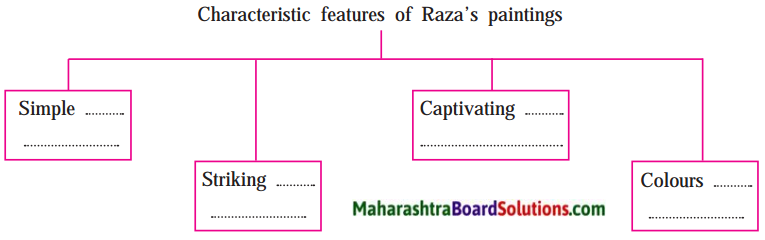
2. Complete the following diagram:

Question 1.
Complete the following diagram:
Maharashtra Board Class 9 My English Coursebook Solutions Chapter 4.2 Reading Works of Art 1
Answer:
Maharashtra Board Class 9 My English Coursebook Solutions Chapter 4.2 Reading Works of Art 2

3. Complete the following sentences with reference to the passage:

Question 1.
Complete the following sentences with reference to the passage:
(a) Raza’s paintings do not depict …………………. .
(b) Raza’s paintings are done in the style ……………… .
(c) Raza’s paintings are not inspired by ………………. .
(d) Raza’s paintings present images from his own …………….. .
(e) Raza’s paintings radiate ……………. .
(f) The …………….. became the core of Raza’s paintings.
(g) For an artist like Raza, his work, or paintings are an effective …………………. .
Answer:
(a) Raza’s paintings do not depict lifelike human figures or copies of scenes.
(b) Raza’s paintings are done in the abstract style.
(c) Raza’s paintings are not inspired by any external factor.
(d) Raza’s paintings present images from his own inner mind.
(e) Raza’s paintings radiate peace.
(f) The bindu or point became the core of Raza’s paintings.
(g) For an artist like Raza, his work, or paintings are an effective medium of communication.

4. Read the passage on ‘Gond Art’ carefully. Then complete the following sentences without going back to the passage:

Question 1.
Read the passage on ‘Gond Art’ carefully. Then complete the following sentences without going back to the passage:
Answer:

  1. Gond art is a tribal art.
  2. The Gondi language is similar to Telugu, a Dravidian language.
  3. Originally people used to draw pictures on the earthen walls of their houses.
  4. In folk arts, you yourself prepare the ‘canvas’ – the surface on which to draw and the colours with which you draw.

Maharashtra Board Class 9 My English Coursebook Solutions Chapter 4.2 Reading Works of Art

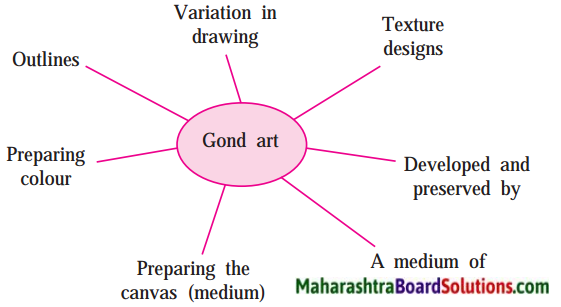
5. Write about the following important features of Gond art with the help of the passage.

Question 1.
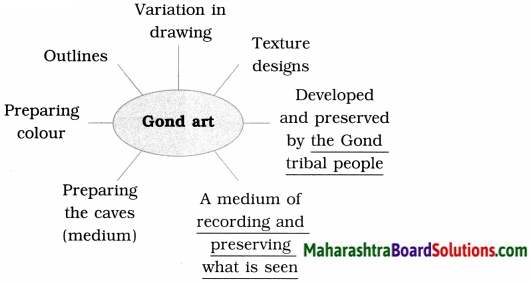
Write about the following important features of Gond art with the help of the passage.
Maharashtra Board Class 9 My English Coursebook Solutions Chapter 4.2 Reading Works of Art 2.1
Answer:
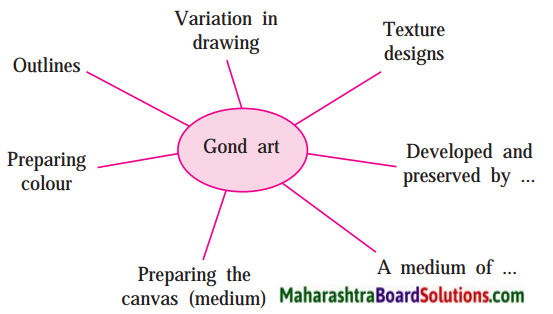
1. Developed and Preserved by: The Gond tribal people residing largely in Madhya Pradesh, Maharashtra, Telangana, Andhra Pradesh and Odisha in India.
2. A medium of: It is a medium of expressing, recording and preserving what is seen. people used to draw pictures on earthen walls of their homes itself.
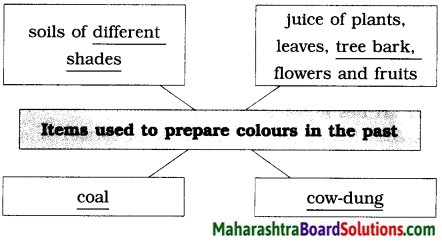
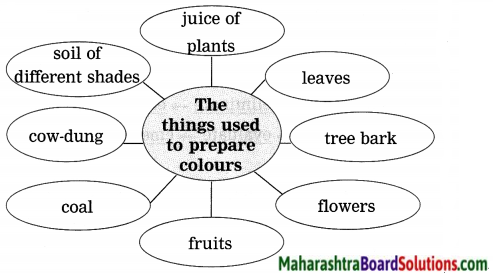
3. Preparing colours: In the days of the past several things in nature such as soil of different shades, the juice of plants, leaves, tree bark, flowers, fruits and even things like coal and cow-dung were used to prepare colours.
4. Outlines: In the Gond style of art, the designs may vary a little from artist to artist but the designs that fill it make the whole picture look lively and attractive.
5. Variation in drawing: The colours, textures and patterns used in drawing vary from painting to painting.
6. Texture designs: By using dots, straight lines, dotted lines, curvy shapes and circles simple texture designs are made.

6. Why does the author think that the roots of folk art lie in women’s chores?

Question 1.
Why does the author think that the roots of folk art lie in women’s chores?
Answer:
In the past, it was the duty of women to look after her home and hearth. It included decorating the house with different things like flowers, rangolis. They handled it very creatively while shouldering the other responsibilities of their home. They used their own creativity while doing it, so the author thinks that the roots of folk art lies in women’s chores.

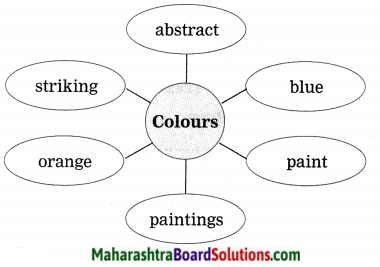
7. From the passages, list the words related to – (a) geometry (b) colours (c) designs.

Question (a)
geometry
Answer:
Maharashtra Board Class 9 My English Coursebook Solutions Chapter 4.2 Reading Works of Art 3

Question (b)
colours
Answer:
Maharashtra Board Class 9 My English Coursebook Solutions Chapter 4.2 Reading Works of Art 4

Question (c)
designs.
Answer:
human figures, scenes, abstract.

Maharashtra Board Class 9 My English Coursebook Solutions Chapter 4.2 Reading Works of Art

8. These two passages are examples of a short introduction to works of art – a short review. They cover the following points:

Question 1.
These two passages are examples of a short introduction to works of art – a short review. They cover the following points:
Answer:

  1. The name of the creator
  2. The theme or subject matter
  3. Type of art
  4. Individual style
  5. Presentation techniques
  6. Its effect on viewers
  7. Message or interpretation

Question 2.
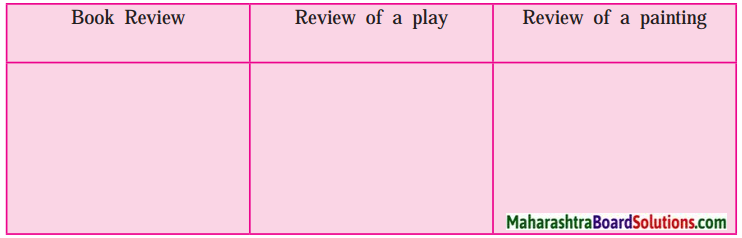
What points will you include if you had to review a book or film or a play? List the points.
Answer:
If I had to review a book, a film or play, I would like to include the following points:

  1. The theme of the book/film/play.
  2. The plot and the story.
  3. The characters in the book/film/play.
  4. Flow of language and style of narration.
  5. Authenticity of the book/film/play (story).
  6. The message conveyed in the book/film/play.

Question 3.
Choose a book/film and review it in short using the points you have listed.
Answer:
Review of the book

The Three Mistakes of My Life

‘The Three Mistakes of My Life’ is a novel written by Chetan Bhagat who writes about Indians and for Indians. His characters are young and passionate. The novel follows the story of three friends and is based in the city of Ahmedabad in Gujarat.

Govind Jaat Patel is an ordinary guy with whom anybody can relate. Being a Gujarati his ambition is to become a businessman. His friend is Omi who is the son of a Hindu priest of the local temple. He is confused about his religious views which are mainly influenced by Bitoo Mama. Ishan is a big cricket freak and a patriot.

He was the best cricketer in his locality and school. He helps Govind’s business by organizing daily cricket coaching camps. He has a younger sister Vidya who is weak in Mathematics. Ishan asks Govind to take her Mathematics tuition. In between their tuition, they fall in love which is kept secret.

The whole story revolves around Govind and his friends and the three mistakes he made. It is pop- fiction of lightest, laziest sort, which tackles serious real-life issues and incidents giving it a veneer of earnest thoughtfulness that stands up to nothing. It is written simply and has the quality that makes one want to read the book in one sitting. The target audience of the book is the young generation. It is based on fun, emotion and pace to turn it into a potential best-seller.

Maharashtra Board Class 9 My English Coursebook Solutions Chapter 4.2 Reading Works of Art

9. You know that an adverb is a word that tells us something more about a verb, an adjective, another adverb etc. It can give us information about the place, time, manner etc. of the action denoted by the verb.

For example, ‘here’ tells us a place. ‘Now’ gives us information about time. ‘Fast’ gives us information about manner. In the same way, an adverb clause is a group of words that can also tell us something about place, time, manner etc. of the action denoted by the verb. Read the following examples, given and then complete the sentence using your own ideas:

Question (a)
Place: You may sit wherever you like.
You may sit ………………………………..
Answer:
(a) Place: You may sit wherever you like.
You may sit next to Ishan.

Question (b)
Time: I entered the school when the bell was ringing.
I entered the school ……………………..
Answer:
(b) Time: I entered the school when the bell was ringing.
I entered the school with my classmates.

Question (c)
Manner: I love my country like a true Indian should.
I love my country………………………….
Answer:
(c) manner: I love my country like a true Indian should.
I like my country more than you.

My English Coursebook 9th Class Solutions Chapter 4.2 Reading Works of Art Additional Important Questions and Answers

Simple Factual Activities:

Question 1.
Name the following:
Answer:

  1. The state where Raza was born – Madhya Pradesh
  2. The institute where he studied art – Chitrakala Mahavidyalaya, Nagpur
  3. The institute where he took his higher education in Mumbai – J. J. School of Art, Mumbai
  4. The country he settled – France

Maharashtra Board Class 9 My English Coursebook Solutions Chapter 4.2 Reading Works of Art

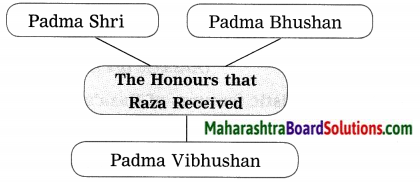
Question 2.
Complete the following web :
(Answers are directly given.)
Answer:
Maharashtra Board Class 9 My English Coursebook Solutions Chapter 4.2 Reading Works of Art 5

Question 3.
Complete the following sentences with reference to the passage: (Answers are directly given.)
Answer:
1. Raza passed away on 23rd July 2016.
2. Raza’s wife was French.

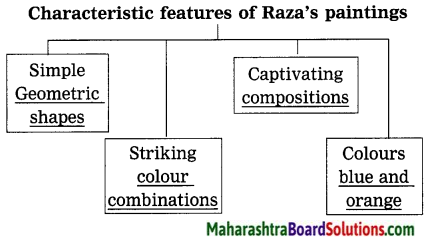
Question 4.
Complete the following web-chart:
(Answers are directly given.)
Answer:
Maharashtra Board Class 9 My English Coursebook Solutions Chapter 4.2 Reading Works of Art 6

Complex Factual Activities:

Question 1.
How did Raza And his paintings?
Answer:
Raza found his paintings through the study of Indian art and its heritage, cultural context and philosophy.

Question 2.
What are the specialities of Raza’s paintings?
Answer:
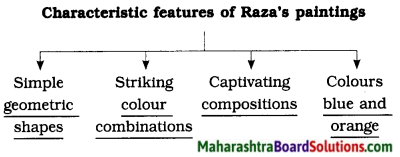
The specialities of Raza’s paintings are:

  1. His paintings belong to the abstract style of paintings.
  2. They are not inspired by any external factor whereas based on inner mind of the painter.
  3. They communicate with the viewers.

Maharashtra Board Class 9 My English Coursebook Solutions Chapter 4.2 Reading Works of Art

Question 3.
What are Raza’s paintings based on? How did he describe his work?
Answer:
Raza’s paintings are based on spirituality, metaphysical path and the bindu or point. He described his work as his own inner experience and involvement with the mysteries of nature and form, which is expressed in colour, line, space and light.

Question 4.
What legacy did Raza leave behind?
Answer:
Raza left behind a rich legacy of sensitive paintings (achieved through extraordinary compositions of lines and colours) that depict extraordinary compositions.

Question 5.
Complete the following sentences:
(Answers are directly given.)
Answer:
1. In the Gond style of art, outlines may vary from artist to artist but the designs that fill it make the whole picture look lively and attractive.
2. The designs in Gond style art contain simple textures of dots, straight lines, dotted lines, curvy shapes and circles.

Activities based on vocabulary:

Question 1.
Find out antonyms from the passage for the following words: (Answers are directly given.)
Answer:

  1. outer × inner
  2. city × village
  3. ordinary × extraordinary
  4. international × national

Maharashtra Board Class 9 My English Coursebook Solutions Chapter 4.2 Reading Works of Art

Question 2.
Spot the error in the spelling of the following words and rewrite them correctly:
1. dicided
2. diffarent
Answer:
1. decided
2. different.

Question 3.
Write related words with “Artist”.
Answer:
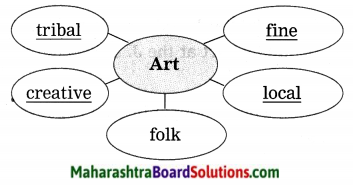
design, outlines, picture, texture, pattern, style.

Activities based on contextual grammar:

Question 1.
Identify the tense:
1. You will find them in almost all paintings.
2. Raza found his paintings through his study of Indian art.
Answer:
1. Simple future tense
2. Simple past tense

Question 2.
Frame a Wh-type question to get underlined part as an answer:
Answer:
1. His paintings belong to the abstract style of paintings.
2. Sayed Haider Raza is popularly known as Raza.
Answer:
1. What do his paintings belong to?
2. What is Sayed Haider Raza popularly known as?

Maharashtra Board Class 9 My English Coursebook Solutions Chapter 4.2 Reading Works of Art

Question 3.
Change the voice:
1. He was honoured with all the three Padma awards – Padma Shri, Padma Bhushan and Padma Vibhushan.
2. Raza left behind a legacy of sensitive paintings.
Answer:
1. The Government of India honoured him with all the three Padma awards – Padma Shri, Padma Bhushan, and Padma Vibhushan.
2. A legacy of sensitive paintings was left behind by Raza.

Question 4.
Make the following sentences exclamatory:
1. His paintings are very expressive.
2. Raza had a great creativity.
Answer:
1. How expressive his paintings are!
2. What a great creativity Raza had!

Question 5.
What a deep thought this art conveys! (Make it assertive.)
Answer:
This art conveys a very deep thought.

Question 6.
Creating folk art is a very enriching experience. (Make it exclamatory.)
Answer:
What an enriching experience creating folk art is!

Question 7.
Complete the words using correct letters:

  1. s_ene
  2. st _ le
  3. pa_nt
  4. c_ eate

Answer:

  1. scene
  2. style
  3. paint
  4. create.

Question 8.
Copy the following sentences correctly:
Answer:
1. He studied art at the J. J. School of Art in Mumbai.
2. What a deep thought this art conveys – and so easily !

Maharashtra Board Class 9 My English Coursebook Solutions Chapter 4.2 Reading Works of Art

Question 9.
Put the following words in alphabetical order:
1. vicious, dreadful, thrilled, favourable
2. enchanted, enabled, explained, endangered.
Answer:
1. dreadful, favourable, thrilled, vicious,
2. enabled, enchanted, endangered, explained,

Question 10.
Punctuate the following sentences:
1. ariel my joyful spirit said prospero bring ferdinand here at once for my daughter must see him
2. most sure she is the goddess of the island he thought to himself
Answer:
1. “Ariel, my joyful spirit,” said Prospero. “Bring Ferdinand here at once, for my daughter must see him.”
2. “Most sure, she is the goddess of the island!” he thought to himself.

Question 11.
Write four small words (minimum letters each) using the letters given word: “treacherous”
Answer:

  1. teacher
  2. reach
  3. each
  4. ache.

Question 12.
Spot the error and rewrite the correct sentences:
1. Prospero touch Miranda with his magic stick and she fell fast asleep.
2. How happy Alonso was to saw his lost son !
Answer:
1. Prospero touched Miranda with his magic stick and she fell fast asleep.
2. How happy Alonso was to see his lost son !

Question 13.
Write related words as shown in the example: (Answers are directly given.)
Answer:
Maharashtra Board Class 9 My English Coursebook Solutions Chapter 4.2 Reading Works of Art 7

Question 14.
Complete the following word-chain of verbs. Write four words, each beginning with the last letter of the previous word:
explore → ……………… → ………………. → ……………… → ………………….
Answer:
explore → eliminate → embrace → evaluate → emerge.

Maharashtra Board Class 9 My English Coursebook Solutions Chapter 4.2 Reading Works of Art

Do as directed:

Question 1.
Make a meaningful sentence by using the following phrase in your own sentence.
‘to settle down’.
Answer:
It is pretty difficult to settle down in cities like Mumbai.

Question 2.
Add a prefix or suffix to make new words and use any one of the root words in your own sentence:
1. rich
2. effect.
Answer:
1. rich-enrich
2. effect-effective.
The painter has used rich attractive colour combinations in his painting.

Question 3.
Add a subordinate clause to expand the sentence meaningfully:
You can see my paintings ………………………..
Answer:
You can see my paintings when vou come to mv house.

Personal Response:

Question 1.
Write 4-5 sentences about any other Indian painter you like.
Answer:
M. F. Husain is my favourite modern painter who was born in Pandharpur town of Maharashtra. He is one of the most famous artists of India both at the national as well as the international level. M. F. Husain was once called ‘the Picasso of India’ by the Forbes magazine. The Government of India awarded the prestigious Padma Shri and Padma Bhushan for his work.

Maharashtra Board Class 9 My English Coursebook Solutions Chapter 4.2 Reading Works of Art

Question 2.
What are the essential things required to become a good painter?
Answer:
The essential things that are required to become a good painter are :

  1. interest in painting
  2. a good concentration skill
  3. capacity to sit for a long time at one place
  4. good eyesight
  5. imagination
  6. the knowledge of mixing colours.

My English Coursebook 9th Class Digest Unit 4

Std 9 English Poem Reading Works of Art 3.2 Question Answer Maharashtra Board

Class 9 English Chapter 3.2 Question Answer Maharashtra Board

Balbharti Maharashtra State Board Class 9 English Solutions Kumarbharati Chapter 3.2 Reading Works of Art Notes, Textbook Exercise Important Questions and Answers.

Reading Works of Art 9th Std Question Answer

English Kumarbharati 9th Solutions Chapter 3.2 Reading Works of Art Textbook Questions and Answers

Warming Up:

Question 1.
Complete the following idioms using the appropriate colour term. (blue, black, green, red)

  1. give someone a ……….. look (a look of anger. dislike, etc.)
  2. the ……….. sheep (of the family a person who brings disgrace to the family)
  3. a …………. list (a list of defaulters)
  4. a ………….. belt (area of fields, woods. etc. around a city)
  5. to have ……………. fingers (be good at gardening)
  6. be ………….. with envy (feel very jealous)
  7. give someone/get the signal (give/get pemilssion to do something)
  8. a bolt from the ………….. (a sudden shock. surprise)
  9. out of the ………….. (suddenly. unexpectedly)
  10. once in a ……………. moon (very rarely)
  11. vanish into the …………… (leave without any trace)
  12. ………….. blood (royal blood. aristocratic origin)
  13. …………. eyed boy (favourite person)
  14. catch someone …………. handed (catch someone in the act of doing something wrong)
  15. roll out the ……………. carpet (give a special welcome)
  16. a …………….. herring (something that diverts attention from the main issue)
  17. see …………… (become angry)

Answer:

  1. give someone a black look.
  2. out of the blue
  3. the black sheep (of the family)
  4. once in a blue moon
  5. a black list
  6. vanish into the blue
  7. a green belt
  8. blue blood
  9. to have green fingers
  10. a blue-eyed boy
  11. be green with envy
  12. catch someone red-handed
  13. give someone/get the green signal
  14. roll out the red carpet
  15. a bolt from the blue
  16. a red herring
  17. see red

Maharashtra Board Class 9 English Kumarbharati Solutions Chapter 3.2 Reading Works of Art

Question 2.
What are you reminded of when you think of the following colours.

  1. purple
  2. orange
  3. yellow
  4. pink
  5. white

Maharashtra Board Class 9 English Solutions Chapter 3.2 Reading Works of Art 1

Answer:

  1. purple – royalty
  2. orange – fire
  3. yellow – the sun
  4. pink – sweetness
  5. white – purity

English Workshop:

1. Spot the error in the spelling of these words with reference to the passage and rewrite them correctly.

Question 1.
Spot the error in the spelling of these words with reference to the passage and rewrite them correctly.

  1. renouned
  2. geomatric
  3. feetures
  4. figars
  5. circals
  6. acheiving

Answer:

  1. renowned
  2. geometric
  3. features
  4. figures
  5. circles
  6. achieving

Maharashtra Board Class 9 English Kumarbharati Solutions Chapter 3.2 Reading Works of Art

2. Complete the following with reference to the passage:

Question 1.
Complete the following with reference to the passage:
Maharashtra Board Class 9 English Solutions Chapter 3.2 Reading Works of Art 2
Answer:
Maharashtra Board Class 9 English Solutions Chapter 3.2 Reading Works of Art 3

3. Complete the following diagram

Question 1.
Complete the following diagram.
Maharashtra Board Class 9 English Solutions Chapter 3.2 Reading Works of Art 4
Answer:
Maharashtra Board Class 9 English Solutions Chapter 3.2 Reading Works of Art 5

4. Complete the following with reference to the passage:

Question 1.
Complete the following with reference to the passage:
(a) Raza’s paintings do not depict ………….. .
(b) Raza’s paintings are done in the ……….. style.
(c) Raza’s paintings are not inspired by …………… .
(d) Raza’s paintings present images from his own …………. .
(e) Raza’s paintings radiate ……………… .
(f) The ……………. became the core of Raza’s paintings.
(g) For an artist like Raza. his work, or paintings are an effective ……………… .
Answer:
(a) Raza’s paintings do not depict lifelike human figures or copies of scenes from his environment.
(b) Raza’s paintings are done in the abstract style.
(c) Raza’s paintings are not inspired by any external factor.
(d) Raza’s paintings present images from his own inner mind.
(e) Raza’s paintings radiate peace and life at the same time.

Maharashtra Board Class 9 English Kumarbharati Solutions Chapter 3.2 Reading Works of Art

5. Write about the important features of Gond art with reference to the passage.

Question 1.
Write about the important features of Gond art with reference to the passage.
Answer:
Gond art involves natural techniques of preparing colours and the use of several mediums. They are transferred from generation to generation in a smoothly flowing process. It is a medium of j recording and preserving what is seen.

6. Why does the author think that the roots of folk art lies in women’s chores?

Question 1.
Why does the author think that the roots of folk art lies in women’s chores?
Answer:
Natural colours available in various things around the house are used in Gond art. The pictures drawn are lively and attractive and depict simple things. The different colours, various textures and patterns were used year after year. The pictures were drawn on the walls of the home earlier. All this makes the author think that the roots of folk art lies in women’s chores.

7. From the passage, list the words related to:

Question 1.
From the passage, list the words related to:
(a) Geometry
(b) colours
(c) designs
Answer:
(b) colours – blue, orange, colour combinations.
(c) designs – abstract, scenes, geometric.

Maharashtra Board Class 9 English Kumarbharati Solutions Chapter 3.2 Reading Works of Art

8. These two passages are examples of a short introduction to works of art a short review. They cover the following points:

Question 1.
These two passages are examples of a short introduction to works of art a short review. They cover the following points:

  • The creator
  • The theme or subject matter
  • Type of ail
  • Individual style tÐ1tjf
  • Presentation techniques SIlO 3DF
  • Its effect on viewers
  • Message or interpretation

Compare the points with those you used for a book review and the review of a play. Present the comparison in the form of a chart.
Maharashtra Board Class 9 English Solutions Chapter 3.2 Reading Works of Art 6
Answer:

Book ReviewReview of a PlayReview of a Painting
1. Title of the bookName of the play/skitThe name of the artist
2. Author / AuthorsImportant charactersThe theme or subject matter
3. Genre/category of the bookAny famous actors/actressesType of art
4. Target group written forThemeIndividual style
5. Setting and time of the storyClimaxPresentation techniques
6. Central idea of the storyEndingIts effect on viewers
7. Important charactersUse of lights and special effects if anyMedium – e.g. oil on canvas
8. Style of writingUse of background music and sound effects if anyMessage / Interpretation
9. Some special featuresThe costumes, make up, etc. of the charactersColour composition
10. Publisher, year of publicationHow well the actors present the play and behave on the stage?Texture / Strokes
11. Your own opinionYour own opinion about the play.Your opinion

Maharashtra Board Class 9 English Kumarbharati Solutions Chapter 3.2 Reading Works of Art

9. Using the Information given in the passage, write a short note on the following in your mother tongue:

Question 1.
Using the Information given in the passage, write a short note on the following in your mother tongue:
(a) The paintings of Raza
(b) Gond art.
(Students may attempt this In their notebook.)

10. Gather Information on any of the following by talking to your elders, family members and from other sources in your mother tongue and write a short note on it in English.

Question 10.
Gather Information on any of the following by talking to your elders, family members and from other sources in your mother tongue and write a short note on it in English.
Answer:

  1. a special type of embroidery
  2. a special dish that is prepared on a special occasion at home.
  3. something that you use to decorate your home on special occasions.

11. Read the following from the Language Study pages:

Question 1.
Read the following from the Language Study pages:

  1. adjective clause
  2. adverb clause
  3. noun clause.

Find an example of each of the following i from the passage and underline the linking words:
Answer:
1. My work is my own inner experience and Involvement with the mysteries of nature and form which is expressed In colour, line, space and light. which Is expressed in colour, line, space and light – Adjective clause
2. They originate when the artist tries to peep into his own inner mind. when the artist tries to peep into his own inner mind – adverb clause.
3. We realize that the painting is a visible form of very deep thought that the painting is a visible form of very deep thought – noun clause.

English Kumarbharati 9th Digest Chapter 3.2 Reading Works of Art Additional Important Questions and Answers

Activities based on Contextual Grammar.

Question 1.
His pictures seem to radiate peace and life. (Rewrite, beginning with ‘Peace and life’ …)
Answer:
Peace and life seem to be radiated from his pictures.

Maharashtra Board Class 9 English Kumarbharati Solutions Chapter 3.2 Reading Works of Art

Personal Response:

Question 1.
Do you like to draw and paint? Elaborate on your answer.
Answer:
Yes, I do. I go to a drawing class regularly and my teacher says I am quite good at it. I also participate in drawing competitions and have won many prizes.

Simple Factual Activity:

Question 1.
‘Complete the following with reference to the passage: (The answers are given directly and underlined.)
Answer:

  1. The ‘bindu’ or point became the core of Raza’s paintings.
  2. For an artist like Raza, his work, or paintings, are an effective medium of communication.
  3. Raza was born in a small village in Madhya pradesh.
  4. Raza won many national & international awards.

Complex Factual Activity:

Question 1.
Name some of the awards won by Raza.
Answer:
Raza was honoured with the Padma Shri, the Padma Bhushan and the Padma Vibhushan.

Maharashtra Board Class 9 English Kumarbharati Solutions Chapter 3.2 Reading Works of Art

Question 2.
How did the artist himself describe his work?
Answer:
Raza described his work in these words: My work is my own inner experience and involvement with the mysteries of nature and form which is expressed in colour, line, space and light.

Activity-based on Vocabulary:

Question 1.
Spot the error in the spelling of these words with reference to the passage and correct them :

  1. penting
  2. vilage
  3. innar
  4. dicided

Answer:

  1. painting
  2. village
  3. inner
  4. decided.

Maharashtra Board Class 9 English Kumarbharati Solutions Chapter 3.2 Reading Works of Art

Activities based on Contextual Grammar.

Question 1.
Find an example of each of the following from the passage and underline the linking words :
1. adverb clause
Answer:
1. Sometimes, an artist’s thoughts appear to be too complex or even complicated when they are expressed through words. when they are expressed through words – adverb clause.

Question 2.
Join the sentences using ‘not only … but also …’ Raza had great creativity. His paintings are very expressive.
Answer:
Raza not only had great creativity but his paintings are also very expressive.

Personal Response.

Question 1.
What is your opinion about abstract art?
Answer:
I do not understand abstract art. I prefer paintings of animals and natural scenes. However, I am sure abstract art is also very great. One has to learn to understand it.

Maharashtra Board Class 9 English Kumarbharati Solutions Chapter 3.2 Reading Works of Art

Simple Factual Activity:

Question 1.
Write if the following sentences are True or False: (The answers are given directly and underlined.)
Answer:

  1. The Gond language is similar to Tamil – False
  2. Gond art has spread mainly in North India – False
  3. Gond art is a tribal art – True
  4. Gonds have been residing in India for thousands of years – True

Activities based on Vocabulary:

Question 1.
Spot the error in the spelling of these words with reference to the passage and correct them:

  1. mediam
  2. tribel
  3. mithology
  4. erthen

Answer:

  1. medium
  2. tribal
  3. mythology
  4. earthen.

Maharashtra Board Class 9 English Kumarbharati Solutions Chapter 3.2 Reading Works of Art

Question 2.
Write the noun forms of the following:

  1. developed
  2. preserved
  3. similar
  4. pleasant

Answer:

  1. developed – development
  2. preserved – preservation
  3. similar – similarity
  4. pleasant – pleasantness.

Activities based on Contextual Grammar.

Question 1.
Find two examples of noun clauses from the passage and underline the linking words :
Answer:
1. We learn that they have lived in India for thousands of years.
that they have lived in India for thousands of years – noun clause
2. Art is a medium of recording and preserving what is seen.
what is seen – noun clause

Maharashtra Board Class 9 English Kumarbharati Solutions Chapter 3.2 Reading Works of Art

Question 2.
Frame a Wh question to get the underlined part as the answer:
It has been developed and preserved by the Gond tribal people.
Answer:
By whom has it been developed and preserved? OR Who has developed and preserved it?

Personal Response:

Question 1.
‘A house decorated with beautiful pictures creates a pleasant atmosphere’. Do you agree with this? Explain your answer.
Answer:
Yes, I agree with this statement. In my house, there are many paintings of beautiful scenes. When you look at these paintings of nature, you feel soothed and happy. However, I feel this is true only with those people who love art.

Simple Factual Activity:

Question 1.
Complete the web: (The answers are underlined directly.)
Answer:
Maharashtra Board Class 9 English Solutions Chapter 3.2 Reading Works of Art 7

Complex Factual Activity.

Question 1.
Write about the important features of Gond art with reference to the passage.
Answer:
Natural colours available in various things around the house are used in Gond art. The different colours, various textures and patterns were used year after year. The outlines may vary a little from artist to artist, but the pictures are lively and attractive. The designs include simple textures using dots, straight lines, dotted lines, curvy shapes and circles. Special attention is given to the choice of colours.

Maharashtra Board Class 9 English Kumarbharati Solutions Chapter 3.2 Reading Works of Art

Activities based on Vocabulary.

Question 1.
Spot the error in the spelling of the following words with reference to the passage and rewrite them correctly:

  1. diffarent
  2. stright
  3. amasing
  4. decorateing

Answer:

  1. different
  2. straight
  3. amazing
  4. decorating.

Question 2.
From the passage, list the words related to:
1. colours
2. designs
Answer:
1. colours – colours, shades.
2. designs – patterns, Gond styles.

Maharashtra Board Class 9 English Kumarbharati Solutions Chapter 3.2 Reading Works of Art

Activities based on Contextual Grammar.

Question 1.
Find an example of each of the following from the passage and underline the linking words :
1. noun clause
2. adverb clause
Answer:
1. We realize that a picture drawn this way or the other can look equally beautiful.
that a picture drawn this way or the other can look equally beautiful. – noun clause
2. Special attention is given to the choice of various colours so that the total effect is amazing and beautiful. so that the total effect is amazing and beautiful – adverb clause

Question 2.
The designs include simple textures. (Rewrite using the noun form of the underlined word.)
Answer:
There is an inclusion of simple textures in the designs.

Simple Activities.

Question 1.
Write two compound words of your own.
Answer:
lifelike, coastline

Question 2.
Make a meaningful sentence using the phrase ‘at the same time’.
Answer:
It is not possible to be at two different places at the same time.

Question 3.
Spot the error and correct the sentence: Art are a medium of recording and preserving what is seen.
Answer:
Art is a medium of recording and preserving what is seen.

Maharashtra Board Class 9 English Kumarbharati Solutions Chapter 3.2 Reading Works of Art

Pick out the gerund from the given sentence:

Question 1.
The roots of folk arts lie in women’s chores like cleaning.
Answer:
cleaning – gerund.

Question 2.
Identify the type of sentence: What a deep thought it conveys!
Answer:
Exclamatory sentence

Question 3.
Find out two hidden words from the word ‘complicated’.
Answer:
complicated-complicate, clamp (leapt, pleat).

Question 4.
Form a present participle in which the last i letter is doubled.
Answer:
run-running

Question 5.
Arrange the following in Alphabetical order:
colour, composition, combination, captivating.
Answer:
captivating, colour, combination, composition.

Maharashtra Board Class 9 English Kumarbharati Solutions Chapter 3.2 Reading Works of Art

Question 6.
Make a word chain of verbs starting with : the following verb:
reward →
Answer:
reward → disappear → remain notice → empathize

Medium-Level Activities.

Question 1.
He won many awards.
(Change the voice beginning ‘Many ….’)
Answer:
Many awards were won by him.

Question 2.
He studied art at Nagpur. (Use the past | perfect continuous tense of the verb.)
Answer:
He had been studying art at Nagpur.

Question 3.
Prepare a word register for ‘geometry’ with words from the lesson.
Answer:
geometry – shapes, circles, triangles, squares, rectangles, lines, dots, straight lines, dotted lines, curvy slopes, circles, point, bindu, space.

Maharashtra Board Class 9 English Kumarbharati Solutions Chapter 3.2 Reading Works of Art

Challenging Activities.

Question 1.
Use the following word as a verb and a noun in two separate sentences : draw
Answer:
(a) The match ended in a draw. (noun)
(b) The teacher asked the children to draw a monkey. (verb)

Question 2.
We see that the outlines may vary a little. (Pick out the modal and state the function.)
Answer:
may – possibility

Maharashtra State Board Class 9 English Solutions

English Kumarbharati 9th Workbook Answers Unit 3