A Battle to Baffle Poem Questions and Answers Class 8 English Chapter 4.5 Maharashtra Board

Std 8 English Lesson 4.5 A Battle to Baffle Question Answer Maharashtra Board

Balbharti Maharashtra State Board Class 8 English Solutions Chapter 4.5 A Battle to Baffle Notes, Textbook Exercise Important Questions, and Answers.

Class 8 English Chapter 4.5 A Battle to Baffle Textbook Questions and Answers

Warming Up:

1. Form suitable groups and discuss the following:

You have heard/read stories of Akbar and Birbal, Tenali Raman, Mulla Nasruddin.
Recollect and write down the names of those stories.

Pick out those aspects of a story that you find common in all their stories.
Answer:
The common aspect found in their stories :
humour, supernatural events, wisdom, suspense, magic, the beauty of nature, wit and play upon words

Maharashtra Board Class 8 English Solutions Chapter 4.5 A Battle to Baffle

2. Read the different types of sentences in Reported Speech and note the differences in the Direct and Indirect forms:

1. a. Direct: The old man said, “What is the time?
b. Indirect: The old man asked what the time was.

2. a. Direct: Mother said to her, “Are you hungry now?
b. Indirect: Mother asked her if she was hungry, then.

3. a. Direct: The teacher said, “Be quiet students.”
b. Indirect: The teacher ordered the students to be quiet.

4. a. Direct: Mother said, “ How pretty she looks!”
b. Indirect: Mother exclaimed with delight that she looked very pretty.

You will observe that –

  • The Reporting Verb changes according to the type of sentence in the speech.
  • Change of Tense
  • Change of word order in the sentence.

Use a dictionary and find the differences in the following terms related to ‘drama’:

Question 1.
A play:
Answer:
A dramatic work staged in a theatre in front of an audience.

Maharashtra Board Class 8 English Solutions Chapter 4.5 A Battle to Baffle

Question 2.
One-act Play:
Answer:
A play that has only one act.

Question 3.
Skit:
Answer:
A short funny play that makes a joke of something.

Question 4.
Mime:
Answer:
A type of theatre using no words but only movements of the hands and body and facial expressions.

Question 5.
Farce:
Answer:
A humorous play in which the characters become involved in unlikely and complicated situations. Uses physical humour and silliness.

Question 6.
Opera:
Answer:
A dramatic work in one or more acts in which all characters communicate through song and the story is told through song put to music.

Question 7.
Tragedy:
Answer:
A play dealing with tragic events and having an unhappy ending.

Question 8.
Comedy:
Answer:
A play characterized by humour; has a happy or cheerful ending.

Maharashtra Board Class 8 English Solutions Chapter 4.5 A Battle to Baffle

1. Read the following words and use them in sentences of your own:

  1. Renown
  2. defiance
  3. exiled
  4. predicament
  5. diffident
  6. benign

Answer:

  1. The Chief Guest at our annual function was a man of great renown.
  2. In an act of defiance, the little girl threw away the expensive toy.
  3. The Prince was exiled by his stepmother for 10 years.
  4. The king turned to his minister to get him out of the predicament.
  5. The new teacher was so diffident that she could not control the students.
  6. The lioness had a benign look on her face as she watched her cubs playing.

2. Read the following phrases and use them ¡n the sentences of your own in proper form:

  1. To voice something
  2. a tight corner
  3. to outwit
  4. to concede defeat

Answer:

  1. The mother wanted to voice her fears but could not do so.
  2. Birbal could always manage to get himself out of a tight corner.
  3. Birbal could outwit all the ministers in the palace.
  4. The Captain had to concede defeat when his army began to turn back.

Maharashtra Board Class 8 English Solutions Chapter 4.5 A Battle to Baffle

3. Pick out dialogues of Tenali Raman which prove that he had the following qualities:

Question a.
Wit and wisdom
Answer:
So this is the ‘tila-kashta-mahisha-bandhana’

Question b.
Self-confidence
Answer:
Let us begin by discussing the merits of ‘tila-kashta- mahisha-bandhana’ .

Question c.
Politeness
Answer:
I have one small request.

Question d.
Humility
Answer:
Your words of praise are my greatest reward, your Highness.

4. Answer the following questions in short:

Question a.
What was Pundit Shahane’s claim as a scholar?
Answer:
Pundit Shahane’s claim as a scholar was that he had mastered all the scriptures.

Maharashtra Board Class 8 English Solutions Chapter 4.5 A Battle to Baffle

Question b.
Why did Pundit Shahane visit Vijaynagar?
Answer:
Pundit Shahane visited Vijaynagar to challenge the knowledge of all the Pundits in the kingdom.

Question c.
What do you learn about Pundits of Vijaynagar?
Answer:
The Pundits of Vijaynagar were frightened and nervous when their knowledge was challenged. They were insecure and did not have confidence in themselves.

Question d.
What punishment did the emperor threaten the Pundits with?
Answer:
The punishment that the Emperor threatened the Pundits with was that they would be exiled from Vijaynagar.

Question e.
Why was Tenali Raman summoned to the court?
Answer:
Tenali Raman was summoned to the court to find a solution to the predicament.

Question f.
On what condition did Tenali Raman agree to take up the challenge?
Answer:
The condition put forward by Tenali Raman was that when Pundit Shahane arrived the next day, everybody had to accept and honour him (Tenali Raman) as the Chief Pundit, for one day.

Question g.
Why was Tenali Raman taken to the court in a palanquin?
Answer:
Tenali Raman probably wanted to impress and frighten Pundit Shahane, and hence he went to the court in a palanquin.

Question h.
How did Tenali Raman outwit Pundit Shahane?
Answer:
Tenali Raman put his hands on a huge bundle next to him and pretended that it contained the scriptures ‘tila kashtamahisha-bandhana’ and he wanted to discuss its merits. He was in fact, only mentioning what the bundle contained. However, the Pundit thought he was referring to some scriptures that he had never even heard of, and hence could not discuss its merits. He immediately gave up. Thus, Tenali Raman outwitted him.

Question i.
What did the bundle in silken cloth contain?
Answer:
Tenali Raman made his entry to the Emperor’s Court in a palanquin, with two pundits following him and carrying a huge bundle in silken cloth.

Maharashtra Board Class 8 English Solutions Chapter 4.5 A Battle to Baffle

Question j.
Explain the significance of the title.
Answer:
The theme of the skit is the challenge to see whether Tenali Raman could outwit the proud Pundit Shahane. This was the ‘battle’. The way to win this battle was to ‘baffle’ (confuse) the Pundit. Hence, the title ‘A Battle to Baffle’ is apt.

5. Fill in the elements that you find in the drama script of ‘A Battle to Baffle.’

Characters:
Background Scene:
Crisis:
Steps taken to resolve the crisis:
Climax:
The end:
Answer:
Characters: Krishnadevaraya, Mantrji, Tenali Raman, Pundit Shahane, 8-10 other courtiers/ministers/scholars.
Background Scene: Krishnadevaraya’s Courtroom. The Emperor is seated on his throne. Courtiers/ministers/scholars are seated in two rows facing one another and discussing softly.
Crisis: A great scholarly Pundit Pundit Shahane, has challenged the knowledge of the Pundits of Vijaynagar. The Pundits of Vijaynagar are not ready to face this challenge.
Steps taken to resolve the crisis: Tenali Raman is sent for to find a solution to the predicament and to pull them out of the tight corner.
Climax: Tenali Raman, with his sheer wit manages to outwit the renowned Pundit Shahane. and make him concede defeat.
The end: Pundit Shahane concedes defeat and leaves. Tenali Raman is praised by the Emperor for saving the reputation and honour of the great empire. Everyone is relieved and happy that the crisis has ended.

6. Do as directed:
(Make sure you do not change the meaning and tense of the sentence).

Question a.
Tenali Raman proved to be wittier than Pundit Shahane.
(Rewrite using ‘as witty as.’)
Answer:
Pundit Shahane proved to be not as witty as Tenali Raman.

Question b.
Pundit Shahane has come here. He wishes to challenge all the Pundits in our Kingdom.
(Combine the two sentences using ‘so’. Now combine the same sentence using because. ‘)
Answer:
Pundit Shahane wishes to challenge all the Pundits in our Kingdom, so he has come here.

Maharashtra Board Class 8 English Solutions Chapter 4.5 A Battle to Baffle

Question c.
How can I discuss its merits?
( Make it Assertive.)
Answer:
I cannot discuss its merits.

Question d.
I have not read that scripture.
( Rewrite using ‘unaware.’)
Answer:
I am unaware of that scripture.

Question e.
Your words of praise are my greatest reward.
(Begin the sentence with ‘No other )
Answer:
No other reward is as great as your words of praise.

Question f.
I am proud of you.
(Rewrite using the noun form of the underlined word).
Answer:
I have pride in you.

Question g.
The Emperor said,” But tell me Raman, to what great work did you refer?”
(Convert into Indirect Speech).
Answer:
The Emperor asked Ra man what great work he had referred to.

Question h.
Tenali Raman was a poet scholar and jester in Vijaynagar in Krishnadevarayas court.
(Punctuate)
Answer:
Tenali Raman was a poet, scholar, and jester in Vijaynagar, in Krishnadevaraya’s court.

Question i.
Mantriji said Maharaj Pundit Shahanes visit to our court is an open challenge.
(Punctuate)
Answer:
“Mantriji,” said Maharaj, “Pundit Shahane’s visit to our court is an open challenge.”

Maharashtra Board Class 8 English Solutions Chapter 4.5 A Battle to Baffle

7. A past student of your school has cleared his UPSC examination and being an lAS officer has been appointed as a Collector of your district. Write a formal letter to invite him to your school to share the story of his success, at a special function.
Answer:
St. Jude school
Dr. Ambedkar Road
Thane 400 601
15 October 2018
Sub: Invitation to grace our Children’s Day function as Chief Guest.
Sir, It was with great pleasure that we learned about your appointment as the Collector of our district. The Principal, teachers, and students of our school congratulate you on this wonderful achievement. We are all so proud that a student from our school has attained this high post!
We intend to have a special function on November 14, Children’s Day. We cordially invite you to grace this function as the Chief Guest and share with us the story of your success. You are an inspiration for our students and your presence will motivate them greatly. The function begins at 10 a.m. and will end at 1 p.m. with lunch. In addition to the talk from you, there will be a short cultural program of dance and music.
It will be an honor for us to have you here and we hope you will accept this invitation.
Thanking you,
Yours faithfully,
Suman Kini (Cultural Secretary, St. Jude school).

8. Understand the quotation and expand It In a paragraph format.
‘Pride goes on horseback, but returns on foot’.
Answer:
Pride goes on horseback but returns on foot:

“I am very beautiful. I am also very clever. Everyone loves me.” How will you react if you hear someone say these words? You will be surprised at such arrogance. You will say that the person is very proud’. To be ‘proud’ here means to have a very high opinion of oneself, one’s looks, abilities, possessions, etc. Pride makes a person think that he/she is superior to others. Would you like such a person? No, no one likes a person who is proud. If you’re too conceited or self-important, someday something will happen to make you look foolish. And when a proud man meets with a bad end, others will have no sympathy for him. History is full of examples of powerful kings who were ruined because of their proud nature. That is the meaning of the quotation: Those who are proud will finally suffer defeat or meet with a shameful end.

Maharashtra Board Class 8 English Solutions Chapter 4.5 A Battle to Baffle

Class 8 English Chapter 4.5 A Battle to Baffle Additional Important Questions and Answers

Complete the table and write who said the given words and to whom:

Question 1.

The wordsWho said?To whom?
(1) He is visiting our court tomorrow.
(2) Not one of you can face the Pundit?
(3) Let us send for Tenali Raman.
(4) That’s an excellent idea.

Answer:

The wordsWho said?To whom?
(1) He is visiting our court tomorrow.Mantri JiEmperor
(2) Not one of you can face the Pundit?EmperorCourtiers, Pundits, etc.
(3) Let us send for Tenali Raman.First ScholarEmperor
(4) That’s an excellent idea.Second ScholarEmperor

Complete the following:

Question 1.
The Courtiers and Pundits were unnerved when they heard the announcement that _________.
Answer:
a very great scholarly Pundit, called Pundit Shahane, was visiting the court to challenge the knowledge of all the Pundits in the kingdom

Question 2.
The first scholar proposed that ________.
Answer:
they send for Tenali Raman to find a solution to their predicament

Maharashtra Board Class 8 English Solutions Chapter 4.5 A Battle to Baffle

Question 3.
Pundit Shahane’s claim as a scholar was that _______.
Answer:
he had mastered all the scriptures

Question 4.
Pundit Shahane visited Vijaynagar to ______.
Answer:
challenge the knowledge of all the Pundits in the kingdom

Question 5.
The punishment that the Emperor threatened the Pundits with was ______.
Answer:
that they would be exiled from Vijaynagar

Question 6.
Tenali Reiman was summoned to the court to ______.
Answer:
find a solution to the predicament

Question 7.
The condition put forward by Tenali Raman was that ______.
Answer:
when Pundit Shahane arrived the next day, everybody had to accept and honour him (Tenali Raman) as the Chief Pundit, for one day

Question 8.
Mantriji introduced Pundit Shahane as __________.
Answer:
the most revered and honoured master of our ancient sculptures, and the Pride of India

Question 9.
Tenali Raman made his entry to the Emperor’s Court ______.
Answer:
in a palanquin, with two pundits following him and carrying a huge bundle in silken cloth

Maharashtra Board Class 8 English Solutions Chapter 4.5 A Battle to Baffle

Question 10.
Tenali Raman wished to debate on the virtues of the scripture ________.
Answer:
‘tila…kashta… mahisha. .bandhana

Question 11.
Pundit Shahane was defeated because ______.
Answer:
he had not read the scripture that Tenali Raman had mentioned

Question 12.
The Emperor and the courtiers reacted ________.
Answer:
by laughing loudly at Tenali Raman’s explanation

Question 13.
The bundle in the silken cloth contained ________.
Answer:
the stems of sesame plants and some rope used to tie up buffaloes

Activities based on Contextual Grammar:

Question 1.
He has mastered all our scriptures and won great renown all over India.
(Write if the sentence is Simple, Compound, or Complex.)
Answer:
Compound Sentence.

Question 2.
I am ashamed of all of you. I shall debar you from my court.
(Join the sentences using a coordinator.)
Answer:
I am ashamed of all of you and I shall debar you from my court.

Question 3.
Your words of praise are my greatest reward.
(Rewrite using the comparative form of the adjective.)
Answer:
There is no other greater reward for me than your words of praise.

Maharashtra Board Class 8 English Solutions Chapter 4.5 A Battle to Baffle

Question 4.
The Pundit got scared when he heard such a complicated name.
(Separate into clauses)
Answer:
The Pundit got scared – Main Clause.
when he heard such a complicated name – Subordinate Clause.

Personal Response:

Question 1.
What do you learn about the Pundits of Vijaynagar?
Answer:
The Pundits of Vijaynagar were frightened and nervous when their knowledge was challenged. They were insecure and did not have confidence in
themselves.

Question 2.
What explanation did Tenali Raman give about the name of the strange scripture?
Answer:
Tenali Raman had pretended that the bundle contained scriptures called ‘tila-kashta-mahisha-bandhana’, and he wanted to discuss its merits. However, the bundle only contained some til (sesame), kashta (sticks or stems of sesame plants) and rope. Hence, tila-kashta meant the stems of sesame plants. The rope the bundle contained was used to tie up buffaloes. Mahisha meant buffalo and bandhana is the rope to tie up something. So that was ( the ‘tila-kashta-mahisha-bandhana’ he had mentioned.

Maharashtra Board Class 8 English Solutions Chapter 4.5 A Battle to Baffle

Write If the following statements are True or False:

Question 1.
Tenali Raman was very proud of being chosen by the Emperor.
Answer:
False

Question 2.
The Emperor was rude to Tenali Raman.
Answer:
False

Question 3.
Tenali Raman accepted the challenge.
Answer:
True

Question 4.
Tenali Raman wanted to be the Chief Pundit permanently.
Answer:
False

Match the adjectives in Column A with the nouns In Column B:

Question 1.

AB
(1) silken(a) scriptures
(2) benign(b) cloth
(3) slight(c) permission
(4) ancient(d) bow

Answer:

AB
(1) silken(b) cloth
(2) benign(c) permission
(3) slight(d) bow
(4) ancient(a) scriptures

Change the voice:

Question 1.
They have recommended you to outwit the challenger.
Answer:
You have been recommended (by them) to outwit the challenger.

Maharashtra Board Class 8 English Solutions Chapter 4.5 A Battle to Baffle

Question 2.
Let them be brought forth at once.
Answer:
Bring them forth at once.

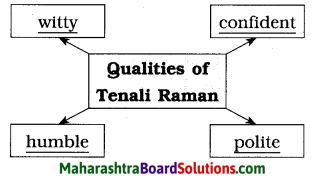
Complete the web showing the qualities of Tenali Raman:

Question 1.
Maharashtra Board Class 8 English Solutions Chapter 4.5 A Battle to Baffle 2
Answer:
Maharashtra Board Class 8 English Solutions Chapter 4.5 A Battle to Baffle 1

Question 2.
Write the English names/words for the following:

  1. til
  2. kashta
  3. mahisha
  4. bandhana

Answer:

  1. sesame
  2. stick
  3. buffalo
  4. rope

Do as directed:

Question 1.
Pick out two non-English words from the lesson.
Answer:
mahisha, bandhana

Question 2.
Pick out two words used for Krishnadevaraya.
Answer:
Maharaj, Emperor (Your Majesty, Your Highness)

Question 3.
Add letters before the word ‘all’ to form two different words:
Answer:
small, shall (stall)

Maharashtra Board Class 8 English Solutions Chapter 4.5 A Battle to Baffle

Question 4.
Find out four hidden words from the given word:
challenger (Each word should have at least 4 letters.)
Answer:
challenger: challenge, change, charge, large

Question 5.
Write down two adjectives formed from the word:
honour
Answer:
honoured, honourable

Question 6.
Underline the pronouns:
Let me assure you that I shall not let you down.
Answer:
Let me assure you that I shall not let you down.

Question 7.
State the tense and aspect of the verb in the following sentence:
Pundit Shahane has come here to challenge all the Pundits in our Kingdom.
Answer:
verb – has come
tense – present
aspect – perfect

Question 8.
Rewrite in indirect speech:
Emperor: (annoyed) Not one of you can face the Pundit? I am ashamed of all of you. I shall debar you from my court.
Answer:
The Emperor was annoyed and ‘ asked if not one of them could face the Pundit. He added that he was ashamed of all of them and would debar them from his court.

Question 9.
Rewrite using the positive and comparative forms of the adjective:
Tenali Raman is the greatest of all scholars.
Answer:
Positive: There is no other scholar as great as Tenali Raman.
Comparative: Tenali Raman is greater than all other scholars.

Maharashtra Board Class 8 English Solutions Chapter 4.5 A Battle to Baffle

Question 10.
Use the following word as a noun and a verb in two separate sentences:
reward
Answer:
(i) The brave girl was asked to collect her reward from the Mayor, (noun)
(ii) Mona was rewarded by the old woman for bringing her cat back, (verb)

Std 8th English Workbook Answers Maharashtra Board Unit 4
Seeing Eyes Helping Hands Poem Questions and Answers Class 7 English Chapter 4.5 Maharashtra Board

Balbharti Maharashtra State Board Class 7 English Solutions Chapter 4.5 Seeing Eyes Helping Hands Notes, Textbook Exercise Important Questions and Answers.

Std 7 English Lesson 4.5 Seeing Eyes Helping Hands Question Answer Maharashtra Board

Class 7 English Chapter 4.5 Seeing Eyes Helping Hands Textbook Questions and Answers

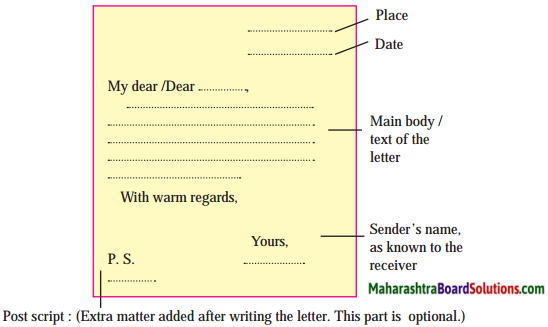
1. Study the following format of an informal letter carefully.

Using the format, (a) Write an informal letter to your friend who has gone to another town for a month. (b) Write a personal letter of thank to an elder person.
Maharashtra Board Class 7 English Solutions Chapter 4.5 Seeing Eyes Helping Hands
Answer:
a. Mogra Villa,
B -116,
Linking Road,
Mumbai – 54.
20th June, 2019.

Dear granny,

How are you? I hope you are taking care of your health. I am sure grandpa too is doing good.

Thank you for the wonderful present you have sent me on my birthday! It was really overwhelming to be remembered and I felt so specially when I received my favourite ‘Harry Potter’ book series.

I enjoyed reading the first book and I am sharing it with my friends too. I am sure to improve my reading skills after reading these books. I will remember you everytime I look at the books or read them.

Thank you granny, I really appreciate your thought and love. Hoping to see you soon. Bye and take care.

Give my love to grandpa.
Your loving granddaughter,
XYZ

Maharashtra Board Class 7 English Solutions Chapter 4.5 Seeing Eyes Helping Hands

b. 73, Minar Road,
Bandra (West),
Mumbai – 50.
21st June, 2019.

Dear Rohini,

How are you? I am sure you are doing good. How is the weather in Pune? You told me that you had to go to Pune for a month because you were selected for the women’s cricket coaching.

I know you have never been to Pune before. Are you excited? Where are you staying? How is the coaching going on? I wish I too was selected. We could have had fun together. How are the other girls who have come for the same? I know that they have come from different places from Maharashtra. Have you made any new friends? I know your nature will be liked by all and you are going to do your best. I am already missing you. Counting the days and waiting for the month to come to an end quickly.

I know you are busy with your new opportunities. Wish you all the luck. Take care and remain healthy.

Your loving friend,
XYZ

2. Form a group of four to six. As a group activity, write a conversation In which a person/a group of persons thanks, someone.

Question 1.
Form a group of four to six. As a group activity, write a conversation In which a person/a group of persons thanks someone.
Answer:

  • Mona: Wow! What a pleasant surprise!
  • Tina: Mona, I have come to thank you for picking up my child from school.
  • Mona: You didn’t need to do that. Anyway I was picking up my child too.
  • Tina: I was unable to pick her on time. Knowing I could rely on You made me breathe a huge sigh of relief.
  • Mona: You could have called me. Why did you take the trouble of coming home all the way?
  • Tina: No It was not a trouble for me. I wanted to thank you personally. I do appreciate your willingness to help. Thank you once again for the timely help at such a short notice.
  • Mona: Thank you for appreciating. You can count on me anytime. I know you have a very busy schedule. Don’t worry, 111 always be there when you need me.
  • Tina: I won’t make it a habit but thank you once again for being such a wonderful person.
  • Mona: It will be my pleasure to be of any help possible and thank you for the kind words

Maharashtra Board Class 7 English Solutions Chapter 4.5 Seeing Eyes Helping Hands

Class 7 English Chapter 4.5 Seeing Eyes Helping Hands Additional Important Questions and Answers

Formal letter (A letter of thanks).

Question 1.
Write a letter of thanks to the owner of a shop.
Answer:
Mogra Villa,
B -116,
Linking Road,
Mumbai – 54.
3rd July, 2017.

To,
Mr. Singh,
Shop No. – 25 Vile Parle (E),
Mumbai – 57.
Mr Singh,

I would like to convey my thanks to you and your team of salesmen. They have done a wonderful job.

My mother who is quite elderly and has difficulty in hearing, had visited your store. She was overwhelmed by the helpful treatment. She praised your team and you too, who have made them so. If everyone could be as pleasant and helpful, our world would be a better and much happier place.

I thank you from the bottom of my heart and please convey my appreciation and thanks to your team as well.

With warm regards.
Thanking you,
Yours sincerely,
XYZ

Seeing Eyes Helping Hands Summary in English

This chapter teaches us how to write a letter whether informal or formal. An informal letter is written in a friendly manner to your family, friends and near and dear ones. A formal letter is a professional way of communicating for official purpose. It can be in the way of appreciation, complaint or application.
A letter of thanks can be formal or informal.

Introduction:

This chapter ‘Seeing Eyes Helping Hands’ introduces us to a couple of writing skills in the form of letter writing and dialogue writing.

7th Std English Balbharati Textbook Solutions

The Worm Poem Questions and Answers Class 8 English Chapter 2.3 Maharashtra Board

Std 8 English Lesson 2.3 The Worm Question Answer Maharashtra Board

Balbharti Maharashtra State Board Class 8 English Solutions Chapter 2.3 The Worm Notes, Textbook Exercise Important Questions and Answers.

Class 8 English Chapter 2.3 The Worm Textbook Questions and Answers

Warming Up:

1. ‘Worms play a very important role; in maintaining ecological balance. They are friends of farmers.’ Form groups and discuss the significance; of worms in the above two roles.
(Point: worms – loosen the soil-bring up fertile soil-turn organic garbage into organic fertilizers-provide/proteins, etc.)
(Students can discuss this as Oral Work.)

2. Think and write down how the following creatures can be useful:

Question a.
DragonFly:
Answer:
eats mosquitoes and flies; controls unwanted insects.

Maharashtra Board Class 8 English Solutions Chapter 2.3 The Worm

Question b.
Spider:
Answer:
keeps insect population under control.

Question c.
Ants:
Answer:
turn and aerate the soil; help; in seed dispersal.

Question d.
Honeybees:
Answer:
provide honey; help in pollination.

Question e.
Earthworms:
Answer:
loosen the soil; turn organic garbage into fertilizer.

Maharashtra Board Class 8 English Solutions Chapter 2.3 The Worm

3. Little creatures in nature can also be your teachers. Think and write: what we can learn from the following:

Question a.
Bees:
Answer:
organization; hard work self-sacrifice

Question b.
Ants:
Answer:
team work hard work discipline

Question c.
Spiders:
Answer:
patience perseverance

Question d.
Caterpillars:
Answer:
patience acceptance of change

Maharashtra Board Class 8 English Solutions Chapter 2.3 The Worm

4. Breeding worms to convert organic waste into fertilizer is called Vermiculture or Vermicomposting.
Find out more about Vermiculture and how you can carry out the same in your garden/backyard to fertilize your plants at home.
(Students can attempt this on their own as a project.)

1. Read the poem aloud and you ill find some old outdated words that we do not use in everyday language now.
However, some writers poets use them to impart an old-fashioned flavour to suit the background of their write-up. Such words are called Archaic words.
Give the modem words for the archaic words from the poem.

  1. thy
  2. being
  3. bestow’d
  4. thee
  5. thou
  6. canst

Answer:

  1. thy – your
  2. being – life
  3. bestow’d – gifted/given as a gift
  4. thee – you
  5. thou – you
  6. cans’t – can

Read any poem I sonnet by William Shakespeare. Pick out archaic words and guess what they mean.

2. The poet uses a device where he directly addresses someone absent or abstarct. Such a device is the Figure of Speech called ‘Apostrophe’.
For example: Turn, turn, thy, hasty, foot aside.

Pick out any two other lines from the poem that on1uin an Apostrophe.
Answer:
(i)Turn, turn thy hasty foot aside
(ii) Let them enjoy their little day
(iii) O do not lightly take away
The life thou canst not give.

Maharashtra Board Class 8 English Solutions Chapter 2.3 The Worm

3. Think and answer in your own words ¡n your notebook:

Question a.
Why does the poet appeal to us to respect the life of worms?
OR
Why should we take care even of small worms?
Answer:
The poet urges us to remember that every creature on this earth is created by God for some purpose. We must hence respect every creature, big or small, for each has its own role to play in this universe. Besides, we have no right to lightly take away a life which we cannot give back.

Question b.
Why had God created worms? What is their ecological importance?
Answer:
Every creature on this earth is created by God for some purpose. Worms play a very important role in maintaining ecological balance. They loosen and aerate the mud and bring up fertile, nutrient-rich soil. They turn organic garbage into organic fertilizers. Their bodies provide proteins.
Thus, though they are so small, they play a huge role in maintaining ecological balance, and this is the purpose for which God created them.

Question c.
Live and let live’ is a famous proverb. Which lines from the poem support this proverb?
Answer:
The lines from the poem that support the proverb ‘Live and let live’ Eire:

(i) Turn, turn thy hasty foot aside Nor crush that helpless worm
(ii) Let them enjoy their little day
(iii) Do not lightly take away The life thou canst not give

Maharashtra Board Class 8 English Solutions Chapter 2.3 The Worm

Question d.
Does the poem urge us to protect I only worms ? What is the general message conveyed through the poem?
Answer:
Though the poem is about the worm, the general message is that God has created all the creatures on earth, big ? and small, and every creature has a role to play. All beings have equal rights over the bounties of the earth. No one can take away a life that he/she cannot give.

4. Find from the library or internet other poems composed on tiny Hing creatures. Try to understand the message in each of them.

5. ‘Even small things in nature play a big role. So protect nature!’
Frame some solgans based on the above topic.
Draft a short speech on the abose topic, which you could give at your school assembly.
Use the following steps while drafting.
(1) Greeting
(2) Salutation
(3) Self-introduction
(4) Introduction of the topic
(5) Body of the speech
(6) Conclusion
(7) Expression of gratitude to audience
Answer:

Small But Important

Respected Principal, teachers and my dear friends, Good morning. Today is 5th June, World Environment Day, and on this important day I, Smruti Kamath, would like to say a few words on the huge role played by the small things in nature.

Let me begin with the earthworm. The earthworm is rightly called the friend of the farmer for it helps the farmer in immeasurable ways. It not only loosens and turns up the soil, it converts garbage into organic fertilizer too. Those minute creatures, ants, help in aerating the soil and in seed dispersal. Bees, in addition to providing honey, are indispensable in pollination. We owe our food to the work done by these little insects. Dragonflies and spiders keep down the insect population by eating insects. Frogs and fish eat the larvae of mosquitoes.

I could go on and on, extolling the virtues and the uses of every little being on this earth. However, time does not permit me to do this, and I end my speech by requesting all of you here to understand and respect the importance and the place of every little creature on this earth. Thank you.

Maharashtra Board Class 8 English Solutions Chapter 2.3 The Worm

6. Puruphrase the poem in your own simple language. Write it down in your notebook.
Answer:
In this poem, the poet tells the reader, who is in a hurry, to turn his foot aside so that he does not crush the helpless worm. The reader may be filled with scorn and hatred for the worm, but it was created by God.

The same God who made human beings and all other things that move has also given a portion of His unlimited love to the poor worm.
God has given the sun, the moon and the stars free to all the creatures He created. The grass that grows over the earth was made for worms as well as for human beings. The poet urges the reader to allow the worms to enjoy their brief life with its humble pleasures. He tells us not to take away a life which we cannot give.

7. Frame a pointwise Analysis of the poem ‘The worm’. Use the following points.
Answer:

(a) Poem and poet: ‘The Worm’ by Thomas Gisborne.
(b) Theme: Respect every creature big or small, for each has its own role to play in this universe.
(c) Tone: Serious and thought-provoking in the imperative.
(d) Structure and stanzas: Stanzas of four lines each short lines.
(e) Rhyme and Rhythm: Rhyme scheme: abab, cdcd, and so on. The last words of the first and third line and second and fourth line of every stanza rhyme, Rhythm is smooth.
(f) Language and Imagery: Archaic language; no imagery.
(g) Figures of Speech: Apostrophe, Inversion.

Maharashtra Board Class 8 English Solutions Chapter 2.3 The Worm

Class 8 English Chapter 2.3 The Worm Additional Important Questions and Answers

Complete the following:

Question 1.
The other creations of God that are mentioned in the poem are the sun, _____.
Answer:
the moon, the stars, the earth, blades of grass and humans.

Question 2.
The thought in the last two lines is that _____.
Answer:
we have no right to lightly take away a life that we cannot give back.

Question 3.
Pick out examples of Inversion from the poem.
Answer:
(i) On that poor worm bestow’d
(ii) The sun, the moon the stars He made To all His creatures free.

Maharashtra Board Class 8 English Solutions Chapter 2.3 The Worm

Writing Skills:

Question 1.
Even small things in nature play a big role. So protect nature Frame some slogans based on the above topic.
Answer:
(i) Nurture nature and get/nurtured by nature.
(ii) All creatures great and small.
The good Lord made them all.
(iii) Take care of one and all.
All creatures great and small.

English Balbharati Digest Std 8 Maharashtra Board PDF Unit 2

The Pilgrim Questions and Answers Class 8 English Chapter 1.3 Maharashtra Board

Std 8 English Lesson 1.3 The Pilgrim Question Answer Maharashtra Board

Balbharti Maharashtra State Board Class 8 English Solutions Chapter 1.3 The Pilgrim Notes, Textbook Exercise Important Questions and Answers.

Class 8 English Chapter 1.3 The Pilgrim Textbook Questions and Answers

Warming Up:

Make groups and discuss the following using the given points:

Question a.
What fatal dangers/problems did mankind face centuries ago, but are no longer a threat today?
Answer:
(Points : wild animals – lack of food – certain diseases – climate etc.)

Question b.
Name a few scientists/explorers/ social reformers / inventors / discoverers, who spent most of their lives to find solutions to some major problems/ setbacks that mankind faced.
Answer:
(Points : Alexander Fleming, Edison, Ronald Ross, Christopher Columbus, Wright brothers, Raja Ram Mohan Roy, Galileo, Marie Curie, Savitribai Phule, Babasaheb Ambedkar, etc.)

Question c.
Did they themselves suffer from those problems/setbacks?
Answer:
(Points : most did not)

Question d.
What inspired them to spend the best part of their lives to research and share their findings?
Answer:
(Points : a passion for well-being of ! mankind – personal goals and aims – interest in the subject – curiosity – the urge to improve society and help others – etc.)

2. Read and understand the following poetic devices:

(A) If two or more words in the same line convey the some meaning, the Figure of Speech in thut line is called Tautology.
For example: It brought joy and cheer.
They groaned with aches and pains.

(B) ‘Poets often change the proper grammatical order of words in the ¡inc of a poem, in order to make the lines rhyme or to emphasize upon something. The Figure of Speech in such lines is called inersion’ or Anastrophe.’
For example: Up came the sun. Down the hill, it flowed.

(C) When a question is asked in order to create a dramatic effect and not to get an answer, in a line of the poem, the Figure of Speech used is called
Interrogation / Rhetorical Questions:
For example: What is this life, if full of care?
When can their glory fade?

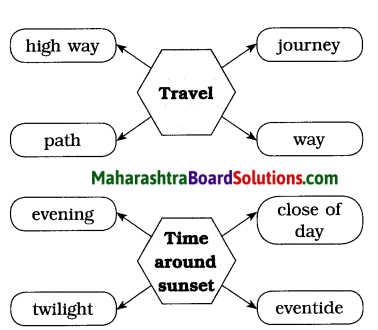
1.Pick out words from the poem to fill in the web diagram. They should be related to the theme in the web.
Maharashtra Board Class 8 English Solutions Chapter 1.3 The Pilgrim 1
Answer:
Maharashtra Board Class 8 English Solutions Chapter 1.3 The Pilgrim 7

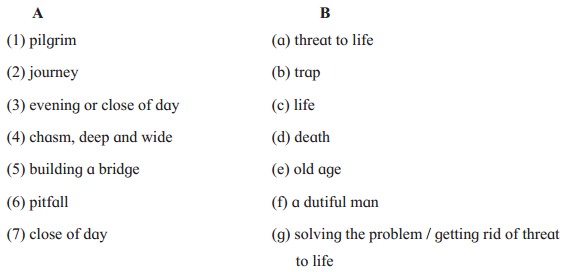
2.The entire poem is metaphorical (Implied comparison).
Match the words in Column A with what they imply in Column B.

Maharashtra Board Class 8 English Solutions Chapter 1.3 The Pilgrim 8
Answer:
(1) pilgrim – a dutiful man
(2) journey – life
(3) evening or close of day – old age
(4) chasm, deep and wide – threat to life
(5) building a bridge – solving a problem /getting rid of a threat to life
(6) pitfall – trap
(7) close of day – death

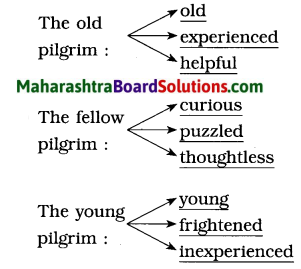
3. A. Read the poem and write 3 qualities of each of the following.
Maharashtra Board Class 8 English Solutions Chapter 1.3 The Pilgrim 2
Answer:
Maharashtra Board Class 8 English Solutions Chapter 1.3 The Pilgrim 6

3. B. Answer in your own words.

Question a.
Why did the old man have no need to build the bridge, across the chasm?
Answer:
The old pilgrim had already crossed the chasm and would never pass that way again. Hence, the old man had no need to build the bridge across the chasm.

Question b.
What explanation did he give to the fellow- pilgrim for his thoughtful deed?
Answer:
The old man said that though he had already crossed the chasm, there was a fair-haired youth who was about to pass that way. The old man was experienced and was not afraid of the chasm. However, the young man was inexperienced and the chasm could prove to be a pitfall for him.
He too had to cross it at twilight, and the old man was building a bridge to help this youth.

Question c.
What message does the poem convey to all of us?
Answer:
The message that the poem conveys to us is that we must be generous ) and unselfish and think of others. We must try to help others who are not as experienced as we are.

4. A. Note the rhyming words in the first stanza:
way – gray I wide-side- tide / dim -him.
Poet has used a deliberate pattern of lines that rhyme with other lines in the poem or
the stanza. This pattern can be identified by giving the rhyming pairs of words the
same letter of the alphabet.
For example: l stanza of this poem has the pattern AABCCBB
So, AABCCBB is called the Rhyme Scheme of the 1stanza of the poem
‘The Pilgrim’.
Answer:
(i) the 2nd stanza : ddaabb
(ii) the 3rd stanza: eeaaffcc

4. B. Now write the Rhyme Scheme of the 2stanza and 3 stanza
Remember that a line in the 2d or stanza may rhyme with lines in P’ stanza,
too. You may use the sanie letter of the alphabet as used in the 1 stanza.
Answer:
(i) Came at evening, cold and gray. To a chasm, deep and vast and wide.
(The correct prose order Is: Came on a cold and gray evening to a deep and wide and vast chasm.)
(ii) To the fair-haired youth. may a pitfall be.
(The correct prose order is : To the fair-haired youth, It may be a pitfall.)

4. C. Find two lines from the poem that j contain the figure of speech ‘Inversion’.
Answer:
(i) Came at evening, cold and gray, To a chasm, deep and vast and wide.
(The correct prose order is : Came on j a cold and gray evening to a deep and wide and vast chasm.)
(ii) To the fair-haired youth, may a pitfall be.
(The correct prose order is : To the fair-haired youth, it may be a pitfall.)

Pick out one line each that contains the following figures of speech:
(Note: Refer to the next page for the explanation.)

Question a.
Tautology:
Answer:
To a chasm, deep and vast and wide.
The words vast and wide have similar meaning.

Question b.
Personification:
Answer:
A pilgrim, going a lone highway.
The highway is given the human quality of being lonely.

Question c.
Interrogation:
Answer:
Why waste your time in building here?
A question is asked to emphasize an idea.

5. Imagine that you are the fellow – pilgrim and you wish to share your experience of the incident in the poem. Write a short article about it for a magazine / journal. Also convey what change it has brought in our life.

Class 8 English Chapter 1.3 The Pilgrim Additional Important Questions and Answers

Complete the following:

Question 1.
Although he had already crossed the chasm, the pilgrim ________.
Answer:
paused and built a bridge across the waters.

Question 2.
The old pilgrim built the bridge to to __________.
Answer:
help the Inexperienced youth who was following on the same path.

Complex Factual Activities:
Give reasons:

Question a.
The fellow pilgrim was puzzled.
Answer:
The old pilgrim had already crossed the chasm and would never pass that way again. Yet, he was building a bridge across the chasm. The fellow pilgrim could not understand the reason for this and was hence puzzled.

Question b.
What/Who could be the third pilgrim?
Answer:
The third pilgrim could be a young, inexperienced youth.

Analysis/Appreciation Of A Poem
Answer:
(1) Poem and poet: ‘The Pilgrim’ by Will Allan Dromgoole
(2) Theme: Those who have faced the difficulties of life successfully and are experienced must be unselfish and help those who are inexperienced and may face difficulties.
(3) Tone: Serious.
(4) Structure and stanzas: Stanzas of unequal length; 1st stanza – 7 lines; 2nd stanza – 6 lines; 3rd stanza – 8 lines;
(5) Rhyme and Rhythm: 1st stanza – AABCCBB; 2nd stanza – ddaabb; 3rd stanza – eeaaffcc
(6) Language and Imagery: The narrative is direct with some archaic language used; there is a strong underlying message. The descriptions are vivid.
(7) Figures of Speech: Inversion, Tautology, Personification, Interrogation.

Writing Skills:

“Imagine that you are the fellow-pilgrim and you wish to share your experience of \ the incident in the poem. Write a short j article about it for a magazine/journal.
Also convey what change it has brought in your life.
Answer:

The Turning Point

There are certain incidents in one’s life which have an impact on a person and prove to be a turning point in their lives. Let me narrate the incident which shook me awake.

I was on a hike in some hilly places when I had to cross a deep ravine which had a gushing river flowing through it. I managed to cross without any difficulty to my surprise, an old man ahead of me also crossed it nimbly. As I was about to continue on my way, I saw the old man turn back and build a rough bridge across the water. It took a lot of effort and I stood by wondering. Finally, I asked him, “Sir, it is late evening and you Eire not likely to cross this way again. Why are you building a bridge now?”

The old man’s answer floored me. “You confused child,” he said with a smile. “I have completed my journey – true. But behind me is a young boy who is inexperienced.

He will soon reach this chasm, and he may have difficulty in crossing it. I am building this bridge to help him.”
I stood still, amazed at the generosity and unselfishness of the old man, who was putting in the time and effort to help someone he did not even know. He was building a bridge that he would never ever cross.

This incident left an indelible mark on my mind. Since that time, I always try to help others even though it may not be beneficial to me in any way. However, it gives me something immeasurable – peace and happiness. Try it out, won’t you? (indelible – permanent; unfading)

English Balbharati Std 8 Answers Solutions Unit 1

A Crow in the House Poem Questions and Answers Class 7 English Chapter 3.3 Maharashtra Board

Balbharti Maharashtra State Board Class 7 English Solutions Chapter 3.3 A Crow in the House Notes, Textbook Exercise Important Questions and Answers.

Std 7 English Lesson 3.3 A Crow in the House Question Answer Maharashtra Board

Class 7 English Chapter 3.3 A Crow in the House Textbook Questions and Answers

1. A. Find antonyms for the following from the story.

Question A.

  1. motionless × …………..
  2. captivity × …………..
  3. frequent × …………..
  4. dull × …………..
  5. gentle × …………..
  6. co-operated × …………..
  7. deep × …………..

Answer:

  1. motionless × restless
  2. captivity × freedom
  3. frequent × sometimes
  4. dull × gleaming
  5. gentle × throaty
  6. co-operated × objected
  7. deep × shallow

Maharashtra Board Class 7 English Solutions Chapter 3.3 A Crow in the House

B. Now try to find out synonyms (words that mean the same. for the following: (You may use a dictionary/thesaurus.

Question B.
Now try to find out synonyms (words that mean the same. for the following: (You may use a dictionary/thesaurus.

  1. disapproved: …………..
  2. bits / pieces: …………..
  3. achievement: …………..
  4. attracted: …………..
  5. nuisance: …………..
  6. mishap: …………..
  7. controlled: …………..
  8. rebuke: …………..

Answer:

  1. disapproved: objected
  2. bits/pieces: shreds
  3. achievement: success
  4. attracted: fascinated
  5. nuisance: pest
  6. mishap: disaster
  7. controlled: restricted
  8. rebuke: scold

2. Using your imagination, write how the other pets in the house could have objected to Caesar living in their house.

Question 1.
Using your imagination, write how the other pets in the house could have objected to Caesar living in their house.
Answer:
The pet dog Bruno and the little pet cat Tisca would have got upset about the author’s attention-getting divided. Tisca would have refused to eat or drink and Bruno must have barked each time the author would play with Caesar. Bruno and Tisca would have leapt onto the writer’s lap to get his attention like before. Their pet parrot in the cage would have squabbled and squawked at the very sight of Caesar and called him names to tease him.

Maharashtra Board Class 7 English Solutions Chapter 3.3 A Crow in the House

3. Prepare a table to show Caesar’s pranks at home and outside.

Question 1.
Prepare a table to show Caesar’s pranks at home and outside.
Answer:

Caesar’s pranks at homeCaesar’s pranks outside
1. He danced about on the dining table.
2. He fidgeted about and investigated things.
3. He would empty the matchbox.
4. He would rip the daily paper to shreds.
5. He would overturn a vase of flowers.
6. He would tug at the tail of a dog.
7. He would squabble with the Hornbill and peck at his feet.
8. He knocked off Aunt Mabel’s spectacles.
1. He would visit neighbors’ houses frequently.
2. He would steal pens and pencils, hair ribbons, combs, keys, shuttlecocks, toothbrushes and false teeth.
3. He would snatch sweets from children.
4. He would take off clothes pegs from the clothesline.

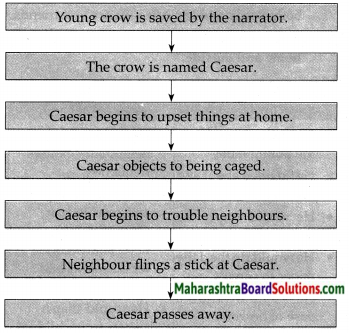
4. Relate the life-story of Caesar, rearranging the facts In a proper sequence in the form of a flow chart.

Question 1.
Relate the life-story of Caesar, rearranging the facts In a proper sequence in the form of a flow chart.
Answer:
Maharashtra Board Class 7 English Solutions Chapter 3.3 A Crow in the House 1

5. Rewrite in your own words.

Question a.
One event from the story.
Answer:
When Aunt Mabel paid the author a visit, Caesar impressed her by landing on her arm and demanding a kiss. As soon as Aunt Mabel (all delighted. put her cheeks forward, her spectacles grabbed his attention and he knocked them off.

Maharashtra Board Class 7 English Solutions Chapter 3.3 A Crow in the House

Question b.
One of the Caesar’s traits that makes you laugh.
Answer:
Begining with getting comfortable in the author’s house, caesar slowly started annoying the pets already there. He would tug at the tail of one of the dogs or sit on top of Harold, the hornbill’s cage and peck his feet and annoy him. This trait makes me laugh.

6. Hold a debate on ‘Pets or Pests’.

Question 1.
Hold a debate on ‘Pets or Pests’
Answer:
Pets are the most lovable beings around us. When it comes to dogs, loyalty is their trademark. Besides being friendly, they shower unconditional love. Their presence in itself is a stress buster. They have the art of lifting one’s spirit with their playfulness and joyful nature. Pets help combat depression. Most pets are least demanding.

When one comes home all tired from the workplace, pets are always there to welcome. Their cheerfulness is extremely contagious. Their very presence adds to the energy of the environment. Although they cannot speak like humans, they express their emotions far more effectively. When it comes to understanding emotions, pets sense it pretty fast.

So pets are a blessing to have. Pets are pests as they are quite demanding when it comes to food. All of us know how choosy a cat is. Besides, pets eat into one’s constructive time as they are dependent for their daily chores. They dirty the house and require special training. Not all pets are friendly. Some even create trouble for the neighbourhood and the owner of the pet is held responsible. Guests fear coming home when they know there is a pet dog.

Moreover, one cannot travel with a carefree mind when one has a pet back home. Making adjustments to keep the pet when one is away is another challenge. When one loses one’s pet, it becomes quite difficult to overcome the sorrow due to emotional attachment. Hence, at times, pets turn out to be pests.

Maharashtra Board Class 7 English Solutions Chapter 3.3 A Crow in the House

7. Do you have pet animals.

Question 1.
Write an interesting story about your own or your friend’s pet.
Answer:
Yes, I do have a pet dog named Brady. He usually gets along well with almost everyone. But one of my neighbours Ms. Miranda, an old woman, aged 70, never managed to impressed the canine. He would do did his utmost to make her life miserable. Sometimes tilting her dustbin kept outside her door, spreading garbage all over her entrance door, other times barking at her guests so fiercely to shoo them away before they could even meet her.

But one evening when Ms. Miranda got stuck in the lift, Brady immediately recognised her voice. He couldn’t bear to hear her cry of anxiety mixed with fear. Off he went running, searching for the security guard and rescued her. Since then both, Brady and Ms. Miranda are best friends.

8. Language Study.

Complement: There are two types of complement: subject complement and object complement. Subject complement Is a word or a phrase used after a verb that describes the subject. The underlined words and phrases in the following sentences are subject complements.
1. I am hungry.
2. My sister became a teacher.
The word ‘hungry’ and the phrase ‘a teacher’ describe the subjects of the verbs. Therefore, they are subject complements. An object complement comes after the object of a verb and gives us information about the object. The underlined words and phrases in the following sentences are object complements.
3. The class made her the monitor.
4. The teacher found my answer correct.
The phrase the monitor’ gives us information about the object ‘her’. The word ‘correct’ gives us information about the object ‘my answer’.

Class 7 English Chapter 3.3 A Crow in the House Additional Important Questions and Answers

Answer the following questions.

Question 1.
Who were the other members of the author’s family living in the same house?
Answer:
Author and his grandparents lived in the same house.

Maharashtra Board Class 7 English Solutions Chapter 3.3 A Crow in the House

Question 2.
Did the author’s Grandfather like animals? How do we know that? Give two examples from this page to support your answer.
Answer:
Yes, the author’s Grandfather liked animals. We know this from the fact that Grandfather already had some pets and Caesar was taken good care of by Grandfather when he was ailing.

Question 3.
What is implied in ‘He took over the administration of the house?
Answer:
Inspite of the opposition to caesar’s presence in the house from Grandmother, Aunt Mabel and Grandfather’s pets, he made himself comfortable there. This is what is meant by “He took over the administration of the house.”

Question 4.
Guess how Caesar learnt to say ‘Hello, hello’.
Answer:
The author laught caesar to, say ‘Hello, hello’ in a cracked throaty voice.

Question 5.
What is meant by ‘Aunt Mabel never was a success with the pets’? Can you think of the reasons why it was so?
Answer:
Aunt Mabel never was a success with the pets means she didn’t get along well with pets. She, probably, must be afraid of them or there must be some inherent dislike for pets. It came in the way of pets developing a rapport with her as they are very quick to sensing love.

Maharashtra Board Class 7 English Solutions Chapter 3.3 A Crow in the House

Question 6.
What is implied in the following sentence? Most of the neighbours were represented in our house by a toothbrush.
Answer:
Caeser stole and gathered toothbrush from his neighborhood and made a collection of them on top of the cupboard in his room. As, he was very fond of them. This implied that ‘Most of the neighbors were represented in our house by a toothbrush.

Question 7.
What actions of the author show that he loved Caesar?
Answer:
The author brought the injured crow home and called it Caesar. Despite Grandmother being unhappy about Caesar’s mischiefs, the author never got upset or thought of getting rid of him. When he died, the author dug a grave in the garden and buried Caesar there along with all the clothes, pegs and toothbrushes. He weven taught him how to talk and kiss These actions of the author show us that he loved Caesar.

Answer the following question in two or three sentences.

Question 1.
Why did the author not expect the crow to live?
Answer:
The author did not expect the crow to live because it was in a very sorry state with its beak gaping and head dropping.

Maharashtra Board Class 7 English Solutions Chapter 3.3 A Crow in the House

Question 2.
How did the author and his Grandfather revive the injured crow?
Answer:
The author and his Grandfather fed the crow little bread and milk; varied this diet with occassional doses of Grandmother’s home-made wine in order to revive the bird.

Question 3.
How did Caesar trouble Aunt Mabel?
Answer:
When caesar alighted on her arm, the delighted Aunt Mabel leaned forward for a kiss. But her glaming spectacles caught his altention and he knocked them off.

Question 4.
Where would the neighbours clothes be lying? Why?
Answer:
The neighbours clothes would be lying in the mud with no sign of pegs because Caesar would steal the pegs and take it to the writer’s house.

Reading Skills, Vocabulary and Grammar.

Simple Factual Questions.

Question 1.
Match the columns.

‘A’‘B’
1. A horse-drawn vehicle.a. shreds
2. Make small nervous movementb. prizing
3. Torn strips of paper.c. tonga
4. Use force to move apart.d. fidget

Answer:

‘A’‘B’
1. A horse-drawn vehicle.c. tonga
2. Make small nervous movementd. fidget
3. Torn strips of paper.a. shreds
4. Use force to move apart.b. prizing

Complex Factual Questions.

Question 1.
What dangers were likely to befall the young crow?
Answer:
The Young crow was in danger of being crushed by a cart or tonga or seized by a cat.

Maharashtra Board Class 7 English Solutions Chapter 3.3 A Crow in the House

Question 2.
To whom do these names refer?
1. Mabel
2. Caesar
Answer:
1. Mabel refers to the author’s aunt.
2. Caesar refers to the young crow brought home by the author.

Vocabulary.

Question 1.
Use appropriate form of the word given in brackets.
1. I picked it up and it home, (bring.
2. He was his freedom (offer.
Answer:
1. I picked it up and brought it home.
2. He was offered his freedom.

Grammar.

Complete the table.

Present TensePast TensePast Participle
……………broughtbrought
fall………………fallen
……………keptkept
give…………….given

Answer:

Present TensePast TensePast Participle
bringbroughtbrought
fallfellfallen
keepkeptkept
givegavegiven

Personal Response.

Question 1.
What pranks did Caesar engage in?
Answer:
During meal times Caesar would dance about on the dining table until he was given a bowl of meat soup and vegetables. He would empty the contents of the match-box, rip the daily paper to shreds, overturn a vase of flowers or tug at the tail of one of the dogs.

Maharashtra Board Class 7 English Solutions Chapter 3.3 A Crow in the House

Simple Factual Questions.

Complete the statements.

Question 1.
Caesar did not show any inclination to
Answer:
join the other crows in the banyan tree

Question 2.
Perching on top of Harold’s cage, Caesar would
Answer:
peck at the big bird’s feet

Complex Factual Questions.

Question 1.
Why did the writer not cage Caesar?
Answer:
When the writer put Caesar in a cage, he cawed and flapped his wings so fiercely that they thought that for their own peace of mind, it was best not to cage him.

Maharashtra Board Class 7 English Solutions Chapter 3.3 A Crow in the House

Question 2.
Why did Caesar not mingle with other crows, according to Grandfather?
Answer:
According to Grandfather, Caesar did not mingle with other crows because he was a jungle crow and looked at ordinary crows with contempt.

Vocabulary.

Question 1.
Use prefix ‘in’/’un’ with any two words from the extract to make its antonymns.
1. kind
2. human
Answer:
1. unkind
2. inhuman

Question 2.
Give verb forms.
1. little
2. inclination
Answer:
1. belittle
2. incline

Maharashtra Board Class 7 English Solutions Chapter 3.3 A Crow in the House

Question 3.
Give one word for the following.
1. to come down
2. shining brightly
Answer:
1. alighted
2. gleaming.

Grammar.

Question 1.
He would sit for hours outside the window. (Rewrite using modal auxiliary of past ability..
Answer:
He could sit for hours outside the window.

Question 2.
I had also taught him to sit on my arm. (Pick out the infinitive..)
Answer:
to sit – infinitive.

Personal Response.

Question 1.
Which two contrasting traits of Caesar does the passage highlight? Do all animals and birds have this?
Answer:
Caesar on one hand is a very snobbish and mischievous crow troubling the Hornbill and not mingling with other crows. But on the other hand, he comes across as a very loving bird greeting the writer and kissing him. Yes, I think all animals and birds have these contrasting traits just as we humans do. They are good to some people and mischievous with the ones who don’t like them.

Maharashtra Board Class 7 English Solutions Chapter 3.3 A Crow in the House

Simple Factual Questions.

State whether the following sentences true or false.
1. Caesar often managed to snatch sweets from children.
2. An occasional sip of Grandmother’s wine finally led to disaster.
Answer:
1. true
2. false.

Complex Factual Questions.

Question 1.
Where did Caesar store his stolen goods?
Answer:
Caesar stored his stolen goods on top of the author’s cupboard.

Question 2.
Why did Grandmother’s blood pressure go up?
Answer:
Watching Caesar steal combs, keys pens, pencils etc. from neighboring houses, Grandmother’s blood pressure went up.

Maharashtra Board Class 7 English Solutions Chapter 3.3 A Crow in the House

Question 3.
Where did the author bury him?
Answer:
The authors dug a shallow grave in the garden and buried him there.

Vocabulary.

Question 1.
Give norm forms for the following.

  1. restrict
  2. fascinate
  3. spy
  4. refuse

Answer:

  1. restriction
  2. fascination
  3. spy
  4. refusal

Question 2.
Use ‘spy’ as a noun and verb in sentences.
Answer:
Noun – Vijay’s brother worked as a spy for FBI
Verb – It is a very sensitive matter to spy for one’s country.

Grammar.

Grandfather and I washed and bandaged his leg and gave a sip of homemade wine. (Rewrite using ‘Not only but also’)
Answer:
Grandfather and I not only washed and bandaged his leg but also gave a sip of homemade wine.

Maharashtra Board Class 7 English Solutions Chapter 3.3 A Crow in the House

Personal Response.

Question 1.
Do you think the author had any feelings when he found Caesar dead?
Answer:
The expression “Poor Caesar!” by the author shows that he had a soft corner for Caesar. They both shared a loving relationship with Caesar welcoming the author back from school saying, ‘hello, hello’ and “Kiss, Kiss” by sitting on his arm and placing his head against the author’s mouth.

Language Study.

Question 1.
I dug a shallow grave in the garden. (End with ‘………. by me’)
Answer:
A shallow grave was dug in the garden by me.

Question 2.
He grew weaker day-by-day. (Make negative)
Answer:
He didn’t grow stronger day-by-day.

Make sentence.

Question 1.
to bring it round
Answer:
The doctors put in their best efforts to bring the patient round.

Maharashtra Board Class 7 English Solutions Chapter 3.3 A Crow in the House

Question 2.
to make oneself at home
Answer:
I made myself at home in the new hostel room within few days.

Question 3.
to tug at something
Answer:
The beggar tugged at my sleeve asking for some money.

Question 4.
to get rid off
Answer:
I got rid off the old story books by giving them to the child next door.

Question 5.
to find one’s way
Answer:
I found my way to the college on my own.

Question 6.
Caesar was joining us at mealtimes. (Identify the tense)
Answer:
was joining – past continuous tense.

Maharashtra Board Class 7 English Solutions Chapter 3.3 A Crow in the House

Question 7.
He danced about on the dining table. (Change into present continuous tense.)
Answer:
He is dancing about on the dining table.

Question 8.
Use the following phrases in sentence.
1. do your best
2. on the road to recovery
Answer:
1. My grandma tells me to do my best when I take up any task.
2. After the revaging floods, the state of of Kerala is on the road to recovery.

Writing Skills.

Question 1.
Write a character sketch on Caesar.
Answer:
Caesar was the author’s pet crow who had been brought home by him after an injury. Caesar, was typically wild with all his anti-social activities. He had made the life of his caretakers difficult. The other pets in the house too did not like him as he would not spare them as well. The fact that he did not mingle with other crows shows that he was too snobbish. He couldn’t be caged and so he made the most of the freedom that he got by troubling others.

He comes across as a hoarder who loved to amass various things ranging from essentials like toothbrushes and combs to false teeth. However, lying beneath this arrogant behaviour, was a layer of love and warmth for the writer whom he greeted with a ‘hello’ and a kiss. He was a good learner as he had learnt to say ‘hello’. But his own notorious action landed him in trouble and proved fatal when he was hit with a stick. In short, Caesar was a wild bird who loved to live a life on his own terms around the author’s house.

Maharashtra Board Class 7 English Solutions Chapter 3.3 A Crow in the House

Formative Assessment.

Question 1.
Crows are very common to India. Gather some information about them.

  1. Are crows intelligent?
  2. Can you teach a crow to talk?
  3. Are crows friendly?
  4. Do crows have funerals?

Answer:

  1. Crows are nearly as intelligent as ravens. They have a good memory for human faces and approach people differently.
  2. Several crows can mimic human speech.
  3. Crows are very social species and live in large extended family groups.
  4. When a bird dies, crows gather squawking loudly and gathering as many other birds as they can find to come and look at the dead body.

A Crow in the House Summary in English

This extract revolves around a crow who was injured and lying on the road. He was picked up and taken home by the author and nursed back to health. How he became a pet as well as a pest in -w the family is seen in this lesson.

Introduction:

Ruskin Bond is an Indian author of British descent. He has made significant contribution to the growth of children’s literature in India. He was a recipients of ‘Padmashri’ in 1999 and ‘Padmabhushan’ in 2014. His works reflect his love for things in nature and his keen sense of observation. The present extract is from his book “Grandfather’s Private Zoo”.

Maharashtra Board Class 7 English Solutions Chapter 3.3 A Crow in the House

Glossary:

  1. fluttering (v) – fly unsteadily
  2. tonga (n) – a light horse-drawn-two-wheeled vehicle used in India
  3. prizing (v) – use force to move apart
  4. recovery (n) – a return to a normal state of health
  5. grubs (n) – the larva of an insect, especially a beetle
  6. fidgeting (v) – to make small nervous movement of hands and feet
  7. rip (v) – tear or pull something away forcibly
  8. shreds (n) – torn strips or pieces of paper or cloth
  9. ruin (n) – destruction
  10. grumbled (v) – complain about something in a bad-tempered way
  11. fierce (adj) – violent and aggressive
  12. contemptuous (adj) – showing disregard
  13. squabble (v) – to quarrel noisily over a small matter
  14. gleaming (adj) – shining brightly
  15. engaging (adj) – charming and attractive
  16. spied (v) – to observe carefully and make out something
  17. disaster (n) – tragedy
  18. mend (v) – repair
  19. flung (v) – threw
  20. anti-social (adj) – contrary to the laws and customs of society
  21. grave (n) – burying place
  22. carrion crows (n) – crows feeding on dead or decaying flesh (and other garbage)

7th Std English Balbharati Textbook Solutions

Past, Present, Future Poem Questions and Answers Class 7 English Chapter 1.1 Maharashtra Board

Balbharti Maharashtra State Board Class 7 English Solutions Chapter 1.1 Past, Present, Future Notes, Textbook Exercise Important Questions and Answers.

Std 7 English Lesson 1.1 Past, Present, Future Question Answer Maharashtra Board

Class 7 English Chapter 1.1 Past, Present, Future Textbook Questions and Answers

1. Read the poem aloud using proper rhythm and intonation.

Question 1.
Read the poem aloud using proper rhythm and intonation.

Maharashtra Board Class 7 English Solutions Chapter 1.1 Past, Present, Future

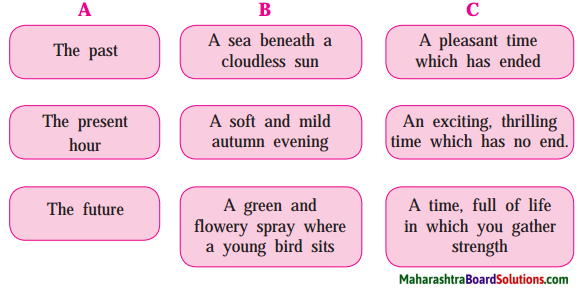
2. Link the items in the three columns properly.

Question 1.
Link the items in the three columns properly.
Maharashtra Board Class 7 English Solutions Chapter 1.1 Past, Present, Future 1
Answer:

ABC
The pastA soft and mild autumn eveningA pleasant time which has ended
The present hourA green and flowery spray where a young bird sitsA time, full of life in which you gather strength
The futureA sea beneath a cloudless sunAn exciting, thrilling time which has no end

Maharashtra Board Class 7 English Solutions Chapter 1.1 Past, Present, Future

3. Find the meaning of the following words.
thee, mournfully, spray, mighty

Question 1.
Find the meaning of the following words.
thee, mournfully, spray, mighty
Answer:

  • thee – you (archaic/old usage)
  • mournfully – sadly
  • spray – a flowering branch
  • might – physical strength

4. WrIte the adjectives that are used to describe the following.
evening, spray, sea

Question 1.
Write the adjectives that are used to describe the following.
Answer:

  • evening – soft, mild
  • spray – green, flowery
  • sea – mighty, glorious, dazzling

5. Write one line about each of the following with the help of the poem.

Question 1.
Wind in the autumn evening
Answer:
It sighs expressing sadness.

Question 2.
Young bird on the spray.
Answer:
Sits on the flowery branch gathering all its physical and mental strength to explore the blue sky.

Maharashtra Board Class 7 English Solutions Chapter 1.1 Past, Present, Future

Question 3.
The Sea.
Answer:
Vast is the sea beneath the cloudless sun and as it stretches endlessly, it displays might, glorious and dazzling beauty.

6. Language Study:
A simile Is an imaginative comparison of two different things which have something in common. A simile always includes the words ‘as’ or ‘like’. For example: as tall as a tree, as lovely as a flower A metaphor is an imaginative expression that refers to someone/something as another person/thing. It shows thai the person or thing has some quality of that other person or thing. The words ‘as’ or ‘like’ are not used in a metaphor. For example : He is a gem of a person. Time is money. Books are our friends. The clouds are white sheep.
There are three metaphors in the poem. Can you find them?
Answer:
The three metaphors are:
Question i.
‘What is the past like to thee?
An autumn evening soft and mild’
Answer:
Here the past is compared to an autumn evening.

Question ii.
’Tell me, what is the present hour?
A green and flowery spray.’
Answer:
Here the present is compared to a green and flowery spray.

Maharashtra Board Class 7 English Solutions Chapter 1.1 Past, Present, Future

Question iii.
’And what is the future, happy one?
A sea beneath a cloudless sun.’
Answer:
Here the present is compared to a sea beneath a cloudless sun.

Class 7 English Chapter 1.1 Past, Present, Future Additional Important Questions and Answers

Answer the following questions:

Question 1.
What is the central idea of the poem?
Answer:
The central idea of the poem is the child’s definition of different periods of time which is presented in the form of a dialogue between the poetess and the child.

Question 2.
What does the past stand for according to the child?
Answer:
According to the child, the past was a pleasant time but they are moments which cannot be revisited as they would never return back.

Maharashtra Board Class 7 English Solutions Chapter 1.1 Past, Present, Future

Question 3.
How does the child define the present time?
Answer:
For the child, the present is a time where he/she
prepares for the future which is unknown, but also exciting so it is the time to gather strength.

Question 4.
How is the present moment viewed with optimism by the child?
Answer:
The child compares the present time to a green and flowery branch on which a bird is all set to take off and explore the unlimited possibilities which awaits it.
This tells us that the present is something which is viewed with optimism by the child as he believes that once we gather strength, nothing is impossible.

Question 5.
How do you define time?
Answer:
According to me, time is the most precious gift we possess. It is up to us to make utmost use of it. We should plan and prioritise to make use of most of the time in hand.
How true is the Estonian proverb!
“Wasting time is robbing oneself”

Maharashtra Board Class 7 English Solutions Chapter 1.1 Past, Present, Future

Reading Skills and Poetic Device

Read the following extract and do the activities.

Simple Factual Questions:

Question 1.
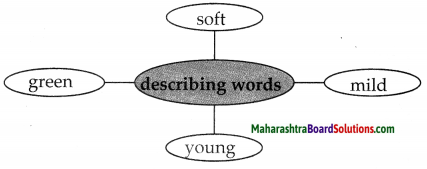
Fill in the blanks with any four describing words from the extract.
Answer:
Maharashtra Board Class 7 English Solutions Chapter 1.1 Past, Present, Future 2

Question 2.
Choose the correct alternative and complete the sentence:
For the child in the poem the past was
i. a pleasant time.
ii. an unpleasant experience.
Answer:
For the child in the poem the past was a pleasant time.

Complex Factual Questions:

Question 1.
What is the theme of the poem?
Answer:
The theme of the poem is about time and the child’s definition about the different periods of time.

Question 2.
How is this poem presented?
Answer:
This poem is presented as a dialogue between the poetess and a happy child.

Maharashtra Board Class 7 English Solutions Chapter 1.1 Past, Present, Future

Question 3.
What is the one characteristic of the past? Which is emphasised in the poem?
Answer:
One characteristic of the past which is emphasised in the poem is that we can never go back to it.

Question 4.
How should we make use of the present time?
Answer:
We should make use of the present time by using it to gather strength and courage to face the future.

Poetic Device:

Rewrite the Metaphors as Similes:

Question 1.
The past is an autumn evening soft and mild.
Answer:
The past is like an autumn evening soft and mild.

Question 2.
The present is a green and flowery spray.
Answer:
The present is like a green and flowery spray.

Question 3.
The future is a sea beneath a cloudless sun.
Answer:
The future is like a sea beneath a cloudless sun.

Question 4.
Give the rhyme scheme of the first stanza.
Answer:
The rhyme scheme of the first stanza is (a b a c).

Maharashtra Board Class 7 English Solutions Chapter 1.1 Past, Present, Future

Question 5.i.
Name and explain the figures of speech.
With a wind that sighs mournfully
Answer:
Personification – Wind is given human qualities,

Question ii.
What the past is like to thee?
‘An Autumn evening soft and mild.
Answer:
Simile – Direct comparison of past with an autumn evening.

Formative Assessment

Question 1.
Complete the following stanza to compose a poem on the topic:
The time gone by…….

Past, Present, Future Introduction:

Past, Present, Future written by Emily Bronte is a dialogue between the poetess and a happy child. They discuss what each period of time means to the child, a child with the ability to see beauty and optimism around it.

Past, Present, Future Summary in English

The poetess Emily Bronte begins the poem by asking a happy child what the past is like to him/ her. In response the child compares the past as an autumn evening which is soft and mild with a sad wind sighing in the background.

In response to the query about the present hour the child compares it to the pleasant green and flowery branch wherein a young bird gathers courage and power to mount and fly above the blue sky. In other words the child finds the present filled with hope, courage and aspiration to scale great heights; the time to gather strength.

On being asked about the future the child compares it with a sea under a cloudless sun, a sea which is mighty, glorious, dazzling and never ending. Through these words the child implies about the thrilling and never ending possibilities which awaits for him/her.

Maharashtra Board Class 7 English Solutions Chapter 1.1 Past, Present, Future

Glossary:

  1. autumn (n) – the season which follows summer when leaves fall from the trees
  2. mild (adj) – not severe or not very harsh
  3. mournfully (adv) – with sad feelings
  4. spray (n) – a flowering branch
  5. mount (n) – to ascend, get ready for take off
  6. glorious (adj) – marvellous
  7. dazzling (adj) – extremely bright
  8. stretching (v) – to be made longer
  9. infinity (n) – endlessness
  10. sighs (v) – to let out a long breath slowly to express sadness
  11. thee (pro) – you
  12. mighty (adj) – possessing great power or strength; very powerful
  13. beneath (prep) – under

7th Std English Balbharati Textbook Solutions

Home Sweet Home Poem Questions and Answers Class 7 English Chapter 4.4 Maharashtra Board

Balbharti Maharashtra State Board Class 7 English Solutions Chapter 4.4 Home Sweet Home Notes, Textbook Exercise Important Questions and Answers.

Std 7 English Lesson 4.4 Home Sweet Home Question Answer Maharashtra Board

Class 7 English Chapter 4.4 Home Sweet Home Textbook Questions and Answers

1. Write in your own words.

Question a.
How does the poet glorify his home in the first stanza?
Answer:
The poet glorifies his home in the first stanza by saying that we may roam places and stay in palaces but like magic we will get drawn to our home however modest it may be because there
is no place in the world better than our own home.

Maharashtra Board Class 7 English Solutions Chapter 4.4 Home Sweet Home

Question b.
How does the poet describe his home in the second stanza?
Answer:
The poet in the second stanza there is says that all the wonders in the world nothing as compared to his modest home. It is in his humble dwelling that he gets peace of mind which is more precious than anything in the world.

Question c.
What makes the poet remember his mother?
Answer:
The poet spends long periods of time away from home and while gazing at the moon in a faraway place he remembers his mother who must be looking at the moon from their home and remembering her child.

Question d.
What does the poet miss?
Answer:
The poet misses his loving father’s smile and the soothing caress of his loving mother.

Question e.
What does the poet hope for?
Answer:
The poet hopes to return to the warmth and comfort of his humble home and remain there forever.

Maharashtra Board Class 7 English Solutions Chapter 4.4 Home Sweet Home

Question f.
In which professions is a person forced to stay away from his home/homeland for a long time? Try to guess why the poet is forced to stay away from his home.
Answer:
A person is forced to stay away from his home/ homeland for a long time if he is an artist – could be an actor, a writer, a model, a businessman, an interpreter, a trader, a dancer, a singer, etc. A poet needs to be constantly on the move so that he gets inspired to write and create poetry. I think this is the reason the poet is forced to stay away from home.

2. Write out a few things that you would really miss about your home if you were to stay away from it for long.

Question a.
Write out a few things that you would really miss about your home if you were to stay away from it for long.
Answer:

  1. I would miss my family members in the first place.
  2. I would miss my friends.
  3. I would miss the food made at home by my mother.
  4. I would miss the love and care I get from my parents and relatives.
  5. I would miss the smell of my home, my bed.

Class 7 English Chapter 4.4 Home Sweet Home Additional Important Questions and Answers

Simple Factual Questions.

Question 1.
State Whether the statements are True or False
1. Though we may roam around palaces, but there is no place like home.
2. The birds sings dolefully and does not respond to the poet’s call
Answer:
1. True
2. False

Maharashtra Board Class 7 English Solutions Chapter 4.4 Home Sweet Home

Poetic Devices.

Question 1.
Pick out the rhyming words from the extract.
Answer:
roam-home, there-elsewhere, rain-again, call-all.

Question 2.
Mid pleasures and palaces though we may roam.
Answer:
Alliteration – The sound of ‘p’ is repeated for better poetic effect.

Question 3.
To thee I’ll return, overburdened with care. (Explain the line)
Answer:
The poet says that he’ll return home with a lot of worries.

Question 4.
Pick out the rhyming words from the extract.
Answer:

  1. smile – beguile
  2. roam – home
  3. care – there

Maharashtra Board Class 7 English Solutions Chapter 4.4 Home Sweet Home

Question 5.
Write the rhyme scheme for the first four lines of the extract.
Answer:
The rhyme scheme is aabb.

Name the figures of speech for the following.

Question 1.
How sweet ’tis to sit ‘neath a fond Father’s smile.
Answer:
Alliteration – The sound of’ s’ and’ f’ is repeated for better poetic effect.

Question 2.
But give me, oh, give me, the pleasures of home.
Answer:
Repetition – The words ‘give me’ have been repeated for better poetic effect.

Maharashtra Board Class 7 English Solutions Chapter 4.4 Home Sweet Home

Question 3.
No more from that cottage again will I roam.
Answer:
Inversion – The words are not in order for better poetic effect. The right order is, ‘No more will I roam again from that cottage’.

Question 4.
Be a poet. Try and write a poem on ‘My Home’.
Answer:
My Home

I have a cosy little home,
Made of cement, bricks and dome.
It is coloured beautifully,
With everything arranged wonderfully.
We are a family of five,
When together we come alive.
A place where I can rest.
My home, it is the best.

Home Sweet Home Summary in English

The poet John Howard Payne through his poem conveys the message that ‘Home Sweet Home’ assurs us that there is no place better than home. It is a poem that reaches into the heart. He says that home is a place where we experience independence, safety, privacy and where we can dispense hospitality. The poet says that wherever we might roam or live, there is no comfort like home however big or small it is, because a home is where our family is.

Introduction:

The poem ‘Home Sweet Home’ was written by John Howard Payne, an American actor, poet, playright and author. ‘Home Sweet Home’ is a song adapted from Payne’s opera ‘Clari, the Maid of Milan’.

Maharashtra Board Class 7 English Solutions Chapter 4.4 Home Sweet Home

Glossary:

  1. humble (adj) (here) – modest
  2. charm (n) – an object believed to have magic powers
  3. ‘neath (adj) – below or underneath
  4. hallow (v) – to make holy
  5. exile (n) – banished from one’s home or country
  6. splendour (n)- magnificent
  7. vain (adj) – useless
  8. gayly (adv) – cheerfully, happily
  9. dearer (adj) – precious or greatly valued by someone
  10. gaze (v) – to stare intently
  11. tread (v) – to walk
  12. drear (adj) – cheerless
  13. woodbine (n) – any of several climbing vines
  14. fragrance (n) – pleasant smell
  15. soothe (v) – comfort
  16. beguile (v) – to charm, delight or captivate
  17. overburdened (adj) – excessively burdened
  18. care (n) (here) – worries
  19. solace (n) – comfort in a time of loneliness or distress

7th Std English Balbharati Textbook Solutions

Leisure Poem Questions and Answers Class 8 English Chapter 3.4 Maharashtra Board

Std 8 English Lesson 3.4 Leisure Question Answer Maharashtra Board

Balbharti Maharashtra State Board Class 8 English Solutions Chapter 3.4 Leisure Notes, Textbook Exercise Important Questions, and Answers.

Class 8 English Chapter 3.4 Leisure Textbook Questions and Answers

Leisure Poem 8th Std Warming Up:

1. Discuss in groups and share with one another:

Leisure Poem Questions And Answers Class 8 Question 1.
The daily routine of your mother and father on working days
Answer:
(Points: what time they get up – what time they leave for work – what time they return home – have lunch – dinner – bedtime, etc.)

3.4 Leisure Questions And Answe Question 2.
How your family relaxes on weekends
Answer:
(Points: rest at home – visit relatives – shopping – malls – movies – gardens – catch up on housework, etc.)

Maharashtra Board Class 8 English Solutions Chapter 3.4 Leisure

Std 8 English Poem Leisure Question 3.
When you go for a picnic, what and how do you enjoy it?
Answer:
(Points: go to the beach/mall /garden/movies etc. – relax and enjoy by yourself – sing songs – go in big groups – go as a family – go to restaurants for food, etc.)

Leisure Question Answers Class 8 Question 4.
Do you spend time admiring and thinking over the beauties of nature? Elaborate on your response.
Answer:
(Points: no beautiful nature around/ gardens nearby – like enjoying natural beauties – prefer city life – like animals and birds – visit zoos and parks. etc.)

2. When a poet I writer attempts (o describe something in words, so that it appeals to our five senses (sight, smell, hearing, touch, taste) he/she has used a des ice called Imager.
For example a host of golden daffodils’.
to a chasm, deep and vast and wide’.
Go through other poems in your textbook or other books and find outlines that contain Imagery. Write them does n along with the name of the poem and line/stanza number.
Answer:
Students can attempt this activity on their own.

3. Prepare un Acrostic from the word ‘Leisure’. The words should be related to what one likes to do in free time:

  1. L ………..
  2. E ………….
  3. I …………
  4. S ………..
  5. U ………..
  6. Reading stories
  7. E …………

Answer:

  1. Laze around
  2. Enjoy movies
  3. Initiate games
  4. Sleep
  5. Undertake to clean house
  6. Read stories
  7. Exercise

Maharashtra Board Class 8 English Solutions Chapter 3.4 Leisure

1. Say Where:

Question a.
………… do the cows and sheep stand? …………..
Answer:
Beneath the branches of trees.

Question b.
………… do squirrels store their food? ………….
Answer:
In the grass.

Question c.
………….. do stars shine in the daytime …………..
Answer:
In the streams.

Question d.
………….. does Beauty’s smile begin? ……………….
Answer:
In her eyes.

2. Think and answer in your own words:

Question a.
What could have inspired the poet to compose this poem? Do you think it relates to our present-day life? Defend your choice.
Answer:
The poet must have seen the busy lives of people around him, who are always in a hurry and have no leisure to look at the beauty around. Yes, it certainly relates to our present life, which keeps getting busier and busier. Today, with the Internet, the mobile phone, the computer, and social networking sites, our lives are getting more I and more artificial and further from nature than ever before.

Maharashtra Board Class 8 English Solutions Chapter 3.4 Leisure

Question b.
Which line proves that in our busy lives we do not even have a fraction of a second to enjoy nature’s beauty?
Answer:
The lines are :
No time to see, when woods we pass
Where squirrels hide their nuts in the grass?
No time to see, in broad daylight,
Are streams full of stars, like skies at night?
No time to turn at Beauty’s glance,
And watch her feet, how they can dance?
No time to wait till her mouth can
Enrich that smile her eyes began.

Question c.
‘Beauty’ in stanza 5 to 6 can refer to a beautiful maiden as well as nature itself. Explain when and how nature ‘dances’ and also ‘smiles’.
Answer:
Nature dances during spring and: summer, when the leaves of trees and the flowers sway in the breeze. Nature smiles at the beginning of spring when the plants begin to once again bloom slowly.

Question d.
Why does the poet call our life ‘poor’?
Answer:
The poet calls our life ‘poor’ because we are always anxious and under stress. We are completely cut off from nature and cannot relax and enjoy its beauty. He feels that this type of life is a ‘poor’ life.

Maharashtra Board Class 8 English Solutions Chapter 3.4 Leisure

3. You have learned that when u human attribute is given to anything that is not a human being or it is spoken of as a person, the Figure of Speech used is culled as ‘Personification’:

Question a.
Pick out two examples of Personification from the poem
Answer:
(i) ‘No time to turn at Beauty’s glance, I And watch her feet, how they can; dance?’ Nature has been given the human qualities of ‘glancing’ and ‘dancing’.
(ii) ‘No time to wait till her mouth can Enrich the smile her eyes began.’ Nature has been given the human quality of ‘smiling’.

Question b.
Pick out from the poem, two examples of each of the following Figures of Speech:

3.4 Leisure Question 1.
Alliteration
Answer:
(i) We have no time to stand and stare.’ Repetition of the sound of the letter ‘s’.
(ii) ‘Streams full of stars, like skies at; night.’ Repetition of the sound of the letter ‘s’.

8th Standard English Poem Leisure Notes Question 2.
Simile
Answer:
(i) ‘And stare as long as sheep or cows.’ Here, a direct comparison has been made between sheep and cows.
(ii) ‘Streams full of stars, like skies at night.’ Here, a direct comparison has been made to the night skies.

Leisure Poem 8th Std Question 3.
Metaphor
Answer:
(i) ‘No time to turn at Beauty’s; glance.’ Here nature has been implicitly compared to a beautiful woman.
(ii) ‘Enrich the smile her eyes began.’ Here the blooming of flowers has been implicitly compared to a woman smiling.

Maharashtra Board Class 8 English Solutions Chapter 3.4 Leisure

Question c.
The poet opens his poem with a question. Is the question asked to receive some answer? No. It is a question used to emphasize and stress the fact that modern man has no time to enrich his life from nature. Such a device used by poets falls under the Figure of Speech called ‘Interrogation
or ‘Rhetorical Question’. Refer to the poem ‘The Pilgrim’ and find examples of Interrogation.
Answer:
‘What is this life, if full of care,
We have no time to stand and stare?’
Here the poet asks a question to emphasize and stress the fact that modern man has no time to appreciate nature.
(Note: The lines in stanzas 2,3,4,5 and 6 are also examples of Interrogation.)

4. Say where the images from mature given in the poem exist:

Air/Land/Water

Question a.
beneath the thoughts …………..
Answer:
Land

Question b.
squirrel hide nuts in grass …………
Answer:
Land

Maharashtra Board Class 8 English Solutions Chapter 3.4 Leisure

Question c.
streams in day time ………..
Answer:
Water

Question d.
stars/ skies at night …………
Answer:
Air

5. Make a paraphrase of the poem ‘Leisure’ in your own simple words. Write down in your notebook.
Answer:
In this poem, the poet, W.H. Davies, questions the type of life we are leading if we have no time to appreciate the beauties of nature. He says that we have no time to stand beneath the trees and stare as sheep and cows do. When we are walking through the woods we have no time to watch where the squirrels hide their food in the grass. We have no time to look at streams that sparkle and a twinkle in broad daylight and appear to be full of stars like the skies at night.

We have no time to watch when a beautiful young girl dances, or wait for her lips to complete the smile which started in her eyes. (We can also say that ‘Beauty’ is nature, and we have no time to see trees swaying In the breeze or flowers blooming slowly.)
In the concluding lines, the poet repeats that our life is a poor life if it is full of cares and worries with no time to appreciate and enjoy the beauty of nature.

Class 8 English Chapter 3.4 Leisure Additional Important Questions and Answers

Complex Factual Activities:

Class 8 English Leisure Question 1.
What does the poet want us to stare at and gain from it?
Answer:
The poet wants us to spare some time from our busy schedules to look at the beauty of nature and enjoy it.

Maharashtra Board Class 8 English Solutions Chapter 3.4 Leisure

Leisure Class 8 Question 2.
Enlist the beautiful things in nature that we overlook.
Answer:
We overlook:

  1. squirrels hiding their food in the grass
  2. twinkling and sparkling streams
  3. a beautiful girl smile and dance/trees swaying in the breeze and flowers blooming slowly.

8th Standard English Poem Leisure Question 3.
Analysis/ Appreciation Of The Poem
Answer:

  1. Poem and poet: ‘Leisure’ by William Henry Davies.
  2. Theme: The poet regrets that ours is a poor life if it is full of cares and worries and we have no time to appreciate and enjoy the beauty of nature.
  3. Tone: Serious and analytical; reflective poem.
  4. Structure and stanzas: The stanzas are of two lines each; seven couplets with lines of equal length.
  5. Rhyme and Rhythm: The rhyme scheme is aa, bb, cc, and so on, with the ending words of each couplet rhyming.
  6. Language and Imagery: The language is simple; the poem has many figures of speech and is full of imagery when the poet describes the beauty of nature.
  7. Figures of Speech: Alliteration, Personification, Simile, Metaphor, Repetition, Interrogation.

Balbharti English Textbook Std 8 Solutions Unit 3

Under the Greenwood Tree Poem Questions and Answers Class 7 English Chapter 4.1 Maharashtra Board

Balbharti Maharashtra State Board Class 7 English Solutions Chapter 4.1 Under the Greenwood Tree Notes, Textbook Exercise Important Questions and Answers.

Std 7 English Lesson 4.1 Under the Greenwood Tree Question Answer Maharashtra Board

Class 7 English Chapter 4.1 Under the Greenwood Tree Textbook Questions and Answers

1. From the poem, find the old word used for each of the following.

Question a.
towards, here, does
Answer:
hither, hither, doth

Maharashtra Board Class 7 English Solutions Chapter 4.1 Under the Greenwood Tree

2. Write in your own words.

Question a.
Who does the poet invite to join him?
Answer:
The poet invites all those people who love nature and are ready to shun their ambitions and appreciate life in nature, to join him.

Question b.
How should that person sing?
Answer:
That person should sing happily just like a free bird.

Question c.
What message does the poem convey?
Answer:
The message conveyed through this poem is that if one wants to live a peaceful life without tensions, enemies and problems, he should spend his life in nature, wherein he would be happy and relaxed. He should forget all his desires and rejoice in the glory of nature like a free bird.

3. Pick out the lines that mean.

Question a.
Sing in such a manner
Answer:
turn his merry note

Maharashtra Board Class 7 English Solutions Chapter 4.1 Under the Greenwood Tree

Question b.
One who wishes to join me
Answer:
who loves to lie with me

Question c.
Who gives up his desire for wealth, power, fame, etc.
Answer:
who doth ambition shun

Question d.
Life in the forest is free from ill-wishers.
Answer:
here shall he see no enemy

Maharashtra Board Class 7 English Solutions Chapter 4.1 Under the Greenwood Tree

Question e.
Happy to eat whatever he can get.
Answer:
seeking the food he eats, and pleased with what he gets

4. Find from the Internet and write down.

Question a.
In which century did William Shakespeare write his famous plays ?
Answer:
William Shakespeare wrote his plays in the late sixteenth and early seventeenth century.

Question b.
From which play is this song extracted ?
Answer:
This song is extracted from William Shakespeare’s comedy play ‘As You Like It’.

Maharashtra Board Class 7 English Solutions Chapter 4.1 Under the Greenwood Tree

Question c.
Which character from the play sings this song?
Answer:
The song is sung by ‘Amiens’, a loyal courtier of Duke Senior.

5. Be a poet. Try to complete the following poem with words that rhyme with each other.

Question a.
Maharashtra Board Class 7 English Solutions Chapter 4.1 Under the Greenwood Tree
Answer:
I’d love to live a life that’s free,
Relax under a shady tree,
And fall into a dreamy sleep,
With no strict hours, forced to keep And sing aloud a merry song,
Untrodden paths, as I walk along.
You ask me what I’d get to eat?
Fruits and nuts and berries sweet You ask me with whom I’d get to play Birds and animals, happy and gay And if a woodcutter put a chop Firmly, I would put a stop So that’s the life I’d like too to lead Free from worries, free from greed

Class 7 English Chapter 4.1 Under the Greenwood Tree Additional Important Questions and Answers

Reading Skills and Poetic Device.

Simple Factual Questions:

Under The Greenwood Tree Poem Questions Answers  Question 1.
State whether the following statement true or false.
1. The only enemy in the forest would be the winter and rough weather.
2. People who do not persue their ambition would be happy to live in nature.
Answer:
1. True
2. True.

Maharashtra Board Class 7 English Solutions Chapter 4.1 Under the Greenwood Tree

Poetic Device.

Under The Greenwood Tree Poem Question Answers Class 7 Question 1.
Pick out the rhyming words from the poem.
Answer:

  1. tree – me
  2. note – throat
  3. see – enemy
  4. hither – weather

Under The Greenwood Tree Question Answers Question 2.
Give the rhyme scheme for the 1st four lines.
Answer:
Tire rhyme scheme for the 1st four lines is aabb.

Under The Greenwood Tree Poem Question Answers Question 3.
Come hither, come hither. (Name the figure of speech of the above line)
Answer:
Tire figure of speech is Repetition. The words ‘come hither’ has been repeated for better poetic effect.

Do as directed.

4.1 Under The Greenwood Tree Question 1.
Give the rhyme scheme for the last four lines.
Answer:
The rhyme scheme for the last four lines is abba.

Maharashtra Board Class 7 English Solutions Chapter 4.1 Under the Greenwood Tree

Under The Greenwood Tree Question Answer Question 2.
Who doth ambition shun. (Name the figure of speech)
Answer:
Inversion – The words are not in proper order for better poetic effect. The proper order is ‘Who doth shun ambition’.

Under The Greenwood Tree Poem Question 3.
Here shall he see No enemy. (Figure of speech)
Answer:
Inversion – The words are not in proper order. The proper order is ‘Here he shall see no enemy’.

Under the Greenwood Tree Summary in English

Through the poem Shakespeare invites people to join him in enjoying the merry singing of the birds in the trees. There are no enemies there to be disturbed about except the vagaries of extreme cold and rough weather. They can be happy eating what they get enjoying the sunshine and giving up lofty ambitions.

Introduction:

This poem has been taken from William Shakespeare’s play ‘As you like it.’ Amiens, a courtier sings the song ‘under the Greenwood Tree’ in the play.

Maharashtra Board Class 7 English Solutions Chapter 4.1 Under the Greenwood Tree

Glossary:

  1. greenwood (n) – forest filled with trees full of green leaves
  2. merry (adj) – jolly and full of high spirits
  3. note (n) – a musical sound; a tone (musical)
  4. hither (adv) – come here; over here
  5. ambition (n) – desire to achieve something
  6. shun (v) – to avoid
  7. seeking (v) – searching; looking for
  8. pleased (adj) – happy; content

7th Std English Balbharati Textbook Solutions

From a Railway Carriage Poem Questions and Answers Class 7 English Chapter 2.1 Maharashtra Board

Balbharti Maharashtra State Board Class 7 English Solutions Chapter 2.1 From a Railway Carriage Notes, Textbook Exercise Important Questions and Answers.

Std 7 English Lesson 2.1 From a Railway Carriage Question Answer Maharashtra Board

Class 7 English Chapter 2.1 From a Railway Carriage Textbook Questions and Answers

1. Read the poem aloud with proper rhythm. What does the rhythm remind you of?

From A Railway Carriage Exercises Class 7 Question 1.
Read the poem aloud with proper rhythm. What does the rhythm remind you of?

2. Find pairs of rhyming words from the poem.

From A Railway Carriage Questions And Answers For Class 7 Question 1.
Find pairs of rhyming words from the poem.
Answer:
witches – ditches, battle – cattle, plain – rain – again, eye – by, scrambles – brambles, gazes – daisies, road – load, river – ever.

Maharashtra Board Class 7 English Solutions Chapter 2.1 From a Railway Carriage

3. Write the following: 

2.1 From A Railway Carriage Question Answer Question 1.
The sights seen through a railway carriage mentioned in the first stanza.
Answer:
The sights seen through a railway carriage mentioned in the first stanza are bridges, houses, hedges, ditches, horses and cattle in the meadows.

2.1 From A Railway Carriage Question 2.
The sights mentioned in the second stanza.
Answer:
The sights seen in the second stanza are hills, plains and painted stations.

From A Railway Carriage Poem Question 3.
The sights mentioned in the third stanza.
Answer:
The sights mentioned in the third stanza are a child clambering and scrambling to gather brambles, a tramp gazing at the train in wonder and green creepers for stringing the daisies.

Maharashtra Board Class 7 English Solutions Chapter 2.1 From a Railway Carriage

4. Think and answer:

From A Railway Carriage Questions And Answers For Class 7 Question 1.
Why are the sights said to ‘fly’?
Answer:
The sights are said to ‘fly’ because the poet is sitting in a fast-moving train and all the beautiful scenes he gets to see as glimpses just rush past him and disappear because of the speed of the train.

From A Railway Carriage Question Answer Question 2.
Does the last line make you happy or sad? Why?
Answer:
The last line ‘and gone forever’ makes me feel sad because all the pleasure and happiness got from enjoying the beauty of nature comes to an end and disappears forever as the railway carriage speeds ahead.

Maharashtra Board Class 7 English Solutions Chapter 2.1 From a Railway Carriage

5. List the lines that begin with ‘Here’ or ‘And here’.
Also list the sentences or phrases that begin with ‘And there’.
These phrases and sentences tell us about things that appear one after the other as the carriage moves. Can we tell which ones are closer to the train and which ones are at a distance? How?

From A Railway Carriage Questions And Answers Question 1.
List the lines that begin with ‘Here’ or ‘And there’.
Also list the sentences or phrases that begin with ‘And there’.
Answer:
The lines that begin with ‘Here’ or ‘And here’. ‘Here’ is an adverb which suggests ‘closeness’ of an object.

  1. Here is a child.
  2. Here is a tramp.
  3. Here is a cart.
  4. Here is a mill.

The above phrases show closeness to the train. ‘There’ is an adverb which suggests ‘distance’ of an object.

  • And there is the green.
  • And there is a river.

The above phrases show distance from the train.

Maharashtra Board Class 7 English Solutions Chapter 2.1 From a Railway Carriage

6. Read the following:

From A Railway Carriage Exercises Question 1.
Read the following:
Charging along like troops in a battle
Fly as thick as driving rain
Using your imagination, write one or two comparisons each with:
i. like…, ii. as… as
Answer:
i. like…

  1. This house looks like a castle.
  2. Her cheeks are red like a rose.
  3. He runs like a horse.
  4. The child chattered like a magpie.

ii. as… as

  1. He is as smart as a fox.
  2. He is as big as an elephant.
  3. He is as funny as a monkey.
  4. Our soldiers are as brave as lions.

Maharashtra Board Class 7 English Solutions Chapter 2.1 From a Railway Carriage

7. Write about the sights you may see from a bus or an aeroplane.
You may write it in the form of a short poem.

From A Railway Carriage Question And Answer Question 1.
Write the sights you may see from a bus or an aeroplane.
Answer:
The Red Bus
I’m out sightseeing in the red bus
With people around making a lot of fuss
I know I’m going to see wonderful sights
That’ll soar me to the heights
The greenery
The scenery
Oh! The wonderful luxury
Of travelling in the red, red bus.

Class 7 English Chapter 2.1 From a Railway Carriage Additional Important Questions and Answers

Answer the following questions.

From A Railway Carriage Questions And Answers For Class 7 Question 1.
What is the speed of the railway carriage compared to?
Answer:
The speed of the railway carriage is compared to the speed of fairies and witches.

From A Railway Carriage Poem In English Question 2.
Why is the child clambering and scrambling?
Answer:
The child is clambering and scrambling to collect brambles.

From A Railway Carriage Question 3.
What does the rhythm of the poem remind you of?
Answer:
The rhythm of the poem reminds me of the rhythm of the train.

Maharashtra Board Class 7 English Solutions Chapter 2.1 From a Railway Carriage

From A Railway Carriage Exercises Class 7 Question 4.
Have you travelled during a rainy day? What was your experience?
Answer:
Yes, I have travelled during the rainy season. Travelling on a rainy day is an awesome experience. You actually come in contact with nature’s beauty. The smell of the wet earth, the greenery, the colourful flowers, the waterfalls, etc. We get to see nature at its best.

Reading Skills and Poetic Device

Read the following extract and do the activities.

From A Railway Carriage Answers Class 7 Simple Factual Questions:

Question 1.
Complete the web diagram with words from the extract.
Answer:
Maharashtra Board Class 7 English Solutions Chapter 2.1 From a Railway Carriage 1

Question
What flies as thick as driving rain?
(Choose the right alternative)
i. Bridges and houses.
ii. Hill and plain.
iii. Hedges and ditches.
Answer:
ii. Hill and plain.

Complex Factual Questions:

Question 1.
How do the sights of the hills and plains move?
Answer:
The sights of the hills and plains move as thick as driving rain.

Maharashtra Board Class 7 English Solutions Chapter 2.1 From a Railway Carriage

Question 2.
What does the poet see the child doing?
Answer:
The poet sees the child clambering and scrambling and gathering brambles all by himself.

Question 3.
To what is the charging train compared?
Answer:
The charging train is compared to troops in a battle.

Poetic Device:

Question 1.
Pick out two pairs of rhyming words from the 1st stanza.
Answer:
witches – ditches, battle – cattle.

Maharashtra Board Class 7 English Solutions Chapter 2.1 From a Railway Carriage

Question 2.
Name the figure of speech for the following line.
“Faster than fairies, faster than witches”
Answer:

  • Repetition: The word ‘faster’ is repeated for poetic effect, or
  • Antithesis: The opposite words ‘fairies’ and ‘witches’ are used in the same line for better poetic effect.

Question 3.
Pick out a word from the extract which means ‘a woman having evil magical powers’.
Answer:
Witch.

From a Railway Carriage Summary in English

‘From a Railway Carriage’ written by R. L. Stevenson describes the scenes he sees through the window of a fast moving train. He is so amazed at the speed of the train and tries to grasp every glimpse he sees because they are out of sight the very next moment. The train moves with such great speed that everything he sees seems to be moving.

Introduction:

‘From a Railway Carriage’ written by Robert Louis Stevenson is a poem in which he shares his experience of a railway journey with us.

Maharashtra Board Class 7 English Solutions Chapter 2.1 From a Railway Carriage

Glossary:

  1. fairy (n) – a small imaginary being of the human form that has magical powers, especially good ones
  2. witch (n) – a woman thought to have magical powers especially evil ones
  3. hedge (n) – a fence or boundary formed by closely growing bushes or shrubs
  4. ditch (n) – a narrow channel dug at the side of a road or field, to hold or carry away water
  5. meadow (n) – a piece of grassland, especially one used for hay
  6. clamber (v) – climb or move in an awkward and laborious way, using both hands and feet
  7. scramble (v) – make one’s way quickly over rough ground by using one’s hands as well as feet
  8. tramp (n) – a person who travels from one place to another on foot in search of work, a homeless person
  9. lumping (v) – carry a heavy load somewhere with difficulty
  10. glimpse (n) – quick look, (v) – to catch sight of briefly
  11. bramble (v) – any rough, wild tangled prickly shrub, specifically the blackberry bush
  12. carriage (n) – a passenger train
  13. cart (n) – a horse-drawn vehicle with four wheels, used for transportation
  14. cattle (n) – domesticated animals like cow and bull
  15. gaze (v) – to look at something for a long time
  16. mill (n) – a building with a machine to grind grain into flour
  17. plain (n) – flat land having trees and grass
  18. sights (n)- things that one sees
  19. stringing (v) – with strings
  20. troop (n) – a group of soldiers
  21. meadow (n) – a field with grass and often wildflowers in it.
  22. daisy (n) – a small flower with white petals and a yellow centre, which often grows in the grass.

7th Std English Balbharati Textbook Solutions