Indefinite Integration Class 12 Maths 2 Exercise 3.4 Solutions Maharashtra Board

Balbharti 12th Maharashtra State Board Maths Solutions Book Pdf Chapter 3 Indefinite Integration Ex 3.4 Questions and Answers.

12th Maths Part 2 Indefinite Integration Exercise 3.4 Questions And Answers Maharashtra Board

I. Integrate the following w. r. t. x:

Question 1.
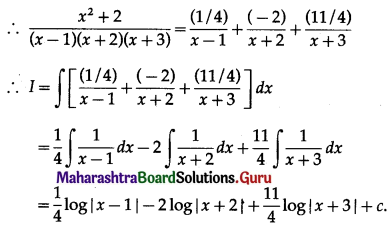
\(\frac{x^{2}+2}{(x-1)(x+2)(x+3)}\)
Solution:
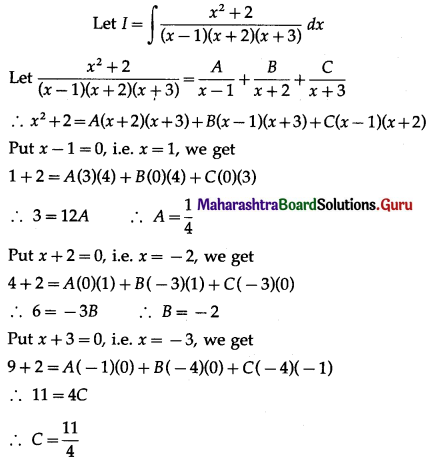
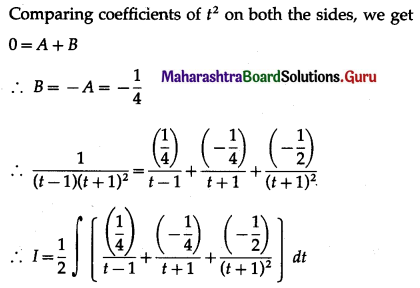
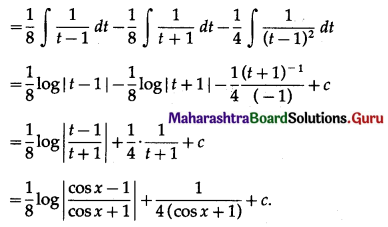
Maharashtra Board 12th Maths Solutions Chapter 3 Indefinite Integration Ex 3.4 Q1
Maharashtra Board 12th Maths Solutions Chapter 3 Indefinite Integration Ex 3.4 Q1.1

Question 2.
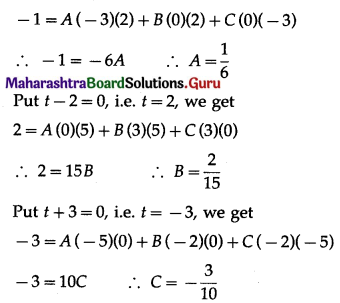
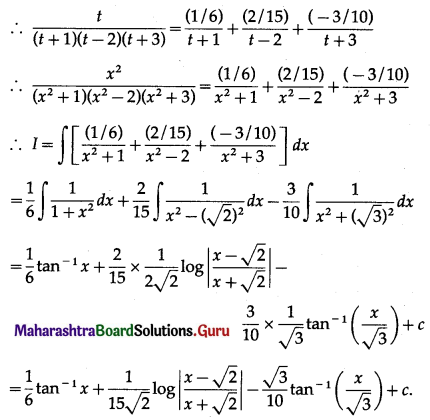
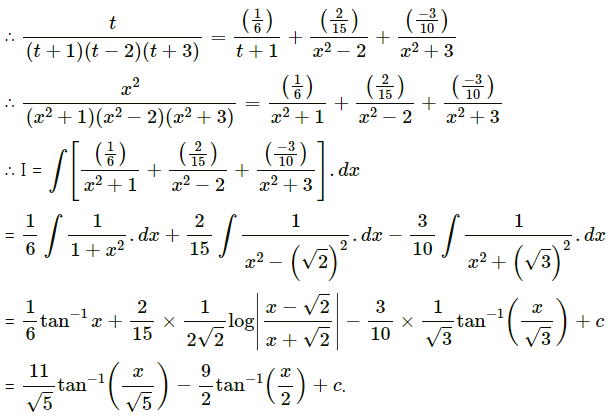
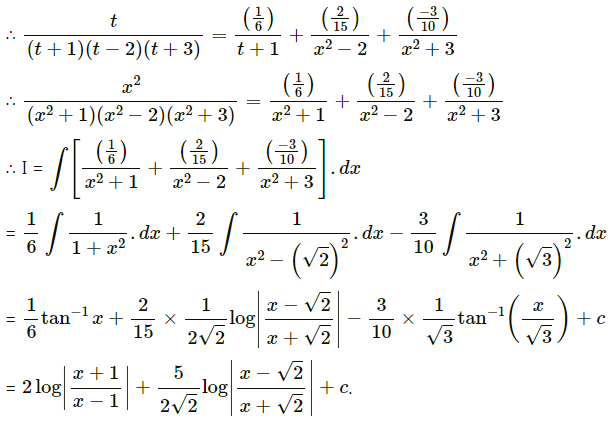
\(\frac{x^{2}}{\left(x^{2}+1\right)\left(x^{2}-2\right)\left(x^{2}+3\right)}\)
Solution:
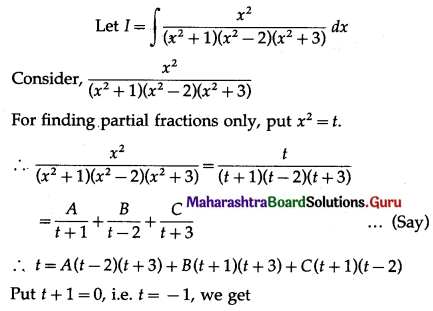
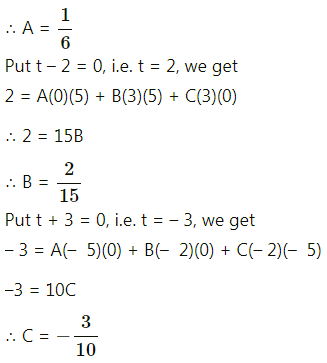
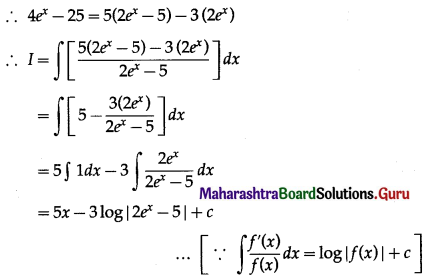
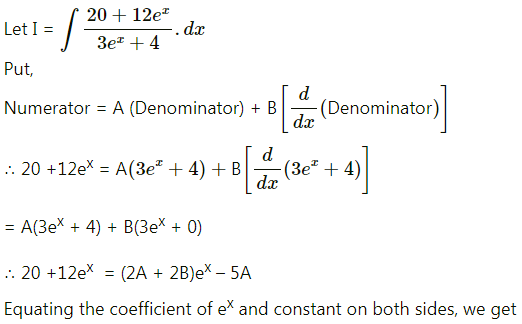
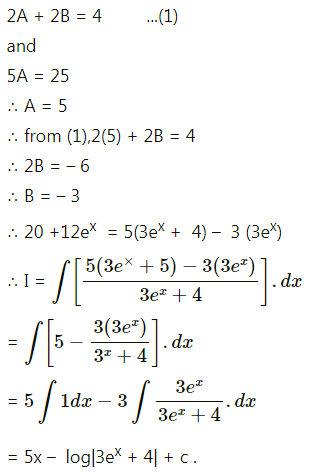
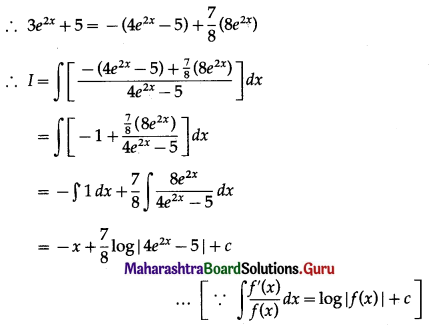
Maharashtra Board 12th Maths Solutions Chapter 3 Indefinite Integration Ex 3.4 Q2
Maharashtra Board 12th Maths Solutions Chapter 3 Indefinite Integration Ex 3.4 Q2.1
Maharashtra Board 12th Maths Solutions Chapter 3 Indefinite Integration Ex 3.4 Q2.2

Maharashtra Board 12th Maths Solutions Chapter 3 Indefinite Integration Ex 3.4

Question 3.
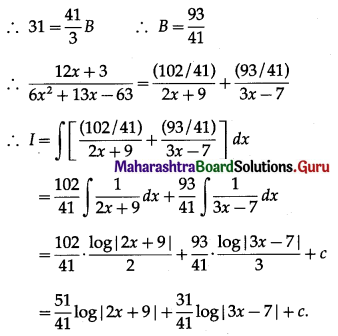
\(\frac{12 x+3}{6 x^{2}+13 x-63}\)
Solution:
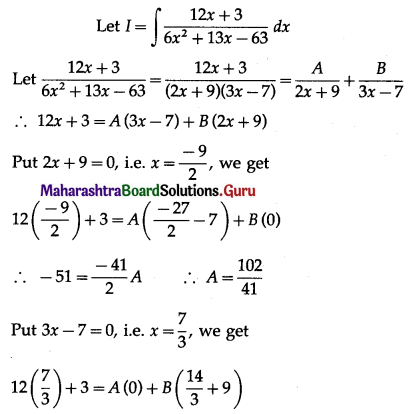
Maharashtra Board 12th Maths Solutions Chapter 3 Indefinite Integration Ex 3.4 Q3
Maharashtra Board 12th Maths Solutions Chapter 3 Indefinite Integration Ex 3.4 Q3.1

Question 4.
\(\frac{2 x}{4-3 x-x^{2}}\)
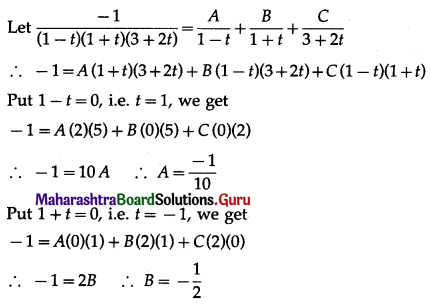
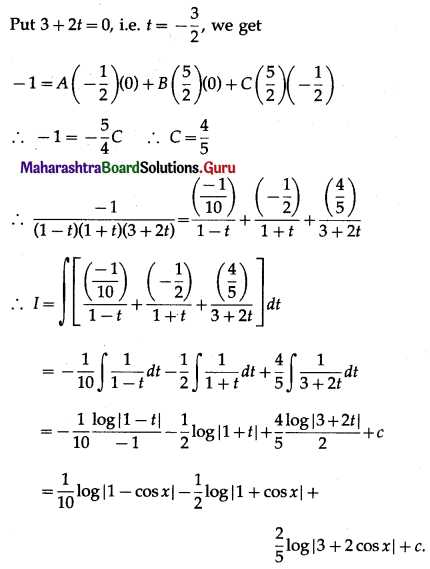
Solution:
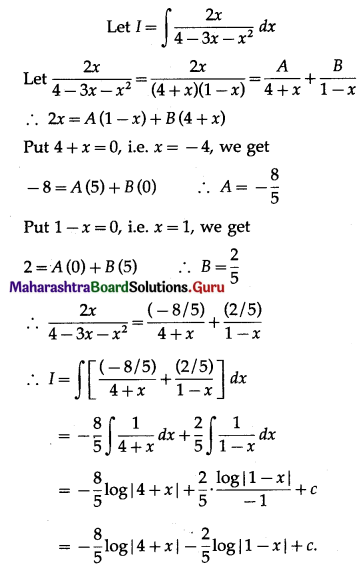
Maharashtra Board 12th Maths Solutions Chapter 3 Indefinite Integration Ex 3.4 Q4

Question 5.
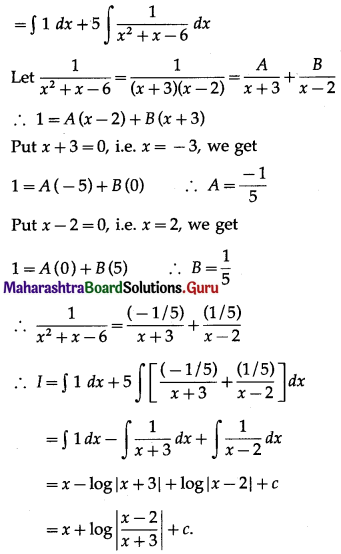
\(\frac{x^{2}+x-1}{x^{2}+x-6}\)
Solution:
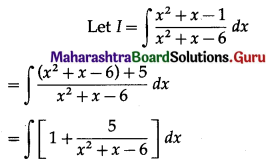
Maharashtra Board 12th Maths Solutions Chapter 3 Indefinite Integration Ex 3.4 Q5
Maharashtra Board 12th Maths Solutions Chapter 3 Indefinite Integration Ex 3.4 Q5.1

Question 6.
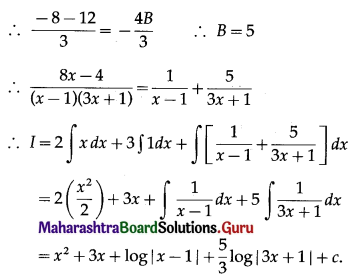
\(\frac{6 x^{3}+5 x^{2}-7}{3 x^{2}-2 x-1}\)
Solution:
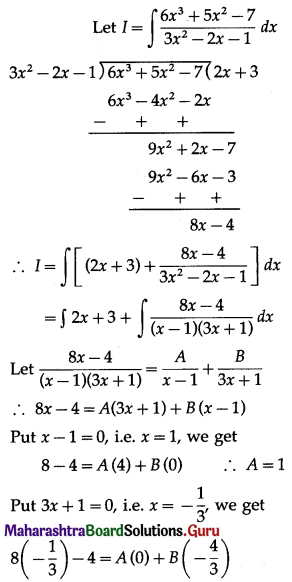
Maharashtra Board 12th Maths Solutions Chapter 3 Indefinite Integration Ex 3.4 Q6
Maharashtra Board 12th Maths Solutions Chapter 3 Indefinite Integration Ex 3.4 Q6.1

Question 7.
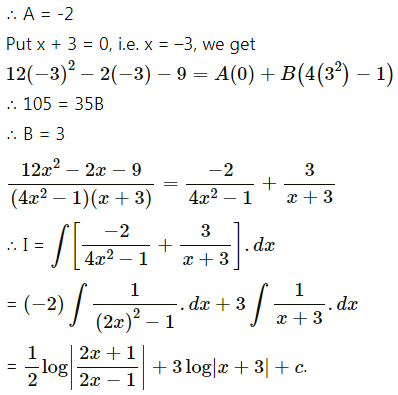
\(\frac{12 x^{2}-2 x-9}{\left(4 x^{2}-1\right)(x+3)}\)
Solution:
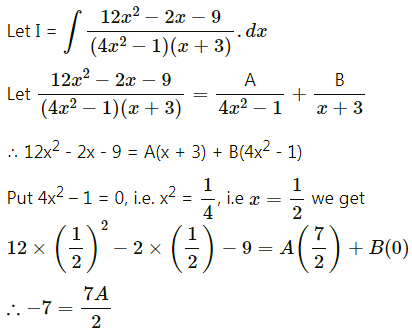
Maharashtra Board 12th Maths Solutions Chapter 3 Indefinite Integration Ex 3.4 Q7
Maharashtra Board 12th Maths Solutions Chapter 3 Indefinite Integration Ex 3.4 Q7.1

Question 8.
\(\frac{1}{x\left(x^{5}+1\right)}\)
Solution:
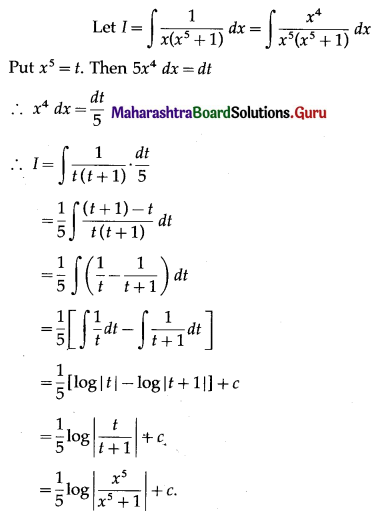
Maharashtra Board 12th Maths Solutions Chapter 3 Indefinite Integration Ex 3.4 Q8

Maharashtra Board 12th Maths Solutions Chapter 3 Indefinite Integration Ex 3.4

Question 9.
\(\frac{2 x^{2}-1}{x^{4}+9 x^{2}+20}\)
Solution:
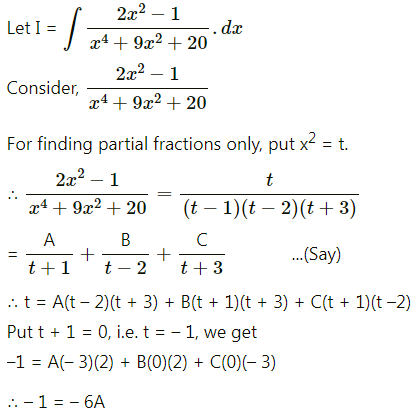
Maharashtra Board 12th Maths Solutions Chapter 3 Indefinite Integration Ex 3.4 Q9
Maharashtra Board 12th Maths Solutions Chapter 3 Indefinite Integration Ex 3.4 Q9.1
Maharashtra Board 12th Maths Solutions Chapter 3 Indefinite Integration Ex 3.4 Q9.2

Question 10.
\(\frac{x^{2}+3}{\left(x^{2}-1\right)\left(x^{2}-2\right)}\)
Solution:
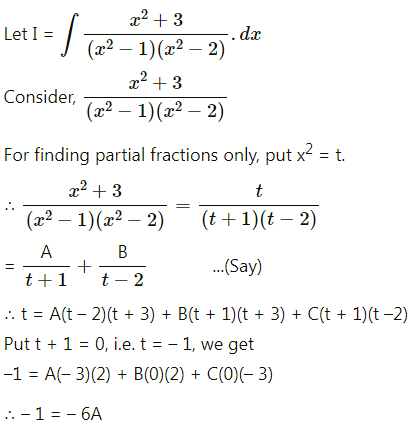
Maharashtra Board 12th Maths Solutions Chapter 3 Indefinite Integration Ex 3.4 Q10
Maharashtra Board 12th Maths Solutions Chapter 3 Indefinite Integration Ex 3.4 Q10.1
Maharashtra Board 12th Maths Solutions Chapter 3 Indefinite Integration Ex 3.4 Q10.2

Question 11.
\(\frac{2 x}{\left(2+x^{2}\right)\left(3+x^{2}\right)}\)
Solution:
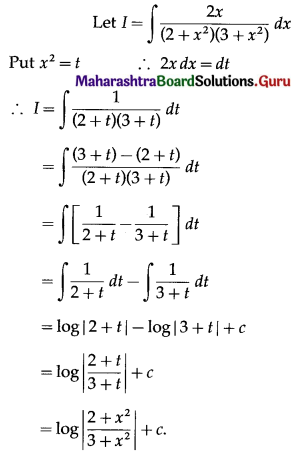
Maharashtra Board 12th Maths Solutions Chapter 3 Indefinite Integration Ex 3.4 Q11

Question 12.
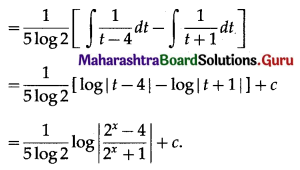
\(\frac{2^{x}}{4^{x}-3 \cdot 2^{x}-4}\)
Solution:
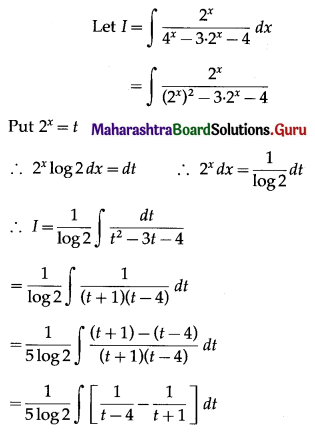
Maharashtra Board 12th Maths Solutions Chapter 3 Indefinite Integration Ex 3.4 Q12
Maharashtra Board 12th Maths Solutions Chapter 3 Indefinite Integration Ex 3.4 Q12.1

Question 13.
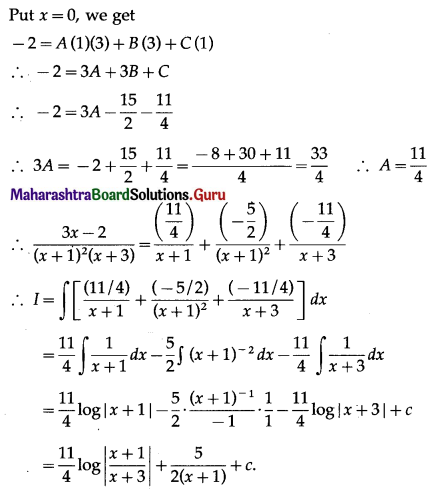
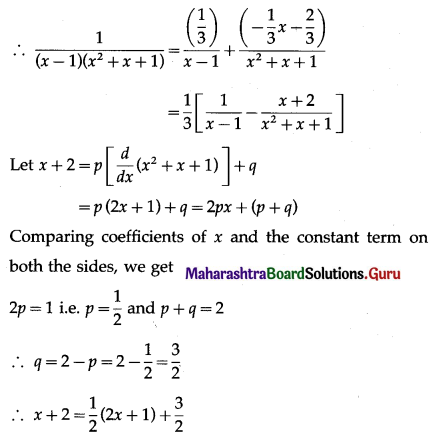
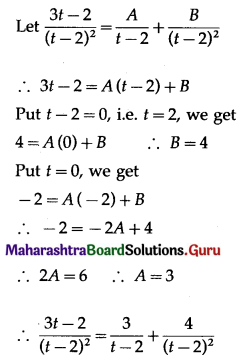
\(\frac{3 x-2}{(x+1)^{2}(x+3)}\)
Solution:
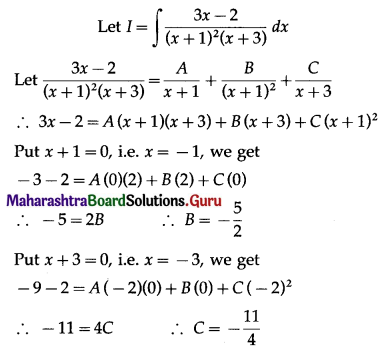
Maharashtra Board 12th Maths Solutions Chapter 3 Indefinite Integration Ex 3.4 Q13
Maharashtra Board 12th Maths Solutions Chapter 3 Indefinite Integration Ex 3.4 Q13.1

Question 14.
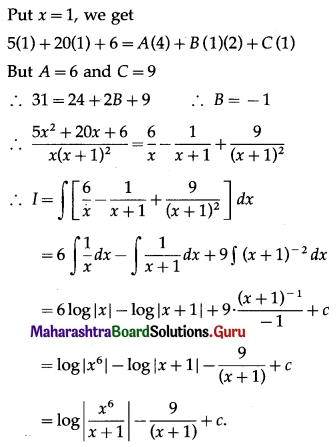
\(\frac{5 x^{2}+20 x+6}{x^{3}+2 x^{2}+x}\)
Solution:
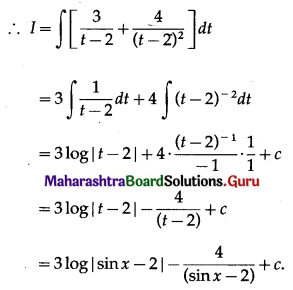
Let I = ∫\(\frac{5 x^{2}+20 x+6}{x^{3}+2 x^{2}+x}\) dx
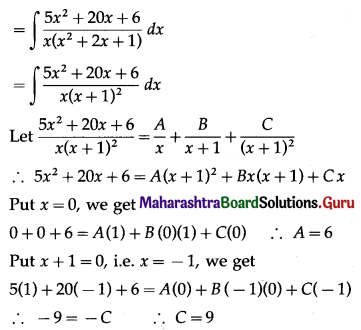
Maharashtra Board 12th Maths Solutions Chapter 3 Indefinite Integration Ex 3.4 Q14
Maharashtra Board 12th Maths Solutions Chapter 3 Indefinite Integration Ex 3.4 Q14.1

Maharashtra Board 12th Maths Solutions Chapter 3 Indefinite Integration Ex 3.4

Question 15.
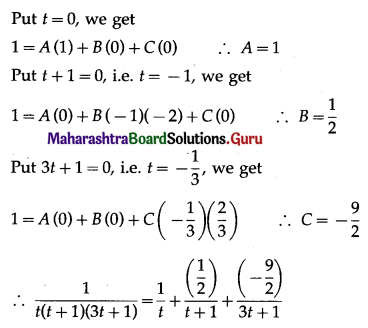
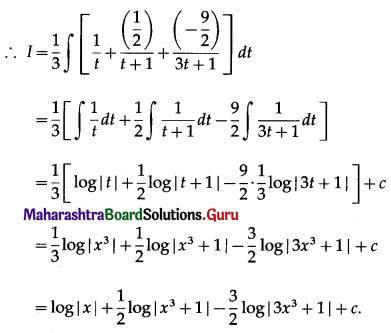
\(\frac{1}{x\left(1+4 x^{3}+3 x^{6}\right)}\)
Solution:
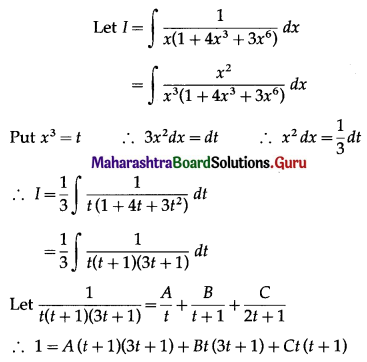
Maharashtra Board 12th Maths Solutions Chapter 3 Indefinite Integration Ex 3.4 Q15
Maharashtra Board 12th Maths Solutions Chapter 3 Indefinite Integration Ex 3.4 Q15.1
Maharashtra Board 12th Maths Solutions Chapter 3 Indefinite Integration Ex 3.4 Q15.2

Question 16.
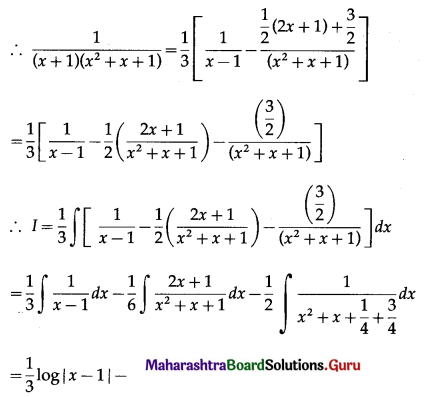
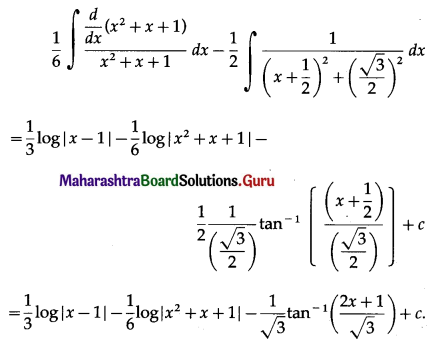
\(\frac{1}{x^{3}-1}\)
Solution:
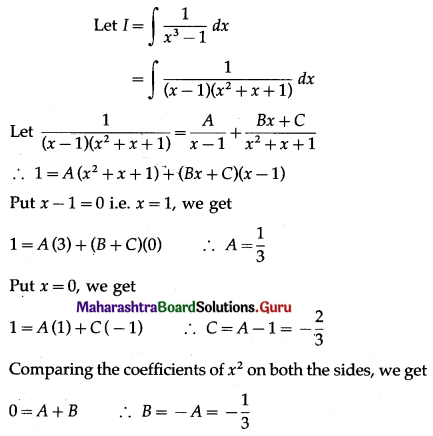
Maharashtra Board 12th Maths Solutions Chapter 3 Indefinite Integration Ex 3.4 Q16
Maharashtra Board 12th Maths Solutions Chapter 3 Indefinite Integration Ex 3.4 Q16.1
Maharashtra Board 12th Maths Solutions Chapter 3 Indefinite Integration Ex 3.4 Q16.2
Maharashtra Board 12th Maths Solutions Chapter 3 Indefinite Integration Ex 3.4 Q16.3

Question 17.
\(\frac{(3 \sin x-2) \cdot \cos x}{5-4 \sin x-\cos ^{2} x}\)
Solution:
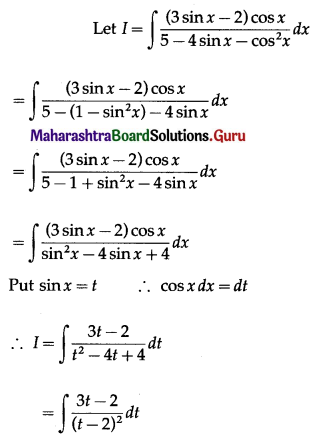
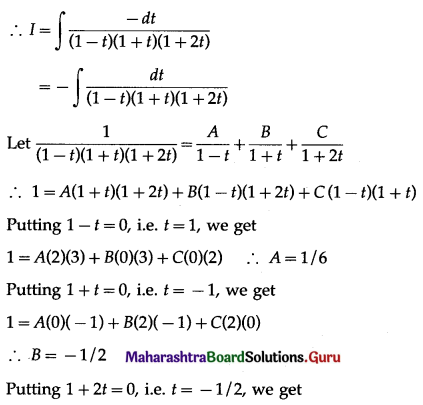
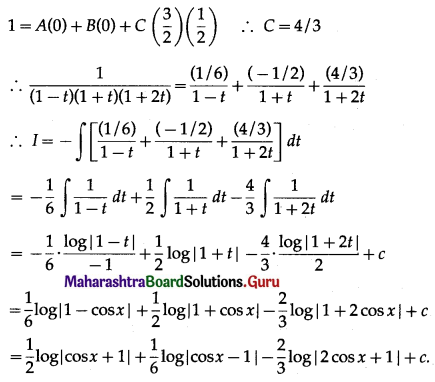
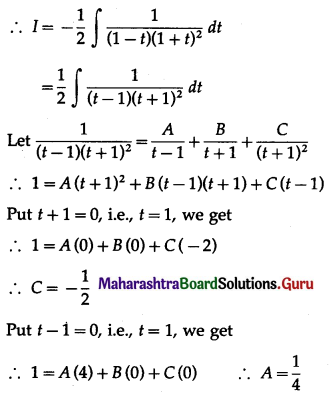
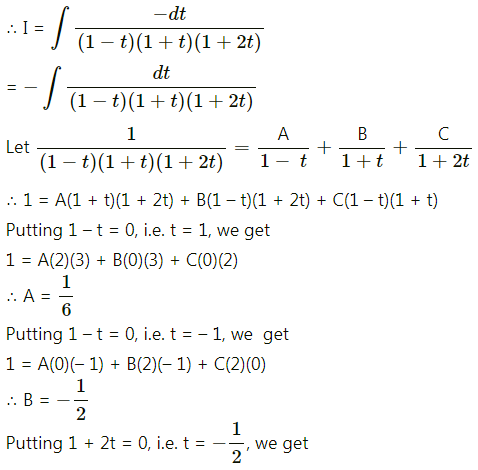
Maharashtra Board 12th Maths Solutions Chapter 3 Indefinite Integration Ex 3.4 Q17
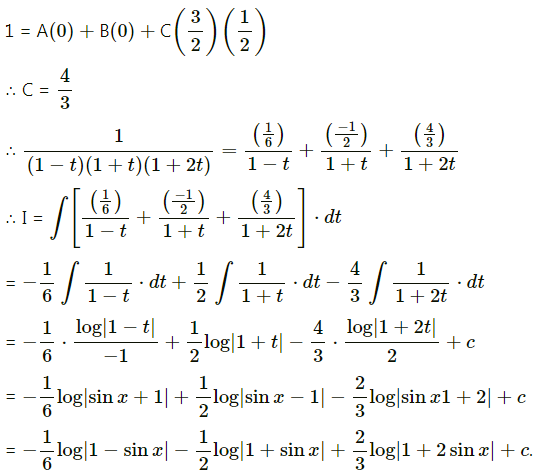
Maharashtra Board 12th Maths Solutions Chapter 3 Indefinite Integration Ex 3.4 Q17.1
Maharashtra Board 12th Maths Solutions Chapter 3 Indefinite Integration Ex 3.4 Q17.2

Question 18.
\(\frac{1}{\sin x+\sin 2 x}\)
Solution:
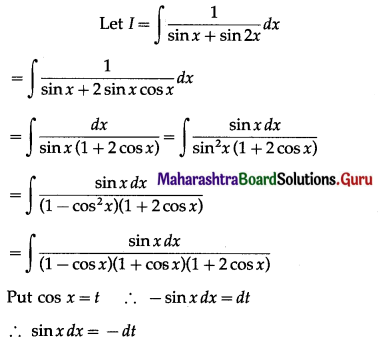
Maharashtra Board 12th Maths Solutions Chapter 3 Indefinite Integration Ex 3.4 Q18
Maharashtra Board 12th Maths Solutions Chapter 3 Indefinite Integration Ex 3.4 Q18.1
Maharashtra Board 12th Maths Solutions Chapter 3 Indefinite Integration Ex 3.4 Q18.2

Maharashtra Board 12th Maths Solutions Chapter 3 Indefinite Integration Ex 3.4

Question 19.
\(\frac{1}{2 \sin x+\sin 2 x}\)
Solution:
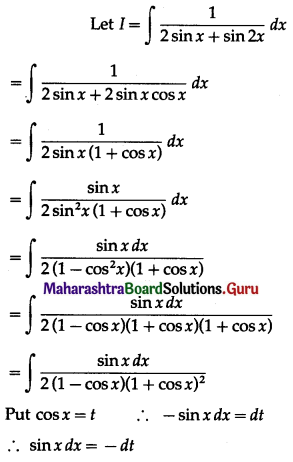
Maharashtra Board 12th Maths Solutions Chapter 3 Indefinite Integration Ex 3.4 Q19
Maharashtra Board 12th Maths Solutions Chapter 3 Indefinite Integration Ex 3.4 Q19.1
Maharashtra Board 12th Maths Solutions Chapter 3 Indefinite Integration Ex 3.4 Q19.2
Maharashtra Board 12th Maths Solutions Chapter 3 Indefinite Integration Ex 3.4 Q19.3

Question 20.
\(\frac{1}{\sin 2 x+\cos x}\)
Solution:
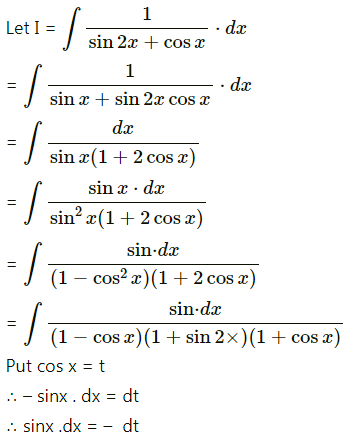
Maharashtra Board 12th Maths Solutions Chapter 3 Indefinite Integration Ex 3.4 Q20
Maharashtra Board 12th Maths Solutions Chapter 3 Indefinite Integration Ex 3.4 Q20.1
Maharashtra Board 12th Maths Solutions Chapter 3 Indefinite Integration Ex 3.4 Q20.2

Question 21.
\(\frac{1}{\sin x \cdot(3+2 \cos x)}\)
Solution:
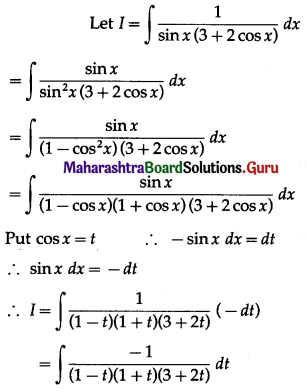
Maharashtra Board 12th Maths Solutions Chapter 3 Indefinite Integration Ex 3.4 Q21
Maharashtra Board 12th Maths Solutions Chapter 3 Indefinite Integration Ex 3.4 Q21.1
Maharashtra Board 12th Maths Solutions Chapter 3 Indefinite Integration Ex 3.4 Q21.2

Question 22.
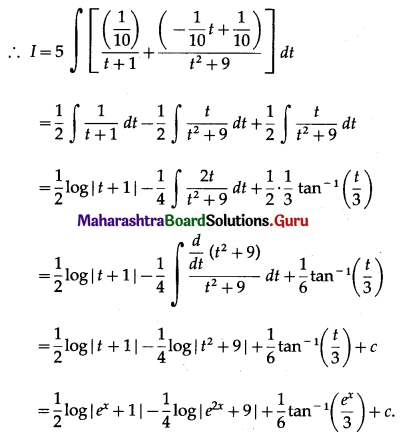
\(\frac{5 \cdot e^{x}}{\left(e^{x}+1\right)\left(e^{2 x}+9\right)}\)
Solution:
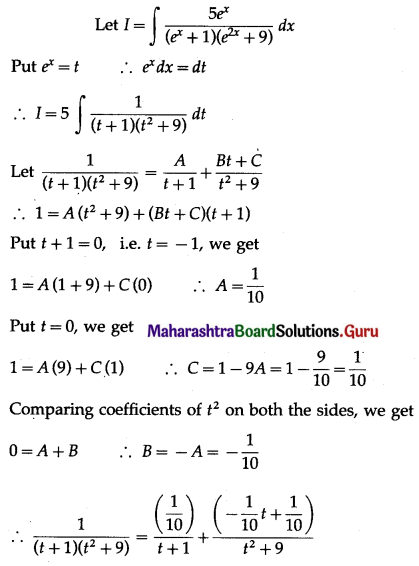
Maharashtra Board 12th Maths Solutions Chapter 3 Indefinite Integration Ex 3.4 Q22
Maharashtra Board 12th Maths Solutions Chapter 3 Indefinite Integration Ex 3.4 Q22.1

Maharashtra Board 12th Maths Solutions Chapter 3 Indefinite Integration Ex 3.4

Question 23.
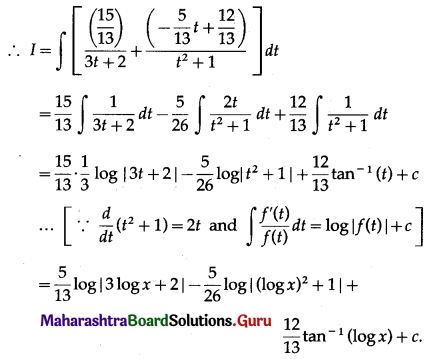
\(\frac{2 \log x+3}{x(3 \log x+2)\left[(\log x)^{2}+1\right]}\)
Solution:
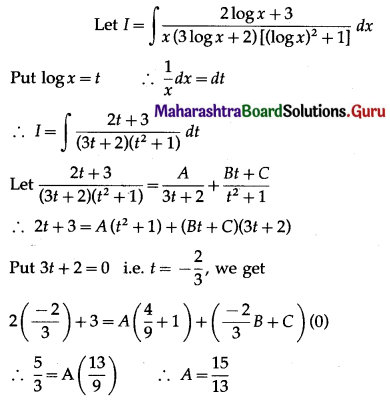
Maharashtra Board 12th Maths Solutions Chapter 3 Indefinite Integration Ex 3.4 Q23
Maharashtra Board 12th Maths Solutions Chapter 3 Indefinite Integration Ex 3.4 Q23.1
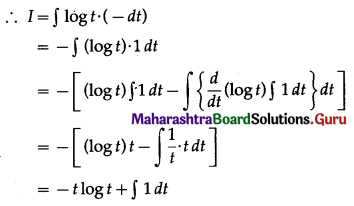
Maharashtra Board 12th Maths Solutions Chapter 3 Indefinite Integration Ex 3.4 Q23.2
12th Maharashtra State Board Maths Solutions Pdf Part 2
Permutations and Combination Class 11 Maths 2 Exercise 3.3 Solutions Maharashtra Board

Balbharti Maharashtra State Board 11th Maths Book Solutions Pdf Chapter 3 Permutations and Combination Ex 3.3 Questions and Answers.

11th Maths Part 2 Permutations and Combination Exercise 3.3 Questions And Answers Maharashtra Board

Question 1.
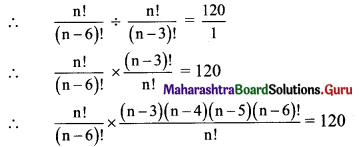
Find n, if nP6 : nP3 = 120 : 1.
Solution:
nP6 : nP3 = 120 : 1
Maharashtra Board 11th Maths Solutions Chapter 3 Permutations and Combination Ex 3.3 Q1
∴ (n – 3) (n – 4) (n – 5) = 120
∴ (n – 3) (n – 4) (n – 5) = 6 × 5 × 4
Comparing on both sides, we get
n – 3 = 6
∴ n = 9

Maharashtra Board 11th Maths Solutions Chapter 3 Permutations and Combination Ex 3.3
Question 2.
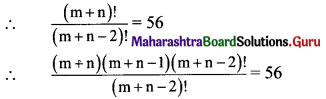
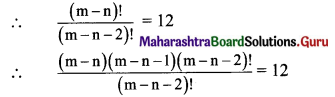
Find m and n, if (m+n)P2 = 56 and (m-n)P2 = 12.
Solution:
(m+n)P2 = 56
Maharashtra Board 11th Maths Solutions Chapter 3 Permutations and Combination Ex 3.3 Q2
(m + n) (m + n – 1) = 56
Let m + n = t
t(t – 1) = 56
t2 – t – 56 = 0
(t – 8) (t + 7) = 0
t = 8 or t = -7
m + n = 8 or m + n = -7
But m + n ≠ -7
∴ m + n = 8 ……(i)
Also, (m-n)P2 = 12
Maharashtra Board 11th Maths Solutions Chapter 3 Permutations and Combination Ex 3.3 Q2.1
(m – n) (m – n – 1) = 12
Let m – n = a
a(a – 1) = 12
a2 – a – 12 = 0
(a – 4)(a + 3) = 0
a = 4 or a = -3
m – n = 4 or m – n = -3
But m – n ≠ -3
∴ m – n = 4 ……(ii)
Adding (i) and (ii), we get
2m = 12
∴ m = 6
Substituting m = 6 in (ii), we get
6 – n = 4
∴ n = 2

Question 3.
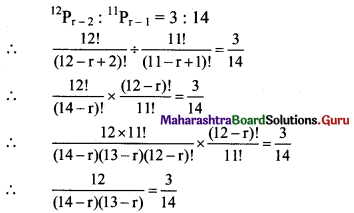
Find r, if 12Pr-2 : 11Pr-1 = 3 : 14.
Solution:
Maharashtra Board 11th Maths Solutions Chapter 3 Permutations and Combination Ex 3.3 Q3
(14 – r)(13 – r) = 8 × 7
Comparing on both sides, we get
14 – r = 8
∴ r = 6

Question 4.
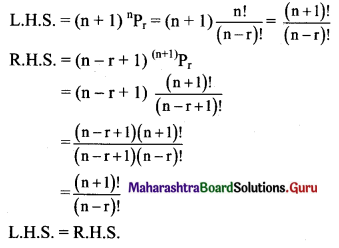
Show that (n + 1) (nPr) = (n – r + 1) [(n+1)Pr]
Solution:
Maharashtra Board 11th Maths Solutions Chapter 3 Permutations and Combination Ex 3.3 Q4
Maharashtra Board 11th Maths Solutions Chapter 3 Permutations and Combination Ex 3.3
Question 5.
How many 4 letter words can be formed using letters in the word MADHURI, if (a) letters can be repeated (b) letters cannot be repeated.
Solution:
There are 7 letters in the word MADHURI.
(a) A 4 letter word is to be formed from the letters of the word MADHURI and repetition of letters is allowed.
∴ 1st letter can be filled in 7 ways.
2nd letter can be filled in 7 ways.
3rd letter can be filled in 7 ways.
4th letter can be filled in 7 ways.
∴ Total no. of ways a 4-letter word can be formed = 7 × 7 × 7 × 7 = 2401

(b) When repetition of letters is not allowed, the number of 4-letter words formed from the letters of the word MADHURI is 7P4 = \(\frac{7 !}{(7-4) !}=\frac{7 \times 6 \times 5 \times 4 \times 3 !}{3 !}\) = 840

Question 6.
Determine the number of arrangements of letters of the word ALGORITHM if
(a) vowels are always together.
(b) no two vowels are together.
(c) consonants are at even positions.
(d) O is the first and T is the last letter.
Solution:
There are 9 letters in the word ALGORITHM.
(a) When vowels are always together.
There are 3 vowels in the word ALGORITHM (i.e., A, I, O).
Let us consider these 3 vowels as one unit.
This unit with 6 other letters is to be arranged.
∴ The number of arrangement = 7P7 = 7! = 5040
3 vowels can be arranged among themselves in 3P3 = 3! = 6 ways.
∴ Required number of arrangements = 7! × 3!
= 5040 × 6
= 30240

(b) When no two vowels are together.
There are 6 consonants in the word ALGORITHM,
they can be arranged among themselves in 6P6 = 6! = 720 ways.
Let consonants be denoted by C.
_C _C_ C _C_C_C
There are 7 places marked by ‘_’ in which 3 vowels can be arranged.
∴ Vowels can be arranged in 7P3 = \(\frac{7 !}{(7-3) !}=\frac{7 \times 6 \times 5 \times 4 !}{4 !}\) = 210 ways.
∴ Required number of arrangements = 720 × 210 = 151200

Maharashtra Board 11th Maths Solutions Chapter 3 Permutations and Combination Ex 3.3
(c) When consonants are at even positions.
There are 4 even places and 6 consonants in the word ALGORITHM.
∴ 6 consonants can be arranged at 4 even positions in 6P4 = \(\frac{6 !}{(6-4) !}=\frac{6 \times 5 \times 4 \times 3 \times 2 !}{2 !}\) = 360 ways.
Remaining 5 letters (3 vowels and 2 consonants) can be arranged in odd position in 5P5 = 5! = 120 ways.
∴ Required number of arrangements = 360 × 120 = 43200

(d) When O is the first and T is the last letter.
All the letters of the word ALGORITHM are to be arranged among themselves such that arrangement begins with O and ends with T.
∴ Position of O and T are fixed.
∴ Other 7 letters can be arranged between O and T among themselves in 7P7 = 7! = 5040 ways.
∴ Required number of arrangements = 5040

Question 7.
In a group photograph, 6 teachers and principal are in the first row and 18 students are in the second row. There are 12 boys and 6 girls among the students. If the middle position is reserved for the principal and if no two girls are together, find the number of arrangements.
Solution:
In 1st row, 6 teachers can be arranged among themselves in 6P6 = 6! ways.
In the 2nd row, 12 boys can be arranged among themselves in 12P12 = 12! ways.
No two girls are together.
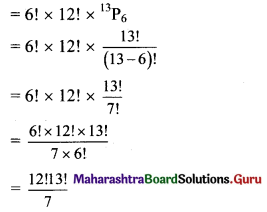
So, there are 13 places formed by 12 boys in which 6 girls occupy any 6 places in 13P6 ways.
∴ Required number of arrangements
Maharashtra Board 11th Maths Solutions Chapter 3 Permutations and Combination Ex 3.3 Q7
Question 8.
Find the number of ways so that letters of the word HISTORY can be arranged as
(a) Y and T are together
(b) Y is next to T
(c) there is no restriction
(d) begin and end with a vowel
(e) end in ST
(f) begin with S and end with T
Solution:
There are 7 letters in the word HISTORY
(a) When ‘Y’ and ‘T’ are together.
Let us consider ‘Y’ and ‘T’ as one unit.
This unit with other 5 letters are to be arranged.
∴ The number of arrangement of one unit and 5 letters = 6P6 = 6! = 720
Also, ‘Y’ and ‘T’ can be arranged among themselves in 2P2 = 2! = 2 ways.
∴ A total number of arrangements when Y and T are always together = 6! × 2!
= 120 × 2
= 1440

Maharashtra Board 11th Maths Solutions Chapter 3 Permutations and Combination Ex 3.3
(b) When ‘Y’ is next to ‘T’.
Let us take this (‘Y’ next to ‘T’) as one unit.
This unit with 5 other letters is to be arranged.
∴ The number of arrangements of 5 letters and one unit = 6P6 = 6! = 720
Also, ‘Y’ has to be always next to ‘T’.
∴ They can be arranged among themselves in 1 way only.
∴ Total number of arrangements possible when Y is next to T = 720 × 1 = 720

(c) When there is no restriction.
7 letters can be arranged among themselves in 7P7 = 7! ways.
∴ The total number of arrangements possible if there is no restriction = 7!

(d) When begin and end with a vowel.
There are 2 vowels in the word HISTORY.
All other letters of the word HISTORY are to be arranged between 2 vowels such that the arrangement begins and ends with a vowel.
The other 5 letters can be filled between the two vowels in 5P5 = 5! = 120 ways.
Also, 2 vowels can be arranged among themselves at first and last places in 2P2 = 2! = 2 ways.
∴ Total number of arrangements when the word begins and ends with vowel = 120 × 2 = 240

(e) When a word ends in ST.
As the arrangement ends with ST,
the remaining 5 letters can be arranged among themselves in 5P5 = 5! = 120 ways.
∴ Total number of arrangements when the word ends with ST = 120

(f) When a word begins with S and ends with T.
As arrangement begins with S and ends with T,
the remaining 5 letters can be arranged between S and T among themselves in 5P5 = 5! = 120 ways.
Total number of arrangements when the word begins with S and ends with T = 120

Maharashtra Board 11th Maths Solutions Chapter 3 Permutations and Combination Ex 3.3
Question 9.
Find the number of arrangements of the letters in the word SOLAPUR so that consonants and vowels are placed alternately.
Solution:
There are 4 consonants S, L, P, R, and 3 vowels A, O, U in the word SOLAPUR.
Consonants and vowels are to be alternated.
∴ Vowels must occur in even places and consonants in odd places.
∴ 3 vowels can be arranged at 3 even places in 3P3 = 3! = 6 ways.
Also, 4 consonants can be arranged at 4 odd places in 4P4 = 4! = 24 ways.
Required number of arrangements = 6 × 24 = 144

Question 10.
Find the number of 4-digit numbers that can be formed using the digits 1, 2, 4, 5, 6, 8 if
(a) digits can be repeated.
(b) digits cannot be repeated.
Solution:
(a) A 4 digit number is to be made from the digits 1, 2, 4, 5, 6, 8 such that digits can be repeated.
∴ Unit’s place digit can be filled in 6 ways.
10’s place digit can be filled in 6 ways.
100’s place digit can be filled in 6 ways.
1000’s place digit can be filled in 6 ways.
∴ Total number of numbers that can be formed = 6 × 6 × 6 × 6 = 1296

(b) A 4 different digit number is to be made from the digits 1, 2, 4, 5, 6, 8 without repetition of digits.
∴ 4 different digits are to be arranged from 6 given digits which can be done in 6P4 ways.
∴ Total number of numbers that can be formed
= \(\frac{6 !}{(6-4) !}\)
= \(\frac{6 \times 5 \times 4 \times 3 \times 2 !}{2 !}\)
= 360

Question 11.
How many numbers can be formed using the digits 0, 1, 2, 3, 4, 5 without repetition so that resulting numbers are between 100 and 1000?
Solution:
A number between 100 and 1000 that can be formed from the digits 0, 1, 2, 3, 4, 5 is of 3 digits, and repetition of digits is not allowed.
∴ 100’s place can be filled in 5 ways as it is a non-zero number.
10’s place digits can be filled in 5 ways.
Unit’s place digit can be filled in 4 ways.
∴ Total number of ways the number can be formed = 5 × 5 × 4 = 100

Question 12.
Find the number of 6-digit numbers using the digits 3, 4, 5, 6, 7, 8 without repetition. How many of these numbers are (a) divisible by 5 (b) not divisible by 5
Solution:
A number of 6 different digits is to be formed from the digits 3, 4, 5, 6, 7, 8 which can be done in 6P6 = 6! = 720 ways.
(a) If the number is to be divisible by 5,
the unit’s place digit can be 5 only.
∴ it can be arranged in 1 way only.
The other 5 digits can be arranged among themselves in 5P5 = 5! = 120 ways.
∴ Required number of numbers divisible by 5 = 1 × 120 = 120

Maharashtra Board 11th Maths Solutions Chapter 3 Permutations and Combination Ex 3.3
(b) If the number is not divisible by 5,
unit’s place can be any digit from 3, 4, 6, 7, 8.
∴ it can be arranged in 5 ways.
Other 5 digits can be arranged in 5P5 = 5! = 120 ways.
∴ Required number of numbers not divisible by 5 = 5 × 120 = 600

Question 13.
A code word is formed by two different English letters followed by two non-zero distinct digits. Find the number of such code words. Also, find the number of such code words that end with an even digit.
Solution:
There is a total of 26 alphabets.
A code word contains 2 English alphabets.
∴ 2 alphabets can be filled in 26P2
= \(\frac{26 !}{(26-2) !}\)
= \(\frac{26 \times 25 \times 24 !}{24 !}\)
= 650 ways.
Also, alphabets to be followed by two distinct non-zero digits from 1 to 9 which can be filled in
9P2 = \(\frac{9 !}{(9-2) !}=\frac{9 \times 8 \times 7 !}{7 !}\) = 72 ways.
∴ Total number of a code words = 650 × 72 = 46800.
To find the number of codewords end with an even integer.
2 alphabets can be filled in 650 ways.
The digit in the unit’s place should be an even number between 1 to 9, which can be filled in 4 ways.
Also, 10’s place can be filled in 8 ways.
∴ Total number of codewords = 650 × 4 × 8 = 20800

Question 14.
Find the number of ways in which 5 letters can be posted in 3 post boxes if any number of letters can be posted in a post box.
Solution:
There are 5 letters and 3 post boxes and any number of letters can be posted in all three post boxes.
∴ Each letter can be posted in 3 ways.
∴ Total number of ways 5 letters can be posted = 3 × 3 × 3 × 3 × 3 = 243

Maharashtra Board 11th Maths Solutions Chapter 3 Permutations and Combination Ex 3.3
Question 15.
Find the number of arranging 11 distinct objects taken 4 at a time so that a specified object (a) always occurs (b) never occurs
Solution:
There are 11 distinct objects and 4 are to be taken at a time.
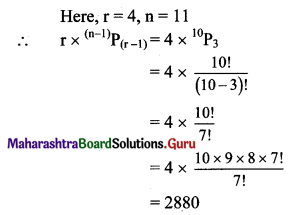
(a) The number of permutations of n distinct objects, taken r at a time, when one particular object will always occur is \(\mathbf{r} \times{ }^{(\mathbf{n}-1)} \mathbf{P}_{(\mathbf{r}-1)}\)
Maharashtra Board 11th Maths Solutions Chapter 3 Permutations and Combination Ex 3.3 Q15
∴ In 2880 permutations of 11 distinct objects, taken 4 at a time, one particular object will always occur.

(b) When one particular object will not occur, then 4 objects are to be arranged from 10 objects which can be done in 10P4 = 10 × 9 × 8 × 7 = 5040 ways.
∴ In 5040 permutations of 11 distinct objects, taken 4 at a time, one particular object will never occur.

Question 16.
In how many ways can 5 different books be arranged on a shelf if
(i) there are no restrictions
(ii) 2 books are always together
(iii) 2 books are never together
Solution:
(i) 5 books arranged in 5P5 = 5! = 120 ways.

(ii) 2 books are together.
Let us consider two books as one unit. This unit with the other 3 books can be arranged in 4P4 = 4! = 24 ways.
Also, two books can be arranged among themselves in 2P2 = 2 ways.
∴ Required number of arrangements = 24 × 2 = 48

(iii) Say books are B1, B2, B3, B4, B5 are to be arranged with B1, B2 never together.
B3, B4, B5 can be arranged among themselves in 3P3 = 3! = 6 ways.
B3, B4, B5 create 4 gaps in which B1, B2 are arranged in 4P2 = 4 × 3 = 12 ways.
∴ Required number of arrangements = 6 × 12 = 72

Maharashtra Board 11th Maths Solutions Chapter 3 Permutations and Combination Ex 3.3
Question 17.
3 boys and 3 girls are to sit in a row. How many ways can this be done if
(i) there are no restrictions.
(ii) there is a girl at each end.
(iii) boys and girls are at alternate places.
(iv) all-boys sit together.
Solution:
3 boys and 3 girls are to be arranged in a row.
(i) When there are no restrictions.
∴ Required number of arrangements = 6! = 720

(ii) When there is a girl at each end.
3 girls can be arranged at two ends in
3P2 = \(\frac{3 !}{1 !}\) = 3 × 2 = 6 ways.
And remaining 1 girl and 3 boys can be arranged between the two girls in 4P4 = 4! = 24 ways.
∴ Required number of arrangements = 6 × 24 = 144

(iii) Boys and girls are at alternate places.
We can first arrange 3 girls among themselves in 3P3 = 3! = 6 ways.
Let girls be denoted by G.
G – G – G –
There are 3 places marked by ‘-’ where 3 boys can be arranged in 3! = 6 ways.
∴ Total number of such arrangements = 6 × 6 = 36
OR
Similarly, we can first arrange 3 boys in 3! = 6 ways
and then arrange 3 girls alternately in 3! = 6 ways.
∴ Total number of such arrangements = 6 × 6 = 36
∴ Required number of arrangements = 36 + 36 = 72

Maharashtra Board 11th Maths Solutions Chapter 3 Permutations and Combination Ex 3.3
(iv) All boys sit together.
Let us consider all boys as one group.
This one group with the other 3 girls can be arranged 4P4 = 4! = 24 ways.
Also, 3 boys can be arranged among themselves in 3P3 = 3! = 6 ways.
∴ Required number of arrangements = 24 × 6 = 144

Maths Solutions for Class 11 State Board
Indefinite Integration Class 12 Maths 2 Exercise 3.3 Solutions Maharashtra Board
Balbharti 12th Maharashtra State Board Maths Solutions Book Pdf Chapter 3 Indefinite Integration Ex 3.3 Questions and Answers.
12th Maths Part 2 Indefinite Integration Exercise 3.3 Questions And Answers Maharashtra Board
I. Evaluate the following:

Question 1.
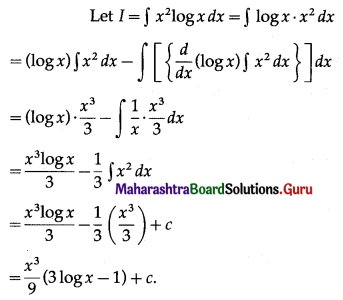
∫x2 log x dx
Solution:
Maharashtra Board 12th Maths Solutions Chapter 3 Indefinite Integration Ex 3.3 I Q1
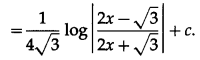
Question 2.
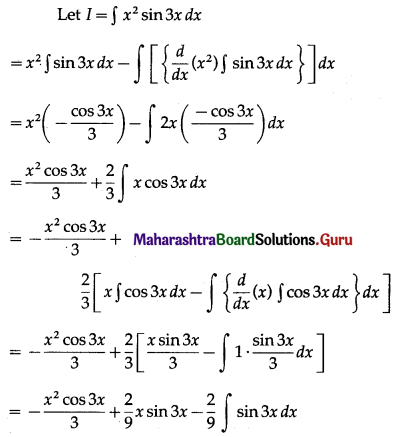
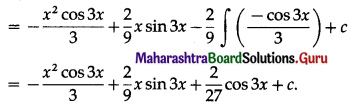
∫x2 sin 3x dx
Solution:
Maharashtra Board 12th Maths Solutions Chapter 3 Indefinite Integration Ex 3.3 I Q2
Maharashtra Board 12th Maths Solutions Chapter 3 Indefinite Integration Ex 3.3 I Q2.1
Maharashtra Board 12th Maths Solutions Chapter 3 Indefinite Integration Ex 3.3

Question 3.
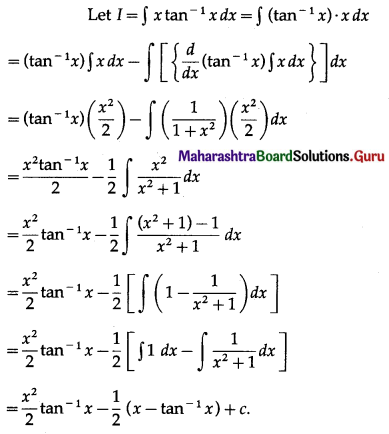
∫x tan-1 x dx
Solution:
Maharashtra Board 12th Maths Solutions Chapter 3 Indefinite Integration Ex 3.3 I Q3

Question 4.
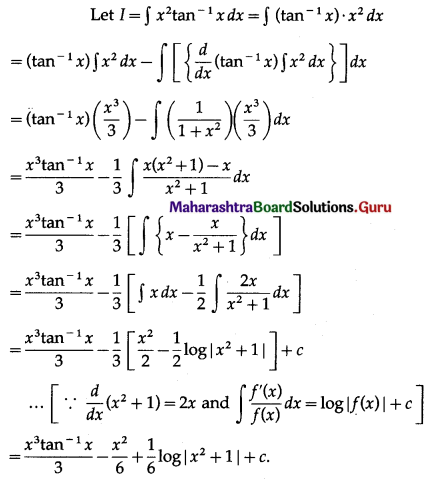
∫x2 tan-1 x dx
Solution:
Maharashtra Board 12th Maths Solutions Chapter 3 Indefinite Integration Ex 3.3 I Q4

Question 5.
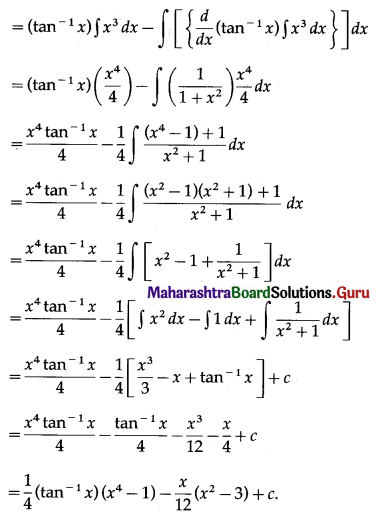
∫x3 tan-1 x dx
Solution:
Let I = ∫x3 tan-1 x dx
= ∫(tan-1 x) . x3 dx
Maharashtra Board 12th Maths Solutions Chapter 3 Indefinite Integration Ex 3.3 I Q5

Question 6.
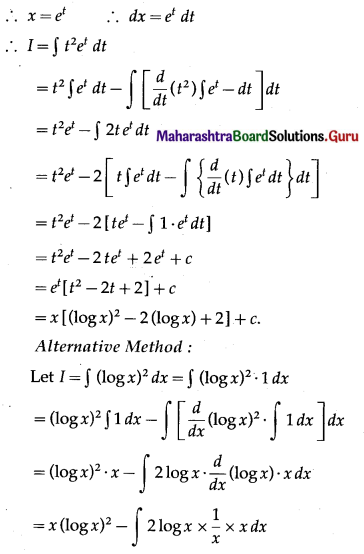
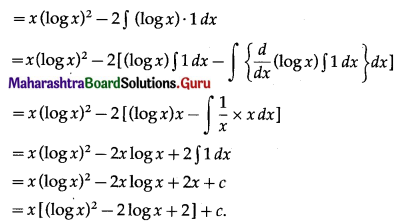
∫(log x)2 dx
Solution:
Let I = ∫(log x)2 dx
Put log x = t
Maharashtra Board 12th Maths Solutions Chapter 3 Indefinite Integration Ex 3.3 I Q6
Maharashtra Board 12th Maths Solutions Chapter 3 Indefinite Integration Ex 3.3 I Q6.1

Question 7.
∫sec3 x dx
Solution:
Let I = ∫sec3 x dx
= ∫sec x sec2 x dx
= sec x ∫sec2 x dx – ∫[\(\frac{d}{d x}\)(sec x) ∫sec2 x dx] dx
= sec x tan x – ∫(sec x tan x)(tan x) dx
= sec x tan x – ∫sec x tan2 x dx
= sec x tan x – ∫sec x (sec2 x – 1) dx
= sec x tan x – ∫sec3 x dx + ∫sec x dx
∴ I = sec x tan x – I + log|sec x + tan x|
∴ 2I = sec x tan x + log|sec x + tan x|
∴ I = \(\frac{1}{2}\) [sec x tan x + log|sec x + tan x|] + c.

Maharashtra Board 12th Maths Solutions Chapter 3 Indefinite Integration Ex 3.3

Question 8.
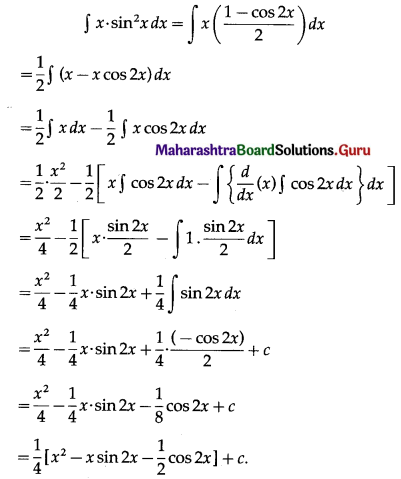
∫x . sin2 x dx
Solution:
Maharashtra Board 12th Maths Solutions Chapter 3 Indefinite Integration Ex 3.3 I Q8

Question 9.
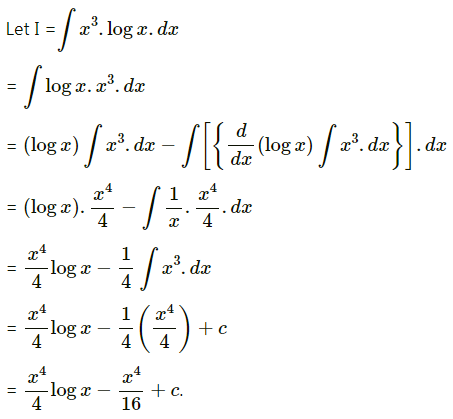
∫x3 log x dx
Solution:
Maharashtra Board 12th Maths Solutions Chapter 3 Indefinite Integration Ex 3.3 I Q9

Question 10.
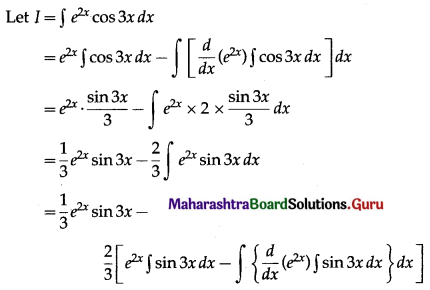
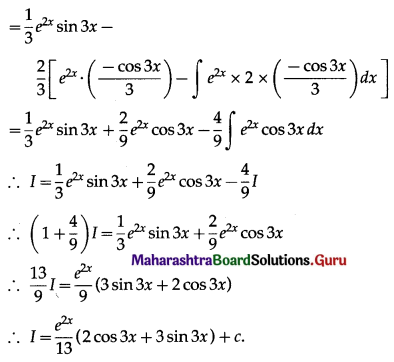
∫e2x cos 3x dx
Solution:
Maharashtra Board 12th Maths Solutions Chapter 3 Indefinite Integration Ex 3.3 I Q10
Maharashtra Board 12th Maths Solutions Chapter 3 Indefinite Integration Ex 3.3 I Q10.1

Question 11.
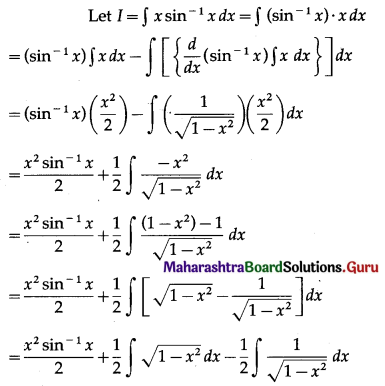
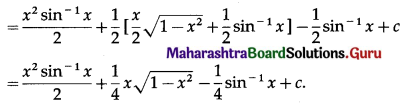
∫x sin-1 x dx
Solution:
Maharashtra Board 12th Maths Solutions Chapter 3 Indefinite Integration Ex 3.3 I Q11
Maharashtra Board 12th Maths Solutions Chapter 3 Indefinite Integration Ex 3.3 I Q11.1

Maharashtra Board 12th Maths Solutions Chapter 3 Indefinite Integration Ex 3.3

Question 12.
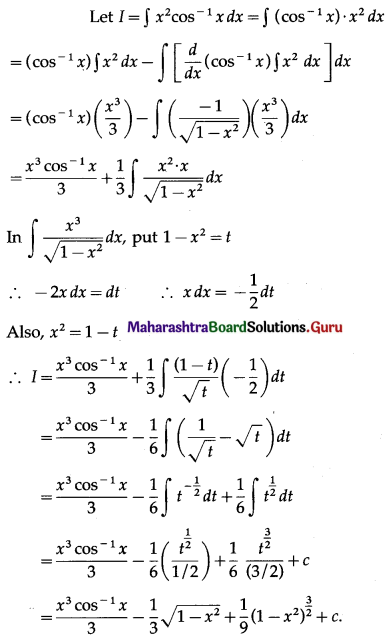
∫x2 cos-1 x dx
Solution:
Maharashtra Board 12th Maths Solutions Chapter 3 Indefinite Integration Ex 3.3 I Q12

Question 13.
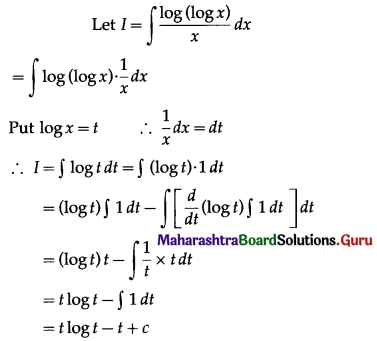
\(\int \frac{\log (\log x)}{x} d x\)
Solution:
Maharashtra Board 12th Maths Solutions Chapter 3 Indefinite Integration Ex 3.3 I Q13
= t(log t – 1) + c
= (log x) . [log(log x) – 1] + c.

Question 14.
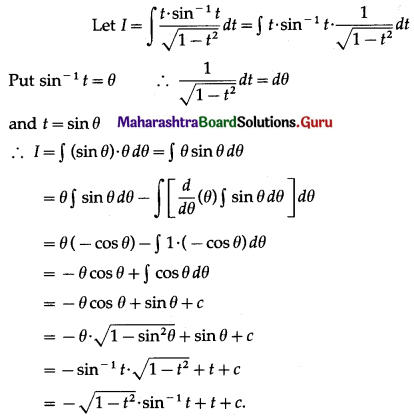
\(\int \frac{t \cdot \sin ^{-1} t}{\sqrt{1-t^{2}}} d t\)
Solution:
Maharashtra Board 12th Maths Solutions Chapter 3 Indefinite Integration Ex 3.3 I Q14

Question 15.
∫cos√x dx
Solution:
Let I = ∫cos√x dx
Put √x = t
∴ x = t2
∴ dx = 2t dt
∴ I = ∫(cos t) 2t dt
= ∫2t cos t dt
= 2t ∫cos t dt – ∫[\(\frac{d}{d t}\)(2t) ∫cos t dt]dt
= 2t sin t – ∫2 sin t dt
= 2t sin t + 2 cos t + c
= 2[√x sin√x + cos√x] + c.

Maharashtra Board 12th Maths Solutions Chapter 3 Indefinite Integration Ex 3.3

Question 16.
∫sin θ . log(cos θ) dθ
Solution:
Let I = ∫sin θ . log (cos θ) dθ
= ∫log(cos θ) . sin θ dθ
Put cos θ = t
∴ -sin θ dθ = dt
∴ sin θ dθ = -dt
Maharashtra Board 12th Maths Solutions Chapter 3 Indefinite Integration Ex 3.3 I Q16
= -t log t + t + c
= -cos θ . log(cos θ) + cos θ + c
= -cos θ [log(cos θ) – 1] + c.

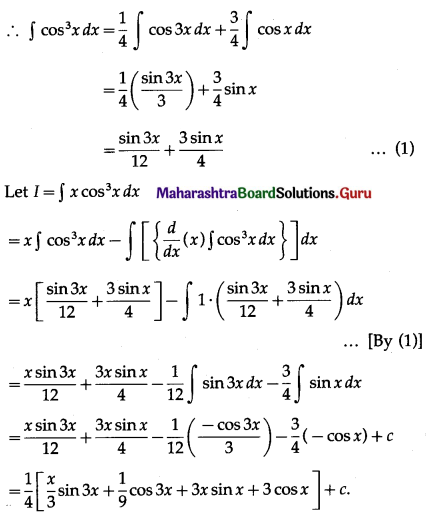
Question 17.
∫x cos3 x dx
Solution:
cos 3x = 4 cos3 x – 3 cos x
∴ cos3 x + 3 cos x = 4cos3x
∴ cos3 x = \(\frac{1}{4}\) cos 3x + \(\frac{3}{4}\) cos x
Maharashtra Board 12th Maths Solutions Chapter 3 Indefinite Integration Ex 3.3 I Q17

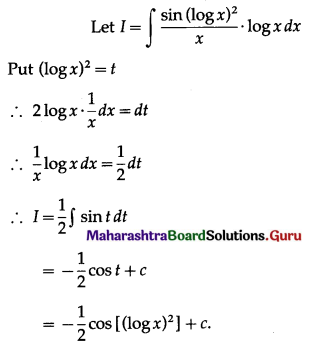
Question 18.
\(\int \frac{\sin (\log x)^{2}}{x} \cdot \log x d x\)
Solution:
Maharashtra Board 12th Maths Solutions Chapter 3 Indefinite Integration Ex 3.3 I Q18

Maharashtra Board 12th Maths Solutions Chapter 3 Indefinite Integration Ex 3.3

Question 19.
\(\int \frac{\log x}{x} d x\)
Solution:
Let I = \(\int \frac{\log x}{x} d x\)
Put log x = t
\(\frac{1}{x}\) dx = dt
∴ I = ∫t dt
= \(\frac{1}{2}\) t2 + c
= \(\frac{1}{2}\) (log x)2 + c

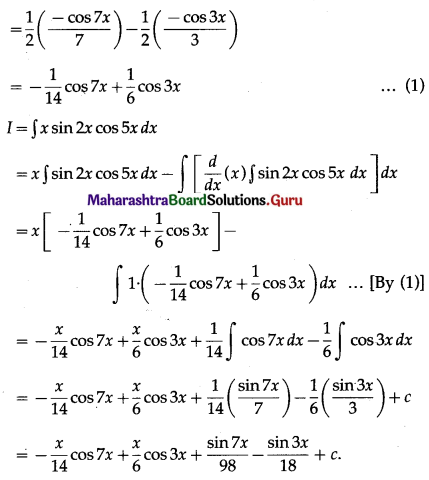
Question 20.
∫x sin 2x cos 5x dx.
Solution:
Let I = ∫x sin 2x cos 5x dx
sin 2x cos 5x = \(\frac{1}{2}\)[2 sin 2x cos 5x]
= \(\frac{1}{2}\) [sin(2x + 5x) + sin(2x – 5x)]
= \(\frac{1}{2}\) [sin 7x – sin 3x]
∴ ∫sin 2x cos 5x dx = \(\frac{1}{2}\) [∫sin 7x dx – ∫sin 3x dx]
Maharashtra Board 12th Maths Solutions Chapter 3 Indefinite Integration Ex 3.3 I Q20

Question 21.
\(\int \cos (\sqrt[3]{x}) d x\)
Solution:
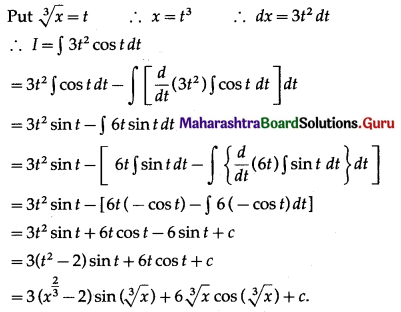
Let I = \(\int \cos (\sqrt[3]{x}) d x\)
Maharashtra Board 12th Maths Solutions Chapter 3 Indefinite Integration Ex 3.3 I Q21

II. Integrate the following functions w.r.t. x:

Question 1.
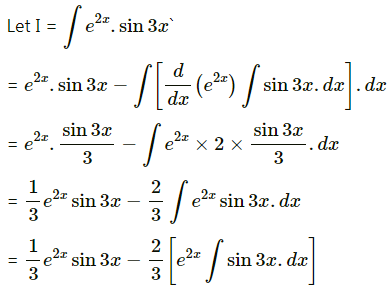
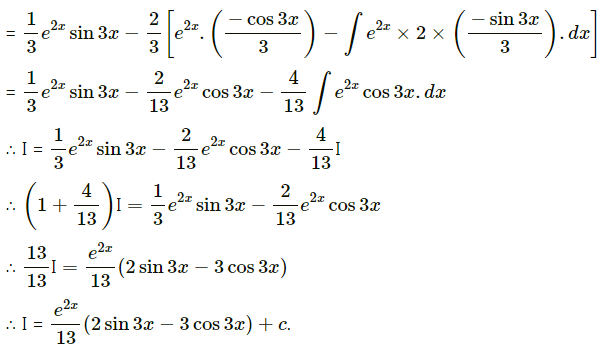
e2x sin 3x
Solution:
Maharashtra Board 12th Maths Solutions Chapter 3 Indefinite Integration Ex 3.3 II Q1
Maharashtra Board 12th Maths Solutions Chapter 3 Indefinite Integration Ex 3.3 II Q1.1

Maharashtra Board 12th Maths Solutions Chapter 3 Indefinite Integration Ex 3.3

Question 2.
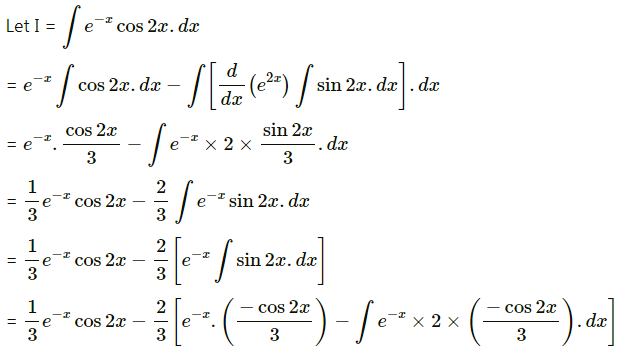
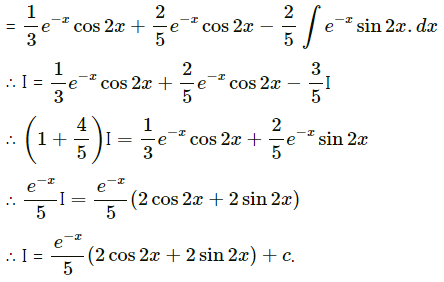
e-x cos 2x
Solution:
Maharashtra Board 12th Maths Solutions Chapter 3 Indefinite Integration Ex 3.3 II Q2
Maharashtra Board 12th Maths Solutions Chapter 3 Indefinite Integration Ex 3.3 II Q2.1

Question 3.
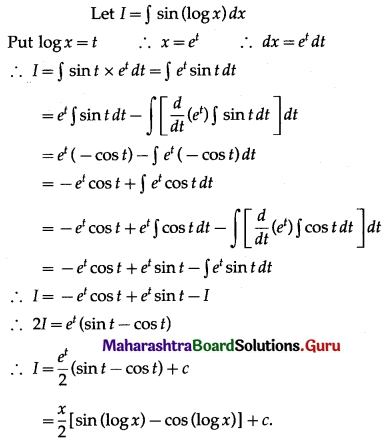
sin(log x)
Solution:
Maharashtra Board 12th Maths Solutions Chapter 3 Indefinite Integration Ex 3.3 II Q3

Question 4.
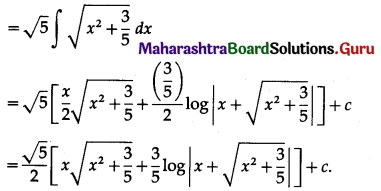
\(\sqrt{5 x^{2}+3}\)
Solution:
Let I = \(\sqrt{5 x^{2}+3}\) dx
Maharashtra Board 12th Maths Solutions Chapter 3 Indefinite Integration Ex 3.3 II Q4

Question 5.
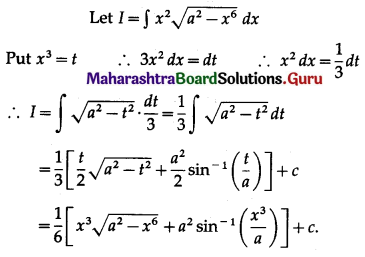
\(x^{2} \sqrt{a^{2}-x^{6}}\)
Solution:
Maharashtra Board 12th Maths Solutions Chapter 3 Indefinite Integration Ex 3.3 II Q5

Question 6.
\(\sqrt{(x-3)(7-x)}\)
Solution:
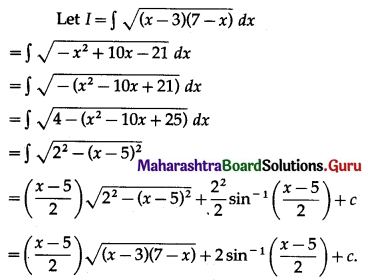
Maharashtra Board 12th Maths Solutions Chapter 3 Indefinite Integration Ex 3.3 II Q6

Maharashtra Board 12th Maths Solutions Chapter 3 Indefinite Integration Ex 3.3

Question 7.
\(\sqrt{4^{x}\left(4^{x}+4\right)}\)
Solution:
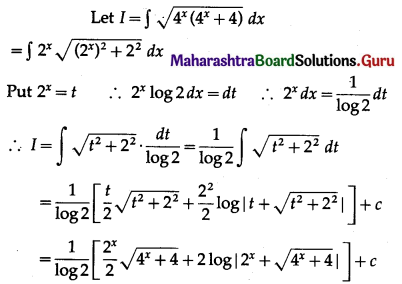
Maharashtra Board 12th Maths Solutions Chapter 3 Indefinite Integration Ex 3.3 II Q7

Question 8.
(x + 1) \(\sqrt{2 x^{2}+3}\)
Solution:
Let I = ∫(x + 1) \(\sqrt{2 x^{2}+3}\) dx
Let x + 1 = A[\(\frac{d}{d x}\)(2x2 + 3)] + B
= A(4x) + B
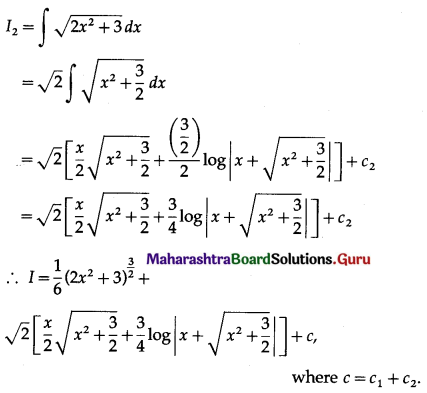
= 4Ax + B
Comparing the coefficients of x and constant term on both the sides, we get
4A = 1, B = 1
∴ A = \(\frac{1}{4}\), B = 1
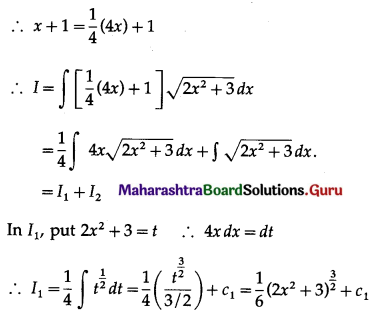
Maharashtra Board 12th Maths Solutions Chapter 3 Indefinite Integration Ex 3.3 II Q8
Maharashtra Board 12th Maths Solutions Chapter 3 Indefinite Integration Ex 3.3 II Q8.1

Question 9.
\(x \sqrt{5-4 x-x^{2}}\)
Solution:
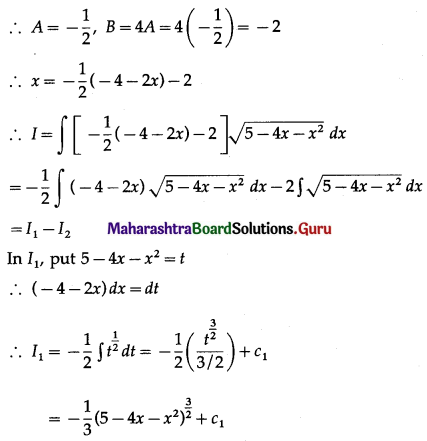
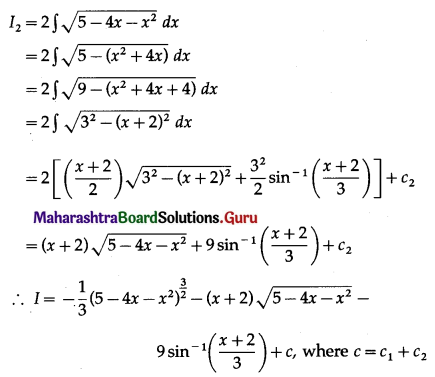
Let I = ∫\(x \sqrt{5-4 x-x^{2}}\) dx
Let x = A[\(\frac{d}{d x}\)(5 – 4x – x2)] + B
= A[-4 – 2x] + B
= -2Ax + (B – 4A)
Comparing the coefficients of x and the constant term on both sides, we get
-2A = 1, B – 4A = 0
Maharashtra Board 12th Maths Solutions Chapter 3 Indefinite Integration Ex 3.3 II Q9
Maharashtra Board 12th Maths Solutions Chapter 3 Indefinite Integration Ex 3.3 II Q9.1

Maharashtra Board 12th Maths Solutions Chapter 3 Indefinite Integration Ex 3.3

Question 10.
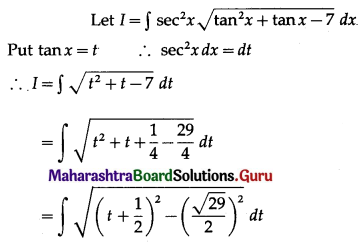
\(\sec ^{2} x \sqrt{\tan ^{2} x+\tan x-7}\)
Solution:
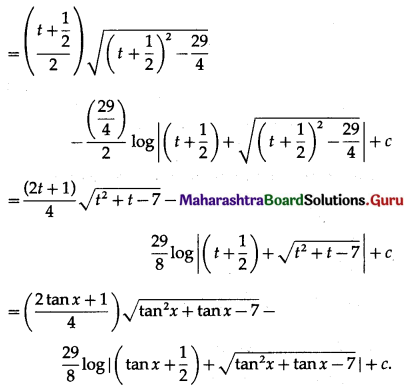
Maharashtra Board 12th Maths Solutions Chapter 3 Indefinite Integration Ex 3.3 II Q10
Maharashtra Board 12th Maths Solutions Chapter 3 Indefinite Integration Ex 3.3 II Q10.1

Question 11.
\(\sqrt{x^{2}+2 x+5}\)
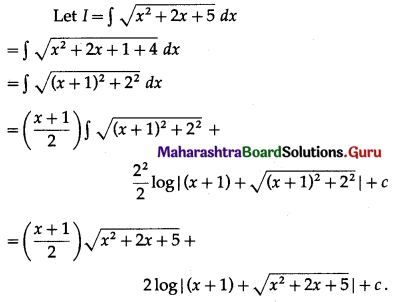
Solution:
Maharashtra Board 12th Maths Solutions Chapter 3 Indefinite Integration Ex 3.3 II Q11

Question 12.
\(\sqrt{2 x^{2}+3 x+4}\)
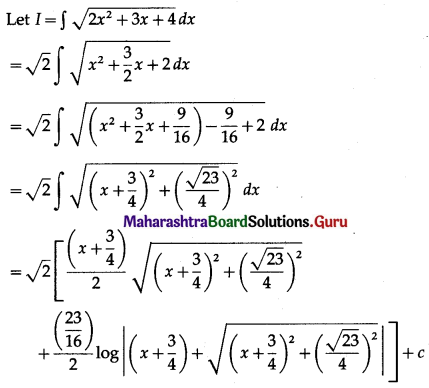
Solution:
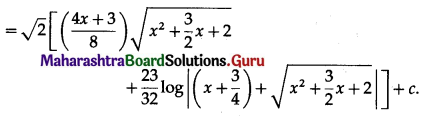
Maharashtra Board 12th Maths Solutions Chapter 3 Indefinite Integration Ex 3.3 II Q12
Maharashtra Board 12th Maths Solutions Chapter 3 Indefinite Integration Ex 3.3 II Q12.1

III. Integrate the following functions w.r.t. x:

Question 1.
[2 + cot x – cosec2 x] ex
Solution:
Let I = ∫ex [2 + cot x – cosec2 x] dx
Put f(x) = 2 + cot x
∴ f'(x) = \(\frac{d}{d x}\)(2 + cot x)
= \(\frac{d}{d x}\)(2) + \(\frac{d}{d x}\)(cot x)
= 0 – cosec2 x
= -cosec2 x
∴ I = ∫ex [f(x) + f'(x)] dx
= ex f(x) + c
= ex (2 + cot x) + c.

Maharashtra Board 12th Maths Solutions Chapter 3 Indefinite Integration Ex 3.3

Question 2.
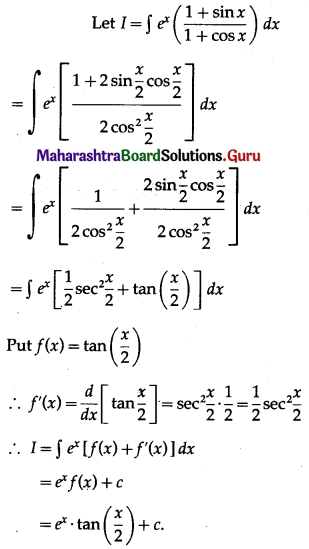
\(\left(\frac{1+\sin x}{1+\cos x}\right) e^{x}\)
Solution:
Maharashtra Board 12th Maths Solutions Chapter 3 Indefinite Integration Ex 3.3 III Q2

Question 3.
\(e^{x}\left(\frac{1}{x}-\frac{1}{x^{2}}\right)\)
Solution:
Let I = ∫\(e^{x}\left(\frac{1}{x}-\frac{1}{x^{2}}\right)\)
Let f(x) = \(\frac{1}{x}\), f'(x) = \(-\frac{1}{x^{2}}\)
∴ I = ∫ex [f(x) + f'(x)] dx
= ex f(x) + c
= ex . \(\frac{1}{x}\) + c

Question 4.
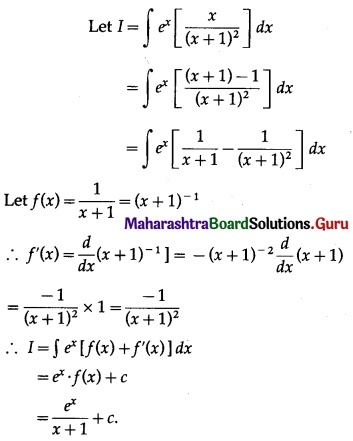
\(\left[\frac{x}{(x+1)^{2}}\right] e^{x}\)
Solution:
Maharashtra Board 12th Maths Solutions Chapter 3 Indefinite Integration Ex 3.3 III Q4

Question 5.
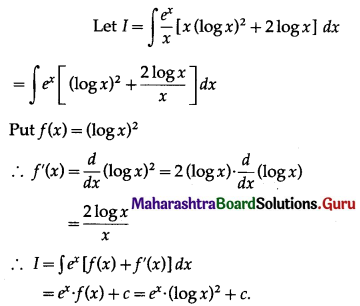
\(\frac{e^{x}}{x}\) . [x(log x)2 + 2 log x]
Solution:
Maharashtra Board 12th Maths Solutions Chapter 3 Indefinite Integration Ex 3.3 III Q5

Maharashtra Board 12th Maths Solutions Chapter 3 Indefinite Integration Ex 3.3

Question 6.
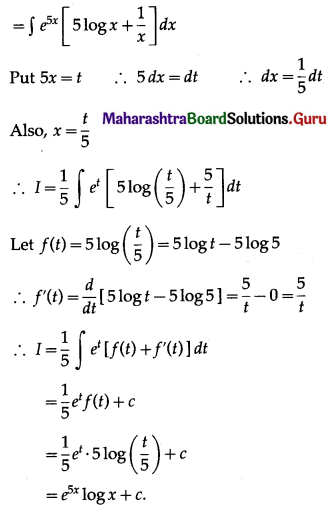
\(e^{5 x}\left[\frac{5 x \log x+1}{x}\right]\)
Solution:
Let I = ∫\(e^{5 x}\left[\frac{5 x \log x+1}{x}\right]\)
Maharashtra Board 12th Maths Solutions Chapter 3 Indefinite Integration Ex 3.3 III Q6

Question 7.
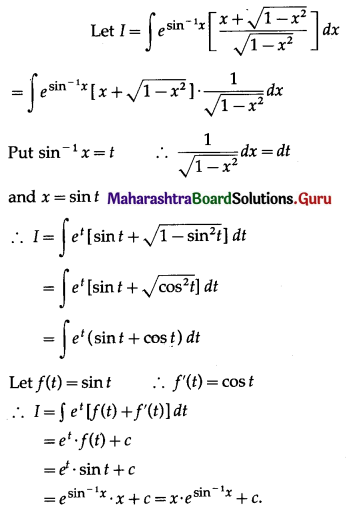
\(e^{\sin ^{-1} x}\left[\frac{x+\sqrt{1-x^{2}}}{\sqrt{1-x^{2}}}\right]\)
Solution:
Maharashtra Board 12th Maths Solutions Chapter 3 Indefinite Integration Ex 3.3 III Q7

Question 8.
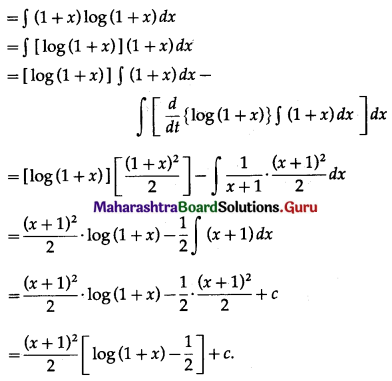
log(1 + x)(1+x)
Solution :
Let I = ∫log(1 + x)(1+x) dx
Maharashtra Board 12th Maths Solutions Chapter 3 Indefinite Integration Ex 3.3 III Q8

Maharashtra Board 12th Maths Solutions Chapter 3 Indefinite Integration Ex 3.3

Question 9.
cosec (log x)[1 – cot(log x)]
Solution:
Let I = ∫cosec (log x)[1 – cot(log x)] dx
Put log x = t
x = et
dx = et dt
I = ∫cosec t (1 – cot t). et dt
= ∫et [cosec t – cosec t cot t] dt
= ∫et [cosec t + \(\frac{d}{d t}\) (cosec t)] dt
= et cosec t + c ….. [∵ et [f(t) +f'(t) ] dt = et f(t) + c ]
= x . cosec(log x) + c.

12th Maharashtra State Board Maths Solutions Pdf Part 2

Indefinite Integration Class 12 Maths 2 Exercise 3.2(C) Solutions Maharashtra Board

Balbharti 12th Maharashtra State Board Maths Solutions Book Pdf Chapter 3 Indefinite Integration Ex 3.2(C) Questions and Answers.

12th Maths Part 2 Indefinite Integration Exercise 3.2(C) Questions And Answers Maharashtra Board

I. Evaluate:

Question 1.
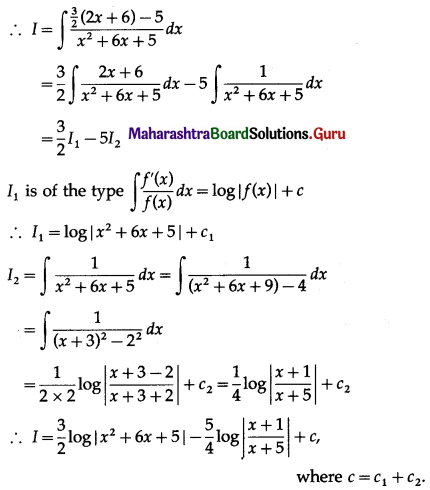
\(\int \frac{3 x+4}{x^{2}+6 x+5} d x\)
Solution:
Let I = \(\int \frac{3 x+4}{x^{2}+6 x+5} d x\)
Let 3x + 4 = A[\(\frac{d}{d x}\)(x2 + 6x + 5)] + B
= A(2x + B) + B
∴ 3x + 4 = 2Ax + (6A + B)
Comparing the coefficient of x and constant on both sides, we get
2A = 3 and 6A + B = 4
∴ A = \(\frac{3}{2}\) and 6(\(\frac{3}{2}\)) + B = 4
∴ B = -5
3x + 4 = \(\frac{3}{2}\) (2x + 6) – 5
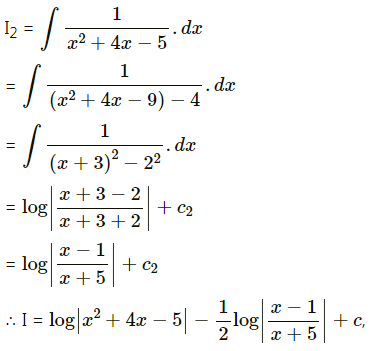
Maharashtra Board 12th Maths Solutions Chapter 3 Indefinite Integration Ex 3.2(C) Q1

Question 2.
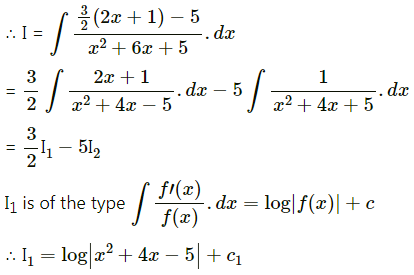
\(\int \frac{2 x+1}{x^{2}+4 x-5} d x\)
Solution:
Let I = \(\int \frac{2 x+1}{x^{2}+4 x-5} d x\)
Let 2x + 1 = A[\(\frac{d}{d x}\)(x2 + 4x – 5)] + B
2x + 1 = A(2x + 1) + B
∴ 2x + 1 = 2Ax + (4A + B)
Comparing the coefficient of x and constant on both sides, we get
4A = 2 and 4A + B = 4
∴ A = \(\frac{3}{2}\) and 6(\(\frac{3}{2}\)) + B = 4
∴ B = -5
∴ 2x + 1 = \(\frac{3}{2}\)(2x + 1) – 5
Maharashtra Board 12th Maths Solutions Chapter 3 Indefinite Integration Ex 3.2(C) Q2
Maharashtra Board 12th Maths Solutions Chapter 3 Indefinite Integration Ex 3.2(C) Q2.1

Maharashtra Board 12th Maths Solutions Chapter 3 Indefinite Integration Ex 3.2(C)

Question 3.
\(\int \frac{2 x+3}{2 x^{2}+3 x-1} d x\)
Solution:
Let I = \(\int \frac{2 x+3}{2 x^{2}+3 x-1} d x\)
Let 2x+ 3 = A[\(\frac{d}{d x}\)(2x2 + 3x – 1)] + B
2x + 1 = A(4x + 3) + B
∴ 2x + 1 = 4Ax + (3A + B)
Comparing the coefficient of x and constant on both sides, we get
4A = 2 and 3A + B = 3
∴ A = \(\frac{1}{2}\) and 3(\(\frac{1}{2}\)) + B = 3
∴ B = \(\frac{3}{2}\)
∴ 2x + 3 = \(\frac{1}{2}\)(4x + 3) + \(\frac{3}{2}\)
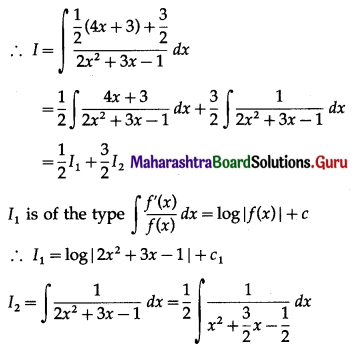
Maharashtra Board 12th Maths Solutions Chapter 3 Indefinite Integration Ex 3.2(C) Q3
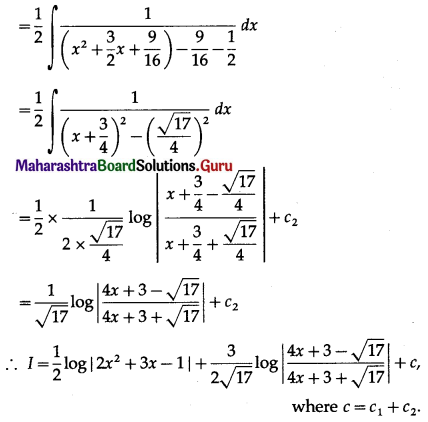
Maharashtra Board 12th Maths Solutions Chapter 3 Indefinite Integration Ex 3.2(C) Q3.1

Question 4.
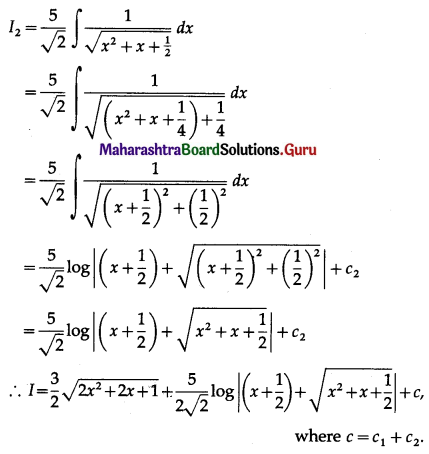
\(\int \frac{3 x+4}{\sqrt{2 x^{2}+2 x+1}} d x\)
Solution:
Let I = \(\int \frac{3 x+4}{\sqrt{2 x^{2}+2 x+1}} d x\)
Let 3x + 4 = A[\(\frac{d}{d x}\)(2x2 + 2x + 1)] + B
∴ 3x + 4 = A (4x + 2) + B
∴ 3x + 4 = 4Ax + (2A + B)
Comparing the coefficient of x and the constant on both the sides, we get
4A = 3 and 2A + B = 4
∴ A = \(\frac{3}{4}\) and 2(\(\frac{3}{4}\)) + B = 4
∴ B = \(\frac{5}{2}\)
∴ 3x + 4 = \(\frac{3}{4}\) (4x + 2) + \(\frac{5}{2}\)
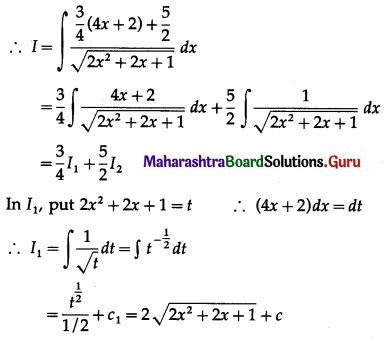
Maharashtra Board 12th Maths Solutions Chapter 3 Indefinite Integration Ex 3.2(C) Q4
Maharashtra Board 12th Maths Solutions Chapter 3 Indefinite Integration Ex 3.2(C) Q4.1

Maharashtra Board 12th Maths Solutions Chapter 3 Indefinite Integration Ex 3.2(C)

Question 5.
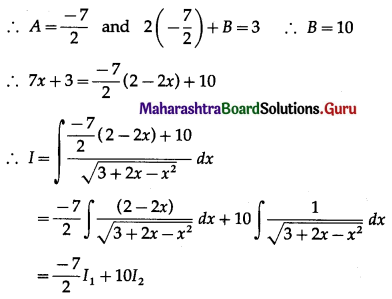
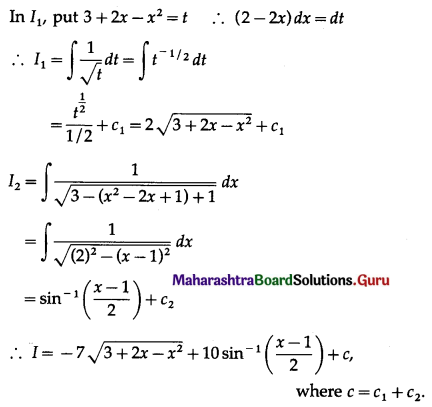
\(\int \frac{7 x+3}{\sqrt{3+2 x-x^{2}}} d x\)
Solution:
Let I = \(\int \frac{7 x+3}{\sqrt{3+2 x-x^{2}}} d x\)
Let 7x + 3 = A[\(\frac{d}{d x}\)(3 + 2x – x2)] + B
7x + 3 = A(2 – 2x) + B
∴ 7x + 3 = -2Ax + (2A + B)
Comparing the coefficient of x and constant on both the sides, we get
-2A = 7 and 2A + B = 3
Maharashtra Board 12th Maths Solutions Chapter 3 Indefinite Integration Ex 3.2(C) Q5
Maharashtra Board 12th Maths Solutions Chapter 3 Indefinite Integration Ex 3.2(C) Q5.1

Question 6.
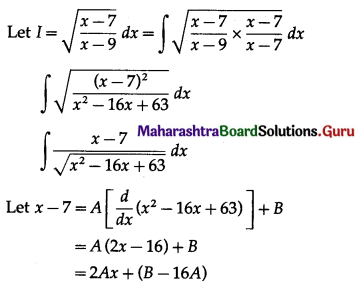
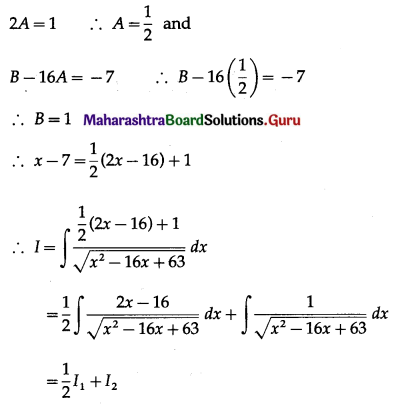
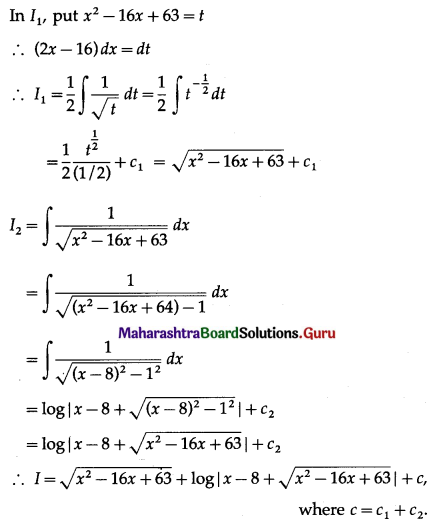
\(\int \sqrt{\frac{x-7}{x-9}} d x\)
Solution:
Maharashtra Board 12th Maths Solutions Chapter 3 Indefinite Integration Ex 3.2(C) Q6
Comparing the coefficients of x and constant term on both sides, we get
Maharashtra Board 12th Maths Solutions Chapter 3 Indefinite Integration Ex 3.2(C) Q6.1
Maharashtra Board 12th Maths Solutions Chapter 3 Indefinite Integration Ex 3.2(C) Q6.2

Maharashtra Board 12th Maths Solutions Chapter 3 Indefinite Integration Ex 3.2(C)

Question 7.
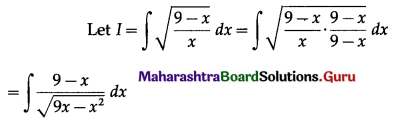
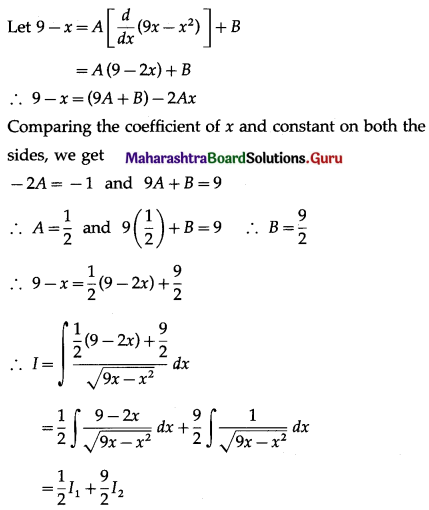
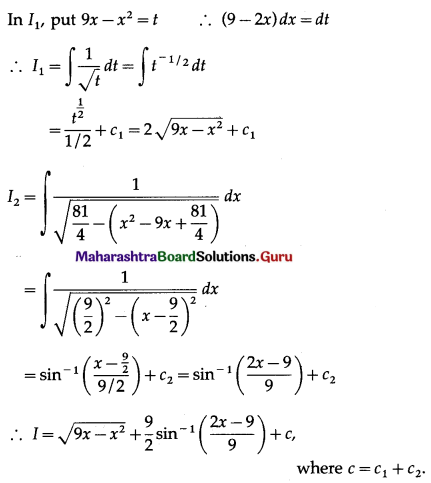
\(\int \sqrt{\frac{9-x}{x}} d x\)
Solution:
Maharashtra Board 12th Maths Solutions Chapter 3 Indefinite Integration Ex 3.2(C) Q7
Maharashtra Board 12th Maths Solutions Chapter 3 Indefinite Integration Ex 3.2(C) Q7.1
Maharashtra Board 12th Maths Solutions Chapter 3 Indefinite Integration Ex 3.2(C) Q7.2

Question 8.
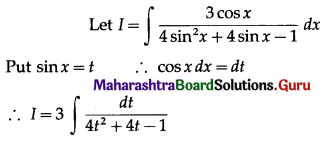
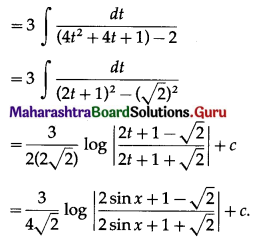
\(\int \frac{3 \cos x}{4 \sin ^{2} x+4 \sin x-1} d x\)
Solution:
Maharashtra Board 12th Maths Solutions Chapter 3 Indefinite Integration Ex 3.2(C) Q8
Maharashtra Board 12th Maths Solutions Chapter 3 Indefinite Integration Ex 3.2(C) Q8.1

Maharashtra Board 12th Maths Solutions Chapter 3 Indefinite Integration Ex 3.2(C)

Question 9.
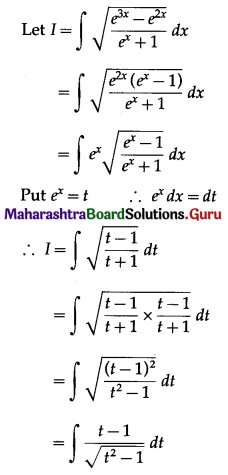
\(\int \sqrt{\frac{e^{3 x}-e^{2 x}}{e^{x}+1}} d x\)
Solution:
Maharashtra Board 12th Maths Solutions Chapter 3 Indefinite Integration Ex 3.2(C) Q9
Maharashtra Board 12th Maths Solutions Chapter 3 Indefinite Integration Ex 3.2(C) Q9.1
Maharashtra Board 12th Maths Solutions Chapter 3 Indefinite Integration Ex 3.2(C) Q9.2

12th Maharashtra State Board Maths Solutions Pdf Part 2

Permutations and Combination Class 11 Maths 2 Exercise 3.2 Solutions Maharashtra Board

Balbharti Maharashtra State Board 11th Maths Book Solutions Pdf Chapter 3 Permutations and Combination Ex 3.2 Questions and Answers.

11th Maths Part 2 Permutations and Combination Exercise 3.2 Questions And Answers Maharashtra Board

Question 1.
Evaluate:
(i) 8!
Solution:
8!
= 8 × 7 × 6 × 5 × 4 × 3 × 2 × 1
= 40320

(ii) 10!
Solution:
10!
= 10 × 9 × 8 × 7 × 6 × 5 × 4 × 3 × 2 × 1
= 3628800

(iii) 10! – 6!
Solution:
10! – 6!
= 10 × 9 × 8 × 7 × 6! – 6!
= 6! (10 × 9 × 8 × 7 – 1)
= 6! (5040 – 1)
= 6 × 5 × 4 × 3 × 2 × 1 × 5039
= 3628080

Maharashtra Board 11th Maths Solutions Chapter 3 Permutations and Combination Ex 3.2

(iv) (10 – 6)!
Solution:
(10 – 6)!
= 4!
= 4 × 3 × 2 × 1
= 24

Question 2.
Compute:
(i) \(\frac{12 !}{6 !}\)
Solution:
\(\frac{12 !}{6 !}=\frac{12 \times 11 \times 10 \times 9 \times 8 \times 7 \times 6 !}{6 !}\)
= 12 × 11 × 10 × 9 × 8 × 7
= 665280

(ii) \(\left(\frac{12}{6}\right) !\)
Solution:
\(\left(\frac{12}{6}\right) !\)
= 2!
= 2 × 1
= 2

(iii) (3 × 2)!
Solution:
(3 × 2)!
= 6!
= 6 × 5 × 4 × 3 × 2 × 1
= 720

(iv) 3! × 2!
Solution:
3! × 2!
= 3 × 2 × 1 × 2 × 1
= 12

(v) \(\frac{9 !}{3 ! 6 !}\)
Solution:
\(\frac{9 !}{3 ! 6 !}=\frac{9 \times 8 \times 7 \times 6 !}{(3 \times 2 \times 1) \times 6 !}=84\)

(vi) \(\frac{6 !-4 !}{4 !}\)
Solution:
\(\frac{6 !-4 !}{4 !}=\frac{6 \times 5 \times 4 !-4 !}{4 !}=\frac{4 !(6 \times 5-1)}{4 !}=29\)

Maharashtra Board 11th Maths Solutions Chapter 3 Permutations and Combination Ex 3.2

(vii) \(\frac{8 !}{6 !-4 !}\)
Solution:
\(\frac{8 !}{6 !-4 !}=\frac{8 \times 7 \times 6 \times 5 \times 4 !}{6 \times 5 \times 4 !-4 !}\)
= \(\frac{8 \times 7 \times 6 \times 5 \times 4 !}{4 !(6 \times 5-1)}\)
= \(\frac{1680}{29}\)
= 57.93

(viii) \(\frac{8 !}{(6-4) !}\)
Solution:
\(\frac{8 !}{(6-4) !}=\frac{8 !}{2 !}\)
= \(\frac{8 \times 7 \times 6 \times 5 \times 4 \times 3 \times 2 !}{2 !}\)
= 20160

Question 3.
Write in terms of factorials
(i) 5 × 6 × 7 × 8 × 9 × 10
Solution:
5 × 6 × 7 × 8 × 9 × 10 = 10 × 9 × 8 × 7 × 6 × 5
Multiplying and dividing by 4!, we get
= \(\frac{10 \times 9 \times 8 \times 7 \times 6 \times 5 \times 4 !}{4 !}\)
= \(\frac{10 \times 9 \times 8 \times 7 \times 6 \times 5 \times 4 \times 3 \times 2 \times 1}{4 !}\)
= \(\frac{10 !}{4 !}\)

(ii) 3 × 6 × 9 × 12 × 15
Solution:
3 × 6 × 9 × 12 × 15
= 3 × (3 × 2) × (3 × 3) × (3 × 4) × (3 × 5)
= (35) (5 × 4 × 3 × 2 × 1)
= 35 (5!)

(iii) 6 × 7 × 8 × 9
Solution:
6 × 7 × 8 × 9 = 9 × 8 × 7 × 6
Multiplying and dividing by 5!, we get
= \(\frac{9 \times 8 \times 7 \times 6 \times 5 !}{5 !}\)
= \(\frac{9 \times 8 \times 7 \times 6 \times 5 \times 4 \times 3 \times 2 \times 1}{5 !}\)
= \(\frac{9 !}{5 !}\)

(iv) 5 × 10 × 15 × 20
Solution:
5 × 10 × 15 × 20
= (5 × 1) × (5 × 2) × (5 × 3) × (5 × 4)
= (54) (4 × 3 × 2 × 1)
= (54) (4!)

Maharashtra Board 11th Maths Solutions Chapter 3 Permutations and Combination Ex 3.2

Question 4.
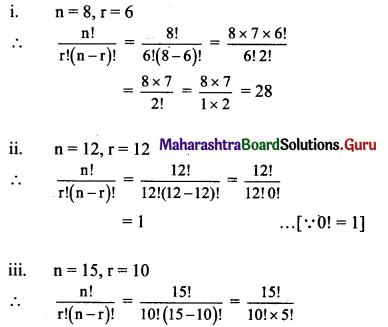
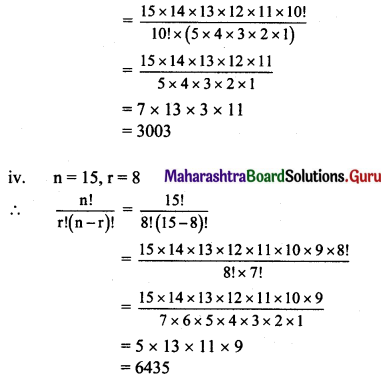
Evaluate: \(\frac{n !}{r !(n-r) !}\) for
(i) n = 8, r = 6
(ii) n = 12, r = 12
(iii) n = 15, r = 10
(iv) n = 15, r = 8
Solution:
Maharashtra Board 11th Maths Solutions Chapter 3 Permutations and Combination Ex 3.2 Q4
Maharashtra Board 11th Maths Solutions Chapter 3 Permutations and Combination Ex 3.2 Q4.1

Question 5.
Find n, if
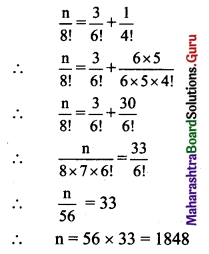
(i) \(\frac{n}{8 !}=\frac{3}{6 !}+\frac{1 !}{4 !}\)
Solution:
Maharashtra Board 11th Maths Solutions Chapter 3 Permutations and Combination Ex 3.2 Q5 (i)

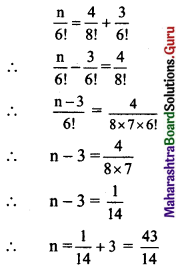
(ii) \(\frac{n}{6 !}=\frac{4}{8 !}+\frac{3}{6 !}\)
Solution:
Maharashtra Board 11th Maths Solutions Chapter 3 Permutations and Combination Ex 3.2 Q5 (ii)

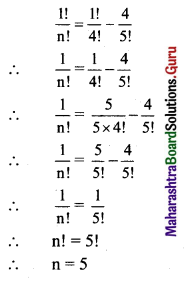
(iii) \(\frac{1 !}{n !}=\frac{1 !}{4 !}-\frac{4}{5 !}\)
Solution:
Maharashtra Board 11th Maths Solutions Chapter 3 Permutations and Combination Ex 3.2 Q5 (iii)

(iv) (n + 1)! = 42 × (n -1)!
Solution:
(n + 1)! = 42(n – 1)!
∴ (n + 1) n (n – 1)! = 42(n – 1)!
∴ n2 + n = 42
∴ n2 + n – 42 = 0
∴ (n + 7)(n – 6) = 0
∴ n = -7 or n = 6
But n ≠ -7 as n ∈ N
∴ n = 6

Maharashtra Board 11th Maths Solutions Chapter 3 Permutations and Combination Ex 3.2

(v) (n + 3)! = 110 × (n + 1)!
Solution:
(n + 3)! = (110) (n + 1)!
∴ (n + 3)(n + 2)(n + 1)! = 110(n + 1)!
∴ (n + 3) (n + 2) = (11) (10)
Comparing on both sides, we get
n + 3 = 11
∴ n = 8

Question 6.
Find n, if:
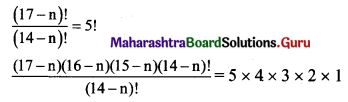
(i) \(\frac{(17-n) !}{(14-n) !}=5 !\)
Solution:
Maharashtra Board 11th Maths Solutions Chapter 3 Permutations and Combination Ex 3.2 Q6 (i)
∴ (17 – n) (16 – n) (15 – n) = 6 × 5 × 4
Comparing on both sides, we get
17 – n = 6
∴ n = 11

(ii) \(\frac{(15-n) !}{(13-n) !}=12\)
Solution:
\(\frac{(15-n) !}{(13-n) !}=12\)
∴ \(\frac{(15-n)(14-n)(13-n) !}{(13-n) !}=12\)
∴ (15 – n) (14 – n) = 4 × 3
Comparing on both sides, we get
∴ 15 – n = 4
∴ n = 11

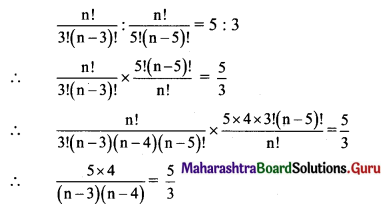
(iii) \(\frac{n !}{3 !(n-3) !}: \frac{n !}{5 !(n-5) !}=5: 3\)
Solution:
Maharashtra Board 11th Maths Solutions Chapter 3 Permutations and Combination Ex 3.2 Q6 (iii)
∴ 12 = (n – 3)(n – 4)
(n – 3)(n – 4) = 4 × 3
Comparing on both sides, we get
n – 3 = 4
∴ n = 7

Maharashtra Board 11th Maths Solutions Chapter 3 Permutations and Combination Ex 3.2

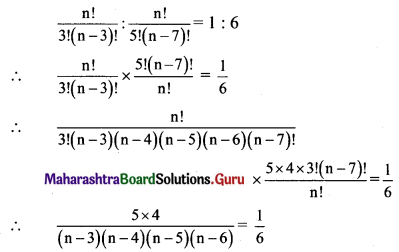
(iv) \(\frac{n !}{3 !(n-3) !}: \frac{n !}{5 !(n-7) !}=1: 6\)
Solution:
Maharashtra Board 11th Maths Solutions Chapter 3 Permutations and Combination Ex 3.2 Q6 (iv)
∴ 120 = (n – 3)(n – 4) (n – 5)(n – 6)
∴ (n – 3)(n – 4) (n – 5)(n – 6) = 5 × 4 × 3 × 2
Comparing on both sides, we get
n – 3 = 5
∴ n = 8

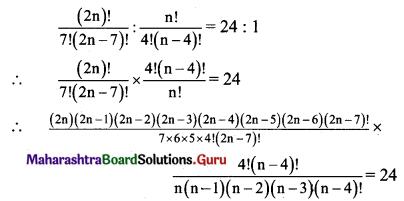
(v) \(\frac{(2 n) !}{7 !(2 n-7) !}: \frac{n !}{4 !(n-4) !}=24: 1\)
Solution:
Maharashtra Board 11th Maths Solutions Chapter 3 Permutations and Combination Ex 3.2 Q6 (v)
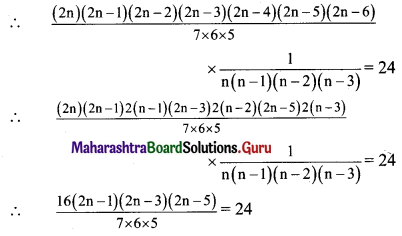
Maharashtra Board 11th Maths Solutions Chapter 3 Permutations and Combination Ex 3.2 Q6 (v).1
(2n – 1)(2n – 3)(2n – 5) = \(\frac{24 \times 7 \times 6 \times 5}{16}\)
∴ (2n – 1)(2n – 3)(2n – 5) = 9 × 7 × 5
Comparing on both sides. We get
∴ 2n – 1 = 9
∴ n = 5

Question 7.
Show that \(\frac{n !}{r !(n-r) !}+\frac{n !}{(r-1) !(n-r+1) !}=\frac{(n+1) !}{r !(n-r+1) !}\)
Solution:
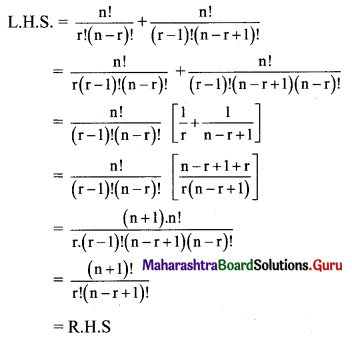
Maharashtra Board 11th Maths Solutions Chapter 3 Permutations and Combination Ex 3.2 Q7

Question 8.
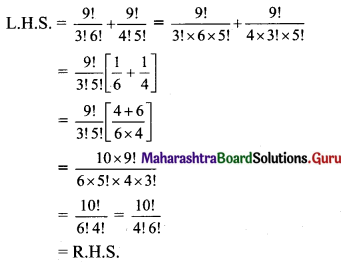
Show that \(\frac{9 !}{3 ! 6 !}+\frac{9 !}{4 ! 5 !}=\frac{10 !}{4 ! 6 !}\)
Solution:
Maharashtra Board 11th Maths Solutions Chapter 3 Permutations and Combination Ex 3.2 Q8

Question 9.
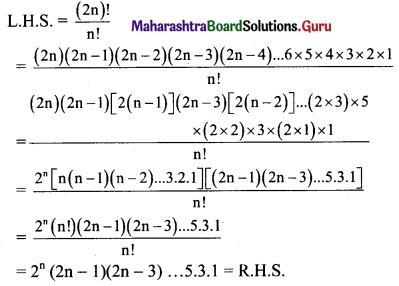
Show that \(\frac{(2 n) !}{n !}\) = 2n (2n – 1)(2n – 3)…5.3.1
Solution:
Maharashtra Board 11th Maths Solutions Chapter 3 Permutations and Combination Ex 3.2 Q9

Maharashtra Board 11th Maths Solutions Chapter 3 Permutations and Combination Ex 3.2

Question 10.
Simplify
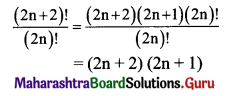
(i) \(\frac{(2 n+2) !}{(2 n) !}\)
Solution:
Maharashtra Board 11th Maths Solutions Chapter 3 Permutations and Combination Ex 3.2 Q10 (i)

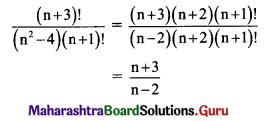
(ii) \(\frac{(n+3) !}{\left(n^{2}-4\right)(n+1) !}\)
Solution:
Maharashtra Board 11th Maths Solutions Chapter 3 Permutations and Combination Ex 3.2 Q10 (ii)

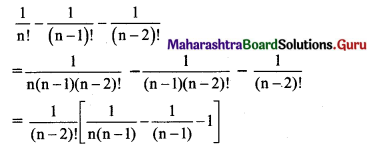
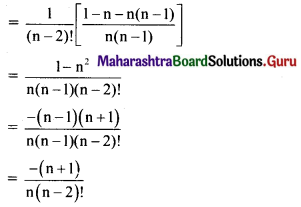
(iii) \(\frac{1}{n !}-\frac{1}{(n-1) !}-\frac{1}{(n-2) !}\)
Solution:
Maharashtra Board 11th Maths Solutions Chapter 3 Permutations and Combination Ex 3.2 Q10 (iii)
Maharashtra Board 11th Maths Solutions Chapter 3 Permutations and Combination Ex 3.2 Q10 (iii).1

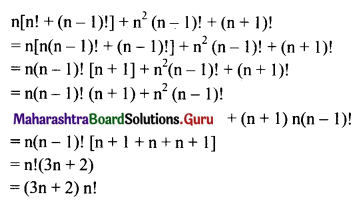
(iv) n[n! + (n – 1)!] + n2(n – 1)! + (n + 1)!
Solution:
Maharashtra Board 11th Maths Solutions Chapter 3 Permutations and Combination Ex 3.2 Q10 (iv)

Maharashtra Board 11th Maths Solutions Chapter 3 Permutations and Combination Ex 3.2

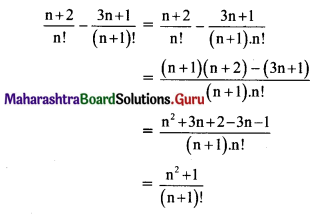
(v) \(\frac{n+2}{n !}-\frac{3 n+1}{(n+1) !}\)
Solution:
Maharashtra Board 11th Maths Solutions Chapter 3 Permutations and Combination Ex 3.2 Q10 (v)

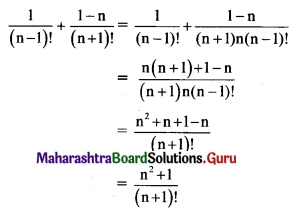
(vi) \(\frac{1}{(n-1) !}+\frac{1-n}{(n+1) !}\)
Solution:
Maharashtra Board 11th Maths Solutions Chapter 3 Permutations and Combination Ex 3.2 Q10 (vi)

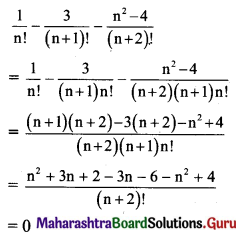
(vii) \(\frac{1}{n !}-\frac{3}{(n+1) !}-\frac{n^{2}-4}{(n+2) !}\)
Solution:
Maharashtra Board 11th Maths Solutions Chapter 3 Permutations and Combination Ex 3.2 Q10 (vii)

Maharashtra Board 11th Maths Solutions Chapter 3 Permutations and Combination Ex 3.2

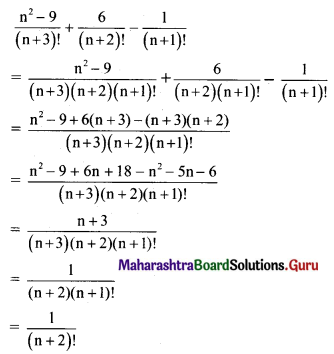
(viii) \(\frac{n^{2}-9}{(n+3) !}+\frac{6}{(n+2) !}-\frac{1}{(n+1) !}\)
Solution:
Maharashtra Board 11th Maths Solutions Chapter 3 Permutations and Combination Ex 3.2 Q10 (viii)

Maths Solutions for Class 11 State Board

Indefinite Integration Class 12 Maths 2 Exercise 3.2(B) Solutions Maharashtra Board

Balbharti 12th Maharashtra State Board Maths Solutions Book Pdf Chapter 3 Indefinite Integration Ex 3.2(B) Questions and Answers.

12th Maths Part 2 Indefinite Integration Exercise 3.2(B) Questions And Answers Maharashtra Board

I. Evaluate the following:

Question 1.
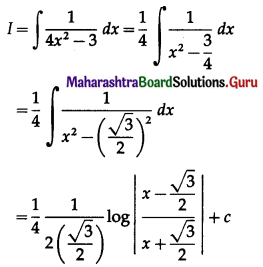
\(\int \frac{1}{4 x^{2}-3} \cdot d x\)
Solution:
Maharashtra Board 12th Maths Solutions Chapter 3 Indefinite Integration Ex 3.2(B) I Q1
Maharashtra Board 12th Maths Solutions Chapter 3 Indefinite Integration Ex 3.2(B) I Q1.1

Question 2.
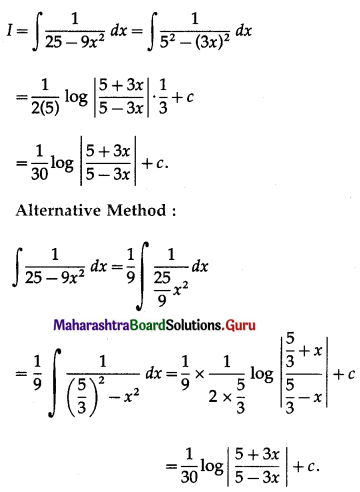
\(\int \frac{1}{25-9 x^{2}} \cdot d x\)
Solution:
Maharashtra Board 12th Maths Solutions Chapter 3 Indefinite Integration Ex 3.2(B) I Q2

Maharashtra Board 12th Maths Solutions Chapter 3 Indefinite Integration Ex 3.2(B)

Question 3.
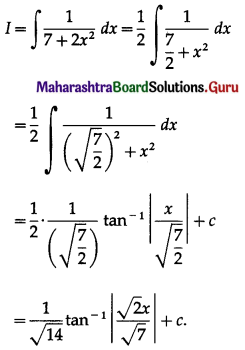
\(\int \frac{1}{7+2 x^{2}} \cdot d x\)
Solution:
Maharashtra Board 12th Maths Solutions Chapter 3 Indefinite Integration Ex 3.2(B) I Q3

Question 4.
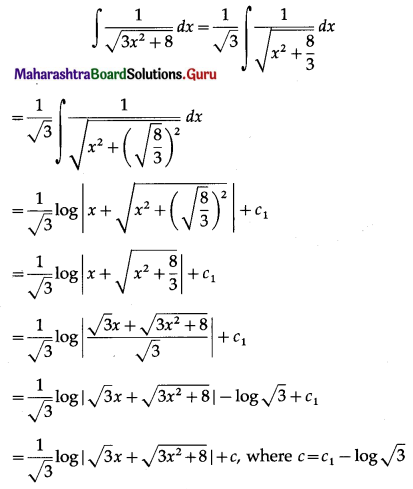
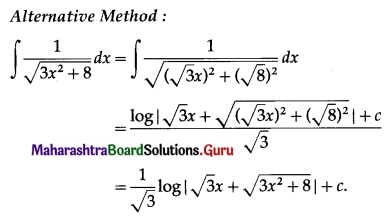
\(\int \frac{1}{\sqrt{3 x^{2}+8}} \cdot d x\)
Solution:
Maharashtra Board 12th Maths Solutions Chapter 3 Indefinite Integration Ex 3.2(B) I Q4
Maharashtra Board 12th Maths Solutions Chapter 3 Indefinite Integration Ex 3.2(B) I Q4.1

Question 5.
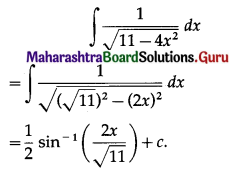
\(\int \frac{1}{\sqrt{11-4 x^{2}}} \cdot d x\)
Solution:
Maharashtra Board 12th Maths Solutions Chapter 3 Indefinite Integration Ex 3.2(B) I Q5

Question 6.
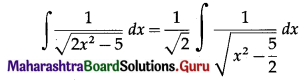
\(\int \frac{1}{\sqrt{2 x^{2}-5}} \cdot d x\)
Solution:
Maharashtra Board 12th Maths Solutions Chapter 3 Indefinite Integration Ex 3.2(B) I Q6
Maharashtra Board 12th Maths Solutions Chapter 3 Indefinite Integration Ex 3.2(B) I Q6.1

Maharashtra Board 12th Maths Solutions Chapter 3 Indefinite Integration Ex 3.2(B)

Question 7.
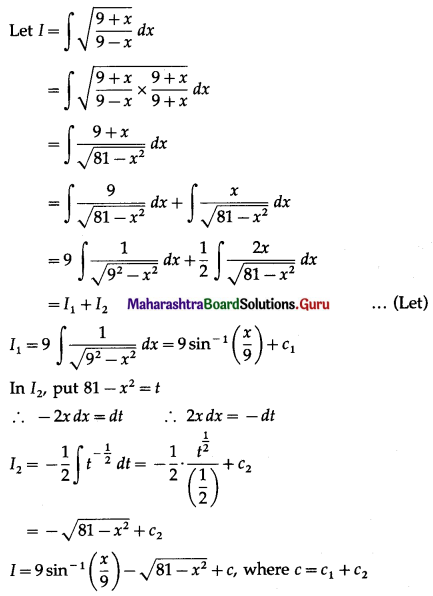
\(\int \sqrt{\frac{9+x}{9-x}} \cdot d x\)
Solution:
Maharashtra Board 12th Maths Solutions Chapter 3 Indefinite Integration Ex 3.2(B) I Q7

Question 8.
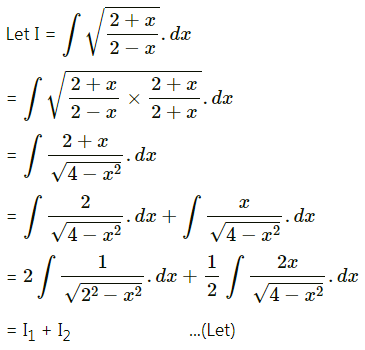
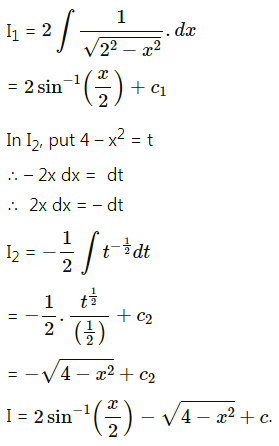
\(\int \sqrt{\frac{2+x}{2-x}} \cdot d x\)
Solution:
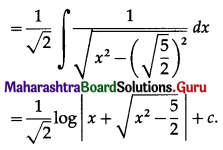
Maharashtra Board 12th Maths Solutions Chapter 3 Indefinite Integration Ex 3.2(B) I Q8
Maharashtra Board 12th Maths Solutions Chapter 3 Indefinite Integration Ex 3.2(B) I Q8.1

Question 9.
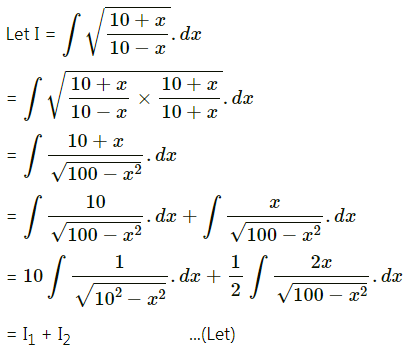
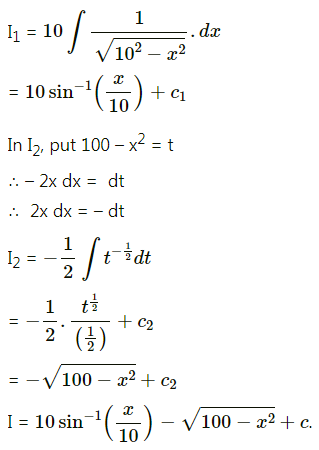
\(\int \sqrt{\frac{10+x}{10-x}} \cdot d x\)
Solution:
Maharashtra Board 12th Maths Solutions Chapter 3 Indefinite Integration Ex 3.2(B) I Q9
Maharashtra Board 12th Maths Solutions Chapter 3 Indefinite Integration Ex 3.2(B) I Q9.1

Question 10.
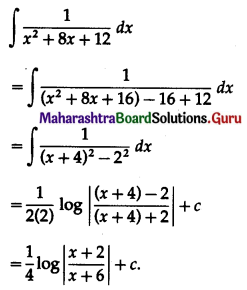
\(\int \frac{1}{x^{2}+8 x+12} \cdot d x\)
Solution:
Maharashtra Board 12th Maths Solutions Chapter 3 Indefinite Integration Ex 3.2(B) I Q10

Maharashtra Board 12th Maths Solutions Chapter 3 Indefinite Integration Ex 3.2(B)

Question 11.
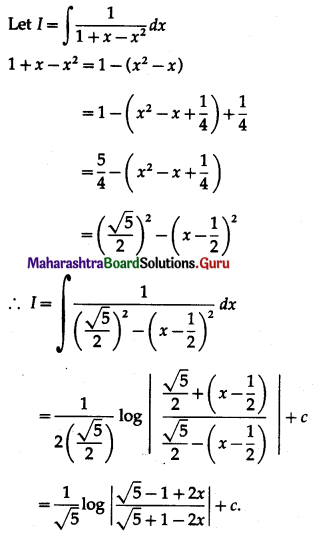
\(\int \frac{1}{1+x-x^{2}} \cdot d x\)
Solution:
Maharashtra Board 12th Maths Solutions Chapter 3 Indefinite Integration Ex 3.2(B) I Q11

Question 12.
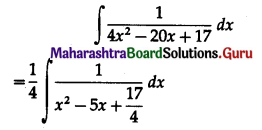
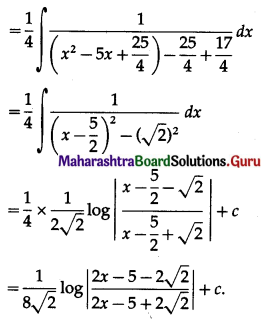
\(\int \frac{1}{4 x^{2}-20 x+17} \cdot d x\)
Solution:
Maharashtra Board 12th Maths Solutions Chapter 3 Indefinite Integration Ex 3.2(B) I Q12
Maharashtra Board 12th Maths Solutions Chapter 3 Indefinite Integration Ex 3.2(B) I Q12.1

Question 13.
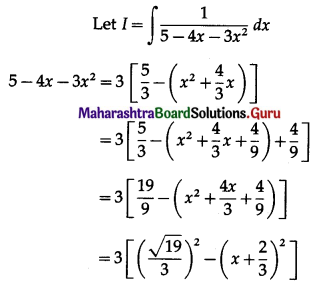
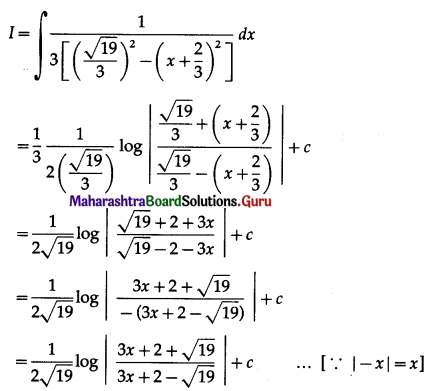
\(\int \frac{1}{5-4 x-3 x^{2}} \cdot d x\)
Solution:
Maharashtra Board 12th Maths Solutions Chapter 3 Indefinite Integration Ex 3.2(B) I Q13
Maharashtra Board 12th Maths Solutions Chapter 3 Indefinite Integration Ex 3.2(B) I Q13.1

Question 14.
\(\int \frac{1}{\sqrt{3 x^{2}+5 x+7}} \cdot d x\)
Solution:
Maharashtra Board 12th Maths Solutions Chapter 3 Indefinite Integration Ex 3.2(B) I Q14
Maharashtra Board 12th Maths Solutions Chapter 3 Indefinite Integration Ex 3.2(B) I Q14.1

Question 15.
\(\int \frac{1}{\sqrt{x^{2}+8 x-20}} \cdot d x\)
Solution:
Maharashtra Board 12th Maths Solutions Chapter 3 Indefinite Integration Ex 3.2(B) I Q15

Question 16.
\(\int \frac{1}{\sqrt{8-3 x+2 x^{2}}} \cdot d x\)
Solution:
Maharashtra Board 12th Maths Solutions Chapter 3 Indefinite Integration Ex 3.2(B) I Q16

Maharashtra Board 12th Maths Solutions Chapter 3 Indefinite Integration Ex 3.2(B)

Question 17.
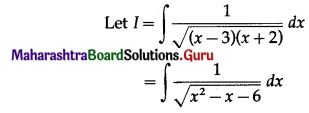
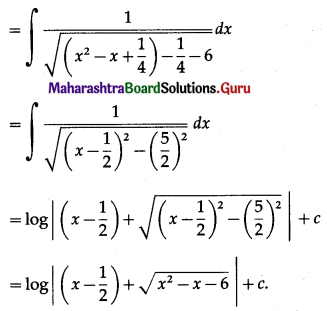
\(\int \frac{1}{\sqrt{(x-3)(x+2)}} \cdot d x\)
Solution:
Maharashtra Board 12th Maths Solutions Chapter 3 Indefinite Integration Ex 3.2(B) I Q17
Maharashtra Board 12th Maths Solutions Chapter 3 Indefinite Integration Ex 3.2(B) I Q17.1

Question 18.
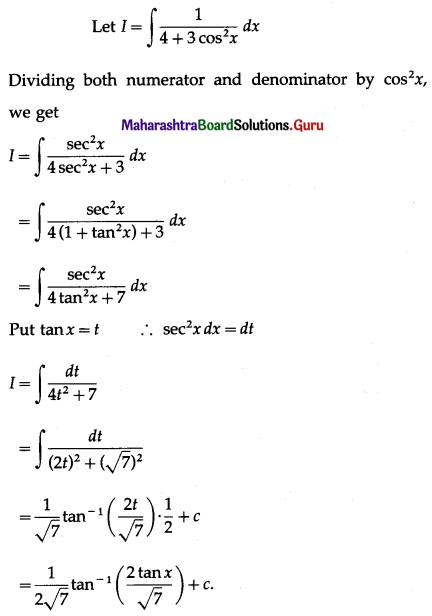
\(\int \frac{1}{4+3 \cos ^{2} x} \cdot d x\)
Solution:
Maharashtra Board 12th Maths Solutions Chapter 3 Indefinite Integration Ex 3.2(B) I Q18

Question 19.
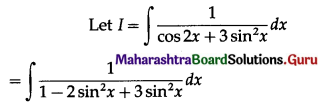
\(\int \frac{1}{\cos 2 x+3 \sin ^{2} x} \cdot d x\)
Solution:
Maharashtra Board 12th Maths Solutions Chapter 3 Indefinite Integration Ex 3.2(B) I Q19
Maharashtra Board 12th Maths Solutions Chapter 3 Indefinite Integration Ex 3.2(B) I Q19.1

Question 20.
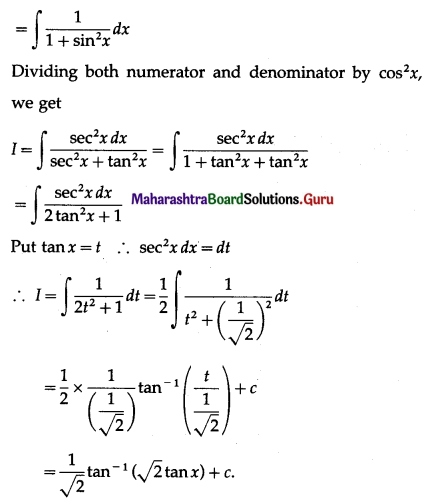
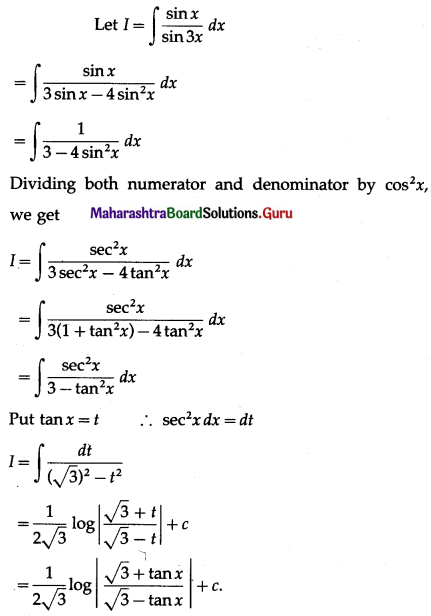
\(\int \frac{\sin x}{\sin 3 x} \cdot d x\)
Solution:
Maharashtra Board 12th Maths Solutions Chapter 3 Indefinite Integration Ex 3.2(B) I Q20

II. Integrate the following functions w. r. t. x:

Question 1.
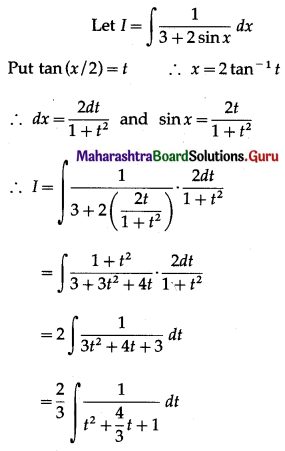
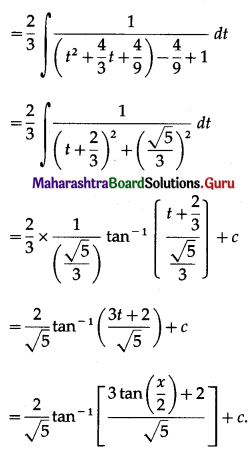
\(\int \frac{1}{3+2 \sin x} \cdot d x\)
Solution:
Maharashtra Board 12th Maths Solutions Chapter 3 Indefinite Integration Ex 3.2(B) II Q1
Maharashtra Board 12th Maths Solutions Chapter 3 Indefinite Integration Ex 3.2(B) II Q1.1

Maharashtra Board 12th Maths Solutions Chapter 3 Indefinite Integration Ex 3.2(B)

Question 2.
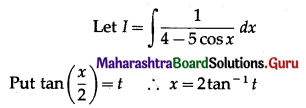
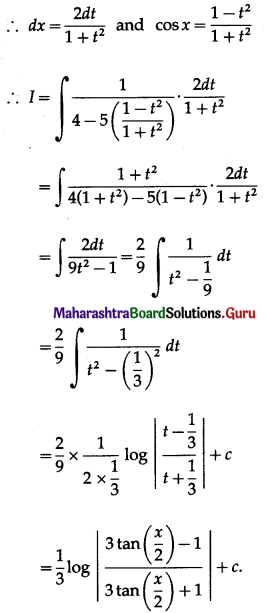
\(\int \frac{1}{4-5 \cos x} \cdot d x\)
Solution:
Maharashtra Board 12th Maths Solutions Chapter 3 Indefinite Integration Ex 3.2(B) II Q2
Maharashtra Board 12th Maths Solutions Chapter 3 Indefinite Integration Ex 3.2(B) II Q2.1

Question 3.
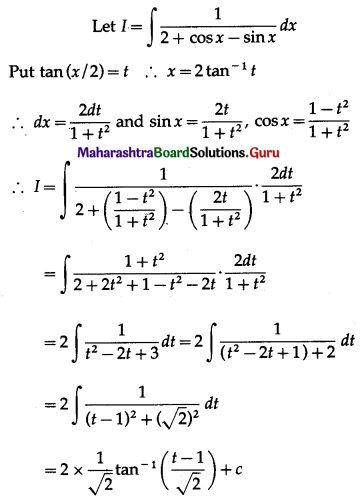
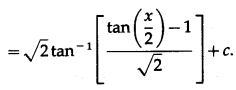
\(\int \frac{1}{2+\cos x-\sin x} \cdot d x\)
Solution:
Maharashtra Board 12th Maths Solutions Chapter 3 Indefinite Integration Ex 3.2(B) II Q3
Maharashtra Board 12th Maths Solutions Chapter 3 Indefinite Integration Ex 3.2(B) II Q3.1

Question 4.
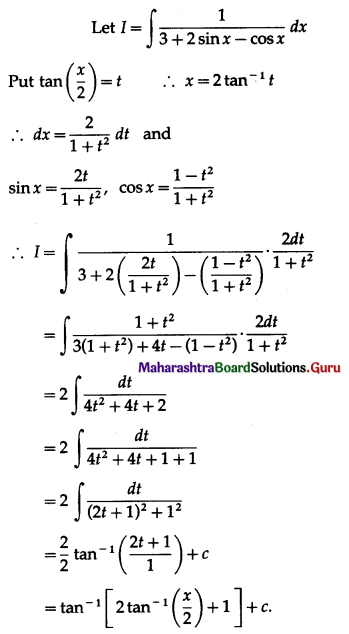
\(\int \frac{1}{3+2 \sin x-\cos x} \cdot d x\)
Solution:
Maharashtra Board 12th Maths Solutions Chapter 3 Indefinite Integration Ex 3.2(B) II Q4

Question 5.
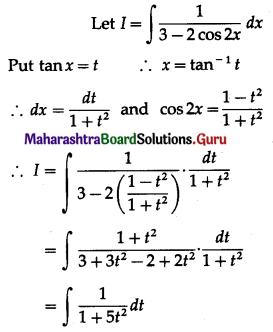
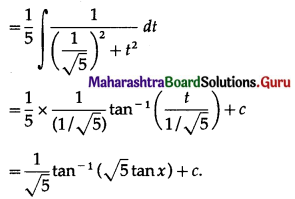
\(\int \frac{1}{3-2 \cos 2 x} \cdot d x\)
Solution:
Maharashtra Board 12th Maths Solutions Chapter 3 Indefinite Integration Ex 3.2(B) II Q5
Maharashtra Board 12th Maths Solutions Chapter 3 Indefinite Integration Ex 3.2(B) II Q5.1

Maharashtra Board 12th Maths Solutions Chapter 3 Indefinite Integration Ex 3.2(B)

Question 6.
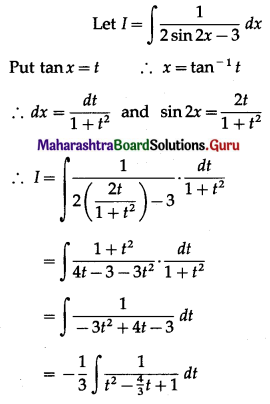
\(\int \frac{1}{2 \sin 2 x-3} \cdot d x\)
Solution:
Maharashtra Board 12th Maths Solutions Chapter 3 Indefinite Integration Ex 3.2(B) II Q6
Maharashtra Board 12th Maths Solutions Chapter 3 Indefinite Integration Ex 3.2(B) II Q6.1

Question 7.
\(\int \frac{1}{3+2 \sin 2 x+4 \cos 2 x} \cdot d x\)
Solution:
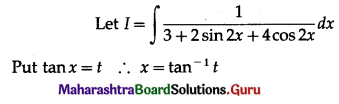
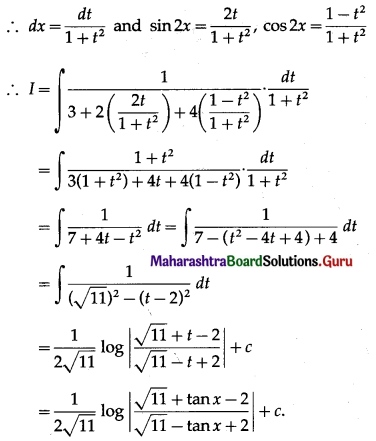
Maharashtra Board 12th Maths Solutions Chapter 3 Indefinite Integration Ex 3.2(B) II Q7
Maharashtra Board 12th Maths Solutions Chapter 3 Indefinite Integration Ex 3.2(B) II Q7.1

Question 8.
\(\int \frac{1}{\cos x-\sin x} \cdot d x\)
Solution:
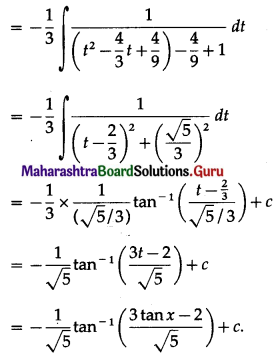
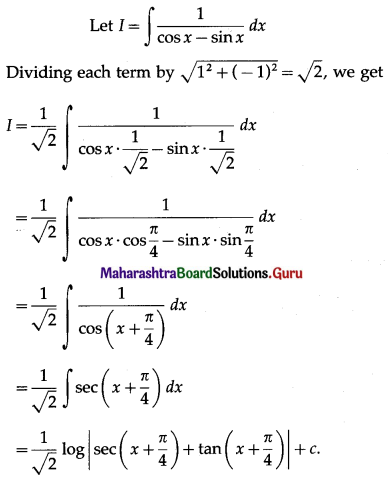
Maharashtra Board 12th Maths Solutions Chapter 3 Indefinite Integration Ex 3.2(B) II Q8

Maharashtra Board 12th Maths Solutions Chapter 3 Indefinite Integration Ex 3.2(B)

Question 9.
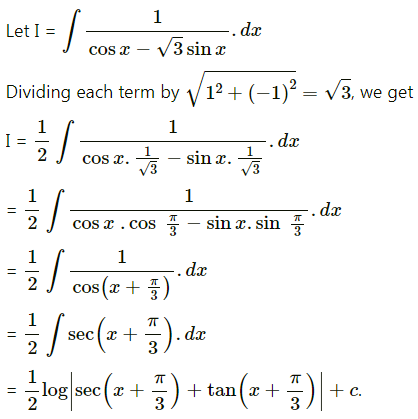
\(\int \frac{1}{\cos x-\sqrt{3} \sin x} \cdot d x\)
Solution:
Maharashtra Board 12th Maths Solutions Chapter 3 Indefinite Integration Ex 3.2(B) II Q9

12th Maharashtra State Board Maths Solutions Pdf Part 2

Permutations and Combination Class 11 Maths 2 Exercise 3.1 Solutions Maharashtra Board

Balbharti Maharashtra State Board 11th Maths Book Solutions Pdf Chapter 3 Permutations and Combination Ex 3.1 Questions and Answers.

11th Maths Part 2 Permutations and Combination Exercise 3.1 Questions And Answers Maharashtra Board

Question 1.
A teacher wants to select the class monitor in a class of 30 boys and 20 girls. In how many ways can the monitor be selected if the monitor must be a girl?
Solution:
There are 30 boys and 20 girls.
A teacher can select any boy as a class monitor from 30 boys in 30 different ways and he can select any girl as a class monitor from 20 girls in 20 different ways.
∴ by the fundamental principle of addition, the total number of ways a teacher can select a class monitor = 30 + 20 = 50
Hence, there are 50 different ways to select a class monitor.

Question 2.
A Signal is generated from 2 flags by putting one flag above the other. If 4 flags of different colours are available, how many different signals can be generated?
Solution:
A signal is generated from 2 flags and there are 4 flags of different colours available.
∴ 1st flag can be any one of the available 4 flags.
∴ It can be selected in 4 ways.
Now, 2nd flag is to be selected for which 3 flags are available for a different signal.
∴ 2nd flag can be anyone from these 3 flags.
∴ It can be selected in 3 ways.
∴ By using the fundamental principle of multiplication, total no. of ways a signal can be generated = 4 × 3 = 12
∴ 12 different signals can be generated.

Maharashtra Board 11th Maths Solutions Chapter 3 Permutations and Combination Ex 3.1

Question 3.
How many two-letter words can be formed using letters from the word SPACE, when repetition of letters (i) is allowed (ii) is not allowed
Solution:
A two-letter word is to be formed out of the letters of the word SPACE.
(i) When repetition of the letters is allowed 1st letter can be selected in 5 ways.
2nd letter can be selected in 5 ways.
∴ By using the fundamental principle of multiplication, the total number of 2-letter words = 5 × 5 = 25

(ii) When repetition of the letters is not allowed 1st letter can be selected in 5 ways.
2nd letter can be selected in 4 ways.
∴ By using the fundamental principle of multiplication, the total number of 2-letter words = 5 × 4 = 20

Question 4.
How many three-digit numbers can be formed from the digits 0, 1, 3, 5, 6 if repetitions of digits (i) are allowed (ii) are not allowed?
Solution:
A three-digit number is to be formed from the digits 0, 1, 3, 5, 6.
(i) When repetition of digits is allowed,
100’s place digit should be a non-zero number.
Hence, it can be anyone from digits 1, 3, 5,6.
∴ 100’s place digit can be selected in 4 ways.
10’s and unit’s place digit can be zero and digits can be repeated.
∴ 10’s place digit can be selected in 5 ways and the unit’s place digit can be selected in 5 ways.
∴ By using the fundamental principle of multiplication, the total number of three-digit numbers = 4 × 5 × 5 = 100

(ii) When repetition of digits is not allowed,
100’s place digit should be a non-zero number.
Hence, it can be anyone from digits 1, 3, 5, 6.
∴ 100’s place digit can be selected in 4 ways.
10’s and unit’s place digit can be zero and digits can’t be repeated.
∴ 10’s place digit can be selected in 4 ways and the unit’s place digit can be selected in 3 ways.
∴ By using the fundamental principle of multiplication, the total number of two-digit numbers = 4 × 4 × 3 = 48

Question 5.
How many three-digit numbers can be formed using the digits 2, 3, 4, 5, 6 if digits can be repeated?
Solution:
A 3-digit number is to be formed from the digits 2, 3, 4, 5, 6 where digits can be repeated.
∴ Unit’s place digit can be selected in 5 ways.
10’s place digit can be selected in 5 ways.
100’s place digit can be selected in 5 ways.
∴ By using fundamental principle of multiplication, total number of 3-digit numbers = 5 × 5 × 5 = 125

Maharashtra Board 11th Maths Solutions Chapter 3 Permutations and Combination Ex 3.1

Question 6.
A letter lock contains 3 rings and each ring contains 5 letters. Determine the maximum number of false trails that can be made before the lock is opened.
Solution:
A letter lock has 3 rings, each ring containing 5 different letters.
∴ A letter from each ring can be selected in 5 ways.
∴ By using the fundamental principle of multiplication, a total number of trials that can be made = 5 × 5 × 5 = 125.
Out of these 124 wrong attempts are made and in the 125th attempt, the lock gets opened.
∴ A maximum number of false trials = 124.

Question 7.
In a test, 5 questions are of the form ‘state, true or false. No student has got all answers correct. Also, the answer of every student is different. Find the number of students who appeared for the test.
Solution:
Every question can be answered in 2 ways. (True or False)
∴ By using the fundamental principle of multiplication, the total number of set of answers possible = 2 × 2 × 2 × 2 × 2 = 32.
Since One of them is the case where all questions are answered correctly,
The number of wrong answers = 32 – 1 = 31.
Since no student has answered all the questions correctly, the number of students who appeared for the test are 31.

Question 8.
How many numbers between 100 and 1000 have 4 in the unit’s place?
Solution:
Numbers between 100 and 1000 are 3-digit numbers.
A 3-digit number is to be formed from the digits 0, 1, 2, 3, 4, 5, 6, 7, 8, 9, where the unit place digit is 4.
Unit’s place digit is 4.
∴ it can be selected in 1 way only.
10’s place digit can be selected in 10 ways.
For a 3-digit number, 100’s place digit should be a non-zero number.
∴ 100’s place digit can be selected in 9 ways.
∴ By using the fundamental principle of multiplication,
total numbers between 100 and 1000 which have 4 in the units place = 1 × 10 × 9 = 90.

Maharashtra Board 11th Maths Solutions Chapter 3 Permutations and Combination Ex 3.1

Question 9.
How many numbers between 100 and 1000 have the digit 7 exactly once?
Solution:
Numbers between 100 and 1000 are 3-digit numbers.
A 3-digit number is to be formed from the digits 0, 1, 2, 3, 4, 5, 6, 7, 8, 9, where exactly one of the digits is 7.
When 7 is in unit’s place:
Unit’s place digit is 7.
∴ it can be selected in 1 way only.
10’s place digit can be selected in 9 ways.
100’s place digit can be selected in 8 ways.
Total numbers which have 7 in unit’s place = 1 × 9 × 8 = 72.

When 7 is in 10’s place:
Unit’s place digit can be selected in 9 ways.
10’s place digit is 7.
∴ it can be selected in 1 way only.
100’s place digit can be selected in 8 ways.
∴ A total number of numbers which have 7 in 10’s place = 9 × 1 × 8 = 72.

When 7 is in 100’s place:
Unit’s place digit can be selected in 9 ways.
10’s place digit can be selected in 9 ways.
100’s place digit is 7.
∴ it can be selected in 1 way only.
∴ Total numbers which have 7 in 100’s place = 9 × 9 × 1 = 81.
∴ Total numbers between 100 and 1000 having digit 7 exactly once = 72 + 72 + 81 = 225

Question 10.
How many four-digit numbers will not exceed 7432 if they are formed using the digits 2, 3, 4, 7 without repetition?
Solution:
Between any set of digits, the greatest number is possible when digits are arranged in descending order.
∴ 7432 is the greatest number, formed from the digits 2, 3, 4, 7.
Since a 4-digit number is to be formed from the digits 2, 3, 4, 7, where repetition of the digit is not allowed,
1000’s place digit can be selected in 4 ways,
100’s place digit can be selected in 3 ways,
10’s place digit can be selected in 2 ways,
Unit’s place digit can be selected in 1 way.
∴ Total number of numbers not exceeding 7432 that can be formed with the digits 2, 3, 4, 7 = Total number of four-digit numbers possible from the digits 2, 3, 4, 7
= 4 × 3 × 2 × 1
= 24

Question 11.
If numbers are formed using digits 2, 3, 4, 5, 6 without repetition, how many of them will exceed 400?
Solution:
Case I: Number of three-digit numbers formed from 2, 3, 4, 5, 6, greater than 400.
100’s place can be filled by any one of the numbers 4, 5, 6.
100’s place digit can be selected in 3 ways.
Since repetition is not allowed, 10’s place can be filled by any one of the remaining four numbers.
∴ 10’s place digit can be selected in 4 ways.
Unit’s place digit can be selected in 3 ways.
∴ Total number of three-digit numbers formed = 3 × 4 × 3 = 36

Case II: Number of four-digit numbers formed from 2, 3, 4, 5, 6.
Since repetition of digits is not allowed,
1000’s place digit can be selected in 5 ways.
100’s place digit can be selected in 4 ways.
10’s place digit can be selected in 3 ways.
Unit’s place digit can be selected in 2 ways.
∴ Total number of four-digit numbers formed = 5 × 4 × 3 × 2 = 120

Maharashtra Board 11th Maths Solutions Chapter 3 Permutations and Combination Ex 3.1

Case III: Number of five-digit numbers formed from 2, 3, 4, 5, 6.
Similarly, since repetition of digits is not allowed,
Total number of five digit numbers formed = 5 × 4 × 3 × 2 × 1 = 120.
∴ Total number of numbers that exceed 400 = 36 + 120 + 120 = 276

Question 12.
How many numbers formed with the digits 0, 1, 2, 5, 7, 8 will fall between 13 and 1000 if digits can be repeated?
Solution:
Case I: 2-digit numbers more than 13, less than 20, formed from the digits 0, 1, 2, 5, 7, 8.
10’s place digit is 1.
∴ it can be selected in 1 way only.
Unit’s place can be filled by any one of the numbers 5, 7, 8.
∴ Unit’s place digit can be selected in 3 ways.
∴ Total number of such numbers = 1 × 3 = 3.

Case II: 2-digit numbers more than 20 formed from 0, 1, 2, 5, 7, 8.
10’s place can be filled by any one of the numbers 2, 5, 7, 8.
∴ 10’s place digit can be selected in 4 ways.
Since repetition is allowed, the unit’s place can be filled by one of the remaining 6 digits.
∴ Unit’s place digit can be selected in 6 ways.
∴ Total number of such numbers = 4 × 6 = 24.

Case III: 3-digit numbers formed from 0, 1, 2, 5, 7, 8.
Similarly, since repetition of digits is allowed, the total number of such numbers = 5 × 6 × 6 = 180.
All cases are mutually exclusive.
∴ Total number of required numbers = 3 + 24 + 180 = 207

Question 13.
A school has three gates and four staircases from the first floor to the second floor. How many ways does a student have to go from outside the school to his classroom on the second floor?
Solution:
A student can go inside the school from outside in 3 ways and from the first floor to the second floor in 4 ways.
∴ A number of ways to choose gates = 3.
The number of ways to choose a staircase = 4.
By using the fundamental principle of multiplication,
number of ways in which a student has to go from outside the school to his classroom = 4 × 3 = 12

Question 14.
How many five-digit numbers formed using the digit 0, 1, 2, 3, 4, 5 are divisible by 5 if digits are not repeated?
Solution:
Here, repetition of digits is not allowed.
For a number to be divisible by 5,
unit’s place digit should be 0 or 5.
Case I: when unit’s place is 0
Unit’s place digit can be selected in 1 way.
10’s place digit can be selected in 5 ways.
100’s place digit can be selected in 4 ways.
1000’s place digit can be selected in 3 ways.
10000’s place digit can be selected in 2 ways.
∴ Total number of numbers = 1 × 5 × 4 × 3 × 2 = 120.

Maharashtra Board 11th Maths Solutions Chapter 3 Permutations and Combination Ex 3.1

Case II: when the unit’s place is 5
Unit’s place digit can be selected in 1 way.
10000’s place should be a non-zero number.
∴ It can be selected in 4 ways.
1000’s place digit can be selected in 4 ways.
100’s place digit can be selected in 3 ways.
10’s place digit can be selected in 2 ways.
∴ Total number of numbers = 1 × 4 × 4 × 3 × 2 = 96
∴ Total number of required numbers = 120 + 96 = 216

Maths Solutions for Class 11 State Board

Indefinite Integration Class 12 Maths 2 Exercise 3.2(A) Solutions Maharashtra Board

Balbharti 12th Maharashtra State Board Maths Solutions Book Pdf Chapter 3 Indefinite Integration Ex 3.2(A) Questions and Answers.

12th Maths Part 2 Indefinite Integration Exercise 3.2(A) Questions And Answers Maharashtra Board

I. Integrate the following functions w.r.t. x:

Question 1.
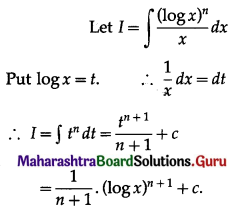
\(\frac{(\log x)^{n}}{x}\)
Solution:
Maharashtra Board 12th Maths Solutions Chapter 3 Indefinite Integration Ex 3.2(A) I Q1

Question 2.
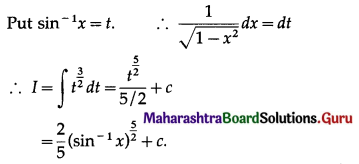
\(\frac{\left(\sin ^{-1} x\right)^{\frac{3}{2}}}{\sqrt{1-x^{2}}}\)
Solution:
Let I = \(\int \frac{\left(\sin ^{-1} x\right)^{\frac{3}{2}}}{\sqrt{1-x^{2}}} d x\)
Maharashtra Board 12th Maths Solutions Chapter 3 Indefinite Integration Ex 3.2(A) I Q2

Maharashtra Board 12th Maths Solutions Chapter 3 Indefinite Integration Ex 3.2(A)

Question 3.
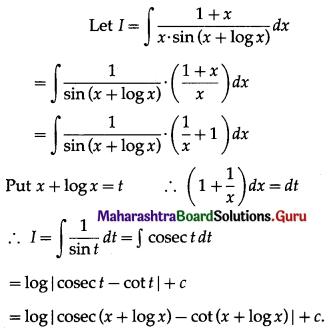
\(\frac{1+x}{x \cdot \sin (x+\log x)}\)
Solution:
Maharashtra Board 12th Maths Solutions Chapter 3 Indefinite Integration Ex 3.2(A) I Q3

Question 4.
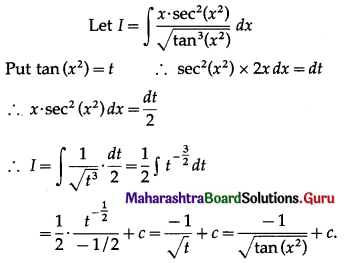
\(\frac{x \cdot \sec ^{2}\left(x^{2}\right)}{\sqrt{\tan ^{3}\left(x^{2}\right)}}\)
Solution:
Maharashtra Board 12th Maths Solutions Chapter 3 Indefinite Integration Ex 3.2(A) I Q4

Question 5.
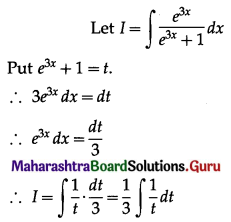
\(\frac{e^{3 x}}{e^{3 x}+1}\)
Solution:
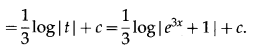
Maharashtra Board 12th Maths Solutions Chapter 3 Indefinite Integration Ex 3.2(A) I Q5
Maharashtra Board 12th Maths Solutions Chapter 3 Indefinite Integration Ex 3.2(A) I Q5.1

Question 6.
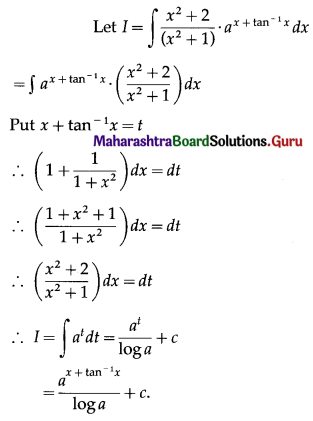
\(\frac{\left(x^{2}+2\right)}{\left(x^{2}+1\right)} \cdot a^{x+\tan ^{-1} x}\)
Solution:
Maharashtra Board 12th Maths Solutions Chapter 3 Indefinite Integration Ex 3.2(A) I Q6

Question 7.
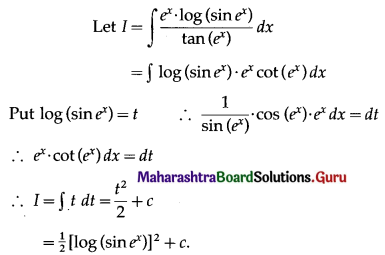
\(\frac{e^{x} \cdot \log \left(\sin e^{x}\right)}{\tan \left(e^{x}\right)}\)
Solution:
Maharashtra Board 12th Maths Solutions Chapter 3 Indefinite Integration Ex 3.2(A) I Q7

Question 8.
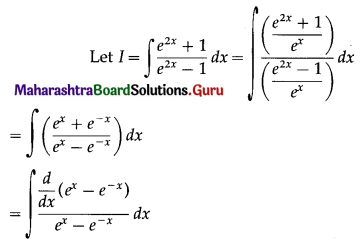
\(\frac{e^{2 x}+1}{e^{2 x}-1}\)
Solution:
Maharashtra Board 12th Maths Solutions Chapter 3 Indefinite Integration Ex 3.2(A) I Q8
Maharashtra Board 12th Maths Solutions Chapter 3 Indefinite Integration Ex 3.2(A) I Q8.1

Maharashtra Board 12th Maths Solutions Chapter 3 Indefinite Integration Ex 3.2(A)

Question 9.
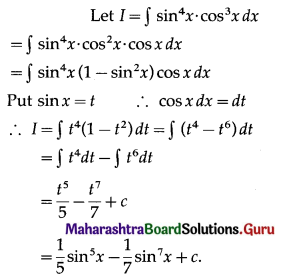
sin4x . cos3x
Solution:
Maharashtra Board 12th Maths Solutions Chapter 3 Indefinite Integration Ex 3.2(A) I Q9

Question 10.
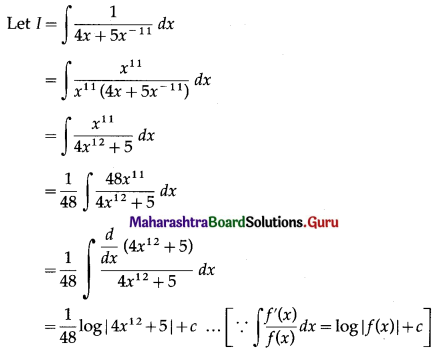
\(\frac{1}{4 x+5 x^{-11}}\)
Solution:
Maharashtra Board 12th Maths Solutions Chapter 3 Indefinite Integration Ex 3.2(A) I Q10

Question 11.
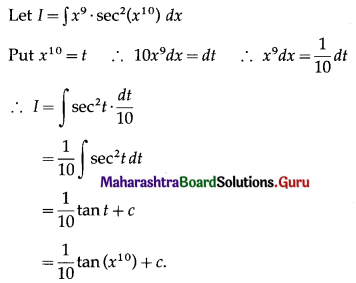
x9 . sec2(x10)
Solution:
Maharashtra Board 12th Maths Solutions Chapter 3 Indefinite Integration Ex 3.2(A) I Q11

Question 12.
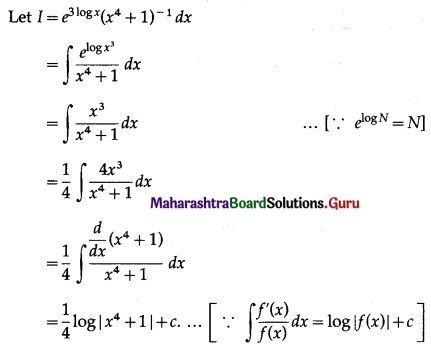
\(e^{3 \log x} \cdot\left(x^{4}+1\right)^{-1}\)
Solution:
Maharashtra Board 12th Maths Solutions Chapter 3 Indefinite Integration Ex 3.2(A) I Q12

Question 13.
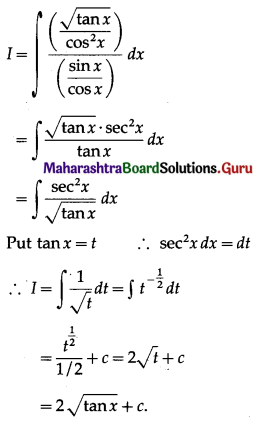
\(\frac{\sqrt{\tan x}}{\sin x \cdot \cos x}\)
Solution:
Let I = \(\int \frac{\sqrt{\tan x}}{\sin x \cdot \cos x} d x\)
Dividing numerator and denominator by cos2x, we get
Maharashtra Board 12th Maths Solutions Chapter 3 Indefinite Integration Ex 3.2(A) I Q13

Question 14.
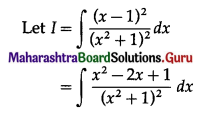
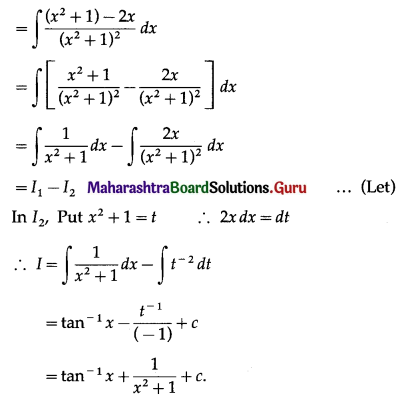
\(\frac{(x-1)^{2}}{\left(x^{2}+1\right)^{2}}\)
Solution:
Maharashtra Board 12th Maths Solutions Chapter 3 Indefinite Integration Ex 3.2(A) I Q14
Maharashtra Board 12th Maths Solutions Chapter 3 Indefinite Integration Ex 3.2(A) I Q14.1

Maharashtra Board 12th Maths Solutions Chapter 3 Indefinite Integration Ex 3.2(A)

Question 15.
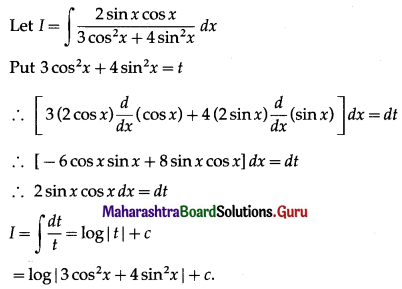
\(\frac{2 \sin x \cos x}{3 \cos ^{2} x+4 \sin ^{2} x}\)
Solution:
Maharashtra Board 12th Maths Solutions Chapter 3 Indefinite Integration Ex 3.2(A) I Q15

Question 16.
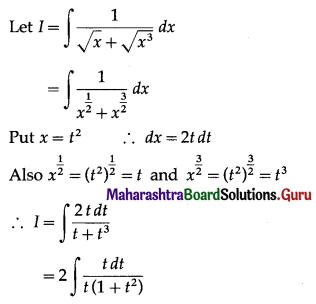
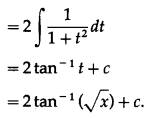
\(\frac{1}{\sqrt{x}+\sqrt{x^{3}}}\)
Solution:
Maharashtra Board 12th Maths Solutions Chapter 3 Indefinite Integration Ex 3.2(A) I Q16
Maharashtra Board 12th Maths Solutions Chapter 3 Indefinite Integration Ex 3.2(A) I Q16.1

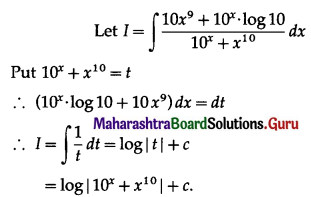
Question 17.
\(\frac{10 x^{9}+10^{x} \cdot \log 10}{10^{x}+x^{10}}\)
Solution:
Maharashtra Board 12th Maths Solutions Chapter 3 Indefinite Integration Ex 3.2(A) I Q17

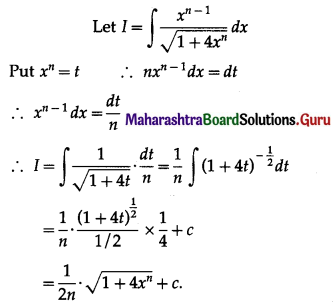
Question 18.
\(\frac{x^{n-1}}{\sqrt{1+4 x^{n}}}\)
Solution:
Maharashtra Board 12th Maths Solutions Chapter 3 Indefinite Integration Ex 3.2(A) I Q18

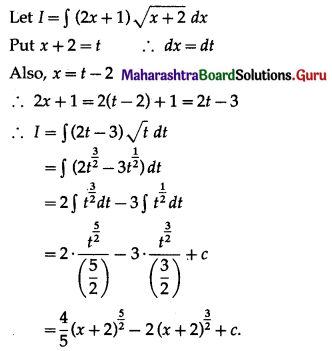
Question 19.
(2x + 1) \(\sqrt{x+2}\)
Solution:
Maharashtra Board 12th Maths Solutions Chapter 3 Indefinite Integration Ex 3.2(A) I Q19

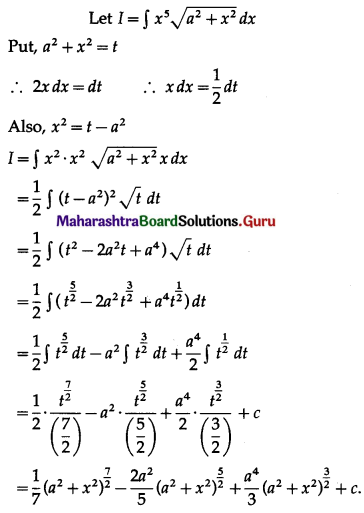
Question 20.
\(x^{5} \sqrt{a^{2}+x^{2}}\)
Solution:
Maharashtra Board 12th Maths Solutions Chapter 3 Indefinite Integration Ex 3.2(A) I Q20

Question 21.
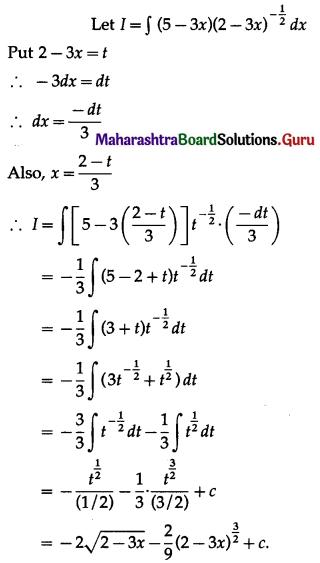
\((5-3 x)(2-3 x)^{-\frac{1}{2}}\)
Solution:
Maharashtra Board 12th Maths Solutions Chapter 3 Indefinite Integration Ex 3.2(A) I Q21

Question 22.
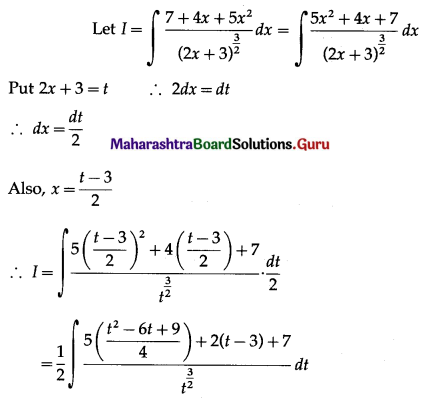
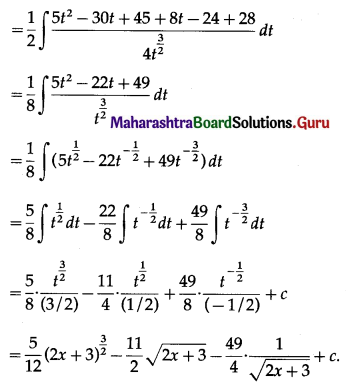
\(\frac{7+4 x+5 x^{2}}{(2 x+3)^{\frac{3}{2}}}\)
Solution:
Maharashtra Board 12th Maths Solutions Chapter 3 Indefinite Integration Ex 3.2(A) I Q22
Maharashtra Board 12th Maths Solutions Chapter 3 Indefinite Integration Ex 3.2(A) I Q22.1

Maharashtra Board 12th Maths Solutions Chapter 3 Indefinite Integration Ex 3.2(A)

Question 23.
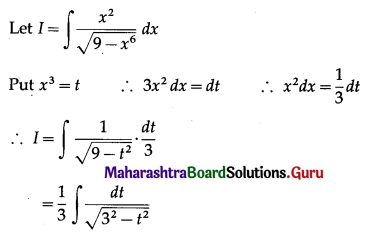
\(\frac{x^{2}}{\sqrt{9-x^{6}}}\)
Solution:
Maharashtra Board 12th Maths Solutions Chapter 3 Indefinite Integration Ex 3.2(A) I Q23
Maharashtra Board 12th Maths Solutions Chapter 3 Indefinite Integration Ex 3.2(A) I Q23.1

Question 24.
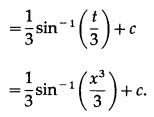
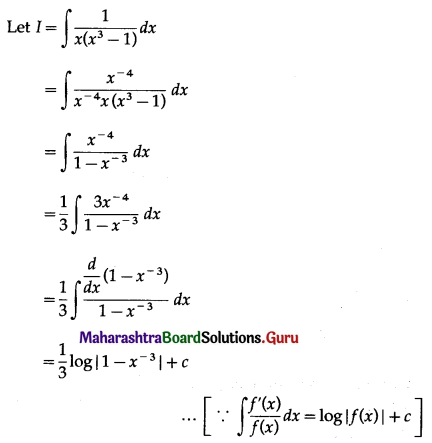
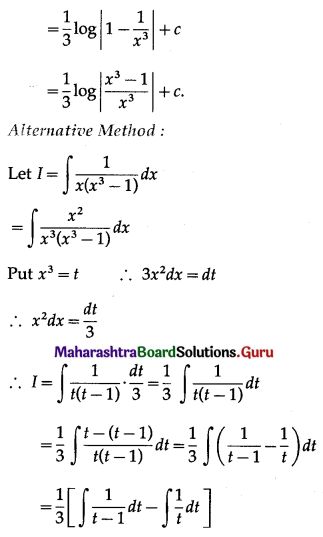
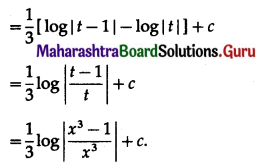
\(\frac{1}{x\left(x^{3}-1\right)}\)
Solution:
Maharashtra Board 12th Maths Solutions Chapter 3 Indefinite Integration Ex 3.2(A) I Q24
Maharashtra Board 12th Maths Solutions Chapter 3 Indefinite Integration Ex 3.2(A) I Q24.1
Maharashtra Board 12th Maths Solutions Chapter 3 Indefinite Integration Ex 3.2(A) I Q24.2

Question 25.
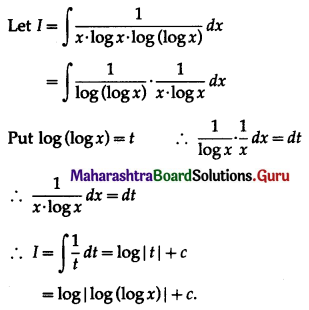
\(\frac{1}{x \cdot \log x \cdot \log (\log x)}\)
Solution:
Maharashtra Board 12th Maths Solutions Chapter 3 Indefinite Integration Ex 3.2(A) I Q25

II. Integrate the following functions w.r.t x:

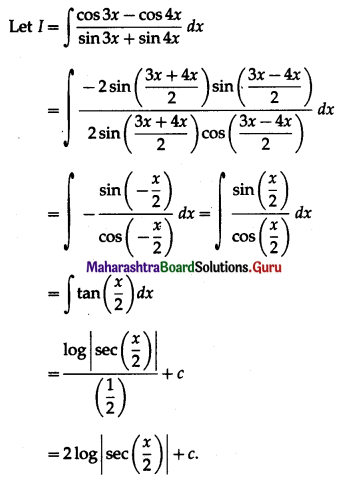
Question 1.
\(\frac{\cos 3 x-\cos 4 x}{\sin 3 x+\sin 4 x}\)
Solution:
Maharashtra Board 12th Maths Solutions Chapter 3 Indefinite Integration Ex 3.2(A) II Q1

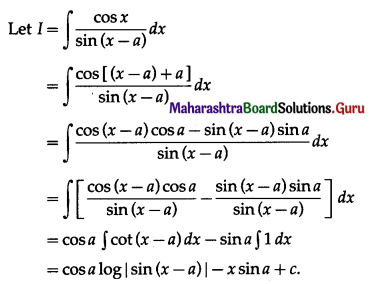
Question 2.
\(\frac{\cos x}{\sin (x-a)}\)
Solution:
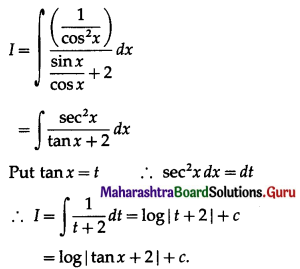
Maharashtra Board 12th Maths Solutions Chapter 3 Indefinite Integration Ex 3.2(A) II Q2

Maharashtra Board 12th Maths Solutions Chapter 3 Indefinite Integration Ex 3.2(A)

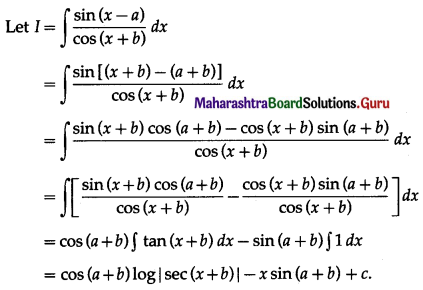
Question 3.
\(\frac{\sin (x-a)}{\cos (x+b)}\)
Solution:
Maharashtra Board 12th Maths Solutions Chapter 3 Indefinite Integration Ex 3.2(A) II Q3

Question 4.
\(\frac{1}{\sin x \cdot \cos x+2 \cos ^{2} x}\)
Solution:
Let I = \(\int \frac{1}{\sin x \cdot \cos x+2 \cos ^{2} x} d x\)
Dividing numerator and denominator of cos2x, we get
Maharashtra Board 12th Maths Solutions Chapter 3 Indefinite Integration Ex 3.2(A) II Q4

Question 5.
\(\frac{\sin x+2 \cos x}{3 \sin x+4 \cos x}\)
Solution:
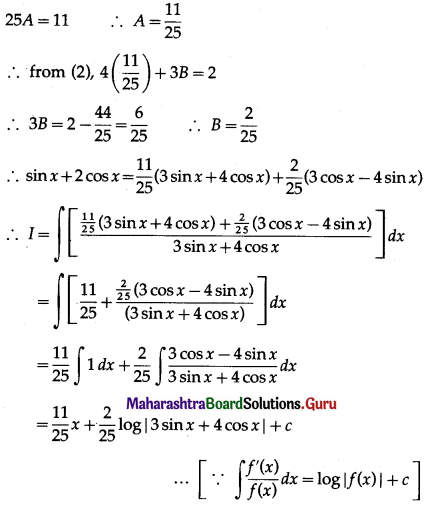
Let I = \(\int \frac{\sin x+2 \cos x}{3 \sin x+4 \cos x} d x\)
Put, Numerator = A (Denominator) + B [\(\frac{d}{d x}\) (Denominator)]
∴ sin x+ 2 cos x = A(3 sin x + 4 cos x) + B [\(\frac{d}{d x}\) (3 sin x + 4 cos x)]
= A(3 sin x + 4 cos x) + B (3 cos x – 4 sin x)
∴ sin x + 2 cos x = (3A – 4B) sin x + (4A + 3B) cos x
Equating the coefficients of sin x and cos x on both the sides, we get
3A – 4B = 1 …… (1)
and 4A + 3B = 2 …… (2)
Multiplying equation (1) by 3 and equation (2) by 4, we get
9A – 12B = 3
16A + 12B = 8
On adding, we get
Maharashtra Board 12th Maths Solutions Chapter 3 Indefinite Integration Ex 3.2(A) II Q5

Question 6.
\(\frac{1}{2+3 \tan x}\)
Solution:
Let I = \(\int \frac{1}{2+3 \tan x} d x\)
Maharashtra Board 12th Maths Solutions Chapter 3 Indefinite Integration Ex 3.2(A) II Q6
Numerator = A (Denominator) + B [\(\frac{d}{d x}\) (Denominator)]
∴ cos x = A(2 cos x + 3 sin x) + B [\(\frac{d}{d x}\) (2 cos x + 3 sin x)]
= A (2 cos x + 3 sin x) + B (-2 sin x + 3 cos x)
∴ cos x = (2A + 3B) cos x + (3A – 2B) sin x
Equating the coefficients of cosx and sinx on both the sides, we get
2A + 3B = 1 …… (1)
and 3A – 2B = 0 ……. (2)
Multiplying equation (1) by 2 and equation (2) by 3, we get
4A + 6B = 2
9A – 6B = 0
On adding, we get
Maharashtra Board 12th Maths Solutions Chapter 3 Indefinite Integration Ex 3.2(A) II Q6.1

Maharashtra Board 12th Maths Solutions Chapter 3 Indefinite Integration Ex 3.2(A)

Question 7.
\(\frac{4 e^{x}-25}{2 e^{x}-5}\)
Solution:
Let I = \(\int \frac{4 e^{x}-25}{2 e^{x}-5} d x\)
Put, Numerator = A (Denominator) + B [\(\frac{d}{d x}\) (Denominator)]
∴ 4ex – 25 = A(2ex – 5) + B[\(\frac{d}{d x}\) (2ex – 5)]
= A(2ex – 5) + B(2ex – 0)
∴ 4ex – 25 = (2A + 2B) ex – 5A
Equating the coefficient of ex and constant on both sides, we get
2A + 2B = 4 …….(1)
and 5A = 25
∴ A = 5
from (1), 2(5) + 2B = 4
∴ 2B = -6
∴ B = -3
Maharashtra Board 12th Maths Solutions Chapter 3 Indefinite Integration Ex 3.2(A) II Q7

Question 8.
\(\frac{20+12 e^{x}}{3 e^{x}+4}\)
Solution:
Maharashtra Board 12th Maths Solutions Chapter 3 Indefinite Integration Ex 3.2(A) II Q8
Maharashtra Board 12th Maths Solutions Chapter 3 Indefinite Integration Ex 3.2(A) II Q8.1

Question 9.
\(\frac{3 e^{2 x}+5}{4 e^{2 x}-5}\)
Solution:
Let I = \(\int \frac{3 e^{2 x}+5}{4 e^{2 x}-5} d x\)
Put, Numerator = A (Denominator) + B [\(\frac{d}{d x}\) (Denominator)]
∴ 3e2x + 5 = A(4e2x – 5) + B [\(\frac{d}{d x}\) (4e2x – 5)]
= A(4e2x – 5) + B(4 . e2x × 2 – 0)
∴ 3e2x + 5 = (4A + 8B) e2x – 5A
Equating the coefficient of e2x and constant on both sides, we get
4A + 8B = 3 …….. (1)
and -5A = 5
∴ A = -1
∴ from (1), 4(-1) + 8B = 3
∴ 8B = 7
∴ B = \(\frac{7}{8}\)
Maharashtra Board 12th Maths Solutions Chapter 3 Indefinite Integration Ex 3.2(A) II Q9

Question 10.
cos8 x . cot x
Solution:
Maharashtra Board 12th Maths Solutions Chapter 3 Indefinite Integration Ex 3.2(A) II Q10

Question 11.
tan5x
Solution:
Let I = ∫ tan5x dx
Maharashtra Board 12th Maths Solutions Chapter 3 Indefinite Integration Ex 3.2(A) II Q11

Question 12.
cos7x
Solution:
Maharashtra Board 12th Maths Solutions Chapter 3 Indefinite Integration Ex 3.2(A) II Q12

Maharashtra Board 12th Maths Solutions Chapter 3 Indefinite Integration Ex 3.2(A)

Question 13.
tan 3x tan 2x tan x
Solution:
Let I = ∫ tan 3x tan 2x tan x dx
Consider tan 3x = tan (2x + x) = \(\frac{\tan 2 x+\tan x}{1-\tan 2 x \tan x}\)
tan 3x (1 – tan 2x tan x) = tan 2x + tan x
tan 3x – tan 3x tan 2x tan x = tan 2x + tan x
tan 3x – tan 2x – tan x = tan 3x tan 2x tan x
I = ∫(tan 3x – tan 2x – tan x) dx
= ∫tan3x dx – ∫tan 2x dx – ∫tan x dx
= \(\frac{1}{3}\) log | sec 3x| – \(\frac{1}{2}\) log |sec 2x| – log |sec x| + c.

Question 14.
sin5x cos8x
Solution:
Maharashtra Board 12th Maths Solutions Chapter 3 Indefinite Integration Ex 3.2(A) II Q14

Question 15.
\(3^{\cos ^{2} x \cdot} \sin 2 x\)
Solution:
Maharashtra Board 12th Maths Solutions Chapter 3 Indefinite Integration Ex 3.2(A) II Q15

Question 16.
\(\frac{\sin 6 x}{\sin 10 x \sin 4 x}\)
Solution:
Maharashtra Board 12th Maths Solutions Chapter 3 Indefinite Integration Ex 3.2(A) II Q16

Maharashtra Board 12th Maths Solutions Chapter 3 Indefinite Integration Ex 3.2(A)

Question 17.
\(\frac{\sin x \cos ^{3} x}{1+\cos ^{2} x}\)
Solution:
Maharashtra Board 12th Maths Solutions Chapter 3 Indefinite Integration Ex 3.2(A) II Q17
Maharashtra Board 12th Maths Solutions Chapter 3 Indefinite Integration Ex 3.2(A) II Q17.1

12th Maharashtra State Board Maths Solutions Pdf Part 2

Indefinite Integration Class 12 Maths 2 Exercise 3.1 Solutions Maharashtra Board

Balbharti 12th Maharashtra State Board Maths Solutions Book Pdf Chapter 3 Indefinite Integration Ex 3.1 Questions and Answers.

12th Maths Part 2 Indefinite Integration Exercise 3.1 Questions And Answers Maharashtra Board

I. Integrate the following functions w.r.t. x:

(i) x3 + x2 – x + 1
Solution:
Maharashtra Board 12th Maths Solutions Chapter 3 Indefinite Integration Ex 3.1 I (i)

(ii) \(x^{2}\left(1-\frac{2}{x}\right)^{2}\)
Solution:
Maharashtra Board 12th Maths Solutions Chapter 3 Indefinite Integration Ex 3.1 I (ii)

(iii) \(3 \sec ^{2} x-\frac{4}{x}+\frac{1}{x \sqrt{x}}-7\)
Solution:
Maharashtra Board 12th Maths Solutions Chapter 3 Indefinite Integration Ex 3.1 I (iii)

(iv) \(2 x^{3}-5 x+\frac{3}{x}+\frac{4}{x^{5}}\)
Solution:
Maharashtra Board 12th Maths Solutions Chapter 3 Indefinite Integration Ex 3.1 I (iv)

Maharashtra Board 12th Maths Solutions Chapter 3 Indefinite Integration Ex 3.1

(v) \(\frac{3 x^{3}-2 x+5}{x \sqrt{x}}\)
Solution:
Maharashtra Board 12th Maths Solutions Chapter 3 Indefinite Integration Ex 3.1 I (v)
Maharashtra Board 12th Maths Solutions Chapter 3 Indefinite Integration Ex 3.1 I (v).1

II. Evaluate:

(i) ∫tan2 x . dx
Solution:
Maharashtra Board 12th Maths Solutions Chapter 3 Indefinite Integration Ex 3.1 II (i)

(ii) \(\int \frac{\sin 2 x}{\cos x} \cdot d x\)
Solution:
Maharashtra Board 12th Maths Solutions Chapter 3 Indefinite Integration Ex 3.1 II (ii)

(iii) \(\int \frac{\sin x}{\cos ^{2} x} \cdot d x\)
Solution:
Maharashtra Board 12th Maths Solutions Chapter 3 Indefinite Integration Ex 3.1 II (iii)

Maharashtra Board 12th Maths Solutions Chapter 3 Indefinite Integration Ex 3.1

(iv) \(\int \frac{\cos 2 x}{\sin ^{2} x} \cdot d x\)
Solution:
Maharashtra Board 12th Maths Solutions Chapter 3 Indefinite Integration Ex 3.1 II (iv)

(v) \(\int \frac{\cos 2 x}{\sin ^{2} x \cdot \cos ^{2} x} \cdot d x\)
Solution:
Maharashtra Board 12th Maths Solutions Chapter 3 Indefinite Integration Ex 3.1 II (v)
= -cot x – tan x + c

(vi) \(\int \frac{\sin x}{1+\sin x} \cdot d x\)
Solution:
Maharashtra Board 12th Maths Solutions Chapter 3 Indefinite Integration Ex 3.1 II (vi)

(vii) \(\int \frac{\tan x}{\sec x+\tan x} \cdot d x\)
Solution:
Maharashtra Board 12th Maths Solutions Chapter 3 Indefinite Integration Ex 3.1 II (vii)

(viii) \(\int \sqrt{1+\sin 2 x} \cdot d x\)
Solution:
Maharashtra Board 12th Maths Solutions Chapter 3 Indefinite Integration Ex 3.1 II (viii)

Maharashtra Board 12th Maths Solutions Chapter 3 Indefinite Integration Ex 3.1

(ix) \(\int \sqrt{1-\cos 2 x} \cdot d x\)
Solution:
Maharashtra Board 12th Maths Solutions Chapter 3 Indefinite Integration Ex 3.1 II (ix)

(x) ∫sin 4x cos 3x dx
Solution:
Maharashtra Board 12th Maths Solutions Chapter 3 Indefinite Integration Ex 3.1 II (x)

III. Evaluate:

(i) \(\int \frac{x}{x+2} \cdot d x\)
Solution:
Maharashtra Board 12th Maths Solutions Chapter 3 Indefinite Integration Ex 3.1 III (i)

(ii) \(\int \frac{4 x+3}{2 x+1} \cdot d x\)
Solution:
Maharashtra Board 12th Maths Solutions Chapter 3 Indefinite Integration Ex 3.1 III (ii)

(iii) \(\int \frac{5 x+2}{3 x-4} \cdot d x\)
Solution:
Maharashtra Board 12th Maths Solutions Chapter 3 Indefinite Integration Ex 3.1 III (iii)

Maharashtra Board 12th Maths Solutions Chapter 3 Indefinite Integration Ex 3.1

(iv) \(\int \frac{x-2}{\sqrt{x+5}} \cdot d x\)
Solution:
Maharashtra Board 12th Maths Solutions Chapter 3 Indefinite Integration Ex 3.1 III (iv)

(v) \(\int \frac{2 x-7}{\sqrt{4 x-1}} \cdot d x\)
Solution:
Maharashtra Board 12th Maths Solutions Chapter 3 Indefinite Integration Ex 3.1 III (v)
Maharashtra Board 12th Maths Solutions Chapter 3 Indefinite Integration Ex 3.1 III (v).1

(vi) \(\int \frac{\sin 4 x}{\cos 2 x} \cdot d x\)
Solution:
Maharashtra Board 12th Maths Solutions Chapter 3 Indefinite Integration Ex 3.1 III (vi)

(vii) \(\int \sqrt{1+\sin 5 x} \cdot d x\)
Solution:
Maharashtra Board 12th Maths Solutions Chapter 3 Indefinite Integration Ex 3.1 III (vii)

Maharashtra Board 12th Maths Solutions Chapter 3 Indefinite Integration Ex 3.1

(viii) ∫cos2 x . dx
Solution:
Maharashtra Board 12th Maths Solutions Chapter 3 Indefinite Integration Ex 3.1 III (viii)

(ix) \(\int \frac{2}{\sqrt{x}-\sqrt{x+3}} \cdot d x\)
Solution:
Maharashtra Board 12th Maths Solutions Chapter 3 Indefinite Integration Ex 3.1 III (ix)

(x) \(\int \frac{3}{\sqrt{7 x-2}-\sqrt{7 x-5}} \cdot d x\)
Solution:
Maharashtra Board 12th Maths Solutions Chapter 3 Indefinite Integration Ex 3.1 III (x)

Maharashtra Board 12th Maths Solutions Chapter 3 Indefinite Integration Ex 3.1

IV.

Question 1.
If f'(x) = x – \(\frac{3}{x^{3}}\), f(1) = \(\frac{11}{2}\), find f(x).
Solution:
By the definition of integral,
Maharashtra Board 12th Maths Solutions Chapter 3 Indefinite Integration Ex 3.1 IV

12th Maharashtra State Board Maths Solutions Pdf Part 2

Applications of Derivatives Class 12 Maths 2 Miscellaneous Exercise 2 Solutions Maharashtra Board

Balbharti 12th Maharashtra State Board Maths Solutions Book Pdf Chapter 2 Applications of Derivatives Miscellaneous Exercise 2 Questions and Answers.

12th Maths Part 2 Applications of Derivatives Miscellaneous Exercise 2 Questions And Answers Maharashtra Board

I. Choose the correct option from the given alternatives:

Question 1.
If the function f(x) = ax3 + bx2 + 11x – 6 satisfies conditions of Rolle’s theorem in [1, 3] and f'(2 + \(\frac{1}{\sqrt{3}}\)) = 0, then values of a and b are respectively.
(a) 1, -6
(b) -2, 1
(c) -1, -6
(d) -1, 6
Answer:
(a) 1, -6

Hint: f(x) = ax3 + bx2 + 11x – 6 satisfies the conditions of Rolle’s theorem in [1, 3]
∴ f(1) = f(3)
a(1)3 + b(1)2 + 11(1) – 6 = a(3)3 + b(3)2 + 11(3) – 6
a + b + 11 = 27a + 9b + 33
26a + 8b = -22
13a + 4b = -11
Only a = 1, b = -6 satisfy this equation.

Question 2.
If f(x) = \(\frac{x^{2}-1}{x^{2}+1}\), for every real x, then the minimum value of f is
(a) 1
(b) 0
(c) -1
(d) 2
Answer:
(c) -1

Maharashtra Board 12th Maths Solutions Chapter 2 Applications of Derivatives Miscellaneous Exercise 2

Question 3.
A ladder 5 m in length is resting against a vertical wall. The bottom of the ladder is pulled along the ground away from the wall at the rate of 1.5 m/sec. The length of the higher point of the ladder when the foot of the ladder is 4.0 m away from the wall decreases at the rate of
(a) 1
(b) 2
(c) 2.5
(d) 3
Answer:
(b) 2

Question 4.
Let f(x) and g(x) be differentiable for 0 < x < 1 such that f(0) = 0, g(0) = 0, f(1) = 6. Let there exist a real number c in (0, 1) such that f'(c) = 2g'(c), then the value of g(1) must be
(a) 1
(b) 3
(c) 2.5
(d) -1
Answer:
(b) 3

Hint: f(x) and g(x) both satisfies the conditions of LMVT in (0, 1).
∴ f'(c) = \(\frac{f(1)-f(0)}{1-0}=\frac{6-0}{1}=6\)
and g'(c) = \(\frac{g(1)-g(0)}{1-0}=\frac{g(1)-0}{1}\) = g(1)
But f'(c) = 2g'(c)
6 = 2g(1)
∴ g(1) = 3

Question 5.
Let f(x) = x3 – 6x2 + 9x + 18, then f(x) is strictly decreasing in
(a) (-∞, 1)
(b) [3, ∞)
(c) (-∞, 1] ∪ [3, ∞)
(d) (1, 3)
Answer:
(d) (1, 3)

Question 6.
If x = -1 and x = 2 are the extreme points of y = α log x + βx2 + x, then
(a) α = -6, β = \(\frac{1}{2}\)
(b) α = -6, β = \(\frac{-1}{2}\)
(c) α = 2, β = \(\frac{-1}{2}\)
(d) α = 2, β = \(\frac{1}{2}\)
Answer:
(c) α = 2, β = \(\frac{-1}{2}\)

Hint: y = α log x + βx2 + x
∴ \(\frac{d y}{d x}=\frac{\alpha}{x}+\beta \times 2 x+1=\frac{\alpha}{x}+2 \beta x+1\)
f(x) has extreme values at x = -1 and x = 2
∴ f'(-1) = 0 and f(2) = 0
α + 2β = 1
and \(\frac{\alpha}{2}\) + 4β = -1
By solving these two equations, we get
α = 2, β = \(\frac{-1}{2}\)

Maharashtra Board 12th Maths Solutions Chapter 2 Applications of Derivatives Miscellaneous Exercise 2

Question 7.
The normal to the curve x2 + 2xy – 3y2 = 0 at (1, 1)
(a) meets the curve again in the second quadrant
(b) does not meet the curve again
(c) meets the curve again in the third quadrant
(d) meets the curve again in the fourth quadrant
Answer:
(d) meets the curve again in fourth quadrant

Hint: x2 + 2xy – 3y2 = 0
Maharashtra Board 12th Maths Solutions Chapter 2 Applications of Derivatives Miscellaneous Exercise 2 I Q7
= slope of the tangent at (1, 1)
∴ equation of the tangent at (1, 1) is -1
∴ equation of the normal is
y – 1= -1 (x – 1) = -x + 1
∴ x + y = 2
∴ y = 2 – x
Substituting y = 2 – x in x2 + 2xy – 3y2 = 0, we get
x2 + 2x(2 – x) – 3 (2 – x)2 = 0
⇒ x2 + 4x – 2x2 – 3(4 – 4x + x2) = 0
⇒ x2 – 4x + 3 = 0
⇒ (x – 1)(x – 3) = 0
⇒ x = 1, x = 3
When x = 1, y = 2 – 1 = 1
When x = 3, y = 2 – 3 = -1
∴ the normal at (1, 1) meets the curve at (3, -1) which is in the fourth quadrant.

Question 8.
The equation of the tangent to the curve y = 1 – \(e^{\frac{x}{2}}\) at the point of intersection with Y-axis is
(a) x + 2y = 0
(b) 2x + y = 0
(c) x – y = 2
(d) x + y = 2
Answer:
(a) x + 2y = 0
Hint: The point of intersection of the curve with the Y-axis is the origin (0, 0).

Question 9.
If the tangent at (1, 1) on y2 = x(2 – x)2 meets the curve again at P, then P is
(a) (4, 4)
(b) (-1, 2)
(c) (3, 6)
(d) \(\left(\frac{9}{4}, \frac{3}{8}\right)\)
Answer:
(d) \(\left(\frac{9}{4}, \frac{3}{8}\right)\)
Hint: y2 = x(2 – x)2
= x(4 – 4x + x2)
= x3 – 4x2 + 4x
Maharashtra Board 12th Maths Solutions Chapter 2 Applications of Derivatives Miscellaneous Exercise 2 I Q9
= slope of the tangent at (1, 1)
∴ equation of the tangent at (1, 1) is
y – 1 = –\(\frac{1}{2}\) (x – 1)
∴ 2y – 2 = -x + 1
∴ x + 2y = 3
Only the coordinates \(\left(\frac{9}{4}, \frac{3}{8}\right)\) satisfy both the equations y2 = x(2 – x)2 and x + 2y = 3
∴ P is \(\left(\frac{9}{4}, \frac{3}{8}\right)\)

Maharashtra Board 12th Maths Solutions Chapter 2 Applications of Derivatives Miscellaneous Exercise 2

Question 10.
The approximate value of tan (44° 30′), given that 1° = 0.0175, is
(a) 0.8952
(b) 0.9528
(c) 0.9285
(d) 0.9825
Answer:
(d) 0.9825

II. Solve the following:

Question 1.
If the curves ax2 + by2 = 1 and a’x2 + b’y2 = 1, intersect orthogonally, then prove that \(\frac{1}{a}-\frac{1}{b}=\frac{1}{a^{\prime}}-\frac{1}{b^{\prime}}\)
Solution:
Let P(x1, y1) be the point of intersection of the curves.
Maharashtra Board 12th Maths Solutions Chapter 2 Applications of Derivatives Miscellaneous Exercise 2 II Q1
Maharashtra Board 12th Maths Solutions Chapter 2 Applications of Derivatives Miscellaneous Exercise 2 II Q1.1

Question 2.
Determine the area of the triangle formed by the tangent to the graph of the function y = 3 – x2 drawn at the point (1, 2) and the coordinate axes.
Solution:
y = 3 – x2
Maharashtra Board 12th Maths Solutions Chapter 2 Applications of Derivatives Miscellaneous Exercise 2 II Q2
= slope of the tangent at (1, 2)
∴ equation of the tangent at (1, 2) is
y – 2= -2(x – 1)
⇒ y – 2= -2x + 2
⇒ 2x + y = 4
Let this tangent cuts the coordinate axes at A(a, 0) and B(0, b).
∴ 2a + 0 = 4 and 2(0) + b = 4
∴ a = 2 and b = 4
∴ area of required triangle = \(\frac{1}{2}\) × l(OA) × l(OB)
= \(\frac{1}{2}\) ab
= \(\frac{1}{2}\) (2)(4)
= 4 sq units.

Maharashtra Board 12th Maths Solutions Chapter 2 Applications of Derivatives Miscellaneous Exercise 2

Question 3.
Find the equation of the tangent and normal drawn to the curve y4 – 4x4 – 6xy = 0 at the point M (1, 2).
Solution:
y4 – 4x4 – 6xy = 0
Differentiating both sides w.r.t. x, we get
Maharashtra Board 12th Maths Solutions Chapter 2 Applications of Derivatives Miscellaneous Exercise 2 II Q3
= slope of the tangent at (1, 2)
∴ the equation of normal at M (1, 2) is
y – 2 = \(\frac{14}{13}\) (x – 1)
∴ 13y – 26 = 14x – 14
∴ 14x – 13y + 12 = 0
The slope of normal at (1, 2)
\(=\frac{-1}{\left(\frac{d y}{d x}\right)_{\mathrm{at}(1,2)}}=\frac{-1}{\left(\frac{14}{13}\right)}=-\frac{13}{14}\)
∴ the equation of normal at M (1, 2) is
y – 2 = \(\frac{-13}{14}\) (x – 1)
14y – 28 = -13x + 13
13x + 14y – 41 = 0
Hence, the equations of tangent and normal are 14x – 13y + 12 = 0 and 13x + 14y – 41 = 0 respectively.

Question 4.
A water tank in the form of an inverted cone is being emptied at the rate of 2 cubic feet per second. The height of the cone is 8 feet and the radius is 4 feet. Find the rate of change of the water level when the depth is 6 feet.
Solution:
Maharashtra Board 12th Maths Solutions Chapter 2 Applications of Derivatives Miscellaneous Exercise 2 II Q4
Let r be the radius of the base, h be the height and V be the volume of the water level at any time t.
Since, the height of the cone is 8 feet and the radius is 4 feet,
\(\frac{r}{h}=\frac{4}{8}=\frac{1}{2}\)
r = \(\frac{h}{2}\) ……..(1)
Maharashtra Board 12th Maths Solutions Chapter 2 Applications of Derivatives Miscellaneous Exercise 2 II Q4.1
Hence, the rate of change of water level is \(\left(\frac{2}{9 \pi}\right)\) ft/sec.

Maharashtra Board 12th Maths Solutions Chapter 2 Applications of Derivatives Miscellaneous Exercise 2

Question 5.
Find all points on the ellipse 9x2 + 16y2 = 400, at which the y-coordinate is decreasing and the x-coordinate is increasing at the same rate.
Solution:
Let P(x1, y1) be the point on the ellipse 9x2 + 16y2 = 400 whose y-coordinate decreasing x-coordinate is increasing at the same rate.
Maharashtra Board 12th Maths Solutions Chapter 2 Applications of Derivatives Miscellaneous Exercise 2 II Q5
Maharashtra Board 12th Maths Solutions Chapter 2 Applications of Derivatives Miscellaneous Exercise 2 II Q5.1

Question 6.
Verify Rolle’s theorem for the function f(x) = \(\frac{2}{e^{x}+e^{-x}}\) on [-1, 1].
Solution:
The functions ex, e-x, and 2 are continuous and differentiable in their respective domains.
∴ f(x) = \(\frac{2}{e^{x}+e^{-x}}\) is continuous on [-1, 1] and differentiable on (-1, 1), because ex + e-x ≠ 0 for all x ∈ [-1, 1].
Now, f(-1) = \(\frac{2}{e^{-1}+e}=\frac{2}{e+e^{-1}}\) and f(1) = \(\frac{2}{e+e^{-1}}\)
∴ f(-1) = f(1)
Thus, the function f satisfies all the conditions of the Rolle’s theorem.
∴ there exist c ∈ (-1, 1) such that f'(c) = 0
Now, f(x) = \(\frac{2}{e^{x}+e^{-x}}\)
Maharashtra Board 12th Maths Solutions Chapter 2 Applications of Derivatives Miscellaneous Exercise 2 II Q6
Hence, Rolle’s theorem is verified.

Question 7.
The position of a particle is given by the function s(t) = 2t2 + 3t – 4. Find the time t = c in the interval 0 ≤ f ≤ 4 when the instantaneous velocity of the particle is equal to its average velocity in this interval.
Solution:
s(t) = 2t2 + 3t – 4
∴ s(0) = 2(0)2 + 3(0) – 4 = -4
and s(4) = 2(4)2 + 3(4) – 4 = 32 + 12 – 4 = 40
∴ average velocity = \(\frac{s(4)-s(0)}{4-0}\)
= \(\frac{40-(-4)}{4}\)
= 11
Also, instantaneous velocity = \(\frac{d s}{d t}\)
= \(\frac{d}{d t}\) (2t2 + 3t – 4)
= 2 × 2t + 3 × 1 – 0
= 4t + 3
∴ instantaneous velocity at t = c is \(\left(\frac{d s}{d t}\right)_{t=c}\) = 4c + 3
When instantaneous velocity at t = c equal to its average velocity, we get
4c + 3 = 11
4c = 8
∴ c = 2 ∈ [0, 4]
Hence, t = c = 2.

Maharashtra Board 12th Maths Solutions Chapter 2 Applications of Derivatives Miscellaneous Exercise 2

Question 8.
Find the approximate value of the function f(x) = \(\sqrt{x^{2}+3 x}\) at x = 1.02.
Solution:
f(x) = \(\sqrt{x^{2}+3 x}\)
Maharashtra Board 12th Maths Solutions Chapter 2 Applications of Derivatives Miscellaneous Exercise 2 II Q8

Question 9.
Find the approximate value of cos-1(0.51), given π = 3.1416, \(\frac{2}{\sqrt{3}}\) = 1.1547.
Solution:
Let f(x) = cos-1 x
Maharashtra Board 12th Maths Solutions Chapter 2 Applications of Derivatives Miscellaneous Exercise 2 II Q9
The formula for approximation is f(a + h)= f(a) + h . f'(a)
∴ cos-1 (0.51) = f(0.51)
= f(0.5 + 0.01)
= f(0.5) + (0.01) f'(0.5)
= \(\frac{\pi}{3}\) + 0.01 × (-1.1547)
= \(\frac{3.1416}{3}\) – 0.011547
= 1.0472 – 0.011547
= 1.035653
∴ cos-1 (0.51) = 1.035653.

Question 10.
Find the intervals on which the function y = xx, (x > 0) is increasing and decreasing.
Solution:
y = xx
∴ log y = log xx = x log x
Differentiating both sides w.r.t. x, we get
Maharashtra Board 12th Maths Solutions Chapter 2 Applications of Derivatives Miscellaneous Exercise 2 II Q10
y is increasing if \(\frac{d y}{d x}\) ≥ 0
i.e. if xx (1 + log x) ≥ 0
i.e. if 1 + log x ≥ 0 ……[∵ x > 0]
i.e. if log x ≥ -1
i.e. if log x ≥ -log e …….[∵ log e = 1]
i.e. if logx ≥ log \(\frac{1}{e}\)
i.e. if x ≥ \(\frac{1}{e}\)
∴ y is increasing in \(\left[\frac{1}{e^{\prime}}, \infty\right)\)
y is decreasing if \(\frac{d y}{d x}\) ≤ 0
i.e. if xx (1 + log x) ≤ 0
i.e. if 1 + log x ≤ 0 ……[∵ x > 0]
i.e. if log x ≤ -1
i.e. if log x ≤ -log e
i.e. if log x ≤ log \(\frac{1}{e}\)
i.e. if x ≤ \(\frac{1}{e}\) where x > 0
∴ y is decreasing is \(\left(0, \frac{1}{e}\right]\)
Hence, the given function is increasing in \(\left[\frac{1}{e^{\prime}}, \infty\right)\) and decreasing in \(\left(0, \frac{1}{e}\right]\)

Maharashtra Board 12th Maths Solutions Chapter 2 Applications of Derivatives Miscellaneous Exercise 2

Question 11.
Find the intervals on which the function f(x) = \(\frac{x}{\log x}\) is increasing and decreasing.
Solution:
f(x) = \(\frac{x}{\log x}\)
Maharashtra Board 12th Maths Solutions Chapter 2 Applications of Derivatives Miscellaneous Exercise 2 II Q11
f is increasing if f'(x) ≥ 0
i.e. if \(\frac{\log x-1}{(\log x)^{2}}\) ≥ 0
i.e. if log x – 1 ≥ 0 ……..[∵ (log x)2 > 0]
i.e. if log x ≥ 1
i.e. if log x ≥ log e ………[∵ log e = 1]
i.e. if x ≥ e
∴ f is increasing on [e, ∞)
f is decreasing if f'(x) ≤ 0
i.e. if \(\frac{\log x-1}{(\log x)^{2}}\) ≤ 0
i.e. if log x – 1 ≤ 0 ……..[∵ (log x)2 > 0]
i.e. if log x ≤ 1
i.e. if log x ≤ log e
i.e. if x ≤ e
Also, x > 0 and x ≠ 1 because f(x) = \(\frac{x}{\log x}\) is not defined at x = 1.
∴ f is decreasing in (0, e] – {1}
Hence, f is increasing in [e, ∞) and decreasing in (0, e] – {1}.

Question 12.
An open box with a square base is to be made out of the given quantity of sheet of area a2. Show that the maximum volume of the box is \(\frac{a^{3}}{6 \sqrt{3}}\).
Solution:
Let x be the side of square base and h be the height of the box.
Then x2 + 4xh = a2
∴ h = \(\frac{a^{2}-x^{2}}{4 x}\) …….(1)
Let V be the volume of the box.
Then V = x2h
Maharashtra Board 12th Maths Solutions Chapter 2 Applications of Derivatives Miscellaneous Exercise 2 II Q12
Maharashtra Board 12th Maths Solutions Chapter 2 Applications of Derivatives Miscellaneous Exercise 2 II Q12.1
Hence, the maximum volume of the box is \(\frac{a^{3}}{6 \sqrt{3}}\) cu units.

Maharashtra Board 12th Maths Solutions Chapter 2 Applications of Derivatives Miscellaneous Exercise 2

Question 13.
Show that of all rectangles inscribed in a given circle, the square has the maximum area.
Solution:
Maharashtra Board 12th Maths Solutions Chapter 2 Applications of Derivatives Miscellaneous Exercise 2 II Q13
Let ABCD be a rectangle inscribed in a circle of radius r.
Let AB = x and BC = y.
Then x2 + y2 = 4r2 …….(1)
Area of rectangle = xy
= \(x \sqrt{4 r^{2}-x^{2}}\) ……[By (1)]
Let f(x) = x2(4r2 – x2)
= 4r2x2 – x4
∴ f'(x) = \(\frac{d}{d x}\) (4r2x2 – x4)
= 4r2 × 2x – 4x3
= 8r2x – 4x3
and f”(x) = \(\frac{d}{d x}\) (8r2x – 4x3)
= 8r2 × 1 – 4 × 3x2
= 8r2 – 12x2
For maximum area, f'(x) = 0
⇒ 8r2x – 4x3 = 0
⇒ 4x3 = 8r2x
⇒ x2 = 2r2 ……..[∵ x ≠ 0]
⇒ x = √2r …..[x > 0]
and f”(√2r) = 8r2 – 12(√2r)2 = -16r2 < 0
∴ f(x) is maximum when x = √2r
If x = √2r, then from (1),
(√2r)2 + y2 = 4r2
⇒ y2 = 4r2 – 2r2 = 2r2
⇒ y = √2r ……[∵ y > 0]
⇒ x = y
∴ rectangle is a square.
Hence, amongst all rectangles inscribed in a circle, the square has maximum area.

Question 14.
Show that a closed right circular cylinder of a given surface area has maximum volume if its height equals the diameter of its base.
Solution:
Let r be the radius of the base, h be the height and V be the volume of the closed right circular cylinder, whose surface area is a2 sq units (which is given).
2πrh + 2πr2 = a2
⇒ 2πr(h + r) = a2
⇒ h = \(\frac{a^{2}}{2 \pi r}\) – r ……(1)
Maharashtra Board 12th Maths Solutions Chapter 2 Applications of Derivatives Miscellaneous Exercise 2 II Q14
Maharashtra Board 12th Maths Solutions Chapter 2 Applications of Derivatives Miscellaneous Exercise 2 II Q14.1
Hence, the volume of the cylinder is maximum if its height is equal to the diameter of the base.

Maharashtra Board 12th Maths Solutions Chapter 2 Applications of Derivatives Miscellaneous Exercise 2

Question 15.
A window is in the form of a rectangle surmounted by a semicircle. If the perimeter is 30 m, find the dimensions so that the greatest possible amount of light may be admitted.
Solution:
Maharashtra Board 12th Maths Solutions Chapter 2 Applications of Derivatives Miscellaneous Exercise 2 II Q15
Let x be the length, y be the breadth of the rectangle and r be the radius of the semicircle.
Then perimeter of the window = x + 2y + πr, where x = 2r
This is given to be 30 m
⇒ 2r + 2y + πr = 30
⇒ 2y = 30 – (π + 2)r
⇒ y = 15 – \(\frac{(\pi+2) r}{2}\) ……..(1)
The greatest possible amount of light may be admitted if the area of the window is maximized.
Let A be the area of the window.
Maharashtra Board 12th Maths Solutions Chapter 2 Applications of Derivatives Miscellaneous Exercise 2 II Q15.1
Maharashtra Board 12th Maths Solutions Chapter 2 Applications of Derivatives Miscellaneous Exercise 2 II Q15.2
Hence, the required dimensions of the window are as follows:
Length of rectangle = \(\left(\frac{60}{\pi+4}\right)\) metres
breadth of rectangle = \(\left(\frac{30}{\pi+4}\right)\) metres
radius of the semicircle = \(\left(\frac{30}{\pi+4}\right)\) metres

Question 16.
Show that the height of a right circular cylinder of greatest volume that can be inscribed in a right circular cone is one-third of that of the cone.
Solution:
Maharashtra Board 12th Maths Solutions Chapter 2 Applications of Derivatives Miscellaneous Exercise 2 II Q16
Given the right circular cone of fixed height h and semi-vertical angle a.
Let R be the radius of the base and H be the height of the right circular cylinder that can be inscribed in the right circular cone.
In the figure, ∠GAO = α, OG = r, OA = h, OE = R, CE = H.
We have, \(\frac{r}{h}\) = tan α
∴ r = h tan α ……(1)
Since ∆AOG and ∆CEG are similar.
Maharashtra Board 12th Maths Solutions Chapter 2 Applications of Derivatives Miscellaneous Exercise 2 II Q16.1
Maharashtra Board 12th Maths Solutions Chapter 2 Applications of Derivatives Miscellaneous Exercise 2 II Q16.2
Maharashtra Board 12th Maths Solutions Chapter 2 Applications of Derivatives Miscellaneous Exercise 2 II Q16.3
Hence, the height of the right circular cylinder is one-third of that of the cone.

Maharashtra Board 12th Maths Solutions Chapter 2 Applications of Derivatives Miscellaneous Exercise 2

Question 17.
A wire of length l is cut into two parts. One part is bent into a circle and the other into a square. Show that the sum of the areas of the circle and the square is the least if the radius of the circle is half of the side of the square.
Solution:
Let r be the radius of the circle and x be the length of the side of the square. Then
(circumference of the circle) + (perimeter of the square) = l
∴ 2πr + 4x = l
∴ r = \(\frac{l-4 x}{2 \pi}\)
A = (area of the circle) + (area of the square)
= πr2 + x2
Maharashtra Board 12th Maths Solutions Chapter 2 Applications of Derivatives Miscellaneous Exercise 2 II Q17
This shows that the sum of the areas of circle and square is least when the radius of the circle = (\(\frac{1}{2}\)) side of the square.

Question 18.
A rectangular sheet of paper of fixed perimeter with the sides having their lengths in the ratio 8 : 15 converted into an open rectangular box by folding after removing the squares of the equal area from all comers. If the total area of the removed squares is 100, the resulting box has maximum volume. Find the lengths of the rectangular sheet of paper.
Solution:
Maharashtra Board 12th Maths Solutions Chapter 2 Applications of Derivatives Miscellaneous Exercise 2 II Q18
The sides of the rectangular sheet of paper are in the ratio 8 : 15.
Let the sides of the rectangular sheet of paper be 8k and 15k respectively.
Let x be the side of the square which is removed from the comers of the sheet of paper.
The total area of removed squares is 4x2, which is given to be 100.
4x2 = 100
⇒ x2 = 25
⇒x = 5 ……[x > 0]
Now, the length, breadth, and height of the rectangular box are 15k – 2x, 8k – 2x, and x respectively.
Let V be the volume of the box.
Then V = (15k – 2x) (8k – 2x) . x
⇒ V = (120k2 – 16kx – 30kx + 4x2) . x
⇒ V = 4x3 – 46kx2 + 120k2x
\(\frac{d V}{d x}=\frac{d}{d x}\) (4x3 – 46kx2 + 120k2x)
= 4 × 3x2 – 46k × 2x + 120k2 × 1
= 12x2 – 92kx + 120k2
Since, volume is maximum when the square of side x = 5 is removed from the corners,
\(\left(\frac{d V}{d x}\right)_{\text {at } x=5}=0\)
⇒ 12(5)2 – 92k(5) + 120k2 = 0
⇒ 60 – 92k + 24k2 = 0
⇒ 6k2 – 23k + 15 = 0
⇒ 6k2 – 18k – 5k + 15 = 0
⇒ 6k(k – 3) – 5 (k – 3) = 0
⇒ (k – 3)(6k – 5) = 0
⇒ k = 3 or k = \(\frac{5}{6}\)
If k = \(\frac{5}{6}\), then
8k – 2x = 8k – 10 < 0
∴ k ≠ \(\frac{5}{6}\)
∴ k = 3
∴ 8k = 8 × 3 = 24 and 15k = 15 × 3 = 45
Hence, the lengths of the rectangular sheet are 24 and 45.

Maharashtra Board 12th Maths Solutions Chapter 2 Applications of Derivatives Miscellaneous Exercise 2

Question 19.
Show that the altitude of the right circular cone of maximum volume that can be inscribed in a sphere of radius r is \(\frac{4 r}{3}\).
Solution:
Maharashtra Board 12th Maths Solutions Chapter 2 Applications of Derivatives Miscellaneous Exercise 2 II Q19
Let x be the radius of the base and h be the height of the cone which is inscribed in a sphere of radius r.
In the figure, AD = h and CD = x = BD
Since, ΔABD and ΔBDE are similar,
\(\frac{\mathrm{AD}}{\mathrm{BD}}=\frac{\mathrm{BD}}{\mathrm{DE}}\)
BD2 = AD . DE = AD (AE – AD)
x2 = h(2r – h) …… (1)
Let V be the volume of the cone.
Maharashtra Board 12th Maths Solutions Chapter 2 Applications of Derivatives Miscellaneous Exercise 2 II Q19.1
Maharashtra Board 12th Maths Solutions Chapter 2 Applications of Derivatives Miscellaneous Exercise 2 II Q19.2
∴ V is maximum when h = \(\frac{4 r}{3}\)
Hence, the altitude (i.e. height) of the right circular cone of maximum volume = \(\frac{4 r}{3}\).

Question 20.
Show that the height of the cylinder of maximum volume that can be inscribed in a sphere of radius R is \(\frac{2 R}{\sqrt{3}}\). Also, find the maximum Volume.
Solution:
Let R be the radius and h be the height of the cylinder which is inscribed in a sphere of radius r cm.
Then from the figure,
\(R^{2}+\left(\frac{h}{2}\right)^{2}=r^{2}\)
∴ R2 = r2 – \(\frac{h^{2}}{4}\) ………(1)
Let V be the volume of the cylinder.
Then V = πR2h
Maharashtra Board 12th Maths Solutions Chapter 2 Applications of Derivatives Miscellaneous Exercise 2 II Q20
Maharashtra Board 12th Maths Solutions Chapter 2 Applications of Derivatives Miscellaneous Exercise 2 II Q20.1
Maharashtra Board 12th Maths Solutions Chapter 2 Applications of Derivatives Miscellaneous Exercise 2 II Q20.2
Hence, the volume of the largest cylinder inscribed in a sphere of radius ‘r’ cm = \(\frac{4 R^{3}}{3 \sqrt{3}}\) cu cm.

Maharashtra Board 12th Maths Solutions Chapter 2 Applications of Derivatives Miscellaneous Exercise 2

Question 21.
Find the maximum and minimum values of the function f(x) = cos2x + sin x.
Solution:
f(x) = cos2x + sin x
∴ f'(x) = \(\frac{d}{d x}\) (cos2x + sin x)
= 2 cos x . \(\frac{d}{d x}\) (cos x) + cos x
= 2 cos x(-sin x) + cos x
= -sin 2x + cos x
and f”(x) = \(\frac{d}{d x}\) (-sin 2x + cos x)
= -cos 2x . \(\frac{d}{d x}\) (2x) – sin x
= -cos 2x × 2 – sin x
= -2 cos 2x – sin x
For extreme values of f(x), f'(x) = 0
-sin 2x + cos x = 0
-2 sin x cos x + cos x = 0
cos x (-2 sin x + 1) = 0
cos x = 0 or -2 sin x + 1 = 0
cos x = cos \(\frac{\pi}{2}\) or sin x = \(\frac{1}{2}\) = sin \(\frac{\pi}{6}\)
∴ x = \(\frac{\pi}{2}\) or x = \(\frac{\pi}{6}\)

(i) f”(\(\frac{\pi}{2}\)) = -2 cos π – sin \(\frac{\pi}{2}\)
= -2(-1) – 1
= 1 > 0
∴ by the second derivative test, f is minimum at x = \(\frac{\pi}{2}\) and minimum value of f at x = \(\frac{\pi}{2}\)
= f(\(\frac{\pi}{2}\))
= \(\cos ^{2} \frac{\pi}{2}+\sin \frac{\pi}{2}\)
= 0 + 1
= 1

Maharashtra Board 12th Maths Solutions Chapter 2 Applications of Derivatives Miscellaneous Exercise 2

(ii) f”(\(\frac{\pi}{6}\)) = \(-2 \cos \frac{\pi}{3}-\sin \frac{\pi}{6}\)
= \(-2\left(\frac{1}{2}\right)-\frac{1}{2}\)
= \(-\frac{3}{2}\) < 0
∴ by the second derivative test, f is maximum at x = \(\frac{\pi}{6}\) and maximum value of f at x = \(\frac{\pi}{6}\)
= f(\(\frac{\pi}{6}\))
= \(\cos ^{2} \frac{\pi}{6}+\sin \frac{\pi}{6}\)
= \(\left(\frac{\sqrt{3}}{2}\right)^{2}+\frac{1}{2}\)
= \(\frac{5}{4}\)
Hence, the maximum and minimum values of the function f(x) are \(\frac{5}{4}\) and 1 respectively.

12th Maharashtra State Board Maths Solutions Pdf Part 2