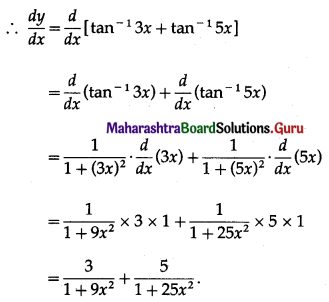
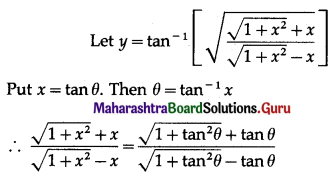
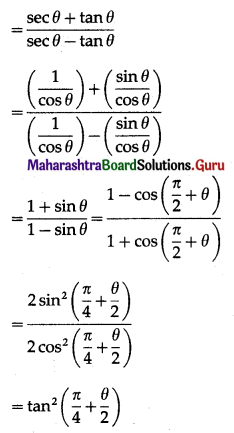
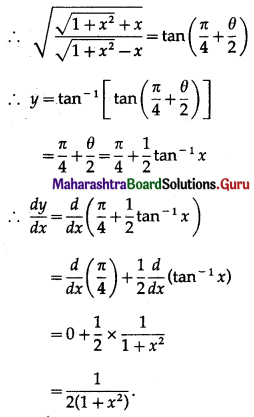
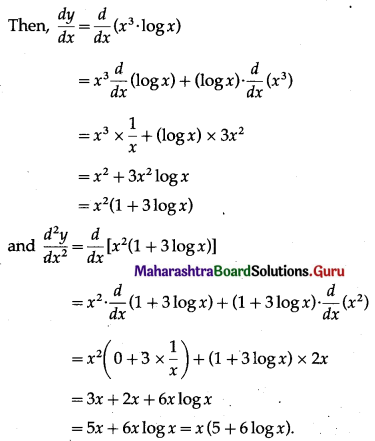
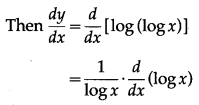
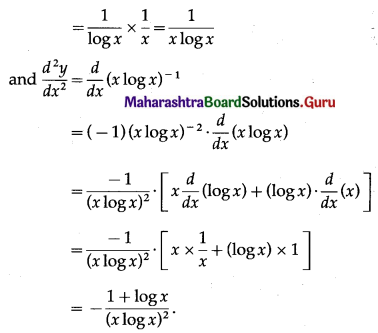
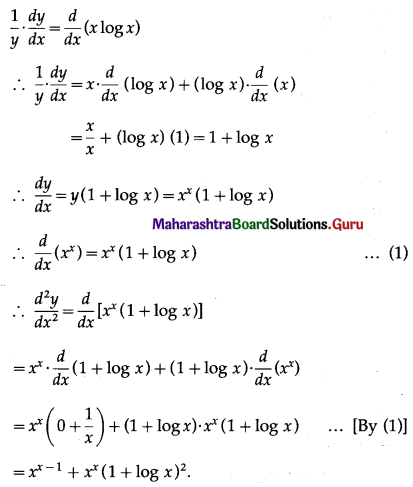
Applications of Derivatives Class 12 Maths 2 Exercise 2.4 Solutions Maharashtra Board

Balbharti 12th Maharashtra State Board Maths Solutions Book Pdf Chapter 2 Applications of Derivatives Ex 2.4 Questions and Answers.

12th Maths Part 2 Applications of Derivatives Exercise 2.4 Questions And Answers Maharashtra Board

Question 1.
Test whether the following functions are increasing or decreasing.
(i) f(x) = x3 – 6x2 + 12x – 16, x ∈ R.
Solution:
f(x) = x3 – 6x2 + 12x – 16
∴ f'(x) = \(\frac{d}{d x}\) (x3 – 6x2 + 12x – 16)
= 3x2 – 6 × 2x + 12 × 1 – 0
= 3x2 – 12x + 12
= 3(x2 – 4x + 4)
= 3(x – 2)2 ≥ 0 for all x ∈ R
∴ f(x) ≥ 0 for all x ∈ R
∴ f is increasing for all x ∈ R.

(ii) f(x) = 2 – 3x + 3x2 – x3, x ∈ R.
Solution:
f(x) = 2 – 3x + 3x2 – x3
∴ f'(x) = \(\frac{d}{d x}\) (2 – 3x + 3x2 – x3)
= 0 – 3 × 1 + 3 × 2x – 3x2
= -3 + 6x – 3x2
= -3(x2 – 2x + 1)
= -3(x – 1)2 ≤ 0 for all x ∈ R
∴ f'(x) ≤ 0 for all x ∈ R
∴ f is decreasing for all x ∈ R.

(iii) f(x) = x – \(\frac{1}{x}\), x ∈ R, x ≠ 0.
Solution:
f(x) = x – \(\frac{1}{x}\)
f'(x) = \(\frac{d}{d x}\left(x-\frac{1}{x}\right)=1-\left(\frac{-1}{x^{2}}\right)\)
= \(1+\frac{1}{x^{2}}\) > 0 for all x ∈ R, x ≠ 0
∴ f'(x) > 0 for all x ∈ R, where x ≠ 0
∴ f is increasing for all x ∈ R, where x ≠ 0.

Maharashtra Board 12th Maths Solutions Chapter 2 Applications of Derivatives Ex 2.4

Question 2.
Find the values of x for which the following functions are strictly increasing:
(i) f(x) = 2x3 – 3x2 – 12x + 6
Solution:
f(x) = 2x3 – 3x2 – 12x + 6
∴ f'(x) = \(\frac{d}{d x}\) (2x3 – 3x2 – 12x + 6)
= 2 × 3x2 – 3 × 2x – 12 × 1 + 0
= 6x2 – 6x – 12
= 6(x2 – x – 2)
f is strictly increasing if f'(x) > 0
i.e. if 6(x2 – x – 2) > 0
i.e. if x2 – x – 2 > 0
i.e. if x2 – x > 2
i.e. if x2 – x + \(\frac{1}{4}\) > 2 + \(\frac{1}{4}\)
i.e. if \(\left(x-\frac{1}{2}\right)^{2}>\frac{9}{4}\)
i.e. if x – \(\frac{1}{2}\) > \(\frac{3}{2}\) or x – \(\frac{1}{2}\) < \(\frac{-3}{2}\) i.e. if x > 2 or x < -1
∴ f is strictly increasing if x < -1 or x > 2.

(ii) f(x) = 3 + 3x – 3x2 + x3
Solution:
f(x) = 3 + 3x – 3x2 + x3
∴ f'(x) = \(\frac{d}{d x}\) (3 + 3x – 3x2 + x3)
= 0 + 3 × 1 – 3 × 2x + 3x2
= 3 – 6x + 3x2
= 3(x2 – 2x + 1)
f is strictly increasing if f'(x) > 0
i.e. if 3(x2 – 2x + 1) > 0
i.e. if x2 – 2x + 1 > 0
i.e. if (x – 1)2 > 0
This is possible if x ∈ R and x ≠ 1
i.e. x ∈ R – {1}
∴ f is strictly increasing if x ∈ R – {1}.

(iii) f(x) = x3 – 6x2 – 36x + 7
Solution:
f(x) = x3 – 6x2 – 36x + 7
∴ f'(x) = \(\frac{d}{d x}\) (x3 – 6x2 – 36x + 7)
= 3x2 – 6 × 2x – 36 × 1 + 0
= 3x2 – 12x – 36
= 3(x2 – 4x – 12)
f is strictly increasing if f'(x) > 0
i.e. if 3(x2 – 4x – 12) > 0
i.e. if x2 – 4x – 12 > 0
i.e. if x2 – 4x > 12
i.e. if x2 – 4x + 4 > 12 + 4
i.e. if (x – 2)2 > 16
i.e. if x – 2 > 4 or x – 2 < -4 i.e. if x > 6 or x < -2
∴ f is strictly increasing if x < -2 or x > 6.

Maharashtra Board 12th Maths Solutions Chapter 2 Applications of Derivatives Ex 2.4

Question 3.
Find the values of x for which the following functions are strictly decreasiong:
(i) f(x) = 2x3 – 3x2 – 12x + 6
Solution:
f(x) = 2x3 – 3x2 – 12x + 6
∴ f'(x) = \(\frac{d}{d x}\) (2x3 – 3x2 – 12x + 6)
= 2 × 3x2 – 3 × 2x – 12 × 1 + 0
= 6x2 – 6x – 12
= 6(x2 – x – 2)
f is strictly decreasing if f'(x) < 0
i.e. if 6(x2 – x – 2) < 0
i.e. if x2 – x – 2 < 0
i.e. if x2 – x < 2
i.e. if x2 – x + \(\frac{1}{4}\) < 2 + \(\frac{1}{4}\)
i.e. if \(\left(x-\frac{1}{2}\right)^{2}<\frac{9}{4}\)
i.e. if \(-\frac{3}{2}<x-\frac{1}{2}<\frac{3}{2}\)
i.e. if \(-\frac{3}{2}+\frac{1}{2}<x-\frac{1}{2}+\frac{1}{2}<\frac{3}{2}+\frac{1}{2}\)
i.e. if -1 < x < 2
∴ f is strictly decreasing if -1 < x < 2.

(ii) f(x) = x + \(\frac{25}{x}\)
Solution:
f(x) = x + \(\frac{25}{x}\), x ≠ 0
∴ f'(x) = \(\frac{d}{d x}\left(x+\frac{25}{x}\right)\)
= 1 + 25(-1) x-2
= 1 – \(\frac{25}{x^{2}}\)
f is is strictly decreasing if f'(x) < 0
i.e. if 1 – \(\frac{25}{x^{2}}\) < 0
i.e. if 1 < \(\frac{25}{x^{2}}\)
i.e. if x2 < 25
i.e. if -5 < x < 5, x ≠ 0
i.e. if x ∈ (-5, 5) – {0}
∴ f is strictly decreasing if x ∈ (-5, 5) – {0}.

(iii) f(x) = x3 – 9x2 + 24x + 12
Solution:
f(x) = x3 – 9x2 + 24x + 12
∴ f'(x) = \(\frac{d}{d x}\) (x3 – 9x2 + 24x + 12)
= 3x2 – 9 × 2x + 24 × 1 + 0
= 3x2 – 18x + 24
= 3(x2 – 6x + 8)
f is strictly decreasing if f'(x) < 0
i.e. if 3(x2 – 6x + 8) < 0
i.e. if x2 – 6x + 8 < 0
i.e. if x2 – 6x < -8
i.e. if x2 – 6x + 9 < -8 + 9
i.e. if (x – 3)2 < 1
i.e. if -1 < x – 3 < 1
i.e. if -1 + 3 < x – 3 + 3 < 1 + 3
i.e. if 2 < x < 4
i.e., if x ∈ (2, 4)
∴ f is strictly decreasing if x ∈ (2, 4)

Maharashtra Board 12th Maths Solutions Chapter 2 Applications of Derivatives Ex 2.4

Question 4.
Find the values of x for which the function f(x) = x3 – 12x2 – 144x + 13
(a) increasing
(b) decreasing.
Solution:
f(x) = x3 – 12x2 – 144x + 13
∴ f'(x) = \(\frac{d}{d x}\) (x3 – 12x2 – 144x + 13)
= 3x2 – 12 × 2x – 144 × 1 + 0
= 3x2 – 24x – 144
= 3(x2 – 8x – 48)

(a) f is increasing if f'(x) ≥ 0
i.e. if 3(x2 – 8x – 48) ≥ 0
i.e. if x2 – 8x – 48 ≥ 0
i.e. if x2 – 8x ≥ 48
i.e. if x2 – 8x + 16 ≥ 48 + 16
i.e. if (x – 4)2 ≥ 64
i.e. if x – 4 ≥ 8 or x – 4 ≤ -8
i.e. if x > 12 or x ≤ -4
∴ f is increasing if x ≤ -4 or x ≥ 12,
i.e. x ∈ (-∞, -4] ∪ [12, ∞).

(b) f is decreasing if f'(x) ≤ 0
i.e. if 3(x2 – 8x – 48) ≤ 0
i.e. if x2 – 8x – 48 ≤ 0
i.e. if x2 – 8x ≤ 48
i.e. if x2 – 8x + 16 ≤ 48 + 16
i.e. if (x – 4)2 ≤ 64
i.e. if -8 ≤ x – 4 ≤ 8
i.e. if -4 ≤ x ≤ 12
∴ f is decreasing if -4 ≤ x ≤ 12, i.e. x ∈ [-4, 12].

Question 5.
Find the values of x for which f(x) = 2x3 – 15x2 – 144x – 7 is
(a) strictly increasing
(b) strictly decreasing.
Solution:
f(x) = 2x3 – 15x2 – 144x – 7
f'(x) = \(\frac{d}{d x}\) (2x3 – 15x2 – 144x – 7)
= 2 × 3x2 – 15 × 2x – 144 × 1 – 0
= 6x2 – 30x – 144
= 6(x2 – 5x – 24)
(a) f is strictly increasing if f'(x) > 0
i.e. if 6(x2 – 5x – 24) > 0
i.e. if x2 – 5x – 24 > 0
i.e. if x2 – 5x > 24
i.e. if x2 – 5x + \(\frac{25}{4}\) > 24 + \(\frac{25}{4}\)
i.e. if \(\left(x-\frac{5}{2}\right)^{2}>\frac{121}{4}\)
i.e. if \(x-\frac{5}{2}>\frac{11}{2} \text { or } x-\frac{5}{2}<-\frac{11}{2}\) i.e. if x > 8 or x < -3
∴ f is strictly increasing, if x < -3 or x > 8.

(b) f is strictly decreasing if f'(x) < 0
i.e. if 6(x2 – 5x – 24) < 0
i.e. if x2 – 5x – 24 < 0
i.e. if x2 – 5x < 24
i.e. if x2 – 5x + \(\frac{25}{4}\) < 24 + \(\frac{25}{4}\)
i.e. if \(\left(x-\frac{5}{2}\right)^{2}<\frac{121}{4}\)
i.e. if \(-\frac{11}{2}<x-\frac{5}{2}<\frac{11}{2}\)
i.e. if \(-\frac{11}{2}+\frac{5}{2}<x-\frac{5}{2}+\frac{5}{2}<\frac{11}{2}+\frac{5}{2}\)
i.e. if -3 < x < 8
∴ f is strictly decreasing, if -3 < x < 8.

Maharashtra Board 12th Maths Solutions Chapter 2 Applications of Derivatives Ex 2.4

Question 6.
Find the values of x for which f(x) = \(\frac{\boldsymbol{x}}{x^{2}+1}\) is
(a) strictly increasing
(b) strictly decreasing.
Solution:
f(x) = \(\frac{\boldsymbol{x}}{x^{2}+1}\)
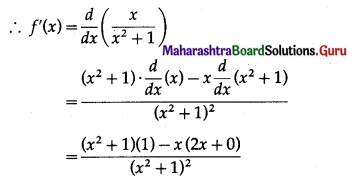
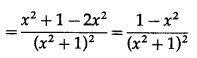
Maharashtra Board 12th Maths Solutions Chapter 2 Applications of Derivatives Ex 2.4 Q6
Maharashtra Board 12th Maths Solutions Chapter 2 Applications of Derivatives Ex 2.4 Q6.1

(a) f is strictly increasing if f'(x) > 0
i.e. if \(\frac{1-x^{2}}{\left(x^{2}+1\right)^{2}}\) > 0
i.e. if 1 – x2 > 0 ……..[∵ (x2 + 1)2 > 0]
i.e. if 1 > x2
i.e. if x2 < 1
i.e. if -1 < x < 1
∴ f is strictly increasing if -1 < x < 1

(b) f is strictly decreasing if f'(x) < 0
i.e. if \(\frac{1-x^{2}}{\left(x^{2}+1\right)^{2}}\) < 0
i.e. if 1 – x2 < 0 ……..[∵ (x2 + 1)2 > 0]
i.e. if 1 < x2 i.e. if x2 > 1
i.e. if x > 1 or x < -1
∴ f is strictly decreasing if x < -1 or x > 1
i.e. x ∈ (-∞, -1) ∪ (1, ∞).

Question 7.
Show that f(x) = 3x + \(\frac{1}{3 x}\) is increasing in (\(\frac{1}{3}\), 1) and decreasing in (\(\frac{1}{9}\), \(\frac{1}{3}\))
Solution:
f(x) = 3x + \(\frac{1}{3 x}\)
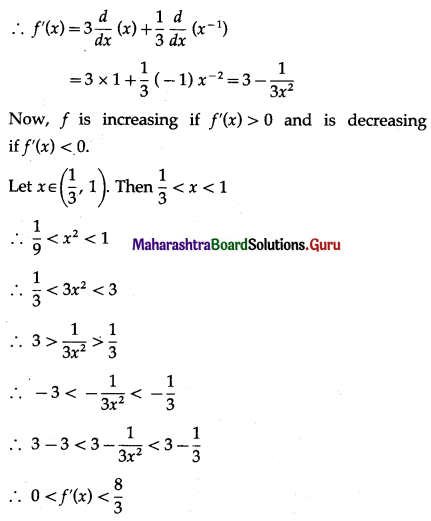
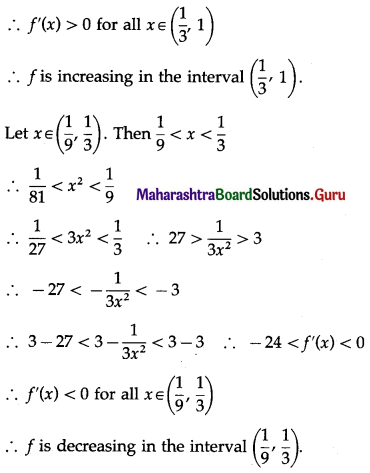
Maharashtra Board 12th Maths Solutions Chapter 2 Applications of Derivatives Ex 2.4 Q7
Maharashtra Board 12th Maths Solutions Chapter 2 Applications of Derivatives Ex 2.4 Q7.1

Question 8.
Show that f(x) = x – cos x is increasing for all x.
Solution:
f(x) = x – cos x
∴ f'(x) = \(\frac{d}{d x}\) (x – cos x)
= 1 – (-sin x)
= 1 + sin x
Now, -1 ≤ sin x ≤ 1 for all x ∈ R
∴ -1 + 1 ≤ 1 + sin x ≤ 1 for all x ∈ R
∴ 0 ≤ f'(x) ≤ 1 for all x ∈ R
∴ f'(x) ≥ 0 for all x ∈ R
∴ f is increasing for all x.

Maharashtra Board 12th Maths Solutions Chapter 2 Applications of Derivatives Ex 2.4

Question 9.
Find the maximum and minimum of the following functions:
(i) y = 5x3 + 2x2 – 3x
Solution:
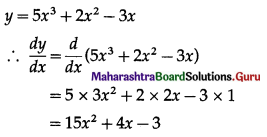
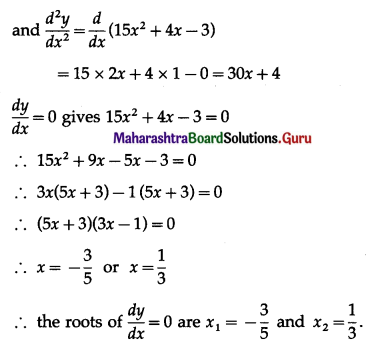
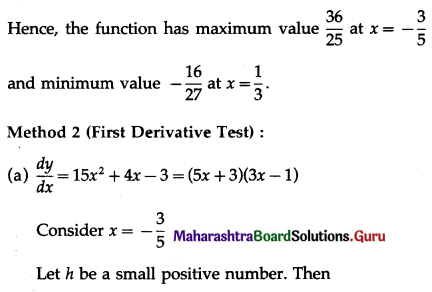
Maharashtra Board 12th Maths Solutions Chapter 2 Applications of Derivatives Ex 2.4 Q9 (i)
Maharashtra Board 12th Maths Solutions Chapter 2 Applications of Derivatives Ex 2.4 Q9 (i).1
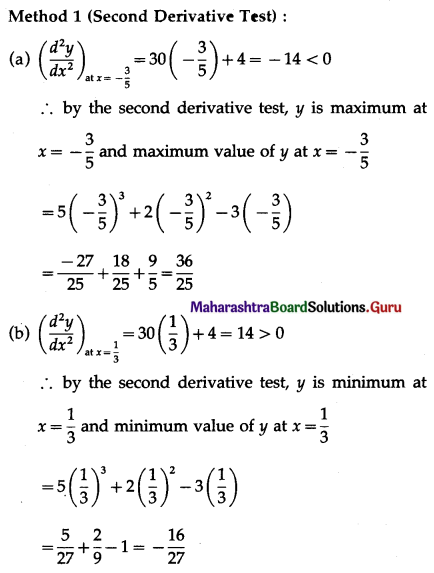
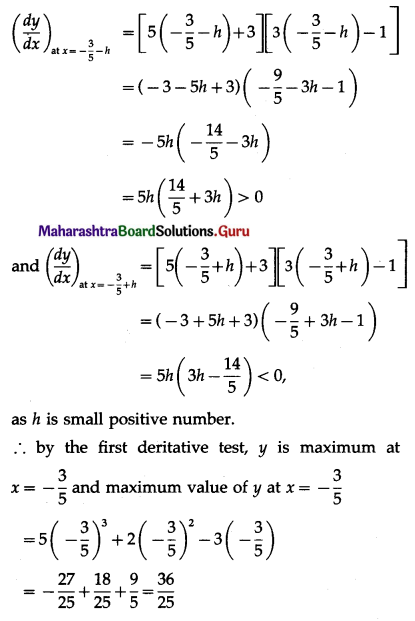
Maharashtra Board 12th Maths Solutions Chapter 2 Applications of Derivatives Ex 2.4 Q9 (i).2
Maharashtra Board 12th Maths Solutions Chapter 2 Applications of Derivatives Ex 2.4 Q9 (i).3
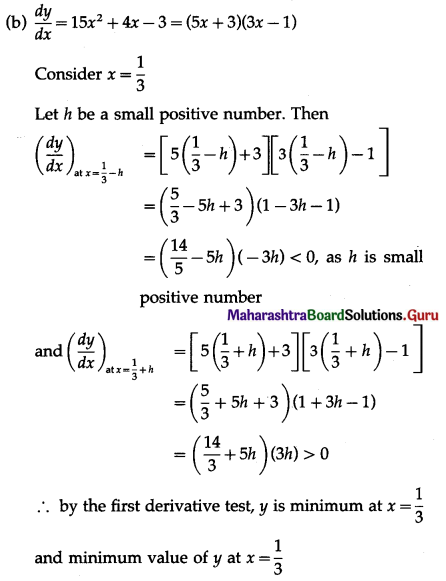
Maharashtra Board 12th Maths Solutions Chapter 2 Applications of Derivatives Ex 2.4 Q9 (i).4
Maharashtra Board 12th Maths Solutions Chapter 2 Applications of Derivatives Ex 2.4 Q9 (i).5
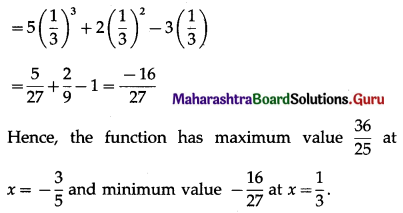
Maharashtra Board 12th Maths Solutions Chapter 2 Applications of Derivatives Ex 2.4 Q9 (i).6

(ii) f(x) = 2x3 – 21x2 + 36x – 20
Solution:
f(x) = 2x3 – 21x2 + 36x – 20
∴ f'(x) = \(\frac{d}{d x}\) (2x3 – 21x2 + 36x – 20)
= 2 × 3x2 – 21 × 2x + 36 × 1 – 0
= 6x2 – 42x + 36
and f”(x) = \(\frac{d}{d x}\) (6x2 – 42x + 36)
= 6 × 2x – 42 × 1 + 0
= 12x – 42
f'(x) = 0 gives 6x2 – 42x + 36 = 0
∴ x2 – 7x + 6 = 0
∴ (x – 1)(x – 6) = 0
the roots of f'(x) = 0 are x1 = 1 and x2 = 6.

Method 1 (Second Derivative Test):
(a) f”(1) = 12(1) – 42 = -30 < 0
∴ by the second derivative test, f has maximum at x = 1
and maximum value of f at x = 1
f(1) = 2(1)3 – 21(1)2 + 36(1) – 20
= 2 – 21 + 36 – 20
= -3

(b) f”(6) = 12(6) – 42 = 30 > 0
∴ by the second derivative test, f has minimum at x = 6
and minimum value of f at x = 6
f(6) = 2(6)3 – 21(6)2 + 36(6) – 20
= 432 – 756 + 216 – 20
= -128.
Hence, the function f has maximum value -3 at x = 1 and minimum value -128 at x = 6.

Method 2 (First Derivative Test):
(a) f'(x) = 6(x – 1)(x – 6)
Consider x = 1
Let h be a small positive number. Then
f'(1 – h) = 6(1 – h – 1)(1 – h – 6)
= 6(-h)(-5 – h)
= 6h(5 + h)> 0
and f'(1 + h) = 6(1 + h – 1)(1 + h – 6)
= 6h(h – 5) < 0, as h is small positive number.
∴ by the first derivative test, f has maximum at x = 1 and maximum value of f at x = 1
f(1) = 2(1)3 – 21(1)2 + 36(1) – 20
= 2 – 21 + 36 – 20
= -3

Maharashtra Board 12th Maths Solutions Chapter 2 Applications of Derivatives Ex 2.4

(b) f'(x) = 6(x – 1)(x – 6)
Consider x = 6
Let h be a small positive number. Then
f'(6 – h) = 6(6 – h – 1)(6 – h – 6)
= 6(5 – h)(-h)
= -6h(5 – h) < 0, as h is small positive number
and f'(6 + h) = 6(6 + h – 1)(6 + h – 6) = 6(5 + h)(h) > 0
∴ by the first derivative test, f has minimum at x = 6
and minimum value of f at x = 6
f(6) = 2(6)3 – 21(6)2 + 36(6) – 20
= 432 – 756 + 216 – 20
= -128
Hence, the function f has maximum value -3 at x = 1
and minimum value -128 at x = 6.

(iii) f(x) = x3 – 9x2 + 24x
Solution:
f(x) = x3 – 9x2 + 24x
∴ f'(x) = \(\frac{d}{d x}\) (x3 – 9x2 + 24x)
= 3x2 – 9 × 2x + 24 × 1
= 3x2 – 18x + 24
and f”(x) = \(\frac{d}{d x}\) (3x2 – 18x + 24)
= 3 × 2x – 18 × 1 + 0
= 6x – 18
f'(x) = 0 gives 3x2 – 18x + 24 = 0
∴ x2 – 6x + 8 = 0
∴ (x – 2)(x – 4) = 0
∴ the roots of f'(x) = 0 are x1 = 2 and x2 = 4.

(a) f”(2) = 6(2) – 18 = -6 < 0
∴ by the second derivative test, f has maximum at x = 2
and maximum value of f at x = 2
f(2) = (2)3 – 9(2)2 + 24(2)
= 8 – 36 + 48
= 20

Maharashtra Board 12th Maths Solutions Chapter 2 Applications of Derivatives Ex 2.4

(b) f”(4) = 6(4) – 18 = 6 > 0
∴ by the second derivative test, f has minimum at x = 4
and minimum value of f at x = 4
f(4) = (4)3 – 9(4)2 + 24(4)
= 64 – 144 + 96
= 16
Hence, the function f has maximum value 20 at x = 2 and minimum value 16 at x = 4.

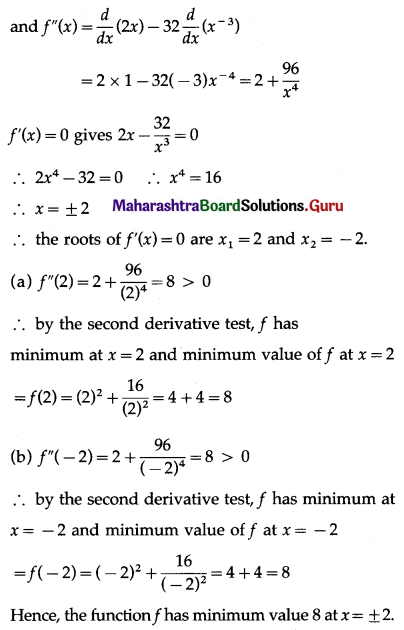
(iv) f(x) = x2 + \(\frac{16}{x^{2}}\)
Solution:
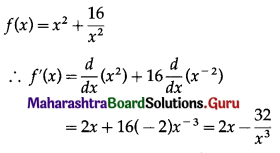
Maharashtra Board 12th Maths Solutions Chapter 2 Applications of Derivatives Ex 2.4 Q9 (iv)
Maharashtra Board 12th Maths Solutions Chapter 2 Applications of Derivatives Ex 2.4 Q9 (iv).1

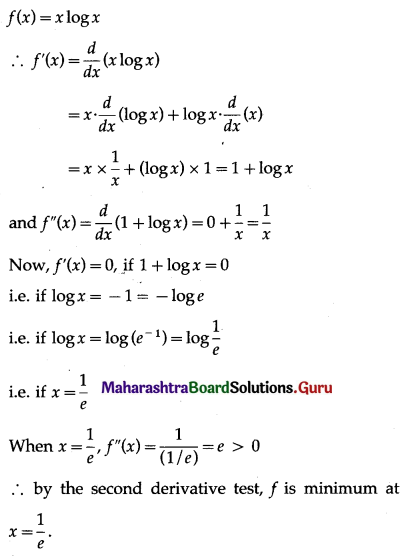
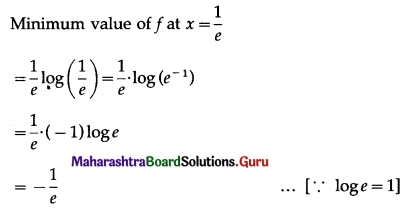
(v) f(x) = x log x
Solution:
Maharashtra Board 12th Maths Solutions Chapter 2 Applications of Derivatives Ex 2.4 Q9 (v)
Maharashtra Board 12th Maths Solutions Chapter 2 Applications of Derivatives Ex 2.4 Q9 (v).1

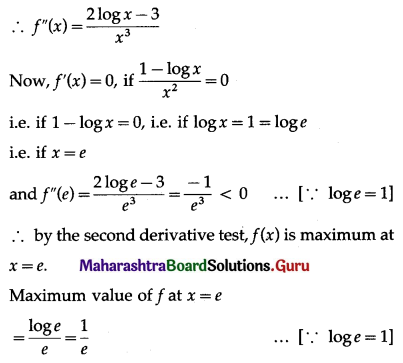
(vi) f(x) = \(\frac{\log x}{x}\)
Solution:
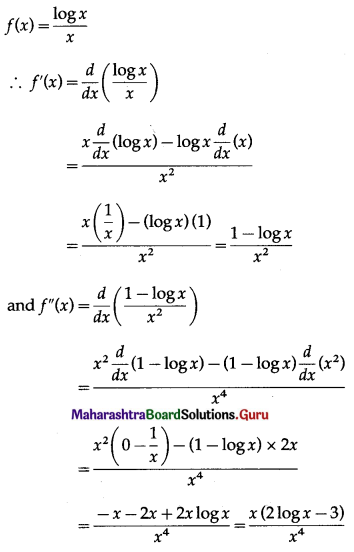
Maharashtra Board 12th Maths Solutions Chapter 2 Applications of Derivatives Ex 2.4 Q9 (vi)
Maharashtra Board 12th Maths Solutions Chapter 2 Applications of Derivatives Ex 2.4 Q9 (vi).1

Question 10.
Divide the number 30 into two parts such that their product is maximum.
Solution:
Let the first part of 30 be x.
Then the second part is 30 – x.
∴ their product = x(30 – x) = 30x – x2 = f(x) ……(Say)
∴ f'(x) = \(\frac{d}{d x}\) (30x – x2)
= 30 × 1 – 2x
= 30 – 2x
and f”(x) = \(\frac{d}{d x}\) (30 – 2x)
= 0 – 2 × 1
= -2
The root of the equation f(x) = 0,
i.e. 30 – 2x = 0 is x = 15 and f”(15) = -2 < 0
∴ by the second derivative test, f is maximum at x = 15.
Hence, the required parts of 30 are 15 and 15.

Maharashtra Board 12th Maths Solutions Chapter 2 Applications of Derivatives Ex 2.4

Question 11.
Divide the number 20 into two parts such that the sum of their squares is minimum.
Solution:
Let the first part of 20 be x.
Then the second part is 20 – x.
∴ sum of their squares = x2 + (20 – x)2 = f(x) …… (Say)
∴ f'(x) = \(\frac{d}{d x}\) [x2 + (20 – x)2]
= 2x + 2(20 – x) . \(\frac{d}{d x}\) (20 – x)
= 2x + 2(20 – x) × (0 – 1)
= 2x – 40 + 2x
= 4x – 40
and f”(x) = \(\frac{d}{d x}\) (4x – 40)
= 4 × 1 – 0
= 4
The root of the equation f'(x) = 0,
i.e. 4x – 40 = 0 is x = 10 and f”(10) = 4 > 0
∴ by the second derivative test, f is minimum at x = 10.
Hence, the required parts of 20 are 10 and 10.

Question 12.
A wire of length 36 meters is bent in the form of a rectangle. Find its dimensions if the area of the rectangle is maximum.
Solution:
Let x metres and y metres be the length and breadth of the rectangle.
Then its perimeter is 2(x + y) = 36
x + y = 18
y = 18 – x
Area of the rectangle = xy = x (18 – x)
Let f(x) = x(18 – x) = 18x – x2
∴ f'(x) = \(\frac{d}{d x}\) (18x – x2) = 18 – 2x
and f”(x) = \(\frac{d}{d x}\) (18 – 2x) = 0 – 2 × 1 = -2
Now, f'(x) = 0, if 18 – 2x = 0
i.e. if x = 9
and f”(9) = -2 < 0
∴ by the second derivative test, f has maximum value at x = 9.
When x = 9, y = 18 – 9 = 9
∴ x = 9 cm, y = 9 cm
∴ the rectangle is a square of side 9 metres.

Maharashtra Board 12th Maths Solutions Chapter 2 Applications of Derivatives Ex 2.4

Question 13.
A ball is thrown in the air. Its height at any time t is given by h = 3 + 14t – 5t2. Find the maximum height it can reach.
Solution:
The height h at any t is given by h = 3 + 14t – 5t2
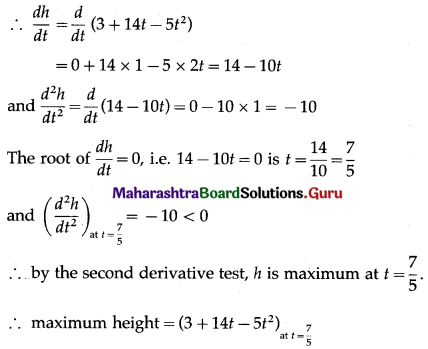
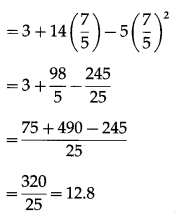
Maharashtra Board 12th Maths Solutions Chapter 2 Applications of Derivatives Ex 2.4 Q13
Maharashtra Board 12th Maths Solutions Chapter 2 Applications of Derivatives Ex 2.4 Q13.1
Hence, the maximum height the ball can reach = 12.8 units.

Question 14.
Find the largest size of a rectangle that can be inscribed in a semicircle of radius 1 unit, so that two vertices lie on the diameter.
Solution:
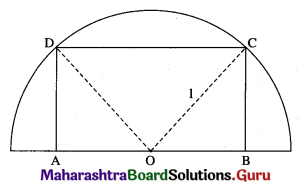
Maharashtra Board 12th Maths Solutions Chapter 2 Applications of Derivatives Ex 2.4 Q14
Let ABCD be the rectangle inscribed in a semicircle of radius 1 unit such that the vertices A and B lie on the diameter.
Let AB = DC = x and BC = AD = y.
Let O be the centre of the semicircle.
Join OC and OD. Then OC = OD = radius = 1.
Also, AD = BC and m∠A = m∠B = 90°.
∴ OA = OB
∴ OB = \(\frac{1}{2}\) AB = \(\frac{x}{2}\)
In right angled triangle OBC,
OB2 + BC2 = OC2
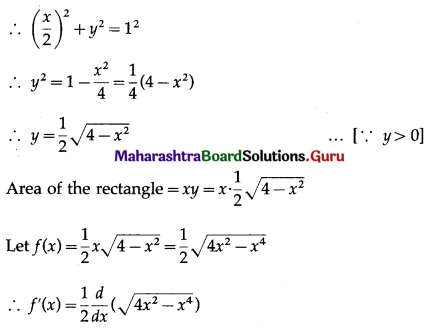
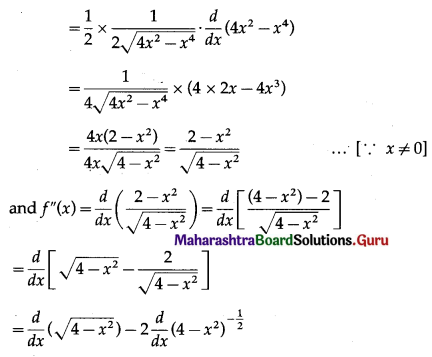
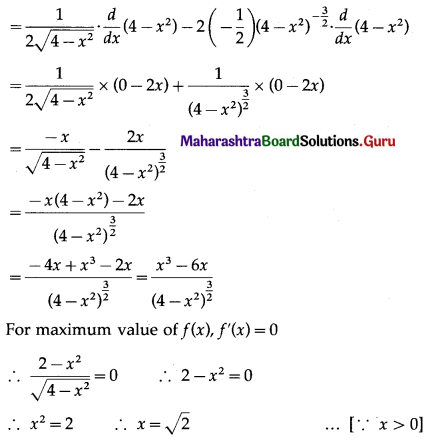
Maharashtra Board 12th Maths Solutions Chapter 2 Applications of Derivatives Ex 2.4 Q14.1
Maharashtra Board 12th Maths Solutions Chapter 2 Applications of Derivatives Ex 2.4 Q14.2
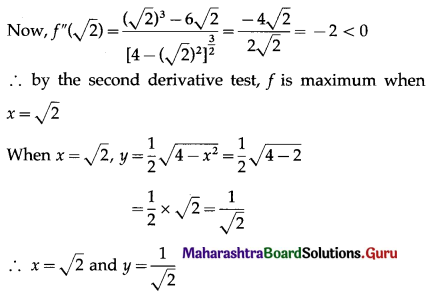
Maharashtra Board 12th Maths Solutions Chapter 2 Applications of Derivatives Ex 2.4 Q14.3
Maharashtra Board 12th Maths Solutions Chapter 2 Applications of Derivatives Ex 2.4 Q14.4
Hence, the area of the rectangle is maximum (i.e. rectangle has the largest size) when its length is √2 units and breadth is \(\frac{1}{\sqrt{2}}\) unit.

Question 15.
An open cylindrical tank whose base is a circle is to be constructed of metal sheet so as to contain a volume of πa3 cu cm of water. Find the dimensions so that the quantity of the metal sheet required is minimum.
Solution:
Let x be the radius of the base, h be the height, V be the volume and S be the total surface area of the cylindrical tank.
Then V = πa3 … (Given)
∴ πx2h = πa3
∴ h = \(\frac{a^{3}}{x^{2}}\) ……..(1)
Now, S = 2πxh + πx2
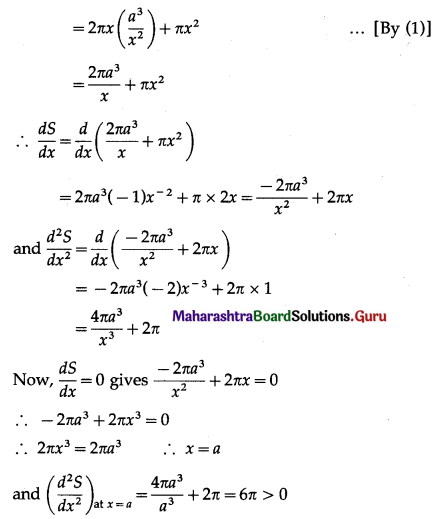
Maharashtra Board 12th Maths Solutions Chapter 2 Applications of Derivatives Ex 2.4 Q15
∴ by the second derivative test, S is minimum when x = a
When x = a, from (1)
h = \(\frac{a^{3}}{a^{2}}\) = a
Hence, the quantity of metal sheet is minimum when radius height = a cm.

Maharashtra Board 12th Maths Solutions Chapter 2 Applications of Derivatives Ex 2.4

Question 16.
The perimeter of a triangle is 10 cm. If one of the sides is 4 cm. What are the other two sides of the triangle for its maximum area?
Solution:
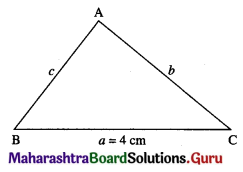
Maharashtra Board 12th Maths Solutions Chapter 2 Applications of Derivatives Ex 2.4 Q16
Let ABC be the triangle such that the side BC = a = 4 cm.
Also, the perimeter of the triangle is 10 cm.
i.e. a + b + c = 10
∴ 2s = 10
∴ s = 5
Also, 4 + b + c = 10
∴ b + c = 6
∴ b = 6 – c
Let ∆ be the area of the triangle.
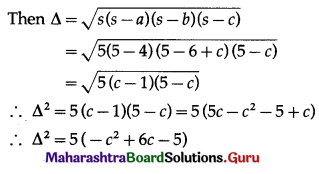
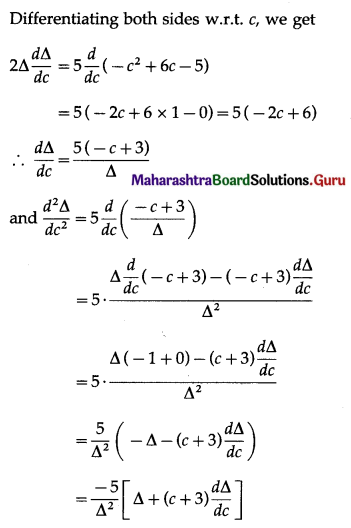
Maharashtra Board 12th Maths Solutions Chapter 2 Applications of Derivatives Ex 2.4 Q16.1
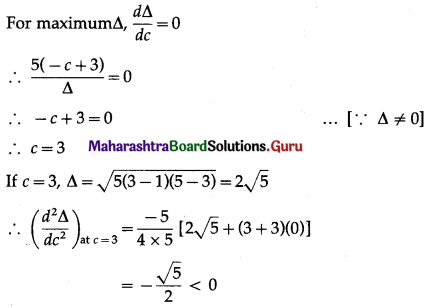
Maharashtra Board 12th Maths Solutions Chapter 2 Applications of Derivatives Ex 2.4 Q16.2
Maharashtra Board 12th Maths Solutions Chapter 2 Applications of Derivatives Ex 2.4 Q16.3
∴ by the second derivative test, ∆ is maximum when c = 3.
When c = 3, b = 6 – c = 6 – 3 = 3
Hence, the area of the triangle is maximum when the other two sides are 3 cm and 3 cm.

Question 17.
A box with a square base is to have an open top. The surface area of the box is 192 sq cm. What should be its dimensions in order that the volume is largest?
Solution:
Let x cm be the side of square base and h cm be its height.
Then x2 + 4xh = 192
∴ h = \(\frac{192-x^{2}}{4 x}\) …… (1)
Let V be the volume of the box.
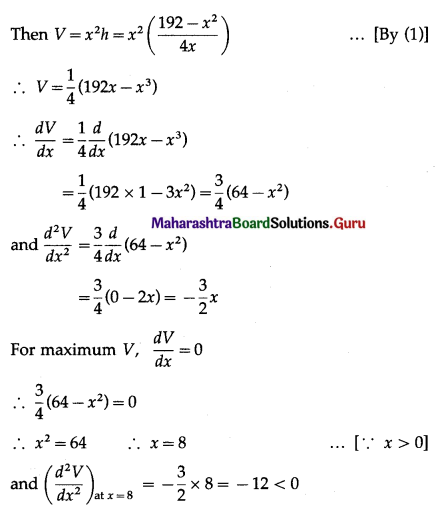
Maharashtra Board 12th Maths Solutions Chapter 2 Applications of Derivatives Ex 2.4 Q17
∴ by the second derivative test, V is maximum at x = 8.
If x = 8, h = \(\frac{192-64}{4(8)}=\frac{128}{32}\) = 4
Hence, the volume of the box is largest, when the side of square base is 8 cm and its height is 4 cm.

Maharashtra Board 12th Maths Solutions Chapter 2 Applications of Derivatives Ex 2.4

Question 18.
The profit function P (x) of a firm, selling x items per day is given by P(x) = (150 – x)x – 1625. Find the number of items the firm should manufacture to get maximum profit. Find the maximum profit.
Solution:
Profit function P (x) is given by
P(x) = (150 – x)x – 1625 = 150x – x2 -1625
∴ P'(x) = \(\frac{d}{d x}\) (150x – x2 – 1625)
= 150 × 1 – 2x – 0
= 150 – 2x
and P”(x) = \(\frac{d}{d x}\) (150 – 2x)
= 0 – 2 × 1
= -2
Now, P'(x) = 0 gives, 150 – 2x = 0
∴ x = 75
and P”(75) = -2 < 0
∴ by the second derivative test, P(x) is maximum when x = 75
Maximum profit = P(75)
= (150 – 75)75 – 1625
= 75 × 75 – 1625
= 4000
Hence, the profit will be maximum, if the manufacturer manufactures 75 items and the maximum profit is 4000.

Question 19.
Find two numbers whose sum is 15 and when the square of one multiplied by the cube of the other is maximum.
Solution:
Let the two numbers be x and y.
Then x + y = 15
∴ y = 15 – x
Let P is the product of square of y and cube of x.
Then P = x3y2
= x3(15 – x)2
= x3(225 – 30x + x2)
= x5 – 30x4 + 225x3
∴ \(\frac{d P}{d x}\) = \(\frac{d}{d x}\) (x5 – 30x4 + 225x3)
= 5x4 – 30 × 4x3 + 225 × 3x2
= 5x4 – 120x3 + 675x2
and \(\frac{d^{2} P}{d x^{2}}\) = \(\frac{d}{d x}\) (5x4 – 120x3 + 675x2)
= 5 × 4x3 – 120 × 3x2 + 675 × 2x
= 20x3 – 360x2 + 1350x
= 10x(2x2 – 36x + 135)
Now, \(\frac{d P}{d x}\) = 0 gives 5x4 – 120x3 + 675x2 = 0
∴ 5x2(x2 – 24x +135) = 0
∴ 5x2(x2 – 15x – 9x + 135) = 0
∴ 5x2[x(x – 15) – 9(x – 35)] = 0
∴ 5x2(x – 15)(x – 9) = 0
∴ the roots of \(\frac{d P}{d x}\) = 0 are x1 = 0, x2 = 15 and x3 = 9
If x = 0, then y = 15 – 0 = 15
If x = 15, then y = 15 – 15 = 0
In both cases, product x3y2 is zero, which is not maximum.
∴ x ≠ 0 and x ≠ 15
∴ x = 6
Now, \(\left(\frac{d^{2} P}{d x^{2}}\right)_{\text {at } x=6}\) = 10(6)[2(6)2 – 36 × 6 + 135]
= 60[72 – 216 + 135]
= 60(-9)
= -540 < 0
∴ P is maximum when x = 6
If x = 6, then y = 15 – 6 = 9
Hence, the required numbers are 6 and 9.

Maharashtra Board 12th Maths Solutions Chapter 2 Applications of Derivatives Ex 2.4

Question 20.
Show that among rectangles of given area, the square has least perimeter.
Solution:
Let x be the length and y be the breadth of the rectangle whose area is A sq units (which is given as constant).
Then xy = A
∴ y = \(\frac{A}{x}\) ………(1)
Let P be the perimeter of the rectangle.
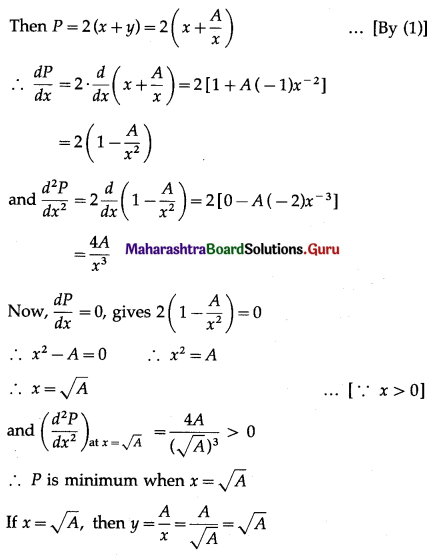
Maharashtra Board 12th Maths Solutions Chapter 2 Applications of Derivatives Ex 2.4 Q20
x = y
∴ rectangle is a square.
Hence, among rectangles of given area, the square has least perimeter.

Question 21.
Show that the height of a closed right circular cylinder of given volume and least surface area is equal to its diameter.
Solution:
Let x be the radius of base, h be the height and S be the surface area of the closed right circular cylinder whose volume is V which is given to be constant.
Then πr2h = V
∴ h = \(\frac{V}{\pi r^{2}}=\frac{A}{x^{2}}\) …….(1)
where A = \(\frac{V}{\pi}\), which is constant.
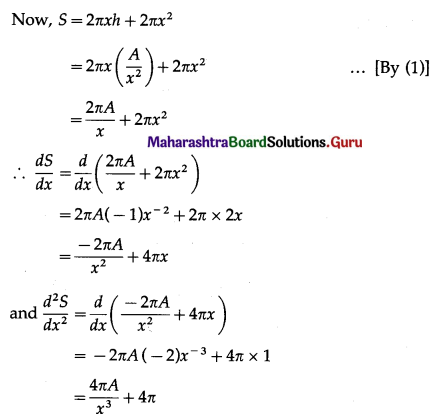
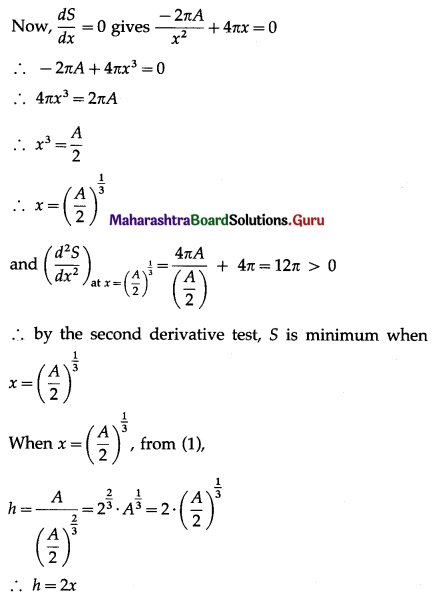
Maharashtra Board 12th Maths Solutions Chapter 2 Applications of Derivatives Ex 2.4 Q21
Maharashtra Board 12th Maths Solutions Chapter 2 Applications of Derivatives Ex 2.4 Q21.1
Hence, the surface area is least when height of the closed right circular cylinder is equal to its diameter.

Question 22.
Find the volume of the largest cylinder that can be inscribed in a sphere of radius ‘r’ cm.
Solution:
Let R be the radius and h be the height of the cylinder which is inscribed in a sphere of radius r cm.
Then from the figure,
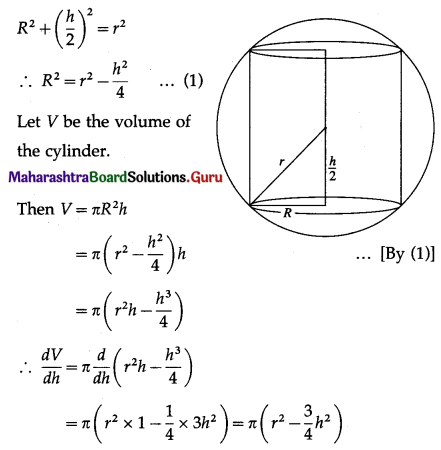
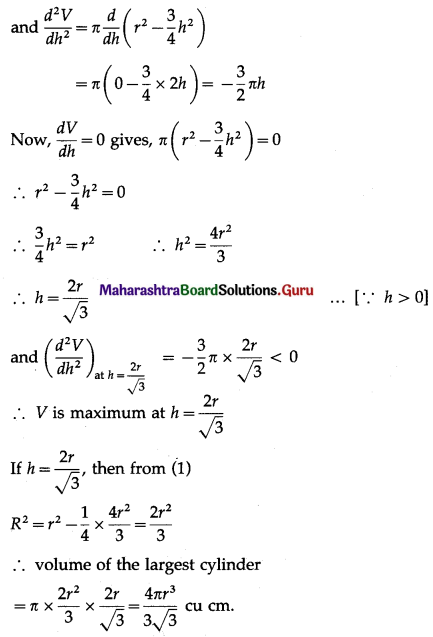
Maharashtra Board 12th Maths Solutions Chapter 2 Applications of Derivatives Ex 2.4 Q22
Maharashtra Board 12th Maths Solutions Chapter 2 Applications of Derivatives Ex 2.4 Q22.1
Hence, the volume of the largest cylinder inscribed in a sphere of radius ‘r’ cm = \(\frac{4 \pi r^{3}}{3 \sqrt{3}}\) cu cm.

Maharashtra Board 12th Maths Solutions Chapter 2 Applications of Derivatives Ex 2.4

Question 23.
Show that y = log(1 + x) – \(\frac{2 x}{2+x}\), x > -1 is an increasing function on its domain.
Solution:
y = log(1 + x) – \(\frac{2 x}{2+x}\), x > -1
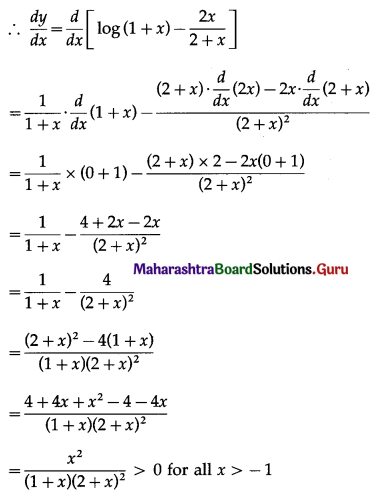
Maharashtra Board 12th Maths Solutions Chapter 2 Applications of Derivatives Ex 2.4 Q23
Hence, the given function is increasing function on its domain.

Question 24.
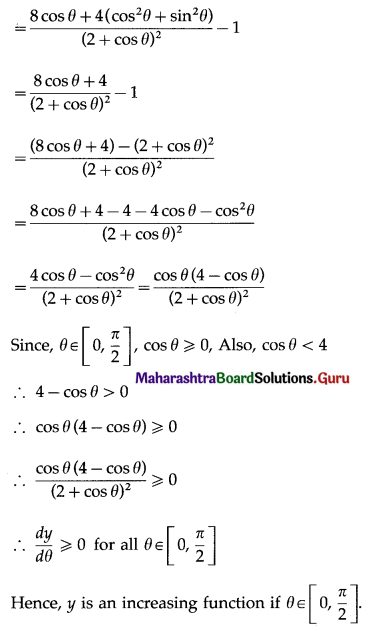
Prove that y = \(\frac{4 \sin \theta}{2+\cos \theta}\) – θ is an increasing function if θ ∈ [0, \(\frac{\pi}{2}\)]
Solution:
y = \(\frac{4 \sin \theta}{2+\cos \theta}\) – θ
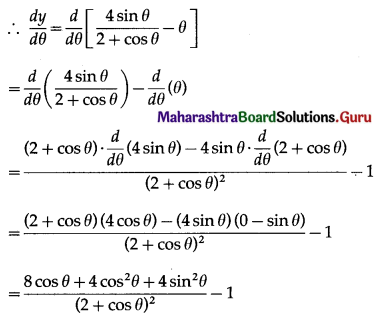
Maharashtra Board 12th Maths Solutions Chapter 2 Applications of Derivatives Ex 2.4 Q24
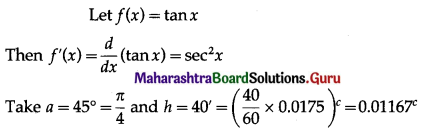
Maharashtra Board 12th Maths Solutions Chapter 2 Applications of Derivatives Ex 2.4 Q24.1
12th Maharashtra State Board Maths Solutions Pdf Part 2
Applications of Derivatives Class 12 Maths 2 Exercise 2.3 Solutions Maharashtra Board

Balbharti 12th Maharashtra State Board Maths Solutions Book Pdf Chapter 2 Applications of Derivatives Ex 2.3 Questions and Answers.
12th Maths Part 2 Applications of Derivatives Exercise 2.3 Questions And Answers Maharashtra Board

Question 1.
Check the validity of the Rolle’s theorem for the following functions.
(i) f(x) = x2 – 4x + 3, x ∈ [1, 3]
Solution:
The function f given as f(x) = x2 – 4x + 3 is polynomial function.
Hence, it is continuous on [1, 3] and differentiable on (1, 3).
Now, f(1) = 12 – 4(1) + 3 = 1 – 4 + 3 = 0
and f(3) = 32 – 4(3) + 3 = 9 – 12 + 3 = 0
∴ f(1) = f(3)
Thus, the function f satisfies all the conditions of Rolle’s theorem.

(ii) f(x) = e-x sin x, x ∈ [0, π].
Solution:
The functions e-x and sin x are continuous and differentiable on their domains.
∴ f(x) = e-x sin x is continuous on [0, π] and differentiable on (0, π).
Now, f(0) = e0 sin 0 = 1 × 0 = 0
and f(π) = e-π sin π = e-π × 0 = 0
∴ f(0) = f(π)
Thus, the function f satisfies all the conditions of the Rolle’s theorem.

Maharashtra Board 12th Maths Solutions Chapter 2 Applications of Derivatives Ex 2.3
(iii) f(x) = 2x2 – 5x + 3, x ∈ [1, 3].
Solution:
The function f given as f(x) = 2x2 – 5x + 3 is a polynomial function.
Hence, it is continuous on [1, 3] and differentiable on (1, 3).
Now, f(1) = 2(1)2 – 5(1) + 3 = 2 – 5 + 3 = 0
and f(3) = 2(3)2 – 5(3) + 3 = 18 – 15 + 3 = 6
∴ f(1) ≠ f(3)
Hence, the conditions of Rolle’s theorem are not satisfied.

(iv) f(x) = sin x – cos x + 3, x ∈ [0, 2π].
Solution:
The functions sin x, cos x and 3 are continuous and differentiable on their domains.
∴ f(x) = sin x – cos x + 3 is continuous on [0, 2π] and differentiable on (0, 2π).
Now, f(0) = sin 0 – cos 0 + 3 = 0 – 1 + 3 = 2
and f(2π) = sin 2π – cos 2π + 3 = 0 – 1 + 3 = 2
∴ f(0) = f(2π)
Thus, the function f satisfies all the conditions of the Rolle’s theorem.

(v) f(x) = x2, if 0 ≤ x ≤ 2
= 6 – x, if 2 < x ≤ 6.
Solution:
f(x) = x2, if 0 ≤ x ≤ 2
= 6 – x, if 2 < x ≤ 6
∴ f(x) = \(\frac{d}{d x}\left(x^{2}\right)\) = 2x, if 0 ≤ x ≤ 2
= \(\frac{d}{d x}(6-x)\) = -1, if 2 < x ≤ 6
∴ Lf'(2) = 2(2) = 4 and Rf'(2) = -1
∴ Lf'(2) ≠ Rf'(2)
∴ f is not differentiable at x = 2 and 2 ∈ (0, 6).
∴ f is not differentiable at all the points on (0, 6).
Hence, the conditions of Rolle’s theorem are not satisfied.

(vi) f(x) = \(x^{\frac{2}{3}}\), x ∈ [-1, 1].
Solution:
f(x) = \(x^{\frac{2}{3}}\)
∴ \(f^{\prime}(x)=\frac{d}{d x}\left(x^{\frac{2}{3}}\right)=\frac{2}{3} x^{-\frac{1}{3}}\) = \(\frac{2}{3 \sqrt[3]{x}}\)
This does not exist at x = 0 and 0 ∈ (-1, 1)
∴ f is not differentiable on the interval (-1, 1).
Hence, the conditions of Rolle’s theorem are not satisfied.

Maharashtra Board 12th Maths Solutions Chapter 2 Applications of Derivatives Ex 2.3
Question 2.
Given an interval [a, b] that satisfies hypothesis of Rolle’s theorem for the function f(x) = x4 + x2 – 2. It is known that a = -1. Find the value of b.
Solution:
f(x) = x4 + x2 – 2
Since the hypothesis of Rolle’s theorem are satisfied by f in the interval [a, b], we have
f(a) = f(b), where a = -1
Now, f(a) = f(-1) = (-1)4 + (-1)2 – 2 = 1 + 1 – 2 = 0
and f(b) = b4 + b2 – 2
∴ f(a) = f(b) gives
0 = b4 + b2 – 2 i.e. b4 + b2 – 2 = 0.
Since, b = 1 satisfies this equation, b = 1 is one of the roots of this equation.
Hence, b = 1.

Question 3.
Verify Rolle’s theorem for the following functions.
(i) f(x) = sin x + cos x + 7, x ∈ [0, 2π]
Solution:
The functions sin x, cos x and 7 are continuous and differentiable on their domains.
∴ f(x) = sin x + cos x + 7 is continuous on [0, 2π] and differentiable on (0, 2π)
Now, f(0) = sin 0 + cos 0 + 7 = 0 + 1 + 7 = 8
and f(2π) = sin 2π + cos 2π + 7 = 0 + 1 + 7 = 8
∴ f(0) = f(2π)
Thus, the function f satisfies all the conditions of Rolle’s theorem.
∴ there exists c ∈ (0, 2π) such that f'(c) = 0.
Now, f(x) = sin x + cos x + 7
∴ f'(x) = \(\frac{d}{d x}\) (sin x + cos x + 7)
= cos x – sin x + 0
= cos x – sin x
∴ f'(c) = cos c – sin c
∴ f'(c) = 0 gives, cos c – sin c = 0
∴ cos c = sin c
∴ c = \(\frac{\pi}{4}, \frac{5 \pi}{4}, \frac{9 \pi}{4}, \ldots\)
But \(\frac{\pi}{4}, \frac{5 \pi}{4}\) ∈ (0, 2π)
∴ c = \(\frac{\pi}{4} \text { or } \frac{5 \pi}{4}\)
Hence, the Rolle’s theorem is verified.

Maharashtra Board 12th Maths Solutions Chapter 2 Applications of Derivatives Ex 2.3
(ii) f(x) = sin(\(\frac{x}{2}\)), x ∈ [0, 2π]
Solution:
The function f(x) = sin(\(\frac{x}{2}\)) is continuous on [0, 2π] and differentiable on (0, 2π).
Now, f(0) = sin 0 = 0
and f(2π) = sin π = 0
∴ f(0) = f(2π)
Thus, the function f satisfies all the conditions of Rolle’s theorem.
∴ there exists c ∈ (0, 2π) such that f'(c) = 0.
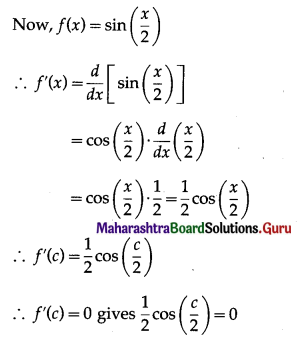
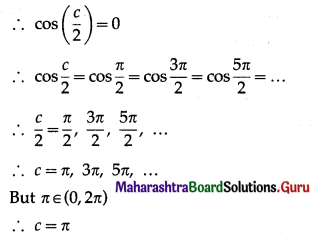
Maharashtra Board 12th Maths Solutions Chapter 2 Applications of Derivatives Ex 2.3 Q3 (ii)
Maharashtra Board 12th Maths Solutions Chapter 2 Applications of Derivatives Ex 2.3 Q3 (ii).1
Hence, Rolle’s theorem is verified.

(iii) f(x) = x2 – 5x + 9, x ∈ [1, 4].
Solution:
The function f given as f(x) = x2 – 5x + 9 is a polynomial function.
Hence it is continuous on [1, 4] and differentiable on (1, 4).
Now, f(1) = 12 – 5(1) + 9 = 1 – 5 + 9 = 5
and f(4) = 42 – 5(4) + 9 = 16 – 20+ 9 = 5
∴ f(1) = f(4)
Thus, the function f satisfies all the conditions of the Rolle’s theorem.
∴ there exists c ∈ (1, 4) such that f'(c) = 0.
Now, f(x) = x2 – 5x + 9
∴ f'(x) = \(\frac{d}{d x}\) (x2 – 5x + 9)
= 2x – 5 × 1 + 0
= 2x – 5
∴ f'(c) = 2c – 5
∴ f'(c) = 0 gives, 2c – 5 = 0
∴ c = 5/2 ∈ (1, 4)
Hence, the Rolle’s theorem is verified.

Question 4.
If Rolle’s theorem holds for the function f(x) = x3 + px2 + qx + 5, x ∈ [1, 3] with c = 2 + \(\frac{1}{\sqrt{3}}\), find the values of p and q.
Solution:
The Rolle’s theorem holds for the function f(x) = x3 + px2 + qx + 5, x ∈ [1, 3]
∴ f(1) = f(3)
∴ 13 + p(1)2 + q(1) + 5 = 33 + p (3)2 + q(3) + 5
∴ 1 + p + q + 5 = 27 + 9p + 3q + 5
∴ 8p + 2q = -26
∴ 4p + q = -13 ….. (1)
Also, there exists at least one point c ∈ (1, 3) such that f'(c) = 0.
Now, f'(x) = \(\frac{d}{d x}\) (x3 + px2 + qx + 5)
= 3x2 + p × 2x + q × 1 + 0
= 3x2 + 2px + q
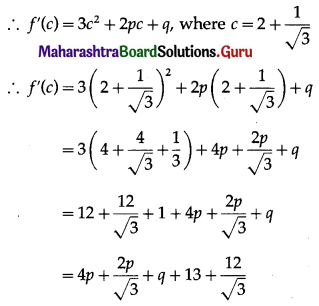
Maharashtra Board 12th Maths Solutions Chapter 2 Applications of Derivatives Ex 2.3 Q4
But f'(c) = 0
∴ \(4 p+\frac{2 p}{\sqrt{3}}+q+13+\frac{12}{\sqrt{3}}=0\)
∴ (4√3 + 2)p + √3q + (13√3 + 12) = 0
∴ (4√3 + 2)p + √3q = -13√3 – 12 ……. (2)
Multiplying equation (1) by √3, we get
4√3p + √3q= -13√3
Subtracting this equation from (2), we get
2p = -12 ⇒ p= -6
∴ from (1), 4(-6) + q = -13 ⇒ q = 11
Hence, p = -6 and q = 11.

Maharashtra Board 12th Maths Solutions Chapter 2 Applications of Derivatives Ex 2.3
Question 5.
If Rolle’s theorem holds for the function f(x) = (x – 2) log x, x ∈ [1, 2], show that the equation x log x = 2 – x is satisfied by at least one value of x in (1, 2).
Solution:
The Rolle’s theorem holds for the function f(x) = (x – 2) log x, x ∈ [1, 2].
∴ there exists at least one real number c ∈ (1, 2) such that f'(c) = 0.
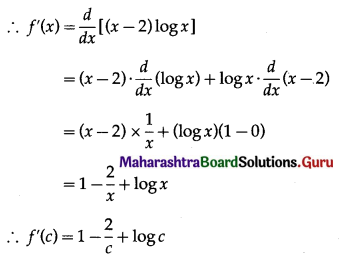
Now, f(x) = (x – 2) log x
Maharashtra Board 12th Maths Solutions Chapter 2 Applications of Derivatives Ex 2.3 Q5
∴ f'(c) = 0 gives 1 – \(\frac{2}{c}\) + log c = 0
∴ c – 2 + c log c = 0
∴ c log c = 2 – c, where c ∈ (1, 2)
∴ c satisfies the equation x log x = 2 – x, c ∈ (1, 2).
Hence, the equation x log x = 2 – x is satisfied by at least one value of x in (1, 2).

Question 6.
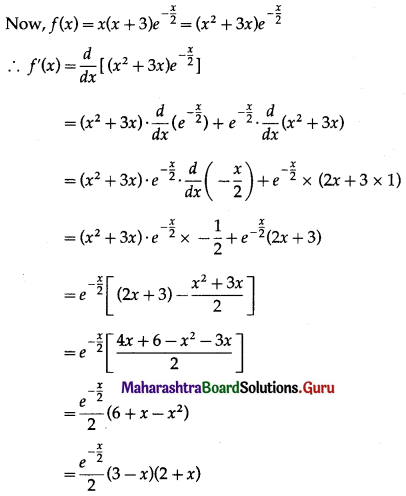
The function f(x) = \(x(x+3) e^{-\frac{x}{2}}\) satisfies all the conditions of Rolle’s theorem on [-3, 0]. Find the value of c such that f'(c) = 0.
Solution:
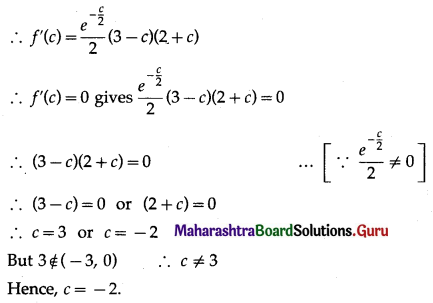
The function f(x) satisfies all the conditions of Rolle’s theorem, therefore there exist c ∈ (-3, 0) such that f'(c) = 0.
Maharashtra Board 12th Maths Solutions Chapter 2 Applications of Derivatives Ex 2.3 Q6
Maharashtra Board 12th Maths Solutions Chapter 2 Applications of Derivatives Ex 2.3 Q6.1
Question 7.
Verify Lagrange’s mean value theorem for the following functions:
(i) f(x) = log x on [1, e].
Solution:
The function f given as f(x) = log x is a logarithmic function that is continuous for all positive real numbers.
Hence, it is continuous on [1, e] and differentiable on (1, e).
Thus, the function f satisfies the conditions of Lagrange’s mean value theorem.
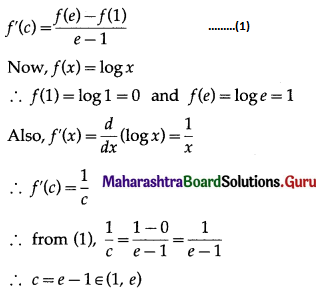
∴ there exists c ∈ (1, e) such that
Maharashtra Board 12th Maths Solutions Chapter 2 Applications of Derivatives Ex 2.3 Q7 (i)
Hence, Lagrange’s mean value theorem is verified.

Maharashtra Board 12th Maths Solutions Chapter 2 Applications of Derivatives Ex 2.3
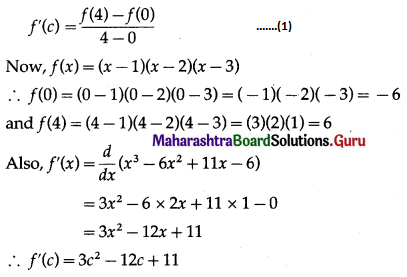
(ii) f(x) = (x – 1)(x – 2)(x – 3) on [0, 4].
Solution:
The function f given as
f(x) = (x – 1)(x – 2)(x – 3)
= (x – 1)(x2 – 5x + 6)
= x3 – 5x2 + 6x – x2 + 5x – 6
= x3 – 6x2 + 11x – 6 is a polynomial function.
Hence, it is continuous on [0, 4] and differentiable on (0, 4).
Thus, the function f satisfies the conditions of Lagrange’s, mean value theorem.
∴ there exists c ∈ (0, 4) such that
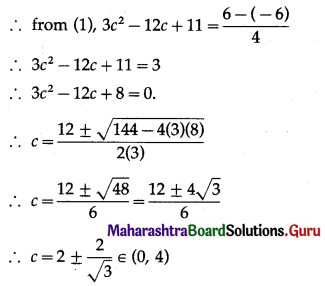
Maharashtra Board 12th Maths Solutions Chapter 2 Applications of Derivatives Ex 2.3 Q7 (ii)
Maharashtra Board 12th Maths Solutions Chapter 2 Applications of Derivatives Ex 2.3 Q7 (ii).1
Hence, Lagrange’s mean value theorem is verified.

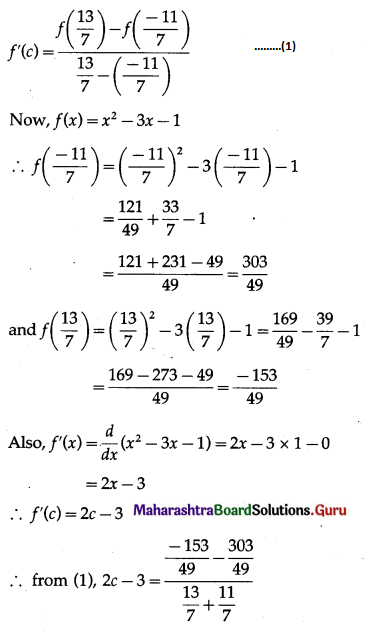
(iii) f(x) = x2 – 3x – 1, x ∈ \(\left[\frac{-11}{7}, \frac{13}{7}\right]\)
Solution:
The function f given as f(x) = x2 – 3x – 1 is a polynomial function.
Hence, it is continuous on \(\left[\frac{-11}{7}, \frac{13}{7}\right]\) and differentiable on \(\left(\frac{-11}{7}, \frac{13}{7}\right)\).
Thus, the function f satisfies the conditions of LMVT.
∴ there exists c ∈ \(\left(\frac{-11}{7}, \frac{13}{7}\right)\) such that
Maharashtra Board 12th Maths Solutions Chapter 2 Applications of Derivatives Ex 2.3 Q7 (iii)
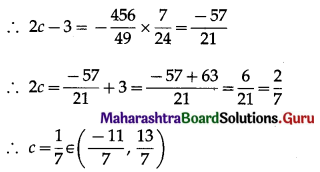
Maharashtra Board 12th Maths Solutions Chapter 2 Applications of Derivatives Ex 2.3 Q7 (iii).1
Hence, Lagrange’s mean value theorem is verified.

Maharashtra Board 12th Maths Solutions Chapter 2 Applications of Derivatives Ex 2.3
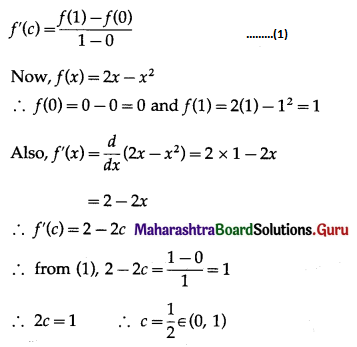
(iv) f(x) = 2x – x2, x ∈ [0, 1].
Solution:
The function f given as f(x) = 2x – x2 is a polynomial function.
Hence, it is continuous on [0, 1] and differentiable on (0, 1).
Thus, the function f satisfies the conditions of Lagrange’s mean value theorem.
∴ there exists c ∈ (0, 1) such that
Maharashtra Board 12th Maths Solutions Chapter 2 Applications of Derivatives Ex 2.3 Q7 (iv)
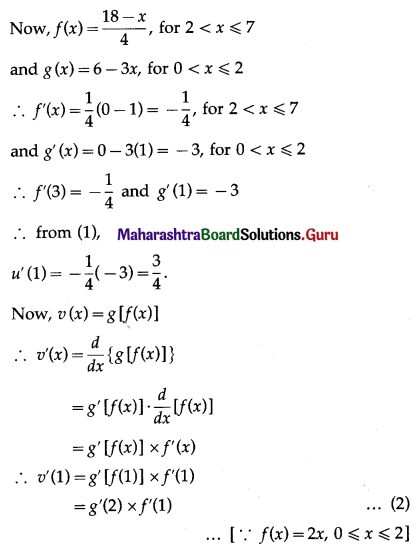
Hence, Lagrange’s mean value theorem is verified.

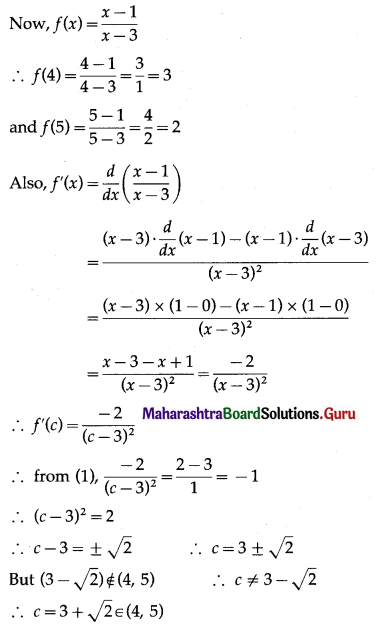
(v) f(x) = \(\frac{x-1}{x-3}\) on [4, 5].
Solution:
The function f given as
f(x) = \(\frac{x-1}{x-3}\) is a rational function which is continuous except at x = 3.
But 3 ∉ [4, 5]
Hence, it is continuous on [4, 5] and differentiable on (4, 5).
Thus, the function f satisfies the conditions of Lagrange’s mean value theorem.
∴ there exists c ∈ (4, 5) such that
f'(c) = \(\frac{f(5)-f(4)}{5-4}\) ……..(1)
Maharashtra Board 12th Maths Solutions Chapter 2 Applications of Derivatives Ex 2.3 Q7 (v)
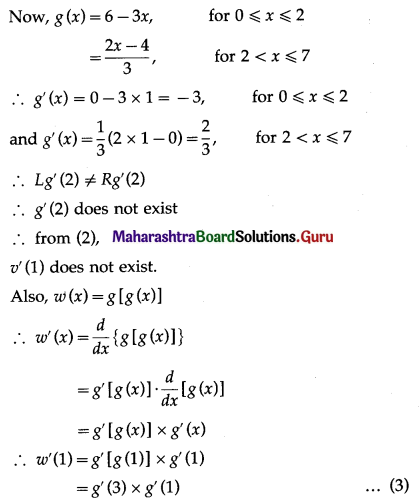
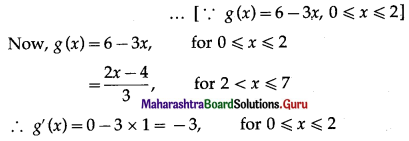
Hence, Lagrange’s mean value theorem is verified.

12th Maharashtra State Board Maths Solutions Pdf Part 2
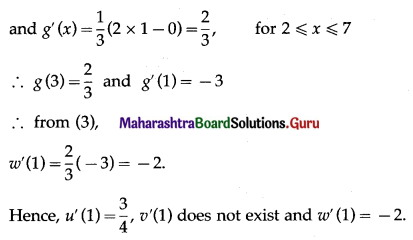
Applications of Derivatives Class 12 Maths 2 Exercise 2.2 Solutions Maharashtra Board
Balbharti 12th Maharashtra State Board Maths Solutions Book Pdf Chapter 2 Applications of Derivatives Ex 2.2 Questions and Answers.
12th Maths Part 2 Applications of Derivatives Exercise 2.2 Questions And Answers Maharashtra Board

Question 1.
Find the approximate value of given functions, at required points.
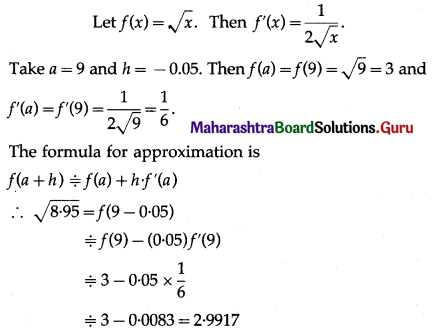
(i) √8.95
Solution:
Maharashtra Board 12th Maths Solutions Chapter 2 Applications of Derivatives Ex 2.2 Q1 (i)
√8.95 = 2.9917

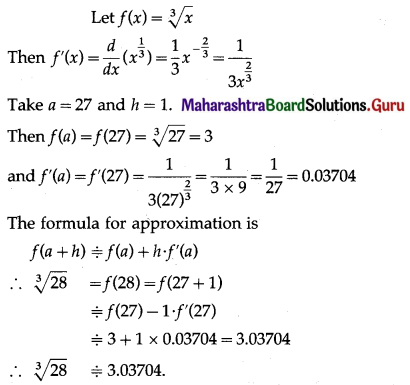
(ii) \(\sqrt[3]{28}\)
Solution:
Maharashtra Board 12th Maths Solutions Chapter 2 Applications of Derivatives Ex 2.2 Q1 (ii)

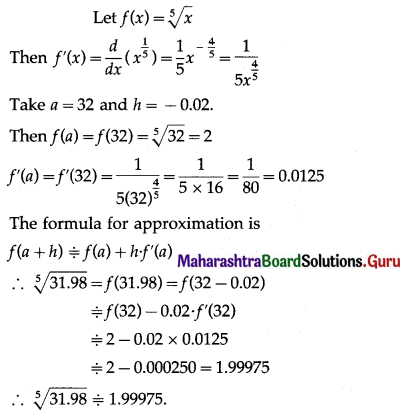
(iii) \(\sqrt[5]{31.98}\)
Solution:
Maharashtra Board 12th Maths Solutions Chapter 2 Applications of Derivatives Ex 2.2 Q1 (iii)

Maharashtra Board 12th Maths Solutions Chapter 2 Applications of Derivatives Ex 2.2

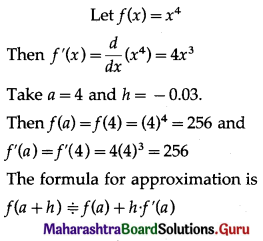
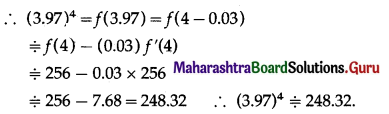
(iv) (3.97)4
Solution:
Maharashtra Board 12th Maths Solutions Chapter 2 Applications of Derivatives Ex 2.2 Q1 (iv)
Maharashtra Board 12th Maths Solutions Chapter 2 Applications of Derivatives Ex 2.2 Q1 (iv).1

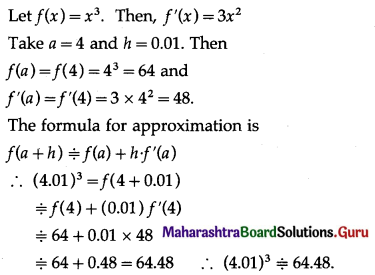
(v) (4.01)3
Solution:
Maharashtra Board 12th Maths Solutions Chapter 2 Applications of Derivatives Ex 2.2 Q1 (v)

Question 2.
Find the approximate values of:
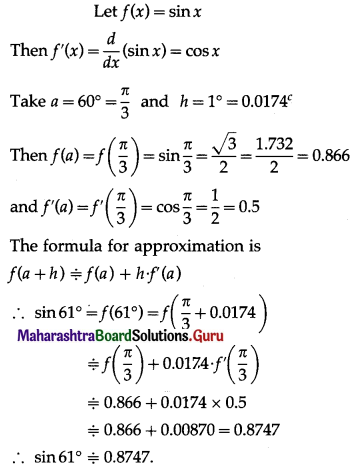
(i) sin 61°, given that 1° = 0.0174c, √3 = 1.732.
Solution:
Maharashtra Board 12th Maths Solutions Chapter 2 Applications of Derivatives Ex 2.2 Q2 (i)

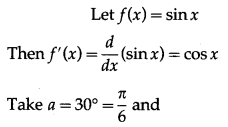
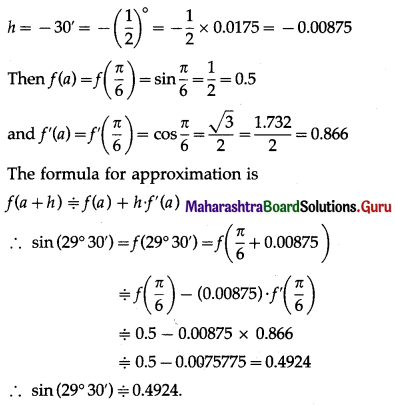
(ii) sin(29° 30′), given that 1° = 0.0175c, √3 = 1.732.
Solution:
Maharashtra Board 12th Maths Solutions Chapter 2 Applications of Derivatives Ex 2.2 Q2 (ii)
Maharashtra Board 12th Maths Solutions Chapter 2 Applications of Derivatives Ex 2.2 Q2 (ii).1

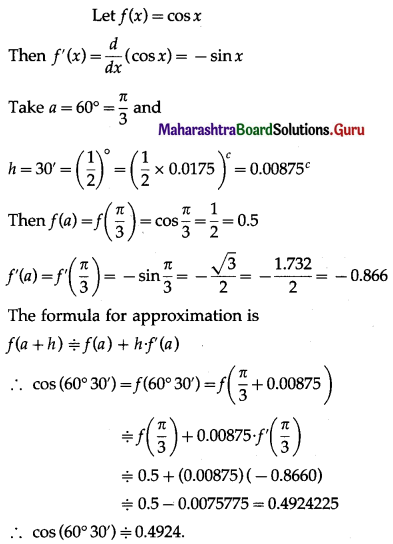
(iii) cos(60° 30′), given that 1° = 0.0175c, √3 = 1.732.
Solution:
Maharashtra Board 12th Maths Solutions Chapter 2 Applications of Derivatives Ex 2.2 Q2 (iii)

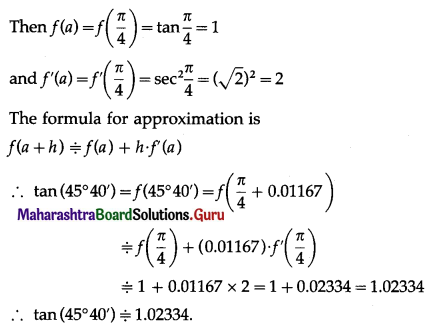
(iv) tan (45° 40′), given that 1° = 0.0175c.
Solution:
Maharashtra Board 12th Maths Solutions Chapter 2 Applications of Derivatives Ex 2.2 Q2 (iv)
Maharashtra Board 12th Maths Solutions Chapter 2 Applications of Derivatives Ex 2.2 Q2 (iv).1

Maharashtra Board 12th Maths Solutions Chapter 2 Applications of Derivatives Ex 2.2

Question 3.
Find the approximate values of
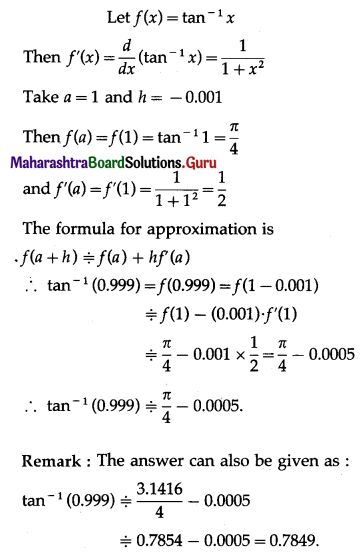
(i) tan-1(0.999).
Solution:
Maharashtra Board 12th Maths Solutions Chapter 2 Applications of Derivatives Ex 2.2 Q3 (i)

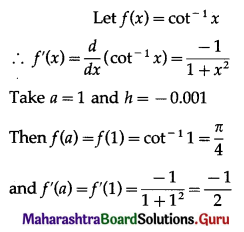
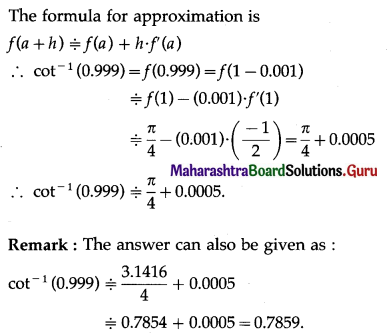
(ii) cot-1(0.999).
Solution:
Maharashtra Board 12th Maths Solutions Chapter 2 Applications of Derivatives Ex 2.2 Q3 (ii)
Maharashtra Board 12th Maths Solutions Chapter 2 Applications of Derivatives Ex 2.2 Q3 (ii).1

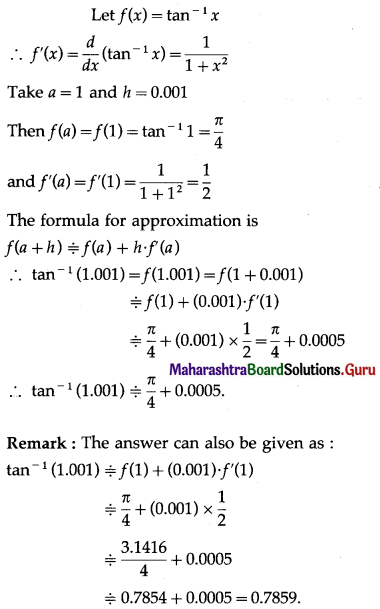
(iii) tan-1(1.001).
Solution:
Maharashtra Board 12th Maths Solutions Chapter 2 Applications of Derivatives Ex 2.2 Q3 (iii)

Question 4.
Find the approximate values of:
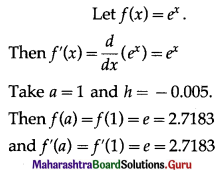
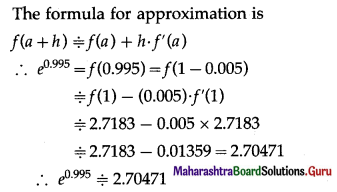
(i) e0.995, given that e = 2.7183.
Solution:
Maharashtra Board 12th Maths Solutions Chapter 2 Applications of Derivatives Ex 2.2 Q4 (i)
Maharashtra Board 12th Maths Solutions Chapter 2 Applications of Derivatives Ex 2.2 Q4 (i).1

Maharashtra Board 12th Maths Solutions Chapter 2 Applications of Derivatives Ex 2.2

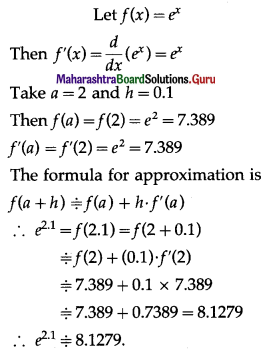
(ii) e2.1, given that e2 = 7.389.
Solution:
Maharashtra Board 12th Maths Solutions Chapter 2 Applications of Derivatives Ex 2.2 Q4 (ii)

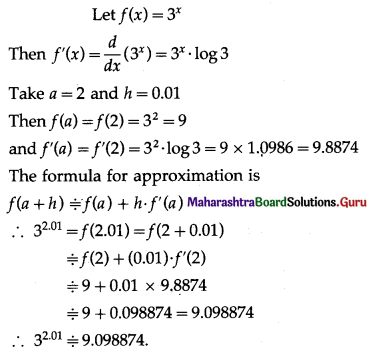
(iii) 32.01, given that log 3 = 1.0986.
Solution:
Maharashtra Board 12th Maths Solutions Chapter 2 Applications of Derivatives Ex 2.2 Q4 (iii)

Question 5.
Find the approximate values of:
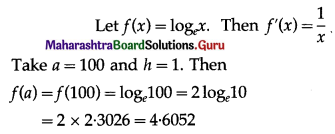
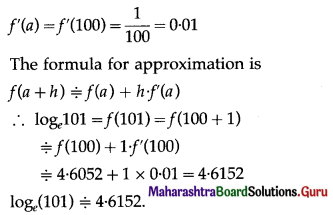
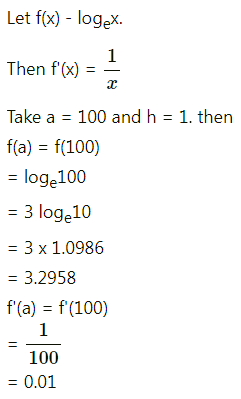
(i) loge(101), given that loge10 = 2.3026.
Solution:
Maharashtra Board 12th Maths Solutions Chapter 2 Applications of Derivatives Ex 2.2 Q5 (i)
Maharashtra Board 12th Maths Solutions Chapter 2 Applications of Derivatives Ex 2.2 Q5 (i).1

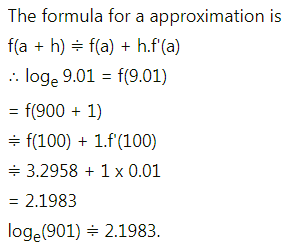
(ii) loge(9.01), given that log 3 = 1.0986.
Solution:
Maharashtra Board 12th Maths Solutions Chapter 2 Applications of Derivatives Ex 2.2 Q5 (ii)
Maharashtra Board 12th Maths Solutions Chapter 2 Applications of Derivatives Ex 2.2 Q5 (ii).1

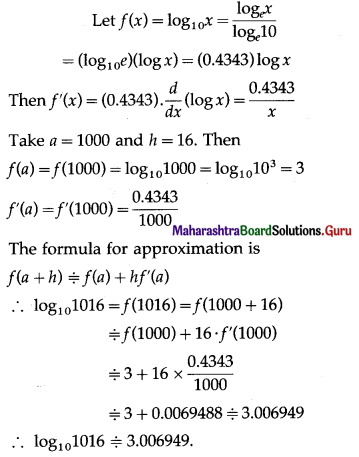
(iii) log10(1016), given that log10e = 0.4343.
Solution:
Maharashtra Board 12th Maths Solutions Chapter 2 Applications of Derivatives Ex 2.2 Q5 (iii)

Maharashtra Board 12th Maths Solutions Chapter 2 Applications of Derivatives Ex 2.2

Question 6.
Find the approximate values of:
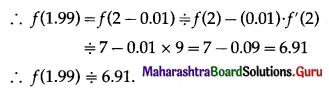
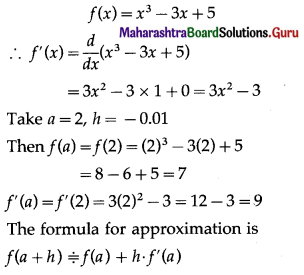
(i) f(x) = x3 – 3x + 5 at x = 1.99
Solution:
Maharashtra Board 12th Maths Solutions Chapter 2 Applications of Derivatives Ex 2.2 Q6 (i)
Maharashtra Board 12th Maths Solutions Chapter 2 Applications of Derivatives Ex 2.2 Q6 (i).1

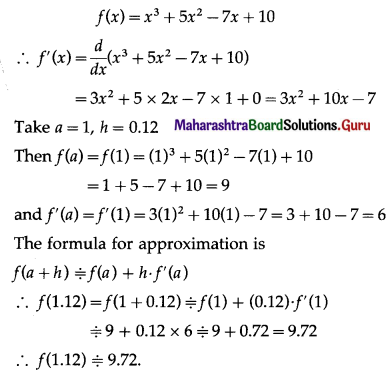
(ii) f(x) = x3 + 5x2 – 7x +10 at x = 1.12
Solution:
Maharashtra Board 12th Maths Solutions Chapter 2 Applications of Derivatives Ex 2.2 Q6 (ii)

12th Maharashtra State Board Maths Solutions Pdf Part 2

Applications of Derivatives Class 12 Maths 2 Exercise 2.1 Solutions Maharashtra Board

Balbharti 12th Maharashtra State Board Maths Solutions Book Pdf Chapter 2 Applications of Derivatives Ex 2.1 Questions and Answers.

12th Maths Part 2 Applications of Derivatives Exercise 2.1 Questions And Answers Maharashtra Board

Question 1.
Find the equations of tangents and normals to the curve at the point on it.
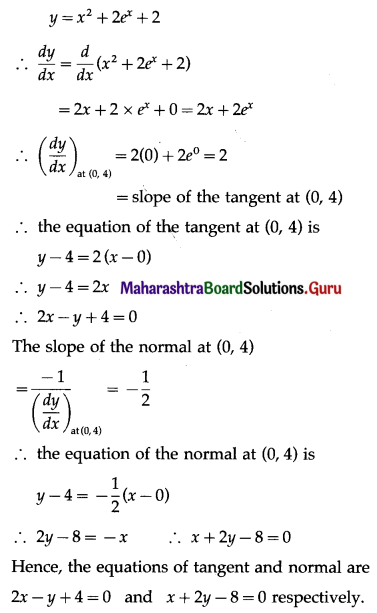
(i) y = x2 + 2ex + 2 at (0, 4)
Solution:
Maharashtra Board 12th Maths Solutions Chapter 2 Applications of Derivatives Ex 2.1 Q1 (i)

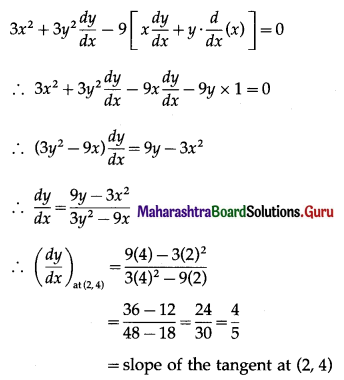
(ii) x3 + y3 – 9xy = 0 at (2, 4)
Solution:
x3 + y3 – 9xy = 0
Differentiating both sides w.r.t. x, we get
Maharashtra Board 12th Maths Solutions Chapter 2 Applications of Derivatives Ex 2.1 Q1 (ii)
Maharashtra Board 12th Maths Solutions Chapter 2 Applications of Derivatives Ex 2.1 Q1 (ii).1
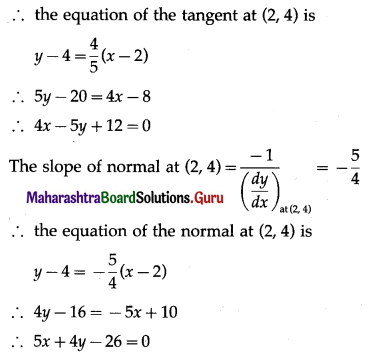
Hence, the equations of tangent and normal are 4x – 5y + 12 = 0 and 5x + 4y – 26 = 0 respectively.

Maharashtra Board 12th Maths Solutions Chapter 2 Applications of Derivatives Ex 2.1

(iii) x2 – √3xy + 2y2 = 5 at (√3, 2)
Solution:
x2 – √3xy + 2y2 = 5
Differentiating both sides w.r.t. x, we get
Maharashtra Board 12th Maths Solutions Chapter 2 Applications of Derivatives Ex 2.1 Q1 (iii)
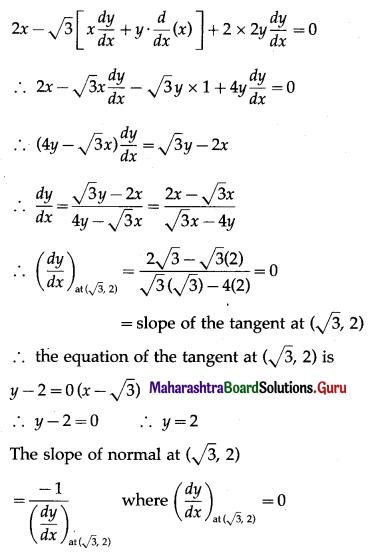
the slope of normal at (√3, 2) does not exist.
normal is parallel to Y-axis.
equation of the normal is of the form x = k
Since, it passes through the point (√3, 2), k = √3
equation of the normal is x = √3.
Hence, the equations of tangent and normal are y = 2 and x = √3 respectively.

(iv) 2xy + π sin y = 2π at (1, \(\frac{\pi}{2}\))
Solution:
2xy + π sin y = 2π
Differentiating both sides w.r.t. x, we get
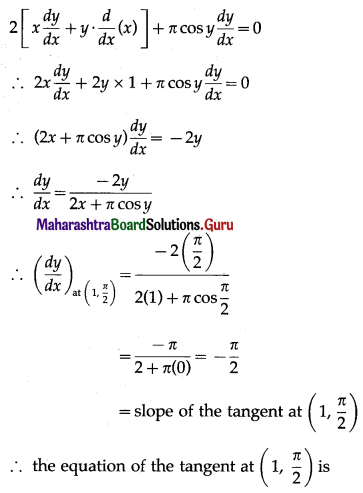
Maharashtra Board 12th Maths Solutions Chapter 2 Applications of Derivatives Ex 2.1 Q1 (iv)
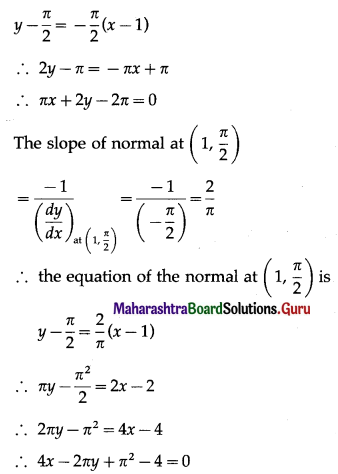
Maharashtra Board 12th Maths Solutions Chapter 2 Applications of Derivatives Ex 2.1 Q1 (iv).1
Hence, the equations of tangent and normal are πx + 2y – 2π = 0 and 4x – 2πy + π2 – 4 = 0 respectively.

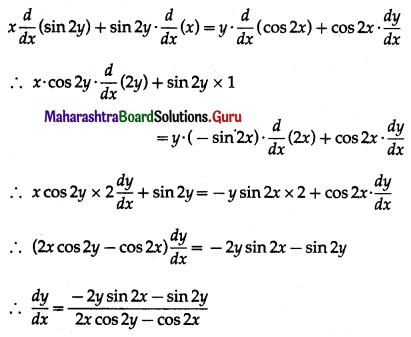
(v) x sin 2y = y cos 2x at (\(\frac{\pi}{4}\), \(\frac{\pi}{2}\))
Solution:
x sin 2y = y cos 2x
Differentiating both sides w.r.t. x, we get
Maharashtra Board 12th Maths Solutions Chapter 2 Applications of Derivatives Ex 2.1 Q1 (v)
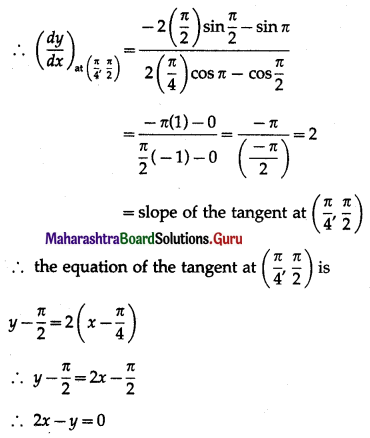
Maharashtra Board 12th Maths Solutions Chapter 2 Applications of Derivatives Ex 2.1 Q1 (v).1
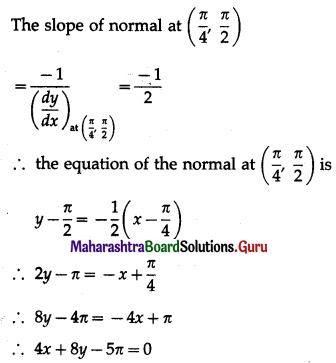
Maharashtra Board 12th Maths Solutions Chapter 2 Applications of Derivatives Ex 2.1 Q1 (v).2
Hence, the equations of the tangent and normal are 2x – y = 0 and 4x + 8y – 5π = 0 respectively.

Maharashtra Board 12th Maths Solutions Chapter 2 Applications of Derivatives Ex 2.1

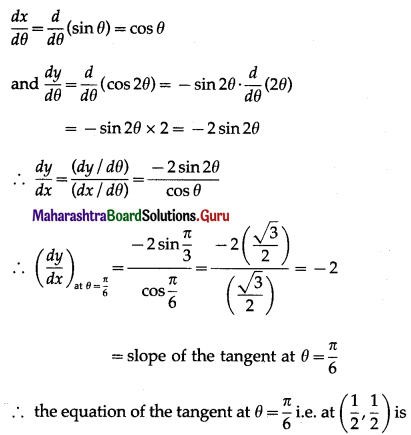
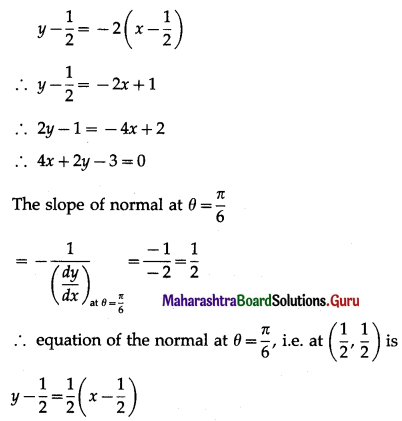
(vi) x = sin θ and y = cos 2θ at θ = \(\frac{\pi}{6}\)
Solution:
When θ = \(\frac{\pi}{6}\), x = sin\(\frac{\pi}{6}\) and y = cos\(\frac{\pi}{3}\)
∴ x = \(\frac{1}{2}\) and y = \(\frac{1}{2}\)
Hence, the point at which we want to find the equations of tangent and normal is (\(\frac{1}{2}\), \(\frac{1}{2}\))
Now, x = sin θ, y = cos 2θ
Differentiating x and y w.r.t. θ, we get
Maharashtra Board 12th Maths Solutions Chapter 2 Applications of Derivatives Ex 2.1 Q1 (vi)
Maharashtra Board 12th Maths Solutions Chapter 2 Applications of Derivatives Ex 2.1 Q1 (vi).1
2y – 1 = x – \(\frac{1}{2}\)
4y – 2 = 2x – 1
2x – 4y + 1 = 0
Hence, equations of the tangent and normal are 4x + 2y – 3 = 0 and 2x – 4y + 1 = 0 respectively.

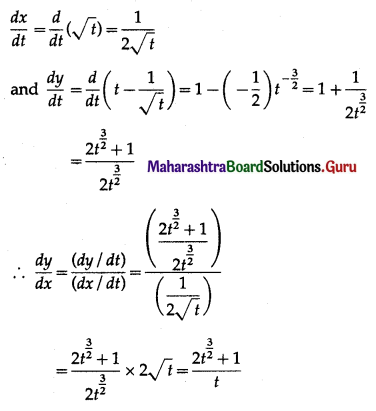
(vii) x = √t, y = t – \(\frac{1}{\sqrt{t}}\), at t = 4.
Solution:
When t = 4, x = √4 and y = 4 – \(\frac{1}{\sqrt{4}}\)
∴ x = 2 and y = 4 – \(\frac{1}{2}\) = \(\frac{7}{2}\)
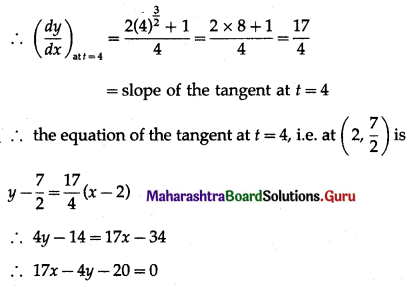
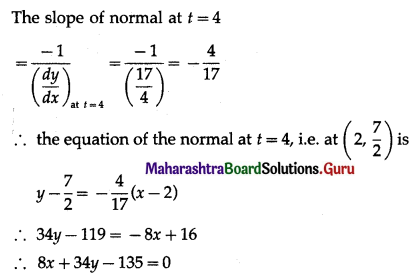
Hence, the point at which we want to find the equations of tangent and normal is (2, \(\frac{7}{2}\)).
Now, x = √t, y = t – \(\frac{1}{\sqrt{t}}\)
Differentiating x and y w.r.t. t, we get
Maharashtra Board 12th Maths Solutions Chapter 2 Applications of Derivatives Ex 2.1 Q1 (vii)
Maharashtra Board 12th Maths Solutions Chapter 2 Applications of Derivatives Ex 2.1 Q1 (vii).1
Maharashtra Board 12th Maths Solutions Chapter 2 Applications of Derivatives Ex 2.1 Q1 (vii).2
Hence, the equations of tangent and normal are 17x – 4y – 20 = 0 and 8x + 34y – 135 = 0 respectively.

Question 2.
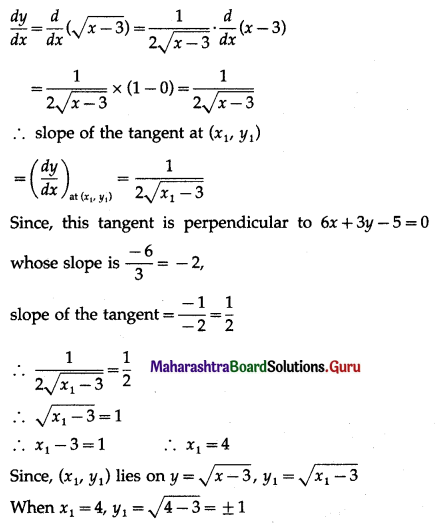
Find the point of the curve y = \(\sqrt{x-3}\) where the tangent is perpendicular to the line 6x + 3y – 5 = 0.
Solution:
Let the required point on the curve y = \(\sqrt{x-3}\) be P(x1, y1).
Differentiating y = \(\sqrt{x-3}\) w.r.t. x, we get
Maharashtra Board 12th Maths Solutions Chapter 2 Applications of Derivatives Ex 2.1 Q2
Hence, the required points are (4, 1) and (4, -1).

Maharashtra Board 12th Maths Solutions Chapter 2 Applications of Derivatives Ex 2.1

Question 3.
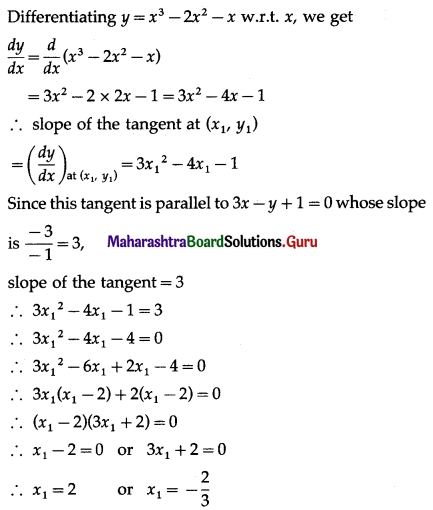
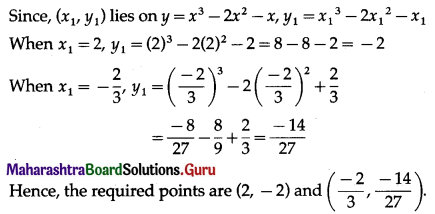
Find the points on the curve y = x3 – 2x2 – x where the tangents are parallel to 3x – y + 1 = 0.
Solution:
Let the required point on the curve y = x3 – 2x2 – x be P(x1, y1).
Maharashtra Board 12th Maths Solutions Chapter 2 Applications of Derivatives Ex 2.1 Q3
Maharashtra Board 12th Maths Solutions Chapter 2 Applications of Derivatives Ex 2.1 Q3.1

Question 4.
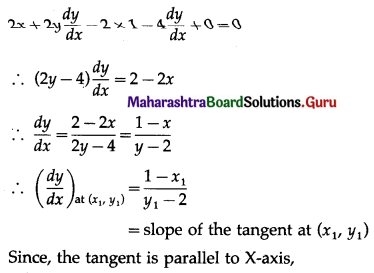
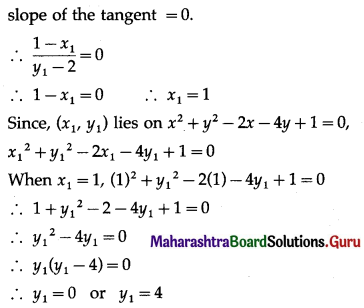
Find the equations of the tangents to the curve x2 + y2 – 2x – 4y + 1 = 0 which are parallel to the X-axis.
Solution:
Let P (x1, y1) be the point on the curve x2 + y2 – 2x – 4y + 1 = 0 where the tangent is parallel to X-axis.
Differentiating x2 + y2 – 2x – 4y + 1 = 0 w.r.t. x, we get
Maharashtra Board 12th Maths Solutions Chapter 2 Applications of Derivatives Ex 2.1 Q4
Maharashtra Board 12th Maths Solutions Chapter 2 Applications of Derivatives Ex 2.1 Q4.1
the coordinates of the points are (1, 0) or (1, 4)
Since the tangents are parallel to X-axis, their equations are of the form y = k
If it passes through the point (1, 0), k = 0, and if it passes through the point (1, 4), k = 4
Hence, the equations of the tangents are y = 0 and y = 4.

Question 5.
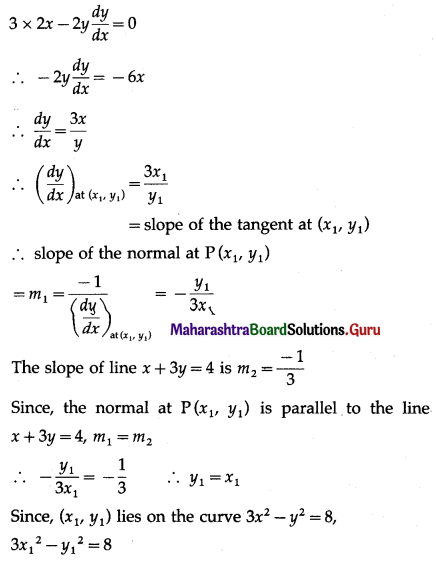
Find the equations of the normals to the curve 3x2 – y2 = 8, which are parallel to the line x + 3y = 4.
Solution:
Let P(x1, y1) be the foot of the required normal to the curve 3x2 – y2 = 8.
Differentiating 3x2 – y2 = 8 w.r.t. x, we get
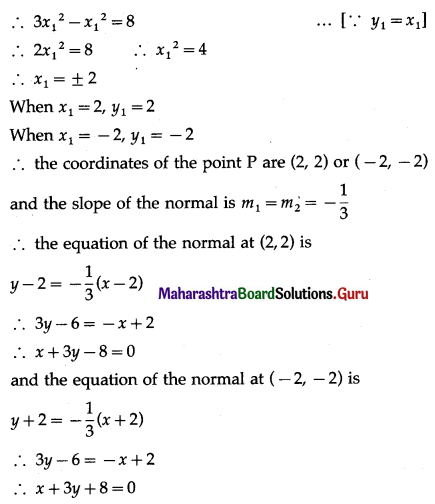
Maharashtra Board 12th Maths Solutions Chapter 2 Applications of Derivatives Ex 2.1 Q5
Maharashtra Board 12th Maths Solutions Chapter 2 Applications of Derivatives Ex 2.1 Q5.1
Hence, the equations of the normals are x + 3y – 8 = 0 and x + 3y + 8 = 0.

Question 6.
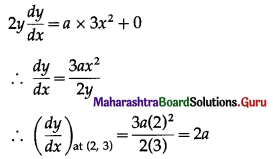
If the line y = 4x – 5 touches the curve y2 = ax3 + b at the point (2, 3), find a and b.
Solution:
y2 = ax3 + b
Differentiating both sides w.r.t. x, we get
Maharashtra Board 12th Maths Solutions Chapter 2 Applications of Derivatives Ex 2.1 Q6
= slope of the tangent at (2, 3)
Since, the line y = 4x – 5 touches the curve at the point (2, 3), slope of the tangent at (2, 3) is 4.
2a = 4 ⇒ a = 2
Since (2, 3) lies on the curve y2 = ax3 + b
(3)2 = a(2)3 + b
9 = 8a + b
9 = 8(2) + b …… [∵ a = 2]
b = -7
Hence, a = 2 and b = -7.

Maharashtra Board 12th Maths Solutions Chapter 2 Applications of Derivatives Ex 2.1

Question 7.
A particle moves along the curve 6y = x3 + 2. Find the points on the curve at which y-coordinate is changing 8 times as fast as the x-coordinate.
Solution:
Let P(x1, y1) be the point on the curve 6y = x3 + 2 whose y-coordinate is changing 8 times as fast as the x-coordinate.
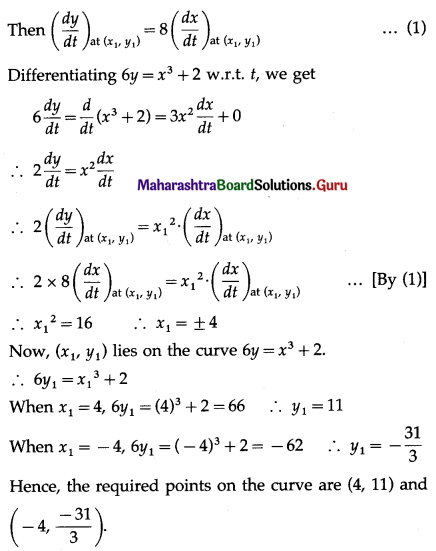
Maharashtra Board 12th Maths Solutions Chapter 2 Applications of Derivatives Ex 2.1 Q7

Question 8.
A spherical soap bubble is expanding so that its radius is increasing at the rate of 0.02 cm/sec. At what rate is the surface area increasing, when its radius is 5 cm?
Solution:
Let r be the radius and S be the surface area of the soap bubble at any time t.
Then S = 4πr2
Differentiating w.r.t. t, we get
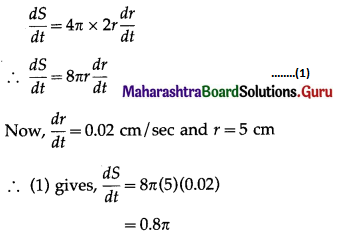
Maharashtra Board 12th Maths Solutions Chapter 2 Applications of Derivatives Ex 2.1 Q8
Hence, the surface area of the soap bubble is increasing at the rate of 0.87c cm2 / sec.

Question 9.
The surface area of a spherical balloon is increasing at the rate of 2 cm2/sec. At what rate is the volume of the balloon is increasing, when the radius of the balloon is 6 cm?
Solution:
Let r be the radius, S be the surface area and V be the volume of the spherical balloon at any time t.
Then S = 4πr2 and V = \(\frac{4}{3} \pi r^{3}\)
Differentiating w.r.t. t, we get
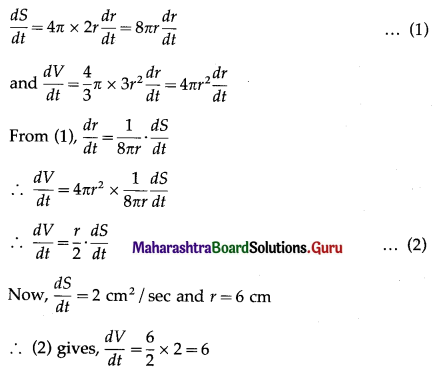
Maharashtra Board 12th Maths Solutions Chapter 2 Applications of Derivatives Ex 2.1 Q9
Hence, the volume of the spherical balloon is increasing at the rate of 6 cm3 / sec.

Question 10.
If each side of an equilateral triangle increases at the rate of √2 cm/sec, find the rate of increase of its area when its side of length is 3 cm.
Solution:
If x cm is the side of the equilateral triangle and A is its area, then \(A=\frac{\sqrt{3}}{4} x^{2}\)
Differentiating w.r.t. f, we get
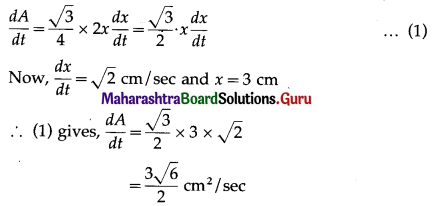
Maharashtra Board 12th Maths Solutions Chapter 2 Applications of Derivatives Ex 2.1 Q10
Hence, rate of increase of the area of equilateral triangle = \(\frac{3 \sqrt{6}}{2}\) cm2 / sec.

Maharashtra Board 12th Maths Solutions Chapter 2 Applications of Derivatives Ex 2.1

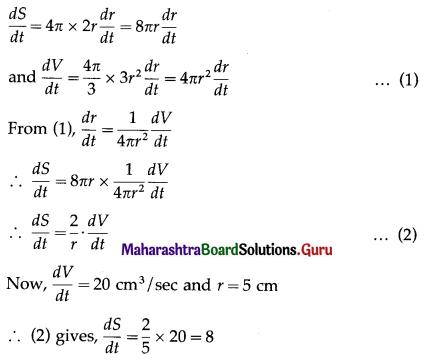
Question 11.
The volume of a sphere increases at the rate of 20 cm3/sec. Find the rate of change of its surface area, when its radius is 5 cm.
Solution:
Let r be the radius, S be the surface area and V be the volume of the sphere at any time t.
Then S = 4πr2 and V = \(\frac{4}{3} \pi r^{3}\)
Differentiating w.r.t. t, we get
Maharashtra Board 12th Maths Solutions Chapter 2 Applications of Derivatives Ex 2.1 Q11
Hence, the surface area of the sphere is changing at the rate of 8 cm2/sec.

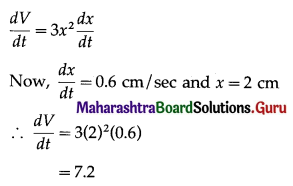
Question 12.
The edge of a cube is decreasing at the rate of 0.6 cm/sec. Find the rate at which its volume is decreasing, when the edge of the cube is 2 cm.
Solution:
Let x be the edge of the cube and V be its volume at any time t.
Then V = x3
Differentiating both sides w.r.t. t, we get
Maharashtra Board 12th Maths Solutions Chapter 2 Applications of Derivatives Ex 2.1 Q12
Hence, the volume of the cube is decreasing at the rate of 7.2 cm3/sec.

Question 13.
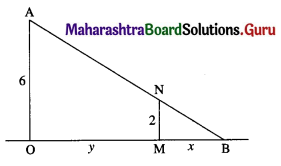
A man of height 2 meters walks at a uniform speed of 6 km/hr away from a lamp post of 6 meters high. Find the rate at which the length of the shadow is increasing.
Solution:
Let OA be the lamp post, MN the man, MB = x, his shadow, and OM = y, the distance of the man from the lamp post at time t.
Maharashtra Board 12th Maths Solutions Chapter 2 Applications of Derivatives Ex 2.1 Q13
Then \(\frac{d y}{d t}\) = 6 km/hr is the rate at which the man is moving at away from the lamp post.
\(\frac{d x}{d t}\) is the rate at which his shadow is increasing.
From the figure,
\(\frac{x}{2}=\frac{x+y}{6}\)
6x = 2x + 2y
4x = 2y
x = \(\frac{1}{2}\) y
\(\frac{d x}{d t}=\frac{1}{2} \frac{d y}{d t}=\frac{1}{2} \times 6=3 \mathrm{~km} / \mathrm{hr}\)
Hence, the length of the shadow is increasing at the rate of 3 km/hr.

Question 14.
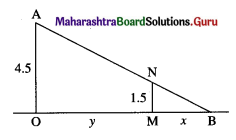
A man of height 1.5 meters walks towards a lamp post of height 4.5 meters, at the rate of (\(\frac{3}{4}\)) meter/sec.
Find the rate at which
(i) his shadow is shortening
(ii) the tip of the shadow is moving.
Solution:
Maharashtra Board 12th Maths Solutions Chapter 2 Applications of Derivatives Ex 2.1 Q14
Let OA be the lamp post, MN the man, MB = x his shadow and OM = y the distance of the man from lamp post at time t.
Then \(\frac{d y}{d t}=\frac{3}{4}\) is the rate at which the man is moving towards the lamp post.
\(\frac{d x}{d t}\) is the rate at which his shadow is shortening.
B is the tip of the shadow and it is at a distance of x + y from the post.
\(\frac{d}{d t}(x+y)=\frac{d x}{d t}+\frac{d y}{d t}\) is the rate at which the tip of the shadow is moving.
From the figure,
\(\frac{x}{1.5}=\frac{x+y}{4.5}\)
45x = 15x + 15y
30x = 15y
x = \(\frac{1}{2}\)y
\(\frac{d x}{d t}=\frac{1}{2} \cdot \frac{d y}{d t}=\frac{1}{2}\left(\frac{3}{4}\right)=\left(\frac{3}{8}\right) \text { metre/sec }\)
and \(\frac{d x}{d t}+\frac{d y}{d t}=\frac{3}{8}+\frac{3}{4}=\left(\frac{9}{8}\right) \text { metres } / \mathrm{sec}\)
Hence (i) the shadow is shortening at the rate of (\(\frac{3}{8}\)) metre/sec, and
(ii) the tip of shadow is moving at the rate of (\(\frac{9}{8}\)) metres/sec.

Maharashtra Board 12th Maths Solutions Chapter 2 Applications of Derivatives Ex 2.1

Question 15.
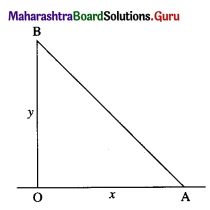
A ladder 10 metres long is leaning against a vertical wall. If the bottom of the ladder is pulled horizontally away from the wall at the rate of 1.2 metres per second, find how fast the top of the ladder is sliding down the wall, when the bottom is 6 metres away from the wall.
Solution:
Maharashtra Board 12th Maths Solutions Chapter 2 Applications of Derivatives Ex 2.1 Q15
Let AB be the ladder, where AB = 10 metres.
Let at time t seconds, the end A of the ladder be x metres from the wall and the end B be y metres from the ground.
Since, OAB is a right angled triangle, by Pythagoras’ theorem
x2 + y2 = 102 i.e. y2 = 100 – x2
Differentiating w.r.t. t, we get
2y \(\frac{d y}{d t}\) = 0 – 2x \(\frac{d x}{d t}\)
∴ \(\frac{d y}{d t}=-\frac{x}{y} \cdot \frac{d x}{d t}\) ……..(1)
Now, \(\frac{d x}{d t}\) = 1.2 metres/sec is the rate at which the bottom at of the ladder is pulled horizontally and \(\frac{d y}{d t}\) is the rate at which the top of ladder B is sliding.
When x = 6, y2 = 100 – 36 = 64
y = 8
(1) gives \(\frac{d y}{d t}=-\frac{6}{8}(1.2)=-\frac{6}{8} \times \frac{12}{10}\)
\(=-\frac{9}{10}=-0.9\)
Hence, the top of the ladder is sliding down the wall, at the rate of 0.9 metre/sec.

Question 16.
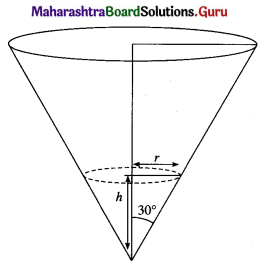
If water is poured into an inverted hollow cone whose semi-vertical angle is 30° so that its depth (measured along the axis) increases at the rate of 1 cm/sec. Find the rate at which the volume of water increases when the depth is 2 cm.
Solution:
Maharashtra Board 12th Maths Solutions Chapter 2 Applications of Derivatives Ex 2.1 Q16
Let r be the radius, h be the height, θ be the semi-vertical angle and V be the volume of the water at any time t.
Maharashtra Board 12th Maths Solutions Chapter 2 Applications of Derivatives Ex 2.1 Q16.1
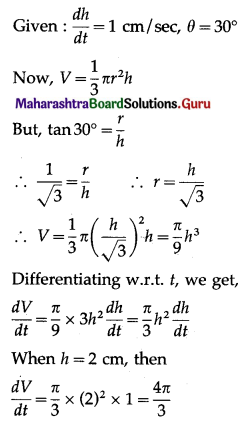
Hence, the volume of water is increasing at the rate of \(\left(\frac{4 \pi}{3}\right)\) cm3/sec.

12th Maharashtra State Board Maths Solutions Pdf Part 2

Differentiation Class 12 Maths 2 Miscellaneous Exercise 1 Solutions Maharashtra Board

Balbharti 12th Maharashtra State Board Maths Solutions Book Pdf Chapter 1 Differentiation Miscellaneous Exercise 1 Questions and Answers.

12th Maths Part 2 Differentiation Miscellaneous Exercise 1 Questions And Answers Maharashtra Board

(I) Choose the correct option from the given alternatives:

Question 1.
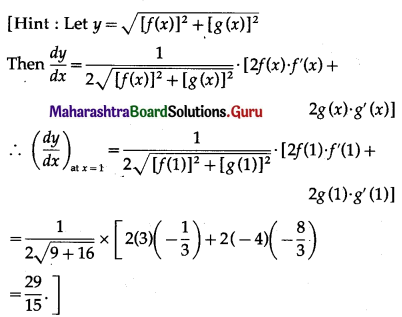
Let f(1) = 3, f'(1) = \(-\frac{1}{3}\), g(1) = -4 and g'(1) = \(-\frac{8}{3}\). The derivative of \(\sqrt{[f(x)]^{2}+[g(x)]^{2}}\) w.r.t. x at x = 1 is
(a) \(-\frac{29}{15}\)
(b) \(\frac{7}{3}\)
(c) \(\frac{31}{15}\)
(d) \(\frac{29}{15}\)
Answer:
(d) \(\frac{29}{15}\)
Maharashtra Board 12th Maths Solutions Chapter 1 Differentiation Miscellaneous Exercise 1 I Q1

Question 2.
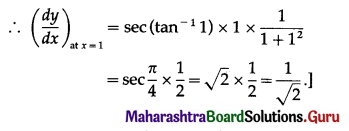
If y = sec(tan-1 x), then \(\frac{d y}{d x}\) at x = 1, is equal to
(a) \(\frac{1}{2}\)
(b) 1
(c) \(\frac{1}{\sqrt{2}}\)
(d) 2
Answer:
(c) \(\frac{1}{\sqrt{2}}\)
Maharashtra Board 12th Maths Solutions Chapter 1 Differentiation Miscellaneous Exercise 1 I Q2
Maharashtra Board 12th Maths Solutions Chapter 1 Differentiation Miscellaneous Exercise 1 I Q2.1

Maharashtra Board 12th Maths Solutions Chapter 1 Differentiation Miscellaneous Exercise 1

Question 3.
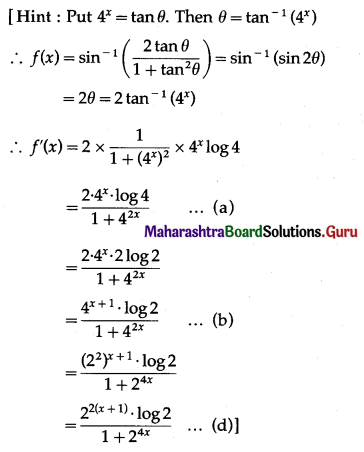
If f(x) = \(\sin ^{-1}\left(\frac{4^{x+\frac{1}{2}}}{1+2^{4 x}}\right)\), which of the following is not the derivative of f(x)?
(a) \(\frac{2 \cdot 4^{x} \log 4}{1+4^{2 x}}\)
(b) \(\frac{4^{x+1} \log 2}{1+4^{2 x}}\)
(c) \(\frac{4^{x+1} \log 4}{1+4^{4 x}}\)
(d) \(\frac{2^{2(x+1)} \log 2}{1+2^{4 x}}\)
Answer:
(c) \(\frac{4^{x+1} \log 4}{1+4^{4 x}}\)
Maharashtra Board 12th Maths Solutions Chapter 1 Differentiation Miscellaneous Exercise 1 I Q3

Question 4.
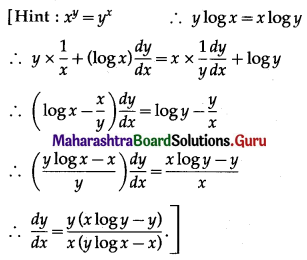
If xy = yx, then\(\frac{d y}{d x}\) = _______
(a) \(\frac{x(x \log y-y)}{y(y \log x-x)}\)
(b) \(\frac{y(y \log x-x)}{x(x \log y-y)}\)
(c) \(\frac{y^{2}(1-\log x)}{x^{2}(1-\log y)}\)
(d) \(\frac{y(1-\log x)}{x(1-\log y)}\)
Answer:
(b) \(\frac{y(y \log x-x)}{x(x \log y-y)}\)
Maharashtra Board 12th Maths Solutions Chapter 1 Differentiation Miscellaneous Exercise 1 I Q4

Question 5.
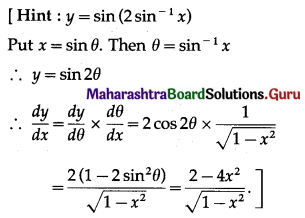
If y = sin (2 sin-1 x), then \(\frac{d y}{d x}\) = _______
(a) \(\frac{2-4 x^{2}}{\sqrt{1-x^{2}}}\)
(b) \(\frac{2+4 x^{2}}{\sqrt{1-x^{2}}}\)
(c) \(\frac{4 x^{2}-1}{\sqrt{1-x^{2}}}\)
(d) \(\frac{1-2 x^{2}}{\sqrt{1-x^{2}}}\)
Answer:
(a) \(\frac{2-4 x^{2}}{\sqrt{1-x^{2}}}\)
Maharashtra Board 12th Maths Solutions Chapter 1 Differentiation Miscellaneous Exercise 1 I Q5

Question 6.
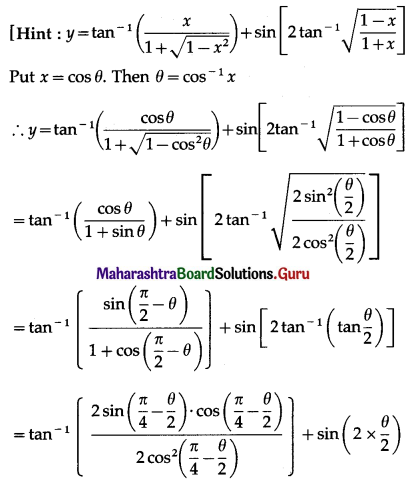
If y = \(\tan ^{-1}\left(\frac{x}{1+\sqrt{1-x^{2}}}\right)+\sin \left[2 \tan ^{-1}\left(\sqrt{\frac{1-x}{1+x}}\right)\right]\), then \(\frac{d y}{d x}\) = _______
(a) \(\frac{x}{\sqrt{1-x^{2}}}\)
(b) \(\frac{1-2 x}{\sqrt{1-x^{2}}}\)
(c) \(\frac{1-2 x}{2 \sqrt{1-x^{2}}}\)
(d) \(\frac{1-2 x^{2}}{\sqrt{1-x^{2}}}\)
Answer:
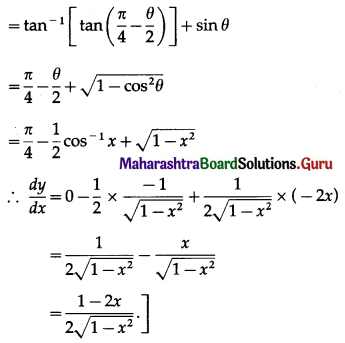
(c) \(\frac{1-2 x}{2 \sqrt{1-x^{2}}}\)
Maharashtra Board 12th Maths Solutions Chapter 1 Differentiation Miscellaneous Exercise 1 I Q6
Maharashtra Board 12th Maths Solutions Chapter 1 Differentiation Miscellaneous Exercise 1 I Q6.1

Question 7.
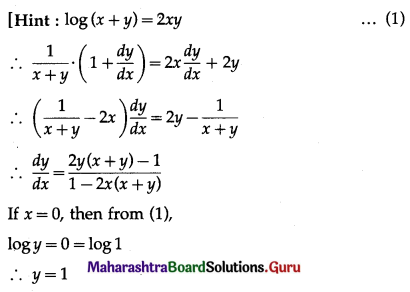
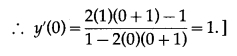
If y is a function of x and log(x + y) = 2xy, then the value of y'(0) = _______
(a) 2
(b) 0
(c) -1
(d) 1
Answer:
(d) 1
Maharashtra Board 12th Maths Solutions Chapter 1 Differentiation Miscellaneous Exercise 1 I Q7
Maharashtra Board 12th Maths Solutions Chapter 1 Differentiation Miscellaneous Exercise 1 I Q7.1

Maharashtra Board 12th Maths Solutions Chapter 1 Differentiation Miscellaneous Exercise 1

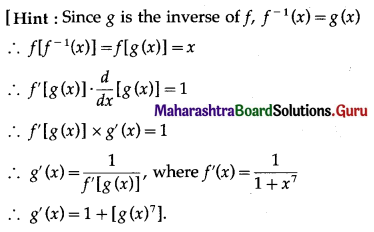
Question 8.
If g is the inverse of function f and f'(x) = \(\frac{1}{1+x^{7}}\), then the value of g'(x) is equal to:
(a) 1 + x7
(b) \(\frac{1}{1+[g(x)]^{7}}\)
(c) 1 + [g(x)]7
(d) 7x6
Answer:
(c) 1 + [g(x)]7
Maharashtra Board 12th Maths Solutions Chapter 1 Differentiation Miscellaneous Exercise 1 I Q8

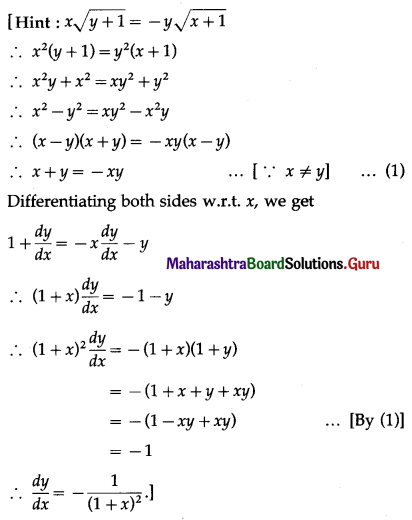
Question 9.
If \(x \sqrt{y+1}+y \sqrt{x+1}=0\) and x ≠ y, then \(\frac{d y}{d x}\) = _______
(a) \(\frac{1}{(1+x)^{2}}\)
(b) \(-\frac{1}{(1+x)^{2}}\)
(c) (1 + x)2
(d) \(-\frac{x}{x+1}\)
Answer:
(b) \(-\frac{1}{(1+x)^{2}}\)
Maharashtra Board 12th Maths Solutions Chapter 1 Differentiation Miscellaneous Exercise 1 I Q9

Question 10.
If y = \(\tan ^{-1}\left(\sqrt{\frac{a-x}{a+x}}\right)\), where -a < x < a, then \(\frac{d y}{d x}\) = _______
(a) \(\frac{x}{\sqrt{a^{2}-x^{2}}}\)
(b) \(\frac{a}{\sqrt{a^{2}-x^{2}}}\)
(c) \(-\frac{1}{2 \sqrt{a^{2}-x^{2}}}\)
(d) \(\frac{1}{2 \sqrt{a^{2}-x^{2}}}\)
Answer:
(c) \(-\frac{1}{2 \sqrt{a^{2}-x^{2}}}\)
[Hint: Put x = a cos θ]

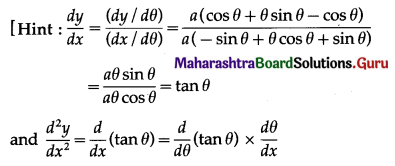
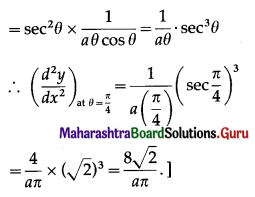
Question 11.
If x = a (cos θ + θ sin θ), y = a (sin θ – θ cos θ), then \(\left[\frac{d^{2} y}{d x^{2}}\right]_{\theta=\frac{\pi}{4}}\) = _______
(a) \(\frac{8 \sqrt{2}}{a \pi}\)
(b) \(-\frac{8 \sqrt{2}}{a \pi}\)
(c) \(\frac{a \pi}{8 \sqrt{2}}\)
(d) \(\frac{4 \sqrt{2}}{a \pi}\)
Answer:
(a) \(\frac{8 \sqrt{2}}{a \pi}\)
Maharashtra Board 12th Maths Solutions Chapter 1 Differentiation Miscellaneous Exercise 1 I Q11
Maharashtra Board 12th Maths Solutions Chapter 1 Differentiation Miscellaneous Exercise 1 I Q11.1

Question 12.
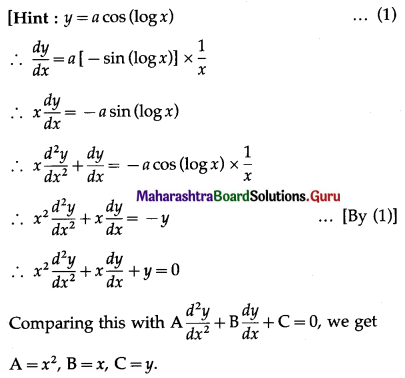
If y = a cos (log x) and \(A \frac{d^{2} y}{d x^{2}}+B \frac{d y}{d x}+C=0\), then the values of A, B, C are _______
(a) x2, -x, -y
(b) x2, x, y
(c) x2, x, -y
(d) x2, -x, y
Answer:
(b) x2, x, y
Maharashtra Board 12th Maths Solutions Chapter 1 Differentiation Miscellaneous Exercise 1 I Q12

(II) Solve the following:

Question 1.
Maharashtra Board 12th Maths Solutions Chapter 1 Differentiation Miscellaneous Exercise 1 II Q1
Maharashtra Board 12th Maths Solutions Chapter 1 Differentiation Miscellaneous Exercise 1 II Q1.1
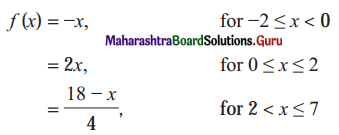
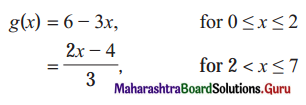
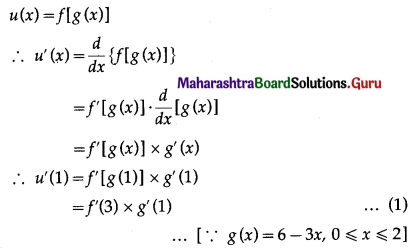
Let u(x) = f[g(x)], v(x) = g[f(x)] and w(x) = g[g(x)]. Find each derivative at x = 1, if it exists i.e. find u'(1), v'(1) and w'(1). if it doesn’t exist then explain why?
Solution:
Maharashtra Board 12th Maths Solutions Chapter 1 Differentiation Miscellaneous Exercise 1 II Q1.2
Maharashtra Board 12th Maths Solutions Chapter 1 Differentiation Miscellaneous Exercise 1 II Q1.3
Maharashtra Board 12th Maths Solutions Chapter 1 Differentiation Miscellaneous Exercise 1 II Q1.4
Maharashtra Board 12th Maths Solutions Chapter 1 Differentiation Miscellaneous Exercise 1 II Q1.5
Maharashtra Board 12th Maths Solutions Chapter 1 Differentiation Miscellaneous Exercise 1 II Q1.6

Maharashtra Board 12th Maths Solutions Chapter 1 Differentiation Miscellaneous Exercise 1

Question 2.
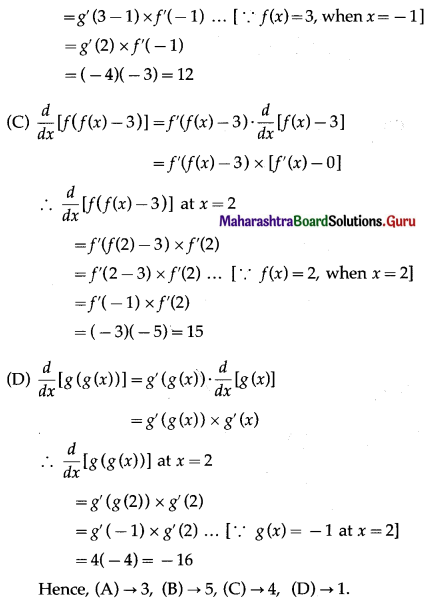
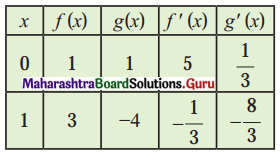
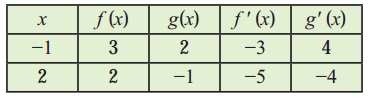
The values of f(x), g(x), f'(x) and g'(x) are given in the following table:
Maharashtra Board 12th Maths Solutions Chapter 1 Differentiation Miscellaneous Exercise 1 II Q2
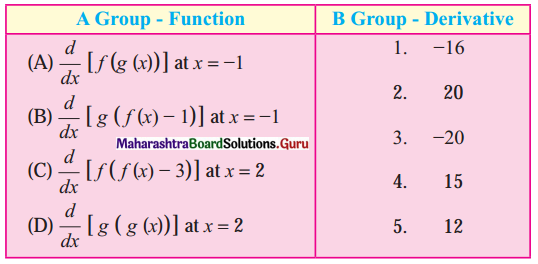
Match the following:
Maharashtra Board 12th Maths Solutions Chapter 1 Differentiation Miscellaneous Exercise 1 II Q2.1
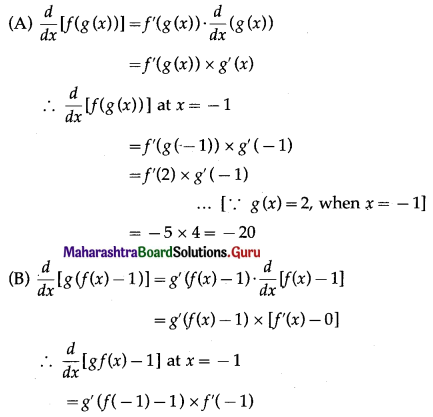
Solution:
Maharashtra Board 12th Maths Solutions Chapter 1 Differentiation Miscellaneous Exercise 1 II Q2.2
Maharashtra Board 12th Maths Solutions Chapter 1 Differentiation Miscellaneous Exercise 1 II Q2.3

Question 3.
Suppose that the functions f and g and their derivatives with respect to x have the following values at x = 0 and x = 1.
Maharashtra Board 12th Maths Solutions Chapter 1 Differentiation Miscellaneous Exercise 1 II Q3
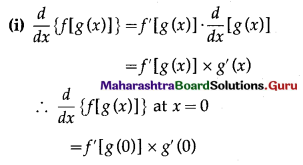
(i) The derivative of f[g(x)] w.r.t. x at x = 0 is _______
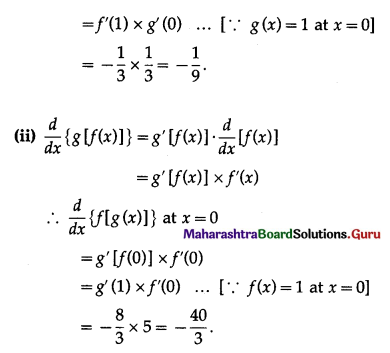
(ii) The derivative of g[f(x)] w.r.t. x at x = 0 is _______
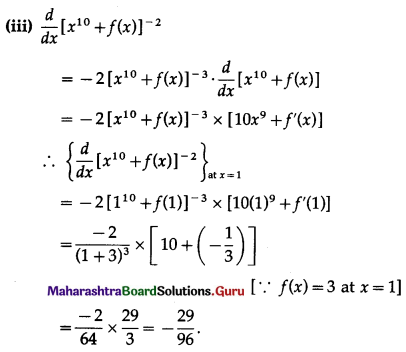
(iii) The value of \(\left[\frac{d}{d x}\left[x^{10}+f(x)\right]^{-2}\right]_{x=1}\) is _______
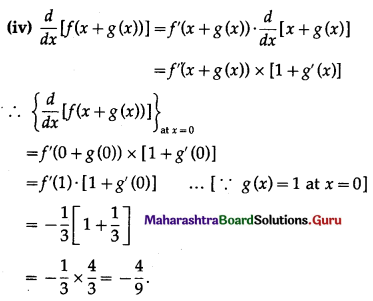
(iv) The derivative of f[(x+g(x))] w.r.t. x at x = 0 is _______
Solution:
Maharashtra Board 12th Maths Solutions Chapter 1 Differentiation Miscellaneous Exercise 1 II Q3.1
Maharashtra Board 12th Maths Solutions Chapter 1 Differentiation Miscellaneous Exercise 1 II Q3.2
Maharashtra Board 12th Maths Solutions Chapter 1 Differentiation Miscellaneous Exercise 1 II Q3.3
Maharashtra Board 12th Maths Solutions Chapter 1 Differentiation Miscellaneous Exercise 1 II Q3.4

Question 4.
Differentiate the following w.r.t. x:
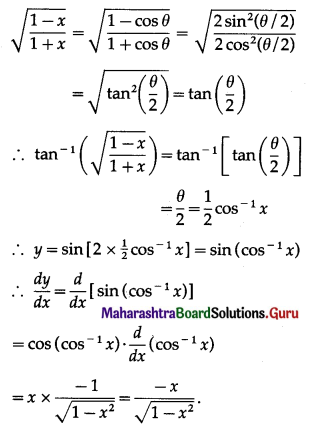
(i) \(\sin \left[2 \tan ^{-1}\left(\sqrt{\frac{1-x}{1+x}}\right)\right]\)
Solution:
Let y = \(\sin \left[2 \tan ^{-1}\left(\sqrt{\frac{1-x}{1+x}}\right)\right]\)
Put x = cos θ, Then θ = cos-1 x and
Maharashtra Board 12th Maths Solutions Chapter 1 Differentiation Miscellaneous Exercise 1 II Q4 (i)

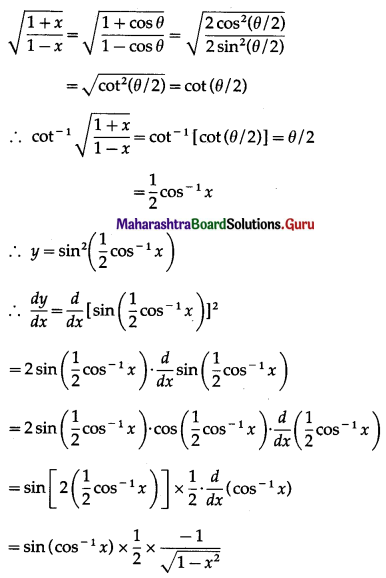
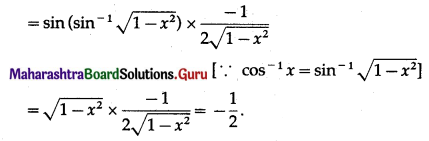
(ii) \(\sin ^{2}\left[\cot ^{-1}\left(\sqrt{\frac{1+x}{1-x}}\right)\right]\)
Solution:
Let y = \(\sin ^{2}\left[\cot ^{-1}\left(\sqrt{\frac{1+x}{1-x}}\right)\right]\)
Put x = cos θ. Then θ = cos-1 x and
Maharashtra Board 12th Maths Solutions Chapter 1 Differentiation Miscellaneous Exercise 1 II Q4 (ii)
Maharashtra Board 12th Maths Solutions Chapter 1 Differentiation Miscellaneous Exercise 1 II Q4 (ii).1

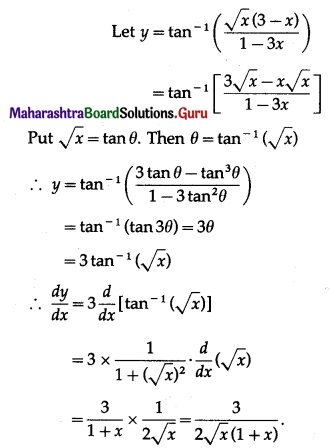
(iii) \(\tan ^{-1}\left[\frac{\sqrt{x}(3-x)}{1-3 x}\right]\)
Solution:
Maharashtra Board 12th Maths Solutions Chapter 1 Differentiation Miscellaneous Exercise 1 II Q4 (iii)

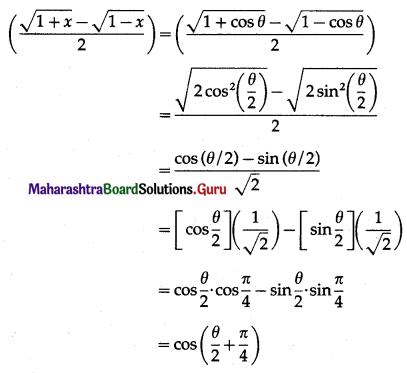
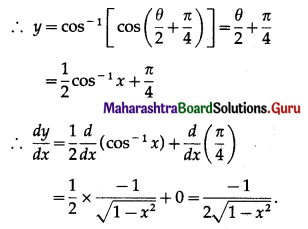
(iv) \(\cos ^{-1}\left(\frac{\sqrt{1+x}-\sqrt{1-x}}{2}\right)\)
Solution:
Let y = \(\cos ^{-1}\left(\frac{\sqrt{1+x}-\sqrt{1-x}}{2}\right)\)
Put x = cos θ. Then θ = cos-1 x and
Maharashtra Board 12th Maths Solutions Chapter 1 Differentiation Miscellaneous Exercise 1 II Q4 (iv)
Maharashtra Board 12th Maths Solutions Chapter 1 Differentiation Miscellaneous Exercise 1 II Q4 (iv).1

Maharashtra Board 12th Maths Solutions Chapter 1 Differentiation Miscellaneous Exercise 1

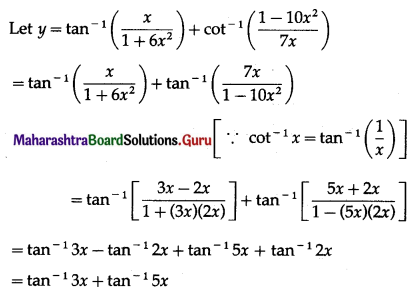
(v) \(\tan ^{-1}\left(\frac{x}{1+6 x^{2}}\right)+\cot ^{-1}\left(\frac{1-10 x^{2}}{7 x}\right)\)
Solution:
Maharashtra Board 12th Maths Solutions Chapter 1 Differentiation Miscellaneous Exercise 1 II Q4 (v)
Maharashtra Board 12th Maths Solutions Chapter 1 Differentiation Miscellaneous Exercise 1 II Q4 (v).1

(vi) \(\tan ^{-1}\left[\sqrt{\frac{\sqrt{1+x^{2}+x}}{\sqrt{1+x^{2}}-x}}\right]\)
Solution:
Maharashtra Board 12th Maths Solutions Chapter 1 Differentiation Miscellaneous Exercise 1 II Q4 (vi)
Maharashtra Board 12th Maths Solutions Chapter 1 Differentiation Miscellaneous Exercise 1 II Q4 (vi).1
Maharashtra Board 12th Maths Solutions Chapter 1 Differentiation Miscellaneous Exercise 1 II Q4 (vi).2

Question 5.
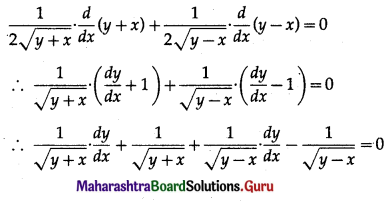
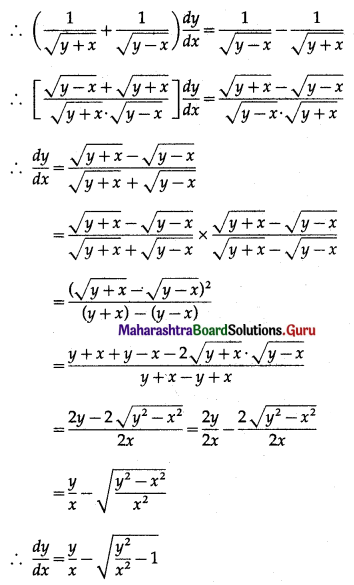
(i) If \(\sqrt{y+x}+\sqrt{y-x}=c\), show that \(\frac{d y}{d x}=\frac{y}{x}-\sqrt{\frac{y^{2}}{x^{2}}-1}\)
Solution:
\(\sqrt{y+x}+\sqrt{y-x}=c\)
Differentiating both sides w.r.t. x, we get
Maharashtra Board 12th Maths Solutions Chapter 1 Differentiation Miscellaneous Exercise 1 II Q5 (i)
Maharashtra Board 12th Maths Solutions Chapter 1 Differentiation Miscellaneous Exercise 1 II Q5 (i).1

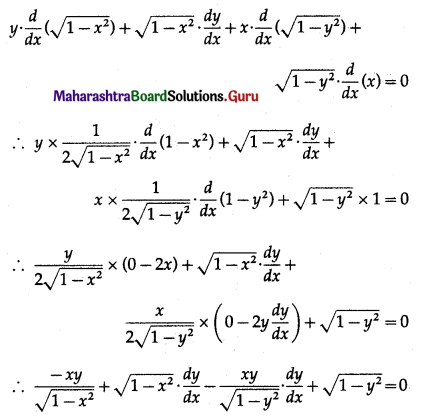
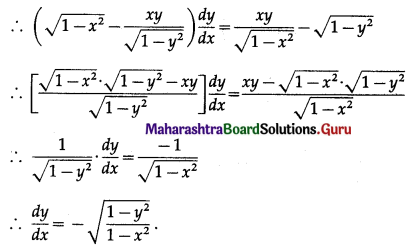
(ii) If \(x \sqrt{1-y^{2}}+y \sqrt{1-x^{2}}=1\), then show that \(\frac{d y}{d x}=-\sqrt{\frac{1-y^{2}}{1-x^{2}}}\)
Solution:
\(x \sqrt{1-y^{2}}+y \sqrt{1-x^{2}}=1\)
\(y \sqrt{1-x^{2}}+x \sqrt{1-y^{2}}=1\)
Differentiating both sides w.r.t. x, we get
Maharashtra Board 12th Maths Solutions Chapter 1 Differentiation Miscellaneous Exercise 1 II Q5 (ii)
Maharashtra Board 12th Maths Solutions Chapter 1 Differentiation Miscellaneous Exercise 1 II Q5 (ii).1

(iii) If x sin(a + y) + sin a cos(a + y) = 0, then show \(\frac{d y}{d x}=\frac{\sin ^{2}(a+y)}{\sin a}\)
Solution:
x sin(a + y) + sin a . cos (a + y) = 0 ….. (1)
Differentiating w.r.t. x, we get
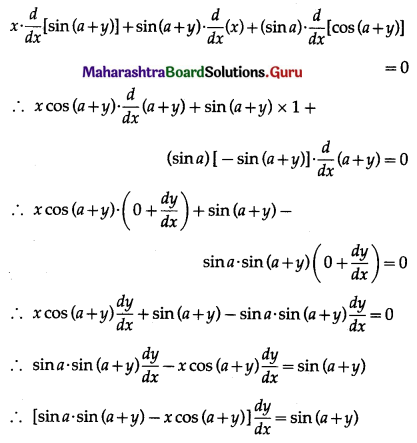
Maharashtra Board 12th Maths Solutions Chapter 1 Differentiation Miscellaneous Exercise 1 II Q5 (iii)
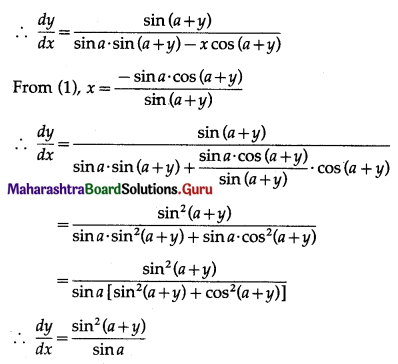
Maharashtra Board 12th Maths Solutions Chapter 1 Differentiation Miscellaneous Exercise 1 II Q5 (iii).1
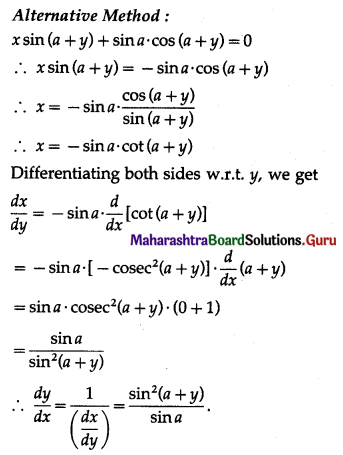
Maharashtra Board 12th Maths Solutions Chapter 1 Differentiation Miscellaneous Exercise 1 II Q5 (iii).2

(iv) If sin y = x sin(a + y), then show that \(\frac{d y}{d x}=\frac{\sin ^{2}(a+y)}{\sin a}\)
Solution:
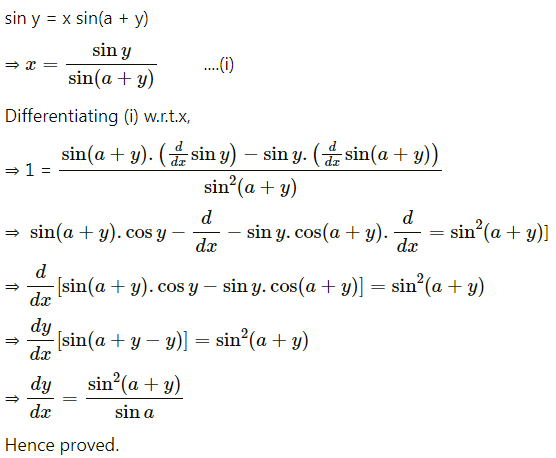
Maharashtra Board 12th Maths Solutions Chapter 1 Differentiation Miscellaneous Exercise 1 II Q5 (iv)

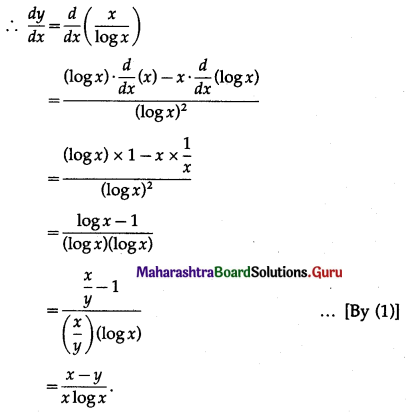
(v) If x = \(e^{\frac{x}{y}}\), then show that \(\frac{d y}{d x}=\frac{x-y}{x \log x}\)
Solution:
x = \(e^{\frac{x}{y}}\)
\(\frac{x}{y}\) = log x …..(1)
y = \(\frac{x}{\log x}\)
Maharashtra Board 12th Maths Solutions Chapter 1 Differentiation Miscellaneous Exercise 1 II Q5 (v)

Maharashtra Board 12th Maths Solutions Chapter 1 Differentiation Miscellaneous Exercise 1

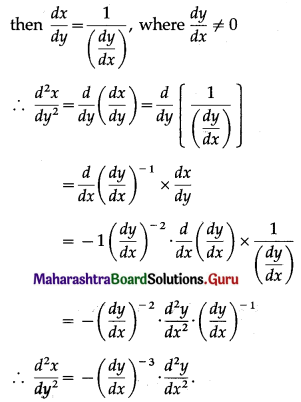
(vi) If y = f(x) is a differentiable function of x, then show that \(\frac{d^{2} x}{d y^{2}}=-\left(\frac{d y}{d x}\right)^{-3} \cdot \frac{d^{2} y}{d x^{2}}\)
Solution:
If y = f(x) is a differentiable function of x such that inverse function x = f-1(y) exists,
Maharashtra Board 12th Maths Solutions Chapter 1 Differentiation Miscellaneous Exercise 1 II Q5 (vi)

Question 6.
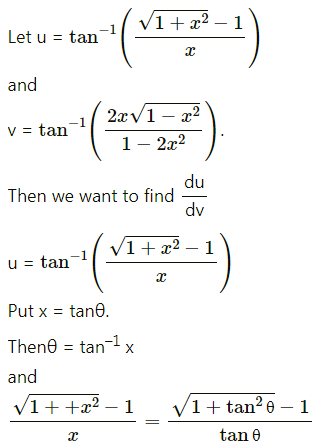
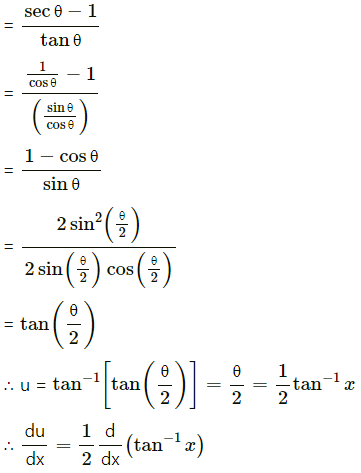
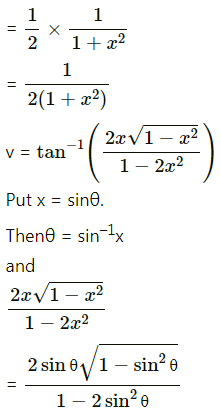
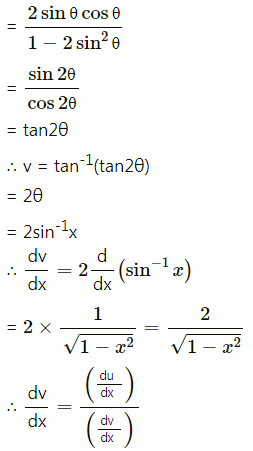
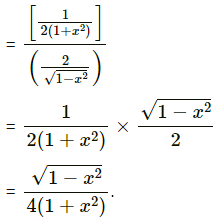
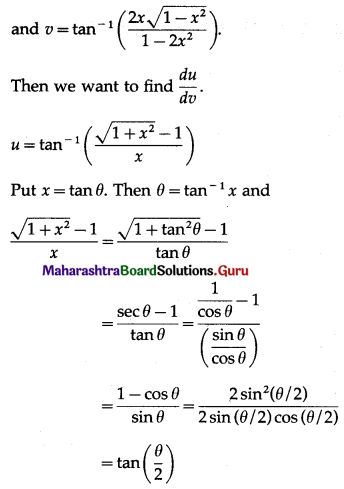
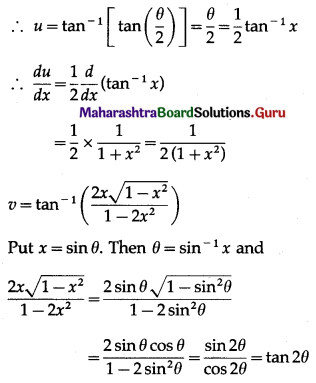
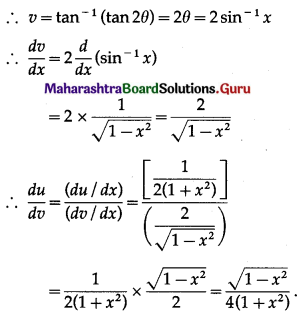
(i) Differentiate \(\tan ^{-1}\left(\frac{\sqrt{1+x^{2}}-1}{x}\right)\) w.r.t. \(\tan ^{-1}\left(\frac{2 x \sqrt{1-x^{2}}}{1-2 x^{2}}\right)\)
Solution:
Maharashtra Board 12th Maths Solutions Chapter 1 Differentiation Miscellaneous Exercise 1 II Q6 (i)
Maharashtra Board 12th Maths Solutions Chapter 1 Differentiation Miscellaneous Exercise 1 II Q6 (i).1
Maharashtra Board 12th Maths Solutions Chapter 1 Differentiation Miscellaneous Exercise 1 II Q6 (i).2
Maharashtra Board 12th Maths Solutions Chapter 1 Differentiation Miscellaneous Exercise 1 II Q6 (i).3
Maharashtra Board 12th Maths Solutions Chapter 1 Differentiation Miscellaneous Exercise 1 II Q6 (i).4

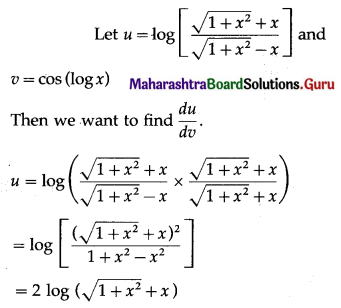
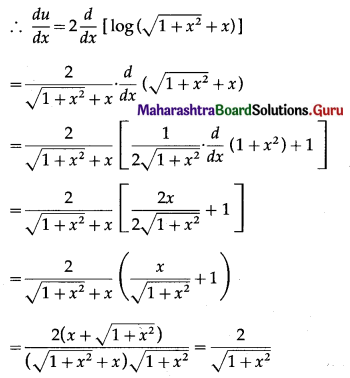
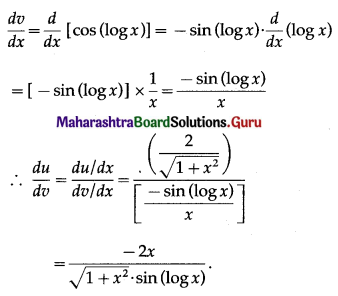
(ii) Differentiate \(\log \left[\frac{\sqrt{1+x^{2}}+x}{\sqrt{1+x^{2}}-x}\right]\) w.r.t. cos(log x)
Solution:
Maharashtra Board 12th Maths Solutions Chapter 1 Differentiation Miscellaneous Exercise 1 II Q6 (ii)
Maharashtra Board 12th Maths Solutions Chapter 1 Differentiation Miscellaneous Exercise 1 II Q6 (ii).1
Maharashtra Board 12th Maths Solutions Chapter 1 Differentiation Miscellaneous Exercise 1 II Q6 (ii).2

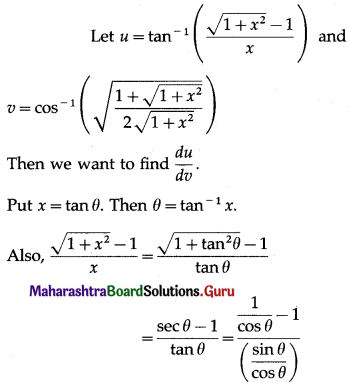
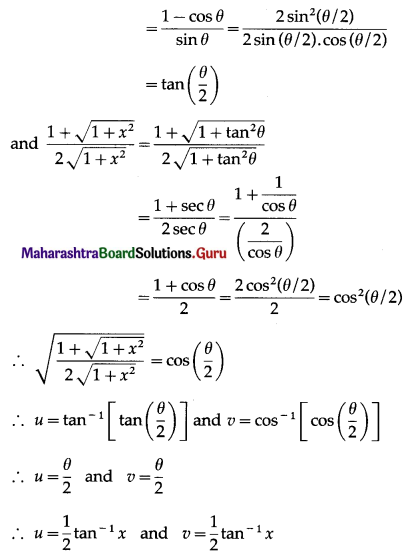
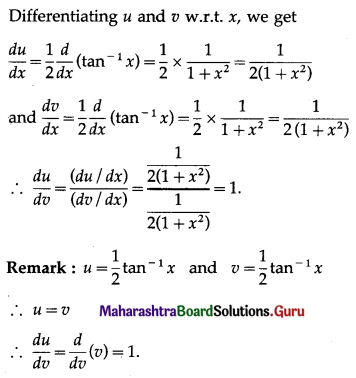
(iii) Differentiate \(\tan ^{-1}\left(\frac{\sqrt{1+x^{2}}-1}{x}\right)\) w.r.t. \(\cos ^{-1}\left(\sqrt{\frac{1+\sqrt{1+x^{2}}}{2 \sqrt{1+x^{2}}}}\right)\)
Solution:
Maharashtra Board 12th Maths Solutions Chapter 1 Differentiation Miscellaneous Exercise 1 II Q6 (iii)
Maharashtra Board 12th Maths Solutions Chapter 1 Differentiation Miscellaneous Exercise 1 II Q6 (iii).1
Maharashtra Board 12th Maths Solutions Chapter 1 Differentiation Miscellaneous Exercise 1 II Q6 (iii).2

Question 7.
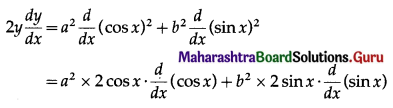
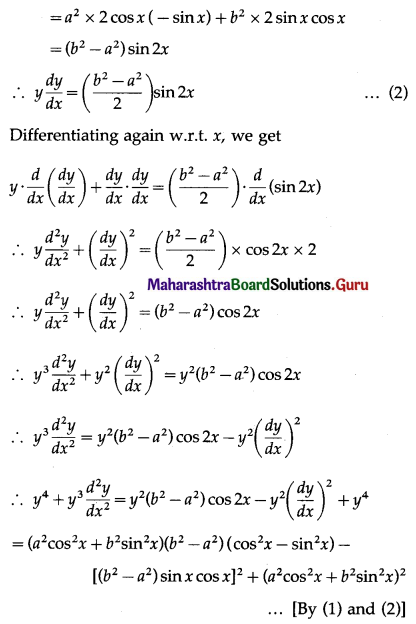
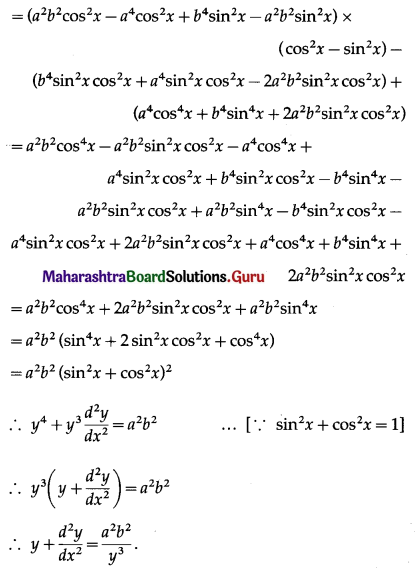
(i) If y2 = a2 cos2x + b2 sin2x, show that \(y+\frac{d^{2} y}{d x^{2}}=\frac{a^{2} b^{2}}{y^{3}}\)
Solution:
y2 = a2 cos2x + b2 sin2x …… (1)
Differentiating both sides w.r.t. x, we get
Maharashtra Board 12th Maths Solutions Chapter 1 Differentiation Miscellaneous Exercise 1 II Q7 (i)
Maharashtra Board 12th Maths Solutions Chapter 1 Differentiation Miscellaneous Exercise 1 II Q7 (i).1
Maharashtra Board 12th Maths Solutions Chapter 1 Differentiation Miscellaneous Exercise 1 II Q7 (i).2

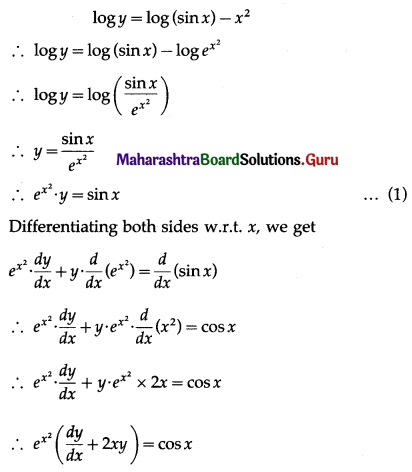
(ii) If log y = log(sin x) – x2, show that \(\frac{d^{2} y}{d x^{2}}+4 x \frac{d y}{d x}+\left(4 x^{2}+3\right) y=0\)
Solution:
Maharashtra Board 12th Maths Solutions Chapter 1 Differentiation Miscellaneous Exercise 1 II Q7 (ii)
Maharashtra Board 12th Maths Solutions Chapter 1 Differentiation Miscellaneous Exercise 1 II Q7 (ii).1

Maharashtra Board 12th Maths Solutions Chapter 1 Differentiation Miscellaneous Exercise 1

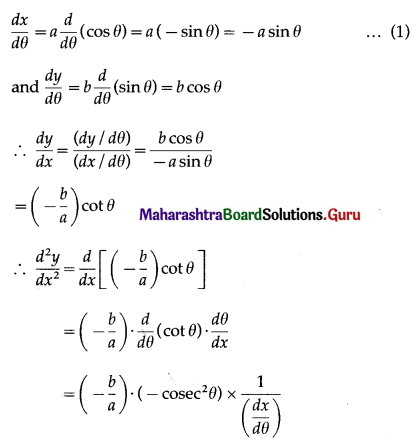
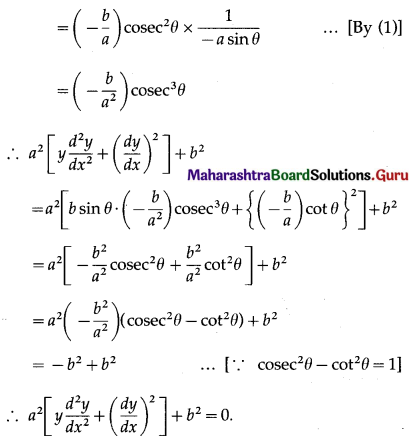
(iii) If x = a cos θ, y = b sin θ, show that \(a^{2}\left[y \frac{d^{2} y}{d x^{2}}+\left(\frac{d y}{d x}\right)^{2}\right]+b^{2}=0\)
Solution:
x = a cos θ, y = b sin θ
Differentiating x and y w.r.t. θ, we get
Maharashtra Board 12th Maths Solutions Chapter 1 Differentiation Miscellaneous Exercise 1 II Q7 (iii)
Maharashtra Board 12th Maths Solutions Chapter 1 Differentiation Miscellaneous Exercise 1 II Q7 (iii).1

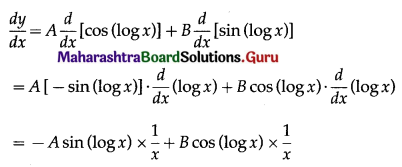
(iv) If y = A cos(log x) + B sin(log x), show that x2y2 + xy1 + y = o.
Solution:
y = A cos (log x) + B sin (log x) …… (1)
Differentiating both sides w.r.t. x, we get
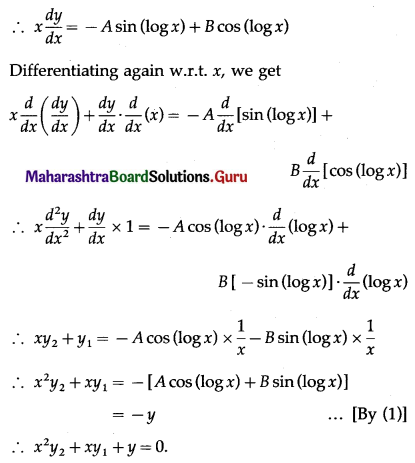
Maharashtra Board 12th Maths Solutions Chapter 1 Differentiation Miscellaneous Exercise 1 II Q7 (iv)
Maharashtra Board 12th Maths Solutions Chapter 1 Differentiation Miscellaneous Exercise 1 II Q7 (iv).1

(v) If y = A emx + B enx, show that y2 – (m + n) y1 + (mn) y = 0.
Solution:
y = A emx + B enx
Differentiating w.r.t. x, we get
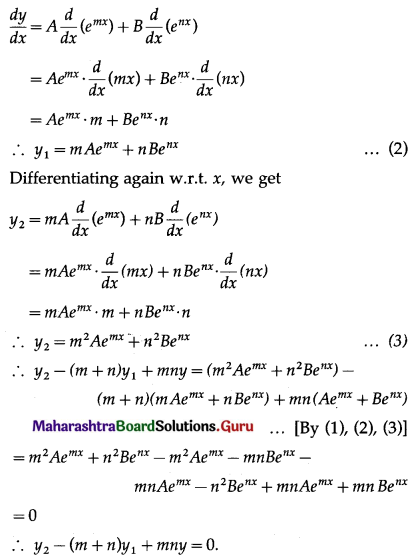
Maharashtra Board 12th Maths Solutions Chapter 1 Differentiation Miscellaneous Exercise 1 II Q7 (v)

12th Maharashtra State Board Maths Solutions Pdf Part 2

Sequences and Series Class 11 Maths 2 Miscellaneous Exercise 2 Solutions Maharashtra Board

Balbharti Maharashtra State Board 11th Maths Book Solutions Pdf Chapter 2 Sequences and Series Miscellaneous Exercise 2 Questions and Answers.

11th Maths Part 2 Sequences and Series Miscellaneous Exercise 2 Questions And Answers Maharashtra Board

(I) Select the correct answer from the given alternative:

Question 1.
The common ratio for the G.P. 0.12, 0.24, 0.48, is
(A) 0.12
(B) 0.2
(C) 0.02
(D) 2
Answer:
(D) 2

Maharashtra Board 11th Maths Solutions Chapter 2 Sequences and Series Miscellaneous Exercise 2

Question 2.
The tenth term of the geometric sequence is \(\frac{1}{4}, \frac{-1}{2}, 1,-2, \ldots\) is
(A) 1024
(B) \(\frac{1}{1024}\)
(C) -128
(D) \(\frac{-1}{128}\)
Answer:
(C) -128
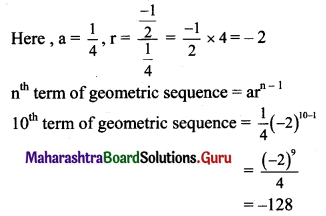
Hint:
Maharashtra Board 11th Maths Solutions Chapter 2 Sequences and Series Miscellaneous Exercise 2 I Q2

Question 3.
If for a G.P. \(\frac{t_{6}}{t_{3}}=\frac{1458}{54}\) then r = ?
(A) 3
(B) 2
(C) 1
(D) -1
Answer:
(A) 3
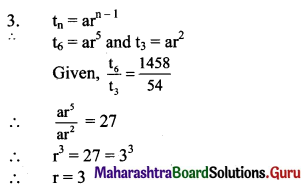
Hint:
Maharashtra Board 11th Maths Solutions Chapter 2 Sequences and Series Miscellaneous Exercise 2 I Q3

Question 4.
Which term of the geometric progression 1, 2, 4, 8, ….. is 2048.
(A) 10th
(B) 11th
(C) 12th
(D) 13th
Answer:
(C) 12th
Hint:
Here, a = 1, r = 2
nth term of geometric progression = arn-1
∴ arn-1 = 2048
2n-1 = 211
n – 1 = 11
∴ n = 12

Question 5.
If the common ratio of the G.P. is 5, the 5th term is 1875, the first term is
(A) 3
(B) 5
(C) 15
(D) -5
Answer:
(A) 3

Question 6.
The sum of 3 terms of a G.P. is \(\frac{21}{4}\) and their product is 1, then the common ratio is
(A) 1
(B) 2
(C) 4
(D) 8
Answer:
(C) 4
Hint:
Let three terms be \(\frac{a}{r}\), a, ar
According to the given conditions,
\(\frac{a}{r}\) + a + ar = \(\frac{21}{4}\) …..(i)
and \(\frac{a}{r}\) × a × ar = 1,
i.e., a3 = 1
∴ a = 1
∴ from equation (i), we get
\(\frac{1}{r}\) + 1 + r = \(\frac{21}{4}\)
By solving this, we get r = 4.

Maharashtra Board 11th Maths Solutions Chapter 2 Sequences and Series Miscellaneous Exercise 2

Question 7.
Sum to infinity of a G.P. 5, \(-\frac{5}{2}, \frac{5}{4},-\frac{5}{8}, \frac{5}{16}, \ldots\) is
(A) 5
(B) \(-\frac{1}{2}\)
(C) \(\frac{10}{3}\)
(D) \(\frac{3}{10}\)
Answer:
(C) \(\frac{10}{3}\)
Hint:
Here, a = 5, r = \(\frac{-1}{2}\), |r| < 1
∴ Sum to the infinity = \(\frac{a}{1-r}=\frac{5}{1+\frac{1}{2}}=\frac{10}{3}\)

Question 8.
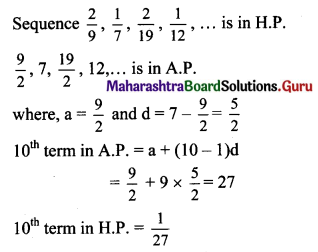
The tenth term of H.P. \(\frac{2}{9}, \frac{1}{7}, \frac{2}{19}, \frac{1}{12}, \ldots\) is
(A) \(\frac{1}{27}\)
(B) \(\frac{9}{2}\)
(C) \(\frac{5}{2}\)
(D) 27
Answer:
(A) \(\frac{1}{27}\)
Hint:
Maharashtra Board 11th Maths Solutions Chapter 2 Sequences and Series Miscellaneous Exercise 2 I Q8

Question 9.
Which of the following is not true, where A, G, H are the AM, GM, HM of a and b respectively, (a, b > 0)
(A) A = \(\frac{a+b}{2}\)
(B) G = \(\sqrt{a b}\)
(C) H = \(\frac{2 a b}{a+b}\)
(D) A = GH
Answer:
(D) A = GH

Maharashtra Board 11th Maths Solutions Chapter 2 Sequences and Series Miscellaneous Exercise 2

Question 10.
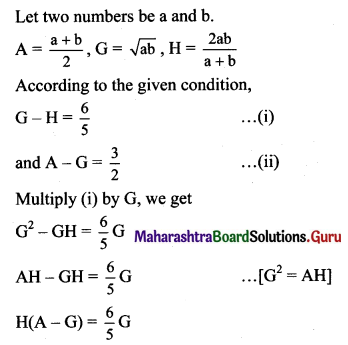
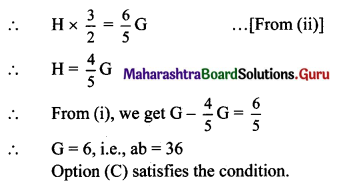
The G.M. of two numbers exceeds their H.M. by \(\frac{6}{5}\), the A.M. exceeds G.M. by \(\frac{3}{2}\) the two numbers are
(A) 6, \(\frac{15}{2}\)
(B) 15, 25
(C) 3, 12
(D) \(\frac{6}{5}\), \(\frac{3}{2}\)
Answer:
(C) 3, 12
Hint:
Maharashtra Board 11th Maths Solutions Chapter 2 Sequences and Series Miscellaneous Exercise 2 I Q10
Maharashtra Board 11th Maths Solutions Chapter 2 Sequences and Series Miscellaneous Exercise 2 I Q10.1

(II) Answer the following:

Question 1.
In a G.P., the fourth term is 48 and the eighth term is 768. Find the tenth term.
Solution:
Maharashtra Board 11th Maths Solutions Chapter 2 Sequences and Series Miscellaneous Exercise 2 II Q1

Question 2.
Find the sum of the first 5 terms of the G.P. whose first term is 1 and the common ratio is \(\frac{2}{3}\).
Solution:
Maharashtra Board 11th Maths Solutions Chapter 2 Sequences and Series Miscellaneous Exercise 2 II Q2

Question 3.
For a G.P. a = \(\frac{4}{3}\) and t7 = \(\frac{243}{1024}\), find the value of r.
Solution:
Maharashtra Board 11th Maths Solutions Chapter 2 Sequences and Series Miscellaneous Exercise 2 II Q3

Question 4.
For a sequence, if \(t_{n}=\frac{5^{n-2}}{7^{n-3}}\), verify whether the sequence is a G.P. If it is a G.P., find its first term and the common ratio.
Solution:
The sequence (tn) is a G.P.
if \(\frac{\mathrm{t}_{\mathrm{n}+1}}{\mathrm{t}_{\mathrm{n}}}\) = constant for all n ∈ N.
Maharashtra Board 11th Maths Solutions Chapter 2 Sequences and Series Miscellaneous Exercise 2 II Q4

Maharashtra Board 11th Maths Solutions Chapter 2 Sequences and Series Miscellaneous Exercise 2

Question 5.
Find three numbers in G.P. such that their sum is 35 and their product is 1000.
Solution:
Let the three numbers in G.P. be \(\frac{a}{r}\), a, ar.
According to the given conditions,
\(\frac{a}{r}\) + a + ar = 35
a(\(\frac{1}{r}\) + 1 + r) = 35 …..(i)
Also, (\(\frac{a}{r}\))(a)(ar) = 1000
a3 = 1000
∴ a = 10
Substituting the value of a in (i), we get
Maharashtra Board 11th Maths Solutions Chapter 2 Sequences and Series Miscellaneous Exercise 2 II Q5
Hence, the three numbers in G.P. are 20, 10, 5, or 5, 10, 20.

Question 6.
Find five numbers in G.P. such that their product is 243 and the sum of the second and fourth numbers is 10.
Solution:
Let the five numbers in G.P. be \(\frac{a}{r^{2}}, \frac{a}{r}, a, a r, a r^{2}\).
According to the given condition,
Maharashtra Board 11th Maths Solutions Chapter 2 Sequences and Series Miscellaneous Exercise 2 II Q6
Maharashtra Board 11th Maths Solutions Chapter 2 Sequences and Series Miscellaneous Exercise 2 II Q6.1

Question 7.
For a sequence, Sn = 4(7n – 1), verify that the sequence is a G.P.
Solution:
Maharashtra Board 11th Maths Solutions Chapter 2 Sequences and Series Miscellaneous Exercise 2 II Q7
∴ The given sequence is a G.P.

Question 8.
Find 2 + 22 + 222 + 2222 + … upto n terms.
Solution:
Sn = 2 + 22 + 222 +… upto n terms
= 2(1 + 11 + 111 + ….. upto n terms)
= \(\frac{2}{9}\) (9 + 99 + 999 + … upto n terms)
= \(\frac{2}{9}\) [(10 – 1) + (100 – 1) + (1000 – 1) + …… upto n terms]
= \(\frac{2}{9}\) [(10 + 100 + 1000 + … upto n terms) – (1 + 1 + 1 + ….. n times)]
Since 10, 100, 1000, ….. n terms are in G.P. with
a = 10, r = \(\frac{100}{10}\) = 10,
Maharashtra Board 11th Maths Solutions Chapter 2 Sequences and Series Miscellaneous Exercise 2 II Q8

Maharashtra Board 11th Maths Solutions Chapter 2 Sequences and Series Miscellaneous Exercise 2

Question 9.
Find the nth term of the sequence 0.6, 0.66, 0.666, 0.6666,…
Solution:
0.6, 0.66, 0.666, 0.6666, …
∴ t1 = 0.6
t2 = 0.66 = 0.6 + 0.06
t3 = 0.666 = 0.6 + 0.06 + 0.006
Hence, in general
tn = 0.6 + 0.06 + 0.006 + …..upto n terms.
The terms are in G.P. with
a = 0.6, r = \(\frac{0.06}{0.6}\) = 0.1
∴ tn = the sum of first n terms of the G.P.
Maharashtra Board 11th Maths Solutions Chapter 2 Sequences and Series Miscellaneous Exercise 2 II Q9

Question 10.
Find \(\sum_{r=1}^{n}\left(5 r^{2}+4 r-3\right)\)
Solution:
Maharashtra Board 11th Maths Solutions Chapter 2 Sequences and Series Miscellaneous Exercise 2 II Q10

Question 11.
Find \(\sum_{r=1}^{n} r(r-3)(r-2)\)
Solution:
Maharashtra Board 11th Maths Solutions Chapter 2 Sequences and Series Miscellaneous Exercise 2 II Q11

Question 12.
Find \(\sum_{r=1}^{n} \frac{1^{2}+2^{2}+3^{2}+\ldots+r^{2}}{2 r+1}\)
Solution:
We know that
Maharashtra Board 11th Maths Solutions Chapter 2 Sequences and Series Miscellaneous Exercise 2 II Q12

Question 13.
Find \(\sum_{r=1}^{n} \frac{1^{3}+2^{3}+3^{3}+\ldots r^{3}}{(r+1)^{2}}\)
Solution:
Maharashtra Board 11th Maths Solutions Chapter 2 Sequences and Series Miscellaneous Exercise 2 II Q13

Maharashtra Board 11th Maths Solutions Chapter 2 Sequences and Series Miscellaneous Exercise 2

Question 14.
Find 2 × 6 + 4 × 9 + 6 × 12 + ….. upto n terms.
Solution:
2, 4, 6, ….. are in A.P.
∴ rth term = 2 + (r – 1) 2 = 2r
6, 9, 12, ….. are in A.P.
∴ rth term = 6 + (r – 1)(3) = (3r + 3)
∴ 2 × 6 + 4 × 9 + 6 × 12 + ….. to n terms
Maharashtra Board 11th Maths Solutions Chapter 2 Sequences and Series Miscellaneous Exercise 2 II Q14
= n(n + 1) [2n + 1 + 3]
= 2n(n + 1)(n + 2)

Question 15.
Find 2 × 5 × 8 + 4 × 7 × 10 + 6 × 9 × 12 + …… upto n terms.
Solution:
2, 4, 6,… are in A.P.
∴ rth term = 2 + (r – 1) 2 = 2r
5, 7, 9, … are in A.P.
∴ rth term = 5 + (r – 1) (2) = (2r + 3)
8, 10, 12, … are in A.P.
∴ rth term = 8 + (r – 1) (2) = (2r + 6)
2 × 5 × 8 + 4 × 7 × 10 + 6 × 9 × 12 + ….. to n terms
Maharashtra Board 11th Maths Solutions Chapter 2 Sequences and Series Miscellaneous Exercise 2 II Q15
= 2n (n + 1) [n(n + 1) + 3(2n + 1) + 9]
= 2n (n + 1)(n2 + 7n + 12)
= 2n (n + 1) (n + 3) (n + 4)

Question 16.
Find \(\frac{1^{2}}{1}+\frac{1^{2}+2^{2}}{2}+\frac{1^{2}+2^{2}+3^{2}}{3}+\ldots\) upto n terms.
Solution:
Maharashtra Board 11th Maths Solutions Chapter 2 Sequences and Series Miscellaneous Exercise 2 II Q16
Maharashtra Board 11th Maths Solutions Chapter 2 Sequences and Series Miscellaneous Exercise 2 II Q16.1

Question 17.
Find 122 + 132 + 142 + 152 + ….. 202
Solution:
Maharashtra Board 11th Maths Solutions Chapter 2 Sequences and Series Miscellaneous Exercise 2 II Q17

Question 18.
If \(\frac{1+2+3+4+5+\ldots \text { upto } \mathrm{n} \text { terms }}{1 \times 2+2 \times 3+3 \times 4+4 \times 5+\ldots \text { upto } \mathrm{n} \text { terms }}=\frac{3}{22}\), Find the value of n.
Solution:
Maharashtra Board 11th Maths Solutions Chapter 2 Sequences and Series Miscellaneous Exercise 2 II Q18

Maharashtra Board 11th Maths Solutions Chapter 2 Sequences and Series Miscellaneous Exercise 2

Question 19.
Find (502 – 492) + (482 – 472) + (462 – 452) +… + (22 – 12).
Solution:
Maharashtra Board 11th Maths Solutions Chapter 2 Sequences and Series Miscellaneous Exercise 2 II Q19

Question 20.
If \(\frac{1 \times 3+2 \times 5+3 \times 7+\ldots \text { upto } \mathrm{n} \text { terms }}{1^{3}+2^{3}+3^{3}+\ldots \text { upto } \mathrm{n} \text { terms }}=\frac{5}{9}\), find the value of n.
Solution:
Maharashtra Board 11th Maths Solutions Chapter 2 Sequences and Series Miscellaneous Exercise 2 II Q20
Maharashtra Board 11th Maths Solutions Chapter 2 Sequences and Series Miscellaneous Exercise 2 II Q20.1

Question 21.
For a G.P. if t2 = 7, t4 = 1575, find a.
Solution:
Maharashtra Board 11th Maths Solutions Chapter 2 Sequences and Series Miscellaneous Exercise 2 II Q21

Question 22.
If for a G.P. t3 = \(\frac{1}{3}\), t6 = \(\frac{1}{81}\) find r.
Solution:
Maharashtra Board 11th Maths Solutions Chapter 2 Sequences and Series Miscellaneous Exercise 2 II Q22

Question 23.
Find \(\sum_{r=1}^{n}\left(\frac{2}{3}\right)^{r}\).
Solution:
Maharashtra Board 11th Maths Solutions Chapter 2 Sequences and Series Miscellaneous Exercise 2 II Q23

Question 24.
Find k so that k – 1, k, k + 2 are consecutive terms of a G.P.
Solution:
Since k – 1, k, k + 2 are consecutive terms of a G.P.,
\(\frac{k}{k-1}=\frac{k+2}{k}\)
k2 = k2 + k – 2
k – 2 = 0
∴ k = 2

Question 25.
If for a G.P. first term is (27)2 and the seventh term is (8)2, find S8.
Solution:
Maharashtra Board 11th Maths Solutions Chapter 2 Sequences and Series Miscellaneous Exercise 2 II Q25

Question 26.
If pth, qth and rth terms of a G.P. are x, y, z respectively. Find the value of \(x^{q-r} \cdot y^{r-p} \cdot z^{p-q}\).
Solution:
Let a be the first term and R be the common ratio of the G.P.
Maharashtra Board 11th Maths Solutions Chapter 2 Sequences and Series Miscellaneous Exercise 2 II Q26

Question 27.
Which 2 terms are inserted between 5 and 40 so that the resulting sequence is G.P.
Solution:
Let the required numbers be G1 and G2.
Maharashtra Board 11th Maths Solutions Chapter 2 Sequences and Series Miscellaneous Exercise 2 II Q27
∴ For the resulting sequence to be in G.P. we need to insert numbers 10 and 20.

Maharashtra Board 11th Maths Solutions Chapter 2 Sequences and Series Miscellaneous Exercise 2

Question 28.
If p, q, r are in G.P. and \(\mathrm{p}^{1 / \mathrm{x}}=\mathrm{q}^{1 / \mathrm{y}}=\mathrm{r}^{1 / \mathrm{z}}\), verify whether x, y, z are in A.P. or G.P. or neither.
Solution:
Maharashtra Board 11th Maths Solutions Chapter 2 Sequences and Series Miscellaneous Exercise 2 II Q28

Question 29.
If a, b, c are in G.P. and ax2 + 2bx + c = 0 and px2 + 2qx + r = 0 have common roots, then verify that pb2 – 2qba + ra2 = 0.
Solution:
a, b, c are in G.P.
∴ b2 = ac
ax2 + 2bx + c = 0 becomes
Maharashtra Board 11th Maths Solutions Chapter 2 Sequences and Series Miscellaneous Exercise 2 II Q29

Question 30.
If p, q, r, s are in G.P., show that (p2 + q2 + r2)(q2 + r2 + s2) = (pq + qr + rs)2.
Solution:
p, q, r, s are in G.P.
Maharashtra Board 11th Maths Solutions Chapter 2 Sequences and Series Miscellaneous Exercise 2 II Q30

Question 31.
If p, q, r, s are in G.P., show that (pn + qn), (qn + rn), (rn + sn) are also in G.P.
Solution:
p, q, r, s are in G.P.
Let the common ratio be R
∴ let p = \(\frac{a}{R^{3}}\), q = \(\frac{a}{R}\), r = aR and s = aR3
To show that (pn + qn), (qn + rn), (rn + sn) are in G.P,
i.e., we have to show
Maharashtra Board 11th Maths Solutions Chapter 2 Sequences and Series Miscellaneous Exercise 2 II Q31

Maharashtra Board 11th Maths Solutions Chapter 2 Sequences and Series Miscellaneous Exercise 2

Question 32.
Find the coefficient x6 in the expression of e2x using series expansion.
Solution:
Maharashtra Board 11th Maths Solutions Chapter 2 Sequences and Series Miscellaneous Exercise 2 II Q32

Question 33.
Find the sum of infinite terms of \(1+\frac{4}{5}+\frac{7}{25}+\frac{10}{125}+\frac{13}{625}+\ldots\)
Solution:
Maharashtra Board 11th Maths Solutions Chapter 2 Sequences and Series Miscellaneous Exercise 2 II Q33
Maharashtra Board 11th Maths Solutions Chapter 2 Sequences and Series Miscellaneous Exercise 2 II Q33.1

Maths Solutions for Class 11 State Board 

Differentiation Class 12 Maths 2 Exercise 1.5 Solutions Maharashtra Board

Balbharti 12th Maharashtra State Board Maths Solutions Book Pdf Chapter 1 Differentiation Ex 1.5 Questions and Answers.

12th Maths Part 2 Differentiation Exercise 1.5 Questions And Answers Maharashtra Board

Question 1.
Find the second order derivatives of the following:
(i) 2x5 – 4x3 – \(\frac{2}{x^{2}}\) – 9
Solution:
Let y = 2x5 – 4x3 – \(\frac{2}{x^{2}}\) – 9
Maharashtra Board 12th Maths Solutions Chapter 1 Differentiation Ex 1.5 Q1 (i)
Maharashtra Board 12th Maths Solutions Chapter 1 Differentiation Ex 1.5 Q1 (i).1

(ii) e2x . tan x
Solution:
Let y = e2x . tan x
Maharashtra Board 12th Maths Solutions Chapter 1 Differentiation Ex 1.5 Q1 (ii)
Maharashtra Board 12th Maths Solutions Chapter 1 Differentiation Ex 1.5 Q1 (ii).1

Maharashtra Board 12th Maths Solutions Chapter 1 Differentiation Ex 1.5

(iii) e4x . cos 5x
Solution:
Let y = e4x . cos 5x
Maharashtra Board 12th Maths Solutions Chapter 1 Differentiation Ex 1.5 Q1 (iii)
Maharashtra Board 12th Maths Solutions Chapter 1 Differentiation Ex 1.5 Q1 (iii).1

(iv) x3 . log x
Solution:
Let y = x3 . log x
Maharashtra Board 12th Maths Solutions Chapter 1 Differentiation Ex 1.5 Q1 (iv)

(v) log(log x)
Solution:
Let y = log(log x)
Maharashtra Board 12th Maths Solutions Chapter 1 Differentiation Ex 1.5 Q1 (v)
Maharashtra Board 12th Maths Solutions Chapter 1 Differentiation Ex 1.5 Q1 (v).1

(vi) xx
Solution:
y = xx
log y = log xx = x log x
Differentiating both sides w.r.t. x, we get
Maharashtra Board 12th Maths Solutions Chapter 1 Differentiation Ex 1.5 Q1 (vi)

Question 2.
Find \(\frac{d^{2} y}{d x^{2}}\) of the following:
(i) x = a(θ – sin θ), y = a (1 – cos θ)
Solution:
x = a(θ – sin θ), y = a (1 – cos θ)
Differentiating x and y w.r.t. θ, we get
\(\frac{d x}{d \theta}=a \frac{d}{d \theta}(\theta-\sin \theta)\) = a(1 – cos θ) …….(1)
Maharashtra Board 12th Maths Solutions Chapter 1 Differentiation Ex 1.5 Q2 (i)

(ii) x = 2at2, y = 4at
Solution:
x = 2at2, y = 4at
Differentiating x and y w.r.t. t, we get
Maharashtra Board 12th Maths Solutions Chapter 1 Differentiation Ex 1.5 Q2 (ii)

Maharashtra Board 12th Maths Solutions Chapter 1 Differentiation Ex 1.5

(iii) x = sin θ, y = sin3θ at θ = \(\frac{\pi}{2}\)
Solution:
x = sin θ, y = sin3θ
Differentiating x and y w.r.t. θ, we get,
Maharashtra Board 12th Maths Solutions Chapter 1 Differentiation Ex 1.5 Q2 (iii)
Maharashtra Board 12th Maths Solutions Chapter 1 Differentiation Ex 1.5 Q2 (iii).1

(iv) x = a cos θ, y = b sin θ at θ = \(\frac{\pi}{4}\)
Solution:
x = a cos θ, y = b sin θ
Differentiating x and y w.r.t. θ, we get
Maharashtra Board 12th Maths Solutions Chapter 1 Differentiation Ex 1.5 Q2 (iv)
Maharashtra Board 12th Maths Solutions Chapter 1 Differentiation Ex 1.5 Q2 (iv).1
Maharashtra Board 12th Maths Solutions Chapter 1 Differentiation Ex 1.5 Q2 (iv).2

Question 3.
(i) If x = at2 and y = 2at, then show that \(x y \frac{d^{2} y}{d x^{2}}+a=0\)
Solution:
x = at2, y = 2at ………(1)
Differentiating x and y w.r.t. t, we get
Maharashtra Board 12th Maths Solutions Chapter 1 Differentiation Ex 1.5 Q3 (i)
Maharashtra Board 12th Maths Solutions Chapter 1 Differentiation Ex 1.5 Q3 (i).1

(ii) If y = \(e^{m \tan ^{-1} x}\), show that \(\left(1+x^{2}\right) \frac{d^{2} y}{d x^{2}}+(2 x-m) \frac{d y}{d x}=0\)
Solution:
y = \(e^{m \tan ^{-1} x}\) ……..(1)
Maharashtra Board 12th Maths Solutions Chapter 1 Differentiation Ex 1.5 Q3 (ii)

(iii) If x = cos t, y = emt, show that \(\left(1-x^{2}\right) \frac{d^{2} y}{d x^{2}}-x \frac{d y}{d x}-m^{2} y=0\)
Solution:
x = cos t, y = emt
Maharashtra Board 12th Maths Solutions Chapter 1 Differentiation Ex 1.5 Q3 (iii)
Maharashtra Board 12th Maths Solutions Chapter 1 Differentiation Ex 1.5 Q3 (iii).1

Maharashtra Board 12th Maths Solutions Chapter 1 Differentiation Ex 1.5

(iv) If y = x + tan x, show that \(\cos ^{2} x \cdot \frac{d^{2} y}{d x^{2}}-2 y+2 x=0\)
Solution:
y = x + tan x
Maharashtra Board 12th Maths Solutions Chapter 1 Differentiation Ex 1.5 Q3 (iv)

(v) If y = eax . sin (bx), show that y2 – 2ay1 + (a2 + b2)y = 0.
Solution:
y = eax . sin (bx) ………(1)
Maharashtra Board 12th Maths Solutions Chapter 1 Differentiation Ex 1.5 Q3 (v)
Maharashtra Board 12th Maths Solutions Chapter 1 Differentiation Ex 1.5 Q3 (v).1

(vi) If \(\sec ^{-1}\left(\frac{7 x^{3}-5 y^{3}}{7 x^{3}+5 y^{3}}\right)=m\), show that \(\frac{d^{2} y}{d x^{2}}=0\)
Solution:
Maharashtra Board 12th Maths Solutions Chapter 1 Differentiation Ex 1.5 Q3 (vi)
Maharashtra Board 12th Maths Solutions Chapter 1 Differentiation Ex 1.5 Q3 (vi).1
Maharashtra Board 12th Maths Solutions Chapter 1 Differentiation Ex 1.5 Q3 (vi).2

(vii) If 2y = \(\sqrt{x+1}+\sqrt{x-1}\), show that 4(x2 – 1)y2 + 4xy1 – y = 0.
Solution:
2y = \(\sqrt{x+1}+\sqrt{x-1}\) …… (1)
Differentiating both sides w.r.t. x, we get
Maharashtra Board 12th Maths Solutions Chapter 1 Differentiation Ex 1.5 Q3 (vii)
Maharashtra Board 12th Maths Solutions Chapter 1 Differentiation Ex 1.5 Q3 (vii).1

(viii) If y = \(\log \left(x+\sqrt{x^{2}+a^{2}}\right)^{m}\), show that \(\left(x^{2}+a^{2}\right) \frac{d^{2} y}{d x^{2}}+x \frac{d y}{d x}=0\)
Solution:
y = \(\log \left(x+\sqrt{x^{2}+a^{2}}\right)^{m}\) = \(m \log \left(x+\sqrt{x^{2}+a^{2}}\right)\)
Maharashtra Board 12th Maths Solutions Chapter 1 Differentiation Ex 1.5 Q3 (viii)
Maharashtra Board 12th Maths Solutions Chapter 1 Differentiation Ex 1.5 Q3 (viii).1

Maharashtra Board 12th Maths Solutions Chapter 1 Differentiation Ex 1.5

(ix) If y = sin(m cos-1x), then show that \(\left(1-x^{2}\right) \frac{d^{2} y}{d x^{2}}-x \frac{d y}{d x}+m^{2} y=0\)
Solution:
y = sin(m cos-1x)
sin-1y = m cos-1x
Differentiating both sides w.r.t. x, we get
Maharashtra Board 12th Maths Solutions Chapter 1 Differentiation Ex 1.5 Q3 (ix)

(x) If y = log(log 2x), show that xy2 + y1(1 + xy1) = 0.
Solution:
y = log(log 2x)
Maharashtra Board 12th Maths Solutions Chapter 1 Differentiation Ex 1.5 Q3 (x)
Maharashtra Board 12th Maths Solutions Chapter 1 Differentiation Ex 1.5 Q3 (x).1
Maharashtra Board 12th Maths Solutions Chapter 1 Differentiation Ex 1.5 Q3 (x).2

(xi) If x2 + 6xy + y2 = 10, show that \(\frac{d^{2} y}{d x^{2}}=\frac{80}{(3 x+y)^{3}}\)
Solution:
x2 + 6xy + y2 = 10 …… (1)
Differentiating both sides w.r.t. x, we get
Maharashtra Board 12th Maths Solutions Chapter 1 Differentiation Ex 1.5 Q3 (xi)
Maharashtra Board 12th Maths Solutions Chapter 1 Differentiation Ex 1.5 Q3 (xi).1
Maharashtra Board 12th Maths Solutions Chapter 1 Differentiation Ex 1.5 Q3 (xi).2

(xii) If x = a sin t – b cos t, y = a cos t + b sin t, Show that \(\frac{d^{2} y}{d x^{2}}=-\frac{x^{2}+y^{2}}{y^{3}}\)
Solution:
x = a sin t – b cos t, y = a cos t + b sin t
Differentiating x and y w.r.t. t, we get
Maharashtra Board 12th Maths Solutions Chapter 1 Differentiation Ex 1.5 Q3 (xii)
Maharashtra Board 12th Maths Solutions Chapter 1 Differentiation Ex 1.5 Q3 (xii).1

Maharashtra Board 12th Maths Solutions Chapter 1 Differentiation Ex 1.5

Question 4.
Find the nth derivative of the following:
(i) (ax + b)m
Solution:
Let y = (ax + b)m
Maharashtra Board 12th Maths Solutions Chapter 1 Differentiation Ex 1.5 Q4 (i)
Maharashtra Board 12th Maths Solutions Chapter 1 Differentiation Ex 1.5 Q4 (i).1
Maharashtra Board 12th Maths Solutions Chapter 1 Differentiation Ex 1.5 Q4 (i).2

(ii) \(\frac{1}{x}\)
Solution:
Let y = \(\frac{1}{x}\)
Maharashtra Board 12th Maths Solutions Chapter 1 Differentiation Ex 1.5 Q4 (ii)

(iii) eax+b
Solution:
Let y = eax+b
Maharashtra Board 12th Maths Solutions Chapter 1 Differentiation Ex 1.5 Q4 (iii)
Maharashtra Board 12th Maths Solutions Chapter 1 Differentiation Ex 1.5 Q4 (iii).1

(iv) apx+q
Solution:
Let y = apx+q
Maharashtra Board 12th Maths Solutions Chapter 1 Differentiation Ex 1.5 Q4 (iv)

Maharashtra Board 12th Maths Solutions Chapter 1 Differentiation Ex 1.5

(v) log(ax + b)
Solution:
Let y = log(ax + b)
Then \(\frac{d y}{d x}=\frac{d}{d x}[\log (a x+b)]\)
Maharashtra Board 12th Maths Solutions Chapter 1 Differentiation Ex 1.5 Q4 (v)

(vi) cos x
Solution:
Let y = cos x
Maharashtra Board 12th Maths Solutions Chapter 1 Differentiation Ex 1.5 Q4 (vi)

(vii) sin(ax + b)
Solution:
Let y = sin(ax + b)
Maharashtra Board 12th Maths Solutions Chapter 1 Differentiation Ex 1.5 Q4 (vii)
Maharashtra Board 12th Maths Solutions Chapter 1 Differentiation Ex 1.5 Q4 (vii).1

(viii) cos(3 – 2x)
Solution:
Maharashtra Board 12th Maths Solutions Chapter 1 Differentiation Ex 1.5 Q4 (viii)
Maharashtra Board 12th Maths Solutions Chapter 1 Differentiation Ex 1.5 Q4 (viii).1

(ix) log(2x + 3)
Solution:
Maharashtra Board 12th Maths Solutions Chapter 1 Differentiation Ex 1.5 Q4 (ix)
Maharashtra Board 12th Maths Solutions Chapter 1 Differentiation Ex 1.5 Q4 (ix).1

(x) \(\frac{1}{3 x-5}\)
Solution:
Let y = \(\frac{1}{3 x-5}\)
Maharashtra Board 12th Maths Solutions Chapter 1 Differentiation Ex 1.5 Q4 (x)
Maharashtra Board 12th Maths Solutions Chapter 1 Differentiation Ex 1.5 Q4 (x).1

Maharashtra Board 12th Maths Solutions Chapter 1 Differentiation Ex 1.5

(xi) y = eax . cos (bx + c)
Solution:
y = eax . cos (bx + c)
Maharashtra Board 12th Maths Solutions Chapter 1 Differentiation Ex 1.5 Q4 (xi)
Maharashtra Board 12th Maths Solutions Chapter 1 Differentiation Ex 1.5 Q4 (xi).1
Maharashtra Board 12th Maths Solutions Chapter 1 Differentiation Ex 1.5 Q4 (xi).2
Maharashtra Board 12th Maths Solutions Chapter 1 Differentiation Ex 1.5 Q4 (xi).3
Maharashtra Board 12th Maths Solutions Chapter 1 Differentiation Ex 1.5 Q4 (xi).4

(xii) y = e8x . cos (6x + 7)
Solution:
Maharashtra Board 12th Maths Solutions Chapter 1 Differentiation Ex 1.5 Q4 (xii)
Maharashtra Board 12th Maths Solutions Chapter 1 Differentiation Ex 1.5 Q4 (xii).1
Maharashtra Board 12th Maths Solutions Chapter 1 Differentiation Ex 1.5 Q4 (xii).2
Maharashtra Board 12th Maths Solutions Chapter 1 Differentiation Ex 1.5 Q4 (xii).3

12th Maharashtra State Board Maths Solutions Pdf Part 2

Sequences and Series Class 11 Maths 2 Exercise 2.6 Solutions Maharashtra Board

Balbharti Maharashtra State Board 11th Maths Book Solutions Pdf Chapter 2 Sequences and Series Ex 2.6 Questions and Answers.

11th Maths Part 2 Sequences and Series Exercise 2.6 Questions And Answers Maharashtra Board

Question 1.
Find the sum \(\sum_{r=1}^{n}(r+1)(2 r-1)\).
Solution:
Maharashtra Board 11th Maths Solutions Chapter 2 Sequences and Series Ex 2.6 Q1

Question 2.
Find \(\sum_{r=1}^{n}\left(3 r^{2}-2 r+1\right)\)
Solution:
Maharashtra Board 11th Maths Solutions Chapter 2 Sequences and Series Ex 2.6 Q2

Maharashtra Board 11th Maths Solutions Chapter 2 Sequences and Series Ex 2.6

Question 3.
Find \(\sum_{r=1}^{n}\left(\frac{1+2+3 \ldots .+r}{r}\right)\)
Solution:
Maharashtra Board 11th Maths Solutions Chapter 2 Sequences and Series Ex 2.6 Q3
= \(\frac{n}{4}\) [(n + 1) + 2]
= \(\frac{n}{4}\) (n + 3)

Question 4.
Find \(\sum_{r=1}^{n}\left(\frac{1^{3}+2^{3}+\ldots . .+r^{3}}{r(r+1)}\right)\)
Solution:
Maharashtra Board 11th Maths Solutions Chapter 2 Sequences and Series Ex 2.6 Q4

Question 5.
Find the sum 5 × 7 + 9 × 11 + 13 × 15 + ….. upto n terms.
Solution:
5 × 7 + 9 × 11 + 13 × 15 + ….. upto n terms
Now, 5, 9, 13, … are in A.P. with
rth term = 5 + (r – 1) (4) = 4r + 1
7, 11, 15, ….. are in A.P. with
rth term = 7 + (r – 1) (4) = 4r + 3
∴ 5 × 7 + 9 × 11 + 13 × 15 + …… upto n terms
Maharashtra Board 11th Maths Solutions Chapter 2 Sequences and Series Ex 2.6 Q5

Maharashtra Board 11th Maths Solutions Chapter 2 Sequences and Series Ex 2.6

Question 6.
Find the sum 22 + 42 + 62 + 82 + ….. upto n terms.
Solution:
Maharashtra Board 11th Maths Solutions Chapter 2 Sequences and Series Ex 2.6 Q6

Question 7.
Find (702 – 692) + (682 – 672) + (662 – 652) + …… + (22 – 12)
Solution:
Let S = (702 – 692) + (682 – 672) + …… + (22 – 12)
∴ S = (22 – 12) + (42 – 32) + ….. + (702 – 692)
Here, 2, 4, 6,…, 70 are in A.P. with rth term = 2r
and 1, 3, 5, …,69 are in A.P. with rth term = 2r – 1
Maharashtra Board 11th Maths Solutions Chapter 2 Sequences and Series Ex 2.6 Q7

Question 8.
Find the sum 1 × 3 × 5 + 3 × 5 × 7 + 5 × 7 × 9 + …… + (2n – 1) (2n + 1) (2n + 3)
Solution:
Let S = 1 × 3 × 5 + 3 × 5 × 7 + ….. upto n terms
Here, 1, 3, 5, 7 … are in A.P. with rth term = 2r – 1,
3, 5, 7, 9,… are in A.P. with rth term = 2r + 1,
5, 7, 9, 11,… are in A.P. with rth term = 2r + 3
Maharashtra Board 11th Maths Solutions Chapter 2 Sequences and Series Ex 2.6 Q8
Maharashtra Board 11th Maths Solutions Chapter 2 Sequences and Series Ex 2.6 Q8.1

Maharashtra Board 11th Maths Solutions Chapter 2 Sequences and Series Ex 2.6

Question 9.
If \(\frac{1 \times 2+2 \times 3+3 \times 4+4 \times 5+\ldots \text { upto } n \text { terms }}{1+2+3+4+\ldots \text { upto } n \text { terms }}\) = \(\frac{100}{3}\), find n.
Solution:
Maharashtra Board 11th Maths Solutions Chapter 2 Sequences and Series Ex 2.6 Q9

Question 10.
If S1, S2 and S3 are the sums of first n natural numbers, their squares and their cubes respectively, then show that 9\(\mathrm{S}_{2}{ }^{2}\) = S3(1 + 8S1).
Solution:
Maharashtra Board 11th Maths Solutions Chapter 2 Sequences and Series Ex 2.6 Q10
Maharashtra Board 11th Maths Solutions Chapter 2 Sequences and Series Ex 2.6 Q10.1

Maths Solutions for Class 11 State Board 

Differentiation Class 12 Maths 2 Exercise 1.4 Solutions Maharashtra Board

Balbharti 12th Maharashtra State Board Maths Solutions Book Pdf Chapter 1 Differentiation Ex 1.4 Questions and Answers.

12th Maths Part 2 Differentiation Exercise 1.4 Questions And Answers Maharashtra Board

Question 1.
Find \(\frac{d y}{d x}\) if
(i) x = at2, y = 2at
Solution:
x = at2, y = 2at
Differentiating x and y w.r.t. t, we get
Maharashtra Board 12th Maths Solutions Chapter 1 Differentiation Ex 1.4 Q1 (i)

(ii) x = a cot θ, y = b cosec θ
Solution:
x = a cot θ, y = b cosec θ
Differentiating x and y w.r.t. θ, we get
Maharashtra Board 12th Maths Solutions Chapter 1 Differentiation Ex 1.4 Q1 (ii)

(iii) x = \(\sqrt{a^{2}+m^{2}}\), y = log (a2 + m2)
Solution:
x = \(\sqrt{a^{2}+m^{2}}\), y = log (a2 + m2)
Differentiating x and y w.r.t. m, we get
\(\frac{d x}{d m}=\frac{d}{d m}\left(\sqrt{a^{2}+m^{2}}\right)\)
Maharashtra Board 12th Maths Solutions Chapter 1 Differentiation Ex 1.4 Q1 (iii)

Maharashtra Board 12th Maths Solutions Chapter 1 Differentiation Ex 1.4

(iv) x = sin θ, y = tan θ
Solution:
x = sin θ, y = tan θ
Differentiating x and y w.r.t. θ, we get
Maharashtra Board 12th Maths Solutions Chapter 1 Differentiation Ex 1.4 Q1 (iv)

(v) x = a(1 – cos θ), y = b(θ – sin θ)
Solution:
x = a(1 – cos θ), y = b(θ – sin θ)
Differentiating x and y w.r.t. θ, we get
Maharashtra Board 12th Maths Solutions Chapter 1 Differentiation Ex 1.4 Q1 (v)

(vi) x = \(\left(t+\frac{1}{t}\right)^{a}\), y = \(a^{t+\frac{1}{t}}\), where a > 0, a ≠ 1 and t ≠ 0
Solution:
x = \(\left(t+\frac{1}{t}\right)^{a}\), y = \(a^{t+\frac{1}{t}}\) ………(1)
Differentiating x and y w.r.t. t, we get
Maharashtra Board 12th Maths Solutions Chapter 1 Differentiation Ex 1.4 Q1 (vi)
Maharashtra Board 12th Maths Solutions Chapter 1 Differentiation Ex 1.4 Q1 (vi).1

(vii) x = \(\cos ^{-1}\left(\frac{2 t}{1+t^{2}}\right)\), y = \(\sec ^{-1}\left(\sqrt{1+t^{2}}\right)\)
Solution:
x = \(\cos ^{-1}\left(\frac{2 t}{1+t^{2}}\right)\), y = \(\sec ^{-1}\left(\sqrt{1+t^{2}}\right)\)
Put t = tan θ Then θ = tan-1t
Maharashtra Board 12th Maths Solutions Chapter 1 Differentiation Ex 1.4 Q1 (vii)
Maharashtra Board 12th Maths Solutions Chapter 1 Differentiation Ex 1.4 Q1 (vii).1

(viii) x = cos-1(4t3 – 3t), y = \(\tan ^{-1}\left(\frac{\sqrt{1-t^{2}}}{t}\right)\)
Solution:
x = cos-1(4t3 – 3t), y = \(\tan ^{-1}\left(\frac{\sqrt{1-t^{2}}}{t}\right)\)
Put t = cos θ. Then θ = cos-1t
x = cos-1(4cos3θ – 3cos θ)
Maharashtra Board 12th Maths Solutions Chapter 1 Differentiation Ex 1.4 Q1 (viii)
Maharashtra Board 12th Maths Solutions Chapter 1 Differentiation Ex 1.4 Q1 (viii).1

Question 2.
Find \(\frac{d y}{d x}\), if
(i) x = cosec2θ, y = cot3θ at θ = \(\frac{\pi}{6}\)
Solution:
x = cosec2θ, y = cot3θ
Differentiating x and y w.r.t. θ, we get
Maharashtra Board 12th Maths Solutions Chapter 1 Differentiation Ex 1.4 Q2 (i)

Maharashtra Board 12th Maths Solutions Chapter 1 Differentiation Ex 1.4

(ii) x = a cos3θ, y = a sin3θ at θ = \(\frac{\pi}{3}\)
Solution:
x = a cos3θ, y = a sin3θ
Differentiating x and y w.r.t. θ, we get
Maharashtra Board 12th Maths Solutions Chapter 1 Differentiation Ex 1.4 Q2 (ii)

(iii) x = t2 + t + 1, y = sin(\(\frac{\pi t}{2}\)) + cos(\(\frac{\pi t}{2}\)) at t = 1
Solution:
x = t2 + t + 1, y = sin(\(\frac{\pi t}{2}\)) + cos(\(\frac{\pi t}{2}\))
Differentiating x and y w.r.t. t, we get
Maharashtra Board 12th Maths Solutions Chapter 1 Differentiation Ex 1.4 Q2 (iii)

(iv) x = 2 cos t + cos 2t, y = 2 sin t – sin 2t at t = \(\frac{\pi}{4}\)
Solution:
x = 2 cos t + cos 2t, y = 2 sin t – sin 2t
Differentiating x and y w.r.t. t, we get
Maharashtra Board 12th Maths Solutions Chapter 1 Differentiation Ex 1.4 Q2 (iv)
Maharashtra Board 12th Maths Solutions Chapter 1 Differentiation Ex 1.4 Q2 (iv).1

(v) x = t + 2 sin(πt), y = 3t – cos(πt) at t = \(\frac{1}{2}\)
Solution:
x = t + 2 sin(πt), y = 3t – cos(πt)
Differentiating x and y w.r.t. t, we get
Maharashtra Board 12th Maths Solutions Chapter 1 Differentiation Ex 1.4 Q2 (v)
Maharashtra Board 12th Maths Solutions Chapter 1 Differentiation Ex 1.4 Q2 (v).1

Question 3.
(i) If x = \(a \sqrt{\sec \theta-\tan \theta}\), y = \(a \sqrt{\sec \theta+\tan \theta}\), then show that \(\frac{d y}{d x}=-\frac{y}{x}\)
Solution:
x = \(a \sqrt{\sec \theta-\tan \theta}\), y = \(a \sqrt{\sec \theta+\tan \theta}\)
Maharashtra Board 12th Maths Solutions Chapter 1 Differentiation Ex 1.4 Q3 (i)
Maharashtra Board 12th Maths Solutions Chapter 1 Differentiation Ex 1.4 Q3 (i).1

Maharashtra Board 12th Maths Solutions Chapter 1 Differentiation Ex 1.4

(ii) If x = \(e^{\sin 3 t}\), y = \(e^{\cos 3 t}\), then show that \(\frac{d y}{d x}=-\frac{y \log x}{x \log y}\)
Solution:
x = \(e^{\sin 3 t}\), y = \(e^{\cos 3 t}\)
log x = log \(e^{\sin 3 t}\), log y = log \(e^{\cos 3 t}\)
log x = (sin 3t)(log e), log y = (cos 3t)(log e)
log x = sin 3t, log y = cos 3t ….. (1) [∵ log e = 1]
Differentiating both sides w.r.t. t, we get
Maharashtra Board 12th Maths Solutions Chapter 1 Differentiation Ex 1.4 Q3 (ii)

(iii) If x = \(\frac{t+1}{t-1}\), y = \(\frac{1-t}{t+1}\), then show that y2 – \(\frac{d y}{d x}\) = 0.
Solution:
x = \(\frac{t+1}{t-1}\), y = \(\frac{1-t}{t+1}\)
Maharashtra Board 12th Maths Solutions Chapter 1 Differentiation Ex 1.4 Q3 (iii)
Maharashtra Board 12th Maths Solutions Chapter 1 Differentiation Ex 1.4 Q3 (iii).1

(iv) If x = a cos3t, y = a sin3t, then show that \(\frac{d y}{d x}=-\left(\frac{y}{x}\right)^{\frac{1}{3}}\)
Solution:
x = a cos3t, y = a sin3t
Differentiating x and y w.r.t. t, we get
Maharashtra Board 12th Maths Solutions Chapter 1 Differentiation Ex 1.4 Q3 (iv)
Maharashtra Board 12th Maths Solutions Chapter 1 Differentiation Ex 1.4 Q3 (iv).1
Maharashtra Board 12th Maths Solutions Chapter 1 Differentiation Ex 1.4 Q3 (iv).2

Maharashtra Board 12th Maths Solutions Chapter 1 Differentiation Ex 1.4

(v) If x = 2 cos4(t + 3), y = 3 sin4(t + 3), show that \(\frac{d y}{d x}=-\sqrt{\frac{3 y}{2 x}}\)
Solution:
x = 2 cos4(t + 3), y = 3 sin4(t + 3)
Maharashtra Board 12th Maths Solutions Chapter 1 Differentiation Ex 1.4 Q3 (v)

(vi) If x = log (1 + t2), y = t – tan-1t, show that \(\frac{d y}{d x}=\frac{\sqrt{e^{x}-1}}{2}\)
Solution:
x = log (1 + t2), y = t – tan-1t
Differentiating x and y w.r.t. t, we get
Maharashtra Board 12th Maths Solutions Chapter 1 Differentiation Ex 1.4 Q3 (vi)
Maharashtra Board 12th Maths Solutions Chapter 1 Differentiation Ex 1.4 Q3 (vi).1

(vii) If x = \(\sin ^{-1}\left(e^{t}\right)\), y = \(\sqrt{1-e^{2 t}}\), show that sin x + \(\frac{d y}{d x}\) = 0
Solution:
x = \(\sin ^{-1}\left(e^{t}\right)\), y = \(\sqrt{1-e^{2 t}}\)
Differentiating x and y w.r.t. t, we get
Maharashtra Board 12th Maths Solutions Chapter 1 Differentiation Ex 1.4 Q3 (vii)
Maharashtra Board 12th Maths Solutions Chapter 1 Differentiation Ex 1.4 Q3 (vii).1

(viii) If x = \(\frac{2 b t}{1+t^{2}}\), y = \(a\left(\frac{1-t^{2}}{1+t^{2}}\right)\), show that \(\frac{d x}{d y}=-\frac{b^{2} y}{a^{2} x}\)
Solution:
x = \(\frac{2 b t}{1+t^{2}}\), y = \(a\left(\frac{1-t^{2}}{1+t^{2}}\right)\)
Maharashtra Board 12th Maths Solutions Chapter 1 Differentiation Ex 1.4 Q3 (viii)

Question 4.
(i) Differentiate x sin x w.r.t tan x.
Solution:
Let u = x sinx and v = tan x
Then we want to find \(\frac{d u}{d v}\)
Differentiating u and v w.r.t. x, we get
Maharashtra Board 12th Maths Solutions Chapter 1 Differentiation Ex 1.4 Q4 (i)

Maharashtra Board 12th Maths Solutions Chapter 1 Differentiation Ex 1.4

(ii) Differentiate \(\sin ^{-1}\left(\frac{2 x}{1+x^{2}}\right)\) w.r.t \(\cos ^{-1}\left(\frac{1-x^{2}}{1+x^{2}}\right)\)
Solution:
Let u = \(\sin ^{-1}\left(\frac{2 x}{1+x^{2}}\right)\) and v = \(\cos ^{-1}\left(\frac{1-x^{2}}{1+x^{2}}\right)\)
Then we want to find \(\frac{d u}{d v}\)
Maharashtra Board 12th Maths Solutions Chapter 1 Differentiation Ex 1.4 Q4 (ii)
Maharashtra Board 12th Maths Solutions Chapter 1 Differentiation Ex 1.4 Q4 (ii).1

(iii) Differentiate \(\tan ^{-1}\left(\frac{x}{\sqrt{1-x^{2}}}\right)\) w.r.t \(\sec ^{-1}\left(\frac{1}{2 x^{2}-1}\right)\)
Solution:
Maharashtra Board 12th Maths Solutions Chapter 1 Differentiation Ex 1.4 Q4 (iii)
Maharashtra Board 12th Maths Solutions Chapter 1 Differentiation Ex 1.4 Q4 (iii).1

(iv) Differentiate \(\cos ^{-1}\left(\frac{1-x^{2}}{1+x^{2}}\right)\) w.r.t. tan-1x
Solution:
Let u = \(\cos ^{-1}\left(\frac{1-x^{2}}{1+x^{2}}\right)\) and v = tan-1x
Then we want to find \(\frac{d u}{d v}\)
Put x = tan θ. Then θ = tan-1x.
Maharashtra Board 12th Maths Solutions Chapter 1 Differentiation Ex 1.4 Q4 (iv)

(v) Differentiate 3x w.r.t. logx3.
Solution:
Let u = 3x and v = logx3.
Then we want to find \(\frac{d u}{d v}\)
Differentiating u and v w.r.t. x, we get
\(\frac{d u}{d x}=\frac{d}{d x}\left(3^{x}\right)=3^{x} \cdot \log 3\)
Maharashtra Board 12th Maths Solutions Chapter 1 Differentiation Ex 1.4 Q4 (v)

(vi) Differentiate \(\tan ^{-1}\left(\frac{\cos x}{1+\sin x}\right)\) w.r.t. sec-1x.
Solution:
Let u = \(\tan ^{-1}\left(\frac{\cos x}{1+\sin x}\right)\) and v = sec-1x
Then we want to find \(\frac{d u}{d v}\).
Differentiating u and v w.r.t. x, we get
Maharashtra Board 12th Maths Solutions Chapter 1 Differentiation Ex 1.4 Q4 (vi)
Maharashtra Board 12th Maths Solutions Chapter 1 Differentiation Ex 1.4 Q4 (vi).1

Maharashtra Board 12th Maths Solutions Chapter 1 Differentiation Ex 1.4

(vii) Differentiate xx w.r.t. xsin x.
Solution:
Let u = xx and v = xsin x
Then we want to find \(\frac{d u}{d x}\).
Take, u = xx
log u = log xx = x log x
Differentiating both sides w.r.t. x, we get
Maharashtra Board 12th Maths Solutions Chapter 1 Differentiation Ex 1.4 Q4 (vii)
Maharashtra Board 12th Maths Solutions Chapter 1 Differentiation Ex 1.4 Q4 (vii).1

(viii) Differentiate \(\tan ^{-1}\left(\frac{\sqrt{1+x^{2}}-1}{x}\right)\) w.r.t. \(\tan ^{-1}\left(\frac{2 x \sqrt{1-x^{2}}}{1-2 x^{2}}\right)\)
Solution:
Let u = \(\tan ^{-1}\left(\frac{\sqrt{1+x^{2}}-1}{x}\right)\) and v = \(\tan ^{-1}\left(\frac{2 x \sqrt{1-x^{2}}}{1-2 x^{2}}\right)\)
Then we want to find \(\frac{d u}{d v}\)
u = \(\tan ^{-1}\left(\frac{\sqrt{1+x^{2}}-1}{x}\right)\)
Put x = tan θ. Then θ = tan-1x and
Maharashtra Board 12th Maths Solutions Chapter 1 Differentiation Ex 1.4 Q4 (viii)
Maharashtra Board 12th Maths Solutions Chapter 1 Differentiation Ex 1.4 Q4 (viii).1
Maharashtra Board 12th Maths Solutions Chapter 1 Differentiation Ex 1.4 Q4 (viii).2

12th Maharashtra State Board Maths Solutions Pdf Part 2

Sequences and Series Class 11 Maths 2 Exercise 2.5 Solutions Maharashtra Board

Balbharti Maharashtra State Board 11th Maths Book Solutions Pdf Chapter 2 Sequences and Series Ex 2.5 Questions and Answers.

11th Maths Part 2 Sequences and Series Exercise 2.5 Questions And Answers Maharashtra Board

Question 1.
Find Sn of the following arithmetico-geometric sequences.
(i) 2, 4x, 6x2, 8x3, 10x4, ……
Solution:
2, 4x, 6x2, 8x3, 10x4, ……
Here, 2, 4, 6, 8, 10,… are in A.P.
∴ a = 2, d = 2
∴ nth term = a + (n – 1)d
= 2 + (n – 1)(2)
= 2n
Maharashtra Board 11th Maths Solutions Chapter 2 Sequences and Series Ex 2.5 Q1 (i)

(ii) 1, 4x, 7x2, 10x3, 13x4, ……
Solution:
1, 4x, 7x2, 10x3, 13x4, ……
Here, 1, 4, 7, 10, 13,… are in A.P.
a = 1, d = 3
∴ nth term = a + (n – 1)d
= 1 + (n – 1)(3)
= 3n – 2
Also, 1, x, x2, x3,… are in G.P.
∴ a = 1, r = x,
nth term = arn-1 = xn-1
nth term of arithmetico-geometric sequence is
Maharashtra Board 11th Maths Solutions Chapter 2 Sequences and Series Ex 2.5 Q1 (ii)

Maharashtra Board 11th Maths Solutions Chapter 2 Sequences and Series Ex 2.5

(iii) 1, 2 × 3, 3 × 9, 4 × 27, 5 × 81, ……
Solution:
1, 2 × 3, 3 × 9, 4 × 27, 5 × 81, …..
Here, 1, 2, 3, 4, 5, … are in A.P.
∴ a = 1, d = 1
∴ nth term = a + (n – 1)d
= 1 + (n – 1)1
= n
Maharashtra Board 11th Maths Solutions Chapter 2 Sequences and Series Ex 2.5 Q1 (iii)

(iv) 3, 12, 36, 96, 240, ……
Solution:
3, 12, 36, 96, 240, ……
i.e., 1 × 3, 2 × 6, 3 × 12, 4 × 24, 5 × 48, …….
Here, 1, 2, 3, 4, 5, ….. are in A.P.
∴ nth term = n
Also, 3, 6, 12, 24, 48, ….. are in G.P.
∴ a = 3, r = 2
∴ nth term = arn-1 = 3 . (2n-1)
∴ nth term of arithmetico-geometric sequence is
Maharashtra Board 11th Maths Solutions Chapter 2 Sequences and Series Ex 2.5 Q1 (iv)

Question 2.
Find the sum to infinity of the following arithmetico-geometric sequence.
(i) \(1, \frac{2}{4}, \frac{3}{16}, \frac{4}{64}, \ldots\)
Solution:
Maharashtra Board 11th Maths Solutions Chapter 2 Sequences and Series Ex 2.5 Q2 (i)

Maharashtra Board 11th Maths Solutions Chapter 2 Sequences and Series Ex 2.5

(ii) \(3, \frac{6}{5}, \frac{9}{25}, \frac{12}{125}, \frac{15}{625}, \ldots\)
Solution:
Maharashtra Board 11th Maths Solutions Chapter 2 Sequences and Series Ex 2.5 Q2 (ii)
∴ \(\frac{4}{5} S=\frac{15}{4}\)
∴ S = \(\frac{75}{16}\)

(iii) \(1, \frac{-4}{3}, \frac{7}{9}, \frac{-10}{27} \ldots\)
Solution:
Maharashtra Board 11th Maths Solutions Chapter 2 Sequences and Series Ex 2.5 Q2 (iii)

Maths Solutions for Class 11 State Board