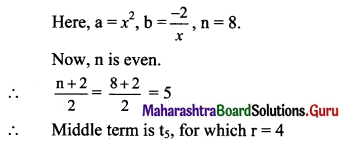
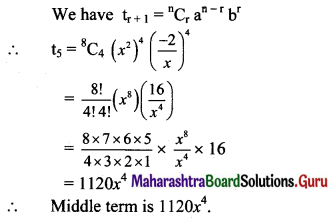
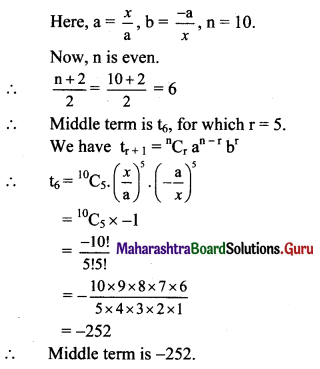
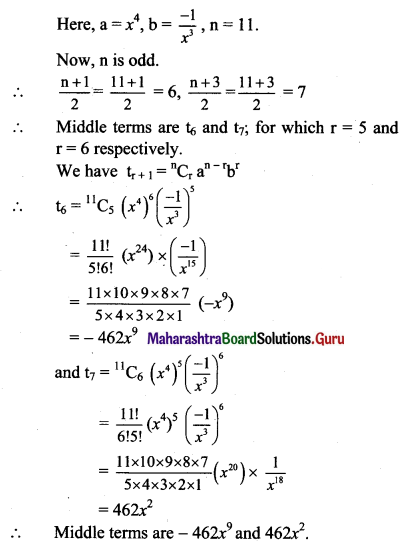
Methods of Induction and Binomial Theorem Class 11 Maths 2 Exercise 4.5 Solutions Maharashtra Board

Balbharti Maharashtra State Board 11th Maths Book Solutions Pdf Chapter 4 Methods of Induction and Binomial Theorem Ex 4.5 Questions and Answers.

11th Maths Part 2 Methods of Induction and Binomial Theorem Exercise 4.5 Questions And Answers Maharashtra Board

Question 1.
Show that C0 + C1 + C2 + ….. + C8 = 256
Solution:
Since C0 + C1 + C2 + C3 + ….. + Cn = 2n
Putting n = 8, we get
C0 + C1 + C2 + ….. + C8 = 28
∴ C0 + C1 + C2 + ….. + C8 = 256

Question 2.
Show that C0 + C1 + C2 + …… + C9 = 512
Solution:
Since C0 + C1 + C2 + C3 + ….. + Cn = 2n
Putting n = 9, we get
C0 + C1 + C2 + ….. + C9 = 29
∴ C0 + C1 + C2 + …… + C9 = 512

Maharashtra Board 11th Maths Solutions Chapter 4 Methods of Induction and Binomial Theorem Ex 4.5

Question 3.
Show that C1 + C2 + C3 + ….. + C7 = 127
Solution:
Since C0 + C1 + C2 + C3 + ….. + Cn = 2n
Putting n = 7, we get
C0 + C1 + C2 + ….. + C7 = 27
∴ C0 + C1 + C2 +….. + C7 = 128
But, C0 = 1
∴ 1 + C1 + C2 + ….. + C7 = 128
∴ C1 + C2 + ….. + C7 = 128 – 1 = 127

Question 4.
Show that C1 + C2 + C3 + ….. + C6 = 63
Solution:
Since C0 + C1 + C2 + C3 + ….. + Cn = 2n
Putting n = 6, we get
C0 + C1 + C2 + ….. + C6 = 26
∴ C0 + C1 + C2 + …… + C6 = 64
But, C0 = 1
∴ 1 + C1 + C2 + ….. + C6 = 64
∴ C1 + C2 + ….. + C6 = 64 – 1 = 63

Maharashtra Board 11th Maths Solutions Chapter 4 Methods of Induction and Binomial Theorem Ex 4.5

Question 5.
Show that C0 + C2 + C4 + C6 + C8 = C1 + C3 + C5 + C7 = 128
Solution:
Since C0 + C1 + C2 + C3 + …… + Cn = 2n
Putting n = 8, we get
C0 + C1 + C2 + C3 + …… + C8 = 28
But, sum of even coefficients = sum of odd coefficients
∴ C0 + C2 + C4 + C6 + C8 = C1 + C3 + C5 + C7
Let C0 + C2 + C4 + C6 + C8 = C1 + C3 + C5 + C7 = k
Now, C0 + C1 + C2 + C3 + C4 + C5 + C6 + C7 + C8 = 256
∴ (C0 + C2 + C4 + C6 + C8) + (C1 + C3 + C5 + C7) = 256
∴ k + k = 256
∴ 2k = 256
∴ k = 128
∴ C0 + C2 + C4 + C6 + C8 = C1 + C3 + C5 + C7 = 128

Question 6.
Show that C1 + C2 + C3 + ….. + Cn = 2n – 1
Solution:
Since C0 + C1 + C2 + C3 + ….. + Cn = 2n
But, C0 = 1
∴ 1 + C1 + C2 + C3 + …… + Cn = 2n
∴ C1 + C2 + C3 + ….. + Cn = 2n – 1

Maharashtra Board 11th Maths Solutions Chapter 4 Methods of Induction and Binomial Theorem Ex 4.5

Question 7.
Show that C0 + 2C1 + 3C2 + 4C3 + ….. + (n + 1)Cn = (n + 2) 2n-1
Solution:
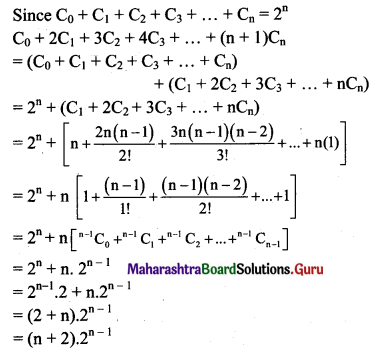
Maharashtra Board 11th Maths Solutions Chapter 4 Methods of Induction and Binomial Theorem Ex 4.5 Q7

Maths Solutions for Class 11 State Board

Differential Equations Class 12 Maths 2 Exercise 6.6 Solutions Maharashtra Board

Balbharti 12th Maharashtra State Board Maths Solutions Book Pdf Chapter 6 Differential Equations Ex 6.6 Questions and Answers.

12th Maths Part 2 Differential Equations Exercise 6.6 Questions And Answers Maharashtra Board

Question 1.
In a certain culture of bacteria, the rate of increase is proportional to the number present. If it is found that the number doubles in 4 hours, find the number of times the bacteria are increased in 12 hours.
Solution:
Let x be the number of bacteria in the culture at time t.
Then the rate of increase is \(\frac{d x}{d t}\) which is proportional to x.
∴ \(\frac{d x}{d t}\) ∝ x
∴ \(\frac{d x}{d t}\) = kx, where k is a constant
∴ \(\frac{d x}{x}\) = k dt
On integrating, we get
\(\int \frac{d x}{x}\) = k∫dt + c
∴ log x = kt + c
Initially, i.e. when t = 0, let x = x0
log x0 = k × 0 + c
∴ c = log x0
∴ log x = kt + log x0
∴ log x – log x0 = kt
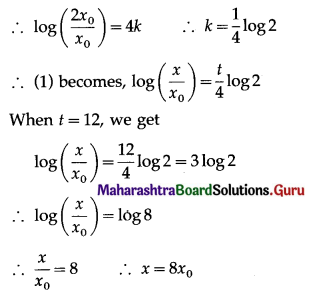
∴ log(\(\frac{x}{x_{0}}\)) = kt ………(1)
Since the number doubles in 4 hours, i.e. when t = 4, x = 2x0
Maharashtra Board 12th Maths Solutions Chapter 6 Differential Equations Ex 6.6 Q1
∴ the number of bacteria will be 8 times the original number in 12 hours.

Maharashtra Board 12th Maths Solutions Chapter 6 Differential Equations Ex 6.6

Question 2.
If the population of a country doubles in 60 years; in how many years will it be triple (treble) under the assumption that the rate of increase is proportional to the number of inhabitants?
[Given log 2 = 0.6912, log 3 = 1.0986]
Solution:
Let P be the population at time t years.
Then \(\frac{d P}{d t}\), the rate of increase of population is proportional to P.
∴ \(\frac{d P}{d t}\) ∝ P
∴ \(\frac{d P}{d t}\) = kP, where k is a constant
∴ \(\frac{d P}{P}\) = k dt
On integrating, we get
\(\int \frac{d P}{P}\) = k∫dt + c
∴ log P = kt + c
Initially i.e. when t = 0, let P = P0
∴ log P0 = k x 0 + c
∴ c = log P0
∴ log P = kt + log P0
∴ log P – log P0 = kt
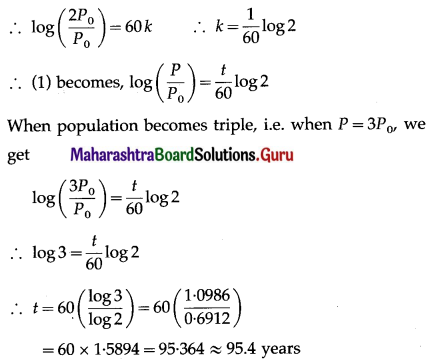
∴ log(\(\frac{P}{P_{0}}\)) = kt ……(1)
Since, the population doubles in 60 years, i.e. when t = 60, P = 2P0
Maharashtra Board 12th Maths Solutions Chapter 6 Differential Equations Ex 6.6 Q2
∴ the population becomes triple in 95.4 years (approximately).

Question 3.
If a body cools from 80°C to 50°C at room temperature of 25°C in 30 minutes, find the temperature of the body after 1 hour.
Solution:
Let θ°C be the temperature of the body at time t minutes.
The room temperature is given to be 25°C.
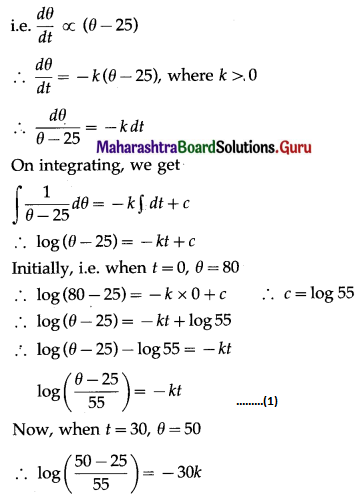
Then by Newton’s law of cooling, \(\frac{d \theta}{d t}\), the rate of change of temperature, is proportional to (θ – 25).
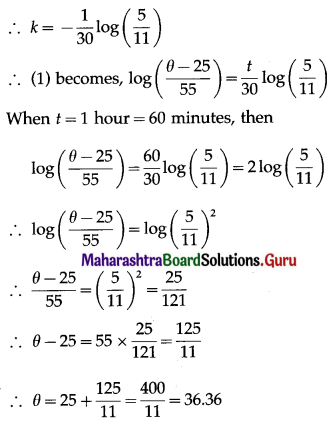
Maharashtra Board 12th Maths Solutions Chapter 6 Differential Equations Ex 6.6 Q3
Maharashtra Board 12th Maths Solutions Chapter 6 Differential Equations Ex 6.6 Q3.1
∴ the temperature of the body will be 36.36°C after 1 hour.

Maharashtra Board 12th Maths Solutions Chapter 6 Differential Equations Ex 6.6

Question 4.
The rate of growth of bacteria is proportional to the number present. If initially, there were 1000 bacteria and the number doubles in 1 hour, find the number of bacteria after 2½ hours. [Take √2 = 1.414]
Solution:
Let x be the number of bacteria at time t.
Then the rate of increase is \(\frac{d x}{d t}\) which is proportional to x.
∴ \(\frac{d x}{d t}\) ∝ x
∴ \(\frac{d x}{d t}\) = kx, where k is a constant
∴ \(\frac{d x}{x}\) = k dt
On integrating, we get
\(\int \frac{d x}{x}\) = k∫dt + c
∴ log x = kt + c
Initially, i.e. when t = 0, x = 1000
∴ log 1000 = k × 0 + c
∴ c = log 1000
∴ log x = kt + log 1000
∴ log x – log 1000 = kt
∴ log(\(\frac{x}{1000}\)) = kt ……(1)
Now, when t = 1, x = 2 × 1000 = 2000
∴ log(\(\frac{2000}{1000}\)) = k
∴ k = log 2
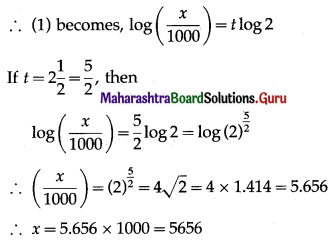
Maharashtra Board 12th Maths Solutions Chapter 6 Differential Equations Ex 6.6 Q4
∴ the number of bacteria after 2½ hours = 5656.

Question 5.
The rate of disintegration of a radioactive element at any time t is proportional to its mass at that time. Find the time during which the original mass of 1.5 gm will disintegrate into its mass of 0.5 gm.
Solution:
Let m be the mass of the radioactive element at time t.
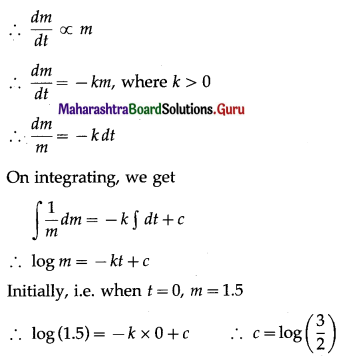
Then the rate of disintegration is \(\frac{d m}{d t}\) which is proportional to m.
Maharashtra Board 12th Maths Solutions Chapter 6 Differential Equations Ex 6.6 Q5
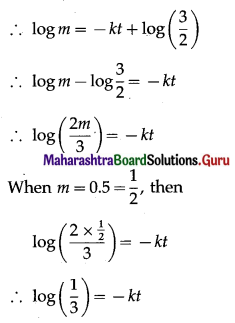
Maharashtra Board 12th Maths Solutions Chapter 6 Differential Equations Ex 6.6 Q5.1
∴ log(3)-1 = -kt
∴ -log 3 = -kt
∴ t = \(\frac{1}{k}\) log 3
∴ the original mass will disintegrate to 0.5 gm when t = \(\frac{1}{k}\) log 3

Maharashtra Board 12th Maths Solutions Chapter 6 Differential Equations Ex 6.6

Question 6.
The rate of decay of certain substances is directly proportional to the amount present at that instant. Initially, there is 25 gm of certain substance and two hours later it is found that 9 gm are left. Find the amount left after one more hour.
Solution:
Let x gm be the amount of the substance left at time t.
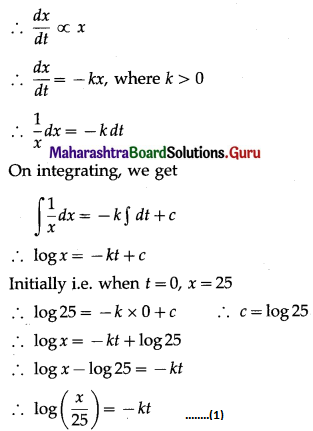
Then the rate of decay is \(\frac{d x}{d t}\), which is proportional to x.
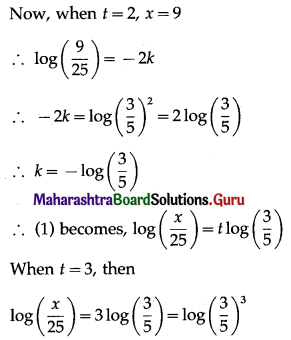
Maharashtra Board 12th Maths Solutions Chapter 6 Differential Equations Ex 6.6 Q6
Maharashtra Board 12th Maths Solutions Chapter 6 Differential Equations Ex 6.6 Q6.1
∴ \(\frac{x}{25}=\frac{27}{125}\)
∴ x = \(\frac{27}{5}\)
∴ the amount left after 3 hours \(\frac{27}{5}\) gm.

Question 7.
Find the population of a city at any time t, given that the rate of increase of population is proportional to the population at that instant and that in a period of 40 years, the population increased from 30,000 to 40,000.
Solution:
Let P be the population of the city at time t.
Then \(\frac{d P}{d t}\), the rate of increase of population is proportional to P.
∴ \(\frac{d P}{d t}\) ∝ P
∴ \(\frac{d P}{d t}\) = kP, where k is a constant.
∴ \(\frac{d P}{P}\) = k dt
On integrating, we get
\(\int \frac{1}{P} d P\) = k∫dt + c
∴ log P = kt + c
Initially, i.e. when t = 0, P = 30000
∴ log 30000 = k × 0 + c
∴ c = log 30000
∴ log P = kt + log 30000
∴ log P – log 30000 = kt
∴ log(\(\frac{P}{30000}\)) = kt …….(1)
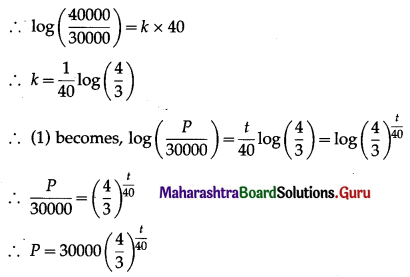
Now, when t = 40, P = 40000
Maharashtra Board 12th Maths Solutions Chapter 6 Differential Equations Ex 6.6 Q7
∴ the population of the city at time t = 30000\(\left(\frac{4}{3}\right)^{\frac{t}{40}}\).

Maharashtra Board 12th Maths Solutions Chapter 6 Differential Equations Ex 6.6

Question 8.
A body cools according to Newton’s law from 100°C to 60°C in 20 minutes. The temperature of the surroundings is 20°C. How long will it take to cool down to 30°C?
Solution:
Let θ°C be the temperature of the body at time t.
The temperature of the surrounding is given to be 20°C.
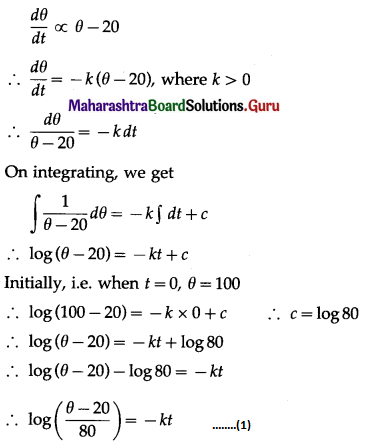
According to Newton’s law of cooling
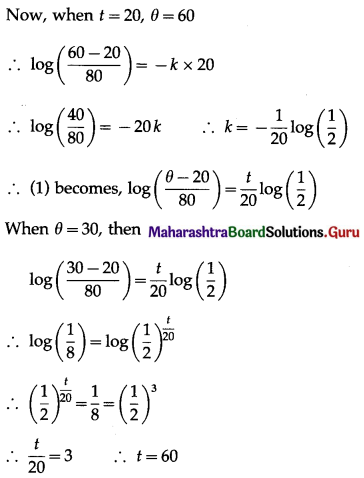
Maharashtra Board 12th Maths Solutions Chapter 6 Differential Equations Ex 6.6 Q8
Maharashtra Board 12th Maths Solutions Chapter 6 Differential Equations Ex 6.6 Q8.1
∴ the body will cool down to 30°C in 60 minutes, i.e. in 1 hour.

Question 9.
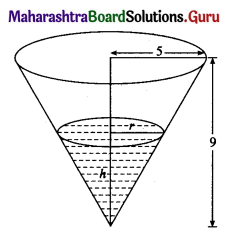
A right circular cone has a height of 9 cm and a radius of the base of 5 cm. It is inverted and water is poured into it. If at any instant the water level rises at the rate of \(\left(\frac{\pi}{A}\right)\) cm/sec, where A is the area of the water surface
at that instant, show that the vessel will be full in 75 seconds.
Solution:
Maharashtra Board 12th Maths Solutions Chapter 6 Differential Equations Ex 6.6 Q9
Let r be the radius of the water surface and h be the height of the water at time t.
∴ area of the water surface A = πr2 sq cm.
Since height of the right circular cone is 9 cm and radius of the base is 5 cm.
\(\frac{r}{h}=\frac{5}{9}\)
∴ r = \(\frac{5}{9} h\)
∴ area of water surface, i.e. A = \(\pi\left(\frac{5}{9} h\right)^{2}\)
∴ A = \(\frac{25 \pi h^{2}}{81}\) ……..(1)
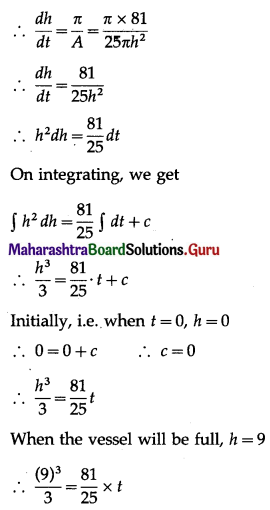
The water level, i.e. the rate of change of h is \(\frac{d h}{d t}\) rises at the rate of \(\left(\frac{\pi}{A}\right)\) cm/sec.
Maharashtra Board 12th Maths Solutions Chapter 6 Differential Equations Ex 6.6 Q9.1
∴ t = \(\frac{81 \times 9 \times 25}{3 \times 81}\) = 75
Hence, the vessel will be full in 75 seconds.

Maharashtra Board 12th Maths Solutions Chapter 6 Differential Equations Ex 6.6

Question 10.
Assume that a spherical raindrop evaporates at a rate proportional to its surface area. If its radius originally is 3 mm and 1 hour later has been reduced to 2 mm, find an expression for the radius of the raindrop at any time t.
Solution:
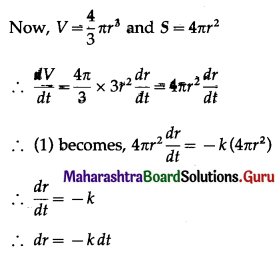
Let r be the radius, V be the volume and S be the surface area of the spherical raindrop at time t.
Then V = \(\frac{4}{3}\)πr3 and S = 4πr2
The rate at which the raindrop evaporates is \(\frac{d V}{d t}\) which is proportional to the surface area.
∴ \(\frac{d V}{d t}\) ∝ S
∴ \(\frac{d V}{d t}\) = -kS, where k > 0 ………(1)
Maharashtra Board 12th Maths Solutions Chapter 6 Differential Equations Ex 6.6 Q10
On integrating, we get
∫dr = -k∫dt + c
∴ r = -kt + c
Initially, i.e. when t = 0, r = 3
∴ 3 = -k × 0 + c
∴ c = 3
∴ r = -kt + 3
When t = 1, r = 2
∴ 2 = -k × 1 + 3
∴ k = 1
∴ r = -t + 3
∴ r = 3 – t, where 0 ≤ t ≤ 3.
This is the required expression for the radius of the raindrop at any time t.

Question 11.
The rate of growth of the population of a city at any time t is proportional to the size of the population. For a certain city, it is found that the constant of proportionality is 0.04. Find the population of the city after 25 years, if the initial population is 10,000. [Take e = 2.7182]
Solution:
Let P be the population of the city at time t.
Then the rate of growth of population is \(\frac{d P}{d t}\) which is proportional to P.
∴ \(\frac{d P}{d t}\) ∝ P
∴ \(\frac{d P}{d t}\) = kP, where k = 0.04
∴ \(\frac{d P}{d t}\) = (0.04)P
∴ \(\frac{1}{P}\) dP = (0.04)dt
On integrating, we get
\(\int \frac{1}{P} d P\) = (0.04) ∫dt + c
∴ log P = (0.04)t + c
Initially, i.e., when t = 0, P = 10000
∴ log 10000 = (0.04) × 0 + c
∴ c = log 10000
∴ log P = (0.04)t + log 10000
∴ log P – log 10000 = (0.04)t
∴ log(\(\frac{P}{10000}\)) = (0.04)t
When t = 25, then
∴ log(\(\frac{P}{10000}\)) = 0.04 × 25 = 1
∴ log(\(\frac{P}{10000}\)) = log e ……[∵ log e = 1]
∴ \(\frac{P}{10000}\) = e = 2.7182
∴ P = 2.7182 × 10000 = 27182
∴ the population of the city after 25 years will be 27,182.

Maharashtra Board 12th Maths Solutions Chapter 6 Differential Equations Ex 6.6

Question 12.
Radium decomposes at a rate proportional to the amount present at any time. If p percent of the amount disappears in one year, what percent of the amount of radium will be left after 2 years?
Solution:
Let x be the amount of the radium at time t.
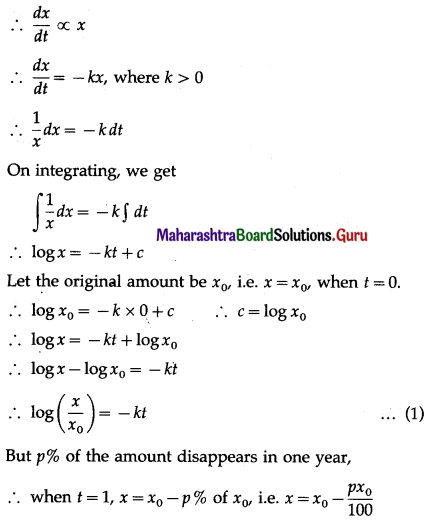
Then the rate of decomposition is \(\frac{d x}{d t}\) which is proportional to x.
Maharashtra Board 12th Maths Solutions Chapter 6 Differential Equations Ex 6.6 Q12
Maharashtra Board 12th Maths Solutions Chapter 6 Differential Equations Ex 6.6 Q12.1
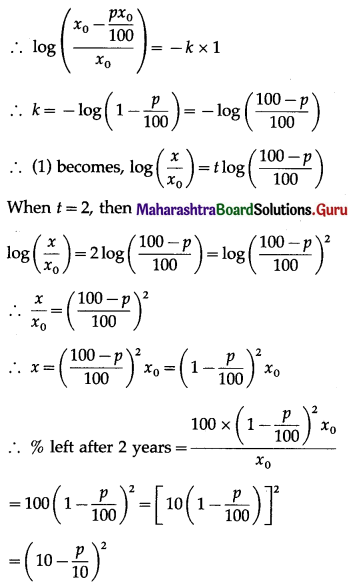
Hence, \(\left(10-\frac{p}{10}\right)^{2} \%\) of the amount will be left after 2 years.

12th Maharashtra State Board Maths Solutions Pdf Part 2

Methods of Induction and Binomial Theorem Class 11 Maths 2 Exercise 4.4 Solutions Maharashtra Board

Balbharti Maharashtra State Board 11th Maths Book Solutions Pdf Chapter 4 Methods of Induction and Binomial Theorem Ex 4.4 Questions and Answers.

11th Maths Part 2 Methods of Induction and Binomial Theorem Exercise 4.4 Questions And Answers Maharashtra Board

Question 1.
State, by writing the first four terms, the expansion of the following, where |x| < 1.
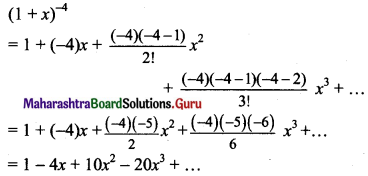
(i) (1 + x)-4
Solution:
Maharashtra Board 11th Maths Solutions Chapter 4 Methods of Induction and Binomial Theorem Ex 4.4 Q1 (i)

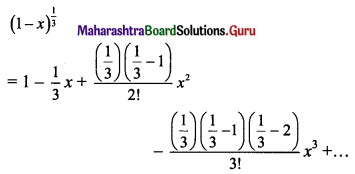
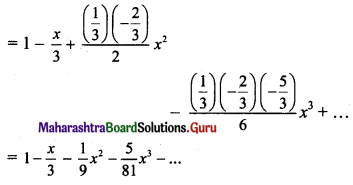
(ii) (1 – x)1/3
Solution:
Maharashtra Board 11th Maths Solutions Chapter 4 Methods of Induction and Binomial Theorem Ex 4.4 Q1 (ii)
Maharashtra Board 11th Maths Solutions Chapter 4 Methods of Induction and Binomial Theorem Ex 4.4 Q1 (ii).1

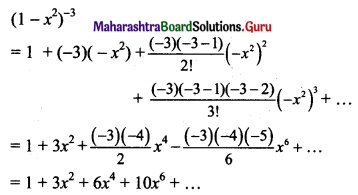
(iii) (1 – x2)-3
Solution:
Maharashtra Board 11th Maths Solutions Chapter 4 Methods of Induction and Binomial Theorem Ex 4.4 Q1 (iii)

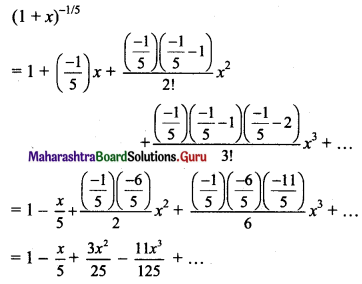
(iv) (1 + x)-1/5
Solution:
Maharashtra Board 11th Maths Solutions Chapter 4 Methods of Induction and Binomial Theorem Ex 4.4 Q1 (iv)

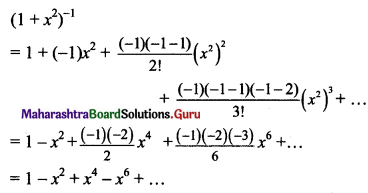
(v) (1 + x2)-1
Solution:
Maharashtra Board 11th Maths Solutions Chapter 4 Methods of Induction and Binomial Theorem Ex 4.4 Q1 (v)

Maharashtra Board 11th Maths Solutions Chapter 4 Methods of Induction and Binomial Theorem Ex 4.4

Question 2.
State by writing first four terms, the expansion of the following, where |b| < |a|.
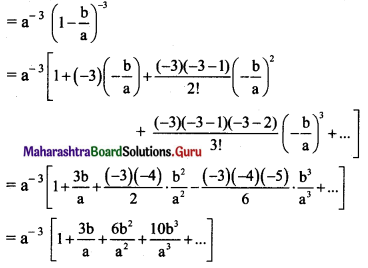
(i) (a – b)-3
Solution:
(a – b)-3 = \(\left[a\left(1-\frac{b}{a}\right)\right]^{-3}\)
Maharashtra Board 11th Maths Solutions Chapter 4 Methods of Induction and Binomial Theorem Ex 4.4 Q2 (i)

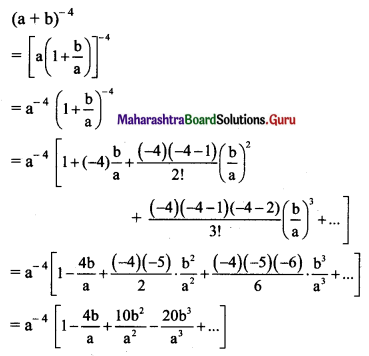
(ii) (a + b)-4
Solution:
Maharashtra Board 11th Maths Solutions Chapter 4 Methods of Induction and Binomial Theorem Ex 4.4 Q2 (ii)

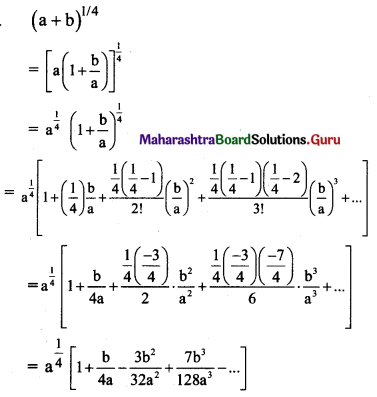
(iii) (a + b)1/4
Solution:
Maharashtra Board 11th Maths Solutions Chapter 4 Methods of Induction and Binomial Theorem Ex 4.4 Q2 (iii)

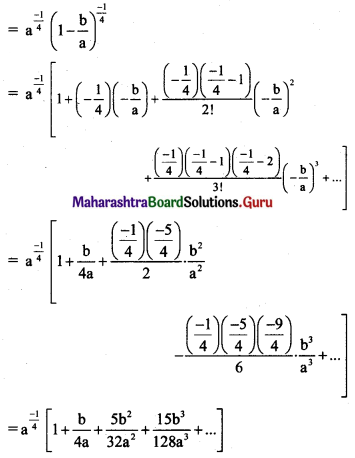
(iv) (a – b)-1/4
Solution:
(a – b)-1/4 = \(\left[a\left(1-\frac{b}{a}\right)\right]^{\frac{-1}{4}}\)
Maharashtra Board 11th Maths Solutions Chapter 4 Methods of Induction and Binomial Theorem Ex 4.4 Q2 (iv)

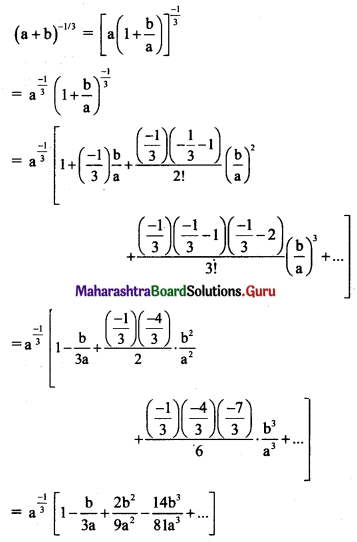
(v) (a + b)-1/3
Solution:
Maharashtra Board 11th Maths Solutions Chapter 4 Methods of Induction and Binomial Theorem Ex 4.4 Q2 (v)

Maharashtra Board 11th Maths Solutions Chapter 4 Methods of Induction and Binomial Theorem Ex 4.4

Question 3.
Simplify the first three terms in the expansion of the following:
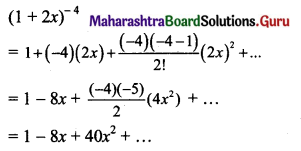
(i) (1 + 2x)-4
Solution:
Maharashtra Board 11th Maths Solutions Chapter 4 Methods of Induction and Binomial Theorem Ex 4.4 Q3 (i)

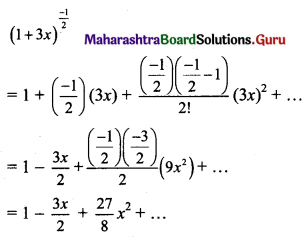
(ii) (1 + 3x)-1/2
Solution:
Maharashtra Board 11th Maths Solutions Chapter 4 Methods of Induction and Binomial Theorem Ex 4.4 Q3 (ii)

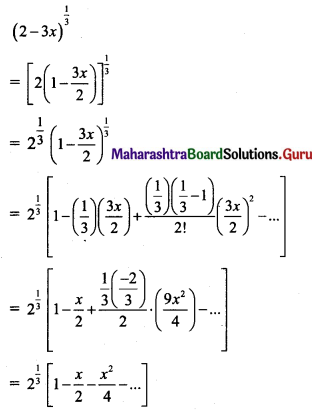
(iii) (2 – 3x)1/3
Solution:
Maharashtra Board 11th Maths Solutions Chapter 4 Methods of Induction and Binomial Theorem Ex 4.4 Q3 (iii)

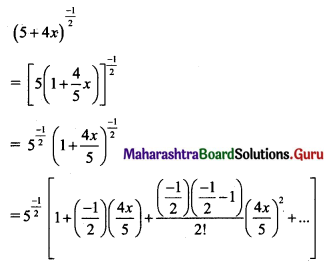
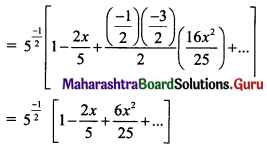
(iv) (5 + 4x)-1/2
Solution:
Maharashtra Board 11th Maths Solutions Chapter 4 Methods of Induction and Binomial Theorem Ex 4.4 Q3 (iv)
Maharashtra Board 11th Maths Solutions Chapter 4 Methods of Induction and Binomial Theorem Ex 4.4 Q3 (iv).1

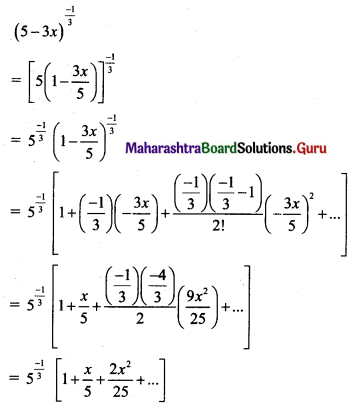
(v) (5 – 3x)-1/3
Solution:
Maharashtra Board 11th Maths Solutions Chapter 4 Methods of Induction and Binomial Theorem Ex 4.4 Q3 (v)

Maharashtra Board 11th Maths Solutions Chapter 4 Methods of Induction and Binomial Theorem Ex 4.4

Question 4.
Use the binomial theorem to evaluate the following upto four places of decimals.
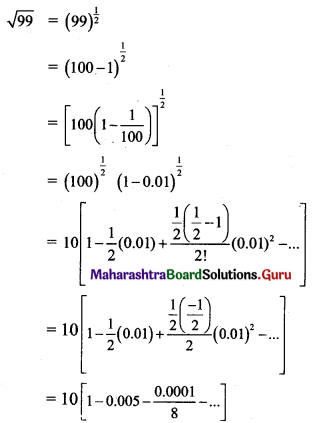
(i) √99
Solution:
Maharashtra Board 11th Maths Solutions Chapter 4 Methods of Induction and Binomial Theorem Ex 4.4 Q4 (i)
= 10 [1 – 0.005 – 0.0000125 – ……]
= 10(0.9949875)
= 9.94987 5
= 9.9499

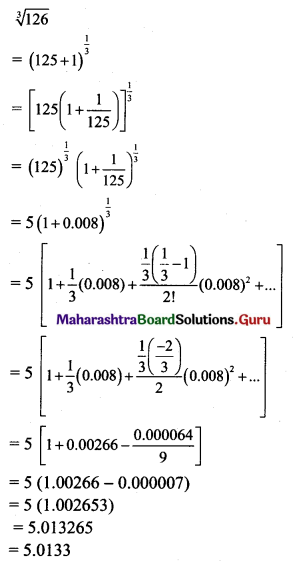
(ii) \(\sqrt[3]{126}\)
Solution:
Maharashtra Board 11th Maths Solutions Chapter 4 Methods of Induction and Binomial Theorem Ex 4.4 Q4 (ii)

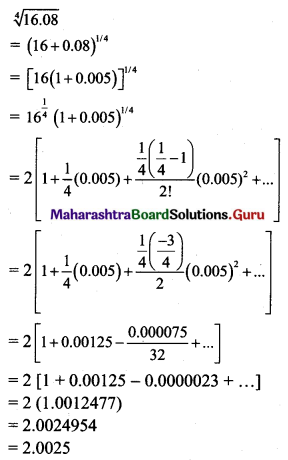
(iii) \(\sqrt[4]{16.08}\)
Solution:
Maharashtra Board 11th Maths Solutions Chapter 4 Methods of Induction and Binomial Theorem Ex 4.4 Q4 (iii)

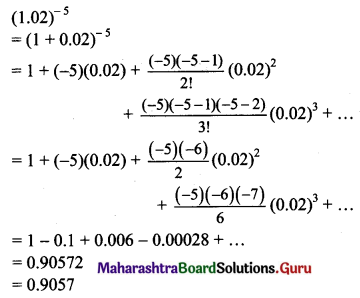
(iv) (1.02)-5
Solution:
Maharashtra Board 11th Maths Solutions Chapter 4 Methods of Induction and Binomial Theorem Ex 4.4 Q4 (iv)

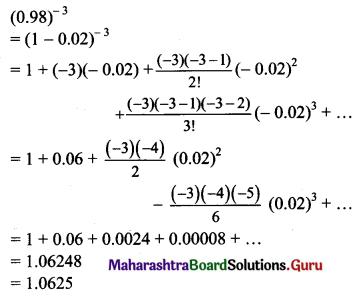
(v) (0.98)-3
Solution:
Maharashtra Board 11th Maths Solutions Chapter 4 Methods of Induction and Binomial Theorem Ex 4.4 Q4 (v)

Maths Solutions for Class 11 State Board

Methods of Induction and Binomial Theorem Class 11 Maths 2 Exercise 4.3 Solutions Maharashtra Board

Balbharti Maharashtra State Board 11th Maths Book Solutions Pdf Chapter 4 Methods of Induction and Binomial Theorem Ex 4.3 Questions and Answers.

11th Maths Part 2 Methods of Induction and Binomial Theorem Exercise 4.3 Questions And Answers Maharashtra Board

Question 1.
In the following expansions, find the indicated term.
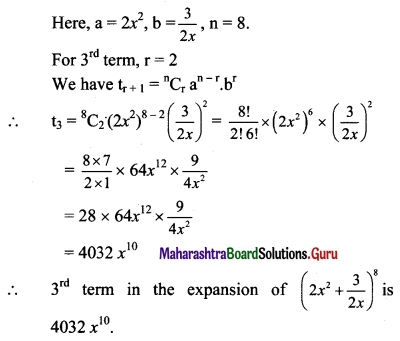
(i) \(\left(2 x^{2}+\frac{3}{2 x}\right)^{8}\), 3rd term
Solution:
Maharashtra Board 11th Maths Solutions Chapter 4 Methods of Induction and Binomial Theorem Ex 4.3 Q1 (i)

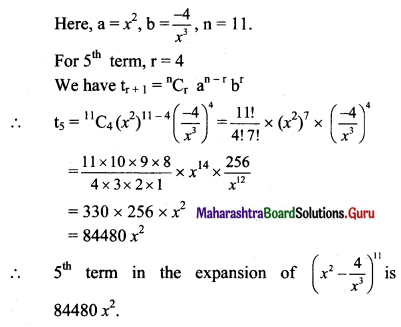
(ii) \(\left(x^{2}-\frac{4}{x^{3}}\right)^{11}\), 5th term
Solution:
Maharashtra Board 11th Maths Solutions Chapter 4 Methods of Induction and Binomial Theorem Ex 4.3 Q1 (ii)

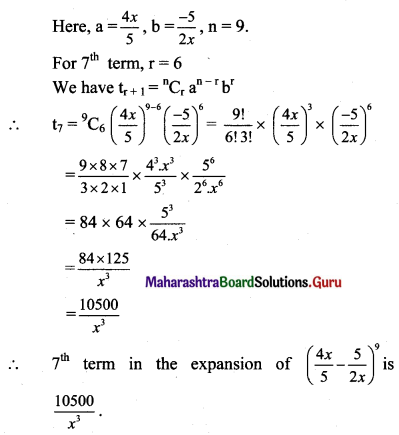
(iii) \(\left(\frac{4 x}{5}-\frac{5}{2 x}\right)^{9}\), 7th term
Solution:
Maharashtra Board 11th Maths Solutions Chapter 4 Methods of Induction and Binomial Theorem Ex 4.3 Q1 (iii)

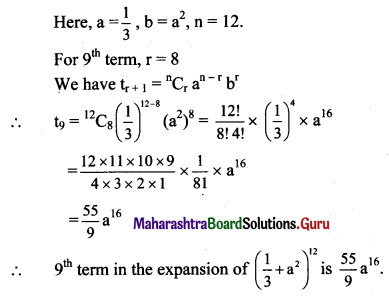
(iv) In \(\left(\frac{1}{3}+a^{2}\right)^{12}\), 9th term
Solution:
Maharashtra Board 11th Maths Solutions Chapter 4 Methods of Induction and Binomial Theorem Ex 4.3 Q1 (iv)

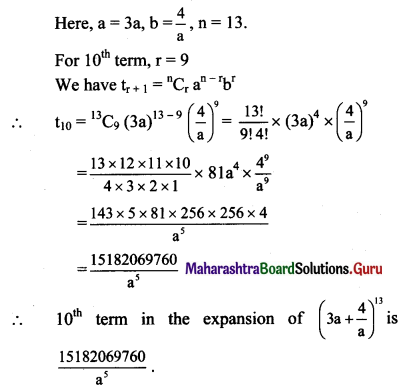
(v) In \(\left(3 a+\frac{4}{a}\right)^{13}\), 10th term
Solution:
Maharashtra Board 11th Maths Solutions Chapter 4 Methods of Induction and Binomial Theorem Ex 4.3 Q1 (v)

Maharashtra Board 11th Maths Solutions Chapter 4 Methods of Induction and Binomial Theorem Ex 4.3

Question 2.
In the following expansions, find the indicated coefficients.
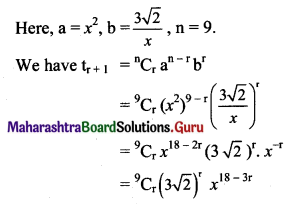
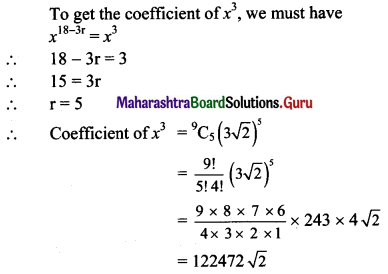
(i) x3 in \(\left(x^{2}+\frac{3 \sqrt{2}}{x}\right)^{9}\)
Solution:
Maharashtra Board 11th Maths Solutions Chapter 4 Methods of Induction and Binomial Theorem Ex 4.3 Q2 (i)
Maharashtra Board 11th Maths Solutions Chapter 4 Methods of Induction and Binomial Theorem Ex 4.3 Q2 (i).1

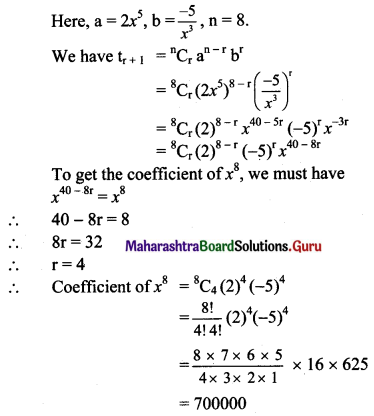
(ii) x8 in \(\left(2 x^{5}-\frac{5}{x^{3}}\right)^{8}\)
Solution:
Maharashtra Board 11th Maths Solutions Chapter 4 Methods of Induction and Binomial Theorem Ex 4.3 Q2 (ii)

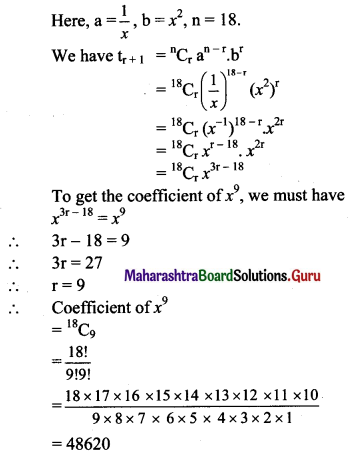
(iii) x9 in \(\left(\frac{1}{x}+x^{2}\right)^{18}\)
Solution:
Maharashtra Board 11th Maths Solutions Chapter 4 Methods of Induction and Binomial Theorem Ex 4.3 Q2 (iii)

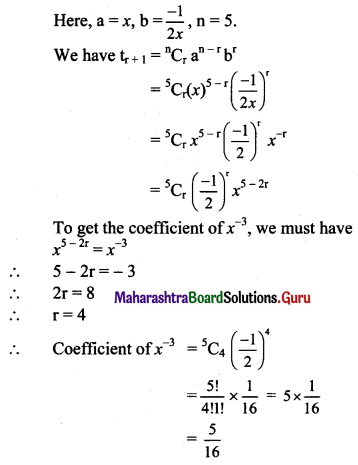
(iv) x-3 in \(\left(x-\frac{1}{2 x}\right)^{5}\)
Solution:
Maharashtra Board 11th Maths Solutions Chapter 4 Methods of Induction and Binomial Theorem Ex 4.3 Q2 (iv)

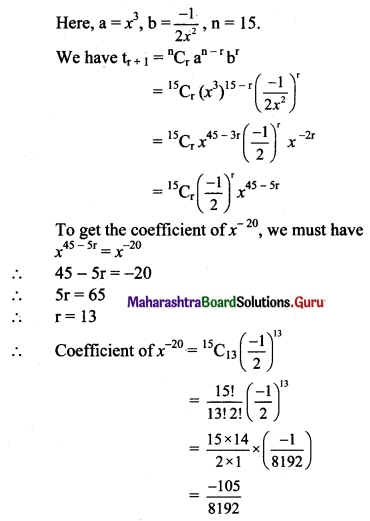
(v) x-20 in \(\left(x^{3}-\frac{1}{2 x^{2}}\right)^{15}\)
Solution:
Maharashtra Board 11th Maths Solutions Chapter 4 Methods of Induction and Binomial Theorem Ex 4.3 Q2 (v)

Maharashtra Board 11th Maths Solutions Chapter 4 Methods of Induction and Binomial Theorem Ex 4.3

Question 3.
Find the constant term (term independent of x) in the expansion of
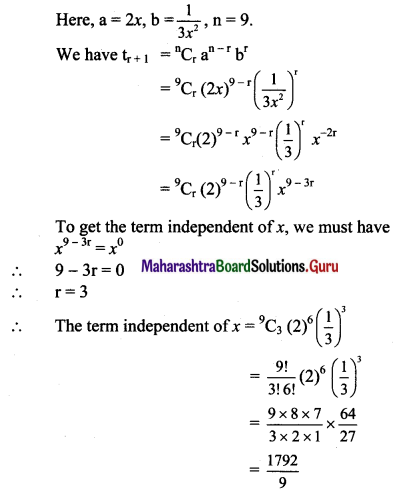
(i) \(\left(2 x+\frac{1}{3 x^{2}}\right)^{9}\)
Solution:
Maharashtra Board 11th Maths Solutions Chapter 4 Methods of Induction and Binomial Theorem Ex 4.3 Q3 (i)

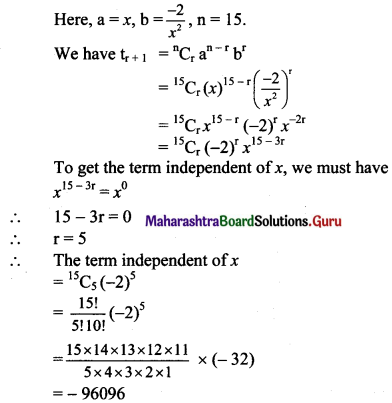
(ii) \(\left(x-\frac{2}{x^{2}}\right)^{15}\)
Solution:
Maharashtra Board 11th Maths Solutions Chapter 4 Methods of Induction and Binomial Theorem Ex 4.3 Q3 (ii)

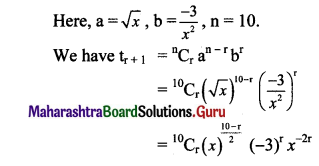
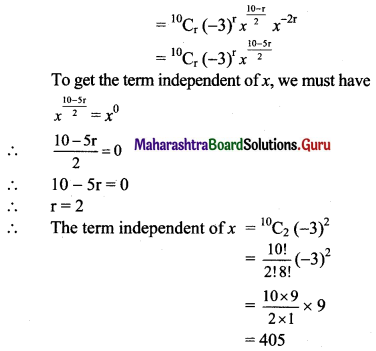
(iii) \(\left(\sqrt{x}-\frac{3}{x^{2}}\right)^{10}\)
Solution:
Maharashtra Board 11th Maths Solutions Chapter 4 Methods of Induction and Binomial Theorem Ex 4.3 Q3 (iii)
Maharashtra Board 11th Maths Solutions Chapter 4 Methods of Induction and Binomial Theorem Ex 4.3 Q3 (iii).1

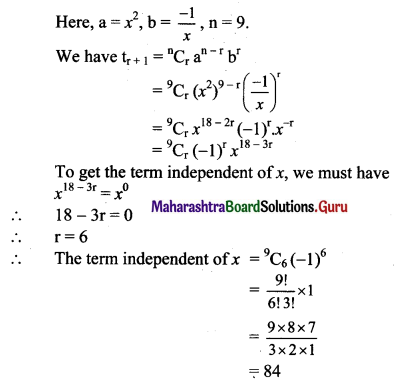
(iv) \(\left(x^{2}-\frac{1}{x}\right)^{9}\)
Solution:
Maharashtra Board 11th Maths Solutions Chapter 4 Methods of Induction and Binomial Theorem Ex 4.3 Q3 (iv)

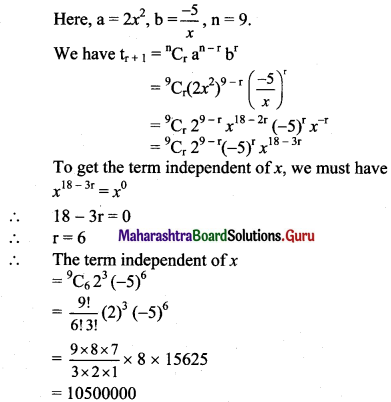
(v) \(\left(2 x^{2}-\frac{5}{x}\right)^{9}\)
Solution:
Maharashtra Board 11th Maths Solutions Chapter 4 Methods of Induction and Binomial Theorem Ex 4.3 Q3 (v)

Maharashtra Board 11th Maths Solutions Chapter 4 Methods of Induction and Binomial Theorem Ex 4.3

Question 4.
Find the middle terms in the expansion of
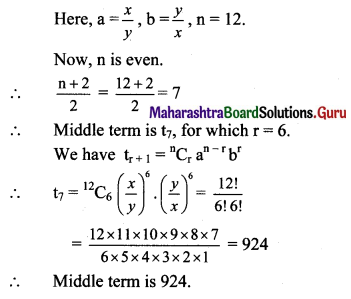
(i) \(\left(\frac{x}{y}+\frac{y}{x}\right)^{12}\)
Solution:
Maharashtra Board 11th Maths Solutions Chapter 4 Methods of Induction and Binomial Theorem Ex 4.3 Q4 (i)

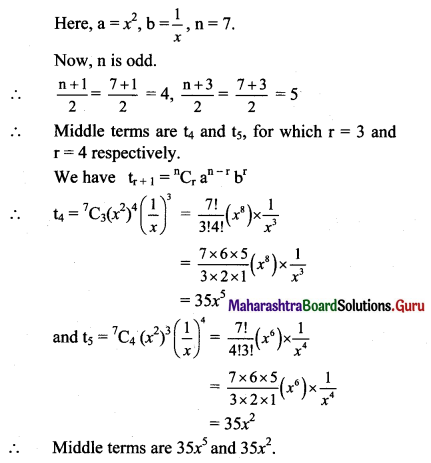
(ii) \(\left(x^{2}+\frac{1}{x}\right)^{7}\)
Solution:
Maharashtra Board 11th Maths Solutions Chapter 4 Methods of Induction and Binomial Theorem Ex 4.3 Q4 (ii)

(iii) \(\left(x^{2}-\frac{2}{x}\right)^{8}\)
Solution:
Maharashtra Board 11th Maths Solutions Chapter 4 Methods of Induction and Binomial Theorem Ex 4.3 Q4 (iii)
Maharashtra Board 11th Maths Solutions Chapter 4 Methods of Induction and Binomial Theorem Ex 4.3 Q4 (iii).1

(iv) \(\left(\frac{x}{a}-\frac{a}{x}\right)^{10}\)
Solution:
Maharashtra Board 11th Maths Solutions Chapter 4 Methods of Induction and Binomial Theorem Ex 4.3 Q4 (iv)

(v) \(\left(x^{4}-\frac{1}{x^{3}}\right)^{11}\)
Solution:
Maharashtra Board 11th Maths Solutions Chapter 4 Methods of Induction and Binomial Theorem Ex 4.3 Q4 (v)

Maharashtra Board 11th Maths Solutions Chapter 4 Methods of Induction and Binomial Theorem Ex 4.3

Question 5.
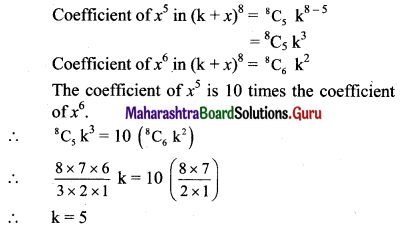
In the expansion of (k + x)8, the coefficient of x5 is 10 times the coefficient of x6. Find the value of k.
Solution:
Maharashtra Board 11th Maths Solutions Chapter 4 Methods of Induction and Binomial Theorem Ex 4.3 Q5

Question 6.
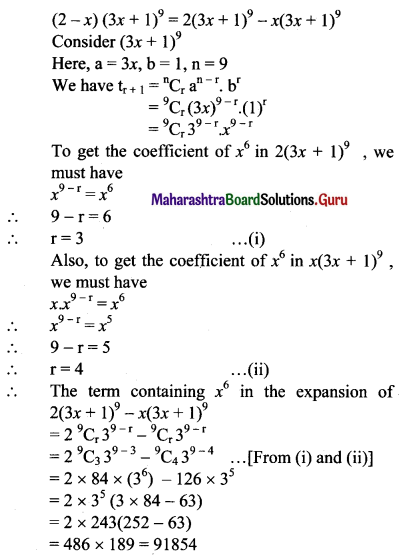
Find the term containing x6 in the expansion of (2 – x) (3x + 1)9.
Solution:
Maharashtra Board 11th Maths Solutions Chapter 4 Methods of Induction and Binomial Theorem Ex 4.3 Q6

Maharashtra Board 11th Maths Solutions Chapter 4 Methods of Induction and Binomial Theorem Ex 4.3

Question 7.
The coefficient of x2 in the expansion of (1 + 2x)m is 112. Find m.
Solution:
The coefficient of x2 in (1 + 2x)m = mC2 (22)
Given that the coefficient of x2 = 112
∴ mC2 (4) = 112
∴ mC2 = 28
∴ \(\frac{\mathrm{m} !}{2 !(\mathrm{m}-2) !}=28\)
∴ \(\frac{m(m-1)(m-2) !}{2 \times(m-2) !}=28\)
∴ m(m – 1) = 56
∴ m2 – m – 56 = 0
∴ (m – 8) (m + 7) = 0
As m cannot be negative.
∴ m = 8

Maths Solutions for Class 11 State Board

Differential Equations Class 12 Maths 2 Exercise 6.5 Solutions Maharashtra Board

Balbharti 12th Maharashtra State Board Maths Solutions Book Pdf Chapter 6 Differential Equations Ex 6.5 Questions and Answers.

12th Maths Part 2 Differential Equations Exercise 6.5 Questions And Answers Maharashtra Board

Question 1.
Solve the following differential equations:
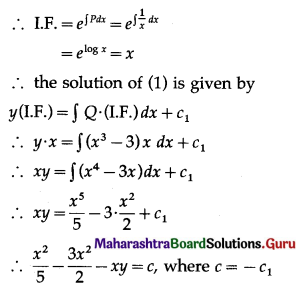
(i) \(\frac{d y}{d x}+\frac{y}{x}=x^{3}-3\)
Solution:
\(\frac{d y}{d x}+\frac{y}{x}=x^{3}-3\) …….(1)
This is the linear differential equation of the form
\(\frac{d y}{d x}\) + P . y = Q, where P = \(\frac{1}{x}\) and Q = x3 – 3
Maharashtra Board 12th Maths Solutions Chapter 6 Differential Equations Ex 6.5 Q1 (i)
This is the general solution.

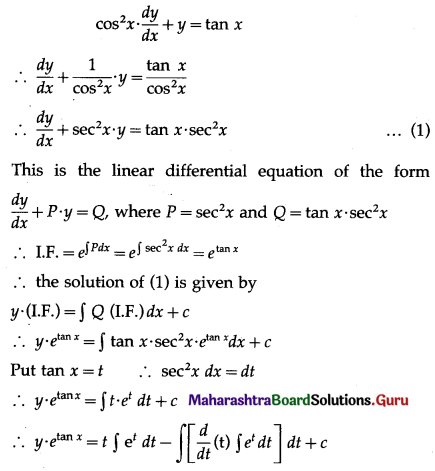
(ii) cos2x . \(\frac{d y}{d x}\) + y = tan x
Solution:
Maharashtra Board 12th Maths Solutions Chapter 6 Differential Equations Ex 6.5 Q1 (ii)
Maharashtra Board 12th Maths Solutions Chapter 6 Differential Equations Ex 6.5 Q1 (ii).1

Maharashtra Board 12th Maths Solutions Chapter 6 Differential Equations Ex 6.5

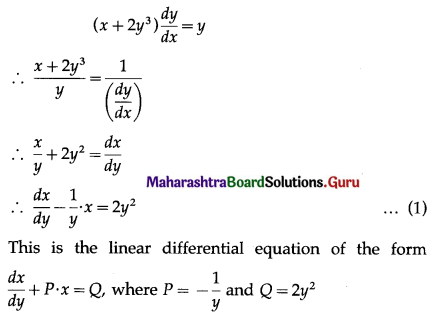
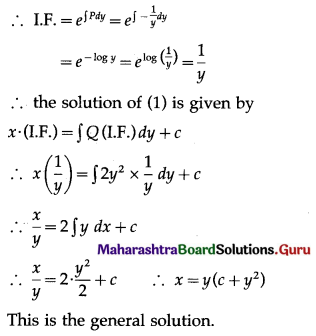
(iii) (x + 2y3) \(\frac{d y}{d x}\) = y
Solution:
Maharashtra Board 12th Maths Solutions Chapter 6 Differential Equations Ex 6.5 Q1 (iii)
Maharashtra Board 12th Maths Solutions Chapter 6 Differential Equations Ex 6.5 Q1 (iii).1

(iv) \(\frac{d y}{d x}\) + y . sec x = tan x
Solution:
\(\frac{d y}{d x}\) + y sec x = tan x
∴ \(\frac{d y}{d x}\) + (sec x) . y = tan x ……..(1)
This is the linear differential equation of the form
\(\frac{d y}{d x}\) + P . y = Q, where P = sec x and Q = tan x
∴ I.F. = \(e^{\int P d x}\)
= \(e^{\int \sec x d x}\)
= \(e^{\log (\sec x+\tan x)}\)
= sec x + tan x
∴ the solution of (1) is given by
y (I.F.) = ∫Q . (I.F.) dx + c
∴ y(sec x + tan x) = ∫tan x (sec x + tan x) dx + c
∴ (sec x + tan x) . y = ∫(sec x tan x + tan2x) dx + c
∴ (sec x + tan x) . y = ∫(sec x tan x + sec2x – 1) dx + c
∴ (sec x + tan x) . y = sec x + tan x – x + c
∴ y(sec x + tan x) = sec x + tan x – x + c
This is the general solution.

Maharashtra Board 12th Maths Solutions Chapter 6 Differential Equations Ex 6.5

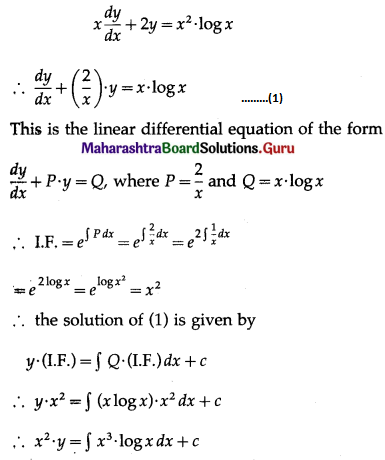
(v) x \(\frac{d y}{d x}\) + 2y = x2 . log x
Solution:
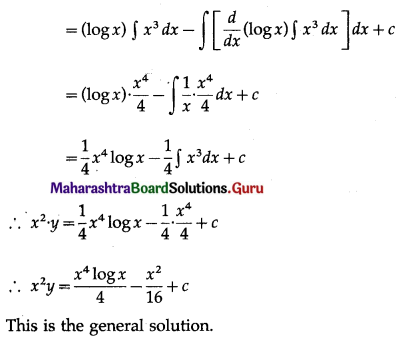
Maharashtra Board 12th Maths Solutions Chapter 6 Differential Equations Ex 6.5 Q1 (v)
Maharashtra Board 12th Maths Solutions Chapter 6 Differential Equations Ex 6.5 Q1 (v).1

(vi) (x + y) \(\frac{d y}{d x}\) = 1
Solution:
(x + y) \(\frac{d y}{d x}\) = 1
∴ \(\frac{d x}{d y}\) = x + y
∴ \(\frac{d x}{d y}\) – x = y
∴ \(\frac{d x}{d y}\) + (-1) x = y ……….(1)
This is the linear differential equation of the form
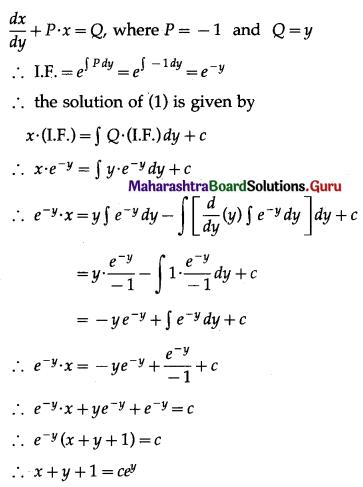
Maharashtra Board 12th Maths Solutions Chapter 6 Differential Equations Ex 6.5 Q1 (vi)
This is the general solution.

(vii) (x + a) \(\frac{d y}{d x}\) – 3y = (x + a)5
Solution:
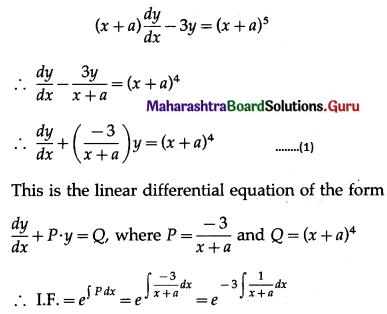
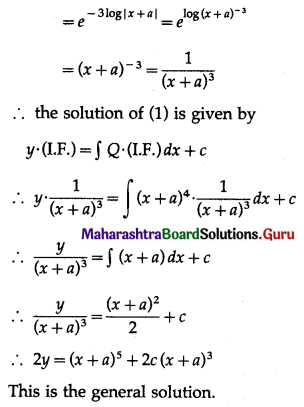
Maharashtra Board 12th Maths Solutions Chapter 6 Differential Equations Ex 6.5 Q1 (vii)
Maharashtra Board 12th Maths Solutions Chapter 6 Differential Equations Ex 6.5 Q1 (vii).1

Maharashtra Board 12th Maths Solutions Chapter 6 Differential Equations Ex 6.5

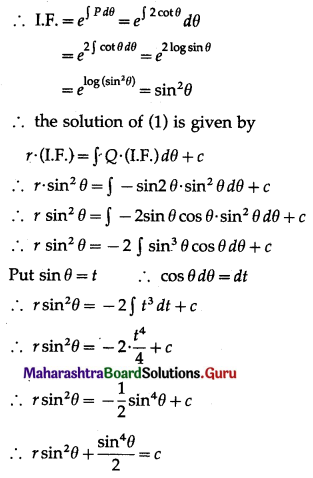
(viii) dr + (2r cot θ + sin 2θ) dθ = 0
Solution:
dr + (2r cot θ + sin 2θ) dθ = 0
∴ \(\frac{d r}{d \theta}\) + (2r cot θ + sin 2θ) = 0
∴ \(\frac{d r}{d \theta}\) + (2 cot θ)r = -sin 2θ ………(1)
This is the linear differential equation of the form dr
\(\frac{d r}{d \theta}\) + P . r = Q, where P = 2 cot θ and Q = -sin 2θ
Maharashtra Board 12th Maths Solutions Chapter 6 Differential Equations Ex 6.5 Q1 (viii)
This is the general solution.

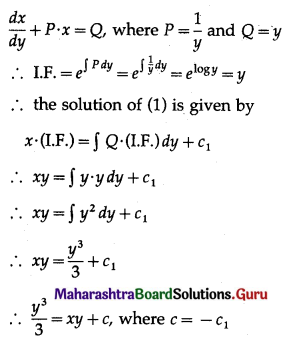
(ix) y dx + (x – y2) dy = 0
Solution:
y dx + (x – y2) dy = 0
∴ y dx = -(x – y2) dy
∴ \(\frac{d x}{d y}=-\frac{\left(x-y^{2}\right)}{y}=-\frac{x}{y}+y\)
∴ \(\frac{d x}{d y}+\left(\frac{1}{y}\right) \cdot x=y\) ………(1)
This is the linear differential equation of the form
Maharashtra Board 12th Maths Solutions Chapter 6 Differential Equations Ex 6.5 Q1 (ix)
This is the general solution.

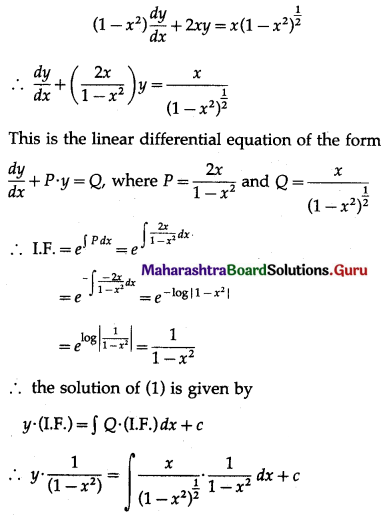
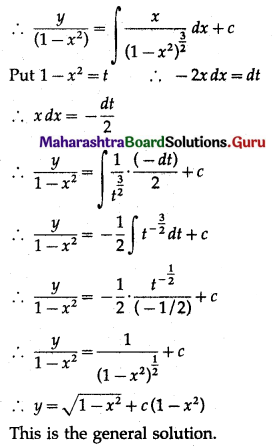
(x) \(\left(1-x^{2}\right) \frac{d y}{d x}+2 x y=x\left(1-x^{2}\right)^{\frac{1}{2}}\)
Solution:
Maharashtra Board 12th Maths Solutions Chapter 6 Differential Equations Ex 6.5 Q1 (x)
Maharashtra Board 12th Maths Solutions Chapter 6 Differential Equations Ex 6.5 Q1 (x).1

Maharashtra Board 12th Maths Solutions Chapter 6 Differential Equations Ex 6.5

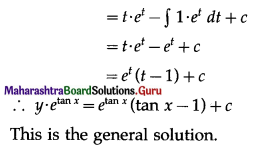
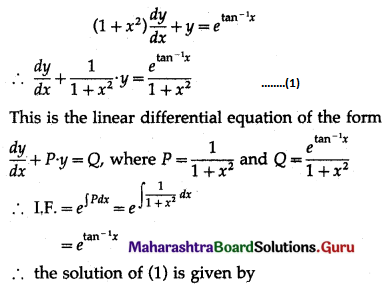
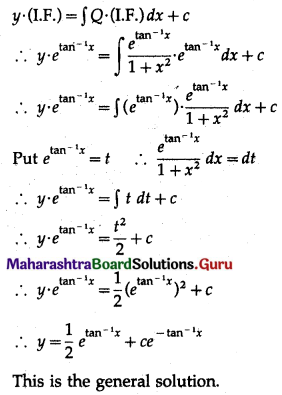
(xi) \(\left(1+x^{2}\right) \frac{d y}{d x}+y=e^{\tan ^{-1} x}\)
Solution:
Maharashtra Board 12th Maths Solutions Chapter 6 Differential Equations Ex 6.5 Q1 (xi)
Maharashtra Board 12th Maths Solutions Chapter 6 Differential Equations Ex 6.5 Q1 (xi).1

Question 2.
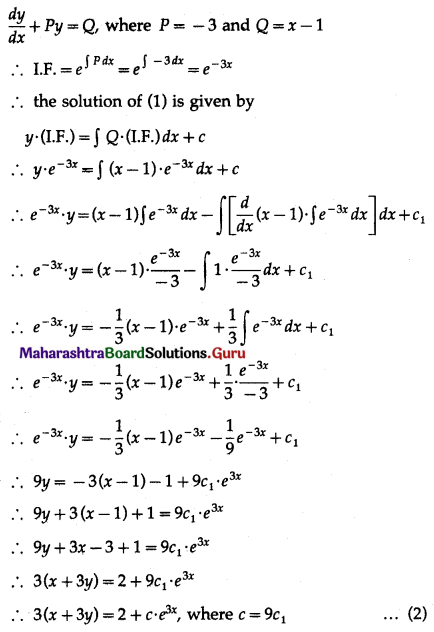
Find the equation of the curve which passes through the origin and has the slope x + 3y – 1 at any point (x, y) on it.
Solution:
Let A(x, y) be the point on the curve y = f(x).
Then slope of the tangent to the curve at the point A is \(\frac{d y}{d x}\).
According to the given condition,
\(\frac{d y}{d x}\) = x + 3y – 1
∴ \(\frac{d y}{d x}\) – 3y = x – 1 ………(1)
This is the linear differential equation of the form
Maharashtra Board 12th Maths Solutions Chapter 6 Differential Equations Ex 6.5 Q2
This is the general equation of the curve.
But the required curve is passing through the origin (0, 0).
∴ by putting x = 0 and y = 0 in (2), we get
0 = 2 + c
∴ c = -2
∴ from (2), the equation of the required curve is 3(x + 3y) = 2 – 2e3x i.e. 3(x + 3y) = 2 (1 – e3x).

Maharashtra Board 12th Maths Solutions Chapter 6 Differential Equations Ex 6.5

Question 3.
Find the equation of the curve passing through the point \(\left(\frac{3}{\sqrt{2}}, \sqrt{2}\right)\) having slope of the tangent to the curve at any point (x, y) is \(-\frac{4 x}{9 y}\).
Solution:
Let A(x, y) be the point on the curve y = f(x).
Then the slope of the tangent to the curve at point A is \(\frac{d y}{d x}\).
According to the given condition
\(\frac{d y}{d x}=-\frac{4 x}{9 y}\)
∴ y dy = \(-\frac{4}{9}\) x dx
Integrating both sides, we get
∫y dy= \(-\frac{4}{9}\) ∫x dx
∴ \(\frac{y^{2}}{2}=-\frac{4}{9} \cdot \frac{x^{2}}{2}+c_{1}\)
∴ 9y2 = -4x2 + 18c1
∴ 4x2 + 9y2 = c where c = 18c1
This is the general equation of the curve.
But the required curve is passing through the point \(\left(\frac{3}{\sqrt{2}}, \sqrt{2}\right)\).
∴ by putting x = \(\frac{3}{\sqrt{2}}\) and y = √2 in (1), we get
\(4\left(\frac{3}{\sqrt{2}}\right)^{2}+9(\sqrt{2})^{2}=c\)
∴ 18 + 18 = c
∴ c = 36
∴ from (1), the equation of the required curve is 4x2 + 9y2 = 36.

Question 4.
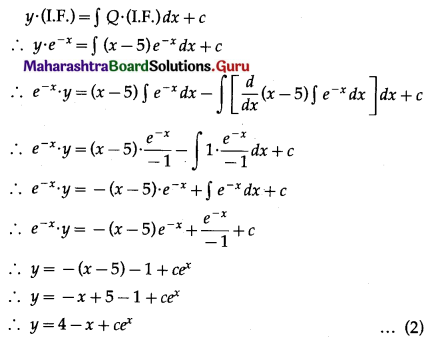
The curve passes through the point (0, 2). The sum of the coordinates of any point on the curve exceeds the slope of the tangent to the curve at any point by 5. Find the equation of the curve.
Solution:
Let A(x, y) be any point on the curve.
Then slope of the tangent to the curve at the point A is \(\frac{d y}{d x}\).
According to the given condition
x + y = \(\frac{d y}{d x}\) + 5
∴ \(\frac{d y}{d x}\) – y = x – 5 ………(1)
This is the linear differential equation of the form
\(\frac{d y}{d x}\) + P . y = Q, where P = -1 and Q = x – 5
∴ I.F. = \(e^{\int P d x}=e^{\int-1 d x}=e^{-x}\)
∴ the solution of (1) is given by
Maharashtra Board 12th Maths Solutions Chapter 6 Differential Equations Ex 6.5 Q4
This is the general equation of the curve.
But the required curve is passing through the point (0, 2).
∴ by putting x = 0, y = 2 in (2), we get
2 = 4 – 0 + c
∴ c = -2
∴ from (2), the equation of the required curve is y = 4 – x – 2ex.

Maharashtra Board 12th Maths Solutions Chapter 6 Differential Equations Ex 6.5

Question 5.
If the slope of the tangent to the curve at each of its point is equal to the sum of abscissa and the product of the abscissa and ordinate of the point. Also, the curve passes through the point (0, 1). Find the equation of the curve.
Solution:
Let A(x, y) be the point on the curve y = f(x).
Then slope of the tangent to the curve at the point A is \(\frac{d y}{d x}\).
According to the given condition
\(\frac{d y}{d x}\) = x + xy
∴ \(\frac{d y}{d x}\) – xy = x ……….. (1)
This is the linear differential equation of the form
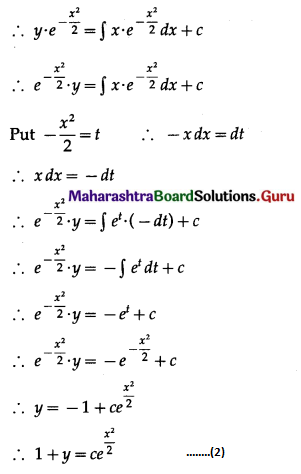
\(\frac{d y}{d x}\) + Py = Q, where P = -x and Q = x
∴ I.F. = \(e^{\int P d x}=e^{\int-x d x}=e^{-\frac{x^{2}}{2}}\)
∴ the solution of (1) is given by
y . (I.F.) = ∫Q . (I.F.) dx + c
Maharashtra Board 12th Maths Solutions Chapter 6 Differential Equations Ex 6.5 Q5
This is the general equation of the curve.
But the required curve is passing through the point (0, 1).
∴ by putting x = 0 and y = 1 in (2), we get
1 + 1 = c
∴ c = 2
∴ from (2), the equation of the required curve is 1 + y = \(2 e^{\frac{x^{2}}{2}}\).

12th Maharashtra State Board Maths Solutions Pdf Part 2

Differential Equations Class 12 Maths 2 Exercise 6.4 Solutions Maharashtra Board

Balbharti 12th Maharashtra State Board Maths Solutions Book Pdf Chapter 6 Differential Equations Ex 6.4 Questions and Answers.

12th Maths Part 2 Differential Equations Exercise 6.4 Questions And Answers Maharashtra Board

I. Solve the following differential equations:

Question 1.
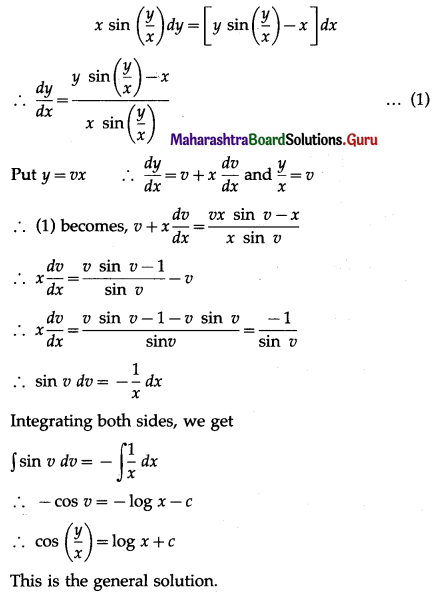
\(x \sin \left(\frac{y}{x}\right) d y=\left[y \sin \left(\frac{y}{x}\right)-x\right] d x\)
Solution:
Maharashtra Board 12th Maths Solutions Chapter 6 Differential Equations Ex 6.4 Q1

Question 2.
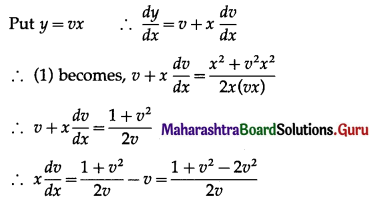
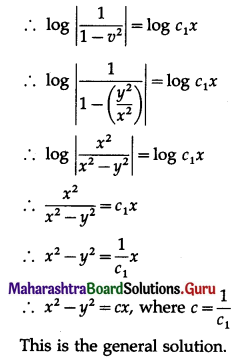
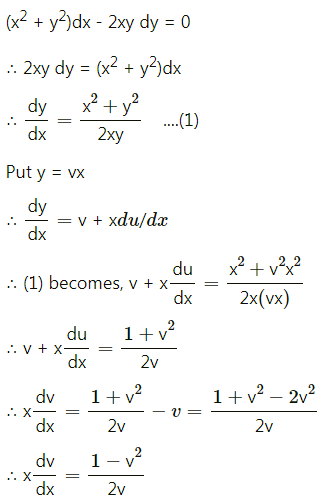
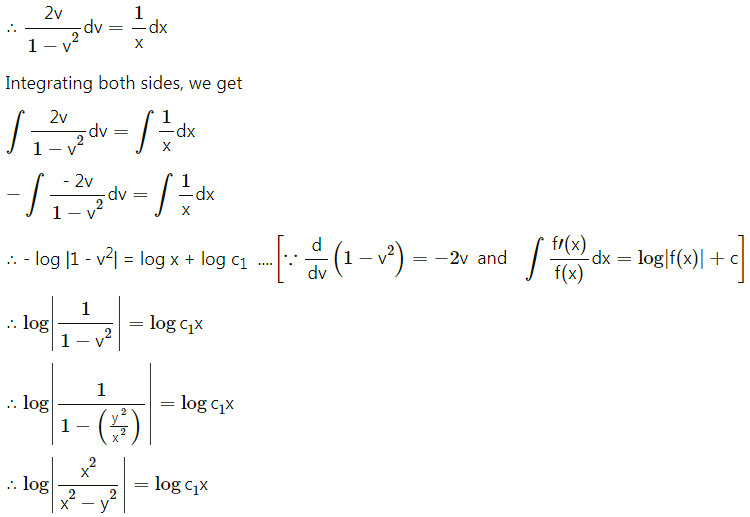
(x2 + y2) dx – 2xy . dy = 0
Solution:
(x2 + y2) dx – 2xy dy = 0
∴ 2xy dy = (x2 + y2) dx
∴ \(\frac{d y}{d x}=\frac{x^{2}+y^{2}}{2 x y}\) ………(1)
Maharashtra Board 12th Maths Solutions Chapter 6 Differential Equations Ex 6.4 Q2
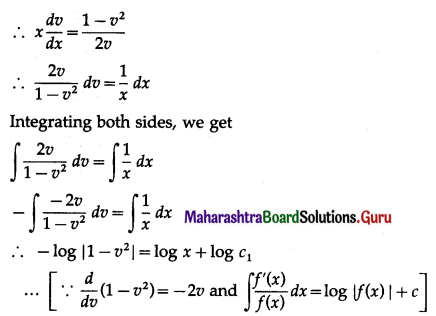
Maharashtra Board 12th Maths Solutions Chapter 6 Differential Equations Ex 6.4 Q2.1
Maharashtra Board 12th Maths Solutions Chapter 6 Differential Equations Ex 6.4 Q2.2

Maharashtra Board 12th Maths Solutions Chapter 6 Differential Equations Ex 6.4

Question 3.
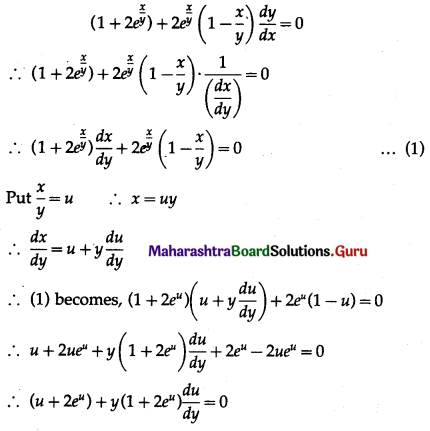
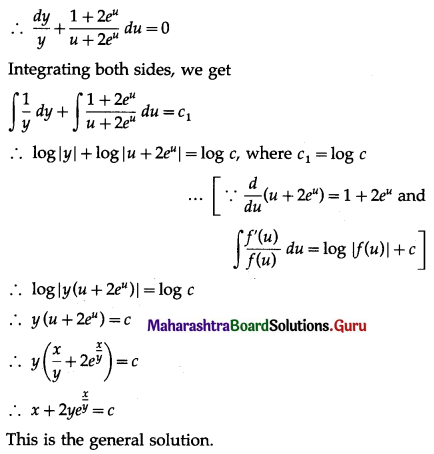
\(\left(1+2 e^{\frac{x}{y}}\right)+2 e^{\frac{x}{y}}\left(1-\frac{x}{y}\right) \frac{d y}{d x}=0\)
Solution:
Maharashtra Board 12th Maths Solutions Chapter 6 Differential Equations Ex 6.4 Q3
Maharashtra Board 12th Maths Solutions Chapter 6 Differential Equations Ex 6.4 Q3.1

Question 4.
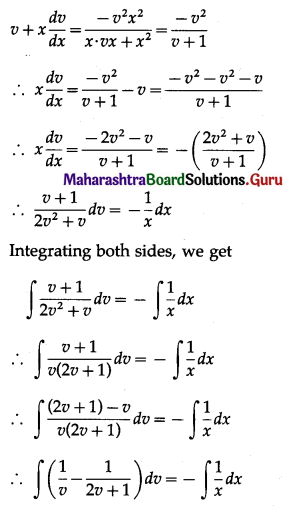
y2 dx + (xy + x2) dy = 0
Solution:
y2 dx + (xy + x2) dy = 0
∴ (xy + x2) dy = -y2 dx
∴ \(\frac{d y}{d x}=\frac{-y^{2}}{x y+x^{2}}\) ……..(1)
Put y = vx
∴ \(\frac{d y}{d x}=v+x \frac{d v}{d x}\)
Substituting these values in (1), we get
Maharashtra Board 12th Maths Solutions Chapter 6 Differential Equations Ex 6.4 Q4
Maharashtra Board 12th Maths Solutions Chapter 6 Differential Equations Ex 6.4 Q4.1

Maharashtra Board 12th Maths Solutions Chapter 6 Differential Equations Ex 6.4

Question 5.
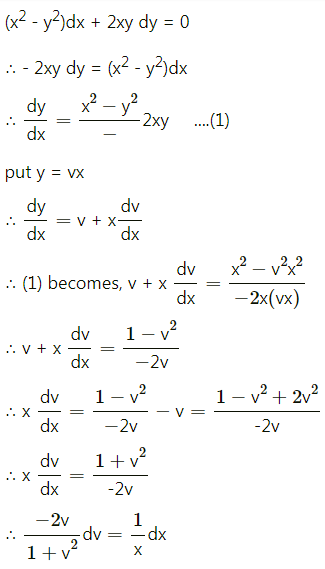
(x2 – y2) dx + 2xy dy = 0
Solution:
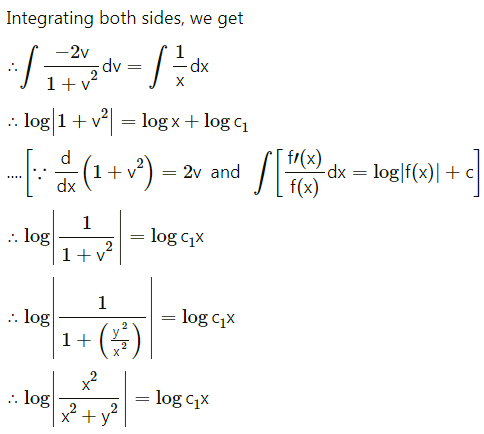
Maharashtra Board 12th Maths Solutions Chapter 6 Differential Equations Ex 6.4 Q5
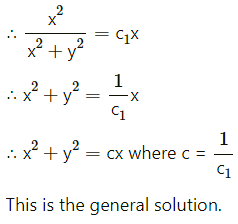
Maharashtra Board 12th Maths Solutions Chapter 6 Differential Equations Ex 6.4 Q5.1
Maharashtra Board 12th Maths Solutions Chapter 6 Differential Equations Ex 6.4 Q5.2

Question 6.
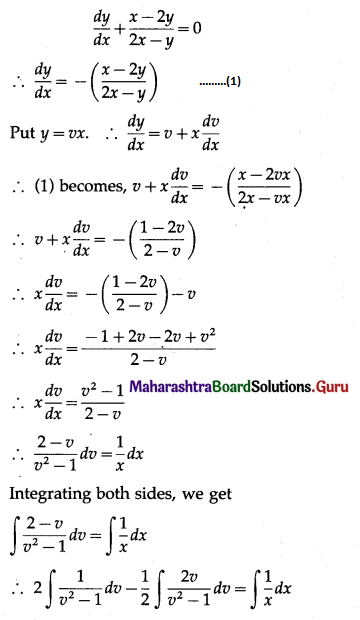
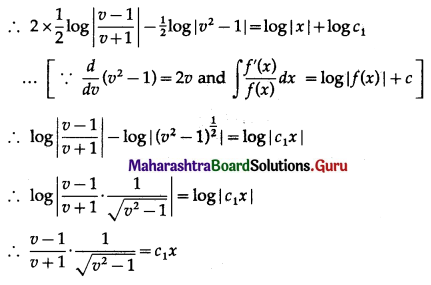
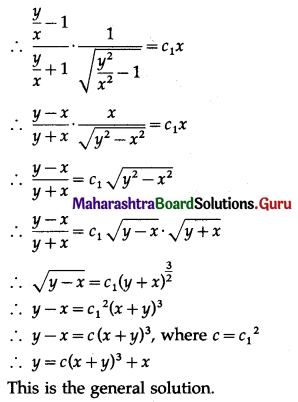
\(\frac{d y}{d x}+\frac{x-2 y}{2 x-y}=0\)
Solution:
Maharashtra Board 12th Maths Solutions Chapter 6 Differential Equations Ex 6.4 Q6
Maharashtra Board 12th Maths Solutions Chapter 6 Differential Equations Ex 6.4 Q6.1
Maharashtra Board 12th Maths Solutions Chapter 6 Differential Equations Ex 6.4 Q6.2

Maharashtra Board 12th Maths Solutions Chapter 6 Differential Equations Ex 6.4

Question 7.
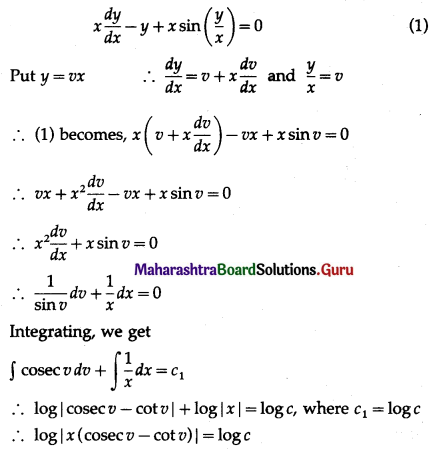
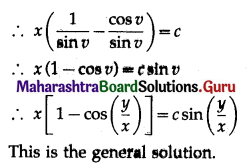
\(x \frac{d y}{d x}-y+x \sin \left(\frac{y}{x}\right)=0\)
Solution:
Maharashtra Board 12th Maths Solutions Chapter 6 Differential Equations Ex 6.4 Q7
Maharashtra Board 12th Maths Solutions Chapter 6 Differential Equations Ex 6.4 Q7.1

Question 8.
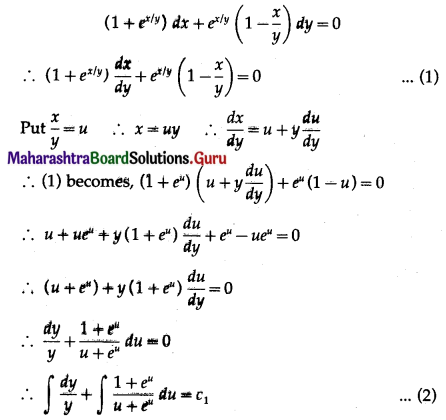
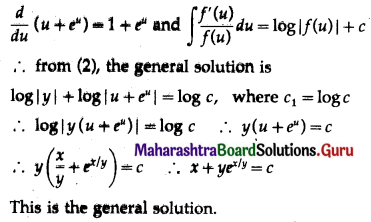
\(\left(1+e^{\frac{x}{y}}\right) d x+e^{\frac{x}{y}}\left(1-\frac{X}{y}\right) d y=0\)
Solution:
Maharashtra Board 12th Maths Solutions Chapter 6 Differential Equations Ex 6.4 Q8
Maharashtra Board 12th Maths Solutions Chapter 6 Differential Equations Ex 6.4 Q8.1

Maharashtra Board 12th Maths Solutions Chapter 6 Differential Equations Ex 6.4

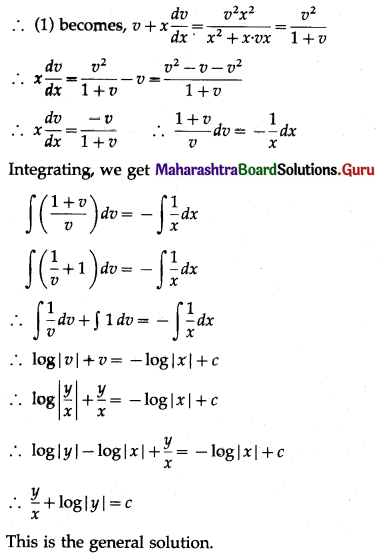
Question 9.
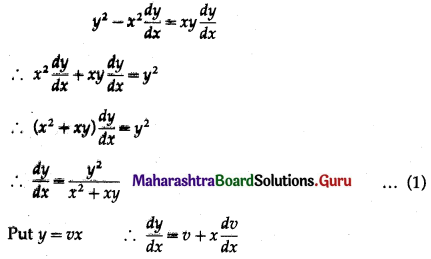
\(y^{2}-x^{2} \frac{d y}{d x}=x y \frac{d y}{d x}\)
Solution:
Maharashtra Board 12th Maths Solutions Chapter 6 Differential Equations Ex 6.4 Q9
Maharashtra Board 12th Maths Solutions Chapter 6 Differential Equations Ex 6.4 Q9.1

Question 10.
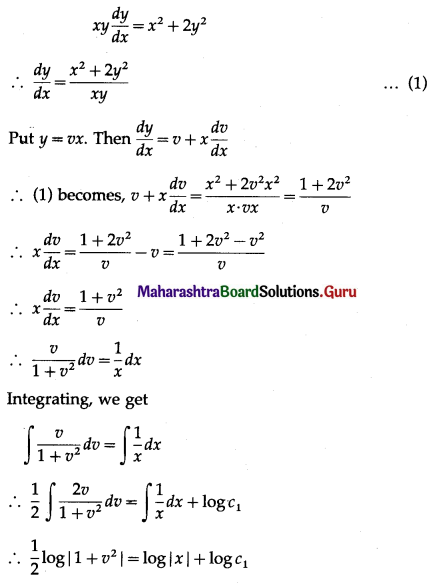
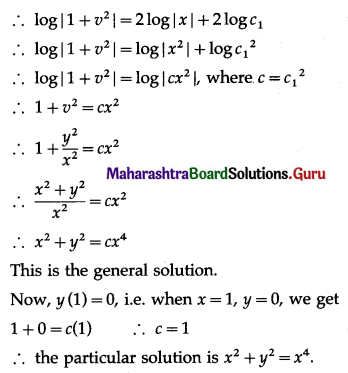
xy \(\frac{d y}{d x}\) = x2 + 2y2, y(1) = 0
Solution:
Maharashtra Board 12th Maths Solutions Chapter 6 Differential Equations Ex 6.4 Q10
Maharashtra Board 12th Maths Solutions Chapter 6 Differential Equations Ex 6.4 Q10.1

Maharashtra Board 12th Maths Solutions Chapter 6 Differential Equations Ex 6.4

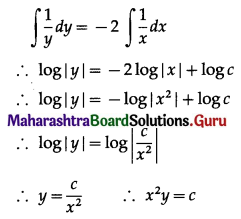
Question 11.
x dy + 2y · dx = 0, when x = 2, y = 1
Solution:
∴ x dy + 2y · dx = 0
∴ x dy = -2y dx
∴ \(\frac{1}{y} d y=\frac{-2}{x} d x\)
Integrating, we get
Maharashtra Board 12th Maths Solutions Chapter 6 Differential Equations Ex 6.4 Q11
This is the general solution.
When x = 2, y = 1, we get
4(1) = c
∴ c = 4
∴ the particular solution is x2y = 4.

Question 12.
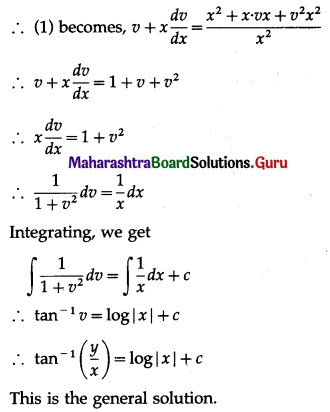
x2 \(\frac{d y}{d x}\) = x2 + xy + y2
Solution:
x2 \(\frac{d y}{d x}\) = x2 + xy + y2
∴ \(\frac{d y}{d x}=\frac{x^{2}+x y+y^{2}}{x^{2}}\) ………(1)
Put y = vx
∴ \(\frac{d y}{d x}=v+x \frac{d v}{d x}\)
Maharashtra Board 12th Maths Solutions Chapter 6 Differential Equations Ex 6.4 Q12

Maharashtra Board 12th Maths Solutions Chapter 6 Differential Equations Ex 6.4

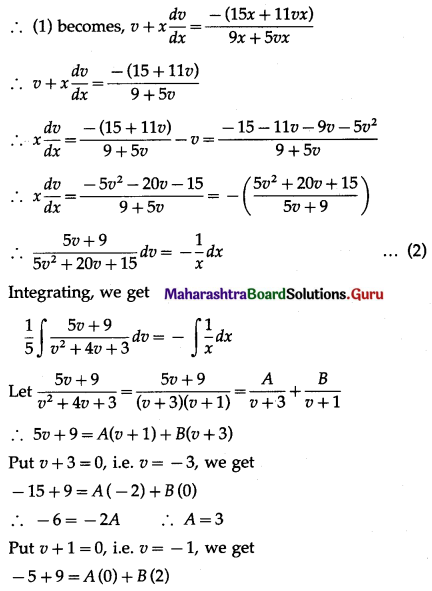
Question 13.
(9x + 5y) dy + (15x + 11y) dx = 0
Solution:
(9x + 5y) dy + (15x + 11y) dx = 0
∴ (9x + 5y) dy = -(15x + 11y) dx
∴ \(\frac{d y}{d x}=\frac{-(15 x+11 y)}{9 x+5 y}\) ………(1)
Put y = vx
∴ \(\frac{d y}{d x}=v+x \frac{d v}{d x}\)
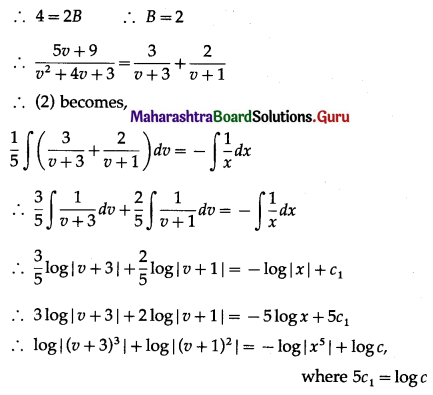
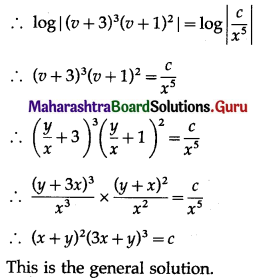
Maharashtra Board 12th Maths Solutions Chapter 6 Differential Equations Ex 6.4 Q13
Maharashtra Board 12th Maths Solutions Chapter 6 Differential Equations Ex 6.4 Q13.1
Maharashtra Board 12th Maths Solutions Chapter 6 Differential Equations Ex 6.4 Q13.2

Question 14.
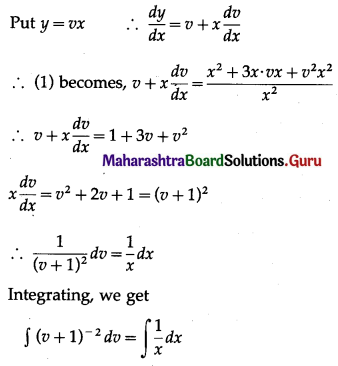
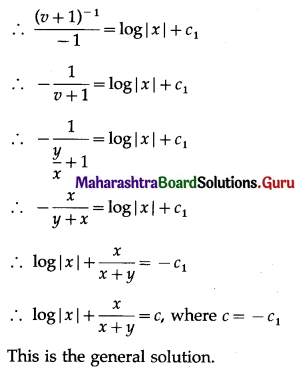
(x2 + 3xy + y2) dx – x2 dy = 0
Solution:
(x2 + 3xy + y2) dx – x2 dy = 0
∴ x2 dy = (x2 + 3xy + y2) dx
∴ \(\frac{d y}{d x}=\frac{x^{2}+3 x y+y^{2}}{x^{2}}\) ………(1)
Maharashtra Board 12th Maths Solutions Chapter 6 Differential Equations Ex 6.4 Q14
Maharashtra Board 12th Maths Solutions Chapter 6 Differential Equations Ex 6.4 Q14.1

Maharashtra Board 12th Maths Solutions Chapter 6 Differential Equations Ex 6.4

Question 15.
(x2 + y2) dx – 2xy dy = 0.
Solution:
Maharashtra Board 12th Maths Solutions Chapter 6 Differential Equations Ex 6.4 Q15
Maharashtra Board 12th Maths Solutions Chapter 6 Differential Equations Ex 6.4 Q15.1
Maharashtra Board 12th Maths Solutions Chapter 6 Differential Equations Ex 6.4 Q15.2

12th Maharashtra State Board Maths Solutions Pdf Part 2

Methods of Induction and Binomial Theorem Class 11 Maths 2 Exercise 4.2 Solutions Maharashtra Board

Balbharti Maharashtra State Board Class 11 Maths Solutions Pdf Chapter 4 Methods of Induction and Binomial Theorem Ex 4.2 Questions and Answers.
11th Maths Part 2 Methods of Induction and Binomial Theorem Exercise 4.2 Questions And Answers Maharashtra Board

Question 1.
Expand:
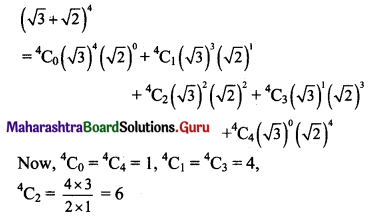
(i) (√3 + √2)4
Solution:
Here, a = √3, b = √2 and n = 4.
Using binomial theorem,
Maharashtra Board 11th Maths Solutions Chapter 4 Methods of Induction and Binomial Theorem Ex 4.2 Q1 (i)
∴ (√3 + √2)4 = 1(9) (1) + 4(3√3) (√2) + 6(3)(2) + 4(√3) (2√2) + 1(1)(4)
= 9 + 12√6 + 36 + 8√6 + 4
= 49 + 20√6

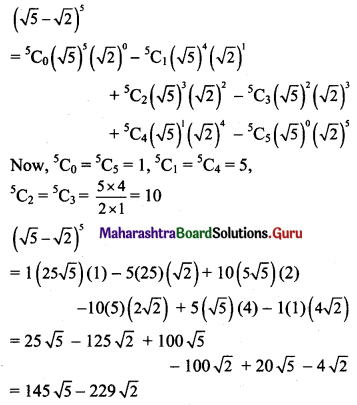
(ii) (√5 – √2)5
Solution:
Here, a = √5, b = √2 and n = 5.
Using binomial theorem,
Maharashtra Board 11th Maths Solutions Chapter 4 Methods of Induction and Binomial Theorem Ex 4.2 Q1 (ii)

Maharashtra Board 11th Maths Solutions Chapter 4 Methods of Induction and Binomial Theorem Ex 4.2

Question 2.
Expand:
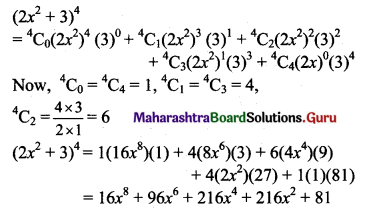
(i) (2x2 + 3)4
Solution:
Here, a = 2x2, b = 3 and n = 4.
Using binomial theorem,
Maharashtra Board 11th Maths Solutions Chapter 4 Methods of Induction and Binomial Theorem Ex 4.2 Q2 (i)

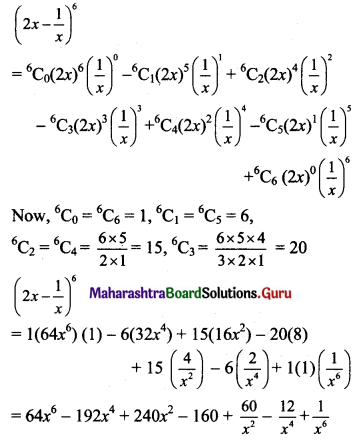
(ii) \(\left(2 x-\frac{1}{x}\right)^{6}\)
Solution:
Here, a = 2x, b = \(\frac{1}{x}\) and n = 6.
Using binomial theorem,
Maharashtra Board 11th Maths Solutions Chapter 4 Methods of Induction and Binomial Theorem Ex 4.2 Q2 (ii)

Question 3.
Find the value of
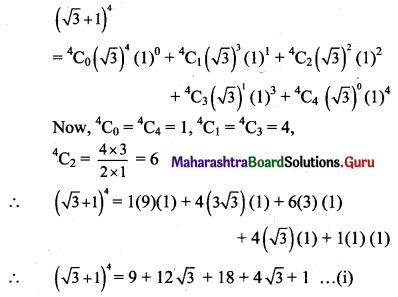
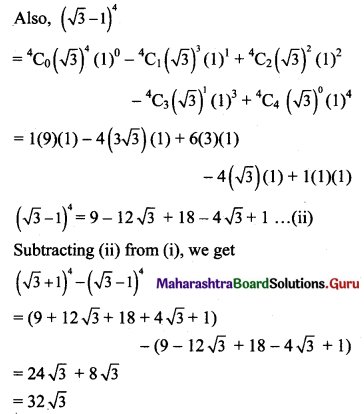
(i) (√3 + 1)4 – (√3 – 1)4
Solution:
Maharashtra Board 11th Maths Solutions Chapter 4 Methods of Induction and Binomial Theorem Ex 4.2 Q3 (i)
Maharashtra Board 11th Maths Solutions Chapter 4 Methods of Induction and Binomial Theorem Ex 4.2 Q3 (i).1

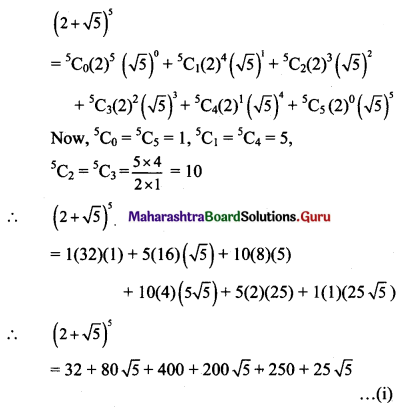
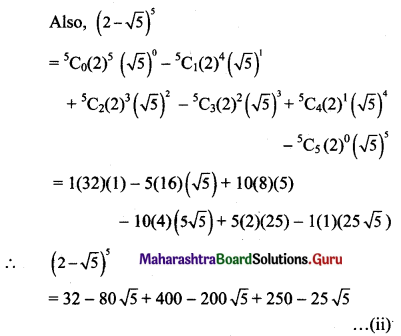
(ii) (2 + √5)5 + (2 – √5)5
Solution:
Maharashtra Board 11th Maths Solutions Chapter 4 Methods of Induction and Binomial Theorem Ex 4.2 Q3 (ii)
Maharashtra Board 11th Maths Solutions Chapter 4 Methods of Induction and Binomial Theorem Ex 4.2 Q3 (ii).1
Adding (i) and (ii), we get
∴ (2 + √5 )5 + (2 – √5)5 = (32 + 80√5 + 400 + 200√5 + 250 + 25√5) + (32 – 80√5 + 400 – 200√5+ 250 – 25√5 )
= 64 + 800 + 500
= 1364

Maharashtra Board 11th Maths Solutions Chapter 4 Methods of Induction and Binomial Theorem Ex 4.2

Question 4.
Prove that:
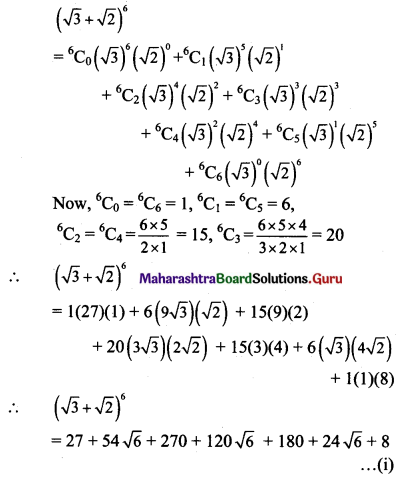
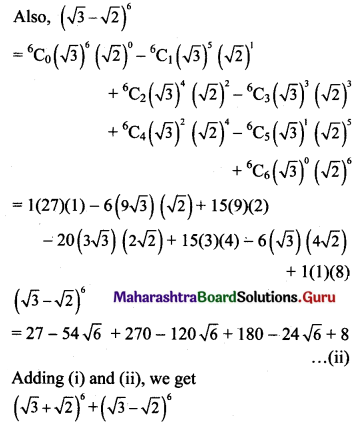
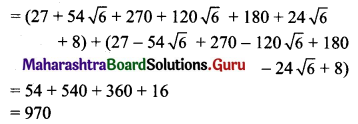
(i) (√3 + √2)6 + (√3 – √2)6 = 970
Solution:
Maharashtra Board 11th Maths Solutions Chapter 4 Methods of Induction and Binomial Theorem Ex 4.2 Q4 (i)
Maharashtra Board 11th Maths Solutions Chapter 4 Methods of Induction and Binomial Theorem Ex 4.2 Q4 (i).1
Maharashtra Board 11th Maths Solutions Chapter 4 Methods of Induction and Binomial Theorem Ex 4.2 Q4 (i).2

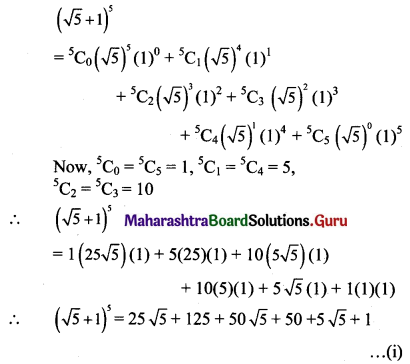
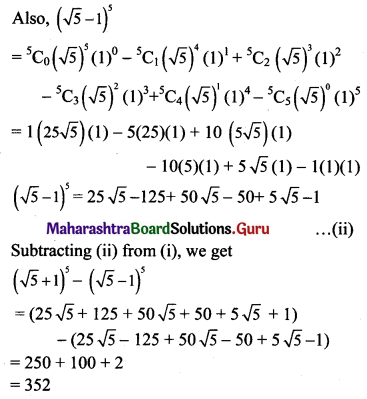
(ii) (√5 + 1)5 – (√5 – 1)5 = 352
Solution:
Maharashtra Board 11th Maths Solutions Chapter 4 Methods of Induction and Binomial Theorem Ex 4.2 Q4 (ii)
Maharashtra Board 11th Maths Solutions Chapter 4 Methods of Induction and Binomial Theorem Ex 4.2 Q4 (ii).1

Question 5.
Using binomial theorem, find the value of
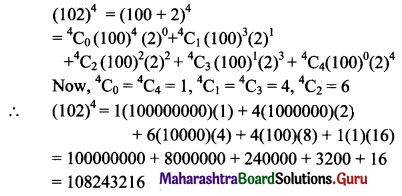
(i) (102)4
Solution:
Maharashtra Board 11th Maths Solutions Chapter 4 Methods of Induction and Binomial Theorem Ex 4.2 Q5 (i)

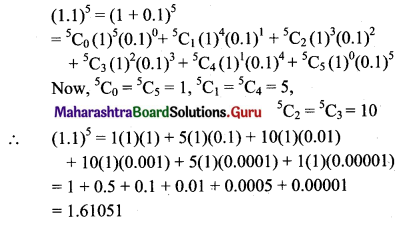
(ii) (1.1)5
Solution:
Maharashtra Board 11th Maths Solutions Chapter 4 Methods of Induction and Binomial Theorem Ex 4.2 Q5 (ii)

Maharashtra Board 11th Maths Solutions Chapter 4 Methods of Induction and Binomial Theorem Ex 4.2

Question 6.
Using binomial theorem, find the value of
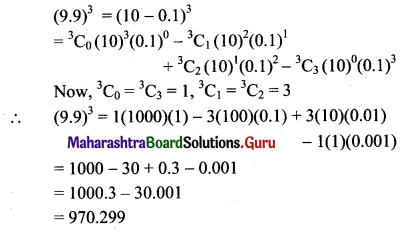
(i) (9.9)3
Solution:
Maharashtra Board 11th Maths Solutions Chapter 4 Methods of Induction and Binomial Theorem Ex 4.2 Q6 (i)

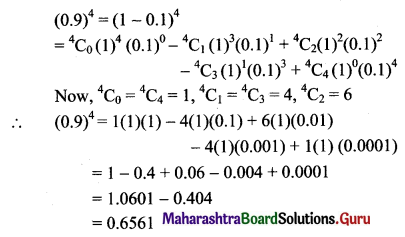
(ii) (0.9)4
Solution:
Maharashtra Board 11th Maths Solutions Chapter 4 Methods of Induction and Binomial Theorem Ex 4.2 Q6 (ii)

Question 7.
Without expanding, find the value of
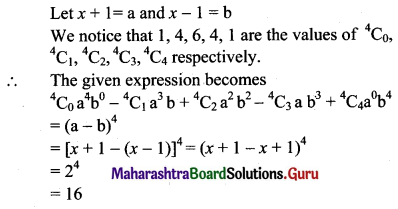
(i) (x + 1)4 – 4(x + 1)3 (x – 1) + 6(x + 1)2 (x – 1)2 – 4(x + 1) (x – 1)3 + (x – 1)4
Solution:
Maharashtra Board 11th Maths Solutions Chapter 4 Methods of Induction and Binomial Theorem Ex 4.2 Q7 (i)

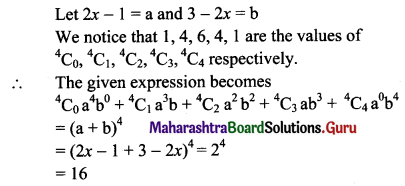
(ii) (2x – 1)4 + 4(2x – 1)3 (3 – 2x) + 6(2x – 1)2 (3 – 2x)2 + 4(2x – 1)1 (3 – 2x)3 + (3 – 2x)4
Solution:
Maharashtra Board 11th Maths Solutions Chapter 4 Methods of Induction and Binomial Theorem Ex 4.2 Q7 (ii)

Maharashtra Board 11th Maths Solutions Chapter 4 Methods of Induction and Binomial Theorem Ex 4.2

Question 8.
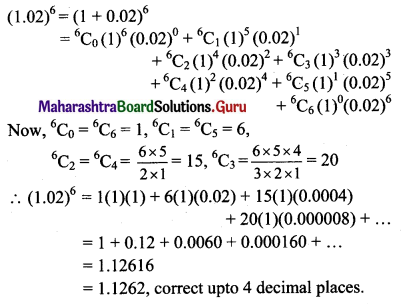
Find the value of (1.02)6, correct upto four places of decimals.
Solution:
Maharashtra Board 11th Maths Solutions Chapter 4 Methods of Induction and Binomial Theorem Ex 4.2 Q8

Question 9.
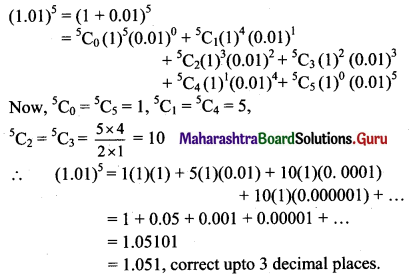
Find the value of (1.01)5, correct upto three places of decimals.
Solution:
Maharashtra Board 11th Maths Solutions Chapter 4 Methods of Induction and Binomial Theorem Ex 4.2 Q9

Maharashtra Board 11th Maths Solutions Chapter 4 Methods of Induction and Binomial Theorem Ex 4.2

Question 10.
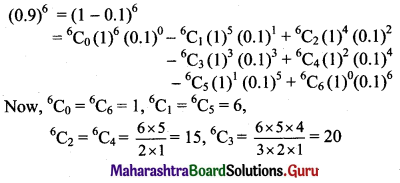
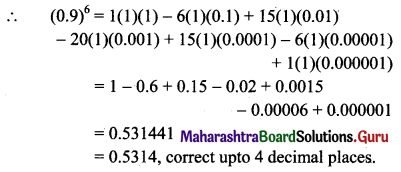
Find the value of (0.9)6, correct upto four places of decimals.
Solution:
Maharashtra Board 11th Maths Solutions Chapter 4 Methods of Induction and Binomial Theorem Ex 4.2 Q10
Maharashtra Board 11th Maths Solutions Chapter 4 Methods of Induction and Binomial Theorem Ex 4.2 Q10.1

Maths Solutions for Class 11 State Board
Differential Equations Class 12 Maths 2 Exercise 6.3 Solutions Maharashtra Board

Balbharti 12th Maharashtra State Board Maths Solutions Book Pdf Chapter 6 Differential Equations Ex 6.3 Questions and Answers.
12th Maths Part 2 Differential Equations Exercise 6.3 Questions And Answers Maharashtra Board

Question 1.
In each of the following examples verify that the given expression is a solution of the corresponding differential equation.
(i) xy = log y + c; \(\frac{d y}{d x}=\frac{y^{2}}{1-x y}\)
Solution:
xy = log y + c
Differentiating w.r.t. x, we get
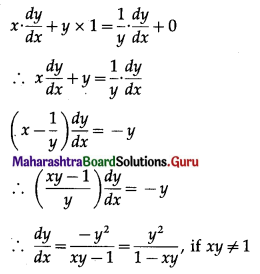
Maharashtra Board 12th Maths Solutions Chapter 6 Differential Equations Ex 6.3 Q1 (i)
Hence, xy = log y + c is a solution of the D.E.
\(\frac{d y}{d x}=\frac{y^{2}}{1-x y^{\prime}}, x y \neq 1\)

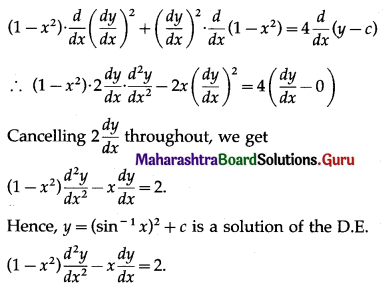
(ii) y = (sin-1x)2 + c; (1 – x2) \(\frac{d^{2} y}{d x^{2}}-x \frac{d y}{d x}=2\)
Solution:
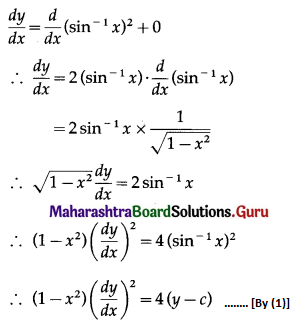
y = (sin-1 x)2 + c …….(1)
Differentiating w.r.t. x, we get
Maharashtra Board 12th Maths Solutions Chapter 6 Differential Equations Ex 6.3 Q1 (ii)
Differentiating again w.r.t. x, we get
Maharashtra Board 12th Maths Solutions Chapter 6 Differential Equations Ex 6.3 Q1 (ii).1
Maharashtra Board 12th Maths Solutions Chapter 6 Differential Equations Ex 6.3
(iii) y = e-x + Ax + B; \(e^{x} \frac{d^{2} y}{d x^{2}}=1\)
Solution:
y = e-x + Ax + B
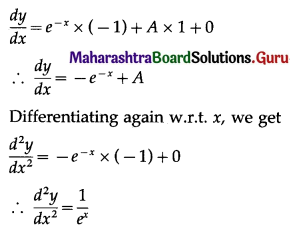
Differentiating w.r.t. x, we get
Maharashtra Board 12th Maths Solutions Chapter 6 Differential Equations Ex 6.3 Q1 (iii)
∴ \(e^{x} \frac{d^{2} y}{d x^{2}}=1\)
Hence, y = e-x + Ax + B is a solution of the D.E.
\(e^{x} \frac{d^{2} y}{d x^{2}}=1\)

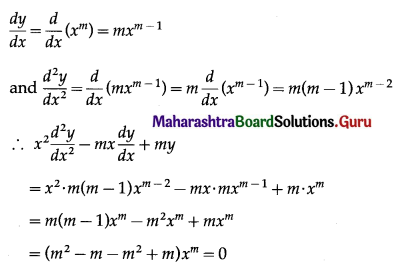
(iv) y = xm; \(x^{2} \frac{d^{2} y}{d x^{2}}-m x \frac{d y}{d x}+m y=0\)
Solution:
y = xm
Differentiating twice w.r.t. x, we get
Maharashtra Board 12th Maths Solutions Chapter 6 Differential Equations Ex 6.3 Q1 (iv)
This shows that y = xm is a solution of the D.E.
\(x^{2} \frac{d^{2} y}{d x^{2}}-m x \frac{d y}{d x}+m y=0\)

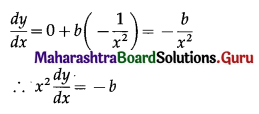
(v) y = a + \(\frac{b}{x}\); \(x \frac{d^{2} y}{d x^{2}}+2 \frac{d y}{d x}=0\)
Solution:
y = a + \(\frac{b}{x}\)
Differentiating w.r.t. x, we get
Maharashtra Board 12th Maths Solutions Chapter 6 Differential Equations Ex 6.3 Q1 (v)
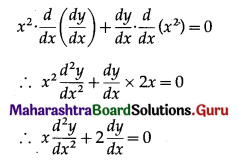
Differentiating again w.r.t. x, we get
Maharashtra Board 12th Maths Solutions Chapter 6 Differential Equations Ex 6.3 Q1 (v).1
Hence, y = a + \(\frac{b}{x}\) is a solution of the D.E.
\(x \frac{d^{2} y}{d x^{2}}+2 \frac{d y}{d x}=0\)

Maharashtra Board 12th Maths Solutions Chapter 6 Differential Equations Ex 6.3
(vi) y = eax; x \(\frac{d y}{d x}\) = y log y
Solution:
y = eax
log y = log eax = ax log e
log y = ax …….(1) ……..[∵ log e = 1]
Differentiating w.r.t. x, we get
\(\frac{1}{y} \cdot \frac{d y}{d x}\) = a × 1
∴ \(\frac{d y}{d x}\) = ay
∴ x \(\frac{d y}{d x}\) = (ax)y
∴ x \(\frac{d y}{d x}\) = y log y ………[By (1)]
Hence, y = eax is a solution of the D.E.
x \(\frac{d y}{d x}\) = y log y.

Question 2.
Solve the following differential equations.
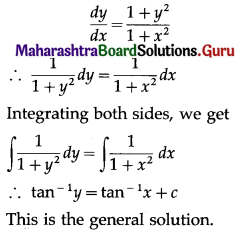
(i) \(\frac{d y}{d x}=\frac{1+y^{2}}{1+x^{2}}\)
Solution:
Maharashtra Board 12th Maths Solutions Chapter 6 Differential Equations Ex 6.3 Q2 (i)
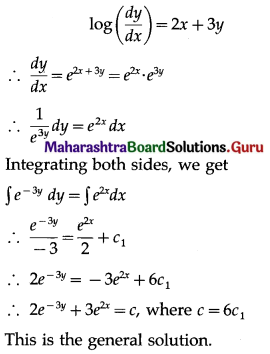
(ii) log(\(\frac{d y}{d x}\)) = 2x + 3y
Solution:
Maharashtra Board 12th Maths Solutions Chapter 6 Differential Equations Ex 6.3 Q2 (ii)
(iii) y – x \(\frac{d y}{d x}\) = 0
Solution:
y – x \(\frac{d y}{d x}\) = 0
∴ x \(\frac{d y}{d x}\) = y
∴ \(\frac{1}{x} d x=\frac{1}{y} d y\)
Integrating both sides, we get
\(\int \frac{1}{x} d x=\int \frac{1}{y} d y\)
∴ log |x| = log |y| + log c
∴ log |x| = log |cy|
∴ x = cy
This is the general solution.

Maharashtra Board 12th Maths Solutions Chapter 6 Differential Equations Ex 6.3
(iv) sec2x . tan y dx + sec2y . tan x dy = 0
Solution:
sec2x . tan y dx + sec2y . tan x dy = 0
∴ \(\frac{\sec ^{2} x}{\tan x} d x+\frac{\sec ^{2} y}{\tan y} d y=0\)
Integrating both sides, we get
\(\int \frac{\sec ^{2} x}{\tan x} d x+\int \frac{\sec ^{2} y}{\tan y} d y=c_{1}\)
Each of these integrals is of the type
\(\int \frac{f^{\prime}(x)}{f(x)} d x\) = log |f(x)| + c
∴ the general solution is
∴ log|tan x| + log|tan y | = log c, where c1 = log c
∴ log |tan x . tan y| = log c
∴ tan x . tan y = c
This is the general solution.

(v) cos x . cos y dy – sin x . sin y dx = 0
Solution:
cos x . cos y dy – sin x . sin y dx = 0
\(\frac{\cos y}{\sin y} d y-\frac{\sin x}{\cos x} d x=0\)
Integrating both sides, we get
∫cot y dy – ∫tan x dx = c1
∴ log|sin y| – [-log|cos x|] = log c, where c1 = log c
∴ log |sin y| + log|cos x| = log c
∴ log|sin y . cos x| = log c
∴ sin y . cos x = c
This is the general solution.

(vi) \(\frac{d y}{d x}\) = -k, where k is a constant.
Solution:
\(\frac{d y}{d x}\) = -k
∴ dy = -k dx
Integrating both sides, we get
∫dy = -k∫dx
∴ y = -kx + c
This is the general solution.

Maharashtra Board 12th Maths Solutions Chapter 6 Differential Equations Ex 6.3

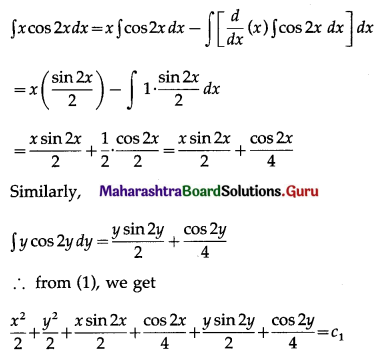
(vii) \(\frac{\cos ^{2} y}{x} d y+\frac{\cos ^{2} x}{y} d x=0\)
Solution:
\(\frac{\cos ^{2} y}{x} d y+\frac{\cos ^{2} x}{y} d x=0\)
∴ y cos2y dy + x cos2x dx = 0
∴ \(x\left(\frac{1+\cos 2 x}{2}\right) d x+y\left(1+\frac{\cos 2 y}{2}\right) d y=0\)
∴ x(1 + cos 2x) dx + y(1 + cos 2y) dy = 0
∴ x dx + x cos 2x dx + y dy+ y cos 2y dy = 0
Integrating both sides, we get
∫x dx + ∫y dy + ∫x cos 2x dx + ∫y cos 2y dy = c1 ……..(1)
Using integration by parts
Maharashtra Board 12th Maths Solutions Chapter 6 Differential Equations Ex 6.3 Q2 (vii)
Multiplying throughout by 4, this becomes
2x2 + 2y2 + 2x sin 2x + cos 2x + 2y sin 2y + cos 2y = 4c1
∴ 2(x2 + y2) + 2(x sin 2x + y sin 2y) + cos 2y + cos 2x + c = 0, where c = -4c1
This is the general solution.

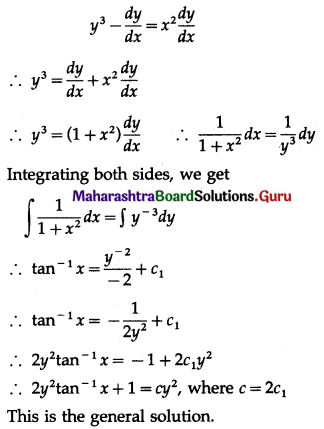
(viii) \(y^{3}-\frac{d y}{d x}=x^{2} \frac{d y}{d x}\)
Solution:
Maharashtra Board 12th Maths Solutions Chapter 6 Differential Equations Ex 6.3 Q2 (viii)

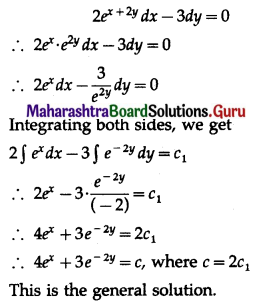
(ix) 2ex+2y dx – 3 dy = 0
Solution:
Maharashtra Board 12th Maths Solutions Chapter 6 Differential Equations Ex 6.3 Q2 (ix)

Maharashtra Board 12th Maths Solutions Chapter 6 Differential Equations Ex 6.3

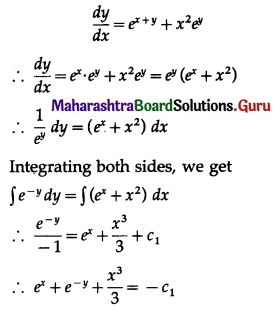
(x) \(\frac{d y}{d x}\) = ex+y + x2 ey
Solution:
Maharashtra Board 12th Maths Solutions Chapter 6 Differential Equations Ex 6.3 Q2 (x)
∴ 3ex + 3e-y + x3 = -3c1
∴ 3ex + 3e-y + x3 = c, where c = -3c1
This is the general solution.

Question 3.
For each of the following differential equations, find the particular solution satisfying the given condition:
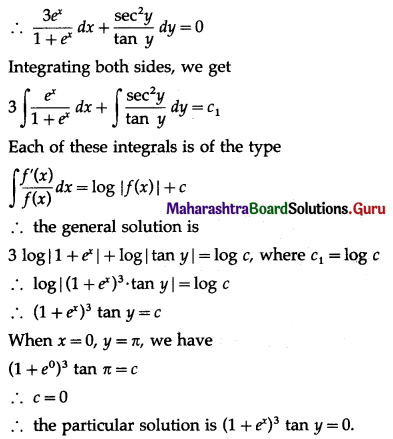
(i) 3ex tan y dx + (1 + ex) sec2y dy = 0, when x = 0, y = π
Solution:
3ex tan y dx + (1 + ex) sec2y dy = 0
Maharashtra Board 12th Maths Solutions Chapter 6 Differential Equations Ex 6.3 Q3 (i)

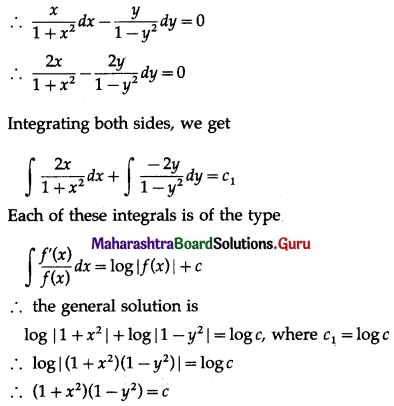
(ii) (x – y2x) dx – (y + x2y) dy = 0, when x = 2, y = 0
Solution:
(x – y2x) dx – (y + x2y) dy = 0
∴ x(1 – y2) dx – y(1 + x2) dy = 0
Maharashtra Board 12th Maths Solutions Chapter 6 Differential Equations Ex 6.3 Q3 (ii)
When x = 2, y = 0, we have
(1 + 4)(1 – 0) = c
∴ c = 5
∴ the particular solution is (1 + x2)(1 – y2) = 5.

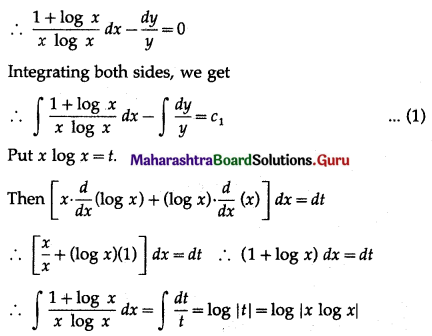
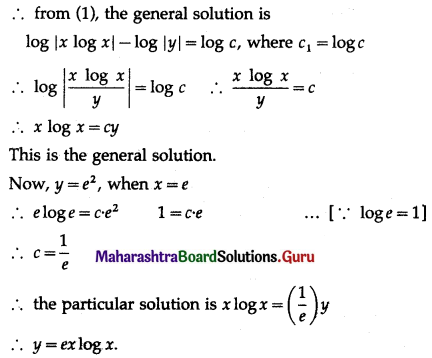
(iii) y(1 + log x) \(\frac{d x}{d y}\) – x log x = 0, y = e2, when x = e
Solution:
y(1 + log x) \(\frac{d x}{d y}\) – x log x = 0
Maharashtra Board 12th Maths Solutions Chapter 6 Differential Equations Ex 6.3 Q3 (iii)
Maharashtra Board 12th Maths Solutions Chapter 6 Differential Equations Ex 6.3 Q3 (iii).1

Maharashtra Board 12th Maths Solutions Chapter 6 Differential Equations Ex 6.3

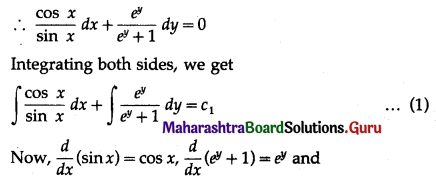
(iv) (ey + 1) cos x + ey sin x \(\frac{d y}{d x}\) = 0, when x = \(\frac{\pi}{6}\), y = 0
Solution:
(ey + 1) cos x + ey sin x \(\frac{d y}{d x}\) = 0
Maharashtra Board 12th Maths Solutions Chapter 6 Differential Equations Ex 6.3 Q3 (iv)
\(\int \frac{f^{\prime}(x)}{f(x)} d x\) = log|f(x)| + c
∴ from (1), the general solution is
log|sin x| + log|ey + 1| = log c, where c1 = log c
∴ log|sin x . (ey + 1)| = log c
∴ sin x . (ey + 1) = c
When x = \(\frac{\pi}{4}\), y = 0, we get
\(\left(\sin \frac{\pi}{4}\right)\left(e^{0}+1\right)=c\)
∴ c = \(\frac{1}{\sqrt{2}}\)(1 + 1) = √2
∴ the particular solution is sin x . (ey + 1) = √2

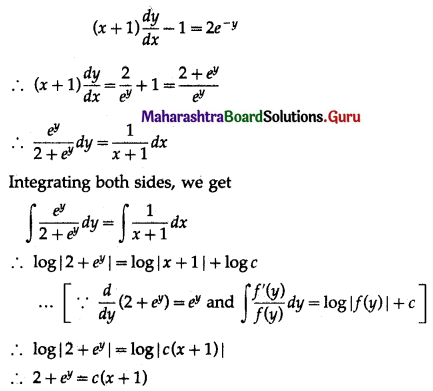
(v) (x + 1) \(\frac{d y}{d x}\) – 1 = 2e-y, y = 0, when x = 1
Solution:
Maharashtra Board 12th Maths Solutions Chapter 6 Differential Equations Ex 6.3 Q3 (v)
This is the general solution.
Now, y = 0, when x = 1
∴ 2 + e0 = c(1 + 1)
∴ 3 = 2c
∴ c = \(\frac{3}{2}\)
∴ the particular solution is 2 + ey = \(\frac{3}{2}\) (x + 1)
∴ 2(2 + ey) = 3(x + 1).

Maharashtra Board 12th Maths Solutions Chapter 6 Differential Equations Ex 6.3

(vi) cos(\(\frac{d y}{d x}\)) = a, a ∈ R, y (0) = 2
Solution:
cos(\(\frac{d y}{d x}\)) = a
∴ \(\frac{d y}{d x}\) = cos-1 a
∴ dy = (cos-1 a) dx
Integrating both sides, we get
∫dy = (cos-1 a) ∫dx
∴ y = (cos-1 a) x + c
∴ y = x cos-1 a + c
This is the general solution.
Now, y(0) = 2, i.e. y = 2,
when x = 0, 2 = 0 + c
∴ c = 2
∴ the particular solution is
∴ y = x cos-1 a + 2
∴ y – 2 = x cos-1 a
∴ \(\frac{y-2}{x}\) = cos-1a
∴ cos(\(\frac{y-2}{x}\)) = a

Question 4.
Reduce each of the following differential equations to the variable separable form and hence solve:
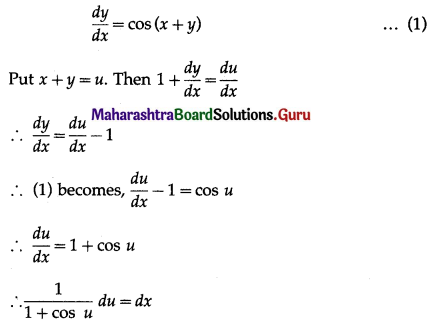
(i) \(\frac{d y}{d x}\) = cos(x + y)
Solution:
Maharashtra Board 12th Maths Solutions Chapter 6 Differential Equations Ex 6.3 Q4 (i)
Maharashtra Board 12th Maths Solutions Chapter 6 Differential Equations Ex 6.3 Q4 (i).1

Maharashtra Board 12th Maths Solutions Chapter 6 Differential Equations Ex 6.3

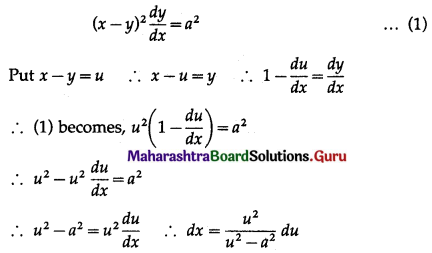
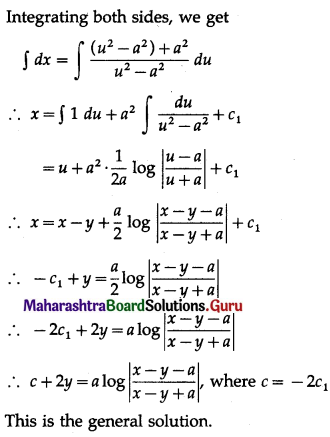
(ii) (x – y)2 \(\frac{d y}{d x}\) = a2
Solution:
Maharashtra Board 12th Maths Solutions Chapter 6 Differential Equations Ex 6.3 Q4 (ii)
Maharashtra Board 12th Maths Solutions Chapter 6 Differential Equations Ex 6.3 Q4 (ii).1

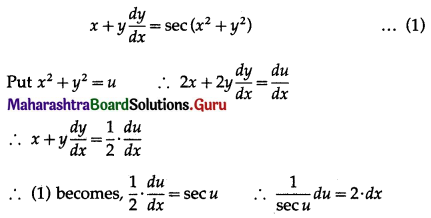
(iii) x + y \(\frac{d y}{d x}\) = sec(x2 + y2)
Solution:
Maharashtra Board 12th Maths Solutions Chapter 6 Differential Equations Ex 6.3 Q4 (iii)
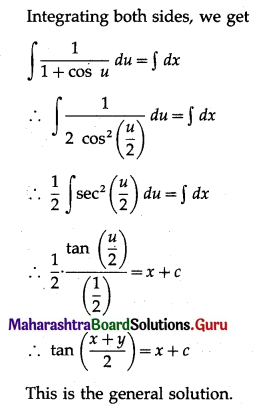
Integrating both sides, we get
∫cos u du = 2 ∫dx
∴ sin u = 2x + c
∴ sin(x2 + y2) = 2x + c
This is the general solution.

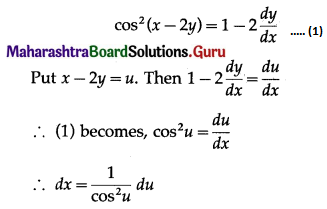
(iv) cos2(x – 2y) = 1 – 2 \(\frac{d y}{d x}\)
Solution:
Maharashtra Board 12th Maths Solutions Chapter 6 Differential Equations Ex 6.3 Q4 (iv)
Integrating both sides, we get
∫dx = ∫sec2u du
∴ x = tan u + c
∴ x = tan(x – 2y) + c
This is the general solution.

Maharashtra Board 12th Maths Solutions Chapter 6 Differential Equations Ex 6.3

(v) (2x – 2y + 3) dx – (x – y + 1) dy = 0, when x = 0, y = 1
Solution:
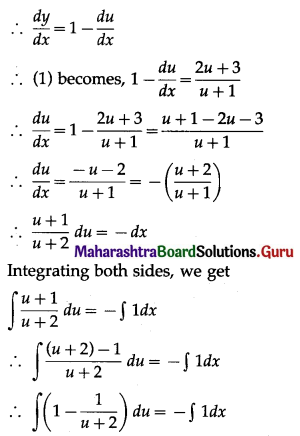
(2x – 2y + 3) dx – (x – y + 1) dy = 0
∴ (x – y + 1) dy = (2x – 2y + 3) dx
∴ \(\frac{d y}{d x}=\frac{2(x-y)+3}{(x-y)+1}\) ………(1)
Put x – y = u, Then \(1-\frac{d y}{d x}=\frac{d u}{d x}\)
Maharashtra Board 12th Maths Solutions Chapter 6 Differential Equations Ex 6.3 Q4 (v)
∴ u – log|u + 2| = -x + c
∴ x – y – log|x – y + 2| = -x + c
∴ (2x – y) – log|x – y + 2| = c
This is the general solution.
Now, y = 1, when x = 0.
∴ (0 – 1) – log|0 – 1 + 2| = c
∴ -1 – o = c
∴ c = -1
∴ the particular solution is
(2x – y) – log|x – y + 2| = -1
∴ (2x – y) – log|x – y + 2| + 1 = 0

12th Maharashtra State Board Maths Solutions Pdf Part 2

Differential Equations Class 12 Maths 2 Exercise 6.2 Solutions Maharashtra Board

Balbharti 12th Maharashtra State Board Maths Solutions Book Pdf Chapter 6 Differential Equations Ex 6.2 Questions and Answers.

12th Maths Part 2 Differential Equations Exercise 6.2 Questions And Answers Maharashtra Board

Question 1.
Obtain the differential equation by eliminating the arbitrary constants from the following equations:
(i) x3 + y3 = 4ax
Solution:
x3 + y3 = 4ax ……..(1)
Differentiating both sides w.r.t. x, we get
3x2 + 3y2 \(\frac{d y}{d x}\) = 4a × 1
∴ 3x2 + 3y2 \(\frac{d y}{d x}\) = 4a
Substituting the value of 4a in (1), we get
x3 + y3 = (3x2 + 3y2 \(\frac{d y}{d x}\)) x
∴ x3 + y3 = 3x3 + 3xy2 \(\frac{d y}{d x}\)
∴ 2x3 + 3xy2 \(\frac{d y}{d x}\) – y3 = 0
This is the required D.E.

Maharashtra Board 12th Maths Solutions Chapter 6 Differential Equations Ex 6.2

(ii) Ax2 + By2 = 1
Solution:
Ax2 + By2 = 1
Differentiating both sides w.r.t. x, we get
A × 2x + B × 2y \(\frac{d y}{d x}\) = 0
∴ Ax + By \(\frac{d y}{d x}\) = 0 ……..(1)
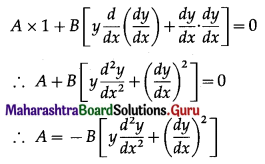
Differentiating again w.r.t. x, we get
Maharashtra Board 12th Maths Solutions Chapter 6 Differential Equations Ex 6.2 Q1 (ii)
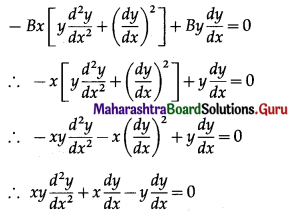
Substituting the value of A in (1), we get
Maharashtra Board 12th Maths Solutions Chapter 6 Differential Equations Ex 6.2 Q1 (ii).1
This is the required D.E.

Alternative Method:
Ax2 + By2 = 1 ……..(1)
Differentiating both sides w.r.t. x, we get
A × 2x + B × 2y \(\frac{d y}{d x}\) = 0
∴ Ax + By \(\frac{d y}{d x}\) = 0 ……….(2)
Differentiating again w.r.t. x, we get,
Maharashtra Board 12th Maths Solutions Chapter 6 Differential Equations Ex 6.2 Q1 (ii).2
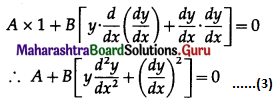
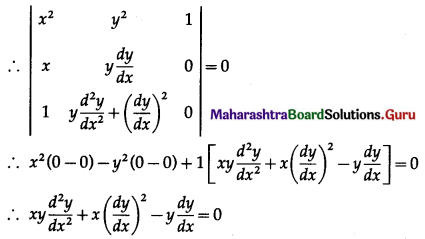
The equations (1), (2) and (3) are consistent in A and B.
∴ determinant of their consistency is zero.
Maharashtra Board 12th Maths Solutions Chapter 6 Differential Equations Ex 6.2 Q1 (ii).3
This is the required D.E.

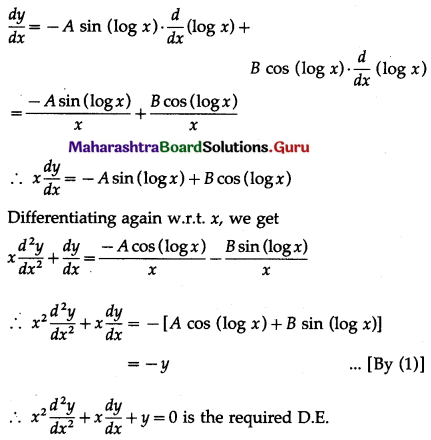
(iii) y = A cos(log x) + B sin(log x)
Solution:
y = A cos(log x) + B sin (log x) ……. (1)
Differentiating w.r.t. x, we get
Maharashtra Board 12th Maths Solutions Chapter 6 Differential Equations Ex 6.2 Q1 (iii)

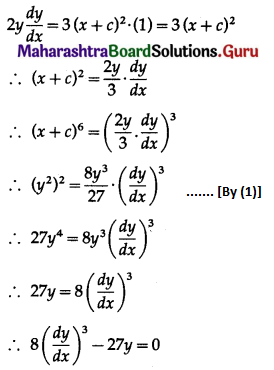
(iv) y2 = (x + c)3
Solution:
y2 = (x + c)3
Differentiating w.r.t. x, we get
Maharashtra Board 12th Maths Solutions Chapter 6 Differential Equations Ex 6.2 Q1 (iv)
This is the required D.E.

Maharashtra Board 12th Maths Solutions Chapter 6 Differential Equations Ex 6.2

(v) y = Ae5x + Be-5x
Solution:
y = Ae5x + Be-5x ……….(1)
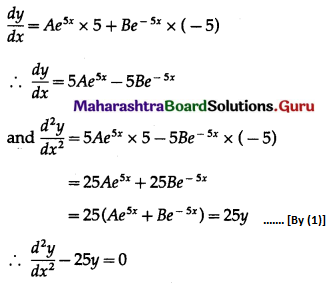
Differentiating twice w.r.t. x, we get
Maharashtra Board 12th Maths Solutions Chapter 6 Differential Equations Ex 6.2 Q1 (v)
This is the required D.E.

(vi) (y – a)2 = 4(x – b)
Solution:
(y – a)2 = 4(x – b)
Differentiating both sides w.r.t. x, we get
2(y – a) . \(\frac{d}{d x}\)(y – a) = 4 \(\frac{d}{d x}\)(x – b)
∴ 2(y – a) . (\(\frac{d y}{d x}\) – 0) = 4(1 – 0)
∴ 2(y – a) \(\frac{d y}{d x}\) = 4
∴ (y – a) \(\frac{d y}{d x}\) = 2 ……..(1)
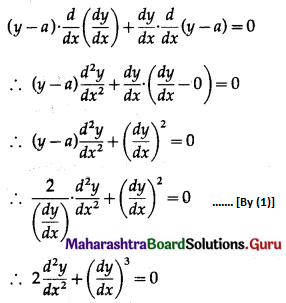
Differentiating w.r.t. x, we get
Maharashtra Board 12th Maths Solutions Chapter 6 Differential Equations Ex 6.2 Q1 (vi)
This is the required D.E.

(vii) y = a + \(\frac{a}{x}\)
Solution:
y = a + \(\frac{a}{x}\)
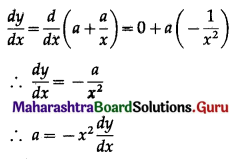
Differentiating w.r.t. x, we get
Maharashtra Board 12th Maths Solutions Chapter 6 Differential Equations Ex 6.2 Q1 (vii)
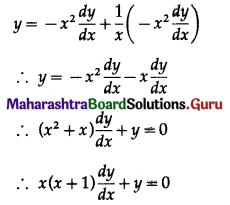
Substituting the value of a in (1), we get
Maharashtra Board 12th Maths Solutions Chapter 6 Differential Equations Ex 6.2 Q1 (vii).1
This is the required D.E.

(viii) y = c1e2x + c2e5x
Solution:
y = c1e2x + c2e5x ………(1)
Differentiating twice w.r.t. x, we get
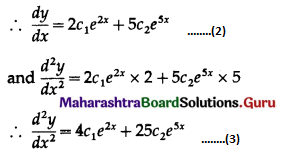
\(\frac{d y}{d x}\) = c1e2x × 2 + c2e5x × 5
Maharashtra Board 12th Maths Solutions Chapter 6 Differential Equations Ex 6.2 Q1 (viii)
The equations (1), (2) and (3) are consistent in c1e2x and c2e5x
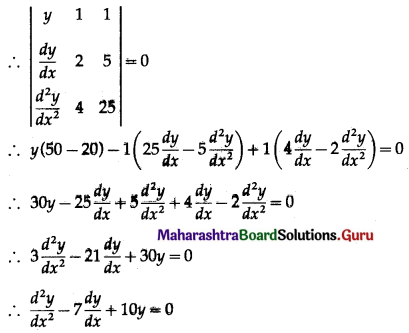
∴ determinant of their consistency is zero.
Maharashtra Board 12th Maths Solutions Chapter 6 Differential Equations Ex 6.2 Q1 (viii).1
This is the required D.E.

Maharashtra Board 12th Maths Solutions Chapter 6 Differential Equations Ex 6.2

Alternative Method:
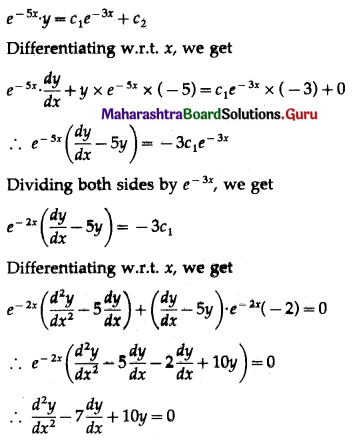
y = c1e2x + c2e5x
Dividing both sides by e5x, we get
Maharashtra Board 12th Maths Solutions Chapter 6 Differential Equations Ex 6.2 Q1 (viii).2
This is the required D.E.

(ix) c1x3 + c2y2 = 5.
Solution:
c1x3 + c2y2 = 5 ……….(1)
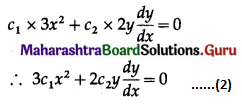
Differentiating w.r.t. x, we get
Maharashtra Board 12th Maths Solutions Chapter 6 Differential Equations Ex 6.2 Q1 (ix)
Differentiating again w.r.t. x, we get
Maharashtra Board 12th Maths Solutions Chapter 6 Differential Equations Ex 6.2 Q1 (ix).1
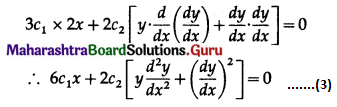
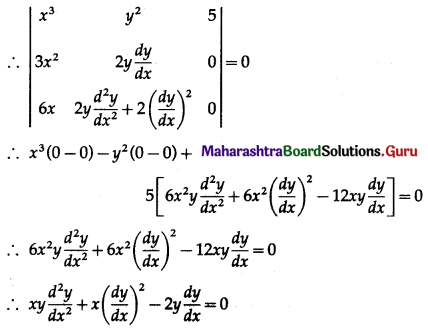
The equations (1), (2) and (3) in c1, c2 are consistent.
∴ determinant of their consistency is zero.
Maharashtra Board 12th Maths Solutions Chapter 6 Differential Equations Ex 6.2 Q1 (ix).2
This is the required D.E.

Maharashtra Board 12th Maths Solutions Chapter 6 Differential Equations Ex 6.2

(x) y = e-2x(A cos x + B sin x)
Solution:
y = e-2x(A cos x + B sin x)
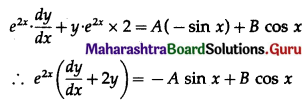
∴ e2x . y = A cos x + B sin x ………(1)
Differentiating w.r.t. x, we get
Maharashtra Board 12th Maths Solutions Chapter 6 Differential Equations Ex 6.2 Q1 (x)
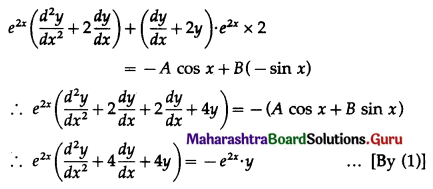
Differentiating again w.r.t. x, we get
Maharashtra Board 12th Maths Solutions Chapter 6 Differential Equations Ex 6.2 Q1 (x).1
Maharashtra Board 12th Maths Solutions Chapter 6 Differential Equations Ex 6.2 Q1 (x).2
This is the required D.E.

Question 2.
Form the differential equation of family of lines having intercepts a and b on the coordinate axes respectively.
Solution:
The equation of the line having intercepts a and b on the coordinate axes respectively, is
\(\frac{x}{a}+\frac{y}{b}=1\) ……….(1)
where a and b are arbitrary constants.
[For different values of a and b, we get, different lines. Hence (1) is the equation of family of lines.]
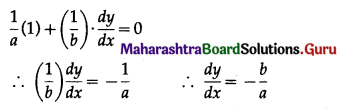
Differentiating (1) w.r.t. x, we get
Maharashtra Board 12th Maths Solutions Chapter 6 Differential Equations Ex 6.2 Q2
Differentiating again w.r.t. x, we get \(\frac{d^{2} y}{d x^{2}}=0\)
This is the required D.E.

Maharashtra Board 12th Maths Solutions Chapter 6 Differential Equations Ex 6.2

Question 3.
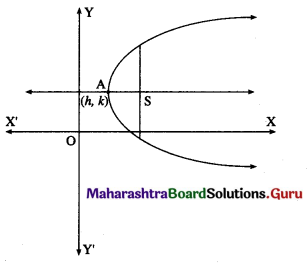
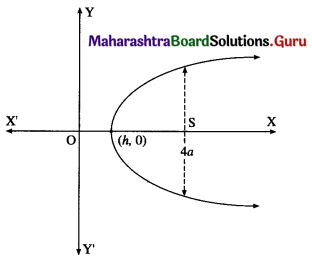
Find the differential equation all parabolas having length of latus rectum 4a and axis is parallel to the X-axis.
Solution:
Maharashtra Board 12th Maths Solutions Chapter 6 Differential Equations Ex 6.2 Q3
Let A(h, k) be the vertex of the parabola whose length of latus rectum is 4a.
Then the equation of the parabola is (y – k)2 = 4a (x – h), where h and k are arbitrary constants.
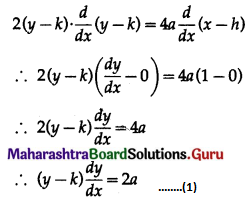
Differentiating w.r.t. x, we get
Maharashtra Board 12th Maths Solutions Chapter 6 Differential Equations Ex 6.2 Q3.1
Differentiating again w.r.t. x, we get
Maharashtra Board 12th Maths Solutions Chapter 6 Differential Equations Ex 6.2 Q3.2
This is the required D.E.

Question 4.
Find the differential equation of the ellipse whose major axis is twice its minor axis.
Solution:
Let 2a and 2b be lengths of major axis and minor axis of the ellipse.
Then 2a = 2(2b)
∴ a = 2b
∴ equation of the ellipse is
\(\frac{x^{2}}{a^{2}}+\frac{y^{2}}{b^{2}}=1\)
i.e., \(\frac{x^{2}}{(2 b)^{2}}+\frac{y^{2}}{b^{2}}=1\)
∴ \(\frac{x^{2}}{4 b^{2}}+\frac{y^{2}}{b^{2}}=1\)
∴ x2 + 4y2 = 4b2
Differentiating w.r.t. x, we get
2x + 4 × 2y \(\frac{d y}{d x}\) = 0
∴ x + 4y \(\frac{d y}{d x}\) = 0
This is the required D.E.

Maharashtra Board 12th Maths Solutions Chapter 6 Differential Equations Ex 6.2

Question 5.
Form the differential equation of family of lines parallel to the line 2x + 3y + 4 = 0.
Solution:
The equation of the line parallel to the line 2x + 3y + 4 = 0 is 2x + 3y + c = 0, where c is an arbitrary constant.
Differentiating w.r.t. x, we get
2 × 1 + 3 \(\frac{d y}{d x}\) + 0 = 0
∴ 3 \(\frac{d y}{d x}\) + 2 = 0
This is the required D.E.

Question 6.
Find the differential equation of all circles having radius 9 and centre at point (h, k).
Solution:
Equation of the circle having radius 9 and centre at point (h, k) is
(x – h)2 + (y – k)2 = 81 …… (1)
where h and k are arbitrary constant.
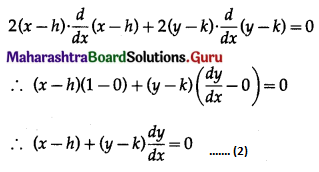
Differentiating (1) w.r.t. x, we get
Maharashtra Board 12th Maths Solutions Chapter 6 Differential Equations Ex 6.2 Q6
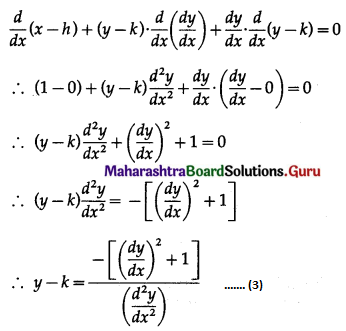
Differentiating again w.r.t. x, we get
Maharashtra Board 12th Maths Solutions Chapter 6 Differential Equations Ex 6.2 Q6.1
From (2), x – h = -(y – k) \(\frac{d y}{d x}\)
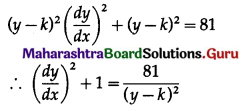
Substituting the value of (x – h) in (1), we get
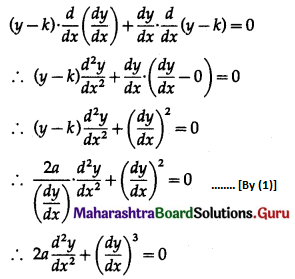
Maharashtra Board 12th Maths Solutions Chapter 6 Differential Equations Ex 6.2 Q6.2
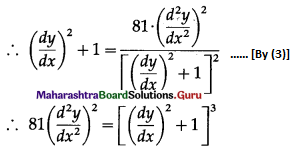
Maharashtra Board 12th Maths Solutions Chapter 6 Differential Equations Ex 6.2 Q6.3
This is the required D.E.

Maharashtra Board 12th Maths Solutions Chapter 6 Differential Equations Ex 6.2

Question 7.
Form the differential equation of all parabolas whose axis is the X-axis.
Solution:
Maharashtra Board 12th Maths Solutions Chapter 6 Differential Equations Ex 6.2 Q7
The equation of the parbola whose axis is the X-axis is
y2 = 4a(x – h) …… (1)
where a and h are arbitrary constants.
Differentiating (1) w.r.t. x, we get
2y \(\frac{d y}{d x}\) = 4a(1 – 0)
∴ y \(\frac{d y}{d x}\) = 2a
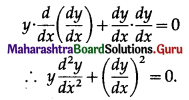
Differentiating again w.r.t. x, we get
Maharashtra Board 12th Maths Solutions Chapter 6 Differential Equations Ex 6.2 Q7.1
This is the required D.E.

12th Maharashtra State Board Maths Solutions Pdf Part 2

Methods of Induction and Binomial Theorem Class 11 Maths 2 Exercise 4.1 Solutions Maharashtra Board

Balbharti Maharashtra State Board 11th Maths Book Solutions Pdf Chapter 4 Methods of Induction and Binomial Theorem Ex 4.1 Questions and Answers.

11th Maths Part 2 Methods of Induction and Binomial Theorem Exercise 4.1 Questions And Answers Maharashtra Board

Prove by the method of induction, for all n ∈ N.

Question 1.
2 + 4 + 6 + …… + 2n = n(n + 1)
Solution:
Let P(n) = 2 + 4 + 6 + …… + 2n = n(n + 1), for all n ∈ N.
Step I:
Put n = 1
L.H.S. = 2
R.H.S. = 1(1 + 1) = 2
∴ L.H.S. = R.H.S.
∴ P(n) is true for n = 1.

Step II:
Let us assume that P(n) is true for n = k.
∴ 2 + 4 + 6 + ….. + 2k = k(k + 1) ……(i)

Step III:
We have to prove that P(n) is true for n = k + 1,
i.e., to prove that
2 + 4 + 6 + …… + 2(k + 1) = (k + 1) (k + 2)
L.H.S. = 2 + 4 + 6 + …+ 2(k + 1)
= 2 + 4 + 6+ ….. + 2k + 2(k + 1)
= k(k + 1) + 2(k + 1) …..[From (i)]
= (k + 1).(k + 2)
= R.H.S.
∴ P(n) is true for n = k + 1.

Step IV:
From all the steps above, by the principle of mathematical induction, P(n) is true for all n ∈ N.
∴ 2 + 4 + 6 + …… + 2n = n(n + 1) for all n ∈ N.

Maharashtra Board 11th Maths Solutions Chapter 4 Methods of Induction and Binomial Theorem Ex 4.1

Question 2.
3 + 7 + 11 + ……… to n terms = n(2n + 1)
Solution:
Let P(n) = 3 + 7 + 11 + ……… to n terms = n(2n +1), for all n ∈ N.
But 3, 7, 11, …. are in A.P.
∴ a = 3 and d = 4
Let tn be the nth term.
∴ tn = a + (n – 1)d = 3 + (n – 1)4 = 4n – 1
∴ P(n) = 3 + 7 + 11 + ……. + (4n – 1) = n(2n + 1)

Step I:
Put n = 1
L.H.S. = 3
R.H.S. = 1[2(1)+ 1] = 3
∴ L.H.S. = R.H.S.
∴ P(n) is true for n = 1.

Step II:
Let us assume that P(n) is true for n = k.
∴ 3 + 7 + 11 + ….. + (4k – 1) = k(2k + 1) …..(i)

Sept III:
We have to prove that P(n) is true for n = k + 1,
i.e., to prove that
3 + 7 + 11 + …+ [4(k + 1) – 1] = (k + 1)(2k + 3)
L.H.S. = 3 + 7 + 11 + …… + [4(k + 1) – 1]
= 3 + 7 + 11 + ….. + (4k – 1) + [4(k+ 1) – 1]
= k(2k + 1) + (4k + 4 – 1) …..[From (i)]
= 2k2 + k + 4k + 3
= 2k2 + 2k + 3k + 3
= 2k(k + 1) + 3(k + 1)
= (k + 1) (2k + 3)
= R.H.S.
∴ P(n) is true for n = k + 1.

Step IV:
From all the steps above, by the principle of mathematical induction, P(n) is true for all n ∈ N.
∴ 3 + 7 + 11 + ….. to n terms = n(2n + 1) for all n ∈ N.

Question 3.
12 + 22 + 32 +…..+ n2 = \(\frac{n(n+1)(2 n+1)}{6}\)
Solution:
Let P(n) = 12 + 22 + 32 +…..+ n2 = \(\frac{n(n+1)(2 n+1)}{6}\) for all n ∈ N.
Step I:
Put n = 1
L.H.S. = 12 = 1
RHS = \(\frac{1(1+1)[2(1)+1]}{6}=\frac{6}{6}\) = 1
∴ L.H.S. = R.H.S.
∴ P(n) is true for n = 1.

Step II:
Let us assume that P(n) is true for n = k.
∴ 12 + 22 + 32 +…+ k2 = \(\frac{k(k+1)(2 k+1)}{6}\) …..(i)

Step III:
We have to prove that P(n) is true for n = k + 1,
i.e., to prove that
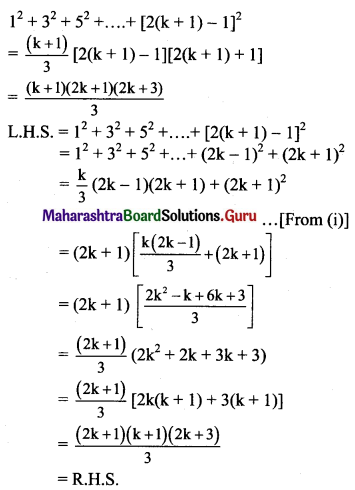
Maharashtra Board 11th Maths Solutions Chapter 4 Methods of Induction and Binomial Theorem Ex 4.1 Q3
∴ P(n) is true for n = k + 1.

Step IV:
From all the steps above, by the principle of mathematical induction, P(n) is true for all n ∈ N.
∴ 12 + 22 + 32 + …+ n2 = \(\frac{n(n+1)(2 n+1)}{6}\) for all n ∈ N.

Maharashtra Board 11th Maths Solutions Chapter 4 Methods of Induction and Binomial Theorem Ex 4.1

Question 4.
12 + 32 + 52 + ….. + (2n – 1)2 = \(\frac{n}{3}\) (2n – 1)(2n + 1)
Solution:
Let P(n) = 12 + 32 + 52+…..+ (2n – 1)2 = \(\frac{n}{3}\) (2n – 1)(2n + 1), for all n ∈ N.
Step I:
Put n = 1
L.H.S. = 12 = 1
R.H.S. = \(\frac{1}{3}\) [2(1) – 1][2(1) + 1] = 1
∴ L.H.S. = R.H.S.
∴ P(n) is true for n = 1.

Step II:
Let us assume that P(n) is true for n = k.
∴ 12 + 32 + 52 +….+(2k – 1)2 = \(\frac{k}{3}\) (2k – 1)(2k + 1) …….(i)

Step III:
We have to prove that P(n) is true for n = k + 1,
i.e., to prove that
Maharashtra Board 11th Maths Solutions Chapter 4 Methods of Induction and Binomial Theorem Ex 4.1 Q4
∴ P(n) is true for n = k + 1.

Step IV:
From all the steps above, by the principle of mathematical induction, P(n) is true for all n ∈ N.
∴ 12 + 32 + 52 + …+ (2n – 1)2 = \(\frac{n}{3}\) (2n – 1)(2n + 1) for all n ∈ N.

Question 5.
13 + 33 + 53 + ….. to n terms = n2 (2n2 – 1)
Solution:
Let P(n) = 13 + 33 + 53 + …. to n terms = n2 (2n2 – 1), for all n ∈ N.
But 1, 3, 5, are in A.P.
∴ a = 1, d = 2
Let tn be the nth term.
tn = a + (n – 1) d = 1 + (n – 1) 2 = 2n – 1
∴ P(n) = 13 + 33 + 53 +…..+ (2n – 1)3 = n2 (2n2 – 1)

Step I:
Put n = 1
L.H.S. = 13 = 1
R.H.S. = 12 [2(1)2 – 1] = 1
∴ L.H.S. = R.H.S.
∴ P(n) is true for n = 1.

Step II:
Let us assume that P(n) is true for n = k.
∴ 13 + 33 + 53 +…+ (2k – 1)3 = k2 (2k2 – 1) …..(i)

Step III:
We have to prove that P(n) is true for n = k + 1,
i.e., to prove that
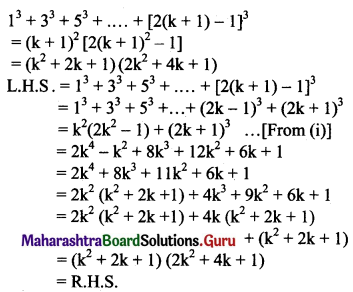
Maharashtra Board 11th Maths Solutions Chapter 4 Methods of Induction and Binomial Theorem Ex 4.1 Q5
∴ P(n) is true for n = k + 1.

Step IV:
From all the steps above, by the principle of mathematical induction, P(n) is true for all n ∈ N.
∴ 13 + 33 + 53 + … to n terms = n2 (2n2 – 1) for all n ∈ N.

Maharashtra Board 11th Maths Solutions Chapter 4 Methods of Induction and Binomial Theorem Ex 4.1

Question 6.
1.2 + 2.3 + 3.4 +… + n(n + 1) = \(\frac{n}{3}\) (n + 1)(n + 2)
Solution:
Let P(n) = 1.2 + 2.3 + 3.4 +….+n(n + 1) = \(\frac{n(n+1)(n+2)}{3}\), for all n ∈ N.

Step I:
Put n = 1
L.H.S. = 1.2 = 2
R.H.S. = \(\frac{1}{3}\) (1 + 1)(1 + 2) = 2
∴ L.H.S. = R.H.S.
∴ P(n) is true for n = 1.

Step II:
Let us assume that P(n) is true for n = k.
∴ 1.2 + 2.3 + 3.4 + ….. + k(k + 1) = \(\frac{k}{3}\) (k + 1)(k + 2) ……(i)

Step III:
We have to prove that P(n) is true for n = k + 1,
i.e., to prove that
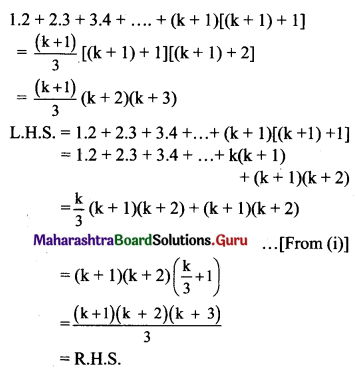
Maharashtra Board 11th Maths Solutions Chapter 4 Methods of Induction and Binomial Theorem Ex 4.1 Q6
∴ P(n) is true for n = k + 1.

Step IV:
From all the steps above, by the principle of mathematical induction, P(n) is true for all n ∈ N.
∴ 1.2 + 2.3 + 3.4 + … + n(n + 1) = \(\frac{n}{3}\) (n + 1)(n + 2), for all n ∈ N.

Question 7.
1.3 + 3.5 + 5.7 +… to n terms = \(\frac{n}{3}\) (4n2 + 6n – 1)
Solution:
Let P(n) = 1.3 + 3.5 + 5.7 +… to n terms = \(\frac{n}{3}\) (4n2 + 6n -1), for all n ∈ N.
But first factor in each term, i.e., 1, 3, 5,… are in A.P. with a = 1 and d = 2.
∴ nth term = a + (n – 1)d = 1 + (n – 1) 2 = (2n – 1)
Also, second factor in each term,
i.e., 3, 5, 7, … are in A.P. with a = 3 and d = 2.
∴ nth term = a + (n – 1) d = 3 + (n – 1) 2 = (2n + 1)
∴ nth term, tn = (2n – 1) (2n + 1)
∴ P(n) ≡ 1.3 + 3.5 + 5.7 + …. + (2n – 1) (2n + 1) = \(\frac{n}{3}\) (4n2 + 6n – 1)

Step I:
Put n = 1
L.H.S. = 1.3 = 3
R.H.S. = \(\frac{1}{3}\) [4(1)2 + 6(1) – 1] = 3
∴ L.H.S. = R.H.S.
∴ P(n) is trae for n = 1.

Step II:
Let us assume that P(n) is true for n = k.
∴ 1.3 + 3.5 + 5.7 +….+ (2k – 1)(2k + 1) = \(\frac{k}{3}\) (4k2 + 6k – 1) ……(i)

Step III:
We have to prove that P(n) is true for n = k + 1,
i.e., to prove that
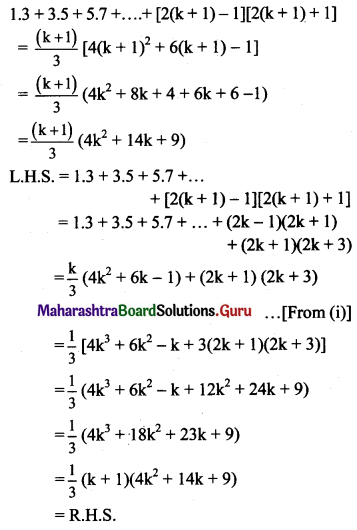
Maharashtra Board 11th Maths Solutions Chapter 4 Methods of Induction and Binomial Theorem Ex 4.1 Q7
∴ P(n) is true for n = k + 1.

Step IV:
From all the steps above, by the principle of mathematical induction, P(n) is true for all n ∈ N.
∴ 1.3 + 3.5 + 5.7 +… to n terms = \(\frac{n}{3}\) (4n2 + 6n – 1) for all n ∈ N.

Maharashtra Board 11th Maths Solutions Chapter 4 Methods of Induction and Binomial Theorem Ex 4.1

Question 8.
\(\frac{1}{1.3}+\frac{1}{3.5}+\frac{1}{5.7}+\ldots+\frac{1}{(2 n-1)(2 n+1)}=\frac{n}{2 n+1}\)
Solution:
Let P(n) ≡ \(\frac{1}{1.3}+\frac{1}{3.5}+\frac{1}{5.7}+\ldots+\frac{1}{(2 n-1)(2 n+1)}=\frac{n}{2 n+1}\), for all n ∈ N.

Step I:
Put n = 1
L.H.S. = \(\frac{1}{1.3}=\frac{1}{3}\)
R.H.S. = \(\frac{1}{2(1)+1}=\frac{1}{3}\)
∴ L.H.S. = R.H.S.
∴ P(n) is true for n = 1.

Step II:
Let us assume that P(n) is true for n = k.
∴ \(\frac{1}{1.3}+\frac{1}{3.5}+\frac{1}{5.7}+\ldots+\frac{1}{(2 k-1)(2 k+1)}=\frac{k}{2 k+1}\) …..(i)

Step III:
We have to prove that P(n) is true for n = k + 1,
i.e., to prove that
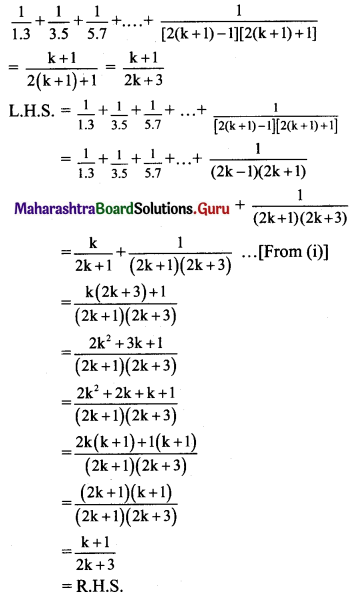
Maharashtra Board 11th Maths Solutions Chapter 4 Methods of Induction and Binomial Theorem Ex 4.1 Q8
∴ P(n) is true for n = k + 1.

Step IV:
From all the steps above, by the principle of mathematical induction, P(n) is true for all n ∈ N.
∴ \(\frac{1}{1.3}+\frac{1}{3.5}+\frac{1}{5.7}+\ldots+\frac{1}{(2 n-1)(2 n+1)}=\frac{n}{2 n+1}\), for all n ∈ N.

Question 9.
\(\frac{1}{3.5}+\frac{1}{5.7}+\frac{1}{7.9}+\ldots \text { to } n \text { terms }=\frac{n}{3(2 n+3)}\)
Solution:
Let P(n) ≡ \(\frac{1}{3.5}+\frac{1}{5.7}+\frac{1}{7.9}+\ldots \text { to } n \text { terms }=\frac{n}{3(2 n+3)}\), for all n ∈ N.
But first factor in each term of the denominator,
i.e., 3, 5, 7, ….. are in A.P. with a = 3 and d = 2.
∴ nth term = a + (n – 1)d = 3 + (n – 1) 2 = (2n + 1)
Also, second factor in each term of the denominator,
i.e., 5, 7, 9, … are in A.P. with a = 5 and d = 2.
∴ nth term = a + (n – 1) d = 5 + (n – 1) 2 = (2n + 3)
∴ nth term, tn = \(\frac{1}{(2 n+1)(2 n+3)}\)
P(n) ≡ \(\frac{1}{3.5}+\frac{1}{5.7}+\frac{1}{7.9}+\ldots+\frac{1}{(2 n+1)(2 n+3)}\) = \(\frac{n}{3(2 n+3)}\)

Step I:
Put n = 1
L.H.S. = \(\frac{1}{3.5}=\frac{1}{15}\)
R.H.S. = \(\frac{1}{3[2(1)+3]}=\frac{1}{3(2+3)}=\frac{1}{15}\)
∴ L.H.S. = R.H.S.
∴ P(n) is true for n = 1.

Step II:
Let us assume that P(n) is true for n = k.
∴ \(\frac{1}{3.5}+\frac{1}{5.7}+\frac{1}{7.9}+\ldots+\frac{1}{(2 k+1)(2 k+3)}\) = \(\frac{k}{3(2 k+3)}\) ….(i)

Step III:
We have to prove that P(n) is true for n = k + 1,
i.e., to prove that
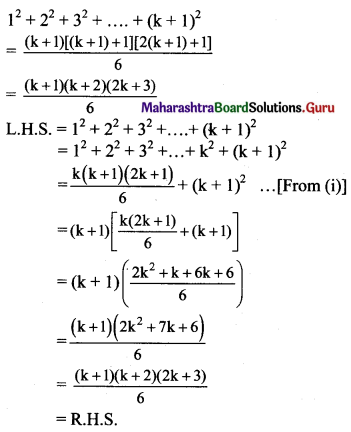
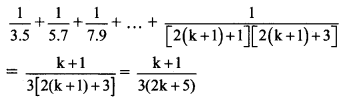
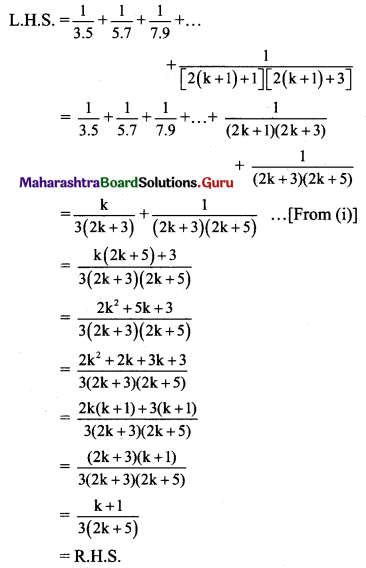
Maharashtra Board 11th Maths Solutions Chapter 4 Methods of Induction and Binomial Theorem Ex 4.1 Q9
Maharashtra Board 11th Maths Solutions Chapter 4 Methods of Induction and Binomial Theorem Ex 4.1 Q9.1
∴ P(n) is true for n = k + 1.

Step IV:
From all the steps above, by the principle of mathematical induction, P(n) is true for all n ∈ N.
∴ \(\frac{1}{3.5}+\frac{1}{5.7}+\frac{1}{7.9}+\ldots \text { to } n \text { terms }=\frac{n}{3(2 n+3)}\), for all n ∈ N.

Maharashtra Board 11th Maths Solutions Chapter 4 Methods of Induction and Binomial Theorem Ex 4.1

Question 10.
(23n – 1) is divisible by 7.
Solution:
(23n – 1) is divisible by 7 if and only if (23n – 1) is a multiple of 7.
Let P(n) ≡ (23n – 1) = 7m, where m ∈ N.

Step I:
Put n = 1
∴ 23n – 1 = 23(1) – 1 = 23 – 1 = 8 – 1 = 7
∴ (23n – 1) is a multiple of 7.
∴ P(n) is true for n = 1.

Step II:
Let us assume that P(n) is true for n = k.
i.e., 23k – 1 is a multiple of 7.
∴ 23k – 1 = 7a, where a ∈ N
∴ 23k = 7a + 1 ……(i)

Step III:
We have to prove that P(n) is true for n = k + 1,
i.e., to prove that
23(k+1) – 1 = 7b, where b ∈ N.
∴ P(k + 1) = 23(k+1) – 1
= 23k+3 – 1
= 23k . (23) – 1
= (7a + 1)8 – 1 …..[From (i)]
= 56a + 8 – 1
= 56a + 7
= 7(8a + 1)
7b, where b = (8a + 1) ∈ N
∴ P(n) is true for n = k + 1.

Step IV:
From all the steps above, by the principle of mathematical induction, P(n) is true for all n ∈ N.
∴ (24n – 1) is divisible by 7, for all n ∈ N.

Question 11.
(24n – 1) is divisible by 15.
Solution:
(24n – 1) is divisible by 15 if and only if (24n – 1) is a multiple of 15.
Let P(n) ≡ (24n – 1) = 15m, where m ∈ N.

Step I:
Put n = 1
∴ 24(1) – 1 = 16 – 1 = 15
∴ (24n – 1) is a multiple of 15.
∴ P(n) is true for n = 1.

Step II:
Let us assume that P(n) is true for n = k.
∴ 24k – 1 = 15a, where a ∈ N
∴ 24k = 15a + 1 …..(i)

Step III:
We have to prove that P(n) is true for n = k + 1,
i.e., to prove that
∴ 24(k+1) – 1 = 15b, where b ∈ N
∴ P(k + 1) = 24(k+1) – 1 = 24k+4 – 1
= 24k . 24 – 1
= 16 . (24k) – 1
= 16(15a + 1) – 1 …..[From (i)]
= 240a + 16 – 1
= 240a + 15
= 15(16a + 1)
= 15b, where b = (16a + 1) ∈ N
∴ P(n) is true for n = k + 1.

Step IV:
From all the steps above, by the principle of mathematical induction, P(n) is true for all n ∈ N.
∴ (24n – 1) is divisible by 15, for all n ∈ N.

Maharashtra Board 11th Maths Solutions Chapter 4 Methods of Induction and Binomial Theorem Ex 4.1

Question 12.
3n – 2n – 1 is divisible by 4.
Solution:
(3n – 2n – 1) is divisible by 4 if and only if (3n – 2n – 1) is a multiple of 4.
Let P(n) ≡ (3n – 2n – 1) = 4m, where m ∈ N.

Step I:
Put n = 1
∴ (3n – 2n – 1) = 3(1) – 2(1) – 1 = 0 = 4(0)
∴ (3n – 2n – 1) is a multiple of 4.
∴ P(n) is tme for n = 1.

Step II:
Let us assume that P(n) is true for n = k.
∴ 3k – 2k – 1 = 4a, where a ∈ N
∴ 3k = 4a + 2k + 1 ….(i)

Step III:
We have to prove that P(n) is tme for n = k + 1,
i.e., to prove that
3(k+1) – 2(k + 1) – 1 = 4b, where b ∈ N
P(k + 1) = 3k+1 – 2(k + 1) – 1
= 3k . 3 – 2k – 2 – 1
= (4a + 2k + 1) . 3 – 2k – 3 …….[From (i)]
= 12a + 6k + 3 – 2k – 3
= 12a + 4k
= 4(3a + k)
= 4b, where b = (3a + k) ∈ N
∴ P(n) is tme for n = k + 1.

Step IV:
From all the steps above, by the principle of mathematical induction, P(n) is tme for all n ∈ N.
∴ 3n – 2n – 1 is divisible by 4, for all n ∈ N.

Question 13.
5 + 52 + 53 + ….. + 5n = \(\frac{5}{4}\) (5n – 1)
Solution:
Let P(n) ≡ 5 + 52 + 53 +…..+ 5n = \(\frac{5}{4}\) (5n – 1), for all n ∈ N.

Step I:
Put n = 1
L.H.S. = 5
R.H.S. = \(\frac{5}{4}\) (51 – 1) = 5
∴ L.H.S. = R.H.S.
∴ P(n) is true for n = 1.

Step II:
Let us assume that P(n) is true for n = k.
∴ 5 + 52 + 53 + ….. + 5k = \(\frac{5}{4}\) (5k – 1) …….(i)

Step III:
We have to prove that P(n) is true for n = k + 1,
i.e., to prove that
Maharashtra Board 11th Maths Solutions Chapter 4 Methods of Induction and Binomial Theorem Ex 4.1 Q13
∴ P(n) is true for n = k + 1.

Step IV:
From all the steps above, by the principle of mathematical induction, P(n) is true for all n ∈ N.
∴ 5 + 52 + 53 + … + 5n = \(\frac{5}{4}\) (5n – 1), for all n ∈ N.

Maharashtra Board 11th Maths Solutions Chapter 4 Methods of Induction and Binomial Theorem Ex 4.1

Question 14.
(cos θ + i sin θ)n = cos (nθ) + i sin (nθ)
Solution:
Let P(n) ≡ (cos θ + i sin θ)n = cos nθ + i sin nθ, for all n ∈ N.
Step I:
Put n = 1
L.H.S. = (cos θ + i sin θ)1 = cos θ + i sin θ
R.H.S. = cos[(1)θ] + i sin[(1)θ] = cos θ + i sin θ
∴ L.H.S. = R.H.S.
∴ P(n) is true for n = 1.

Step II:
Let us assume that P(n) is true for n = k.
∴ (cos θ + i sin θ)k = cos kθ + i sin kθ …….(i)

Step III:
We have to prove that P(n) is true for n = k + 1,
i.e., to prove that
(cos θ + i sin θ)k+1 = cos (k + 1)θ + i sin (k + 1)θ
L.H.S. = (cos θ + i sin θ)k+1
= (cos θ + i sin θ)k . (cos θ + i sin θ)
= (cos kθ + i sin kθ) . (cos θ + i sin θ) ……[From (i)]
= cos kθ cos θ + i sin θ cos kθ + i sin kθ cosθ – sin kθ sin θ ……[∵ i2 = -1]
= (cos kθ cos θ – sin k θ sin θ) + i(sin kθ cos θ + cos kθ sin θ)
= cos(kθ + θ) + i sin(kθ + θ)
= cos(k + 1) θ + i sin (k + 1) θ
= R.H.S.
∴ P(n) is true for n = k + 1.

Step IV:
From all the steps above, by the principle of mathematical induction, P(n) is true for all n ∈ N.
∴ (cos θ + i sin θ)n = cos (nθ) + i sin (nθ), for all n ∈ N.

Question 15.
Given that tn+1 = 5 tn+4, t1 = 4, prove by method of induction that tn = 5n – 1.
Solution:
Let the statement P(n) has L.H.S. a recurrence relation tn+1 = 5 tn+4, t1 = 4 and R.H.S. a general statement tn = 5n – 1.
Step I:
Put n = 1
L.H.S. = 4
R.H.S. = 51 – 1 = 4
∴ L.H.S. = R.H.S.
∴ P(n) is true for n = 1.
Put n = 2
L.H.S. = t2 = 5t1 + 4 = 24
R.H.S. = t2 = 52 – 1 = 24
∴ L.H.S. = R.H.S.
∴ P(n) is true for n = 2.

Step II:
Let us assume that P(n) is true for n = k.
∴ tk+1 = 5 tk+4 and tk = 5k – 1

Step III:
We have to prove that P(n) is true for n = k + 1,
i.e., to prove that tk+1 = 5k+1 – 1
Since tk+1 = 5 tk+4 and tk = 5k – 1 …..[From Step II]
tk+1 = 5 (5k – 1) + 4 = 5k+1 – 1
∴ P(n) is true for n = k + 1.

Step IV:
From all the steps above, by the principle of mathematical induction, P(n) is true for all n ∈ N.
∴ tn = 5n – 1, for all n ∈ N.

Maharashtra Board 11th Maths Solutions Chapter 4 Methods of Induction and Binomial Theorem Ex 4.1

Question 16.
Prove by method of induction
\(\left(\begin{array}{ll}
1 & 2 \\
0 & 1
\end{array}\right)^{n}=\left(\begin{array}{cc}
1 & 2 n \\
0 & 1
\end{array}\right) \forall n \in N\)
Solution:
Maharashtra Board 11th Maths Solutions Chapter 4 Methods of Induction and Binomial Theorem Ex 4.1 Q16
Maharashtra Board 11th Maths Solutions Chapter 4 Methods of Induction and Binomial Theorem Ex 4.1 Q16.1

Maths Solutions for Class 11 State Board