Substances in Daily Use Class 6 Questions And Answers Maharashtra Board

Std 6 Science Chapter 6 Substances in Daily Use Question Answer Maharashtra Board

Balbharti Maharashtra State Board Class 6 Science Solutions Chapter 6 Substances in Daily Use Notes, Textbook Exercise Important Questions and Answers.

Class 6 Science Chapter 6 Substances in Daily Use Question Answer Maharashtra Board

1. Fill in the blanks using proper works:

Question a.
Rubber made by vulcanization is a …………… material.
Answer:
hard

Question b.
Man-made materials are made by …………… natural materials.
Answer:
processing

Maharashtra Board Class 6 Science Solutions Chapter 6 Substances in Daily Use

Question c.
…………… thread was developed simultaneously in New York and London.
Answer:
Nylon

Question d.
Rayon is also known as …………… .
Answer:
synthetic silk

2. Answer the following questions. 

Question a.
Why did the need for man-made materials arise?
Answer:
The need for man-made materials arose due to the following reasons:

  1. To meet the needs of an increasing population.
  2. Human nature to try to make life more comfortable.
  3. They can be made available in plenty at a low cost.
  4. The reserve of natural substances is decreasing.

Maharashtra Board Class 6 Science Solutions Chapter 6 Substances in Daily Usec

Question b.
Which are the natural materials obtained from plants and animals?
Answer:
Leather, jute, wool, cotton, silk are the natural substances obtained from plants and animals.

Question c.
What is vulcanization?
Answer:

  1. Vulcanization is the process in which rubber is heated with sulphur for three to four hours.
  2. Sulphur is mixed to give hardness to rubber.
  3. The proportion of sulphur depends on the purpose for which the rubber is to be used.

Question d.
Which natural materials are used to obtain fibres?
Answer:
Cotton, wood pulp and various hydrocarbons obtained from mineral oils are used to obtain fibres.

3. What are we used for?

Question a.
What are we used for?
Answer:

  1. Soil: It supports plant life and hence indirectly supports all living things. It is used for making clay pot, utensils, bricks etc.
  2. Wood: It is used in paper industry. It is also used to make furniture.
  3. Nylon: It is used to manufacture clothes, fishing nets, ropes, etc.
  4. Paper. It is used in our textbooks, note books, currency notes, etc.
  5. Rubber: It is used in the manufacture of erasers, tyres, rubber toys, rubber bands, etc.

Maharashtra Board Class 6 Science Solutions Chapter 6 Substances in Daily Use

4. How is paper manufactured? Write in your own words.

Question a.
How is paper manufactured? Write in your own words.
Answer:
Coniferous trees like pine trees are used to make paper.

  1. The bark of the logs of these trees is first removed and the wood is broken into small pieces.
  2. The mixture of these pieces with some chemicals is kept soaked for a long time to form pulp.
  3. On completion of chemical process, fibrous substances from wood pulp are separated and some dyes are added.
  4. The pulp is then passed through rollers, dried to form paper and finally wound on reels.

5. Give scientific reasons.

Question a.
We must use cotton clothes during summer.
Answer:

  1. During summer we sweat more due to high temperature.
  2. Cotton clothes absorb sweat.
  3. Synthetic clothes are water repellent. They do not absorb sweat and we feel uncomfortable. Hence we must use cotton clothes in summer.

Maharashtra Board Class 6 Science Solutions Chapter 6 Substances in Daily Use

Question b.
We must observe economy in the use of materials.
Answer:

  1. Due to excessive use of natural substances by human beings to fulfil their needs; they are getting depleted at a faster rate.
  2. At the same time, it takes a very long time for these substances to get naturally formed again.
  3. Hence, we must observe economy in the use of materials so that they are available for the future generation also.

Question c.
Saving paper is the need of the hour.
Answer:

  1. Saving paper means saving trees as wood is used as the raw material to manufacture paper.
  2. Trees are natural habitat for many Living things.
  3. Trees help in increasing rainfall and water availability. Hence, saving paper helps in saving trees which in turn maintains balance in nature.

Question d.
Man-made materials have more demand.
Answer:

  1. Man-made substances are waterproof, lightweight and easy for transportation.
    Substances in Daily Use
  2. They are easier to use and can be made available in plenty at a low cost.
    Hence, there is more demand for man-made materials.

Maharashtra Board Class 6 Science Solutions Chapter 6 Substances in Daily Use

Question e.
Humus is a natural material.
Answer:

  1. Humus is obtained from plant and animal wastes.
  2. Micro-organisms act on these wastes and convert them into humus.
  3. Hence, humus is a natural material.

6. Find out.

Question 1.
How is lac obtained from nature?
Answer:

  1. Lac is a resinous substance secreted from the glands present in the skin of female lac insect.
  2. Lac insects live on the Palash trees. In India lac is mainly produced in the states of Rajasthan and Bihar.

Question 2.
How are pearls obtained?
Answer:

  1. Pearls are formed when a foreign particle such as a grain of sand or a small particle of rock accidentally enters the space between the mantle and shell of an oyster’s body.
  2. Oysters cannot reject the particle, and as a defence mechanism its produces a shining coating called nacre on the particle layer by layer.
  3. As the shiny layers get added, a pearl is formed.
  4. Cultured pearls are artificially formed by inserting a bead in oyster shell and allowed to coat it with nacre over several years.

Maharashtra Board Class 6 Science Solutions Chapter 6 Substances in Daily Use

Activity:

Question 1.
Visit a rubber, paper or textile industry in your area and collect information about it.

Question 2.
Collect various samples of paper and note their uses.

Question 3.
Use blank pages from old note-books and make a new one.

Class 6 Science Chapter 6 Substances in Daily Use Important Questions and Answers

Fill in the blanks using proper works.

Question 1.
Natural rubber is obtained from …………… of trees.
Answer:
latex

Question 2.
Changes where the original constituent substances cannot be obtained again from the new substances are called …………… changes.
Answer:
irreversible

Maharashtra Board Class 6 Science Solutions Chapter 6 Substances in Daily Use

Question 3.
A paper factory in Maharashtra is situated at …………… .
Answer:
Ballarpur

Question 4.
Glass can be made from …………… and …………… .
Answer:
sand, calcium

Question 5.
Botanical name of rubber plant is …………… .
Answer:
Hevea brasiliensis

Question 6.
…………… obtained from mineral oils are used to make polymer chains.
Answer:
Hydrocarbons

Question 7.
The maximum production of rubber in India is in …………… .
Answer:
Kerala

Maharashtra Board Class 6 Science Solutions Chapter 6 Substances in Daily Use

Question 8.
…………… invented the process of vulcanisation.
Answer:
Charles Goodyear

Match the columns:

Question 1.

Column ‘A’Column ‘B’
1. Jutea. Animal origin
2. Airb. Plant origin
3. Leatherc. Man-made
4. Cementd. Abiotic

Answer:

Column ‘A’Column ‘B’
1. Juteb. Plant origin
2. Aird. Abiotic
3. Leathera. Animal origin
4. Cementc. Man-made

Maharashtra Board Class 6 Science Solutions Chapter 6 Substances in Daily Use

State whether the following statements are ‘true’ or ‘false’.

Question 1.
We can find plastic in nature.
Answer:
False

Question 2.
Soap is a man-made substance.
Answer:
True

Question 3.
We should reuse available resources.
Answer:
True

Maharashtra Board Class 6 Science Solutions Chapter 6 Substances in Daily Use

Question 4.
Nylon clothes are good summer wear.
Answer:
False

Question 5.
Glass is a man-made substance.
Answer:
True

Question 6.
In irreversible changes original substances can be obtained again.
Answer:
False

Question 7.
Rayon is made up of cotton and wood pulp.
Answer:
True

Give two examples of each of the following:

Question 1.
Natural fibres
Answer:
cotton, silk

Maharashtra Board Class 6 Science Solutions Chapter 6 Substances in Daily Use

Question 2.
Synthetic fibres
Answer:
terylene, rayon

Question 3.
Biotic natural substances
Answer:
wool, jute

Question 4.
Abiotic natural substances
Answer:
air, water

Question 5.
Man-made substances.
Answer:
paper, glass

Classify the following substances in the table given below.
(iron, wood, brick, paper, terylene, stone, jute, air, silk, utensils, plastic, rayon, water, wool, dacron, lac, nylon, pearl)
Answer:

Natural SubstancesMan-made Substances               Natural FibresSynthetic Fibres
iron, wood, stone, water, lac, pearlbrick, paper, utensils, plasticjute, silk, woolterylene, rayon, dacron, nylon

Maharashtra Board Class 6 Science Solutions Chapter 6 Substances in Daily Use

Define:

Question 1.
Natural substances.
Answer:
Substances available in nature are called natural substances.

Question 2.
Man-made substances.
Answer:
Man-made substances are new substances produced by processing naturally available resources.

Question 3.
Biotic substances.
Answer:
Natural substances obtained from living things are called biotic substances.

Maharashtra Board Class 6 Science Solutions Chapter 6 Substances in Daily Use

Question 4.
Abiotic substances.
Answer:
Natural substances that are not obtained from living things are called abiotic substances.

Question 5.
Plant-originated substance.
Answer:
A substance obtained from a plant is called a plant-originated substance.

Question 6.
Animal-originated substance.
Answer:
A substances obtained from an animal is called an animal-originated substance.

Question 7.
Hydrocarbons.
Answer:
Substances obtained from mineral oil are called hydrocarbons.

Maharashtra Board Class 6 Science Solutions Chapter 6 Substances in Daily Use

Answer the following in one or two sentences.

Question 1.
Why was Rayon named so?
Answer:
The threads of Rayon have shine and strength. They appeared to be shining bright like the sun’s rays. Hence, they were named ‘Rayon.

Question 2.
How are TV sets, refrigerators, etc. packed? Why?
Answer:
To pack TV sets, refrigerators, etc. big cartons and thermocol are used. These man-made substances are water resistant, light weight and easy for transportation.

Question 3.
Give the properties and uses of nylon.
Answer:
Nylon threads have a shine and are strong, transparent and water resistant. They are used to manufacture clothes, fishing nets, ropes, etc.

Maharashtra Board Class 6 Science Solutions Chapter 6 Substances in Daily Use

Question 4.
What is latex?
Answer:
Latex is a milky white natural substance produced in the stems of rubber trees.

Question 5.
Name the basic material used to obtain paper.
Answer:
Wood is the basic material used in the manufacture of paper.

Question 6.
What kind of paper is used for currency notes manufacturing?
Answer:
Flax fibre is used in the manufacture of currency notes.

Question 7.
Where was the process of making paper invented?
Answer:
The process of making paper was invented in China.

Answer in brief:

Question 1.
What are the advantages of synthetic fibre?
Answer:
Advantages of synthetic fibre are:

  1. These fibres can be manufactured on a large scale.
  2. They cost less.
  3. They are strong and durable.
  4. They can be used for a long time.
  5. They are water repellent. They dyy easily.
  6. They are light weight and comfortable to wear.
  7. Clothes made from these threads are wrinkle free and scratch free.

Maharashtra Board Class 6 Science Solutions Chapter 6 Substances in Daily Use

Question 2.
Give the shortcomings of synthetic fibre.
Answer:

  1. They are water repellent. Hence, they do not absorb sweat from the skin.
  2. Continuous use of these clothes keeps the skin moist which may cause skin diseases.
  3. Synthetic clothes are uncomfortable to wear especially in summer.
  4. They catch fire easily.
  5. If they catch fire, they stick to the skin and cause skin injuries.
  6. These fibres are not decomposed by micro-organisms.

Question 3.
Write a short note on natural rubber.
Answer:

  1. Rubber is a natural substance obtained by collecting the latex of certain trees.
  2. The botanical name of this tree is ‘Hevea brasiliensis’
  3. In India, the maximum production of rubber is in Kerala.

Question 4.
What are dacron, terylene and terene?
Answer:

  1. Dacron, terelyne and terene are synthetic fibres prepared from hydrocarbons.
  2. Various hydrocarbons obtained from mineral oil are used to make polymer chains.
  3. A solution of such polymer is pressed through a strainer with fine holes.
  4. The fibre formed after cooling are long and unbroken threads.
  5. These threads have been named as dacron, terylene and terene.

Maharashtra Board Class 6 Science Solutions Chapter 6 Substances in Daily Use

Give scientific reasons:

Question 1.
Natural substances are depleting.
Answer:

  1. Due to increase in population there is an increase in demand. To meet this demand, natural substances are used to a greater extent.
  2. Due to human nature to make his life more comfortable, he learnt to use natural resources and also began to process them to make new substances. Hence natural substances are depleting at an alarming rate.

Can you tell?

Question 1.
Difference between leather, jute, wool, cotton and soil, water, metals.
Answer:

  1. Leather, jute, wool are biotic natural substances.
  2. Soil, water, metals are abiotic natural substances.

Maharashtra Board Class 6 Science Solutions Chapter 6 Substances in Daily Use

Question 2.
How are leather and wool different from jute and cotton?
Answer:
Leather and wool are obtained from animals while jute and cotton are obtained from plants.

Question 3.
Do you find plastic, nylon, brass or cement in nature?
Answer:
No, they are all man-made materials.

Question 4.
Can red chillies become green chillies again?
Answer:
No, the change from green chillies to red chillies is irreversible.

Question 5.
From which substances in nature can we get threads or fibre?
Answer:
Cotton plant, jute, silkworm.

Maharashtra Board Class 6 Science Solutions Chapter 6 Substances in Daily Use

Question 6.
What are clothes made from?
Answer:
Clothes are made from yarn obtained from fibre.

Classify the following substances according to their uses:
sand, soap, wool, window glass, bamboo, cotton, bricks, silk, leafy vegetables, cement, fruits, water, sugar.
Answer:

  • For construction: Sand, window glass, bamboo, bricks, cement.
  • As food: Leafy vegetables, fruits, water, sugar.
  • At home: Soap for cleaning.
  • For clothes: Wool, cotton, silk.

Make a list of objects, each of which can be made from several substances.
Answer:

ObjectsSubstances
TableWood, glass, plastic.
ToysWood, plastic, clay.
UtensilsAluminium, wood, glass, ceramic, plastic.

Maharashtra Board Class 6 Science Solutions Chapter 6 Substances in Daily Use

Use your brain power!

Question 1.
Complete the table below, showing how substance of daily use are classified.
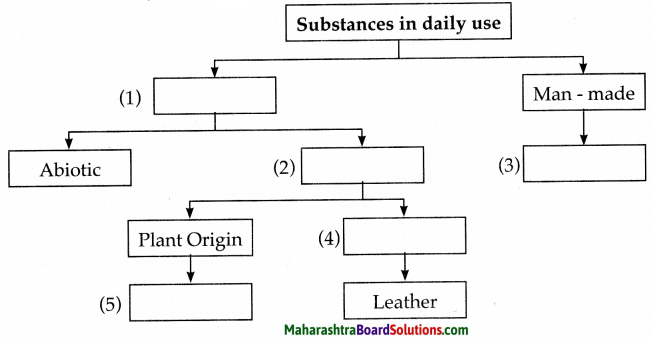
Maharashtra Board Class 6 Science Solutions Chapter 6 Substances in Daily Use 1
Answer:

  1. Natural
  2. Biotic
  3. Cement
  4. Animal Origin
  5. Cotton

Also Read:

PETRONET Pivot Point Calculator

Maharashtra State Board Class 6 Science Textbook Solutions
Practice Set 37 Class 6 Answers Maths Chapter 16 Quadrilaterals Maharashtra Board

Quadrilaterals Class 6 Maths Chapter 16 Practice Set 37 Solutions Maharashtra Board
Balbharti Maharashtra State Board Class 6 Maths Solutions covers the Std 6 Maths Chapter 16 Quadrilaterals Class 6 Practice Set 37 Answers Solutions.
Std 6 Maths Practice Set 37 Solutions Answers
Question 1.
Observe the figures below and find out their names:
Maharashtra Board Class 6 Maths Solutions Chapter 16 Quadrilaterals Practice Set 37 1
Solution:
i. Pentagon (5 sides)
ii. Hexagon (6 sides)
iii. Heptagon (7 sides)
iv. Octagon (8 sides)

Maharashtra Board Class 6 Maths Chapter 16 Quadrilaterals Practice Set 37 Intext Questions and Activities

Question 1.
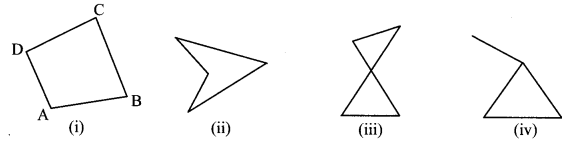
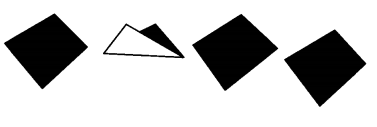
Observe the figures given below and say which of them are quadrilaterals. (Textbook pg. no. 81)
Maharashtra Board Class 6 Maths Solutions Chapter 16 Quadrilaterals Practice Set 37 2
Solution:
Is a quadrilateral: (i)

Question 2.
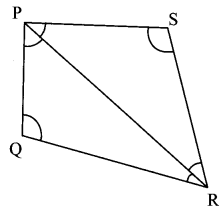
Draw a quadrilateral. Draw one diagonal of this quadrilateral and divided it into two triangles. Measures all the angles in the figure. Is the sum of the measures of the four angles of the quadrilateral equal to the sum of the measures of the six angles of the two triangles? Verity that this is so with other quadrilaterals. (Textbook pg. no. 84)
Solution:
Maharashtra Board Class 6 Maths Solutions Chapter 16 Quadrilaterals Practice Set 37 3
m∠PQR = 104°
m∠QRP = 26°
m∠RPQ = 50°
m∠PRS = 34°
m∠RSP = 106°
m∠SPR = 40°
∴ Sum of the measures of the angles of quadrilateral = m∠PQR + m∠QRP + m∠RPQ + m∠PRS + m∠RSP + m∠SPR
= 104° + 26° + 50° + 34° + 106° + 40°
= 360°
Also, we observe that
Sum of the measures of the angles of quadrilateral = Sum of the measures of angles of the two triangles (PQR and PRS)
= (104°+ 26°+ 50°)+ (34° + 106° + 40°)
= 180° + 180°
= 360°
[Note: Students should drew different quadrilaterals and verify the property.]

Question 3.
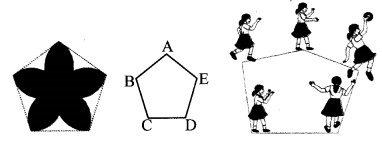
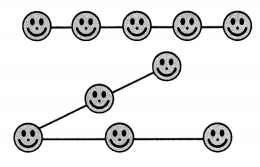
For the pentagon shown in the figure below, answer the following: (Textbook pg. no. 84)

  1. Write the names of the five vertices of the pentagon.
  2. Name the sides of the pentagon.
  3. Name the angles of the pentagon.
  4. See if you can sometimes find players on a field forming a pentagon.

Maharashtra Board Class 6 Maths Solutions Chapter 16 Quadrilaterals Practice Set 37 4
Solution:

  1. The vertices of the pentagon are points A, B, C, D and E.
  2. The sides of the pentagon are segments AB, BC, CD, DE and EA.
  3. The angles of the pentagon are ∠ABC, ∠BCD, ∠CDE, ∠DEA and ∠EAB.
  4. The players shown in the above figure form a pentagon. The players are standing on the vertices of

Question 4.
Cut out a paper in the shape of a quadrilateral. Make folds in it that join the vertices of opposite angles. What can these folds be called? (Textbook pg. no. 83)
Maharashtra Board Class 6 Maths Solutions Chapter 16 Quadrilaterals Practice Set 37 5
Solution:
The folds are called diagonals of the quadrilateral.

Question 5.
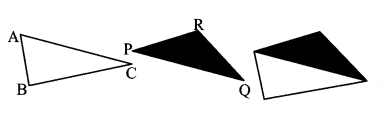
Take two triangular pieces of paper such that . one side of one triangle is equal to one side of the other. Let us suppose that in ∆ABC and ∆PQR, sides AC and PQ are the equal sides. Join the triangles so that their equal sides lie B side by side. What figure do we get? (Textbook pg. no. 83)
Maharashtra Board Class 6 Maths Solutions Chapter 16 Quadrilaterals Practice Set 37 6
Solution:
If we place the triangles together such that the equal sides overlap, the two triangles form a quadrilateral.

6th Std Maths Digest Pdf Download

Practice Set 3 Class 6 Answers Maths Chapter 2 Angles Maharashtra Board

Angles Class 6 Maths Chapter 2 Practice Set 3 Solutions Maharashtra Board

Balbharti Maharashtra State Board Class 6 Maths Solutions covers the Std 6 Maths Chapter 2 Angles Class 6 Practice Set 3 Answers Solutions.

Std 6 Maths Practice Set 3 Solutions Answers

Question 1.
Use the proper geometrical instruments to construct the following angles. Use the compass and the ruler to bisect them:

  1. 50°
  2. 115°
  3. 80°
  4. 90°

Solution:
Maharashtra Board Class 6 Maths Solutions Chapter 2 Angles Practice Set 3 1

Maharashtra Board Class 6 Maths Chapter 2 Angles Practice Set 3 Intext Questions and Activities

Question 1.
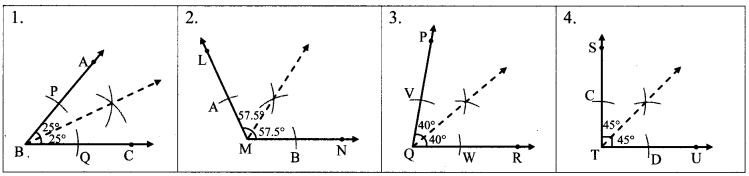
Construct an angle bisector to obtain an angle of 30°. (Textbook pg. no. 11)
Solution: .
In order to get a bisected angle of a given measure, the student has to draw the angle having twice the measurement of required bisected angle.

For getting measurement of 30° (for the bisected angle), one has to make an angle of 60° (i.e. 30° × 2).

Step 1:
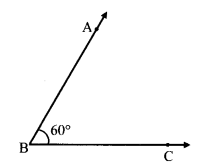
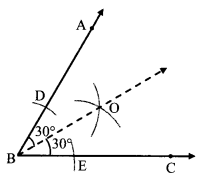
Draw ∠ABC of 60°.
Maharashtra Board Class 6 Maths Solutions Chapter 2 Angles Practice Set 3 2

Step 2:
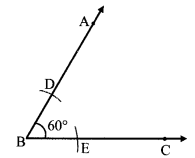
Cut arcs on the rays BA and BC. Name these points as D and E respectively.
Maharashtra Board Class 6 Maths Solutions Chapter 2 Angles Practice Set 3 3

Step 3:
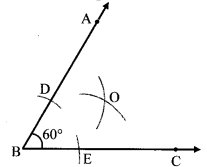
Place the compass point on point D and draw an arc inside the angle.
Without changing the distance of the compass, place the compass point on point E and cut the previous arc. Name the point of intersection as O
Maharashtra Board Class 6 Maths Solutions Chapter 2 Angles Practice Set 3 4

Step 4:
Draw ray BO.
Ray BO is the angle bisector of ∠ABC.
i.e. m∠ABO = m∠CBO = 30°
Maharashtra Board Class 6 Maths Solutions Chapter 2 Angles Practice Set 3 5

Question 2.
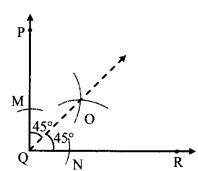
Construct an angle bisector to draw an angle of 45°. (Textbook pg. no. 11)
Solution:
For getting measurement of 45° (for the bisected angle), one has to make an angle of 90° (i.e. 45° × 2).
Step 1:
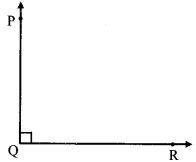
Draw ∠PQR of 90°.
Maharashtra Board Class 6 Maths Solutions Chapter 2 Angles Practice Set 3 6

Step 2:
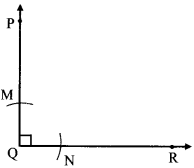
Cut arcs on the rays QP and QR.
Name these points as M and N respectively.
Maharashtra Board Class 6 Maths Solutions Chapter 2 Angles Practice Set 3 7

Step 3:
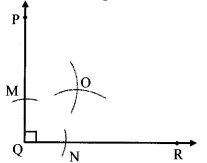
Place the compass point on point M and draw an arc inside the angle.
Without changing the distance of the compass, place the compass point on point N and cut the
Maharashtra Board Class 6 Maths Solutions Chapter 2 Angles Practice Set 3 8

Step 4:
Draw ray QO.
Ray QO is the angle bisector of ∠PQR.
i.e. m∠PQO = m∠RQO = 45°
Maharashtra Board Class 6 Maths Solutions Chapter 2 Angles Practice Set 3 9

Question 3.
Ask three or more children to stand in a straight line. Take two long ropes. Let the child in the middle hold one end of each rope. With the help of the ropes, make the children on either side stand along a straight line. Tell them to move so as to form an acute angle, a right angle, an obtuse angle, a straight angle, a reflex angle and a full or complete angle in turn. Keeping the rope stretched will help to ensure that the children form straight lines. (Textbook pg. no. 6)
Solution:
Maharashtra Board Class 6 Maths Solutions Chapter 2 Angles Practice Set 3 10

Question 4.
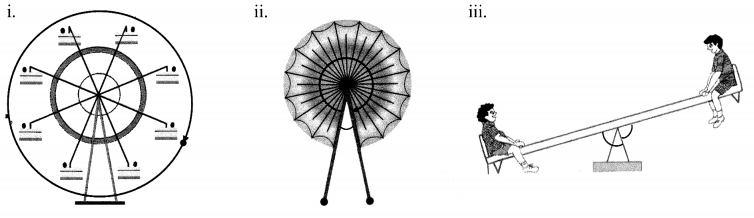
Look at the pictures below and identify the different types of angles. (Textbook pg. no. 8)
Maharashtra Board Class 6 Maths Solutions Chapter 2 Angles Practice Set 3 11
Solution:
i. Complete angle
ii. Reflex and Acute angle
iii. Acute and Obtuse angle

6th Std Maths Digest Pdf Download

Practice Set 15 Class 6 Answers Maths Chapter 5 Decimal Fractions Maharashtra Board

Decimal Fractions Class 6 Maths Chapter 5 Practice Set 15 Solutions Maharashtra Board

Balbharti Maharashtra State Board Class 6 Maths Solutions covers the Std 6 Maths Chapter 5 Decimal Fractions Class 6 Practice Set 15 Answers Solutions.

Std 6 Maths Practice Set 15 Solutions Answers

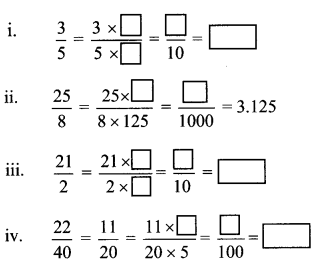
Question 1.
Write the proper number in the empty boxes.
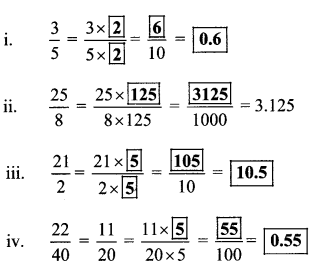
Maharashtra Board Class 6 Maths Solutions Chapter 5 Decimal Fractions Practice Set 15 1
Solution:
Maharashtra Board Class 6 Maths Solutions Chapter 5 Decimal Fractions Practice Set 15 2

Question 2.
Convert the common fractions into decimal fractions:
i. \(\frac { 3 }{ 4 }\)
ii. \(\frac { 4 }{ 5 }\)
iii. \(\frac { 9 }{ 8 }\)
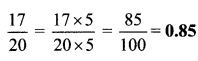
iv. \(\frac { 17 }{ 20 }\)
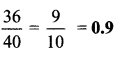
v. \(\frac { 36 }{ 40 }\)
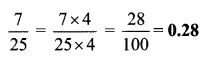
vi. \(\frac { 7 }{ 25 }\)
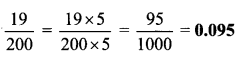
vii. \(\frac { 19 }{ 200 }\)
Solution:
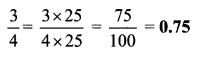
i. \(\frac { 3 }{ 4 }\)
Maharashtra Board Class 6 Maths Solutions Chapter 5 Decimal Fractions Practice Set 15 3

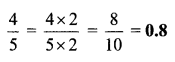
ii. \(\frac { 4 }{ 5 }\)
Maharashtra Board Class 6 Maths Solutions Chapter 5 Decimal Fractions Practice Set 15 4

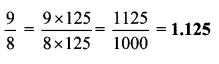
iii. \(\frac { 9 }{ 8 }\)
Maharashtra Board Class 6 Maths Solutions Chapter 5 Decimal Fractions Practice Set 15 5

iv. \(\frac { 17 }{ 20 }\)
Maharashtra Board Class 6 Maths Solutions Chapter 5 Decimal Fractions Practice Set 15 6

v. \(\frac { 36 }{ 40 }\)
Maharashtra Board Class 6 Maths Solutions Chapter 5 Decimal Fractions Practice Set 15 7

vi. \(\frac { 7 }{ 25 }\)
Maharashtra Board Class 6 Maths Solutions Chapter 5 Decimal Fractions Practice Set 15 8

vii. \(\frac { 19 }{ 200 }\)
Maharashtra Board Class 6 Maths Solutions Chapter 5 Decimal Fractions Practice Set 15 9

Question 3.
Convert the decimal fractions into common fractions:
i. 27.5
ii. 0.007
iii. 90.8
iv. 39.15
v. 3.12
vi. 70.400
Solution:
i. 27.5
= \(\frac { 275 }{ 10 }\)

ii. 0.007
= \(\frac { 7 }{ 1000 }\)

iii. 90.8
= \(\frac { 908 }{ 10 }\)

iv. 39.15
= \(\frac { 3915 }{ 100 }\)

v. 3.12
= \(\frac { 312 }{ 100 }\)

vi. 70.400
= 70.4
= \(\frac { 704 }{ 10 }\)

6th Std Maths Digest Pdf Download

Practice Set 27 Class 6 Answers Maths Chapter 10 Equations Maharashtra Board

Equations Class 6 Maths Chapter 10 Practice Set 27 Solutions Maharashtra Board

Balbharti Maharashtra State Board Class 6 Maths Solutions covers the Std 6 Maths Chapter 10 Equations Class 6 Practice Set 27 Answers Solutions.

Std 6 Maths Practice Set 27 Solutions Answers

Question 1.
Rewrite the following using a letter:
i. The sum of a certain number and 3.
ii. The difference is obtained by subtracting 11 from another number.
iii. The product of 15 and another number.
iv. Four times a number is 24.
Solution:
i. Let the number be x.
∴ x + 3 represents the sum of a certain number x and 3.

ii. Let the number be x.
∴ x – 11 represents the number obtained by subtracting 11 from another number x.

iii. Let the number be x.
∴ 15x represents the product of 15 and another number x.

iv. Let the number be x.
∴ 4x = 24 represents four the product of a number x four times.

Question 2.
Find out which operation must be done on both sides of these equations in order to solve them:

  1. x + 9 = 11
  2. x – 4 = 9
  3. 8x = 24
  4. \(\frac { x }{ 6 }\) = 3

Solution:

  1. Subtract 9 from both sides.
  2. Add 4 to both sides.
  3. Divide both sides by 8.
  4. Multiply both sides by 6.

Question 3.
Given below are some equations and the values of the variables. Are these values the solutions to those equations?

No.EquationValue of the VariableSolution (Yes/No)
i.y – 3 = 11y = 3No
ii.17 = n + 7n = 10
iii.30 = 5xx = 6
iv.\(\frac { m }{ 2 }\) = 14m = 7

Solution:

No.EquationValue of the VariableSolution (Yes/No)
i.y – 3 = 11y = 3No
ii.17 = n + 7n = 10Yes
iii.30 = 5xx = 6Yes
iv.\(\frac { m }{ 2 }\) = 14m = 7No

i. y – 3 = 11
∴ y – 3 + 3 = 11 + 3
…. (Adding 3 to both sides)
∴ y + 0 = 14
∴ y = 14

ii. 17 = n + 7
∴ 17 – 7 = n + 7 – 7
…. (Subtracting 7 from both sides)
∴ 17 + (-7) = n + 7 – 7
∴ 10 = n
∴  n = 10

iii. 30 = 5x
∴ \(\frac{30}{5}=\frac{5x}{5}\)
…. (Dividing both sides by 5)
∴  6 = 1x
∴ 6 = x
∴  x = 6

iv. \(\frac { m }{ 2 }\) = 14
∴ \(\frac { m }{ 2 }\) × 2 = 14 × 2
…. (Multiplying both sides by 2)
\(\frac { m\times2 }{ 2\times1 }\) = 28
∴ m = 28

Question 4.
Solve the following equations:
i. y – 5 = 1
ii. 8 = t + 5
iii. 4x = 52
iv. 19 = m – 4
v. \(\frac { p }{ 4 }=9\)
vi. x + 10 = 5
vi. m – 5 = -12
vii. p + 4 = -1
Solution:
i. y – 5 = 1
∴y – 5 + 5 = 1 + 5
…. (Adding 5 to both sides)
∴y + 0 = 6
∴y = 6

ii. 8 = t + 5
∴8 – 5 = t + 5 – 5
……(Subtracting 5 from both sides)
∴8 + (-5) = t + 0
∴ 3 = t
∴t = 3

iii. 4x = 52
∴\(\frac{4x}{4}=\frac{52}{4}\)
…. (Dividing both sides by 4)
∴ 1x = 13
∴ x = 13

iv. 19 = m -4
∴ 19 + 4 = m – 4 + 4
…. (Adding 4 to both sides)
∴ 23 = m + 0
∴ m = 23

v. \(\frac { p }{ 4 }\) = 9
∴ \(\frac { p }{ 4 }\) × 4 = 9 × 4 …. (Multiplying both sides by 4)
∴ \(\frac { p\times4 }{ 4\times1 }=36\)
∴ 1p = 36
∴ p = 36

vi. x + 10 = 5
∴ x + 10 – 10 = 5 – 10
…. (Subtracting 10 from both sides)
∴ x + 0 = 5 + (-10)
∴ x = -5

vii. m – 5 = -12
∴m – 5 + 5 = – 12 + 5
…. (Adding 5 to both sides)
∴m + 0 = -7
∴m = -7

viii. p + 4 = – 1
∴p + 4 – 4 = -1 – 4
…. (Subtracting 4 from both sides)
∴p + 0 = (-1) + (-4)
∴P = -5

Question 5.
Write the given information as an equation and find its solution:
i. Haraba owns some sheep. After selling 34 of them in the market, he still has 176 sheep. How many sheep did Haraba have at first?

ii. Sakshi prepared some jam at home and filled it in bottles. After giving away 7 of the bottles to her friends she still has 12 for herself. How many bottles had she made in all? If she filled 250g of jam in each bottle, what was the total weight of the jam she made?

iii. Archana bought some kilograms of wheat. She requires 12 kg per month and she got enough wheat milled for 3 months. After that, she had 14 kg left. How much wheat had Archana bought altogether?
Solution:
i. Let the number of sheep before selling be x.
∴ x – 34 = 176
∴ x – 34 + 34 = 176 + 34 ….(Adding 34 to both sides)
∴ x + 0 = 210
∴ x = 210
The number of sheep with Haraba before selling is 210.

ii. Let the total number of bottles be x.
∴ x – 7 = 12
∴ x – 7 + 7 = 12 + 7 ….(Adding 7 to both sides)
∴ x + 0 = 19
∴ x = 19
Weight of jam in each bottle = 250g
∴ Total weight of jam = 19 × 250g = 4750 g = \(\frac { 4750 }{ 1000 }\)kg = 4.75 kg
∴ The total number of bottles of jam made by Sakshi is 19, and the total weight of jam made is 4.75 kg.

iii. Let the total wheat bought by Archana be x kg.
Wheat used in 1 month = 12 kg
∴ Wheat used in 3 months = 3 × 12 = 36 kg
∴ x – 36 = 14
∴ x – 36 + 36 = 14 + 36 ….(Adding 36 to both sides)
∴ x + 0 = 50
∴ x = 50
∴ The total amount of wheat bought by Archana was 50 kg.

6th Std Maths Digest Pdf Download

Practice Set 36 Class 6 Answers Maths Chapter 15 Triangles and their Properties Maharashtra Board

Triangles and their Properties Class 6 Maths Chapter 15 Practice Set 36 Solutions Maharashtra Board

Balbharti Maharashtra State Board Class 6 Maths Solutions covers the Std 6 Maths Chapter 15 Triangles and their Properties Class 6 Practice Set 36 Answers Solutions.

Std 6 Maths Practice Set 36 Solutions Answers

Question 1.
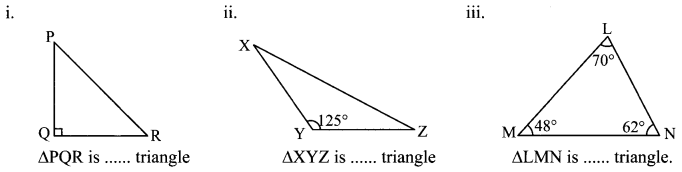
Observe the figures below and write the type of the triangle based on its angles:
Maharashtra Board Class 6 Maths Solutions Chapter 15 Triangles and their Properties Practice Set 36 1
Solution:
i. right angled
ii. Obtuse angled
iii. acute angled

Question 2.
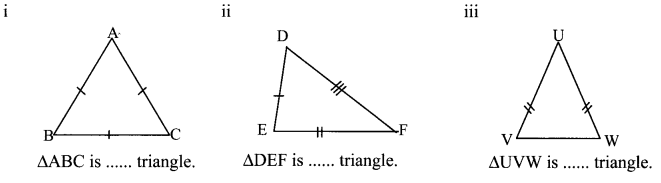
Observe the figures below and write the type of the triangle based on its sides:
Maharashtra Board Class 6 Maths Solutions Chapter 15 Triangles and their Properties Practice Set 36 2
Solution:
i. equilateral
ii. scalene
iii. isosceles

Question 3.
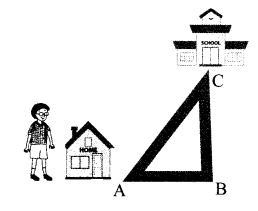
As shown in the figure, Avinash is standing near his house. He can choose from two roads to go to school. Which way is shorter? Explain why.
Maharashtra Board Class 6 Maths Solutions Chapter 15 Triangles and their Properties Practice Set 36 3
Solution:
The two roads which Avinash can choose to go to school are

  1. Road AB + Road BC
  2. Road AC

The three roads together form ∆ABC.
Road AC is shorter because the sum of the lengths of any two sides (side AB + side BC) of a triangle is always greater than the third side (side AC).

Question 4.
The lengths of the sides of some triangles are given. Say what types of triangles they are.

  1. 3 cm, 4 cm, 5 cm
  2. 3.4 cm, 3.4 cm, 5 cm
  3. 4.3 cm, 4.3 cm, 4.3 cm
  4. 3.7 cm, 3.4 cm, 4 cm

Solution:

  1. Since, no two sides have equal lengths, the given triangle is a scalene triangle.
  2. Since, two sides have equal length, the given triangle is an isosceles triangle.
  3. Since, all the three sides have equal lengths, the given triangle is an equilateral triangle.
  4. Since, no two sides have equal lengths, the given triangle is a scalene triangle.

Question 5.
The lengths of the three segments are given for constructing a triangle. Say whether a triangle with these sides can be drawn. Give the reason for your answer.
i. 17 cm, 7 cm, 8 cm
ii. 7 cm, 24 cm, 25 cm
iii. 9 cm, 6 cm, 16 cm
iv. 8.4 cm, 16.4 cm, 4.9 cm
v. 15 cm, 20 cm, 25 cm
vi. 12 cm, 12 cm, 16 cm
Solution:
i. The lengths of the three sides are 17 cm, 7 cm, 8 cm.
a. 7 cm + 17 cm = 24 cm, greater than 8 cm
b. 8 cm +17 cm = 25 cm, greater than 7 cm
c. 7 cm + 8 cm =15 cm, not greater than 17 cm
The sum of lengths of two sides in (c) is not greater than the length of the third side.
∴ Triangle cannot be drawn with sides 17 cm, 7 cm, 8 cm.

ii. The lengths of the three sides are 7 cm, 24 cm, 25 cm.
a. 7 cm + 24 cm = 31 cm, greater than 25 cm
b. 25 cm + 7 cm = 32 cm, greater than 24 cm
c. 24 cm + 25 cm = 49 cm, greater than 7 cm
The sum of lengths of two sides is greater than the length of the third side.
∴ Triangle can be drawn with sides 7 cm, 24 cm, 25 cm.

iii. The lengths of the three sides are 9 cm, 6 cm, 16 cm.
a. 9 cm + 16 cm = 25 cm, greater than 6 cm
b. 6 cm + 16 cm = 22 cm, greater than 9 cm
c. 9 cm+ 6 cm =15 cm, not greater than 16 cm
The sum of lengths of two sides in (c) is not greater than the length of the third side.
∴ Triangle cannot be drawn with sides 9 cm, 6 cm, 16 cm.

iv. The lengths of the three sides are 8.4 cm, 16.4 cm, 4.9 cm.
a. 8.4 cm + 16.4 cm = 24.8 cm, greater than 4.9 cm
b. 4.9 cm + 16.4 cm = 21.3 cm, greater than 8.4 cm
c. 8.4 cm + 4.9 cm = 13.3 cm, not greater than 16.4 cm
The sum of lengths of two sides in (c) is not greater than the length of the third side.
∴ Triangle cannot be drawn with sides 8.4 cm, 16.4 cm, 4.9 cm.

v. The lengths of the three sides are 15 cm, 20 cm, 25 cm.
a. 15 cm + 20 cm = 35 cm, greater than 25 cm
b. 25 cm + 20 cm = 45 cm, greater than 15 cm
c. 15 cm + 25 cm = 40 cm, greater than 20 cm
The sum of lengths of two sides is greater than the length of the third side.
∴ Triangle can be drawn with sides 15 cm, 20 cm, 25 cm.

vi. The lengths of the three sides are 12 cm, 12 cm, 16 cm.
a. 12 cm + 12 cm = 24 cm, greater than 16 cm
b. 12 cm + 16 cm = 28 cm, greater than 12 cm
c. 12 cm + 16 cm = 28 cm, greater than 12 cm
The sum of lengths of two sides is greater than the length of the third side.
∴ Triangle can be drawn with sides 12 cm, 12 cm, 16 cm.

Maharashtra Board Class 6 Maths Chapter 15 Triangles and their Properties Practice Set 36 Intext Questions and Activities

Question 1.
In the given figure, some points and some line segments joining them have been drawn. Which of these figures is a triangle? Which figure is not a triangle? Why not? (Textbook pg. no. 77)
Maharashtra Board Class 6 Maths Solutions Chapter 15 Triangles and their Properties Practice Set 36 4
Solution:
ABC it is a closed figure with three sides. Hence, ABC is a triangle.
PQRS has three sides but it is not a closed figure. Hence, PQRS is not a triangle.

Question 2.
As seen above, ∆ABC has three sides. Line segment AB is one side. Write the names of the other two sides. ∆ABC has three angles. ∠ABC is one among them. Write the names of the other angles. (Textbook pg. no. 77)
Solution:
The names of other two sides are: seg BC and seg AC
The names of other angles are: ∠BCA and ∠CAB

Question 3.
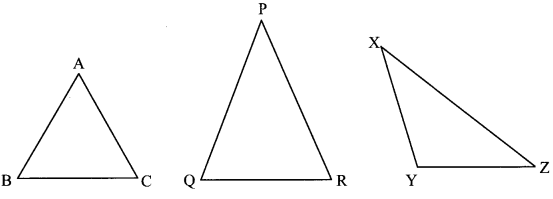
Measure the sides of the following triangles in centimeters, using a divider and ruler. Enter the lengths in the table below. What do you observe? (Textbook pg. no. 77)
Maharashtra Board Class 6 Maths Solutions Chapter 15 Triangles and their Properties Practice Set 36 5

In ∆ABCIn ∆PQRIn ∆XYZ
l (AB) =       cml (QR) =       cml (XY) =       cm
l (BC) =       cml (PQ) =       cml (YZ) =       cm
l (AC) =       cml (PR) =        cml (XZ) =       cm

Solution:

In ∆ABCIn ∆PQRIn ∆XYZ
l (AB) = 2.6 cml (QR) = 2.8 cml (XY) = 2.8 cm
l (BC) = 2.6 cml (PQ) = 3.8 cml (YZ) = 2.6 cm
l (AC) = 2.6 cml (PR) = 3.8 cml (XZ) = 4.3 cm

We observe that,

  1. ∆ABC is an equilateral triangle,
  2. ∆PQR is an isosceles triangle, and
  3. ∆XYZ is a scalene triangle.

Question 4.
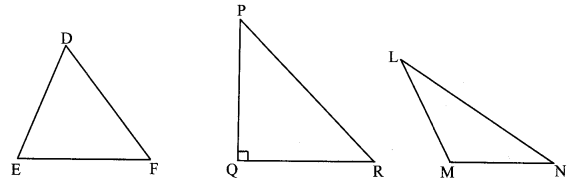
Measure all the angles of the triangles given below. Enter them in the following table. (Textbook pg. no. 78)
Maharashtra Board Class 6 Maths Solutions Chapter 15 Triangles and their Properties Practice Set 36 6

In ∆DEFIn ∆PQRIn ∆LMN
Measure of ∠D = m ∠D =___Measure of ∠P = m ∠P =___Measure of ∠L =__
Measure of ∠E = m ∠E =___Measure of ∠Q =___=___Measure of ∠M =___
Measure of ∠F = ___=___Measure of ∠R =___=___Measure of ∠N =___
Observation:
All three angles are acute angles.
Observation:
One angle is right angle and two are acute angles.
Observation:
One angle is an obtuse angle and two are acute.

Solution:

In ∆DEFIn ∆PQRIn ∆LMN
Measure of ∠D = m ∠D = 60ºMeasure of ∠P = m ∠P = 45ºMeasure of ∠L = 30º
Measure of ∠E = m ∠E = 68ºMeasure of ∠Q = m = 90ºMeasure of ∠M = 116º
Measure of ∠F = m = 52ºMeasure of ∠R = m ∠R = 45ºMeasure of ∠N = 34º
  1. ADEF is an acute angled triangle,
  2. APQR is a right angled triangle,
  3. ALMN is an obtuse angled triangle.

Question 5.
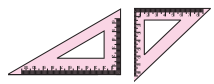
Observe the set squares in your compass box. What kind of triangles are they? (Textbook pg. no. 78)
Maharashtra Board Class 6 Maths Solutions Chapter 15 Triangles and their Properties Practice Set 36 7
Solution:
The first set square is a scalene triangle and also a right angled triangle.
The second set square is an isosceles triangle and also a right angled triangle.

Question 6.
Properties of a triangle. (Textbook pg. no. 79)
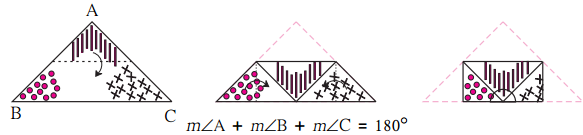
Take a triangular piece of paper. Choose three different colors or signs to mark the three comers of the triangle on both sides of the paper. Fold the paper at the midpoints of two sides as observe?
Maharashtra Board Class 6 Maths Solutions Chapter 15 Triangles and their Properties Practice Set 36 8
Solution:
The three angles of the triangle form a straight angle.
∴ m∠A + m∠B + m∠C = 180°
Hence, the sum of the measures of the angles of a triangle is 180°.

Question 7.
Properties of a triangle (Textbook pg. no. 79)
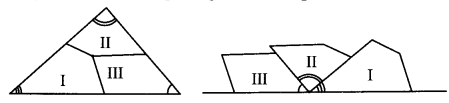
Take a triangular piece of paper and make three different types of marks near the three angles. Take a point approximately at the center of the triangle. From this point, draw three lines that meet the three sides. Cut the paper along those lines. Place the three angles side by side as shown. See how the three angles of a triangle together form a straight angle, or, an angle that measures 180°.
Maharashtra Board Class 6 Maths Solutions Chapter 15 Triangles and their Properties Practice Set 36 10
Solution:
The three angles of the triangle form a straight angle.
Hence, the sum of the measures of the angles of a triangle is 180°.

Question 8.
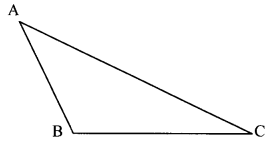
Draw any triangle on a paper. Name its vertices A, B, C. Measure the lengths of its three sides using a divider and scale and enter them in the table. (Textbook pg. no. 79)

Length of sideSum of the lengths of two sidesLength of the third side
l (AB) =         cml (AB) + l (BC) =         cml (AC) =         cm
l (BC) =         cml (BC) + l (AC) =         cml (AB) =         cm
l (AC) =         cml (AC) + l (AB) =        cml (BC) =         cm

Solution:
Maharashtra Board Class 6 Maths Solutions Chapter 15 Triangles and their Properties Practice Set 36 9

Length of sideSum of the lengths of two sidesLength of the third side
l (AB) = 2.7 cml (AB) + l (BC) = 6.6 cml (AC) = 5.6 cm
l (BC) = 2.9 cml (BC) + l (AC) = 9.5 cml (AB) = 2.7 cm
l (AC) = 5.6 cml (AC) + l (AB) = 8.3 cml (BC) = 3.9 cm

6th Std Maths Digest Pdf Download

Practice Set 14 Class 6 Answers Maths Chapter 5 Decimal Fractions Maharashtra Board

Decimal Fractions Class 6 Maths Chapter 5 Practice Set 14 Solutions Maharashtra Board

Balbharti Maharashtra State Board Class 6 Maths Solutions covers the Std 6 Maths Chapter 5 Decimal Fractions Class 6 Practice Set 14 Answers Solutions.

Std 6 Maths Practice Set 14 Solutions Answers

Question 1.
In the table below, write the place value of each of the digits in the number 378.025.

PlaceHundredsTensUnitsTenthsHundredthsThousandths
100101\(\frac { 1 }{ 10 }\)\(\frac { 1 }{ 100 }\)\(\frac { 1 }{ 1000 }\)
Digit378025
Place value300\(\frac { 0 }{ 10 }=0\)\(\frac { 5 }{ 1000 }\)
= 0.005

Solution:

PlaceHundredsTensUnitsTenthsHundredthsThousandths
100101\(\frac { 1 }{ 10 }\)\(\frac { 1 }{ 100 }\)\(\frac { 1 }{ 1000 }\)
Digit378025
Place value3007 × 10 = 708 × 1 = 8\(\frac { 0 }{ 10 }=0\)\(\frac { 2 }{ 100 }\)
= 0.02
\(\frac { 5 }{ 1000 }\)
= 0.005

Question 2.
Solve :
i. 905.5 + 27.197
ii. 39 + 700.65
iii. 40 + 27.7 + 2.451
Solution:
i. 905.5 + 27.197
Maharashtra Board Class 6 Maths Solutions Chapter 5 Decimal Fractions Practice Set 14 1

ii. 39 + 700.65
Maharashtra Board Class 6 Maths Solutions Chapter 5 Decimal Fractions Practice Set 14 2

iii. 40 + 27.7 + 2.451
Maharashtra Board Class 6 Maths Solutions Chapter 5 Decimal Fractions Practice Set 14 3

Question 3.
Subtract:
i. 85.96 – 2.345
ii. 632.24 – 97.45
iii. 200.005 – 17.186
Solution:
i. 85.96 – 2.345
Maharashtra Board Class 6 Maths Solutions Chapter 5 Decimal Fractions Practice Set 14 4

ii. 632.24 – 97.45
Maharashtra Board Class 6 Maths Solutions Chapter 5 Decimal Fractions Practice Set 14 5

iii. 200.005 – 17.186
Maharashtra Board Class 6 Maths Solutions Chapter 5 Decimal Fractions Practice Set 14 6

Question 4.
Avinash traveled 42 km 365 m by bus, 12 km 460 in by car and walked 640 m. How many kilometers did he travel altogether? (Write your answer in decimal fractions)
Solution:
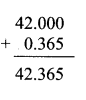
Distance traveled in bus = 42 km 365 m
= 42 km + \(\frac { 365 }{ 1000 }\) km
= 42 km + 0.365 km
Maharashtra Board Class 6 Maths Solutions Chapter 5 Decimal Fractions Practice Set 14 7
= 42.365 km
Distance travelled in car = 12 km 460 m
= 12 km + \(\frac { 460 }{ 1000 }\) km
= 12 km + 0.460 km
Maharashtra Board Class 6 Maths Solutions Chapter 5 Decimal Fractions Practice Set 14 8
= 12.460 km
Distance walked = 640 m
= \(\frac { 640 }{ 1000 }\) = 0.640 km
∴ Total distance travelled = Distance travelled in bus + Distance travelled in car + Distance walked
= 42.365 + 12.460 + 0.640
Maharashtra Board Class 6 Maths Solutions Chapter 5 Decimal Fractions Practice Set 14 9
= 55.465 km
∴ Distance travelled altogether by Avinash is 55.465 km.

Question 5.
Ayesha bought 1.80 m of cloth for her salwaar and 2.25 for her kurta. If the cloth costs Rs 120 per metre, how much must she pay the shopkeeper?
Solution:
Total length of cloth bought = 1.80 m + 2.25 m
= 4.05 m
Maharashtra Board Class 6 Maths Solutions Chapter 5 Decimal Fractions Practice Set 14 10
Cost of 1 m of cloth = Rs 120
∴ Cost of 4.05 m of cloth = 4.05 x 120
Maharashtra Board Class 6 Maths Solutions Chapter 5 Decimal Fractions Practice Set 14 11
∴ Amount to be paid to the shopkeeper is Rs 486.

Question 6.
Sujata bought a watermelon weighing 4.25 kg and gave 1 kg 750 g to the children in her neighbourhood. How much of it does she have left?
Solution:
Total weight of watermelon = 4.25 kg
Weight of watermelon given to children = 1 kg 750 g
= 1 kg + \(\frac { 750 }{ 1000 }\) kg
= 1 kg + 0.75 kg
Maharashtra Board Class 6 Maths Solutions Chapter 5 Decimal Fractions Practice Set 14 12
= 1.75 kg
∴ Weight of watermelon left = Total weight of watermelon – Weight of watermelon given to children
= 4.25 kg – 1.75 kg
Maharashtra Board Class 6 Maths Solutions Chapter 5 Decimal Fractions Practice Set 14 13
= 2.5 kg
∴ Weight of watermelon left with Sujata is 2.5 kg.

Question 7.
Anita was driving at a speed of 85.6 km per hour. The road had a speed limit of 55 km per hour. By how much should she reduce her speed to be within the speed limit?
Solution:
Speed at which Anita is driving = 85.6 km per hr.
Speed limit = 55 km per hr.
∴ Anita should reduce her speed by 85.6 km per hr – 55 km per hr.
Maharashtra Board Class 6 Maths Solutions Chapter 5 Decimal Fractions Practice Set 14 14
= 30.6 km per hr.
∴ Anita should reduce her speed by 30.6 km per hour to be within the speed limit.

Maharashtra Board Class 6 Maths Chapter 4 Operations on Fractions Practice Set 14 Intext Questions and Activities

Question 1.
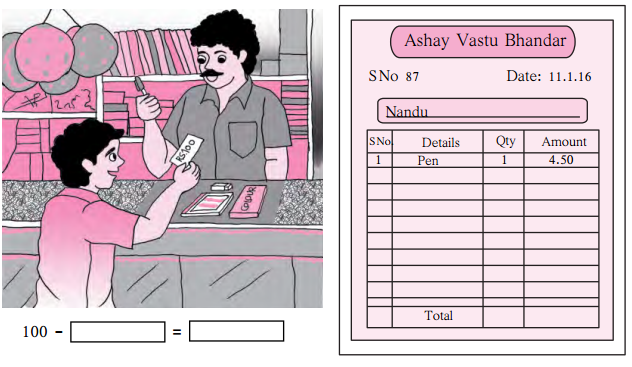
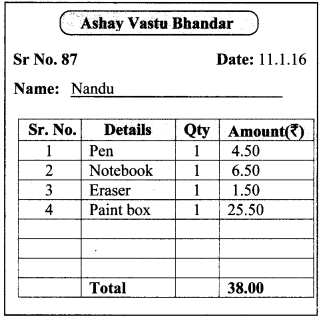
Nandu went to a shop to buy a pen, notebook, eraser and a paint box. The shopkeeper told him the prices. A pen costs four and a half rupees, an eraser one and a half, a notebook six and a half and a paintbox twenty-five rupees and fifty paise. Nandu bought one of each article. Prepare his bill.
If Nandu gave a 100 rupee note, how much money does he get back? (Textbook pg. no. 29)
Maharashtra Board Class 6 Maths Solutions Chapter 5 Decimal Fractions Practice Set 14 15
Nandu will get __ rupees back.
Solution:
100 – 38 = 62.00
Nandu will get Rs 62 rupees back.
Maharashtra Board Class 6 Maths Solutions Chapter 5 Decimal Fractions Practice Set 14 16

Question 2.
Take a pen and notebook with you when you go to the market with your parent. Note the weight of every vegetable your mother buys. Find out the total weight of those vegetables. (Textbook pg. no. 30)
Solution:
(Students should attempt this activity on their own.)

6th Std Maths Digest Pdf Download

Practice Set 2 Class 6 Answers Maths Chapter 2 Angles Maharashtra Board

Angles Class 6 Maths Chapter 2 Practice Set 2 Solutions Maharashtra Board

Balbharti Maharashtra State Board Class 6 Maths Solutions covers the Std 6 Maths Chapter 2 Angles Class 6 Practice Set 2 Answers Solutions.

Std 6 Maths Practice Set 2 Solutions Answers

Question 1.
Match the following:

Measure of the angleType of the angle
i.180°a.Zero angle
ii.240°b.Straight angle
iii.360°c.Reflex angle
iv.d.Complete angle

Solution:
(i – Straight Angle),
(ii – Reflex Angle),
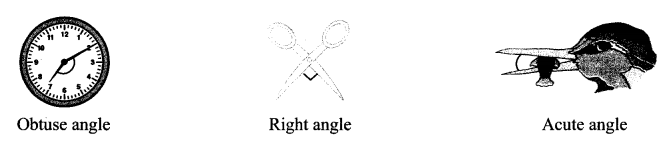
(iii – Complete Angle),
(iv – Zero Angle).

Question 2.
The measures of some angles are given below. Write the type of each angle:

  1. 75°
  2. 215°
  3. 360°
  4. 180°
  5. 120°
  6. 148°
  7. 90°

Solution:

  1. Acute angle
  2. Zero angle
  3. Reflex angle
  4. Complete angle
  5. Straight angle
  6. Obtuse angle
  7. Obtuse angle
  8. Right angle

Question 3.
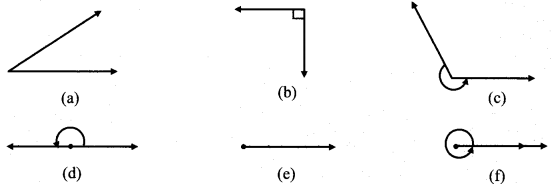
Look at the figures below and write the type of each of the angles:
Maharashtra Board Class 6 Maths Solutions Chapter 2 Angles Practice Set 2 1
Solution:
a. Acute angle
b. Right angle
c. Reflex angle
d. Straight angle
e. Zero angle
f. Complete angle

Question 4.
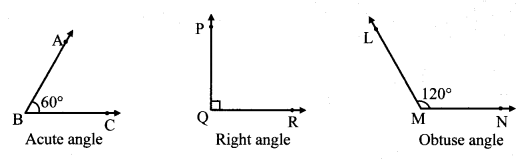
Use a protractor to draw an acute angle, a right angle and an obtuse angle:
Solution:
Maharashtra Board Class 6 Maths Solutions Chapter 2 Angles Practice Set 2 2
[Note: Students may draw acute and obtuse angles of measure other than the ones given.]

Maharashtra Board Class 6 Maths Chapter 2 Angles Practice Set 2 Intext Questions and Activities

Question 1.
Look at the angles shown in the pictures below. Identify the type of angle and write its name below the picture: (Textbook pg. no. 6)
Maharashtra Board Class 6 Maths Solutions Chapter 2 Angles Practice Set 2 3
Solution:
Maharashtra Board Class 6 Maths Solutions Chapter 2 Angles Practice Set 2 4

Question 2.
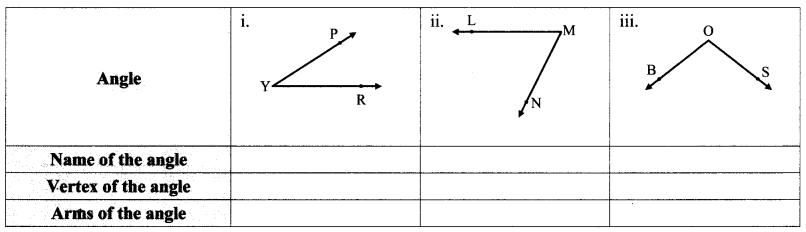
Complete the following table: (Textbook pg. no. 6)
Maharashtra Board Class 6 Maths Solutions Chapter 2 Angles Practice Set 2 5
Solution:

Sr. No.i.ii.iii.
Name of the angle∠PYR or ∠RYP∠LMN or ∠NML∠BOS or ∠SOB
Vertex of the angleYMO
Arms of the angleYP and YRML and MNOB and OS

6th Std Maths Digest Pdf Download

Practice Set 29 Class 6 Answers Maths Chapter 11 Ratio-Proportion Maharashtra Board

Ratio-Proportion Class 6 Maths Chapter 11 Practice Set 29 Solutions Maharashtra Board

Balbharti Maharashtra State Board Class 6 Maths Solutions covers the Std 6 Maths Chapter 11 Ratio-Proportion Class 6 Practice Set 29 Answers Solutions.

Std 6 Maths Practice Set 29 Solutions Answers

Question 1.
If 20 metres of cloth costs Rs 3600, find the cost of 16 m of cloth.
Solution:
Cost of 20 metres of cloth = Rs 3600
∴ Cost of 1 metre of cloth = \(\frac{\text { cost of } 20 \text { metres of cloth }}{20}=\frac{3600}{20}\)
= Rs 180
∴ Cost of 16 metres of cloth = Cost of 1 metre of a cloth × 16
= 180 x 16 = Rs 2880
∴ The cost of 16 metres of cloth is Rs 2880.

Question 2.
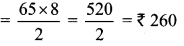
Find the cost of 8 kg of rice, if the cost of 10 kg is Rs 325.
Solution:
Cost of 10 kg rice = Rs 325
∴ Cost of 10 kg rice
Maharashtra Board Class 6 Maths Solutions Chapter 11 Ratio-Proportion Practice Set 29 1
Cost of 8 kg rice = Cost of 1 kg rice x 8
Maharashtra Board Class 6 Maths Solutions Chapter 11 Ratio-Proportion Practice Set 29 2
∴ The cost of 8 kg rice is Rs 260.

Question 3.
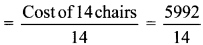
If 14 chairs cost Rs 5992, how much will have to be paid for 12 chairs?
Solution:
Cost of 14 chairs = Rs 5992
∴ Cost of 1 chairs
Maharashtra Board Class 6 Maths Solutions Chapter 11 Ratio-Proportion Practice Set 29 3
= Rs 428
∴ Cost of 12 chairs = Cost of 1 chair x 12
= 428 x 12 = Rs 5136
∴ The amount to be paid for 12 chairs is Rs 5136.

Question 4.
The weight of 30 boxes is 6 kg. What is the weight of 1080 such boxes?
Solution:
Weight of 30 boxes = 6 kg
∴ Weight of 1 box
Maharashtra Board Class 6 Maths Solutions Chapter 11 Ratio-Proportion Practice Set 29 4
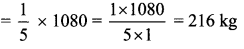
∴ Weight of 1080 boxes = Weight of 1 box x 1080
Maharashtra Board Class 6 Maths Solutions Chapter 11 Ratio-Proportion Practice Set 29 5
∴ The weight of 1080 boxes is 216 kg.

Question 5.
A car travelling at a uniform speed covers a distance of 165 km in 3 hours. At that same speed,
a. How long will it take to cover a distance of 330 km?
b. How far will it travel in 8 hours?
Solution:
Distance covered in 3 hours = 165 km
Distance covered in 1 hour
Maharashtra Board Class 6 Maths Solutions Chapter 11 Ratio-Proportion Practice Set 29 6
= 55 km
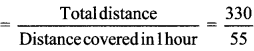
a. Time required to covered a distance of 330 km
Maharashtra Board Class 6 Maths Solutions Chapter 11 Ratio-Proportion Practice Set 29 7
= 6 hours
∴ The time required to cover a distance of 330 km is 6 hours.

b. Distance traveled in 8 hours = Distance covered in 1 hour x 8
= 55 x 8 = 440 km
∴ The distance traveled in 8 hours is 440 km.

Question 6.
A tractor uses up 12 litres of diesel while ploughing 3 acres of land. How much diesel will be needed to plough 19 acres of land?
Solution:
Diesel required to plough 3 acres of land =12 litres
∴ Diesel required to plough 1 acre of land
Maharashtra Board Class 6 Maths Solutions Chapter 11 Ratio-Proportion Practice Set 29 8
= 4 liters
∴ Diesel required to plough 19 acres of land = Diesel required to plough 1 acre of land x 19
= 4 x 19 = 76 litres
∴ Diesel needed to plough 19 acres of land is 76 litres.

Question 7.
At a sugar factory, 5376 kg of sugar can be obtained from 48 tonnes of sugarcane. If Savitatai has grown 50 tonnes of sugarcanes, how much sugar will it yield?
Solution:
Sugar obtained from 48 tonnes of sugarcane = 5376 kg
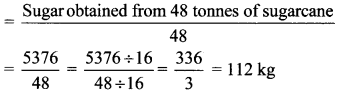
∴ Sugar obtained from 48 tonnes of sugarcane
Maharashtra Board Class 6 Maths Solutions Chapter 11 Ratio-Proportion Practice Set 29 9
∴ Sugar obtained from 50 tonnes of sugarcane = Sugar obtained from 1 tonne of sugarcane x 50
= 112 x 50 = 5600 kg
∴ 50 tonnes of sugarcane will yield 5600 kg of sugar.

Question 8.
In an orchard, there are 128 mango trees in 8 rows. If all the rows have an equal number of trees, how many trees would there be in 13 rows?
Solution:
Number of mango trees in 8 rows =128
Number of mango trees in 1 row
Maharashtra Board Class 6 Maths Solutions Chapter 11 Ratio-Proportion Practice Set 29 10
∴ Number of mango trees in 13 rows = Number of mango trees in 1 row x 13
= 16 x 13 = 208
∴ The number of mango trees in 13 rows are 208.

Question 9.
A pond in a field holds 120000 litres of water. It costs Rs 18000 to make such a pond. How many ponds will be required to store 480000 litres of water, and what would be the expense?
Solution:
Capacity of 1 pond = 1,20,000 litres
Total quantity of water = 4,80,000 litres
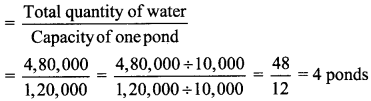
∴ Number of ponds required
Maharashtra Board Class 6 Maths Solutions Chapter 11 Ratio-Proportion Practice Set 29 11
Amount required to make 1 pond = Rs 18,000
∴ Amount required to make 4 ponds = Amount required to make 1 pond x 4
= 18,000 x 4 = Rs 72,000
∴ The number of ponds required to store 4,80,000 litres of water is 4, and the expense incurred in making the ponds is Rs 72,000.

Maharashtra Board Class 6 Maths Chapter 11 Ratio-Proportion Practice Set 29 Intext Questions and Activities

Question 1.
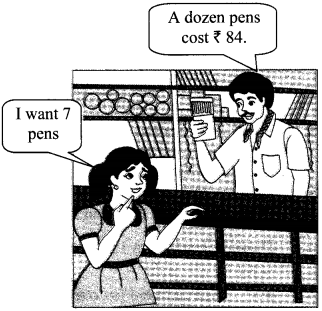
Vijaya wanted to gift pens to seven of her friends on her birthday. When she went to a shop to buy them, the shopkeeper told her the rate for a dozen pens.
i. Can you help Vijaya to find the cost of 7 pens?
ii. If you find the cost of one pen, you can also find the cost of 7, right? (Textbook pg. no. 59)
Maharashtra Board Class 6 Maths Solutions Chapter 11 Ratio-Proportion Practice Set 29 12
Solution:
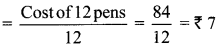
Cost of 12 pens = Rs 84.
∴ Cost of 12 pens
Maharashtra Board Class 6 Maths Solutions Chapter 11 Ratio-Proportion Practice Set 29 13
∴ Cost of 7 pens = Cost of one pen x Number of pens = 7 × 7
∴ Cost of 7 pens = Rs 49
∴ The cost of 7 pens (Rs 49) can be found by unitary method.

6th Std Maths Digest Pdf Download

Practice Set 26 Class 6 Answers Maths Chapter 10 Equations Maharashtra Board

Equations Class 6 Maths Chapter 10 Practice Set 26 Solutions Maharashtra Board

Balbharti Maharashtra State Board Class 6 Maths Solutions covers the Std 6 Maths Chapter 10 Equations Class 6 Practice Set 26 Answers Solutions.

Std 6 Maths Practice Set 26 Solutions Answers

Question 1.
Different mathematical operations are given in the two rows below. Find out the number you get in each operation and make equations.

    1. 16 ÷ 2,
    2. 5 × 2,
    3. 9 + 4,
    4. 72 ÷ 3,
    5. 4 + 5,
  1. 8 × 3,
  2. 19 – 10,
  3. 10 – 2,
  4. 37 – 27,
  5. 6 + 7

Solution:

  1. 16 ÷ 2 = 8
  2. 5 × 2 = 10
  3. 9 + 4 = 13
  4. 72 ÷ 3 = 24
  5. 4 + 5 = 9
  6. 8 × 3 = 24
  7. 19 – 10 = 9
  8. 10 – 2 = 8
  9. 37 – 27 = 10
  10. 6 + 7 = 13

∴ The equations are

  1. 16 ÷ 2 = 10 – 2
  2. 5 × 2 = 37 – 27
  3. 9 + 4 = 6 + 7
  4. 72 ÷ 3 = 8 x 3
  5. 4 + 5 = 19 – 10

6th Std Maths Digest Pdf Download