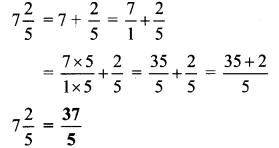
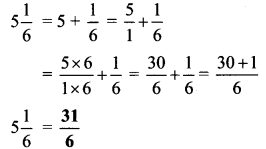
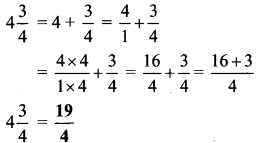
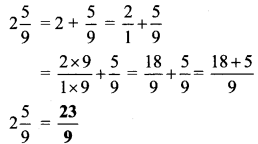
Practice Set 20 Class 6 Answers Maths Chapter 7 Symmetry Maharashtra Board

Symmetry Class 6 Maths Chapter 7 Practice Set 20 Solutions Maharashtra Board

Balbharti Maharashtra State Board Class 6 Maths Solutions covers the Std 6 Maths Chapter 7 Symmetry Class 6 Practice Set 20 Answers Solutions.

Std 6 Maths Practice Set 20 Solutions Answers

Question 1.
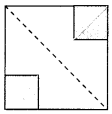
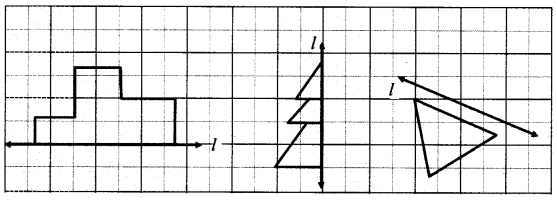
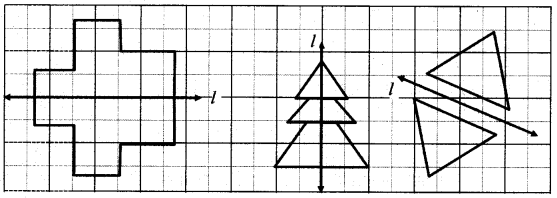
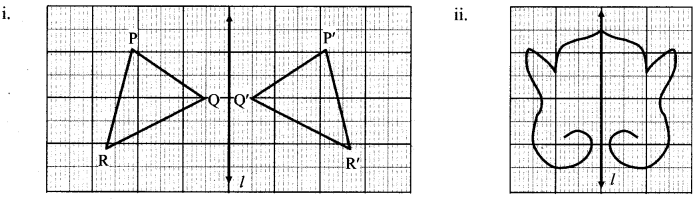
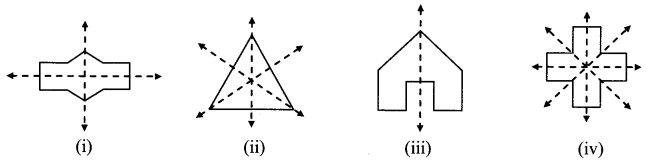
Draw the axes of symmetry of each of the figures below. Which of them has more than one axis of symmetry?
Maharashtra Board Class 6 Maths Solutions Chapter 7 Symmetry Practice Set 20 1
Solution:
Maharashtra Board Class 6 Maths Solutions Chapter 7 Symmetry Practice Set 20 2
Figures (i), (ii) and (iv) have more than one axis of symmetry.

Question 2.
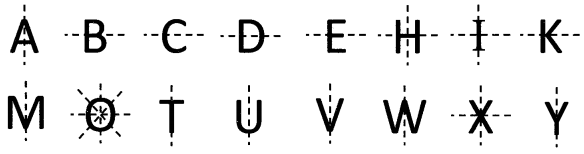
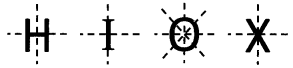
Write the capital letters of the English alphabet in your notebook. Try to draw their axes of symmetry. Which ones have an axis of symmetry? Which ones have more than one axis of symmetry?
Solution:
Alphabets having axis of symmetry:
Maharashtra Board Class 6 Maths Solutions Chapter 7 Symmetry Practice Set 20 3
Alphabets having more than one axis of symmetry:
Maharashtra Board Class 6 Maths Solutions Chapter 7 Symmetry Practice Set 20 4

Question 3.
Use color, a thread and a folded paper to draw symmetrical shapes.
Solution:
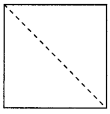
Take any color, a thread and a folded square paper.
Step 1:
Take a folded square paper which is folded along one of its axis of symmetry.
Maharashtra Board Class 6 Maths Solutions Chapter 7 Symmetry Practice Set 20 5

Step 2:
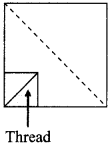
Open the paper. Draw a square in one comer. Place the thread in the square drawn and apply colour on it as shown in the figure.
Maharashtra Board Class 6 Maths Solutions Chapter 7 Symmetry Practice Set 20 6

Step 3:
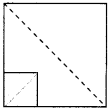
Remove the thread. You will see a white patch where the thread was.
Maharashtra Board Class 6 Maths Solutions Chapter 7 Symmetry Practice Set 20 7

Step 4:
Fold the paper and press it along the axis of symmetry. When you unfold the paper, you will see an imprint on the other side of the fold which is identical to the color patch you had made earlier.
Maharashtra Board Class 6 Maths Solutions Chapter 7 Symmetry Practice Set 20 8

Question 4.
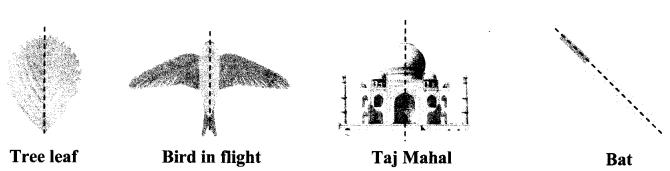
Observe various commonly seen objects such as tree leaves, birds in flight, pictures of historical buildings, etc. Find symmetrical shapes among them and make a collection of them.
Solution:
Some of the symmetrical objects seen in daily life are shown below:
Maharashtra Board Class 6 Maths Solutions Chapter 7 Symmetry Practice Set 20 9

Maharashtra Board Class 6 Maths Chapter 7 Symmetry Practice Set 20 Intext Questions and Activities

Question 1.
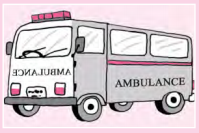
Do you recognize this picture?
Why do you think the letters written on the front of the vehicle are written the way they are? Copy them on a paper. Hold the paper in front of a mirror and read it.
Do you see letters written like this anywhere else?
(Textbook pg. no. 40)
Maharashtra Board Class 6 Maths Solutions Chapter 7 Symmetry Practice Set 20 10
Solution:

  1. The name written in reverse alphabets on the vehicle reads
    as ‘AMBULANCE’ when viewed in the mirror.
    In the case of an emergency, it helps a driver to quickly notice an ambulance by looking into his rear view mirror and read the reverse alphabets which appear perfectly normal in a mirror
  2. Other than ambulance, we see letters written in reverse on school bus.

6th Std Maths Digest Pdf Download

Practice Set 40 Class 6 Answers Maths Chapter 17 Geometrical Constructions Maharashtra Board

Geometrical Constructions Class 6 Maths Chapter 17 Practice Set 40 Solutions Maharashtra Board

Balbharti Maharashtra State Board Class 6 Maths Solutions covers the Std 6 Maths Chapter 17 Geometrical Constructions Class 6 Practice Set 40 Answers Solutions.

Std 6 Maths Practice Set 40 Solutions Answers

Question 1.
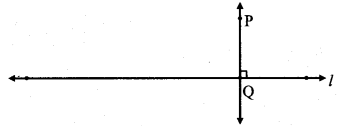
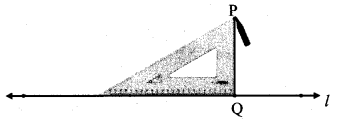
Draw line l. Take point P anywhere outside the line. Using a set square draw a line PQ perpendicular to line l.
Solution:
Step 1:
Maharashtra Board Class 6 Maths Solutions Chapter 17 Geometrical Constructions Practice Set 40 1

Step 2:
Maharashtra Board Class 6 Maths Solutions Chapter 17 Geometrical Constructions Practice Set 40 2
line PQ ⊥ line l.

Question 2.
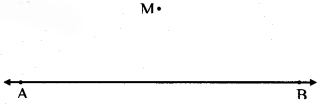
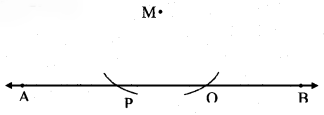
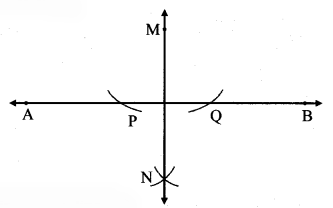
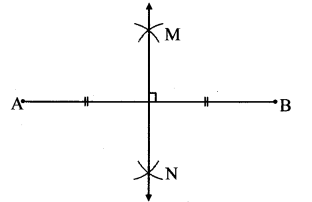
Draw line AB. Take point M anywhere outside the line. Using a compass and ruler, draw a line MN perpendicular to line AB.
Solution:
Step 1:
Maharashtra Board Class 6 Maths Solutions Chapter 17 Geometrical Constructions Practice Set 40 3

Step 2:
Maharashtra Board Class 6 Maths Solutions Chapter 17 Geometrical Constructions Practice Set 40 4

Step 3:
Maharashtra Board Class 6 Maths Solutions Chapter 17 Geometrical Constructions Practice Set 40 5
line MN ⊥ line AB.

Question 3.
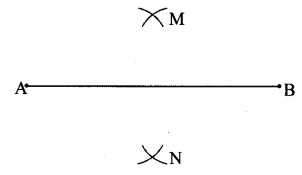
Draw a line segment AB of length 5.5 cm. Bisect it using a compass and ruler.
Solution:
Step 1:
Maharashtra Board Class 6 Maths Solutions Chapter 17 Geometrical Constructions Practice Set 40 6

Step 2:
Maharashtra Board Class 6 Maths Solutions Chapter 17 Geometrical Constructions Practice Set 40 7
line MN is the perpendicular bisector of seg AB.

Question 4.
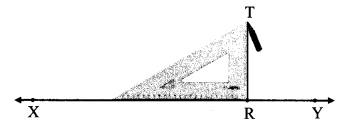
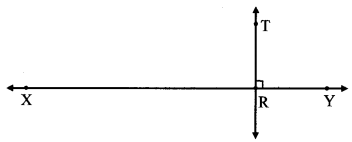
Take point R on line XY. Draw a perpendicular to XY at R, using a set square.
Solution:
Step 1:
Maharashtra Board Class 6 Maths Solutions Chapter 17 Geometrical Constructions Practice Set 40 8

Step 2:
Maharashtra Board Class 6 Maths Solutions Chapter 17 Geometrical Constructions Practice Set 40 9
line TR ⊥ line XY.

Maharashtra Board Class 6 Maths Chapter 17 Geometrical Constructions Practice Set 40 Questions and Activities

Question 1.
In the above construction, why must the distance in the compass be kept constant? (Textbook pg. no. 90)
Solution:
The point N is at equal distance from points P and Q.
If we change the distance of the compass while drawing arcs from points P and Q, we will not get a point which is at equal distance from P and Q. Hence, the distance in the compass must be kept constant.

Question 2.
The Perpendicular Bisector. (Textbook pg. no. 90)
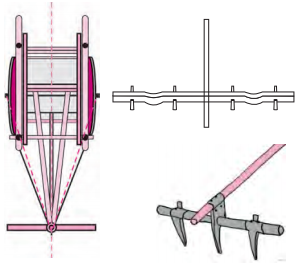
Maharashtra Board Class 6 Maths Solutions Chapter 17 Geometrical Constructions Practice Set 40 10

  1. A wooden ‘yoke’ is used for pulling a bullock cart. How is the position of the yoke determined?
  2. To do that, a rope is used to measure equal distances from the spine/midline of the bullock cart. Which geometrical property is used here?
  3. Find out from the craftsmen or from other experienced persons, why this is done.

Solution:

  1. For the bullock cart to be pulled in the correct direction by the yoke, its Centre O should be equidistant from the either sides of the cart.
  2. The property of perpendicular bisector is used to make the point equidistant from both the ends
  3. A rope is used just like a compass to get equal distances from the spine/midline of bullock cart.

Question 3.
Take a rectangular sheet of paper. Fold the paper so that the lower edge of the paper falls on its top edge, and fold it over again from right to left. Observe the two folds that have formed on the . paper. Verify that each fold is a perpendicular bisector of the other. Then measure the following distances. (Textbook pg. no. 91)
i. l(XP)
ii. l(XA)
iii. l(XB)
iv. l(YP)
v. l(YA)
Maharashtra Board Class 6 Maths Solutions Chapter 17 Geometrical Constructions Practice Set 40 11
You will observe that l(XP) = l(YP), l(XA) = l(YA) and l(XB) = l(YB)
Therefore we can conclude that all points on the vertical fold (perpendicular bisector) are equidistant from the endpoints of the horizontal fold.
Solution:
[Note: Students should attempt this activity on their own.]

6th Std Maths Digest Pdf Download

Practice Set 19 Class 6 Answers Maths Chapter 6 Bar Graphs Maharashtra Board

Bar Graphs Class 6 Maths Chapter 6 Practice Set 19 Solutions Maharashtra Board

Balbharti Maharashtra State Board Class 6 Maths Solutions covers the Std 6 Maths Chapter 6 Bar Graphs Class 6 Practice Set 19 Answers Solutions.

Std 6 Maths Practice Set 19 Solutions Answers

Question 1.
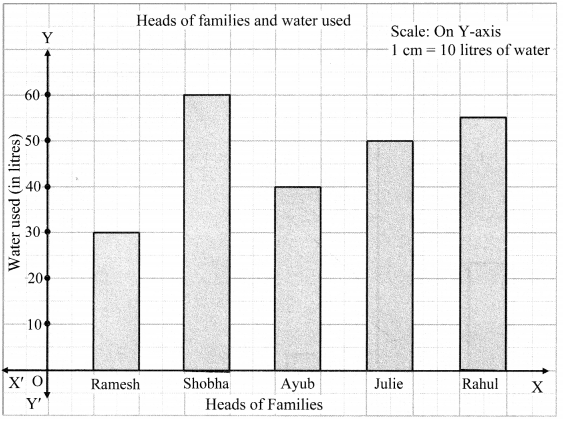
The names of the heads of some families in a village and the quantity of drinking water their family consumes in one day are given below. Draw a bar graph for this data.
(Scale: On Y axis. 1 cm = 10 liters of water)

NameRameshShobhaAyubJulieRahul
Liters of water Used30 L60 L40 L50L55 L

Solution:
Maharashtra Board Class 6 Maths Solutions Chapter 6 Bar Graphs Practice Set 19 1

Question 2.
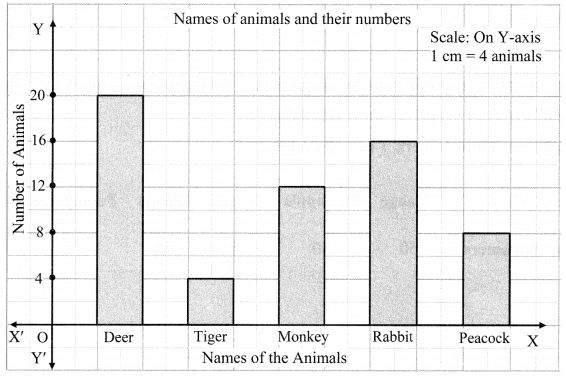
The names and numbers of animals in a certain zoo are given below. Use the data to make a bar graph. (Scale: On Y axis, 1 cm = 4 animals).

AnimalsDeerTigerMonkeyRabbitPeacock
Number20412168

Solution:
Maharashtra Board Class 6 Maths Solutions Chapter 6 Bar Graphs Practice Set 19 2

Question 3.
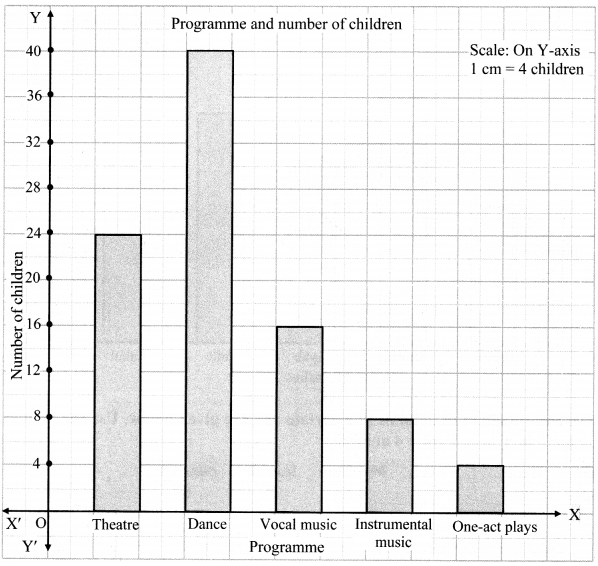
The table below gives the number of children who took part in the various items of the talent show as part of the annual school gathering. Make a bar graph to show this data.
(Scale: On Y-axis, 1 cm = 4 children)

ProgrammeTheaterDanceVocal musicInstrumental musicOne-act plays
Number of Children24401684

Solution:
Maharashtra Board Class 6 Maths Solutions Chapter 6 Bar Graphs Practice Set 19 3

Question 4.
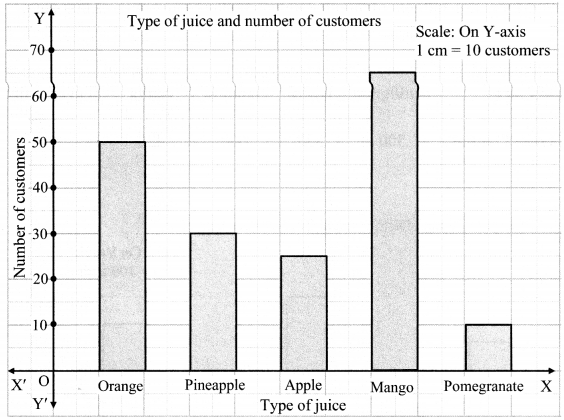
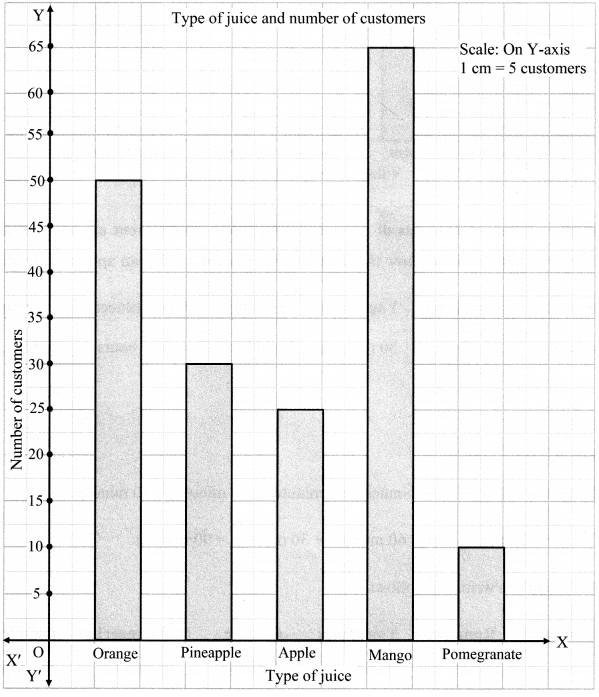
The number of customers who came to a juice centre during one week is given in the table below. Make two different bar graphs to show this data.
(On Y-axis, 1 cm = 10 customers, 1 cm = 5 customers)

Type of juiceOrangePineappleAppleMangoPomegranate
Number of customers5030256510

Solution:
Maharashtra Board Class 6 Maths Solutions Chapter 6 Bar Graphs Practice Set 19 4
Maharashtra Board Class 6 Maths Solutions Chapter 6 Bar Graphs Practice Set 19 5

Question 5.
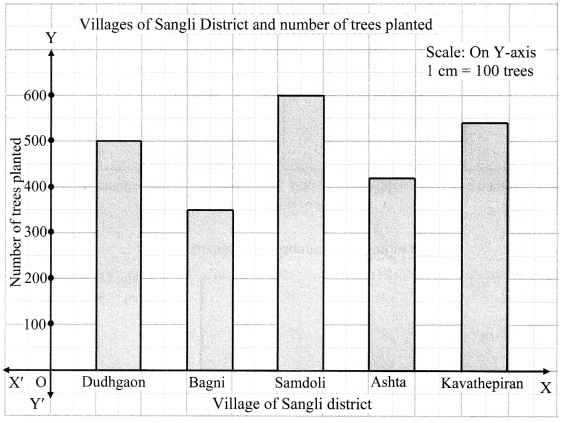
Students planted trees in 5 villages of Sangli district. Make a bar graph of this data. (Scale: On Y-axis, 1 cm = 100 trees).

Name of PlaceDudhgaonBagniSamdoliAshtaKavathepiran
Number of Trees Planted500350600420540

Solution:
Maharashtra Board Class 6 Maths Solutions Chapter 6 Bar Graphs Practice Set 19 6

Question 6.
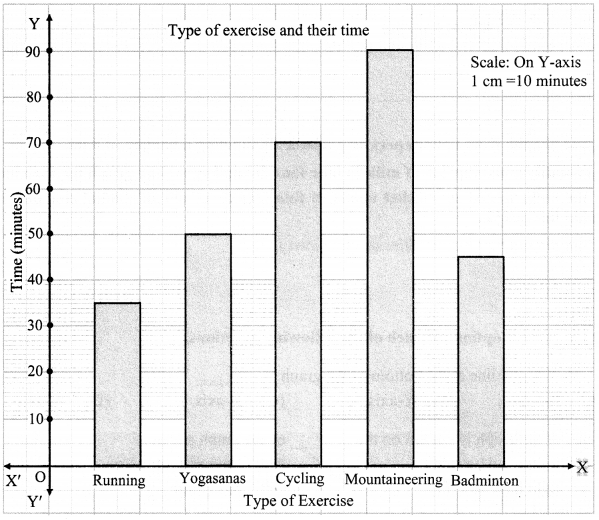
Yashwant gives different amounts of time as shown below, to different exercises he does during the week. Draw a bar graph to show the details of his schedule using an appropriate scale.

Type of exerciseRunningYogasanasCyclingMountaineeringBadminton
Time35 minutes50 minutes1 hr 10 min\(1\frac { 1 }{ 2 }\) hours45 minutes

Solution:
1 hour = 60 minutes
∴ 1 hour 10 minutes = 1 hour + 10 minutes = 60 minutes +10 minutes = 70 minutes
and \(1\frac { 1 }{ 2 }\) hours = 1 hour + \(\frac { 1 }{ 2 }\) hour = 60 minutes + 30 minutes = 90 minutes
The given table can be written as follows:

Type of ExerciseRunningYogasanasCyclingMoutaineeringBadminton
Time35 minutes50 minutes70 minutes90 minutes45 minutes

Maharashtra Board Class 6 Maths Solutions Chapter 6 Bar Graphs Practice Set 19 7

Question 7.
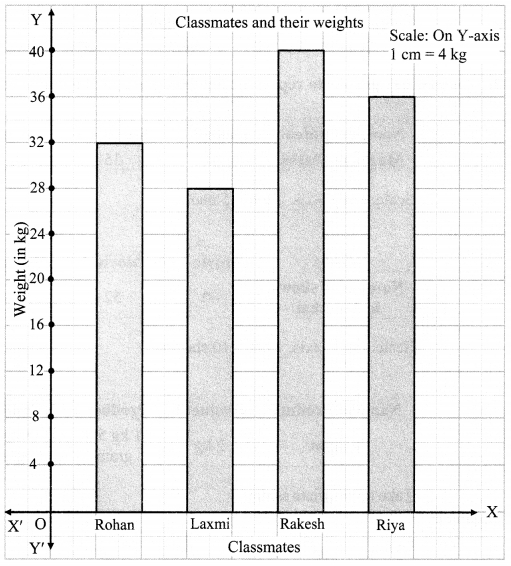
Write the names of four of your classmates. Beside each name, write his/her weight in kilograms. Enter this data in a table like the above and make a bar graph.
Solution:

Name of classmatesWeight (kg)
Rohan32
Laxmi28
Rakesh40
Riya36

Scale: On Y-axis, 1 cm = 4 kg [Note: Students can take their own examples]
Maharashtra Board Class 6 Maths Solutions Chapter 6 Bar Graphs Practice Set 19 8

Maharashtra Board Class 6 Maths Chapter 6 Bar Graphs Practice Set 19 Intext Questions and Activities

Question 1.
Collect bar graphs from newspapers or periodicals showing a variety of data. (Textbook pg. no. 38)
Solution:
(Student should attempt the activities on their own.)

6th Std Maths Digest Pdf Download

Practice Set 7 Class 6 Answers Maths Chapter 3 Integers Maharashtra Board

Integers Class 6 Maths Chapter 3 Practice Set 7 Solutions Maharashtra Board

Balbharti Maharashtra State Board Class 6 Maths Solutions covers the Std 6 Maths Chapter 3 Integers Class 6 Practice Set 7 Answers Solutions.

Std 6 Maths Practice Set 7 Solutions Answers

Question 1.
Write the proper signs >, < or = in the boxes below:

  1. -4 __ 5
  2. 8 __ -10
  3. +9 __ +9
  4. -6 __ 0
  5. 7 __ 4
  6. 3 __ 0
  7. -7 __ 7
  8. -12 __ 5
  9. -2 __ -8
  10. -1 __ -2
  11. 6 __ -3
  12. -14 __ -14

Solution:

  1. -4 < 5
  2. 8 > -10
  3. +9 = +9
  4. -6 < 0
  5. 7 > 4
  6. 3 > 0
  7. -7 < 7
  8. -12 < 5
  9. -2 > -8
  10. -1 > -2
  11. 6 > -3
  12. -14 = -14

6th Std Maths Digest Pdf Download

Practice Set 6 Class 6 Answers Maths Chapter 3 Integers Maharashtra Board

Integers Class 6 Maths Chapter 3 Practice Set 6 Solutions Maharashtra Board

Balbharti Maharashtra State Board Class 6 Maths Solutions covers the Std 6 Maths Chapter 3 Integers Class 6 Practice Set 6 Answers Solutions.

Std 6 Maths Practice Set 6 Solutions Answers

Question 1.
Write the opposite number of each of the numbers given below.

Number47+52-33-84-21+16-2680
Opposite number

Solution:

Number47+52-33-84-21+16-2680
Opposite number-47-52+33+84+21-16+26-80

6th Std Maths Digest Pdf Download

Practice Set 28 Class 6 Answers Maths Chapter 11 Ratio-Proportion Maharashtra Board

Ratio-Proportion Class 6 Maths Chapter 11 Practice Set 28 Solutions Maharashtra Board

Balbharti Maharashtra State Board Class 6 Maths Solutions covers the Std 6 Maths Chapter 11 Ratio-Proportion Class 6 Practice Set 28 Answers Solutions.

Std 6 Maths Practice Set 28 Solutions Answers

6th Standard Maths Practice Set 28 Question 1.
In each example below, find the ratio of the first number to the second:
i. 24, 56
ii. 63,49
iii. 52, 65
iv. 84, 60
v. 35, 65
vi. 121, 99
Solution:
i. 24, 56
\(\frac{24}{56}=\frac{24 \div 8}{56 \div 8}=\frac{3}{7}\)
= 3:7

ii. 63,49
\(\frac{63}{49}=\frac{63 \div 7}{49 \div 7}=\frac{9}{7}\)
= 9:7

iii. 52, 65
\(\frac{52}{65}=\frac{52 \div 13}{65 \div 13}=\frac{4}{5}\)
= 4:5

iv. 84, 60
\(\frac{84}{60}=\frac{84 \div 12}{60 \div 12}=\frac{7}{5}\)
= 7:5

v. 35, 65
\(\frac{35}{65}=\frac{35 \div 5}{65 \div 5}=\frac{7}{13}\)
= 7:13

vi. 121, 99
\(\frac{121}{99}=\frac{121 \div 11}{99 \div 11}=\frac{11}{9}\)
= 11:9

6th Maths Practice Set 28 Question 2.
Find the ratio of the first quantity to the second.
i. 25 beads, 40 beads
ii. Rs 40, Rs 120
iii. 15 minutes, 1 hour
iv. 30 litres, 24 litres
v. 99 kg, 44000 grams
vi. 1 litre, 250 ml
vii. 60 paise, 1 rupee
viii. 750 grams, \(\frac { 1 }{ 2 }\) kg
ix. 125 cm, 1 metre
Solution:
i. Required Ratio = \(\frac{25}{40}=\frac{25 \div 5}{40 \div 5}=\frac{5}{8}\)

ii. Required Ratio = \(\frac{40}{120}=\frac{40 \div 40}{120 \div 40}=\frac{1}{3}\)

iii. 1 hour = 60 minutes
Required Ratio = \(\frac{15}{60}=\frac{15 \div 15}{60 \div 15}=\frac{1}{4}\)

iv. Required Ratio = \(\frac{30}{24}=\frac{30 \div 6}{24 \div 6}=\frac{5}{4}\)

v. 99 kg = 99 x 1000 grams = 99000 grams
Required Ratio = \(\frac{99000}{44000}=\frac{99000 \div 1000}{44000 \div 1000}=\frac{99}{44}\)
= \(\frac{99}{44}=\frac{99 \div 11}{44 \div 11}=\frac{9}{4}\)

vi. 1 litre, 250 ml
1 litre = 1000 ml
Required Ratio = \(\frac{1000}{250}=\frac{1000 \div 10}{250 \div 10}=\frac{100}{25}\)
= \(\frac{100}{25}=\frac{100 \div 25}{25 \div 25}=\frac{4}{1}\)

viii. 750 grams, \(\frac { 1 }{ 2 }\) kg
\(\frac { 1 }{ 2 }\) kg = \(\frac { 1000 }{ 2 }\) grams = 500 grams
Required Ratio = \(\frac{750}{500}=\frac{750 \div 10}{500 \div 10}=\frac{75}{50}\)
= \(\frac{75}{50}=\frac{75 \div 25}{50 \div 25}=\frac{3}{2}\)

ix. 125 cm, 1 metre
1 metre = 100 cm
Required Ratio = \(\frac{125}{100}=\frac{125 \div 25}{100 \div 25}=\frac{5}{4}\)

6th Std Maths Practice Set 28 Question 3.
Reema has 24 notebooks and 18 books. Find the ratio of notebooks to books.
Solution:
Ratio of notebooks to books
Maharashtra Board Class 6 Maths Solutions Chapter 11 Ratio-Proportion Practice Set 28 1
∴ The ratio of notebooks to books with Reema is \(\frac { 4 }{ 3 }\)

Practice Set 28 Question 4.
30 cricket players and 20 kho-kho players are training on a field. What is the ratio of cricket players to the total number of players?
Solution:
Total number of players = Cricket players + Kho-kho players
= 30 + 20 = 50
Ratio of cricket players to the total number of players
Maharashtra Board Class 6 Maths Solutions Chapter 11 Ratio-Proportion Practice Set 28 2
∴ The ratio of cricket players to the total number of players is \(\frac { 3 }{ 5 }\).

Question 5.
Snehal has a red ribbon that is 80 cm long and a blue ribbon 2.20 m long. What is the ratio of the length of the red ribbon to that of the blue ribbon?
Solution:
1 metre =100 cm
Length of the red ribbon = 80 cm
Length of the blue ribbon = 2.20 m = 2.20 x 100 cm
\(=\frac{220}{100} \times \frac{100}{1}=\frac{220 \times 100}{100 \times 1}\)
= 220 cm
∴ Ratio of length of the red ribbon to that of the blue ribbon
Maharashtra Board Class 6 Maths Solutions Chapter 11 Ratio-Proportion Practice Set 28 3
∴ The ratio of the length of the red ribbon to that of the blue ribbon is \(\frac { 4 }{ 11 }\).

11 Ratio Question 6.
Shubham’s age today is 12 years and his father’s is 42 years. Shubham’s mother is younger than his father by 6 years. Find the following ratios.
i. Ratio of Shubham’s age today to his mother’s age today.
ii. Ratio of Shubham’s mother’s age today to his father’s age today.
iii. The ratio of Shubham’s age to his mother’s age when Shubham was 10 years old.
Solution:
Shubham’s age today = 12 years
Shubham’s father’s age = 42 years
Shubham’s mother age = Shubham’s father’s age – 6 years
= 42 years – 6 years = 36 years

i. Ratio of Shubham’s age today to his mother’s age today
Maharashtra Board Class 6 Maths Solutions Chapter 11 Ratio-Proportion Practice Set 28 4
∴ The ratio of Shubham’s age today to his mother’s age today is \(\frac { 1 }{ 3 }\).

ii. Ratio of Shubham’s mother age today to his father’s age today
Maharashtra Board Class 6 Maths Solutions Chapter 11 Ratio-Proportion Practice Set 28 5
∴ The ratio of Shubham’s mother’s age today to his father’s age today is \(\frac { 6 }{ 7 }\).

iii. Shubham’s age today is 12 years and his mothers age is 36 years.
Hence when Shubham’s age was 10 years, his mother’s age was 34 years (i.e. 36 – 2 years).
Ratio of Shubham’s age to his mother’s age when Shubham was 10 years old
Maharashtra Board Class 6 Maths Solutions Chapter 11 Ratio-Proportion Practice Set 28 6
∴ The ratio of Shubham’s age to his mother’s age when Shubham was 10 years old is \(\frac { 5 }{ 17 }\)

Maharashtra Board Class 6 Maths Chapter 11 Ratio-Proportion Practice Set 28 Intext Questions and Activities

Question 1.
In the figure, colour some squares with any colour you like and leave some blank. (Textbook pg. no. 57)
Maharashtra Board Class 6 Maths Solutions Chapter 11 Ratio-Proportion Practice Set 28 7
i. Count all the boxes and write the number.
ii. Count the colored ones and write the number.
iii. Count the blank ones and write the number.
iv. Find the ratio of the colored boxes to the blank ones.
v. Find the ratio of the colored boxes to the total boxes.
vi. Find the ratio of the blank boxes to the total boxes.
Solution:
i. The number of all boxes is 16.
ii. The number of colored boxes is 7.
iii. The number of blank boxes is 9.
iv. Ratio of the colored boxes to the blank ones
Maharashtra Board Class 6 Maths Solutions Chapter 11 Ratio-Proportion Practice Set 28 8
v. Ratio of the colored boxes to the total boxes
Maharashtra Board Class 6 Maths Solutions Chapter 11 Ratio-Proportion Practice Set 28 9
vi. Ratio of the blank boxes to the total boxes
Maharashtra Board Class 6 Maths Solutions Chapter 11 Ratio-Proportion Practice Set 28 10

6th Std Maths Digest Pdf Download

Practice Set 5 Class 6 Answers Maths Chapter 3 Integers Maharashtra Board

Integers Class 6 Maths Chapter 3 Practice Set 5 Solutions Maharashtra Board

Balbharti Maharashtra State Board Class 6 Maths Solutions covers the Std 6 Maths Chapter 3 Integers Class 6 Practice Set 5 Answers Solutions.

Std 6 Maths Practice Set 5 Solutions Answers

Question 1.
Add:

  1. 8 + 6
  2. 9 + (-3)
  3. 5 + (-6)
  4. – 7 + 2
  5. – 8 + 0
  6. – 5 + (-2)

Solution:

1. 8 + 6 = (+8) + (+6) = +142. 9 + (-3) = (+9) + (- 3) = +63. 5 + (-6) = (+5) + (-6) = -1
4. -7 + 2 = (-7) + (+2) = -55. -8 + 0 = (-8) + 0 = -86. -5 + (-2) = (-5) + (-2) = -7

Question 2.
Complete the table given below:

+84-3-5
-2-2 + 8 = +6
6
0
-4

Solution:

+84-3-5
-2(-2) + (+8) = +6(-2) +(+4) = 2(-2) +(-3) =-5(-2) +(-5) =-7
6(+6) + (+8) = 14(+6) + (+4) = 10(+6) + (-3) = 3(+6) + (-5) = 1
00 + (+8) = 80 + (+4) = 40 + (-3) = -30 + (-5) = -5
-4(-4) + (+8) = 4(-4) +(+4) = 0(-4) + (-3) = -7(-4) + (-5) = -9

Maharashtra Board Class 6 Maths Chapter 3 Integers Practice Set 5 Intext Questions and Activities

Question 1.
On the playground, mark a timeline showing the years from 2000 to 2024. With one child standing at the position of the 2017, ask the following questions: (Textbook pg. no. 15)

  1. While playing this game, what is his/her age?
  2. Five years ago, which year was it? And what was his / her age then?
  3. In which year will he / she go to Std X? How old will he / she be then?

The child should find answers to such questions by walking the right number of units and in the right direction on the timeline.
[Assume child born year is 2009]
Solutions:

  1. Age of child is 8 years.
  2. Five years ago, year was 2012. His/her age is 3 years.
  3. In 2024, he/she will go the Std X. His/her age is 15 years.

Question 2.
On a playground mark a timeline of 100 years. This will make it possible to count the years from 0 to 2100 on it. Important historical events can then be shown in proper centuries. (Textbook pg. no. 16)
Solution:
(Students should attempt this activity on their own)

Question 3.
Observe the figures and write appropriate number in the boxes given below. (Textbook pg. no. 16 and 17)
i.

Maharashtra Board Class 6 Maths Solutions Chapter 3 Integers Practice Set 5 1
a. At first the rabbit was at the number ____
b. It hopped ___ units to the right.
c. It is now at the number ___
Solution:
i.
a. +1
b. 5
c. +6

ii.
Maharashtra Board Class 6 Maths Solutions Chapter 3 Integers Practice Set 5 2
a. At first the rabbit was at the number ___
b. It hopped ____ units to the right.
c. It is now at the number ____
Solution:
ii.
a. -2
b. 5
c. +3

iii.
Maharashtra Board Class 6 Maths Solutions Chapter 3 Integers Practice Set 5 3
a. At first the rabbit was at the number ___
b. It hopped ____ units to the left.
c. It is now at the number ___
Solution:
iii.
a. -3
b. 4
c. -7

iv.
Maharashtra Board Class 6 Maths Solutions Chapter 3 Integers Practice Set 5 4
a. At first the rabbit was at the number ___
b. It hopped___units to the left.
c. It is now at the number ____
Solution:
iv.
a. +3
b. 4
c. -1

6th Std Maths Digest Pdf Download

Practice Set 39 Class 6 Answers Maths Chapter 17 Geometrical Constructions Maharashtra Board

Geometrical Constructions Class 6 Maths Chapter 17 Practice Set 39 Solutions Maharashtra Board

Balbharti Maharashtra State Board Class 6 Maths Solutions covers the Std 6 Maths Chapter 17 Geometrical Constructions Class 6 Practice Set 39 Answers Solutions.

Std 6 Maths Practice Set 39 Solutions Answers

Question 1.
Draw line l. Take any point P on the line. Using a set square, draw a line perpendicular to line l at the point P.
Solution:
Step 1:
Maharashtra Board Class 6 Maths Solutions Chapter 17 Geometrical Constructions Practice Set 39 1

Step 2:
Maharashtra Board Class 6 Maths Solutions Chapter 17 Geometrical Constructions Practice Set 39 2
line PQ ⊥ line l

Question 2.
Draw a line AB. Using a compass, draw a line perpendicular to AB at point B.
Solution:
Step 1:
Maharashtra Board Class 6 Maths Solutions Chapter 17 Geometrical Constructions Practice Set 39 3

Step 2:
Maharashtra Board Class 6 Maths Solutions Chapter 17 Geometrical Constructions Practice Set 39 4

Step 3:
Maharashtra Board Class 6 Maths Solutions Chapter 17 Geometrical Constructions Practice Set 39 5
line BC ⊥ line AB.

Question 3.
Draw line CD. Take any point M on the line. Using a protractor, draw a line perpendicular to line CD at the point M.
Solution:
Step 1:
Maharashtra Board Class 6 Maths Solutions Chapter 17 Geometrical Constructions Practice Set 39 6

Step 2:
Maharashtra Board Class 6 Maths Solutions Chapter 17 Geometrical Constructions Practice Set 39 7
line MN ⊥ line CD

Maharashtra Board Class 6 Maths Chapter 17 Geometrical Constructions Practice Set 39 Questions and Activities

Question 1.
When constructing a building, what is the method used to make sure that a wall is exactly upright? What does the mason in the picture have in his hand? What do you think is his purpose for using it? (Textbook pg. no. 87)
Maharashtra Board Class 6 Maths Solutions Chapter 17 Geometrical Constructions Practice Set 39 8
Solution:
When constructing a building, a weight (usually with a pointed tip at the bottom) suspended from a string called as plummet or plump bob is aligned from the top of the wall to make sure that the wall is built exactly upright.
The mason in the picture is holding a plumb bob.
The string of the plumb bob is suspended from the top of the wall, such that plumb bob hangs freely. By observing whether the vertical wall is parallel to the string we can check if the constructed wall is vertical.

Question 2.
Have you looked at lamp posts on the roadside? How do they stand? (Textbook pg. no. 87)
Solution:
The lamp posts on the road side are standing erect or vertical.

Question 3.
For the above explained construction, why must we take a distance greater than half of the length of AB? What will happen if we take a smaller distance? (Textbook pg. no. 88)
Solution:
For the above construction, in step-3 we take distance greater than half of the length of AB, so that the arcs drawn by keeping the compass on points A and B intersect each other at point Q.
If the distance in compass is less than half of the length of AB, then the arcs drawn by keeping the compass at A and B will not intersect each other.

6th Std Maths Digest Pdf Download

Practice Set 4 Class 6 Answers Maths Chapter 3 Integers Maharashtra Board

Integers Class 6 Maths Chapter 3 Practice Set 4 Solutions Maharashtra Board

Balbharti Maharashtra State Board Class 6 Maths Solutions covers the Std 6 Maths Chapter 3 Integers Class 6 Practice Set 4 Answers Solutions.

Std 6 Maths Practice Set 4 Solutions Answers

Question 1.
Classify the following numbers as positive numbers and negative numbers.
-5, +4, -2, 7, +26, -49, -37, 19, -25, +8, 5, -4, -12, 27
Solution:

Positive Numbers+4, 7, +26, 19, +8, 5, 27
Negative Numbers-5, -2, -49, -37, -25, -4, -12

Question 2.
Given below are the temperatures in some cities. Write them using the proper signs.

PlaceShimlaLehDelhiNagpur
Temperature7 °C below 0°12 °C below 0°22 °C above 0°31 °C above 0°

Solution:

PlaceShimlaLehDelhiNagpur
Temperature with proper sign-7 °C-12 °C+22 °C+31 °C

Question 3.
Write the numbers in the following examples using the proper signs.

  1. A submarine is at a depth of 512 meters below sea level.
  2. The height of Mt Everest, the highest peak in the Himalayas, is 8848 meters.
  3. A kite is flying at a distance of 120 meters from the ground.
  4. The tunnel is at a depth of 2 meters under the ground.

Solution:

  1. A submarine is at a depth of -512 meters from sea level.
  2. The height of Mt Everest, the highest peak in the Himalayas is +8848 meters.
  3. A kite is flying at a distance of +120 meters from the ground.
  4. The tunnel is at a depth of -2 meters from the ground.

Maharashtra Board Class 6 Maths Chapter 3 Integers Practice Set 4 Intext Questions and Activities

Question 1.
Take warm water in one beaker, some crushed ice in another and a mixture of salt and crushed ice in a third beaker. Ask your teacher for help in measuring the temperature of the substance in each of the beakers using a thermometer. Note the temperatures. (Textbook pg. no. 13)
Maharashtra Board Class 6 Maths Solutions Chapter 3 Integers Practice Set 4 1
Solution:
( Students should attempt this activity on their own)

Question 2.
Look at the picture of the kulfi man. Why do you think he keeps the kulfi moulds in a mixture of salt and ice? (Textbook pg. no. 14)
Maharashtra Board Class 6 Maths Solutions Chapter 3 Integers Practice Set 4 2
Solution:
Kulfi man keeps the kulfi moulds in a mixture of salt and ice because such a mixture helps in keeping the kulfi cool for a longer period of time. The kulfi kept in the said mixture relatively takes more time to melt. This mixture is Considered ideal as it has the temperature of -4°C as against the temperature of ice i.e. 0°C.

Question 3.
My class, i.e. Std. VI, is a part of my school. My school is in my town. My town is a part of a taluka. In the same way, the taluka is a part of a district, and the district is a part of Maharashtra State. In the same way, what can you say about these groups of numbers? Textbook pg. no. 15)
Maharashtra Board Class 6 Maths Solutions Chapter 3 Integers Practice Set 4 3
Solution:
By observing the above given groups of numbers, we can infer that natural numbers are a part of whole numbers. In turn, whole numbers are a part of integers.

6th Std Maths Digest Pdf Download

Practice Set 17 Class 6 Answers Maths Chapter 5 Decimal Fractions Maharashtra Board

Decimal Fractions Class 6 Maths Chapter 5 Practice Set 17 Solutions Maharashtra Board

Balbharti Maharashtra State Board Class 6 Maths Solutions covers the Std 6 Maths Chapter 5 Decimal Fractions Class 6 Practice Set 17 Answers Solutions.

Std 6 Maths Practice Set 17 Solutions Answers

Question 1.
Carry out the following divisions.
i. 4.8÷2
ii. 17.5÷5
iii. 20.6÷2
iv. 32.5÷25
Solution:
i. 4.8÷2
Maharashtra Board Class 6 Maths Solutions Chapter 5 Decimal Fractions Practice Set 17 1

ii. 17.5÷5
Maharashtra Board Class 6 Maths Solutions Chapter 5 Decimal Fractions Practice Set 17 2

iii. 20.6÷2
Maharashtra Board Class 6 Maths Solutions Chapter 5 Decimal Fractions Practice Set 17 3

iv. 32.5÷25
Maharashtra Board Class 6 Maths Solutions Chapter 5 Decimal Fractions Practice Set 17 4

Question 2.
A road is 4 km 800 m long. If trees are planted on both its sides at intervals of 9.6 m, how many trees were planted?
Solution:
Length of road = 4 km 800 m
= 4 × 1000 m + 800 m
= 4000 m + 800 m
= 4800 m
Number of trees on one side = 4800 ÷ 9.6
Maharashtra Board Class 6 Maths Solutions Chapter 5 Decimal Fractions Practice Set 17 5
= 500
∴ Number of trees on both sides = 2 x number of trees on one side
= 2 x 500 = 1000
If the trees are planted at the beginning of the road, then
Total number of trees = 1000 + 2 = 1002
∴ Total number of trees planted is 1000 or 1002.

Question 3.
Pradnya exercises regularly by walking along a circular path on a field. If she walks a distance of 3.825 km in 9 rounds of the path, how much does she walk in one round?
Solution:
Total distance walked in 9 rounds = 3.825 km
∴Distance walked in 1 round = 3.825 4 ÷ 9
Maharashtra Board Class 6 Maths Solutions Chapter 5 Decimal Fractions Practice Set 17 6
= 0.425 km
∴ Total distance walked in 1 round is 0.425 km.

Question 4.
A pharmaceutical manufacturer bought 0.25 quintal of hirada, a medicinal plant, for Rs 9500. What is the cost per quintal of hirada? (1 quintal = 100 kg)
Solution:
Cost of 0.25 quintal of hirada = Rs 9500
∴ Cost of 1 quintal of hirada = 9500 ÷ 0.25
Maharashtra Board Class 6 Maths Solutions Chapter 5 Decimal Fractions Practice Set 17 7
= Rs 38,000
∴ Cost per quintal of hirada is Rs 38,000.

Maharashtra Board Class 6 Maths Chapter 4 Operations on Fractions Practice Set 17 Intext Questions and Activities

Question 1.
Maths is fun! (Textbook pg. no. 34)

  1. Consider any three-digit number (say 527).
  2. Multiply the number by 7. Then multiply the product obtained by 13, and this product by 11.
  3. The found product is 5,27,527.

Take two or three other numbers. Do the same multiplication and find out how it is done.
Solution:
7 × 13 × 11 = 1001
∴ 527 × 1001 = 527 × (1000+ 1)
= (527 × 1000) + (527 × 1)
= 527000 + 527 = 527527
Thus, when any three-digit number is multiplied with 1001, the product obtained is a six-digit number in which the original three-digit number is written back to back twice.
(Students may consider any other three-digit numbers and verify the property.)

6th Std Maths Digest Pdf Download